Recently there was an event at which Bill Gates and Warren Buffett answered questions from students of the Columbia Business School in New York. I referred to the event recently when writing about Warren Buffett.
So why were these students interested in Messrs Gates and Buffett? It is, of course, because they are successful.
While different people define success in many different ways, we can be reasonably sure that, in the context of a business school, most of those business students would categorise Gates and Buffett as being among the most successful people alive.
So what did the students ask about? Well, of course, they asked about success! The questions were of two main types.
A summary of the different collections is listed here, many of them wartime photographs that bring a multitude of emotions to the surface: incredible bravery of the pilots; photographic standards of 70 years ago, man’s inhumanity to man; and so on.
I pondered a bit about writing this Post because, well ….. well…, see what you make of it!
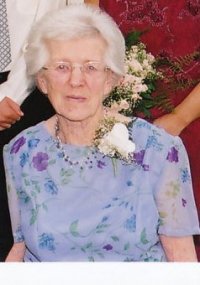
Author's Mum
Being born in England in the early part of November, 1944, World War 2 still resonates within me.
Early home in an industrial part of West London meant that my mother and father had a ring-side view of the German V1 and V2 rockets that were being visited on London at that time.
My mother, 90, still recounts her enormous sense of relief when VE Day was announced (May 8th, 1945) because she then thought that her son’s future life was more or less assured.
So back to these aerial photographs held in those collections.
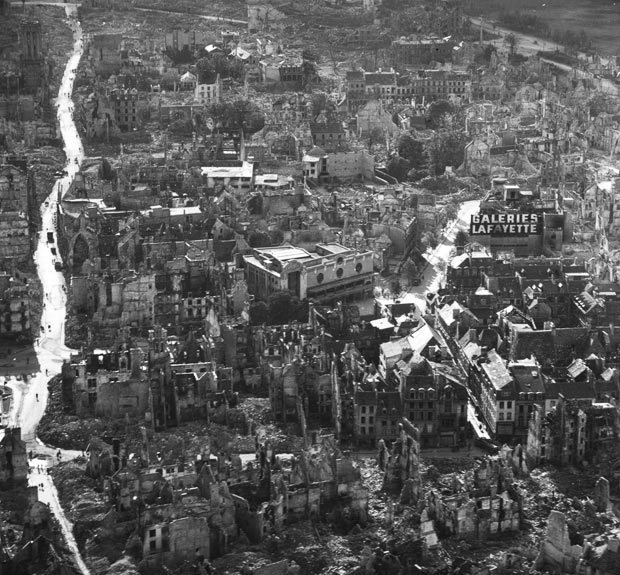
Here’s a picture of the visitation of war on the beautiful French town of Caen.
Linger a while and look at the damage, mostly to private homes. The photograph was taken just slightly more than a month before I was born.
These are very strange times: thank goodness for Blogs.
Learning from Dogs is a relatively young Blog (first Post was July 15th, 2009) but already it has opened the eyes of all the authors to the power of plain speaking. All of us involved in bringing you a dozen Posts a week find inspiration for our creative juices from the corners, far and wide, of the virtual world of digital communications, the World Wide Web.
Because we are in the midst of huge turmoil it’s very difficult to see the underlying trends of change at work. But see them we must if we are to be smart and work out, for the best, what needs to be done at the scale of the individual and the family.
So with that theme in mind, go to the Blog called Jesse’s Café Américain and read a recent Post about the behaviour of the price of gold. But also read beyond the subject of gold and reflect on the deeper message.
Now, it is very noble of the Minister to try to help save the planet. However, his efforts do raise some questions.
The thing is, if it is essential to stop eating meat then shouldn’t the government put its money where its mouth is and DO something about it? Such as tax it? (usually the first instinct!) Or do they only do things that are electorally favourable? (this is a rhetorical question, by the way – feel free not to answer it …)
Or is this perhaps a long process of “educating the electorate”? Well, there are plenty who leave school hardly literate already, so he’s being a bit optimistic, isn’t he? And why start with poor, little Britain? There are tens if not hundreds of millions of our American buddies to convince ….
In our quaint British lingo this is known as “not singing from the same song-sheet”. And as for oil, I wish they would make up their minds once and for all; either we have to reduce its use or we don’t.
At the moment, all they seem to be doing is organising conferences (at vast carbon footprint) where they promise to reduce emissions. This is schizophrenia, isn’t it?
Re the British sermon, one wonders whether the noble minister is himself a vegetarian, and of course whether he is among the vast government contingent attending the international climate conference. And does he drive the car 50 metres to the baker’s on Sunday mornings?
Personally, I’d be prepared to give up meat if: A) I were convinced it would do any good and B) I thought that the great and good (and rich) would make a similar sacrifice.
To lead the project which took an old clay pit in a remote corner of the UK and converted it into a world class environmental visitor attraction is a tremendous achievement.
Homo sapiens? A game show!
Tim Smit had some fun with the business community at the 2009 Annual Convention of the UK Institute of Directors. Everyone, including he, was in their best business attire, but very few people could get away with crumpled shirt and jeans!
However, he has a serious message about the environment (1:55) and he knows a thing or two about people as well!
How Peter L Bernstein’s work helps us make the safest decision with regard to global warming.
Probably like me you hadn’t heard of Peter Bernstein. He was instrumental in understanding risk and that alone makes him worth knowing about. Here’s the entry from Wikipedia:
Peter Lewyn Bernstein (January 22, 1919 – June 5, 2009) was a financial historian, economist and educator whose development and refinement of the efficient market theory made him one of the country’s [USA] best known authorities in popularizing and presenting investment economics to the general public.
Watch the YouTube video before reading on:
You could not have missed a fundamental message in the interview – if the consequence of something is critically harmful then don’t take ANY risks. Bernstein’s book on risk is Against the Gods.
Regular readers of this Blog will know that Naked Capitalism is a daily read for this author. Yves Smith always includes her ‘antidote du jour’ picture of animals. How Yves finds these is beyond me but her antidote of the 14th November really was special. The original author of the piece, Tom Sears, is encouraging the distribution of his story and pictures and it’s a pleasure to do so via Learning from Dogs.
Black bears typically have two cubs; rarely, one or three. In 2007, in northern New Hampshire, a black bear Sow gave birth to five healthy young. There were two or three reports of sows with as many as 4 cubs, but five was, and is, very extraordinary. I learned of them shortly after they emerged from their den and set myself a goal of photographing all five cubs with their mom – no matter how much time and effort was involved. I knew the trail they followed on a fairly regular basis, usually shortly before dark. After spending nearly four hours a day, seven days a week, for more than six weeks, I had that once-in-a-lifetime opportunity and photographed them. I used the equivalent of a very fast film speed on my digital camera. The print is properly focused and well exposed, with all six bears posing as if they were in a studio for a family portrait.
I stayed in touch with other people who saw the bears during the summer and into the fall hunting season. All six bears continued to thrive. As time for hibernation approached, I found still more folks who had seen them, and everything remained OK. I stayed away from the bears as I was concerned that they might become habituated to me, or to people in general, and treat them as `approachable friends’. This could easily become dangerous for both man and animal.
After Halloween, I received no further reports and could only hope the bears survived until they hibernated.
This spring, just before the snow disappeared, all six bears came out of their den and wandered all over the same familiar territory they trekked in the spring of 2007.
I saw them before mid-April and dreamed nightly of taking another family portrait, a highly improbable second once-in-a-lifetime photograph.
On 25 April 2008, I achieved my dream.
When something as magical as this happens between man and animal, Native Americans say, “We have walked together in the shadow of a rainbow”. And so it is with humility and great pleasure that I share these exhilarating photos with you. Do pass them on!
Energy contradictions underline some very strange attitudes. I went for a bike ride this afternoon ….. there is a super 6km circuit that goes from our village Unterthingau along a country road, up past a farm with magnificent views over the Allgäu countryside then along to Oberthingau and back home ….. On the way there are horses and cows munching happily in fields and of course the snow-capped Alps in the background …. The exercise and the fresh air were great, but during the ride I was struck by a couple of things. On the skyline in the direction of Kempten was – as usual – a line of a dozen wind turbines. All were – as usual – immobile, save one which was doing its best to turn languidly, and hardly succeeding.
A private house in the village
Now the Germans do things properly, as we know. This area is pristine, hardly a blade of grass or a stone out of place; it is stunning. So when it comes to energy-saving, they do it seriously (up to a point).
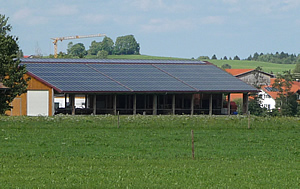
For a start, there are solar panels covering many roofs; the farmers get a subsidy for the installations and sell any surplus to the German National Grid. And then there are those windmills …. but the point is, they are usually motionless. There may be plenty of winter snow in this area, but there isn’t much wind.
Solar panels on cowshed ...
This confirmed my view that windmills in most places in Europe are never going to solve the energy shortage. They are contributing almost nothing now, and of course only produce anything at all when there’s wind. Full marks to the Germans for trying, but it’ll never be enough.
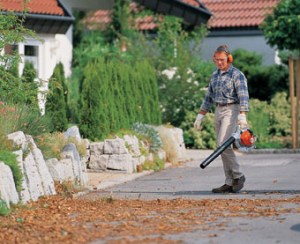
leaf-blower ....
Then as I rode through Oberthingau I saw a local resident blowing leaves off his forecourt with one of those “leaf-blower” machines …. This struck me as bizarre.
In truth, I’ve NEVER understood those things. What is the point? You blow the leaves from one place to another and later on when there is a little wind it’ll blow them straight back again. If he had been hoovering UP the leaves, fine, but blowing them from one place to another? Why not use a broom? And what have they got against leaves, anyway?
And I thought, on the one hand we are rushing around like headless chickens trying to think of ways of generating energy and on the other we are totally wasting it on ludicrous non-essentials.
As has been claimed and to my mind proven for Africa, what is needed is not giant, national and international projects (though more nuclear power-stations would help) but micro-projects for the masses, and especially a cosmic change in the mindset. You only have to look around to see examples of humungous waste of energy. Get rid for a start of most traffic lights! Dangerous? Errrmmm, no actually … experiments have shown that when there are no lights people drive more cautiously …. Get rid of those barriers on motorways that go up and down thousands of times every day. How many people actually drive through a toll barrier without paying? And even if they do, the operator can take their number and report them; why on earth do we need an energy-consuming barrier?
It’s individual mindsets that need to change … Do people really have to fire up their car to drive 300 metres to the baker’s on Saturday mornings? What happened to walking? The British “school run” is a classic example; kids are driven to school, don’t get enough exercise and so get fat, the roads are clogged up (and dangerous) and loads of CO2 is produced. Insane …..
Operation Migration has played a leading role in the reintroduction of endangered Whooping cranes into eastern North America since 2001. In the 1940s the species was reduced to just 15 birds.
Operation Migration is a founding partner of the Whooping Crane Eastern Partnership (WCEP), the coalition of non-profit organizations and government agencies behind the project to safeguard the endangered Whooping crane from extinction.
A couple of Saturdays ago (October 24), we had a great time out at Wash Farm, the home of Riverford Organics.
Our five year old son enjoys eating sweetcorn. Recently, having carried the weekly veg box from our doorstep to the kitchen calling “Riverford coming through!”, he was then delighted to report: “there are three sweetcorns”, there having been two in previous weeks!
On Saturday, he marched into a field of sweetcorn and, as if he had done it for years, went straight to a plant and, explaining what he was doing, tested the crop for size and ripeness and picked it by breaking it off like an expert. He then handed it to me and proceeded to pick many more of them. When I asked him how he knew what to do, all was revealed: “I saw it on the telly!”.
As luck would have it, I encountered Guy Watson at the event and it was great to shake his hand and offer a few words of congratulation on what he has done. Of course, he has no idea who I am!
Their customer service is great; and now they are embarking on more market research to understand better how their customers use their products! [See the relevant edition of their newsletter here!] [The subject of a Post on Market Research coming out soon. Ed.]
Although I am not an expert, I know enough to know that this is remarkable. To think about how customers are using the product, to measure it, to go into customers homes and find out what they are really doing with your products: this is at the pinnacle of good customer research!
No doubt there are others, but I have only ever heard of one other company who paid so much attention to customers in their homes. It was Intuit, the highly regarded US software vendor which, for decades, has consistently beaten Microsoft at providing accounting software. Their representatives would wait in a shop for a customer to buy their product and then request permission to travel with them to their home to record exactly what experience they had with installing and using it!
Final report from the day at Riverford: the event on Saturday was “Pumpkin Day”, its primary purpose being to buy (and have carved) your pumpkin for Hallowe’en. There was a competition to guess the weight of a (largish) pumpkin; I guessed by comparative lifting of the pumpkin and of said five-year-old son, and based my estimate on information from his mother about his most recent weight! Guess what? I have just heard that I won! So a case of (organic, of course) red wine is now expected to materialise alongside this weeks box of vegetables!


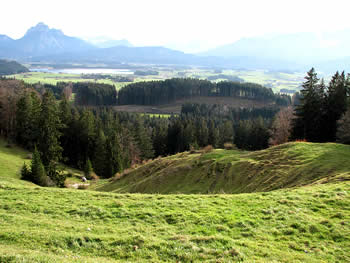 I went for a bike ride this afternoon ….. there is a super 6km circuit that goes from our village Unterthingau along a country road, up past a farm with magnificent views over the Allgäu countryside then along to Oberthingau and back home ….. On the way there are horses and cows munching happily in fields and of course the snow-capped Alps in the background …. The exercise and the fresh air were great, but during the ride I was struck by a couple of things. On the skyline in the direction of Kempten was – as usual – a line of a dozen wind turbines. All were – as usual – immobile, save one which was doing its best to turn languidly, and hardly succeeding.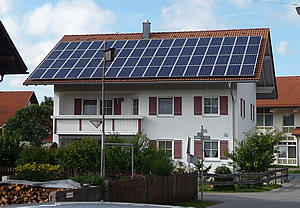

 kitchen calling “Riverford coming through!”, he was then delighted to report: “there are three sweetcorns”, there having been two in previous weeks!
 On Saturday, he marched into a field of sweetcorn and, as if he had done it for years, went straight to a plant and, explaining what he was doing, tested the crop for size and ripeness and picked it by breaking it off like an expert. He then handed it to me and proceeded to pick many more of them. When I asked him how he knew what to do, all was revealed: “I saw it on the telly!”.
 Learning from Dogs