Category: Environment

Earth’s climate

Where’s it going?

Last Friday (10th) I wrote about a recent article that appeared in the Newsweek magazine of June 6th and mused about there seeming to be a growing awareness of the changing of the Planet Earth.

I just wanted to add a few other important elements (pardon the pun) of the current awareness.

First, at the time of writing this (June 2nd) the website that shows the monthly level of CO2 in the atmosphere was still showing the figure for April.  Here it is,

CO2 in the atmosphere

Go here and check out what it is for May 2011.  We all know that it won’t be below 393.18, which is already over 12% above the maximum safe level that scientists have determined.

UPDATE (June 7th): The figures for May are now on the website CO2 Now and they are 394.35 up, as predicted, from the figure of 393.18 for April, 2011.

Then go and watch this, from Bill McKibben,

Then go to the CO2 Now website and read, and ponder and think about what is becoming increasingly obvious to us all.

Finally, read a article that Bill McKibben has recently written that seems to have been widely published.  Here it is on the TomDispatch website.  It starts thus,

Three Strikes and You’re Hot
Time for Obama to Say No to the Fossil Fuel Wish List 

By Bill McKibben

In our globalized world, old-fashioned geography is not supposed to count for much: mountain ranges, deep-water ports, railroad grades — those seem so nineteenth century. The earth is flat, or so I remember somebody saying.

But those nostalgic for an earlier day, take heart. The Obama administration is making its biggest decisions yet on our energy future and those decisions are intimately tied to this continent’s geography. Remember those old maps from your high-school textbooks that showed each state and province’s prime economic activities? A sheaf of wheat for farm country? A little steel mill for manufacturing? These days in North America what you want to look for are the pickaxes that mean mining, and the derricks that stand for oil.

Yes, it all seems ‘doom and gloom’ around us at present but then consider that the only way we, as in mankind, can change to a truly sustainable relationship with this Planet is through better understanding and a global realisation that the time for change is now!  That is a very positive message!

That very special relationship

No, not the one between the USA and the UK but between dogs and man.

Great thanks to Peter N. a loyal Learning from Dogs reader, who passed this item to me just a few days before I left for England, where I am until the 16th.  The story comes from the website Life With Dogs, not a website that I had previously come across, where it appeared on June 2nd. It is reproduced in full below.

'Puppy' Bear

A Piedmont, OK man says his devoted dog tried to save his wife’s life during last week’s tornado.

Leanne Sneed was at home when the deadly tornado struck. Her husband Gary said she took cover as the twister began to rip the house apart around her, laying down and covering her head as debris fell.

What happened next can only be explained as an act of love. Bear used his considerable frame to protect Leanne. He laid down on top of her, completely covering her body with his. He did not move, keeping her pinned under him until the storm had passed. Miraculously, despite the complete destruction that surrounded them, neither Bear nor Leanne suffered any injuries.

Gary Sneed said that Bear’s bravery is even more impressive when you consider that he’s still just a puppy. He said the 160-pound dog is incredibly loving, and he fully believes Bear was willing to sacrifice his life for Leanne’s.

The BBC

A remarkably fine institution

Having now been living in Arizona for 18 months, I can say with some degree of certainty that there are few British things that I miss.  One of them is draft English beer, of course, but another one is the BBC.  Luckily modern internet technology means that quite a few of the great BBC television programmes ‘leak’ outside the UK.

The BBC Horizon science series has been one such example of a really well-produced programme.

Recently, a BBC Horizon programme about genetically modified (GM) foods aired by the BBC found its way onto YouTube and thence to the website Top Documentary Films.  Not only is it an interesting programme but it also reveals how the facts of new advances in science are often difficult to understand by us; the general public.

The link to the film on the TDF website is here but if you want to watch it directly from YouTube then here it is.

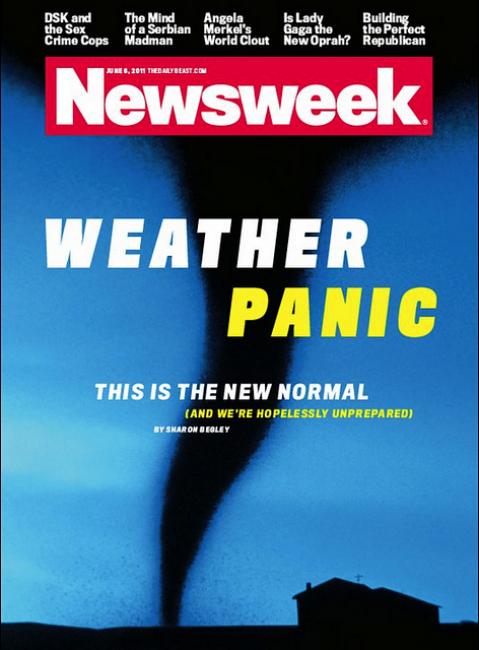
“Weather panic” courtesy Newsweek

Is it me or does there seem to be a shift in overall awareness of our ‘new world’?

On the 30th May, I mentioned the concept of a new Anthropocene era for the second time, based on The Economist of the 28th May having it as a lead story.  (The first mention was on the 16th May.)

Then a couple of days later, friend John H. here in Payson, drops off his copy of Newsweek for June 6th.  Here’s the cover page.

Newsweek, June 6, 2011

This is how the article runs, written by Sharon Begley,

Are You Ready for More?

In a world of climate change, freak storms are the new normal. Why we’re unprepared for the harrowing future.

Joplin, Mo., was prepared. The tornado warning system gave residents 24 minutes’ notice that a twister was bearing down on them. Doctors and nurses at St. John’s Regional Medical Center, who had practiced tornado drills for years, moved fast, getting patients away from windows, closing blinds, and activating emergency generators. And yet more than 130 people died in Joplin, including four people at St. John’s, where the tornado sucked up the roof and left the building in ruins, like much of the shattered city.

Then just a couple of paragraphs later, this pretty blunt summary,

From these and other extreme-weather events, one lesson is sinking in with terrifying certainty. The stable climate of the last 12,000 years is gone. Which means you haven’t seen anything yet. And we are not prepared.

Just read that again very carefully, “The stable climate of the last 12,000 years is gone.”  Do take a few moments off and go here and read the full article.  The last paragraph of which reads,

So what lies behind America’s resistance to action? Economist Sachs points to the lobbying power of industries that resist acknowledgment of climate change’s impact. “The country is two decades behind in taking action because both parties are in thrall to Big Oil and Big Coal,” says Sachs. “The airwaves are filled with corporate-financed climate misinformation.” But the vanguard of action isn’t waiting any longer. This week, representatives from an estimated 100 cities are meeting in Bonn, Germany, for the 2nd World Congress on Cities and Adaptation to Climate Change. The theme is “Resilient Cities.” As Joplin, Mo., learned in the most tragic way possible, against some impacts of climate change, man’s puny efforts are futile. But time is getting short, and the stakes are high. Says Daniel Sarewitz, a professor of science and society at Arizona State University: “Not to adapt is to consign millions of people to death and disruption.”

It’s a powerful article that can be read in full on the Newsweek website.

So, perhaps one might say at last, the notion that mankind’s impact on the Planet is real and capable of affecting practically all of us living on this beautiful Planet is becoming a ‘mainstream’ accepted idea.

More musings about this next Tuesday, 14th.

Life tough for you? Try this!

An amazing and powerfully positive story from here in Payson, AZ

Big thanks to friends John and Janet Z. here in Payson for passing me a copy of the Payson Roundup from Tuesday, May 24th.  Because I want to include much of this news story I have left it a few days so as not seen too directly as a copyright infringement.

This is how the story unfolds,

Homeless teens triumph against odds

Graduation nears for students who persevered despite chaos and carnage

By Alexis Bechman

May 24, 2011

In the summer after fifth-grade, Payson Herring found himself on the streets, living behind dingy car washes and eating stale food out of dumpsters. With both of his parents in jail and no one to look after him, he barely survived.

When he did show up to school, he was dirty, smelly and his attitude stunk worse than his clothes. Herring didn’t worry about high school graduation, he just wanted to make it through another night.

Yes, young Mr. Herring’s first name is Payson, presumably named after the town.  The article continues,

Meanwhile, for Emerald “Emi” Stacklie, after living through three of her mother’s failed suicide attempts and two of her own, life remains chaotic as a homeless student. She continues to bounce from one friend’s couch to another, and often spends the night in her truck.

The only stability she found in life came when she met her fiancé a year ago, but like her childhood, that was also ripped away. Five months ago, her fiancé died in a car crash that left Stacklie two weeks in the hospital for her own injuries.

Both Herring and Stacklie continue to face circumstances most teens will never dream of, but despite hardships — that include incarcerated or addicted parents, homelessness, medical conditions and tragedy — both have so far beaten the odds.

From the outside, both teens look normal, with designer-laced clothing and beautiful smiles, but what they have gone through is unbelievable.

Both teens agreed to an interview, hoping other homeless teens will come forward sooner for help. Payson High School has resources, including housing for homeless teens through the Payson Assisting Displaced Students (PADS) program launched last year.

Emi Stacklie and Payson Herring are ready to graduate, after having overcome daunting obstacles.

The rest of the story may be read here. I’m going to cut straight to the closing paragraphs.

With the support of friends and his teammates, Herring has developed a new perspective.

No longer angry with his past, Herring began focusing on the future. He worked hard at football, put more effort into schoolwork and stayed away from drugs and alcohol.

Herring used his past to help shape what he was becoming.

“I am not even mad at my parents,” he said. “There is nothing they can do now about the past. What matters now is what happens in the future and what I do. I am making my future brighter.”

Herring has plans to adopt “at least three kids.” Using his own experiences, Herring said he could handle just about any child. “I want kids to grow up realizing alcohol does bad things,” he said.

Recently, Herring even reconciled with his father.

While Herring and Stacklie still struggle, both are graduating May 26 along with 163 Payson High classmates. Both have plans for their futures — Herring to serve in the military and eventually become a police officer and Stacklie will start work at a hospital as an LPN.

“I am very, very proud,” Oakland said. “We will miss them.”

Herring and Stacklie defied the odds and “bottom-line beat the system,” she added.

These are very tough young people who will see in time that combating these sorts of major hurdles will give them a self-confidence and self-pride that is beyond measure. Well done to you, Payson and Stacklie.

Just amazing dog power!

Watch this video – any chit-chat from me is superfluous.

Smithfield, Alabama

If a tornado picked you up, threw you across the sky, and set you down in an unfamiliar place far away from home, and you broke two legs in the process, could you find your way back? That’s exactly the incredible story of Mason, a terrier mix in Alabama.

Credits.

I first saw the item as a link in the daily digest from Naked Capitalism.  As ever, I am indebted to the fantastic work that Yves and her team does in scouring the world for interesting news items.

The link went to a website that was just loaded with ads but in the article was another link to Fox 6.  There was the story as well, as this extract explains,

BIRMINGHAM, AL (WBRC) –

Update**:As of Wednesday night, Mason has been x-rayed and put on an IV. His vets at the Vulcan Park Animal Clinic plan to operate on his two broken legs Friday. They will use plates and maybe pins to help realign his bones. Doctors think it will be a long, but ultimately successful recovery.

Amazing stories of survival from the April 27th tornadoes don’t just include people. There are some amazing 4-legged tales of endurance being told including the story of one dog who just returned home yesterday. He is clearly battered, but alive.

Mason, a terrier mix, now rests inside the Vulcan Park Animal Care Clinic where he’s waiting to find out what kind of surgery he will need to repair 2 badly broken legs. This is only the 2nd night he’s spent under any kind of roof in the last 2 weeks and the story of how he got there is almost too amazing to believe.

On April 27th, Mason was hiding in his garage in North Smithfield when the storm picked him up and blew him away. His owners couldn’t find him and had about given up when they came back Monday to sift through the debris, and found Mason waiting for them on the porch.

Do support the Fox 6 website by reading the story in full.

Finally, the original link, as mentioned above, did contain this great news update,

Because of the generosity of Vulcan Park Animal Care in Birmingham, a center that volunteered their services to help the ailing pup, Mason is now on the mend — and needless to say, being showered with affection. Last Friday, Mason underwent surgery to fix metal plates to both his broken limbs, which will keep them stabilized as they heal. Mason will remain at Vulcan Park for about six more weeks, as his family works to restore some sense of order to their shattered home.

Just another account of how remarkable man’s best friend truly is.

Brave, lucky, sweet Mason

Anthropocene era gaining legs

We really may be on the verge of a new geological period.

Just a couple of weeks ago, on the 16th May, I wrote an article called The Anthropocene period.  It was based on both a BBC radio programme and a conference called “The Anthropocene: A New Epoch of Geological Time?”

So imagine my surprise when I collected this week’s copy of The Economist from my mail-box last Saturday.  The cover page boldly illustrated a lead article within, as this picture shows.

US edition, May 28th

The leader is headlined, ‘Humans have changed the way the world works.  Now they have to change the way they think about it, too.’  The first two paragraphs of that leader explain,

THE Earth is a big thing; if you divided it up evenly among its 7 billion inhabitants, they would get almost 1 trillion tonnes each. To think that the workings of so vast an entity could be lastingly changed by a species that has been scampering across its surface for less than 1% of 1% of its history seems, on the face of it, absurd. But it is not. Humans have become a force of nature reshaping the planet on a geological scale—but at a far-faster-than-geological speed.

A single engineering project, the Syncrude mine in the Athabasca tar sands, involves moving 30 billion tonnes of earth—twice the amount of sediment that flows down all the rivers in the world in a year. That sediment flow itself, meanwhile, is shrinking; almost 50,000 large dams have over the past half- century cut the flow by nearly a fifth. That is one reason why the Earth’s deltas, home to hundreds of millions of people, are eroding away faster than they can be replenished.

There’s also a video on The Economist website of an interview with Dr. Erle Ellis, associate professor of geography and environmental systems at the University of Maryland.  That video link is here.

That Economist lead article concludes,

Recycling the planet

How frightened should people be about this? It would be odd not to be worried. The planet’s history contains many less stable and clement eras than the Holocene. Who is to say that human action might not tip the planet into new instability?

Some will want simply to put the clock back. But returning to the way things were is neither realistic nor morally tenable. A planet that could soon be supporting as many as 10 billion human beings has to work differently from the one that held 1 billion people, mostly peasants, 200 years ago. The challenge of the Anthropocene is to use human ingenuity to set things up so that the planet can accomplish its 21st-century task.

Increasing the planet’s resilience will probably involve a few dramatic changes and a lot of fiddling. An example of the former could be geoengineering. Today the copious carbon dioxide emitted to the atmosphere is left for nature to pick up, which it cannot do fast enough. Although the technologies are still nascent, the idea that humans might help remove carbon from the skies as well as put it there is a reasonable Anthropocene expectation; it wouldn’t stop climate change any time soon, but it might shorten its lease, and reduce the changes in ocean chemistry that excess carbon brings about.

More often the answer will be fiddling—finding ways to apply human muscle with the grain of nature, rather than against it, and help it in its inbuilt tendency to recycle things. Human interference in the nitrogen cycle has made far more nitrogen available to plants and animals; it has done much less to help the planet deal with all that nitrogen when they have finished with it. Instead we suffer ever more coastal “dead zones” overrun by nitrogen-fed algal blooms. Quite small things, such as smarter farming and better sewage treatment, could help a lot.

For humans to be intimately involved in many interconnected processes at a planetary scale carries huge risks. But it is possible to add to the planet’s resilience, often through simple and piecemeal actions, if they are well thought through. And one of the messages of the Anthropocene is that piecemeal actions can quickly add up to planetary change.

We are living in interesting times!

Finally, more of Dr. Ellis may be watched on the following YouTube video.

Solar Impulse

Just enjoy this.

Solar Impulse

From Wired Magazine,

“In a world dependent on fossil energies, Solar Impulse is a paradox, almost a provocation.”

Press release gobbledygook? Absolutely. But you’ve got to give it up for any company with the guts to try designing and building a true solar airplane.

We’ve written about Solar Impulse — it’s a consortium of European financial and technology parters led by the Federal Institute of Technology in Lausanne, Switzerland. The group is working on a solar-powered plane that can take off under its own power without generating any emissions at all. The general idea is that sunlight would not only power the plane during the day but would also charge its lithium batteries, allowing it to fly around the clock pollution free.

That was written May 12th, 2008.  This is now!  Landing at Brussels International Airport, May 2011.

And here’s the Solar Impulse website.

More on Bill McKibben’s book, eaarth.

Some very telling points.

I first mentioned this book on the 13th May when I was about a third of the way in.  Because I thought there might be material useful to the course that has been running here in Payson, I did skip around the book looking for ‘attention-grabbing’ points.  It wasn’t difficult to find numerous extracts.

Try this on page 214 from the Chapter Afterword.

As it turns out, however, the BP spill was not the most dangerous thing that happened in the months after this book was first published.  In fact, in the spring and summer of 2101, the list of startling events in the natural world included:

  • Nineteen nations setting new all-time high temperature records, which in itself is a record.  Some of those records were for entire regions – [then some of the details]
  • Scientists reported that the earth had just come through the warmest six months, the warmest year, and the warmest decade for which we have records; it appears 2010 will be the warmest calendar year on record.
  • The most protracted and extreme heat wave in a thousand years of Russian history (it had never before topped 100 degrees in Moscow) led to a siege of peat fires that shrouded the capital in ghostly, deadly smoke.  [Then goes on to mention the effect of this heat on global grain prices.]
  • Since warm air holds more water vapour that cold air, scientists were not surprised to see steady increases in flooding.  Still, the spring and summer of 2010 were off the charts.  We saw “thousand-year storms” across the globe [goes into details]
  • Meanwhile, in the far north, the Petermann Glacier on Greenland calved an iceberg four times the size of Manhattan.
  • And the most ominous news of all might have come from the pages of the eminent scientific journal Nature, which published an enormous study of the productivity of the earth’s seas. [More details follow – not good news!]
That last point can be read in more detail from Nature‘s website.  It’s here.
The book closes thus (referring to how the BP oil spill was, ultimately, an accident),
But the greatest danger we face, climate change, is no accident.  It’s what happens when everything goes the way it’s supposed to go.  It’s not a function of bad technology, it’s a function of a bad business model: of the fact that Exxon Mobil and BP and Peabody Coal are allowed to use the atmosphere, free of charge, as an open sewer for the inevitable waste from their products.  They’ll fight to the end to defend that business model, for it produces greater profits that any industry has ever known.  We won’t match them dollar for dollar: To fight back, we need a different currency, our bodies and our spirit and our creativity.  That’s what a movement looks like; let’s hope we can rally one in time to make a difference.
Powerful stuff from a powerful book.
Fired up?  Then go and join:  350.org

Greece, or grease?

The agony of watching a country (and a planet) slip.

Readers will be aware that I very rarely stroll through the tangled pastures of international politics and finance.  The only reason that I do so today is on the back of a very impressive letter published in the German newspaper  Handelsblatt.  That was brought to my attention by my subscription to Mike Shedlock’s (Mish) Blog Mish’s Global Economic Trend Analysis.  You will see that I muse at two levels about where we are today.

Earlier, I had read in last Saturday’s, The Economist a leader on Greece’s debt crisis, entitled Trichet the intransigent.   That started thus,

The European Central Bank’s refusal to consider a restructuring of Greek debt could wreck the euro zone
May 12th 2011 | from the print edition

IF THE stakes were not so high, Europeans’ incompetence in the euro-zone debt crisis would be comic.

and concluded thus,

It is time for the Germans and the IMF to call the ECB’s bluff. Together they should demand, and instigate, a restructuring of Greek debt. Germany should push other European governments to cough up money to support Greek banks and, if necessary, to make whole the ECB. The fund, which knows how to restructure debt, must ensure the process is run in a competent manner. The ECB will then be faced with a choice: go along with an orderly restructuring, or trigger a much greater mess by in effect forcing Greece out of the euro zone. Surely Mr Trichet does not want that to be his legacy.

So with that as background, the letter to Georgios Papandreou, Prime Minister of Greece written by Gabor Steingart is powerful and hard hitting.  Here it is in full.

Mr. Prime Minister,

Dear Mr. Papandreou,

With the greatest respect, the Western world is monitoring your efforts to master your country’s debt crisis. No other democratic country has ever managed anything like that in peacetime. You are shrinking the state apparatus; you are fighting corruption; you are teaching your fellow countrymen how to become honest tax-payers.

You are a modern hero. You are attempting the impossible. As the son of a persecuted and ostracized politician who was chased by the military junta you grew up close to danger. When the officers were looking for your father who was hiding in the attic, they threatened you by putting an unlocked pistol to your forehead and challenged you to betray your father. You denied your father’s presence until he, worried about his son’s life, left his hiding place.Later you fled with him to America where you spent your adolescence. You are alarger-than-life-character.

Preceding governments almost ruined your country. Debts amounting to 340 billion Euros are burdening the Greek state,equaling 155 times the profit of the 60 largest companies of your country and 1.5 times the amount of debts the Maastricht Treaty allows. A year ago, this newspaper, Germany’s biggest Business Daily, appealed to the public to buy Greek government bonds in order to give to the country what Greece needs just as urgently as money: confidence. We also wanted to assist in breaking through the negative spiral of growing doubt and increasing interest rates. Everyone who granted you guarantees and loans wanted it, the European Union, the International Monetary Fund, the heads of state and government.

But since then, the spiral has picked up in speed instead of slowing down. In May 2010 the interest rate at which your country was given money on a ten year basis was at eight per cent. Today, it is at 16 per cent. And in all probability, it will be going up further. The bitter truth to which you and all parties who wanted to help Greece have to admit is that the help doesn’t help. Your country is getting deeper and deeper into the mess. Debts are growing, the gross national product will decrease by at least three per cent in 2011. But it would have to grow by three per cent instead if you were to lower your debt to the allowedlimit until 2040. This is becoming more and more unrealistic. You can’t starve and build up your muscles at the same time.

The truth that Greece has to cut back and save has turned into an untruth. The right thing has turned into the wrong thing. You already cut pensions, lowered the salaries of civil servants by 30 per cent and raised the prices of gas by almost 50 per cent. You can’t restore the health of your country by saving. And the European Union can’t restore your country’s health by again and again injecting new loans.

Soon, the day will come when the tortured body will surrender. The Greek construction industry already shrank by 70 per cent. Sales of car dealers sank by half. A daily export volume of 50 million Euros Greece is achieving  far too little.  Soon the day will come which investors fear in their nightmares. Then the word “insolvency” will be on everyone’s lips.

But it is also the day when a new truth will be born: Don’t save but invest, they will tell you – so that the Greek economy will grow again. Do not service debt with debt, you then will be recommended, but spread out the debt service, cut it and maybe even completely suspend it for a while. It will be a day of impositions, especially for those who lendmoney to you and your people. Financial markets will grind to a halt in horror – and then they will turn to embrace the future. Because Argentina in 2001, Mexico at the beginning of the eighties and Germany after World War II taught us that there is a life after death – at least, in the case of highly indebted states.

Mr. Papandreou, so far, you attempted the impossible. Now you should do the possible. Just as you deceived the officers as a boy and denied to know where your father was hiding you now must repudiate the pride of the Greeks – in order to save your country. Come to meet the new uncomfortable truth before it knocks at your door. It’s already on its way.

Respectfully yours,

Gabor Steingart

The author is an award winning Journalist, the former White House Correspondent of “Der Spiegel” and now Handelsblatt’s  Editor-in-Chief.  His book “The war for wealth. The true story of globalization or while the flat world is broken” was  published in the US, GB, China and several other countries by McGraw Hill, New York, in 2008.

You may contact him at

steingart@handelsblatt.com


Powerful, as I said.

In a sense, in a very real sense, this illustration of the end game of our love affair with debt is symptomatic of the end game in terms of mankind’s love affair with, well with mankind.  The following was written by an inmate of Oklahoma Prison in 1998.

At the root of my humanity lies a potentially insatiable self-centredness.  Given its way, it can become unquenchable. Nothing, not even the richest of imagination, will put out its fire.

This ‘what’s in it for me’ mindset is at the root of all my problems and is where my fears live.  From those fears come anger, greed, intolerance, and a host of other shortcomings.

It is no accident that all religions point to the forgetting of self, because all religions know salvation lies in self-forgetting.

As we head relentlessly towards a level of 400 parts per million (PPM) of carbon dioxide in the atmosphere, 50 PPM above the highest safe limit determined by climate scientists, the time for mankind to move on from the debt-laden, over-leveraged, disconnected life from Planet Earth, is now.

That’s now!