Category: Environment

Still on the theme of this Blog

More on why this Blog gets written.

Last Wednesday, I set out to explain why the blog is called Learning from Dogs.  If you missed that then it is here.  The focus was on the very special relationship between man and dog that goes back thousands of years.  It has been a critically important relationship for both species.

But there is another aspect to this Blog, as follows: The relationship between dogs and man goes back thousands of years. The theory is that dogs were domesticated between 15,000 and 40,000 years ago although DNA evidence suggests dogs split away from the grey wolf around 100,000 years ago.  Certainly, the dog was the first animal to be domesticated by man. In fact, some archaeologists speculate that man could not have been a successful ‘hunter-gatherer’ without his relationship with the dog and thus been able to progress to farming the earth for food.

The relationship between Planet Earth and man, as in H. sapiens, goes back around 200,000 years. There is little doubt that most people, even with a minimum of awareness about the world that we live in, are deeply worried. On so many fronts there are forbidding and scary views. It feels as though all the certainty of past times has gone; as if all the trusted models of society are now broken. Whether we are talking politics, economics, employment or the environment, nothing seems to be working.

Why is this? What’s the cause?

It would be easy to condemn man’s drive for progress and an insatiable self-centredness as root causes. But it’s not the case.

The root cause is clear. It is this. How mankind has developed is the result of mankind’s behaviours. All of us behave in many ways that are hugely damaging to the survival of our species. It is likely that these behaviours are little unchanged over thousands of years.

But 2000 years ago, the global population of man was just 300 million.

Twelve-hundred years later, in 1800, it was 1 billion. In 1927, just 127 years later, the two-billionth baby was born. In 1960, only 33 years on, the three-billionth baby. (Remember the moon landing in 1969?  Well, of course you do!  There were about three and a half billion people on the planet!)

Just 16 years on, in 1974, the four-billionth baby was born. In 1987, 13 years later, five billion. Around October 1999, the sixth-billionth baby was born!

It’s trending to a billion every decade. 100 million population growth every year, or about 270,000 every single day!

Combine man’s behaviours with this growth of population and we have the present situation. A totally unsustainable situation disconnected from the planet that supports us.

The only viable solution is to amend our behaviours. To tap into the powers of integrity, self-awareness and mindfulness and change our game.

We all have to work with the fundamental, primary relationships we have with each other and with the planet upon which we all depend. We need a level of consciousness with each other and with the living, breathing planet that will empower change. We need spiritual enlightenment on a grand scale.

That’s why we have so much to learn from dogs. They are man’s best friend. They are man’s oldest friend. They have a relationship with us that is very special; almost certainly telepathic. They can show us how we need to live our lives.

Man's oldest, and wisest, friend.

That’s the real reason why this Blog gets written.  Phew! Glad that’s off my chest!

Chernobly, Fukushima and change.

From out of darkness has to come the dawn

One side effect of the earthquake and tsunami that hit Northern Japan on the 11th March causing an explosion at the Fukushima nuclear power station is that the anniversary of the Chernobyl disaster is much more a news item than I suspect it might have been.

The nuclear accident at Chernobyl in Russia occurred on the 26th April, 1986, twenty-five years ago today.  One major difference between the two disasters was, of course, how they were reported.

Here’s a small extract from a fuller article in The Financial Times published on the 19th April written by Tony Barber who was in Russia those 25 years ago.

Twenty-five years after the explosion at the Ukrainian facility, I vividly recall every detail of those terrible days of April 1986. I was a 26-year-old foreign correspondent working in Moscow for Reuters news agency. On Friday, April 25, I flew to Kiev to spend a couple of days with Rhona, an ebullient Scottish friend who was teaching at the city’s university under a British Council programme. I was the only western journalist in Kiev that weekend.

While we caroused the night away, extraordinary events were unfolding 130km to the north. Technicians were conducting experiments that involved the disabling of automatic shutdown mechanisms at the plant’s fourth reactor. After a tremendous power surge, the reactor blew up at 1.23am on Saturday, April 26.

Except for high-ranking Communist party officials, the KGB and a number of scientists, doctors and fire-fighters, no one in the Soviet Union, let alone the wider world, knew anything about this. Soviet habits of secrecy and deception kept millions of people in the dark even as radiation spread across Ukraine, Belarus, Russia and beyond.

Certainly the disaster in Japan was widely broadcast across the world without any delays or restraints.  But the thrust of this Post today is to point out what, in the end, will have to be understood by the majority of the world’s peoples and their representatives in power.  That is that our dependence, our love affair, with cheap carbon-based energy has to come to an end, and soon.

On the 26th March, The Economist published a briefing on nuclear power entitled, When the steam clears.  As with so many of this newspaper’s essays, it was very well written [I am a subscriber to The Economist; have been for years.]  Here’s a taste of the article,

When last year a volcano closed the skies over Europe and a blown-out oil-rig turned the Gulf of Mexico black, there was no widespread enthusiasm for giving up oil or air travel. But nuclear power is much less fundamental to the workings of the world than petrol or aeroplanes. Nuclear reactors generate only 14% of the world’s electricity, and with a median age of about 27 years (see chart) and a typical design life of 40 a lot are nearing retirement. Although the world is eager to fly and thirsts for oil, it has had little appetite for new nuclear power for the past quarter of a century.

And towards the end of the article, this,

Distressing though it is, the crisis at Fukushima Dai-ichi is not in itself a reason for the world to change energy policy. The public-health effects seem likely, in the long run, to be small. Coal, with its emissions of sulphur, mercury and soot, will continue to kill far more people per kilowatt hour than nuclear does. But as an opportunity to reflect it may be welcome.  [my italics]

Power of hope

We need a continued growing awareness of the craziness of using coal and oil as primary sources of energy, and from that awareness a growing political pressure for change.  Change that recognises that mankind’s present energy strategies of continuing to pump carbon-based gases into the atmosphere are insane; pure and simple.

We need more of these examples:

Science Daily

University of Minnesota researchers are a key step closer to making renewable petroleum fuels using bacteria, sunlight and carbon dioxide.

Scientific American magazine

As the world continues to grapple with energy-related pollution and poverty, can innovation help?

The clock is ticking, as I wrote here a few days ago.

Earth Policy Release

Finding the right solutions for the 21st century and the next generation.

Just before presenting the release from the Earth Policy Institute that came out on the 20th, here’s a reminder about watching the film, Plan B, that I wrote about on the 4th April.  It’s a very good film from an excellent and creditable source.  You can watch it for FREE from PBS, BUT ONLY UNTIL THE END OF APRIL!

Here’s the link – Plan B, the film

Now to the release published in full on Learning from Dogs.

Earth Policy Release
World on the Edge
Book Byte
April 19, 2011

“LET NO MAN SAY IT CANNOT BE DONE”

www.earth-policy.org/book_bytes/2011/wotech13_ss5

By Lester R. Brown

We need an economy for the twenty-first century, one that is in sync with the earth and its natural support systems, not one that is destroying them. The fossil fuel-based, automobile-centered, throwaway economy that evolved in western industrial societies is no longer a viable model—not for the countries that shaped it or for those that are emulating them. In short, we need to build a new economy, one powered with carbon-free sources of energy—wind, solar, and geothermal—one that has a diversified transport system and that reuses and recycles everything. We can change course and move onto a path of sustainable progress, but it will take a massive mobilization—at wartime speed.

Whenever I begin to feel overwhelmed by the scale and urgency of the changes we need to make, I reread the economic history of U.S. involvement in World War II because it is such an inspiring study in rapid mobilization. Initially, the United States resisted involvement in the war and responded only after it was directly attacked at Pearl Harbor. But respond it did. After an all-out commitment, the U.S. engagement helped turn the tide of war, leading the Allied Forces to victory within three-and-a-half years.

In his State of the Union address on January 6, 1942, one month after the bombing of Pearl Harbor, President Franklin D. Roosevelt announced the country’s arms production goals. The United States, he said, was planning to produce 45,000 tanks, 60,000 planes, and several thousand ships. He added, “Let no man say it cannot be done.”

No one had ever seen such huge arms production numbers. Public skepticism abounded. But Roosevelt and his colleagues realized that the world’s largest concentration of industrial power was in the U.S. automobile industry. Even during the Depression, the United States was producing 3 million or more cars a year.

After his State of the Union address, Roosevelt met with auto industry leaders, indicating that the country would rely heavily on them to reach these arms production goals. Initially they expected to continue making cars and simply add on the production of armaments. What they did not yet know was that the sale of new cars would soon be banned. From early February 1942 through the end of 1944, nearly three years, essentially no cars were produced in the United States.

In addition to a ban on the sale of new cars, residential and highway construction was halted, and driving for pleasure was banned. Suddenly people were recycling and planting victory gardens. Strategic goods—including tires, gasoline, fuel oil, and sugar—were rationed beginning in 1942. Yet 1942 witnessed the greatest expansion of industrial output in the nation’s history—all for military use. Wartime aircraft needs were enormous. They included not only fighters, bombers, and reconnaissance planes, but also the troop and cargo transports needed to fight a war on distant fronts. From the beginning of 1942 through 1944, the United States far exceeded the initial goal of 60,000 planes, turning out a staggering 229,600 aircraft, a fleet so vast it is hard even today to visualize it. Equally impressive, by the end of the war more than 5,000 ships were added to the 1,000 or so that made up the American Merchant Fleet in 1939.

In her book No Ordinary Time, Doris Kearns Goodwin describes how various firms converted. A sparkplug factory switched to the production of machine guns. A manufacturer of stoves produced lifeboats. A merry-go-round factory made gun mounts; a toy company turned out compasses; a corset manufacturer produced grenade belts; and a pinball machine plant made armor-piercing shells.

In retrospect, the speed of this conversion from a peacetime to a wartime economy is stunning. The harnessing of U.S. industrial power tipped the scales decisively toward the Allied Forces, reversing the tide of war. Germany and Japan, already fully extended, could not counter this effort. British Prime Minister Winston Churchill often quoted his foreign secretary, Sir Edward Grey: “The United States is like a giant boiler. Once the fire is lighted under it, there is no limit to the power it can generate.”

The point is that it did not take decades to restructure the U.S. industrial economy. It did not take years. It was done in a matter of months. If we could restructure the U.S. industrial economy in months, then we can restructure the world energy economy during this decade.

With numerous U.S. automobile assembly lines currently idled, it would be a relatively simple matter to retool some of them to produce wind turbines, as the Ford Motor Company did in World War II with B-24 bombers, helping the world to quickly harness its vast wind energy resources. This would help the world see that the economy can be restructured quickly, profitably, and in a way that enhances global security.

The world now has the technologies and financial resources to stabilize climate, eradicate poverty, stabilize population, restore the economy’s natural support systems, and, above all, restore hope. The United States, the wealthiest society that has ever existed, has the resources and leadership to lead this effort.

One of the questions I hear most frequently is, What can I do? People often expect me to suggest lifestyle changes, such as recycling newspapers or changing light bulbs. These are essential, but they are not nearly enough. Restructuring the global economy means becoming politically active, working for the needed changes, as the grassroots campaign against coal-fired power plants is doing. Saving civilization is not a spectator sport.

Inform yourself. Read about the issues. Share the Earth Policy Institute’s publications with friends. Pick an issue that’s meaningful to you, such as tax restructuring to create an honest market, phasing out coal-fired power plants, or developing a world class-recycling system in your community. Or join a group that is working to provide family planning services to the 215 million women who want to plan their families but lack the means to do so. You might want to organize a small group of like-minded individuals to work on an issue that is of mutual concern. You can begin by talking with others to help select an issue to work on.

Once your group is informed and has a clearly defined goal, ask to meet with your elected representatives on the city council or the state or national legislature. Write or e-mail your elected representatives about the need to restructure taxes and eliminate fossil fuel subsidies. Remind them that leaving environmental costs off the books may offer a sense of prosperity in the short run, but it leads to collapse in the long run.

During World War II, the military draft asked millions of young men to risk the ultimate sacrifice. But we are called on only to be politically active and to make lifestyle changes. During World War II, President Roosevelt frequently asked Americans to adjust their lifestyles and Americans responded, working together for a common goal. What contributions can we each make today, in time, money, or reduced consumption, to help save civilization?

The choice is ours—yours and mine. We can stay with business as usual and preside over an economy that continues to destroy its natural support systems until it destroys itself, or we can be the generation that changes direction, moving the world onto a path of sustained progress. The choice will be made by our generation, but it will affect life on earth for all generations to come.

Adapted from Chapter 13, “Saving Civilization,” in Lester R. Brown, World on the Edge: How to Prevent Environmental and Economic Collapse (New York: W.W. Norton & Company, 2011), available online at www.earth-policy.org/books/wote

Additional data and information sources at www.earth-policy.org

So much to learn from dogs

Beautiful images that will make appreciate the majesty of wild animals.

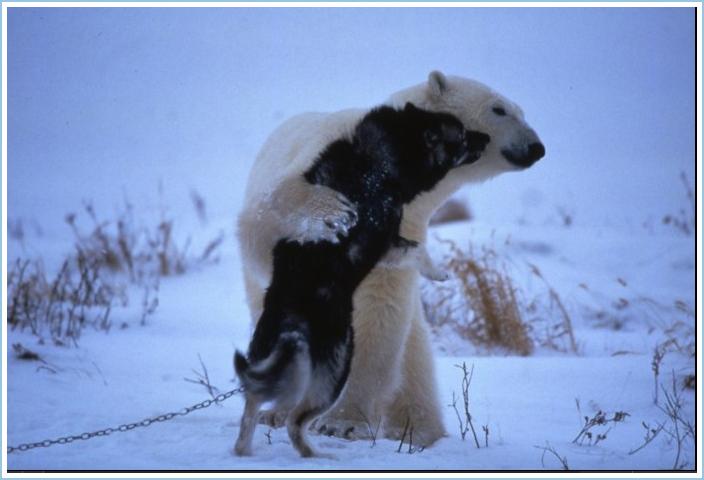
First a big thank you to Mary and Ed G. for passing me an email that contained fabulous photographs of the polar bear playing with a  husky dog.  From that email it was the matter of a few moments to find more on the Internet.

Let’s start with a YouTube video of a short talk by Stuart Brown called Animals at Play.

Then another YouTube video that is from FirstScience TV, which appears to be a defunct website.

Here’s Norbert Rosing’s website and here’s the website for the charity, Polar Bears International.

Enjoy your week-end.

These charming pictures were taken by renowned nature photographer Norbert Rosing, whose work has appeared inNational Geographic and other magazines, as well as several books including The World of the Polar Bear (Firefly Books, 1996), in which Rosing recounts the story of how these particular photographs came to be taken.

The location was a kennel outside Churchill, Manitoba owned by dog breeder Brian Ladoon, who kept some 40 Canadian Eskimo sled dogs there when Rosing visited in 1992. A large polar bear showed up one day and took an unexpected interest in one of Ladoon’s tethered dogs. The other dogs went crazy as the bear approached, Rosing says, but this one, named Hudson, “calmly stood his ground and began wagging his tail.” To Rosing and Ladoon’s surprise, the two “put aside their ancestral animus,” gently touching noses and apparently trying to make friends.

Just beautiful!

If you want to watch the whole sequence of photographs including background notes to each picture, click here.

Earth Day and The 11th Hour

Some very thought-provoking ideas.

John H, a good friend of us here in Payson, lent us the Leonardo DiCaprio film The 11th Hour.  More information on the film’s website.  Here’s the trailer,

The plot of the film, if plot is the right word, is as follows,

With contributions from over 50 politicians, scientists, and environmental activists, including former Soviet leader Mikhail Gorbachev, physicist Stephen HawkingNobel Prize winner Wangari Maathai, and journalist Paul Hawken, the film documents the grave problems facing the planet’s life systems. Global warming, deforestation, mass species extinction, and depletion of the oceans’ habitats are all addressed. The film’s premise is that the future of humanity is in jeopardy.

The film proposes potential solutions to these problems by calling for restorative action by the reshaping and rethinking of global human activity through technology, social responsibility and conservation.

Whether or not you watch the film, and I strongly suggest you do, the action website that supports making a difference is For the Love of Action.  Drop in and make your own mind up.

Following on from that film is this apt reminder of the world we have created.  I tend to write articles a few days ahead of the publish date, so it wasn’t possible to have this post come out on the 20th April, last Wednesday, which was Earth Day.  Shame.  Because as this email from the Alaska Wilderness League pointed out, it’s also a sad reminder of our love affair with oil.

Dear Paul,

The next Deepwater Horizon could be amid the broken sea ice and polar bear habitat of America’s Arctic: unless we prevent it now. Donate to the League.

It was one year ago today. I remember sitting in my living room after dinner when the news alert flashed across the screen:Deepwater Horizon oil rig explodes in the Gulf of Mexico; 11 workers dead or missing. 

Huddled around the office television the next morning, there was no way we could anticipate the true magnitude of the disaster. Images of ruined lives and tarnished lands poured out of the Gulf formonths on end. As the oil industry’s feeble attempts to contain the destruction grew evermore cartoony – ‘top hat,’ ‘junk shot,’ ‘top kill’ – we learned just how little they had prepared for the eventual catastrophe of an oil spill.

Our government rubber-stamped the faulty plans for this oil rig. They had a chance to prevent this disaster, but didn’t. What’s worse: they continue to approve plans for America’s Arctic that are functionally identical to the plans that caused the Gulf disaster. America’s Arctic could be our next Deepwater Horizon tragedy. The effects of deadly crude oil spilling into the broken sea ice and polar bear habitat of America’s Arctic would be disastrous: unless we stop it.

We are fighting the next horrifying oil spill every step of the way. Help us prevent it – donate now! 

When Deepwater Horizon exploded in the Gulf, the League had just completed a campaign to highlight the incredible annual migration of Arctic birds that begins in the Arctic Refuge and extends through each U.S. state. Some of these birds fly as far as the southern tip of Argentina! Many of them rely on critical nesting grounds around the Gulf of Mexico.

The League moved quickly to save these birds, distributing ‘Arctic Garden Kits’ to help donors across the country to provide sustenance and shelter to Arctic birds in their own backyards. Proceeds from the fundraiser helped us fight faulty plans from moving forward in America’s Arctic for the last two summers.

Shell Oil, the biggest threat for Arctic drilling, remains undaunted by our success. Their drilling plans for 2012 have ballooned from one drill rig to six. This is their big move – their cards are on the table. We need your help and support to go over the top to stop their escalating plans.

Help us stop the next disaster in America’s Arctic. Give today.

The way in which the League responded to the Gulf disaster – stemming the damage to wildlife and preventing the next disaster – was one of the most inspiring experiences of my life. You have a chance to be a part of this continuing work. Help us save America’s Arctic before it suffers the fate of another Deepwater Horizon.

Thank you for all that you do,

Cindy Shogan
Executive Director
Alaska Wilderness League

Finally, let me close rather pointedly, perhaps, by this video of the fires in Texas which are burning out of control and have already scorched 1.6 million acres.; long-term drought being part of the cause.

Why the Blog is called Learning from Dogs.

A reflection on the starting point of this Blog.

It struck me recently that many of you readers that come to Learning from Dogs on a regular basis, say, over the last 18 months, may not be clear as to why it’s called what it is, and the deeper issues behind the name.

First, the name.  Quite a few years ago I was sitting chatting with Jon Lavin, the co-founder of the Blog, in his home in South-West England.  My German Shepherd, Pharaoh (that’s him on the home page) was sleeping on the floor while Jon and I were nattering about the works of Dr David Hawkins of Veritas Publishing.  Jon mentioned that David Hawkins had measured the consciousness of dogs and that they came out about 205.  In other words they were integrous creatures and firmly on the truthful side of the boundary between truth and falsehood.

I was fascinated by that idea.  Later, back at my home, less than an hour away from Jon’s house, I was idly looking at domain names that were available, and imagine my glee when I discovered that learningfromdogs (dot) com was free.  It was rapidly grabbed.

A rather chaotic period of my life descended upon me but the notion that we have much to learn from dogs stayed with me.  Much later, when I was happily settled with Jean, the vision and purpose of the Blog got me under way.  The first post was published on 15th July, 2009.

The ideas behind the theme that dogs have an extraordinary relationship with man is contained in a very early piece written for the Blog back in July 19th, 2009.  That article is called Dogs and integrity.  But nothings stays still.  In that piece, I wrote,

Because of this closeness between dogs and man, we (as in man!) have the ability to observe the way they live.  Now I’m sure that scientists would cringe with the idea that the way that a dog lives his life sets an example for us humans, well cringe in the scientific sense.

However, on Sunday evening we watched a video from PBS that showed that scientists are now taking a very close interest in dogs and why they have such a special relationship with man, perhaps even a critical part in enabling man to prosper as hunter-gatherers.  Here’s a preview of that video programme.

Unfortunately, the video is not freely available from PBS.  However, it was based on the BBC Horizon programme, The Secret Life of the Dog, which I wrote about back in the 25th January, 2011.  (The YouTube link on that post appears to have been curtailed.)

Luckily there are a couple of options to watch this fascinating and very revealing documentary.  You can either watch it in sections from YouTube, the first 10 minutes is below, or you can watch it in full, if you don’t mind some Chinese translations here.  Your choice.

That’s enough for today, I shall return to this theme next week.

Gondolas for New York?

Can we really make sense of the science of climate change?

Those that come to this Blog on a regular basis, and many thanks to you, by the way, will know that, overall, I take the stance that climate change, global warming, etc., etc. is real.  At the very least to me it is reasonably described by the saying that most pilots are familiar with, “If there’s any doubt, there’s no doubt.”  In other words, if something is worrying you don’t hesitate to get your ‘arse’ on the ground.

The planet’s climate systems are incredibly complex and like processes and systems much less complex than the earth’s atmosphere getting to real hard evidence is challenging.  Please accept that my personal position is unchanged; for me there are sufficient signs to suggest that climatic changes may be more likely, than less likely, to substantially harm humankind’s existence on Planet Earth within the next generation.

However, Dan Gomez, my very good Californian friend of 40-plus years, is much more sceptical.  I respect his intellect greatly and, therefore, respect his opinions.  Dan recently sent me a number of documents that raise valid questions.  Over time I want to share these with you and invite anyone who wishes to comment on Learning for Dogs to do so, or even better submit a guest post.

But before going to the first of Dan’s documents, let me share something that was reported by BBC News recently.  It’s this.

New York is a major loser and Reykjavik a winner from new forecasts of sea level rise in different regions.

The Intergovernmental Panel on Climate Change (IPCC) said in 2007 that sea levels would rise at least 28cm (1ft) by the year 2100.

But this is a global average; and now a Dutch team has made what appears to be the first attempt to model all the factors leading to regional variations.

Other researchers say the IPCC’s figure is likely to be a huge under-estimate.

Whatever the global figure turns out to be, there will be regional differences.

That IPCC report may be accessed here and the main website of the IPCC is here.  But even the BBC’s report shows that scientists are still learning more, as time goes on.

Ocean currents and differences in the temperature and salinity of seawater are among the factors that mean sea level currently varies by up a metre across the oceans – this does not include short-term changes due to tides or winds.

So if currents change with global warming, which is expected – and if regions such as the Arctic Ocean become less saline as ice sheets discharge their contents into the sea – the regional patterns of peaks and troughs will also change.

“Everybody will still have the impact, and in many places they will get the average rise,” said Roderik van der Wal from the University of Utrecht, one of the team presenting their regional projections at the European Geosciences Union (EGU) meeting in Vienna.

“But places like New York are going to have a larger contribution than the average – 20% more in this case – and Reykjavik will be better off.”

The news item also contains some fascinating evidence of the influence of gravity from the mass of the polar ice caps.  Read the full article here.

Gondola's for hire in a few year's time?

Now on to one of Dan’s documents.  It is from the website detailing the history of plant fossils of West Virginia.  The document refers to the climate of the carboniferous period.  Here’s how it starts.

West Virginia today is mostly an erosional plateau carved up into steep ridges and narrow valleys, but 300 million years ago, during the Carboniferous Period, it was part of a vast equatorial coastal swamp extending many hundreds of miles and barely rising above sea level. This steamy, tropical quagmire served as the nursery for Earth’s first primitive forests, comprised of giant lycopods, ferns, and seed ferns.

North America was located along Earth’s equator then, courtesy of the forces of continental drift. The hot and humid climate of the Middle Carboniferous Period was accompanied by an explosion of terrestrial plant life. However by the Late Carboniferous Period Earth’s climate had become increasingly cooler and drier. By the beginning of the Permian Period average global temperatures declined by about 10° C.

Interestingly, the last half of the Carboniferous Period witnessed periods of significant ice cap formation over polar landmasses– particularly in the southern hemisphere. Alternating cool and warm periods during the ensuing Carboniferous Ice Age coincided with cycles of glacier expansion and retreat. Coastlines fluctuated, caused by a combination of both local basin subsidence and worldwide sea level changes. In West Virginia a complex system of meandering river deltas supported vast coal swamps that left repeating stratigraphic levels of peat bogs that later became coal, separated by layers of fluvial rocks like sandstone and shale when the deltas were building, and marine rocks like black shales and limestones when rising seas drowned coastlands. Accumulations of several thousand feet of these sediments over millions of years caused heat and pressure which transformed the soft sediments into rock and the peat layers into the 100 or so coal seams which today comprise the Great Bituminous Coalfields of the Eastern U.S. and Western Europe.

One needs to read the full article to properly understand this period of history of the planet.  But it includes revealing diagrams like this one.

Global Temperature and Atmospheric CO2 over Geologic Time

Here’s how it concludes.

What will our climate be like in the future? That is the question scientists are asking and seeking answers to currently. The causes of “global warming” and climate change are today being popularly described in terms of human activities. However, climate change is something that happens constantly on its own. If humans are in fact altering Earth’s climate with our cars, electrical powerplants, and factories these changes must be larger than the natural climate variability in order to be measurable. So far the signal of a discernible human contribution to global climate change has not emerged from this natural variability or background noise.

Understanding Earth’s geologic and climate past is important for understanding why our present Earth is the way it is, and what Earth may look like in the future. The geologic information locked up in the rocks and coal seams of the Carboniferous Period are like a history book waiting to be opened. What we know so far, is merely an introduction. It falls on the next generation of geologists, climatologists, biologists, and curious others to continue the exploration and discovery of Earth’s dynamic history– a fascinating and surprising tale, written in stone.


Truth fears no questions.  ~Unknown

Unintended consequences!

Europe’s fishing quotas turning a seemingly good idea into apparent madness.

The European Union formally came into being in 1993 although co-operation in the form of the European Coal and Steel Community and then the European Economic Community went well back before then, back to the 1950’s.

As far back as 1957 when the Treaty of Rome was established, an Article stated that there should be a common policy for fisheries.  That became known as the Common Fisheries Policy.  Fish catches in many European waters were reducing stocks of many species to the point of extinction, so something had to be done.

Now watch this.

If you feel sufficiently perplexed to want to learn more, then Hugh Fearnley-Whittingstall,  a food and cookery writer and broadcaster, as well as a campaigner for real food, has a Campaign Website here.  There is a Facebook page here.

How on earth would one explain such actions to, say, these two kids?


Ready for a fish meal!


20:20 hindsight

One of the great aspects of modern web-based communications is that much of what is said, written and recorded is available to peruse long after the item was ‘broadcast’.

Prof. Ehrenfeld

A few days ago, I introduced Prof. David Ehrenfeld via a short, but stunningly clear, five-minute YouTube video.  I promised to follow that up with more material.

So here’s a book review undertaken by Prof. Ehrenfeld.  The book in question is The Long Emergency: Surviving the Converging Catastrophes of the Twenty-First Century. James Howard Kunstler. x + 307 pp. Atlantic Monthly Press, 2005. $23.  Here’s the review in full from The American Scientist website.  Read it carefully and ponder that this review goes back to Autumn 2005, about five and half years ago. Great foresight.

James Howard Kunstler begins The Long Emergency with the hope that “the American public will wake up from its sleepwalk and act to defend the project of civilization” while there is still time. “Throughout this book,” he writes, “I will concern myself with what I believe is happening, what will happen, or what is likely to happen, not what I hope or wish will happen.” The reality that our society is currently refusing to face, Kunstler says, is that time is just about up for industrial civilization as we have known it.

Kunstler’s thesis is straightforward: Malthus was right, but cheap oil has postponed the day of reckoning, creating a century-long “artificial bubble of plenitude” and generating a host of intractable problems partly or entirely related to our prolonged energy spending spree. These problems include serious damage to our agricultural infrastructure, global climate change and the reorganization of living places into unsustainable suburbs and cities. Now cheap oil is disappearing fast, leaving only the problems behind.

What sets The Long Emergency apart from numerous other books on this theme is its comprehensive sweep—its powerful integration of science, technology, economics, finance, international politics and social change—along with a fascinating attempt to peer into a chaotic future. And Kunstler is such a compelling, fast-paced and sometimes eloquent writer that the book is hard to put down.

Beginning with the story of Edwin L. Drake, who drilled the world’s first oil well in northwestern Pennsylvania in August 1859, Kunstler takes us through the development of the global oil-based economy of the 20th and early 21st centuries. He carefully traces the origins of the idea, first proposed by geologist M. King Hubbert, that oil consumption by modern industrial society will draw down current and potential supplies in a predictable way. Hubbert’s 1956 prediction of the date of “peak oil” production in the United States (which he put at sometime between 1966 and 1972) was strikingly accurate—the peak occurred in 1970. After Hubbert’s death in 1989, the distinguished petroleum geologists Colin Campbell and Jean Laherrère, Princeton geologist Kenneth Deffeyes, University of Colorado physicist Albert Bartlett and others adapted his model and applied it to global oil production, yielding a prediction that the global peak would occur between 2000 and 2010.

As pointed out by Richard A. Kerr and Robert F. Service in the July 1, 2005, issue of Science, petroleum geologists tend to accept this “pessimistic” prediction of the date when the global peak will be (or has been) reached, whereas “optimistic” dates farther in the future are being advanced primarily by resource economists. Kunstler sides with the geologists, and his fast-paced but detailed discussion of the economics of oil supports this position. In his chapter “Geopolitics and the Global Oil Peak,” he comes to grips with a complex mix of elements: Middle Eastern and Islamic nationalism, terrorism, Chinese industrial growth and the overwhelming problems of Russia, the world’s second-largest producer of oil. These are set against a backdrop of diminishing supply, as one country after another, including Saudi Arabia, passes its oil peak. Kunstler’s explanations of why the Saudis can no longer control world oil prices (they lack the reserves to increase production much beyond what they are already pumping) and of the immense significance of that loss of control are particularly insightful. American politicians have not yet grasped this new reality.

The book’s lengthy discussion of the alternatives to cheap oil that are so beloved by techno-optimists is straightforward and sobering. Kunstler gives all of the alternatives a critical but fair inquiry, from conventional energy sources such as coal and natural gas, through oil shales and tar sands, synthetic oil, renewable energy (including wind, solar and hydroelectric power and biomass), nuclear fission and nuclear fusion, hydrogen, thermal depolymerization (turning organic waste into oil), methane hydrates and even zero-point energy.

Most of these technologies founder on “the classic problem of energy economics: energy returned over energy invested (ERoEI). “The figure in the case of tar sands and oil shale is approximately three barrels of oil produced for every two barrels of oil-equivalent invested. In the case of ethanol produced from agribusiness corn or sugar cane, the ratio may be less than one. Some alternatives, such as methane hydrates, are dangerous to handle. Hydrogen is not a primary fuel: Its production requires considerable energy. Also, because of the low density of hydrogen gas, it must be stored and transported under high compression, or liquefied at very low temperatures, or combined with other compounds. Each of these options costs still more energy, and they introduce an assortment of complications and hazards into the delivery system. Although hydrogen will have its uses, Kunstler says, his verdict is unequivocal: “There is not going to be a ‘hydrogen economy.'” Nor is he sanguine about such far-out schemes as a process for deriving zero-point energy from the dark matter of the universe; he reminds us that “A useful maxim in engineering states that when something sounds too good to be true, it generally is not true.”

Kunstler’s moderate treatment of nuclear power (fission) has angered some environmentalists. I think he makes a good case, however, that during the transition period to a post-petroleum economy, the United States, which produces much of its electricity from a rapidly declining supply of natural gas, will not be as well off as France, which gets 80 percent of its electric power from nuclear energy. Nevertheless, he does not see nuclear power as more than a short-term stopgap. Its ultimate limitations come first from safety issues with regard to plant operations and the disposal of waste fuel (although he points out that coal has cost far more lives than nuclear power, especially in the West). Second is the large amount of oil needed to mine and process nuclear fuel and to build and maintain nuclear plants. And the third, formidable objection Kunstler makes is that “Atomic fission is useful for producing electricity, but most of America’s energy needs are for things that electricity can’t do very well, if at all. For instance, you can’t fly airplanes on electric power from nuclear reactors”—although, as he notes, the U.S. military has tried.

Kunstler describes a host of natural disasters that will interact with the energy crisis to cause social upheaval on a global scale. No country will be exempt, he says. Some of these disasters, such as climate change, are the direct result of our profligate use of cheap energy. Others, including the widespread shortage of fresh water, have been greatly augmented by the drain on resources brought about by the explosion of high-oil-input agriculture, industrialization and changes in living habits. All of those natural disasters, however, including the emergence of new infectious diseases and the re-emergence of old ones, will be much harder to cope with when cheap energy is no longer available. Our efforts will also be confounded by diminishing returns on technology and by “technological regress—the loss of information, ability, and confidence.”

The Long Emergency is more than a list of disasters, present or impending. It is an attempt to understand how we got to where we are. Nearly 100 years of cheap oil have allowed us, even prompted us, to construct an economic and social system that depends utterly (often without our knowledge) on a continuous, never-failing energy subsidy. The system cannot stand on its own feet. It is unstable, lacking internal restraints and negative feedbacks, and most of all it undermines all stabilizing alternatives, such as diverse small businesses and local community support systems. Kunstler’s understanding of history and economics helps him delineate this clearly.

My only complaint about the book is that it lacks an index, which is inexcusable for a text so crammed with names and facts. Kunstler’s use ofentropy as a synonym for social disorder may bother readers who prefer that the term be reserved for discussions of thermodynamics, but an accepted definition of the word is “inevitable and steady deterioration of a system or society.”

One question that most readers of this review will ask is, When will the coming collapse occur? As Kunstler notes, Deffeyes—perhaps not entirely in jest—has predicted on National Public Radio that the global oil peak will occur on Thanksgiving Day, 2005, with “‘an uncertainty factor of only three or four weeks on either side.'” But the closest thing to a hint of Kunstler’s position on the subject is found in his remark in the last chapter that “The denizens of Bergen County, New Jersey, or Fairfield County, Connecticut, today may never believe how desperate their localities may become in 2025.” He is probably wise to be vague. As the great biochemist Erwin Chargaff remarked in his 1978 autobiography, Heraclitean Fire, “On the whole, professional pessimists prove right at the end if one does not hold them too tightly to a time scale.”

The last (and longest) chapter of The Long Emergency is also the most innovative and controversial one. Having made a powerful case that it is too late to avoid serious trauma, Kunstler speculates on what life will be like during the painful transition period, as cheap petroleum wanes. The question is well worth asking, if only to stimulate creative thinking about alternatives to a high-energy lifestyle. The book is not a survivalist tract, but Kunstler argues persuasively that life will be better in some geographic regions of the country than in others and better in some kinds of communities than in others. Factors such as the availability of water, the degree of dependence on automobiles and air-conditioning, the regional tolerance for violence and the persistence of strong communities lead him to conclude that the states of New England, the mid-Atlantic, and the upper Midwest that make up the “Old Union” of the Civil War period, along with the Pacific Northwest, will fare much better than the Southwest, the Rocky Mountain states and the Southeast.

Within each region, however, conditions will not be uniform. Kunstler, whose earlier book The Geography of Nowhere established him as heir presumptive to the intellectual legacy of Lewis Mumford, describes America’s automobile-dependent suburbs as “the greatest misallocation of resources in the history of the world.” It is the suburbs, he thinks, that will suffer the most during the coming energy crisis. (I concur, having taught the same message in field courses in suburban New Jersey for 30 years.) And cities, with their skyscrapers and total food dependence, will not, Kunstler claims, be far behind the suburbs in misery.

There is much more in the final chapter than I can do justice to in a review: The many topics discussed include, among others, the new economy and new commerce that will accompany the end of oil-dependent consumer culture (he predicts the demise of the chain stores and the rise of scavenging), possible political fragmentation of the nation, changes in education, the end of romantic childhood and changes in race relations. The picture he paints is incomplete—he doesn’t say what will happen to health care, the arts or entertainment in the long emergency—but there is material enough to provoke scientists and laypeople alike into considering what lies ahead.

Kunstler, like George Orwell, understands that being honest about the past and present is the only way to prepare ourselves for an uncertain future. Civilization, he believes, will survive the end of cheap oil, but not without great loss. “How many … familiar things in time may go?” he wonders. “What will abide in our collective memory?” Not all readers will accept his answers to these questions, but I think we must be grateful to him for showing us the need to ask them.

A timely reminder that so very often it is knowing what questions to ask that matters most!

Plan B Movie for Planet Earth

This is a ‘must see’ video for all to watch.

On the 17th March, I wrote another piece inspired by Lester Brown’s book, World on the Edge.  That piece was about what Lester Brown calls Plan B and shows that there are positive, real solutions to the dilemma that us humans have got ourselves in.

Anyway, I was delighted to see in my email in-box the following,

PLAN B: MOBILIZING TO SAVE CIVILIZATION—THE FILM

Plan B video

For the month of April only, you can watch a streaming edition of the film Plan B on the PBS website. So if you missed the initial release for whatever reason, here is your opportunity to watch it at your leisure.

Based on Lester Brown’s Plan B book series, this 90-minute film, by the award-winning film producers Marilyn and Hal Weiner, follows Lester as he speaks in Beijing, Seoul, Tokyo, New Delhi, Rome, Istanbul, Ankara, and Washington, DC, and visits with world leaders to discuss ways to respond to the challenges of climate change.

The film begins with a dramatic portrayal of a world where there is a mounting tide of public concern about melting glaciers and sea level rise and a growing sense that we need to change course in how we react to emerging economic and social pressures. The film also spotlights a world where ocean resources are becoming scarce, croplands are eroding, and harvests are shrinking.

But what makes Plan B significant and timely is that it provides hopeful solutions—a road map that will help eradicate poverty, stabilize population, and protect and restore our planet’s fisheries, forests, aquifers, soil, grasslands, and biological diversity.

Along with Lester Brown, you will hear from notable scholars and scientists including Nobel Laureate Paul Krugman, Pulitzer Prize winner and New York Times columnist Thomas Friedman, and former Governor and Secretary of the Interior Bruce Babbitt.

Narrated by Matt Damon, well-known for his work raising environmental awareness.

The film is available to view here.  Note that it is only free to watch for the month of April.