Possibly the start of the end of traditional means of generating electricity
A recent item by David Roberts on the Grist website/Blog caught my eye,
Solar is getting cheap fast—pay attention, Very Serious People
That was the headline to the opening, thus,
I hope everyone has read Kees Van Der Leun’s post about the rapidly falling cost of solar PV. I want to draw out one quick point that Kees leaves implicit.
He argues that PV will be the cheapest source of electricity for most of the world some time around 2018, and for the rest of the world soon after. That could be off by a few years in either direction. It depends on whether the cost curve for silicon solar cells continues as it has the past and, as Alan says in his comment, whether the cost curve for “balance of system” costs (steel, glass, installation, etc.) declines as well. Let’s say it could be off by five years either way. Let’s just assume it’s 2023 before solar PV crosses grid parity and becomes cheaper than coal.
The Kees Van Der Leun post, referred to, points out that,
For a long time, the holy grail of solar photovoltaics (PV) has been “grid parity,” the point at which it would be as cheap to generate one’s own solar electricity as it is to buy electricity from the grid. And that is indeed an important market milestone, being achieved now in many places around the world. But recently it has become clear that PV is set to go beyond grid parity and become the cheapest way to generate electricity.
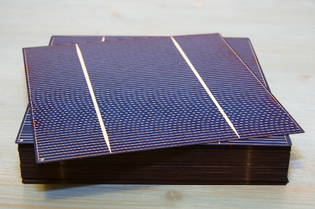
A hundred solar cells, good for 380 watts of solar PV power. Photo: Ariane van Dijk
Whenever I say this I encounter incredulity, even vehement opposition, from friends and foes of renewable energy alike. Apparently, knowledge of the rapid developments of the last few years has not been widely disseminated. But it’s happening, right under our noses! It is essential to understand this so that we can leverage it to rapidly switch to a global energy system fully based on renewable energy.
Working on solar PV energy at Ecofys since 1986, I have seen steady progression: efficiency goes up, cost goes down. But it was only on a 2004 visit to Q-Cells‘ solar cell factory in Thalheim, Germany, that it dawned on me that PV could become very cheap indeed. They gave me a stack of 100 silicon solar cells, each capable of producing 3.8 watts of power in full sunshine. I still have it in the office; it’s only an inch high!
That’s when I realized how little silicon was needed to supply the annual electricity consumption of an average European family (4,000 kWh). Under European solar radiation, it would take 1,400 cells, totaling less than 30 pounds of silicon.
Of course, you need to cover the cells with some glass and add a frame, a support structure, some cables, and an inverter. But the fact that 30 pounds of silicon, an amount that costs $700 to produce, is enough to generate a lifetime of household electricity baffled me. Over 25 years, the family would pay at least $25,000 for the same 100,000 kilowatt-hours (kWh) of electricity from fossil fuels — and its generation cost alone would total over $6,000!
He argues that PV will be the cheapest source of electricity for most of the world some time around 2018, and for the rest of the world soon after. That could be off by a few years in either direction. It depends on whether the cost curve for silicon solar cells continues as it has the past and, as Alan says in his comment, whether the cost curve for “balance of system” costs (steel, glass, installation, etc.) declines as well. Let’s say it could be off by five years either way. Let’s just assume it’s 2023 before solar PV crosses grid parity and becomes cheaper than coal.
Here’s the thing: 2023 isn’t that far off. It feels distant to us in a lot of ways. My kids will be out of college. Fifty versions of the iPhone will have come and gone. We might finally have the jetpacks we were promised.
But in terms of energy infrastructure, 12 years is nothing. It can take half that long or longer to permit and build big coal and nuclear plants, and they are meant to last a long-ass time. The Perry K Steam Plant, which serves downtown Indianapolis, was built in 1938. They didn’t have color TV then. Thirty-six coal plants in the U.S. were built before 1950. If a coal plant built today lasts that long, it will still be belching all over the atmosphere in 2072. My kids will be in their 60s.
This is also true of nuclear plants (the oldest is 42 years) and to a lesser extent natural-gas plants. It’s even true of transmission lines. These are large, long-term investments.
So if solar PV is going to be cheaper than coal in the next decade or so, that seems like the kind of thing utilities, regulators, investors, and political leaders would want to, I don’t know, talk over. Grapple with. Mull. It certainly seems relevant to the investment thesis for large, centralized power infrastructure. Yet it’s all but invisible in the elite U.S. energy conversation, outside of a few voices like FERC Chair Jon Wellinghoff. Very Serious People still see solar PV as an affectation, a kind of charity project.
Hope you are still with me, because this is really an incredibly positive message. By the time children born today are becoming teenagers, the means of harnessing the sun to deliver clean energy cheaper than carbon-based and nuclear generation will be a reality. In a little over a decade from now!
It is so easy to see doom and gloom wherever we look. For good reasons; these are very difficult times as societies pull back from the greed and materialism of recent times to a better, sustainable relationship with our planet, the only one we have. But technology and innovation are quietly creating the opportunities for a new future for humanity.
Let me finish with an email received recently from good friend, John H., up here in Payson, Arizona.
Greetings from a Mountain Top,
It has been another bright and peaceful day of Indian summer in the Ponderosa pine forests of the Arizona Rocky Mountains. Our annual state-wide church convention last weekend was a metaphorical breath of fresh air. It was an opportunity to realize where we’ve been and consider how far we have to go.
From the early evening vantage point of an upper porch with a vista of forest, mountains and sky, it appears that we’re facing spiritual, environmental, human and economic bankruptcy caused by top down idolatry, arrogance and ignorance.
It’s deeply disturbing to watch our human heritage destroyed by a corporate-government-military-industrial-intelligence complex with a clear plan to control the world through oppression. This systemic machine continues to increase the drain on the earth’s severely depleted resources.
Our present energy sources can no longer sustain exponential human population growth. The industrial use of fossil fuels is destroying the earth which sustains us. It’s time for us to wake up and read the book of life. It’s time to lighten the human footprint upon the earth while we still have a choice. Nature doesn’t care about human ambition.
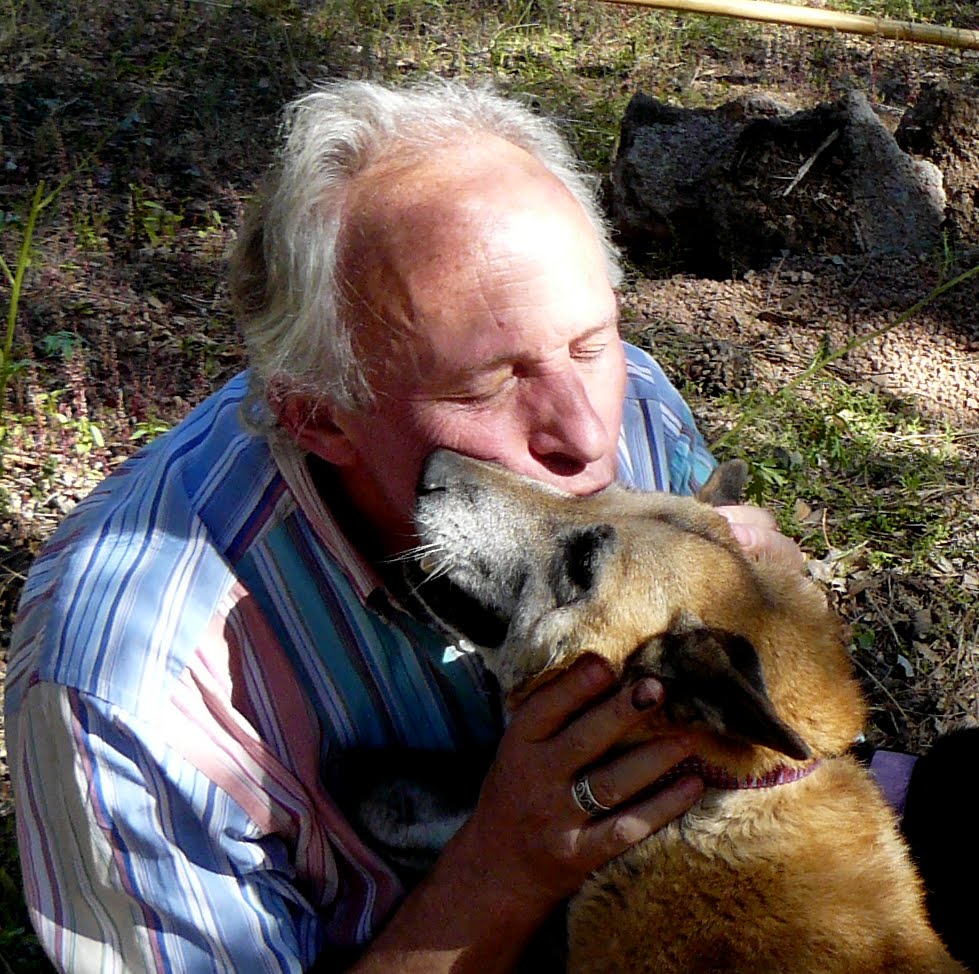
The brown dog with her head nestled against my chest is Loopy. Like Phoebe, the black dog looking at the camera, they are dogs that Jean originally had rescued in Mexico.
Here’s Loopy’s story.
Loopy and Phoebe
When I first met Jean in December 2007 in San Carlos, Mexico, it was immediately clear that she was an animal lover extraordinaire! There were 13 dogs and 6 cats in her home and many other dogs in a fenced off compound not so far away from the house.
Abandoned and stray dogs in that part of Mexico were numerous, there was no humane society and no real care or interest from the Mexicans for these dogs. So many years ago, Jean decided to run her own unofficial dog rescue society, supported by more than a few Americans who had winter homes in San Carlos. Over the years, Jeannie and her team must have rescued and found homes for well over 50 dogs.
In my introduction to the post last Tuesday, Please Help a George, I wrote about how long it had taken for Loopy to bond with me, but Jean’s experience of Loopy goes way back before I entered their lives.
I mentioned above that Jean had a piece of land in San Carlos that she used as a rescue compound for her dogs. One morning, back in 2003, as usual she had gone to the compound to attend to her dogs. Jeannie noticed immediately, cowering in one corner, this young female, brown-haired dog, the dog had been tossed over the fence of the compound. Jean estimated that she was about a year old, hadn’t yet had any pups. The dog had very cold eyes, growled aggressively as soon as Jean approached her; clearly deeply traumatised.
Jean set out food and water before the dog, hoping that whatever had traumatised the dog would soon abate. The dog was named: Loopy!
Despite the fact that Loopy wouldn’t mix with the other dogs in the compound, she was not mean. But the days turned into weeks, the weeks into months, and still Loopy would not allow Jean to get close to her. One could only imagine the degree of cruelty that must have been metered out to Loopy – or, rather, one couldn’t imagine it!
Then, one day, when Jean went to the compound, Loopy was amongst the other dogs. Loopy cautiously came up to Jean, sniffed her feet and legs and then, miraculously, allowed Jean to gently stroke her head and back. Loopy’s cold, angry eyes were now soft and brown; Loopy had melted. For obvious reasons, Loopy would never be available for adoption and soon moved into the main house.
When I became a permanent part of the Mexican household in 2008, Loopy was deeply suspicious of me. I was given the cold, hard-eyed stare from Loopy and any attempt by me to touch her was returned with growling, fanged teeth. There were a number of instances where I collected teeth rips across my hands from Loopy.
The aggression towards me lasted a long time, about a year. But then one day, quite unexpectedly, Loopy decided that I was friend, not some reminder of a demon foe from her past. She trusted me, first with strokes and cuddles and then with the most passionate and trusting embraces. I love her so much.
One could wax lyrical about love, patience and trust, but I won’t. The photograph below says it all. We really do have so much to learn from dogs!
This is such a beautiful dog, and so many ways to help her.
Milly
On the 11th October, I published a story, a story with a very happy ending, about George, a lovely dog who was rescued from the Dog Pound the day before he was due to be killed. The underlying request was to help, in any way that you could, raise funds in conjunction with the Dog Pound Ball being held in Yorkshire.
As I wrote, and as we all know full too well, there are many other dogs that require our help. This is the story of Milly, 9 years old and sadly has spent almost 3 years in rescue.
Little Milly
Milly was handed in from a local home when her owners felt they could no longer keep her. She is an affectionate dog once she learns to trusts, but does growl at strangers and doesn’t present well in kennels. As a result of these issues Milly has been at the rescue kennels for almost three years now, which is a long time for any dog to have to tolerate.
As time goes on it becomes increasingly unlikely that we will succeed in finding her a home. Barnsley Animal Rescue Centre (BARC) does not give up on its rescue animals and has been working with this lovely dog to overcome her problems. Sadly we feel we have done all we can here.
It would be heartbreaking to think she would live out the rest of her life here with us instead of being loved and surrounded by her own family. So we have decided on a way of helping Milly, but it comes at a cost.
Specialist rehabilitation has been arranged but it is going to cost BARC about £50 per week. It’s unclear how long the treatment will take and how effective it will be, but we feel Milly deserves this chance, and know that you will agree with us.
So let’s all do something to help these special creatures, the Georges and the Millys of this world, who offer us humans such unconditionally love and loyalty.
Friday 4th November, 7.30pm – Come to the Hellaby Hall Hotel, Old Hellaby, Maltby, Yorkshire, S66 8SN
Call for tickets now to the Pound Dog Ball telephone number (UK) 07772 538513 or email pogpublications@yahoo.com Full details here.
Please help by supporting this Charity Fundraising Event: Black Tie, Dinner/Dance at Hellaby Hall, Rotherham, 7.30pm, on Friday 4th November. It’s a don’t miss night…..3 course meal, live entertainment all night and dancing ’til late!!!! It’s going to be a great night.
If you can’t make the Ball but would like to send in a donation then please post a cheque, made out to Pound Dog Ball, to the following address:
c/o Jennifer Smith
Clumber Lodge,
50 Hemingfield Road
Wombwell, S73 0LY.
Or if you prefer an electronic donation, further details are:
Pound Dog Ball
A/C 31542265
Sort 40-45-29 (HSBC)
The account is a charity account, set up only for this event. Once the money has been paid to the charities the account will be closed.
A chance dip into the BBC News website a few days ago allowed me to come across an article about the vanishing glaciers in the Himalayas. It just about broke my heart. Here’s what it said,
Rivers of ice: Vanishing glaciers
Stunning images from high in the Himalayas – showing the extent by which many glaciers have shrunk in the past 80 years or so – have gone on display at the Royal Geographical Society in central London.
Between 2007 and 2010, David Breashears retraced the steps of early photographic pioneers such as Major E O Wheeler, George Mallory and Vittorio Sella – to try to re-take their views of breathtaking glacial vistas.
The mountaineer and photographer is the founder of GlacierWorks – a non-profit organisation that uses art, science and adventure to raise public awareness about the consequences of climate change in the Himalayas.
Rivers of Ice: Vanishing Glaciers of the Greater Himalaya can be seen at the RGS in London until 11 November 2011. Admission free.
All photos courtesy GlacierWorks and Royal Geographical Society. Map copyright Jay Hart. All images subject to copyright.
Music courtesy KPM Music. Audio slideshow production by Paul Kerley. Publication date 11 October 2011.
Then follows a 3:59 film made by David Breashears that is so beautiful as well as so upsetting. I don’t have a way of linking to the film directly but it’s easy to watch, just click here and be very moved.
David Breashears has his own website, from where one can learn that,
David Breashears is an accomplished filmmaker, adventurer, author, mountaineer, and professional speaker. Since 1978, he has combined his skills in climbing and filmmaking to complete more than forty film projects.
In 1983, Breashears transmitted the first live television pictures from the summit of Mount Everest, and in 1985 became the first American to reach the summit of Mount Everest twice.
In the spring of 1996, Breashears co-directed and co-produced the first IMAX film shot on Mount Everest. When the now infamous blizzard of May 10, 1996 hit Mount Everest, killing eight climbers, Expedition Leader Breashears and his team were in the midst of making this historic film. In the tragedy that soon followed, Breashears and his team stopped filming to provide assistance to the stricken climbers. After returning to Base Camp, Breashears and his team then regrouped and reached the summit of the mountain on May 23, 1996, achieving their goal of becoming the first to record IMAX film images at Earth’s highest point. Breashears has said that if there is a lesson to be learned from the May 1996 tragedy, it is that for him, success that year was not to be found in reaching the summit, it was that everyone on his team returned safely. The film, titled EVEREST, premiered in March 1998.
As was written in that BBC item, David is the founder of GlacierWorks which is full of beautiful, albeit tinged with sadness, images of the glaciers featured in that BBC item. As the GlacierWorks website explains on the home page,
The Mighty Himalayan Glaciers are Vanishing.
The rate of recession is unprecedented, accelerating and, without some remedy to the problem of climate change, unstoppable. GlacierWorks is a non-profit organization that uses art, science, and adventure to raise awareness about the consequences of climate change in the Greater Himalaya.
Read that first sentence again, “The rate of recession is unprecedented, accelerating and, without some remedy to the problem of climate change, unstoppable.” [my emphasis]
There are a number of videos on YouTube if you search for David Breashears, none up to the beauty of the slide show in the BBC item so don’t miss that at all. However, the following is also worth watching,
OK, a change of topic but one that connects with the underlying message about the disappearing glaciers. This was an article in the American The Nation newspaper written by Naomi Klein, following her speech to the demonstrators at Occupy Wall Street. The article really should be read in full but I wanted to highlight just the following words from Naomi,
The point is, today everyone can see that the system is deeply unjust and careening out of control. Unfettered greed has trashed the global economy. And it is trashing the natural world as well. We are overfishing our oceans, polluting our water with fracking and deepwater drilling, turning to the dirtiest forms of energy on the planet, like the Alberta tar sands. And the atmosphere cannot absorb the amount of carbon we are putting into it, creating dangerous warming. The new normal is serial disasters: economic and ecological.
We all know, or at least sense, that the world is upside down: we act as if there is no end to what is actually finite—fossil fuels and the atmospheric space to absorb their emissions. And we act as if there are strict and immovable limits to what is actually bountiful—the financial resources to build the kind of society we need.
The task of our time is to turn this around: to challenge this false scarcity. To insist that we can afford to build a decent, inclusive society—while at the same time, respect the real limits to what the earth can take.
Thanks to Bill Mitchell of Billy Blog for linking me to the Naomi Klein speech.
We can afford to build a decent, inclusive society and we must – not tomorrow but now. Start with your local community, think about transition. Some of our grandchildren will be mountaineers – let them see the beautiful rivers of ice.
The ways of our carbon-consuming past & present cannot be continued into the future.
In many ways that sub-heading above is not controversial for millions of citizens of Planet Earth. The challenge is in changing behaviours, ending old habits of energy use, and working towards a truly sustainable relationship with the only planetary home we have!
Like many others, Jean and I are of the view that the Keystone XL Pipeline is not required. Last week there was an update from EPI about this subject illustrating how the pipeline is not required. That update is published in full, as follows,
Plan B Updates
OCTOBER 06, 2011
U.S. Gasoline Use Declining: Keystone XL Pipeline Not Needed
Lester R. Brown
As the debate unfolds about whether to build a 1,711-mile pipeline to carry crude oil from the tar sands in Canada to refineries in Texas, the focus is on the oil spills and carbon emissions that inevitably come with it. But we need to ask a more fundamental question. Do we really need that oil?
The United States currently consumes more gasoline than the next 16 countries combined. Yes, you read that right. Among them are China, Japan, Russia, Germany, and Brazil. (See data.)
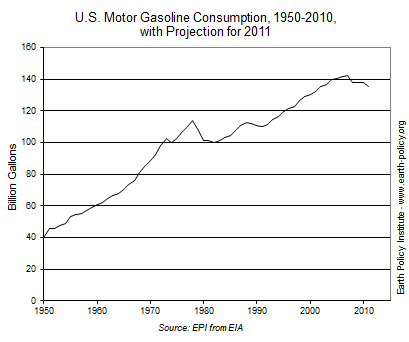
But now this is changing. Not only is the affluence that sustained this extravagant gasoline consumption eroding, but the automobile-centered lifestyle that was considered part of the American birthright is fading as well. U.S. gasoline use has dropped 5 percent in four years.
Four key developments are set to further reduce U.S. gasoline use: a shrinking car fleet, a decline in the miles driven per car, dramatic mandated future gains in new car fuel efficiency, and the shift from gasoline to electricity to power our cars.
The U.S. fleet appears to have peaked at 250 million vehicles in 2008. From 1994 through 2007, new-car sales were in the range of 15–17 million per year. Since then they have totaled 10–13 million per year, and they are unlikely to top 14 million again. Retirees likely will exceed sales of new cars throughout this decade.
The contraction that began when the fleet dropped from 250 million in 2008 to 248 million in 2010 is likely to continue. Sales of new cars are not matching those of earlier years in part because the economic prospect has dimmed and in part because we are still urbanizing. Today 82 percent of us live in urban areas where cars are becoming less essential.
On top of urbanization, we also have a change in the manner in which young people socialize. For teenagers in rural communities a half century ago, getting a driver’s license and something to drive—a car, a pickup, or even a farm truck—was a rite of passage. That’s what everyone did.
This too is changing. Today’s teenagers, most of whom grew up in an urban setting, socialize through smartphones and the Internet. For many of them, a car is of little interest. The number of licensed teenage drivers in this country—the car owners of the future—has dropped from a peak of 12 million in 1978 to 10 million today.
Cities are also being redesigned for people. Among other things, this means cities are becoming pedestrian- and bicycle-friendly, with ready access to public transit.
Many cities are building a cycling infrastructure of bicycle trails, dedicated bike lanes, and bike racks for parking. Bike-sharing programs are showing up, too. In Washington, D.C., the Capital Bikeshare program that began in 2010 has expanded to 116 stations with 1,100 bicycles. Within the first year, some 16,000 riders signed up for annual membership in the program. Denver and Chicago have similar bike share programs. And New York City is about to launch a huge program of its own.
The second reason that gasoline use is falling is the decline in miles driven per car. This is partly in response to economic uncertainty and the high price of gasoline. When gas costs nearly $4 a gallon, people think twice before jumping in a car and using a gallon of gasoline to pick up a half-gallon of milk.
A third trend that is reducing gasoline use is the rising fuel efficiency of the U.S. automobile fleet. New cars sold in 2008 averaged 27 miles per gallon. But in early 2009, President Obama raised the average fuel efficiency standard so that those sold in 2016 will get 36 miles per gallon. Additional standards announced in 2011 mean that new cars sold in 2025 will use less than half as much gasoline as the 2008 models.
The game changer in reducing gasoline use is going to come as drivers shift from gasoline to electrically powered vehicles, including plug-in hybrids and all-electric cars. General Motors recently introduced the Chevrolet Volt, designed to run largely on electricity, and Nissan unveiled the Leaf, an all-electric vehicle. Beyond these, Toyota is accepting orders for the plug-in version of its Prius hybrid, the pacesetter in fuel efficiency. It will be followed by a steady flow of new plug-in hybrid and all-electric car models coming to market.
Although these electrically powered vehicles are typically more costly to buy, the day-to-day cost of operating them is extraordinarily low. An analysis by Professor Michael McElroy at Harvard indicates that running a car on wind-generated electricity could cost less than the equivalent of 80-cent-a-gallon gasoline.
With the auto fleet shrinking, with the average car being driven less, with the fuel use of new cars to be cut in half by 2025, and with electricity starting to replace gasoline as a fuel, why do we need to build a pipeline to bring crude oil from Canada’s tar sands to oil refineries in Texas? The answer is we don’t.
Lester R. Brown is president of the Earth Policy Institute and author of World on the Edge.
There’s a footnote that I would like to add from the Center for Biological Diversity (great website!) that came out in a recent newsletter.
Here it is,
Lawsuit Seeks to Halt Work on Controversial Keystone XL Pipeline
Keystone Pipeline
The hotly contested Keystone XL pipeline hasn’t been approved for construction, but federal officials don’t seem to care; they’ve allowed the pipeline company to mow down 100 miles of native prairie grasslands in Nebraska to clear the way — before any public hearings were held on whether Keystone XL should move forward at all.
The Center for Biological Diversity and Friends of the Earth filed a lawsuit in federal court in Omaha Wednesday to halt that work. Specifically, we’re challenging decisions by the State Department and U.S. Fish and Wildlife Service to allow work to begin before a decision’s been made on the pipeline or the public hearings, which look like little more than a sham at this point.
If approved, TransCanada’s 1,700-mile pipeline would carry up to 35 million gallons of oil a day from tar sands in Canada to refineries in Texas. Not only will this project add fuel to the global climate crisis, but the pipeline will cut across Nebraska’s legendary Sandhills, hundreds of rivers and streams, and the Ogallala Aquifer, which provides drinking water for millions of people. TransCanada’s existing pipeline, called Keystone 1, has reportedly leaked 14 times since it started operating in June 2010.
Three guest posts from Martin Lack of Lack of Environment, today the concluding Part Three
Hope you have been following the previous two parts of this essay from Martin. Part One can be read here; Part Two here.
————————-
Can modernisation be “ecological”? – Part 3
This is the third and final part of my mini-critique of the school of environmental thought known as Ecological Modernisation.
——————-
Newsflash: Today [Sept. 27th.] isEarth Overshoot Day for 2011. This was a genuine coincidence (i.e. I did not know this when I decided to do this 3-part story). See paragraph 2 below…
——————-
Where are we now?
In his seminal 1968 article on ‘The Tragedy of the Commons’, Garrett Hardin had observed that it was not possible to achieve Jeremy Bentham’s hedonistic goal of “the greatest good for the greatest number” because, at the level of the individual, to do so would require food and/or energy to be used for subsistence purposes only (Hardin 1968: 1243). In 1977, William Ophuls agreed that the optimum population is not the maximum possible, which appears to imply that, if necessary, artificial limits to growth should be imposed. Furthermore, he explicitly stated that, “…this optimum level… may be as little as fifty percent of the theoretical maximum…” (Ophuls 1977: 28).
Mathis Wackernagel et al have recently provided “…evidence that human activities have exceeded the biosphere’s capacity since the 1980s. This overshoot can be expressed as the extent to which human area demand exceeds nature’s supply. Whereas humanity’s load corresponded to 70% of the biosphere’s capacity in 1961; this percentage grew to 120% by 1999.” However, the authors also pointed out that, if… “12% of the bioproductive area was set aside to protect other species; the demand line crosses the supply line in the early 1970s rather than the 1980s” (Wackernagel et al 2002: 9268-9)(emphasis mine).
In laboratory-controlled studies, the size of a population of, say, fruit flies can be shown to depend on the scarcity or abundance of food; and the presence or absence of predators. However, in 2005, Meadows et al pointed out that a growing population “…will slow and stop in a smooth accommodation with its limits… only if it receives accurate, prompt signals telling it where it is with respect to its limits, and only if it responds to those signals quickly and accurately” (Meadows et al 2005: 157).
This pursuit of the resulting “S-curve” is sometimes referred to as the demographic transition of an increasingly affluent society through three stages: (1) high birth and death rates; (2) high birth rate but low death rate; and (3) low birth and death rates. However, in a section entitled ‘Why Technology and Markets Alone Can’t Avoid Overshoot’, Meadowset al also pointed out that if we put off dealing with limits to growth we are more likely to come up against several of them simultaneously (ibid: 223).
Even though no-one seems to want to talk about population control today, neither Hardin nor Malthus was the first to raise this contentious subject because, as Philip Kreager has pointed out, this dubious honour goes to Aristotle’s treatise on Politics within which, “…population is a recurring topic, extensively discussed and integral to the overall argument…” (Kreager 2008: 599). Furthermore, according to Theodore Lianos, although Aristotle was thinking at the scale of a city rather than a country, the great philosopher recognised that there was an optimum population size, which depended on the land area controlled by the city (for food production purposes), which could be determined by, “the land-population ratio that produces enough material goods so that the citizens can live a wise and generous life, comfortable but not wasteful nor luxurious” (Lianos 2010: 3).
Conclusions
It has been demonstrated that dematerialisation alone cannot deal with the problem of resource depletion unless the increase in unit efficiency is greater than the increase in scale of production (i.e. something that cannot be sustainable indefinitely).
Furthermore, whereas it may be possible to partially decouple environmental degradation from economic growth, pursuit of this as a sole objective is a dangerous strategy. This is because to do so is to remain ambivalent about the existence and significance of limits to growth; indeed it is to deny that growth itself may be the problem.
In the final analysis, the only thing that will be sustainable is progression towards the steady-state economy proposed by Daly and others; combined with qualitative development instead of quantitative growth. Therefore, the only form of modernisation that could be ecological is one that places the intrinsic value of vital resources such as clean air and clean water – and the inherent value of a beautiful landscape – well above the instrumental value of money or precious metals.
——————-
References:
Hardin, G. (1968), ‘The Tragedy of the Commons’, Science, 168, pp.1243-8.
Kreager, P. (2008), ‘Aristotle and open population thinking’, Population and Development Review 14(34), pp.599-629.
Lianos, T. (2010), ‘Aristotle’s Macroeconomic Model of the City-State’.
Meadows D, et al (2005), Limits to Growth: the 30-Year Update, London: Earthscan.
Ophuls, W. (1977), Ecology and the Politics of Scarcity, San Francisco: Freeman and Co..
Wackernagel, M. et al (2002), ‘Tracking the ecological overshoot of the human economy’,Proc. of the National Academy of Sciences [USA], 99(14), pp.9266-9271.
Three guest posts from Martin Lack of Lack of Environment, today Part Two
As previously mentioned, Martin came to the attention of Learning from Dogs when making a comment to the second part of my Sceptical Voices essay. This is the second part of an essay that Martin wrote that is worthy of deep consideration. Part One can be read here; the concluding Part Three next Monday, the 10th.
————————-
Can modernisation be “ecological”? – Part 2
What is the problem with Modernity?
The problem is that the accumulation of personal wealth has become the sole objective of many people in modern society; and perpetual growth is posited as a means whereby even the poorest might achieve it. However, the New International Version of the Bible records the Apostle Paul as having written, “For the love of money is a root of all kinds of evil…” (1 Timothy 6:10); and economists and politicians have argued about this for centuries…
According to Jon Elster, it was Karl Marx that coined the term ‘money fetishism’ to describe the belief that money (and/or precious metals) have intrinsic (use) value rather than just instrumental (exchange) value, which Marx felt was as misguided as the religious practice of endowing inanimate objects with supernatural powers (Elster 1986: 56-7). However, the terms use value and exchange value were first put forward by Aristotle (384-322 BC) who, according to Daly, also recognised the danger of focusing on the latter (i.e. whereby the accumulation of wealth becomes an end in itself). Therefore, Daly suggests that the paperless economy (where no useable commodities actually change hands) is the ultimate destiny for money fetishism (Daly 1992: 186).
In 1987, the World Commission on the Environment and Development (WCED) was clearly keen to try and settle an argument and, therefore, made the following quite astonishing assertion: “Growth has no set limits in terms of population or resource use beyond which lies ecological disaster” (Brundtland et al 1987: 45). Instead, WCED gave us the much-touted – but ill-defined – concept of sustainable development (SD). However, in stark contrast to the WCED report, Carter much more recently observed that SD “…will require a fundamental transformation in attitudes to economic growth, consumption, production and work” (Carter 2007: 48). This appears to be a subtle acknowledgement of the legitimacy of Herman Daly’s insistence of the need for a move to a steady-state economy; precisely because infinite growth is impossible in a closed system.
A basic tenet of Daly’s thesis is that economic activity does not take place in a vacuum and that economic – not just ecological – collapse awaits us unless we recognise the limited capacity of the ecosystem within which we operate: “Of all the fields of study, economics is the last one that should seek to be ‘value-free’, lest it deserve Oscar Wilde’s remark that an economist ‘is a man that knows the price of everything and the value of nothing.’” (Daly 1992: 4).
On 22 December 2010, the BBC broadcast a Panorama programme entitled “What Price Cheap Food” containing the startling revelation that, in the two years between 1 November 2008 and 1 November 2010, town planners approved applications for at least 577 new supermarkets across the UK. The programme also revealed that so-called “mega farms” (i.e. factory farming of cows and pigs – “dairy-go-rounds” and “sty scrappers” respectively) will be the next ‘big idea’ imported from the USA. The potential mega farm operators argue that there is significant scope for recycling and energy from waste schemes to be incorporated, although environmentalists would question (1) the wisdom of concentrating potentially polluting activities; and (2) the ethics of factory farming (which undoubtedly goes against the grain of green consumerism). However, although the potential for economies of scale cannot be denied, this could all be seen as symptomatic of what Daly called “growthmania“.
Growthmania versus Limits to Growth
One of the world’s most famous deniers of Limits to Growth arguments is Julian Simon, who once famously won a bet with Paul Ehrlich that the price of any commodity would reduce with the passage of time. Nevertheless, how can anyone deny that the Earth’s resource base or its capacity to accommodate human beings is anything other than limited? Quite easily, apparently: In 1994, Simon claimed that “humanity now has the ability (or knowledge) to make it possible to feed, clothe, and supply energy to an ever-growing population for the next 7 billion years.”
However, the stupidity of such a dangerously fallacious argument was exposed 2 years later by Paul and Anna Ehrlich, who pointed out that at 1994 growth rates, “it would take only 774 years for the 1994 population of 5.6 billion to increase to the point where there were 10 human beings for each square meter of ice-free land on the planet!” Furthermore, they pointed out that if growth did not decline from 1994 levels, it would take only 1900 years for the mass of the human population to equal the mass of the Earth! (Ehrlich and Ehrlich 1996: 66).
Fortunately, the UN now believes (May 2011) that the human population on this planet will probably stabilise by the end of the current Century at somewhere between 10 and 15 billion. The only trouble with that is that, we may well have already exceeded the ecological carrying capacity of the planet, and are therefore causing extreme stress to the global ecosystem; of which the most obvious symptom is AGW.
—————-
References:
Daly, H. (1992), Steady State Economics (2nd ed), London: Earthscan.
Elster, J. (1986), An Introduction to Karl Marx, Cambridge: Cambridge University Press.
Ehrlich, P. and Ehrlich, A. (1996), Betrayal of Science and Reason, New York: Island Press.
Three guest posts from Martin Lack of Lack of Environment, today Part One
Martin came to the attention of Learning from Dogs when making a comment to the second part of my Sceptical Voices essay. Since then, he and I have exchanged a number of emails. Over the next few days, I would like to re-publish an essay that Martin wrote that is worthy of deep consideration. Here is Part One. Part Two will be on Friday and Part Three next Monday, the 10th.
————————-
Can modernisation be “ecological”? – Part 1
This is the first of a series of posts based on an essay with this title that I wrote earlier this year as part of the requirements for my MA in Environmental Politics.
Introduction
There are two possible ways of understanding the question; as to require a critique ofEcological Modernisation (EM) as a school of environmental thought or perhaps, far more demandingly, a critique of modernity itself. Although the main intention of this essay is to do the latter; it will inevitably do the former as well.
Definitions
In order to answer this question, it is essential to define what is meant by ‘ecological’; ‘modernisation’; and the theory of EM to which it has given rise:
– In the context of the question, ‘ecological’ is taken to mean thinking, behaviour, and policy that are ‘environmentally-friendly’; rather than merely or predominantly anthropocentric (i.e. concerned with human needs and interests).
– To understand what is implied by the term ‘modernisation’, it is necessary to define what is meant by the word ‘modernity’ because people often conflate the term with industrialisation or even capitalism. However, whereas both of the latter were forged in the industrial revolution of the late eighteenth and early nineteenth century, modernity has its roots in the scientific revolution of “the Enlightenment” in the eighteenth century.
– The theory – if not the practice – of EM emerged from Germany in the early 1980s. Whereas the social scientists Joseph Huber and Martin Jänicke are most-commonly credited with having originated the term, it is probably Arthur Mol that brought it to the attention of the English-speaking world in 1996, when he quoted Huber as having (somewhat enigmatically) said, ‘…all ways out of the environmental crisis lead us further into modernity.’ Thankfully, Mol then went on to explain that EM theory therefore seeks to repair “…a structural design fault of modernity: the institutionalised destruction of nature.” (Mol 1996: 305).
In addition to the above, it is important to differentiate the terms ‘modernity’ and ‘civilisation’: Civilisation pre-dates the Enlightenment by several millennia; and is often equated with the development of agriculture, settled communities, and cities. However, since past civilisations have come and gone, is there any reason to think that our modern civilisation will be any different? This should not be seen as the question of a wannabe anarchist; as it is merely an acknowledgement of human history.
According to John Dryzek, the rhetoric of the EM discourse is reassuringly optimistic; and would have us believe that we can retain a healthy environment without having to sacrifice the benefits of progress (Dryzek 2005: 171). More recently, echoing both Mol and Dryzek, Neil Carter has defined EM as a “…policy strategy that aims to restructure capitalist political economy along more environmentally benign lines based on the assumption that economic growth and environmental protection can be reconciled.” (Carter 2007: 7).
It is in this context that Carter used the term “decoupling” to refer the idea of breaking any direct causal link between economic growth and environmental degradation; but also suggested that “dematerialisation” of manufacturing processes (i.e. the reduction of environmental resources consumed per unit of production) would be essential (2007: 227). However, if we take the manufacturing of motor cars as an example, the rate of fossil fuel consumption will always accelerate unless the percentage increases engine fuel efficiency is greater than the percentage increases in the number of cars. Therefore, since the former must exponentially decline towards zero, the logical conclusion is that we must control the demand for the latter.
—————
References:
Carter, N. (2007), The Politics of the Environment (2nd ed), Cambridge: Cambridge University Press.
Dryzek, J. (2005), The Politics of the Earth (2nd ed), Oxford: Oxford University Press.
Mol, A. (1996), ‘Ecological Modernisation and Institutional Reflexivity: Environmental Reform in the Late Modern Age’, Environmental Politics, 5(2), pp.302-23.
Maybe less is more is really at the heart of our thirst for something more
A number of disparate recent experiences seem to have an underlying common thread.
See if these strike you in a similar fashion.
Yesterday, Joelle Jordan wrote about joy, about the wonderful relationship that dogs have with the world around them. As Joelle wrote,
Joy is a difficult commodity to come by these days. I don’t mean entertainment, I don’t mean a good laugh, I mean pure joy, where, even just for a single moment, all worries and doubts, frustration and anger are lifted as though by Atlas.
Like so many other humans in our world, I often find myself in a constant state of stress. There always seems to be something to worry about, whether it’s money, job fulfilment, the state of my relationships, getting the house cleaned, finding time to get to the market, and more. If given the chance, I know we all could spend nearly all of our waking hours (and some of our sleeping hours, too) worrying about something. We spend so much time on the many things that inevitably work themselves out, and so little time on things that will create a memory and a crystal moment of joy.
My little dog Charlie spends his time in the completely opposite fashion; spending his waking hours seeking joy, and committing less time to things that worry him.
Charlie seems to exist normally in three states of being; content, happy and utterly joyful.
How many of us can echo Charlie’s existance in our own lives?
Then last Sunday, Father D’s sermon spoke about our tendency to develop habitual behaviours and rarely challenge the point of them.
The truth is that we get used to doing things a certain way and keep doing them without ever thinking of what we are doing. We say things in the liturgy without even thinking of what we are saying. I’m sure many people utter the words in the Book of Common Prayer without thinking of the theology behind the words, or the relationship between church and state that they express.
Later on,
There was a desire for “something more” but it was hard to put a finger on what it was. I realized from these conversations that we are involved today in a time of intense searching. Few of us are satisfied with what the church and society have served up.
The honest among us will readily admit we lead fractured lives – with a disembodied spirituality on one side, and a soulless daily existence on the other. We are desperate for something more, for a faith with the power to transform both ourselves and our world.
“…. we are involved today in a time of intense searching“! That smacked me right in the eye!
These are clearly challenging times with mankind facing increasing odds of an ecological disaster of Old Testament proportions, and much of the western world on the cusp of a long and difficult recession. It is so easy to go on “doing things a certain way and keep doing them without ever thinking of what we are doing” while we wait for the leaders of our societies to fix our problems.
The truth is that we have to be the first to change, to question what we do on a daily basis and amend it if it is not truly healthy for us and for the planet. As was said in that sermon, “It means bringing forth each day the fruits of the Spirit: Love, joy, patience, kindness, generosity, faithfulness, gentleness and self-control.”
Go back and read yesterday’s Post and reflect on how many of those ‘fruits’ are the ways of dogs.
My final connection with the theme of today’s essay is with a recent series from the BBC called ‘Status Anxiety’. The programmes are still on YouTube and the first 10 minutes is below,
Status Anxiety discusses the desire of people in many modern societies to “climb the social ladder” and the anxieties that result from a focus on how one is perceived by others. De Botton claims that chronic anxiety about status is an inevitable side effect of any democratic, ostensibly egalitarian society. De Botton lays out the causes of and solutions to status anxiety.
Or if you prefer, all 2 hours 23 minutes may be watched on Top Documentary Films, described thus,
De Botton's book
Why doesn’t money (usually) buy happiness? Alain de Botton breaks new ground for most of us, offering reasons for something our grandparents may well have told us, as children.
It is rare, and pleasing, to see a substantial philosophical argument sustained as well as it is in this documentary. De Botton claims that we are more anxious about our own importance and achievements than our grandparents were. This is status anxiety.
Alain quotes philosophical writings, such as Democracy in America, a report by Alexis de Tocqueville on his visit to the USA in 1831. De Tocqueville noted that American equality, notable in those times, was accompanied by a climate of envy.
We jump to present-day USA, and see what, to de Botton, are some awful examples ofThe American Way. A Christian preaches get rich. A steelworker tells of his insecure life in an industry being closed down through others’ love of money.
Our protagonist points out the advantage of high status: those with high status will enjoy the care and attention of the world. Then joins this advantage with the illusion, orattempt at meritocracy in the USA, mentioning Jefferson’s notion of an aristocracy of talent.
Some of the messages towards the end of the programme are very thought-provoking indeed. Let me draw this all together.
If you own a dog, or a cat, or any pet, stop a while today and see how their simplicity of life brings them so much more. Naturally, we can never live life in the same way that our pet does but there are strong metaphors that carry equally strong messages for us. Less is more.
Now watch the last part of Status Anxiety even if you didn’t watch the first segment above, Reason? Watch and it will become clear.
Readers may recall that John H. and I went to the nearest Moving Planet event in Phoenix, as posted on Monday. Now 350.org have released a video of the event as seen from a global perspective.
2000+ events. 180+ countries. A single day to Move Beyond Fossil Fuels. 350.org’s 2011 day of action, Moving Planet, brought together Moving Together.
Photos and Videos submitted by thousands of organizers and activists around the world — THANK YOU!





 Learning from Dogs