I’ve always felt great wildlife photography mapped well to the Chinese proverb “the journey is the reward.” While I obviously enjoy seeing the end result of my wildlife photography outings I get a great deal of satisfaction in the crafting of those images. My best images often rise to the top because of one of the following maxims: –
1. Backgrounds are Equally Important as Your Subject
Pronghorn Antelope (Antilocapra americana) Portrait. Canon EOS 1Ds III, Canon 70-200mm f/2.8 IS USM + 2x teleconverter, 1/250 sec, f/8, ISO 400
It has loads of fabulous advice plus some pretty neat pictures.
Take a look at the last tip:
7. Utilize Negative Space
Alert Sea Otter and Pup. Canon EOS 1Ds III, Canon 600mm + 1.4x teleconverter, 1/1000 sec, f/8, ISO 400
Don’t have a long lens? Fear not as images taken with shorter focal length lenses can help capture areas of negative space. By employing negative space you can enhance your subject by highlighting its place/scale, its environment and/or leverage contrasting color and textures to make your subject stand out.
Finally, having ‘borrowed’ these couple of images, it seems only proper to close the post with the last two paragraphs of the article promoting both the NWF and the guest author, Jim Goldstein. If you own a camera and enjoy the great outdoors then do read the article in full.
Enter the National Wildlife Photo Contest
Be sure to read Jim’s previous post about selecting the right gear for spectacular landscape photography. And, after you’ve rented your gear, planned your trip, and taken your wonderful nature photos, remember to enter the National Wildlife Photo Contest. You could win part of $6,000 in prizes, including a Grand Prize trip for two to Churchill, Canada where you can see and photograph polar bears. There are wildlife and landscape categories, but the deadline to enter is July 15, so enter soon!
About Jim Goldstein
Jim Goldstein is a San Francisco-based professional photographer and author who has been in numerous publications, including Outdoor Photographer, Digital Photo Pro, Popular Photography and has self-published a PDF eBook Photographing the 4th Dimension – Time covering numerous slow shutter techniques. Follow Jim Goldstein on Google+ | Twitter | Facebook | 500px
And let me close with a favourite of mine – a dog photograph, of course!
The immensity of the universe and what it means for Planet Earth.
Jean and I have been watching the astounding BBC Series Wonders of Life presented by Professor Brian Cox. Here’s the BBC trailer:
and there are more clips from the programmes on the relevant part of the BBC website. There is so much about the series that is breath-taking. So much that reminds one of what a beautiful and fragile planet we live on. Quite rightly, the series received great reviews. Here, for example, is a little of what the UK Daily Telegraph newspaper wrote:
Wonders of Life, BBC Two, review
Sarah Crompton reviews the first episode of Brian Cox’s latest series, Wonders of Life (BBC Two).
When it comes to presenting styles, Professor Brian Cox is hard to keep still. There isn’t a beach he won’t feel compelled to stroll on, a mountain he won’t climb, or a river he won’t jump into. And what does he carry in that bag?
Once you got beyond these irritating stylistic tropes, however, Wonders of Life (BBC Two) was Cox at his absolute best, using his natural enthusiasm to communicate complicated ideas in very simple ways. He decided, for example, to show us his own DNA by spitting in a test tube – and missed.
“A physicist doing an experiment,” he giggled, with unforced charm. But when he actually succeeded, those little strands of white that you suddenly see brought everything he subsequently said to life.
He was brilliant at explaining his thesis, which was actually about the second law of thermodynamics, so not that much of a doddle to grasp. If I’ve got it right, what Cox thinks is that life itself may have been the inevitable consequence of the laws of physics and can be explained in the same terms as we explain “the falling of the rain and the shining of the stars”.
Sarah rounds off her review, thus:
The programme’s sophisticated use of graphics, and Cox’s patient repetition of his conclusions, all added to the sensation that this is a series that is actually going to tell you something. For the BBC to unveil both this and The Story of Music over a single weekend reveals a pretty impressive commitment to public service broadcasting. Long may it last.
One of the clear messages that comes from the program is the fact that our universe and the formation of life are intimately connected. That the ‘big bang’ some 3.2 billion years ago, the huge interstellar gas clouds, the formation of the carbon atom and the subsequent long-chained molecules, the collapse of those gas clouds to form suns and planets, the start of life, evolution through natural selection to ever more complex life forms, and on and on and on were and are inevitable. The science is clear. There is nothing mystical about it.
Yes, of course, anyone with half-an-ounce of sensitivity will be in awe of it all; the power and beauty of nature and of the natural world.
But here’s the rub.
As another BBC television programme explained, the universe is bigger than beyond imagination. That was from the BBC Horizon broadcast of August, 2012: How Big is the Universe? Here’s the trailer for that programme.
Stay with me a little longer! Just look at the following image.
The Andromeda galaxy.
This image of the Andromeda galaxy, taken in infrared and X-ray, consists of over a trillion stars.
The detailed Spitzer Space Telescope view above features infrared light from dust (red) and old stars (blue) in Andromeda, a massive spiral galaxy a mere 2.5 million light-years away. In fact, with over twice the diameter of our own Milky Way, Andromeda is the largest nearby galaxy. Andromeda’s population of bright young stars define its sweeping spiral arms in visible light images, but here the infrared view clearly follows the lumpy dust lanes heated by the young stars as they wind even closer to the galaxy’s core. Constructed to explore Andromeda’s infrared brightness and stellar populations, the full mosaic image is composed of about 3,000 individual frames. Two smaller companion galaxies, NGC 205 (below) and M32 (above) are also included in the combined fields. The data confirm that Andromeda (aka M31) houses around 1 trillion stars, compared to 4 hundred billion for the Milky Way.
Please stay with me for a few more minutes. Keeping the Andromeda galaxy in mind, now read this:
ESA astronomers say that for every ten far galaxies observed, a hundred go undetected.
Astronomers estimate that there are between 100 billion and 200 billion galaxies in the known universe. A single galaxy such as the Milky Way contain upwards of 200 billion normal stars. About 75 percent of all stars in the Milky Way are less than half as massive as our Sun. In the universe at large, the majority of galaxies are classified as dwarfs, each with less than a few hundred million stars. The image above is a computer simulation of a colliding dwarf galaxy triggering the formation of the Milky Ways spiral arms.
The largest project ever undertaken to map out the Universe in three dimensions using ESO telescopes has reached the halfway stage. An international team of astronomers has used the VIMOS instrument on the ESO Very Large Telescope to measure the distances to 55,000 galaxies as part of the VIPERS survey (VIMOS Public Extragalactic Redshift Survey). This has already allowed them to create a remarkable three-dimensional view of how galaxies were distributed in space in the younger Universe.This reveals the complex web of the large-scale structure of the Universe in great detail. The light of each galaxy is spread out into its component colours within VIMOS. Follow up analysis then allows astronomers to work out how fast the galaxy appears to move away from us — its redshift. This in turn reveals its distance and, when combined with its position on the sky, its location in the Universe.
Wow!
Millions of galaxies, trillions of suns, inconceivable numbers of planets.
Please pause and let the numbers sink in.
Now back to that Wonders of Life BBC series, during which Professor Brian Cox, said, “that it is inconceivable that there isn’t life elsewhere, that life is not present on countless other planets circling countless other suns …“.
In other words, if mankind is so intent on ‘fouling our nest’ on this most beautiful of planets, so what!
In the bigger scheme of things, it matters not. Find that tough? Then go and hug a dog and enjoy the moment. For tomorrow may never come.
Who doesn’t get stressed out! Maybe not such an issue?
I have in my bookshelf a book called The Anxiety Epidemic. On the back cover it explains this:
The Pain & Stress Center was founded in 1979, but the dream started long before that. The goal is to help individuals realize their true potential and to support and conduct research in the areas of man’s greatest needs – natural alternatives.
I had seen the book in a second-hand bookshop and paid $1.99 for it!
Clearly I have some interest in the topic and like many others around me know that certain situations cause me stress.
Thus when recently there was a TED talk on the topic of ‘How to make stress your friend’ it seemed like a worthwhile thing to watch. I was not wrong!
Published on Sep 4, 2013
Stress. It makes your heart pound, your breathing quicken and your forehead sweat. But while stress has been made into a public health enemy, new research suggests that stress may only be bad for you if you believe that to be the case. Psychologist Kelly McGonigal urges us to see stress as a positive, and introduces us to an unsung mechanism for stress reduction: reaching out to others.
It was an easy matter to find Kelly McGonigal’s website and discover a mine of advice and other good stuff. For example, this:
In this fun course, I invited my favorite psychology and neuroscience researchers at Stanford to talk about their work and what it means for everyday life and real-world problems. Each class starts with a 45-min lecture by the guest speaker, followed by about 30 minutes of Q&A from myself and course participants. I had a great time grilling these amazing scientists about everything from politics to education, parenting, shopping, and the scientific process. You’ll even hear a few personal stories they’ve never shared in public before!
I’m frequently asked questions about how to get started meditating, what is the best meditation for beginners, what is the best meditation for reducing stress (or training willpower, or cultivating self-compassion, or developing focus, etc.). Below is my favorite meditation for all these intentions.
The intention of this practice is to turn your attention to the breath, notice when the mind wanders, and bring your attention back to the breath.
This meditation cultivates self-awareness, mindfulness, and the ability to make conscious choices about what you are doing. It also is good practice in not following every impulse or habit.
There are a few different ways to focus on the breath; choose the one that feels right to you.
Philosopher Daniel Dennett offers a kind of self-help book for deep thinkers.
Those of you that are regular followers of Learning from Dogs know that I tend to offer posts for the week-end that are light-hearted. Certainly that’s easier for me, if you pardon me from saying, and hopefully a change for you, dear reader.
Well today’s offering is not exactly heavy but it is, nonetheless, not a typical Saturday topic.
However, trust you find it engaging.
Of the many blogs and websites that I follow, I enjoy the regular mental stimulation that flows from the blog Big Think. Recently there was a piece from Daniel Dennett that tickled my interest and I wanted to share it here.
While Silicon Valley and Silicon Alley busy themselves making every aspect of our lives more efficient (except, perhaps, for the process of discovering these new technologies, learning them, and integrating them into our lives), Daniel Dennett sits up at Tufts University in Massachusetts, philosophizing. His latest book, Intuition Pumps and Other Tools for Thinking is an attempt to make transparent some of the tricks of the philosopher’s trade. In an accelerating age, it’s a self-help book designed to slow the reader down and improve our ability to think things through.
The kinds of things Mr. Dennett likes to think about include the nature of consciousness, evolution, and religious belief. But the mind-training his new book offers is applicable to any problem you want to consider thoroughly. In an age of quick fixes and corner-cutting, we’re in constant danger of bad decision making – of overreliance on what cognitive psychologist Daniel Kahneman calls “system 1”, and what most of us call intuition. This rapid decision making channel of the brain is helpful when we are in mortal danger, or pressed for a quick decision within our areas of expertise. But for most decisions, the slower, more deliberate channel (system 2) is much more reliable. What Dennett offers, then, in Intuition Pumps, is a workout for system 2 – a series of thought experiments you can apply to puzzles real and imagined to bulk up the slower, wiser parts of your consciousness.
Some of the tools Dennett offers in the book are more familiar than others. Reductio ad absurdum arguments, for example, in which we test the validity of a claim by taking it to its most outrageous illogical extreme (a: “all living things have a right to liberty.” b: “so let me get this straight – a blade of grass has a right to liberty? What does that even mean?”). But the true delights of the book are the far-out exercises Dennett and his colleagues have dreamed up in the course of their work, such as “Swampman Meets A Cow-Shark”, from Donald Davidson, which begins:
Suppose lightning strikes a dead tree in a swamp; I am standing nearby. My body is reduced to its elements, while entirely by coincidence (and out of different molecules) the tree is turned into my physical replica. My replica, The Swampman, moves exactly as I did; according to its nature it departs the swamp, encounters and seems to recognize my friends, and appears to return their greetings in English.
Walking us through Davidson’s considerations about whether and to what extent the Swampman is anything like Davidson, and related ones about a cow that gives birth to something that looks exactly like a shark (yet has cow DNA in all of its cells), Dennett teaches us a surprising lesson about the utility of wild philosophical speculation.
Cloaked in the breezy, familiar trappings of a self-help book, Intuition Pumps is in actuality a dark mirror of that genre – a field of rabbit holes designed to leave the reader with more questions than answers, and wiser for the long and indirect journey.
Watch for Daniel Dennett’s Tools For Better Thinking – a Big Think Mentor workshop coming soon.
oooOOOooo
Don’t know about you but Daniel Dennett’s book looks like one that deserves reading. If you feel the same way the book is called Intuition Pumps And Other Tools for Thinking and here’s the link to Amazon.
Now don’t misunderstand me. There are huge numbers of people on this planet who have challenges and issues that I can’t even imagine handling. But whatever we are dealing with, it is at a personal ‘size’ proportional to scale of our lives. For example, I have a guest post coming out tomorrow from Tom Engelhardt about the nature of the American Empire. Frankly, it’s more than disturbing. But, or should I write that as BUT, it is about matters that are trivial and inconsequential in the larger scheme of things.
All of which is a little introduction to a YouTube link that Suzann sent me; the video below. It’s just about 2 1/2 minutes long, yet is incredible. Plus it has already been watched over 9 million times!
My name is Noella and I am a writer and dog enthusiast from Portland, Maine. I am reaching out to you in hopes of contributing to Learning from Dogs as a guest blogger. I have an original, unpublished piece about Top Five Reasons to Pet a Pitbull Today, that I think would fit nicely with the current offering of blog topics you post. I would also be open to writing you a new piece, if there’s a specific topic you’d like covered.
Please let me know if you’d be interested in having a look at my piece and hopefully fitting it into your editorial calendar.
I hope to hear back from you soon!
Thanks,
Noella
Now to be honest, this type of writing offer is not that rare but almost without exception is connected to some form of commercial organisation seeking to advance their profile. My responses are ‘not interested’! Initially, that was my first impression of this email from Noella. But in reply to my query along that vein, Noella sent me this:
Paul,
You’re right, there will be revenue earned from dog friendly businesses that want to get involved and have ads featured on Harry’s Picks. As you can see, presently we have one dog bakery featured. The idea is to keep the website running and give back to the canine community. We are not affiliated with any brand or company.
Thank you,
Noella
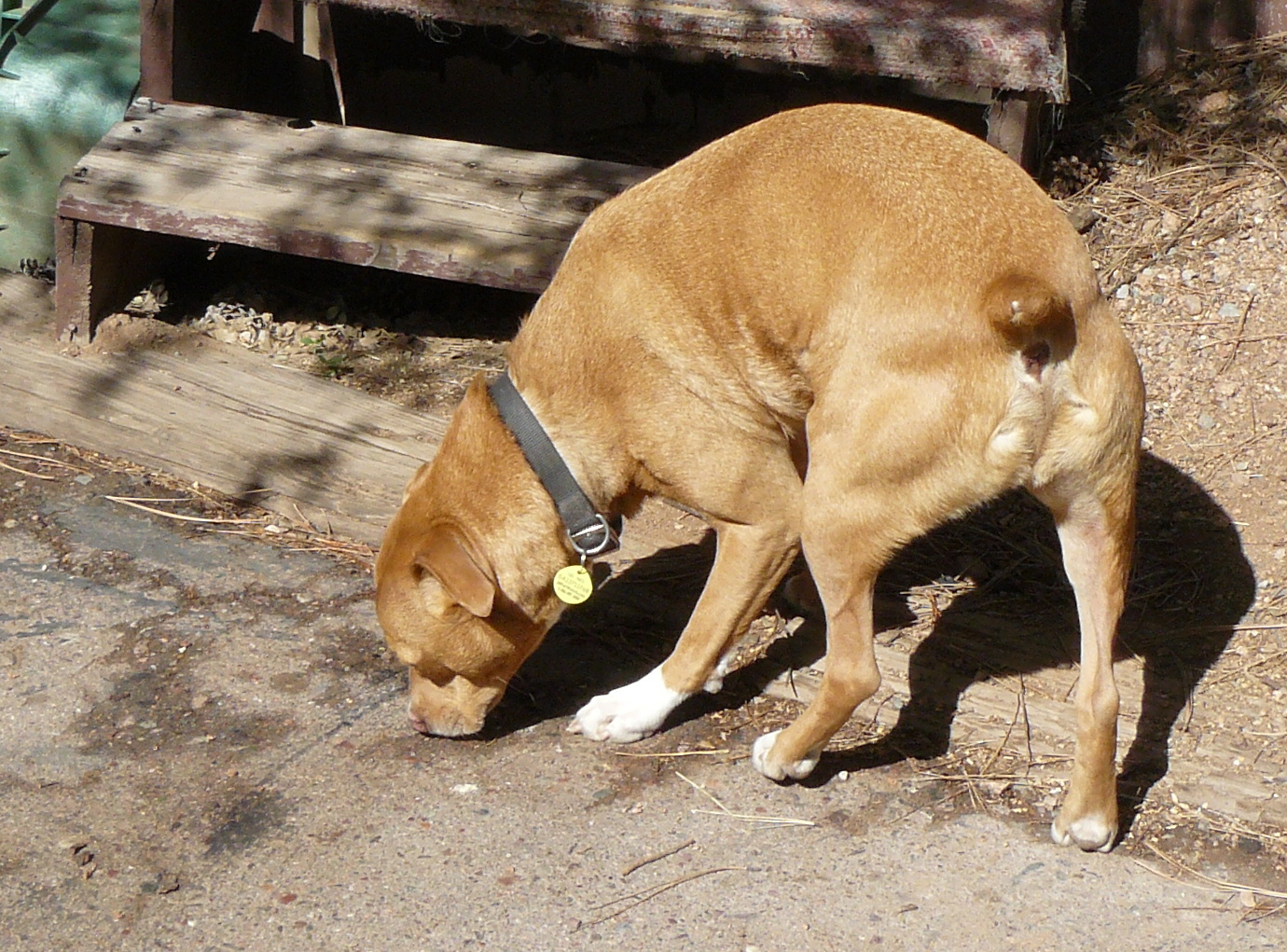
Thus on that basis I was happy to go ahead with the guest post. Influenced in great part by the gorgeous temperament of our Casey, a Pit Bull that we adopted February, 2012 when we were still living in Payson, Arizona. Casey, as he was named, had been living in the Humane Centre for nearly a year with no-one taking a liking to him, and his days as a rescue dog were running out.
Jean loved Casey from first sight and in due course brought him home. He quickly settled into the most wonderful, caring and gregarious dog one could imagine. He continues to be a happy, warm dog with all of us here in Oregon.
Casey doing what dogs do so well – picking up scents of his new home. (28th February, 2012)
So with all that, let me turn to Noella’s guest post.
oooOOOooo
Top 5 Reasons To Love a Pittie
Sweet Addie.
This is Addie. She is my best friend. She is a Pit Bull mix and the sweetest dog I have ever known. I really didn’t know much about Pit Bulls when I adopted her. I hadn’t been spoiled by tales of their viciousness and I had not yet been brought into the fold by a devotee. So I had to learn fast!
Everything I know about Pit Bulls now has been through her or inspired by her.
Here are the top 5 things I love about Addie and Pit Bulls:
5) They are incredibly strong and athletic. They come in pretty small packages but they are dynamos. Addie can jump five feet straight up in the air from standing still. It’s awe inspiring to watch.
4) You will always be missed! They fuss when you come home. I’m sure lots of dogs do this, but I’ve noticed it in a lot of pitties. They whine and wiggle and snort in the most adorable way. They love people and are always ecstatic to see you. I’m lucky to get a raised eyebrow from my hound dog.
3) They love to play. Pitties are a very determined breed. They will play until you are completely worn out and they will be fully engaged and inquisitive the entire time.
2) THEY LOVE PEOPLE. In my experience Pit Bulls are the most affectionate breed. They are snuggle monsters and will use their gigantic noggins to nose their way into your personal space whether you are seeking their attention or not.
1) THEY NEED THE LOVE. Sadly Pit Bulls and Pit Bull mixes makeup 30%-40% of shelter intakes nationwide and that number goes up in urban areas (interesting article on the subject here). Pit Bulls are misunderstood and often times fall into the hands of the wrong people. They need good owners that have the love and patience to provide them solid training and safe homes.
Noella Schink, writes from Portland, Maine, where she lives and plays with her 3-year-old pit bull mix, Addie, 8-year old shih-tzu, Brutus, and 2-year old hound, Lula. For great tips and reviews about dog friendly businesses around the country, she recommends Harry’s Picks, a new online community for dog lovers.
Yesterday, I wrote about the growing awareness of a major crisis affecting bees in a number of countries. Coincidentally, when researching the various articles for that post, into my email ‘inbox’ came the latest essay from George Monbiot published both in the UK Guardian newspaper and on his own blog. The title was DDT 2.0. I emailed Mr. Monbiot requesting permission to republish his essay in full on Learning from Dogs and promptly received his approval to so do.
But for those who for whatever reason, don’t recall clearly the history of DDT, here’s some background.
Wikipedia’s entry opens, thus:
DDT (dichlorodiphenyltrichloroethane) is an organochlorineinsecticide which is a colorless, crystalline solid, tasteless and almost odorless chemical compound. Technical DDT has been formulated in almost every conceivable form including solutions in xylene or petroleum distillates, emulsifiable concentrates, water-wettable powders, granules, aerosols, smoke candles, and charges for vaporisers and lotions.[2]
First synthesized in 1874, DDT’s insecticidal properties were not discovered until 1939, and it was used with great success in the second half of World War II to control malaria and typhus among civilians and troops. The Swiss chemist Paul Hermann Müller was awarded the Nobel Prize in Physiology or Medicine in 1948 “for his discovery of the high efficiency of DDT as a contact poison against several arthropods.”[3] After the war, DDT was made available for use as an agricultural insecticide, and soon its production and use skyrocketed.[4]
Then goes on to mention Rachel Carson (1907 – 1964) and her mind-boggling expose of DDT in the famous book Silent Spring.
How a courageous woman took on the chemical industry and raised important questions about humankind’s impact on nature.
Although their role will probably always be less celebrated than wars, marches, riots or stormy political campaigns, it is books that have at times most powerfully influenced social change in American life. Thomas Paine’s Common Sense galvanized radical sentiment in the early days of the American revolution; Uncle Tom’s Cabin by Harriet Beecher Stowe roused Northern antipathy to slavery in the decade leading up to the Civil War; and Rachel Carson’s Silent Spring, which in 1962 exposed the hazards of the pesticide DDT, eloquently questioned humanity’s faith in technological progress and helped set the stage for the environmental movement.
Carson, a renowned nature author and a former marine biologist with the U.S. Fish and Wildlife Service, was uniquely equipped to create so startling and inflammatory a book. A native of rural Pennsylvania, she had grown up with an enthusiasm for nature matched only by her love of writing and poetry. The educational brochures she wrote for the Fish and Wildlife Service, as well as her published books and magazine articles, were characterized by meticulous research and a poetic evocation of her subject.
It’s the new DDT: a class of poisons licensed for widespread use before they had been properly tested, which are now ripping the natural world apart. And it’s another demonstration of the old truth that those who do not learn from history are destined to repeat it.
It is only now, when neonicotinoids are already the world’s most widely deployed insecticides, that we are beginning to understand how extensive their impacts are. Just as the manufacturers did for DDT, the corporations which make these toxins claimed that they were harmless to species other than the pests they targeted. Just as they did for DDT, they have threatened people who have raised concerns, published misleading claims and done all they can to bamboozle the public. And, as if to ensure that the story sticks to the old script, some governments have collaborated in this effort. Among the most culpable is the government of the United Kingdom.
As Professor Dave Goulson shows in his review of the impacts of these pesticides, we still know almost nothing about how most lifeforms are affected. But as the evidence has begun to accumulate, scientists have started discovering impacts across a vast range of wildlife.
Most people who read this newspaper will be aware by now of the evidence fingering neonicotinoids as a major cause of the decline of bees and other pollinators. These pesticides can be applied to the seeds of crops, and they remain in the plant as it grows, killing the insects which eat it. The quantities required to destroy insect life are astonishingly small: by volume these poisons are 10,000 times as powerful as DDT. When honeybees are exposed to just 5 nanogrammes of neonicotinoids, half of them will die. As bees, hoverflies, butterflies, moths, beetles and other pollinators feed from the flowers of treated crops, they are, it seems, able to absorb enough of the pesticide to compromise their survival.
But only a tiny proportion of the neonicotinoids that farmers use enter the pollen or nectar of the flower. Studies conducted so far suggest that only between 1.6 and 20% of the pesticide used for dressing seeds is actually absorbed by the crop: a far lower rate even than when toxins are sprayed onto leaves. Some of the residue blows off as dust, which is likely to wreak havoc among the populations of many species of insects in hedgerows and surrounding habitats. But the great majority – Goulson says “typically more than 90%” – of the pesticide applied to the seeds enters the soil.
In other words, the reality is a world apart from the impression created by the manufacturers, which keep describing the dressing of seeds with pesticides as “precise” and “targeted”.
Neonicotinoids are highly persistent chemicals, lasting (according to the few studies published so far) for up to 19 years in the soil. Because they are persistent, they are likely to accumulate: with every year of application the soil will become more toxic.
What these pesticides do once they are in the soil, no one knows, as sufficient research has not been conducted. But – deadly to all insects and possibly other species at tiny concentrations – they are likely to wipe out a high proportion of the soil fauna. Does this include earthworms? Or the birds and mammals that eat earthworms? Or for that matter, the birds and mammals that eat insects or treated seeds? We don’t yet know enough to say.
This is the story you’ll keep hearing about these pesticides: we have gone into it blind. Our governments have approved their use without the faintest idea of what the consequences are likely to be.
You might have had the impression that neonicotinoids have been banned by the European Union. They have not. The use of a few of these pesticides has been suspended for two years, but only for certain purposes. Listening to the legislators, you could be forgiven for believing that the only animals which might be affected are honeybees, and the only way in which they can be killed is through the flowers of plants whose seeds were dressed.
But neonicotinoids are also sprayed onto the leaves of a wide variety of crop plants. They are also spread over pastures and parks in granules, in order to kill insects that live in the soil and eat the roots of the grass. These applications, and many others, remain legal in the European Union, even though we don’t know how severe the wider impacts are. We do, however, know enough to conclude that they are likely to be bad.
Of course, not all the neonicotinoids entering the soil stay there indefinitely. You’ll be relieved to hear that some of them are washed out, whereupon … ah yes, they end up in groundwater or in the rivers. What happens there? Who knows? Neonicotinoids are not even listed among the substances that must be monitored under the EU’s water framework directive, so we have no clear picture of what their concentrations are in the water that we and many other species use.
But a study conducted in the Netherlands shows that some of the water leaving horticultural areas is so heavily contaminated with these pesticides that it could be used to treat lice. The same study shows that even at much lower concentrations – no greater than the limits set by the European Union – the neonicotinoids entering river systems wipe out half the invertebrate species you would expect to find in the water. That’s another way of saying erasing much of the foodweb.
I was prompted to write this article by the horrible news from the River Kennet in southern England: a highly protected ecosystem that is listed among the few dozen true chalk streams on earth. Last month someone – farmer or householder, no one yet knows – flushed another kind of pesticide, chlorpyrifos, down their sink. The amount was equivalent – in pure form – to two teaspoonsful. It passed through Marlborough sewage works and wiped out most of the invertebrates in fifteen miles of the river.
The news hit me like a bereavement. The best job I ever had was working, during a summer vacation from university, as temporary waterkeeper on the section of the Kennet owned by the Sutton estate. The incumbent had died suddenly. It was a difficult job and, for the most part, I made a mess of it. But I came to know and love that stretch of river, and to marvel at the astonishing profusion of life the clear water contained. Up to my chest in it for much of the day, I immersed myself in the ecology, and spent far more time than I should have done watching watervoles and kingfishers; giant chub fanning their fins in the shade of the trees; great spotted trout so loyal to their posts that they had brushed white the gravel of the river bed beneath their tails; native crayfish; dragonflies; mayflies; caddis larvae; freshwater shrimps and all the other teeming creatures of the benthos.
In the evenings, wanting company and fascinated in equal measure by the protest and the remarkable people it attracted, I would stop at the peace camp outside the gates of the Greenham Common nuclear base. I’ve told the strange story that unfolded during my visits in another post.
Campaigners seeking to protect the river have described how, after the contamination,the river stank from the carcases of the decaying insects and shrimps. Without insects and shrimps to feed on, the fish, birds and amphibians that use the river are likely to fade away and die.
After absorbing this news, I remembered the Dutch study, and it struck me that neonicotinoid pesticides are likely, in many places, to be reducing the life of the rivers they enter to a similar extent: not once, but for as long as they are deployed on the surrounding land.
Richard Benyon, the minister supposed to be in charge of protecting wildlife and biodiversity, who happens to own the fishing rights on part of the River Kennet, and to represent a constituency through which it passes, expressed his “anger” about the chlorpyrifos poisoning. Should he not also be expressing his anger at the routine poisoning of rivers by neonicotinoids?
Were he to do so, he would find himself in serious trouble with his boss. Just as they are systematically poisoning our ecosystems, neonicotinoids have also poisoned the policies (admittedly pretty toxic already) of the department supposed to be regulating them. In April, Damian Carrington, writing in the Observer, exposed a letter sent by the ministerin charge of the Department for Environment, Food and Rural Affairs (Defra), Owen Paterson, to Syngenta, which manufactures some of these pesticides. Paterson promised the company that his efforts to prevent its products from being banned “will continue and intensify in the coming days”.
And sure enough, the UK refused to support the temporary bans proposed by the commission both in April and last month, despite the massive petitions and the 80,000 emails on the subject that Paterson received. When Paterson and Deathra were faced with a choice between the survival of natural world and the profits of the pesticides companies, there was not much doubt about how they would jump. Fortunately they failed.
Their attempt to justify their votes led to one of the most disgraceful episodes in the sorry record of this government. The government’s new chief scientist, Sir Mark Walport, championed a “study” Deathra had commissioned, which purported to show that neonicotinoids do not kill bees. It was not published in a peer-reviewed journal, nor could it be, as as any self-respecting scientist, let alone the government’s chief scientist, should have been able to see in a moment that it was complete junk. Among many other problems, the controls were hopelessly contaminated with the pesticide whose impacts the trial was supposed to be testing. The “study” was later ripped apart by the European Food Safety Authority.
But Walport did still worse, making wildly misleading statements about the science, and using scare tactics and emotional blackmail to try to prevent the pesticides from being banned, on behalf of his new masters.
It is hard to emphasise sufficiently the importance of this moment or the dangers it contains: the total failure of the government’s primary source of scientific advice, right at the beginning of his tenure. The chief scientist is not meant to be a toadying boot-licker, but someone who stands up for the facts and the principles of science against political pressure. Walport disgraced his post, betrayed the scientific community and sold the natural world down the river, apparently to please his employers.
Last week, as if to remind us of the extent of the capture of this government by the corporations it is supposed to be regulating, the scientist who led the worthless trials that Walport and Paterson cited as their excuse left the government to take up a new post at … Syngenta. It seems to me that she was, in effect, working for them already.
So here we have a department staggering around like a drunkard with a loaded machine gun, assuring us that it’sh perfectly shafe. The people who should be defending the natural world have conspired with the manufacturers of broad-spectrum biocides to permit levels of destruction at which we can only guess. In doing so they appear to be engineering another silent spring.
oooOOOooo
Frankly, there are more and more occasions when I think that if homo sapiens becomes virtually extinct there will be no queries as to why it happened. Then again, a much more positive muse would be to see the ever-increasing madness going on in today’s world as the crumbling death throws of a materialistic and consumptionist era that is past its time.
A response to the many who enjoy the regular Sunday photo parade.
Jean and I have recently joined the National Wildlife Federation partly because there are times when it really does seem ‘wild’! Anyway, I was trawling the NWF website the other day and came across this very helpful advice: 7 Wildlife Photo Tips to Never Forget. In view of the popularity of Sunday’s regular Picture Parade on Learning from Dogs, it seemed appropriate to dip into that section for today’s post. [Note: you will have to go to the website to read the full article as it would be wrong to republish the entire item without permission.]
7 Wildlife Photo Tips to Never Forget
This guest post by Jim Goldstein is sponsored by BorrowLenses.com.
I’ve always felt great wildlife photography mapped well to the Chinese proverb “the journey is the reward.” While I obviously enjoy seeing the end result of my wildlife photography outings I get a great deal of satisfaction in the crafting of those images. My best images often rise to the top because of one of the following maxims:
1. Backgrounds are Equally Important as Your Subject
2. Embrace Serendipity When Photo Editing
3. Challenge Viewers with Anthropomorphism
4. Employ Non-Standard Compositions
5. Capture Your Subjects at Their Eye Level
6. Factor in Form and Pose
7. Utilize Negative Space
I am going to republish just one of these tips to give you an idea, because the advice is stunning, in my humble opinion.
2. Embrace Serendipity When Photo Editing
Arctic Hare. Canon 1D Mark II, Canon 500mm f/2.8 + 1.4x teleconverter, 1/640 sec, f/7.1, ISO 400
When behind the camera, focus carefully on your subject. But when photo editing look for unique and subtle differences that might enhance or transform the story within your image. Case in point: this example image of a mosquito biting the nose of an Arctic Hare. My attention was on obtaining a razor sharp image and composing carefully, but when photo editing I found a couple frames that captured the biting mosquito that had been invisible to me at the time I took the photo.
Arctic Hare Being Bitten By Mosquito on the Nose
Jim Goldstein is a San Francisco-based professional photographer and author who has been in numerous publications, including Outdoor Photographer, Digital Photo Pro, Popular Photography and has self-published a PDF eBook Photographing the 4th Dimension – Time covering numerous slow shutter techniques. Follow Jim Goldstein on Google+ | Twitter | Facebook | 500px
Do take a few moments and go across to the website and read the full set of tips. If you have any interest in photographing nature and wildlife this is unmissable good advice. Want to know more about the National Wildlife Federation? More information here.
It really is absurd to think that animals don’t have feelings!
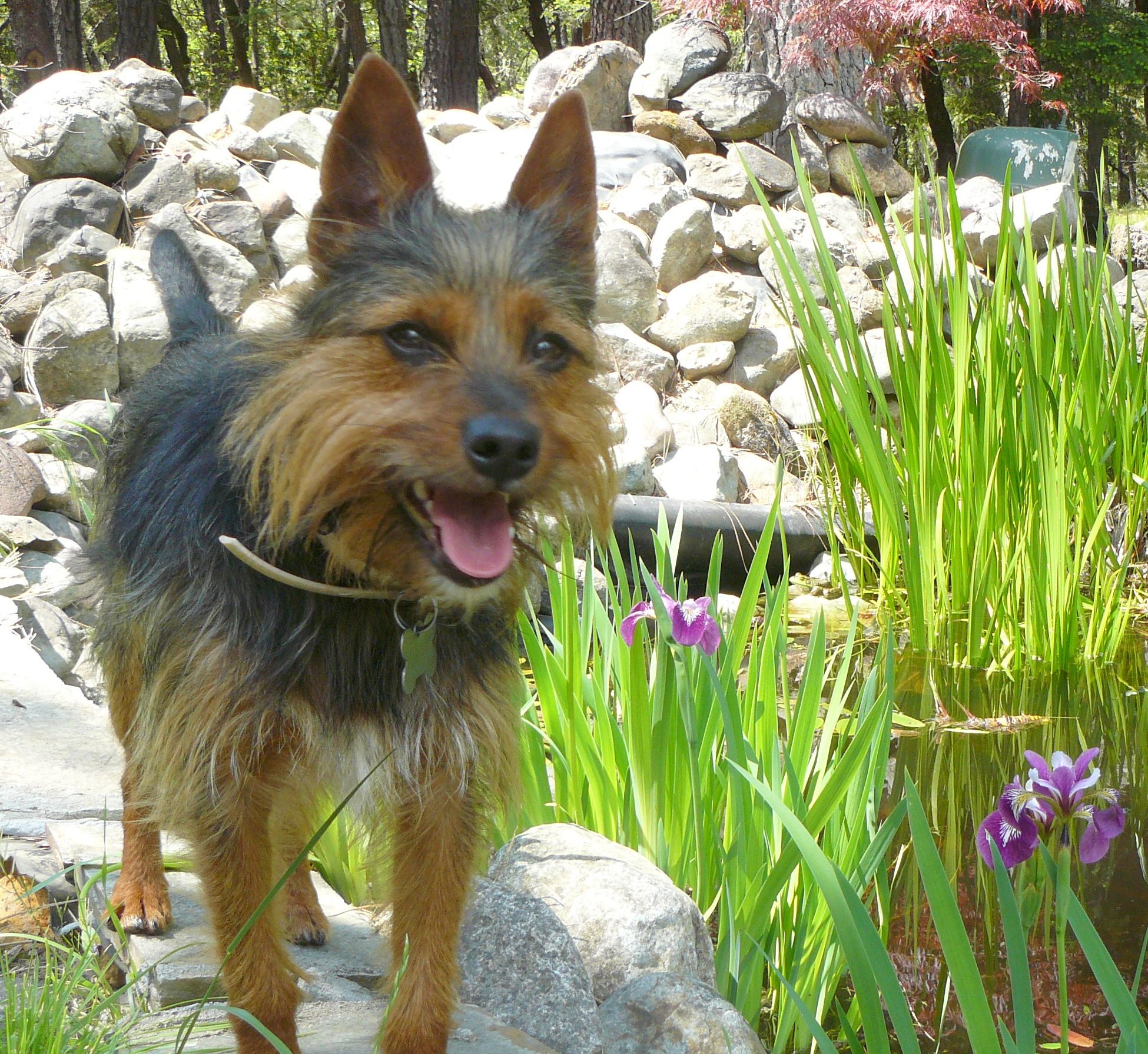
Surely, a smiling Sweeny?
Many thousands of animal owners will intuitively know that animals have feelings. Not only expressed through their behaviour but also through many other subtle signs including facial expressions. But what about the science behind this?
Back towards the end of May, there was an item on the BBC News website that was headlined: Ape tantrums: Chimps and bonobos emotional about choice. It caught my eye.
Ape tantrums: Chimps and bonobos emotional about choice
Like many humans, chimpanzees and bonobos react quite emotionally when they take risks that fail to pay off.
This is according to researchers from Duke University in the US, who developed decision-making games that the apes played to earn edible treats.
Some animals that lost the game – receiving a bland piece of cucumber rather than a preferred piece of banana – reacted with what looked like the ape equivalent of a tantrum.
It was then only a matter of a couple of ‘mouse clicks‘ to go to that Plos One publication of the findings.
Chimpanzees and Bonobos Exhibit Emotional Responses to Decision Outcomes
Abstract
The interface between cognition, emotion, and motivation is thought to be of central importance in understanding complex cognitive functions such as decision-making and executive control in humans. Although nonhuman apes have complex repertoires of emotional expression, little is known about the role of affective processes in ape decision-making. To illuminate the evolutionary origins of human-like patterns of choice, we investigated decision-making in humans’ closest phylogenetic relatives, chimpanzees (Pan troglodytes) and bonobos (Pan paniscus). In two studies, we examined these species’ temporal and risk preferences, and assessed whether apes show emotional and motivational responses in decision-making contexts. We find that (1) chimpanzees are more patient and more risk-prone than are bonobos, (2) both species exhibit affective and motivational responses following the outcomes of their decisions, and (3) some emotional and motivational responses map onto species-level and individual-differences in decision-making. These results indicate that apes do exhibit emotional responses to decision-making, like humans. We explore the hypothesis that affective and motivational biases may underlie the psychological mechanisms supporting value-based preferences in these species.
Wonderfully, just a short time later I found on Psychology Today an article about the emotions felt by dogs. It was written by Stanley Coren, Ph.D., F.R.S.C., who is Professor Emeritus in the Department of Psychology at the University of British Columbia. (As an aside, a quick search revealed that Prof. Coren was mentioned in a blog post back in October, 2011 in this place: The power of joy.)
So imagine my pleasure and delight at receiving written permission from the Professor to republish his article in full. So without further ado, here it is.
oooOOOooo
Which Emotions Do Dogs Actually Experience?
Dogs have the same emotions as a human 2 year-old child.
Since most of us routinely read emotions in our dogs (wagging tail means happy, cringing means afraid and so forth) it may be difficult to believe that the existence of real emotions in dogs was, and in some places still is, a point of scientific controversy. In the distant past it was presumed that dogs had very rich mental lives with feelings much like those of humans. However with the rise of science things began to change. We learned enough about the principles of physics and mechanics, so that we could build complex machines, and began to notice that living things (both people and animals) were also based upon by systems governed by mechanical rules and chemical processes. In the face of such discoveries, religions stepped in to suggest that there must be more to human beings than simply mechanical and chemical events. Church scholars insisted that people have souls, and the evidence they gave for this was the fact that humans have consciousness and feelings. Animals might have the same mechanical systems, but they did not have a divine spark, and therefore they do not have the ability to experience true feelings.
Since most research at the time was church sponsored it is not surprising that prominent scholars, such as the French philosopher and scientist René Descartes adopted this viewpoint. In a highly influential set of analyses, Descartes suggested that animals like dogs were simply some kind of machine. He would thus describe my Beagle, Darby, as simply being a dog-shaped chassis, filled with the biological equivalent of gears and pulleys. Although this machine doesn’t have consciousness and emotions it can still be programmed to do certain things.
In recent times science has progressed a long way beyond Descartes and we now understand that dogs have all of the same brain structures that produce emotions in humans. Dogs also have the same hormones and undergo the same chemical changes that humans do during emotional states. Dogs even have the hormone oxytocin, which, in humans, is involved with feeling love and affection for others. With the same neurology and chemistry that people have, it seems reasonable to suggest that dogs also have emotions that are similar to ours. However it is important to not go overboard and immediately assume that the emotional ranges of dogs and humans are the same.
To understand what dogs feel we must turn to research which was done to explore the emotions of humans. Not all people have the full range of all possible emotions. In fact at some points in your life you did not have the full complement of emotions that you feel and express today. Research shows that infants and very young children have a more limited range of emotions, but over time the child’s emotions begin to differentiate and they come to be able to experience different and more complex emotional states.
This data is important to our understanding of the emotional lives of dogs because researchers have come to believe that the mind of a dog is roughly equivalent to that of a human who is two to two-and-a-half years old. This conclusion holds for most mental abilities — including emotions. Thus we can look to the human research to see what we might expect of our dogs. Like a young child, dogs will clearly have emotions, but many fewer kinds of emotions than we find in adults.
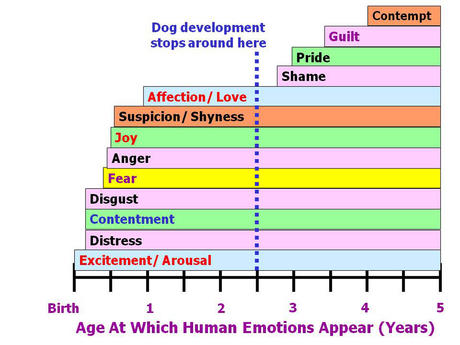
I’ve illustrated this in the accompanying illustration. At birth a human infant only has an emotion that we might call excitement. This indicates how aroused he is, ranging from very calm up to a state of frenzy. Within the first weeks of life the excitement state comes to take on a positive or a negative flavor, so we can now detect the general emotions of contentment and distress. In the next couple of months disgust, fear, and anger, become detectable in the infant. Joy often does not appear until the infant is nearly six months of age and it is followed by the emergence of shyness or suspicion. True affection (the sort that it makes sense to use the label “love” for) does not fully emerge until nine or ten months of age.
The complex social emotions, those which have elements that must be learned, don’t appear until late. Shame and pride take more than three years to appear, while guilt appears around six months after these. A child must be nearly four years of age before it feels contempt.
This developmental sequence is the golden key to understanding the emotions of dogs. Dogs go through their developmental stages much more quickly than humans do, and have all of the emotional range that they will ever achieve by the time they are four to six months of age (depending on the rate of maturing in their breed). However, we know that the assortment of emotions available to the dog will not exceed that which is available to a human who is two to two-and-a-half years old. This means that a dog will have all of the basic emotions: joy, fear, anger, disgust and even love. However based on current research it seems likely that your dog will not have those more complex emotions like guilt, pride and shame.
Now many people might argue that they have seen evidence which indicates that their dog is capable of experiencing guilt. The usual situation is where you come home and your dog starts slinking around and showing discomfort, and you then find that he or she has left a smelly brown deposit on your kitchen floor. It is natural to conclude that the dog was acting in a way that shows that it is feeling guilty about its transgression. However this is not guilt, but simply the more basic emotion of fear. The dog has learned that when you appear and his droppings are visible on the floor, bad things happen to him. What you see is his fear of punishment—he will never feel guilt.
So what does this mean for those of us who live with, and interact with dogs? The good news is that you can feel free to dress your dog in that silly costume for a party. He will not feel shame, regardless how ridiculous he looks. He will also not feel pride at winning a prize at a dog show or an obedience competition. However your dog can still feel love for you, and contentment when you are around, and aren’t these the emotions we truly value?
So going to return to that BBC News item. I broke off after that reference to the findings being published in Plos One. This is how the BBC item continued:
The researchers worked with 23 chimps and 15 bonobos in two ape sanctuaries in the Republic of Congo.
“The animals were all [rescued] orphans of the bushmeat trade,” explained lead researcher Alexandra Rosati, now at Yale University.
“They’re sort of in semi-captivity, but it’s possible to play games with them.
“It’s as close as we can come to wild animals without actually being in the wild.”
Dr Rosati, who studies problem-solving in apes in order to examine the origins of human behaviour, designed two games.
In the first, the animals could choose between receiving a relatively small food reward immediately, or receiving a larger reward but having to wait for it.
The second game involved choosing between a “safe” and a “risky” option. The safe option was six peanuts hidden under a bowl. But a second bowl concealed either a slice of cucumber or a highly favoured portion of banana.
Many of the apes – both bonobos and chimps – became emotional when they had to wait or took a gamble that did not pay off.
The researchers recorded some very tantrum-like responses: vocalisations including “pout moans” and “screams”, as well as anxious scratching and banging on the bars of the enclosure.
“Some of the reactions look similar to a kid [shouting] ‘no, I wanted it!’,” said Dr Rosati.
Emotional decisions
The results, Dr Rosati explained, suggest that the emotional component of decision-making – feelings of frustration and regret that are so fundamental to our own decisions – are intrinsic to ape society and are not uniquely human.
Emotions may have shaped the way great apes, including chimpanzees and bonobos, live.
The researchers also found differences in the way the two species responded to the games; chimps were more willing to take risks, and also more patient than bonobos.
This could suggest that the apes’ capacity for emotion may have helped shape the way they live.
“These differences might be reflected in differences in how the apes choose to forage in the wild,” said Dr Rosati.
“This might be why chimpanzees are more likely to engage in risky strategies like hunting, in that you could spend all day pursuing a monkey, but end up with nothing.
Overall, she said that the results suggested that decision-making in apes involved moods and motivations similar to our own.
OK, better let the dogs outside now – I’m on the receiving end of that look!
This is not a single topic blog. But the last few days have brought such a wealth of marvellous stuff that I couldn’t resist this final, for the time being, post on the benefits of slowing down, of taking a break – meditation, in other words.
First, and I wish I could remember from whence it came, I found this essay by Bertrand Russell In Praise of Idleness It’s a wonderful piece of writing from one of the great masters of the art. Take this extract from just the first paragraph, (and the photo insertion is from me!):
Bertrand Russell (18 May 1872 – 2 February 1970)
I think that there is far too much work done in the world, that immense harm is caused by the belief that work is virtuous, and that what needs to be preached in modern industrial countries is quite different from what always has been preached. Everyone knows the story of the traveler in Naples who saw twelve beggars lying in the sun (it was before the days of Mussolini), and offered a lira to the laziest of them. Eleven of them jumped up to claim it, so he gave it to the twelfth. This traveler was on the right lines. But in countries which do not enjoy Mediterranean sunshine idleness is more difficult, and a great public propaganda will be required to inaugurate it. I hope that, after reading the following pages, the leaders of the YMCA will start a campaign to induce good young men to do nothing. If so, I shall not have lived in vain.
Then from out of the Transition Network stables came this interview by Rob Hopkins with Sophy Banks on the Power of Not Doing Stuff. Just going to pick out a couple of exchanges that really struck me.
Sophy, I’m sure you get asked the question lots of times, but how would you describe Inner Transition ? What’s Inner Transition for you?
I gave a talk about Inner Transition in Canada just recently, and someone said “what I want from the talk is, what’s the most succinct story? What’s the E=mc² of Inner Transition?” The way that I’m talking about that at the moment is to say the absolute core of Inner Transition is that in our groups, within ourselves, in our relationships, in what we’re doing in our communities, how can we be creating a culture that supports us to be in a state of feeling resourced, feeling empowered, feeling seen and appreciated? With the understanding that when we have those kind of external conditions, we find ourselves in a state where we’re the most open to new ideas, the most open to connection, the most able to build relationships with people who are different from us.
That’s the core of it, to understand that internally we can be in different inner states, we can be in a state where we feel stressed and closed and driven or whatever, or we can be in a state where we’re open and creative and learning and available. That’s one way of framing Inner Transition, how do we keep recreating that?
Part of it, I think, is when we’re all in that state of being open and creative and connected with each other and with ourselves, we make the best decisions. We’re able to take the longest and the widest view, we’re able to see the consequences of what we do, so there’s also something which has really been resonating for me. That’s not only the process we need for Transition, that’s the end-state we want to get to. Part of what’s not working in our culture is that lots of the people with a lot of power who are making really key decisions are in a state of constant stress and pressure and having to make very narrow decisions, decisions based on very narrow viewpoints.
oooo
One of the expressions you’ve been using increasingly over the last couple of years is “healthy human culture” and this idea that that’s ultimately the aim of Transition, to enable that and to create that. What does that mean? Can you define “healthy human culture”?
This is where my enquiry took me. I got really interested in seeing polarities and dualities – people have been doing that for centuries – about our culture and calling it dualistic. I came across Riane Eisler’s work. She talks about basically two kinds of human culture. One is based on partnership and one is based on domination. I got really interested in that and the question what if that’s true? It’s a big proposition.
If that’s true, what’s underneath that and what is it about what goes on inside us that we’re constructed, the way we’ve evolved, that causes that to be so, that there are these two stable states? I feel like I’ve been looking at lots of different territories, I’m really interested in trauma and how that affects us in the creation of the unconscious that comes through trauma.
This whole thing about how we create unintended consequences. The idea that anybody could have sat down and designed the consequences that we’re living with is inconceivable. However dysfunctional people were and however much they’re interested in wealth or power or anything, I just don’t believe that anybody intended it to be like this. How do we get this as a by-product of something that’s natural and…just who we are, who we’ve evolved to be.
So for me, the question around “healthy human culture” is one of the inner. What’s the inner state of a culture that creates partnership, learns to live within its resources, that’s oriented towards joyful, pleasurable existence, that has a belief about ourselves as humans that we’re trustworthy and generous and want good things for the future, good things for our children. What I see very very strongly: in a lot of the depth work that I’ve done, what I see is when you peel away a lot of the damage, what you find is a profound and I could say universal. In my experience (I haven’t worked with the psychopaths and the most damaged people) but that sense that if we’re healed and whole what we want is to love each other and do good in the world.
Then there’s another state we could be in, which comes back to your first question, where we feel under-resourced, disempowered, under attack. There’s not enough and I’m taught that other people are selfish, violent and greedy so I need to fight for what I can get. In order to have status I’ve got to have stuff, I’ve got to prove myself. With that goes a whole lot of very difficult feelings.
I’m very interested in that idea, that in unhealthy culture we have a whole lot of unmanageable feelings centred around shame and not being good enough that we then disown – I can’t deal with that in myself, I’ll put it on to you, I’ll find somebody else to have that experience and then I’ll watch it in them and feel OK about myself. It’s really interesting to look at cultures of domination and colonialism and capitalism and power-over as being driven by the need to not feel stuff myself, but grab enough power so that I can do it to somebody else.
The whole driver for those things is a psychological state of splitting and projection. When I bring that back to me and what culture I create in my relationships and my groups, you see it out in those big systems in the world but it’s also a very precise way of understanding and discerning what culture do I make in this room with these people, around splitting and projection or unity.
That’s quite a big answer! The short answer is “healthy human culture” is that one where we reel resourced, empowered, connected, appreciated and safe. Those seem to be the 5 things. If we have those, we are in that state of openness and availability and connection and learning and receptivity and then taking good action instead of action that creates a problem somewhere else in the system.
It really is a fascinating and thought-provoking interview. Go and read it in full, or better still, find somewhere to sit and relax, close your eyes and listen to it.
Moving on.
There was an article in Nature about the Brain: Neuroscience: Idle minds – Neuroscientists are trying to work out why the brain does so much when it seems to be doing nothing at all.
For volunteers, a brain-scanning experiment can be pretty demanding. Researchers generally ask participants to do something — solve mathematics problems, search a scene for faces or think about their favoured political leaders — while their brains are being imaged.
But over the past few years, some researchers have been adding a bit of down time to their study protocols. While subjects are still lying in the functional magnetic resonance imaging (fMRI) scanners, the researchers ask them to try to empty their minds. The aim is to find out what happens when the brain simply idles. And the answer is: quite a lot.
Again, a very important read so do go across and read it in full. Because, you will come to this:
Zen and the art of network maintenance
Raichle favours the idea that activity in the resting state helps the brain to stay organized. The connections between neurons are continually shifting as people age and learn, but humans maintain a sense of self throughout the upheaval. Spontaneous activity might play a part in maintaining that continuity. “Connections between neurons turn over in minutes, hours, days and weeks,” says Raichle. “The structure of the brain will be different tomorrow but we will still remember who we are.”
Or perhaps the activity is part of the reshaping process, tweaking connections while we idle. Several teams have reported changes in resting connectivity after language and memory tasks and motor learning. Chris Miall, a behavioural brain scientist at the University of Birmingham, UK, and his colleagues have shown that spontaneous activity at rest can be perturbed by what has just happened. The team scanned volunteers at rest, and then asked them to learn a task involving using a joystick to track a moving target. When the participants were scanned at rest again, the team could see the effects of motor learning in the resting networks. That study, and subsequent work along the same lines, suggests that “the brain is not only thinking about supper coming up, but it’s also processing the recent past and converting some of that into long-term memories”, says Miall. The network changes are specific to the tasks performed.
So, hopefully, anyone who has read this post and who would like to slow down, to practise the art of doing nothing, will be eager to learn how. Well, keep reading!
There are lots and lots of ways to meditate. But our concern is not to find a perfect form of meditation — it’s to form the daily habit of meditation. And so our method will be as simple as possible.
1. Commit to just 2 minutes a day. Start simply if you want the habit to stick. You can do it for 5 minutes if you feel good about it, but all you’re committing to is 2 minutes each day.
2. Pick a time and trigger. Not an exact time of day, but a general time, like morning when you wake up, or during your lunch hour. The trigger should be something you already do regularly, like drink your first cup of coffee, brush your teeth, have lunch, or arrive home from work.
3. Find a quiet spot. Sometimes early morning is best, before others in your house might be awake and making lots of noise. Others might find a spot in a park or on the beach or some other soothing setting. It really doesn’t matter where — as long as you can sit without being bothered for a few minutes. A few people walking by your park bench is fine.
4. Sit comfortably. Don’t fuss too much about how you sit, what you wear, what you sit on, etc. I personally like to sit on a pillow on the floor, with my back leaning against a wall, because I’m very inflexible. Others who can sit cross-legged comfortably might do that instead. Still others can sit on a chair or couch if sitting on the floor is uncomfortable. Zen practitioners often use a zafu, a round cushion filled with kapok or buckwheat. Don’t go out and buy one if you don’t already have one. Any cushion or pillow will do, and some people can sit on a bare floor comfortably.
5. Start with just 2 minutes. This is really important. Most people will think they can meditate for 15-30 minutes, and they can. But this is not a test of how strong you are at staying in meditation — we are trying to form a longer-lasting habit. And to do that, we want to start with just a two minutes. You’ll find it much easier to start this way, and forming a habit with a small start like this is a method much more likely to succeed. You can expand to 5-7 minutes if you can do it for 7 straight days, then 10 minutes if you can do it for 14 straight days, then 15 minutes if you can stick to it for 21 straight days, and 20 if you can do a full month.
6. Focus on your breath. As you breathe in, follow your breath in through your nostrils, then into your throat, then into your lungs and belly. Sit straight, keep your eyes open but looking at the ground and with a soft focus. If you want to close your eyes, that’s fine. As you breathe out, follow your breath out back into the world. If it helps, count … one breath in, two breath out, three breath in, four breath out … when you get to 10, start over. If you lose track, start over. If you find your mind wandering (and you will), just pay attention to your mind wandering, then bring it gently back to your breath. Repeat this process for the few minutes you meditate. You won’t be very good at it at first, most likely, but you’ll get better with practice.
And that’s it. It’s a very simple practice, but you want to do it for 2 minutes, every day, after the same trigger each day. Do this for a month and you’ll have a daily meditation habit.
Now to the close.
Beautifully rendered thanks to Terry Hershey. For on his website there is this:
When I pause, I put myself in a new or different environment. When I pause, I create spaces–or sanctuaries–in which renewal can be born. When I pause, I allow my soul to savor, relish, value, honor, welcome, see, celebrate, wonder, and to experience grace.