Category: Education

AGW – summing up.

“If there’s any doubt, there’s no doubt!”

I opened the first post on Monday with the sub-heading: “Certainty is perfect knowledge secure from error or doubt.” going on to write that, “Whatever your views on the effect of man’s behaviours on our planet’s climate, it’s a long way from the logical idea of ‘2 + 2‘!”

Within that very strict definition, I remain unmoved.  The argument that mankind is the cause of the present change in the climate of Planet Earth is not certain!

However, if only life was that simple! The change in our planet’s atmosphere is possibly the most emotionally-laden topic of all time.  For some reason that quotation attributed to Hiram Johnson comes to mind, “The first casualty when war comes is truth.” because the supporters and deniers of AGW are engaged in what amounts to a verbal war.

Each side can draw on much information.

For example, a very recent article in The New York Times by their Justin Gillis offered this:

The rise in the surface temperature of earth has been markedly slower over the last 15 years than in the 20 years before that. And that lull in warming has occurred even as greenhouse gases have accumulated in the atmosphere at a record pace.

The slowdown is a bit of a mystery to climate scientists. True, the basic theory that predicts a warming of the planet in response to human emissions does not suggest that warming should be smooth and continuous. To the contrary, in a climate system still dominated by natural variability, there is every reason to think the warming will proceed in fits and starts.

But given how much is riding on the scientific forecast, the practitioners of climate science would like to understand exactly what is going on. They admit that they do not, even though some potential mechanisms of the slowdown have been suggested. The situation highlights important gaps in our knowledge of the climate system, some of which cannot be closed until we get better measurements from high in space and from deep in the ocean.

As you might imagine, those dismissive of climate-change concerns have made much of this warming plateau. They typically argue that “global warming stopped 15 years ago” or some similar statement, and then assert that this disproves the whole notion that greenhouse gases are causing warming.

Rarely do they mention that most of the warmest years in the historical record have occurred recently. Moreover, their claim depends on careful selection of the starting and ending points. The starting point is almost always 1998, a particularly warm year because of a strong El Niño weather pattern.

Dan Gomez, a long-time friend of over 40 years and a regular contributor to items on Learning from Dogs, wrote in a recent email,

I’m not sure what is meant by “believer”, Paul.  The Universe unfolds as it should.  Because many have been led to “believe” that AGW is inevitable and that all the facts are the ‘Truth”, we’ve created a religious substitute, almost a new “industry” with significant “tithing” obligations, etc. (e.g. Cap and Trade). Presumptions and facts are being manipulated to fulfill the prophecy.

Interesting to note in our daily lives, that weather prediction is very good 24-36 hrs out.  This drops precipitously just a few days out.  More than 7-10 days is nearly impossible. Even though both Europe and the USA have decreased CO2 levels by multiple percentage points over the last 20 years, the rest of the world does not care and the impact is very problematic.  Recently, CO2 gas has increased overall but heat has not. In the past, warming has occurred followed by CO2 levels increasing. Global politics and redistribution of wealth schemes continue to interfere with common sense.

Let’s just deal with the facts as Science reveals its secrets. New information is discovered every day about the interaction of the  Earth/Sun/Atmosphere/Lithosphere/Hydrosphere. New information is learned every day about the Universe.  These are not closed subjects. Climatology, meteorology, geology and solar system dynamics will continue to shape the Earth’s future for millennia to come whether Man is involved or not.

There is much in what Dan writes that has me nodding my head; stimulates my recollection of what Luther Haave and Derek Alker wrote in 2009:

With the explosion of knowledge, particularly in the past 100 years, each of us has found it a requirement for being successful, and to being able to earn a living, to concentrate our knowledge in an ever increasingly narrow field. Just as we have come to expect others to defer to our expertise in our narrow area, we have come to assume that we need to defer to others who have a deeper comprehension of seemingly complex topics such as the science related to climate change. [Apologies, can’t find the web link for this.]

However, if we broaden the perspective from that tight definition of certainty to an analysis of probabilities, then it all changes for me and I can embrace the views so strongly put forward by Martin Lack.

For example, Martin left a comment on Monday, “ACD is not a matter of opinion or belief; it is a matter of probability. As such, all that matters now is the extremely high probability that the scientific consensus is real, reasonable and reliable.”  That comment included a link to a discussion on the website Skeptical Science, Is the science settled? Let me quote from that:

Some aspects of the science of AGW are known with near 100% certainty. The greenhouse effect itself is as established a phenomenon as any: it was discovered in the 1820s and the basic physics was essentially understood by the 1950s. There is no reasonable doubt that the global climate is warming. And there is also a clear trail of evidence leading to the conclusion that it’s caused by our greenhouse gas emissions. Some aspects are less certain; for example, the net effect of aerosol pollution is known to be negative, but the exact value needs to be better constrained.

What about the remaining uncertainties? Shouldn’t we wait for 100% certainty before taking action? Outside of logic and mathematics, we do not live in a world of certainties. Science comes to tentative conclusions based on the balance of evidence. The more independent lines of evidence are found to support a scientific theory, the closer it is likely to be to the truth. Just because some details are still not well understood should not cast into doubt our understanding of the big picture: humans are causing global warming.

In most aspects of our lives, we think it rational to make decisions based on incomplete information. We will take out insurance when there is even a slight probability that we will need it. Why should our planet’s climate be any different?

That, ultimately, delivers for me what truly counts.

I am not a scientist; just a Brit living in Southern Oregon trying to make sense of the world while I still have a functioning head and body – time is not on my side! 😉  The powerful common-sense in the sentence, “Outside of logic and mathematics, we do not live in a world of certainties.” is beyond argument.

In the year 2012, the total number of passengers carried by US Airlines and other carriers in and out of the USA was a staggering 815 million people. 815,000,000 people!

Remember the sub-heading from the start of this post!  “If there’s any doubt, there’s no doubt!” Years ago I heard that from Bob Derham, a long-time friend and a commercial airline Captain since the time God was a boy!  It’s that cautious, safety-focused attitude that has made airline transport such an amazing mode of transport for all those millions of passengers.

Should we not travel with the same cautious, safety-focused attitude on the ‘vehicle’ that carries every man, woman and child; every animal, plant and living thing: Planet Earth!

The answer is obvious – more than obvious!

Common-sense from HRH The Prince of Wales

Reinforcing my long-time respect for Prince Charles.

HRH The Prince of Wales, more familiarly known as Prince Charles, is a man I have longed admired and respected.

Many years ago, I worked as a volunteer teacher/mentor with what was then known as The Prince’s Youth Business Trust (PYBT).  Later, it became incorporated into The Prince’s Trust.  The PYBT enjoyed passionate and active support from HRH, and with good cause.  Essentially, the PYBT offered socially-disadvantaged youngsters, who had very little chance of getting a job, the opportunity to be mentored on the skills of being an entrepreneur.  Many of those youngsters went on to get decent jobs and many others started their own businesses, some with considerable success.  Simply because thinking like an entrepreneur is impossible if you don’t have faith in your own abilities.  That self-confidence shows in so many walks of life, especially when one is going through a job interview!

The Prince has also long been known for his concerns over the way we treat our planet, going right back to the days when it was regarded rather quaint by the mainstream media.  But as Wikipedia reveals, “He has long championed organic farming and sought to raise world awareness of the dangers facing the natural environment, such as climate change. As an environmentalist, he has received numerous awards and recognition from environmental groups around the world.”

So it was lovely, but no great surprise, to see how well a recent speech was received on the subject of Regional Food Security given at Langenburg Castle in Baden-Wurttenberg, Germany.  The full text is available on The Prince of Wales website.  Let me give you a taste (whoops, pun unintended!) of what The Prince said,

Prinz Charles Langenburg

Ladies and Gentlemen, if I may say so, this is a very important conference. I am sure what you have heard so far about the problems we face and the obstacles to tackling them has given you a clear context in which to be able to consider what comes next this afternoon.

The aim here is to think through how we might create a much more local model of food production and distribution. But also, how that might fit with producing healthy food using far more sustainable methods and how we might do all of this without damaging business. Indeed, how this could improve business.

As you have heard, the urgency for this comes from the fact that there is not sufficient resilience in the system as it currently stands. It may appear that things are well. Big global corporations may appear to be prospering out of operating on a global monocultural scale but, as I hope you have seen, if you drill down into what is actually happening, things are not so healthy. Our present approach is rapidly mining resilience out of our food system and threatening to leave it ever more vulnerable to the various external shocks that are becoming more varied, extreme and frequent.

Some of the stories about food that have been making the news are simply disgraceful, if not downright madness.  Take this one: Meat scrap leftovers now being reprocessed into ice cream: The dismal future of food!

Or try this one: GMO feed turns pig stomachs to mush! Shocking photos reveal severe damage caused by GM soy and corn.

So see the relevance of The Prince’s speech as he continued:

The drive to make food cheaper for consumers and to earn companies bigger profits is sucking real value out of the food production system – value that is critical to its sustainability. I am talking here about obvious things like the vitality of the soil and local eco-systems, the quality and availability of fresh water and so on, but also about less obvious things, like local employment and people’s health. It is, as I fear you know only too well, a complex business.

The aggressive search for cheaper food has been described as a “drive to the bottom”, which I am afraid is taking the farmers with it. They are being driven into the ground by the prices they are forced to expect for their produce and this has led to some very worrying short cuts. The recent horsemeat scandals are surely just one example, revealing a disturbing situation where even the biggest retailers seem not to know where their supplies are coming from. And it has also led to a very destructive effect on farming. We are losing farmers fast. Young people do not want to go into such an unrewarding profession. In the U.K., I have been warning of this for some time and recently set up apprenticeship schemes to try to alleviate the problem; but the fact remains that at the moment the average age of British farmers is fifty-eight, and rising.

One more extract from the speech:

In the U.K., as elsewhere – but particularly I think in the U.S. – the consequences of this are ever more apparent in the deteriorating state of our public health. We all know that Type 2 Diabetes and other obesity-related conditions are rapidly on the increase. The public bill for dealing with these is already massive and I am told it could become completely unaffordable if we do not see a shift in emphasis. And, of course, it will be cities that carry the heaviest part of that burden. It is a peculiar trend.

Am I alone, ladies and gentlemen, in wondering how it is that those who are farming according to organic, or agro-ecological principles – in other words, sustainably, for the long-term, by operating in a way that reduces pollution and contamination of the natural environment to a minimum and maximizes the health of soil, biodiverse ecosystems and humanity – are then penalized? They find that their produce is considered too expensive and too “niche market” to be available to everyone. How is it, then, that systems of farming which do precisely the opposite – with increasingly dire and damaging effects on both the terrestrial and marine environments, not to mention long-term human health – are able to sell their products in mass markets at prices that in no way reflect the immense and damaging cost to the environment and human health? A cost that then has to be paid for over and over again elsewhere – chiefly, in all probability, by our unfortunate children and grandchildren, whose welfare I happen to care about. Surely this is a truly perverse situation which, you would have thought, could be turned on its head to make genuinely sustainably-produced food accessible to everyone, and the polluter to pay the real costs for the side effects of industrialized food? It is to be wondered at how this state of affairs persists – and yet to suggest standing it on its head and transforming the situation is to invite the predictable chorus of vitriolic accusations that you are anti-science, anti-progress, out of touch with commercial pressures and not living in the “real world.”

The full speech may be read here, and please do!

Well done, Sir!  As someone once said, “We are what we eat!

Being tied to that mast!

What an expanse of learning is out there in this modern interconnected world!

I try to limit my following to those organisations and writers who offer me the opportunity of learning.  Whether something I was previously unaware of or a sight of the world from an unfamiliar perspective, it’s a rare day when something doesn’t ‘pass my screen’ that offers an ‘Ah, ha’ moment.

Such as the following essay by Dave Nussbaum that recently appeared on the Big Think website.  Cheekily, I asked permission to republish and promptly and generously both Dave and Daniel Honan, managing editor of Big Think, said yes.  Thank you, gentlemen.

A quick web search finds that Dave Nussbaum is Adjunct Assistant Professor of Behavioral Science, University of Chicago Booth School of Business.  (I couldn’t avoid wondering if the learned Professor requires extra-large business cards! Sorry for that!)  To fill in a little more about the Professor, one can easily read that:

nausbaum

I am currently an Adjunct Assistant Professor of Behavioral Science at the University of Chicago Booth School of Business. I received my PhD in Social Psychology from Stanford in 2008, working primarily with Claude Steele and Carol Dweck. I recently completed a SSHRC Post-Doctoral Fellowship at the University of Waterloo with Steve Spencer. My research is primarily focused on how people manage and defend their self-image in the face of threats, and how this affects their beliefs and behavior. I also explore how social contexts and psychological processes can either exacerbate threats to self-image or attenuate them. I have found that defensively managing self-image threats can often lead to negative consequences, including academic disidentification, missed learning opportunities, the avoidance of important medical tests, and persistence in failing investments. I believe that by identifying contexts and processes that attenuate threat, individuals and organizations can employ strategies to prevent these maladaptive outcomes.

So moving on past my quip about the length of Professor Nussbaum’s title, the summary above shows that this is one smart cookie!  Just go back and reread “My research is primarily focused on how people manage and defend their self-image in the face of threats, and how this affects their beliefs and behavior.” Then reflect on the range and scale of ‘threats’ facing millions of us across the world.  So research into “how social contexts and psychological processes can either exacerbate threats to self-image or attenuate them“, seems particularly appropriate for these times.

OK, without further ramblings from yours truly, here is that essay.

oooOOOooo

Odysseus Nudged: How Limiting Our Choices Can Give Us More Freedom

by Dave Nussbaum – May 27, 2013

Odysseus

According to legend, the Sirens were beautiful women whose voices were so alluring that when sailors heard their song they could not resist approaching and were drowned on the rocky shores of the island where the Sirens sang. No sailor had heard their song and lived until Odysseus, who, on the counsel of the goddess Circe, had his crew tie him to the mast of his ship. When he heard the Sirens’ song he begged to be released, but his crew, their ears plugged with beeswax, would not unbind him and saved him from his own desires. Odysseus was lucky – he knew that he would be unable to resist the Sirens and had himself bound – but people often have difficulty foreseeing their weakness from a distance. Sometimes they need help.

I love watching my not-quite-two-year-old son learn about the world from his mistakes. I look on with sympathy at his falls and bumps and spills and I try to restrain myself from interceding. But when he’s about to tumble down a flight of stairs I step in. It is difficult to balance preserving his freedom to explore and make his own mistakes with the desire to keep him safe. There’s a lot to be said for giving kids autonomy and letting them learn from experience, but sometimes you have to behave paternalistically and tie them to the mast (or at least install safety gates).

When you start treating grown men and women like you’re their father, though, the charge of paternalism becomes a more serious one. There may be cases in which a heavy-handed approach is necessary (particularly when people’s actions harm others), but we should be careful about using it. A more circumspect approach is libertarian paternalism, described by Richard Thaler and Cass Sunstein in Nudge (and re-articulated more recently by Sunstein in his Simpler) as a way of influencing people to make decisions that they themselves would consider beneficial, without restricting their freedom.

Here, we are not tying Odysseus to the mast – the more appropriate analogy would be to the beeswax that Odysseus had his sailors put in their ears. The wax prevented the sailors from hearing the Sirens’ song and saved them from being lured to their deaths, but it also left them free to remove the wax if that is what they wanted to do. This sort of intervention is an acknowledgment that the sailors’ freedom is important, but also that people are not always perfectly rational. As Carnegie Mellon economist (and psychologist) George Loewenstein recently explained to me, “When people have problems exercising self-control, restricting their choices can, in some cases, leave them more freedom to choose.”

On its face, Loewenstein’s claim may seem paradoxical – isn’t a person most free when presented with all her options and allowed to choose among them? But as the mythical Sirens make clear, there are some options that we are not truly free to resist. Without beeswax in their ears Odysseus’ crew would have been doomed; the wax gave them the freedom to choose.

Take the recent attempt by New York City Mayor, Michael Bloomberg, to forbid stores from displaying cigarettes to their customers. Just like the beeswax did not prevent the sailors’ from choosing to hear the Sirens’ song, hiding cigarettes from view doesn’t prevent people from buying them. But, as Loewenstein explains, it makes it easier for those who may be trying to quit to avoid being lured back in.

When we pass laws that forbid the sale of cigarettes to minors we are being paternalistic. We are tying Odysseus to the mast, whether he likes it or not. But when we ban cigarette advertising that targets children – as the FTC did when it banned Joe Camel ads – we’re not tying anyone down. We are merely acknowledging that children are vulnerable to influences that may lead them to act contrary to their own interests and that they may not be in a position to resist these influences. Banning the display of cigarettes in stores is merely acknowledging that children aren’t the only ones who are vulnerable. The cigarettes, like the sirens, draw us in against our will. Putting them out of sight is like putting wax in our ears – we can easily still give in to temptation if we choose to, but we’re less at its mercy.

You can visit Dave Nussbaum’s blog at www.davenussbaum.com and follow Dave on Twitter at @davenuss79

Images courtesy of Wikimedia Commons and Shutterstock.

oooOOOooo

The dog’s letter.

A delightful exploration of the letter ‘r’.

This was sent in by reader Colin Reynolds.  To be honest, I cannot do better than to reproduce the entire email.

oooOOOooo

I only just subscribed to the OED owotd’ yesterday.

Yesterday’s word was a great one for me: ‘quisquilian.

Today’s made me think of you 🙂

dog’s letter

“There is only the difference of the dog’s letter between friend and [fiend].” The Westminster Review (London, UK); 1830.


Colin Reynolds
Some days the best I can do is stick a pencil in each nostril and go ‘wibble‘.


Date: Sun, 5 May 2013 01:30:00 +0100
From: oedwotd@oup.com
Subject: “dog’s letter, n.” – Word of the Day from the OED
To: OEDWOTD-L@WEBBER.UK.HUB.OUP.COM

OED Online Word of the Day

The March 2013 quarterly update is now available. New words and meanings have been added across the dictionary, including braggadocious, podium, Vulcan, and whip-smart. Find out more…


Your word for today is: dog’s letter, n.

dog’s letter, n.

[‘ A name for the letter R (from its resemblance in sound to the snarl of a dog). Now rare.’]
Pronunciation: Brit. /ˈdɒɡz ˌlɛtə/,  U.S. /ˈdɔɡz ˌlɛdər/, /ˈdɑɡz ˌlɛdər/
Forms:  15 dogges letter,   16 dogs letter,   18– dog’s letter.
Etymology: < the genitive of dog n.1 + letter n.1, after classical Latin littera canīna (Persius).
  A name for the letter R (from its resemblance in sound to the snarl of a dog). Now rare.

a1552  A. Barclay tr. S. Brant Stultifera Nauis (1570) f. 69, This man malicious which troubled is with wrath, Nought els soundeth but the hoorse letter R Though all be well, yet he none aunswere hath, Sauve the dogges letter, glowming with nar nar.
1630  W. Vaughan Arraignment of Slander iii. i. 82 A blasphemous censure.which eyther may be termed a kinde of scurrility, or knauish carping,..or else a doubling of the Dogs letter R. out of their snarling nostrils.
a1637  B. Jonson Eng. Gram. i. iv, in Wks. (1640) III, R is the Dogs Letter, and hurreth in the sound; the tongue striking the inner palate, with a trembling about the teeth.
a1670  J. Hacket Scrinia Reserata (1693) i. 55 Whose pamphlet is perpetuus Rhotacismus, one snarling Dogs-letter all over.
1830 Westm. Rev. 12 356 There is only the difference of the dog’s letter between friend and [fiend].
1858  R. D. Bulwer-Lytton World & his Wife I. ii. ii. 9 In this short query the dog’s letter, the r, whirred through the air.
1943  E. Esar Comic Dict. at R, The dog’s letter-r-r.
oooOOOooo
So there you go.  Bet you didn’t know that anymore than I did!
Thanks Colin.


The counter-intuitive aspect of liberty.

How libertarian ideology is holding back our liberty to change.

Martin Lack, he of the popular blog Lack of Environment is taking a small break from his writings.  In his own words,

I am afraid this may be the last post on this blog for a while because – what with the all the willful blindness and ideological prejudice that seems to stop people from recognising what an Eff-ing mess humanity is in – and my as yet unresolved employment situation – I am feeling somewhat emotionally drained. However, please don’t cancel your subscription (as who knows how quickly I may recover).

So what a pleasant surprise when less than a day after those words in came an email that read, “Since I have told readers of my blog that I am taking a rest, I offer you the text appended below to post on your blog instead (or not – as you see fit).

On reading the text I most certainly ‘saw fit‘ to publish it!

It is a very interesting approach to climate science denialism resulting from an analysis of conspiracy theories.

So over to Martin.

oooOOOooo

Professor Stephan Lewandowsky.

Libertarian ideology is the real road block

I have recently been catching up on a bit of reading – focusing on the recent work of Professor Stephan Lewandowsky (and others).  Following in the wake of James Hansen, Ben Santer and Michael Mann, Lewandowsky has recently been the target of hate-mail campaigns by climate change sceptics.  Unlike all the others, however, Lewandowsky (formerly at the University of Western Australia but now at Bristol University in the UK) is not a climate scientist.  This is how Bristol University announced his recent appointment.

Steve is an internationally renowned cognitive scientist who has joined us from the University of Western Australia. His research has already revolutionised our understanding of human memory and cognition, and he now stands poised to build upon his impressive body of work with a project as ambitious as it is timely. In particular, Steve’s intention to improve our understanding of how people choose to acquire information, and to use this understanding to help create a more informed populace, is a unique and much needed undertaking. Thus, this research offers enormous benefits in the fields of experimental psychology, climate research and the wider public engagement with and understanding of scientific research.

I must admit that, until recently, I had not sat down to read either of the papers by Lewandowsky et al (  ‘Motivated Rejection of Science’ [PDF]  or ‘Recursive Fury: Conspiracy Ideation in the Blogosphere’ [PDF] ) – I had only read about them.

However, now that I have read them, the thing that strikes me most forcefully is not the stupidity of conspiracy “ideation”, the invocation of conspiracy theories, it is the fact that, as Lewandowsky et al acknowledge, their work confirms the findings of many previous studies; that climate change scepticism is associated with prejudicial adherence to libertarian ideology.  Also key is that climate change scepticism can be predicted by that prejudicial adherence to libertarian ideology.

Amongst many other things, this explains why EU sceptics are climate sceptics and why the United Kingdom Independence Party (UKIP) do not like Wind Farms.  I had understood this for some time.  However, I had not fully realised its importance; it was just one theme among others.  Anyone who has read my blog recently will probably have noticed my post about New World Order (NWO) conspiracy theory, in which I acknowledged that I had not realised just how significant such thinking is, and how subliminal and subconscious it may be.

Although adherence to free-market economics and libertarian ideology were themes I highlighted in my MA dissertation and in my subsequent book, and mentioned on my blog numerous times, everything I have read in the last few days points to one conclusion:  We will not succeed in communicating the urgency of the need for radical changes in energy policy until we can convince people that climate scientists are not trying to perpetuate their research funding or halt human progress.

Professor Lewandowsky’s research shows that little can be achieved by simply telling people they are wrong.  Far better is pointing out to people that Limits to Growth and Peak Oil have already halted the progress of globalised Capitalism, as recent times prove dramatically. In other words conveying facts to people rather than ideology.

I must admit that this has been a tough pill to swallow.  I am not naturally progressive and certainly not naturally “liberal”.  On the contrary, I am socially and politically conservative.  However, the reality of anthropogenic climate disruption is a game-changer. Therefore, unlike members of the Flat Earth Society or Young Earth Creationists (YECs), I do not refuse to accept what scientists tell me simply because I don’t like the message.

We cannot defeat such obscurantism by telling people they are irrational; we can only defeat it by focusing on the evidence that suggests strongly that they are mistaken.  To this end, I think the words of St Augustine of Hippo are an important consideration; words going back over 1,400 years before anyone started to question the Age of the Earth or the Origin of Species!  Words echoed by Thomas Aquinas, (often quoted to those YECs):

“… since Holy Scripture can be explained in a multiplicity of senses, one should adhere to a particular explanation only in such measure as to be ready to abandon it if it be proved with certainty to be false, lest Holy Scripture be exposed to the ridicule of unbelievers, and obstacles be placed to their believing.”
– Thomas Aquinas, Summa Theologica (1273).

In the last 150 years or so, most Christians have now come to reject conspiracy theory explanations for fossils, for example, and have realised that it is inappropriate to treat the Bible as a scientific text book.  Regretably, the main source of ideological blindness today is not conventional religion; it is adherence to free-market economics.

Therefore, it is important that we acknowledge the ideological nature of the communication problem we face. That is that the research by Prof Lewandowsky and others has discovered a tendency for libertarians to prefer conspiracy theories to reality.  Perhaps, therefore, not surprising that he has been attacked; no-one likes to be told they are deluded.

Roadblocks to policy change will not be cleared by social and political scientists telling libertarians that they are deluded.  All that will do is confirm their suspicions and reinforce their prejudices!  No, what is needed is for climate scientists to be bolder in stating the facts.

The majority of climate scientists seem content to continue to soft-soap the issue; afraid of “telling it to people straight” because it may induce despair.

No, it is not too late to prevent an ecological catastrophe but I am certain that we are now very short of time and, as everyone from the International Energy Agency, the Pentagon and the IMF agree, further delay will not be cost-effective.

At the same time, I think social and political scientists need to focus on debunking the ‘New World Order’ conspiracy myth and pointing out the logical fallacy in the idea that all Greens are Communists in disguise (the so-called ‘Watermelons’).

The environment has become a political football when it is nothing of the kind.  It is our life support system and we have pushed it near to the point of collapse, as E.F. Schumacher once said, by mistaking Nature’s capital for a form of income.  Therefore, if we do not change course, bankruptcy would seem inevitable.

oooOOOooo

Having read and reflected on Martin’s essay, a couple of recollections surface.  The first is Guy McPherson’s book Walking Away from Empire that I reviewed earlier this year then referred to in a recent republication of a George Monbiot essay:

So very difficult to pick out the sentence that carried the most power, for the essay is powerful from start to end.  But this one did hit me in the face, “The impossibility of sustaining this system of endless, pointless consumption without the continued erosion of the living planet and the future prospects of humankind, is the conversation we will not have.

Finally, I can’t resist reminding you, dear reader, of the point made by Prof. Guy McPherson in his book Walking Away from Empire, which I reviewed on March 6th.  particularly in the first paragraph of the first chapter; Reason:

At this late juncture in the era of industry, it seems safe to assume we face one of two futures. If we continue to burn fossil fuels, we face imminent environmental collapse. If we cease burning fossil fuels, the industrial economy will collapse. Industrial humans express these futures as a choice between your money or your life, and tell you that, without money, life isn’t worth living. As should be clear by now, industrial humans — or at least our “leaders” — have chosen not door number one (environmental collapse) and not door number two (economic collapse), but both of the above.

The second recollection comes most recently; from yesterday’s The story of carbon. A story that showed the power of academic, peer-reviewed, properly conducted, rational science!

I will close with a repeat of the closing words from yesterday:

“By my calculation, we have a 5–10 year window to avoid the catastrophe. It won’t be easy — we’re past the point where any transition will be smooth — but we can make the transition and survive as a civilized species, humans in a recognizable world.”

Nothing counter-intuitive about that!

The story of carbon, part one.

Looking back enables us to look clearly ahead.

I struggled for a while to decide what to call this post, the first of three.  Explain why in just a moment.

The post is predominantly from the hand of a professional writer who goes under the name of Gaius Publius.  He is described as contributing editor on AMERICAblog from where one also learns that:

Gaius Publius
Gaius Publius

Gaius Publius is a professional writer living on the West Coast of the United States. Gaius has written in a variety of genres and styles. He’s published short stories and poetry, books on education & technology, and is currently working on two book-length projects, including one novel.

In addition to writing, Gaius has been a professional educator and currently manages a small publishing consultancy. He holds a Bachelors degree in Great Books with a side concentration in physics and math, and a Masters in English and Communication.

A web search soon comes across a blog where there is a collection of the gentleman’s works.

OK, back to the theme.

Five days ago I read an essay on Yves Smith’s Naked Capitalism blog that struck me as a fabulously bold and clear presentation of the climate crisis.  The essay, written by Gaius, also derived a positive message from the boldness and clarity of the argument.  I dropped Yves an email asking for permission to republish on Learning from Dogs and not only did I get a quick reply from Yves, that reply included approval for the reposting from Mr. Publius.  Thank you both.

The essay was called: The climate crisis in three easy charts. However, I was uncomfortable that the word ‘crisis’ might be a turn-off in a blog post title, so opted for The story of carbon.  So with that off my chest, let me go straight to the essay as it appeared on Naked Capitalism.

oooOOOooo

 The Climate Crisis in Three Easy Charts

Yves here. This post is the first in a series by Gaius. It starts by looking at the larger climate picture over larger swathes of time and showing what level of temperature changes led to mass extinction events.

By Gaius Publius, who you can follow at Twitter @Gaius_Publius. Cross posted from AmericaBlog

I’m preparing to pivot back to climate crisis, starting with some reformatting of the earlier Climate Series posts — the transition to WordPress wasn’t kind to them — and the organization of this material into book form. (There’s also a climate-themed novel in the works; thriller fans, stay tuned.)

As a result, I’m doing serious study to refine both the concepts (or rather, the explanation of them) and the dating of coming events (the crisis in its various stages).

The first part of that pivot includes two media appearances this week. I’ll be on Virtually Speaking With Jay Ackroyd this Thursday (May 2) at 9 pm ET to discuss climate crisis for a full hour, followed by a Sunday appearance with Avedon Carol as part of the Virtually Speaking Sundays weekly media panel.

It’s the climate discussion I want to focus on here, and I’d like to do it by focusing on three diagrams and a few references back to my earlier climate pieces.

Climate catastrophe will usher in a new geologic era

Long-scale earth history is divided into Eons, then Eras, then Periods. But in fact, prior to the Cambrian Period, when life on earth exploded in number and variety, earth history is the story of non-life or small single- or multi-celled life. And starting with the Cambrian period, there’s just one “eon” anyway. It’s eras and periods we care about.

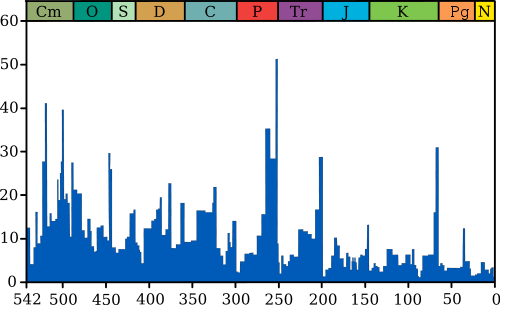
So let’s start there, with the Cambrian Period and the flourishing of life on earth. Consider the chart below:

Mass_Extinction_500px-Extinction_intensity.svg_2

The divisions across the top are geologic periods, starting with the Cambrian (“Cm”), the period of “visible life”‘ — meaning a proliferation of hardshelled species. It’s the big explosion of life on earth. The numbers across the bottom are millions of years ago. The spikes show extinction events, with the percentage of marine species going extinct expressed on the vertical or Y axis.

The chart doesn’t call them out, but starting with the Cambrian period, we’ve had three geologic eras (the larger divisions):

Paleozoic Era — “old life”
Mesozoic Era — “middle life” or the Age of Reptiles (dino days)
Cenozoic Era — “new life” or the Age of Mammals (including us)

The Paleozoic Era runs from the start of the graph to the big spike at 250 million years ago on the X axis. It encompasses six geologic periods and ended in the greatest mass extinction event on the planet — geologists call it the “Great Dying”.

The Mesozoic Era runs from the Great Dying at 250 million years ago to the big spike at 65 million years ago, the event that wiped out the dinosaurs — and every other large species. That cleared the way for mammals to grow big and thrive.

We’re now in the Cenozoic Era. Keep those transitions in mind — when mass extinctions change which groups of species can evolve and rule, it’s the end of an era and the start of another. Now look at the chart again. The whole chart shows 540 million years, and just three geologic eras. The next extinction event on the scale of the one at 250 million years ago, or the one at 65 million years ago, will change the shape of life on earth and usher in a new era. Ready for that?

[Update: For a chart that shows geologic eras, periods and their subdivisions in one place, click here. Opens in a new tab.]

Where does man fit in?

Great question — where does man fit in? Answer: We come in very late.

First, notice the last three geologic “periods” at the top-right in the chart above. The period marked “K” is the Cretaceous, the period at the end of the Mesozoic Era. The next period (“Pg”) is the Paleogene, the one that marks the start of the Cenozoic (new life) Era. The period after that (“N”) is the Neogene, which ended just 2 million years ago. The period after that, not shown, is the Quarternary Period, our current one.

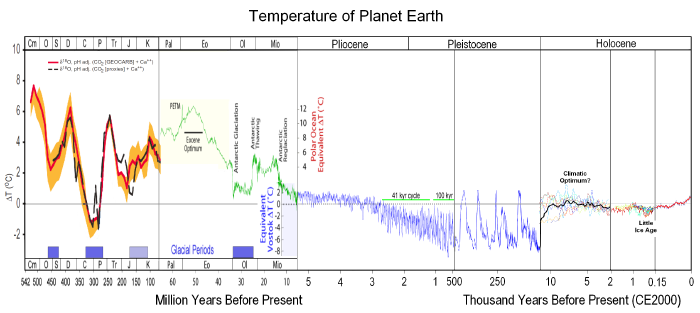
The Neogene-Quarternary boundary is the start of the time of great glaciers, and the best way to show that is with the chart below, showing earth temperatures mapped across the geologic periods (at the left end) and geologic epochs (the rest of the chart).

Earth_tem_All_palaeotemps_700px

Click here to open the full version in another tab. It’s a big, interesting chart. (Source here.)

First, get oriented. On the Y axis is global temperature using change — in °C — from global temperature in the year 1800 as the norm or zero mark. (The global pre–Industrial Revolution temperature is generally the mark from which other global temperatures are measured, unless otherwise noted. To convert from °C to °F, just double the number; you’ll be pretty close.)

On the X axis, the first big division — from 542 million years ago to 65 million years ago — represents the first two geologic eras, the Paleozoic and Mezozoic (which unfortunately aren’t called out on this chart). “K” at the top and bottom is still the Cretaceous Period, and the end of the Cretaceous Period is also the end of the dinos and the end of the Mesozoic Era.

In this respect, both charts are the same. Man hasn’t showed up yet — our mammal ancestors were the equivalent of field mice in that world, small prey with soft shells and hiding skills.

But before we look at the rest of the X axis, notice that in the left-most part of the chart, the Y axis shows a huge change in global temperature relative to pre-Industrial norms. Looks like a monster spike, especially the first one, doesn’t it?

The Cambrian temperature spike is 6–8°C (about 11–14°F) higher than pre-Industrial levels.

It’s also the temperature we’re headed for by 2100.

But let’s not get distracted. Let’s set some markers in this chart in the horizontal (time) dimension. The whole rest of the chart — the part after the period called “K” — shows the Cenozoic Era (“new life” or Age of Mammals). From here to the right, the chart’s subdivisions show Epochs, which are sub-parts of Periods.

[Update: For a chart that shows the relationship between eras, periods and epochs, click here. it will help you stay oriented.]

Jump through the next five divisions — the epochs marked “Pal” through “Pliocene”. That takes you through the Neogene Period (“N” in the first chart) and to the start of the modern Quarternary Period, the one we’re in, and the one we’re interested in.

The epoch of the Pleistocene, which starts the Quarternary Period (again, see the chart), is the great age of glaciers. Homo habilis evolves at this time, a little over 2 million years ago. Homo erectus evolves shortly afterward. Each starts in Africa — now you can probably guess why — and each leaves Africa and spreads across the globe. (Homo erectus, by the way, lasts a long time on this earth. Longer than us by a lot.)

Homo sapiens evolved much later, in the Pleistocene — the age of glaciers, remember — just 250 thousand years ago, almost died out in Africa, but rebuilt our numbers, then spread out of Africa like our cousins. Because that was the glacier age, we’re still hunter-gatherers like the the rest of our cousins. The big beasts of the earth are creatures like woolly mammoths and sabre-tooth tigers, and we’re all alive on a fairly frozen planet with glaciers coming and going.

At the end of the Pleistocene is another extinction event. At the same time that the last glaciers recede (see chart), the big mammoths and tigers (et al) die off. Simultaneous with a noticeable change in climate, what we call “human civilization” begins. You can see that above, around 12–10 thousand years ago as the planetary temperature stabilizes. From then until almost now, planetary temperature is pretty stable. Notice it doesn’t take much of a wobble to mark the “Little Ice Age”.

Just two more points to make in this piece and I’m done.

First the bad news

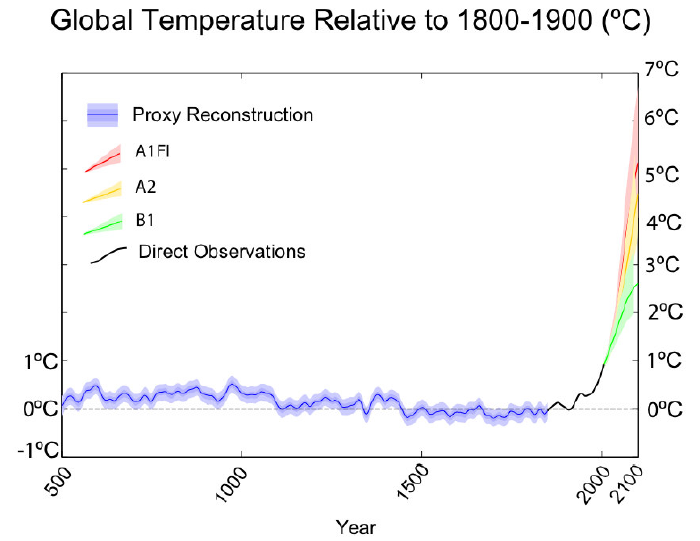
Folks, that little climb in temperature you see near the right end of the graph above is just the beginning. Remember the Cambrian spike at the left end of the graph? Take another look and note the increase — about 7°C. Now here’s Figure 21 from the Copenhagen Diagnosis, a report prepared by … oh … every single one of the world’s top climate scientists for the benefit of our world’s “leaders,” who met in 2009 to discuss how to pass the climate buck one more time:

Copenhagen_Diagnosis_Fig_21_LARGE

What you see is temperatures from 500 AD to about 2000, with a number of prediction scenarios going forward. See the scenario called “A1FI”? It’s the one in red. That’s the one we’re on if we don’t stop spewing carbon. I call it the “do nothing” scenario — otherwise known as the “Keep David Koch Happy” scenario.

All you need to know? We’re on track for about +7°C — the peak temperature in the big Cambrian spike — by the year 2100.

Now the good news

Despite all this doom-and-gloom, it’s not over yet. Truly. By my calculation, we have a 5–10 year window to avoid the catastrophe. It won’t be easy — we’re past the point where any transition will be smooth — but we can make the transition and survive as a civilized species, humans in a recognizable world.

But two things are needed:

  1. This has to be our top priority, which means you and everyone you know has to be fully aware and in full battle gear. (For reference, it’s called “hugging the monster.”)
  2. It’s us vs. David Koch and all of his friends and enablers. Tackling any other enemy is tackling a dummy while the game is being played.

Educate your friends, and put a wrench into the Koch machine. How’s that not a plus?

If the Koch Bros keep getting rich, we move backward. If Barack “Hope & Change” Obama approves Keystone, we move backward. If the U.S. develops “domestic oil” resources, we move backward. For every new car (“carbon-delivery system”) sold, we move backward. People need to know this and think like this. We can stop the crisis, but only if we stop carbon. It’s that simple; and that stark.

But it’s also doable, and we’re the species that’s most equiped for “doable.” It’s what our big brains are for.

I’ll have more in the weeks and months ahead. I haven’t given up, not by a long shot. But you can’t pull out of a tail spin if you don’t admit you’re in one. Me, I think we can pull out.

oooOOOooo

So presumably if you are reading this, you have read the essay above.  I hope so because while at first sight there appears to be much to take in, the story is clear, informed and powerful.  You are unlikely to change the mind of a committed ‘denier’ but if there’s a little part of you that isn’t utterly clear about the risks ahead, then this essay is a fabulous opportunity to embrace clarity – and not to give up hope! Remember those words in the essay:

“By my calculation, we have a 5–10 year window to avoid the catastrophe. It won’t be easy — we’re past the point where any transition will be smooth — but we can make the transition and survive as a civilized species, humans in a recognizable world.”

Oceans and Minds.

How the linking of minds offers us vast horizons!

I subscribe to two blogs: Pendantry’s Wibble and Christine’s 350 or bust. But a temporary lack of quiet reading time has meant that recent posts from each of them were initially only briefly skimmed.  I made a mental note to read the one from Pendantry, Where oceans meet, because I have always had a love affair with the oceans.  When I did read it, I was blown away, to use the modern vernacular.  Why?  Stay with me.

Where oceans meet opened thus:

I’ve recently been introduced to two things that demonstrate (to my satisfaction, anyway) that the universe is much stranger than I first thought. Mind you, my first thought was quite some time ago, now.

Then after showing a wonderful photograph of where the Indian Ocean meets the Southern Ocean, (this one below) …

Twooceansmerging
Even vast oceans come together.

…. Pendantry goes on:

The other one of those ‘strange universe’ things is something that I find even more surprising: after decades of eating meat, an hour watching just one film has persuaded me to reconsider the habits of a lifetime.

That really jumped off the page at me because Jeannie has been a vegetarian for most of her life and I have been flirting with the idea.

That ‘one film’ was Vegucated.  Here’s the rest of that Wibble post republished with Pendantry’s kind permission.

oooOOOooo

A TED talk highlighted yesterday over on 350orbust (well worth watching — thanks, Christine) included a reference to the film Vegucated. Intrigued, was I, so I trundled off to watch it, and returned a changed man. Well, maybe that’s a bit ambitious, but I do now feel motivated to think more about what I eat, why I’m eating it, and to actively seek out vegan alternatives — something that I have never considered before.

vegucated-meat-means-disease-350_zpsc6ef410f
More meat equals more disease.

Vegucated reinforces the betrayal of a society that has sold us all on the idea of having ‘consumer choice’ — but continues to withhold from us the information necessary to make informed choices. And on that point: don’t just take my word for it that this is a film well worth watching: there are many other reviews and quotes about it.

Einstein deliberated, and chose a vegetarian lifestyle

Our world is changing, and, one way or another, we must change with it. I believe that films like Vegucated are essential to help us to choose to move in the direction of a healthier, happier world.

If slaughterhouses had glass walls, everyone would be vegetarian. “— Paul McCartney.

oooOOOooo

As you can see Pendantry referred to Christine’s recent post on 350orbust.  That post was called Are You A Changemaker?

Naturally I was curious and wandered across to that post.  Here are Christine’s own words,

It’s TED Talk Tuesday on 350orbust, and today’s presenter is Zoe Weil who spoke to the young people who gathered at the TEDx Youth symposium held at Cape Elizabeth, Maine, last December. Ms. Weil is the co-founder and president of the Institute for Humane Education. Ms. Weil’s inspiring talk is entitled “How To Be A Solutionary.” Enjoy!

I tell you what!  That 11 minute presentation by Zoe Weil was not just inspirational, it was one of the most inspirational speeches I have ever heard!  That’s EVER!

Take this quote that comes in less than 2 minutes from the start of the speech, “Never before have we had the capacity to cause the breakdown of so many ecological systems that sustain our life.

Now if that doesn’t have you gagging for the rest of what Zoe talks about, nothing will.  So here it is.

Published on Jan 11, 2013

Zoe Weil is the co-founder and president of the Institute for Humane Education and is considered a pioneer in the comprehensive humane education movement, which provides people with the knowledge, tools, and motivation to be conscientious choicemakers and engaged changemakers for a better world. Zoe created the first Master of Education and Certificate Program in Humane Education in the U.S. covering the interconnected issues of human rights, environmental preservation, and animal protection. She has also created acclaimed online programs and leads workshops and speaks at universities, conferences, and events across the U.S. and Canada. She has taught tens of thousands students through her innovative school presentations, and has trained several thousand teachers through her workshops and programs. Zoe’s most recent book, Most Good, Least Harm: A Simple Principle for a Better World and Meaningful Life, won the 2010 Nautilus silver medal in sustainability and green values. She is the author of several other books including Above All, Be Kind: Raising a Humane Child in Challenging Times for parents; The Power and Promise of Humane Education for educators; and Claude and Medea: The Hellburn Dogs, winner of the Moonbeam gold medal in juvenile fiction, which follows the exploits of two seventh graders who become clandestine activists in New York City, righting wrongs where they find them. Zoe received a Master of Theological Studies from Harvard Divinity School and a Master of Arts from the University of Pennsylvania.

So from the meeting of vast oceans to the meeting of minds.

Fancy a tiny pet?

When I say tiny, I mean tiny!

A few days ago, dear friend Dan Gomez sent me a link to an article in the March/April edition of Maui Magazine (must admit not heard of it before).

It was a story written by Shannon Wianecki under the title of ‘Eight Tiny Steps for Tardigrades‘.  Here’s how it opened;

Eight Tiny Steps for Tardigrades

phpThumb.php

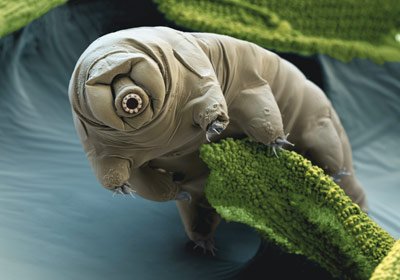
It might sound like a fairy tale, but it’s fact: Haleakala National Park is home to a troupe of tiny bears. But don’t bother searching for these wee creatures. Tardigrades, better known as water bears, are miniscule, ranging from 50 to 1,200 microns. Which means a couple of water bears could fit into the period ending this sentence.

Water bears are so named for their appearance and form of locomotion. Like microscopic grizzlies, they pad along on eight stumpy legs, brandishing claws and short snouts. Another name — moss piglet — refers to the animal’s most common habitat. Tardigrades are aquatic, but to creatures of their size, suitable swimming holes include the moisture clinging to mosses, or the capillary water between grains of sand. They are found all over the globe: in the arctic, desert, deep sea, and — most of all — in Hawai‘i.

Now if I blow the dust off my aged brain, I recall that a micron is a millionth of a metre (or meter in American speak).  Whatever the spelling, that is small.

So even if this little creature can be up to 1,200 microns ‘big’ that would still only be 1.2 thousandths of a metre.

The article is well-worth reading in full.  However, I will take the small liberty of republishing the final paragraph;

In 2007, water bears joined astronauts in space to see how they handled cosmic rays. Exposed for ten days to the vacuum of space, without oxygen, water, or heat, and zapped by intense solar radiation, water bears became the first animals to survive in space.

Back on Earth, the mini-cosmonauts continued to breed successfully. Investigating the molecular makeup of these amazing creatures may show humans how to survive future space explorations.

Now without wishing to be too basic, I would love to have this question answered: How does something that small breed?  Indeed, how could they ever find each other?

So if you are a pet owner and a bit worried about the costs of feeding and looking after your beloved animal, don’t worry! There’s something else in town a little bit smaller!

A small island called Utila.

Something inspirational and encouraging (for a change!)

As regular readers of Learning from Dogs will know, I subscribe to news items from The Permaculture Institute of Australia.  It is much recommended.

Well just the other day, this item came up:

Permaculture Recycled

Off the coast of Honduras, on a small island called Utila, lives a guy called Shane. Shane has broken away from all the social restraints and has built his own house. He is now building his own garden. However, he is doing it slightly different from most people — he uses cardboard boxes! This short film by Serena Aurora talks about Shane’s key concepts and tips on permaculture.

It’s a deeply moving film.

I’m sorry but I forget!

I can remember everything, except the things I forget!

Today’s post is about something that at it’s heart is no laughing matter; loss of memory.  But the opportunity to open in a slightly frivolous manner is simply too tempting!

Because I admit to not remembering when I started to lose my memory! 🙂

But somewhere along the way during the last 5 or 6 years others around me, especially Jeannie, started noticing that my mental recall wasn’t so good.  In November, I shall be 69 and have been told (I forget by whom!) that the sort of life changes that these last few years have delivered would be classic causes of declining memory in a person in their sixties.

OK, on with the show.

Some time ago, I received an email from a Daniel Strauss.  This is what Daniel wrote:

Hi,

I’’m a contributor to an education improvement resource and I recently published an article providing many tips about improving your memory I think you’ would be interested in. I found your site and your item, Let’s do nothing, during my research and would like to invite you to take a look at my published piece.

Please let me know if you woul’d be interested in taking a look and possibly sharing with your readers.

Thanks,

Daniel

My reply was to query Daniel’s motivation before saying ‘yeah’ or ‘nay’.  A further email subsequently arrived:

I am one of many contributors on a research project and recently completed work on resource that provides quick and easy tips to keep your mind sharp and be able to remember things you’ve learned. I reached out because I thought you and your readers would be interested in my resource. Here is the link to the resource. Take a look and let me know if you would consider including it among the other resource links that you’ve provided on your site.

Look forward to hearing from you.

Thanks for your help.

I was happy to feature these memory tips.

The 75 tips are on a website that is called the Open Education Database, from which one learnsWe’ve compiled the Open Education Database (OEDb) to help ambitious or prospective students find the most convenient, valuable, and relevant education programs to fulfill their academic and career objectives.

Not entirely sure why a feature on memory is part of the OEdb website, but so what!  The tips strike me as fabulous advice.

The memory feature is called The Memory Toolbox: 75 Tips and Resources to Go from Amnesic to Elephantic, and is introduced, thus:

Many people expect increasing memory loss as they age, but this memory loss can be reduced or stalled with some simple memorization techniques, physical exercise, and a reduction of stress. In fact, impaired memory has more to do with chemicals that are released in the brain when an individual suffers from chronic stress. But, you can reduce the obstacles and increase your memory capacity with the seventy-five tips and resources listed below. In fact, you can go from amnesic to elephantic within a few short weeks.

Some of the tips you may already know, but we’ve repeated them because they may have slipped your mind. Other tips are from recent news stories that contained information you may not have heard. The links will take you to those news items and to other resources that you can use to increase your capacity to remember anything you deem important.

The 75 tips and resources are sorted into 10 groupings; here are some of the recommendations:

Be in the Moment

You can’t remember something if you’ve never learned it, so focus on learning.

It only takes about eight seconds to process data through your hippocampus into the appropriate memory center, so it doesn’t take long to absorb information.

To learn how to stay in the moment, don’t focus on the past or worry about the future while you’re learning.

Don’t multitask, as you create a “brain drain” when you focus on more than one activity.

Create a Learning Environment

Create a learning environment at home. This is crucial for adult learners who will be taking online courses, while balancing work, family, and other factors.

Use All Your Senses

If you’re learning something, involve as many senses as possible to help retain the experience.

Drawing and writing includes the use of motor skills that help you to remember information as you stimulate motor pathways.

If you utilize these motor skills in a task, don’t try something new for a few days. Instead, repeat some of the exercises listed immediately below a few times during the first week so that they become ingrained with your learning habits.

Talk with another person about the information you’ve gathered. This action will incorporate more than one sense and it will help you to categorize information as well.

Attach your ideas to an inert object for your learning process. For instance, connect the introduction of a speech to the entrance of the house, move on to the next room to connect the introduction to the next idea, and so on throughout a building.

Use Mnemonic Devices

Mnemonic (the initial “m” is silent) devices can provide clues to help you remember things. For instance, you can use visual images to memorize names, places, and events. If you wanted to remember Tom’s name, think of a tom cat and connect that person to that image. Or, use something more obvious, like Queen Victoria for Victoria. Just place an imaginary crown on Victoria’s head and you might remember that person’s name the next time you meet them.

“Every Good Boy Does Fine” is a sentence that many musicians use to remember the lines in a treble staff (E, G, B, D, and F). Medical students use silly sentences to remember anatomical features. Try this tool when you need to memorize a sequence of difficult words or a series like the biological taxonomy (Kingdom, Phylum, Class, Order, Family, Genus, Species): “Kids Played Cards On Furry Gray Skins.”

Connect new data to information you already know. For example, if you already know how to cook a turkey, use that information to relate to how you might cook a goose. You’re merely building on information you’ve already retained and relating it to a new recipe. The new recipe will be easier to remember.

Organize

Disorganized people report more memory problems than those individuals who are accustomed to organization. This ability to organize is external as well as internal…External organization can free your brain up for more creative endeavors. Internal organization requires a less stressful lifestyle.

Write things down, but write them down in appropriate places. For instance, write addresses in address books, and write grocery lists in a special notebook that you’ve designated for that list. Accordingly, use specific places in the house for certain items. For instance, if you hang the keys on a hook by the door when you enter, you won’t need to sap your time or brain power to find those keys.

Use online or paper calendars to remember important dates. This will help you to be more social, on time, and employed. Plus, you can free up your mind for more creative endeavors.

Keep a pad, pencil and small flashlight by your bed to write down ideas that you have at night. If you forget these tools, just move something out of place so that you’ll remember that idea in the morning (just throw a tissue or book on the floor so you see it in the morning – those items will trigger memories of the previous evening).

Increase your scholarly productivity with tools that will help you stay organized online.

Overlearn

Spend some time with new material a few hours after you’ve been introduced to it. Review notes and try to consolidate the notes into a broad concept or idea.

Review notes and other information at intervals throughout the next few days. This is called “Spaced Rehearsal” or “Spaced Repetition,” and it’s a more effective method for learning than cramming.

When you use overlearning, you improve recall speed.

Retain a Positive Attitude

Tell yourself that you want to learn and that you can learn and remember the information at hand.

A positive outlook and positive mental feedback sets up an expectation for success.

Exercise Regularly

Exercise increases oxygen to the brain, and oxygen is important for brain function.

Physical exercise reduces the risk for many disorders that relate to memory loss, such as dementia and cardiovascular disease.

The hippocampus is especially vulnerable to age-related deterioration that can affect how well you retain information, so it’s important to maintain an exercise routine as you age.

Walking is not strenuous (unless you power walk), so your leg muscles don’t take up extra oxygen and glucose like they do during other forms of exercise. If you find yourself stressed, take a few minutes to oxygenate your brain with a leisurely walk.

Manage stress

Cortisol, the stress hormone secreted under stress by the human adrenal gland, near the kidneys, can damage the hippocampus if stress is unrelieved.

Physical exercise can help to relieve stress. Even a simple walk can help to clear the mind.

Jokes, soothing music, and even a short nap can help to break the stress.

On the other hand, arousing, exciting, momentous occasions, including stressful ones, get filed away very readily. If you can remember your first date, your first job, 9/11, or when Kennedy was shot, these examples prove that some stressful occasions can create vivid memories.

Other Good habits

A good night’s sleep is necessary for memory consolidation. Sleep disorders (especially in aging women) can leave you tired and unable to concentrate during the day.

Quit smoking – smoking constricts arteries that deliver oxygen to the brain. Research has proven this memory loss in smokers.

Relaxation through meditation, tai chi, yoga, or other techniques that slow respiration, slow metabolism, and release muscle tension can make a huge difference in your overall health and stress levels. Invest about ten to fifteen minutes per day with these techniques.

Staying properly hydrated can do more for your body and mind than eating, at times. Drink your recommended 8-10 glasses per day.

So if you, like me, find the loss of one’s memory to be frustrating, or worse, make a note of the Memory Toolbox website and work your way through all 75 excellent tips and recommendations. It’s a fabulous resource.

I’ll shall be adding the link to my ‘blogroll’ – so long as I don’t forget! 😉