A warning of the dangers of cell phones and the like!
Yesterday, I simply ran out of time to write to write a more personal post for today. So I looked at some of the news items that I had collected recently and two jumped out as being both deeply connected and worthy of posting.
The first was an item that was seen on Natural News a little more than a couple of months ago. It had the title of EMF exposures destroy health and well-being, claims panel of top international scientists. The link to that article is here. It opens, thus:
(NaturalNews) Nearly 8 million people worldwide die from cancer on an annual basis. Cardiovascular disease is the number one cause of death, killing almost 17 million people in 2011; both of these statistics are spiraling out of control. Now three top scientists, Dr. Panagopoulos of the University of Athens , Associate Prof. Johansson of the Karolinska Institute, and Dr. Carlo of the Science and Public Policy Institute, are sounding the alarm bell.
Leaders in their respective fields, Panagopoulos, Johansson, and Carlo, claim electromagnetic field (EMF) exposures significantly below international safety levels exposures are destroying the public’s health and well-being.
Recent study findings
This latest study concluded the present standard of measuring EMFs, Specific Absorption Rate (SAR), to be totally inappropriate. SAR measures the heating effect of EMF based technologies like microwave ovens, cell phones, cordless phones, Wi-Fi and the like. But countless studies have brought to light adverse biological effects at radiation levels significantly below levels where a thermal effect is detected.
Please do go here and read the full article. Because as one reads from the closing advice, as below, whom these days isn’t being affected?
Basic EMF protection
Reducing personal exposure to EMFs is a fairly easy endeavor. Basic EMF protection can be achieved by:
• Texting instead of talking with cell phones
• Setting cell phones on airplane mode when not in use
• Clearing the bedroom of electrical devices
• Replacing Wi-Fi with a hard-wired connection
Taking these simple steps is well worth the effort; the power to reduce EMF exposure and the adverse health effects that stem from them are truly right there at your fingertips.
Multifocal Breast Cancer in Young Women with Prolonged Contact between Their Breasts and Their Cellular Phones
Abstract
Breast cancer occurring in women under the age of 40 is uncommon in the absence of family history or genetic predisposition, and prompts the exploration of other possible exposures or environmental risks. We report a case series of four young women—ages from 21 to 39—with multifocal invasive breast cancer that raises the concern of a possible association with nonionizing radiation of electromagnetic field exposures from cellular phones. All patients regularly carried their smartphones directly against their breasts in their brassieres for up to 10 hours a day, for several years, and developed tumors in areas of their breasts immediately underlying the phones. All patients had no family history of breast cancer, tested negative for BRCA1 and BRCA2, and had no other known breast cancer risks. Their breast imaging is reviewed, showing clustering of multiple tumor foci in the breast directly under the area of phone contact. Pathology of all four cases shows striking similarity; all tumors are hormone-positive, low-intermediate grade, having an extensive intraductal component, and all tumors have near identical morphology. These cases raise awareness to the lack of safety data of prolonged direct contact with cellular phones.
Although not my usual type of post here on Learning from Dogs a forthcoming event regarding GMOs seemed worthy of greater promotion, especially as it includes concerns about possible ‘contaminated’ dog food. The event was mentioned on the Permaculture News blog; a blog that I follow.
What was described was a free, 3-day online ‘summit’ about genetically modified organisms. Let me quote from the blog post:
The scary truth about Genetically Modified Organisms (GMOs) is being deliberately kept from you….
Fact: Your food has been unnaturally changed. These changes have very serious consequences.
Your family’s health is at risk and you deserve the truth….
We’re going to share with you the true effects of genetically engineered food on human health and the environment. You’re invited to join our panel of experts, researchers and activists in an inspirational and free, 3-day GMO Summit — October 25-27, 2013.
This is a virtual event you can enjoy at no cost from the comfort and convenience of your own home.
If you want to know the truth about GMOs and the risks Monsanto, the government, their paid advisors and the media are deliberately hiding from you, then join in this unique, free summit.
There’s an impressive line-up of 10 main speakers and another 10 supplementary speakers. And, as the blog post goes on to say:
We didn’t want to overwhelm you in just 3 days, so once the GMO Mini Summit is complete, you’ll get even more empowered by 10 more experts in interviews over the next 5 weeks (2 per week) who will share even more about this crucial topic. When you register for free you will gain access to all 20 speakers!
So you need to go here to sign up, after which you will be directed to a welcome page. There you will learn more about the way that GMOs are affecting so many aspects of our lives and of the lives of our beloved dogs.
Note:We have a flooring contractor in the house all week and it’s making it a little tricky to spend the couple of hours a day that is my usual pattern for writing posts for LfD. So apologies if this week’s posts are more dependent on the thoughts of others than is usual.
Alain de Botton
Alain de Botton is a familiar face on British television. WikiPedia’s entry describes him, thus:
Alain de Botton, FRSL (born 20 December 1969) is a Swiss/British writer, philosopher, television presenter and entrepreneur, resident in the United Kingdom. His books and television programmes discuss various contemporary subjects and themes, emphasizing philosophy’s relevance to everyday life.
He has been the presenter of a BBC Six-part series called Philosophy: A Guide To Happiness. And who wouldn’t be turned on by that!
Luckily, all six episodes are available on YouTube, at this overall link.
But I wanted to share the first episode because despite the title being Socrates on Self-Confidence it really speaks to our lives in this year of 2013.
Moving on.
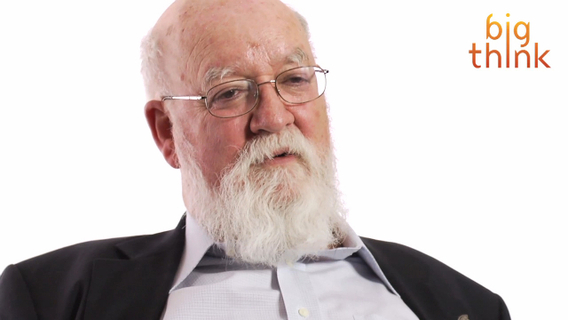
A recent item on Big Think, again about philosophy, jumped off the page at me. It specifically looked at making our life, as in mental health, easier in these demanding times. It was by Daniel Dennett and was called The Philosopher’s Self-Help Book.
Daniel Dennett
oooo
The Philosopher’s Self-Help Book (with Daniel Dennett)
While Silicon Valley and Silicon Alley busy themselves making every aspect of our lives more efficient (except, perhaps, for the process of discovering these new technologies, learning them, and integrating them into our lives), Daniel Dennett sits up at Tufts University in Massachusetts, philosophizing. His latest book, Intuition Pumps and Other Tools for Thinking is an attempt to make transparent some of the tricks of the philosopher’s trade. In an accelerating age, it’s a self-help book designed to slow the reader down and improve our ability to think things through.
The kinds of things Mr. Dennett likes to think about include the nature of consciousness, evolution, and religious belief. But the mind-training his new book offers is applicable to any problem you want to consider thoroughly. In an age of quick fixes and corner-cutting, we’re in constant danger of bad decision making – of overreliance on what cognitive psychologist Daniel Kahneman calls “system 1”, and what most of us call intuition. This rapid decision making channel of the brain is helpful when we are in mortal danger, or pressed for a quick decision within our areas of expertise. But for most decisions, the slower, more deliberate channel (system 2) is much more reliable. What Dennett offers, then, in Intuition Pumps, is a workout for system 2 – a series of thought experiments you can apply to puzzles real and imagined to bulk up the slower, wiser parts of your consciousness.
Some of the tools Dennett offers in the book are more familiar than others. Reductio ad absurdum arguments, for example, in which we test the validity of a claim by taking it to its most outrageous illogical extreme (a: “all living things have a right to liberty.” b: “so let me get this straight – a blade of grass has a right to liberty? What does that even mean?”). But the true delights of the book are the far-out exercises Dennett and his colleagues have dreamed up in the course of their work, such as “Swampman Meets A Cow-Shark”, from Donald Davidson, which begins:
Suppose lightning strikes a dead tree in a swamp; I am standing nearby. My body is reduced to its elements, while entirely by coincidence (and out of different molecules) the tree is turned into my physical replica. My replica, The Swampman, moves exactly as I did; according to its nature it departs the swamp, encounters and seems to recognize my friends, and appears to return their greetings in English.
Walking us through Davidson’s considerations about whether and to what extent the Swampman is anything like Davidson, and related ones about a cow that gives birth to something that looks exactly like a shark (yet has cow DNA in all of its cells), Dennett teaches us a surprising lesson about the utility of wild philosophical speculation.
Cloaked in the breezy, familiar trappings of a self-help book, Intuition Pumps is in actuality a dark mirror of that genre – a field of rabbit holes designed to leave the reader with more questions than answers, and wiser for the long and indirect journey.
Watch for Daniel Dennett’s Tools For Better Thinking – a Big Think Mentor workshop coming soon.
oooOOOooo
I’m tempted to put the book on my own reading list. If you want to drop into the appropriate Amazon page there is an audio link plus the option to read an extract. Amazon describe the book, as follows:
One of the world’s leading philosophers offers aspiring thinkers his personal trove of mind-stretching thought experiments.
Over a storied career, Daniel C. Dennett has engaged questions about science and the workings of the mind. His answers have combined rigorous argument with strong empirical grounding. And a lot of fun.
Intuition Pumps and Other Tools for Thinking offers seventy-seven of Dennett’s most successful “imagination-extenders and focus-holders” meant to guide you through some of life’s most treacherous subject matter: evolution, meaning, mind, and free will. With patience and wit, Dennett deftly deploys his thinking tools to gain traction on these thorny issues while offering readers insight into how and why each tool was built.
Alongside well-known favorites like Occam’s Razor and reductio ad absurdum lie thrilling descriptions of Dennett’s own creations: Trapped in the Robot Control Room, Beware of the Prime Mammal, and The Wandering Two-Bitser. Ranging across disciplines as diverse as psychology, biology, computer science, and physics, Dennett’s tools embrace in equal measure light-heartedness and accessibility as they welcome uninitiated and seasoned readers alike. As always, his goal remains to teach you how to “think reliably and even gracefully about really hard questions.”
A sweeping work of intellectual seriousness that’s also studded with impish delights, Intuition Pumps offers intrepid thinkers—in all walks of life—delicious opportunities to explore their pet ideas with new powers.
Speaking of ‘pet ideas with new powers’ prompts one to reflect on the amount of time that dogs spend thinking! As the following picture confirms!
It’s easy to underestimate just how powerful the brain can be.
Last Friday’s post was called Instinctive behaviours and explored the notion of instinct, coming to the conclusion that almost everything the brain does is a result of learning rather than genetics. Yet acknowledging the vast amount of brain activity that runs in ‘background’ mode or subconsciously.
That was brought home to me in spades as a result of being introduced to the flying of gliders, or sailplanes in American speak. The year was 1981 and working near to me in my offices in Colchester, Essex was a gentlemen running his own company, like yours truly. His name was Roger Davis and we were sharing a beer one day when the subject of flying came up. It piqued my interest so, as my logbook declares, on the 7th June, 1981 I had the first of two flights in a glider with Roger at the controls. The place was Rattlesden Airfield, an old wartime airfield near Felsham, Bury St. Edmunds in Suffolk. The gliding club was Rattlesden Gliding Club.
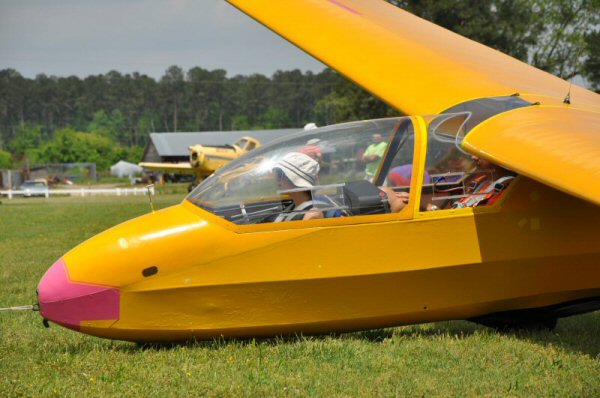
The glider we were in was known as a K-7, a high-wing, two-seater (naturally!) glider with the instructor sitting behind the student.
A K-7 typical of the glider I first flew in at Rattlesden GC.
Anyway, some 43 flights later, I was signed off to conduct my first solo flight in the K-7. The date was 5th September, 1981 and my flight time was just 4 minutes! I was hooked.
In over 10 years of flying amounting to more than 1,400 flights I had the great fortune to experience much of the magic of flying relying on nothing more than the currents of air.
Ahh! Memories! Over 10 years of glider flying, amounting to more than 200 hours of flight-time, 17 different types of glider. Longest flight was 5 hours, 16 minutes including a climb to over 6000 feet above sea-level on the 7th July, 1985 in a single-seater LS4 glider type.
So what’s this got to do with subconscious thinking? Simply this.
One quickly learnt that once the decision had been made to land, most frequently because one was unable to find further, or any, rising air currents the brain had a major computing task in hand. As the aircraft descends, the air currents change and the direction and velocity of the wind changes. There is no engine to allow one to abort the landing; to do a ‘go round’!
One of the key visual judgments was determining the point of touchdown: not too early that might risk a ground contact before the start of the runway, and not too late which might risk running out of landing space.
Thus the brain was operating clearly in two modes. Consciously, computing second by second where the touch-down point was going to be and, subconsciously, the flying of the glider as in operating the joystick and rudder pedals in support of the touch-down ‘computations’.
Moving on.
In last Friday’s post, I also wrote this: “Plus something that could just possibly be the key to mankind having a long-term sustainable future on this planet: The Power of Thinking.”
That ‘something’ was me reflecting on an article in the October 7th edition of FORTUNE magazine. Not something I read on a normal basis but just happened to come across that edition – and glad I did. Because there was an article about IBM’s new supercomputer Watson. The link to the summary is here, from which I republish this:
Dr. Mark Kris is among the top lung cancer specialists in the world. As chief of thoracic oncology at Memorial Sloan-Kettering (MSK) Cancer Center in New York City, he has been diagnosing and treating patients for more than 30 years. But even he is overwhelmed by the massive amount of information that goes into figuring out which drugs to give his patients — and the relatively crude tools he has to decipher that data. “This is the standard for treatment today,” he says, passing me a well-worn printout of the 2013 treatment guidelines in his office. We choose a cancer type. A paragraph of instructions says to pair two drugs from a list of 16. “Do the math,” he says. It means more than 100 possible combinations. “How do you figure out which ones are the best?”
It’s a huge problem. More than 230,000 Americans will be diagnosed with lung cancer this year. Almost all of them will receive chemotherapy. As crude as the existing guidelines are, says Kris, they won’t be followed more than half the time. If we bumped up adherence by just 10% to 20%, he says, as many as 30,000 people might live longer. Never mind curing cancer — shouldn’t we be able to get the best available combinations of medications to sick people now?
That’s the question that led Kris to IBM. He saw that more information was not the answer. What doctors needed was a better brain — one that could instantly vacuum up facts, draw deeper connections between data points, and remember everything. They needed Watson.
Just read that last paragraph again. That it’s not about information, it’s about offering humanity computing power that can see things that humans might not easily see.
Thus, I mused that when mankind gets to the point where there is total and complete commitment to finding a non-carbon-burning way ahead for every living thing on this planet we won’t have the luxury of countless years working out the new journey directions. Maybe, just maybe, computing power a la Watson might just be our saving grace.
Curious to learn more about IBM Watson? Then here’s the relevant website.
We see instinct as common across all species including man, so why is so little known about it.
There was an item seen on the BBC Capital website. It was an article about intuition:
Trusting your gut: Smart management or a fool’s errand?
by Eric Barton*
Photographer Mindy Véissid woke up one winter morning in 2010 with a simple idea: dogs running in the snow.
“That’s all I had,” she recalled.
The Manhattan resident followed her gut and went across town to Central Park. There, Véissid found three dogs jumping around in a couple of inches of new snow covering the famed park’s Great Lawn. She plopped down in the field and waited. That’s when the dogs headed right for her. She snapped off a shot just before they barrelled over her.
The picture she took that morning, of happy-looking pups charging through a cloud of snow with the New York City skyline behind them, has become one of Véissid’s calling cards, maybe her most recognisable shot. It’s a photo she would have missed if she had not trusted her gut.
“What I realised is that if I follow my heart, if I follow my feelings, I get good photographs,” Véissid said. “We try to control everything in our lives, and sometimes you have to let go.”
It wasn’t long ago that decision-by-intuition would have been regarded as little more than magical thinking or a try at luck. But research has changed that and intuition has been embraced as a key component to business decision making.
There is, however, an inherent danger to it, and blindly following your gut can be worse than ignoring it altogether. For managers, that means learning how to trust your own instincts and encouraging employees to do the same. But it also means learning to recognise when careful planning trumps sudden inspiration.
Perhaps the thing that most changed the way businesses think about inspiration was a 2008 study co-authored by Gerard Hodgkinson, professor at Leeds University Business School in the United Kingdom. Hodgkinson found that intuition can be beneficial in specific circumstances. First, it’s best to rely on a gut feeling when you need to make a quick decision. Second, and this is the important part, trust your intuition only when you have extensive knowledge on the subject. In other words, the best intuition is pulled from a well of deep knowledge and expertise.
“A lot of people think intuition is general purpose, but intuition is actually domain specific,” said Massimo Pigliucci, a philosophy professor at City University of New York, and author of Answers for Aristotle: How Science and Philosophy Can Lead Us to A More Meaningful Life. “Intuition is the result of your subconscious brain picking up on clues and hints and calculating the situation for you, and that’s based solely on experience.”
Wrong to republish the whole piece, however I do want to republish the closing paragraphs as they are so relevant to today’s post.
Western cultures began to embrace intuition only recently, Pigliucci said, while research suggests Southeast Asian countries have long given credit to gut feelings being a good guide to decision making. Eastern managers, for instance, are more likely to rely on hunches and give them credit for successes afterward.
After photographer Véissid learned to rely on her gut feelings, she wanted to teach others how to do it. Her class, the Art of Intuitive Photography, teaches the photography basics, but her instruction is more about following hunches.
“You can get a good photograph and it will be technically correct,” she said. “But if you follow your heart, you can take photos that can be wonderful.”
Follow BBC Capital on Twitter @BBC_Capital or follow us and join the conversation about this or any other Capital story on Facebook: BBC Capital on Facebook.
—-
* Eric is a freelance journalist who lives in Fort Lauderdale, Florida. He is formerly a writer and editor at New Times in Fort Lauderdale and The Pitch in Kansas City, Missouri. His work has been featured by the Florida Center for Investigative Reporting.
To my mind, what Eric Barton has written about is not instinctive. That is if one believes that instinct is something that is ‘hard-wired’, so to speak, into our psyche at birth, a function of our genetic heritage.
When one reflects on the start of life, ergo for all warm-blooded species that are the result of a successful copulation between the two genders of that species, then one realises that there is little functioning at birth beyond those bodily functions vital to that new life.
But if we mean by instinctive those behaviours that are subconsciously acted out while the mind is engaged on other mental processes, then that’s different.
Read that last opening paragraph again [my emphasis]:
“A lot of people think intuition is general purpose, but intuition is actually domain specific,” said Massimo Pigliucci, a philosophy professor at City University of New York, and author of Answers for Aristotle: How Science and Philosophy Can Lead Us to A More Meaningful Life. “Intuition is the result of your subconscious brain picking up on clues and hints and calculating the situation for you, and that’s based solely on experience.”
Think of when we drive a car how much of what we are doing in the ‘hand-eye’ department is being managed by our subconscious brain. Think about the way we use a language, especially the language of our birth country. One will immediately recognise that the brain is on auto-pilot. Yet we were born unable to speak, or to drive a car!
Abstract: “Innate Knowledge” is a stupid idea. The truth is the exact opposite: KNOWLEDGE IS EVERYWHERE, OUT THERE.Knowledge is the opposite of innate. This insight has tremendous consequences on our entire prehension of the world.
(It will not escape the cognoscenti that Socrates, Plato, and Aristotle, were partisans of innateness. And that believing in the superiority of inheritance is a necessary condition for racism, fascism, slavery, and hereditary plutocracy as fairness. That makes the likes of Chomsky and Dawkins self contradictory)
Subjective time slows down in smaller brains.
Fastest Wings, Fastest Brains. Anna Hummingbird California
Those wings go at 100 Hertz, four time the human perception limit.
Thus time is relative; just as light-clock time slows down in a fast reference frame, or in a heavy gravitational field, neurological timeslows down in a small neurology.
(Interestingly, the deepest reason for the slowing of time… boils down to the same in the Relativity case as in the Neurological one! It’s all about energy.)
A lot of ideas on instinct came from studying insects: insects seem to know all, without having studied anything. However, if insect time flows slowly, insects actually have time to learn.
And that’s rendered easier by having brains adapted to their environment. If they have only a few tricks to learn, and what looks like ten seconds for us is an hour for them, no wonder they learn lots. Thus slow in small explains how “instinct” works.
Hence behaviors one describes as “instinctive” are just fast studies. A lot of the silliness about “genes” is thus dispelled, and the mind comes on top.
It’s an essay that deserves the full reading. This is how it closes:
Conclusion:
Instinct As Fast Learning solves the nature-nurture problem. It also shows something else, even more important. It shows that the force of nature makes not just the force, but even the very geometry, of our minds.
(The construction of neuromorphology itself being forced by feedback from nature.)
The minds of sentient species, from bees to hummingbirds, are exquisitely tuned to be programmed by the (part of) nature they are made to respond to, all the way to the speed of time they need.
If we kill the environment, we kill out instruction set. The usual reason given to save the environment is that we would not want our descendants to live in a bad world. But what we see now is that a poor world gives poor minds, and that even time may go askew. Another, deeper than ever, reason to be a fanatical ecologist. Nature is not just our temple. Nature is where, and how, time itself is built, one neurological impulse at a time.
***
Patrice Ayme
On Monday, I have a sequel to this post. It’s an insight into the conscious and unconscious skills that come from flying a glider, or sailplane in American speak! Plus something that could just possibly be the key to mankind having a long-term sustainable future on this planet: The Power of Thinking.
But back to today.
You will recall that the item from the BBC website opened with photographer Mindy Véissid waking up one winter morning in 2010 with a simple idea: dogs running in the snow. Too good not to miss for a blog called Learning from Dogs.
Mindy’s website is here and do go across there and browse. You will quickly discover, for example:
we teach small sized group and private digital photography classes and workshops in fun locations throughout nyc, focusing on how to use your camera, how intuition can help guide you to images, and compositional improvement
So having given Mindy that small, but well-deserved, plug, I don’t feel too bad closing today with Mindy’s picture of those dogs running in the snow.
I’ve always felt great wildlife photography mapped well to the Chinese proverb “the journey is the reward.” While I obviously enjoy seeing the end result of my wildlife photography outings I get a great deal of satisfaction in the crafting of those images. My best images often rise to the top because of one of the following maxims: –
1. Backgrounds are Equally Important as Your Subject
Pronghorn Antelope (Antilocapra americana) Portrait. Canon EOS 1Ds III, Canon 70-200mm f/2.8 IS USM + 2x teleconverter, 1/250 sec, f/8, ISO 400
It has loads of fabulous advice plus some pretty neat pictures.
Take a look at the last tip:
7. Utilize Negative Space
Alert Sea Otter and Pup. Canon EOS 1Ds III, Canon 600mm + 1.4x teleconverter, 1/1000 sec, f/8, ISO 400
Don’t have a long lens? Fear not as images taken with shorter focal length lenses can help capture areas of negative space. By employing negative space you can enhance your subject by highlighting its place/scale, its environment and/or leverage contrasting color and textures to make your subject stand out.
Finally, having ‘borrowed’ these couple of images, it seems only proper to close the post with the last two paragraphs of the article promoting both the NWF and the guest author, Jim Goldstein. If you own a camera and enjoy the great outdoors then do read the article in full.
Enter the National Wildlife Photo Contest
Be sure to read Jim’s previous post about selecting the right gear for spectacular landscape photography. And, after you’ve rented your gear, planned your trip, and taken your wonderful nature photos, remember to enter the National Wildlife Photo Contest. You could win part of $6,000 in prizes, including a Grand Prize trip for two to Churchill, Canada where you can see and photograph polar bears. There are wildlife and landscape categories, but the deadline to enter is July 15, so enter soon!
About Jim Goldstein
Jim Goldstein is a San Francisco-based professional photographer and author who has been in numerous publications, including Outdoor Photographer, Digital Photo Pro, Popular Photography and has self-published a PDF eBook Photographing the 4th Dimension – Time covering numerous slow shutter techniques. Follow Jim Goldstein on Google+ | Twitter | Facebook | 500px
And let me close with a favourite of mine – a dog photograph, of course!
The immensity of the universe and what it means for Planet Earth.
Jean and I have been watching the astounding BBC Series Wonders of Life presented by Professor Brian Cox. Here’s the BBC trailer:
and there are more clips from the programmes on the relevant part of the BBC website. There is so much about the series that is breath-taking. So much that reminds one of what a beautiful and fragile planet we live on. Quite rightly, the series received great reviews. Here, for example, is a little of what the UK Daily Telegraph newspaper wrote:
Wonders of Life, BBC Two, review
Sarah Crompton reviews the first episode of Brian Cox’s latest series, Wonders of Life (BBC Two).
When it comes to presenting styles, Professor Brian Cox is hard to keep still. There isn’t a beach he won’t feel compelled to stroll on, a mountain he won’t climb, or a river he won’t jump into. And what does he carry in that bag?
Once you got beyond these irritating stylistic tropes, however, Wonders of Life (BBC Two) was Cox at his absolute best, using his natural enthusiasm to communicate complicated ideas in very simple ways. He decided, for example, to show us his own DNA by spitting in a test tube – and missed.
“A physicist doing an experiment,” he giggled, with unforced charm. But when he actually succeeded, those little strands of white that you suddenly see brought everything he subsequently said to life.
He was brilliant at explaining his thesis, which was actually about the second law of thermodynamics, so not that much of a doddle to grasp. If I’ve got it right, what Cox thinks is that life itself may have been the inevitable consequence of the laws of physics and can be explained in the same terms as we explain “the falling of the rain and the shining of the stars”.
Sarah rounds off her review, thus:
The programme’s sophisticated use of graphics, and Cox’s patient repetition of his conclusions, all added to the sensation that this is a series that is actually going to tell you something. For the BBC to unveil both this and The Story of Music over a single weekend reveals a pretty impressive commitment to public service broadcasting. Long may it last.
One of the clear messages that comes from the program is the fact that our universe and the formation of life are intimately connected. That the ‘big bang’ some 3.2 billion years ago, the huge interstellar gas clouds, the formation of the carbon atom and the subsequent long-chained molecules, the collapse of those gas clouds to form suns and planets, the start of life, evolution through natural selection to ever more complex life forms, and on and on and on were and are inevitable. The science is clear. There is nothing mystical about it.
Yes, of course, anyone with half-an-ounce of sensitivity will be in awe of it all; the power and beauty of nature and of the natural world.
But here’s the rub.
As another BBC television programme explained, the universe is bigger than beyond imagination. That was from the BBC Horizon broadcast of August, 2012: How Big is the Universe? Here’s the trailer for that programme.
Stay with me a little longer! Just look at the following image.
The Andromeda galaxy.
This image of the Andromeda galaxy, taken in infrared and X-ray, consists of over a trillion stars.
The detailed Spitzer Space Telescope view above features infrared light from dust (red) and old stars (blue) in Andromeda, a massive spiral galaxy a mere 2.5 million light-years away. In fact, with over twice the diameter of our own Milky Way, Andromeda is the largest nearby galaxy. Andromeda’s population of bright young stars define its sweeping spiral arms in visible light images, but here the infrared view clearly follows the lumpy dust lanes heated by the young stars as they wind even closer to the galaxy’s core. Constructed to explore Andromeda’s infrared brightness and stellar populations, the full mosaic image is composed of about 3,000 individual frames. Two smaller companion galaxies, NGC 205 (below) and M32 (above) are also included in the combined fields. The data confirm that Andromeda (aka M31) houses around 1 trillion stars, compared to 4 hundred billion for the Milky Way.
Please stay with me for a few more minutes. Keeping the Andromeda galaxy in mind, now read this:
ESA astronomers say that for every ten far galaxies observed, a hundred go undetected.
Astronomers estimate that there are between 100 billion and 200 billion galaxies in the known universe. A single galaxy such as the Milky Way contain upwards of 200 billion normal stars. About 75 percent of all stars in the Milky Way are less than half as massive as our Sun. In the universe at large, the majority of galaxies are classified as dwarfs, each with less than a few hundred million stars. The image above is a computer simulation of a colliding dwarf galaxy triggering the formation of the Milky Ways spiral arms.
The largest project ever undertaken to map out the Universe in three dimensions using ESO telescopes has reached the halfway stage. An international team of astronomers has used the VIMOS instrument on the ESO Very Large Telescope to measure the distances to 55,000 galaxies as part of the VIPERS survey (VIMOS Public Extragalactic Redshift Survey). This has already allowed them to create a remarkable three-dimensional view of how galaxies were distributed in space in the younger Universe.This reveals the complex web of the large-scale structure of the Universe in great detail. The light of each galaxy is spread out into its component colours within VIMOS. Follow up analysis then allows astronomers to work out how fast the galaxy appears to move away from us — its redshift. This in turn reveals its distance and, when combined with its position on the sky, its location in the Universe.
Wow!
Millions of galaxies, trillions of suns, inconceivable numbers of planets.
Please pause and let the numbers sink in.
Now back to that Wonders of Life BBC series, during which Professor Brian Cox, said, “that it is inconceivable that there isn’t life elsewhere, that life is not present on countless other planets circling countless other suns …“.
In other words, if mankind is so intent on ‘fouling our nest’ on this most beautiful of planets, so what!
In the bigger scheme of things, it matters not. Find that tough? Then go and hug a dog and enjoy the moment. For tomorrow may never come.
Who doesn’t get stressed out! Maybe not such an issue?
I have in my bookshelf a book called The Anxiety Epidemic. On the back cover it explains this:
The Pain & Stress Center was founded in 1979, but the dream started long before that. The goal is to help individuals realize their true potential and to support and conduct research in the areas of man’s greatest needs – natural alternatives.
I had seen the book in a second-hand bookshop and paid $1.99 for it!
Clearly I have some interest in the topic and like many others around me know that certain situations cause me stress.
Thus when recently there was a TED talk on the topic of ‘How to make stress your friend’ it seemed like a worthwhile thing to watch. I was not wrong!
Published on Sep 4, 2013
Stress. It makes your heart pound, your breathing quicken and your forehead sweat. But while stress has been made into a public health enemy, new research suggests that stress may only be bad for you if you believe that to be the case. Psychologist Kelly McGonigal urges us to see stress as a positive, and introduces us to an unsung mechanism for stress reduction: reaching out to others.
It was an easy matter to find Kelly McGonigal’s website and discover a mine of advice and other good stuff. For example, this:
In this fun course, I invited my favorite psychology and neuroscience researchers at Stanford to talk about their work and what it means for everyday life and real-world problems. Each class starts with a 45-min lecture by the guest speaker, followed by about 30 minutes of Q&A from myself and course participants. I had a great time grilling these amazing scientists about everything from politics to education, parenting, shopping, and the scientific process. You’ll even hear a few personal stories they’ve never shared in public before!
I’m frequently asked questions about how to get started meditating, what is the best meditation for beginners, what is the best meditation for reducing stress (or training willpower, or cultivating self-compassion, or developing focus, etc.). Below is my favorite meditation for all these intentions.
The intention of this practice is to turn your attention to the breath, notice when the mind wanders, and bring your attention back to the breath.
This meditation cultivates self-awareness, mindfulness, and the ability to make conscious choices about what you are doing. It also is good practice in not following every impulse or habit.
There are a few different ways to focus on the breath; choose the one that feels right to you.
Philosopher Daniel Dennett offers a kind of self-help book for deep thinkers.
Those of you that are regular followers of Learning from Dogs know that I tend to offer posts for the week-end that are light-hearted. Certainly that’s easier for me, if you pardon me from saying, and hopefully a change for you, dear reader.
Well today’s offering is not exactly heavy but it is, nonetheless, not a typical Saturday topic.
However, trust you find it engaging.
Of the many blogs and websites that I follow, I enjoy the regular mental stimulation that flows from the blog Big Think. Recently there was a piece from Daniel Dennett that tickled my interest and I wanted to share it here.
While Silicon Valley and Silicon Alley busy themselves making every aspect of our lives more efficient (except, perhaps, for the process of discovering these new technologies, learning them, and integrating them into our lives), Daniel Dennett sits up at Tufts University in Massachusetts, philosophizing. His latest book, Intuition Pumps and Other Tools for Thinking is an attempt to make transparent some of the tricks of the philosopher’s trade. In an accelerating age, it’s a self-help book designed to slow the reader down and improve our ability to think things through.
The kinds of things Mr. Dennett likes to think about include the nature of consciousness, evolution, and religious belief. But the mind-training his new book offers is applicable to any problem you want to consider thoroughly. In an age of quick fixes and corner-cutting, we’re in constant danger of bad decision making – of overreliance on what cognitive psychologist Daniel Kahneman calls “system 1”, and what most of us call intuition. This rapid decision making channel of the brain is helpful when we are in mortal danger, or pressed for a quick decision within our areas of expertise. But for most decisions, the slower, more deliberate channel (system 2) is much more reliable. What Dennett offers, then, in Intuition Pumps, is a workout for system 2 – a series of thought experiments you can apply to puzzles real and imagined to bulk up the slower, wiser parts of your consciousness.
Some of the tools Dennett offers in the book are more familiar than others. Reductio ad absurdum arguments, for example, in which we test the validity of a claim by taking it to its most outrageous illogical extreme (a: “all living things have a right to liberty.” b: “so let me get this straight – a blade of grass has a right to liberty? What does that even mean?”). But the true delights of the book are the far-out exercises Dennett and his colleagues have dreamed up in the course of their work, such as “Swampman Meets A Cow-Shark”, from Donald Davidson, which begins:
Suppose lightning strikes a dead tree in a swamp; I am standing nearby. My body is reduced to its elements, while entirely by coincidence (and out of different molecules) the tree is turned into my physical replica. My replica, The Swampman, moves exactly as I did; according to its nature it departs the swamp, encounters and seems to recognize my friends, and appears to return their greetings in English.
Walking us through Davidson’s considerations about whether and to what extent the Swampman is anything like Davidson, and related ones about a cow that gives birth to something that looks exactly like a shark (yet has cow DNA in all of its cells), Dennett teaches us a surprising lesson about the utility of wild philosophical speculation.
Cloaked in the breezy, familiar trappings of a self-help book, Intuition Pumps is in actuality a dark mirror of that genre – a field of rabbit holes designed to leave the reader with more questions than answers, and wiser for the long and indirect journey.
Watch for Daniel Dennett’s Tools For Better Thinking – a Big Think Mentor workshop coming soon.
oooOOOooo
Don’t know about you but Daniel Dennett’s book looks like one that deserves reading. If you feel the same way the book is called Intuition Pumps And Other Tools for Thinking and here’s the link to Amazon.
Now don’t misunderstand me. There are huge numbers of people on this planet who have challenges and issues that I can’t even imagine handling. But whatever we are dealing with, it is at a personal ‘size’ proportional to scale of our lives. For example, I have a guest post coming out tomorrow from Tom Engelhardt about the nature of the American Empire. Frankly, it’s more than disturbing. But, or should I write that as BUT, it is about matters that are trivial and inconsequential in the larger scheme of things.
All of which is a little introduction to a YouTube link that Suzann sent me; the video below. It’s just about 2 1/2 minutes long, yet is incredible. Plus it has already been watched over 9 million times!






 Learning from Dogs