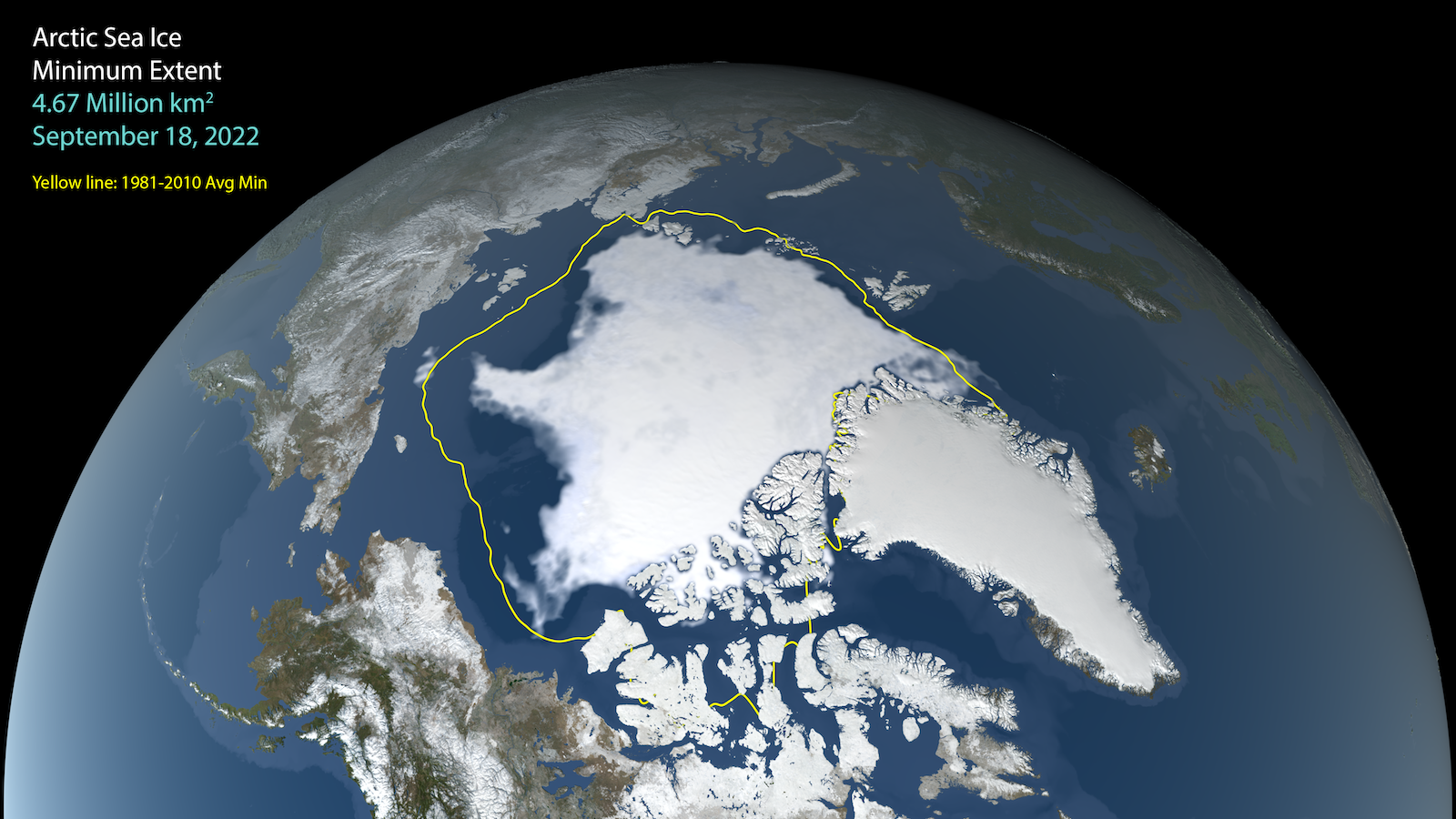
There’s no way to make this pleasant; the Arctic Summer Sea Ice tied for the tenth lowest on record.
ooOOoo
This image visualizes sea ice change in the Arctic using data provided by the Japan Aerospace Exploration Agency’s Global Change Observation Mission 1st-Water “SHIZUKU” satellite, which is part of a NASA-led partnership to operate several Earth-observing satellites. The visualization can be accessed at https://svs.gsfc.nasa.gov/5030. Credit: NASA’s Scientific Visualization Studio.
According to satellite observations, Arctic sea ice reached its annual minimum extent (lowest amount of ice for the year) on Sept. 18, 2022. The ice cover shrank to an area of 4.67 million square kilometers (1.80 million square miles) this year, roughly 1.55 million square kilometers (598,000 square miles) below the 1981-2010 average minimum of 6.22 million square kilometers (2.40 million square miles).
The average September minimum extent record shows significant declines since satellites began measuring consistently in 1978. The last 15 years (2007 to 2021) are the lowest 15 minimum extents in the 43-year satellite record.
This visualization, created at NASA’s Goddard Space Flight Center in Greenbelt, Maryland, shows data provided by the Japan Aerospace Exploration Agency (JAXA), acquired by the Advanced Microwave Scanning Radiometer 2 (AMSR2) instrument aboard JAXA’s Global Change Observation Mission 1st-Water “SHIZUKU” (GCOM-W1) satellite.
Music: “Celestial Vault” from Universal Production Music
Video credit: NASA’s Goddard Space Flight Center
Kathleen Gaeta (GSFC AIMMS): Lead Producer
Trent L. Schindler (USRA): Lead Animator
Roberto Molar (KBR): Lead Writer
ooOOoo
As I said, a sorry tale for which there is no good news. I wish there were!
Next, a few words from her website that explain a little more about Jill.
I started working in a photo studio in 1985 (yikes!). I’ve worked in studios in Maine and California, and started Lasting Image in 1997. I have photographed literally thousands of people of all ages.
I was a Grand Imaging Award finalist in 2019 (crazy hard to do!) and a PPA Silver Medalist in 2020. I regularly enter my work in Professional Photographers of America’s image competitions for judging and critique. It’s brutal. But it has made me a better photographer.
Here is Ziggy’s owner describing what it takes for Ziggy to become a service dog.
ooOOoo
Thank you to my friend Anne Marie Shumate from Lasting Image Photography for doing such a great job photographing Ziggy and me.
Ziggy is a SDIT or otherwise known as a Service Dog in Training. He has passed two of the three major test and four of the ten outings. Once he completes his other test he’ll get his final certificate from Soldiers Best Friend, a non-profit 501c3. Jamie Barilla is my trainer. She works with the two of us for two days a week. Sometimes Ziggy catches on quicker than I do, so I think Jamie is training me!
Jamie Barilla works with Soldiers Best Friend, a non-profit 501c3. Besides working on Photography with my own non-profit 501c3, I spend a great deal of time training Ziggy. Not counting the 2 1/2 hours of training Ziggy receives a day, I also have to write a daily report of what we do everyday.
I now can understand the complexities involved in training a service dog. He already knows over 64 commands, with a lot more coming down the road. A lot of the commands Ziggy first learned, even though they were OK at the beginning, had to be tweaked to make them even better.
So if you see a service dog now you know it takes a lot of work. Some 50 to 70 percent of dogs that enter a service dog program don’t make the grade; either because the dog doesn’t have the proper temperament or the person involved doesn’t have the time or energy to put into the dog.
ooOOoo
Well we hope that Ziggy gets the final certificate and I can see no reason why that doesn’t come about. And, finally, coming back to Jill to note that she is a great lover of dogs. Have a look at the page on her website that shows the awards that she has won. Please, take a peep and see the wonderful photos of dogs!
Showing that droughts have been in evidence for 1,000 years or more!
It is very easy, well it is for me, to think that the changes we are seeing in the climate are purely recent. There is no question that we are experiencing changes in the global climate. But it would be too easy to think that these changes are only the result of recent times.
1,000-year-old stalagmites from a cave in India show the monsoon isn’t so reliable – their rings reveal a history of long, deadly droughts.
Published on the 19th September, 2022 by:
Gayatri Kathayat Associate Professor of Global Environmental Change, Xi’an Jiaotong University
Ashish Sinha Professor of Earth and Climate Sciences, California State University, Dominguez Hills
In a remote cave in northeast India, rainwater has slowly dripped from the ceiling in the same spots for over 1,000 years. With each drop, minerals in the water accumulate on the floor below, slowly growing into calcium carbonate towers known as stalagmites.
These stalagmites are more than geological wonders – like tree rings, their layers record the region’s rainfall history. They also carry a warning about the potential for catastrophic multiyear droughts in the future.
By analyzing the geochemistry of these stalagmites in a new study published Sept. 19, 2022, in the Proceedings of the National Academy of Sciences, we were able to create the most precise chronology yet of the summer Indian monsoon over the past millennium. It documents how the Indian subcontinent frequently experienced long, severe droughts unlike any observed in the last 150 years of reliable monsoon rainfall measurements.
They show how the decline of the Mughal Empire and India’s textile industries in the 1780s and 1790s coincided with the most severe 30-year period of drought over the millennium. The depth and duration of the drought would have caused widespread crop failures and the level of famine discussed in written documentsat the time.
Another long drought encompasses the 1630-1632 Deccan famine, one of the most devastating droughts in India’s history. Millions of people died as crops failed. Around the same time, the elaborate Mughal capital of Fatehpur Sikri was abandoned and the Guge Kingdom collapsed in western Tibet.
Buland Darwaza (Door of Victory) at Fatehpur Sikri, India.
Our findings have important implications today for water planning in a warming world, particularly for India, which, with its vast monsoon-reliant agriculture industry, is on pace to soon be the most populous country on the planet.
Why the monsoon’s history matters
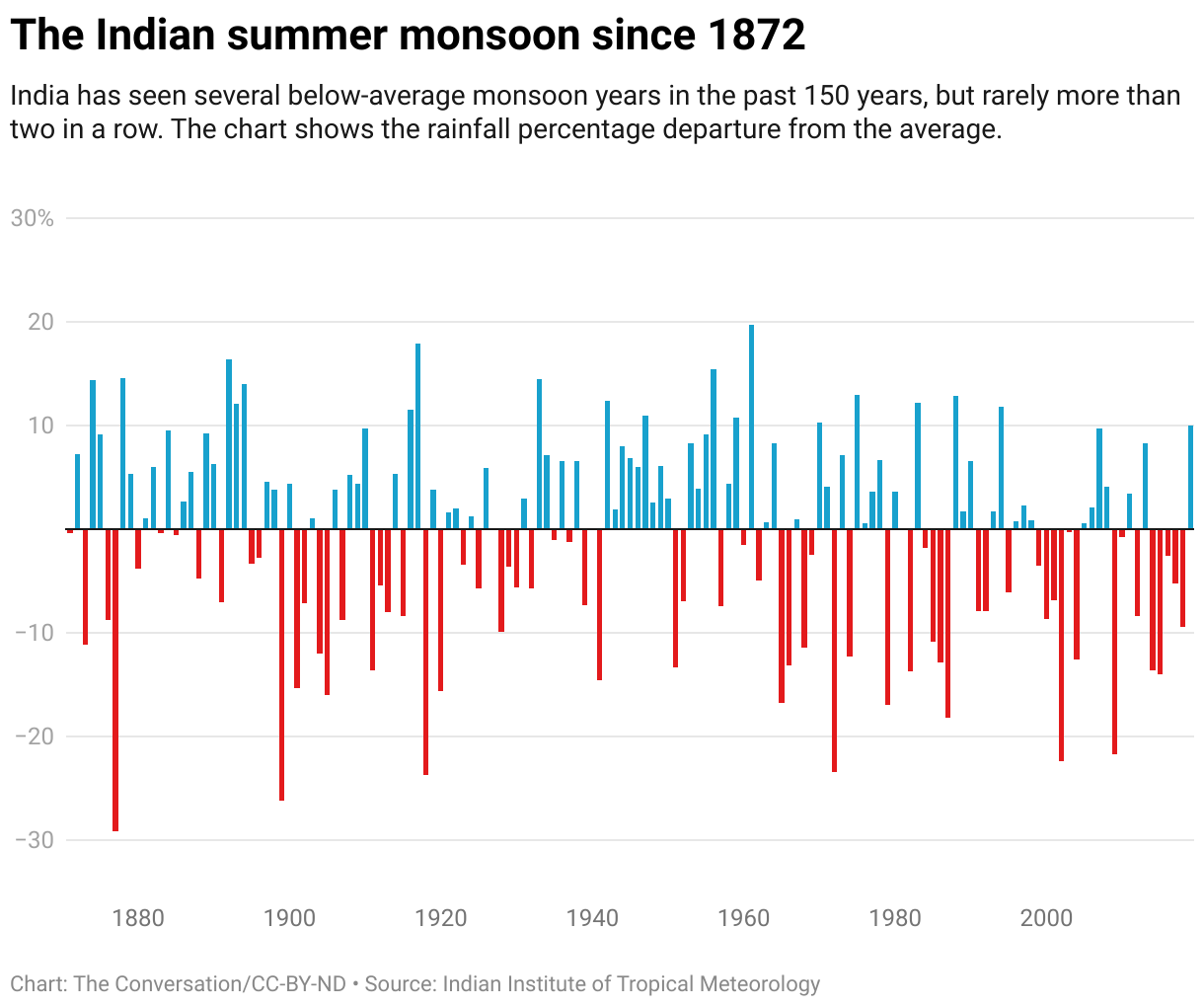
Scientists began systematically measuring India’s monsoon rainfall with instruments around the 1870s. Since then, India has experienced about 27 regionally widespread droughts. Among them, only one – 1985 to 1987 – was a three-year consecutive drought or worse.
The apparent stability of the Indian monsoon in that data might lead one to surmise that neither protracted droughts lasting multiple years nor frequent droughts are intrinsic aspects of its variability. This seemingly reassuring view currently informs the region’s present-day water resource infrastructure.
However, the stalagmite evidence of prolonged, severe droughts over the past 1,000 years paints a different picture.
It indicates that the short instrumental period does not capture the full range of Indian monsoon variability. It also raises questions about the region’s current water resources, sustainability and mitigation policies that discount the possibility of protracted droughts in the future.
Timeline of major societal and geopolitical changes in India and the oxygen isotope record from Mawmluh cave. Gayatri Kathayat
How do stalagmites capture a region’s monsoon history?
To reconstruct past variations in rainfall, we analyzed stalagmites from Mawmluh cave, near the town of Cherrapunji in the state of Meghalaya – one of the wettest locations in the world.
Stalagmites are conelike structures that grow slowly from the ground up, typically at a rate of about one millimeter every 10 years. Trapped within their growth layers are minute amounts of uranium and other elements that were acquired as rainwater infiltrated the rocks and soil above the cave. Over time, uranium trapped in stalagmites decays into thorium at a predictable pace, so we can figure out the age of each stalagmite growth layer by measuring the ratio of uranium to thorium.
The oxygen in rainwater molecules comes in two primary types of isotopes – heavy and light. As stalagmites grow, they lock into their structure the oxygen isotope ratios of the percolating rainwater that seeps into the cave. Subtle variations in this ratio can arise from a range of climatic conditions at the time the rainwater originally fell.
Stalagmite formation are marked inside Mawmluh Cave, where the new study was based. Gayatri Kathayat
A cross-section of a stalagmite shows differences in its ring formation as climate conditions changed. Gayatri Kathayat
Our previous research in this area showed that variations in oxygen isotope ratios in rainwater, and consequently, in stalagmites, track changes in the relative abundance of different moisture sources that contribute to summer monsoon rainfall.
During years when monsoon circulation is weak, rainfall here is primarily derived from the moisture that evaporated from the nearby Arabian Sea. During strong monsoon years, however, atmospheric circulation brings copious amounts of moisture to this area all the way from the southern Indian Ocean.
The two moisture sources have quite different oxygen isotope signatures, and this ratio is faithfully preserved in the stalagmites. We can use this clue to learn about the overall strength of the monsoon intensity at the time the stalagmite formed. We pieced together the monsoon rainfall history by extracting minute amounts of calcium carbonate from its growth rings and then measuring the oxygen isotope ratios. To anchor our climate record to precise calendar years, we measured the uranium and thorium ratio.
Stalagmites grow from the ground, and stalactites grow from above. These are in Mawmluh Cave, where the authors conducted their research. Gayatri Kathayat.
Next steps
The paleoclimate records can usually tell what, where and when something happened. But often, they alone cannot answer why or how something happened.
Our new study shows that protracted droughts frequently occurred during the past millennia, but we do not have a good understanding of why the monsoon failed in those years. Similar studies using Himalayan ice cores, tree rings and other caves have also detected protracted droughts but face the same challenge.
In the next phase of our study, we are teaming up with climate modelers to conduct coordinated proxy-modeling studies that we hope will offer more insight into the climate dynamics that triggered and sustained such extended periods of drought during the past millennium.
ooOOoo
So there we are. Droughts are a thing of the ancient past. But only a partial understanding for why the monsoons failed is known. Despite these modern times with so much general access to knowledge there are still things that we do not know!
Finally, one hopes that the next phase of their study will be along in reasonable time! I would love to report on it.
This article was written by Professor Shuang-Ye Wu. It is very good.
Professor Wu is the Professor of Geology and Environmental Geosciences at the University of Dayton, USA.
Looking back on America’s summer of heat, floods and climate change: Welcome to the new abnormal!
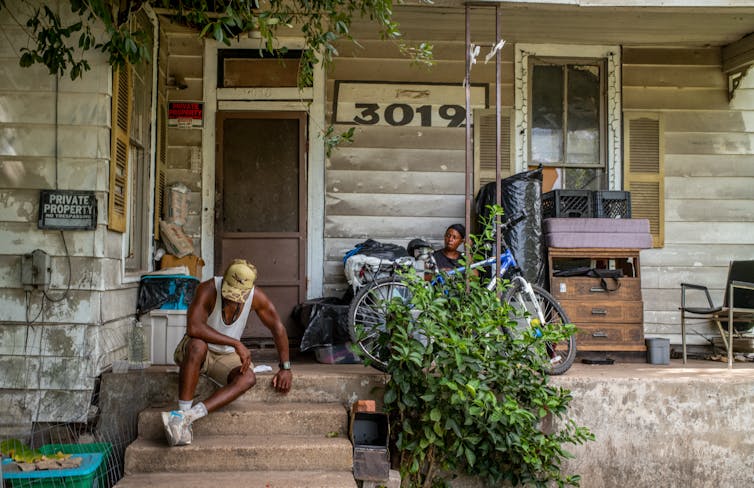
Much of the South and Southern Plains faced a dangerous heat wave in July 2022, with highs well over 100 degrees for several days. Brandon Bell/Getty Images
The summer of 2022 started with a historic flood in Montana, brought on by heavy rain and melting snow, that tore up roads and caused large areas of Yellowstone National Park to be evacuated.
In between, wildfires raged through California, Arizona and New Mexico on the background of a megadrought in Southwestern U.S. that has been more severe than anything the region has experienced in at least 1,200 years. Near Albuquerque, New Mexico, a five-mile stretch of the Rio Grande ran dry for the first time in 40 years. Persistent heat waves lingered over many parts of the country, setting temperature records.
The United States is hardly alone in its share of climate disasters.
In Pakistan, record monsoon rains inundated more than one-third of the country, killing over 1,500 people. In India and China, prolonged heat waves and droughts dried up rivers, disrupted power grids and threatened food security for billions of people.
In Europe, heat waves set record temperatures in Britain and other places, leading to severe droughts and wildfires in many parts of the continent. In South Africa, torrential rains brought flooding and mudslides that killed more than 400 people. The summer may have come to an end on the calendar, but climate disasters will surely continue.
This isn’t just a freak summer: Over the years, such extreme events are occurring in increasing frequency and intensity.
Climate change is intensifying these disasters
The most recent international climate assessment from the United Nations’ Intergovernmental Panel on Climate Change found significant increases in both the frequency and intensity of extreme temperature and precipitation events, leading to more droughts and floods.
A recent study published in the scientific journal Nature found that extreme flooding and droughts are also getting deadlier and more expensive, despite an improving capacity to manage climate risks. This is because these extreme events, enhanced by climate change, often exceed the designed levels of such management strategies.
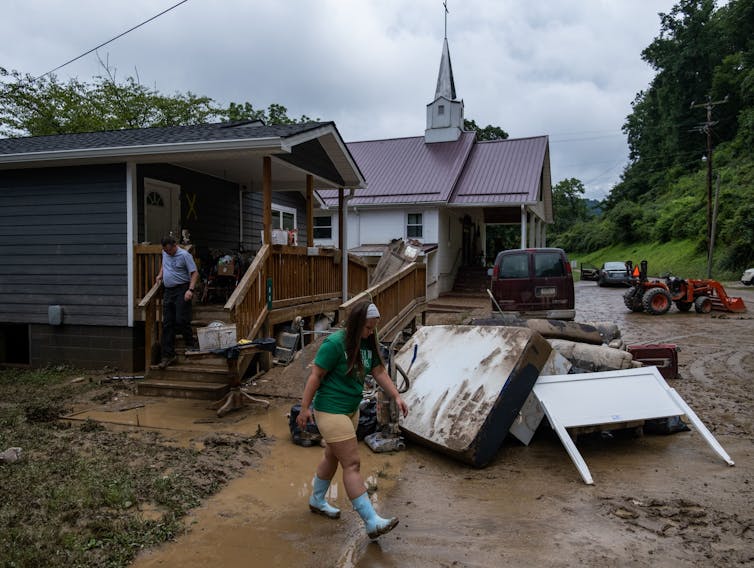
Flash flooding swept through mountain valleys in eastern Kentucky in July 2022, killing more than three dozen people. It was one of several destructive flash floods. Seth Herald/AFP via Getty Images
Extreme events, by definition, occur rarely. A 100-year flood has a 1% chance of happening in any given year. So, when such events occur with increasing frequency and intensity, they are a clear indication of a changing climate state.
The term “global warming” can sometimes be misleading, as it seems to suggest that as humans put more heat-trapping greenhouse gases into the atmosphere, the world is going to get a bit warmer everywhere. What it fails to convey is that warming temperatures also lead to a more violent world with more extreme climate disasters, as we saw this past summer.
Climate models showed these risks were coming
Much of this is well-understood and consistently reproduced by climate models.
As the climate warms, a shift in temperature distribution leads to more extremes. The magnitudes of changes in extreme temperature are often larger than changes in the mean. For example, globally, a 1 degree Celsius increase in annual average temperature is associated with 1.2 C to 1.9 C (2.1 Fahrenheit to 3.4 F) of increase in the annual maximum temperature.
Heat waves, like the heat dome over the South in July 2022, can hit outdoor workers especially hard. Brandon Bell/Getty Images
In addition, global warming causes changes in the vertical profile of the atmosphere and equator-to-pole temperature gradients, leading to changes in how the atmosphere and ocean move. The temperature difference between equator and the poles is the driving force for global wind. As the polar regions warm at much higher rates then the equator, the reduced temperature difference causes a weakening of global winds and leads to a more meandering jet stream.
Some of these changes can create conditions such as persistent high-pressure systems and atmosphere blocking that favor more frequent and more intense heat waves. The heat domes over the Southern Plains and South in June and the West in September are examples.
The initial warming can be further amplified by positive feedbacks. For example, warming increases snow melt, exposing dark soil underneath, which absorbs more heat than snow, further enhancing the warming.
Warming of the atmosphere also increases its capacity to hold water vapor, which is a strong greenhouse gas. Therefore, more water vapor in the air leads to more warming. Higher temperatures tend to dry out the soil, and less soil moisture reduces the land’s heat capacity, making it easier to heat up.
These positive feedbacks further intensify the initial warming, leading to more heat extremes. More frequent and persistent heat waves lead to excessive evaporation, combined with decreased precipitation in some regions, causing more severe droughts and more frequent wildfires.
This increased humidity leads to heavier rainfall events. In addition, storm systems are fueled by latent heat, or the large amount of energy released when water vapor condenses to liquid water. Increased moisture content in the atmosphere also enhances latent heat in storm systems, increasing their intensity. Extreme heavy or persistent rainfall leads to increased flooding and landslides, with devastating social and economic consequences.
Even though it’s difficult to link specific extreme events directly to climate change, when these supposedly rare events occur with increasing frequency in a warming world, it is hard to ignore the changing state of our climate.
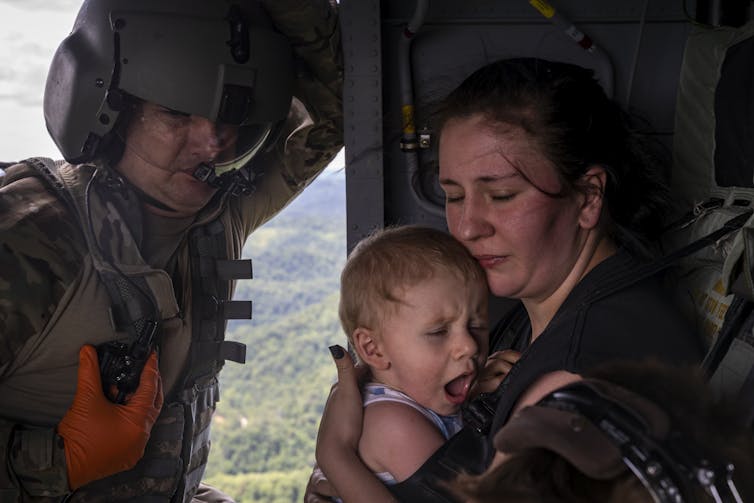
A family had to be airlifted from their home in eastern Kentucky after it was surrounded by floodwater in July 2022. Michael Swensen/Getty Images
The new abnormal
So this past summer might just provide a glimpse of our near future, as these extreme climate events become more frequent.
To say this is the new “normal,” though, is misleading. It suggests that we have reached a new stable state, and that is far from the truth.
Without serious effort to curb greenhouse gas emissions, this trend toward more extreme events will continue. Things will keep getting worse, and this past summer will become the norm a few years or decades down the road – and eventually, it will seem mild, like one of those “nice summers” we look back on fondly with nostalgia.
There is growing evidence that things are really changing globally. I used to say that I would be dead before the impacts of climate change really hit home. As in, it would be a good twenty years before things really took a hold. But it is now much more likely that the next five years are going to see a continuation of the changes and that there isn’t time to hang around.
I may not be as sharp as I used to be but the changing climate will affect me and Jean and all those in our area. Will our leaders grasp this nettle now? I wish I knew.
Penny wanted me to post this guest post from her a little earlier than the ‘chosen’ date. So, I am publishing it today!
ooOOoo
Tips and Tricks for Multistate Living with a Pet
As a senior, you get the best of both worlds by spending half the year in one state and half in another. But sometimes, things can get a little hectic along the way, especially when you own two homes in independent living communities and a pet on top of it. There may be days when your stress levels rise as you try to cope with everything. That’s why Learning from Dogs has assembled some handy tips and tricks to smooth out multistate living for you and your pet.
Saving Money
One of your first considerations may be to save some money as you switch from one home to the other. You might, for instance, register your cars and purchase auto insurance in a state that is less expensive. Do the same for health insurance and even pet insurance to save extra money. You might also stock up on nonperishable and freezer items for each house when your budget allows so that you’ll have supplies on hand when you transfer between homes. Finally, consider replacing double cable services with streaming options. This way, you can watch all your favorite shows whenever and wherever you want without paying for access in two states.
Staying Organized
It can be quite difficult to stay organized when you’re splitting your time between two different homes, but you can if you get in the habit of making lists. Keep a running tab of your possessions and current supplies, like food and cleaning products, at both homes. This way, you’ll know what you have and what you need to bring with you. If you find yourself overwhelmed by clutter, don’t be afraid to use a storage unit. There are plenty of self-storage options in San Diego, and you can check prices and reviews in advance.
When it comes to your pet’s needs, you might do well to have a set of care items like harnesses, crates, cat trees, and litter boxes at both homes. This way, you won’t have to drag things back and forth. When you’re shopping for pet supplies, be sure to read online reviews from customers but also from veterinarians and other animal experts so that you can ensure the quality of the products and the health and safety of your pet.
Keeping Your Pet Healthy
Dividing time between two homes in two different states can be stressful for your pet, so make sure you take care of your pet’s health. Find a trustworthy veterinarian in both locations, and take your pet for frequent checkups each time you settle into a new place. Make sure your pet has proper flea and tick prevention for both environments, and find a good pet sitter in both locations, too.
Also, consider pet insurance to help defray vet costs. One state may actually offer less expensive pet insurance policies than another — although you may find it more expensive in many ways — so shop around for the best policy. Research coverage options, prices, deductibles, limitations, and provider reputations before choosing a policy that is right for you and your pet.
Living Well in Two States
Multistate living can be a challenge, but it can also be a delightful experience for you and your pet. Use the tips above to save money, stay organized, keep your pet healthy, and enjoy the best of both worlds.
Learning from Dogs serves as a reminder of the values of life and the power of unconditional love – as so many, many dogs prove each and every day. Click here to get involved!
Today and tomorrow there are guest posts for you. I must say that I really appreciate these guest articles. So without any more delay, here is today’s post.
ooOOoo
A guest post by Indiana Lee.
How To Effectively Discuss Your ESA With Your Employer
If you have — or want to obtain — an emotional support animal (ESA), it’s natural that you may want to bring it to work. If this is the case, you need to discuss your ESA with your employer. Yet, doing so is often easier said than done.
For some people, bringing an ESA to work may seem problematic. Your ESA helps you feel and perform your best. However, you may be concerned that your emotional support animal will be a distraction. Even worse, you may be worried that your ESA may disrupt your relationship with your employer.
When it comes to ESAs at work, it is important to keep in mind that you and your employer share a common goal: to achieve the best-possible results at work. If you know how to discuss your needs with your employer, you can highlight the benefits for all parties involved.
Now, let’s look at five tips to help you effectively bring up an ESA with your employer.
1. Have a Face-to-face Conversation With Your Employer
Schedule a date and time to meet with your employer to discuss your ESA. Once you set up the meeting, plan accordingly.
Consider how you will deliver your message to your employer. It can be beneficial to illustrate the health benefits of having a pet for emotional support. You can also provide details about how you’ll manage the animal while you work and ensure it does not hamper your and your colleagues’ productivity.
2. Respond to Your Employer’s Concerns and Questions About Your ESA
Give your employer plenty of time to share their concerns and questions about your emotional support animal. If your employer has concerns or questions about why you need an animal at work, you should be ready to address them.
The most common emotional support animals are dogs. Complete any paperwork required by your employer so you can take a dog or other type of emotional support animal to work. They will perhaps already have a policy on bringing dogs to work, but if it is a cat or other type of pet, you should make this clear in the meeting.
Employers are also allowed to request medical documentation if you want to bring an ESA to work due to a disability. You can meet with a medical professional to get this documentation.
3. Let Your Employer Share Your ESA’s Story
Encourage your employer to use your ESA to promote its workplace culture. This can help your employer attract top talent and keep its staff happy.
For instance, your employer can share the story of your ESA with job candidates and employees. This can show job candidates that your employer is committed to do what it can to accommodate its workers. Giving the background of the pet and how it has helped you be a productive, happy employee can be heartwarming and aid in their search for top performers.
Meanwhile, your coworkers can see that your employer wants them to feel comfortable. This can lead to a positive work culture in which all employees are treated with the respect and dignity they deserve. After all, workplace efficiency is improved when employees feel valued and comfortable in the work environment.
4. Keep Your Employer Up to Date About Your ESA
Communicate with your employer about your ESA. If any problems arise that involve the animal, you can share them with your employer immediately. That way, you and your employer can address any issues before they escalate. For example, if your emotional support dog contracts an infectious disease, let your employer know. You can make accommodations to work from home or not bring the animal during that period to keep others safe.
5. Explore Alternatives to Bringing Your ESA to Work
If your employer will not allow you to bring your ESA to work, try not to stress about it. Rather, continue to work with your employer to explore alternatives. For example, your employer may let you work remotely so you can have your ESA by your side while you work. Or, your employer may allow you to work a flexible schedule. If this isn’t possible, it’s entirely okay to look for a job that accommodates your needs.
Don’t Wait To Discuss Your ESA With Your Employer
An emotional support animal can provide a great source of comfort and companionship. If you feel having an ESA at work would be beneficial, you should discuss this topic with your employer right away.
Many employers are more willing than ever before to let their employees have an ESA at work. By discussing the topic with your employer, you can find out what it can offer. From here, you and your employer can work together to ensure you receive the support you need to thrive at work.
ooOOoo
That is very good advice and I am grateful to Indiana for writing it and then offering it to Learning from Dogs. Thank you, Indiana.
I have been a user of Facebook for some time. Persons in my family use it but not Jeannie. In fact, Jean is a very low user of all things computing and that has turned out to be a very good act.
Here is the summary of what the talk is all about:
Facebook’s role in Brexit — and the threat to democracy
In an unmissable talk, journalist Carole Cadwalladr digs into one of the most perplexing events in recent times: the UK’s super-close 2016 vote to leave the European Union. Tracking the result to a barrage of misleading Facebook ads targeted at vulnerable Brexit swing voters — and linking the same players and tactics to the 2016 US presidential election — Cadwalladr calls out the “gods of Silicon Valley” for being on the wrong side of history and asks: Are free and fair election…
Here is the talk:
So by the time you watch this I shall have deleted my Facebook account. Then it is on to finding a good alternative to WhatsApp!
I was just idly browsing dog websites a couple of days ago and came across the Dog Aging Project. As their About page reports:
The goal of the Dog Aging Project is to understand how genes, lifestyle, and environment influence aging. We want to use that information to help pets and people increase healthspan, the period of life spent free from disease.
I have taken the liberty of sharing one of their blog posts with you (I can’t see that isn’t allowed!)
ooOOoo
Longer, healthier lives. Together.
Dog and Human Genetics: Similarity and Difference
July 26th, 2022
Your pup may be your “fur baby,” but how similar are you genetically? You may be surprised!
Did you know that dogs and people share over 17,000 special genes called orthologs? Each pair of orthologs is derived from the same common ancestor via vertical descent (speciation) and they tend to have similar functions. They are one of the main reasons why your pup is such an invaluable comparative animal model for studying human health. In fact, humans and dogs have numerous similarities even in those parts of the genome that aren’t genes (the noncoding part of the genome). When it comes to better understanding human health, your pup is our best friend!
Sometimes, the effects of a gene are identical between dogs and people. For example, the same version of EPAS1, a gene triggered by low-oxygen conditions, is shared by people living in the Tibetan Plateau and the dog lineages that developed there. Genetic changes in this gene have taken place to help kickstart the body’s responses to hypoxia, or low oxygen levels, at high altitudes.
In other cases, the effects of a gene may be similar but not identical. For instance, the gene SCN3A is important to brain function and affects the development of speech. In children, mutations in SCN3A have been reported to cause disorders like epilepsy. But in dogs, genetic changes near the canine ortholog of SCN3A are associated with the frequency of howling in dogs.[1] The functions of this gene seem distinct (speech versus howling) but related!
For other health conditions shared by dogs and people, the same genes may not be responsible, but that doesn’t mean that research on those conditions in dogs isn’t helpful for humans! By learning more about how a dog’s genes are connected with a shared health condition, we can investigate the biological mechanisms involved and potentially make links to human health.
For example, people long suggested that narcolepsy might be a disease of the immune system: an autoimmune attack that causes daytime drowsiness and sudden sleep. In human studies, it was difficult to confirm the immune system link. It wasn’t until 1999[2] that this connection was discovered in a lineage of Doberman pinscher dogs. The researchers discovered a gene that is involved in the interface between the nervous system and immune system.
Finally, you and your pup share more than just genetics. Your environments are also very similar! You sleep in the same house—maybe even the same bed!—go on walks together, and breathe the same air. Interactions between these environmental variables and your genetics (called gene by environment interactions) can have an important impact on health. For example, smoking is well known to increase risk of bladder cancer in humans[3], but it is still unknown how secondhand smoke affects risk of bladder cancer in dogs.[4]
Data from the Dog Aging Project should help us answer important questions like these!
2. Ling Lin et al. 1999. The Sleep Disorder Canine Narcolepsy Is Caused by a Mutation in the Hypocretin (Orexin) Receptor 2 Gene. Cell 98 (3): 365-376. https://doi.org/10.1016/S0092-8674(00)81965-0
3. JD Figueroa et al. 2014. Genome-wide interaction study of smoking and bladder cancer risk. Carcinogenesis 35 (8):1737-44. https://pubmed.ncbi.nlm.nih.gov/24662972/
“Do what you can, with what you have, where you are.” “Believe you can and you’re halfway there.”“It is hard to fail, but it is worse never to have tried to succeed.”
“It is not the critic who counts; not the man who points out how the strong man stumbles, or where the doer of deeds could have done them better.”
This famous quotation by Teddy Roosevelt (1858-1919), the 26th President of the USA, seems apt for today’s post.
Exactly one week ago I published a post called Musings from a 77 year old! I wrote that the future was uncertain. Summed up at one point by me writing: “I have no idea of the global changes that are afoot and how they will affect us in Merlin. Indeed, I have no idea how long I have to live.“
Margaret (from Tasmania) was one of the many people who responded. She included a video interview of Meg Wheatley by Michael Shaw. It is an hour long. Last Friday afternoon Jean and I watched it in full and it was incredibly interesting. Thank you very much, dear Margaret.
But before I present Meg’s video again I want to show you another video. It is a talk by Richard Grannon about the collapse of our civilisation. Now Richard Grannon is an author, YouTuber and life coach so one needs to remain impartial to his views, certainly before one does further research. But in the 46-minute talk I think there is much sense in what he says. See for yourself:
Moving on! The interview of Meg Wheatley is very good indeed. It’s a broad look at the issues and problems governing society but done in such a way that the people who watch her will also take away a number of tools for avoiding depression and anxiety. Meg places great store on the Hopi Native American Indians: “The Hopi maintain a complex religious and mythological tradition stretching back over centuries.“
Meg quotes one of the more famous Hopi prophecies, that is reproduced below:
This could be a good time! There is a river flowing now very fast. It is so great and swift that there are those who will be afraid. They will try to hold on to the shore. They will feel they are being torn apart and will suffer greatly. Know the river has its destination. The elders say we must let go of the shore, push off into the middle of the river, keep our eyes open, and our heads above the water.
And I say, see who is in there with you and celebrate. At this time in history, we are to take nothing personally, least of all ourselves. For the moment that we do, our spiritual growth and journey come to a halt.
The time of the lone wolf is over. Gather yourselves! Banish the word ’struggle’ from your attitude and your vocabulary. All that we do now must be done in a sacred manner and in celebration.
Here is that Meg Wheatley interview. (It is an hour long but very interesting; please watch it!)
I want to pick up the topic that was at the end of her interview; that of societal collapse. How would one define it? I chose Wikipedia for a reference.
Societal collapse (also known as civilizational collapse) is the fall of a complex human society characterized by the loss of cultural identity and of socioeconomic complexity, the downfall of government, and the rise of violence.[1]Possible causes of a societal collapse include natural catastrophe, war, pestilence, famine, economic collapse, population decline, and mass migration. A collapsed society may revert to a more primitive state, be absorbed into a stronger society, or completely disappear.
Virtually all civilizations have suffered such a fate, regardless of their size or complexity, but some of them later revived and transformed, such as China, India, and Egypt. However, others never recovered, such as the Western and Eastern Roman Empires, the Maya civilization, and the Easter Island civilization.[1] Societal collapse is generally quick[1] but rarely abrupt.[2] However, some cases involve not a collapse but only a gradual fading away, such as the British Empire since 1918.[3]
Anthropologists, (quantitative) historians, and sociologists have proposed a variety of explanations for the collapse of civilizations involving causative factors such as environmental change, depletion of resources, unsustainable complexity, invasion, disease, decay of social cohesion, rising inequality, secular decline of cognitive abilities, loss of creativity, and misfortune.[1][4] However, complete extinction of a culture is not inevitable, and in some cases, the new societies that arise from the ashes of the old one are evidently its offspring, despite a dramatic reduction in sophistication.[4] Moreover, the influence of a collapsed society, such as the Western Roman Empire, may linger on long after its death.[5]
The article is much more extensive than I have quoted above and for anyone deeply interested then I do recommend you going to the article and reading it extensively.
Now Meg is of the opinion that it is too late to turn back but next Tuesday I want to talk to you about Sir David Attenborough’s film A Life on our Planet. That he believes there is a chance to undo the harm we are causing to the planet; through rewilding.
Once again I am delighted to publish another post from Penny. This is a relatively short post but nevertheless of supreme importance.
With no more ado from me, here it is:
ooOOoo
Protecting Our Pets: Resources for Volunteering at Animal Shelters
By Penny Martin
August 10th, 2022
If animal welfare is close to your heart, you might want to consider helping out at a pet shelter for abandoned or unwanted animals. There are always a number of charities in the USA and beyond looking for eager volunteers.
Before You Apply
Animal welfare work can be challenging for an individual, even if you’re just volunteering. It’s important to take precautions before you commit to your decision.
Read about the experience of working at a shelter to better understand the challenges and obstacles you might encounter.
Often, volunteers need to undergo training, orientation, and background checks before they’re allowed to contribute.
Connect with your local shelters on social media to see the kind of work they do and whether there are opportunities to volunteer.
Organizations
Shelters for abandoned and neglected pets are frequently found throughout the country. If you want to do your part, the logical first step is to locate one close to you.
Institutions like Guide Star have been established to hold animal rescue services accountable and ensure they are being maintained properly.
Take some time to learn about the listed charities in your area.
If you find an abandoned pet and you’re not aware of shelters in your area, try reaching out to American Humane.
Ways to Help
If you’re unable to volunteer in person, there are still plenty of ways to get involved and do your part.
There’s good work to be done online via social media and you can help out by engaging in discussion and sharing posts about missing or unwanted pets.
If you have any spare supplies that you’re willing to donate, these can make a profound impact on the lives of animals.
If you’re purchasing supplies to donate, read expert reviews to choose the highest-quality products.
Unfortunately, across the USA and beyond, there are a great many pets in need of our help but even small acts of kindness can take us a significant way towards eradicating the problem altogether. Reach out to your local shelter and see how you can help.
Read the Learning from Dogs book for a reminder of the unconditional love dogs give us every day.









 Learning from Dogs