Category: Economics

Carts and horses!

“Don’t chase the money! Chase personal development and let the money chase you!”

This was the parting shot that came to my mind a couple of years ago, at the end of delivering a one week training course to a group of new graduates.

In general, my approach to training is less well suited to people at their stage than it is to people who are motivated by the need to get a job done. However, that is, of course, my “problem”.

Nevertheless, at the end of that particular course, I felt the need to pass on something from my years of supposed experience, however irrelevant that experience might seem to a group of young, newly minted, investment banking people.

Cause and effect

Although I do not remember the source of the quote, it seemed quite apt. I liked the way in which the opening exhortation seemed completely opposed to their motivation. That woke them up! Then the second part gave them a different entry point and restored the connection with that original motivation.

Perhaps the strongest aspect of the quote is, of course, that it attempts to clarify the direction of causation between money and personal development.

It seemed neat at the time, and it still does!

By John Lewis

The Swine Flu “Pandemic”

When is a Pandemic a Pandemic?

[I owe Chris an apology as this Post was prepared for publication on the 20th August and somehow got lost in the works.  I believe it is still a relevant and important topic and has not lost any impact from this unintentional delay. Ed.]

The swine flu “pandemic” is to me a very interesting phenomenon. Sadly, it seems typical of the sort of combination of marketing hype and hysteria that is all too common.

I am principally interested in seeing beyond all the media lies and spin to know the TRUTH about what is going on. From what I have so far read the following seems to be true, but if anyone is able to correct me on some issues I would be most grateful.

Read more about this so-called pandemic

A Better Idea: let’s limit TARP legislator pay!

Saving taxpayers some money?

Seems that Congress is hell bent on replacing the best-functioning labor market in the world with their own unique brand of wisdom.  Well, I have a better idea.  Why don’t we slash in half the pay of all those Congressional leaders who came up with the TARP idea in the first place, since they are spending our money, and I think it is clear that they are spending our money unwisely, which is precisely the logic they use to confiscate the salaries and bonuses of the bail-out executives.

Moral of the story?  Government should not be in the business of trying to run a business. The TARP bailout should have never seen the light of day.  With no TARP bailout, Congress would not have had it’s latest excuse for grabbing up yet more of the private economy’s resources for trying to put this country back on track toward improved productivity, output, jobs, income, and security.

By Sherry Jarrell

More truth about this crisis

“Never in the field of financial endeavour has so much money been owed by so few to so many. And, one might add, so far with little real reform.”

Thus spoke Mervyn King, governor of the Bank of England, on Tuesday night, 20th October, to a group of Scottish

Mervyn King
Mervyn King

business people.  Echoing one of Churchill’s many famous sayings, Governor King is probably one of the highest ranking people around to state, at last, what everyone on the Clapham Omnibus (a London bus route) knows to be obvious.  Whether the forces can build to a point where common sense is applied by Governments before we enter another Great Depression is another matter.

Mention of the Great Depression (the last one) triggers a step back in time.

On June 16th 1933 Franklin Roosevelt signed into law the Glass-Steagall Act.  In fact that was the second Act signed

Senator Carter Glass
Carter Glass

into law, the first Act was passed by Congress in February 1932 and was largely designed to stop deflation.  The second Act was, in a sense, much more important because it set out to prevent bank holding companies from owning other financial institutions.  It was repealed on November 12th, 1999 by the Gramm-Leach-Bliley Act. Just a little under 10 years ago.  10 years which have seen the biggest boom-bust probably ever in modern history.  And has much of the Western world slipping into another great depression.

US Senator Carter Glass and US Congressman Henry B. Steagall must be turning in their graves

Steagall
Henry Steagall

But thank goodness for investigative journalism and the role of the Internet in creating a truly open ‘meeting place’.

Read more about this Post

Janet Tavakoli on Warren Buffet

The following is reproduced in full from the TSF website and is reprinted with the permission of Tavakoli Structured Finance, Inc.

It’s a fascinating tale about Warren Buffet in the midst of all the financial turmoil.  And in case you think that Tavakoli Finance is run by the grey suit brigade …

Janet Tavakoli
Janet Tavakoli

Read Tavakoli’s article about Buffet

A view of England – from France.

A work trip to Brittany, France and a chance to reflect on the differences.

I’m sat writing this in my hotel room on the outskirts of Quimper in Brittany. Usual overcast and drizzle but considering I’m only a couple of hundred miles south of home, that’s the only similarity with the Devon weather.

Quimper
Quimper

They simply seem to have no comprehension about the recession. There are small signs of some new office building being empty but more buildings seem to have appeared and business appears to be booming. The super market where I have lunch is even busier than last year and the shops are full of people buying things.

What’s the difference?

I’m sure my friend Chris [Chris Snuggs, another author on this Blog] who I used to work for here will be able to say, but I can’t believe it’s all about the main business of food and agriculture, which predominates in this part of the country.

Back home in Devon, the same set of circumstance ought to hold true as it’s mainly agriculture and tourism, just like in Brittany.  However there is a vibrancy in Quimper that I find refreshing.  And a lack of charity shops!

What can we learn from this?

I was bought up in an environment that did not trust the French and it wasn’t until I got an opportunity to work here 10 years ago I realised that it wasn’t all that I’d been told.

I really like Brittany and its people who are friendly and very welcoming. There is definitely something to learn from this.

By Jon Lavin

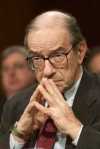
Greenspan being quite remarkable!

Fingers crossed this becomes a key political statement.

I am indebted to Baseline Scenario for drawing my attention to a recent article in Bloomberg.  Greenspan is voicing what many regard as so obvious we wonder why the present US Government haven’t been pushing for this for some time. (And if you want the answer to that question, read this)

Anyway, in the Bloomberg story Greenspan says:

“If they’re too big to fail, they’re too big,” Greenspan said today. “In 1911 we broke up Standard Oil — so what happened? The individual parts became more valuable than the whole. Maybe that’s what we need to do.”

Breathtaking!

And Greenspan goes on to say:

“Failure is an integral part, a necessary part of a market system,” he said. “If you start focusing on those greenspanwho should be shrinking, it undermines growing standards of living and can even bring them down.”

Amen to that!

By Paul Handover

Insulting us?

Is this, in the end, how our Governments are treating us?

Yves Smith runs the incredibly successful Blog, Naked Capitalism.  Frankly, I have no idea where she finds the time to put together her Posts, many of which are constructed on the back of in-depth research.

On Friday, 16th October there was a Post which has huge implications.  It is all about Access Journalism.  It needs to be read.  Here’s an extract.

Let us start with the cheerleading in the media over Wall Street, and in particular, Goldman earnings. Matt Taibbi, in “Good News on Wall Street Means… What Exactly?,” tells us why this is so distorted:

It’s literally amazing to me that our press corps hasn’t yet managed to draw a distinction between good news on Wall Street for companies like Goldman, and good news in reality.

I watched carefully the reporting of the Dow breaking 10,000 the other day and not anywhere did I see a major news organization include a paragraph of the “On the other hand, so fucking what?” sort, one that might point out that unemployment is still at a staggering high, foreclosures are racing along at a terrifying clip, and real people are struggling more than ever. In fact the dichotomy between the economic health of ordinary people and the traditional “market indicators” is not merely a non-story, it is a sort of taboo — unmentionable in major news coverage.

The press has been on a downslope for at least a decade, as a result of strained budgets and vastly more effective government and business spin control (and it was already pretty good at that, see the BBC series, The Century of the Self, via Google video, for a real eye-opener). I met a reporter who had been overseas for six years, opening an important foreign office for the Wall Street Journal. He was stunned when he came back in 1999 to see how much reporting had changed in his absence. He said it was impossible to get to the bottom of most stories in a normal news cycle because companies had become very sophisticated in controlling their message and access.

As I said, please read the Post in full.  Oh, and I see Baseline Scenario picked up on this as well.

By Paul Handover

Insulting us, postscript

Just a few figures that underline reality.

US rent indexes declined in September. Last time this happened was 1992.

US Consumer Price Index fell 1.3%, year on year, in September 2009. Note that it bottomed at -2.1% y/y in July 2009, making it the largest annual contraction since 1949.

September’s US food prices fell (-0.2%) in September, the first annual decline in over 40 years.

US industrial production, as of August, was down (-10.7%) compared to August 2008.

Just a US problem?

Japanese industrial production, as of August, was down (-22.7%) compared to August 2008.

Britain’s industrial production, as of August, was down (-9.3%) compared to August 2008.

Eurozone area industrial production, as of August, was down (-15.9%) compared to August 2008.

Meanwhile the banks steam ahead reporting huge profits ……

Crazy world!

By Paul Handover

Cash for Clunkers program a failure

The law of unintended consequences

It should come as no surprise to anyone that U.S. car companies are slumping once again.  The Cash for Clunkers program was a wasteful, inefficient publicity stunt or, worse, an actual attempt by the US Federal Government to stimulate the economy.  The worse part is that the program cost the economy jobs: many healthy, profitable dealerships had their company taken away from them by government edict under this program, never to return.  It’s almost criminal.

By Sherry Jarrell