Category: Economics

The ageing of the USA, Part Two

Back to the future – a new way of seeing forward

Part Two of a three-part paper previously published by Professor Sherry Jarrell, Part One is here.

In this post, we examine the current income and spending patterns from metropolitan statistical areas (MSAs) with age demographics similar to those projected for the U.S. economy in 2020 and 2025.  Two MSAs are selected for each year to verify that differences in buying patterns across cities are because of differing age distributions, not peculiarities in the cities.

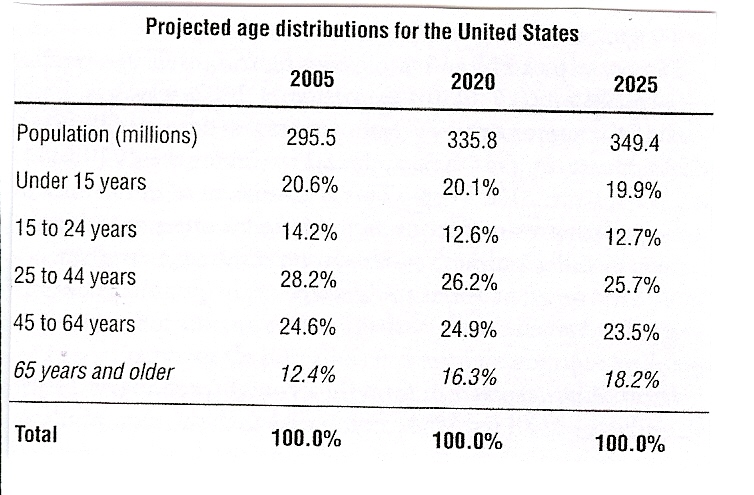
We began with U.S. Bureau of Census data on the percent of total U.S. population expected within five age groups through 2025. The share of U.S. population attributed to people age 65 and older is expected to increase from 12.4% today to 16.3% in 2020 and 18.2% in 2025. By 2025, nearly one out of every four drivers will be age 65 or older, compared with 15.6% today.

Income and Spending Patterns

We find that, although many mature adults are highly mobile, most stay put; this results in the Northeast and Midwest remaining key mature markets.  Three of our four 2020 and 2025 MSAs are in Ohio, New York, and Pennsylvania. We also find that older consumers:

  • spend more of their income: The spending per income ratio rises from .67 today, to .76 for the 2020 MSAs and .77 for the 2025 MSAs.
  • continue to depend on their cars and prefer them to public transportation.
  • spend increasingly larger shares of their income on healthcare.
  • make TV a key element of their lifestyles.
  • remain in their homes and avoid nursing homes.
  • are politically conservative.
  • are civically active and wield growing influence.
  • are joiners.
  • spend heavily on housekeeping supplies, household furnishings and equipment, new vehicles, entertainment, computers, healthcare products, vitamins, healthier foods, and reading materials.
  • spend less on apparel, cosmetics, and fast food.

Retail spending data

We find that the percent of retail spending on necessities such as products at food and beverage stores and the subcategory of grocery stores is generally higher in all six of our MSAs, compared with the nation. The same is true for the general merchandise store category, which includes discount stores.  We also observe generally lower spending shares relative to the nation in the more discretionary categories of clothing and accessories stores, furniture and home furnishings stores, electronics and appliance stores, building materials stores, and garden equipment stores.

The more important observations relate to spending patterns across the three pairs of MSAs. Looking at food and beverage stores, spending as a share of total retail sales declines across the three pairs of MSAs with increasingly older populations. Beginning with an average of 17.2% in the 2005 MSAs, spending at food and beverage stores drops to 14.1% in the 2025 MSAs.

Similarly, the subcategory of grocery stores falls from 15.1% today to 12.2% in the 2025 MSAs. Note that the approximately 3 percentage point declines in these categories are in spending relative to total retail sales, and that within the categories, the decreases in spending are nearly 20%. For example, for every $1,000 in retail spending in the 2005 cities, approximately $151 is spent at grocery stores. That compares with $122 in the 2025 cities. Thus, although spending shares at food and beverage stores are higher than the national average in all six MSAs, the spending shares fall across the three pairs of MSAs as their populations become increasingly older.

The trend also is downward over time for food service and drinking places, from an average of 9.7% in the 2005 MSAs to 7.5% in the 2025 MSAs—with the trend again representing a roughly 20% absolute dollar spending decline per capita within the category. These results support the expectation that older consumers eat healthier and in less quantities (especially in the case of fast food), and also spend fewer dollars at drinking places.

Per capita spending at clothing and accessories stores decreases from an average of 4% of retail sales in the two 2005 cities to 3.2% in the 2025 cities. As before, although the 1% drop appears small, it represents an approximately 20% reduction in per capita spending.

What types of stores benefit from older populations?

Our results indicate increased spending on furniture, automobiles, and homes. Looking at the per capita shares of total retail spending for furniture, home furnishings, and electronics and appliances, spending shares rise from an average of 2% in the 2005 MSAs to 3.9% in the 2020 MSAs and 4.2% in the 2025 MSAs. This suggests a doubling of per capita spending at furniture and related stores. There are similar patterns for the subcategories of furniture and home furnishings stores, and electronics and appliance stores. Spending also generally rises at building materials and garden equipment stores. Upward trends across the six cities additionally are shown for motor vehicles and parts, and healthcare and personal care.

In the third and final installment of this research, we will discuss the specific types of business establishments that will thrive in the U.S. city of the future.

By Sherry Jarrell
The ageing of the USA, Part One

Back to the future – a new way of seeing forward

Part One of a three-part paper previously published by Professor Sherry Jarrell

Market research on the ageing of the U.S. baby boomer generation has focused on the spending habits of these older consumers. A new approach enables marketing researchers to observe the future now: Examine income and spending patterns from metropolitan statistical areas (MSAs) with age demographics similar to those projected for the U.S. economy in 2020 and 2025. With knowledge of these trends, they can begin preparing to meet the demands for particular products and services.

“Find a comfortable couch, lie back, and close your eyes. … Let your mind wander toward the future. Move, slowly, to the year 2030. Now open your eyes. What do you see? You see a country whose collective population is older than that in Florida today. You see a country where walkers outnumber strollers.” Laurence J. Kotlikoff and Scott Burns in The Coming Generational Storm (The MIT Press, 2004).

Projected Age Distribution, U.S. Bureau of Census data

There has been much speculation regarding the effects of the aging population on the U.S. economy. By the year 2025, more than 18% of the U.S. population is projected to be age 65 or older, greater than the percentage in Florida today. This has led some to describe the future of the United States as “a nation of Floridas.” Furthermore, the aging of the United States is not expected to pass with the demographic bulge produced by baby boomers (those born between 1946 and 1964). The U.S. population also is aging because of increased life expectancy and decreased numbers of offspring. As a result, current research projects that the U.S. age profile soon will transform from the current pyramid shape, with older groups at the top, to more of a barrel shape, with roughly 40% of the population divided fairly evenly between the youngest (under age 15) and oldest (over age 65) groups. This new profile will persist for decades.

Although much has been said about aging baby boomers leading to potential crises in Social Security and Medicare, we are more interested in the economic prospects of their retirement as they relate to consumer spending: in particular, whether they have saved enough to maintain their standards of living in retirement. In this regard, the Congressional Budget Office (CBO) reviewed studies from the past decade on the retirement prospects of aging Americans, and found evidence that varied with the standard used to define “enough.” Some studies defined it as the level that maintained the retiree’s working-age standard of living, whereas others defined it as levels that made the retiree as well off as his or her parents at the same age.

The picture that emerges from the CBO study is that baby boomers, relative to their parents at the same age, have higher real incomes, are preparing for retirement at the same pace, and have accumulated more private wealth. Furthermore, the savings behavior of baby boomers and other future retirees is dependent on their views of the health and stability of government benefit programs. If they believe that they will receive all of the government benefits they have earned, then they will tend to work and save less. If they believe that these programs are in trouble, then they might increase savings and postpone retirement.

What impact will changing age demographics have on future spending patterns? We obtain a more complete picture of future spending by observing aggregate spending patterns in local economies that resemble the future now: those cities where “walkers outnumber strollers” today. This novel research approach is based on actual observed data, rather than on speculation and long-term statistical forecasts, both of which are notorious for inaccuracy.

In the next post, we discuss our sometimes surprising findings on the spending patterns in the U.S. city of the future.

By Sherry Jarrell

Reflecting on insider trading

Time to Reassess Insider Trading Rules?

On the face of it, prohibiting insider trading seems to be fair and reasonable.

US insider trading laws, refined over time in court on a case-by-case basis, define “trading on the basis of inside InsiderTradinginformation” as any time a person trades while aware of material nonpublic information (US Securities and Exchange Commissions Rule 10b5-1, which also creates an affirmative defense for pre-planned trades.) SEC regulation FD (“Fair Disclosure”) also requires that if a company intentionally discloses material non-public information to one person, it must simultaneously disclose that information to the public at large; in an unintentional disclosure, the company must make a public disclosure “promptly.” Lastly, the Williams Act gives the SEC regulatory authority over insider trading in takeovers and tender offers.
Read more about Insider Trading

Lies, damn lies and Government statistics!

Do the last US 3rd Quarter GDP figures stand up to inspection?

The press recently celebrated the 3.5% annualized rise in the third quarter in reported U.S. Gross Domestic Product (GDP).  The figures were widely reported with, for example, CNNMoney, carrying the following headline and opening remarks:

Economy finally back in gear

Government says GDP grew 3.5% in third quarter, ending a year-long string of declines and coming in better than forecasts.

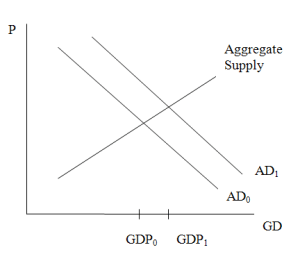
I urge caution in interpreting these figures at face value.  After all, the current GDP of the U.S. economy is simply the intersection of aggregate demand with aggregate supply.

As the figure below shows, GDP increases with increases in either the demand or supply curve, although increases in demand are accompanied by rising price levels while increases in supply push prices down and real incomes up.

graph

The quarterly figures make clear that the increase in demand was driven almost entirely by the expansion of government spending; the other three components of demand – consumption, business spending, and net exports, were either flat or falling.

Government spending is inherently short-term; it does not create wealth or enable sustainable growth.  In fact, neither consumption nor net exports create sustainable economic growth either.   Only business investment in new productive equipment (which includes business fixed investment, new residential housing and additions to inventory) has the potential to create sustainable growth in U.S. GDP, and then only when the investment leads to a permanent increase in the productivity of the business, namely a rightward (increased output per input) or downward (decreased cost) shift in the Aggregate Supply curve.

And there was little chance that the reported increase in GDP resulted from a long-term increase in the productive capacity or efficiency of the U.S. economy, as Business Investment was soundly negative in the 3rd quarter of 2009.

By Sherry Jarrell

[P.S. Karl Denninger at Market Ticker also raised big question marks about these figures. Ed.]

How far can you push people?

Debt stress in Middle Class America – how may this play out?

On Saturday, October 24th Yves Smith of Naked Capitalism ran a Post on her Blog about an anonymous couple who were over their heads in debt.  (Yves has given me written permission to reproduce the Post.) The story of this couple then generated a huge response of comments. Read the comments, each and every one of them.

Then ask yourself abraham-lincoln-picturewhere this is all heading?  These comments may, almost certainly are, just be the tip of the iceberg.  Seems a long way from Lincoln’s Gettysburg address in which he was reputed  to have used the words: “… government of the people, by the people, for the people, shall not perish from the earth.”

Some days I worry; worry a lot!

The extract from Yves Post about this couple is reproduced below but far better is to go and read the whole Post and all the comments.

UPDATE: Since writing this Post Yves has published a further Post on the topic again generating a huge volume of comments.  That was Sunday, November 1st.  Then bright and early on November 2nd James Kwak of Baseline Scenario weighs in with his version, Do smart, hard-working people deserve to make more money? 150 comments (at the time of writing) for that one.  Interestingly, as the days have gone on the mood of the commentators has become more reflective and thoughtful thus partly negating the theme behind this Post.

Read the Post from Naked Capitalism

Remarkable people update

Another quick look at Riverford Organics and a lesson for all.

Further to my post on Guy Watson of Riverford Organics, in the mini-series on remarkable people:

A couple of Saturdays ago (October 24), we had a great time out at Wash Farm, the home of Riverford Organics.

Our five year old son enjoys eating sweetcorn. Recently, having carried the weekly veg box from our doorstep to the sweetcornkitchen calling “Riverford coming through!”, he was then delighted to report: “there are three sweetcorns”, there having been two in previous weeks!

riverford 008On Saturday, he marched into a field of sweetcorn and, as if he had done it for years, went straight to a plant and, explaining what he was doing, tested the crop for size and ripeness and picked it by breaking it off like an expert. He then handed it to me and proceeded to pick many more of them. When I asked him how he knew what to do, all was revealed: “I saw it on the telly!”.

As luck would have it, I encountered Guy Watson at the event and it was great to shake his hand and offer a few words of congratulation on what he has done. Of course, he has no idea who I am!

Their customer service is great; and now they are embarking on more market research to understand better how their customers use their products! [See the relevant edition of their newsletter here!] [The subject of a Post on Market Research coming out soon. Ed.]

Although I am not an expert, I know enough to know that this is remarkable. To think about how customers are using the product, to measure it, to go into customers homes and find out what they are really doing with your products: this is at the pinnacle of good customer research!

No doubt there are others, but I have only ever heard of one other company who paid so much attention to customers in their homes. It was Intuit, the highly regarded US software vendor which, for decades, has consistently beaten Microsoft at providing accounting software. Their representatives would wait in a shop for a customer to buy their product and then request permission to travel with them to their home to record exactly what experience they had with installing and using it!

Final report from the day at Riverford: the event on Saturday was “Pumpkin Day”, its primary purpose being to buy (and have carved) your pumpkin for Hallowe’en. There was a competition to guess the weight of a (largish) pumpkin; I guessed by comparative lifting of the pumpkin and of said five-year-old son, and based my estimate on information from his mother about his most recent weight! Guess what? I have just heard that I won! So a case of (organic, of course) red wine is now expected to materialise alongside this weeks box of vegetables!

By John Lewis

P.S. The Riverford Blog is a good read

U.S. Cash for Clunkers Program a Failure?

Is there evidence that this US programme has been a failure?

I was asked by a reader recently about my claim that the Cash for Clunkers program was a failure.  He said, and I quote, “And your proof is…?”  Here is my response:

My conclusion that the Cash for Clunkers program was a failure is based on three factors.

One, it did not have the intended consequences on the environment; for those folks who purchased a marginally more fuel efficient car now, rather than later, the added fuel efficiency was likely more than offset by the pollution generated by destroying the old car, and by the loss in additional fuel efficiency they would have enjoyed had they waited a year or two to replace their current vehicle with an even later, even more fuel efficient model year.

Two, the costs of the program, which are much greater than the $4,500 rebate, far exceed any benefits generated. Abrams and Parsons in the Economists’ Voice estimate that the costs of the program exceeded the benefits by about $2000 per car.  A recent study by Edmunds.com put the cost of the program at $24,000 per car  once the cars purchases that would have occurred during that period anyway are deducted (http://content.usatoday.com/communities/driveon/post/2009/10/620000657/1). I think the real cost is somewhere in-between, but closer to $24,000 than $2,000. 

The true costs of the program include but are not limited to the additional paperwork and private and public workers needed to administer the program, the interest costs to dealerships of financing the rebate program while awaiting the government checks (some less capitalized dealerships actually went out of business because of the program), the costs of destroying the old vehicles, and the cost of lives lost and injuries sustained in accidents in smaller, less safe but more fuel efficient cars, just to mention a few.

Last, this “injection” into the economy — which, in reality, is the blatant substitution of private consumption choices with public policy, and an affront to our economic freedom — costs the economy untold sums by putting off the inevitable failure of automotive companies that fail to produce cars the population values sufficiently to keep the auto companies in business without being propped up by the government.

Case in point: GM’s plunge of 45% and Chrysler’s fall of 43% in the months following the rebate program; Honda and Toyota also reported double-digit slides, while Kia and Hyundai had double-digit increases.

New car sales fell in September as the predicted post-“cash for clunkers” slump dragged the U.S. market down to its lowest levels in seven months.

I wish it weren’t so, but I’m afraid that good business is not the strong suit of our policymakers.

By Sherry Jarrell

Sherry responds to John

A Post published today by John Lewis raises the question of why not consumer protection for financial ‘products.

Sherry’s reply.

A great question, John: why do we not have a threshold level of safety for financial products, as we do with cars and toys?

Well, for one, if a financial product “fails,” the consequence is purely financial – it is not injury or death.  A financial product simply represents a financial investment today in exchange for financial payoffs tomorrow.

The less certain those payoffs, the higher the minimum required return on that investment. If the returns were certified or regulated in some way, risk would be reduced, and the required return would also fall.  Limiting risk exposure throws out the baby with the bath water:  less risk means lower returns on the investment.  Look at the real returns to U.S. Treasury Bills – they are almost zero!

There is a role for regulation in financial products and that is for disclosure of relevant information.  When we invest in a financial product, we are putting our money at risk in exchange for future expected cash flows.  We forecast those cash flows on the basis of material information about the firm, its products or services, and its management and strategy.

Even here there is a fine line between the right to know and proprietary information that enables a firm to invest its own funds in the hope of generating a large return in exchange for taking risks.

The Securities and Exchange Commission’s requirement for a 20-day window between the time a bidder makes a tender offer for a target and the time the target shareholders must decide whether to accept the offer or not is an example of a regulation that crosses the line, in my view.

In a misguided attempt to protect shareholders from fly-by-night tender offers, the SEC has created an environment where multiple competing bids can arise, driving down the return to the original bidder and limiting the incentives for firms to productively redeploy assets through tender offers.

By Sherry Jarrell

Zombie Stocks: Not for the faint of heart

Prof. Sherry Jarrell in the news

A news release by Wake Forest University has been picked up by at least one publication. It reads as follows:
Two weeks before Halloween, the Securities and Exchange Commission again warned investors against buying shares of bankrupt companies, but like those creatures in horror films that rise from the dead, so-called “zombie” stocks–shares of companies that failed during the financial crisis–are still on the march.zombies

Take, for example, Washington Mutual and Lehman Brothers. At the end of last year, their stocks traded at 2 cents and 3 cents per share, respectively. With no future earnings in sight, shares of Washington Mutual recently traded around 20 cents, and Lehman Brothers shares have hovered around 15 cents–spectacular gains fueled by what many consider nothing more than gambling.

Critics have called on the SEC to halt the trading of such stocks to protect unsophisticated investors who might be lured into unwise trades. But Professor Sherry Jarrell, who teaches a graduate-level class on investments and portfolio management in the Wake Forest University Schools of Business, disagrees.

While Jarrell doesn’t think investing in zombie stocks is a sure-fire profitable strategy, she doesn’t consider it gambling either, because there is an expectation of gain. Jarrell also doesn’t believe those who are trading zombie stocks are ignorant or unsophisticated. Jarrell says:

To outlaw these stocks means that you’ve truncated an avenue for people to express their different risk preferences. If someone wants to go on that haunted trail, let them. It’s not like they’re taking advantage of people on the other side of the trade.

Washington Mutual and Lehman Brothers lost their standing to be listed on stock exchanges, so traders have to keep up with prices through a quotation service known as the Over the Counter Bulletin Board, which unsophisticated investors are unlikely to access. Other troubled companies, such as Fannie Mae, Freddie Mac and AIG, whose shares are widely considered to be zombie stocks, are still listed on major exchanges. The federal government’s own backing of those companies weakens any argument against allowing individuals to invest in them, if they dare.

One project Jarrell assigns her students is to identify a publicly traded stock they believe the market has significantly mispriced. By definition, she says, the exercise requires the same calculation made by traders of zombie stocks–reaching a different conclusion about a stock’s future cash flows and risks than that of the market.

Jarrell points out that all investments carry a degree of risk proportional to potential returns, and investors have varying tolerances for risk. Some hide from risk; others seek it out.

She recalls a study some years ago that found striking similarities in the blood chemistry of day traders on Wall Street and jet fighter pilots. “It turns out they need a certain amount of danger to feel normal,” Jarrell says. “They seek risk in order to feel comfortable.”

By Sherry Jarrell

Consumer ‘safety’ for financial products

Are we missing a lesson that has been applied for years?

I have resisted any temptation to comment on the economic situation on Learning from Dogs. The contributions from others are based on far more knowledge and understanding of the subject then I will ever have.

However, I feel obliged to ask humbly for some clarification about something that bothers me. Are we putting the cart before the horse? Are we ignoring the relationship between provider and consumer in finance?

The regulatory regime applied to the vast majority of products which are allowed to be sold to the public is such that toasterthere are probably more stringent safety standards for an electric toaster than for most, if not all, financial products!

Much of the talk of regulation and restraint, in the current climate, seems to relate to remuneration of people working for financial organisations. But, why does it matter what they receive? In other fields, success is rewarded and the shareholders, admittedly fairly indirectly, have some say on the policy in that area. Why should they not pay what they wish?

On the other hand (to coin an economic phrase!),  the minimum standards of the products are set by regulators.

In other fields, if a supplier cannot demonstrate, to the satisfaction of the regulators, that its product meets specified safety standards, then that product is not allowed to be offered.

It is very simple! I am not referring to contracts, customer service, compensation and so on; I am referring to a threshold level of safety below which the product is not allowed to be sold or operated. Think: “cars”, “aeroplanes”, “electrical appliances”, “children’s toys”, and … well anything else!

To be even clearer, this is not about “perfect safety” which is, of course, not available at any price. This is not about blame. This is not about guarantees. It IS about inspection, testing, certification, regulation … oh and policing!

Can anyone explain why this approach cannot be applied to financial products? (Sherry attempts to here.)

By John Lewis

p.s. as chance would have it the image of the toaster at the head of this Post was taken from an article talking about a recall of the Viking Toaster – point made rather well, don’t you think?