Category: Economics

Should you invest in U.S. bonds? Part 4

This is the concluding part four of a multipart series on the factors that drive U.S. and foreign bond prices and yields.

[Part One is here, Part Two here, Part Three here Ed.]

Bond’s in a weak or faltering economy will generate a lower return to lenders than bonds in a strong economy, absent inflation or any other material changes in the purchasing power of the currency.  Weak demand for goods and services means weak demand for financial capital which means low rates of return on financial capital.

The policies of the government can increase the borrowing costs of private industry.  Fiscal policy that increases taxes reduces the profitability of projects and undermines the ability of companies to pay coupons and repay principal.  Monetary policy that increases the money supply may lead to inflation, which also increases the cost of borrowing and reduces economic activity.

Lastly, and of the greatest concern of late, is the level of borrowing by the U.S. government.   Debt levels are at record highs, with no relief in sight. The AAA rating of U.S. debt is reportedly in jeopardy (Chicago Tribune editorial).

Moody's Corporate Logo

Both existing and new lenders worry about the ability of the U.S. government to repay. Yes, the can simply roll over existing debt by raising taxes or creating money to retire old debt and replace it with new, but the interest rate required by new lenders goes up as the ability of the private economy to sustain tax revenues falls and the risk of inflation rises (Moody’s explains U.S. bond ratings).

Both factors are in play now: an anemic economy with little hope that this administration will undertake policies that support business, and a ballooning money supply and weak dollar that undermine the purchasing power of the returns to lenders.  The returns to U.S. debt may still be healthy relative to those one can earn in other countries, but the spread is shrinking. The private economy remains fundamentally strong, thanks to the work ethic of the American people and the profit motive of the capitalistic system, but the policies of the U.S. government are straining those resources.

By Sherry Jarrell

Should you invest in U.S. bonds? Part 3

This is part three of a multipart series on the factors that drive U.S. and foreign bond prices and yields.

[Part One is here, Part Two here, Ed.]

The yield on a bond is made up of several components. Some think of the return on a bond as the sum of the risk-free rate of interest (how impatient we are to get our money back, or how much we need to be compensated to delay consumption) and a risk premium (the additional return we require to compensate us for the risk of default, the risk the bond will be called, the risk of inflation reducing the purchase power of the repaid dollars, and many other sources of risk as outlined in the most recent article in this series).

Another useful way of thinking of the return on a bond is as the sum of the real rate of interest and the expected rate of inflation.  But what is the real rate of interest?  We never actually observe that rate, unless of course the inflation rate is zero and then the real rate is just the nominal rate set in the market.

It is useful, however, to think about what drives the ability of a company to generate a real rate of return to lenders, for this is essence of capitalism and risk-taking and creating economic value and growth.

Bond traders

A firm’s asset cash flows support the real returns to its lenders – all kinds of lenders (debt, equity, hybrid, and derivative security holders). A firm will want to borrow more, and is willing to pay a higher interest rate for those funds, the more profitable are the projects they want to undertake, or the greater the number of profitable projects. Profitability, in turn, is determined by the relationship between demand and supply:  how much does society value a good or service, and how many resources does the business use in producing the good or service.  As the marginal productivity or efficiency of a business goes up, it can afford to profitably fund more projects.  So the core driver of the real return on bonds is the strength of the underlying economic activity of the private economy.

Or, when viewed from the investor’s side, note that an investor will purchase a bond, or lend money to a company, if they expect to earn a return sufficient to compensate them, first, for delaying consumption and, second, for bearing the various sources of risk or uncertainty associated with the bond’s cash flows or return.

By Sherry Jarrell

Europe Uber Alles, Pt 2.

A Guest post by Patrice Ayme

Part One ended saying:

The euro, long in planning by some European institutions, was introduced minimally, namely without the governmental apparatus generally associated to a currency. This is the way Europeans have found to progress peacefully towards greater harmony: do what is necessary, and nothing more than that, and do it with total consensus.

Everybody knew that a currency without a government to create and anchor it had never happened before, and was unlikely to endure.

The European Union

Part Two continues

That fit the European federalists just right, and could not have escaped the understanding of Paris and Berlin. As it turned out, the PIIGS’ crisis is putting back Paris and Berlin, the historical engine of Europe, back on top, and this, for an excellent reason.

“PIIGS” stand for Portugal Ireland Iceland Greece Spain. All of them ran bubble economies, partially propelled by taxes from the richest European countries (including France and Germany). It became ridiculous as, for example, Ireland was getting European subsidies while the Irish were already way richer than those subsidizing them. (OK Iceland is not in the EU, yet, but it begged to enter the Eurozone, and it has disappeared the savings of countless Brits and Dutch, which means it has some outstanding business with the rest of Europe, that it will have to sort out, after executing a few more whales, guilty as charged.)

Some acknowledge the convenience of a common European currency and easier border transits, while remaining obsessed by what they view as gigantic differences between European countries. Those quaint nationalists and parochial types obsess that core differences between countries are so strong and deep-rooted that any form of real European union is a ridiculous concept. This is triply erroneous.

Read the rest of this Post

U.S. unemployment remains at 9.7%

Little reason for celebration

The official unemployment rate of the U.S. economy remains at 9.7%,  and the underemployment rate increased to 16.9%.  These numbers represent a real tragedy for many Americans.

While the White House tries to celebrate the creation of 162,000 new jobs last month, at least 48,000 of these new jobs are government jobs, specifically temporary census workers, who are doing unproductive work and are being paid with taxes collected from the rest of the private economy.

Unemployment

Employment also increased in temporary help services and healthcare, but continued to decline in financial activities and in information, which is interesting given the recent comments by President Obama that the government takeover of the student loan program tucked into the health care bill “took $68 billion from banks and financial institutions.”(Obama’s  April 1 remarks)  That’s a lot of jobs, Mr. President.

Seems like there is more concrete evidence that, rather than creating jobs, the President’s policies are costing the economy jobs.

by Sherry Jarrell

Europe Uber Alles

Welcome Patrice Ayme

On the 22nd March, Learning from Dogs had the pleasure of a Post from our first Guest Author, Elliot Engstrom.  We were then doubly delighted to have Per Kurowski join us as our second Guest Author with his introductory Post.

Now we have the additional honour of welcoming Patrice Ayme to the growing ranks of Guest Author to Learning from Dogs.

Patrice, like Elliot and Per, also is a prolific blogger.  He describes himself as:

I was born in Europe, raised in Africa, and lived in America. So doing, I learned to compare different cultures, even during my early childhood, and to appreciate superiority of many of their traits, even the most surprising. I consider myself Senegalese, and proudly so. I studied, and know, several languages, not just Latin, and several cultures, deeply, by living through and inside them for years. I have done formal studies in mathematics and physics at three leading Universities receiving the highest degrees, and putting me in a good position to learn to differentiate between hard knowledge and wishful thinking, differently from many a common philosopher. I am a specialist of non commutative geometry, arguably the most abstract field of knowledge in existence (even hard core logic, model theory, is used in my approach).

Here is Patrice’s first Guest Post for Learning from Dogs.

——————————

GREEK TROJAN HORSE TO CONQUER BETTER EUROPEAN UNION

Abstract:

The European currency, the euro, is, foremost, a solution to a problem. War. All other problems, and the euro solves many, pale in significance relative to this one.

Many talk about “problems” with the euro, and, oozing with glee all over, perceive weakness. They are right, there is weakness, but it is not European weakness. Just the opposite.

What those skeptics are seeing with their uncomprehending neurology is the further construction of the European imperium, according to its core principle: fix what needs to be fixed, but with complete consensus of the parties concerned, which means do it just so. It appears messy, because it’s democratic, and before the people (demos) can use its kratos (power), it needs to think right, which means it has to argue thoroughly. It looks like squabbling, but it is thinking aloud. Europe is not built for some parties to gain advantage anymore (as it was with Napoleon, or Hitler), but to solve problems and gain opportunities for all.

The euro is, for the first time, used as a weapon against Europe’s enemies. Hence all the squealing. Far from weakening Franco-German resolve, the recourse to the IMF adds another layer of authority to the European Communities. When the IMF, speaking in the name of Franco-German taxpayers, tell restive exploiters in Greece that they have to pay more taxes (only 6 plutocrats declare more than one million euro income in Greece, and more than 500 professions can retire at 50 years of age, whereas Germany just brought up the retirement age to 67!), they will have to submit under orders (imperare, to use the Roman notion)

The European Union

Read more of Patrice’s fascinating article

US incomes

This isn’t just about America, it’s affecting us all!

Yesterday, Learning from Dogs published in full a Stratfor report about China.  The thrust of the report was:

U.S.-Chinese relations have become tenser in recent months, with the United States threatening to impose tariffs unless China agrees to revalue its currency and, ideally, allow it to become convertible like the yen or euro. China now follows Japan and Germany as one of the three major economies after the United States. Unlike the other two, it controls its currency’s value, allowing it to decrease the price of its exports and giving it an advantage not only over other exporters to the United States but also over domestic American manufacturers. The same is true in other regions that receive Chinese exports, such as Europe.

What Washington considered tolerable in a small developing economy is intolerable in one of the top five economies. The demand that Beijing raise the value of the yuan, however, poses dramatic challenges for the Chinese, as the ability to control their currency helps drive their exports. The issue is why China insists on controlling its currency, something embedded in the nature of the Chinese economy. A collision with the United States now seems inevitable. It is therefore important to understand the forces driving China, and it is time for STRATFOR to review its analysis of China.

(My italics)

So the state of US incomes is crucial, not only to Chinese exports to America but for global trade in general.

Karl Denninger

We have often congratulated Karl Denninger of Market Ticker for his commitment in analysing and reporting on the American economic scene and a recent piece on US Incomes was typical of his excellent reporting.  I am taking the liberty of publishing his Post in full because, frankly, this information is of importance to us all, wherever we live.

Where Did The Income Go?

It appears that the Federal Tit Pump is running out of power…

Personal income increased $1.2 billion, or less than 0.1 percent, and disposable personal income (DPI) increased $1.6 billion, or less than 0.1 percent, in February, according to the Bureau of Economic Analysis.  Personal consumption expenditures (PCE) increased $34.7 billion, or 0.3 percent.

Oh boy, now the $1.3 trillion in additional deficit spending is no longer contributing to personal income!  That’s not so positive – indeed, it’s not positive at all.

Private wage and salary disbursements increased $2.0 billion in February, compared with an increase of $16.6 billion in January.  Goods-producing industries’ payrolls decreased $3.5 billion, in contrast to an increase of $5.2 billion; manufacturing payrolls decreased $1.4 billion, in contrast to an increase of $5.0 billion.  Services-producing industries’ payrolls increased $5.5 billion, compared with an increase of $11.4 billion.

Goods down…. uh, where’s our so-called economic recovery?

Proprietors’ income decreased $6.1 billion in February, the same decrease as in January. Farm proprietors’ income decreased $7.1 billion, the same decrease as in January.  Nonfarm proprietors’ income increased $1.0 billion, the same increase as in January.

Very little change in proprietor’s income ex farming, but farmer income is down significantly.

Rental income of persons increased $2.2 billion in February, compared with an increase of $1.9 billion in January.  Personal income receipts on assets (personal interest income plus personal dividend income) decreased $16.5 billion, the same decrease as in January.

Rents up a bit, but dividends are down huge, continuing a trend.  This is not positive at all, and implies that assets are being sold to continue lifestyle choices.  This leads to a question that has begun to gnaw at me: Have we begun to cross into where boomers start pulling funds out of asset classes to live on?

Personal current transfer receipts increased $16.6 billion in February, compared with an increase of $29.8 billion in January.  The January change reflected the Making Work Pay Credit provision of the American Recovery and Reinvestment Act of 2009, which boosted January receipts by $19.8 billion. The Act provides for a refundable tax credit of up to $400 for working individuals and up to $800 for married taxpayers.  When an individual’s tax credit exceeds the taxes owed, the refundable tax credit payment is classified as “other” government social benefits to persons.

Government to the rescue!  $45 billion worth in the last two months, to be specific.  That’s a direct $270 billion in handouts, or 2% of GDP – and that’s only the direct handouts!  So subtract that off GDP and….. (oh, and don’t forget the rest of the $1.3 trillion too.)

Nothing to see here folks, as in “no evidence of sustainability in the recovery.”  We have a government that continues to “prime the pump” but there’s no water at the bottom of the well to generate self-sustaining economic growth.

By Paul Handover

Elliot’s schooling

Elliot Engstrom – Guest Author

Elliot was ‘exposed’ to the Learning from Dogs readership on the 22nd March as our first Guest author.  He wrote about the US Government and Poverty.

Elliot has one important distinction with respect to the other authors of this Blog; he is the right side of 30 years old!

He is going to use this perspective to reflect on schooling, something that most of us ‘aged’ peeps take for granted, assuming we can remember our school days! 😉

It promises to be a fascinating reflection.

———————————–

Setting the scene

I’ve had a plethora of experiences over the past 17 years of my life. I’ve made and lost friends, had romantic

Elliot Engstrom

relationships, read, traveled all around the world, lived in France, and done countless other things that I consider myself immeasurably blessed to have experienced.

Despite the fluidity of where these different experiences have taken me, my entire life since the age of four has had one characteristic in common – I have been a school student.

In the spirit of “Learning from Dogs,” I thought it might be interesting to reflect a bit upon the core dynamic between education (not learning, which is a far broader topic) and schooling.

I often ask myself just how effective the modern US schooling system is as a tool of education, and whether or not its costs outweigh its benefits. I hope to have at least a rough answer to this question in the final post of this series.

In the following three posts, I will examine three topics:

In what ways does the modern schooling system function as a positive tool for education?

What costs involved in modern schooling hinder its ability as an educative tool, and even make it a negative influence on students?

Considering the analyses put forth in the first two posts, do the costs or benefits or this system outweigh the other? On the whole, are school and education complements or antagonists?

This series is going to be exciting for me because, to be quite frank, I have no idea what my final answer is going to be. I guess I’ll just have to stay tuned to see where my brain takes me – and so for you!

By Elliot Engstrom

So what next in the global merry-go-round?

Well, it is a Chinese saying, “May you live in interesting times”!

A couple of weeks ago on Learning from Dogs, there was an article reminding readers that the web has been around for 20 years and Sir ‘Tim’ Berners-Lee is still hard at it in terms of Internet innovations. And to support this, today accompanying this Post is one on what the BBC is doing to commemorate the event.

The Internet has completely reformed the way that ordinary people get access to information.  Stratfor is a great example.

From their web site:

STRATFOR’s global team of intelligence professionals provides an audience of decision-makers and sophisticated news consumers in the U.S. and around the world with unique insights into political, economic, and military developments. The company uses human intelligence and other sources combined with powerful analysis based on geopolitics to produce penetrating explanations of world events. This independent, non-ideological content enables users not only to better understand international events, but also to reduce risks and identify opportunities in every region of the globe.

One can subscribe to a range of free reports and it came to pass that a Stratfor report on China came into my in-box.

Stratfor generously allow free distribution of this report and because the relationship between China and the USA has so many global implications, the report is published in full, as follows:

Read the Stratfor report

Burning the Bridges in Europe

A very far-sighted view of European collaboration from 12 years ago!

Once again, Learning from Dogs welcomes a guest post from Per Kurowski.

Per Kurowski

——————-

I was intrigued by a recent Post on Learning from Dogs entitled Poor Old Europe.  It included two commentaries from elsewhere about the state of Europe and how the feeling of trying to force, politically, very disparate countries together was still ever so dominant.  It reminded me of an article that I wrote for my own Blog nearly 12 years ago just before the Euro came into effect.  Reading it today is interesting, to say the least.

In just a few weeks, on the 1st of January 1999, eleven European countries will forsake the right to issue their own currency and accept the circulation within their boundaries of a common currency, the Euro. Monetary policy related to the Euro will be set by a European Central Bank. One fact that struck me as curious is that in all the abundant legislation that regulates this process, there is no mention whatsoever of how to manage the withdrawal or future regret of any of the union’s members.

The absence of alternatives in this case evidently represents a burning of the bridges, but this may be necessary to achieve credibility. There is no turning back and there is no doubt that this is a truly historical moment. As participants in a globalized world in which Europe has an important role, we must naturally wish all members luck, no matter what worries we might secretly harbor.

Until 1971, all money used throughout the history of humanity was backed in one way or another by something physical to which a real value was attributed. Sometimes the backing was direct, pearls for example, while in other cases it was indirect such as the right to exchange bills for a certain quantity of gold.

This physical backing in itself did not necessarily mean it consisted of something of fixed value. The value of a pearl, for example, is in itself subjective. The promise to exchange bills for gold did not guarantee anything either, since this promise could easily be voided by fraud. Whatever the backing was, however, it did at least offer the holder of the money the illusion that it was supported by something concrete.

In 1971, the United States formally abandoned the gold standard and the direct backing, however imaginary, disappeared. Since the Dollar is a legal currency, it could always be used to repay Dollar denominated debt. Today, however, in spite of the fact that the Dollars may have lost some of their purchasing power, a holder of excess Dollars can only hope that the Government of the United States will exchange his old bills for new ones of the same tenor.

This apparently precarious situation must be the raison d’etre of the motto printed clearly on the bills which states “In God We Trust”.

Since 1971, the real value of the Dollar as an element of exchange, has lost some of its value due to inflation. Today, we would need many more Dollars to buy the same houses, cars, movie tickets and gold than we would have needed in 1971. In spite of the above, with few exceptions such as the end of the ‘70s during which inflation increased dramatically, few would dare qualify the United States’ elimination of the gold standard as a failure.

The world’s economies have managed to increase international commerce drastically and with it, sustain a healthy growth rate. Many analysts would explain this phenomenon by saying that the discipline exacted by the gold standard represented a brake on international commerce. The growth rate registered in commerce after 1971 was the result of the release of this brake. Other more critical analysts sustain the thesis that, due to the fact that we have abandoned the discipline required by the gold standard, the world has accumulated gigantic accounts payable, which we may be coming due very soon.

I personally swing back and forth between amazement of the fact that the world has accepted such a fragile system and satisfaction that it actually has done so.

The Euro has one characteristic that differentiates it from the Dollar. This characteristic makes me feel less optimistic as to its chances of success. The Dollar is backed by a solidly unified political entity, i.e. the United States of America. The Euro, on the other hand, seems to be aimed at creating unity and cohesion. It is not the result of these.

The possibility that the European countries will subordinate their political desires to the whims of a common Central Bank that may be theirs but really isn’t, is not a certainty. Exchange rates, while not perfect, are escape valves. By eliminating this valve, European countries must make their economic adjustments in real terms. This makes these adjustments much more explosive. High unemployment will not be confronted with a devaluation of the currency which reduces the real value of salaries in an indirect manner, but rather with a direct and open reduction of salaries or with an increase of emigration to areas offering better possibilities.

What worries me most is the timing. The world is facing the possibility of a global recession. This will require very flexible economic and monetary policies. The fact that the search for initial credibility for the Euro is based on trying to assure markets around the world that the new currency will be guided by a philosophy closer to that of Bonn than that of Rome, probably goes against the best interests of the world.

Published in Daily Journal, Caracas, November 19, 1998

By Per Kurowski

Unwinding $1 trillion in Toxic Assets

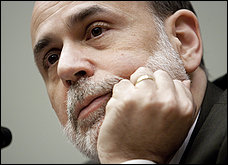
Ben S. Bernanke, Chairman of the Federal Reserve

Used toxic assets, anyone?

Ben Bernanke, Chairman of the U.S. Federal Reserve, announced that the Fed was likely to begin to sell some of the $1 trillion in mortgages, the so-called “toxic assets,” that it purchased over the last fifteen months to help stave off a total credit market meltdown. Those purchases essentially doubled the U.S. money supply, igniting fears of potential inflation should the underlying real economy recover before the money supply could be drawn back down. See earlier post.

Well, the process of tightening the money supply may be just around the corner. And increases in interest rates and the cost of everything purchased on credit – homes, cars, durable goods, and business capital expenditures – are not far behind. Increases in interest rates dampen economic activity, an unfortunate development given the current lethargic state of the U.S. economy. But it has to be done sometime – we cannot sustain such a huge increase in the money supply without paying an even higher price in terms of inflation and a weak dollar.

It will be interesting to see who buys the toxic assets and how much they will pay. Regardless, the sale will reduce the money supply which, if done in a slow, orderly manner, is a good thing for the economy. Getting the Fed out of the business of buying and selling private market securities will be an even better thing for the U.S. economy. Now more than ever we need a monetary authority that is focused on the best policies for our economy, not those that help Fannie Mae, the White House, or the Treasury Secretary save face.

By Sherry Jarrell