Category: Economics

Group human insanity

In individuals, insanity is rare; but in groups, parties, nations, and epochs it is the rule.Friedrich Nietzsche

I was minded to select this quote because an item in the UK Independent newspaper brought to light a new book from Lester R Brown, founder and President of Earth Policy Institute, called World on the Edge.  Here’s what The Independent wrote (selected extracts by me, the full article is here ):

Like many environmentalists, Lester Brown is worried.

In his new book “World on the Edge,” released this week, Brown says mankind has pushed civilization to the brink of collapse by bleeding aquifers dry and overplowing land to feed an ever-growing population, while overloading the atmosphere with carbon dioxide.

If we continue to sap Earth’s natural resources, “civilizational collapse is no longer a matter of whether but when,” Brown, the founder of Worldwatch and the Earth Policy Institute, which both seek to create a sustainable society, told AFP.

“We’ve got to get our act together quickly. We don’t have generations or even decades – we’re one poor harvest away from chaos,” he said.

Global warming is also impacting the global supply of grain, which Brown calls the foundation of the world food economy.

Every one-degree-Celsius rise above the normal temperature results in a 10 percent fall in grain yields, something that was painfully visible in Russia last year, where a seven-week heatwave killed tens of thousands and caused the grain harvest to shrink by 40 percent.

Food prices soared in Russia as a result of the poor harvest, and Russia – which is one of the top wheat exporters in the world – cut off grain exports.

Different grains are staple foods in most of the world, and foods like meat and dairy products are “grain-intensive.”

It takes seven pounds (3.2 kilograms) of grain fed to a cow to produce a pound of beef, and around four pounds (1.8 kilograms) of grain to produce a pound of cheese, Brown told AFP.

In “World on the Edge”, Brown paints a grim picture of how a failed harvest could spark a grain shortage that would send food prices sky-rocketing, cause hunger to spread, governments to collapse and states to fail.

Regular readers of Learning from Dogs will understand, because I bang on about it, how the behaviour of dogs over thousands and thousands of years gives us so many metaphors that we can use to rethink how we live, before it’s too late.

(Of course, it’s not just dogs, there are many ‘higher order’ pack animals such as horses, lions and dolphins. to name but a few, that instinctively live in harmony with their surroundings and also we shouldn’t forget some of the earlier human inhabitants of this planet; Eskimos, native North American Indians, Australian Aborigines, that lived similarly in balance with their environment.)

Anyway, back to the theme of this article.

Read a little about Lester, his biography is here.  It starts:

Lester Brown

The Washington Post called Lester Brown “one of the world’s most influential thinkers.” The Telegraph of Calcutta refers to him as “the guru of the environmental movement.” In 1986, the Library of Congress requested his personal papers noting that his writings “have already strongly affected thinking about problems of world population and resources.”

Brown started his career as a farmer, growing tomatoes in southern New Jersey with his younger brother during high school and college. Shortly after earning a degree in agricultural science from Rutgers University in 1955, he spent six months living in rural India where he became intimately familiar with the food/population issue. In 1959 Brown joined the U.S. Department of Agriculture’s Foreign Agricultural Service as an international agricultural analyst.

Brown earned masters degrees in agricultural economics from the University of Maryland and in public administration from Harvard. In 1964, he became an adviser to Secretary of Agriculture Orville Freeman on foreign agricultural policy. In 1966, the Secretary appointed him Administrator of the department’s International Agricultural Development Service. In early 1969, he left government to help establish the Overseas Development Council.

As I said, that was just the start; read the full biography here.

Having recently signed up to the EPI mailing list, this morning an email arrived talking further about Lester Brown’s latest book, World on the Edge.  Here’s what was in that email.

World on the Edge: Quick Facts

JANUARY 25, 2011

We are facing issues of near-overwhelming complexity and unprecedented urgency. Can we think systemically and fashion policies accordingly? Can we change direction before we go over the edge? Here are a few of the many facts from the book to consider:

  • In Sana’a, the capital of Yemen—home to 2 million people—water tables are falling fast. Tap water is available only once every 4 days; in Taiz, a smaller city to the south, it is once every 20 days.
  • The indirect costs of gasoline, including climate change, treatment of respiratory illnesses, and military protection, add up to $12 per gallon. Adding this to the U.S. average of $3 per gallon brings the true market price closer to $15 per gallon.
  • Between 2007 and 2010, U.S. coal use dropped 8 percent. During the same period,300 new wind farms came online, adding 21,000 megawatts of U.S. wind-generating capacity.

“We can get rid of hunger, illiteracy, disease, and poverty, and we can restore the earth’s soils, forests, and fisheries. We can build a global community where the basic needs of all people are satisfied—a world that will allow us to think of ourselves as civilized.” –Lester R. Brown

World on the Edge: How to Prevent Environmental and Economic Collapse is available online at www.earth-policy.org.

In a very real sense it’s a book we should all be reading and if so minded you can buy it directly from the EPI here.  But there is a health warning, so to speak.  That is that each and every one of us has to take a stand to protect the world we live on, to preserve it for our children’s children, and to start the long haul towards sustainability.

Think about one small thing you can do this week to make a positive difference, and do it!

“By the inch it’s a cinch, by the yard it’s hard!”

A ‘steady’ relationship with Planet Earth

Perpetual economic growth is neither possible nor desirable. Growth, especially in wealthy nations, is already causing more problems than it solves.

Recession isn’t sustainable or healthy either. The positive, sustainable alternative is a steady state economy.

These are the opening sentences that one sees when going to the CASSE website.  CASSE is an acronym for Centre for the Advancement of the Steady State Economy.  More on this organisation as I spend more time getting to know the background.  But my instinct is to support it, hence the reason it is the subject of a Post on Learning from Dogs.

With the permission of CASSE I am re-publishing something that was on the CASSE Blogsite recently. Well worth signing up to, in my humble opinion.

Anyway, the article is called From Black Friday to a Better Way and is written by Brent Blackwelder who, among other things, was recent President of Friends of the Earth.

From Black Friday to a Better Way

Rethinking Consumer Spending and Enjoying the Holidays

by Brent Blackwelder

The day following Thanksgiving Day in the United States is called Black Friday. For retailers the day marks the beginning of the Christmas shopping season. While the origin of the term is debated, it is today associated with special sales and extraordinary promotions that retailers use to induce shoppers into spending the holiday weekend on a shopping spree.

Our modern economy is structured such that its stability depends upon ever increasing consumer spending. In my first economics course in college in 1961, the professor told the class to go out and shop because it is good for the gross national product (GNP). Then and now, mainstream economics continues to treat the Earth as if it were a business in a liquidation sale.

At a time of high unemployment in the United States, it may seem like an act of madness to question the growth economy, but relentless pursuit of growth has failed to deliver again and again on the promise of economic stability and security. Its recipes are not making people any happier, and it is undermining the ecological life support systems of our planet. It has failed about one third of the world’s population who live on less than $2 per day, while simultaneously producing an exclusive club of gratuitously wealthy individuals. Those of us advocating a steady state economy seek a new way to maintain full employment that does not incentivize employers to seek dirt-cheap labor or to replace people with machines.

Professor Tim Jackson’s 2009 report to the UK Sustainable Development Commission entitled Prosperity without Growth provides an outstanding foundation for any discussion of consumerism and the growth economy. For those interested in a steady state economy, it is worthwhile to think in this holiday season about the nature of shopping in such an economy.

Throughout history religious leaders have expressed concerns about the accumulation of stuff. Two thousand years ago Jesus cautioned about excessive attention to material possessions, saying: “Lay not up for yourself treasures on earth where moth and rust doth corrupt and where thieves break through and steal.”

Over 100 years ago the economist and philosopher John Stuart Mill recognized that eventually humanity would have to move toward a stationary state of capital and wealth, but that condition need not entail a stagnation of human improvement.

Two centuries ago the poet William Wordsworth expressed alarm at the consumerism he witnessed in England: “The world is too much with us, late and soon. Getting and spending we lay waste our powers. Little we see in nature that is ours. We have given our hearts away…”

Today’s economy is five times bigger than in the 1950s, and at current growth rates stimulated by commercial promotions, it is headed to a global economy 80 times as large.

The consumer rampage is in part fueled by slick advertising for novel consumer products, and much of this advertising is targeted at youth. Ralph Nader questions who is watching what young people worldwide are being enticed to buy? He writes: “Undermining parental authority with penetrating marketing schemes and temptations, companies deceptively excite youngsters to buy massive amounts of products that are bad for their safety, health and minds.”

Excessive packaging accompanying today’s products attracts ecological criticism, but it is only the tip of the iceberg in terms of waste. The volume of raw resource extraction required in the manufacture of products dwarfs the packaging waste. For example, many mining operations for valuable metals leave behind as waste over 90% of the material excavated, and such rocky rubble often releases a mass of toxicity onto the land and into the water.

Has happiness been improved by having all these products? Studies over the past two decades have suggested that a certain amount of material comfort and ease provided by various products increases one’s happiness, but beyond a certain point – one study suggested $75,000 income – more stuff doesn’t produce more happiness. In fact, it can yield the perverse result of adding stress, worry and depression.

It is amazing that times of holiday celebration in the United States are frequently the very times of peak stress. What should be a fun and cheerful experience becomes a week or even a month of worry.

The holiday season is a good time to reexamine the kinds of purchases we make to see whether they are reducing the use of natural resources and encouraging more sustainable ways of growing food and conducting commercial business.

Many religious congregations are looking toward a different approach to reclaim the holidays from preoccupation with material gifts. Some offer ways to reduce the volume of purchasing and to make different kinds of purchases that reduce throughput and pollution.

For example, Interfaith Power and Light seeks to get religious congregations to purchase renewable energy and to reduce energy use in their homes and their places of worship. Through Greater Washington Interfaith Power and Light, our family now purchases all our electricity, sourced from wind farms, at a surcharge of about $130 a year.

By voting with their food dollars many Americans have already sent powerful signals in favor of local farm markets and organic food. With some due diligence, people can determine whether their purchases lend further support to child labor and slave conditions, whether the purchases harm women or empower women, and whether the product came from an animal-slum factory farm operation. The Fair Trade label allows consumers to identify imported products that avoid harmful labor and environmental degradation in their manufacture.

We have options.  We can do better than liquidating our natural bounty for consumer novelty, we can refrain from pitching unnecessary products to our children, and we can stop pursuing growth for growth’s sake.  The steady state economy is a better choice than continuous pursuit of economic growth, but the transition starts with better choices about what and how we consume.

If you didn’t read yesterday’s Post touching on the second bitterly cold winter in Europe, then you may care to read it and ponder.

By Paul Handover

A little bit of old Irish!

Sorry, dear readers, a bit squeezed for time today so apologies for republishing a few bits and pieces that have caught my eye about the Irish situation.

First, who would want to be Irish Prime Minister?

The Irish Republic‘s prime minister (taoiseach) is facing parliament for the first time since agreeing to borrow 85bn euros ($113bn; £72bn).

Brian Cowen is answering questions in the Dail as the opposition Labour Party argues that the EU/IMF rescue will ruin the country.

Ireland faces four years of austerity to reduce its deficit from a record 32% of GDP to the eurozone limit of 3%.

Who else thinks that it would make so much more impact on folk if ‘bn’ was replaced with zeros.  If that was the case then the first sentence would read,

The Irish Republic’s prime minister (taoiseach) is facing parliament for the first time since agreeing to borrow 85,000,000,000 euros ($113,000,000,000; £72,000,000,000).

Ouch!

In 2009 the World Bank  estimated the Irish population to be 4,450,000.  So this little borrowing for their country is the equivalent of 19,101 euros for every man, woman and child.

Is there an alternative?  Yes, according to a suggestion from a reader of Yves Smith’s fabulous Blog, Naked Capitalism.

This suggestion on the Irish mess from an irreverent Commonwealth reader:

The UK conquest of Ireland began in 1169.

It’s time to finish the job.

All they have to do is offer the following:

Ireland converts all its public debt to sterling.

The UK Treasury takes over the responsibility for all of Ireland’s existing public debt.

(Ireland gets a clean start with no Irish govt. debt and not interest payments)

Ireland taxes and spends in sterling only and has a balanced budget requirement.

Ireland can borrow only for capital expenditures.

The UK Treasury guarantees all existing insured euro bank deposits in Irish banks.

Only sterling deposits are insured for new deposits.

Ireland runs a mirror tax code to the UK and keeps all of its tax revenues.

The UK agrees to fund Ireland’s with a pro rata/per capita share of any UK deficit spending.

St. Patrick’s Day is declared a UK national holiday and everyone over 21 gets a beer voucher.

No comment from me required!

By Paul Handover


Fairness in society

Very difficult times ahead but a fairer social order could be one outcome.

As is so often the case, a number of different lines of thought come together once again to highlight the pressures on society and my belief that we are in the ‘zone of change’ between the last 40 or 50 years and what is ahead for western societies.  There is no question that these are very difficult times as, I presume, all phases of change have been over many centuries.

On the 28th October there was a Post on Learning from Dogs about the recent book from Will Hutton, Them and Us.  That book masterfully articulates the core issues in British society arising out of some fundamental economic policy errors and the very difficult times that are being experienced right now.

The British are a lost tribe – disoriented, brooding and suspicious. They have lived through the biggest bank bail-out in history and the deepest recession since the 1930s, and they are now being warned that they face a decade of unparalleled public and private austerity.

As if to underline the fact that the economic situation is far from recovery, despite what is being promoted, here’s a recent article from Washington’s Blog. Almost impossible to take an extract that conveys the essence of this powerful (and scary) article – so just go here and read it.  Or if you haven’t the time here’s a taste:

SATURDAY, NOVEMBER 27, 2010

It’s Not Just the “Peripheral” European Countries … Financial Contagion Could Spread to “Core” Eurozone Countries and the U.S.

CNN notes:

Americans will not be spared if there’s a recession in Europe, even if U.S. bank exposure to European government debt is relatively limited.

SNIP

The European Union is the second largest market for U.S. exports, behind only Canada. The EU bought about $175 billion in U.S. goods in the first three quarters of this year. That’s up about 8% from a year ago.

So worsening problems in Europe will clearly be a drag on the U.S. as well.
Niall Ferguson, Marc Faber, and SocGen’s Edwards and Grice predicted 9 months ago that the European debt crisis would eventually spread to America.

But the question of what country the “contagion” might spread to next is really the wrong question altogether.

The real question is whether the wealth of the people around the world will continue to be shoveled into the bottomless pit of debts held by the big banks, or whether the people will prevail and the giant banks and bondholders will be forced to take a haircut. See thisthis and this.

So back to the issue of fairness.  There is no escaping the consequences, still playing out, of the ‘spend now, pay tomorrow’ culture of the last 30 or 40 years so then the main issue is how do we mitigate the consequences for those who are most exposed to some of less prettier aspects of modern life.  Ponder on that question while you read this recent piece from Open Democracy.

Fairness and the cost of life for the poor in Britain

Brian Landers26 November 2010

Most Britons had “never had it so good” despite the “so-called recession” declared Lord Young of Graffham.  His words were immediately disowned by David Cameron, who fired him. But in reality Young was only articulating what he and his circle are experiencing and privately believe.

For example, on the BBC’s Sunday morning Broadcasting House on 21 November, Lord Charles Powell who was Margaret Thatcher’s advisor, complained, “unfortunately he said the wrong thing. In terms of fact what he said was probably right, with interests rates low people are not particularly badly off at the moment. But some people are very badly off and it is insensitive, I suppose, to suggest that everyone is not doing too badly at this time. It does show that you can’t speak the truth in politics anymore you have to defer to what is politically correct”.

Well, there is another truth: that for thousands of pensioners and not just “some” of them, negative real interest rates on their savings are becoming a disaster. Even though for the heavily mortgaged wealthy, low interest rates do indeed make them much better off.

What Young’s comments illustrate, therefore, is that when we consider equality and inequality we need to look at expenditure patterns, which can be just as important as differences in income.

Historically debates on social equality focus overwhelmingly and inevitably on inequalities of income. We read, for example, that according to a study by Incomes Data Services chief executives of the UK’s 100 largest companies are now paid on average 88 times the pay of typical full-time workers and that this ratio is getting worse. Last year the multiple was 81 times and ten years ago top bosses took home 47 times the average wage.

But in addition to their income being a lot lower the poor also suffer more because life costs them more. There are two issues, one obvious, one less so.

The primary issue is one of fairness. Three for the price of two supermarket offers are great value only for those who can afford to buy two; those who can only afford one end up paying 50% more per unit. Is that fair?

Another supermarket example which received widespread but soon-forgotten newspaper coverage earlier this year is more subtle. Tesco owns three convenience store brands in this country: Tesco Express, Tesco Metro and One Stop. An enquiry in 2006 found that the corporation was charging more than 20% more for the same products in its One Stop stores than in its Tesco branded stores. Tesco responded that it was bringing prices down in One Stop but in 2010 further research showed that One Stop prices were still 14% higher than prices for the same product in the rest of Tesco. One Stop typically operated in less attractive (that is poorer) areas where there was no competition from other mega-corporations and where therefore significantly higher prices could be charged. Again that raises issues of fairness.

If such unfairness is somehow familiar there is a further layer that goes beyond fairness: we live in a society where in many tiny ways the poor actually subsidise the better off through the way patterns of expenditure are organised by the market place, (i.e., not just by providing cheap labour).

Consider for example the cost of owning a car.  Bernard Jullien of the University of Bordeaux analysed published data on household expenditure and trade data from car distributors (See Competition and Change 6, 2002). He showed that richer consumers were being cross-subsidised by poorer consumers. Distributors in France (and almost certainly elsewhere) were following a conscious policy of keeping new car prices lower to increase their market share. Then then marked up the prices of spare parts and maintenance to maintain their overall profit levels. Jullien found that the unintended consequence was that well off customers, who were more likely to buy new cars, ended up being subsidised by less well off customers who typically bought second hand cars that needed more frequent repair.

There are more examples if the term “well off” is extended to include corporations. The cost of producing and distributing the electricity needed to power a light bulb is the same whether the bulb is in a private house or in the office of a mega-corporation – and yet the corporation will undoubtedly pay far less. Quantity discounts typically reflect the purchasing power of the buyer rather than any scale economies for the seller.

What are apparently rational pricing strategies have the unintended consequence of ensuring that poor people pay more than the well off in ensuring the overall profits corporations need.

Then there is time. Time budget surveys have shown, for example, that the poor take much longer per mile to get to work than the rich because the forms of transport they use are typically much slower. Similarly the poor have to devote more time to food shopping and a host of other activities.

There is nothing conspiratorial about the way that the poor fare worse than the rich. Often it is just the accidental by-product of perfectly sensible business decisions. Indeed in some cases there may even be wider social benefits. Improved stock control with Just-In-Time inventory techniques and Call-Off procurement contracts has ensured that waste in many industries has been sharply reduced; it is unfortunate that in food retailing one consequence is that end-of-day price reductions on perishable products are now less common, again hurting the poor more than the rich.

What can be done to mitigate these expenditure inequalities? First, they deserve to be highlighted, if only because, like so much else, they are beyond the experience of the multimillionaires in and around the cabinet. Second, and especially if we are going to talk about Big Society and us being ‘all in it together’, we need to think about economic models that build into their measures of success their consequences for all of us.

[Published with the permission of Brian Landers and openDemocracy.net under a Creative Commons licence.]

By Paul Handover

And a reply to Patrice Ayme

This is a guest post from an old regular (as in frequency, not age!) contributor to Learning from Dogs, Chris Snuggs.  He has written in response to the guest post from Patrice himself that was published on the 31st October.

Patrice AYME – WOW!

First, an amazing post – lots to talk about. Secondly, (get the bad news out of the way first) the fact that you warmed to Brown when he became Prime Minister worries me, principally because the man was at best totally incompetent and at worst a moron, having totally messed up almost every aspect of British life one can think of but in particular the economy. It is only the fact that we started out from a better position that prevented (or prevents) us from “doing a Greece”. The waste and delusions were humungous; the basic management skills non-existent. I note that Mr Brown is going to make a speech in the House of Commons soon; I wonder if he is going to apologize for the appalling shambles he left behind or whether he is going to accuse the new government of not spending enough. His finest hour came when “saving the world” by encouraging governments everywhere to borrow vast amounts of money to save money. Had the overall consequences of his previous policies not been so disastrous this could almost have been funny. Well, it was funny for the banks, who of course were laughing all the way not only to the bank but at it.

CHINA: I’ve been to China – (wonderful people) the problem (if there is one) is not their economy per se but the fact that it is a dictatorship. There have been and indeed are worse dictatorships, but it is one nonetheless. As their economic power increases so does their sabre-rattling. Have there ever been any cases where mighty economic power has not been followed by territorial expansion? Patrice will know this; his overview of history in these matters is extraordinary. N° 1 Satan the USA may be, but without their umbrella free, democratic Taiwan would most likely already have been invaded by mainland China.

The YANKS? Humans are – in my humble opinion – often extremely conservative. Americans have been used for decades if not centuries to believing that their country is “the greatest in the world”. (they are not the only guilty ones, the French and Chinese run them close). It is going to take them some time to realize the junk value of that particular belief. While they are slowly internalising it we should be patient, remembering that they did save us from Hitler and/or Stalin. No doubt of course for their own selfish reasons, they did the same in Kosovo, too, (the Europeans – except those anti-European, Anglo-Saxon Brits of course – having done SFA) though I’m still trying to work out why – perhaps EXXON had geological surveys indicating vast oilfields around Pristina?

To save the US it will take someone with a lot more steel than Obama; that is the problem, and WHERE is this person coming from?

FRANCE: If there is any country mired in self-delusion apart from the USA it seems to me to be France ….. I am NOT anti-French – far from it. I lived and worked there for ten years ….. however, Patrice’s observation that most French people understand the need for change but most also support the strikes is revealing. This is the crux – they cannot make up their minds what they want – for too many in positions of power the status quo is too good – a bit like in the USA with the plutocrats. Thus they stagger about getting into a worse and worse situation, much like Britain did under Gordon Brownosaurus.  The STATE in France is TOO BIG and SELF-IMPORTANT. Sarko realizes this, but his attempts to rein it in (forced by budget constraints) have been feeble and in any case the inertial resistance is stupendous. The phrase “reality-check” comes to mind.

THE EU: As for “STATE TOO BIG”, the EU is overreaching itself, having just committed to spending over €5 BILLION on a fatuous new diplomatic service run by a nonentity earning TWICE as much as the British and French leaders and which will give the EU FORTY-SIX “diplomats” on the island of Barbados. Nothing against the Barbadians – jolly good chaps and chapesses – but are they REALLY that important to the EU taxpayer? We’ll also have over 50 in that economic colossus of the universe, Madagascar. Meanwhile in Brussels, a new building is to be leased at a cost of a piffling £10,000,000 a year. It is said by the great and good in Brussels that this new diplomatic service is needed to “compete with the Chinese and Indians”.  Absolute rubbish of course. The idea that a black-African country will trade with the EU and not the Chinese just because we have fifty odd “diplomats” in a spanking new building downtown is ludicrous. What the Africans want is good value (i.e. cheap) and reliability. Europe is getting past the stage of being able to offer much of those, bogged down as it is by 100,000 pages of European Law and mindless regulations designed à la française to improve the lot of “workers” but which in fact gradually destroy all their jobs.

I personally think the EU is doomed; destroyed by greed, arrogance and self-delusion. The British are already very anti-EU, NOT because we are anti-European; we are just anti venality, greed and overweeing self-delusion. However, in true EU spirit, we are denied the referendum we were promised on the Lisbon Treaty. Anyway, in the EU if you vote “No” in a referendum you just keep getting referenda over and over again until you say “Yes”, so what is the point?

EU TREATIES? A tremendous FARCE of course. Did you know that it is ILLEGAL for members states to bail each other out? But what happened with Greece? And now they have a NEW cunning plot to bail out the next failing economies: Spain, Italy, Portugal and Ireland must already be licking their lips at the thought of getting free German money. So, bailouts are ILLEGAL, but not apparently if we actually want to do it. So they are only illegal in THEORY then? So it seems. Now Frau Merkel and the usual stitch-up-the-rest suspects (France) have worked out their plan there remains the niggling little detail about it being ILLEGAL. So what is the solution? The humungously-overpaid and fatuous EU President (has he got his presidential jet yet?) has been asked to look at the problem and “see if he can find a way to bail the countries out legally.”

Of course, despite spending thousands of man-hours on the problem he won’t find a way that will stand up in court so the increasingly-fragile and erratic Frau Merkel is talking about “amendments to the Lisbon Treaty”. More hilarity – this took ten years to thrash out, agree and pass and yet she wants to muck about with it already. I find all this both hilarious and criminally venal, treating the European taxpayer with contempt. How do they get away with it? VOTER INERTIA – the same problem as in the USA, where they have a POOR choice of parties and lurch from one dinosaur to the other without ever seeming to explore alternatives. EUROPE? Do YOU know who your MEP is? Does he or she LISTEN to what you say? With Europe in the midst of the biggest financial crisis since WWII when EVERYONE in the real world (not Wayne Rooney of course) is cutting back, jobs are going, projects abandoned the MEPs voted for a 6% INCREASE in their budget. One wonders who their PR people are, but in truth they don’t have to bother much about PR since their accountability is about zero.

The EU initiatives are INSANE – power-mad. It is so transparent as to be laughable. As the British learned from “Yes Minister”, the bigger your budget the more important you must be and therefore the more you must pay yourself. This is the rational for EU top-brass being paid double what NATIONAL LEADERS get.  (Oh, and for the “inconvenience” of living abroad of course, even though they get a whole raft of vast expenses including free schooling for their kids). Cameron knows it, but the Brits are so used to being slagged off by the Continent (especially statist France, which is always very glad to get its bills paid by someone else  – will the Germans bail out France when their economy collapses?) that Cameron has to tread a tricky line. At heart, the Brits are FREE MARKETERS and NOT willing to be an outpost of The United States of Europe, which is of course what they want over the Channel. France wants that because it believes it can control it;, they could be deluding themselves – monsters one creates often become uncontrollable. And the Germans of course are kept on a leash because France still plays on German guilt for WWII, but is that ploy now looking a bit sick? It certainly can’t last for ever so milk it while you can, eh?

THE EURO: The recent EU jolly came up with a plan to “save the euro”; they were all happy as sandboys about this, but do they REALLY believe that Greece can EVER repay its debt without MORE vast donations from Germany? Do they think Germany will continue to bail out the feckless Mediterranean countries (plus Ireland …)? Some of these countries shouldn’t BE in the euro, unless of course the EU can control their economies. AHA, THERE WE HAVE IT! That is the agenda of course … more central control = more power and in particular more “harmonisation” of taxation. Don’t you just love that word; it sounds so PC. ‘harmony’ = balance, peace, contentment ….. all the right marketing vibes … but what it means of course is “harmonisation” UPWARDS to match the preposterous tax levels in Germany and France. The Germans are so efficient that they seem to get by with such high taxes, but they are crippling France. Despite their fatuous 35 hour week  – introduced to create more employment (why didn’t they make it 10 hours per week – surely that would have created even MORE employment?) – their unemployment rate is still way above the average, and this for DECADES.

Well Patrice, I agree with much of your analysis of the USA, but I suspect Yanks will be up in arms. (the “greatest country in the world” syndrome). I am reminded of the importance of education; is it SO difficult to learn from the past? Apparently so – humans are so deep-rooted in the immediate present and so few take a long-term view, especially in our “democratic” systems of government where Obama has only been going for two years yet is effectively starting the next election campaign. And as we know, British politicians will do and say anything to gain power and having done so very often ignore much of what they promised. I myself do not remember the British Labour Party promising to ruin the country in 1997, yet that is what they have done in many areas.

Where I disagree is with the impression I have from your post that Europe is doing much better than the USA. I don’t think we are. I think we are in a tremendous mess and have NOT yet understood what faces us – see strikes in France for a start. One bright light? the economic performance of Germany, the only “serious country in Europe – apart from those magnificent Scandinavians of course. Another bright light? The performance so far of the British Coalition, at least having the courage not to take the easy but long-term catastrophic path of “Spend, spend, spend” so honed and perfected by the previous bunch of charlatans.

By Chris Snuggs

A reflection from Patrice Ayme

Intelligence at the core of humanism – Patrice Ayme

This is a full copy of a recent post from Patrice Ayme published on Learning from Dogs with Patrice’s written permission.

I am bound to say that many of the arguments set forth in much of Patrice’s writings stretch my brain cells but that is not the point.  The point is that all right-minded (not in a political sense, you will grant me!) citizens of the free world need the expressions of thoughtful people in order to make the best decisions they can; for themselves, their families and the wider community.  For me that is why Patrice should be read.

Here is the article from Patrice Ayme published on his Blog on the 22nd October. (It’s long – but it’s a Sunday so think of it as your Sunday newspaper, settle down in an easy chair and get stuck in!)

Krugman, or Crudeman?

By Patrice Ayme

HIGH DEBT = HIGH PLUTOCRACY.

Abstract: President Obama has been getting atrocious economic and financial advice, all across the spectrum, from Summers to Krugman.

This abominable advice reinforced the plutocracy, with tax cuts, and a giant spigot of money creation directed at giant banks and their demons. While the banks are getting nearly all the money, the rest of the economy has been weltering. The government is obsessed with throwing money at bank holding companies to save its friends, while accusing everybody else.

The main architect of this quiet coup, Summers, and his demoncrats and democrats, is supposedly on his way out (see Note1). That may be just a ruse to escape the sword of justice and positive change.

Another Reagan adviser posing as a democrat, and a progressive, Paul Krugman, has been more in evidence recently, as some of his advice has obviously gained traction.

Krugman’s advice: accusing China, with GUSTO (while sparing the American plutocracy of much blame), and augmenting government spending, BLINDLY. It does not matter if said spending is on foolish things: just spend. Keynes, the Jesus Christ of Krugman’s religion, said so, so it ought to be right. A detail: said augmented spending goes through… the friendly giant banks. Friendly to them oligarchs (see Rahm Emanuel’s 17 millions from one bank).

After accusing China, whatever China does, Krugman has also targeted European austerity programs, from Ireland to Lithuania, blaming them for the difficulties of the USA.

Krugman’s latest attacks are against the British government austerity program (some of which was started by Labor before the election in Spring, so there is real tripartisan support for it).

China and Europe are trying hard, in many ways, to change their economies and societies for the best, though, whilst the USA is just forking more money to its greedy plutocrats, calling thatdismal masquerade “recovery and reinvestment (a lot of these huge transfers of money go through hermetic notions such as “Quantitative Easing”, or buying toxic garbage from the banks, as if it were worth anything: it’s done through the banks… the private banks).

Let me repeat slowly. The advice of Krugman is dressed in leftist garb, but it is nothing of the sort. It’s like getting currency advice from Soros: dangerous at any speed.

The policies Krugman promotes, such as Quantitative Easing 2 (flushing the biggest banks with money), and xenophobia, are deeply pro-plutocratic (unsurprisingly Soros advises QE2 too).

This essay will rectify some of Krugman’s massive disinformation. Whether he is fully conscious of it, or not, is irrelevant: Krugman gives bad advice to the government of the USA. The USA needs to engage in Colbertism, as Europe and China are doing, and the defense department of the USA does.

Sending more money on the ravenous world manipulating financiers, as Krugman suggests to do even more of, in practice, amounts to feeding more poison to the victim, throwing more gasoline on the fire, breeding more black mambas inside the house, while screaming that more insanity will bring strength. And lying about other countries, from China to Great Britain, does not help. It’s internationalism at its worst.

***

***

DEBASING CHINA:

According to Krugman, China is bad, Europe is bad, whilst the hard working USA is good, as it tries single handedly to pull the entire world economy out of the slump it itself created. But the USA’s goodness is not quite enough to master the foreign devils. So sad. This is apparently Krugman’s latest New Trade Theory: USA sinks, because big bad aliens did it.

Nothing to do with reaganomics, Obama’s admiration for Reagan, Clinton’s dismal selling of democracy and the future to plutocracy, and Krugman’s work for Reagan, hand in hand with Summers. This is all the past, we don’t need to ruminate it. Krugman would rather talk about…1937. (Not to tell us about American plutocracy supporting Hitler, while undermining democracy, as what was going on then, but to talk about FDR overenthusiastic support of… interest rates!)

One has to know that Krugman is viewed as one of the authors of“New Trade Theory”, NTT, a sophistry which basically boiled down to claiming that trade is good, no matter what. NTT did not work for the common folk, thus apparently Paul Krugman is now down to trading insults with reality, in the apparent hope that this will distract enough simple common folks. Thus New Trade Theory has revealed its true nature: adding insult to injury.

New Trade Theory faltered by ignoring the enormous leverage American plutocracy would get by going global, while no legal strings were attached, and conspiring with local dictators (the later a good source of Bill Clinton’s prodigious income). Plutocracy could drive at any speed, carry whatever cargo it wanted, including the most precious good: people’s employment.

The result is the unfolding economic and social disaster in the USA (and a lot of the world). Krugman may be trying to change his spots to cleanse his soul. And Krugman liberally attacks all foreigners, all over, most of the time, thus diverting attention to the root cause of the problem, already clear with his old boss, Reagan.

Last week Krugman was furious because China had lifted its short term interest rates up to 2.5%. That should lift the Chinese currency, which is one of the obsession of Krugman. So Krugman gets what he wanted, but that makes him even angrier (because, as expected, it changes nothing).

Meanwhile the dollar of the USA is returning a colossal .18% on short term maturities (Fed Funds rate). Yes that is about zero percent. Yes, that is about 13 times LESS than the return on the Chinese currency! In other words the USA is trying to lower the dollar as much as possible (Obama said he wanted to double USA exports in the next five years. But he forgot the slight detail that the USA is becoming a banana republic. I cannot believe he will find so many bananas to sell, even if they come super cheap, not everybody wants to splurge and become obese on American bananas).

So Krugman accuses China to debase its currency, but the USA is debasing the US dollar thirteen times more (this, what I just uttered, is a parody of what plutocratic economists call a model, full of sophisticated mathematics, the sort of things Krugman claims he does. but it’s little more than smoke and mirrors, and silly graphs which mean nothing, except that plutocracy is hiding behind them).

In truth China has something like four giant infrastructure projects running concurrently, in education, trains, biology, clean energy, etc. China builds universities, and China builds Airbuses (yes, from the company headquartered in Toulouse). Just the Chinese High Speed Rail infrastructure project amounts to 500 billion dollars or so (it uses basic European HSR technology).

China has even offered to finance and build the High Speed Rail in California. That is because all the American money goes to American plutocrats, and none is left for mundane activities. As Stiglitz pointed out a few days ago:

The US Federal Reserve may make funds available to banks at close to zero interest rates, but if the banks make those funds available to small and medium-sized enterprises at all, it is at a much higher rate.”

The banks keep the money, making risk free profits, feeding their bonuses, and their power.

And don’t worry: Silicon Valley plutocrats use private planes, and do not want to see 250 mph trains in their backyards, for many reasons, so it will not happen, for a long time (except if American sheep wake up and turn into combative Europeans, which is unlikely, because they have been brainwashed into believe that it is cool to be as cool and politically minded as barnacles).

***

WRONG IS WRONG:

Krugman, Stiglitz, and also myself, would be viewed, by many as critics from the left. As the last British election unfolded, I was more in support of Mr. Brown, who had long aggravated me, but changed his spots, once he became Prime Minister. However, I hold that the truth is the truth. It is not because one overall disapproves of the general drift of the new PM, Cameron, that one should then support invented data inimical to Cameron. But that is what Krugman has been doing.

When the sheep invents data to support its cause, it invites the wolf to do the same, and the wolf will do it better, with more drastic consequences for the sheep.

In a remarkably misleading editorial, Krugman says the following (see full quotes in the notes):

1) “Fiscal austerity is the fad of 2010. That fad is fading, but the damage is done.” (False: successful Europeans nations, such as Sweden and Germany, have been at austerity for arguably 20 years. Let alone France in the 1930s…)

2) Krugman asserts that austerity does not rest on careful analysis(False: not only it rests on careful analysis, all the way from the High Middle Ages, but austerity rests on careful experience: Europe is made of more than 30 nations, and some went austere, and came out ahead, while the profligate ones are down in the dumps.)

3) Krugman claims that austerity has been justified by the hope of gaining confidence. (False: Europeans and Chinese don’t give primacy to market and business confidence, due to the fact that there, in China and Europe, the state rules, rather than the plutocracy. In the EU around half of the economy is state.)

4) Krugman claims that The sensible thing, then, is to devise a plan for putting the nation’s fiscal house in order, while waiting until a solid economic recovery is under way before wielding the ax. But trendy fashion, almost by definition, isn’t sensible — and the British government seems determined to ignore the lessons of history.

(False: the sensible thing to do is to do what has worked several times in Europe, let alone China: re-establish fiscal, economic and social order, FIRST. Don’t wait for plutocracy to toll for thee. There is no evidence that the other way around ever worked.)

-So what history is Krugman alluding to? Just the relevant, but specious case of the 1937 USA, when FDR squeezed “liquidity” (that is, money creation by private banks, in financial jargon) too early, reverting a nascent recovery of the PRIVATE economy.- This a special case, irrelevant to the present Europe and China. And, of course, irrelevant to the present USA where short term interest rates have long been put at zero by the government (and other rates have been made very low, by same government, to HUGE opportunity cost for the rest of society)-

5) Krugman compare incomparables by claiming that Both the new British budget announced on Wednesday and the rhetoric that accompanied the announcement might have come straight from the desk of Andrew Mellon, the Treasury secretary who told President Herbert Hoover to fight the Depression by liquidating the farmers, liquidating the workers, and driving down wages.”Krugman confuses here the private sector in the USA in 1931, with the public sector in Great Britain in 2011. So many words, so many ideas, so many concepts, so many years! It can all go zoom zoom in one’s head!

6) Krugman then observes that Great Britain’s debt is below “historical average”. He disingenuously forgets to say that historically average debt, contracted in World War One was what the boom of the 1920s was engineered to fix (causing Great depression II). And that historically average debt, furthered by World War Two, and the USA financially perfidious behavior, ruined Great Britain durably thereafter. As a good American patriot, Krugman wants Great Britain to be historically indebted, so it can keep on being the USA’s poodle. Fortunately the present British government has no docile canine temperament, and has figured out American perfidy.

7) Sanctimoniously, Krugman gives the usual preaching about learning from history. But the preceding shows that as he threatens Great Britain with Japan’s fate, he forgets that Japan has a total state debt above 200% of GDP, nearly double that of Greece (itself much larger than Britain’s). Among dozens of other important facts he conveniently forgets to mention as true.

Paul Krugman forgets to say that, overall, the British government spending will keep on augmenting. UK government spending is planned to be UP by 6% in nominal terms by 2014. (Down 3% in real terms with inflation taken into account.) So much for the gloom and doom. Oh, wait…

Why so many spectacular cuts while spending increases? Because the payment of the interest on the British government debt is exploding, and the government has to budget it. It is pretty telling that Krugman does not mention the rotting elephant in the bathroom: what a jolly sight, what a happy surprise!

The problem of exploding interest is not exclusive to Great Britain. In France the entire national income tax is used to pay for the interest on the national debt. French national debt is still augmenting as more debt is piled up to pay for retirees, some retiring at 54 (as in the railways, as if we were still in the age of steam and coal). 10% of the French retirement is paid through more national debt.

***

KRUGMAN IS RIGHT (OF THE PLUTOCRATS), EXCEPT FOR ALL THE FACTS:

I reacted to Krugman’s “British Fashion Victims” with the following reply that the honorable Krugman and his New York Times had the kindness to publish:

In truth, Europe knows what it is doing, and Krugman, with all due respect, does not know enough about what he is talking about, to be cogent, as we will presently demonstrate by deconstructing most of his remarkably erroneous essay.

An example: Prime Minister Cameron program will reduce government employees by 490,000 (much of them through attrition, as employees retire with their expensive pensions). Krugman says that’s terrible, and it will depress the British economy.

However, Great Britain has six million civil servants in 2010. Proportionally to the population, it is as if the USA had 30 millioncivil servants (the UK has a bit more than 60.5 million citizens, the USA a bit more than 310 millions).

But how many civil servants do the USA have? Krugman forgot to point that number out. The USA has 18 millions employed in government, three times as much as in Great Britain. Three times as much, for five times as big a population. Thus, to have the same relative number of civil servants as the USA, PM Cameron would need to fire more than two million British civil servants.

Thus the situation is much different from what Krugman depicts it to be. Different times, different countries, different situations.

Krugman compares Prime Minister Cameron in 2011 to Hoover in 1931. In truth, by letting banks close, Hoover was destroying the private economy. Cameron and his government are cutting what they view as government fat. Education and defense are basically untouched. Nationalized health care is left completely untouched (as promised in the campaign).

Cameron’s and Clegg’s idea is to increase high technology plus innovation. Tories and Liberals are singing the praises of Airbus (a major employer in the UK, as it builds there Airbus’ wings). This is very far from what the Americans expected, as it behooves them that Britain would be anti-European, that is, against itself. The British government wants to make economies by sharing aircraft carriers with France. What is there not to like in this no non sense approach to the real European economy?

Indeed, the analysis in Britain is that the UK has fallen behind France and Germany in high technology industry (after centuries of leading, or being equal), and that this is the root of Great Britain’s doom, should it be not fixed immediately. The aim is to do whatever it takes to catch up in industrial high technology. This is a major insight of Tories and Liberals. It is of course a major rapprochement with the main line of France, first, and Germany, second.

This line of progress was the line of the Franks: instead of enslaving men, let technology do the work… And let’s keep the government small. After five hard centuries of using that method to pull out of the Dark Ages imposed by the Christian obscurantism and fascist theocracy, by the year 1000 CE, the Franks (basically the present Eurozone) had achieved the world’s highest GDP per head.

So it is not surprising that Europe is going back to the tried and true. All of Europe is reigning in state spending. Even Norway (which is more than twice richer, per head, than the USA). Even Sweden, the temple of social democracy, richer per capita than France, or Germany.

Even in Germany, the world number one exporter (even beating sneaky China, most of the time).

In France, more than 10% of the present retirement spending is paid by further borrowing by the state. This is unsustainable, thus unacceptable. Most of the French population (more than 60%) believe that it is unacceptable (while, paradoxically a majority supports the strikers according to the sacred French principle that loud protests are the only religion worth having… as long as it does not interfere with the All Saints vacation).

And the stingy Europeans are right. Those who have borrowed money are owned by those who lent it to them. The last time there was really major borrowing in Europe, it came to be called serfdom. This is indeed what happened in the High Middle Ages.

The debt had to be piled up, then, because the Imperium Francorum was invaded from all directions. First Charles Martel nationalized the church, to pay for the army. But that was not enough.

The terrible Muslim invasions were very expensive to fight as the attacking fascists had harnessed the resources of more than half, and the richest half, of the Roman empire to feed and equip their jihadist armies.

Thus, although the Franks had outlawed slavery, overspending, caused in great part by the necessity of rising the greatest armies since the heydays of imperial Rome, and the cost of reconstruction once the ravaging Muslim armies had been pushed out, brought them right back down into a system where the average person was indebted… And being indebted means being indebted to the rich.

The first European Prime Minister who came to understand that government spending had to be cut down was the Swedish PM, and he was a Social-Democrat. Social democrats had put in place the all controlling Swedish nanny state. That Swedish PM, as progressive a liberal as they come, embarked on a savage austerity program who made him very hated.

At the time, the Swedish economy was collapsing, so there was no choice. The PM started very crafty changes, replacing a lot of costly central state functions by cheaper local citizen initiatives, for example in health care ( midwives and other non MD medical personnel were allowed to make a lot of medical procedures, and lots of health care is conducted on the phone, making Sweden the best health care system, even ahead of the 2% of GDP costlier French health care, which is more gold plated).

Now, but for oil rich Norway, Sweden is doing better economically and socially than all other European countries. And Sweden is in the EU, and it has no oil. The Swedes are proselytizing, and the rest of the 26 EU countries are inspired by it.

In general, Scandinavia has long cracked down on the imperial state. Scandinavian politicians pay for all their private expenses, and do not fly business on flights less than 3.5 hours. One is far from the Imperial Roman state based in Washington, with a First Man (“Princeps”) and a “First Lady” who make Nero and Caligula look like misers, relatively speaking.

***

IMPERIAL USA, DOWN THE PLUTOCRATIC ROAD: I SELL, THEREFORE I RULE:

Why does this all mean? Trying to boost the economy through throwing money at the people was done during the worst centuries of Rome. It led to success only in the sense that the fascist imperial degeneracy kept on going.

Of course, some will say that those days are back. Imperial Rome was at its most grotesque when the Praetorian Guard put the imperial throne for auction. Yesterday, Barack Obama came to the San Francisco Bay Area. Plutocrats paid $30,400 per person to come to events where the president was acting up. Two months old plutocratic babies paid their $30,400. Then, to have your photograph taken with the president, it would cost you another $6,500.

Yes, $30,400 is more than half the average family income in the USA. And yes, Barack Obama visited several plutocratic homes. Meanwhile the Praetorian Guard is building bases as if it were going to stay a century in Afghanistan. Never mind what Obama says, he will do as the plutocrats say. As long as they pay. A Silicon Valley plutocrat spent more than 100 million dollars of her money to be elected governor.

***

LEVERAGING STATE SPENDING FOR THE TECHNOLOGICAL ADVANCEMENT OF THE ECONOMY:

I am as progressive as they come. I am for central state spending in health, education, etc. I believe in Colbertism, the invention, earlier, by King Henri IV, of the high technology, legislated advancing economy to provide every family with a hen in the pot, at least once a week, as he put it.

However, this government investing in a valuable future works better when the spending is similar to what is done with money creation through private banks (the fractional reserve money creation system). The state brings in 10%, of the money, the privates do the rest. So the privates leverage on public money. For example in Europe, 250 mph, High Speed Rail is financed and built by private companies, leveraging governmental input. The USA used to do this, for example when railroads were built in the USA in the 19C. But for that government has to have available money to spend. This is highly relevant: 1.2 million construction workers are idle, and they could be put to work on conventional railroads, making them faster, safer, more efficient. But of course that cannot happen as long as the money goes to the corruptocrats and other plutocrats.

To borrow for current spending is unacceptable, in a family, but even more in a country: a family can die, and escape debt that way, but not a country…without great mayhem. Actually this is exactly how debt leads to war.

Cautious spending, investment spending, is the way to go. Unfortunately, Obama’s spending, deluded by Reagan advisers, and their plutocratic masters, has been neither. What British PM Cameron is doing is risky, but it may well work. What has been done under Obama, so far, cannot work.

***

Patrice Ayme

***

Note 1: STIMULATING PLUTOCRACY, NOT JOBS: First there was Larry Summers, who used to be a Reagan economic adviser, at the inception of the plan to put the plutocracy in power much more than it already was (“trickle-down economics”). Summers advised to write as many big checks to the banks as needed, to save their owners and managers.

TARP was put in evidence, but was only a small part of the (on-going) support to the giant banks and their giant owners. A grandly called “stimulus” was also put in evidence. But it was nothing of the sort. More than half of it was made of tax cuts (yes, a la Reagan!), and most of the rest compensated for the states’ financial collapse. A tiny proportion went to creating jobs (mostly of the menial, non multiplying type, such as improving trails in the middle of national lands).

This meant that money creation was mostly directed at Wall Street. Money was created, to serve Wall Street, not industry. In 2 years Obama stimulated jobs for 50 billion dollars (the trails above, and a few potholes), while Wall Street, in bonuses alone, distributed to itself 300 billion dollars. The source of the money is the same: taxpayers. To create these 300 billion dollars of bonuses, about four trillion dollars were spent.

How? Through Quantitative Easing. Basically the government lent short at zero interest to the giant banks, which were then allowed to reinvest with the government on so called longer maturities, at much higher interest. Many other tricks were used, such as having nationalized companies (FHA, Fannie Mae, Freddie Mac) buy at outrageous prices worthless mish mash of over-valued mortgages. said nationalized companies are broke.

The other of ex-twenty something Reagan adviser, Summers’ alter ego, at least in the Reagan White House, was Paul Krugman. He seems to be listened to recently (considering the USA’s aggressive dollar devaluation, and all azimuths attacks against other countries).

***

Note 2: HOW THE QUR’AN CREATED MIDDLE AGE SERFDOM: One way the Franks beat the Muslim armies, aside from sheer intelligence, was with very heavy cavalry, and its giant armored horses. The cost was tremendous, but a cavalry charge by European knights would go through Muslim horse like a hot knife into butter. More generally a highly specialized military aristocracy, training itself from early childhood was created (under Charles Martel). But it put all of Western Europe in debt. On the positive side, the savages from the north (Vikings), from the east (various types of Huns), and the south (Muslims), were thereafter domesticated, once their armies had been defeated and chased out (which took more than 12 centuries in the case of Europe itself, and various Muslim theocracies).

Note 3: American ignorance is an astounding marvel: The other day, Fox News’ Neal Cavuto, one of Fox’s stars, who thinks he is a business genius, was interviewing a BRITISH European Member of Parliament in Strasbourg, France (the Euro parliament sits in Strasbourg, part time).

As he interviewed the British European MP, Cavuto idiotically insisted, again and again, that “Great Britain had to be happy not being part of that club“. Meaning that Great Britain had to be happy not being in the European UNION. First, the EU is not a club, but an Union.

Secondly Cavuto was interviewing a British Euro MP, knowing very well that the gentleman was British, and a Euro MP, but apparently, Cavuto was congenitally incapable of drawing the conclusion that this meant that Great Britain was part of the European Union.

This is the degree of ignorance of Americans about Europe, in full evidence. And it’s not just Fox’s Cavuto: Krugman and Stiglitz, and smart, for American economists, are both deeply ignorant of European politics, history and economics, to the point that the advice they give about Europe reminds of the advice of Huns about Ukraine.

(Stiglitz, as Krugman has long been anti-European; in the last few days, Stiglitz wrote an essay in the Financial Times along the lines I have long held, of doing what one could call an investment stimulus… by opposition to a current account debt pile up, advocated before. So some are learning… Hopefully such knowledge can reach Obama…)

***

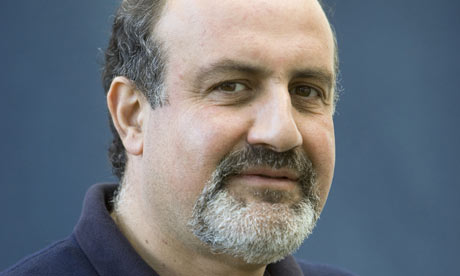
Nassim Nicholas Taleb

Much, much more than the author of The Black Swan

This Post for Learning from Dogs was inspired by a simple email.  An email sent out automatically by Facebook inviting me to join a group committed to holding the Nobel prize in Economics accountably for the crisis.


Nassim Nicholas Taleb


That intrigued me.  Like thousands of others I had previously read The Black Swan, a book The Times newspaper describes as ” as one of the 12 most influential books since World War II”.

Wikipedia has a thorough description of Taleb much recommended if you have 10 minutes to read it.

Bryan Appleyard of The Times wrote an excellent piece on Taleb on the 1st June, 2008 which may be read here.  Here’s an extract from near the front of that piece in The Times:

He spilt the tea – bear with me; this is important – while grabbing at his BlackBerry. He was agitated, reading every incoming e-mail, because the Indian consulate in New York had held on to his passport and he needed it to fly to Bermuda. People were being mobilised in New York and, for some reason, France, to get the passport.

The important thing is this: the lost passport and the spilt tea were black swans, bad birds that are always lurking, just out of sight, to catch you unawares and wreck your plans. Sometimes, however, they are good birds. The recorders cost $20 less than the marked price owing to a labelling screw-up at Circuit City. Stuff happens. The world is random, intrinsically unknowable. “You will never,” he says, “be able to control randomness.”

To explain: black swans were discovered in Australia. Before that, any reasonable person could assume the all-swans-are-white theory was unassailable. But the sight of just one black swan detonated that theory. Every theory we have about the human world and about the future is vulnerable to the black swan, the unexpected event. We sail in fragile vessels across a raging sea of uncertainty. “The world we live in is vastly different from the world we think we live in.”

Despite the article being over two years old, it is still an important piece for anyone trying to understand the causes of the financial mess we are all still in.

Finally, Taleb’s own website is a rich resource of much that will allow us all to better understand where we got to, where we are and what has to change if we are to have real hope for a better future.

Here’s a YouTube video of  a TV interview taken in May, 2010.

Here’s an earlier video of Taleb explaining what his theory of black swans is about.

By Paul Handover

Commodity trading

Something really disquieting about this.

I don’t know about you but I’m picking up more and more ‘vibes’ from all over the place that strongly suggest an increasing awareness of the need for real change in society.  Anyway, more of this another time.

My article today is base on an editorial in the Mole Valley Farmers Newsletter


MVF logo


for October 2010 (no. 557).  First some background to this organisation.

Mole Valley Farmers is described on their web site thus:

Mole Valley Farmers was started in 1960 by a small group of farmers around South Molton* who were concerned by the discriminatory practices and the large margins being taken by many of their input suppliers. From the outset it was decided to treat all members equally, subject only to quantity allowance and that the Company would operate on the minimum margin to allow continuity and growth. Today it remains one of a few true co-operatives in the supply industry.

Mole Valley Farmers consists of:

  • Nine branches in the south west supplying a vast range of goods to farmers and the public alike. These range from farm requirements to clothing, footwear, garden supplies, pet food and accessories, domestic goods and power tools
  • Our own feed mills for all animal feeds
  • Fertiliser blending plants
  • A specialist mineral plant
  • A quality farm building division

Of special importance are our farmer customers who purchase animal feed, fertilisers and minerals, all manufactured to a high specification by Mole Valley Farmers and delivered direct from point of manufacture to farm or to branches for collection in small lots.

* South Molton is in Devon, England about half-way between Barnstaple and Tiverton and the history of this interesting firm may be found here.

I have to declare a certain interest in that when I lived in Harberton, Devon for a number of years, we were non-farmer Members of Mole Valley Farmers for feed for our chickens and ducks and later on for Pharaoh.  So when I arrived to stay recently for a week with friends in Brixham, Devon,  my eye quickly picked up the familiar look of the MVF Newsletter lying on the table.

This is the editorial, reproduced in full with the kind permission of the Newsletter editor, from the pen of David Burke, Chairman of MVF.

Commodity trading

Until relatively recently, the price of food was set by the forces of supply and demand for the food itself, which worked reasonably well in developed countries able to purchase in times of shortage.  For the last century farmers have been able to reduce some of the market risk by forward selling crops to a trader in that market, at a price that fair to both parties.

This type of trading was tightly regulated and only those who were directly involved could participate and it worked well.  At some time in the mid-90s, Goldman Sachs, with other financial institutions, successfully lobbied for the regulations to be abolished.

Forward contracts became derivatives, which could be bought and sold repeatedly by traders, which enabled the financial institutions to become involved.  This type of investment really took off when the American and European pension market collapsed, together with that for normally traded derivatives like metals, prior to the recession, although actual food supply and demand remained relatively in balance.  Last year Goldman Sachs reportedly made £3.2bn profit from derivatives trading.

In spite of Russia’s grain export ban and some other weather affected harvests, both the EU commission and the International Grains Council report more than adequate reserves of grain to meet demand and that the carry-over stocks are likely to be the second highest for years.  The rumoured (but non-existent) wheat shortage that is driving up all feed prices, is entirely due to actions of the world’s principle investment bankers and their investors, which have serious implications throughout the globe.  Whilst few in the developed world mostly in the Northern Hemisphere, will go hungry, it is a growing tragedy for the poorer countries in the Southern Hemisphere where three-quarters of the world’s population live.  According to the Food and Agricultural Organisation, one third of the population lack food security and 792m people there are undernourished to varying degrees of starvation.  But most damning of all, some 12m children die annually of malnourishment.  Derivative speculation, which pushes up the cost of grains and in particular wheat, is responsible for food inflation that is proportionally greater for the impoverished nations.

Re-regulation of the basic food market to prevent a recurrence of the spikes of 2007 and 2010 would go some way to stabilising global food costs and help with developing nations, though without a great deal of pressure from compassionate people, this will be difficult, given the influence that the world’s richest investors have over governments.  Alternatively, primary food producers worldwide are paid a high enough price for their produce to enable them to invest in research and best practice, as well as in efficient equipment.  This concept received the approval of the European Parliament on 9th September and although they are considering legislation to ensure farmers receive a fairer share of the consumer price, it may be difficult to implement other than through a properly funded and regulated CAP.

Well said, Mr Burke.

NB.  The web links in Mr Burke’s article have been inserted by me, they were not in the original article.

By Paul Handover

Is it me…

…. or have we all gone stark, staring mad!

Sorry, in a bit of a rant mood just now.

I read widely many Blogs out there because it seems that this channel is one which is more likely to offer real, valid commentaries on what is going on at present with regard to the economic crisis, that is the crisis in the broader sense.

Here’s a recent piece from Baseline Scenario about the US Federal Reserve.  Here’s how that piece ends:

Regulation remains largely ineffective (in fact, the industry has managed to demonize the word), the big banks are too important to fail, and interest rates are low across the yield curve. The Fed provides downside protection and there is no effective limit on the amount or nature of risks that the private financial sector can take. This is a recipe not for stagnation but rather for a metaboom in which we will receive warnings, including painful recessions – but consistently ignore them.

The 1920s opened with an 18-month recession, an eerie parallel to the 2007-9 experience. It ended with the Great Crash of 1929.

Then across the way we have a piece on The Daily Beast about Summers. I quote from the first two paragraphs with their permission (thanks guys.)

Washington is swirling with the usual rumors—the White House’s man was pushed! He jumped! But Summers is leaving because he made sure real reform was discussed—but not accomplished.

Thomas

The rumor that come November, when the mid-term elections are history, Lawrence Summers, administration’s quarterback on economic matters, will leave the White House, has been confirmed. The usual presumptions have been put in play: Summers is weary of the job; the president and his men and women feel the need for a new pair of hands under center; the man has done well; the man has done badly. There is no indication that, like Bush II’s ill-served first Treasury Secretary, Paul O’Neill, Summers is being canned for speaking truth to power. That is not the man’s style, not—let it be said—that there’s much evidence that the administration has better than a shaky grasp of the practical truths of American financial and economic life in the Age of Goldman Sachs.The bottom line is that we can expect the usual judgemental blahblahblah to grow in volume and marginality on the talk-show and Op-Ed circuit as the day calendared by the media for Summers’ leave-taking approaches.

Now go across to the article and read it in full. Read why Michael Thomas, the author and no stranger to Wall St., describes Summers as someone who “saw to it that the talk was talked, but the walk was never walked.

And I’ll close by repeating a comment I made to the Baseline Scenario article:

I don’t have the knowledge to respond to Simon’s excellent Post in detail but his comments reinforce what feels like a constant throbbing in my mind – how can the citizens of so many countries have abdicated so much interest and concern in how they/we are governed. Wish I had even a clue as to the answer to that question.

Significant social unrest would be very scary – the ‘law’ of unintended consequences and all that – but there are times when I wonder if this, in the end, might be the only form of real progress for the hard-working, tax-paying majority.

End of rant! 😉

By Paul Handover

Not quite so ‘Irish’

“You’ve got to do your own growing, no matter how tall your grandfather was.” Irish quotation.

In England, inexplicable happenings are commonly ascribed to being ‘Irish’! It’s meant in a loving way; there is a great deal of warmth towards the different ways that Irish people appear to see the world.  But what is facing Ireland (and other countries) as a result of some distinctly unfunny goings-on in the USA is potentially hugely damaging.

To many the way that the world has descended into a dark, economic abyss, which is likely to affect us all in so many ways, and in which we are going to remain for a long time (a la Japan?), is also inexplicable.

Thus a chance comment from Norm Cimon to a recent post on Baseline Scenario set off a chain of discovery that for me has been very interesting.  Here’s how it ran.

I have subscribed to Baseline Scenario for some time.  It describes itself thus:

The Baseline Scenario is dedicated to explaining some of the key issues in the global economy and developing concrete policy proposals. Since it was launched in September 2008, this blog has been cited by virtually every major newspaper, Internet site, and blog covering economic and financial issues.

It’s a great resource.

A recent Post on Baseline Scenario, Irish Worries For The Global Economy, had already attracted 135 comments at the time of writing this post.  A recent one was from a Norm Cimon, who is described in Linked In as the owner of Info Synchronicity LLC.  This is what he said:

That is the other side of the coin. William Black has been lucid on this topic, and clear on the morality of the current age and how to fix it. Put people in jail and let everyone know why they were sent there. If you want to change perceptions then change the reality. The anger of the general public and the disdain of Wall Street are tied to that one issue. No one has paid for the crime of the millenium and everybody knows it.

And included was this recording of Bill Moyers interviewing Bill Black, the author of The Best Way to Own a Bank is to Rob One.

Here’s the interview:

However, there’s more to this discovery than the YouTube video.  If one clicks on the link behind Norm Cimon’s name on that Baseline post, then one is taken here.  It’s a pdf of a paper written by Norm Cimon entitled, “Computing Power and Human Greed.” It seems to me to explain the tools, for want of a better word, that enabled the American banking system to behave in the way that Bill Black so roundly condemns in the Bill Moyer interview.  Here’s how Cimon ends his paper:

With networked computers now cast by all organizations, including the financial sector, into the role of wizard-behind-the-curtain, we all live in Oz.  It’s long past time we pull back the veil and call a halt to the mindless application of this supreme and supremely dangerous creation before the damage gets any greater.

Unfortunately, there isn’t a date to the paper but my guess was that it was written late in 2009. Whatever the date, it is a very apt observation.

Where do we go from here, I ask?

By Paul Handover