Category: Economics

The Federal Reserve

To all people that live outside the US, and quite a few as well who don’t!

The Federal Reserve is the central banking system of the USA. I am going to republish most of the article that appears on WikiPedia. It is yet another example of how the United States set itself up taking the best from all around the world.

(And apologies for not posting a Picture Parade yesterday.)

ooOOoo

 The Federal Reserve System (often shortened to the Federal Reserve, or simply the Fed) is the central banking system of the United States. It was created on December 23, 1913, with the enactment of the Federal Reserve Act, after a series of financial panics (particularly the panic of 1907) led to the desire for central control of the monetary system in order to alleviate financial crises.[list 1] Although an instrument of the U.S. government, the Federal Reserve System considers itself “an independent central bank because its monetary policy decisions do not have to be approved by the president or by anyone else in the executive or legislative branches of government, it does not receive funding appropriated by Congress, and the terms of the members of the board of governors span multiple presidential and congressional terms.”[11] Over the years, events such as the Great Depression in the 1930s and the Great Recessionduring the 2000s have led to the expansion of the roles and responsibilities of the Federal Reserve System.[6][12]

Congress established three key objectives for monetary policy in the Federal Reserve Act: maximizing employment, stabilizing prices, and moderating long-term interest rates.[13] The first two objectives are sometimes referred to as the Federal Reserve’s dual mandate.[14] Its duties have expanded over the years, and include supervising and regulating banks, maintaining the stability of the financial system, and providing financial services to depository institutions, the U.S. government, and foreign official institutions.[15] The Fed also conducts research into the economy and provides numerous publications, such as the Beige Book and the FRED database.[16]

The Federal Reserve System is composed of several layers. It is governed by the presidentially appointed board of governors or Federal Reserve Board (FRB). Twelve regional Federal Reserve Banks, located in cities throughout the nation, regulate and oversee privately owned commercial banks.[17] Nationally chartered commercial banks are required to hold stock in, and can elect some board members of, the Federal Reserve Bank of their region.

The Federal Open Market Committee (FOMC) sets monetary policy by adjusting the target for the federal funds rate, which generally influences market interest rates and, in turn, US economic activity via the monetary transmission mechanism. The FOMC consists of all seven members of the board of governors and the twelve regional Federal Reserve Bank presidents, though only five bank presidents vote at a time: the president of the New York Fed and four others who rotate through one-year voting terms. There are also various advisory councils.[list 2] It has a structure unique among central banks, and is also unusual in that the United States Department of the Treasury, an entity outside of the central bank, prints the currency used.[23]

The federal government sets the salaries of the board’s seven governors, and it receives all the system’s annual profits after dividends on member banks’ capital investments are paid, and an account surplus is maintained. In 2015, the Federal Reserve earned a net income of $100.2 billion and transferred $97.7 billion to the U.S. Treasury,[24] and 2020 earnings were approximately $88.6 billion with remittances to the U.S. Treasury of $86.9 billion.[25] The Federal Reserve has been criticized for its approach to managing inflation, perceived lack of transparency, and its role in economic downturns.[26][27][28]

Purpose

The primary declared motivation for creating the Federal Reserve System was to address banking panics.[6] Other purposes are stated in the Federal Reserve Act, such as “to furnish an elastic currency, to afford means of rediscounting commercial paper, to establish a more effective supervision of banking in the United States, and for other purposes”.[29] Before the founding of the Federal Reserve System, the United States underwent several financial crises. A particularly severe crisis in 1907 led Congress to enact the Federal Reserve Act in 1913. Today the Federal Reserve System has responsibilities in addition to stabilizing the financial system.[30]

Current functions of the Federal Reserve System include:[15][30]

  • To address the problem of banking panics
  • To serve as the central bank for the United States
  • To strike a balance between private interests of banks and the centralized responsibility of government
    • To supervise and regulate banking institutions
    • To protect the credit rights of consumers
  • To conduct monetary policy by influencing market interest rates to achieve the sometimes-conflicting goals of
    • maximum employment
    • stable prices, interpreted as an inflation rate of 2 percent per year on average[31]
    • moderate long-term interest rates
  • To maintain the stability of the financial system and contain systemic risk in financial markets
  • To provide financial services to depository institutions, the U.S. government, and foreign official institutions, including playing a major role in operating the nation’s payments system
    • To facilitate the exchange of payments among regions
    • To respond to local liquidity needs
  • To strengthen U.S. standing in the world economy
Unemployment vs Inflation vs Inverted yield curve  Unemployment rate  Inflation CPI  10 year bond minus 2 year bond Inverted yield curve

Addressing the problem of bank panics

Further information: Bank run and Fractional-reserve banking

Banking institutions in the United States are required to hold reserves‍—‌amounts of currency and deposits in other banks‍—‌equal to only a fraction of the amount of the bank’s deposit liabilities owed to customers. This practice is called fractional-reserve banking. As a result, banks usually invest the majority of the funds received from depositors. On rare occasions, too many of the bank’s customers will withdraw their savings and the bank will need help from another institution to continue operating; this is called a bank run. Bank runs can lead to a multitude of social and economic problems. The Federal Reserve System was designed as an attempt to prevent or minimize the occurrence of bank runs, and possibly act as a lender of last resort when a bank run does occur. Many economists, following Nobel laureate Milton Friedman, believe that the Federal Reserve inappropriately refused to lend money to small banks during the bank runs of 1929; Friedman argued that this contributed to the Great Depression.[32]

Check clearing system

Because some banks refused to clear checks from certain other banks during times of economic uncertainty, a check-clearing system was created in the Federal Reserve System. It is briefly described in The Federal Reserve System‍—‌Purposes and Functions as follows:[33]

By creating the Federal Reserve System, Congress intended to eliminate the severe financial crises that had periodically swept the nation, especially the sort of financial panic that occurred in 1907. During that episode, payments were disrupted throughout the country because many banks and clearinghouses refused to clear checks drawn on certain other banks, a practice that contributed to the failure of otherwise solvent banks. To address these problems, Congress gave the Federal Reserve System the authority to establish a nationwide check-clearing system. The System, then, was to provide not only an elastic currency‍—‌that is, a currency that would expand or shrink in amount as economic conditions warranted‍—‌but also an efficient and equitable check-collection system.

Lender of last resort

In the United States, the Federal Reserve serves as the lender of last resort to those institutions that cannot obtain credit elsewhere and the collapse of which would have serious implications for the economy. It took over this role from the private sector “clearing houses” which operated during the Free Banking Era; whether public or private, the availability of liquidity was intended to prevent bank runs.[34]

Fluctuations

Through its discount window and credit operations, Reserve Banks provide liquidity to banks to meet short-term needs stemming from seasonal fluctuations in deposits or unexpected withdrawals. Longer-term liquidity may also be provided in exceptional circumstances. The rate the Fed charges banks for these loans is called the discount rate (officially the primary credit rate).

By making these loans, the Fed serves as a buffer against unexpected day-to-day fluctuations in reserve demand and supply. This contributes to the effective functioning of the banking system, alleviates pressure in the reserves market and reduces the extent of unexpected movements in the interest rates.[35] For example, on September 16, 2008, the Federal Reserve Board authorized an $85 billion loan to stave off the bankruptcy of international insurance giant American International Group (AIG).[36]

Central bank

Further information: Central bank

Obverse of a Federal Reserve $1 note issued in 2009

In its role as the central bank of the United States, the Fed serves as a banker’s bank and as the government’s bank. As the banker’s bank, it helps to assure the safety and efficiency of the payments system. As the government’s bank or fiscal agent, the Fed processes a variety of financial transactions involving trillions of dollars. Just as an individual might keep an account at a bank, the U.S. Treasury keeps a checking account with the Federal Reserve, through which incoming federal tax deposits and outgoing government payments are handled. As part of this service relationship, the Fed sells and redeems U.S. government securitiessuch as savings bonds and Treasury bills, notes and bonds. It also issues the nation’s coinand paper currency. The U.S. Treasury, through its Bureau of the Mint and Bureau of Engraving and Printing, actually produces the nation’s cash supply and, in effect, sells the paper currency to the Federal Reserve Banks at manufacturing cost, and the coins at face value. The Federal Reserve Banks then distribute it to other financial institutions in various ways.[37] During the Fiscal Year 2020, the Bureau of Engraving and Printing delivered 57.95 billion notes at an average cost of 7.4 cents per note.[38][39]

Federal funds

Main article: Federal funds

Federal funds are the reserve balances (also called Federal Reserve Deposits) that private banks keep at their local Federal Reserve Bank.[40] These balances are the namesake reserves of the Federal Reserve System. The purpose of keeping funds at a Federal Reserve Bank is to have a mechanism for private banks to lend funds to one another. This market for funds plays an important role in the Federal Reserve System as it is the basis for its monetary policy work. Monetary policy is put into effect partly by influencing how much interest the private banks charge each other for the lending of these funds.

Federal reserve accounts contain federal reserve credit, which can be converted into federal reserve notes. Private banks maintain their bank reserves in federal reserve accounts.

Bank regulation

The Federal Reserve regulates private banks. The system was designed out of a compromise between the competing philosophies of privatization and government regulation. In 2006 Donald L. Kohn, vice chairman of the board of governors, summarized the history of this compromise:[41]

Agrarian and progressive interests, led by William Jennings Bryan, favored a central bank under public, rather than banker, control. However, the vast majority of the nation’s bankers, concerned about government intervention in the banking business, opposed a central bank structure directed by political appointees. The legislation that Congress ultimately adopted in 1913 reflected a hard-fought battle to balance these two competing views and created the hybrid public-private, centralized-decentralized structure that we have today.

The balance between private interests and government can also be seen in the structure of the system. Private banks elect members of the board of directors at their regional Federal Reserve Bank while the members of the board of governors are selected by the president of the United States and confirmed by the Senate.

Government regulation and supervision

Ben Bernanke (lower right), former chairman of the Federal Reserve Board of Governors, at a House Financial Services Committee hearing on February 10, 2009. Members of the board frequently testify before congressional committees such as this one. The Senate equivalent of the House Financial Services Committee is the Senate Committee on Banking, Housing, and Urban Affairs.

The Federal Banking Agency Audit Act, enacted in 1978 as Public Law 95-320 and 31 U.S.C. section 714 establish that the board of governors of the Federal Reserve System and the Federal Reserve banks may be audited by the Government Accountability Office (GAO).[42]

The GAO has authority to audit check-processing, currency storage and shipments, and some regulatory and bank examination functions–though there are restrictions to what the GAO may audit. Under the Federal Banking Agency Audit Act, 31 U.S.C. section 714(b), audits of the Federal Reserve Board and Federal Reserve banks do not include (1) transactions for or with a foreign central bank or government or non-private international financing organization; (2) deliberations, decisions, or actions on monetary policy matters; (3) transactions made under the direction of the Federal Open Market Committee; or (4) a part of a discussion or communication among or between members of the board of governors and officers and employees of the Federal Reserve System related to items (1), (2), or (3). See Federal Reserve System Audits: Restrictions on GAO’s Access (GAO/T-GGD-94-44), statement of Charles A. Bowsher.[43]

The board of governors in the Federal Reserve System has a number of supervisory and regulatory responsibilities in the U.S. banking system, but not complete responsibility. A general description of the types of regulation and supervision involved in the U.S. banking system is given by the Federal Reserve:[44]

The Board also plays a major role in the supervision and regulation of the U.S. banking system. It has supervisory responsibilities for state-chartered banks[45] that are members of the Federal Reserve System, bank holding companies(companies that control banks), the foreign activities of member banks, the U.S. activities of foreign banks, and Edge Act and “agreement corporations” (limited-purpose institutions that engage in a foreign banking business). The Board and, under delegated authority, the Federal Reserve Banks, supervise approximately 900 state member banks and 5,000 bank holding companies. Other federal agencies also serve as the primary federal supervisors of commercial banks; the Office of the Comptroller of the Currency supervises national banks, and the Federal Deposit Insurance Corporation supervises state banks that are not members of the Federal Reserve System.

Some regulations issued by the Board apply to the entire banking industry, whereas others apply only to member banks, that is, state banks that have chosen to join the Federal Reserve System and national banks, which by law must be members of the System. The Board also issues regulations to carry out major federal laws governing consumer credit protection, such as the Truth in LendingEqual Credit Opportunity, and Home Mortgage Disclosure Acts. Many of these consumer protection regulations apply to various lenders outside the banking industry as well as to banks.

Members of the Board of Governors are in continual contact with other policy makers in government. They frequently testify before congressional committees on the economy, monetary policybanking supervision and regulationconsumer credit protectionfinancial markets, and other matters.

The Board has regular contact with members of the President’s Council of Economic Advisers and other key economic officials. The Chair also meets from time to time with the President of the United States and has regular meetings with the Secretary of the Treasury. The Chair has formal responsibilities in the international arena as well.

Regulatory and oversight responsibilities

The board of directors of each Federal Reserve Bank District also has regulatory and supervisory responsibilities. If the board of directors of a district bank has judged that a member bank is performing or behaving poorly, it will report this to the board of governors. This policy is described in law:

Each Federal reserve bank shall keep itself informed of the general character and amount of the loans and investments of its member banks with a view to ascertaining whether undue use is being made of bank credit for the speculative carrying of or trading in securities, real estate, or commodities, or for any other purpose inconsistent with the maintenance of sound credit conditions; and, in determining whether to grant or refuse advances, rediscounts, or other credit accommodations, the Federal reserve bank shall give consideration to such information. The chairman of the Federal reserve bank shall report to the Board of Governors of the Federal Reserve System any such undue use of bank credit by any member bank, together with his recommendation. Whenever, in the judgment of the Board of Governors of the Federal Reserve System, any member bank is making such undue use of bank credit, the Board may, in its discretion, after reasonable notice and an opportunity for a hearing, suspend such bank from the use of the credit facilities of the Federal Reserve System and may terminate such suspension or may renew it from time to time.[46]

National payments system

The Federal Reserve plays a role in the U.S. payments system. The twelve Federal Reserve Banks provide banking services to depository institutions and to the federal government. For depository institutions, they maintain accounts and provide various payment services, including collecting checks, electronically transferring funds, and distributing and receiving currency and coin. For the federal government, the Reserve Banks act as fiscal agents, paying Treasury checks; processing electronic payments; and issuing, transferring, and redeeming U.S. government securities.[47]

In the Depository Institutions Deregulation and Monetary Control Act of 1980, Congress reaffirmed that the Federal Reserve should promote an efficient nationwide payments system. The act subjects all depository institutions, not just member commercial banks, to reserve requirements and grants them equal access to Reserve Bank payment services. The Federal Reserve plays a role in the nation’s retail and wholesale payments systems by providing financial services to depository institutions. Retail payments are generally for relatively small-dollar amounts and often involve a depository institution’s retail clients‍—‌individuals and smaller businesses. The Reserve Banks’ retail services include distributing currency and coin, collecting checks, electronically transferring funds through FedACH (the Federal Reserve’s automated clearing house system), and beginning in 2023, facilitating instant payments using the FedNow service. By contrast, wholesale payments are generally for large-dollar amounts and often involve a depository institution’s large corporate customers or counterparties, including other financial institutions. The Reserve Banks’ wholesale services include electronically transferring funds through the Fedwire Funds Service and transferring securities issued by the U.S. government, its agencies, and certain other entities through the Fedwire Securities Service.

ooOOoo

There is more in that article including Structure, Board of Governors, the Federal Reserve Banks (there are 12), and more subjects. So if you want to read these then, please, go here.

And I am bound to say that I have recently finished reading The FINANCIAL SYSTEM LIMIT by David Kauders. The sub-title of the book is The World’s Real Debt Burden. If you are at all interested in the subject then read the book.
A repeat of my post ‘Being scammed’.

I thought it very worthwhile to repeat this, plus a real treat at the end of the post!

Scamming in all its forms has only got worse in the last couple of years, since I parted with $9,000 in 2021!

As a direct result of that error, I changed my bank, installed a VPN at home (Proton), changed my email account to ProtonMail, and also changed my calendar (also to Proton).

But I still do not take it as important as it is. I guess because it is not my first thought whenever I come across an unfamiliar email.

ooOOoo

Please read this; and do not make the same mistake as me!

The Story of a Scam

(or how I lost the thick end of $10,000.)

On Friday, 6th August, 2021 at 05:51 in came the following email:

Norton Customer ,

User name:paulhandover

*we like to confim you that the NortonDesk re-newal. has been done on your request*

It is very easy to unsubscribe it,

and related to your any query,  reach us at +1-(860) – (852) – (6259).

Product-Name : NortonDesk

……………………………………………………………………………………………………..

Price : $475.04

……………………………………………………………………………………………………..

Subscription ID : 8837-77942826-947192-8126

……………………………………………………………………………………………………..

Expiration Date : 3 Year from the Date of Purchase

………………………………………………………………………………………………

* If you wish to Cancel this Membership then please feel free to Contact our Billing department as soon as Possible*

……………………………………………………………………………………………………..

*Please do not write to this mail address, that will not help*

Reach us on +1 – (860) – (852) – (6259)

……………………………………………………………………………………………………..

Regards,

Billing department

Contact: +1 – (860) – (852) – (6259)

693 Amwell Rd, Hillsborough, NJ 


My first mistake was not to check the incoming email address. It was mahaliashomakerxhv928@gmail.com

I telephoned the number given and told the person that I wanted to cancel this membership. Indeed that I had never subscribed for this membership in the first place.

I spoke with ‘Adam’. I was then asked to go to a webpage where I filled in a Refund Application Order form. I filled in my details including the refund amount and my bank details: Sort Code & Account Number.

I then submitted the form and imagine my surprise when a few minutes later I was informed that I had received the sum of $10,000. I quickly checked our bank account online and there was the $10,000 credit in our checking account. 

My second mistake was me not examining the total in our accounts. I have the facility to show the total funds in our accounts. Why I didn’t do that I can not explain.

Then it was back on the telephone and Adam also was surprised (later I realised that this was a feigned surprise and all part of the scam) and said could I go to the bank and fill in an International Wire Transfer for the amount of $9,500. Adam also said that he would give me the details of the person in Thailand that was to receive the funds, and could I say this was for a medical operation because it would save ‘Norton’ the taxation.

My third mistake was not to discuss this with Jeannie and to assume that it was just a harmless error.

The details came through and I went to our bank in Grants Pass. I got to the bank a little after 09:00. I saw a staff member of the bank and explained what I needed to do. The bank member queried this and said that it sounded like a scam. I lied and said I knew the woman in Thailand and wanted to go ahead. That was what I had been instructed to say.

My fourth mistake was not listening to the woman at the bank. (And I still thought that the ‘Norton’ funds were in my account.)

The International Wire Transfer was completed and I signed it. I also asked the balances on our two accounts. It was about $10,000 less than I expected and I queried it but was told that there had been a transfer from my savings account to my checking account of $10,000 for Norton. I thought that this was still a little low but that I could check it carefully once I got home. I had a thirty-minute window to change my mind.

Mistake number five, a huge mistake, was while at the bank not to ask them carefully to go through all my transactions that day because that would have revealed that the receipt of $10,000 that I had seen online had mysteriously disappeared. Indeed had never been received. That would have enabled me to stop the wire transfer within the thirty-minute window.

I returned home and found out the truth. I had been scammed out of $9,500.

The strange thing was that ‘Adam’ of the billing department of so-called Norton kept ringing me throughout the day to say that the funds would be sent back to me and gave me the details of three wires and that the funds would be back in my bank account on Monday, 9th August!

Later that morning I rang Kevin Dick who manages our investments and told him the tale. He said that there was a huge amount of scamming about and that I should make three phone calls: to the bank and report the fraud; to the Sheriff’s office and report the fraud; and to my insurance company. The first two were done straight away. Kevin also told me to close my bank accounts and amend my email address. Alex, my son, said to use my Proton mail account and straight away I started to make the change.

A person from the humanists group that we belong to said also to inform The Daily Courier.

Kevin also sent me the following links:

From a recent Podcast I created:

 https://pivot-with-kdi-wealth.simplecast.com/episodes/financial-fraud-and-how-to- keep-from-being-a-victim

A video from our site:

https://www.kdiwealth.com/resource-center/money/data-thieves-from-outer-space

From Finra on Fraud to dos:

https://www.finra.org/investors/insights/investment-fraud-awareness

On Monday morning Ryan of ‘Norton’ called me at 07:15 and said that Adam Prescott was no longer with the firm. Ryan said that their General Manager, Ron Cooper, would call me shortly. Ron did indeed call me and said that they would return the money but that the minimum cheque they could write was $30,000. I was then told that in advance of me receiving the money I would have to pay a small amount to them. At this point I put the phone down for it was clearly a second attempt to steal more funds from me.

Finally we went back to the bank on Monday morning. We were informed that there was never a credit of $10,000 but that a clever switch of the money from one account to another made it look as though the money had been credited. The event had been reported to the bank’s fraud department.

On Tuesday morning, the 10th August, the bank said that as well as our two accounts being locked out from us and that only cheques and cash withdrawals would be honoured for the time being, the fraud department had made the decision to issue us with a ten-day notice to terminate our accounts. In other words, within ten days the bank would no longer want us as customers. Since then I have done much research and found out via the Forbes website that this was more to do with the bank being ultra conservative than anything else. Indeed Kevin said that he had spoken with his IT department and they thought that it was strange that my ex-bank had terminated us so quickly. The IT department thought that the teller at the bank realised that she had been partly culpable.

However the bank did recommend another bank to go to in Grants Pass.

I have since reset my iMac and changed my email address.

It is a most humiliating affair. I have beaten myself up several times over and have at last understood the frame of mind that I had gotten myself into.

To explain that, first of all I thought that I needed to stop the billing urgently and because it was early on a Friday morning thought that the best thing to do was to call immediately.

Secondly, during the call that scammers spoke to me in friendly tones and quietly complimented me on my integrity. I am sure that this ‘spoke’ to my psychological fear of rejection that I have had since I my father died in 1956.

Then in the morning of the 11th August I received a call from a regular contact at the English company who manage my UK SIPP. He wanted to check if I had tried to log on at 09:00 UK time and I replied that there was no way that was me for that UK time was 01:00 Pacific time. There were apparently three attempts to log on. Unsuccessfully as it turned out and my SIPP account is temporarily closed as a result.

The scammers are very thorough in their crooked craft!

Now as of Thursday, the 12th August, we are pretty much out of the grim shadow of this event. We have new accounts at The People’s Bank here in Grants Pass. I have changed my email address and yesterday afternoon I decided that the only safe way of protecting myself was to get another iMac. I was speaking to the sales department of Apple and mentioned the scam and the woman immediately said I should speak with their Technical Support and transferred me. Then I was helped via screen sharing to go through many pages deleting unnecessary files and other stuff. And the helpful woman found another item of malware that was deleted and removed. She spent 54 minutes getting me properly cleaned out and then forwarded an email with all the links for me to do the same process at a later date. It was a superb experience.

So that is it.

Now watch these two YouTube videos. The first is just 5 minutes long and is important to all who use computers and want to be protected against scammers. (NB: This first video is now not included.)

and then watch this slightly longer video from Jim

Be safe! Please!

An addendum dated Saturday, 14th August, at 7am Pacific Time.

Only to say that I also posted my scamming report on Ugly HedgeHog under their General Chit Chat forum. Of the many responses that came in I wanted to post here two of them.

The first from ‘Stanikon’:

Sorry you had to go through this. Your first clue should have been the grammar and phrasing of the original email. That would have given it away. Legitimate companies go to great lengths to make sure their grammar, phrasing and language are correct. I have avoided several scams by paying attention to that so there is some value in being slightly OCD.

and the second from ‘Red6’:

The safest thing to do in these situations is simply not to open the email. I receive on a daily basis, emails telling me that the items I ordered are being shipped, my subscription to something has been renewed etc, etc. 99.9% of these are scams and nothing bad will happen if you just delete them. Older working people often have the fear that there’s a bill out there that has not been paid and they are afraid of getting a bad credit report. So they aggressively try to send someone money for something they cannot even recognize. If it is a true debt, you will be reminded of it several times before any reports are made.

I follow several simple rules in preventing scams. There are many more but this will take care of most of them.

1. Examine the sender’s email address, if you do not recognize it then DO NOT OPEN and DELETE immediately. Most of these scammer’s email addresses will not have the company name in the email address OR it will be combined with other names. Most will not have the .com, .org, etc but will be gmail, Hotmail, or other generic URL. Many of these scammers “broadcast” their emails to everyone on a purchased email list not knowing whether some or valid or not. If you open or reply to these it verifies your email as valid and active and worthy of more attention. Also, if it is an unknown email address, it could be a carrier of a virus or some other bad computer/software infection.

2. If you do get involved with something that does not feel right and you take it to the bank – TRUST THE BANK if they tell you it is suspicious. They see these things every day and develop a feel for them. I received a cashier’s check for something I sold on craigslist. I took it to the bank to deposit and the bank rep immediately recognized the cashier’s check as a fake. She even called the bank the check was supposed to be drawn on and they checked the records and told her that it was counterfeit. You trust your bankers, credit union, etc with your money every day so trust them when they tell you something does not seem right.

3. Scammers know that many older people do NOT like to use credit cards. So a lot of their dealings involve checks, bank transfers, and other forms of older less secure payment methods that older citizens are comfortable with. I NEVER, NEVER send money for something I purchase or order online unless it is through a credit card. In fact, I rarely buy ANYTHING anymore that does not go on the credit card. They are safer, quicker, and easier. If somehow you do get something on your bill that you did not authorize, the credit card company will investigate and go after the person or company that charged you. This is one more safety step that protects the consumer. This does not always apply to debit cards. Debit cards are issued by individual banks or credit unions and some have policies in the fine print that they do NOT have the same policies as the big credit card companies and may not forgive or relieve the user for bad charges made to their debit card.

4. Just do not believe anyone or any company that says they sent you a huge refund or overpayment or some amount of money by mistake. That rarely happens. It is even rarer if they also tell you to return the money to some foreign address, email, or wire transfer. When in doubt, wait for a week or so before you do ANYTHING. If they sent you the check, transfer etc, wait to see if it clears or is valid. We are conditioned by TV and movies that we need to act immediately in situations such as this. This is rarely the case. Take time to see what happens. During this cooling-off period check them out, research the internet to see if others have experienced this scam. It is almost a sure thing that if you are being scammed, others have been also and it has been reported somewhere with law enforcement agencies or on websites on the internet. Check them out before acting. Or better yet, do nothing for a while and most likely they will just go away. Much like the telephone scammers, they make their money on volume, calling as many as possible in the least amount of time. Scammers will not waste time working on you for days, they have thousands of other emails, accounts to call. Remember, they are after the fastest, easiest targets – the low-hanging fruit.

If it is a true mistake or debt you owe then most likely you will receive some official correspondence in regards to the debt. A good example is the IRS and Social Security phone scams in the past couple of years. You get a call from the IRS or Social Security informing you that you may have committed fraud and law enforcement is on their way to arrest you. But if you arrange repayment with their representative, an arrest can be avoided. The IRS and Social Security NEVER take action without first sending several official US Postal letters to you.
If you are still inclined to send money to someone in a foreign country then discuss it with your bank and listen.

Hope this helps.

ooOOoo

All very sound advice and as relevant today as it was when first published.

Finally, for something completely different; have a look at the recent Hunter’s Moon as featured on YouTube.

An apology

I simply got on the wrong foot.

Do not ask me how it came about but somehow my US Tax Return for 2022 was not completed.

Affordable & Professional Services alerted me to the fact that I have very few days to submit the return.

So writing a fancy blog post was a long way from my mind.

Sorry!

And a P.S.

This morning Jean and I went round with all our files and notes to see Niobe of AAPS and she was terrific. Niobe took complete control of the situation and patiently worked her way through the myriad of details and a couple of hours later it was done! 🙂

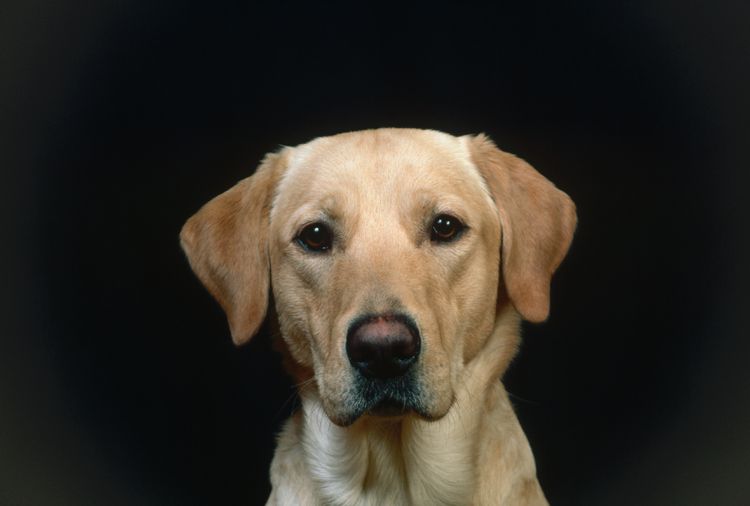
There is so much more to our dogs than we realise!

A fascinating post on Treehugger.

It is Wednesday morning in Southern Oregon and already I am having to think about the post for tomorrow. Not that this is a problem it is just one more thing that I want to do. Plus we are in the middle of a local heat wave with temperatures expected to be well above 100 degrees F and possibly 109 deg F (42.8 deg C.).

So I am turning to Treehugger for a dog post and hoping that I shall be able to share it with you all.

ooOOoo

Dogs Could Revolutionize the Sustainability of Future Pandemic Testing

Scent dogs are quicker, more effective, and create less healthcare waste than conventional COVID tests.

By Melissa Breyer

Senior Editorial Director

  • Hunter College
  • F.I.T., State University of New York
  • Cornell University

Published July 17, 2023 

Joe McDonald / Getty Images

One of the more frustrating roadblocks in navigating the COVID-19 pandemic was the difficulty in getting quick, accurate test results. Sometimes, results for PCR tests took up to two weeks, rendering their diagnosis useless for planning isolation scenarios. Meanwhile, rapid tests still oftentimes provide a false negative if taken too soon after infection. When I had COVID, I was four days into symptoms before I got a positive at-home test—I’ve heard many people recount similar stories.

The testing we have is certainly better than nothing, but it leaves a lot to be desired. If only there were a better way, say, using something with remarkable innate sensitivity. Like, dogs. Far-fetched? Not at all.

review of recent research concluded that scent dogs may represent a cheaper, faster, and more effective way to detect COVID-19 and could be a key tool in future pandemics. This could be a game-changer for sustainability as well, eliminating the enormous amount of waste that comes with billions of testing kits.

The review, published in De Gruyter’s Journal of Osteopathic Medicine, found that scent dogs are as effective, or even more effective, than conventional COVID-19 tests such as PCR tests.

Most of us know that dogs have a remarkable sense of smell; they sniff out drugs and explosives and have even successfully identified patients with certain cancers, Parkinson’s, and diabetes. They have up to 300 million olfactory cells, compared to 5 or 6 million in humans. And they use one-third of their brains to process scent information—humans just use 5%.

Professor Tommy Dickey of the University of California, Santa Barbara, and Heather Junqueira of BioScent Detection Dogs analyzed 29 different studies in which dogs detected COVID-19. “The studies were performed using over 31,000 samples by over 400 scientists from more than 30 countries using 19 different dog breeds. In some studies, the scent dogs sniffed people directly, sometimes in public places as a health screening. In others, the dogs sniffed patient samples such as sweat, saliva, or urine samples,” explains a press statement from De Gruyter.

Dogs’ Incredible Accuracy 

The dogs ranged from Labrador retrievers and Belgian malinois to beagles and English springer spaniels. In most of the studies, the dogs demonstrated similar or better sensitivity and specificity than the current gold-standard PCR tests or antigen tests.

“In one study, four of the dogs could detect the equivalent of less than 2.6 x 10⁻¹² copies of viral RNA per milliliter. This is equivalent to detecting one drop of any odorous substance dissolved in ten and a half Olympic-sized swimming pools and is three orders of magnitude better than modern scientific instruments,” notes De Gruyter.

Remarkably, they not only detected COVID-19 in symptomatic, pre-symptomatic, and asymptomatic patients, but they could also sniff out COVID variants and even long COVID.

Considering the Safety of the Dogs 

One thing we certainly don’t want is for dogs to become collateral damage in the pursuit of better testing. The study authors acknowledge this, writing that the “safety of scent dogs, their handlers, and those who are inspected by the dogs is critical for the acceptance and implementation of the scent dog screening and testing approach.”

“This is consistent with the One Health paradigm,” they add, “which defines health as more than the absence of disease and recognizes the interrelationships among humans, animals, and environmental welfare.”

The authors evaluated whether medical detection dogs could contract and become ill with the COVID-19 virus and if dogs pass on the COVID-19 virus to humans. From a number of studies, they concluded that dogs are in the low-risk category. “To our knowledge, there have been no deaths of dogs that can be unequivocally attributed to COVID-19,” the authors explain. “Importantly, the studies described above suggest that it is safe for healthy individual handlers to utilize scent dogs to directly screen and test individuals who may be infected with the COVID-19 virus.”

Speedy Test Results 

A major benefit of using the dogs is their speed. In one study, researchers were able to do a lineup with 40 samples, including sample collection, lineup loading, and unloading, within just 3  minutes.

“The time between RT-PCR sampling and the return of results can be up to days, whereas the RAG test results are obtained within about 15 min.,” write the study authors. “Again, if scent dogs directly sniff individuals, results are learned in seconds, or a few minutes if samples are taken and sniffed soon after by the dogs.”

“The criticality of the speed of the return of test results cannot be overemphasized,” the authors add.

Elimination of Plastic Waste 

That dogs could provide a result in seconds to minutes is crucial. But additionally, and importantly, scent tests by dogs don’t require expensive lab equipment or create mountains of plastic waste, unlike conventional diagnostic approaches.

As of December 22, 2022, the United States alone had performed around 1.15 billion tests for COVID-19. Thinking of all the material for the testing kits and all the resources used for testing labs and sending samples around, etc., the reduction in ecological footprint is potentially tremendous.

Not to mention the cost. Some of the research in the review was, in fact, motivated by the need for inexpensive testing in developing nations, the authors note.

“Although many people have heard about the exceptional abilities of dogs to help humans, their value to the medical field has been considered fascinating, but not ready for real-world medical use,” says Dickey. “Having conducted this review, we believe that scent dogs deserve their place as a serious diagnostic methodology that could be particularly useful during pandemics, potentially as part of rapid health screenings in public spaces. We are confident that scent dogs will be useful in detecting a wide variety of diseases in the future.”

ooOOoo

In the interests of expanding the argument, here is a copy of a comment left to that original post:

Here we go again, using animals for testing. I believe that dogs can’t smell covid and detected it 100%, but we humans NEVER treat animals with the respect and equality they deserve, so I am very concern for the safety and health of testing “smell Covid” dogs… I know a person that have esophageal cancer and for almost 5 years before it was diagnosed, his dog (an adorable mutt) insisted on crawling over her owner chest every single time that he laid down, in an attempt to “cure” the inflammation in that spot. After the cancer was eliminated with chemo and surgery the dog stopped doing it… 
I which we humans were more connected and attentive with animal wisdom, to learn from them, respecting and became better people.

I think that second sentence should read can smell covid but have left it how it was printed.

Anyway, I will leave readers to cover the main article which speaks very highly of man’s best friend.

Why is intelligent life so rare?

Maybe it is because of a ‘Great Filter‘.

Like so many others I read many items online. One of the websites that I follow is the EarthSky site because for a long time I have been interested in space.

So when I saw an article on why intelligent life is so rare in our Milky Way I read it fully. And hoped it would be of interest to others.

Here it is:

ooOOoo

What is the Great Filter, and can we survive it?

Posted by

Kelly Kizer Whitt and Deborah Byrd

November 17, 2022

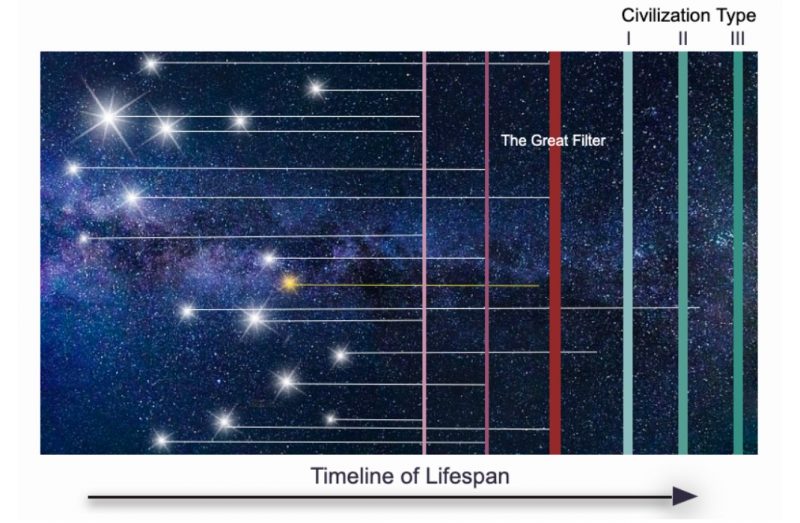
This graphic depicts intelligent civilizations as stars. The vertical lines represent Great Filters that civilizations do or don’t survive. This graphic depicts Earth’s human population (the yellow “star”) approaching its own Great Filter. How would we surpass it, and keep going? Image via NASA/ arXiv.

What is the Great Filter?

Is intelligent life common, or rare in our Milky Way galaxy? If it’s common, why haven’t we encountered it? While discussing UFOs on a walk to lunch in the year 1950, the physicist Enrico Fermi is famously said to have asked, “But where is everybody?” Scientists today call that riddle Fermi’s Paradox. Now a new paper by NASA scientists explores one possible answer to the paradox. The answer may be what’s called the Great Filter.

Economist Robin Hanson first proposed the Great Filter, in the late 1990s. It’s the idea of that – even if life forms abundantly in our Milky Way galaxy – each extraterrestrial civilization ultimately faces some barrier to its own survival. The barrier might come from without (for example, an asteroid striking a planet, and wiping out all life forms). Or it might come from within (for example, all-out nuclear war).

Hanson proposed that a Great Filter might be at work within our Milky Way galaxy. He argued – from what we can see here on Earth – life expands to fill every niche. And so, he argued, we should see signs of intelligent life beyond Earth in nearby star systems, perhaps even in our solar system. But we don’t see this.

Is humanity facing a Great Filter?

The authors of the new paper take Hanson’s idea further. They explore the idea that humanity may now be facing a Great Filter. The authors wrote:

We postulate that an existential disaster may lay in wait as our society advances exponentially towards space exploration, acting as the Great Filter: a phenomenon that wipes out civilizations before they can encounter each other … In this article, we propose several possible scenarios, including anthropogenic and natural hazards, both of which can be prevented with reforms in individual, institutional and intrinsic behaviors. We also take into account multiple calamity candidates: nuclear warfare, pathogens and pandemics, artificial intelligence, meteorite impacts, and climate change. 

And they offer solutions, beginning with, as they say:

… a necessary period of introspection, followed by appropriate refinements to properly approach our predicament, and addressing the challenges and methods in which we may be able to mitigate risk to mankind and the nearly 9 million other species on Earth.

In a sense, the authors of the new paper – including lead author Jonathan H. Jiang of NASA’s Jet Propulsion Laboratory in Pasadena, California – are engaging in a “necessary period of introspection” by the act of writing their paper.

And, with their paper, they’re laying out the challenges we’re facing and methods of addressing them.

We’ve already survived some ‘filters’

The scientists point to life’s resilience. Life on Earth has already survived a number of filters in the form of mass extinction events. The Permian-Triassic extinction – aka the Great Dying – occurred 250 million years ago and nearly ended all life on the planet. This extinction event wiped out about 96% of marine life and 70% of land species. The exact cause of the Great Dying is still a matter of study, but some scientists have said it was a combination of warming temperatures and decreasing oxygen.

But these previous filters, or extinction events, have been natural, arising from the evolution of our planet and solar system, including volcanic eruptions and asteroid impacts

A Great Filter of our own making

But now, clearly, humanity may be facing a Great Filter of our own making, and one that other intelligent civilizations in the galaxy have faced … and failed to withstand. Perhaps it’s no surprise that the technological advancements humans have achieved might ultimately lead to our undoing. Perhaps that’s nature’s way. As the new paper said:

It seems as though nearly every great discovery or invention, while pushing back the borders of our technological ignorance, is all too quickly and easily turned to destructive ends. Examples such as splitting the atom, biomedical innovations and resource extraction and consumption come to mind with disconcerting swiftness. Still, some have suggested artificial intelligence (AI) as yet another factor, which, pending substantial technical hurdles, may yet have its chance to prove friend or foe.

Here’s a look at some of the issues that might compose Earth’s Great Filter.

Unchecked population growth

One of the factors Earth faces, according to the paper, is unchecked population growth. Earth just passed a milestone on November 15, 2022, when it reached 8 billion human inhabitants. The paper said with our current population figures, Earth has experienced:

… an exponential rise from about 1.6 billion [people] at the start of the 20th century.

Technological advancements in farming, energy production and distribution have made such a large population possible on Earth. But, as the paper said, these advancements cannot:

… indefinitely offset the multifaceted stresses imposed by an ever-escalating population.

When will Earth’s human population reach its peak size? Some projections report that education in developing nations might allow Earth’s population to peak at 10 billion in the 2060s. But, of course, no one really knows.

Nuclear war

While warfare has long been a factor of life on Earth, only in the past century has humanity had a weapon that could destroy all nations, not just those participating in a nuclear war. The scientists said the greater the number of democracies in the world, the better our chances for avoiding nuclear war. The scientist also saw other encouraging signs, including:

Peace agreements in the historically troubled Middle East, a vast reduction in nuclear warheads since the height of the Cold War and a wide coalition of nations rallying their support for the besieged in Eastern Europe.

Pathogens and pandemics

The threat of illness and pandemics continues to grow simply because our world is so interconnected. Spreading diseases have a much easier time in our global society. But on the positive side, advancements in medicine have also given us an edge. The scientists said that having current and reliable data is crucial:

… in predicting how future pandemics will spread, how deadly they will be and how quickly and effectively we will be able to leverage our knowledge of the life sciences to counter this manifestation of the Great Filter.

Artificial intelligence

While true artificial intelligence as a separate sentient being is not yet reality, the authors of the paper urge a proactive plan to peacefully share Earth. They project that computer sophistication will one day rival that of the human mind. The scientists said:

As for whether AI would be benign or otherwise, self-imposing a Great Filter of our own invention, that will depend on the evolving nature and disposition of Earth’s first high-tech species.

Asteroid and comet impacts

Here’s an extinction event from the past that could still spell our doom in the future. While large impacts are exceedingly rare, there is, as the scientists said:

… a non-zero percentage [of asteroids or comets] which are large enough to survive passage through the atmosphere and, impacting the surface, cause catastrophic destruction to our sensitive biosphere.

The odds of a mass extinction level event in the coming years is vanishingly small. But, over time periods extending into the very distant future, the odds increase toward 100%. Meanwhile, with projects such as the DART mission, and given enough lead time, humanity has a way of defending itself.

Climate change

Climate change has become one of the most studied threats to life on Earth. Because the threats from climate change happen on a slower time scale than, say, the time it takes to launch a nuclear weapon, the efforts to curb these effects have not been as rapid as they could have been. The scientists said:

The major impediment to taking more decisive actions, however, are the challenges imposed by transitioning to non-carbon-based energy sources such as solar, wind, nuclear power. Here again, rapidly advancing technologies in areas such as modularized nuclear power plants and carbon capture and sequestration (CCS) are among the best hopes for avoiding slow-motion ensnarement by this lulling but lethal Great Filter.

Avoiding the Great Filter

So you see there’s not just one possible Great Filter for Earth, but many. Any one of them could be our downfall. These scientists are suggesting something that sounds simple on its face, but is (apparently) hard to do. That is, in order to avoid the Great Filter, humans must work together and recognize the big picture. As the paper said:

History has shown that intraspecies competition and, more importantly, collaboration, has led us toward the highest peaks of invention. And yet, we prolong notions that seem to be the antithesis of long-term sustainable growth. Racism, genocide, inequity, sabotage … the list sprawls.

Meanwhile, we continue to look outward, peering at the dark depths between the stars, hoping for a sign that we aren’t alone in the universe. Ultimately, our quest to find life beyond Earth is part of trying to understand life on our planet and where we fit in. As Carl Sagan said:

In the deepest sense, the search for extraterrestrial intelligence is a search for ourselves.

Bottom line: Scientists say the reason we haven’t found intelligent civilizations in the galaxy is that they may not have survived the Great Filter. And they say we may be facing down our own Great Filter.

Source: https://arxiv.org/ftp/arxiv/papers/2210/2210.10582.pdf

ooOOoo

We are a funny bunch! As was said just a couple of paragraphs ago we humans must work together and recognise the big picture. But we do not!

Why do we not do that?

I wish I knew the answer to that conundrum! Nevertheless, I hope you enjoyed the article.

We are getting close to it being too late!

As in we humans living on this planet.

Next Saturday I am giving a talk to our local Freethinkers and Humanists group on climate change. As a result of this I was doing some research on the subject and I thought that I would share what I found with you.

But first may I say that the new King of the United Kingdom, King Charles III, may not have ages and ages on the throne but he is a committed environmentalist. In a recent VoA article the Prince of Wales, as he was then, reported that when Charles opened the COP26 climate summit, held in Scotland last year, and gave the opening speech, urging world leaders seated in front of him to redouble their efforts to confront global warming, he warned: “Time has quite literally run out.”

It is us!

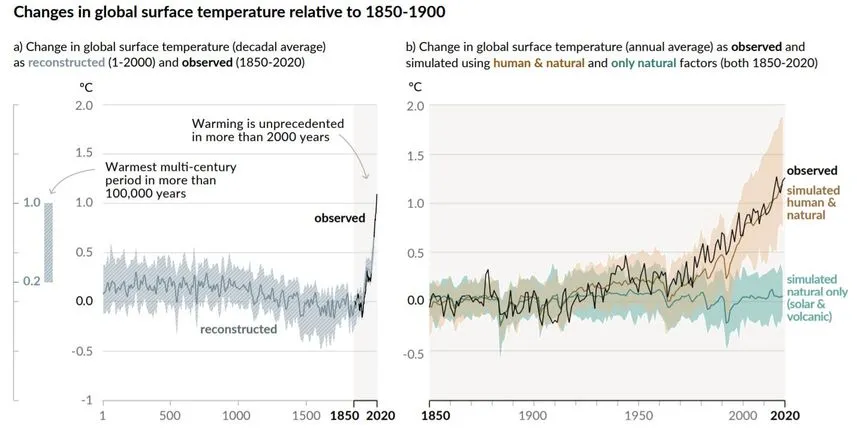
The UN’s Intergovernmental Panel on Climate Change (IPCC) kicked off its 2021 report with the following statement: “It is unequivocal that human influence has warmed the atmosphere, ocean and land.

A little later the article says: It took a while, but climate modelling is now refined enough to predict how things would go without human influence, within a margin of error. What we are observing today, however, is beyond that margin of error, therefore proving that we have driven the change.

It is getting hot

The last decade was the hottest in 125,000 years. There are a number of graphs to support this. Here is one:

The oceans

One of the facts of having a water world, 71% of the Earth’s surface is water-covered, and the oceans hold about 96.5% of all Earth’s water, is that a 2019 study found that oceans had sucked up 90% of the heat gained by the planet between 1971 and 2010. Another found that it absorbed 20 sextillion joules of heat in 2020  – equivalent to two Hiroshima bombs per second.

Carbon-dioxide

In fact CO2 levels are now the highest that they have been in 2 million years. Today, they stand at close to 420 parts per million (ppm). To put that into context pre-industrial levels, before 1750, had CO2 levels around 280 parts per million.

We are losing ice big time

I can do no better than to quote from Earth.org: Since the mid-1990s, we’ve lost around 28 trillion tons of ice, with today’s melt rate standing at 1.2 trillion tons a year. To help put that into perspective, the combined weight of all human-made things is 1.1 trillion tons. That’s about the same weight as all living things on earth.

I repeat: Every single year we are losing 1,200,000,000,000 tons of ice!

Extreme weather

We can now attribute natural disasters to human-driven climate change with certainty. We can now say with precision how much likelier we made things like the North American summer 2021 heatwave, which the World Weather Attribution says was “virtually impossible” without climate change as well as the Indian heatwave, which experts believe it was made 30 times more likely because of climate change.

Climate change mitigation

There is a long and comprehensive article on the above subject on WikiPedia. I will quote from the paragraph Needed emissions cuts.

If emissions remain on the current level of 42 GtCO2, the carbon budget for 1.5 °C could be exhausted in 2028. (That’s 42 gigatones, as in 1 gigaton is a unit of explosive force equal to one billion (109) tons of trinitrotoluene (TNT).

In 2022, the Intergovernmental Panel on Climate Change (IPCC) released its Sixth Assessment Report on climate change, warning that greenhouse gas emissions must peak before 2025 at the latest and decline 43% by 2030, in order to likely limit global warming to 1.5°C (2.7°F). Secretary-general of the United Nations, António Guterres, clarified that for this “Main emitters must drastically cut emissions starting this year”.

Then just before that paragraph WikiPedia reports that: The UNFCCC aims to stabilize greenhouse gas (GHG) concentrations in the atmosphere at a level where ecosystems can adapt naturally to climate change, food production is not threatened, and economic development can proceed in a sustainable fashion. Currently human activities are adding CO2 to the atmosphere faster than natural processes can remove it.

We need to act now, otherwise…

… it will be too late for billions of us.

This may be the most catastrophic of our climate change facts. As of now, only 0.8% of the planet’s land surface has mean annual temperatures above 29°C, mostly in the Sahara desert and Saudi Arabia (solid black in the map below).

study by Xu et al. (2020) called “Future of the Human Niche” found that by 2070, under a high emissions scenario, these unbearable temperatures could expand to affect up to 3 billion people (dark brown areas).

Doing nothing is much worse than doing something

On the current path, climate change could end up costing us 11 to 14% of the global GDP by mid-century. Regression into a high emissions scenario would mean an 18% loss, while staying below 2°C would reduce the damage to only 4%. 

It has been proposed that ending climate change would take between $300 billion and $50 trillion over the next two decades. Even if $50 trillion is the price tag, that comes down to $2.5 trillion a year, or just over 3% of the global GDP. 

Climate change is an incredibly complex phenomenon, and there are many other things happening that were not covered above.

These are the facts. There is no disputing them. Jean and I are relatively immune from the effects, because of our ages, but not entirely so. The last few weeks with the imminent risk of our property being damaged by wildfires is one example. The last three winters being below average rainfall is another. But it is the youngsters I fear most for. On a personal note, my daughter and husband have a son and he is now 12. What sort of world is he growing up in?

So here is a view of the global population of young people.

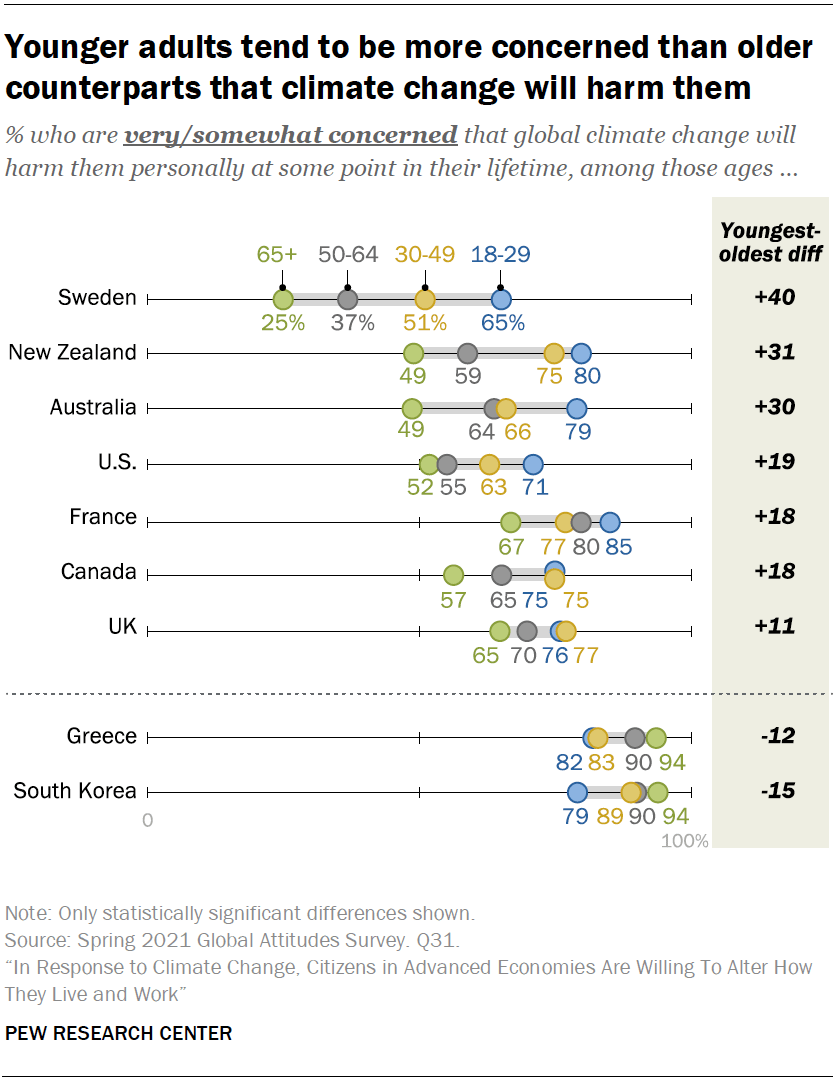
Just before I close let me show you my final chart. It goes to show our attitudes.

I am not a political animal. However I recognise that it is our leaders, globally, but especially in the top 10 countries in the world, who have to be leaders! Here are the top 10 countries.

So, please, dear leader, make this the number one priority for your country and for the world (areas of their country in square kilometres): Russia. 17,098,242, Canada. 9,984,670, United States. 9,826,675, China. 9,596,961, Brazil. 8,514,877, Australia. 7,741,220, India. 3,287,263 and Argentina. 2,780,400.

What a difference a week makes!

It all makes sense now.

Photo by Salmen Bejaoui

Do what you can, with what you have, where you are.” “Believe you can and you’re halfway there. It is hard to fail, but it is worse never to have tried to succeed.

“It is not the critic who counts; not the man who points out how the strong man stumbles, or where the doer of deeds could have done them better.”

This famous quotation by Teddy Roosevelt (1858-1919), the 26th President of the USA, seems apt for today’s post.

Exactly one week ago I published a post called Musings from a 77 year old! I wrote that the future was uncertain. Summed up at one point by me writing: “I have no idea of the global changes that are afoot and how they will affect us in Merlin. Indeed, I have no idea how long I have to live.

Margaret (from Tasmania) was one of the many people who responded. She included a video interview of Meg Wheatley by Michael Shaw. It is an hour long. Last Friday afternoon Jean and I watched it in full and it was incredibly interesting. Thank you very much, dear Margaret.

But before I present Meg’s video again I want to show you another video. It is a talk by Richard Grannon about the collapse of our civilisation. Now Richard Grannon is an author, YouTuber and life coach so one needs to remain impartial to his views, certainly before one does further research. But in the 46-minute talk I think there is much sense in what he says. See for yourself:

Moving on! The interview of Meg Wheatley is very good indeed. It’s a broad look at the issues and problems governing society but done in such a way that the people who watch her will also take away a number of tools for avoiding depression and anxiety. Meg places great store on the Hopi Native American Indians: “The Hopi maintain a complex religious and mythological tradition stretching back over centuries.

Meg quotes one of the more famous Hopi prophecies, that is reproduced below:

This could be a good time! There is a river flowing now very fast. It is so great and swift that there are those who will be afraid. They will try to hold on to the shore. They will feel they are being torn apart and will suffer greatly. Know the river has its destination. The elders say we must let go of the shore, push off into the middle of the river, keep our eyes open, and our heads above the water.

And I say, see who is in there with you and celebrate. At this time in history, we are to take nothing personally, least of all ourselves. For the moment that we do, our spiritual growth and journey come to a halt.

The time of the lone wolf is over. Gather yourselves! Banish the word ’struggle’ from your attitude and your vocabulary. All that we do now must be done in a sacred manner and in celebration.

We are the ones we’ve been waiting for.

Photo by Lucas Ludwig 

Here is that Meg Wheatley interview. (It is an hour long but very interesting; please watch it!)

I want to pick up the topic that was at the end of her interview; that of societal collapse. How would one define it? I chose Wikipedia for a reference.

Societal collapse (also known as civilizational collapse) is the fall of a complex human society characterized by the loss of cultural identity and of socioeconomic complexity, the downfall of government, and the rise of violence.[1]Possible causes of a societal collapse include natural catastrophe, war, pestilence, famine,  economic collapse,  population decline, and mass migration. A collapsed society may revert to a more primitive state, be absorbed into a stronger society, or completely disappear.

Virtually all civilizations have suffered such a fate, regardless of their size or complexity, but some of them later revived and transformed, such as China, India, and Egypt. However, others never recovered, such as the Western and Eastern Roman Empires, the Maya civilization, and the Easter Island civilization.[1] Societal collapse is generally quick[1] but rarely abrupt.[2] However, some cases involve not a collapse but only a gradual fading away, such as the British Empire since 1918.[3]

Anthropologists, (quantitative) historians, and sociologists have proposed a variety of explanations for the collapse of civilizations involving causative factors such as environmental change, depletion of resources, unsustainable complexity, invasion, disease, decay of social cohesion, rising inequality, secular decline of cognitive abilities, loss of creativity, and misfortune.[1][4] However, complete extinction of a culture is not inevitable, and in some cases, the new societies that arise from the ashes of the old one are evidently its offspring, despite a dramatic reduction in sophistication.[4] Moreover, the influence of a collapsed society, such as the Western Roman Empire, may linger on long after its death.[5]

The study of societal collapse, collapsology, is a topic for specialists of historyanthropologysociology, and political science. More recently, they are joined by experts in cliodynamics and study of complex systems.[6][4]

The article is much more extensive than I have quoted above and for anyone deeply interested then I do recommend you going to the article and reading it extensively.

Now Meg is of the opinion that it is too late to turn back but next Tuesday I want to talk to you about Sir David Attenborough’s film A Life on our Planet. That he believes there is a chance to undo the harm we are causing to the planet; through rewilding.

Until then!

Cruising over the Edge

I am very grateful to the Free Inquiry for permission to republish this article!

I am a subscriber to the print edition of Free Inquiry. Have been for quite a while. In the last issue, the April/May magazine, there was an article by Ophelia Benson that just seemed to ‘speak’ to me. I was sure that I was not alone. It was an OP-ED.

I emailed Julia Lavarnway, the Permissions Editor, to enquire what the chances were of me being granted permission to share the story. Frankly, I was not hopeful!

So imagine my surprise when Julia wrote back to say that she had contacted the author, Ophelia, and she had said ‘Yes’.

ooOOoo

Cruising over the Edge

By Ophelia Benson

The trouble with humans is that we never know when to stop. We know how to invent things, but we seem to be completely unable to figure out how to uninvent them—or even just stop using them once we’ve invented them. We can commission like crazy but we can’t decommission.

Like, for instance, cruise ships the size of condo towers. They’re feats of engineering and ship building no doubt, but as examples of sustainable tourism, a small carbon footprint, a sensible approach to global warning, not so much. How many gallons of fuel do you suppose they burn while cruising? Eighty thousand a day, for one ship.

We can’t uninvent, we can’t let go, we can’t stop. We can as individuals, but that’s useless when most people are doing the opposite. It’s useless when cruise ships keep cruising, SUVs keep getting bigger, container ships are so massive they get stuck in canals, more people move to Phoenix as the Colorado River dries up, more people build houses in the Sierras just in time for more wildfires, air travel is almost back to “normal,” and Christmas lights stay up until spring.

So heads of state go to meetings on climate change and sign agreements and pretend they’ve achieved something, but how can they have? Have any of them promised to shut down nonessential enterprises such as the cruise industry? Will they ever? The CEOs and lobbyists and legislatures would eat their lunch if they did. They can’t mess with profitable industries like that unless they’re autocrats like Putin or Xi … and of course Putin and Xi and other autocrats have zero inclination to act in the interests of the planet.

Janos Pasztor wrote in Foreign Policy after COP26, the UN climate change conference in Glasgow this past November:

Even if all Glasgow pledges are fulfilled, we are still facing a temperature overshoot of approximately 2 degrees Celsius. In the more likely scenario of not all pledges being fulfilled, warming will be more: perhaps 3 degrees Celsius. This would be catastrophic in nearly every sense for large parts of humanity, especially the poorest and most vulnerable who are suffering first and worst from escalating climate impacts.

Ironically, the technologies we can’t uninvent aren’t just the material luxuries such as huge cars, they’re also intangibles like democracy and freedom and individual rights. It may be our very best inventions along these lines that are the biggest obstacles to doing anything about the destruction we’ve wrought. We believe in democracy, and a downside of democracy is that governments that do unpopular things, no matter how necessary, are seldom governments for long. Biden and Macron and Trudeau and Johnson probably can’t do anything really serious about global warming and still stay in office to carry the work through.

Pasztor went on to ask a pressing question:

So how do we avoid temperature overshoot? The most urgent and important task is to slash emissions, including in the hard-to-abate sectors (such as air transport, agriculture, and industry), which will require substantial lifestyle changes.

Yes, those substantial lifestyle changes—the ones we show absolutely no sign of making. Maybe the biggest luxury we have, and the one we can least afford to sustain, is democracy.

Democracy at this point is thoroughly entangled with consumerism or, to put it less harshly, with standards of living. We’re used to what we’re used to, and anybody who tries to take it away from us would be stripped of power before the signature dried.

This is why beach condos in Florida aren’t the only kind of luxury we have to give up; we also have to give up the “consent” part of the “consent of the governed” idea when it comes to this issue. Not that I have the faintest idea how that would happen, but it seems all too obvious that democratic governance as we know it can’t do what needs to be done to avoid catastrophe.

We don’t usually think of democracy as a luxury alongside skiing in Gstaad or quick trips into space, but it is. It relies on enough peace and prosperity to be able to afford a few mistakes.

We take it for granted because we’ve always had it, at least notionally (some of us were excluded from it until recently), but it’s not universal in either time or place. To some it’s far more intuitive and natural to have “the best” people in charge, because they are the best. It’s a luxury of time and location to have grown up in a moment when non-aristocrats got a say.

The British experience in the Second World War is an interesting exception to the “take people’s pleasures away and lose the next election” pattern. Hitler’s blockade on shipping created a very real threat of starvation, and the Churchill government had to take almost all remaining pleasures away in pursuit of defeating the Nazis. Rationing, the blackouts, conscription, censorship, evacuation, commandeering of houses and extra bedrooms were all commonplace. Much of the dismal impoverished atmosphere of George Orwell’s 1984 is a picture not of Stalin’s Russia but of Churchill’s Britain. Life was grim and difficult, but Hitler was worse, so people drank their weak tea without sugar and planted root vegetables where the roses had been.

It’s disastrous but not surprising that it doesn’t work that way with a threat that’s unfolding swiftly but not so swiftly that everyone can see how bad it’s going to get. We can see what’s in front of us but not what’s too far down the road, especially if our contemporary pleasures depend on our failure to see. We’re default optimists until we’re forced to be otherwise, Micawbers assuring ourselves that “something will turn up”—until the wildfires or crop failures or mass migrations appear over our horizons.

ooOOoo

I do not know what the answer is? But I do know that we have to change our ways and change in the relatively near future; say, ten years maximum.

Because as Janos wrote, quoted in part above: “This would be catastrophic in nearly every sense for large parts of humanity…”

We are in a war. Not a military one but a war with the reality of where we are, all of us, heading. We have to stop ducking and weaving and come out fighting. Fighting for the very survival of our species. Do I think it will happen? I am afraid I do not. Not soon enough anyway: not without the backing of every government in the free world.

I really wonder what will become of us all!

An American’s view of America.

Personally, I think this is an important video.

Let me say straight away that I am an atheist. Apart from a couple of wobbles in my life I have always been that way. I believe in the sanctity of the truth and wherever possible that is a scientific truth. Jean also is a non-theist. That’s why we enjoy so much the meetings of our local Rogue Valley Humanists & Freethinkers Group. Indeed, this video was first shown to the group at the last meeting.

Now Kurt Andersen, born August 1954, is an American writer and he has his own website as well as a long entry on Wikipedia.

In January, 2020 Kurt made a video. It is nearly 50 minutes long and it is on YouTube. I have inserted this video below. If you can, please watch it and, even better, give me your thoughts.

How can we make sense of America’s current “post-factual,” “post-truth,” “fake news” moment? By looking to America’s past. All the way back. To the wishful dreams and make-believe fears of the country’s first settlers, the madness of the Salem witch trials, the fantasies of Hollywood, the anything-goes 1960s, the gatekeeper-free internet, the profusion of reality TV….all the way up to and most especially including President Donald Trump. In this fascinating and lively talk, Kurt Andersen brings to life the deep research behind and profound implications of his groundbreaking, critically acclaimed and bestselling latest work. Connecting the dots in a fresh way to define America’s character—from the religious fanatics and New Age charlatans to talk-radio rabble-rousers and online conspiracy theorists—Andersen explains our national susceptibility to fantasy and how our journey has brought us to where we are today. Kurt Andersen is a brilliant analyst and synthesizer of historical and cultural trends, a bestselling novelist, a groundbreaking media entrepreneur, and the host of public radio’s Studio 360. Join CFI and find out how we are protecting critical thought and science by visiting: https://centerforinquiry.org This talk took place at the CSICon 2019 in Las Vegas on October 19, 2019

The end of our present behaviours!

What is happening to Earth’s climate needs attention NOW!

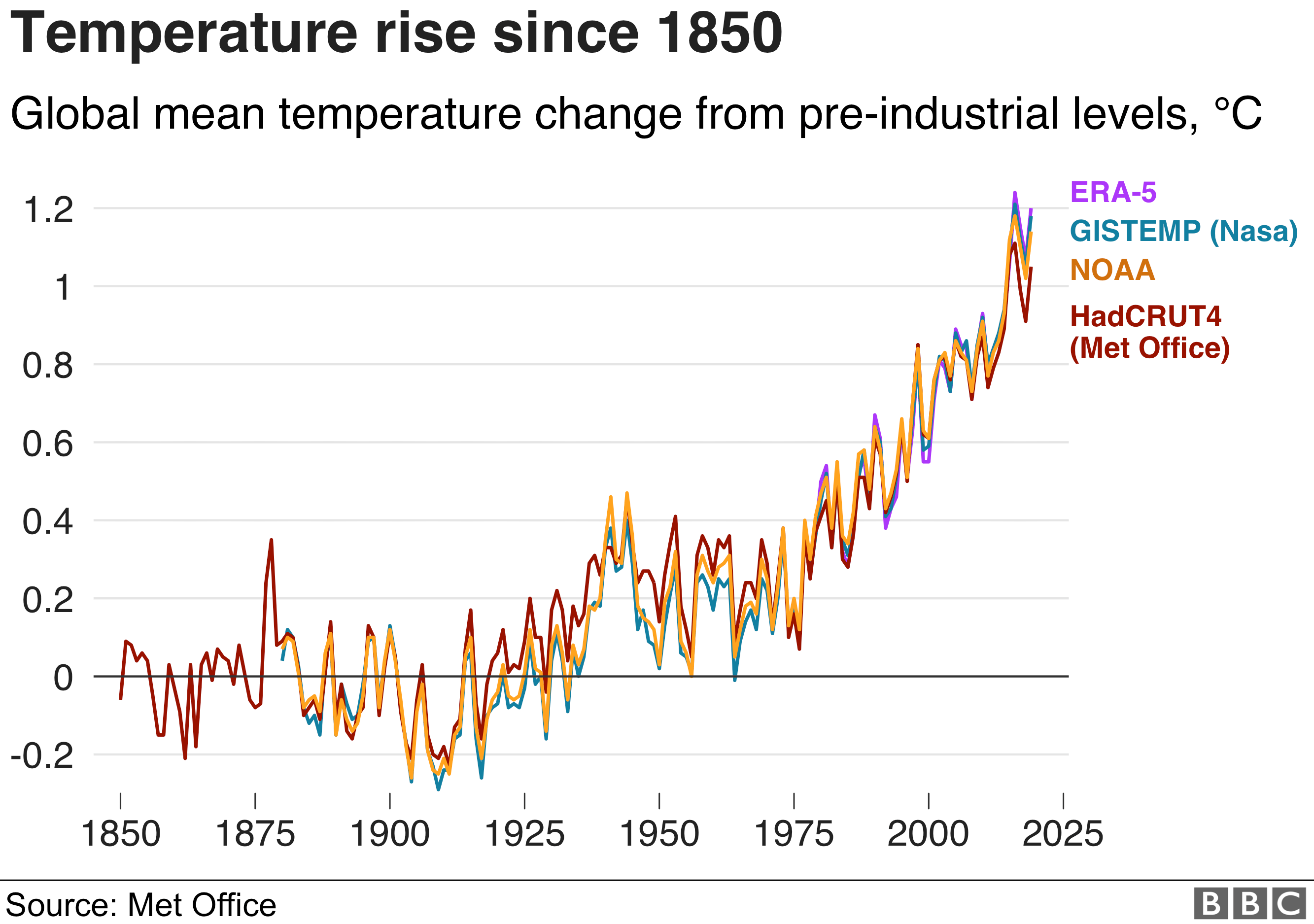
Two charts recently from the BBC News.

The 10 years to the end of 2019 have been confirmed as the warmest decade on record by three global agencies. 

According to Nasa, Noaa and the UK Met Office, last year was the second warmest in a record dating back to 1850. The past five years were the hottest in the 170-year series, with the average of each one more than 1C warmer than pre-industrial.

The Met Office says that 2020 is likely to continue this warming trend.2016 remains the warmest year on record, when temperatures were boosted by the El Niño weather phenomenon.

This is the reality.

It affects every part of the world and it affects everyone. BUT! We, as in you and me, and everyone else, still haven’t got it.

The recent COP26 was progress and, especially, the next convention being held in a year’s time is important. But it is a long way from where we need to be. A very long way.

Patrice Ayme is someone that I follow and there have been times when I have gladly republished his posts. With his permission I should add.

Recently he published a post called Cataclysmic Seven Degree Centigrade Rise and I wanted to share it with you. Here is is:

ooOOoo

CATACLYSMIC SEVEN DEGREES CENTIGRADE RISE

Abstract: Expected rise of temperature in mountains correspond to a seven degree C rise. This informs global heating: in the long run, it will also be 7C. Large systems (Antarctica, Greenland) have greater thermal inertia, so their temperatures rise slower… But they will rise as much. In other words the so-called “forcing” by man-made greenhouse gases (which corresponds to 600 ppm of CO2) is universal, but the smaller the system, the faster the temperature rise

****

Geographical systems with little thermal inertia (mountain glaciers) show an accelerated rate of heating of these parts which is only compatible with a seven (7) degrees rise in Celsius by 2100… A rise the IPCC of the UN considers impossible… But INERTIA says that it IS happening. The first thing this implies is that most forests will burn… worldwide. Then the ice shelves in Antarctica will follow.

TEMPS RISING ULTRA FAST IN MOUNTAINS

Anybody familiar with mountains worldwide know that temperatures are rising extremely fast: large glaciers I used to know have completely disappeared.. As in Chacaltaya, Bolivia. Or Portage, Alaska. The closest glacier to an Alpine village I went to as a child has been replaced by a larch forest (melezes)… One reason for this is that mountains are smaller in frozen mass than immense ensembles like Greenland and Antarctica. Moreover, the mountains’ permafrost is not as cold.  

From 1984 to 2017, the upper reaches of the fires in the Sierra Nevada of California rose more than 1,400 feet. Now the temperature in the lower atmosphere decreases by 7C every 1,000 meters. There are many potential factors to explain why fires go higher (although some contradict each other). To avoid paralysis by analysis, I will assume the rise in fires is all due to temperature rise. So what we have here is a 2.5C rise in 33 years.

….FROM SMALLER THERMAL INERTIA:

Mountain thermal capacity is accordingly reduced relative to those of Greenland and Antarctica. The proportionality factors are gigantic. Say the permafrost of a mountain range is of the order of 10^4 square kilometers, at a depth of one kilometer (typical of the Sierra Nevada of California or the Alps at a temp of -3C. By comparison, Antarctica is 14x 10^6 sq km at a depth of 4 kilometers of permafrost at a temp of -30C. Thinking in greater depth reveals the proportions to be even greater: individual mountains are of the order of square kilometers. This means that (using massively simplified lower bounds), Antarctica has a mass of cold which is at least 4 orders of magnitude higher than a mountain range: to bring Antarctica to seriously melt, as mountain ranges are right now, would require at least 10,000, ten thousand times, as much heat (or maybe even a million, or more, when considering individual mountains).  

As it is, mountains are exposed to a heat bath which makes their permafrost unsustainable. From their small thermal inertia, mountains warm up quickly. Greenland and Antarctica, overall, are exposed to the same bath, the same “forcing”, but because they are gigantic and gigantically cold, they resist more: they warm up, but much slower (moreover as warmer air carries more snow, it snows more while Antarctica warms up).

I have looked, in details at glaciologists records, from the US to Europe… Everywhere glaciologists say the same thing: expect a rise of the permafrost line of 1,000 meters… That corresponds to a SEVEN DEGREE CENTIGRADE RISE. Basically, while glaciers were found down to 2,500 meters in the Alps (some can still be seen in caves)… Expect that, in a few decades, none will occur below 3,500 meters… Thus speak the specialists, the glaciologists…

Mount Hood, Oregon, in August 1901 on the left, and August 2015, on the right. The Eliot glacier, front and center, which used to sprawl for miles, is in the process of disappearing completely.

What is happening then, when most climate scientists speak of holding the 1.5 C line (obviously completely impossible, even if humanity stopped emitting CO2 immediately)???… Or when they admit that we are on a 2.7C future in 2100? Well, those scientists have been captured by the establishment… They say what ensure their prosperous careers… At a global rise of 2.7 C, we get a migration of the permafrost line of around 500 kilometers towards the poles… Catastrophic, yes, but still, Antarctica will not obviously start to melt, big time. 

At 7C, the melting of the surrounding of Antarctica, including destabilization of West Antarctica, and the Aurora and Wilkes Basin can’t be avoided… They hold around 25 meters of sea level rise….

If it came to light that a seven degree centigrade rise is a real possibility, authorities would turn around and really do some things, which may destabilize the worldwide plutocratic establishment: carbon tariffs are an obvious example. Carbon tariffs could be imposed next week… and they would have a big impact of the CO2 production. So why are carbon tariffs not imposed? Carbon tariffs would destabilize the deindustrialization gravy train: by employing who are basically slaves in poor countries, plutocrats make themselves ever wealthier, while making sure there would be no insurrection at home… A trick already used in imperial Rome, by the Senatorial aristocracy/plutocracy. That would be highly effective… By the way, without saying so, of course, and maybe even unwittingly, this is basically what Trump had started to do…

The devil has these ways which the commons do not possess…

That would stop the crafty, dissembling nonsense that countries such as France are at 4.6 tons per capita of CO2 emissions per year… That’s only true when all the CO2 emitted to produce the goods the French need is NOT counted.. including deforestation in Brazil to grow soybean. With them counted, one gets to 11 tons or so, more than double… The wonderful graph of CO2 emissions collapsing in Europe is the same graph as collapsing industrial production…

The devil has these ways the commons have not even detected…

Carbon tariffs would be a way to solve two wrongs in one shot: the wrong of deindustrialization, of corrupt pseudo-leaders not putting the most advanced countries, their own countries, first… And the wrong of producing too much CO2.

Little fixes will go a long way, as long as they incorporate hefty financing fundamentally researching new energy (it does not really matter which type, as long as it is fundamental…)

Patrice Ayme

ooOOoo

Now this isn’t some academic treatise that doesn’t affect the likes of you and me. This is, as I have said, the harsh reality of NOW!

Here’s a photo of me and Jeannie together with Andy and Trish taken in March, 2018. On the edge of Crater Lake.

Then this is a stock photograph of Crater Lake taken in March, 2020.

Taken by Valerie Little

Not a great deal of difference but the trees in the photo above aren’t encased in snow as is the tree in the 2018 photo.

Now there is important news to bring you from COP 26. On Sunday Boris Johnson said:

Scientists say this would limit the worst impacts of climate change.

During a Downing Street news conference, Mr Johnson said: 

  • “We can lobby, we can cajole, we can encourage, but we cannot force sovereign nations to do what they do not wish to do”
  • “For all our disagreements, the world is undeniably heading in the right direction”
  • The “tipping point has been reached in people’s attitudes” – with leaders “galvanised and propelled by their electorates”
  • But “the fatal mistake now would be to think that we in any way cracked this thing”

Mr Johnson said that despite the achievements of the summit, his reaction was “tinged with disappointment”.

He said there had been a high level of ambition – especially from countries where climate change was already “a matter of life and death”. 

And “while many of us were willing to go there, that wasn’t true of everybody”, he admitted. But he added the UK could not compel nations to act. “It’s ultimately their decision to make and they must stand by it.”

That point about attitudes is interesting. Who would have thought, say, five years ago, that attitudes had changed so dramatically by late-2021.

One hopes that we will come to our collective senses but I can’t see the CO2 index being returned to its normal range without machines taking the excessive CO2 out of the atmosphere. Because, as was quoted on The Conversation nearly a year ago:

On Wednesday this week, the concentration of carbon dioxide in the atmosphere was measured at at 415 parts per million (ppm). The level is the highest in human history, and is growing each year.

Finally, my daughter, Maija, and my son-in-law, Marius, had a child some ten years ago. He is my grandson and I left England before he was born. He is Morten and he is a bright young spark.

Morten

Morten and all the hundreds of thousands of young persons like him are going to have to deal with the world as they find it!