Anyone who has ever tried to convince even one dog to sit still for a photo knows just how difficult it can be — but one woman has managed to do the impossible with — wait for it — 11 dogs.
Melissa Lentz
Melissa Lentz, who fosters dogs through Releash Atlanta, told The Dodo in a rundown about who is in this photo.
“Top from left: Mia, Pancake, Paxton,” Lentz said. “Bottom from left: Benji, Gizmo, Alex, Penny, Donny, Lula, Monroe and Rudy.”
Lentz added that seven of the depicted dogs are fosters waiting for homes, while “Gizmo, Donny, Monroe and Rudy are mine,” she said.
Even more remarkable, perhaps, is the fact that that perfect portrait is far from a one-time fluke.
Melissa Lentz
“I have tons of these photos,” Lentz said.
Melissa Lentz
Sometimes, Lentz even manages to join the pack for that perfect shot.
But how does she get such perfect family portraits — something that’s hard enough even for humans?
Melissa Lentz
Lentz’s secret seems to have to do with the particular relationships she forms with the dogs. One can almost see the bond reflected in the way the dogs look at her as she’s snapping the photos.
Melissa Lentz
“I literally just put them on the couch one by one and they situate themselves!” Lentz said. “I don’t use food [or] treats or anything. I just tell them to look at me.”
Melissa Lentz
The pictures aren’t only adorable — they’re also pretty emotional, since they capture the fosters at a very important time in their lives — when they’re learning how to be comfortable in a home with the longer-term hopes that they’ll soon find forever homes of their own.
Thankfully, they’ve landed with this dog whisperer to help them on their journey.
It always amazes me that dogs can so quickly learn that they have a human friend in their midst. Plenty of us would find it very difficult to make the change.
On April 30th I published a story that had been on the BBC News website about a dog that had been rescued from the sea some 200+ kilometres from the Thai coast.
Vitisak Payalaw sits behind Boonrod, the dog he helped rescue from the ocean, as he prepares to take him from a shelter in Hat Yai district, Songkhla, to his home in Khon Kaen on Saturday. (Photo from Boonrod Facebook account)
Seafaring dog Boonrod is heading to a new life in Khon Kaen with his new owner — one of the oil rig workers who rescued him from the ocean in a story that captured international attention.
“We’re leaving,” owner Vitisak Payalaw posted in a message on the Boonrod Facebook page on Saturday evening.
Mr Vitisak, an planner of Chevron Thailand Exploration and Production, met Boonrod — in Thai — on Saturday for the first time since the team found him to an oil platform in the Gulf of Thailand about 220km from the shore in Songkhla on April 12.
How Boonrod got there remains a mystery, but it is believed that he must have fallen off a trawler. After helping rescue the deepwater dog, Mr Vitisak offered to be his new owner.
The exhausted animal was brought ashore on April 15 and lodged at Dog Smile House, a shelter in Hat Yai district of the southern province, with financial support from the US oil firm and Watchdog Thailand, a non-profit group.
Boonrod appeared delighted to see Mr Vitisak and the other members of the oil rig team who rescued him.
Mr Vitisak said he was taking annual leave from his work at the oil platform to transport the dog to his home in Khon Kaen, almost 1,500km from Hat Yai. The house in the northeastern province has been prepared to accomodate a new resident, the Chevron employee added.
Mr Vitisak asked for privacy and requested that well-wishers not visit his new pet at his parents’ home in Khon Kaen. But fans are welcome to greet Boonrod when he walks the dog, he added.
He also encouraged other animal lovers to adopt pets if they can.
The story of Boonrod was carried by global news agencies, including CNN. He can be followed on his Facebook page.
Randy Etter and his dog Gemini have been together since Gemini was just a little puppy. It’s been around two years now, and the pair are the absolute best of friends. They love each other so much and brighten each other’s lives every single day — so when Etter found out he might lose Gemini, he vowed to do absolutely everything he could to save his life.
Randy Etter.
Gemini was playing with Etter’s girlfriend’s daughter one day four weeks ago, and the baby thought it was hilarious to continuously throw her bottle out of her playpen at Gemini. Gemini would pick it up every time and his dad would quickly grab it from him, wash it off, and give it back to the baby — but at some point, Gemini got ahold of the bottle without his dad realizing and ended up eating the top off of it.
No one had any idea that Gemini had swallowed something he wasn’t supposed to — until he started getting very, very sick.
“He just started to slow down and I didn’t think that was normal, just laying beside me and following me everywhere,” Etter told The Dodo. “I just felt like he was saying, ‘Help me.’”
Randy Etter.
When Gemini started vomiting uncontrollably, his dad knew something was very, very wrong, and immediately rushed him to the vet. Unfortunately, at first, no one could tell him for sure what was wrong with Gemini.
“I lost my job driving vet to vet to vet and it just seemed like I wasn’t gonna get anywhere or get him the help he needed in time,” Etter said. “It was truly one of the scariest things I had to deal with.”
Randy Etter.
Finally, a vet was able to confirm that Gemini had a blockage inside of him and would need surgery — which would cost $4,500, money that Etter definitely did not have. Losing Gemini was not an option, though, and so he decided to put his car up for sale to try and raise at least part of the money to save his best friend’s life.
“I was gonna spend every dollar made from the car sale on his surgery,” Etter said. “I would be devastated if I lost my best friend.”
Eventually, a friend was able to loan him $2,000, but it still wasn’t enough — until a local charity heard about his plight and decided to do everything they could to help Etter and Gemini.
The S.O.A.R Initiative (Street Outreach Animal Response) heard about what was happening to Etter and Gemini, and were able to raise nearly $3,000 in donations from total strangers who just wanted to help the best friend pair continue their life together. With all of the donated money, Gemini was able to have the surgery — and made it through with flying colors.
Randy Etter.
Gemini is now recovering well, safe in the arms of his dad and best friend. Etter is so grateful to everyone who helped him keep Gemini alive, and can’t imagine what he would have done without everyone’s support.
Randy Etter.
“It means the world to me,” Etter said. “He’s my best friend. He’s always there for me, I just wanted to be able to return the favor and be there for him.”
ooOOoo
Randy puts it perfectly; “He’s my best friend. He’s always there for me, I just wanted to be able to return the favor and be there for him.”
Thousands upon thousands of people feel exactly the same way.
This remarkable story of a dog that was rescued some 200+ kilometres off the coast of Thailand was featured on the BBC news website.
It’s quite amazing and truly miraculous.
ooOOoo
Dog rescued 220km from Thai coast by rig workers
A dog discovered some 220km (135 miles) off the coast of Thailand has been rescued by a team of oil rig workers after the exhausted pooch was spotted paddling near a drilling platform.
The brown aspin swam towards the workers when they called out to him last Friday afternoon. He was then pulled to safety.
It is not clear how the dog became stranded so far out at sea. Some reports suggest he may have fallen from a fishing trawler.
The rig workers named the dog Boonrod, a Thai word that roughly translates as “the saved one” or “survivor”.
Boonrod was said to have been exhausted and in need of fresh drinking water and food.
He was nursed back to health on the rig while staff radioed for help, requesting the assistance of a tanker that was heading back to shore.
Boonrod had to have a proper wash to cleanse his fur of salt from the seawater. Afterwards, he had a nap.
The conditions were said to have been calm during the rescue, which workers said made it easier to spot Boonrod among the rusty metal bars of the rig.
Boonrod was lifted by crane on to an oil vessel that was passing through the area on Sunday to be transported to a veterinary practice in southern Thailand.
The dog was said to have been in good spirits when he arrived on land to be taken to the vet.
(All images are copyright Viralpress.)
ooOOoo
The fact that this dog was rescued so far out to sea is incredible. Clearly, the poor dog had fallen off another vessel but the details of that incident are not known and it is purely conjecture.
But what is really important was that the dog was rescued and returned to health.
For a while now I have been subscribing to The Dodo. As the website explains it’s for animal people and as you and I know that’s quite a great many people!
Until now I have been a little nervous of sharing articles from The Dodo with you. But then I noticed quite recently that there is a ‘share’ button at the end of the articles.
So I presume it’s alright to share these wonderful stories!
A family was out riding their bikes one day in South Carolina when they suddenly heard what sounded like a puppy crying. They pulled their bikes over to the side of the road and went to investigate, and were shocked to find a little puppy trapped under a pile of dirt and concrete. Not knowing how else to help, they quickly called 911, and both the police and firefighters with the North Charleston Fire Department responded in hopes that they could free the trapped puppy.
North Charleston Fire Department
“They showed us where the dog was located,” Captain Paul Bryant, of the North Charleston Fire Department, told The Dodo. “It was piles of concrete 4 foot by 4 foot, some smaller, some bigger. One of the police officers said he could see the dog so we got on our hands and knees to look and saw his nose sticking out of the pile of rubble.”
After moving the concrete slabs out of the way with a pry bar, Captain Bryant attempted to pull the puppy, later named Rocky, out from the remaining dirt and rubble, but unfortunately there just wasn’t enough room. He then took a shovel and started digging, and finally was able to create enough space to pull the confused puppy out to safety. The whole rescue only took about 11 minutes, but no one has any idea how long Rocky had been stuck under there before everyone arrived.
North Charleston Fire Department
As soon as he was free, little Rocky couldn’t stop licking Bryant’s face in gratitude. The puppy clearly had so much energy and lots of love to give, and everyone immediately fell in love with him — especially Bryant. The family who had initially found Rocky said they would take him to a nearby animal hospital to get checked for a microchip so he could hopefully be reunited with his family, but after he was gone, Bryant just couldn’t get Rocky out of his head.
“I wanted to know if his owner was found, or if the person who found him was going to keep him,” Bryant said. “Once I found out he did not have an owner and the family who found him could not keep him, I knew he was coming home with me.”
North Charleston Fire Department
Bryant felt connected to Rocky from the second he rescued him from underneath that concrete, and it was as if the pair had always been meant to be together.
“I found out I was going to be able to adopt him, and I’ve been on a high ever since,” Bryant said in a video about Rocky’s rescue.
Captain Paul Bryant
Once Rocky had been given a clean bill of health and was ready to head off to his new forever home, Bryant headed over to Charleston Animal Society to pick him up …
Facebook/Charleston Animal Society
… and as soon as Rocky saw his rescuer again, he could barely contain his excitement.
Charleston Animal Society
Rocky is now all settled into his new home and couldn’t be happier with how things turned out. He went from being trapped and alone to having the world’s best dad, and everyone involved is so thrilled that Bryant and Rocky ended up together.
Captain Paul Bryant
“He is a very energetic dog and loves to play fetch with his new toys,” Bryant said. “He is always by my side, never letting me leave the room without following me.”
ooOOoo
Time and time again people from all walks of life know something instinctively when it’s in front of them. The love that we humans give to our dogs and the love that they return to us.
In Neolithic times there was an important relationship, as there is today. Maybe our dogs have become more of the ‘pet’ rather than the working dog that they are assumed to be then.
But here’s the article.
ooOOoo
Thanks to Facial Reconstruction, You Can Now Look Into the Eyes of a Neolithic Dog
The collie-sized canine was buried in a cavernous tomb on Scotland’s Orkney Islands around 2,500 B.C.
Experts believe the Neolithic dog is the first canine to undergo forensic facial reconstruction (Santiago Arribas/Historic Environment Scotland) By Meilan Solly
SMITHSONIAN.COM,
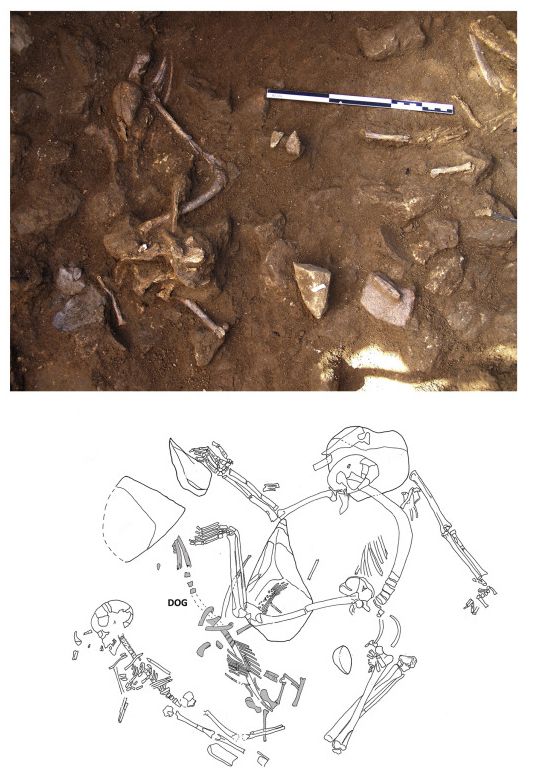
Some 4,500 years ago, a collie-sized dog with pointed ears and a long snout comparable to that of the European grey wolf roamed Scotland’s Orkney Islands. A valued member of the local Neolithic community, the canine was eventually buried alongside 23 other dogs and at least eight humans in a cavernous tomb known as the Cuween Hill Chambered Cairn.
Now, 118 years after archaeologists first chanced upon its resting place, the prized pup’s image is being reimagined. As Esther Addley reports for the Guardian, experts believe the dog is the first canine to undergo forensic facial reconstruction. Its likeness, commissioned by Historic Environment Scotland (HES) and the National Museum of Scotland, is set to go on view in Orkney later this year.
“Just as they’re treasured pets today, dogs clearly had an important place in Neolithic Orkney, as they were kept and trained as pets and guards and perhaps used by farmers to help tend sheep,” Steve Farrar, interpretation manager at HES, explains in a statement. “But the remains discovered at Cuween Hill suggest that dogs had a particularly special significance for the farmers who lived around and used the tomb about 4,500 years ago.”
It’s possible, Farrar adds, that the Neolithic group viewed dogs as their “symbol or totem,” perhaps even dubbing themselves the “dog people.”
Cuween Hill dates to around 3,000 B.C., Sky News reports, but radiocarbon dating places the dog’s actual interment some 500 years later. It remains unclear why the animal was buried so many centuries after the tomb’s creation, but archaeologists posit the timing may point toward the ceremony’s ritual value within the community. As HES observes, the fact that the Orkney residents placed canine remains alongside those of humans could also speak to their belief in an afterlife for both parties.
According to the Scotsman, forensic artist Amy Thornton drew on a CT scan to create a 3-D print of the animal’s skull. After layering clay approximations of muscle, skin and hair onto this base, she cast the model in silicone and added a fur coat designed to mimic that of the European grey wolf. Interestingly, Thornton notes, the process played out much as it would for a human facial reconstruction, although “there is much less existing data” detailing average tissue depth in canine versus human skulls.
The model is the latest in a series of technologically focused initiatives centered on Orkney’s Neolithic residents. Last year, HES published 3-D digital renderings of the chambered cairn on Sketchfab, enabling users to explore the tomb’s four side cells, tall central chamber and entrance passage. First discovered in 1888 but only fully excavated in 1901, the impressive stone structure held 24 canine skulls and the remains of at least eight humans.
In an interview with the Guardian’s Addley, Farrar explains that the reconstruction aims “to bring us closer to who [the dog’s owners] were and perhaps give a little hint of what they believed.”
“When you look at a Neolithic dog, it somehow communicates human relationships,” Farrar concludes. “… I can empathise with the people whose ingenuity made Orkney such an enormously important place. When this dog was around, north-west Europe looked to Orkney.”
ooOOoo
“When you look at a Neolithic dog, it somehow communicates human relationships,” Farrar concludes.
Built between 3000 and 2400 BC, this is an excellent example of a Neolithic chambered tomb. It has four cells opening off a central chamber, which is accessed down a passage. Entrance into the tomb today is through the original passage.
Secondary burials at the Cuween Hill could reflect a continued reverence for the site. A recently discovered settlement nearby is probably contemporary with the cairn, and would likely have been connected.
Tomb of the dogs
Exploration at the tomb in 1901 found:
Remains of at least eight humans – five skulls on the floor of the chamber, one at the entrance and two in side cells
The skulls of 24 dogs on the chamber floor
The dog remains suggest the local tribe or family perhaps had a dog as their symbol or totem, or there may have been a belief in an afterlife for animals.
The tomb is completely unlit, which serves to both add to the atmosphere and discourage vandalism and graffiti. It also means the tomb is largely free of green algal growth.
The stonework at Cuween Hill is of particularly high quality. The roof of one of the cells is likely to be original, elsewhere the walls and corbelled roofs have survived to a considerable height.
And a particular credit must go to the dog’s nose. It is many more times more sensitive than our nose, as the following article taken from Mother Nature Network shows. (And I really must stop republishing articles from MNN!)
ooOOoo
6 medical conditions that dogs can sniff out
From cancer to migraines and even seizures, dogs can give us a heads up about a range of human diseases.
Dogs have millions of smell receptors that can detect countless smells, including the smells of changes going on inside our bodies. (Photo: RedTC/Shutterstock)
Dogs are famous for their sense of smell. With about 220 million scent receptors (compared to our 5 million), dogs can smell things that seem unfathomable to us. They can detect some odors in parts per trillion, and they can detect countless subtleties in scents.
As PBS points out, “Experts have reported incredible true stories about the acuteness of dogs’ sense of smell. There’s the drug-sniffing dog that ‘found’ a plastic container packed with 35 pounds of marijuana submerged in gasoline within a gas tank. There’s the black lab stray from the streets of Seattle that can detect floating orca scat from up to a mile away across the choppy waters of Puget Sound.”
And yes, there are the dogs who have sniffed out medical issues that even doctors weren’t aware of. Dogs can pick up on tiny changes in the human body, from a tiny shift in our hormones to the release of volatile organic compounds, or VOCs, released by cancer cells. Researchers and dog trainers are just beginning to understand how dogs do this and how we might put them to work in being our helpers in health care. Here are six medical conditions that dogs are able to smell.
Dog are naturally tuned into their owner’s emotions, but what about signs of ill health? (Photo: sherwood/Shutterstock)
Cancer
Perhaps the condition dogs are currently most famous for detecting is cancer. Dogs have been able to sniff out a variety of types including skin cancer, breast cancer and bladder cancer.
There are quite a few stories of a pet dog obsessing about an owner’s mole or some part of their body, only to discover in a doctor’s appointment that the dog was actually sensing cancer. For example, Canada Free Press writes of a 1989 instance when a woman’s “dog kept sniffing at a mole on her thigh, but ignored other moles. In fact, the dog had actually tried to bite off the mole when she was wearing shorts. The woman consulted her doctor, the mole was excised and the diagnosis confirmed a malignant melanoma.”
In the last couple decades, researchers have looked seriously into dogs’ sniffing abilities when it comes to cancers. In studies, dogs have successfully been trained to detect the disease using samples from known cancer patients and people without cancer.
The newest study offers the most startling statistics: Dogs can correctly pick out blood samples from people who have cancer with 97% accuracy, a 2019 study published in Experimental Biology found. Heather Junqueira, the lead researcher at BioScentDx who performed the study, used clicker training with four beagles. The dogs focused their efforts on blood samples from patients with lung cancer, and with one exception, they were highly successful. The sample was small, so BioScentDx plans to continue its work, according to Science Daily.
In a 2006 study, five dogs were trained to detect cancer based on breath samples. Once trained, the dogs were able to detect breast cancer with 88 percent accuracy, and lung cancer with 99 percent accuracy. They could do this across all four stages of the diseases.
Sometimes the dogs can do an even better job than the humans in these studies. According to Penn State News, Nancy Dreschel, a veterinarian in Dairy and Animal Science at Penn State University, tells of an illuminating example: “A scientist was training dogs to detect bladder cancer in humans by smelling their urine. She said a dog alerted them to a sample from a supposedly healthy person who was being used as a control. On reexamination that person was found to have bladder cancer, so the dog caught it before anyone else did.”
Study after study has shown that dogs can detect cancer in people, but it may a while before your doctor employs a hound for your annual checkup. Researchers still don’t know exactly what chemical compounds for different types of cancers the dogs are sensing in these samples to alert to the presence of the disease, and this remains a hurdle both for better training of cancer-sniffing dogs and for creating machines that can more accurately detect cancer in the early stages.
Narcolepsy
Narcolepsy is a brain disorder that affects the ability to control sleep-wake cycles. This can mean a person suddenly falls asleep, even in the middle of a task. It’s a dangerous condition, as someone who has an attack could be injured falling to the ground or could have a car accident if it happens while driving.
Mary McNeight, Service Dog Academy director of training and behavior, has been working with narcolepsy service dogs since 2010, and she notes that there’s a scent the dogs pick up on when an attack is coming on. “It’s a biochemical change in the body. We do not know what the particular odor smells like due to the difference between human scent perception and dog scent perception,” she tells Sleep Review.
In a study published in 2013, Luis Dominguez-Ortega, M.D., Ph.D., found that two trained dogs detected 11 of 12 narcolepsy patients using sweat samples, demonstrating that dogs can detect a distinct scent for the disorder.
Service dogs help people with narcolepsy by performing several different types of tasks. They can stand over the person’s lap when an attack comes on, which prevents them from sliding out of a chair onto the floor; they can also stand over the person to protect them if they are out in public, or they can go get help. And most importantly, they can provide a warning up to 5 minutes before an attack comes on, giving their handler a chance to get to a safe place or a safe position.
While large dogs can be helpful in giving a narcoleptic sufferer extra support in balance and mobility after an attack, these dogs don’t have to be big. According to Petful, even medium-sized dogs can do the job. “Theo, a 2-year-old cocker spaniel, has virtually put an end to [Kelly] Sears’ suffering. He can sense when she is about to have a narcoleptic episode and warn her so that she can sit or lie down, waking her after a few seconds with a kiss on her chin. Since arriving two months ago from Medical Detection Dogs, the only organization in Europe that trains narcolepsy service dogs, Theo has proven himself indispensable.”
Dogs can smell all sorts of chemical changes in our bodies, including a drop in blood sugar or the onset of a migraine. (Photo: WilleeCole Photography/Shutterstock)
Migraines
For those who suffer migraines, having a warning before one comes on can mean the difference between managing the problem or succumbing to hours or days of intense pain. Fortunately, some dogs have a talent for sniffing out the signs that a migraine is on the way.
Psychology Today reports on a recent study that asked migraine sufferers with dogs if they noticed a change in their dogs’ behavior before or during a migraine. The results show that “54 percent of the 1027 participants indicated they had noticed changes in the behavior of their pets during or preceding migraines. Nearly 60 percent of these subjects indicated that their dog had alerted them to the onset of a headache — usually an hour or two in advance.” The results are fascinating, though it’s important to point out that the study was conducted with self-reports rather than observation by researchers. Even so, the study shows evidence that many dogs seem to detect and point out a change in their human companion’s health.
According to Kendall Winship, a migraine sufferer with a service dog, “These [migraine alert service] dogs are highly valued because the ability to tell when a migraine is approaching is an innate talent; it can’t be taught. Similar to diabetic alert dogs that can smell when their handler has low blood sugar, migraine alert dogs can hone in on the scent of serotonin, a chemical that skyrockets when the body is about to have a migraine. By alerting to the danger long before their handlers might feel any symptoms, these dogs can warn them to take preventative medication. When Rally looks up at me and whines, I know I have about two hours before the migraine will strike, and if I can take my medication early enough, I might be able to avoid the stroke-like symptoms and incapacitating pain.”
Low blood sugar
Increasingly, dogs are helping diabetics know when their blood sugar level is dropping or spiking. Dogs4Diabetics is one organization that trains and places service dogs with insulin-dependent diabetics. These dogs undergo extensive training to be able to detect and alert their handlers to changes in blood sugar levels.
A 2016 study published in the journal Diabetes Care found that the dogs detect isoprene, a common natural chemical found in human breath that rises significantly during episode of low blood sugar. People can’t detect the chemical, but the researchers believe that the dogs are particularly sensitive to it and can tell when their owner’s breath has high levels of it.
Medical News Today reports that dogs are trained to discriminate between the scent from a previous episode and the scent of a current episode. They detect when their handler is having an issue and alert the person, giving them time to test their blood sugar and take the insulin they need.
A 2013 study published in PLOS One showed that having a diabetic alert dog seems to provide significant improvements in both the safety and quality of life of insulin-dependent diabetics. “Since obtaining their dog, all 17 clients studied reported positive effects including reduced paramedic call outs, decreased unconscious episodes and improved independence.”
There’s still some skepticism about whether or not dogs can accurately alert handlers to a blood sugar change at a level beyond chance, something that can be determined with more studies. Even so, for those diabetics living with alert dogs, the sniffing ability of their companions seems to be a big help.
Seizure
One of the more controversial areas where dogs are used to alert to a medical condition is with seizures. There is growing evidence that dogs can and do detect the onset of a seizure; however, the level of accuracy and, most importantly, our ability to train dogs to alert a handler to an oncoming seizure remains a bit questionable.
As is the case with some other conditions, dogs cannot be trained to predict seizures. We don’t have a way to provide them with a scent or information that can be used for training. We can, however, train dogs how to respond to and assist a handler when a seizure occurs. Some service dogs that are placed with seizure patients do develop the ability to detect when a seizure is coming and can provide an alert if the handler pays close attention to the signals the dog provides. WebMD reports, “Jennifer Arnold, founder of Canine Assistants in Georgia, … says about nine out of 10 of the service dogs her organization has placed develop the ability on their own within a year of placement.”
A small 2019 study found that dogs were able to clearly discriminate a general epileptic “seizure odor.” However the study only involved a handful of dogs and involved odor samples that were collected during a seizure. Researchers pointed out that much more extensive testing would need to be done to see if other dogs would respond similarly and if dogs could predict seizures before they happened.
However, there is some question about how dogs are responding. How Stuff Workspoints out that in 2007, “two small studies in the journal Neurology reported that four out of seven seizure alert dogs studied turned out to be warning their masters of psychological, rather than epileptic seizures. This may not seem like a big deal, but the two disorders are different. A 2006 study revealed that up to 30 percent of patients who suffer from psychogenic nonepileptic seizures (PNES) are misdiagnosed with epilepsy. PNES, which results from emotional difficulties and can often be successfully treated with counseling, rather than unnecessary and harsh epilepsy drugs. The 2007 study also revealed one instance of seizures being triggered by the patient’s dog’s warning behaviors, indicating another flaw in the reliability of canine seizure prediction.”
A 2003 study concluded that “findings suggest some dogs have innate ability to alert and/or respond to seizures” however, it notes that further research is needed to uncover which seizure patients would benefit from the help of a dog. We also need more research to learn how to train dogs to be as effective as possible. We have to first learn how dogs know when a seizure is coming — are they smelling a change in body chemistry, or are they picking up on behavior changes? — before we can reliably train them to alert handlers before a seizure happens.
Dogs can smell fear and stress, and they can use that ability to help people with issues such as PTSD. (Photo: Glynnis Jones/Shutterstock)
Fear and stress
The age-old notion that dogs can smell fear is an accurate one. Dogs can smell when we are feeling fear or are experiencing an increased level of stress, even if we aren’t showing outward signs. What dogs are smelling is the surge of hormones our bodies release to respond to stressful situations, including adrenalin and cortisol.
Thankfully, this can be used to humans’ benefit, as dogs can signal a handler that they (or someone else) needs to take a few deep breaths. Dogs that alert handlers of the change in their emotional state — a change that often people aren’t even aware they’re experiencing — can help prevent panic attacks and other possible episodes associated with post-traumatic stress disorder or other issues.
“This 18-month Rhodesian ridgeback is the first cortisol-sniffing dog on staff at a school. Cortisol is known as the ‘stress hormone,’ and people on the autism spectrum tend to have higher levels of cortisol in their blood. Cali is employed to detect rising cortisol levels in the students. She waits outside of school each morning as the students file by. If she notices anyone with a high level of cortisol in their blood, she will signal to her handler, Casey Butler, a health teacher on staff at The Calais School who is a certified specialist in natural canine behavior rehabilitation and in animal adaptive therapy. When Cali stares at a child, Butler knows that is the signal. She then takes that child aside and works with him or her before a meltdown occurs.”
We still have a long way to go to discover exactly what dogs are smelling about us, let alone how we can train them to be as accurate as possible about a change in our bodies. Even though many details are not yet known, it’s clear that dogs have an uncanny ability to sniff out certain medical issues, and that’s a skill that could be a real lifesaver.
Editor’s note: This story was originally published in 2016 and has been updated with new information.
Jaymi Heimbuch ( @jaymiheimbuch ) focuses on wildlife conservation and animal news from her home base in San Francisco.
ooOOoo
Where on earth would we be without these wonderful, clever dogs! Seriously, whether you love dogs or not you cannot deny that they are incredible creatures!