Dogs are being enlisted in the fight against the novel coronavirus. Researchers at the University of Pennsylvania are testing a pack of eight Labrador retrievers to find out if their sensitive snouts can detect the pandemic virus by scent, Karin Brulliard reports for the Washington Post.
Humans have trained our canine friends’ finely tuned noses to sniff out other deadly diseases, including malaria, diabetes, some cancers and Parkinson’s disease, reported Ian Tucker for the Guardian in 2018. Other research has shown that viruses give off a particular smell, Cynthia Otto, director of the Working Dog Center at UPenn’s School of Veterinary Medicine, tells the Post.
If the dogs’ 300 million scent receptors can be trained to smell the novel coronavirus they could eventually be used in public places such as airports, businesses or hospitals to quickly and easily screen large numbers of people. Because this diagnosis by dog would depend on the smell given off by people infected with COVID-19 it should have no problem picking out asymptomatic carriers.
The yellow, black and chocolate labs will be trained for three weeks using a process called odor imprinting. Miss M., Poncho and six other dogs will be exposed to COVID-19 positive saliva or urine collected from hospitals and then rewarded with food when they pick out the correct samples, according to a statement from UPenn. When the dogs have the scent, they’ll be tested to see if they can pick out COVID-19 positive people.
“We don’t know that this will be the odor of the virus, per se, or the response to the virus, or a combination,” Otto, who is leading the project, tells the Post. “But the dogs don’t care what the odor is. … What they learn is that there’s something different about this sample than there is about that sample.”
Dogs are also being trained for this purpose in the United Kingdom by the charity Medical Detection Dogs in collaboration with Durham University and the London School of Hygiene and Tropical Medicine, reports the BBC.
“This would help prevent the re-emergence of the disease after we have brought the present epidemic under control,” Steve Lindsay, public health entomologist at Durham University, tells the BBC.
The U.K. trial expects to start collecting COVID-19 positive samples in the coming weeks and will train its dogs shortly thereafter, per the Post. If the trial is successful the group aims to distribute six dogs to be used for screening in U.K. airports.
“Each individual dog can screen up to 250 people per hour,” James Logan, epidemiologist at Durham University and collaborator on the project, tells the Post. “We are simultaneously working on a model to scale it up so it can be deployed in other countries at ports of entry, including airports.”
Otto tells the Post that the trial could inspire an electronic sensor that could detect COVID-19 which might be able to rapidly test thousands of people. But if the dogs’ olfactory prowess can’t be replicated, then the ability to scale up could be limited by another issue: the U.S.’s shortage of detection dogs.
ooOOoo
The list of fabulous skills that dogs have and their ability to help us humans out is practically endless.
To be more to the point, if dogs really can make a difference in determining who has got COVID-19, especially at airports, then this is a step to eventually returning to a more open and normal lifestyle.
May it happen!
I would like to close by returning to that NOVA article and republishing the following:
Put another way, dogs can detect some odors in parts per trillion. What does that mean in terms we might understand? Well, in her book Inside of a Dog, Alexandra Horowitz, a dog-cognition researcher at Barnard College, writes that while we might notice if our coffee has had a teaspoon of sugar added to it, a dog could detect a teaspoon of sugar in a million gallons of water, or two Olympic-sized pools worth. Another dog scientist likened their ability to catching a whiff of one rotten apple in two million barrels.
Animals, especially dogs, can have a profoundly positive effect on us humans.
We had to go to the local tip yesterday morning and there were a couple of other cars in the ‘recycling’ area that had dogs. Both the drivers of those other cars were allowing their dogs to look out through an open window and, in the course of dumping our stuff in the various piles, I approached the dogs and allowed them to sniff my outstretched arm. What struck me later was how natural that was, with the drivers being so friendly towards their dogs and me, let’s face it, practically a stranger. They were only brief exchanges but they were happy exchanges and that’s the point!
Emma is not really a private guest writer; putting all her material on her website Pawstruck.com.
But the value in what she writes totally justifies in my mind what is being said.
What do you think?
ooOOoo
The Many Ways Owning a Dog Can Change Your Life
True-blue dog owners can attest to the fact that life is never the same without their pet pooch. There’s something innately contagious about a dog’s spirit that nurses and nurtures the human soul.
It’s science!
According to a Finnish study, merely looking at your dog releases a flood of oxytocin in your brain. Also called the love hormone, these neurotransmitters lessen anxiety and promote well-being.
For most dog parents, simply receiving their dog’s unconditional love is enough of a reason to keep pumping love, effort, and money into caring for their pet. Still, there are so many more arguments for why having a dog is an experience everyone should try once in their lives.
Dogs Are Mood Boosters
The jolly temperament, silly mannerisms, and unsinkable enthusiasm of a dog at whatever time of day make them the funniest companions. Simply petting your dog or spending a few minutes of fetch each day releases serotonin and dopamine in the human brain. These neurotransmitters are responsible for keeping you in a good mood.
Constant interaction with your pet is also found to manage the symptoms of depression, according to a 2018 study. In many instances, dogs can provide the kind of genuinely reliable relationship that can rarely be found between humans. This feeling of dependability, it turns out, is vital for humans’ mental wellness.
Dogs Keep You Fit
Being a dog parent is a full-time job. That means ensuring they eat well and exercise right. Even if you own a “lazy” breed, all dogs still need to be exercised at least 30 minutes every day to keep fit.
As a responsible owner, you are obliged to attend to these needs and, in the process, also benefit from the task. A lot of people, despite the clear benefits of exercise, refuse to move for lack of motivation. Dog parents don’t get to choose, and sometimes, that’s a good thing.
Make a routine out of your dog’s walking schedule. This way, your body can get used to the new pace and help turn the practice into a habit.
This, coupled with the mood-boosting benefits of a dog’s presence all contribute to a reduced risk of developing heart problems, which are the leading cause of death among older adults in the US.
Dogs Help You Socialize
One of the biggest contributors and symptoms of depression is social isolation. Living alone can exacerbate the situation and cause you to distance yourself even more from family members and your tightest circle of friends.
Whereas if you have a dog, the responsibility of going out for dog supplies, routine vet visits, and daily walks obliges you to interact with people. For natural introverts, the forced socialization may be hard at first. But it will also help you hone your social skills and find new friends aside from keeping the blues at bay.
Dogs Help You Be Kinder to Yourself and to Those Around You
When someone else’s life depends on you, you learn to be more conscious of your decisions. You encourage yourself to take care of your health because no one else will tend to their needs. You learn to be decisive with your choices, from selecting the perfect dog treats to opting for brands with cruelty-free practices.
You cannot pour from an empty cup, as they say, and once you experience your pup’s absolute love, you will realize that the only way to give love back is to love yourself first.
ooOOoo
I asked Emma, as I do with all my guest bloggers at first, to send me a short bio.
This is what she wrote:
Emma Nolan is a blogger, writer, and dog parent to a dachshund and three adorable black Labradoodles. She likes strolling outdoors with her lovable fur babies when not writing about them. She writes about everything pooch at Pawstruck.
To be honest, I much prefer guest posts, even ones with a commercial aspect to them, than the republication of articles from other blogs.
This is an excellent example of what I mean.
John has written down all the key aspects of treating this, luckily uncommon, trait in a dog. It is his second guest post. The first one is here.
ooOOoo
How to Get Rid of Your Dog’s Aggressive Behavior
By John Brooks.
“Dog: a man’s best friend.”
The quote says it all.
A dog is a very lovable four-legged pet that cares and loves its owners. But what stands out the most is the loyalty of the dog towards its owners. You probably have heard of incidents where dogs have saved their owners from many unwanted threats, and even in some cases, they risk their own lives while doing so.
A dog can only do so much for you, so, therefore, it becomes your responsibility too, to take care of your dog as your child. It needs your time and attention, and just like a human being, it can even express emotions of love, sadness, and anger.
But this doesn’t mean that your dog doesn’t like you or anything. Dogs can experience different moods depending on many things. If your dog has been aggressive lately, then you need to find out the right reason and treat the cause immediately rather than just putting up a thick dog collar around its neck.
Reasons for Aggression
First of all, you need to find out why your dog is behaving the way it is. There may be many reasons for the cause like:
He may be Afraid
Fear may very well be one of the reasons why your dog is behaving in such a way. He may have a fear of suddenly seeing a lot of strange people at once. Or children might be poking him and irritating him to the point that he has become afraid and has developed aggression to counter that fear.
Lack of Socialism
If your dog fears crowd places, the chances are that he has not been exposed to a lot of crowds, beforehand and now this has made him anti-social and therefore has developed fear as a result.
Depression
Depression is a real thing not only for humans but also for dogs. Depression may cause your dog to be frustrated internally, and slowly that frustration might creep and turn into aggression later on. The cause of depression can be anything like being beaten up, fear, etc. But these problems should be addressed as soon as possible.
Punishment
Punishment is the last thing you want to do. Beating your dog will drive it to develop fear against you, and this fear will cause it to express in the form of aggression.
Almost in all cases, fear is the one main factor that drives a dog to be aggressive towards its owner or any stranger. It can be a fear of any previous experience when he was a puppy and had to go through any trauma. A fear of anything that he finds unpleasant or unwilling. He may also face fear when he thinks that valuable resources are being taken away or are under threat.
Signs of aggression
You may see some other sign too like the dog may start to crouch with his tail between his legs, or may develop tension around his mouth and jaw. You may notice him becoming stiff and still. Don’t just assume that if your dog is wagging his tail, it means that it is a sign of friendship. A stiff wagging of the tail or a dog wagging tail in crouched position is all signs of him that he is in a state of confusion or fear.
The last stage before attacking will be growling. It is the final stage of warning after which the dogs are sure to strike if the irritating factor is not removed.
How Do you Counter such Aggressive Behavior?
There are many ways you can do to prevent the aggressive behavior of your dog.
Remove the Cause
Immediately remove the cause of its aggression or the thing that is making him frighten or take your dog away from that situation as soon as possible.
Do not Punish him for Being Aggressive
Punishing your dog for being aggressive in the form of beating, yelling or any other bold tone manner will only make the dog more frightened and more aggressive the next time and may directly bite. The proper way to do this is just to show him that you don’t approve of such behavior either by shrugging your shoulders or by leashing only slightly. This behavior makes your dog believe that the owner doesn’t accept its action.
Train Him
You should train him to face his fear in a more fun and less aggressive way. Train him to be less violent and manage his stress. Try to play with him, hang out, and spend time so that he knows that his owner is always there with him so that he can have more confidence when next time he is around stressful situations.
Consult a Professional Dog Trainer or Veterinarian
Sometimes, even with the hardest of your efforts, things don’t work out and then it is time for you to visit the professionals who have been doing this for so long. They can guide you in many ways and help your dog to be better again.
ooOOoo
John’s bio is as follows:
John Brooks is the Professional Content Marketer. He writes a lot of articles on his carrier. Last one year he is working with Orbeen.com as a digital marketing expert. The company provides various types of Digital Marketing services i.e, Search Engine Optimisation (SEO), Search Engine Marketing (SEM), Social Media Optimization (SMO), Web design & development, Link Building, Content Marketing & blogger outreach.
I found this a most useful article. I hope you did as well.
Yesterday morning, well before 7am, we let all the dogs out for their morning walks, smells and ablutions! They are let out on our property.
Ten minutes later all of them were back home save one: Brandy!
Then followed a good couple of hours while I, and then later Jeannie and I, walked the entire property, all 13 acres, looking for Brandy. To no avail. He appeared to have disappeared. It’s not helped by the fact that Brandy has poor hearing and can’t really hear calls more than thirty feet away.
At one point I went out with Cleo, our GSD, who has a supreme sense of smell and excellent hearing, to look for Brandy. No luck!
I was getting very stressed and while Brandy at times does go for a walk on his own he had never been gone for this long.
Brandy!
Well eventually, with the help of our new neighbours, we located Brandy and, in time, got him back in the house. The only way off the property is via Bummer Creek, which flows across our property, under a bridge built on our driveway, that is not fenced. Only Brandy sometimes takes a stroll down the creek. Brandy had done so this morning and ended up past our neighbours property, a good quarter mile or more downstream.
It was then time to go across and thank our neighbours for their help. I was invited in for a coffee and also spent time with the eight-year-old, soon to be nine, chatting about this and that, and, towards the end of the coffee, about writing!
This was lovely and I said that if aforesaid young man was to write a story about one of their two dogs I would love to feature it as a guest post in this place!
Then when I came home I was thinking more about encouraging the young man to write some more and came across the following. I trust it is OK to republish.
ooOOoo
Creative writing techniques for kids: a step-by-step guide to writing a story
Encouraging children to write a story of their very own can give them an enormous confidence boost, as well as help them consolidate their literacy learning by putting their phonics, grammar and reading skills into practice. Primary teacher Phoebe Doyle offers parents tips on how to get their children’s creative thoughts flowing.
The way literacy is taught in primary schools has changed radically in the last couple of decades; when I was at school in the 80s we copied from blackboards, had whole hours of handwriting practice and sweated over spellings without any formal teaching of phonics whatsoever. While I think the more structured approach to literacy teaching we see in classrooms today makes learning more fun and accessible, my one worry is that there’s little time left for writing creatively.
When I was at school I adored writing stories – even stories with chapters and illustrations. I know my author brother did too – we found some of his old stories a few years back, and I felt so pleased he’d had the time to write these endless pages of action, adventure, characterisation and twisting plotlines.
As a primary teacher I ensured I would have a week each term when, during literacy sessions, we would focus solely on creating stories. I wasn’t deviating from the curriculum – far from it. During this week children would be consolidating their learning of phonics and be ‘writing for purpose’, considering carefully the aspects of story and who their audience might be.
It may very well be that your children write stories at home regardless of whether they’re required to for school, because most children have a seemingly natural urge to want to do so from time to time. This is just a little guidance on how you can support them and encourage a more structured approach to their story writing.
Plot planning
Firstly, ask your child where the story is going to take place. It could be somewhere fictional or real, it could be a planet, a country, a town or a house – anywhere!
Then, ask when the story is taking place – now? In the future? In the past?
Finally ask what they think is going to happen. Remember that this doesn’t have to be accurate and they don’t have to stick to what they say; many of the best writers say that their plots develop organically as they write. If they do have a firm idea of where they want to go with the plot, though, they can create an outline by completing a story planner, which could look something like this:
First….
Then…
Next…
And finally….
Characterisation
Ask your child who is going to be in the story. How do they want their readers to feel about each character? Again, they may want to jot some ideas down. You could make a table for them to help them organise their thoughts, with these headings:
Name of character
Relationship to other characters
What he/she looks like
Behaviour
Story language
Ask your child to think of some fabulous words to use in their story writing. They might be long words or simple ones, or they might be great descriptive words or words that help create pace and tension. Encourage them to jot these down and refer to the list as they write their story.
Story starters
All writers know that you’ve got to capture the attention of your readers right from the start; you want to make them desperate to read on. Ask your child to think of some good story openers that’ll entice people to find out more. Here are a few examples:
First sentences that are mysterious…
Molly had no sense of the day that lay ahead.
Story starters that use language tricks like alliteration…
It was damp, dark and dreadfully dusty when Molly entered the house.
Story openers that create tension…
Molly could hear her heart beating faster than ever before. Could this really be happening?
Stories that go straight into dialogue…
“But I don’t want to go to school, Mummy,” groaned Molly.
Encourage your child to look at some of the books they like to read and see how they begin in order to offer inspiration.
Get writing
Once they’ve got all of these ideas in place, they can start writing. They could do a draft in the first instance and then a neat, polished version later. They may wish to write in short chapters, use illustrations, or make their own book to write in – let them use their imagination and creativity when it comes to presentation, and make sure you show how much you value the end product by keeping it to read again with the other books in your house.
It never fails to amaze me at the potential for friendship between cats and dogs.
This comes from The Dodo website. It’s one of a number of sites that I follow. I should really say more but am lost for words so here it is!
ooOOoo
Cat Makes Sure His Dog Friend Is OK During Thunderstorm
Photo Credit: Mary Barnes
When things get scary, we all need a friend to let us know that everything’s going to be OK.
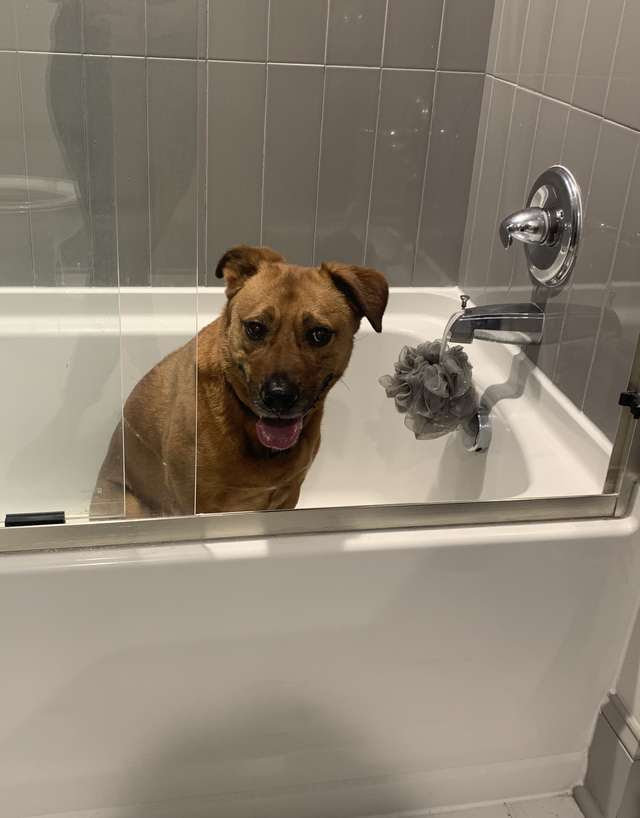
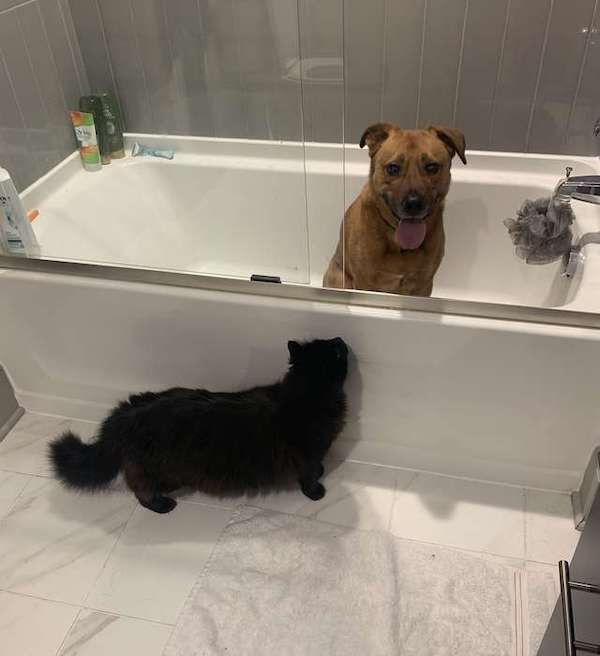
For a pittie mix named Moose, that friend is a cat named Marvin.
Mary Barnes rescued Marvin six months ago, hoping that the fearless kitty would become a playmate for her 7-year-old dog.
“I didn’t know how Moose and Marvin would get along because Moose had never really interacted with cats, but she’s the absolute sweetest and most gentle girl so I had faith,” Barnes told The Dodo.
Photo Credit: Mary Barnes
“They very quickly became best friends,” she added. “Marvin has the personality of a dog so they nap and play together all day.”
When Barnes moved into an apartment in downtown Detroit, she began to notice that Moose was becoming more and more sensitive to loud noises. Every time the pup heard fireworks or thunderstorms, she would immediately tremble and hide.
“I try to give her treats and keep her busy when it’s storming but she usually ends up going into the bathroom and hiding in the shower,” Barnes said. “She’s always hidden in the shower — it’s her safe place.”
Photo Credit: Mary Barnes
Marvin doesn’t have the same fear of thunder shaking the windows. But Barnes never could have guessed the loving cat would step up and comfort Moose in her time of need.
“Last night was the first really big, long storm we’ve gotten in Detroit since Marvin has been with us,” Barnes said. “He was very curious and concerned about his big sister.”
Marvin knew Moose was suffering and he wasn’t going to let her sit alone.
Photo Credit: Mary Barnes
“He went back and forth to her in the shower to check in,” Barnes said. “It distracted [Moose] from the storm for a little bit because she leaned down to give him kisses!”
The storm eventually passed, and Moose and Marvin quickly got back to playing and relaxing together.
If there’s one thing they both know, it’s that having a best friend can make getting through hard times a whole lot easier.
ooOOoo
The thing about this story is that our pet dogs and cats have a number of emotions and they recognise the need to comfort other animals in the same house.
I suspect that a wide range of animals also have a number of emotions.
I allowed myself to do a quick web search on the subject – there’s loads!
Emotion is defined as any mental experience with high intensity and high hedonic content.[1] The existence and nature of emotions in animals are believed to be correlated with those of humans and to have evolved from the same mechanisms. Charles Darwin was one of the first scientists to write about the subject, and his observational (and sometimes anecdotal) approach has since developed into a more robust, hypothesis-driven, scientific approach.[2][3][4][5]Cognitive bias tests and learned helplessness models have shown feelings of optimism and pessimism in a wide range of species, including rats, dogs, cats, rhesus macaques, sheep, chicks, starlings, pigs, and honeybees.[6][7][8]Jaak Panksepp played a large role in the study of animal emotion, basing his research on the neurological aspect. Mentioning seven core emotional feelings reflected through a variety of neuro-dynamic limbic emotional action systems, including seeking, fear, rage, lust, care, panic and play.[9] Through brain stimulation and pharmacological challenges, such emotional responses can be effectively monitored.[9]
Emotion has been observed and further researched through multiple different approaches including that of behaviourism, comparative, anecdotal, specifically Darwin’s approach and what is most widely used today the scientific approach which has a number of subfields including functional, mechanistic, cognitive bias tests, self-medicating, spindle neurons, vocalizations and neurology.
While emotions in animals is still quite a controversial topic it has been studied in an extensive array of species both large and small including primates, rodents, elephants, horses, birds, dogs, cats, honeybees and crayfish.
There’s much more and it is a comprehensive article.












 A dog can only do so much for you, so, therefore, it becomes your responsibility too, to take care of your dog as your child. It needs your time and attention, and just like a






 Learning from Dogs