The following photographs were sent to me by Jess Anderson. But first here is the story:
For years, photographer Tanja Brandt has made it her mission to capture magnificent photos of animals and wildlife and has drawn accolades in the German and international photography world with her heart-warming animal portraits.
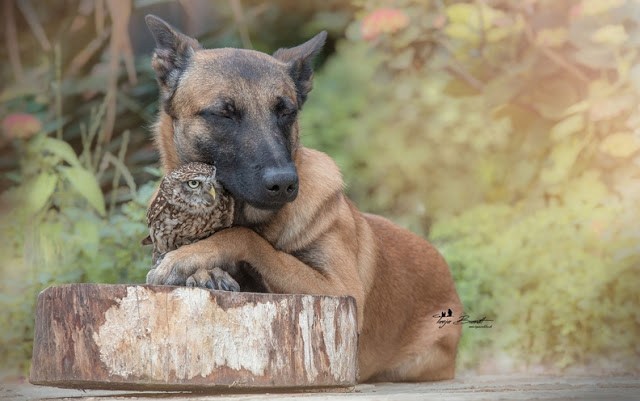
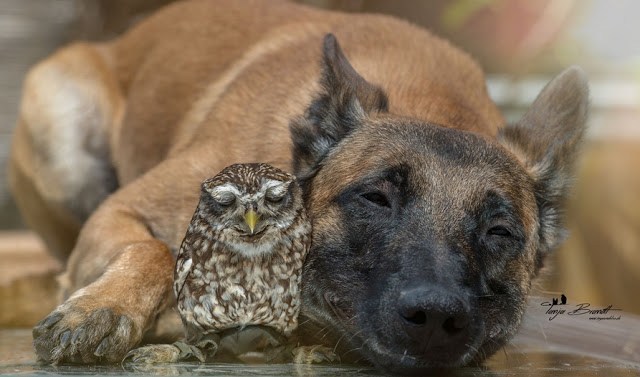
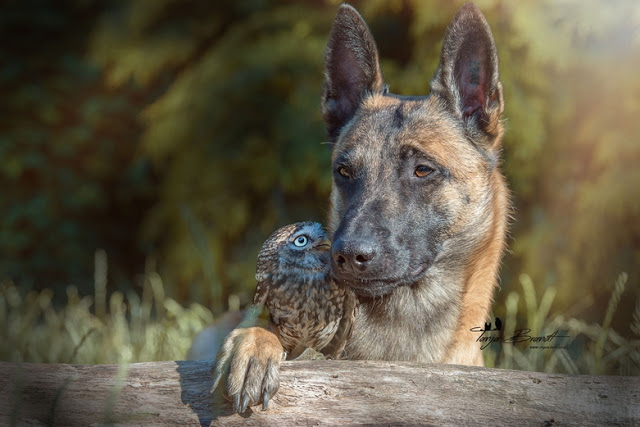
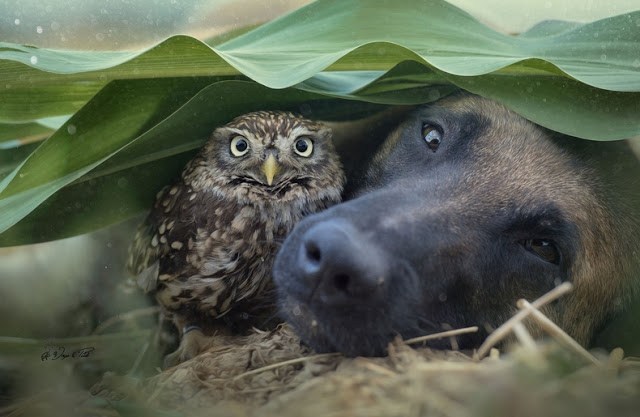
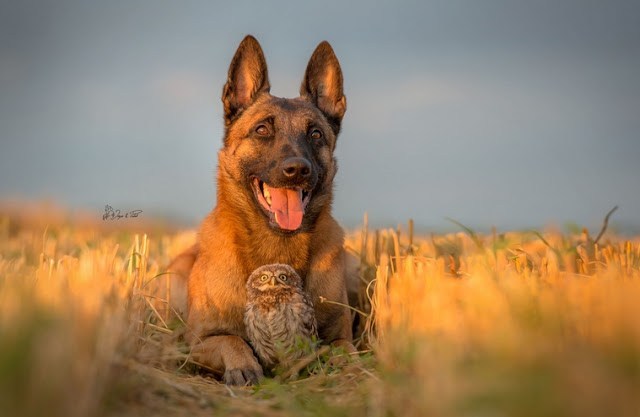
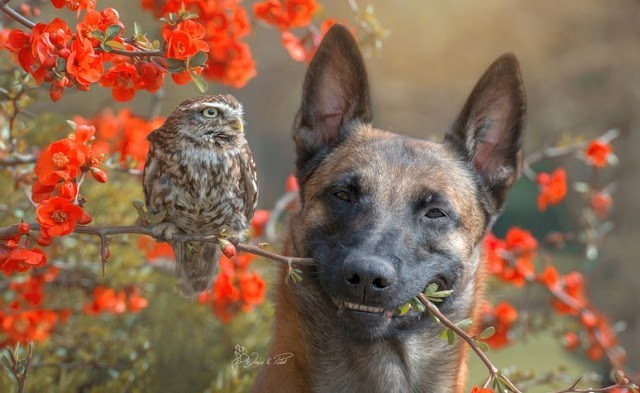
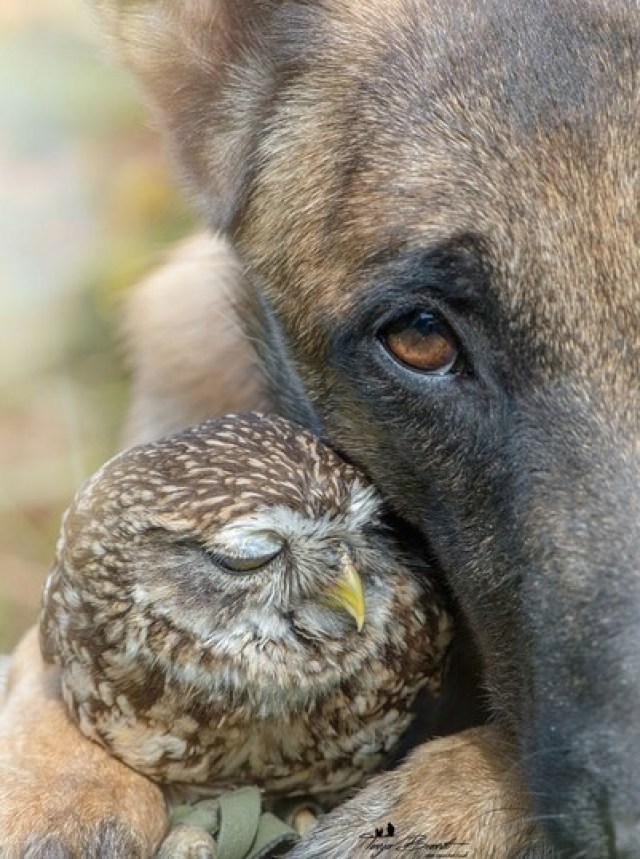
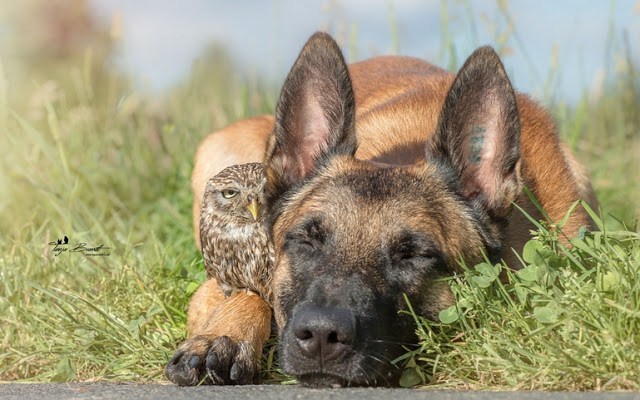
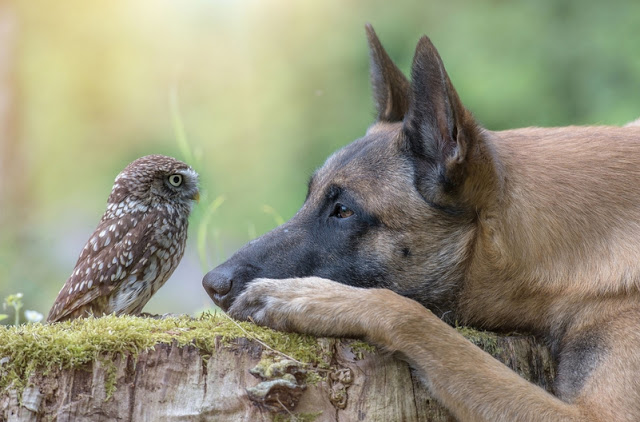
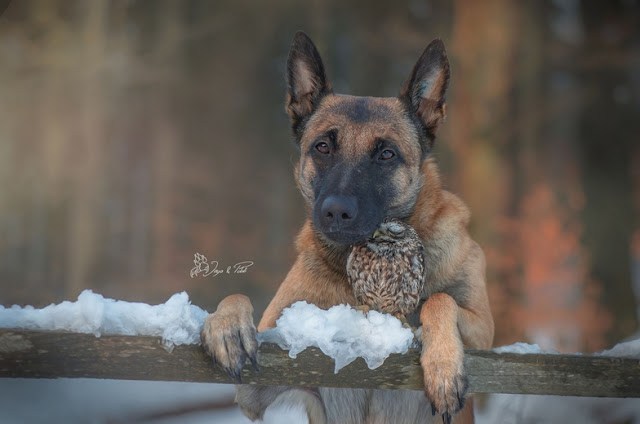
Recently, the German artist found a new challenge when she photographed the unique bond between two unlikely friends: Ingo, a Belgian Shepherd, and Poldi (Napoleon), a one-year-old owlet.
The owlet and canine have a special protector-protected relationship. Their affection toward each other couldn’t be any more evident. Ingo lovingly guards Poldi, who apparently doesn’t know how to live free.
The owlet hatched two days after his six brothers and sisters, therefore, has always been very vulnerable due to his small size. They respect each other and they can read each other, says the photographer.
oooo
oooo
oooo
oooo
oooo
oooo
oooo
oooo
oooo
These photographs are truly unique. Plus they are astoundingly beautiful.
This documentary reveals the unknown true stories of the working rescue dogs who saved lives at Ground Zero during the September 11, 2001 crisis and aftermath. Blind office worker Michael Hingson had to trust his seeing-eye dog Roselle on a treacherous descent of 78 flights of stairs to escape only moments before the towers collapsed. Lt. David Lim was called to duty with his dog Sirius. Genelle Guzman-McMillan was found by recovery dogs after being pinned under the rubble for 27 hours.
Once again, dogs come to the rescue of us humans, both physically and psychologically!
I was a bit tight on time yesterday and just looked for a YouTube video that might please.
Anyway, I quickly came across this from CBS. It goes back 7 years but so what, it is still very pertinent today.
People will tell you it’s not what you say to a dog that counts, it’s how you say it. But now researchers say dogs respond to much more than your tone of voice. They say brain scans confirm that canines can understand exactly what you’re saying. Michelle Miller reports.
They are incredibly intuitive but not in such a broad way as us humans.
On Friday morning Oliver got lifted up onto the bed. It’s a daily routine and one that Jeannie and I love.
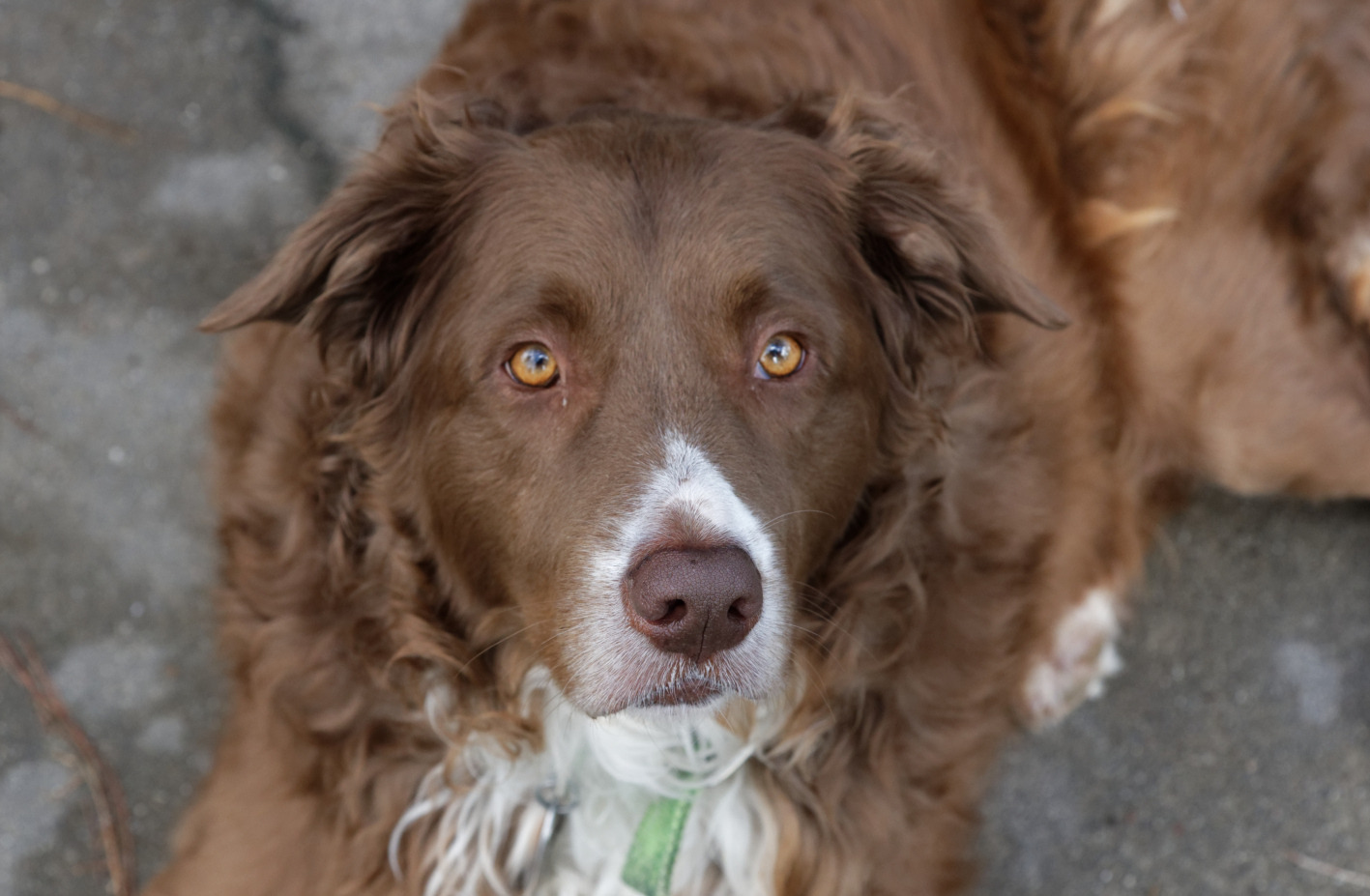
Oliver – He has magnificent eyes.
On this particular early morning I decided to switch the lamp off next to me and snuggle under the covers for a bit more shuteye. At the moment the light went out Oliver moved from his regular position somewhere over my knees to the bottom of the bed in between me and Jean. He has never done that before.
Of all our dogs Oliver is the one that seems to sense what is happening. That is not to say that the other dogs are dumb, far from it, but that Oliver is extra intuitive.
So that’s why this from Science magazine is being republished today. Because it is right on the money, so to speak.
ooOOoo
Dogs Know When You’re Lying to Them
By the BEC Crew, 25th February, 2015
We all know that dogs can sense our emotions, whether happy, sad or angry, but now researchers have found that they can also tell when you’re lying, and will stop following the cues of someone they deem untrustworthy.
Researchers led by Akiko Takaoka from Kyoto University in Japan figured this out by using the old ‘point and fetch’ trick – a human points at the location of something, like a ball, a stick, or some food, and the dog runs off to find it. They wanted to figure out if dogs were just blindly following these cues, or if they were adjusting their behaviour based on how reliable they perceived the person giving the cues to be. And if they didn’t perceive this person as being reliable, how quickly would they learn to mistrust and disobey the humans who pointed in the wrong direction?
Working with 34 dogs, the team went through three rounds of pointing. The first round involved truthfully pointing out to the dogs where their treats and toys were hidden in a container. In the second round, after showing the dogs what’s in the container, they pointed out the location again, but this time, it was a trick – the container was empty. In the third round, the team pointed to the location of the box, which was filled with treats again.
They found that the dogs were following the age-old adage, “Fool me once, shame on you, fool me twice, shame on me,” because by round three, many of them were done believing the actions of the pointing volunteers.
A second experiment was performed in exactly the same way as the first one, except the person was replaced by an entirely new one. The dogs happily started the process all over again, and were fully open to trusting their new ‘friend’. “That suggests, says Takaoka, that the dogs could use their experience of the experimenter to assess whether they were a reliable guide,” Melissa Hogenboom writes for BBC News. “After these rounds, a new experimenter replicated the first round. Once again, the dogs followed this new person with interest.”
What’s going on here, the researchers report in the journal Animal Cognition, is that the dogs were ‘devaluing’ the reliability of the human when they experienced their lies. “Dogs have more sophisticated social intelligence than we thought,” Takaoka told Hogenboom. “This social intelligence evolved selectively in their long life history with humans.”
The experiment reaffirms what we know about the nature of dogs – they love routine, but they also love new things. In round one, they learnt how the activity goes: the human points, I sniff out something great. But in round two, the rules changed and the dogs became stressed out. But when round three came along, the human who broke the rules was replaced by a different human, and the dogs were happy to trust this one because of their love of trying new things.
“Dogs are very sensitive to human behaviour but they have fewer preconceptions,” Bradshaw told the BBC. “They live in the present, they don’t reflect back on the past in an abstract way, or plan for the future.” And they certainly don’t approach a situation by “thinking deeply about what that entails”, he said.
Something to think about when you consider inflicting the ‘fake tennis ball’ game on your dog. It might work a few times for hilarious effect, because your dog trusts you way more than the dogs in the experiment trusted the strangers they just met, but how long will it last?
It also explains why dogs are so unsure about magicians:
ooOOoo
So to all the dogs in the world I say this: “Keep on trusting us humans!” And to the millions of dog owners in the world, I say this: “Never lie, especially to a dog!”
Yesterday morning while sitting up in bed I was browsing the internet on my iPad. I looked up TED Talks and fancied watching the story of Mark Pollock and Simone George. It turned out to be 19 minutes of incredible viewing and it is reproduced below as a YouTube video.
Towards the end Mark refers to his guide dog Larry. More of that later.
Then I came across a comprehensive entry on WikiPedia. From which the following is taken:
Pollock enrolled in a course to help come to terms with his disability. He left for Dublin with his guide dog Larry and began putting himself forward for job interviews. Prospective employers were uncertain as to how to approach him. Eventually the father of one of his college friends assigned him to organising corporate entertainment. He returned to rowing and won bronze and silver medals for Northern Ireland in the 2002 Commonwealth Rowing Championships. He engaged in other athletic pursuits, including running six marathons in seven days with a sighted partner across the Gobi Desert, China in 2003 when he raised tens of thousands of euro for the charity Sightsavers International. On 10 April 2004, he competed in the North Pole Marathon on the sixth anniversary of his blindness.
Then I discovered that Larry had died: “My great mate Larry The Guide Dog died on Sunday night. An amazing Guide Dog and amazing friend.”.
He died on the 2nd May, 2010 just a couple of months before Mark’s terrible accident.
Finally a photograph of Mark and Larry!
“Who do you rely on most? When I was just blind, it was my guide dog Larry who empowered me to live life independently.”
For the first day of September I wanted to change the topic to an item that was recently published by The Conversation.
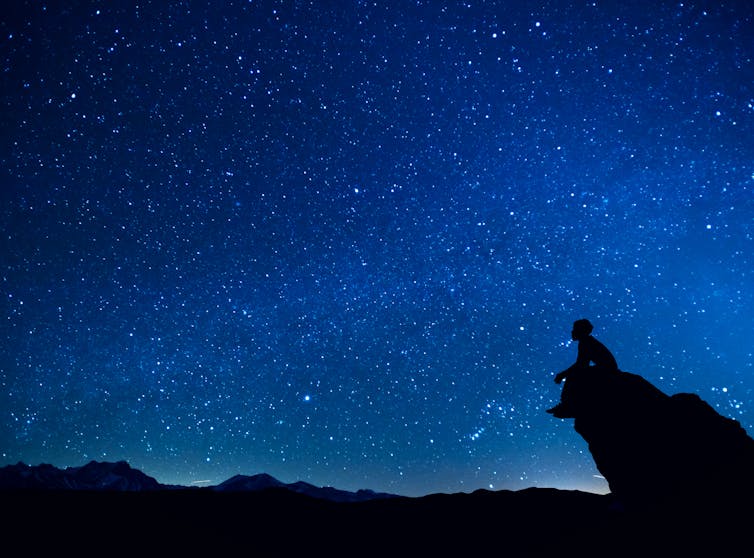
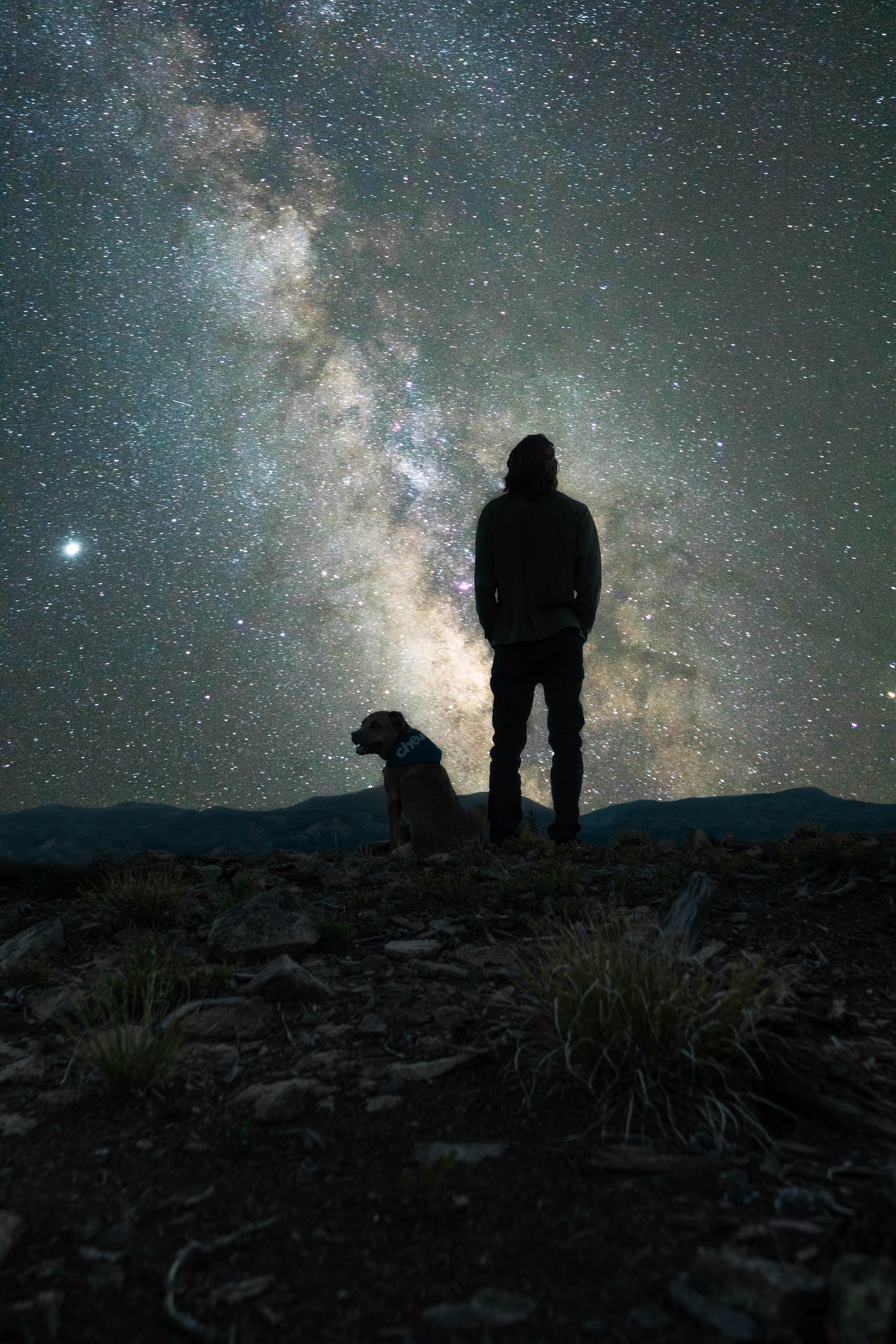
Space has always been fascinating to me. One of my enduring memories was standing on the roof of my Land Rover in 1969 during a long journey around the interior of Australia. We were in the Nullabor desert and it was flat, and lonely, for miles and miles. This particular night I clambered up onto the roof and just took in the night sky. There was not a single spot of human-caused light pollution and the night sky was beautiful beyond words.
Later on when I was sailing I used to regard the North Star as my friend.
What is beyond outer space? – Siah, age 11, Fremont, California
Right above you is the sky – or as scientists would call it, the atmosphere. It extends about 20 miles (32 kilometers) above the Earth. Floating around the atmosphere is a mixture of molecules – tiny bits of air so small you take in billions of them every time you breathe.
Above the atmosphere is space. It’s called that because it has far fewer molecules, with lots of empty space between them.
Have you ever wondered what it would be like to travel to outer space – and then keep going? What would you find? Scientists like me are able to explain a lot of what you’d see. But there are some things we don’t know yet, like whether space just goes on forever.
Planets, stars and galaxies
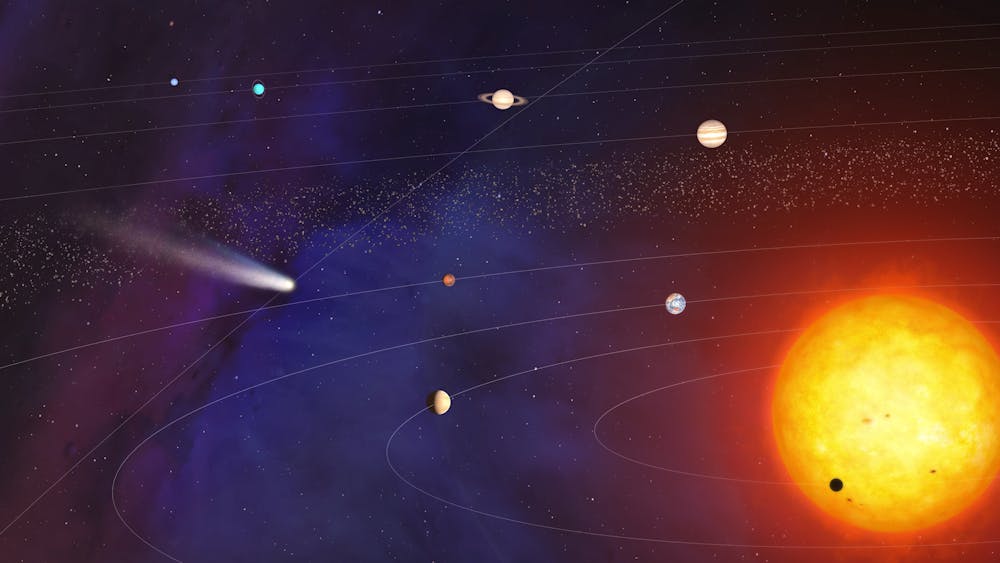
At the beginning of your trip through space, you might recognize some of the sights. The Earth is part of a group of planets that all orbit the Sun – with some orbiting asteroids and comets mixed in, too.
You might know that the Sun is actually just an average star, and looks bigger and brighter than the other stars only because it is closer. To get to the next nearest star, you would have to travel through trillions of miles of space. If you could ride on the fastest space probe NASA has ever made, it would still take you thousands of years to get there.
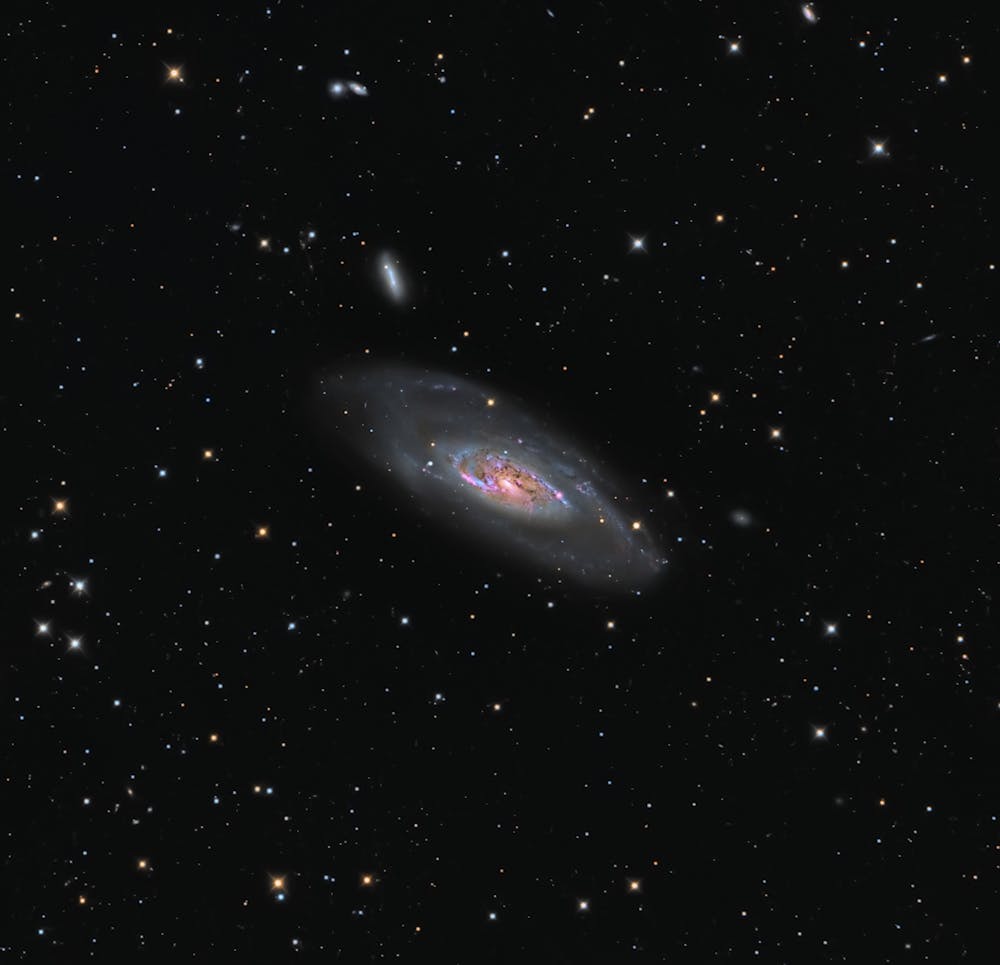
If stars are like houses, then galaxies are like cities full of houses. Scientists estimate there are 100 billion stars in Earth’s galaxy. If you could zoom out, way beyond Earth’s galaxy, those 100 billion stars would blend together – the way lights of city buildings do when viewed from an airplane.
If you could watch for long enough, over millions of years, it would look like new space is gradually being added between all the galaxies. You can visualize this by imagining tiny dots on a deflated balloon and then thinking about blowing it up. The dots would keep moving farther apart, just like the galaxies are.
Is there an end?
If you could keep going out, as far as you wanted, would you just keep passing by galaxies forever? Are there an infinite number of galaxies in every direction? Or does the whole thing eventually end? And if it does end, what does it end with?
These are questions scientists don’t have definite answers to yet. Many think it’s likely you would just keep passing galaxies in every direction, forever. In that case, the universe would be infinite, with no end.
Some scientists think it’s possible the universe might eventually wrap back around on itself – so if you could just keep going out, you would someday come back around to where you started, from the other direction.
One way to think about this is to picture a globe, and imagine that you are a creature that can move only on the surface. If you start walking any direction, east for example, and just keep going, eventually you would come back to where you began. If this were the case for the universe, it would mean it is not infinitely big – although it would still be bigger than you can imagine.
In either case, you could never get to the end of the universe or space. Scientists now consider it unlikely the universe has an end – a region where the galaxies stop or where there would be a barrier of some kind marking the end of space.
But nobody knows for sure. How to answer this question will need to be figured out by a future scientist.
Zola’s always known she was a big dog in a small dog’s body. The 2-year-old corgi refuses to let her short legs hold her back from getting what she wants.
And what Zola really wants is to play with her neighbor, Rocky.
Haley Smith
About three weeks ago, Haley Smith noticed that whenever Zola went out in the yard, she’d make a beeline for the fence.
“She started really going crazy and barking at the fence, and we weren’t sure why,” Smith told The Dodo. “She would sit by the door and we would let her out, and she would sprint to the fence and start jumping. We thought it was odd.”
Haley Smith
Smith didn’t understand what was so attractive about the cinder block barrier until she caught a glimpse of a sweet black and white spotted face looking over. But no matter how high Zola jumped, she couldn’t reach the dog on the other side.
“We peeked outside and lo and behold, she was just trying to talk to the big paws and head that were peering over at her,” Smith said. “She really wants to get to Rocky. She will take a running leap at the fence and try to jump to his height.”
Haley Smith
Rocky and Zola’s meetings have since become a nightly affair. The two have yet to meet without the barrier, but that just makes the pups even more interested in each other.
“Rocky is very gentle,” Smith said. “At first he barked back at her. Now, he jumps up and just watches her quietly. He seems very curious about her.”
But Zola doesn’t seem to like that their meetings are a little one-sided. “One theory I have is that she’s a little jealous that Rocky can see into her yard but she can’t see into his,” Smith said. “She probably wants to know how to get to him so they can sniff and play.”
Zola loves other dogs and always pulls to sniff each one she sees on her walks. The fact that she hasn’t been able to reach Rocky is the ultimate challenge, and she’s constantly trying to figure out how to get to his level.
Haley Smith
Smith has no doubt that Zola will soon reach him, and the two will finally be together.
“Zola is too smart for her own good,” Smith said. “She’s pretty sure she will figure out a way to get to the top of the fence.”
ooOOoo
In a way dogs are so human but then again dogs are a very different species. We know from years of personal experience that dogs have pure unconditional love for their doggy friends and for us humans. That is what makes them so special!
A more informative way to do something most of us don’t think about!
The Dodo recently had an article about petting a dog. I was about to ignore it and then decided to read the article. I am glad I did because The Dodo went to a veterinarian in New York City for the answers.
Here’s the article.
ooOOoo
These Are The Best Places To Pet A Dog, According To A Dog
Some dogs love all the pets from all the people, while others can definitely be more finicky.
When it comes to where she’s petted (and who’s petting her), your dog probably has some personal preferences —so it’s important that you learn her boundaries.
Typically, most dogs share safe zones that are OK to pet — as well as areas on their bodies that are totally off-limits.
To help, The Dodo reached out to Dr. Stephanie Austin, a veterinarian at Bond Vet in New York City, who explained the best places to pet a dog — and where to avoid.
Where do dogs love to be petted?
As a general rule of thumb, the neck, chest and shoulders are places that many dogs like to be petted.
But it’s important to keep in mind that not all dogs are created equal when it comes to where they like to be touched. “For example, some pups love belly scratches or petting on the rump area, while others may be more guarded about those parts of their body,” Dr. Austin told The Dodo.
How to pet a dog the right way
If you’re not sure what a dog likes or doesn’t like when you first meet her, your best strategy is to let her come to you and sniff your hand.
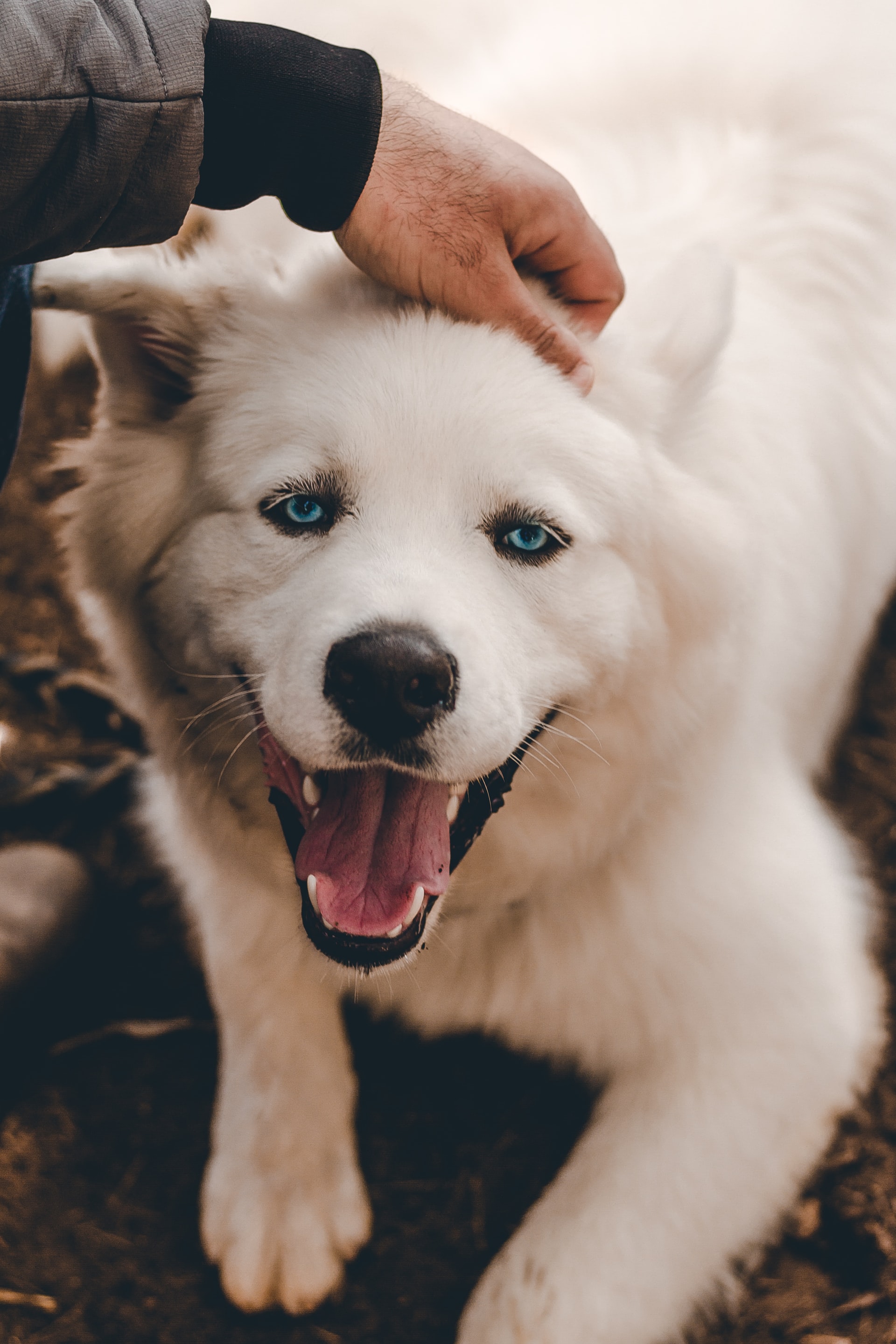
“If the dog is friendly and relaxed, try gently petting the neck, chest or shoulders. Don’t reach for their head from above, as this could appear threatening to a dog,” Dr. Austin suggested.
You can usually tell if a dog is enjoying being petted because she’ll get closer to you, act relaxed and happy and even lean into your hand where you are petting.
“If a dog becomes tense or standoffish, this may be a warning that they aren’t comfortable with the petting,” Dr. Austin said.
Where to not pet a dog
According to Dr. Austin, there are some places — in general — where dogs might be uncomfortable with someone touching.
Questionable spots include:
Paws
Legs
Tail
Face
“And even though many pups appreciate a good belly rub, they may also be protective of their belly and the underside of their body,” Dr. Austin said.
And be wary of any areas on the body that might be particularly sensitive.
“Some dogs may have areas of the body that are sensitive due to underlying health conditions — for example, if a dog’s hips are painful due to arthritis, they might not like someone pressing on or near their hips,” Dr. Austin said.
It’s also important to keep in mind that some dogs just don’t like to be touched by strangers. So if your dog prefers to warm up to people, advocate for her and let others know that she just needs time. Don’t force her to be uncomfortable by accepting unwanted interactions from other pets!
Of course, the best thing you can do when getting to know a dog is to start off slow and check in with her body language. She’ll usually tell you exactly what she’s comfortable with.
And once you figure it out together, your bond will be even stronger!
ooOOoo
Now Jeannie and I are biased because our six dogs love being fondled in so many ways including much of what is cautioned by Dr. Austin. But we certainly agree with the last few word about the bond being even stronger!
This is still good advice because there are so many different personalities with our six dogs and many just have a single dog.
But Dr. Austin’s advice applies to Jeannie and me and we would never be as relaxed when we have visitors. Then the strong advice is to let the dogs chose in their own time when and how to approach the guests.







 Learning from Dogs
