Category: Dogs

This most beautiful of relationships

That of man and dog.

A number of items have crossed my screen that, together, present the most wonderful story of the intensity and length of the time that mankind has shared his life with the dog.

First is this piece from Anthropology.net from 2008 when this was big news.

A Possible Domestication Of Dogs During The Aurignacian: 31,700 Years Ago

Both Dienkes and John Hawks have shared news about the latest research on the domestication of dogs. The researchers analyze 117 skulls of prehistoric canids from sites in Belgium, Ukraine and Russia. They conclude that a 31,700 year old canid from Belgium is ‘clearly different from the recent wolves, resembling most closely the prehistoric dogs.’

The draft can be found in the Journal of Archaeological Science under the title, “Fossil dogs and wolves from Palaeolithic sites in Belgium, the Ukraine and Russia: osteometry, ancient DNA and stable isotopes.” If the dating, and phylogenetic analysis is correct, these remains makes them the oldest known remains of domesticated dog, pushing back domestication time by 17,700 years, since the second oldest known dog, found in Russia, dates to 14,000 years ago as explained by Carl Feagans.

Doral View of the Goyet Cave Dog (a) and wolf skulls (b & c)Doral View of the Goyet Cave Dog (a) and wolf skulls (b & c)

Prehistoric dogs are distinguished from both prehistoric and extant wolves in having a shorter and broader snout, relatively wider brain cases, and a general reduction in skull size. Palaeolithic dogs in the study conform to this pattern. The researchers extended their anatomical analysis to mtDNA and stable isotopes on the Belgian samples. All fossil samples yielded unique DNA sequences.

This is a fascinating article, read the rest of it here.

Next a further explanation of the history of the dog from About.com Archaeology:

Dog history is really the history of the partnership between dogs (Canis lupus familiaris) and humans. That partnership is based on human needs for help with herding and hunting, an early alarm system, and a source of food in addition to the companionship many of us today know and love. Dogs get companionship, protection and shelter, and a reliable food source out of the deal. But when this partnership first occurred is at the moment under some controversy.

Dog history has been studied recently using mitochondrial DNA, which suggests that wolves and dogs split into different species around 100,000 years ago; but whether humans had anything to do with that, no one really knows.

Just think about that – 100,000 years ago!  But even if one assumes that early man wasn’t linked to this species divergence, the hard evidence of dogs being special to man still goes back a very long way.  Continuing the piece above:

The oldest dog skull discovered to date is from Goyet Cave, Belgium. The Goyet cave collections (the site was excavated in the mid-19th century) were examined recently (Germonpré and colleagues, cited below) and a fossil canid skull was discovered among them. Although there is some confusion as to which level the skull came from, it has been direct-dated by AMS at 31,700 BP. The skull most closely represents prehistoric dogs, rather than wolves. The study examining the Goyet cave also identified what appears to be prehistoric dogs at Chauvet Cave (~26,000 bp) and Mezhirich in the Ukraine (ca 15,000 years BP), among others.

However, I am told that what the Goyet Cave skull represents is not a “domesticated dog” but rather a wolf in transition to a dog, and that the physical changes seen in the skulls (consisting primarily of the shortening of the snout) may have been driven by changes in diet, rather than specific selection of traits by humans. That transition in diet could well have been partly due to the beginnings of a relationship between humans and dogs, although the relationship might have been as tenuous as animals following human hunters to scavenge, rather like the behavior that is believed to have existed between humans and cats. You could argue that cats never have been domesticated, they just take advantage of the mice we attract

As they say, dogs have masters, cats have slaves! Millions of dog owners have a relationship with their dog that is close to spiritual, and that also isn’t new. Let’s read on:

A burial site in Germany called Bonn-Oberkassel has joint human and dog interments dated to 14,000 years ago. The earliest domesticated dog found in China is at the early Neolithic (7000-5800 BC) Jiahu site in Henan Province. European Mesolithic sites like Skateholm(5250-3700 BC) in Sweden have dog burials, proving the value of the furry beasts to hunter-gatherer settlements. Danger Cave in Utah is the earliest case of dog burial in the Americas, at about 11,000 years ago.

Haplotypes and Grey Wolves

A recent study led by Robert Wayne (vonHoldt et al., below) at UCLA and appearing in Nature in March 2010 reported that dogs appear to have a higher proportion of wolf haplotypes from grey wolves native to the Middle East. That suggests, contrary to earlier studies, that the middle east was the original location of domestication. What also showed up in this report was evidence for either a second Asian domestication or a later admixture with Chinese wolves.

Dog History: When Were Dogs Domesticated?

It seems clear that dog domestication was a long process, which started far longer ago than was believed even as recently as 2008. Based on evidence from Goyet and Chauvetcaves in Europe, the dog domestication process probably began as long ago as 30,000 years, although the oldest evidence for a broader relationship, a working relationship, is at the Bonn-Oberkassel site, 14,000 years ago. The story of dog domestication is still in transition itself.

14,000 years ago people buried a dog with a human!  That is so beautiful.

Finally, National Geographic have been showing a series on this wonderful relationship between man and dog.  Enjoy this introduction video.
Poppy, Be in Peace

A tragic loss of a wonderful dog.

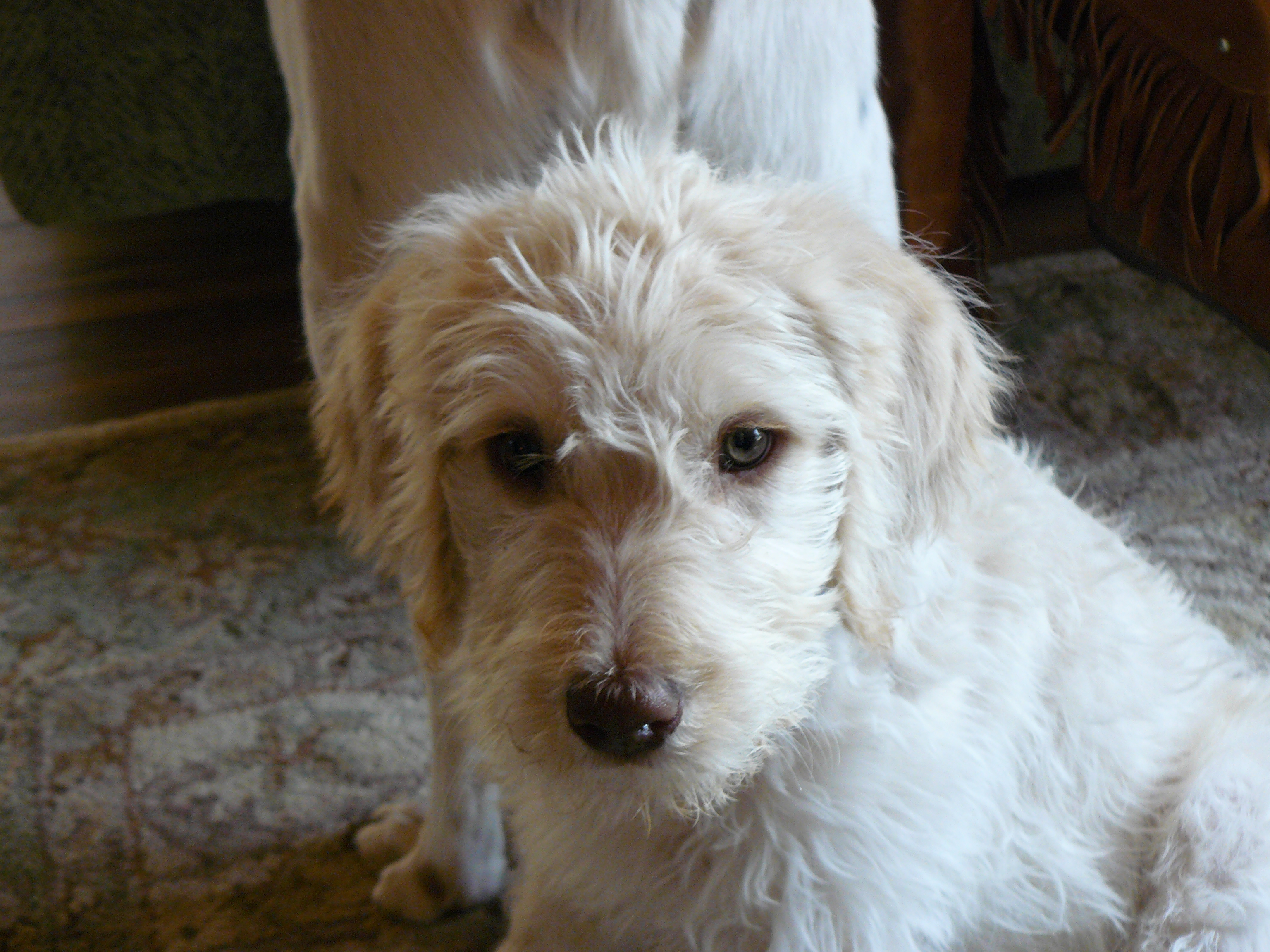
Little Poppy

On Friday afternoon, Jeannie and I were out on our usual walk along a trail through the Granite Dells.  This is spectacular scenery with magnificent granite boulders, escarpments and mountains all around.  The trail that we use is a Payson Area Trails System/United States Forestry Service designated walk.

As it happens it’s just over a mile from where we live and it has been a regular place to walk Pharaoh’s ‘pack’ most days.

Pharaoh’s little group of dogs includes Dhalia, Hazle and Poppy.  Poppy is a small terrier/poodle mix and like Dhalia and Hazle is a rescue dog.  Indeed Jean rescued Poppy many years ago from a Mexican rubble site practically hairless and surviving, just, off food scraps she could beg, steal or find.  Poppy, at 15 lbs, was also the closest buddy of Pharaoh, at 90 lbs!  Pharaoh is our German Shepherd dog whose face is the subject of the home page of this Blog.

We walk all four of them most days along the trail described above; Friday was no exception.  The only difference was that when we were almost back to the car we stopped and chatted to a neighbour, Bud, who was in his truck with a couple of his dogs.

Bud then drove off and we immediately noticed Poppy wasn’t with us.

One minute she was with us, the next Poppy had simply disappeared!

And that really is it.  I could go on about the hours spent going over and over the area, re-walking the trail, staying there until nightfall on Friday, going back at 06.30 am on Saturday morning, then again twice more on Saturday and again on Sunday with an inch of snow on the ground and with heavy sleet pelting down.  Not a sign, not a whimper, not a clue.

Thus she remains lost in weather that for the last 48 hours has been brutal; it is unrealistic to imagine that she survived despite us praying for a miracle.  Jeannie is devastated; I the same.  What hurts so much is not knowing what happened.

So dear little Poppy we hope you are at peace and we thank you for the great love you have given Jean and then later on me and Pharaoh.

“There is one best place to bury a dog.
“If you bury him in this spot, he will
come to you when you call – come to you
over the grim, dim frontier of death,
and down the well-remembered path,
and to your side again.

“And though you call a dozen living
dogs to heel, they shall not growl at
him, nor resent his coming,
for he belongs there.

“People may scoff at you, who see
no lightest blade of grass bent by his
footfall, who hear no whimper, people
who may never really have had a dog.
Smile at them, for you shall know
something that is hidden from them,
and which is well worth the knowing.

“The one best place to bury a good
dog is in the heart of his master.”

Ben Hur Lampman —
from the Portland Oregonian Sept. 11, 1925

Poppy is beautifully placed in the heart of Jeannie, me and all her doggie friends.

Nothing ‘knows’ like a dog’s nose

Lovely what comes across one’s PC screen.

It started when someone we know in Payson, Peter N, posted an item on Facebook about dogs being able to smell out cancer.  The Facebook item referred to an article in Natural News.  That item here went as follows:

(NaturalNews) The mainstream media is suddenly reporting on the idea that dogs can sniff out cancer in human beings. This concept is no surprise to NaturalNews readers, of course, as we’ve talked about this before, but until now the idea that cancer patients could be detected by smelling them was considered pure quackery by conventional doctors.

Of course, conventional doctors are once again wrong:Cancer patients do have a particular smelldue to the metabolic off-gassing of cancer cell tumors. But here’s the real story the mainstream media isn’t telling you: It’s not just dogs that can smell cancer — manyhealth practitionerscan also smell cancer patients.

I’ve personally spoken to numerous natural health practitioners who say they can smell cancer in patients. It’s not really a difficult thing to do, it turns out. With a bit of training, I believe most doctors could even be trained to do it, much like this dog in Japan which correctly identified cancer from stool samples 37 out of 38 times.

It doesn’t mean doctors have to sniff patients’ poo, either: You can also smell cancer on someone’s breath, so just talking to a patient can give a doctor an opportunity to do that. (Historically, by the way, physicians use to taste patients’ urine, from which they could diagnose a number of diseases, especially diabetes.)

This particular research on dogs’ ability to sniff out cancer was conducted by researchers at the Kyushu University in Japan. Dr Hideto Sonoda, who conducted the research, told the BBC, “The specific cancer scent indeed exists, but the chemical compounds are not clear. Only the dog knows the true answer.”

An important point in all this is thatthe cancer-sniffing dogs were able to detect early-stage bowel cancer— something that is extremely difficult for modern medical technology to detect. And it only takes a dog a few seconds — at virtually zero cost — to make the assessment.

Now, of course, medical scientists are busy trying to build an electronic device to replace the dog, because conventional medicine can’t stand the fact that something built by nature (the dog’s nose) might be better than some million-dollar electronic gizmo they come up with that can be billed out at $500 a test. So rather than just using dogs who can already detect cancer right now, they’re going to wait around a few years and try to create some high-tech equipment that will probably be a poor replacement for the dog.

That’s how modern medicine works: It steals good ideas from nature and replicates them, but the results are almost always a poor imitation of what Mother Nature has provided for free. Here’s how the end results would likely stack up:

CANCER-SNIFFING DOG
Accuracy: 98%
Cost: One dog biscuit and a pat on the head

CANCER-SNIFFING HIGH-TECH MACHINE
Accuracy: 60%
Cost: $500 billed to Medicare [the US medical system for those unfamiliar with the term. Ed.]

Gee, which one do you think conventional medicine will end up using?

In fact, a quick web search finds much information on the topic including these YouTube videos.

Now how to get our dogs to tell us ……… we’re OK; assuming we are!

Then from HousePet online magazine comes this:

The British Medical Journal published a ground-breaking research reporting how dogs have been trained to detect bladder cancer by its smell in urine, bringing together dogs’ exceptional sense of smell, with the theory that cancer produces chemicals with distinctive odours. (on September 24th, 2004 )

Six dogs, none of which had any prior experience in scent discrimination, were trained over seven months to distinguish between urine samples from bladder cancer patients and those from healthy people and individuals with non-cancerous diseases. For the final tests, each dog was offered a set of seven urine samples, and their task was to determine which of them was from a patient with bladder cancer. All of the samples used in the tests were completely new and unfamiliar to the dogs.

The dogs, comprising three spaniels, one papillon, one Labrador and one mongrel, correctly selected the bladder cancer urine on 22 out of 54 occasions – an average success rate of 41% compared to the 14% which would have been expected if the dogs had randomly selected a sample each time. This was statistically significant.

The research was undertaken by a unique partnership of medical scientists, including a statistician, and dog trainers. An orthopaedic surgeon from Buckinghamshire, Mr John Church, brought together colleagues from the Department of Dermatology, Buckinghamshire Hospitals NHS Trust (funded by the Erasmus Wilson Dermatological Research Fund) to develop and supervise the scientific protocol for the research, and Hearing Dogs for Deaf People (based near Princes Risborough) for the purpose of training the dogs for the trial.

“We were flattered to be asked to assist in this study on the basis of our reputation in the field of training dogs,” Claire Guest, Operations Director at Hearing Dogs said, “although we have been very careful not to let this project affect our normal work which involves training dogs for deaf people. The four of us who trained these cancer detection dogs did so using our own pet dogs, in our own homes, in our own spare time.”

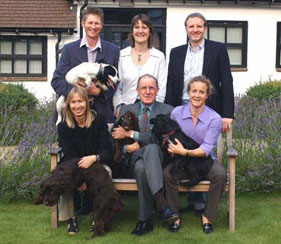
Back row: And Cook, Claire Guest, Martin Church. Front row: Carolyn Willis, John Church, Susannah Church

I rather loved the quote from John Church, “I am a passionate believer that animals have a huge amount to teach us, and I have heard many stories of people who have been alerted to the presence of cancer in their bodies by their pet dogs. I was delighted to find that the two charities were open-minded enough to participate in this study, so that we could really examine this phenomenon scientifically.”

As I keep going on about – we really can learn from dogs!

Thanks Peter.

So near, so far!

Mixed emotions about those other worlds out there.

In recent times, Learning from Dogs has been reflecting on the magic, and fragility, of the planet we all live on.

There was the photograph of the Earthrise that attracted quite a few comments.  That was followed up by the amazing photograph of the Earth from Voyager 1 taken in 1990 from 3,762,136,324 miles away!  Then the lovely poem from Sue.

So it was interesting to note my mixed emotions to a piece on the BBC News website yesterday.  Here’s a flavour.

Worlds away

Astronomers have identified some 54 new planets where conditions may be suitable for life.

Five of the candidates are Earth-sized.

The announcement from the Kepler space telescope team brings the total number of exoplanet candidates they have identified to more than 1,200.

The data release also confirmed a unique sextet of planets around a single star and 170 further solar systems that include more than one planet circling far-flung stars.

Read the rest of the item here. (and there’s a fuller version on NetworkWorld)

So here are those mixed emotions.

  • Man has been, and still continues to be, wonderfully curious to the point of spending huge sums of money on projects that appear to do nothing more than satisfy that curiosity. (The (Kepler) mission‘s life-cycle cost is estimated at US$600 million, including funding for 3.5 years of operation, from here.)  That’s a beautiful trait, in my humble opinion.
  • Homo Sapiens is a wonderfully innovative and creative species, as so wonderfully presented by Alan Alda on a recent PBS Programme called The Human Spark.  (See the YouTube intro at the end of this Post.)
  • Look at all the inventions and incredible advances to our species that are all around us – including the PC I am using and the World Wide Web that is aiding this message!
  • For such an intelligent species as us, why is it that we are treating Planet Earth in such a suicidal manner through greed, pollution and over-consumption!
  • As was reported yesterday, we could be on the verge of total and utter chaos in terms of food.  Then also yesterday was a small item about food prices reaching a new global record.
  • It always struck me as absurd to conclude that this planet is the only habitable planet in the universe – ‘Astronomers estimate there are 1021 stars in the universe. With a conservative estimate of three planets per star (some could have many more, some would have none at all) this puts the estimated number of planets into millions of billions.‘ From here.
  • So the data coming in from Kepler is truly astounding and, personally, underlines this era as a great time to be alive.
  • But there simply is no choice in that for decades ahead, if not centuries ahead, Planet Earth is all there is for us.  So why do we do it so much harm!
  • Our civilisation is likely to go to the very limits of survivability before the message that the existing ‘model’ is broken is picked up by every major political party in the world.  That is very, very scary to contemplate.
  • So it looks as though, soon, mankind will face the ultimate decision of all time.  Give up and let the chaos overwhelm us all, or … or what?  In other words millions of us will have to live with the consequences of our greed.
  • The ‘or what?’ can only be a faith that it will be OK.
  • A faith that mankind will use the power of dreams, imagination and energy to create a new future that will, at long last, be a new dawn of democratic and just, integrous existence.
  • And maybe, just maybe, that could be the Second Coming and maybe, just maybe, the world’s Churches and religions will be our saving grace.

But of that day and hour knoweth no man, no, not the angels of heaven, but my Father only. Matthew 24:36

Fascinating times – a Chinese proverb, ‘It’s better to be a dog in a peaceful time than be a man in a chaotic period.’

Finally, here’s that video of the series preview to The Human Spark.

This is the dog!

More close to man for more years than one could ever imagine.

A week ago, there was an article on Learning from Dogs entitled What is the dog? It was primarily based on the work of Dr. George Johnson; his details are here.

Anyway, last Thursday Pete N who is incredibly helpful in passing me items of interest, passed me a link to a series of videos that come under the collective name of Dogs Decoded.  They were on the website Top Documentary Films itself an interesting site.

It looks as though the videos are due to be released as a single film later on this year, as this link suggests.  Here’s how the three videos are introduced.

Dogs Decoded reveals the science behind the remarkable bond between humans and their dogs and investigates new discoveries in genetics that are illuminating the origin of dogs – with surprising implications for the evolution of human culture.

Other research is proving what dog lovers have suspected all along; dogs have an uncanny ability to read and respond to human emotions.

Humans, in turn, respond to dogs with the same hormone responsible for bonding mothers to their babies. How did this incredible relationship between humans and dogs come to be? And how can dogs, so closely related to fearsome wild wolves, behave so differently?

No more from me.  Just find a quiet corner and watch the three videos by clicking on each link in turn.  They will blow your mind.

Dogs Decoded (1/3)

Dogs Decoded (2/3)

Dogs Decoded (3/3)


What is the dog?

Time to attempt an answer to this fundamental, well for this Blog, question!


Like wolves, the Dingo is smarter than pet dogs.

(The above photograph comes from an article on ImpactLab – see foot of Post for more details.)

When putting together the Blog ahead of the publication of the very first Post on July 15th, 2009, some 820 Posts ago, I prepared some additional material that set out to justify the Raison d’être for the venture.  Included was a piece regarding Dogs and integrity.  There I wrote:

Dogs are part of the Canidae, a family including wolves, coyotes and foxes, thought to have evolved 60 million years ago.  There is no hard evidence about when dogs and man came together but dogs were certainly around when man developed speech and set out from Africa, about 50,000 years ago.  See an interesting article by Dr. George Johnson.

Anyway, I revisited the article written by Dr Johnson and thought it worthy of being published in full, as a separate article in Learning from Dogs.  I requested permission to reproduce the article in full and Dr. George Johnson was very gracious in quickly coming back to me giving his agreement.  Thank you.  The original article can be read here, the ONSCIENCE home page is here and Dr. Johnson’s details are here.

Evolution of the family dog

I first suspected that Boswell would have a short life when he bit my wife on our nuptial bed.

Boswell was my dog, a feisty Toto-like terrier who shared my bachelor bed and resented the intrusion of a woman where he felt a dog — Boswell — ought to be. As it turns out, my suspicion was correct, and he did not live out the year, which was 1982. Staying with others while I and my bride were overseas, Boswell resented being denied chicken bones, ate them anyway, and died of the consequences. To this day I miss him.

This week I found myself wondering about Boswell’s origins. From what creature did the domestic dog arise? Darwin suggested that wolves, coyotes, and jackals — all of which can interbreed and produce fertile offspring– may all have played a role, producing a complex dog ancestry that would be impossible to unravel. In the 1950s, Nobel Prize-winning behaviorist Konrad Lorenz suggested some dog breeds derive from jackals, others from wolves.

Based on anatomy, most biologists have put their money on the wolf, but until recently there was little hard evidence, and, as you might expect if you know scientists, lots of opinions.

The issue was finally settled in 1997 by an international team of scientists led by Robert Wayne of the University of California, Los Angeles. To sort out the evolutionary origin of the family dog, Wayne and his colleagues used the techniques of molecular biology to compare the genes of dogs with those of wolves, coyotes and jackals.

Wayne’s team collected blood, tissue, or hair from 140 dogs of sixty-seven breeds, and 162 wolves from North America, Europe, Asia, and Arabia. From each sample they extracted DNA from the tiny organelles within cells called mitochondria.

While the chromosome DNA of an animal cell derives from both parents, the mitochondrial DNA comes entirely from the mother. Biologists love to study mitochondrial DNA because of this simple line of descent, female-to-female-to-female. As changes called mutations occur due to copying mistakes or DNA damage, the mitochondrial DNA of two diverging lines becomes more and more different. Ancestors can be clearly identified when you are studying mitochondrial DNA, because clusters of mutations are not shuffled into new combinations like the genes on chromosomes are. They remain together as a particular sequence, a signature of that line of descent.

When Wayne looked at his canine mitochondrial DNA samples, he found that wolves and coyotes differ by about 6% in their mitochondrial DNA, while wolves and dogs differ by only 1%. Already it smelled like the wolf was the ancestor.

Wayne’s team then focused their attention on one small portion of the mitochondrial DNA called the control region, because it was known to vary a lot among mammals. Among the sixty seven breeds of dogs, Wayne’s team found a total of 26 different sequences in the control region, each differing from the others at one or a few sites. No one breed had a characteristic sequence — rather, the breeds of dogs share a common pool of genetic diversity.Wolves had 27 different sequences in the control region, none of them exactly the same as any dog sequence, but all very similar to the dog sequences, differing from them at most at 12 sites along the DNA, and usually fewer.

Coyote and jackal were a lot more different from dogs than wolves were. Every coyote and jackal sequence differed from any dog sequence by at least 20 sites, and many by far more.

That settled it. Dogs are domesticated wolves.

Using statistical methods to compare the relative similarity of the sequences, Wayne found that all the dog sequences fell into four distinct groups. The largest, containing 19 of the 26 sequences and representing 3/4 of modern dogs, resulted from a single female wolf lineage. The three smaller groups seem to represent later events when other wolves mated with the now-domesticated dogs. Domestication, it seems, didn’t happen very often, and perhaps only once.

The large number of different dog sequences, and the fact that no wolf sequences are found among them, suggests that dogs must have been separated from wolves for a long time. The oldest clear fossil evidence for dogs is 12,000 – 14,000 years ago, about when farming arose. But that’s not enough time to accumulate such a large amount of mitochondrial DNA difference. Perhaps dogs before then just didn’t look much different from wolves, and so didn’t leave dog-like fossils. Our species first developed speech and left Africa about 50,000 years ago. I bet that’s when dogs came aboard, when our hunter-gatherer ancestors first encountered them. They would have been great hunting companions.

I think Boswell would be happy to know his ancestor was a wolf. I doubt, however, I will ever be able to get my wife to overlook the biting as “wolf genetic baggage” inherited from nobel ancestors. In my house, science only stretches so far. © Txtwriter Inc

As so often happens, for reasons quite beyond me, when I am pursuing an article idea something else crops up that is highly relevant to my musings.  This was no exception.

A recent article in the Christian Science Monitor describes finding a fragment of dog bone in North America dating back some 9,400 years.  Here’s a flavour of that article.

By Associated Press / January 19, 2011

PORTLAND, MaineNearly 10,000 years ago, man’s best friend provided protection and companionship — and an occasional meal.

That’s what researchers are saying after finding a bone fragment from what they are calling the earliest confirmed domesticated dog in the Americas.

University of Maine graduate student Samuel Belknap III came across the fragment while analyzing a dried-out sample of human waste unearthed in southwest Texas in the 1970s. A carbon-dating test put the age of the bone at 9,400 years, and a DNA analysis confirmed it came from a dog — not a wolf, coyote or fox, Belknap said.

Because it was found deep inside a pile of human excrement and was the characteristic orange-brown color that bone turns when it has passed through the digestive tract, the fragment provides the earliest direct evidence that dogs — besides being used for company, security and hunting — were eaten by humans and may even have been bred as a food source, he said.

Belknap wasn’t researching dogs when he found the bone. Rather, he was looking into the diet and nutrition of the people who lived in the Lower Pecos region of Texas between 1,000 and 10,000 years ago.

The article then, a little later, goes on to say:

Dogs have played an important role in human culture for thousands of years.

There are archaeological records of dogs going back 31,000 years from a site in Belgium, 26,000 years in the Czech Republic and 15,000 years in Siberia, said Robert Wayne, a professor of evolutionary biology at UCLA and a dog evolution expert. But canine records in the New World aren’t as detailed or go back nearly as far.

Darcy Morey, a faculty member at Radford University who has studied dog evolution for decades, said a study from the 1980s dated a dog found at Danger Cave, Utah, at between 9,000 and 10,000 years old. Those dates were based not on carbon-dating or DNA tests, but on an analysis of the surrounding rock layers.

“So 9,400 years old may be the oldest, but maybe not,” Morey said in an e-mail.

Morey, whose 2010 book, “Dogs: Domestication and the Development of a Social Bond,” traces the evolution of dogs, said he is skeptical about DNA testing on a single bone fragment because dogs and wolves are so similar genetically.

My last extract is as follows:

Darcy Morey, a faculty member at Radford University who has studied dog evolution for decades, said a study from the 1980s dated a dog found at Danger Cave, Utah, at between 9,000 and 10,000 years old. Those dates were based not on carbon-dating or DNA tests, but on an analysis of the surrounding rock layers.

“So 9,400 years old may be the oldest, but maybe not,” Morey said in an e-mail.

Morey, whose 2010 book, “Dogs: Domestication and the Development of a Social Bond,” traces the evolution of dogs, said he is skeptical about DNA testing on a single bone fragment because dogs and wolves are so similar genetically.

Fascinating.

Finally, going back to the photograph at the top of the page, this came from an article here in ImpactLab.  It’s well worth a read.

Don’t forget Tara’s Babies!

Big thank you to all those that have acted.

I have received quite a few emails in response to a mailing sent out by me yesterday promoting the fabulous work being done by a dog rescue centre near Payson, here in Arizona.  Thank you for letting me know you are adding your support to this great effort by Tara’s Babies to win $250,000 from Pepsi!

If you missed the post on Friday, here’s a link to it – https://learningfromdogs.com/2011/01/21/taras-babies/

An email received a short while ago from Tara’s Babies shows that everyone involved is making a difference!

Yesterday we were unplaced in

The Animal Rescue Site, now we’re

#9 in AZ and 266 overall!

Thank you for VOTING : we CAN win!!


PEPSI VOTING LINKS:Three dogs
a. vote online here

b. text 105549 to 73774


c. Have a Facebook page?
1. Click here
2. Click on “Vote for this Idea”
3. Click on “Login with Facebook account”
4. Click on “Vote for this Idea” again!
 

THE ANIMAL RESCUE SITE VOTING LINK:


1. Click here

2. Click on the Purple Box “Click Here to Give, its FREE”

3. Click on thje link in the box at the top of the page “Vote Now”

4. Search for “Taras Babies” in “AZ”

5. Click on “VOTE”

6. Prove you are a human being and not a Bot by identifying an animal!

7. Click on “Confirm Vote”

NB: You only have to do Step 4 – Search – the first time you vote. The site remembers Tara’s Babies for you!
Mr HCompassion  community  innovation

love   determination  humor  prayer

MANY THANKS FROM ALL OF US AT TARA’S BABIES


Tara’s Babies

A rare request from Learning from Dogs asking if you will vote on behalf of a dog rescue centre.

Many who follow this Blog will know that my beautiful wife, Jean, is totally devoted to dogs, especially rescue dogs.  Over the years that she and her previous husband Ben, who died in 2005, lived in Mexico, Jean must have rescued at least 70 dogs.  Even today, we have 11 ex-rescue dogs enjoying a fabulous life in our mountain home here in Payson, Arizona.

So it was a big surprise to come across a dog rescue organisation called Tara’s Babies and find that their sanctuary is in our neighbourhood.


Photo by Wib Middleton


Here’s a description of the organisation taken from the local newspaper from September 9th, 2009.

By Alan R. Hudson
Gazette/Connection Correspondent
It has been nearly five years since Tara’s Babies Animal Welfare began rescuing animals displaced by Hurricane Katrina. Tara’s Babies operates a no-kill animal rescue and sanctuary “off the grid” at the Ellinwood Ranch, near Young.

A few dogs from the dark days of Katrina still remain and many more have been added since. This is no normal animal rescue however: It is operated by three very dedicated and compassionate ordained Buddhists.

Kunzang Drolma, a Buddhist Nun and the director of Tara’s Babies, graciously invited the Connection to spend the afternoon at the facility. When we arrived, she was (as we had anticipated) wearing her Shamtab—the traditional Buddhist robe—as she fed her canine adoptees.

From that article Drolma explains:

“Katrina was a catastrophe that threw it in everyone’s faces but ultimately, every day, hundreds of dogs and cats are being euthanized in shelters because there’s not enough space for them—just because they were abused, homeless, old or sick. And so that’s when we just moved straight into this process of being a no-kill rescue and sanctuary. We will never euthanize.”

What’s needed, explained Drolma, is a paradigm shift. One that is so profound that shelters will become a thing of the past. While euthanasia is something that Tara’s Babies does not agree with, the solution lies at a higher cultural level.

Frankly, my view is that we need solutions to so many of life’s problems to come from a ‘higher cultural level’ but this Post is about helping Tara’s Babies raise more funds to help their mission.  It’s easy for any of you to help.  You can do it now from your computer.

Go here – http://www.tarasbabies.org/pepsi_refresh.html and read.  If you need convincing of the purpose watch this video (the one at that last web page or direct from YouTube as below).

And from that web-link you can read:

Feel free to copy and personalize the following paragraph to send to your friends:

“Have you heard about Tara’s Babies Animal Welfare, a No-Kill Dog Rescue and Sanctuary in Arizona? They started rescuing dogs left homeless and injured by Hurricane Katrina, after their founder, Jetsunma Ahkon Lhamo, felt compelled to act on seeing the devastation and suffering in the Gulf. They have continued rescuing dogs on death row in overcrowded shelters ever since.

Tara’s Babies Animal Welfare is working to win a $250,000 Pepsi Refresh grant by receiving the most votes for their project in the month of January. The grant will allow them to improve the care they provide to dogs at their beautiful, off-the-grid Sanctuary.

I am going to help Tara’s Babies Animal Welfare by voting for them daily in the Pepsi Refresh grant program and hope that you will too. Please visit www.tarasbabies.org to check them out. You will be able to sign up from their website to support their application to Pepsi Refresh.

The dogs need your vote!”

Here, here!  It’s very quick to initiate and then each day all you need to do is to add your daily vote – a few seconds of your life exchanged for the rest of the life of a dog that, otherwise, would have nowhere to go!

Thank you!