Sustainable is an overused word these days. All for the right reasons, of course! But how often is the word used in the context of relationships? Of the relationships between the domesticated dog and man? I suspect rarely.
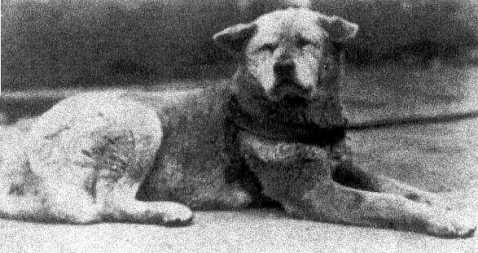
Take the example of the Japanese Akita dog called Hachi, (Hachikō in Japanese) that I wrote about almost a year ago.
In 1924, Hidesaburō Ueno, a professor in the agriculture department at theUniversity of Tokyo took in Hachikō as a pet. During his owner’s life Hachikō saw him out from the front door and greeted him at the end of the day at the nearby Shibuya Station. The pair continued their daily routine until May 1925, when Professor Ueno did not return on the usual train one evening. The professor had suffered from a cerebral hemorrhage at the university that day. He died and never returned to the train station where his friend was waiting. Hachikō was loyal and every day for the next nine years he waited sitting there amongst the town’s folk.
Hachikō 1925
“…. every day for the next nine years he waited sitting there amongst the town’s folk” Truly a sustainable relationship.
Now to something closer to home; literally.
The Payson Roundup is our local newspaper. Last Tuesday’s edition had the following story which Tom Brossart, Editor, has kindly given me written permission to reproduce here on Learning from Dogs. Thank you, Tom.
Best friends help save man’s life
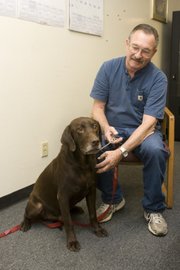
Both Logger and Harold Green are a little gray around the muzzle, but they have lots of good days ahead after Logger helped save Green’s life back on July 1.Photo by Andy Towle
Logger is Harold Green’s best friend. Logger isn’t a flannel-wearing, tattooed burly woodsman; he is a sweet-tempered chocolate Labrador retriever. And this best friend saved Green’s life.
Green makes his home up in Happy Jack. Recently he and Logger drove into the woods and went for a walk, and then Green had a heart attack. He didn’t have a history of heart disease, but all of a sudden his chest became tight. He collapsed and on his way to the ground, he hit a fallen log and wound up hitting his forehead and nose, tearing his bottom lip away from his gums, cutting his chin and breaking a rib.
“Right before I had the heart attack I had a page there was a fire, and that’s the last thing I remember,” he said. Green is an emergency medical technician with the Blue Ridge Fire Department.
He said the next thing he remembers was waking up and trying to call 911. “There was so much blood in my eyes I couldn’t see at first, but Logger licked the blood away.”
Green was conscious long enough to dial 911 and try to explain where he was. He heard the sirens go past him and with that information; the emergency responders had a place to start looking for him.
At that point, Logger left Green’s side to go to the rescue personnel.
“From what they told me, he was like Lassie. He came running to them, barking, and started running back to me, stopped and made sure they were following,” Green said.
The first person on the scene with him was a law enforcement officer with the Forest Service. Green said he told him his nose was bleeding so much he thought it was broken.
Next to arrive was a deputy sheriff. Green said he later learned the guy was off duty, but came to help anyway.
The Blue Ridge ambulance crew arrived next.
“Logger did the same with all of them as he had with the first one on the scene. They told me, without Logger’s help they would have had to search for me a lot longer.”
Green said when they first reached him his heart rate was in the mid-40s and he had no blood pressure. The rescue team stabilized him and carried him out to the ambulance to take him to the fire station where a helicopter could land.
“They said Logger tried to get into the ambulance with me,” Green said.
He said he has little or no memory of everything that took place, when he woke up he was in the hospital in Flagstaff.
Logger couldn’t ride in the ambulance with Green and couldn’t come see him in the hospital, but since he has been out, the dog has not been more than three feet from him for three weeks.
“It is really humbling to have so many friends there to help you out,” Green said.
The people who came to his rescue were all friends and, just like Logger, they did what best friends do, except it was something they do every day, for friends and strangers alike.
Logger has been part of Green’s family for seven years, joining it when he was just a puppy.
Green is the son of longtime Rim Country Realtor Bea Baxter, who has been in the community for around 40 years.
So dear, lovely Logger also demonstrated the same, deep sustainability of relationship that Hachikō did back in 1925. There is so much that we can learn from dogs. Think about sustainability, as it relates to the relationship between dogs and man. It goes back at least 30,000 years. It’s an unimaginable length of time.
In this context, sustainability is an underused word!
A recent item on the BBC website provides a welcome reminder of the power of the relationship between dogs and mankind.
Practically no-one is unaware of the role that dogs provide, for example, as guides for humans with sight impairment. But there’s much more to the ‘service’ dog than that.
A service dog might be described as,
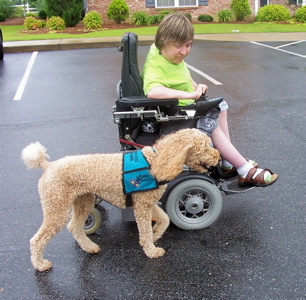
“any guide dog, signal dog, or other animal individually trained to do work or perform tasks for the benefit of an individual with a disability, including, but not limited to, guiding individuals with impaired vision, alerting individuals with impaired hearing to intruders or sounds, providing minimal protection or rescue work, pulling a wheelchair, or fetching dropped items.”
That definition is taken from the United States Code of Federal Regulations for the Americans with Disabilities Act of 1990!
Carrie and Lilly
But then cast your eye over this, as I mentioned, from the BBC on the 26th May, 2011.
Dogs can help reduce stress in parents of children with lifelong developmental disability autism, a study suggests.
The University of Lincoln compared 20 families with dogs with 20 without.
Daniel Mills told a Royal Society of Medicine conference early results suggested any breed could improve communication and relationships.
The veterinary behavioural medicine professor hopes to use video footage to show how dogs can improve child eating, sleeping and tantrum behaviour.
At a three-day Parents’ Autism Workshops and Support course, the families listed more than a thousand ways their dog had helped – from developing language and establishing a routine to using the pet to request action in a non-confrontational way.
Full story is here in which is included Professor Mills saying: “While there is no shortage of opinion on how dogs can help, there has been little money given to scientifically look into this.”
Autism is a challenging condition and anything that can establish a scientific underpinning for the role that dogs can have is to be welcomed whole-heartedly.
Finally, there are quite a few videos online that provide more information about the special, almost magical relationship between dogs and autistic people. Here’s one that is the first part of a series of five.
A chance email from Dan G. opens up a whole treasure trove.
Here’s what Dan sent to me,
True Friends
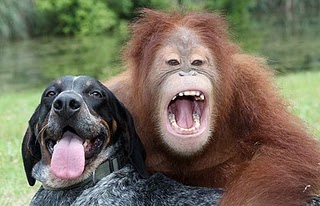
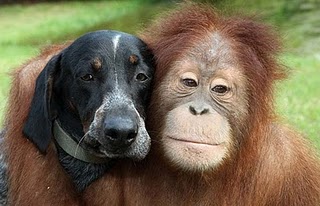
After losing his parents, this 3 year old orangutan was so depressed he wouldn’t eat and didn’t respond to any medical treatments. The veterinarians thought he would surely die from sadness. The zoo keepers found an old sick dog on the grounds in the park at the zoo where the orangutan lived and took the dog to the animal treatment center. The dog arrived at the same time the orangutan was there being treated. The 2 lost souls met and have been inseparable ever since.
The orangutan found a new reason to live and each always tries his best to be a good companion to his new found friend. They are together 24 hours a day in all their activities.
Roscoe and Surya
They live in Northern California where swimming is their favorite past time, although Roscoe (the orangutan) is a little afraid of the water and needs his friend’s help to swim.
Roscoe and SuryaRoscoe and Surya
Together they have discovered the joy and laughter in life and the value of friendship.
Roscoe and SuryaRoscoe and Surya
They have found more than a friendly shoulder to lean on.
Roscoe and SuryaLove across the species boundary
Long Live Friendship!!!!!!!
I don’t know……some say life is too short, others say it is too long, but I know that nothing that we do makes sense if we don’t touch the hearts of others…….while it lasts!
So after I had seen the pictures above, it was pretty easy to find this YouTube video.
Then if that wasn’t amazing and wonderful, try this,
Well that’s enough for today. But tomorrow, I will continue with Part Two which recounts the amazing year that Joe Hutto spent in the Florida wildlands with ….. (you’ll have to wait for tomorrow!)
More on how dogs adapt to challenges in their lives.
(As readers picked up from my closing comment in yesterday’s part of this story, technology has rather interfered with events. ‘Touch wood’ things appear to be back to normal!)
Yesterday’s article (thanks to Paul Gilding for the link) was about the stray dogs in Moscow. Before musing on the more general nature of how dogs survive as strays, there is a video on YouTube about these Muscovite dogs. Just over 7 minutes long, it further underlines the amazing adaptability of the domesticated dog when thrust into self-survival.
As regular readers of Learning from Dogs will know, before Jean and I met, Jean had spent a large part of her life rescuing dogs in the San Carlos area of Mexico, much of that with Suzann (who was instrumental in Jean and me meeting!). Indeed, when Jean and I moved up to Payson in February, 2010 we had with us, much to the amusement of the American border staff at the Nogales crossing, 12 dogs and 6 cats, all rescues except my German Shepherd dog, Pharaoh.
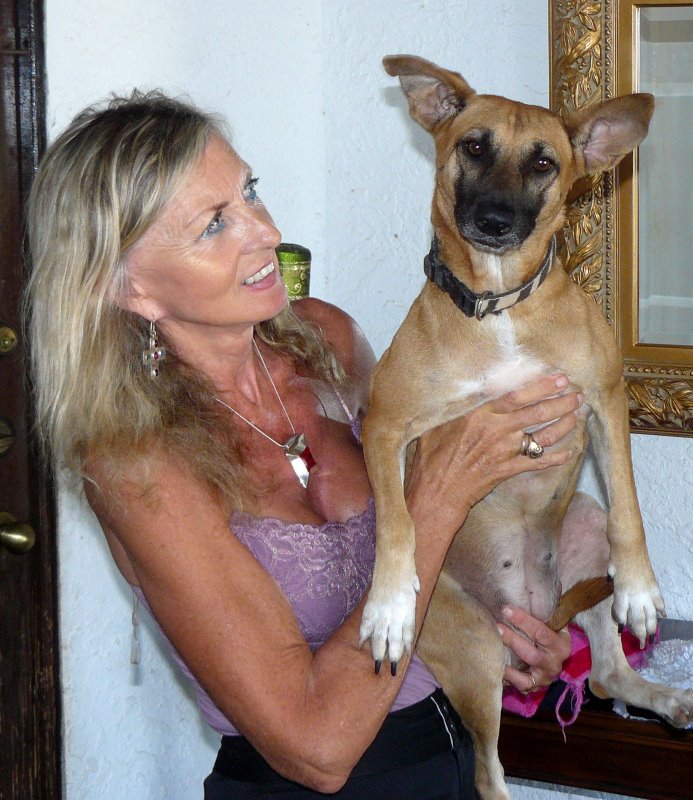
So Jean has lots of stories about how the far-too-many stray dogs in San Carlos developed strategies for staying alive. Dhalia, see story below, shows her feral habits when we go out for a walk in the forest by constantly looking for food, despite the fact that she is a well-fed, happy and contented dog. Jean recounts finding Dhalia,
It was in 2005, about three months after Ben died (Jean’s husband). I was driving out to the small Mexican fishing port of La Manga where there were many stray dogs. The aim was to feed them on a regular basis and hope that they would become sufficiently comfortable with my presence so that they could be caught, so that they may be spayed or neutered and then offered for adoption.
On the way there, I drove past a couple of dogs running alongside the highway. Dogs frequently did this looking for ‘road-kill’ that they could feed on. I stopped the car wanting to put out some food and water.
One of the dogs was so feral that it immediately took off into the bush. I turned around and the other dog was standing about ten feet away. It was cadaverous and obviously suffering from mange but cautiously came up to the food, sniffed carefully and then started to eat. That dog allowed me to pick it up and then sat quietly with me on the front seat of the car while I continued to La Manga. It sense immediately that it was safe and from that day has remained with me. I named her Dhalia.
Dhalia in Jean's arms, November 2008
Fast forward to today. Dhalia is one of Pharaoh’s group of dogs and is a sweet and loving animal.
Finally, a couple of other stories to give you a feeling about these rescue dogs. One from August 2009 about a dog called Lucky Lucy. The other about Corrie, both stories from Suzann.
Stray dogs demonstrate remarkable skills at staying alive.
Before I start, a big word of thanks to Paul Gilding who passed this story to me. Apart from reading Paul’s powerful book, The Great Disruption, and exchanging a couple of emails, he doesn’t know me from Adam. But the fact that this undoubtedly busy man (his book has been a great success) not only responded to an earlier email from me and then dropped me a note to say that I might enjoy the following article, says a great deal about the integrity of the person.
The article, from the website The Dog Files, is about Moscow’s stray dogs. I’m taking the liberty of reproducing it in full.
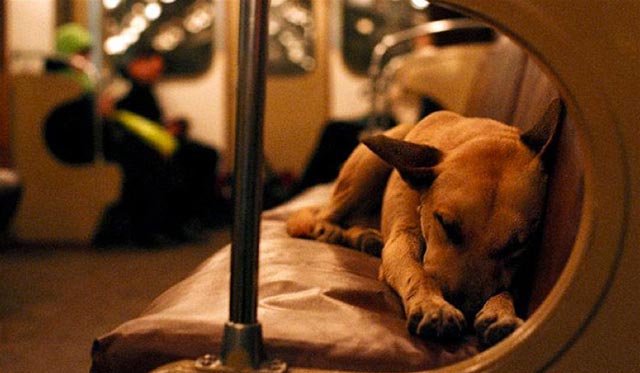
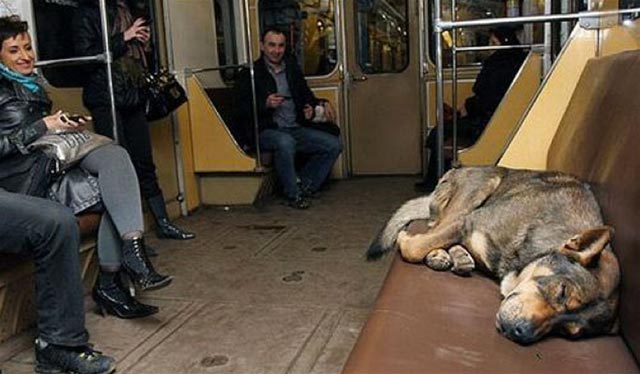
Each morning, like clockwork, they board the subway, off to begin their daily routine amidst the hustle and bustle of the city.
But these aren’t just any daily commuters. These are stray dogs who live in the outskirts of Moscow Russia and commute on the underground trains to and from the city centre in search of food scraps.
Then after a hard day scavenging and begging on the streets, they hop back on the train and return to the suburbs where they spend the night.
Experts studying the dogs, who usually choose the quietest carriages at the front and back of the train, say they even work together to make sure they get off at the right stop – after learning to judge the length of time they need to spend on the train.
Scientists believe this phenomenon began after the Soviet Union collapsed in the 1990s, and Russia’s new capitalists moved industrial complexes from the city centre to the suburbs.
Dr Andrei Poiarkov, of the Moscow Ecology and Evolution Institute, said: “These complexes were used by homeless dogs as shelters, so the dogs had to move together with their houses. Because the best scavenging for food is in the city centre, the dogs had to learn how to travel on the subway – to get to the centre in the morning, then back home in the evening, just like people.”
Dr Poiarkov told how the dogs like to play during their daily commute. He said: “They jump on the train seconds before the doors shut, risking their tails getting jammed. They do it for fun. And sometimes they fall asleep and get off at the wrong stop.”
The dogs have also amazingly learned to use traffic lights to cross the road safely, said Dr Poiarkov. And they use cunning tactics to obtain tasty morsels of shawarma, a kebab-like snack popular in Moscow.
With children the dogs “play cute” by putting their heads on youngsters’ knees and staring pleadingly into their eyes to win sympathy – and scraps.
Dr Poiarkov added: “Dogs are surprisingly good psychologists.”
Now had this been a normal day then I would have had the time to complete this story about the tenacity of dogs. But a failed wireless modem earlier today (Thursday) meant the loss of too many hours fighting technology. It was all sorted just a little before 5pm. It is now 6.15 pm and dinner is ready and, frankly, my brain is too tired to continue.
So stay with this fascinating story about stray dogs as I continue it tomorrow (Saturday, 20th.).
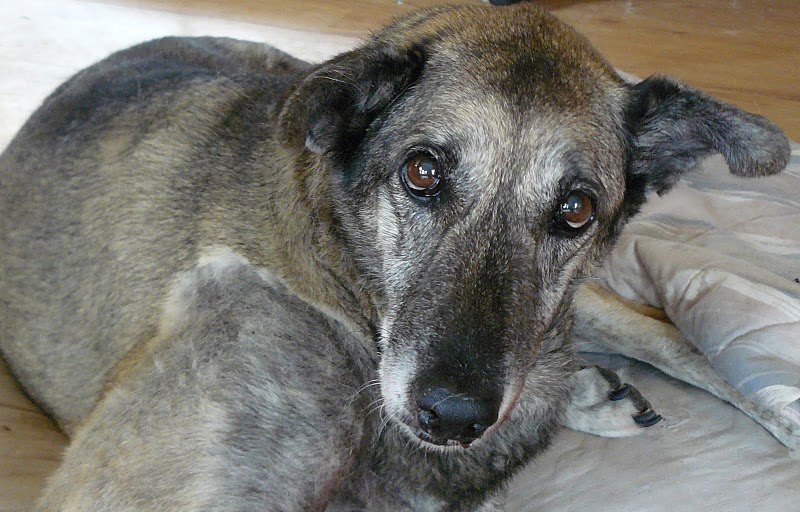
Over a couple of months ago, Tess was diagnosed with bone cancer, in the shoulder joint of her right front leg. The vet thought that she might have only a very few weeks to live, this particular form of cancer being aggressive.
As it happened, Tess kept going for much, much longer. But this morning (Wednesday at the time of writing) Jean made the agonising decision to end the pain for Tess. Despite a daily dose of strong pain-killer tablets, this morning Tess was breathing more laboriously and showing clear signs of tiring. It was time.
For me it was the first time that I had been with a loved animal that had to be euthanised and it was hard.
A few pictures to keep her memory alive.
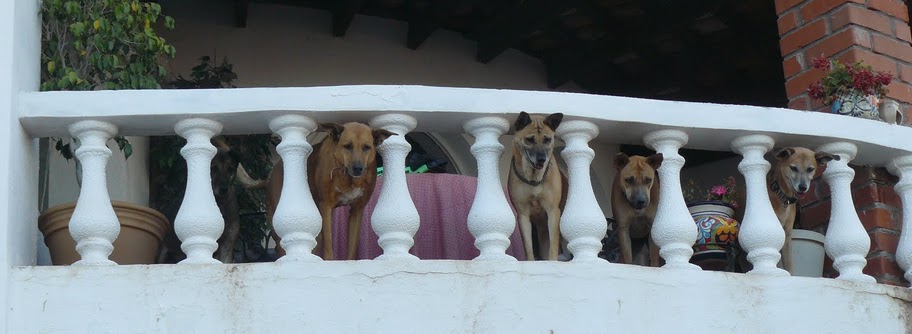
Tess, far left (next to the plant pot), and friendsJean & Tess, a few moments before leaving.Dear Tess, you are out of pain and at peace.
Let me close with the same poem that was published when we lost our little Poppy,
“There is one best place to bury a dog.
“If you bury him in this spot, he will
come to you when you call – come to you
over the grim, dim frontier of death,
and down the well-remembered path,
and to your side again.
“And though you call a dozen living
dogs to heel, they shall not growl at
him, nor resent his coming,
for he belongs there.
“People may scoff at you, who see
no lightest blade of grass bent by his
footfall, who hear no whimper, people
who may never really have had a dog.
Smile at them, for you shall know
something that is hidden from them,
and which is well worth the knowing.
“The one best place to bury a good
dog is in the heart of his master.”
Ben Hur Lampman —
from the Portland Oregonian Sept. 11, 1925
Author Sue Miller perfectly articulates our relationship with dogs and cats.
As a rest to the number of non-fiction books that I have been reading over the past few months, Jean recommended a novel she recently finished, While I Was Gone, by Sue Miller. It’s featured on Oprah’s Book Club, from which I quote,
About the Book
A decade ago she put a face on every mother’s worst nightmare with her phenomenal best-seller The Good Mother. Now, Sue Miller delivers a spellbinding novel of love and betrayal that explores what it means to be a good wife.
In the summer of 1968, Jo Becker ran out on the marriage and the life her parents wanted for her, and escaped–for one beautiful, idyllic year–into a life that was bohemian and romantic, living under an assumed name in a rambling group house in Cambridge. It was a time of limitless possibility, but it ended in a single instant when Jo returned home one night to find her best friend lying dead in a pool of blood on the living room floor.
Now Jo has everything she’s ever wanted: a veterinary practice she loves, a devoted husband, three grown daughters, a beautiful Massachusetts farmhouse. And if occasionally she feels a stranger to herself and wonders what happened to the freedom she once felt, or how she came to be the wife, mother, and doctor her neighbors know and trust–if at times she feels as if her whole life is vanishing behind her as she’s living it–she need only look at her daughters or her husband, Daniel, to recall the satisfactions of family and community and marriage.
But when an old housemate settles in her small town, the fabric of Jo’s life begins to unravel: seduced again by the enticing possibility of another self and another life, she begins a dangerous flirtation that returns her to the darkest moment of her past and imperils all she loves.
While I Was Gone is an exquisitely suspenseful novel about how quickly and casually a marriage can be destroyed, how a good wife can find herself placing all she holds dear at risk. In expert strokes, Sue Miller captures the precariousness of even the strongest ties, the ease with which we abandon each other, and our need to be forgiven. An extraordinary book, her best, from a beloved American writer.
Have to say that even though there’s an obvious gender difference between me, the heroine and the author, I found the book tough reading , as in emotional, from time to time. Especially, the euthanasia of Arthur the dog towards the end of Chapter 7 – Jo is a vet. A few paragraphs I just couldn’t read . But then on page 137 in Chapter 8, comes this,
Pure bliss.
I stood in the center of the yard for a moment and tilted my head back to let the soft snow touch my face. The dogs pranced and rolled for pure joy in the pale, gray-brown light. They chased each other wildly. I made snowballs and threw them; the dogs leapt and bit at where they’d disappeared. As they played, their muzzles whitened, their paws pilled up.
I left them reluctantly and came back in. Watson trailed me around as I did my chores, watching me soberly. I shut him out of the cat room, where we had only two boarders. I let one of them out to roam and use the litter pan while I checked its cage. I put more food down. Then I went back out and worked my way through the dogs’ cages. Two of them had had accidents, so I cleaned up and changed their bedding. Several of them had their own food, in cans – those dishes needed to be washed. Water refreshed, kibbles set out for the others.
I went to the cat room, put the first cat back and let the other one out. Then I called the reluctant dogs in. Watson greeted each one like a tiny worried mother, licking at their snow, fussing about how they smelled. Slowly I recaged them. I released Lucky and let him go outside for his solitary run while I refilled his food and water dishes. Three dogs needed medications. I put the last cat back in, called Lucky inside, locked up.
And while I did all this, I thought only of them, of the dogs and cats, of their requests for affection, of their comical or passionate relationships to one another, of the performance of their bodily functions. I was taken up by them and their life and energy, by what they needed and asked of me. I let go of everything difficult or complex in my life.
It reminded me of my days at Dr. Moran’s, caring for the dogs and cats he boarded and treated. It reminded me of what a comfort it had been to me, even just physical escape into the lives of animals. As I was driving home, I thought of all this, and it seemed to me that I’d chosen work which offered me daily the presence of pure innocence, a forgiveness for all my human flaws.
the presence of pure innocence, a forgiveness for all my human flaws Impossible to add anything; so I won’t!
A passing visit to the American biologist, E. O. Wilson
E O Wilson
Edward Osborne Wilson was born in June 1929 thus making him, at this time of writing, just into his 82 year. His biological specialty is myrmecology. Got that? Myrmecology. And if you, like me, didn’t have a clue as to what myrmecology is and had to look it up, it is the study of ants. Blow me down, there is even a myrmecology blogsite!
So where is this all heading?
One of the things that we do know about dogs, especially if we go way back into the dim and distant times when they behaved more like the grey wolf, from which the species ‘dog’ genetically originates 100,000 years ago, is that their social order, their pack behaviour, was highly stable. As an aside, when Jean was rescuing dogs in San Carlos, Mexico during the years that she lived there with her late husband she readily observed that the stray dogs, of which there were too many, had a natural propensity to group up into their historic pack formations. (And as an aside to my aside, Jean’s close friend of many years, Dan’s sister Suzann, today carries on the splendid work of looking after stray dogs from her San Carlos house!)
OK, back to the plot!
E O Wilson’s study of ants has revealed much about social order and organisation. The following YouTube video was from a PBS programme, aired in May, 2008, from which I quote (that is the PBS website),
Program Description
At age 78, E.O. Wilson is still going through his “little savage” phase of boyhood exploration of the natural world. In “Lord of the Ants,” NOVA profiles this soft-spoken Southerner and Harvard professor, who is an acclaimed advocate for ants, biological diversity, and the controversial extension of Darwinian ideas to human society.
Actor and environmentalist Harrison Ford narrates this engaging portrait of a ceaselessly active scientist and eloquent writer, who has accumulated two Pulitzer Prizes among his many other honors. Says fellow naturalist David Attenborough: “He will go down as the man who opened the eyes of millions ’round the world to the glories, the values, the importance of—to use his term—biodiversity.”
It’s a fascinating film, truly engaging, so do settle down for a relaxing 53 minutes and watch,
Now there’s more to this and I do want to continue with the theme of this Post tomorrow.
So for now, look in on the E O Wilson Biodiversity Foundation’s website and I’ll see you tomorrow.
Underlining what 30,000 years of domestication produces!
This video, just under 6 minutes long, may well be ‘old news’ to many dog owners but still very much worth a viewing.
Scamp
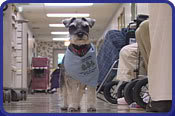
And while I think about, if you didn’t see the video about Scamp and his ability to identify, and then comfort, humans very close to death, when it first appeared on Learning from Dogs, then do drop back to here and watch it. It’s from the Extraordinary Animals series from Channel Five on British television and just 22 minutes long.







 Learning from Dogs