That’s Life was a very long-running programme on BBC TV in the UK. As Wikipedia writes, “That’s Life! was a magazine-style television series on BBC1 between 26 May 1973 and 19 June 1994, presented by Esther Rantzen throughout the entire run, with various changes of co-presenters.”
I had just about forgotten this silly item presented on That’s Life back in 1986 but thanks to fellow Brit, Dusty M. living here in Payson, it has re-surfaced.
Still fun to watch some 25 years later. (Can’t explain why this YouTube video has Dutch subtitling!)
And for those that enjoy sentimental recollections, the video below is the last few minutes from the very last programme on the 19th June, 1994.
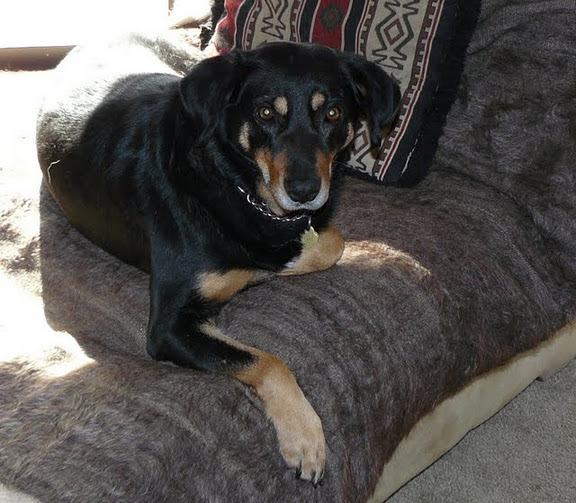
This is Hazel. She is one of three dogs that ‘belong’ to Pharaoh.
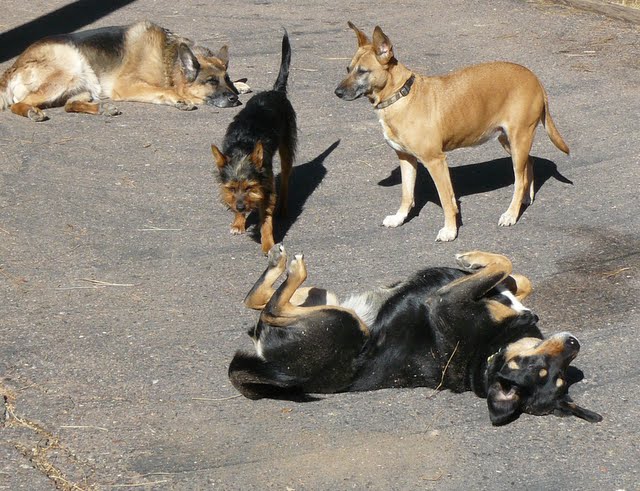
Last Tuesday, we took Pharaoh and his mini-pack of 3 dogs out for our usual afternoon walk at the very end of Granite Dells Rd, out where the forest road ends and soon becomes the relative wilderness of the Tonto National Forest.
Pharaoh, and Hazel, Dhalia and little Sweeny.
However, on this occasion Hazel decided to leave us and link up with a stranger who was hiking the forest. That was the last we saw of Hazel for many hours. Miracle of miracles, the stranger, Joanie, was a dog-lover so when Hazel had followed Joanie and her dog all the way to Joanie’s car, the next stop for her, Hazel that is, was our local Payson Humane Center. Hazel’s tag very quickly linked her to Jean (a great reminder of the importance of tagging your dogs!) who is well-known as a volunteer assistant at the Humane Society Thrift store and the scare was over.
But during the hours of tramping those miles along challenging forest tracks, calling out Hazel’s name, both Jeannie and I had plenty of time to hurt. Here’s a small insight, that millions of pet owners will resonate with, that demonstrates the way that dogs offer us so much love which, in turn, opens our human hearts to the purity of unconditional love. (And I know it’s not just dogs but many animals in our lives that offer us such love!)
Pharaoh and his ‘team’ sleep in our bedroom. During the Winter months Hazel will often lay stretched out on the bed-cover alongside the back of my legs. If I need a trip to the bathroom during the night, not unknown at my age, I can almost guarantee that Hazel will shift her cuddly body up to the warm sheets just below my pillow.
Thus it was this last Tuesday morning when I returned from my bathroom run about 3am; Hazel asleep with her head on my pillow! I didn’t have the heart to push her off the bed, so just slipped in beside her and moments later back asleep, my head nestled against Hazel’s warm head. Sleeping so close to a dog is more than just nice, it seems to stir very ancient memories deep in the subconscious, perhaps back all those thousands of years to when domesticated dogs were an integral part of early man’s security.
So you can imagine the anguish that, in our own separate minds, Jeannie and I were experiencing. I just couldn’t go to the place where never again would I feel the warmth of Hazel’s body against mine. Jean was desperately hoping this wasn’t a tragic repeat of losing Poppy. Thus when I went round to the Humane Center just as they were closing up and Hazel came out to me, I dissolved in sobs of relief.
That’s the heart-felt closeness of dogs and humans.
Join the One In A Million Movement to End Puppy Mills!
Take another quick look at the emotions that dogs bring out in so many of us. I’m referring to the piece I posted last Sunday under the title of The logic of dogs. However, there’s a darker side to owning a dog, or more accurately, a puppy.
A quick search for ‘puppy mills’ on Google or YouTube will come up with more anguish than I suspect you can handle. Here’s just one website that offers some facts about the commercial breeding of puppies.
Here’s a 2-minute video to underline the importance of this cause.
But thanks to an email sent to me from Diane M, here in Payson, there’s something that can be done.
Here’s the email that was sent.
Dear Friends and Family,
I’m sending this to you because of your concern for pets. Dan Morrison, my friend and ex-husband, has been an advocate for years for animals. I received the information below regarding another way to protect those animals who cannot speak for themselves.
Please take a minute and read the important message below. Please know that Dan Morrison along with Marlene Walsh are the co-founders of Pet Connections. Dan is also the President of the Board. Check out the website!
In addition, do you have friends who love animals and are understanding and empathize with the message below? If so, please take a couple minutes and forward this message to them. Dan, Marlene and I will greatly appreciate your effort.
Happy New Year, Everyone!
Diane
And now what follows is the information that Diane received and then circulated,
Sent: Friday, December 09, 2011 6:14 AM Subject: Join the One In A Million Movement to End Puppy Mills!
There is a new movement underway to permanently put an end to the puppy mill industry by ending all demand for these puppies. And Pet Connections, Inc. believes in the power of people to do this, one person at a time.
Just this week, the Pet Connections’ website (www.pet-connections.org) went live with its new “One In A Million” campaign, where the public is being asked to sign a pledge stating that they will not purchase or supportthe purchase of puppies, dogs, cats or kittens that come from “puppy mills” or indiscriminate breeders.
A puppy mill or kitten mill, sometimes known as a farm, is a commercial breeding facility that is operated with an emphasis upon profits above animal welfare and often hundreds of animals are kept in substandard conditions with little regard to the well-being of animals under their control.
Instead, the pledge asks the public to patronize animal shelters, humane societies, or “humane” pet stores who offer only shelter/rescue puppies, dogs, cats or kittens. Pet Connections’ goal is to collect one million names to present to the governors and legislators of states who harbor puppy or kitten mills because of lax or unenforced laws and to our congressmen and senators telling them that the people have spoken! This cruel and inhumane industry must end.
Pet Connections will work with any pet store who believes that their only source of animals are mills or farms and “convert” them to using animal shelters, humane societies or rescue groups as a source for their animals.
I am hoping that you will go to our pledge page (www.pet-connections.org/pledge/pledge.php) and sign the pledge, and then share it with your family, friends, colleagues, other organizations, newsletters – everything you can think of to help us get the word out and make a big enough impact to make a difference.
Pet Connections believes people can make a difference . . . one person at a time. I know that with your help we will make a difference.
So it’s just a moment to go here and sign the pledge – PLEASE! Why? Well, I can’t put it better than as conveyed in the thank-you email response you will receive,
Change will happen because you took the Pledge. Thank you for becoming ONE IN A MILLION and supporting the efforts of Pet Connections, Inc. We are dedicated to ending the practice of selling puppies bred in puppy mills and sold in pet shops. This is an intolerable practice and must end. By Pledging, you join a cause whereby numbers create the power for change.
Would you like to help Pet Connections, Inc., reach our goal of ONE IN A MILLION? Share the message by any means you can. Tell your friends, family and neighbors about the importance of Pledging. Convince your Facebook and Twitter friends to Pledge to become ONE IN A MILLION athttp://www.pet-connections.org/pledge/pledge.php. Watch the tote board change with each Pledge you influence.
Pet Connections, Inc., is grateful for contributions to help in our goal of ONE IN A MILLION. It is up to each and every one of us to take responsibility to end the practice of breeding and selling puppy mill puppies. It is the humane thing to do.
Now let me close with this video that shows the power that can flow from love as opposed to greed.
NEVER BUY A PUPPY FROM A PET STORE!!!
All three parts combined into one! Created in 2002, “I’m Alive For The Very First Time” tells the story of how two puppy mill rescue dogs forever changed the lives of their adoptive parents, Kathleen and Scottie.
We are what we eat! A sobering assessment of the food industry this Friday, the 13th!
This saying, which has been around for some time, reminds us that the foods we eat break down into elements that our bodies absorb. What we eat literally becomes part of us, and not just us humans but our dogs and cats as well. That’s why I haven’t differentiated between us humans and our pets in this Post.
Let’s start off with our pets.
On the 28th December, just a couple of weeks ago, I wrote an article about the possible harm to dogs from Jerky treats coming in to the USA from China. Kenneth Bryant of TriPom Chews added a comment that included a link to a news story about 353 dogs possibly being made sick. Since then he and I have been in email correspondence including Ken passing the web address of Susan Thixton’s website Truth about Pet Food. If you have a pet, go to this website!
I’m sure Susan wouldn’t mind me giving you a flavour (pardon the pun!) of what she has on this important website. Try this.
Is there Chicken in Chicken Pet Foods?
One of the newest trends of pet food marketing is a tag line something like ‘Chicken is the first ingredient’. Sounds good doesn’t it? Chicken, first or second on the ingredient list surely means this pet food contains lots of quality meat doesn’t it? No wonder this ‘chicken’ pet food is a little more expensive – it contains more meat. Right? Maybe not.
Just because petsumers think meat when the ingredient ‘chicken’ is listed on a label, doesn’t mean the pet food actually contains chicken meat. Pet food can have a very different definition of ‘chicken’. Thanks to very broad Association of American Feed Control Officials (AAFCO) ingredient definitions, the ingredient ‘chicken’ listed on a pet food label could be nothing more than skin, bone, cartilage, and maybe a few tiny fragments of meat.
Here is the AAFCO definition of poultry (quoting the 2011 AAFCO Official Publication): “Poultry is the clean combination of flesh and skin with or without accompanying bone, derived from the parts or whole carcasses of poultry or a combination thereof, exclusive of feathers, heads, feet and entrails. It shall be suitable for use in animal food. If it bears a name descriptive of its kind, it must correspond thereto.”
Problems with this pet food ingredient definition…
#1 This ingredient (which includes all types of poultry including chicken) can be “a combination thereof” of any part of poultry. This means that a pet food, proudly claiming Chicken as the #1 ingredient, can include ONLY chicken bones and/or skin (left over from the human food industry).
#2 “It shall be suitable for use in animal food” means that animals rejected for use in human food for reasons including (but not limited to) disease and drug residues are approved for use in pet food. This we can thank the FDA for. Federal Food Safety Laws should make it illegal for pet food to include whole or parts of diseased or rejected animals, but FDA Compliance Policies tell pet food it is acceptable to use diseased and drugged animals in pet food [My emboldening, PH.] (“it shall be suitable for use in animal food”).
Chicken Meal/Poultry Meal is very similarly defined – except ‘meal’ implies moisture removed. However the very same end result can apply – the meal can consist of little more than skin and bones — no meat.
Other pet food meat ingredient definitions are a bit more descriptive, however all meat pet food ingredient definitions include the “it shall be suitable for use in animal food” disclaimer. Thus any pet food meat ingredient – thanks to FDA Compliance Policies and AAFCO ingredient definitions – can be the same quality as human meats or can be sourced from diseased, rejected animals. But, regulations do NOT provide petsumers with a means to determine which is which.
Read the rest of this article on Susan’s website. Even better subscribe to her newsletters.
I could go on and on but will close this section by saying ‘thanks’ to Ken of TriPom for providing this awareness of what we all may be feeding our beloved cats and dogs.
So, humans next!
Just a few days ago there was an article on The Atlantic magazine website about The Very Real Danger of Genetically Modified Foods. It’s a detailed article that, nonetheless, needs to be read by the widest possible audience. Here are some extracts,
Chinese researchers have found small pieces of ribonucleic acid (RNA) in the blood and organs of humans who eat rice. The Nanjing University-based team showed that this genetic material will bind to proteins in human liver cells and influence the uptake of cholesterol from the blood.
The type of RNA in question is called microRNA, due to its small size. MicroRNAs have been studied extensively since their discovery ten years ago, and have been linked to human diseases including cancer, Alzheimer’s, and diabetes. The Chinese research provides the first example of ingested plant microRNA surviving digestion and influencing human cell function.
Should the research survive scientific scrutiny, it could prove a game changer in many fields. It would mean that we’re eating not just vitamins, protein, and fuel, but information as well.
Later on the article says,
Monsanto’s claim that human toxicology tests are unwarranted is based on the doctrine of “substantial equivalence.” This term is used around the world as the basis of regulations designed to facilitate the rapid commercialization of genetically engineered foods, by sparing them from extensive safety testing.
According to substantial equivalence, comparisons between GM and non-GM crops need only investigate the end products of DNA translation: the pizza, as it were. “There is no need to test the safety of DNA introduced into GM crops. DNA (and resulting RNA) is present in almost all foods,” Monsanto’s website reads. “DNA is non-toxic and the presence of DNA, in and of itself, presents no hazard.”
The Chinese RNA study threatens to blast a major hole in that claim. It means that DNA can code for microRNA, which can, in fact, be hazardous.
And the closing two paragraphs,
The OECD’s 34 member nations could be described as largely rich, white, developed, and sympathetic to big business. The group’s current mission is to spread economic development to the rest of the world. And while that mission has yet to be accomplished, OECD has helped Monsanto spread substantial equivalence to the rest of the world, selling a lot of GM seed along the way.
The news that we’re ingesting information as well as physical material should force the biotech industry to confront the possibility that new DNA can have dangerous implications far beyond the products it codes for. Can we count on the biotech industry to accept the notion that more testing is necessary? Not if such action is perceived as a threat to the bottom line.
Please read the whole article as my extracts do not give justice to the importance of these findings.
Finally, let me turn to a recent item on the BBC website about the decline of brain function from as soon as age 45! (I’m 67!) The item starts,
The brain’s ability to function can start to deteriorate as early as 45, suggests a study in the British Medical Journal.
University College London researchers found a 3.6% decline in mental reasoning in women and men aged 45-49.
What caught my eye were these concluding paragraphs,
Dr Simon Ridley, head of research at Alzheimer’s Research UK, said he wanted to see similar studies carried out in a wider population sample.
He added: “Previous research suggests that our health in mid-life affects our risk of dementia as we age, and these findings give us all an extra reason to stick to our New Year’s resolutions.
“Although we don’t yet have a sure-fire way to prevent dementia, we do know that simple lifestyle changes – such as eating a healthy diet, not smoking, and keeping blood pressure and cholesterol in check – can all reduce the risk of dementia.”
Professor Lindsey Davies, president of the Faculty of Public Health, said that people should not wait until their bodies and minds broke down before taking action.
“We need only look at the problems that childhood obesity rates will cause if they are not addressed to see how important it is that we take ‘cradle to grave’ approach to public health.”
Let me repeat this sentence, “we do know that simple lifestyle changes – such as eating a healthy diet, not smoking, and keeping blood pressure and cholesterol in check – can all reduce the risk of dementia.”
Understanding what food is healthy for us and our animals ought to be straightforward. But it’s not, when one understands the terrible lack of integrity in the industries that make our food!
Way back before I came into Jean’s life, or perhaps I should expand on that by saying way before Pharaoh and I came into the life of Jean, her 12 dogs and 6 cats, Jean had come across a feral litter of pups.
This was in 1998 when Jean was living with her husband, Ben, in San Carlos, Sonora State, Mexico. Jean had already been rescuing feral dogs for a number of years. This litter of four puppies had been born underneath a trailer parked on a dirt road near Ben and Jean’s house. They were all cute, healthy little pups and Jean quickly found homes for three of them. However, the fourth had ended up being taken in by Jean and Ben and named Sammy.
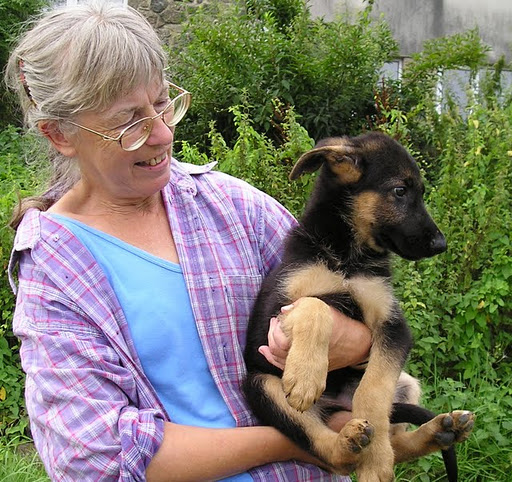
The picture below shows Jean holding Sammy when she was around 3 months old.
Jean and Sammy
Thus, as it does for all of us, time passed to the point where last Friday, Sammy’s back legs had become so arthritic that she was unable to walk without a great deal of pain and, at the grand old age of 13 1/2, it was time for her to go to that big dog prairie in the sky.
Sammy, January 6th 2012 - now forever out of pain.
For Jean especially, this was a tough loss as Ben had loved Sammy so much. Sammy was the most sweet and gentle of dogs. I know that all of you who have had experience of putting a dog or cat to sleep will share the angst that Jean endured last Friday.
Thank you Sammy for being such a loving animal throughout your entire life.
We had to put one of our dogs to sleep on Friday, not a GSD, but one of Jean’s rescued dogs from way back. At this moment in time (11am US Mountain Time, Saturday) I’m writing a piece about this wonderful dog that will appear tomorrow.
Thus not in the mood to post my usual light-hearted item for a Sunday. So I resorted to looking up an appropriate dog video on YouTube.
Came across this,
Of course, that reminded me of how precious our Pharaoh is and it only took a few moments to find a couple of earlier pics of him.
Here’s Pharaoh the day I collected him from GSD breeders Jutone‘s in Dartmoor, SW England. That’s Sandra Tucker, the owner of Jutone, with Pharaoh; the date being 12th August 2003 when Pharaoh was then just over 8 weeks old.
Sandra Tucker holding young Pharaoh
The next photograph was taken on the 11th March, 2008 at London’s Heathrow Airport. The occasion being the time that Jean came across to England from her home in Mexico. Jean came to see if the romance that had blossomed between us at Christmas in 2007 in San Carlos, Mexico was alive and well. Luckily, it was!
Jean meeting Pharaoh for the very first time!
Thus it came to pass that in September, 2008, Pharaoh and I travelled out from Devon, England to Mexico where we lived until February, 2010, when Jean and I, Pharaoh and 12 other dogs and 6 cats relocated to Payson, Arizona.
Something new for the New Year – stories about dogs!
Preface.
Before I met Jean in December 2007, she had been rescuing feral dogs in the Mexican beach town of San Carlos for many, many years. Over those years, Jean must have rescued and found homes for 60 dogs or more. In the month that I met Jean, she had 12 dogs and 6 cats at her home. Ten months later, September 2008, I flew out to be permanently with Jean with my German Shepherd, Pharaoh – that’s him on the home page of Learning from Dogs – taking the total up to 13 dogs.
When we moved up to Payson, Arizona in February, 2010 we brought all 13 dogs and 6 cats with us, much to the amazement of the US Immigration officers at the US-Mexican border town of Nogales! Indeed, our particular officer left his booth excitedly to explain to his colleagues that our dogs and cats represented a border crossing record!
So many of the dogs that have passed through Jean’s loving arms have stories to tell. Thus over the coming months, Jean and I will offer you, dear reader, those stories.
Here’s the first, written by ‘Dog Lady’ Jean about gorgeous, sweet Paloma who, despite her age (Paloma that is!), is alive and well here in Payson.
* * * * * * * * * * *
Paloma, December 29th 2011
Paloma
The old white dog padded down the dusty pavement. Sway-backed and dull-eyed, her teats, heavy with milk, grazed the ground. An anonymous creature in a cruel world. The pavement sizzled in the afternoon Mexican summer sun blistering her tired feet, but she could not hurry. She had to conserve her energy. Her pups were soon coming and finding a safe place to give birth to them was her priority. The beach that had been her home was not a good place. .. needed cool shelter. She would find it.
She was alone among a sea of human legs in this scruffy Mexican beach town. No-one noticed her plight. No-one cared. She was used to it. She had long been adept at finding dried fish, discarded tortillas, sometimes a tasty morsel thrown by a tourist sunning in front of the big hotel.
This would be her eighth litter and she was very tired. As a puppy she belonged to a family with small children. There were plenty of leftovers. But when she became pregnant they drove her to the beach, threw her out and left her to fend for herself.
Her babies were always beautiful. She had Labrador in her genes donating a coat that was pure white. Humans always took her pups; she could only ever hope their fate was always a better one than hers.
Anonymity. She had perfected the art; never make eye contact, move low to the ground, escape the stray kick with a quick sideways leap.
She remembered at the very end of the long beach there was a house with a pool. Plenty of water. Onward she padded.
The lawn surrounding the pool was moist with sprinklers and the hibiscus hedge close to the house made a safe nest. Soon she had dug into the damp earth a big enough hole to curl into; it was cool under the canopy of red flowers.
A human voiced shouted, “Carlos, get that dog out of the hedge.” Then the long hose filling that tempting pool was turned on her and a burst of water hit her in the face. She uttered a low growl. Carlos, the gardener, backed away, “Señor, the dog, she is having babies.”
The owner of the house turned abruptly and went inside. He picked up his phone, made a call to the local English lady who over the years had acquired the nickname ‘Dog Lady’. He practically shouted down the phone, “I have a dog in my hedge having pups. You had better do something about it or I shall dispose of them, and I won’t be pretty about it!”
‘Dog Lady’ was used to this. Had been many years since she took on the practically impossible task of rescuing Mexican feral dogs and she was well-known for never turning a dog away. In less than 15 minutes, she had walked to the fine house overlooking the beach and quietly looked under the hedge. As anticipated, the dog was incapable of being moved, her focus entirely now on the safe birth of her pups. With appropriate feminine wiles, the white dog’s human saviour persuaded the disgruntled owner to allow the mother dog a stay of a few days. ‘Dog Lady’ promised that she would take them away as soon as possible.
“She’s a mean and wild dog, you’ll never tame her,” came the angry response from the house owner.
‘Dog Lady’ just smiled and said nothing.
But every day she took food to the white dog then sat quietly close by on the grass reading her book. The white dog had just the one pup, which ‘Dog Lady’ called Solovino, the Spanish for ‘comes alone’. The mother dog she called Paloma, Spanish for ‘Dove’. Many white dogs in Mexico were called Paloma and maybe years earlier that was what the children named her as the name did seem to resonate with this gentle dog.
Patiently, ‘Dog Lady’ moved closer and closer until Paloma would take meat from her hand, rapidly followed by allowing her ears to be caressed. Ten days later, while Paloma was eating, ‘Dog Lady’ picked up the little Solovino and put him into her car. Paloma’s response was immediate; she frantically ran to her child, her mothering instinct so great that she leapt without hesitation into this strange vehicle. Paloma and Solovino were safe.
The house owner graciously admitted that he had been taught a lesson in empathy and how sorry he was for being so rude and cruel.
Back at ‘Dog Lady’s’ home, a quiet sanctuary for so many dogs over the past years, Paloma and Solovino were quickly settled into a cool room. Paloma soon utterly trusted her ‘Dog Lady’ human companion and became the tame and loving dog she always wanted to be. Her shining eyes embraced her new world and she even regained her figure! Solovino grew quickly and found a wonderful family home in Tucson, Arizona.
Now some 6 years after ‘Dog Lady’ rescued Paloma from under that hedge, she is a beloved part of the Handover family. Indeed, she travelled in peace in February 2009 with her twelve dog friends from her sanctuary in San Carlos, Mexico to this dog paradise in the Arizonan forest just outside Payson.
This important information came to hand an hour ago.
Stephanie from our local Payson Humane Society Thrift Shop sent me and Jean an email a short while ago. While the potential issue goes back to 2007 that is no reason not to keep this in mind when it comes to what commercial treats you give your dog. Indeed, the US FDA updated their recall information only last November.
Please circulate this to all dog owners that you know.
Jerky treats from China could be causing illness in pets
The AVMA staff has been in communication with veterinarians who believe certain brands of jerky treats from China could be causing illness in pets. Signs of illness have included vomiting, lethargy, and anorexia.
The Food and Drug Administration is aware of consumer complaints relevant to chicken jerky for dogs. Laura Alvey, director of the communications staff at the FDA Center for Veterinary Medicine, said the agency is actively investigating the situation.
Alvey said the FDA has analyzed products for multiple microbiologic and chemical contaminants, but the agency had not detected any contaminants as of Sept. 14.
Wal-Mart pulled a type of chicken jerky for pets off store shelves July 26 after receiving complaints about the product, manufactured by both Import-Pingyang Pet Product Co. and Shanghai Bestro Trading. A laboratory that tested the jerky product reported finding low concentrations of melamine, one of the contaminants that led to massive recalls of pet food earlier this year.
Alvey said the FDA has reviewed the laboratory report, which found 20 ppm of melamine in one sample. The agency has not been able to verify the finding. Alvey added that the FDA would not expect the low concentration of melamine to result in any illness.
Dr. Richard Goldstein, an associate professor of small animal medicine at Cornell University College of Veterinary Medicine, has been collecting data on cases of pets that became ill after ingesting jerky treats from China. He is the primary author of an informational document available on the Web site of the American College of Veterinary Internal Medicine, www.acvim.org.
According to the document, ACVIM diplomates who work in nephrology and urology became aware of an unusual number of dogs with similar presenting complaints and clinicopathologic testing results in association with the ingestion of various brands of jerky treats, mostly chicken jerky. The dogs are typically small and have a history of vomiting, lethargy, and anorexia.
Blood chemistry in many cases has revealed hypokalemia and a mild increase in liver enzymes. Blood gas analysis indicates acidosis. Urinalysis has consistently shown glucosuria and granular casts. The findings suggest an acquired Fanconi syndrome, according to ACVIM diplomates, and Fanconi screens on urine have been positive.
The ACVIM document recommends treatment consisting of supportive care, electrolyte supplementation, and blood gas monitoring. These cases appear to warrant liberal potassium supplementation. In some cases, veterinarians should consider long-term bicarbonate supplementation.
Most of the dogs have recovered from their acute disease and have not required long-term treatment. Dr. Goldstein at Cornell asks veterinarians who can contribute data on these cases to e-mail him at rg225@cornell.edu. The AVMA will provide updates about the situation at www.avma.org as new information becomes available.
Veterinarians who see any illnesses that they suspect might relate to a pet food should contact an FDA consumer complaint coordinator and the manufacturer or retailer. A list of phone numbers for FDA complaint coordinators in each state is available at www.fda.gov/opacom/backgrounders/complain.html.
As I mentioned, the US. Food and Drug Administration website updated their recall information on November 15th, 2011. The link is here, from which is reproduced,
List of recalls for Pet Food Products from Jerky Treats
Note: This compiled list represents all pet food recalled since March 2007. If and when new information is received, this list will be updated. The “Information Current as of” date provided above indicates when this Web page was updated; it does not indicate the date when the pet food recalls listed below were initiated. Once listed, each of the recalled pet food products remains listed, even if there are no new recalls associated with that product. Although we have taken care to make sure the information is accurate, if we learn that any information is not accurate we will revise the list as soon as possible. For initiation dates of specific recalls, click on the brand name and then product description links that appear on these pages. For recalls that occurred before September 1, 2008, a date range might appear in the initiation date field. The date range indicates the timeframe within which multiple recalls of this product were initiated. For recalls that occur September 1, 2008 and after, the actual initiation date of each recall event is provided for each product. If a new recall is initiated for a product that had previously been recalled before September 1, 2008, the food product will be listed again, with the new recall initiation date. If a new recall is initiated for a product that had previously been recalled after September, 1, 2008, the initiation date of the new recall event will be added to the previous date listed.
The recall number is V-095-2007 The Trade Name is Jerky Treats
The Product Description is: Jerky Treats Beef Flavor Dog Snacks. The product is sold in 3.75 oz bags and shipped in cases containing 12 bags; sold in 7.5 oz bags shipped in cases containing 6 bags & 12 bags; sold in 11.25 oz bags shipped in cases containing 8 bags; sold in 15 oz bags (which is buy one get one free of the 7.5 oz size) shipped in cases containing 12 bags; sold in 170 g bags shipped in cases containing 12 bags (Canadian only); and sold in 567 g canisters shipped in cases containing 8 canisters (Canadian only).
Check the label for country of origin, and be observant if you give your dog chicken jerky treats. The American Veterinary Medical Association was notified last week by the Canadian VMA that several Canadian veterinarians have seen dogs with a condition that resembles Fanconi syndrome, and it may be associated with the consumption of chicken jerky treats manufactured in China. Similar incidents were reported in the United States in 2007 and investigated by the U.S. Food and Drug Administration, which issued a further warning in 2008.
It’s unknown if the problem is limited to Canada. The AVMA reports that it has not received any recent reports from U.S. veterinarians about pets with illness that may be related to chicken jerky treats, and there have been no recalls of any chicken jerky treat products associated with the Canadian complaints. Brand names of the products involved are not available.
Fanconi syndrome affects the kidney tubes and can be heritable or acquired. The heritable form is rare and usually is seen only in certain breeds, including basenjis and Norwegian elkhounds. The acquired form can be caused by heavy metal poisoning or certain chemicals. Dogs affected with the acquired syndrome usually have signs that include vomiting, listlessness and lack of appetite. According to the FDA’s 2008 report, extensive chemical and microbial testing did not turn up any contaminant or a definitive cause for the reported illness. Most dogs recover, but some reports to the FDA involved dogs that died.
After checking the information on the Veterinary Information Network, Lake Forest veterinarian Scott Weldy of Serrano Animal and Bird Hospital said that so far, the reports have been anecdotal, with no evidence tying the problems to the chicken jerky treats.
“Right now they’re basically not blaming anything,” he says. “They’re saying it might be from chicken treats, but they don’t know yet.”
According to the comments on VIN, Weldy says, veterinarians are reporting cases infrequently, “maybe one case every week or two or three.” Some cases have a reasonably suspicious history.
“Right now it is speculation,” he says. “Everybody wants to jump on a cause for everything that happens, and they’ll look for some common link. Cheap treats and cheap foods are by far more popular than more expensive things because people are trying to save money. A lot more people are using cheaper products or are being sold products that are marketed better, so they’re more common in the market. Sometimes those get blamed first when they have nothing to do with anything.”
Nonetheless, it doesn’t hurt to be cautious.
“I would be skeptical to put a cause-and-effect relationship on the chicken treats right now, but I also wouldn’t feed my dog a chicken jerky treat right now,” he says. “It’s an easy thing to avoid.”
Limit the amount of jerky treats you give to a small dog. If you give your dog chicken jerky treats, pay attention if the dog’s appetite or activity level decreases, if it vomits or has diarrhea, or starts to drink more water and urinate more frequently. Signs can occur within hours to days of giving the treats.
Stop giving the jerky if your dog shows any of these signs, and take him to the veterinarian if the signs are severe or continue for more than a day. Blood tests should be run to check for kidney failure or an increase in liver enzymes and urine tests to check for increased glucose levels. Treatment involves supportive care, such as fluids and electrolyte supplements.
(For my regular readers, indeed, for all of you, just a reminder that I’m giving the Blog a small rest until later this week – just filling in with silly things!)
According to YouTube, over 78 million have viewed this. But if you are like me and hadn’t seen it before, watch and be very amused.








 Learning from Dogs