At least for the time being!
Have a loving peaceful week-end wherever you are.
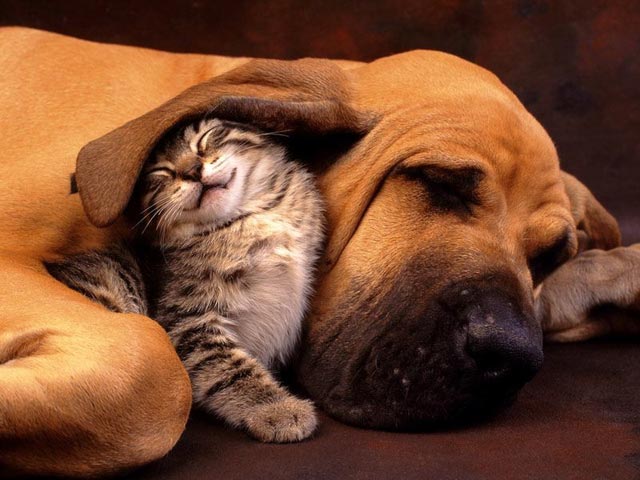
Dogs are animals of integrity. We have much to learn from them.
Category: Dogs
At least for the time being!
Have a loving peaceful week-end wherever you are.
Reflections on the meaning of love.
Yesterday, I explored love across the species; back to that first encounter between wolf and early man.
Today, I want to revisit what we mean when we use the word ‘love‘ and feel the emotion. I say revisit because it’s not the first time I have dipped my toes into this particular pool. Last August, I wrote a piece What is love? It opened thus:
How the relationship that we have with domesticated animals taught us the meaning of love.
This exploration into the most fundamental emotion of all, love, was stimulated by me just finishing Pat Shipman’s book The Animal Connection. Sturdy followers of Learning from Dogs (what a hardy lot you are!) will recall that about 5 weeks ago I wrote a post entitled The Woof at the Door which included an essay from Pat, republished with her permission, that set out how “Dogs may have been man’s best friend for thousands of years longer than we realized“.
The following day, I wrote a further piece introducing the book and then commenced reading it myself. Please go there and read about the praise that the book has received.
What I want to do is to take a personal journey through love. I should add immediately that I have no specialist or professional background with regard to ‘love’ just, like millions of others, a collection of experiences that have tapped me on the shoulder these last 67 years.
The challenge for us humans is that while we instinctively understand what emotions represent: love, fear, anger, joy, grief, sadness, happiness, et al, we really have no way of knowing precisely what another person is feeling and how that feeling compares to our own awareness and experience of that emotion.
Stay with me as I explore how others offer a meaning of love.
As it happens, this week’s Sabbath Moment from Terry Hershey was much about love.
If you judge people you have not time to love them. Mother Teresa
Where there is great love there are always miracles. Willa Cather
Someday, after we have mastered the winds, the waves, the tides, and gravity, we shall harness… the energies of love. Then for the second time in the history of the world man will have discovered fire. Pierre Teilhard de Chardin
Then some further reflections:
Here’s my take: Life is complicated and at times, very, very challenging. And sometimes, overwhelming. Bad things can happen to good people. Decisions can be thorny and disconcerting. However. Even in the midst … where there is great love, there are always miracles.
and
Here’s the deal:
- Love is not always where I predict it will be.
- Love can grow and blossom even in the face of striving and anguish.
- If we judge we cannot love. Just because I see something one way, doesn’t mean that I am right and you are wrong.
- When we do love, we are present. When we are present, there is always a thread. The good news is that we are in this together. One day you may be that thread for me. And one day, I may be that thread for you.
Powerful words! Words that will have many nodding. Yet still nothing absolute that offers a definition of love that would be universally understood. Because there can be no universal definition. That is the magic of all emotions – they defy the ‘science of life’. So let’s just treasure that magic.
A few days ago, Sue over at Dreamwalker’s Sanctuary wrote a post under the title of Cosmic Seeds of Thought. With Sue’s kind permission, I republish that in full.
Last night I wrote this poem, its been a while since I posted one, so as my pen flew across the page I was inspired with these words.. Maybe due to the recent Solar flares, but my ears have been ringing ever louder as the energies have intensified.. The Silence space within is a place to reflect and absorb the peacefulness of Oneness with the Universe…. A place I often go, where we can just close our eyes to the constant noise as the Planet cries with yet more pain… Meditation helps centre our minds. If you would like to follow a meditation I often do… You can find it Here on a post I did back in 2008 .
Silence booms in an explosion of sound
Splintering static high pitched and loud
Morse Coded downloads in intermittent bursts
The Cosmos is talking-Do you hear its verse?
~~
I escape to the mountains and I run to the sea
But its chatter surrounds me as I long to be free
I hear cries of children, laments from the old
Each on a journey their stories to be told
~~
The Elephants and Dolphin their cries go unheard
Yet I hear their low rumbles and clicks how absurd
Each voice in the matrix – every thought in the mix
A Planet in Crisis – will it ever be fixed?
~~
So I turn down the volume as I shut the outer door
As I meditate inward finding higher-self law
Here I seek Peace in the stillness I find
The Key to the Cosmos we turn in the mind
~~
All things are great and all things are small
The Mind gives them power and shall overcome all
The Universal Plan- I am part and unique
Each one is searching to fit the pieces they seek
~~
And the answer is simple- but we make is so hard
With the choices we choose as we shuffle life’s cards
It seems we chose greed, possession is King
Forgetting how to love our fellow Human Being
~~
But it’s never too late for we each have a heart
To alter our ways – To care is a start
So clear out your Anger, your hatred and greed
Listen to your heartbeat –Start sowing Love Seeds
© Sue Dreamwalker – 2013 All rights reserved.
Start sowing love seeds! Wonderful.
How to close it for today? Frankly, I’m not sure. So I’m going to ‘cheat’. By which I mean republish something else from last August. A guest essay about the loss of love. Because it seems to me that one way (the only way?) to experience what love truly means is when we lose it. As Eleanore MacDonald describes below in the most heart-rending and beautiful fashion.
oooOOOooo
“Until one has loved an animal, a part of one’s soul remains unawakened.”
Anatole France

A great squall came upon us here on our farmlet a week ago. I saw it first from a distance, in that dawning of the morning when Djuna usually announced the coming day with his gentle, breathy ‘woooof’, his polite plea to join us on the bed. Mysteriously disturbing, it surely was a sign of things to come, but we didn’t know how dangerous it really was until it was upon us.
And when it was suddenly there, a Great Joy was sucked from our world and an overwhelming sadness took its place … a raging stillness, hot and stifling, no breath, no heartbeat.
My springs of Joy are dry … (a sentiment stolen in part from that great old song, Long Time Traveler)
Djuna Cupcake was one of the Seven Great Dogs. If you’ve seen the film ‘Dean Spanley’, you will know what I mean. If you have loved and been loved by a dog of pure heart … one who was a great teacher of presence, of patience, one who was the dispenser of unconditional love and the blessings of an incomparable joy … one who was a great listener, guardian, and the embodiment of Buddha, Coyote, the Goddesses Eleos and Kuan Yin all in one soft coated body … one who was your loving shadow because he or she felt that it was their job to see you safe at all times … you will know what I mean.
He died quite suddenly. Like that squall, his death came with no warning and for days after Paul and I were sucked deep into that great black hole of grief. The dread attacked us at every turn, where we would always see him but now only a glaring emptiness stood. I felt as though my heart and soul had a raw, oozing, gaping, searingly painful wound where he had been torn away from me. Stolen. We cried a lot.
Some people will never understand. I try to feel compassion for them, rather than issuing the big ‘EFF YOU”, but I am only human. What is this BS about a ‘three day’ rule? What? Because he was ‘just a dog’ we should be over it all in 3 days? Djuna was surely a better person than most Humans and I will never stop missing him. I feel so deeply sorry for those people who have overlooked having such grace and beauty bless their lives –– the companionship of a great dog (or cat or horse, or human person) –– so that, when the monumental end comes and they’ve come through the great fires of sorrow, and have been washed by the flush of a million tears, they come through to the other side where they are able to see the remarkable love, joys and lessons they’d been gifted by that companionship. I can only hope now to ‘be’ the person Djuna thought me to be.
3 days and 3 more and 3 million more and even then more just won’t do it.
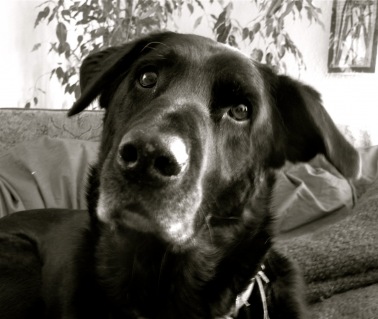
Paul and I were with Djuna on our bedroom floor when he died. I lay with him next to my heart, whispering love, my arm draped over his neck … and as he was leaving us, I saw him standing just beyond Paul. Alert, ears akimbo, head cocked, eyes bright, a wad of socks in mouth, standing in his particularly great exuberance, as he did each morning when the time for chores presented itself – “Come on! It’s time to go! Get with it you silly humans! There’s work to be done, there’s a barn to clean and a day to sniff, there’s delight to be found!” And then he left.
My ‘joyometer’, my daily dispenser of mirth, and my constant reminder of the importance of presence, has gone missing – his lessons of ‘Be Here Now’ measured in doses of ’Oh, sense the beauty in the music of the wind!’, ‘Let’s just run in circles and laugh’, ‘I love, love, love you!’ … gone. It is wholly up to me now to remember to stay in each moment, to just be a nice person, cry whenever I must, to laugh as much as possible and dance for the sheer joy of it. And when the cacophony of the deafening silence has quieted and the colors of sorrow have muted and gone transparent and I’ve had some time to let the Aegean clean up those bloodied wounds in my heart and soul, there will be room again here for another one of the Seven Great Dogs. And the cycles will continue on.
Almost every evening Djuna and I took an evening stroll down our quiet lane. I loved watching him dance his great joy, nose to the ground scenting all of the news of the day or nose to the sky, sensing what was coming on the breeze. On our walks I watched the seasons change, the rising of the full moon, the greening of the new spring and the evening skies, like snowflakes, no one ever alike … I watched the Canadian geese come and go, the Red Tail hawks courting in the air above me, and let the build up of my day fall away as I tread softly with my gentle friend. It took me several days after Djuna’s death for me to realize that here was yet again another gift he had left for me in his wake, and one I should continue to enjoy. The sky was black to the West, we’d had heavy winds and rain all day, but when there was a break I set off on ‘our’ walk. Wrapped tightly in sadness and hardly breathing with the missing of him, I shuffled along about a 1/2 mile and turned for home before the rains started up and the chill wind began to blow, fierce again, from the south. That wind battered and bashed me until it freed the tears from my eyes, and the freezing rain lashed my face until I grew numb. As though suddenly realizing I was about to drown, I surfaced, taking in great gulps of air as though I’d not been breathing for several days, and began to climb free of the suffocating bonds of my sadness.

My Djuna, my Cupcake … My Heart of Hearts who knew my soul, my every thought; great lover of Paul and I, and of Breelyn; great lover of his mare and his pony, of socks and his furry toys and his GWBush chew doll; great lover of his evening walkies and of riding in the car, and feeding the birds; great lover of sofa naps and sleeping in late with us on the bed and chasing BALL and rolling on the grass and of eating horse poop; bountiful bestower of stealthy kisses; joyful jokester, Greek scholar (he knew about 15 words and understood several phrases spoken to him in Greek; something we did only after he’d begun to understand words and phrases *spelled out* in English! ‘Car’, ‘dinner?’, ‘play with the ball?’, ‘feed the birds’, water, pony, get the goat, etc!); Djuna, beloved Honorary Cat, our timekeeper, our guardian angel, our boss, our playfully dignified friend (thanks for that Marija) and family member, and one of the Seven Great Dogs – we will love and miss you forever.
But now – there’s work to be done, there’s a barn to clean and a new day to sniff, there’s delight to be found!

Copyright (c) 2012 Eleanore MacDonald
oooOOOooo
Dedicated to MaryAnne G.
A week ago I started the first of what became four day’s writings about passing the 400ppm CO2 level in the planet’s atmosphere. As I said in the penultimate post, “In nearly four years of writing for Learning from Dogs, I can’t recall devoting three days of posts to a single subject.”
Later that week, I had a wonderful telephone conversation with MaryAnne back in Payson. MaryAnne and husband Ed were among a group of people who did so much to ease our transition into our new home in Arizona. As part of the process of obtaining my fiancee visa, I was to and fro between Payson and London which meant having to leave Jeannie alone for a number of weeks at a time. So for Jean having to get used to a change of country as well as home and for me wondering if I would ever get the magic piece of paper allowing me and Jean to be married and settle down, having so many loving friends around us was invaluable.
In last week’s telephone conversation MaryAnne spoke so easily about love that I promised her that I would dedicate a post on Learning from Dogs to her.
In fact, rather than one post, I’m setting myself the challenge of writing about love for the entire week, i.e. Monday to Friday. I will readily admit that over and beyond today’s post, I don’t have more than the vaguest inkling of how the week will pan out. You have been warned!
But how much better that ‘devoting three days to a single subject‘ should be about love rather than climate change.
oooOOOooo
Love across the species.
A week ago, we had friend Richard and his partner Julie from England staying with us. Richard and I go back 40 years and have been wonderful buddies all that time. Last Monday, I took Richard and Julie across to Wildlife Images just a few miles from the house here in Merlin, Oregon. As their website explains,
Wildlife Images Rehabilitation and Education Center was founded as a non-profit corporation in 1981 by renowned wildlife rehabilitator J. David Siddon. The facility was created in order to provide for the care and treatment of sick, injured and orphaned wildlife.
and a little later,
The organization’s clinic, animal sanctuary, and education center are located on 24 acres of land adjacent to the wild and scenic section of Oregon’s famous Rogue River. Animals treated at Wildlife Images have included everything from baby squirrels and badgers to American bald eagles.
Wildlife Images release rate of intakes is near 50 percent each year – far above the national average of 33 percent. Animals with permanently disabling injuries that make them unable to live in the wild are integrated into one of Wildlife Images educational programs, either as educational ambassadors, or as permanent residents of the facility.
While we were looking at the animals, along the pathway came a couple of the volunteer staff walking a Grey Wolf (Canis Lupus).

I was utterly captivated by this beautiful animal. Her story was that she was born in captivity and owned by an individual who soon decided he didn’t want her! Not long thereafter Tundra, as she became named, was brought to the Sarvey Wildlife Center in Washington and thence to Wildlife Images when she was just 8 weeks old.
Tundra turned to look at me. I stood perfectly still and quiet. Tundra seemed to want to come closer. As one would with a strange dog, I got down on my knees and turned my eyes away from Tundra’s. I sensed she was coming towards me so quickly held up my camera and took the picture below.

I kept my gaze averted as I felt the warm breath of this magnificent animal inches from my face. Then the magic of love across the species! Tundra licked my face! The tears came to my eyes and were licked away. I stroked her and became lost in thought.
Was this an echo of how thousands and thousands of years ago, a wolf and an early man came together out of trust and love and started the journey of the longest animal-human relationship, by far?
As I write elsewhere on this blog,
Dogs are part of the Canidae, a family including wolves, coyotes and foxes, thought to have evolved 60 million years ago. There is no hard evidence about when dogs and man came together but dogs were certainly around when man developed speech and set out from Africa, about 50,000 years ago.
Let me close the first day of these musings by coming forward all those thousands of years to the year 2012. To the 6th April, 2012. To the day that we brought puppy Cleo back home. That sweet little creature of less than ten weeks of age starting her own journey of love across the species.

Three Koi joined our family yesterday.
Our pond has settled to the point where Jean thought it would be good to get some fish. So off to a pond and fish supplies store in Grants Pass to seek advice. We settled on some Koi and a water lily plant.
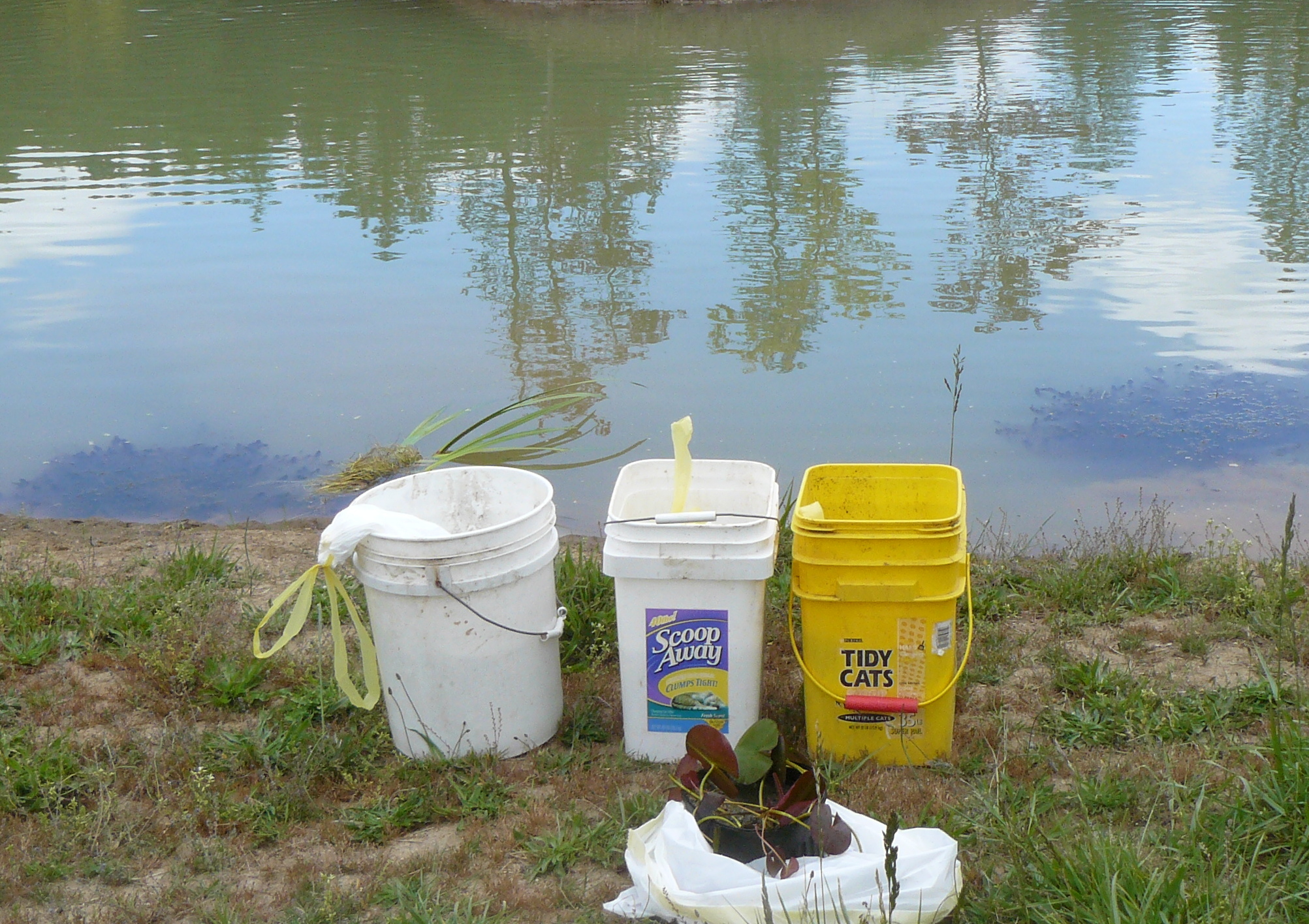
We were advised to acclimatise the fish in terms of water temperature by slowly mixing pond water into the bags containing each fish.
Meanwhile, Pharaoh took advantage of clean, green grass to give his back a bit of a rubdown.
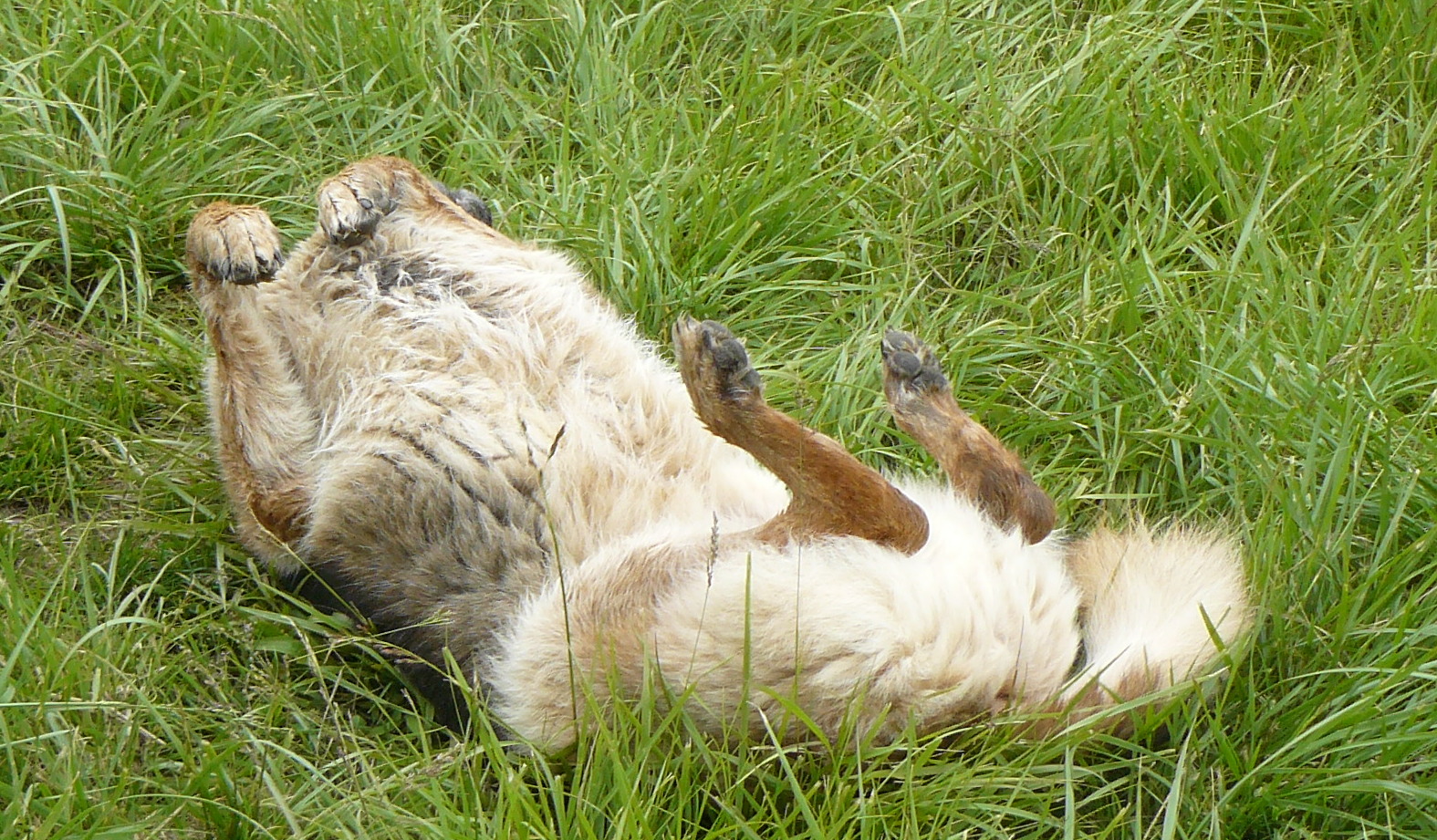
And Hazel pondered what ‘Dad’ was up to.
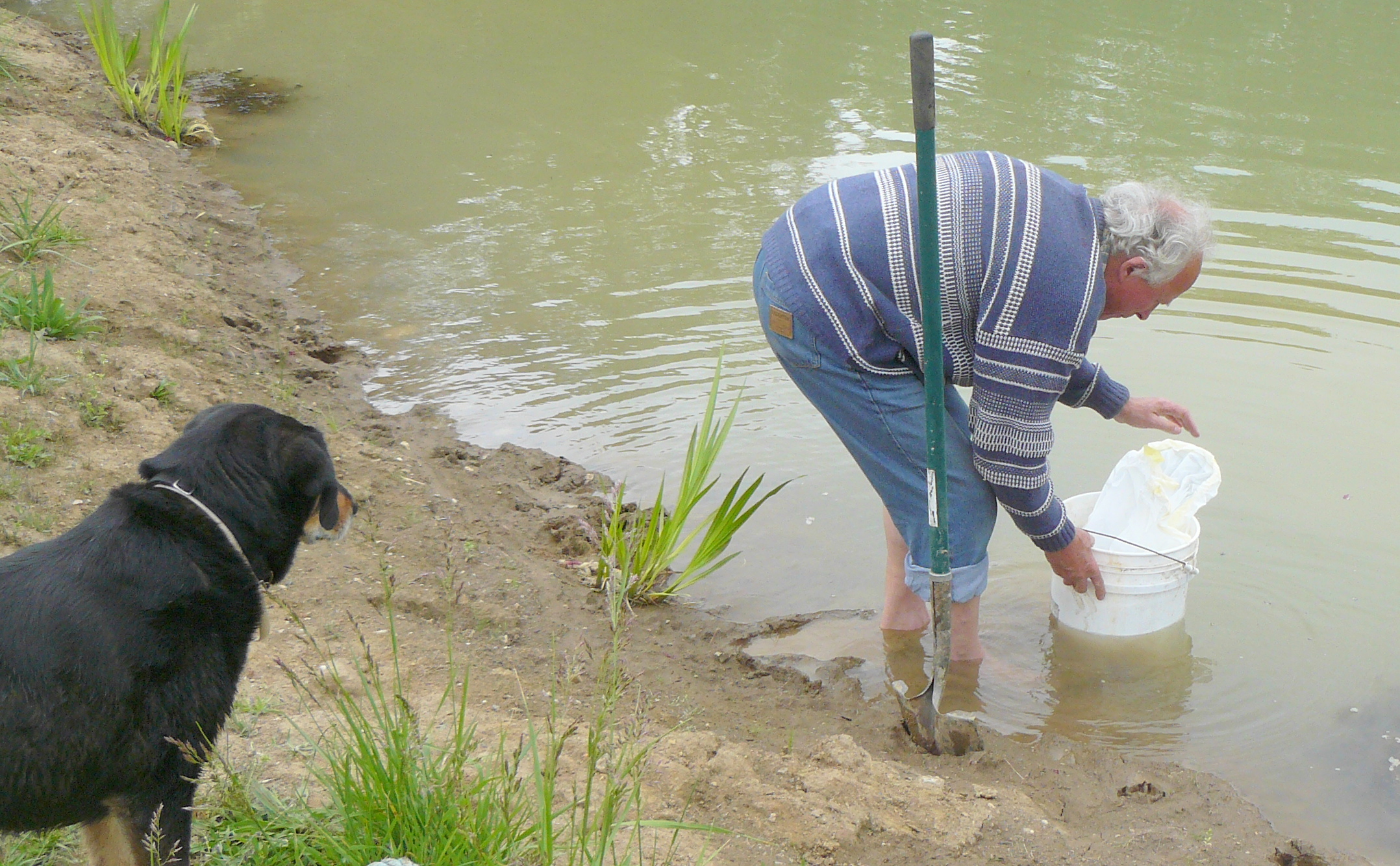
But eventually it was time for the three Koi to slip away into the depths of their new home.

The twenty-three?
Nine dogs, five cats, four chickens, two miniature horses and three Koi!
Brings a whole new meaning to the description of a ‘seeing-eye’ dog!
Big thanks to Suzann for sending this.
From the WTHI-TV website.
A dog with a special talent
Updated: Tuesday, 22 Jan 2013, 4:58 PM EST
Published : Wednesday, 07 Nov 2012, 6:46 PM ESTCLAY COUNTY, Ind. (WTHI) – Finding a dog that can fetch is hardly news.
We’ve found a dog that can fetch; that we think is worth a news story.
If your pooch is nearby, bring them near the computer, they’re going to want to see this.
Chica is a happy border collie that lives on the Knox Farm, in Clay County.
When we find her, she darts from the back door of the barn and weaves through the chicken and cattle.
Chica’s favorite pastime is playing fetch with her owners Martha and Buddy Knox.
It’s a sight to see, but it’s a sight Chica can’t see.
Chica has no eyes.
Her eyes were surgically removed when she was a mere pup.
So, how does a dog with no eyes see a moving ball, and bring it back to the feet of Martha?
This is something Martha wonders as well, and so do the experts at Purdue University.
Whatever it is, here is a hound that lives its life in the dark, but seemingly is seeing everything.
Now watch this and be both humbled and amazed.
Something wonderful we can learn from Chica. Accept our limitations, because we all have them, and “see with our heart”.
Thank you so much, Su, for sharing that.
Yesterday and Monday saw a team from Caveman Heating in Grants Pass installing a new heating and air-conditioning system in the house. That resulted in me not turning my computer on until 6pm. So apologies for lacking the creative spirit.
Will just leave you with a picture of Pharaoh, Hazel and Dhalia helping a couple of the crew eat their lunch yesterday! 😉

Can’t close without saying that the entire Caveman team were just wonderful with all the dogs, who will surely miss the innumerable strokes and head rubs.
Thanks guys!
I’m clearly not the only one to believe we really can learn from dogs!
Last Friday, I published a post under the title of The healing power of dogs. This is how that post opened:
How dogs offer us humans health and happiness.
Many months ago, I was contacted by a Peter Bloch offering to write a guest post on the subject of the healing power of dogs. Peter had read a post that I had published in July last year which prompted the email dialogue between us.
Not going to say much more at this stage except that today I am republishing that post from last July. On Monday, I will introduce Peter and his guest post. Then on Tuesday, I will speak of my own experiences both as entrepreneurial mentor and as a ‘customer’ of a wonderful psychotherapist back in Devon during 2007.
So, as promised, here is that guest post from Peter.
oooOOOooo
My dog Fergus is a philosopher, and the nature of health and happiness is his area of special expertise. When he learned about Paul’s blog he became very excited because he has always been convinced that dogs have so much to teach humans about life. As much as anything to have a little peace from his continual philosophical musings, I agreed to set out his theories here for the benefit of everyone who loves dogs.
Fergus would like it to be known that when he is free to pursue the activities to which his particular breed is most naturally attracted then, as a dog, he feels happy, energised, purposeful and fulfilled in every way. Fergus has also observed that when he is able to participate as a co-operating member of his ‘pack’, he feels safe and secure, is clear about how to proceed with his life, and at night he sleeps like a dog.
But Fergus says that when these conditions do not apply, he can be quite remarkably miserable. As a Greyhound, he loves to run very fast, and he is not at all interested in things like retrieving balls, or wallowing in water.

However once he was in the care of someone who Fergus thinks we should just call ‘Sarah’. Sarah has a Labrador and thinks that all dogs really ought to be like her dog, resulting in Fergus being put under considerable pressure to enjoy activities that he could not understand.
That lead to Sarah telling Fergus’ owners that he was a difficult dog when in fact he was just a misunderstood dog. He was amazed how, in just one day, he went from sleeping ‘like a dog‘ to ‘living in the doghouse‘!
Indeed, within a week he was suffering from digestive problems and skin disorders, despite an identical diet, and was found to be engaging in several bizarre neurotic behaviours. Fortunately, when more congenial conditions were restored, Fergus returned to feeling safe and secure.
Fergus often expresses surprise that people often do not understand that the freedom to be himself, the true dog that he is, including living in unifying solidarity with his pack, is a fundamental requirement for his health; in all meanings of the word.
For instance, Fergus noticed that Sarah has a son called Henry, who really wanted to be a designer. But his mother thought that it would be better for him to be a lawyer. In fact, Sarah was so certain that in the end Henry became a lawyer. Fergus observes that Henry is always suffering from digestive problems and skin disorders and sometimes behaves a little strangely. Doctors have not been able to find out what is wrong with him, despite all sorts of diets and medicines being tried.
But here’s the rub. When Henry goes out for a walk with Fergus, Fergus always runs as fast as he can and his resulting happiness always makes Henry feel so much better.
Henry is convinced that Fergus is a healer! Who could argue with that?
oooOOOooo
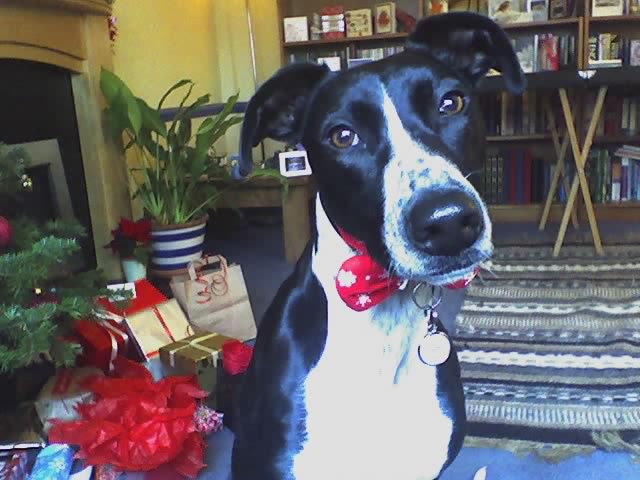
Trust me, when I’m feeling a little down the dogs all know. All of them allow me to come and bury my face in their fur, or rest my face alongside their face. Perhaps one of the most powerful gifts from our dogs is their wonderful, unconditional love for us funny humans.
I have no connection with Peter other than being delighted to have this guest post from him (or was it from Fergus??). Peter offered this brief summary of his work, which I am pleased to include:
Peter Bloch has developed a form of existential and person-centred psychotherapy through touch. In this therapeutic model, health is defined as the ability to be true to oneself and open to genuine relationships with others – qualities that he finds in abundance in his dog.
How dogs offer us humans health and happiness.
Many months ago, I was contacted by a Peter Bloch offering to write a guest post on the subject of the healing power of dogs. Peter had read a post that I had published in July last year which prompted the email dialogue between us.
Not going to say much more at this stage except that today I am republishing that post from last July. On Monday, I will introduce Peter and his guest post. Then on Tuesday, I will speak of my own experiences both as entrepreneurial mentor and as a ‘customer’ of a wonderful psychotherapist back in Devon during 2007. Hope that works for you.
So here’s that Learning from Dogs post.
000OOOooo
Such a beautiful and mutually-important relationship.
I didn’t plan to write more about this subject thinking that my last two posts, Woof at the Door and Prof. Pat Shipman, more than covered the theme; indeed much more.
But then a flurry of other articles conspired to pass my desk.

In no particular order there was an article on the Big Think website, Do Dogs Speak Human? As the article opened,
What’s the Big Idea?
Perhaps the better question is, do humans speak dog? Either way, the debate over whether language is unique to humans, or a faculty also possessed by wild and domestic animals from dogs to apes to dolphins, is an interesting one. The answer depends on exactly how we define “language,” and who’s doing the talking, says David Bellos, the Booker prize-winning translator.
The article includes this three-minute video,
and concludes,
Broadly, a language is a mode of expression. “The argument that only human language is language and that animal communication systems, however sophisticated they are — and some of them are quite sophisticated — are not languages because they consist of discrete signals is a circular argument,” he argues. “It’s a self-fulfilling thing. And I think we should be a little bit more interested in the complexity and the variability of animal communication systems and less rigid about this distinction between what is a language and what is not a language.”
For now, we’re happy with this:
The June 30th edition of The Economist had an article entitled, Can dogs really show empathy towards humans? (You may have to register (free) to view this.) That report ends, as follows,
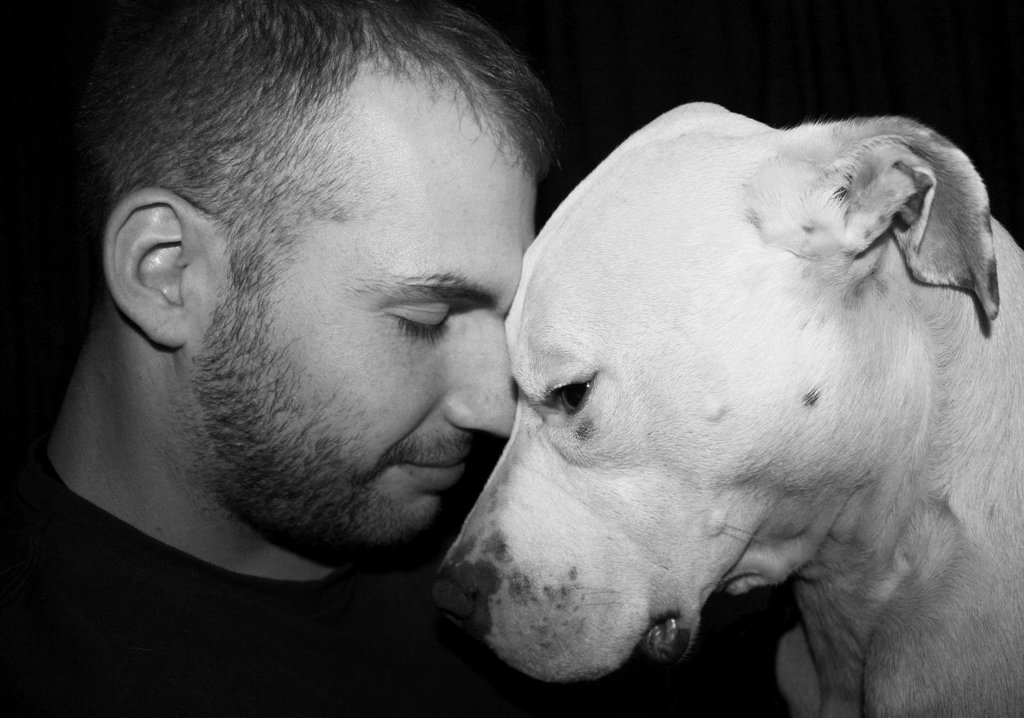
As they report in Animal Cognition, “person-oriented behaviour” did sometimes take place when either the stranger or the owner hummed, but it was more than twice as likely to occur if someone was crying. This indicated that dogs were differentiating between odd behaviour and crying. And of the 15 dogs in the experiment that showed person-oriented responses when the stranger cried, all of them directed their attention towards the stranger rather than their owner.
These discoveries suggest that dogs do have the ability to express empathetic concern. But although the results are clear enough, Dr Custance argues that more work needs to be done to be sure that such behaviour is true empathy. It is possible, she points out, that the dogs were drawing on previous experiences in which they were rewarded for approaching distressed human companions. Dog-owners, however, are unlikely to need any more convincing.
It was then an easy follow-up to that Animal Cognition article which is available online here; here’s the abstract,
Empathy covers a range of phenomena from cognitive empathy involving metarepresentation to emotional contagion stemming from automatically triggered reflexes.
An experimental protocol first used with human infants was adapted to investigate empathy in domestic dogs. Dogs oriented toward their owner or a stranger more often when the person was pretending to cry than when they were talking or humming. Observers, unaware of experimental hypotheses and the condition under which dogs were responding, more often categorized dogs’ approaches as submissive as opposed to alert, playful or calm during the crying condition. When the stranger pretended to cry, rather than approaching their usual source of comfort, their owner, dogs sniffed, nuzzled and licked the stranger instead.
The dogs’ pattern of response was behaviorally consistent with an expression of empathic concern, but is most parsimoniously interpreted as emotional contagion coupled with a previous learning history in which they have been rewarded for approaching distressed human companions.
Not quite as obvious as it might seem.
Considering that this blog is called Learning from Dogs, there has been precious little published about the animal species known as Canis familiaris; the classification of the domestic dog. Let me try to correct that.
So, this reference explains:
The subdivision of Canidae into “foxes” and “true dogs” may not be in accordance with the actual relations; also, the taxonomic classification of several canines is disputed. Recent DNA analysis shows that Canini (dogs) and Vulpini (foxes) are valid clades (see phylogeny below). Molecular data imply a North American origin of living Canidae and an African origin of wolf-like canines (Canis, Cuon, and Lycaon).
Currently, the domestic dog is listed as a subspecies of Canis lupus, C. l. familiaris, and the dingo (also considered a domestic dog) as C. l. dingo, provisionally a separate subspecies from C. l. familiaris; the red wolf, eastern Canadian wolf, and Indian wolf are recognized as subspecies. Many sources list the domestic dog as Canis familiaris, but others, including the Smithsonian Institution and the American Society of Mammalogists, more precisely list it as a subspecies of C. l. familiaris; the red wolf, eastern Canadian wolf, and Indian wolf may or may not be separate species; in the past, the dingo has been variously classified as Canis dingo, Canis familiaris dingo and Canis lupus familiaris dingo.
However a recent paper published by Nature magazine throws some interesting light of the development on the domestic dog. As the article preview explains:
The genomic signature of dog domestication reveals adaptation to a starch-rich diet
The domestication of dogs was an important episode in the development of human civilization. The precise timing and location of this event is debated and little is known about the genetic changes that accompanied the transformation of ancient wolves into domestic dogs. Here we conduct whole-genome resequencing of dogs and wolves to identify 3.8 million genetic variants used to identify 36 genomic regions that probably represent targets for selection during dog domestication.
Nineteen of these regions contain genes important in brain function, eight of which belong to nervous system development pathways and potentially underlie behavioural changes central to dog domestication. Ten genes with key roles in starch digestion and fat metabolism also show signals of selection. We identify candidate mutations in key genes and provide functional support for an increased starch digestion in dogs relative to wolves. Our results indicate that novel adaptations allowing the early ancestors of modern dogs to thrive on a diet rich in starch, relative to the carnivorous diet of wolves, constituted a crucial step in the early domestication of dogs.
The BBC News website picked up on this:
Dog evolved ‘on the waste dump’
By Jonathan Amos Science correspondent, BBC News
Anyone who owns a dog knows that it will rummage around in the kitchen bin looking for food, given half a chance.
But this annoying behaviour may have a more profound undercurrent than we realise, according to scientists.
A new study of dog genetics reveals numerous genes involved in starch metabolism, compared with wolves.
It backs an idea that some dogs emerged from wolves that were able to scavenge and digest the food waste of early farmers, the team tells Nature journal.
No-one knows precisely when or how our ancestors became so intimately connected with dogs, but the archaeological evidence indicates it was many thousands of years ago.
One suggestion is that the modern mutt emerged from ancient hunter-gatherers’ use of wolves as hunting companions or guards.
But another opinion holds that domestication started with wolves that stole our food leftovers and eventually came to live permanently around humans as a result.
Anyone who owns or loves dogs will find this article fascinating. Jonathan Amos goes on to say:
“This second hypothesis says that when we settled down, and in conjunction with the development of agriculture, we produced waste dumps around our settlements; and suddenly there was this new food resource, a new niche, for wolves to make use of, and the wolf that was best able to make use of it became the ancestor of the dog,” explained Erik Axelsson from Uppsala University.
“So, we think our findings fit well with this theory that the dog evolved on the waste dump,” he told BBC News.
Dr Axelsson and colleagues examined the DNA of more than 50 modern dogs from breeds as diverse as the cocker spaniel and the German shepherd. They then compared their generic genetic information with those of 12 wolves taken from across the world.
The Swedish-US team scanned the DNA sequences of the two types of canid for regions of major difference. These would be locations likely to contain genes important in the rise of the domesticated dog.
Axelsson’s group identified 36 such regions, carrying a little over a hundred genes. The analysis detected the presence of two major functional categories – genes involved in brain development and starch metabolism.
In the case of the latter, it seems dogs have many more genes that encode the enzymes needed to break down starch, something that would have been advantageous in an ancestor scavenging on the discarded wheat and other crop products of early farmers.
Do go across to that BBC item and read the rest of the article.
That article and the paper in Nature magazine resonate strongly with an article written on the Dr George Johnson on Science website. In fact I referred to the George Johnson piece when I first published the Dogs and integrity side piece in July 2009. (My how time flies!) As that George Johnson piece reveals:
This week I found myself wondering about Boswell’s origins. From what creature did the domestic dog arise? Darwin suggested that wolves, coyotes, and jackals — all of which can interbreed and produce fertile offspring– may all have played a role, producing a complex dog ancestry that would be impossible to unravel. In the 1950s, Nobel Prize-winning behaviorist Konrad Lorenz suggested some dog breeds derive from jackals, others from wolves.
Based on anatomy, most biologists have put their money on the wolf, but until recently there was little hard evidence, and, as you might expect if you know scientists, lots of opinions.
The issue was finally settled in 1997 by an international team of scientists led by Robert Wayne of the University of California, Los Angeles. To sort out the evolutionary origin of the family dog, Wayne and his colleagues used the techniques of molecular biology to compare the genes of dogs with those of wolves, coyotes and jackals.
Wayne’s team collected blood, tissue, or hair from 140 dogs of sixty-seven breeds, and 162 wolves from North America, Europe, Asia, and Arabia. From each sample they extracted DNA from the tiny organelles within cells called mitochondria.
While the chromosome DNA of an animal cell derives from both parents, the mitochondrial DNA comes entirely from the mother. Biologists love to study mitochondrial DNA because of this simple line of descent, female-to-female-to-female. As changes called mutations occur due to copying mistakes or DNA damage, the mitochondrial DNA of two diverging lines becomes more and more different. Ancestors can be clearly identified when you are studying mitochondrial DNA, because clusters of mutations are not shuffled into new combinations like the genes on chromosomes are. They remain together as a particular sequence, a signature of that line of descent.
Do read the full article here.
Finally, just watch this short trailer for a BBC Horizon screened in early 2010. (Wet eyes warning!)
So the next time you look a dog in the eyes or hug their lovely furry body, think how far back the relationship goes and marvel at how much we have learnt from them.
Journey to the Sea of Cortez.

I feel very guilty as I didn’t make a note of where I came across this film. Whoever highlighted the film, thank you! It’s truly beautiful. So, please, settle yourself down and be enthralled.
In March 1940, the author John Steinbeck and his friend, marine biologist Ed Ricketts, sailed down the coast of California and Mexico to the Sea of Cortez. “The abundance of life here gives one an exuberance,” they wrote, “a feeling of fullness and richness.”
Their stated purpose was to document the creatures that inhabit shallow waters and tide pools on the margins of the Sea of Cortez. But it became much more. In these mysterious, phosphorescent waters they sought an understanding of mankind’s relationship to the natural world and a wellspring of hope for a world headed toward war.
Looking beyond the events of the day, the two friends foresaw our rising impact on the oceans and the devastating impact that over fishing would have on this rich sea. And yet, in their journey, they encountered a periodic cooling of the eastern Pacific Ocean known as La Niña that can still set off an explosion of life.
Can the story of their journey inspire new efforts to preserve the Sea of Cortez? Down along the shores of western Mexico, the wind blows hot and dry. Beyond these barren landscapes, cold currents rush up from the deep and the ocean literally boils with life.
Following their journey down to the Sea of Cortez in March of 1940, John Steinbeck and Ed Ricketts searched for a way to describe what they saw. “Trying to remember this place,” they wrote, “is like trying to re-create a dream. It is fierce and hostile and sullen. The stone mountains pile up to the sky and there is little fresh water. But we know we must go back if we live, and we don’t know why.”
The Sea of Cortez is one of the most diverse marine ecosystems on the planet. It’s shaped by the cool waters of the California Current flowing into the warm tropics and by a complex undersea terrain that rises up along a chain of islands and sea mounts. It was the shorelines, between the desert and the deep, that drew John Steinbeck, the author, and Ed Ricketts, a marine biologist and expert on coastal ecosystems.
Ricketts’ book, “Between Pacific Tides,” is a classic study of the inter-tidal zones of the California coastline and the myriad creatures that live in shallow pools, clinging to rocks to sift the rich nutrients carried in by the tides. Steinbeck and Ricketts sought to extend this work to the Sea of Cortez and to explore ideas at the core of their friendship. They shared a belief that man’s fate, like that of the animals they saw, is linked to the health of the natural world. [Ed. my emphasis]
Ricketts is said to have inspired some of Steinbeck’s most memorable characters, including Doc in Cannery Row, and the preacher Jim Casy in The Grapes of Wrath, published a year before their voyage. Set against the backdrop of drought and economic depression, the book describes the dustbowl conditions that gripped the American heartland in the 1930’s. “Now the wind grew strong and hard and it worked at the rain crust in the corn fields. Little by little the sky was darkened by the mixing dust, and carried away. The wind grew stronger. The rain crust broke and the dust lifted up out of the fields and drove gray plumes into the air like sluggish smoke.”
In most years, southerly winds carry moisture into the midsection of the country from the Gulf of Mexico. In the 1930’s, according to a recent NASA study, those winds were diverted by a build up of warm water in the Western Atlantic and by a periodic cooling of the Eastern Pacific known as La Niña. This combination robbed the region of rain.
By the time Steinbeck and Ricketts began their journey, the historic backdrop had shifted to war. Fighting had engulfed Europe and was spreading to the western Pacific. While the United States was still officially neutral, American companies had begun supplying arms to the allied effort. In early 1940, John Steinbeck used money he earned from “The Grapes of Wrath” to hire a sardine boat called the Western Flyer. From Monterrey, California, he, his wife Carol, Ed Ricketts and a four-man crew headed south, charting a course along the Mexican coastline.
By all accounts, the journey was filled with adventure, camaraderie, and a sense of wonder at the diversity of living things they encountered. Over a six-week period, the two friends wrote journal entries, took notes on conversations, and catalogued specimens they collected on the way. They compiled these writings into a book: “Sea of Cortez, A Leisurely Journal of Travel and Research,” later changed to “The Log From the Sea of Cortez.”
The work amounts to a search for a way to understand nature, and humanity at large, in a world steadily coming apart at the seams.

The film was released last Feb 28, 2013. Directed by Thomas Lucas, the Producers were John Friday, Thomas Lucas and Adam Ravetch.
oooOOOooo
Will end with a couple of personal reflections. First is that when I was invited out to Mexico for Christmas 2007 by Suzann and Don, I travelled to San Carlos, Mexico on the Eastern shores of the Sea of Cortez. San Carlos is a little under 300 miles south of the Arizonan border with Mexico and was where Jean had been living for many years. Meeting Jean changed my life forever! Here’s a picture of the Sea of Cortez through the rear door of Jean’s house in San Carlos.

Second reflection is about dogs. Jean had spent many years rescuing Mexican feral dogs and finding homes for them; hundreds of them over her time in San Carlos. We brought 13 of those dogs with us when we moved to Arizona and 9 came to Oregon. Below is Hazel, one of the five remaining Mexican ‘rescue’ dogs that are still with us in Oregon.

 Learning from Dogs