With a sub-title regarding a missing dog, why on earth would I lead with a picture of fine food?
I will tell you.
In the last hour, Jean and I have come back from a meeting with the General Manager of a restaurant nearby in Grants Pass: the River’s Edge restaurant. That picture is on the home page of the restaurant’s website.
The GM’s name is Missy Clements and she is also the banqueting manager. Jean and I have previously enjoyed wonderful meals at the River’s Edge and the reason for meeting up with Missy was to kick around some ideas for a future event at the restaurant.
Anyway …..
During the meeting the conversation inevitably led to dogs and Missy, with obvious pain in her voice, explained that her six-year-old Boxer mix, Lucy, had recently gone missing.
I offered to post an item in this place, hence this coming out an an unusual time.
Please do all you can to share this, especially if you are in the Southern Oregon area. The address where Lucy was last seen was Crooks Creek Road, a few miles North-East of Selma in Oregon; Selma being 20 miles to the South-West of Grants Pass. If you have any questions or, even better, think you have some information on the whereabouts of Lucy then Missy has given me permission to publish her email address; that is: clements (dot) missy57 (at) gmail (dot) com
We were out with our guests until late afternoon yesterday leaving me no time to offer anything original. (Of course, there’s an inherent assumption in that last sentence! 😉 )
So I am reposting an essay about a Japanese dog that has been a long-term favourite of many readers of Learning from Dogs. Apologies if you have read this before.
oooo
Faithful dog Hachikō
30th August, 2010
More than a film, a message from dogs to mankind.
Richard Gere and Hachi
We recently watched a film about an Akita dog called Hachi, Hachikō in Japanese, that demonstrates the loyalty that dogs can have for their human owners.
Here’s the official movie trailer.
It’s a very moving film – seriously so! Expect to shed many tears. Even more so when one reflects that the Hollywood film is based, reasonably accurately, on a true story. The details of this story are in Wikipedia from which is quoted:
In 1924, Hidesaburō Ueno, a professor in the agriculture department at the University of Tokyo took in Hachikō as a pet. During his owner’s life Hachikō saw him out from the front door and greeted him at the end of the day at the nearby Shibuya Station. The pair continued their daily routine until May 1925, when Professor Ueno did not return on the usual train one evening. The professor had suffered from a cerebral hemorrhage at the university that day. He died and never returned to the train station where his friend was waiting. Hachikō was loyal and every day for the next nine years he waited sitting there amongst the town’s folk.
Hachikō was given away after his master’s death, but he routinely escaped, showing up again and again at his old home. Eventually, Hachikō apparently realized that Professor Ueno no longer lived at the house. So he went to look for his master at the train station where he had accompanied him so many times before. Each day, Hachikō waited for Professor Ueno to return. And each day he did not see his friend among the commuters at the station.
The permanent fixture at the train station that was Hachikō attracted the attention of other commuters. Many of the people who frequented the Shibuya train station had seen Hachikō and Professor Ueno together each day. They brought Hachikō treats and food to nourish him during his wait.
This continued for nine years with Hachikō appearing precisely when the train was due at the station
This hasn’t been the only film about this dog. See below:
Back to the Wikipedia entry:
That same year, another of Ueno’s faithful students (who had become something of an expert on the Akita breed) saw the dog at the station and followed him to the Kobayashi home (the home of the former gardener of Professor Ueno — Kikuzaboro Kobayashi) where he learned the history of Hachikō’s life. Shortly after this meeting, the former student published a documented census of Akitas in Japan. His research found only 30 purebred Akitas remaining, including Hachikō from Shibuya Station.
Professor Ueno’s former student returned frequently to visit the dog and over the years published several articles about Hachikō’s remarkable loyalty. In 1932 one of these articles, published in Tokyo’s largest newspaper, threw the dog into the national spotlight. Hachikō became a national sensation. His faithfulness to his master’s memory impressed the people of Japan as a spirit of family loyalty all should strive to achieve. Teachers and parents used Hachikō’s vigil as an example for children to follow. A well-known Japanese artist rendered a sculpture of the dog, and throughout the country a new awareness of the Akita breed grew.
Eventually, Hachiko’s legendary faithfulness became a national symbol of loyalty.
Hachikō died on March 8, 1935. He was found on a street in Shibuya. His heart was infected with filarial worms and 3-4 yakitori sticks were found in his stomach. His stuffed and mounted remains are kept at the National Science Museum of Japan in Ueno, Tokyo.
Hachiko
The Akita breed has a great reputation for loyalty. But knowing that doesn’t in any way weaken the power of the message for the present times.
A dog offers loyalty, trust and love in exchange for being treated with integrity and compassion.
In terms of the bond between dog and human, it doesn’t get much better than this!
Britain’s Got Talent is a British talent television show that started in June 2007 and has been running very successfully ever since. Originally broadcast by Thames Television it is now part of the ITV ‘stable’. Inevitably there is a website!
Anyway, Jean and I were browsing YouTube one evening looking for something to watch and came across this:
Published on Apr 7, 2012
Ashleigh and Pudsey the dancing dog wow the judges with their flintstones dance act.
Britain searches for a new act to perform in front of the royal family at the royal variety performance.
Judged by Simon Cowell, Amanda Holden, Carmen Electra, Alesha Dixon and David Walliams.
Resist the urge to watch the semi-finals until you have watched the above; less than five minutes long.
Published on May 6, 2012
Britain’s got talent 2012 Live Semi finals.
Ashleigh and Pudsey the dancing dog perform their dance routine to Peppy and George in the Live Semi-finals.
Of course, you know where this is going!
Here are the finals.
Published on May 12, 2012
The performance of Ashleigh and Pudsey in the Britain’s Got Talent 2012 Final.
A thank you to all those that work so hard to stop fires from getting out of control.
I am drafting this post at a little after noon on the 4th., i.e. early afternoon yesterday.
It is yet another dry, hot day in a long run of hot, dry days. Our local online weather service, GrantsPassWeather.com, informs me that the temperature this afternoon (i.e. yesterday) is forecast to be a high of 93 deg F. or 34 deg C. We last had monthly rain totals of more than an inch back in March. At the top of the home page of Grants Pass Weather is a bold red banner proclaiming a Red Flag Warning for three counties: Jackson, Josephine and Eastern Curry. We live in Josephine County and clicking that banner reveals:
Details:
…RED FLAG WARNING REMAINS IN EFFECT UNTIL 10 PM PDT THIS EVENING FOR COMBINATION OF STRONG WINDS AND LOW RELATIVE HUMIDITIES FOR FIRE WEATHER ZONES 280…281…617…619…620…621…622 AND 623…
* AFFECTED AREA: FIRE WEATHER ZONES 80…281…617…619…620…621…622 AND 623.
* HUMIDITY…MINIMUM RELATIVE HUMIDITY AT 10 TO 20 PERCENT FOLLOWED BY RECOVERIES TONIGHT AT 20 TO 40 PERCENT.
* WIND…NORTHEAST TO EAST WINDS 10 TO 20 MPH THROUGH THIS EVENING THEN 5 TO 15 MPH OVERNIGHT.
* IMPACTS…POSSIBLE PLUME DOMINATED BEHAVIOR ON ACTIVE FIRES AS STRONG WINDS AND LOW RELATIVE HUMIDITIES THROUGH THIS EVENING WILL CAUSE FIRES TO SPREAD VERY RAPIDLY.
STRONG WINDS AND LOW RELATIVE HUMIDITIES WILL CAUSE FIRES TO SPREAD VERY RAPIDLY.
Little after 7am a few weeks ago – looking out to North-East. Picture taken from the rear deck of our house near Merlin, Oregon.
Does this focus the mind? You bet! The trees in the foreground of the above photograph are within our property. Our house is surrounded by tall oaks, pines and fir trees.
Now stay with me through what, at first, may seem like a disconnected change of topic.
Long, long time ago Jean met Ira Weisenfeld, a young vet making his way in the world. Jean’s passion for rescuing feral street dogs meant that she was a more active user of a vet’s services than the average pet owner. Jean and Ira became very good friends.
Earlier on this year, we had the pleasure of the company of Ira’s daughter, Amber, who came to see us with the man in her life, Ben Elkind.
Fast forward to the 1st September and Amber sent us the following email:
Hello Paul and Jean!
Hope you guys are doing well. Here is a BBC story about smokejumpers in Redding, CA where Ben works, he is interviewed too. Thought you might like it! Hope you had a wonderful summer. I just finished the boundary water canoe trip with Dad, it was very good.
Take care,
Amber
Forest fires kept at bay in US by elite ‘smokejumpers’
26 August 2014 Last updated at 00:48 BST
The drought that has gripped much of the American West shows no sign of abating – yet despite the tinder-box conditions, so far less land in the region has been lost to wildfires in 2014 than in recent years.
That is partly due to an aggressive strategy to stop smaller forest fires before they become too big to handle.
At the frontline of this effort are the smokejumpers, airborne firefighters who parachute into the wilderness to get the blazes under control.
It’s a dangerous job for an elite group of highly-trained men and women. The BBC spoke to three smokejumpers – Ben Elkind, Gretchen Stumhofer and Luis Gomez – at their base in Redding, California.
Produced by the BBC’s Jack Garland.
Additional footage courtesy of Ben Elkind and Tye Erwin
In my research for that post, I came across another Smithsonian article regarding the contagious nature of yawning in dogs. I wanted to republish that here as a follow-up to the yawning in wolves piece.
ooOOoo
Dogs Yawn Contagiously Too
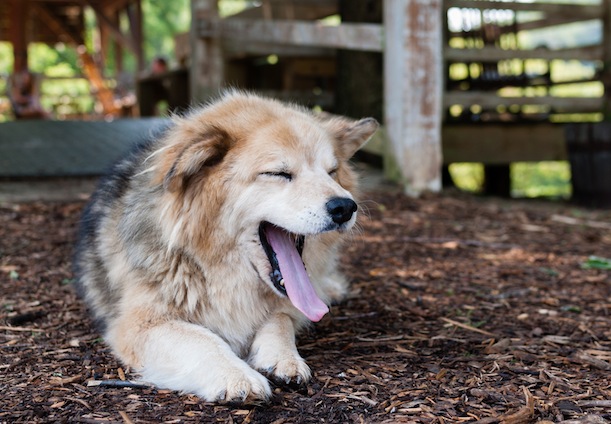
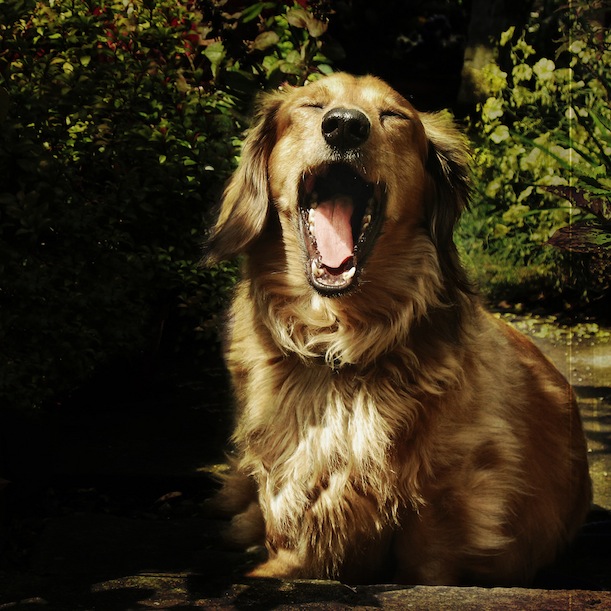
Like humans, dogs are prone to yawning when they see someone else do it—and a new study shows that they yawn most frequently in response to their owner.
New research shows that, like humans, dogs are prone to yawning when they see someone else do it—and they yawn most frequently in response to their owner. Image via Flickr user The Eggplant
And now, in one of the most groundbreaking scientific discoveries of the decade—and perhaps even the century—researchers from the University of Tokyo have discovered that, like humans, dogs yawn contagiously.
Okay, we kid. But in all seriousness, the finding does shed a bit of light on that most mysterious of behaviors, the yawn. Despite years of research, scientists still don’t understand why we do it in the first place. Most believe we yawn to help cool down when our brains are overheated. The fact that yawning is contagious in 60 to 70 percent of people, many argue, is a function of empathy, as people who score higher on empathy tests are more likely to experience contagious yawning.
In the new study, published today [Ed. August 7th, 2013] in PLOS ONE, the researchers found that more than half the dogs they tested yawned contagiously—and, most interesting, they were more likely to yawn after watching their owner yawn than seeing it done by an unfamiliar human. If empathy truly is at the heart of contagious yawning, these findings could suggest that canines, too, are capable of true empathy.
This isn’t the first study to show that dogs yawn contagiously, but it is the first to get the dogs’ owners involved. The researchers visited the homes of 25 dogs from different breeds (ranging from golden retrievers to labs to chihuahuas) and had their owners sit in front of them, call their name, and then yawn. For a control, they also had their owners simply open and close their mouths, without a yawn’s characteristic jaw-stretching, deep inhalation or long sigh. As a comparison, they also had people that the dogs had never met before perform both actions. (Incidentally, the paper is vague on how they got the owners and strangers to yawn—although, as you might have discovered since starting this post, simply reading about yawning might have done the trick.)
In total, the 25 dogs yawned 22 times after seeing people yawn, and just 5 times after seeing people open and close their mouths. They were nearly three times more likely to yawn contagiously after seeing their owner yawn as compared to seeing a random person do it. This last finding, they say, provides further evidence for the role of empathy in yawning, as dogs are presumably more likely to empathize with their owners than another person.
Why would empathy be the explanation for why yawns are contagious? As social animals, humans often inadvertently copy the emotions and behaviors of those around them, whether it’s a smile or a frown.
Yawns, presumably, are no exception. And if the underlying function of yawning is to dissipate heat and cool the brain down, mimicking the yawns of others would make a lot of sense. “If I see a yawn, that might automatically cue an instinctual behavior that if so-and-so’s brain is heating up, that means I’m in close enough vicinity, I may need to regulate my neural processes too,” Steven Platek, a psychology professor at Georgia Gwinnett College, told my colleague Marina Koren in her recent post on the science of yawning.
Other work has found that chimpanzees yawn contagiously. That research, along with the new finding, suggests that to some extent, chimps and dogs operate based on the same sorts of social cues as we do.
ooOOoo
What more can I add!
Especially with a yawn coming up! (A younger version of me, you do understand!)
Readers will recall that the first dog spot was published two weeks ago. I explained the background behind the idea:
Anyway, long before I came on the scene, Suzann and Jean had been working together caring for the countless feral street dogs that roam so many Mexican streets. In many cases that caring included finding new, loving homes for them in the USA. When Jean and I moved away from San Carlos in 2010, eventually ending up here in Southern Oregon almost 2 years ago, Suzann didn’t hesitate to continue caring for these Mexican dogs and, wherever possible, finding new homes for them.
Thus came the idea of promoting a wonderful dog ready for a new home here on Learning from Dogs. Who knows, maybe a reader somewhere may know of a family or a person looking for a dog and as a recent post highlighted, rescued dogs are life-savers.
So to the story behind these two dogs.
Please do everything you can to share this post as far and wide as possible, because the rescuing of dogs off the streets of Mexico can only be continued if loving homes are found for each and every one of them.
oooo
L’il Bear Cruz and Blaze
by Suzann Reeve
What’s not to love with these two!
These two little darlings are the offspring of a half-coyote I have been feeding off and on for years out in the desert.
I named the half-coyote Luna and she is totally feral and has always lived at the base of the mountains in the desert 20 minutes outside of town.
Luna, the half-coyote mother dog.
Luna learned as a pup that if she came down to the sea she would be fed, and she has been for years by a whole string of people, the latest being myself. But she always returns to the desert at the bottom of the mountain.
I’m pretty certain that Luna is around 14-years-old. But she looks like she is 4. Luna has had a litter every year, only ever has 3 pups, never gains weight and her teats never show any milk, so it is difficult to understand how she even feeds them!
In the case of L’il Bear Cruz and Blaze, I had to take the pups after only two weeks because of threats to their continued existence due to vultures hovering over the young animals. Indeed, Luna had to chase the big birds away every day from her nest!
They are happy little creatures and I dearly love them.
















 Learning from Dogs