Let’s embrace those who seek out and love our lost dogs!
Just going to include today two videos from the Hope for Paws charity both of them about rescuing and restoring love to Pit Bulls.
Pit Bull rescue on the beach
Mountain rescue of an abandoned injured Pit Bull
I can’t close this post without thinking of the amazing quality of forgiveness that our dogs demonstrate. It would be a rare person who suffered this pain and rejection and wasn’t scarred for the rest of their days.
I’m not going to rant on about there never being a dangerous dog just as me saying that there never is a dangerous person is clearly factually incorrect. But they are rare!
In yesterday’s post, I shared the terrible news about Stella, a female Pit Bull mix, that because of her breed, and nothing else, has been locked up by The Devon and Cornwall Police for over two years. Sharon Stone’s petition over on the Care@ website has, at the time of writing this yesterday, received nearly 16,000 signings!
To support the proposition that for the vast majority of dogs, of all breeds, it is how they are loved and cared for by us humans that makes the difference, let me republish a post from a couple of years ago. For we have a Pit Bull mix here at home and he is the most wonderful, caring dog one could ever wish for. Here’s that post.
ooOOoo
Meet the dogs – Casey
On to dog number five.
If you are new to this series then Ruby’s story of last week will link you to all the dogs written about so far. Today, here is Jean’s account of how Casey became part of the family.
ooOOoo
Casey
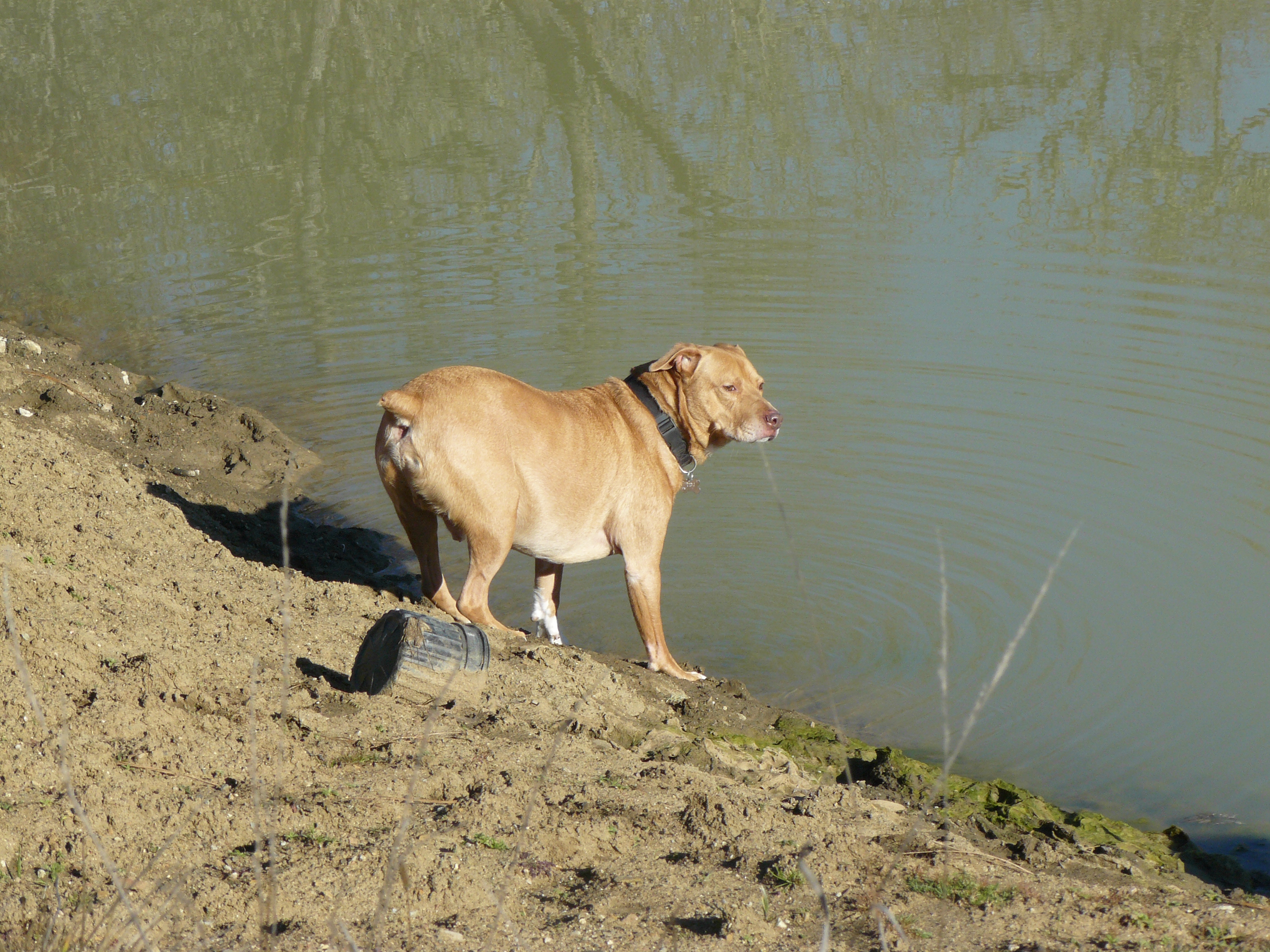
Casey, at home; picture taken a month ago.
Every Friday, the Payson Roundup newspaper would devote a full page to the Humane Society, displaying some of the cats and dogs they had for adoption. I would read about each animal and quietly wish I could bring them all home.
I was particularly taken with one dog that had appeared several times in this Friday page. His name was Casey and he was a six-year-old Pit Bull mix. Unfortunately, at home (we were then living in Payson, AZ) we were ‘maxed out’ with a total of 14 dogs in three different sections of our house. We just couldn’t take Casey.
I had volunteered to be a dog-walker at the Humane Society dog shelter. But after two sessions walking dogs, I just couldn’t look at these sad little faces without breaking down in tears. I switched my efforts to working at the Society’s Thrift Store. That was great fun and, at least, it felt as though I was still helping the animals. Nonetheless, I was very impressed with the animal shelter. They did their utmost to re-home the animals in their care.
Ruby’s ‘pack’ here at home included Phoebe and Tess, rescue dogs from Mexico. Recently, Phoebe had died with leukaemia and Tess with bone cancer leaving Ruby on her own. Ruby was a dog that didn’t mix at all well with the other dogs, as was explained in last week’s post.
The next Friday, the Payson Roundup showed the Society’s ‘lonely hearts club’, highlighting animals that had been in care for a long time. The first dog shown was Casey. I telephone Chandra, the lady responsible for adoptions, and asked if Paul and I could bring Ruby to the shelter to find a companion for her. When we were at the shelter, Chandra asked us if we had anything against Pit Bulls. Of course we didn’t. Ruby was introduced to Casey and, as they say, the rest was history. Casey and Ruby right from the start were just wonderful together.
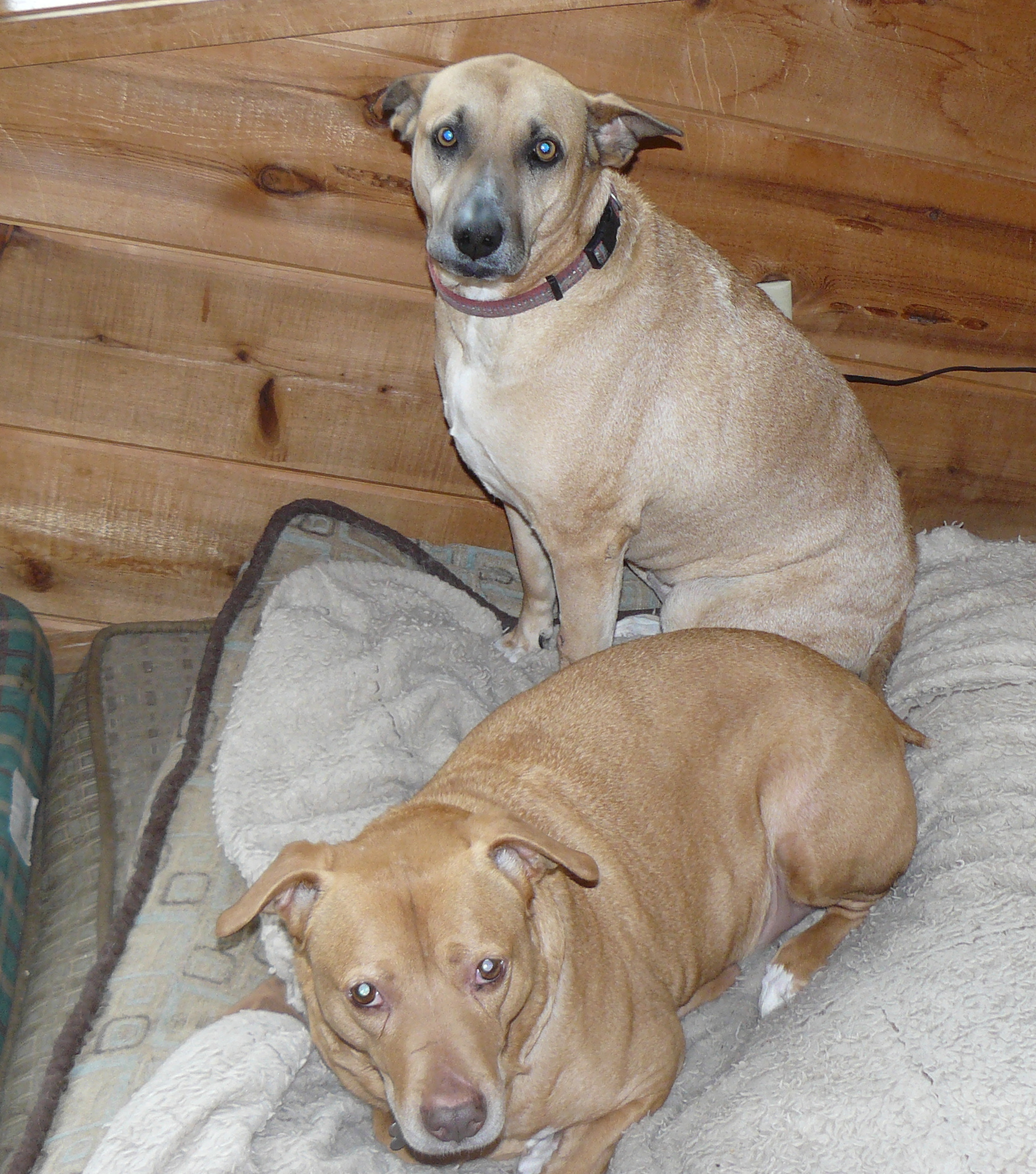
Ruby behind Casey.
Subsequently, I learned from Chandra that Casey had been in care for over a year and, had we not taken him home, his days were numbered at the shelter. There were many cheers and tears when I signed the adoption paper for Casey.
Casey now lives in the kitchen group here in Oregon: Paloma, Ruby, Lilly and Casey. As with all our dogs, Casey is so happy to have our 14 acres to play in. He is also the sweetest natured of dogs and will try to climb on to your lap at the first opportunity. I have always been a great advocate of Pit Bulls and Pit Bull mixes and have never come across a mean one.
Thus, if you are in the position to adopt a dog, please consider Pit Bulls and Pit Bull mixes for the Pit Bull is a much-maligned breed.
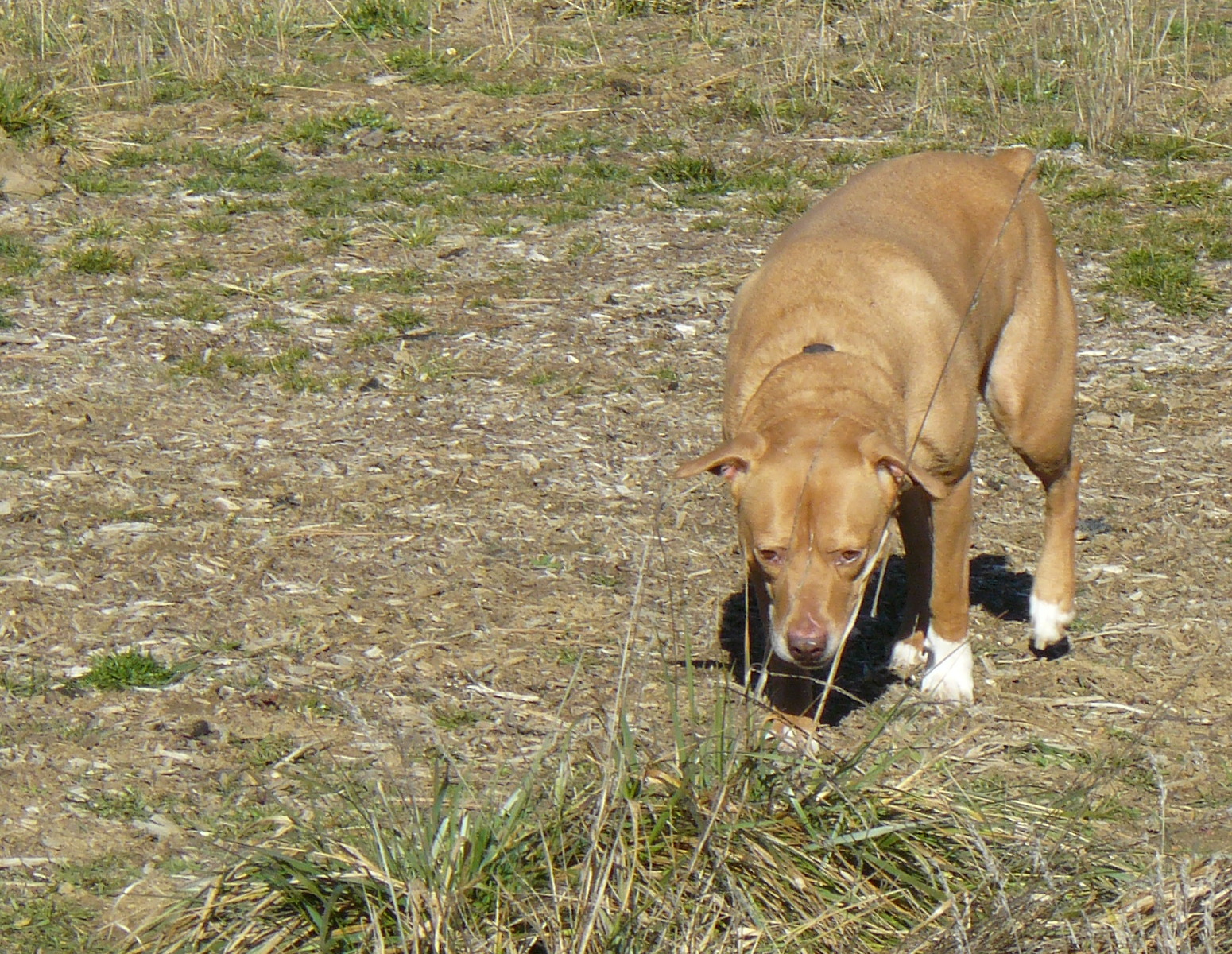
Casey demonstrating a dog’s focussing skills!
ooOOoo
If there is any news about Stella’s fate I will share that with all you dear readers without delay.
Before leaving England in 2008 to be with my Jeannie, I lived in South Devon. Lived in the small village of Harberton, just a few miles west of Totnes. But never had cause to form an opinion, good or bad, of my local police force: The Devon and Cornwall Police. Until now!
ooOOoo
Why Did Police Keep a Dog Locked in a Cage for 2 Years?
Stella has spent the last two years locked in a 3-by-9 foot cage in a kennel in Devon, England. She has never been let out to exercise or play.
In 2014, Stella was taken away by police from her owner, Antony Hastie, because she was “potentially dangerous.” Did she bite or attack someone? No. Under the UK’s Dangerous Dogs Act 1991, Stella is illegal and considered a threat to public safety – but only because of her breed. Stella is a pit bull mix.
Stella was taken to a private kennel owned by Devon and Cornwall Police. She was put in a cage that she has only been allowed to leave twice in the past two years, and only for behavior assessments.
“We were always told not to exercise or go into a kennel with any dogs, regardless of character, that had been brought in under the Dangerous Dogs Act,” Laura Khanlarian, who worked at the kennel, told BBC News.
“We were under no circumstances allowed to touch any of those dogs — which was hard,” Khanlarian said. “Animal welfare comes before anything, and that was my job. I don’t believe I would be doing it properly if I would sit back and think that’s okay. It wasn’t okay — it’s not okay.”
The dogs that were “so kind and needed us the most for reassurance – we were never able to give that to them,” she told SWNS TV.
Khanlarian lost her job when she breached her employment contract by interacting with the seized dogs.
Contrary to Khanlarian’s eyewitness account, Devon and Cornwall Police issued a statement claiming that of the hundred or so dogs they’ve seized over the past two years, Stella was the only one deemed too dangerous to be exercised by kennel staff.
All dogs “must have daily access to outdoor safe and secure areas, away from the kennel area and this should be at least 30 minutes per day,” the guide states (yes, “must” is emphasized in bold).
The Dangerous Dogs Act is breed-specific legislation (BSL), laws that apply only to certain breeds (usually pit bulls). BSL is opposed in the United States by virtually every major animal welfare organization because it punishes well-behaved dogs and responsible owners. Besides, it’s expensive to enforce and has not proven to increase public safety anywhere that it’s been enacted.
“It’s terrible. It’s unjustified. It’s wasting huge amounts of money and it’s not doing a single thing to prevent dog bites,” Kendal Shepherd, a veterinarian and animal behavior expert with 30 years of experience working with dogs, told BBC News. “It’s cruel. But it’s what our system forces us to do.”
Stella’s owner has gone to court 11 times over the past two years, trying in vain to get his beloved dog back. She had never showed any signs of aggression before she was seized, he said.
But Cornwall and Devon Police said — in the same statement in which they claimed Stella was the only dog in their kennel not let out of her cage – that Stella had “threatened and shown aggressive behavior toward two Police Community Support Officers,” had shown “aggressive behavior prior to being seized” and “attempted to bite a court appointed independent expert during the dog’s assessment.”
Last month, Torquay Magistrates’ Court ordered Stella to be destroyed.
Stella’s heartbreaking situation is similar to that of Lennox, a therapy dog from Northern Ireland that was seized because he was perceived to be a pit bull mix. Despite an international outcry and pleas for his life from dog experts like Victoria Stilwell, Lennox was euthanized in 2012.
Several rescue organizations in the United States had offered to take in Lennox, to no avail.
Perhaps Animals R Family will have better luck with Stella. The nonprofit rescue has offered to fly her to its headquarters in Connecticut, where BSL is banned.
“Breed specific legislation is wrong and ineffective. In the US, pit bulls are one of the most popular dogs for family pets,” the rescue wrote on its Facebook page.
Inevitably, this was signed by Jean and me seconds after it was read. Please do everything in your power to support this petition and stand behind Sharon, the originator of the Care2 Petition.
Thank you from all of my being. This is wrong on just so many levels it makes me ashamed to be a human or English. You can not torture and destroy animals because of outdated laws. Henry VIII killed people for not being Christian, where would we be if that was still lawful????? Animals only EVER ask for love. I have been around more animals than I have had hot dinners in my life and I’m 50 now. Someone please help me make this a happy ending.
The behaviour of dogs is always a product of the humans who are around them, it is never a function of the dog alone! (And please see my post tomorrow about our own Pit Bull mix.)
Last week, author and blogger (4am Writer) Kate Johnston published a post about getting 1 million supporters to help save the monarch butterfly. Kate was very happy for me to republish that here on Learning from Dogs. Please read it and sign up.
World Wildlife Fund has set a goal – getting 1 million supporters to help save the monarch butterfly.
Threatened by illegal logging, global warming, herbicide use, and vanishing food source (milkweed) for caterpillars, monarchs are in serious danger.
“Now more than ever, Mexico, the United States, and Canada should increase their conservation efforts to protect and restore the habitat of this butterfly along its migratory route,” said Omar Vidal, Director General for WWF-Mexico.
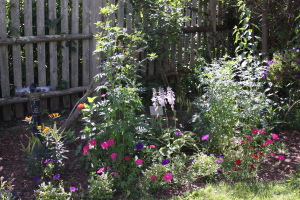
Last year, I began planting my own butterfly garden in an effort to help provide a habitat for monarch butterflies, and any other form of wildlife that might seek food and shelter there.
BEFORE
Ready for planting!
AFTER
Not very organized and probably have too much in there, but I didn’t expect everything to take off the way it did!
Turtles come through my backyard every summer to lay their eggs in the same place. Each generation of turtle somehow knows the exact route, like they have their own inner GPS.See the butterfly in the middle of the milkweed? This is not a monarch, as it has no white spots. I think it might be a fritillary, maybe the variegated species.This is a harmless garter snake, and they love my garden!Just a baby, though. Hubs still took off, so my son had to take the pics.Hubs nearly ran over this guy with the mower. I had to come and get it ‘cuz it’s a snapping turtle!
Spring is just around the corner in the US, and the monarch butterflies will be heading along their migratory route, back to their northern homes. They will be in search of food and shelter. They will need milkweed, the only plant on which they lay their eggs and the one food source for their babies.
If you have a backyard, won’t you consider providing a home for some beautiful monarchs? Even if you’re sans yard, you can still fight for their survival.
We found Kalu lying in a hole at a construction site in Udaipur on October 7, 2015. His face looked like a bomb had exploded between his forehead. The horrific gaping hole was infested with maggots that were literally eating him alive. As soon as our rescuers Ganpat and Kalu Singh brought him back to Animal Aid we decided that euthanizing him would be the best decision. But as Kalu stood there on the examining table, something in his spirit stopped us in our tracks and we knew we had to give him a chance.
So we began treatment on the most heartbreaking wound we had ever before seen.
We put a powder into the wound that kills the maggots and gave him IV fluids while we waited for the powder to do it’s job.
A few hours later we put Kalu under sedation and began to remove the dead maggots, debride and clean the wound.
Over the course of the next 3 months, Kalu astounded us with him strength of will, his incredible healing and all the love he had to give.
Click here to sponsor Kalu’s life-long sanctuary at Animal Aid.
If you would like to make a donation then the charity’s home page is here.
Animal Aid is a vital rescue center, hospital and sanctuary for injured and ill street animals in Udaipur, Rajasthan, India. We rescue thousands of hurt and sick animals each year and provide sanctuary to those who need life-long care.
According to YouTube that video has already been watched over 6.6 million times.
When we let the dogs out last thing on Tuesday evening there was a local pack of coyotes not far from our fence line. Cleo started barking and some of the coyotes responded with their spine-chillingly beautiful howls. The sound really does transport one back thousands of years in a mystical sense.
I started doing some research as to whether we, as in us humans, had studied what the song of the coyote means. I came across The Natural History of the Urban Coyote website and therein was an article called Translating the Song Dog. It’s a fabulously interesting article and I do hope it’s OK to share with you.
ooOOoo
The scientific name for the coyote is Canis latrans, which translates to “barking dog,” a perfect name for this species which has been called the most vocal of North America’s mammals.
Less formally, the coyote is known as the song dog, and one listen to a group howl by a pack of coyotes makes it clear why. Rather than the simple but soul-haunting sound of a wolf’s howl, the coyote’s howl can be made up of high-pitched howls, barks, and yips that make it clear the coyote has a whole lot of lyrics in a single song. But what exactly do those lyrics say?
The coyote has a range of vocalizations depending on social context and message. In 1978, Philip N. Lehner published his research of coyote communication and what the various vocalizations mean, which has been included in Coyotes: Biology, Behavior, and Management.
“The vocal repertoire of the adult coyote contains eleven vocalizations, several of which are also given by pups. These vocalizations grade into one another such that their separation into eleven types is somewhat arbitrary based on their different sounds, behavior context, and physical characteristics.”
In other words, the coyote language is complex and depends on the social situation, the coyote’s body language in addition to the sounds, the intensity of the vocalization, and other factors. This makes sense considering that when one digs a little into hunting forums, some coyote hunters are convinced they know more than eleven calls for coyotes. Indeed, there are likely more vocalizations when one looks at subtleties.
If you have paid close attention the vocalizations of domestic dogs, especially those more talkative breeds, you’ll likely find it easy to decode coyote sounds. There is a lot of overlap in the sounds dogs, coyotes and other canid species make – from a startled huff to a whine of greeting, from an antagonistic growl to a bark of alarm. But coyotes take the language of canids to another level with their extensive list of sounds, especially the yips, howls, and of course their choral group howls.
Though Lehner notes that it’s a bit arbitrary to categorize coyote sounds, we can at least begin to understand them by breaking them down into the types of sounds they make along with their purpose. So he created the following 11 categories, which can also be considered sign-posts on a gradient of meaning and intensity.
Types of Coyote Vocalizations
1. Growl – This vocalization holds no mystery. A growl is used as a threat, specifically for something within close range.
2. Huff – This is the expulsion of air through the nose and mouth, and is also used as a high-intensity threat in close proximity. Huffs are used, for instance, when there’s bickering over carrion.
3. Woof – This vocalization is made as both a low-intensity threat and as an alarm. It’s a sound made when a coyote is startled and unsure of exactly what is happening, but knows it is not comfortable with whatever it is.
4. Bark – The bark is a long-distance threat or alert of low to medium intensity.
5. Bark-Howl – This is when the coyote gets serious about a threat. The bark-howl is used as a long-distance high-intensity threat or alarm. It starts with a bark and blends into a howl.
What is interesting about the bark and the bark-howl is that research suggests that the varying intensity and frequency of barks could contain different information. More recent research by Brian R. Mitchell has shown that coyotes likely identify individuals by their barks and bark-howls.
“By analyzing spectrograms of howls and barks,” writes Mitchell, “I was able to determine that both of these vocalizations do indeed contain individually specific information. Because of the tremendous advantage of being able to determine individual identities, I presume that coyotes use the information in barks to identify individuals they are familiar with.”
“Another interesting aspect of coyote barks and howls,” he continues, “is that howls stably convey information for distances of at least one kilometer. Barks, on the other hand, rapidly attenuated and did not appear suitable for transmitting information. Barks likely serve other purposes, such as attracting information and providing information that listeners could use to estimate distance to the barking animal.”
Barks and bark-howls, then, can serve in saying, “I’m here, and here’s how I’m feeling” and allow listening coyotes to recognize if those individuals are family or strangers. Mitchell underscores that a coyote recognizing an individual by their howl isn’t about the howling coyote shouting his own name again and again; rather it is akin to how we can recognize a family member or friend by the sound of their voice no matter what they’re saying, because of their unique pitch, timbre, cadence and even accent.
6. Whine – This sound is used to express submission and is usually given by a subordinate coyote to a more dominant coyote.
7. Yelp – The yelp takes the whine up a notch and represents high-intensity submission. However, it can also be a response to being startled. As is the case with several other of these vocalizations, this categorization shows that coyote communication is more of a gradient. Lehner writes, “A yi-e-e-e often precedes or follows the yelp portion and resembles a high-frequency bark [and] appears on a sonogram like a short howl chopped into segments.”
8. Woo-oo-wow – This is the “greeting song” of coyotes, and is used during high-intensity greeting displays. The vocalization modulates in frequency and amplitude as a coyote’s motivation shifts, Lehner notes, and so can fluctuate from a whine to a growl.
9. Lone Howl – The lone howl is just what you probably already know it to be: a howl by a single coyote, which is often started with a series of barks that reseracher R. M. Mengel called “herald barks.” As mentioned above, coyotes can distinguish individuals based on their unique howl, and the purpose of the howl is to announce one’s location to others in their social group. Often, the lone howl gets an answer, and the coyotes can find each other to meet up.
10. Group Howl – A group howl is sent up when two or more coyotes come together after being apart, or it could be given as a response to the howls of distant coyotes. It is, according to Lehner, essentially two or more coyotes giving their own lone howls either successively or simultaneously, as a way of giving out location information to any listeners.
11. Group Yip-Howl – This is what coyotes are really known for. The group yip-howl is sent up when coyotes reunite, or just before they separate to go off hunting individually. As more coyotes join in, the more intense the vocalizations become, increasing in frequency and amplitude. Lehner notes that the group yip-howl includes sounds that researcher H. McCarley called screams, gargles and laughs. In other words, the many variations of coyote vocalizations show up in this chorus.
According to Lehner, the group yip-howl probably strengthens social bonds, may help to synchronize mood, and may also reaffirm social status within the pack. He also notes that the group yip-howl “may be most important in announcing territorial occupancy and preventing visual contact between groups of coyotes.”
The chorus tells any nearby coyote packs about whose turf this is, and thus keeps other coyotes away. It also reveals (or hides) how many coyotes are in the area and may help regulate coyote density through reproductive rate. Research has shown that female coyotes will produce larger litters when there is little competition, and smaller litters when there is a high density of coyotes in the habitat. This is one of the secrets to the coyote’s success at spreading across the continent in the last century.
[Note: This is also why indiscriminate killing of coyotes to decrease their density doesn’t work as a management strategy. Coyotes repopulate an area quickly and easily when competition is eliminated, with the population rebounding or even expanding in a very short time. Perhaps a more effective, cost-cutting and non-lethal strategy for reducing the number of coyotes in an area would be playing recorded group yip-howls to make resident coyotes think there is more competition for resources. This is something several researchers have expressed interest in exploring, specifically in order to reduce conflicts with ranchers. If we can discover more about what specific messages are embedded in certain howls or barks, ranchers could play specific recordings to keep coyotes away from livestock as well as minimize the number of coyotes living in an area.]
Mitchell writes, “Group yip-howls are produced by a mated and territorial pair of ‘alpha’ coyotes, with the male howling while the female intersperses her yips, barks, and short howls. ‘Beta’ coyotes (the children of the alpha pair from previous years) and current year pups may join in if they are nearby, or respond with howls of their own. And once one group of coyotes starts howling, chances are that any other alpha pairs nearby will respond in kind, with chorus after chorus of group yip-howls rippling across the miles.”
In Talking to Coyotes with the Song Dog, a pamphlet about using a coyote caller, Major L. Boddicker, Ph.D. brings up a personal experience with such a chain reaction. After sending up what he calls a “Joy of Life Call” which is a group yip-howl, “It sounded like every coyote in the USA responded in the musical see-saw coyote chant which went on and on for 3-5 minutes. I later called a friend in Steamboat Springs, Colorado (150 miles away) to check for the time when the coyotes started to sing there. Given the time it took sound to travel and coyotes to react, I very likely started the chorus.” Whether or not the chorus traveled that far, it is indeed possible to start a chain of coyotes sending up group yip-howls.
Boddicker discusses Lehner’s list of vocalizations in his pamphlet, and brings in two more vocalizations that he or experienced coyote callers have heard. He notes that these my fall into the umbrella categories identified by Lehner, but are distinct enough to point out anyway. They are:
Whoop – This sound is used as part of more complex sounds such as the group howl or group yip-howls.
Yodel – This is when a howl tapers up and ends abruptly, rather than tapering down in a typical howl, which gives the howl a sound like the coyote is asking a question. Boddicker notes that this happens when coyotes howl for an unusual reason such as for a lost family member.
How Many Coyotes Are Howling?
“When people hear coyote howls, they often mistakenly assume that they’re hearing a large pack of animals, all raising their voices at once,” writes Mitchell. “But this is an auditory illusion called the ‘beau geste’ effect.”
Coyotes howl both to reunite and to keep trespassers at bay. It may be in their favor that if they howl, they sound like a bigger pack than they really are. They accomplish complicated and confusing howls by a smart strategy of using wavering howls and changing their pitch rapidly. This, combined with the howls bouncing off objects in the environment such as rocks, trees, or the far side of a valley may make it hard for a listener to know if they are hearing one coyote or several howling simultaneously.
When two or three coyotes howl together, they can sound like a pack of six or ten or more, which perhaps makes them seem much more formidable to any nearby competitors or predators.
Coyotes May Have Local Accents
We know that coyotes vary in size and build depending on their location, as the difference between western and eastern coyotes clearly demonstrates. Does their location also mean they have accents? We know that other species with complex communication such as whales have different accents, so it makes sense that coyotes may also have regional accents. And does that affect how they might interpret or respond to strangers?
Sara Waller, associate professor of philosophy at Montana State University in Bozeman, told the Bozman Gazette, “We know that dogs have ‘accents’ just as people do — we can reliably tell the difference between British dog barks and American dog barks. When we have enough recordings to really compare Eastern and Western coyotes, we may find that like dogs, and people, they have regionally based differences in the way they communicate with each other. This would show that coyote vocalizations are impacted by social and environmental factors just as human speech is.”
What Can Coyotes Teach Us About Language?
There is still so much to learn about what coyotes are saying through their complex and varied vocalizations. The more we learn about the way coyotes communicate as social predators, the more we can learn about not just their species, but our own as well.
Coyotes can sense things we humans can’t, and Waller questions, “How does that impact the way they think? They are social, communicative predators, and so are very like humans in many ways. If we could figure out what some of these vocalizations mean, it would give us insight into how our own language works, and how human minds differ from those of other social predators.”
Examples of Coyote Vocalizations
In the video below, two coyotes give barks and bark-howls as an alarm against the person recording the video:
The person who uploaded this video notes that the coyotes had been hanging around a lot and ventured a guess that is because her dog was in heat. However, the date on the video is in late May, which is about the time when coyote pups are emerging from the den and becoming active around the den site. So it is possible that these are the parents and/or helper coyote keeping a watch on the person taking a video and giving alarm, warning them away from a nearby den.
In the video below, coyotes send up a group yip-howl. Note that the howls do not begin with a bark, like the previous video. As Lehner notes, the group yip-howl starts usually with the dominant individual of the pack. That seems to happen here as the coyote in the video joins in after another coyote begins the howl:
The video below is a coyote group yip-howl, likely started with reunion of group members, and includes yips, whines and other vocalizations on the coyote-sounds spectrum as the members interact. There is so much great behavior and body language captured in this video, showing the group dynamics of submissive members with more dominant members of the pack:
And that beautiful photograph of the howling coyote at the start of today’s post? That came from this website that also included the following that I will use to close this post.
“when the end comes there will be coyotes and coach roaches left in the world and the coyote will eat the coach roach and that will be that!” Some say that “Cher” will still be on tour though.







 Learning from Dogs