Category: Dogs

Dog & Cat Food Recall

This was issued a little over two hours ago!

It concerns possible contamination of food with Salmonella so please read and share as widely as you can.

ooOOoo

Smallbatch Dog and Cat Food Recall of May 2017

May 5, 2017 — Smallbatch Pets Inc. of Portland, OR, is voluntarily recalling two lots of its Smallbatch frozen chicken blend for dogs and cats due to the potential to be contaminated with Salmonella.

About Salmonella

Salmonella can affect animals eating the products and there is risk to humans from handling contaminated pet products, especially if they have not thoroughly washed their hands after having contact with the products or any surfaces exposed to these products.

Symptoms of infection in people include nausea, vomiting, diarrhea or bloody diarrhea, abdominal cramping and fever.

Rarely, Salmonella can result in more serious ailments, including arterial infections, endocarditis, arthritis, muscle pain, eye irritation, and urinary tract symptoms.

Consumers exhibiting these signs after having contact with this product should contact their healthcare providers.

Pets with Salmonella infections may be lethargic and have diarrhea or bloody diarrhea, fever, and vomiting.

Some pets will have only decreased appetite, fever and abdominal pain.

Infected but otherwise healthy pets can be carriers and infect other animals or humans.

If your pet has consumed the recalled product and has these symptoms, please contact your veterinarian.

No pet or consumer illnesses from this product have been reported to date. However, because of their commitment to safety and quality, Smallbatch Pets is conducting a voluntary recall of this product.

Consumers should also follow the Simple Handling Tips published on the Smallbatch Pets package when disposing of the affected product.

What’s Recalled?

The affected lots of 2 pound bags of Smallbatch Chicken Blend were distributed to retail pet food stores in the following states:

  • California
  • Colorado
  • Oregon
  • Washington

Two hundred eighty-two cases of this product were sold between the dates of 2/1/17 and 5/5/17.

The affected products are sold frozen in 2 pound bags.

The products affected by this recall are identified with the following manufacturing codes and “Best By” dates, located on the back of the package.

  • Lot: D032
    UPC: 705105970974
    Best By: 2/1/2018
  • Lot: E058
    UPC: 705105970974
    Best By: 2/27/2018

    What Caused the Recall?

    The recall was initiated after routine testing by the Food and Drug Administration of a 2 pound bag of Smallbatch Chicken Blend that was collected at a distributor revealed the presence of Salmonella.

    This recall is being made with the knowledge of the U.S. Food and Drug Administration.

What to Do?

Consumers who have purchased the above lots of Smallbatch Chicken Blend are urged to stop feeding the product to their dogs or cats and to return product to place of purchase for a full refund.

Or dispose of them immediately.

Consumers with questions are asked to call the company at 888-507-2712, Monday through Friday, 9:00 AM to 4:00 PM PST.

Or via email at info@smallbatchpets.com.

U.S. citizens can report complaints about FDA-regulated pet food products by calling the consumer complaint coordinator in your area.

Or go to http://www.fda.gov/petfoodcomplaints.

Canadians can report any health or safety incidents related to the use of this product by filling out the Consumer Product Incident Report Form.

Get Dog Food Recall Alerts by Email

Get free dog food recall alerts sent to you by email. Subscribe to The Dog Food Advisor’s emergency recall notification system.

ooOOoo

Once again, good people, read and share.

All at Sea!

Just relax and go and paddle a boat!

I was speaking to Angus the dog, by the way!

When the sun is low in the sky!

What dogs mean to us whatever our age!

I chose the title for today’s post deliberately. Wanting it to act as a metaphor for our senior years, as the dear Americans like to put it, or leaning on my English roots, preferring the metaphor of the sinking sun for the Autumnal years of our lives.

We live in a part of the world where “The median age was 47.3 years.”

Josephine County, Oregon

As of the 2010 United States Census, there were 82,713 people, 34,646 households, and 22,498 families residing in the county.[20] The population density was 50.4 inhabitants per square mile (19.5/km2). There were 38,001 housing units at an average density of 23.2 per square mile (9.0/km2).[21] The racial makeup of the county was 92.4% white, 1.4% American Indian, 0.8% Asian, 0.4% black or African American, 0.2% Pacific islander, 1.5% from other races, and 3.2% from two or more races. Those of Hispanic or Latino origin made up 6.3% of the population.[20] In terms of ancestry, 26.3% were German, 15.6% were Irish, 15.5% were English, 5.5% were Italian, and 5.5% were American.[22]

Of the 34,646 households, 25.5% had children under the age of 18 living with them, 49.2% were married couples living together, 11.0% had a female householder with no husband present, 35.1% were non-families, and 28.3% of all households were made up of individuals. The average household size was 2.34 and the average family size was 2.82. The median age was 47.3 years.[20]

Yet in the rural areas of this County one does see a fair number of people who, as with Jean and me, are the wrong side of 65!!

But one very frequent observation of those ‘senior’ people is that they have a dog in their lives.

On April 10th, I posted a guest article written by Jessica Brody. It was very well received and I closed that post by saying: “I know many will agree with me when I say that it would be good to receive some more articles from Jessica.”

Our wishes have been granted. Here is Jessica’s second guest article.

ooOOoo

The Wonderful Benefits of Pet Ownership for Seniors

by Jessica Browdy. May 3rd., 2017

It’s no mystery that pet ownership can bring joy to people’s lives, but it turns out that having a pet may benefit seniors in ways that reach far beyond the pleasures of companionship. For elderly people who live alone or in senior care facilities, owning a pet can improve mental and physical health, paving the way for longer, healthier, and happier lives. Here are five ways that having a critter companion can benefit senior health.
Pets Improve Senior Mental Health
One of the greatest benefits of pet ownership for people of any age is the unconditional friendship and love that a pet provides. This support is especially important for elderly people, who are prone to loneliness and isolation as they leave the workforce, children move away, and friends and loved ones begin to pass on. Isolation is one of the biggest risks to senior health; isolation can cause depression (and related issues), cognitive decline, and even early death. The company of a beloved pet can help seniors stave off loneliness and preserve their mental health. Caring for a pet can also give seniors something to focus on other than negative thoughts about grief, physical ailments, and aging, thereby reducing their overall stress levels.

Pets Keep Seniors Social

Pets do more than provide a social outlet for seniors — they can actually lead the elderly to be more social with their peers as well. People are naturally drawn to dogs, and a senior who is out walking a pet is more likely to meet new people than if walking alone. Pets can help bring people together in senior living facilities, too. Dogs, cats, and other animals give people a common interest over which they can come together, share stories, and develop friendships.

Pets Reduce Heart Attack Risk

Companion animals like dogs, cats, birds, and even fish can improve heart health by lowering blood pressure. One study showed that being in the presence of your dog can even have a greater impact on your blood pressure than some medications. And by lowering blood pressure, pets can reduce heart attack risk in seniors.
Pets Keep Seniors Active
The daily routine of caring for a pet helps seniors maintain functional mobility. Giving food and water, cleaning a litter box, and letting the dog outside makes a sedentary senior get up and get moving. These simple activities can support an elderly person’s ability to complete the activities of daily living like bending, preparing meals, bathing, and dressing. Older people who own dogs are also more likely to stay active into their later years. Not only do they get out to walk the dog, but they’re also more likely to be involved in other active hobbies like gardening.
Pets Improve Senior Personal Care
A senior who has a daily pet care routine is more likely to adhere to a daily personal care routine. Having a routine gives structure to a senior’s days, making it easier to adhere to medication schedules, meal times, and personal care. Maintaining a daily routine can even help seniors sleep better.

Seniors can be saviors to pets, too. When older people adopt adult or senior pets, they provide a loving, stable home to an animal that may not have found a home otherwise. Dogs and cats aged seven and older are adopted at staggeringly low rates, even though they still have years of love to give. Many shelters and rescues even offer discounts for seniors adopting senior pets, so be sure to ask if you might be able to adopt your new friend at a reduced rate.

Image viaPixabay by marmax

Author: Jessica Brody

ooOOoo

Keep them coming, Jessica. (Well that’s the view from this senior!)

Loyalty with a capital ‘L’.

This is almost too beautiful for words.

Recently Jean was sent a link to an item on Mother Nature Network by Trish, a close friend living down in Tucson, AZ. It shows the strength of character of one particular dog but easily serves as a reminder of the power of love, commitment, endurance and loyalty that thousands of dogs exhibit so many times. Qualities that we humans may so easily overlook because our dogs fit so comfortably into the relationship with us.

The article, on Mother Nature Network, was originally published in 2014 and, as the Editor explains:

Editor’s note: This story has been updated since it was originally published in November 2014.

The article is also presented with the enclosed video at the end of the text. But when Jean and I watched the video last night we were so taken by it that I am making an ‘executive’ decision to present the article slightly differently.

In that I think that watching this beautiful, incredible, video first is better.

http://www.youtube.com/watch?v=Fi37_GYRYCs

Now on to the full article that was published on Mother Nature Network.

ooOOoo

Stray dog follows adventure race team for 430 miles

The harrowing story of how the dog finished the race with his adopted companions will melt your heart

Bryan Nelson    March 6, 2017

A stray dog named Arthur made an amazing trek with his new companions. (Photo: TrendingVideos/YouTube)

The Adventure Racing World Series might be the most fraught and challenging sports event in the world. It usually involves teams of four navigating through a vast wilderness terrain while utilizing adventure skills from a range of disciplines including trekking, adventure running, mountain biking, paddling and climbing.

During the 2014 competition, for the first time ever, an exception was made so that one team could finish the race with five members instead of four. That fifth member? A stray dog, named Arthur by his adopted companions, who decided to follow one team for 430 harrowing miles through the Amazon jungle, according to the Daily Mail. If this story doesn’t warm your heart, you don’t have one.

Team Peak Performance, hailing from Sweden, happened upon Arthur while sharing a meal in advance of a 20-mile race stage through rough terrain in Ecuador. Mikael Lindnord, one of the team’s members, felt sorry for the scruffy, lonely stray, and decided to share a meatball with him. It was an innocent gesture — Lindnord had no intention but to lift the poor pooch’s spirits — but it was a gesture that would earn him a friend for life.

As the team got up to continue their race, Arthur tagged along. The team suspected he would eventually turn back around, but Arthur kept following them. He trailed them through muddy jungle, across vast distances of the Amazon river, all the way to the finish line.

The sport of adventure racing is not for the faint of heart — no more for dogs than for humans. During the most harrowing stages of the race, the team tried to shrug off their canine companion over concerns for his safety, but Arthur would have none of it. He was determined to stick with his adopted companions.

For instance, one crucial stage of the race requires the team to kayak along the coast for 36 miles. Understandably, the team was required to leave Arthur behind on the shore. But as they paddled away, Arthur broke free and leaped into the water and began swimming after the team. Realizing that the dog was willing to drown in order to stay with his friends, the team lifted Arthur onto the kayak so the dog could complete the race with them, to sounds of ovation from bystanders watching from the shore.

Arthur’s loyalty paid off in the end; Lindnord was able to adopt him and bring him back to his home in Sweden, where the dog is currently living, healthy and happy.

“I almost cried in front of the computer, when receiving the decision from Jordbruksverket (Board of Agriculture) in Sweden!” reported Lindnord when he first heard that his request to adopt Arthur was granted. “I came to Ecuador to win the World Championship. Instead, I got a new friend.”

ooOOoo

Loyalty with a capital “L”.

Love with a capital “L”.

This picture of Arthur speaks for itself.

In memory of Zeke

A story about the death of a very dear dog.

This is a guest post coming up today. A reflection on what any dog lover feels when their beloved dog dies. (I don’t even want to think about the end of Pharaoh that can’t be too many weeks off!) But as has been said before it is one the key lessons that we learn from our dogs.

Not too many days ago I received an email from Liz Nelson.

I wanted to submit a synopsis of how our fur babies have dealt with the loss of a friend and the addition of another one to see if you wanted to use it as a guest post.

There was no question that I wanted to publish Liz’s synopsis so it could be shared with you. Here it is.

ooOOoo

The death of Zeke

See footnote for details of this photograph.

A little over a year ago we lost our precious Rottweiler, Zeke, to bone cancer.

Zeke, a rescue who still had remnants of buckshot in his torso from his days living in the woods of Mississippi, was with our family for about 8 years. A gentler giant there never was. He and our cat were friends and Zeke frequently bathed the cat’s head and ears. Zeke and our Chow-mix (Fiona) were also very close. We joked he was in love with her because he let her collect all the toys and win at tug-a-war, despite the size difference.

Losing Zeke was a tremendous blow for our household. Both dogs and our 2 cats were visibly impacted by Zeke’s loss. Fiona took it the hardest. She became listless, fatigued, and generally out of sorts. She wasn’t interested in playing and she became an even pickier eater. She would skip several meals in a row and then eat everybody’s food at one time (including the cats’). She and the other animals refused to touch the dog bed in the living room that Zeke had used. She also refused to chew on a large rawhide we found that had once been Zeke’s. It felt like she was saving his things for when he came back to claim them. We noticed the hair under her eyes starting to go gray. She started to show and act all 9 of her years (she’s a rescue and special needs dog so we’re amazed we’ve had 9 years with her).

The vet said we could explore antidepressants but I wanted to see if we could let her try to work through it without medication. Though they remain an option if needed.

In January, my husband said he was ready to think about getting a puppy and several weeks later we adopted an adorable rescue named Pierce. The rescue told us he was part Husky and part Lab. Now that he’s older we think there’s a hefty dose of hound in there. After a few days of wariness and some growling, the older dogs decided to accept the puppy as part of the household. Fiona regained her energy and she was often seen in the yard with the puppy, teaching Pierce how to play fight or stalk birds. She would chase the puppy until they were both exhausted (which we were grateful for). Sometimes she got annoyed with the puppy but for the most part she took on a big sister role.

Fast forward a few months and the puppy is now the biggest dog in the house. While he really is a good dog, he’s still a puppy. Now when he is too energetic there is a lot more of him bouncing around a room. Fiona spends much of her time reinforcing her dominance by taking his toys and putting them under her chin where Pierce is afraid to attempt to retrieve them. She’s stopped running around the yard to play with him. Perhaps because it hurts when you collide with 45 lbs of speeding, clumsy puppy (just ask my husband)? She has gone back to spending most of her time looking pitiful. She will let me pet her though she acts as if it is an imposition.

We’re hoping that when the puppy matures a little more Fiona will regain interest in playing with him. Or at least his behavior won’t annoy her as much. I know that the puppy can never replace Zeke’s place in the family but I really hope Fiona doesn’t spend the rest of her dog life mourning Zeke and ignoring the new dog!

Liz Nelson

Footnote (re the photo above):

I have a great picture of our family with Zeke and Fiona in it (and my third dog). It’s one of our engagement photos and I’m so glad we included the pups. As you can see Zeke was super cuddly! It’s one of my favorite pictures. You can use any of the information in my about section for an introduction. I don’t have it very detailed (I only started this blog this week) so if there is any additional info you want to include please let me know. I looked around for a more recent photo of myself but all of my recent ones are from Halloweens and involve costumes. Not really an everyday look!

So I guess let’s stick with the family photo. Thank you Paul!

ooOOoo

Liz’s website is Supervising With Social Anxiety. Her About page opens with:

I am a supervisor at a small non-profit agency. I’m also in school part-time working on a doctorate. I’m a social worker so I’ve been working in non-profit agencies since I got my master’s degree around 8 years ago. I’ve been in management for around 5 years. I have had to deal with pretty intense social anxiety for as long as I can remember.

Another great connection if you ask me!!

Picture Parade One Hundred and Ninety-Three

Janet Goodbrod just keeps giving and giving!

oooo

oooo

oooo

oooo

oooo

More next Sunday and, thanks to Janet, for quite a few Sundays thereafter.

Talking to one’s dog!

Are you a dog owner? Then here’s something else that you gain from your wonderful friend.

I was rather short on time yesterday so apologies for cutting my introduction to a minimum. But you will still love this item that appeared on the Care2 site three days ago.

ooOOoo

People Who Talk to Their Pets Are Actually Quite Intelligent

If you’ve ever owned a pet, you’ve probably talked to it at one point or another. And even though you may have been fully aware that your pet couldn’t talk back or even really comprehend what you were saying, you still did it anyway.

Why do we do this? Why do we talk to our pets like human friends when we know their little minds just aren’t built to think or feel the same way we do?

When we talk to our pets, we subconsciously create a human-like bond in our own minds with non-human creatures. We’re built for connection — and we feel more connected to things when we recognize that they’re just like us.

Talking to animals (and even to inanimate objects, such as house plants) is called anthropomorphism. We usually call it “cute” when kids do it, but when adults do it, we tend to view it as a little weird and immature.

According to behavioral science professor at the University of Chicago and anthropomorphism expert Nicholas Epley, talking to animals and objects is actually a sign of intelligent social cognition. Humans are very social creatures, so our brains are wired to see faces and perceive minds everywhere.

Epley explains that we anthropomorphize the things that we love as opposed to the things that we hate. The more we like something, the more likely we are to want to engage with its mind — even if it doesn’t actually have a mind.

In a 2011 study where a group of participants were shown photos of baby animals and adult animals, most admitted to liking the baby animals better and were more likely to anthropomorphize them. If the participants could own one of the baby animals, they said that they would name it, talk to it and refer to it by its appropriate gender pronoun.

The most common way we anthropomorphize animals and objects is by giving them names, but it can apply to character traits, too. For example, a person may describe their cat as “sassy” or their car as a “rickety old man.” These human-like character traits given to non-human things reflect our relationship with them and perhaps even symbolize extensions of ourselves.

Anthropomorphizing only benefits us when inanimate objects are involved, but when it comes to anthropomorphizing domesticated animals like dogs and cats, both ourselves and our pets can benefit. Since these animals evolved over thousands of years to become human companions, they are biologically designed to bond with us.

Studies have shown that when we talk to dogs, they can distinguish between the meaning of the words and the emotional cues we give them. Cats may not be as responsive to human language as dogs are, but they do have the ability to recognize their owners’ voices and they also have 16 different types of vocalizations they use to communicate.

So you can let go of the widely held belief that talking to your pet, your houseplants, your car or anything else is childish or even a little bit crazy. From a scientific viewpoint, it turns out that quite the opposite is true.

ooOOoo

Let me close by reminding all you good people of yet another wonderful aspect of the relationship between humans and dogs. In that we all know the dog evolved from the grey wolf. But had you pondered on the fact that wolves don’t bark! Yes, they howl but they do not bark.

There is good science to underpin the reason why dogs evolved barking; to have a means of communicating with us humans.

Every person who has a dog in their life will instinctively understand the meaning of most, if not all, of the barks their dog utters.

A plea for shelter dogs in Oregon

Recognize Rescued Shelter Dogs as Oregon’s State Dog

A couple of hours ago I received an email from Scott Beckstead. Scott is the Senior Oregon Director and the Rural Outreach Director for The Humane Society of the United States (HSUS).

Scott and his wife are two people that Jeannie and I have met and they know that we are committed to supporting the HSUS. Scott was asking in his email that we promote his plea, on behalf of HSUS’s great work in Oregon, for all Oregon residents to support a proposal that comes with the catchy title of Proposal H.C.R. 16.

Because of the immediacy of this campaign, tomorrow is the deadline, I was pleased to publish what Scott sent me without delay.

ooOOoo

In Support of H.C.R. 16

Recognize Rescued Shelter Dogs as Oregon’s State Dog

Dogs are man’s best friend, providing many benefits to their families such as love, loyalty and an improved sense of well-being.  Yet many people are surprised to learn that nationwide, millions of healthy, adoptable dogs are euthanized in shelters annually due to a lack of critical resources and public awareness.

The number of euthanized dogs could be reduced dramatically if more people adopted pets instead of buying them. When families choose to adopt, they save a loving animal by making them part of their family and open up shelter space for another animal who might desperately need it. If more families looking for a pet dog this year would adopt their new furry friend from a shelter, we could put an end to this tragedy.

Animal shelters and rescue groups are brimming with happy, healthy dogs of every breed, shape, size, age, and color, just waiting for someone to take them home. With the help of legislation like H.C.R. 16, we can spread the word about the benefits of adoption and work to end the senseless euthanasia of homeless dogs nationwide.

Shelter dogs make great pets. Please pass this legislation to emphasize the importance of animal adoption with the support of state and national animal sheltering leaders.

oooo

MY TESTIMONY IN SUPPORT OF H.C.R. 16

From: SCOTT BECKSTEAD, SENIOR OREGON DIRECTOR, RURAL OUTREACH DIRECTOR

THE HUMANE SOCIETY OF THE UNITED STATES

This Testimony presented to the HOUSE COMMITTEE ON RULES, APRIL 27, 2017

 Chair Williamson, Co-Chairs Rayfield and McLane, and Members of the Committee:

Thank you for the opportunity to comment on H.C.R. 16, the bill to designate the rescued shelter dog as the official state dog of Oregon. The Humane Society of the United States strongly supports this legislation and urges you to vote YES.

First it is important to recognize this bill is not intended to denigrate reputable breeders of purebred dogs. Rather, it celebrates dogs of all stripes, be they purebred or mutt- and encourages Oregon citizens to consider adopting a dog in need of a home.

With regard to the claim that many Oregon shelter dogs originated in other parts of the country, transporting dogs from areas of over-population into areas where the population of adoptable dogs does not meet the demand is an activity that has been taking place for many years, and has saved countless lives, and created many happy families across the state.   The Society of Animal Welfare Administrators (SAWA) has produced best practice guidelines for transport programs to ensure that both sending and receiving shelters are adhering to the highest standards of animal welfare and health considerations, including but not limited appropriate health certificates and veterinary inspection.

Shelters across Oregon adhere to industry best practices and appropriate oversight.  Contrary to scare-mongering from the National Animal Interest Alliance, there is no data to show that dogs within the Oregon shelter system have higher incidences of temperament issues, health concerns, or that dogs from out of state are displacing Oregon dogs in need.

When a prospective owner buys a dog from a pet store, online seller or flea market, they’re almost certainly getting a dog from a puppy mill. Puppy mills are factory-style breeding facilities that put profit above the welfare of dogs. Animals from puppy mills are housed in shockingly poor conditions with improper medical care, and are often very sick and behaviorally troubled as a result. The mothers of these puppies are kept in cages to be bred over and over for years, without human companionship and with little hope of ever joining a family. And after they’re no longer profitable, breeding dogs are simply discarded—either killed, abandoned or sold at auction.

These puppy mills continue to stay in business through deceptive tactics — their customers are unsuspecting consumers who shop in pet stores, over the Internet or through classified ads. Puppy mills will continue to operate until people stop supporting them. But by visiting your local shelter or rescue and adopting a homeless pet, you can be certain you aren’t giving them a dime.

Dogs and cats share the homes of 65% of U.S. households, providing many benefits to their families such as love, loyalty and an improved sense of well-being.  Yet many people are surprised to learn that nationwide, millions of healthy, adoptable dogs are euthanized in shelters annually due to a lack of critical resources and public awareness.

The number of euthanized animals could be reduced dramatically if more people adopted pets instead of buying them. When families choose to adopt, they save a loving animal by making them part of their family and open up shelter space for another animal who might desperately need it.

Animal shelters and rescue groups are brimming with happy, healthy pets just waiting for someone to take them home. With the help of legislation like HCR 16, we can spread the word about the benefits of adoption and work to end the senseless euthanasia of homeless pets nationwide.

Usually when you adopt a pet, the cost of spay/neuter, first vaccinations (and sometimes even microchipping!) is included in the adoption price, which can save you some of the up-front costs of adding a new member to your family. Furthermore, pets are screened for good health and behavior.

Not only do animals give you unconditional love, but they have been shown to be psychologically, emotionally and physically beneficial to their companions. Caring for a pet can provide a sense of purpose and fulfillment and lessen feelings of loneliness. And when you adopt instead of buying a pet, you can also feel proud about helping an animal in need!

Thank you for considering our position, and for your service to the people and animals of Oregon.

ooOOoo

Let me close with this graphic that Scott also sent me.
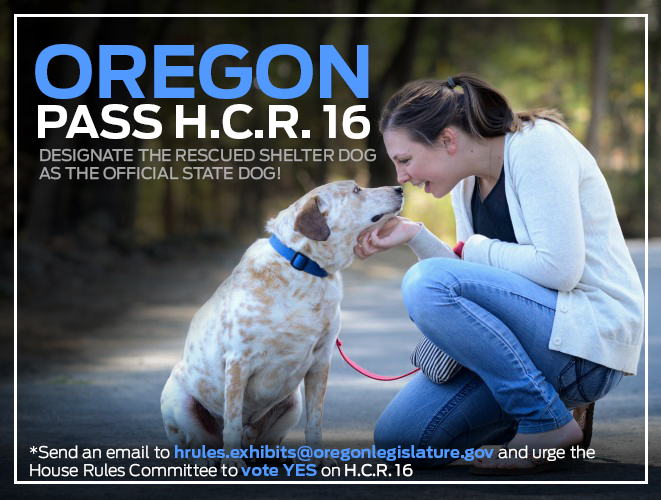
Please, please, if you wish to support this proposed measure then, without delay, send an email now to hrules.exhibits@oregonlegislature.gov asking for a YES vote on H.C.R. 16

Jean and I have just done so.

Chair Williamson, Co-Chairs Rayfield and McLane, and Members of the Committee,

I write to you all on behalf of myself and my wife.

When we moved to Oregon in 2012 we came with 12 dogs many of which were rescue dogs and from animal shelters. We still have 7 dogs.
Shelter dogs make wonderful pets and they always know when they have been rescued from a shelter. They offer such love and gratitude to their loving owners.
Please, Jean and I ask for this measure, Measure H.C.R. 16, to be supported.

Thank you.

Paul & Jean Handover
4000 Hugo Road, Merlin, OR 97532
The Vista Verde Help Fund for strays.

A return to such an important story.

Last week, under the post title of Group Goodness, I put out a plea for anyone who felt so minded to make a donation to this fund. That donate page for this fund being here.

Now it’s very fair to say that there wasn’t a rush of donations. It would be more accurate to say that there were no donations for several days. In fact it is only in the last twenty-four hours that the amount donated has gone from 216 to 244 Australian dollars. (The fund will be transferring those Aussie dollars across to assist John Zande and his lovely wife soon. The currency being used is because it is the sister of John’s wife who is raising the money and she lives in Australia.)

Now it would be very wrong of me to seek the reasons why not a single follower or reader of this place chose not to make a donation. But I will offer this perspective. In that Jean and I wanted to make a second donation and it has taken several days to figure out why our gift wasn’t being processed; the reason being a rather cautious (our) bank attitude to debit card payments being made overseas. So if anyone else has tried to make a donation and the system has got in the way then please do find a solution.

Here’s why!

Because John and his wife, Dionete, are totally immersed in doing their best to help the homeless and abandoned dogs in Sao Paulo, Brazil.

Here are copies of recent emails that John  and Dionete have sent me over the last few days.

20th. April

Morning Paul, I took a camera this morning just to show you the new boy I’m helping. Gorgeous fellow, and young. It never stops. They never stop showing up… which is something I’m sure Jean understands all too well from her work in Mexico.

Again, thank you for your help and posting the campaign.
I queried if this new boy had a name?

No name yet. Can you think of one? I found him on the corner of a street where I feed two (sometimes 3) cats every morning. G’s mum and dad used to live in that street and her dad would feed them. He loved cats, and after he died (and G’s mum moved closer to us) I’ve kept going back. It’s been over a year now that I go there every day, and despite every effort to capture them, I’ve failed. They’re quite feral, but I can’t bring myself to letting them to fend for themselves.

And these are those photos.

oooo

John then continued that same day:

Anyway, the boy showed up about 9 days ago, so on my daily run I feed and water him. G put his pictures on Facebook this morning and a girl (Luiza) responded saying she knows of another lady who’s also feeding him. I saw food there once, on day 2 I think, but none since, so I’m not sure what that’s all about. The girl who actually responded is a part of this loose Vista Verde group. I’ve never met her, but I know of her. We’re helping her as she took in a dog a few months ago that had been hit by a car and is paralysed, but, to her credit, she’s refused to give in and has him in physio (including water treadmills), which is actually showing some positive signs. That’s sort of how it all works. Here’s some pictures and video of that case. Gorgeous dog.

Go here to view those pictures & videos.

The boy is relatively safe where he is. He has shelter, and doesn’t appear to be in any mood to move on, which is good. If he stays put we can help. Finding a home for him is not easy, but after we can find some place as a temporary shelter we’ll get him into the vet, neutered, treated for whatever, then settled. The huge problem is, there simply aren’t any shelters we can just take him to, so we can’t get him off the street and into the vet immediately. Every shelter is over-full, and that makes rescues just that much harder. It’s not the case of simply finding a dog (or cat) and getting them to safety… which is heartbreaking. You just have to hope they stay put. A few times I’ve put a dog in the car and taken them from danger (like near a main road) and brought them up to our area where there are parks and plenty of shelter and people to help. It’s a safe place, and if they stay put we often have successes… But that takes time. But, as I said, he doesn’t seem to want to move on, and he’s starting to put on weight. He was desperately thin, but 500g of mince and a big bowl of dry food every day seems to be doing the trick.

Here’s hoping to a good ending for him.

In speaking with Jeannie about this poor dog she very quickly suggested the name of Socks. John happily went with Jean’s suggestion.

21st April

Hi Paul, just a quick update on socks. Luiza (the girl I mentioned yesterday) has found temporary shelter for Socks for one month. It’s not long, but will give us the chance to neuter him and do all necessary blood work. Finding him a home is the next hill, but I spent time with him this morning, just sitting with him, and he’s really a lovely, gentle fellow, so here’s hoping.

24th April

Socks update: His shelter home is ready today, we’ve been told. That, however, might now not be needed. Sunday I saw he now has a huge dog house on the footpath, with blankets, food and water. He wasn’t interested in the mince I brought him, so I just left some chewing treats. Same thing this morning (I’ve just gotten back). So, we’ll go back later today just to speak (again) to the people in the street (we don’t know who exactly put the dog house there), and it might be the case that he just goes straight to the vet for neutering, maybe a few days in the shelter for recovery, then back to his house while (if still needed) we look for a permanent home/family.

April 25th.

Hello Paul – I can see you’ve been playing “email tennis” with the gofundme staff  –  good to read they (finally) managed to sort it out.

We saw Socks today. Apparently a bunch of neighbours got together to feed and take care of him, albeit on the street (he was given a 2nd-hand doghouse & doona (oops, duvet)). One of the guys has been thinking of taking him to his country house; an acquaintance of mine knows of somebody who might adopt him. Yes, everything’s still in the air, but he has it much much better than other dogs we’ve found and helped.
Now we can book his neutering/vaccine.

As for me, I don’t have enough words to thank you & Jean. Truth to be told it feels a bit weird to be the beneficiary of a campaign. We’ve always helped others and suddenly seeing ourselves in this position is a tad uncomfortable, actually – which doesn’t mean this money is not welcome, considering all the cases we’ve had so far this year.

Fingers crossed it all works out for Socks. We’ll keep you posted.

So, good people, this is why I beseech you to please support what John, Dionete and his close group are doing on behalf of those dogs down in Brazil. Please make a donation!

Picture Parade One Hundred and Ninety-Two

The third and final set of Janet Goodbrod’s images.

oooo

oooo

oooo

Weren’t they wonderful. If only there were more!

Well, there are! 🙂 And from the same lovely lady.

So here’s a taster for more over the next few weeks.

oooo

oooo

oooo

oooo

oooo

And wasn’t that last one simply stunning!

Be happy good people!