Ironically, we are away this day but here are the ‘stats’ from yesterday, the 14th:
594,721 individual viewings
449 subscribers
An average of 1,300 readers a day (and still growing!)
3,705 comments in this period
Nearly 1,372 posts since the start
It seems a rather trite thing to say but, trust me, this is said from the bottom of my heart. All of you who come to Learning from Dogs, whether just a couple of times or most days, have made this a wonderfully creative three years for me.
THANK YOU ALL!
And now here’s a republication of that very first post back on July 15th, 2009.
Parenting lessons from Dogs
Much too late to make me realise the inadequacies of my own parenting skills, I learnt an important lesson when training my GSD (who is called Pharaoh, by the way). That is that putting more emphasis into praise and reward for getting it right ‘trains’ the dog much quicker than telling it off. The classic example is scolding a dog for running off when it should be lots of hugs and praise for returning home. The scolding simply teaches the dog that returning home isn’t pleasant whereas praise reinforces that home is the place to be. Like so many things in life, very obvious once understood!
Absolutely certain that it works with youngsters just the same way.
Despite being a very dominant dog, Pharaoh showed his teaching ability when working with other dogs. In the UK there is an amazing woman, Angela Stockdale, who has proved that dogs (and horses) learn most effectively when being taught by other dogs (and horses). Pharaoh was revealed to be a Beta Dog, (i.e. second in status below the Alpha Dog) and, therefore, was able to use his natural pack instinct to teach puppy dogs their social skills and to break up squabbles within a pack.
When you think about it, don’t kids learn much more (often to our chagrin!) from other kids than they do from their parents. Still focusing on giving more praise than punishment seems like a much more effective strategy.
As was read somewhere, Catch them in the act of doing Right!
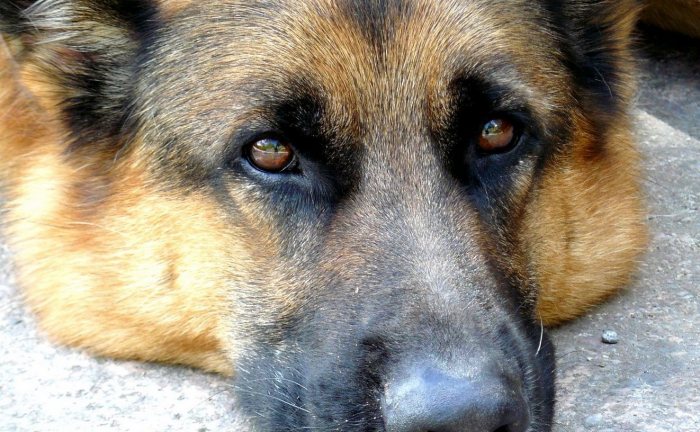
He lay there, on the hard concrete, motionless, his eyes linked to mine. Linking our two very different species in a bond that defied rational description. A bond across not only two radically different creatures but across the tens of thousands of years since species dog embraced species homo sapiens, that is the hunter-gatherer version.
Such history of intimate co-operation shining out from those quiet, wise, brown eyes. Impossible not to sense the linking of souls as each gazed into the eyes of the other. The arm of the man reached behind, found the camera, and captured forever this magic.
Some of us think holding on makes us strong; but sometimes it is letting go. Hermann Hesse
Nuneaton in Warwickshire is a town about 100 miles North-West of London. It’s firmly in that part of England known as the Midlands, encircled by such places as Birmingham, Coventry, Rugby and Leicester. It is also the home of the Nuneaton & Warwickshire Wildlife Sanctuary So what, you might ask?
Watch this!
On the Wildlife Sanctuary’s website, there is the story of Jasmine,
Jasmine was a rescue dog who lived at the sanctuary until her passing in 2011. She was no ordinary rescue dog, she was the most amazing greyhound in the world!
She was only a young pup when she was locked in a shed and abandoned. When she was discovered by the police many days later she was emaciated, mange ridden and terrified. She was taken to the RSPCA quarters in Coventry where Geoff just happened to be visiting several weeks later. They were introduced and as they say ‘the rest is history’. She came to live with Geoff at the sanctuary. Each day her confidence grew and her personality flourished. But the most amazing thing was yet to come….
It turned out Jasmine was a natural ‘Mother hen’. One day a young fox cub was brought in to the sanctuary. She had been tied to railings and left to die. She was very small and weak and the outlook wasn’t bright. That was until Jasmine sauntered over to the fox cub’s basket and started to lick her. Geoff was immediately concerned, followed by bemusement, followed by amazement as he saw before his eyes the fox responding to Jasmine’s touch. He quickly realised that Jasmine was acting in the same way the fox cub’s mother would have done in the wild!
Over the next few days Jasmine continued to ‘mother’ the fox cub who Geoff had named Roxy. Roxy grew strong and grew up. She lives at the sanctuary with Jasmine who is mum and best friend all rolled into one.
Jasmine was truly one of a kind. She mothered many of the sanctuary’s residents back to health including Bramble the roe deer, Humbug the badger and two of the other sanctuary dogs, just to mention a few.
Sadly Jasmine passed away in 2011. She is greatly missed by all at the sanctuary.
So what’s Geoff’s story? That is beautifully explained here,
In February 2001, an injured swan was taken to a veterinary clinic in Warwickshire. The swan was injured, but needed only a week of rest before it was able to be released back into the wild. However, there was nowhere in the area for the swan to rest and receive care, so it was put to sleep. This was when Geoff decided to set up the sanctuary.
Geoff had worked as a security guard for many years but was injured at work and forced to retire. He used his savings to transform his garden into a haven for wildlife and has never looked back.
Geoff, all the caring people in the world salute you!
As of 2011, the Sanctuary has been open for ten years, and has had 6,500 birds and 4,250 animals.
The Sanctuary relies on the work of our dedicated team of volunteers; who accompany us on fundraising events, talks, and shows to help raise money for the Sanctuary.
So let me close by thanking Suzann for sending me the video link to this beautiful story. And do make a note to look in on Learning from Dogs next Saturday to marvel at yet another example of the way dogs (and Geoff!) throw off their pasts and rejoice in the present.
Yesterday’s article reminds me of something fundamental!
In Patricia’s guest post of yesterday, she wrote about Chloe, her dog,
Chloe was born knowing. She knows about joy. She knows about living a life in balance. She knows about forgiveness, trust, exuberance, a passion for learning and the power of a good nap.
I was speaking with Jon Lavin a few days ago about the effect of anxiety on memory. Jon confirmed that as we get older even low levels of anxiety can play games with our mental focus. He described what many of us know – of walking into a room, for instance, and suddenly realising that you didn’t have a clue as to why you had come into the room! In a very real sense anxiety is the body’s manifestation of fear.
Jon went on to say that practicing ‘letting go’ for a couple of 10-minute sessions a day is wonderfully therapeutic for the mind. In fact, when Jon was a guest author for Learning from Dogs he touched on the subject of fear in a post almost two years ago to the day; Dealing with the fear of the known. Indeed, I’m going to reproduce that article in full – here it is,
Jon Lavin
Can we ever conquer fear?
In a recent article I discussed the fear of the unknown, linked to the down-turn, redundancies, etc.
Per Kurowski, a great supporter of this Blog, posed the following question. “Great advice… but how do we remove the fear of what is known?” A simple, and slightly flippant answer would be, “Develop a different relationship with it.”
What I’m saying is that when we are facing the known, and I’m assuming that it’s something unpleasant, our choices are limited. It’s going to happen, so the only thing we can do is change the way we view it.
This brings us back full circle to developing a different relationship with it. Let’s take the word, ‘fear’.
“All fear is an illusion, walk right through“. I heard Dr David Hawkins say on a CD. Granted, a great trick if you can do it!
Here’s another description of fear: Fear = False Evidence Appearing Real
Fear is generally future-based. We tend to use the past as a learning reference to inform us of what to be afraid of in the future. So human beings live their lives trying to predict and prepare for the future, limited by their past experiences.
Unfortunately, the only way to work with fear of the known is to live in the present!
Our whole society is geared up to look into the future. We are forever worrying about or planning something for the future.
To begin focussing on the present, try this.
Simply, to start off, become aware of the breath and sensations in the body. This will slowly start to remind us to be present, or embodied, in our own body. Problems, fear and spiral thinking, often at 3 or 4 in the morning, are generated in the mind. Thoughts occur randomly, although we call them, “Our thoughts“, and refer to, “Our mind“.
By dropping out of the thought processes into the awareness of our breath and our body, the noise stops, even if only for a moment. Here’s the rub: So very few people in the world will have even the slightest inkling what these words mean!
If more of us got used to coming out of the mind before making an important decision, and simply sat with the question for a while, the answer would probably present itself.
This will probably raise more questions than it answers but that’s not a bad thing.
Difficult to add anything to that very sound advice save to try it out yourself, and if you own a dog or have one as a friend, just look much more closely at how he or she behaves and remember why this blog is called what it is! Or as Trish wrote,
Chloe was born knowing. She knows about joy. She knows about living a life in balance. She knows about forgiveness, trust, exuberance, a passion for learning and the power of a good nap.
Regular readers will know that one of my joys of this blog writing game is the wonderful connections that are made across this funny old virtual world. Trish Iles is one of those wonderful connections.
In fact, Trish is based at our local insurance firm, Crabdree Insurance, right here in Payson but until we ‘chit-chatted’ about writing a guest post for Learning from Dogs I had no idea there is much more to this lady.
To underline that, anyone who has their own blog called Contemplating Happiness will inevitably generate some curiosity. That curiosity increases as one learns more about Trish and discovers that she is a published author.
Anyway, that’s enough from me, here is Trish Iles writing What the dog knew!
oooOOOooo
The wisdom of Chloe
I was pondering the eternal question: why does two weeks of relaxing vacation seem like so much more time than two weeks of working like my pants are on fire, here at my desk? My sweet husband and I talked about it a little bit, but came to no definitive answer. I chatted with friends about it. No insights. Google had no opinion, either.
Chloe came to us from a rescue organization. I think sometimes about what her experiences have been in her young life. She started out as an abandoned puppy on a reservation in New Mexico and was soon in the pound where she was on the euthanasia list. A kind woman rescued her and took care of her until she found us: just when Chloe was becoming at home with the rescue lady, she was uprooted again and sent home with two new people. What must she have been thinking?
Chloe didn’t close her heart to us, though. She watched for a few days. When she decided we weren’t going to make dinner out of her and that she was really staying with us, she threw her whole being into becoming one of the family. She let herself trust us.
I’m not sure I would have had the courage to trust a new set of people again. I’m doubly not sure that I give a rat’s patootie what those new people thought of or wanted from me. Chloe was willing not only to trust us, but to love us. She forgave us immediately for ripping her from the home she knew, and she adopted us right back.
Chloe was born knowing. She knows about joy. She knows about living a life in balance. She knows about forgiveness, trust, exuberance, a passion for learning and the power of a good nap. I think that when I grow up, I want to be just like her.
oooOOOooo
Don’t know about you dear reader but I just loved that story from Patricia. Deep messages about what we can learn from our wonderful canine friends.
Indeed, I’m going to stay with the theme with tomorrow’s Post.
But before I get my blood up, let me reflect on a small passage of time. I first started writing this Blog on July 15th, 2009, coming up to three years ago. The idea came from a previous conversation with Jon Lavin of The People Workshop when we were chatting about Dr. David Hawkins’ Map of Consciousness and Jon pointed out that dogs had a ‘score’ of about 210, i.e. were positively above the boundary between truth and falsehood. As I wrote here,
value and cherish the ‘present’ in a way that humans dream of achieving
are, by eons of time, a more successful species than man.
That’s why the blog is called Learning from Dogs!
Stay with me just a little longer.
The picture of Pharaoh on the Home page, this one:
Dogs know better, much better! Time again for man to learn from dogs!
is a picture of a ‘beta’ dog. The beta dog is the second-in-command, so to speak, in a wild dog pack. A dog pack, about 40 to 50 dogs in the wild, has three dogs of special rank, although rank is not really the correct word, role is a better one. The leader of the pack is the alpha dog; always a female dog. The next role dog is the beta; always a male. The third role dog is the ‘clown’ dog and can be either sex.
In reverse order, the clown dog is there to keep the pack happy (in dog terms), the beta dog’s role is to break up fights within the pack and to ‘teach’ the puppies their social skills (which is why a beta dog is always a dominant male) and the alpha’s primary role is to ensure that the pack’s territory is not compromised by other animals and that there is plenty of food for the pack.
Ergo, the single most important decision of the alpha dog is to move the pack to a new territory when she judges that the present one is unsustainable!
OK, to my ‘rant’!
Why isn’t mankind learning from dogs and realising that our present ‘territory’, Planet Earth, is not capable of sustaining mankind for very much longer.
I don’t believe that man is intrinsically stupid! Many know the famous quotation from Einstein, “Insanity: doing the same thing over and over again and expecting different results.” So if most of us ‘nod’ our heads when we read that quote, why are most of us seemingly content to keep doing the same thing? Why isn’t there such a huge outpouring of anger at the complacency of the world’s leaders? How far does the collapse of the conditions, both social and physical, as in biosphere, have to go before we get real, urgent change?
Last Thursday, in a post I called Denialists standing up for insanity, I quoted Tom Engelhardt in his introduction to an article by Bill McKibben thus,
It’s true that no single event can be pinned on climate change with absolute certainty. But anyone who doesn’t think we’re in a fierce new world of weather extremes — and as TomDispatch regular Bill McKibben has suggested, on an increasingly less hospitable planet that he calls Eaarth – is likely to learn the realities firsthand soon enough. Not so long ago, if you really wanted to notice the effects of climate change around you, you had to be an Inuit, an Aleut, or some other native of the far north where rising temperatures and melting ice were visibly changing the landscape and wrecking ways of life — or maybe an inhabitant of Kiribati. Now, it seems, we are all Inuit or Pacific islanders. And the latest polling numbers indicate that Americans are finally beginning to notice in their own lives, and in numbers that may matter.
Well it’s good that Americans are starting to get the picture but it’s all too gentile – we all have to get much more excited about making our leaders understand that we want action to curb CO2 emissions, and we want action NOW!
Year-to-Date divisional temperature rankings from NOAA.
More about that tomorrow!
OK, only a short rant! Which is immediately followed by an apology! Because you will have to wait 24 hours before reading my next Post about fracking, about how some ‘leaders’ expect the CO2 emissions in the earth’s atmosphere to stabilise at 650 ppm and how very close we are to losing control!
Back on the 25th April I ran a Post called Dogs and the Mathematics of Calculus that had been prompted by a lovely email from Richard Hake who is Emeritus Professor of Physics at Indiana University. (Now here’s a question for yours truly; what does it mean for a Professor to be an Emeritus Professor? Answers as comments please.)
It was very well received. Then just a few days ago Professor Hake, who admits to being a dedicated lurker of this blogsite, sent me another email with a number of fascinating links. So here goes with one of those links.
Talking to Your Dog About Physics
A conversation with Chad Orzel
So, why do you talk to your dog about physics?
Lots of reasons, but the main one is that I’m a physics professor. Talking about physics is what I do. Sooner or later I talk to everybody about physics.
I bet that’s a big hit at parties.
You might be surprised. I mean, sure, I get a lot of people making faces and saying how much they hated physics when they took it in college. But some of those same people turn right around and start asking interested questions about the subject.
OK, but why the dog?
Talking to the dog about physics is worthwhile because it can help me see how to explain physics to my human students. Humans all come at the subject with the same set of preconceptions about how the world works, and what “should” happen, and it can be very hard to shake those off. That’s a big barrier to understanding something like quantum physics.
Dogs look at the world in a very different way. To a dog, the world is a neverending source of wonder and amazement. You can walk your dog past the same rock every morning, and every morning, she’ll sniff that rock like she’s never sniffed it before. Dogs are surprised by things we take for granted, and they take in stride things that would leave us completely baffled.
Can you give an example?
Well, take the dog’s bowl, for example. Every now and then, we put scraps from dinner in the bowl when she’s not looking, and she’s become convinced that her bowl is magic– that tasty food just appears in it out of nowhere. She’ll wander over a couple of times a day, and look just to see if anything good has turned up, even when we haven’t been anywhere near the bowl in hours.
This puts her in a better position to understand quantum electrodynamics than many humans.
It does?
Sure. One of the most surprising features of QED, in Feynman’s formulation, is the idea of “virtual particles.” You have an electron that’s moving along, minding its own business, and every now and then, particle-antiparticle pairs just pop into existence for a very short time. They don’t stick around very long, but they have a real and measurable influence on the way electrons interact with each other, and with other particles.
You’re making this up, right?
No, not at all. One set of these interactions is described by a number called the “g-factor” of the electron, and this has been measured to something like fifteen decimal places, and the experimental measurement agrees perfectly with the theoretical prediction. If there weren’t electrons and positrons popping out of nowhere, there’s no way you could get that sort of agreement.
So, what’s this have to do with the dog?
Well, like I said, the dog is perfectly comfortable with the idea of stuff popping into existence out of nowhere. If a great big steak were to suddenly appear on your dining room table, you’d probably be a little perturbed. The dog, on the other hand, would feel it was nothing more than her due.
So she’s perfectly ok with the idea of virtual particles, unlike most humans, who tend to say things like “You’re making this up, right?” She was already convinced that there were bunnies made of cheese popping in and out of the backyard, and just regards QED as a solid theoretical justification for her beliefs.
And this helps humans, how, exactly?
Physics has a reputation as a difficult and unapproachable subject, especially in fields like quantum mechanics, where the predictions of the theory confound our human preconceptions. If you can put aside a few of your usual notions of how the world works, and think about how things look to a dog, some aspects of physics that seem absolutely impossible to accept become a lot more approachable.
Why does this matter, though? Isn’t this all stuff that you need a billion-dollar particle accelerator to see?
Actually, no. It’s a common misconception, but most of the really cool aspects of quantum mechanics that we talk about in the book are experiments that are done on a table-top scale. One of them, the “quantum eraser,” you can even do yourself with a laser pointer and a couple of pairs of polarized sunglasses.
OK, but what is it good for, in a practical sense?
Lots of things. It’s not an exaggeration to say that modern life as we know it would be impossible without an understanding of quantum phyiscs. You need to understand quantum ideas to build the lasers we use in modern telecommunications, and the transistors that are the basis of all modern electronics. The computer I’m typing this on wouldn’t exist without quantum physics.
And there are a whole host of future technologies that are based on quantum ideas. There are exotic applications like quantum computers that can do calculations that would be impossible with any normal computer, and quantum cryptography systems that allow us to make unbreakable codes. But even relatively mundane “green” technologies like more efficient light bulbs, batteries, and solar panels rely on quantum ideas to work.
Quantum physics is everywhere, and drives a huge amount of modern science and technology.
So that’s why people should teach quantum physics to their dogs?
Exactly. Also, it’s just about the coolest thing ever.
OK, two thoughts to close this off. The first is to remind you of an early sentence that Chad Orzel wrote, “Talking to the dog about physics is worthwhile because it can help me see how to explain physics to my human students.” and to add that in my next life, I wouldn’t mind coming back as one of Chads dogs!
The second thought is that Chad’s talks with his dogs are pretty relaxed affairs, as the picture above bears out!
The second fascinating contribution from a guest author.
On Monday I mentioned that I had been approached by two authors who wanted to share their articles with the readers of Learning from Dogs and on that day I published a guest post from Dr. Jane Brackman. Today, I’m delighted to share with you the thoughts of the second of those authors, Kylie Dunning, who describes herself as a writer who holds a strong passion for Psychology, especially in the field of Forensics. She is a lover of animals and an avid hiker in her spare time.
Trainer Julio Simuel (left) watches as his student “Walker” gets congratulations from admirers following a graduation ceremony at Nash Correctional Institution last Wednesday.
Here now follows Kylie’s essay,
Psychology of Healing: Dogs and Inmate Rehabilitation
In 1981, Sister Pauline Quinn envisioned a prison pet partnership program where inmates would train dogs for people with disabilities. Designed to benefit unwanted dogs, the inmates, and the future dog owners, the program was initiated in the Washington state prison for women. The success of the program led to dog training programs in prisons all over the country and has since become part of the material in forensic psychology programs and criminal rehabilitation programs.
Male and female inmates train anywhere from three to fifty dogs at a time for adoption into new families, as service animals, and sometimes for specialized purposes such as bomb-sniffing. There are other benefits. The prisoners who worked as trainers hope to find jobs in animal care as soon as they leave prison. Others, serving longer sentences, are given a sense of purpose and an improved outlook. Psychologically, having a dog to care for serves as a form of therapy and decreases depression, and it brings out good qualities in the inmates, even improving their attitude toward each other.
The Nash Correctional Institution in North Carolina has a program called “New Leash on Life,” in partnership with Southern Siberia Rescue, which pays for all the food and medical treatment for the dogs. Three dogs at a time are trained for eight weeks, then offered for adoption. Jerome Peterson, who has served 19 years for a second-degree murder charge, is one of the trainers. He says that teaching the dogs has taught him compassion and made him a better man. “You have to be patient with the dogs,” he explained. “Some have been abused, and some were left stranded.” He says that though only six of the inmates train the dogs, all 980 of the inmates at the medium-security prison benefit from the program. “A lot of guys wake up mad at the world for no reason,” he said. “When they see the dogs, they get happy — excited. Their whole demeanor just changes.”
Lansing Correctional Facility in Kansas, a combined medium- and maximum-security prison, has a population of 2,500 criminals. Their Safe Harbor Prison Dog Program rescues dogs from death row. About 50 of them are trained by about 100 inmates on any given day. So far, about 1,200 dogs of all breeds and ages have found new homes under the program. Inmate Jerry McMullin trains his dogs in 15-minute intervals four times a day, rewarding them with treats he buys for 45 cents a pound at the canteen (out of the dollar a day he earns at his prison job—prisoners aren’t paid for training the dogs). “You don’t want to work with them too long or they stop paying attention. They get bored,” he says. “I use no force or fear, positive reinforcement only.” Inmates like Pete Spencer will go to lengths to help troubled dogs. “I had one who was so physically abused, he had no trust in humans,” Spencer says. “I slept on the floor with him for a month to get his trust and then I taught him commands.”
The inmates can see positive changes from working with dogs. Spencer says of his fellow inmate, “When I first met (McMullin), he was … well, pretty grouchy,” Spencer says. “Now he’s more open and alive and he has a positive outlook.” Other work programs can help prepare inmates for a job after release, but working with dogs may psychologically be a more effective way to rehabilitate them. With prison populations stressing already taxed resources, and the more and more animals in need of homes, the use of dog training programs in prisons is more than a happy accident. It is a creative way of using state resources to do real and lasting change in society.
oooOOOooo
Well what another wonderfully interesting guest post. Thank you, Kylie. More please!
Using details in Kylie’s article, it was very easy to find this video, plus the photograph at the head of the article came from the Southern Siberian Rescue website.
Homeless dogs are getting special help from inmates. The Columbia County Sheriff’s Office has launched their own “New Leash on Life” program that benefits inmates at the Columbia County Jail and the dogs.
Dear readers, from time to time I am approached by other authors who have flattered me by asking if I would like to publish their Blog posts from time to time. So I have been doubly flattered by having two authors contact me in the last week.
So to the first. It is with great pleasure that I welcome Jane Brackman, Ph.D., author of the blog Doctor Barkman Speaks who will, from time to time, republish her posts on Learning from Dogs. I have no doubt that you will enjoy her scientific expertise regarding dogs
So today, please enjoy …
oooOOOooo
HOW DOGS THINK – NEW SCIENCE LOOKS INSIDE THEIR MINDS WITH MRI IMAGING
Canine illustrator Robert Dickey assigned thoughts and feeling to his Boston Terrier based on the dogs’s expressions. Here he illustrates contentment, sympathy and misery. (Dogs from Life, Page & Co., 1920)
**
“Are you gonna eat that? Are you gonna eat that? I’ll eat it.”
Is this what dogs think? Or do they experience more complex thoughts? Apparently science is getting pretty close to figuring it out. If not exactly WHAT they’re thinking, then where in the brain the thoughts are coming from. Since brains are pretty much the same across mammal species, if researchers identify which parts of the the brain light up, based on what humans have said, they can guess what the dogs’ thoughts are, too.
A couple of smart guys, Gregory Berns and Andrew Brooks of Emory University, watching a military dog assist Navy Seals as they overran the Osama Bin Laden compound, got a brilliant idea. If you can teach dogs to jump out of helicopters, surely dogs could be trained to enjoy themselves inside an fMRI machine while scientists calculate what the dogs are thinking by scanning their brains.
The researchers, who are dog-lovers, explained, “We want to understand the dog-human relationship, from the dog’s perspective. From the outset, we wanted to ensure the safety and comfort of the dogs. We wanted them to be unrestrained and go into the scanner willingly.”
So they recruited a professional dog trainer, Mark Spivak, and two companion dogs, a Feist Terrier named Callie and a Border Collie named McKenzie. The team said that both dogs were trained over several months to walk into an fMRI scanner and hold completely still while researchers measured their brain activity.
In the photo below Callie wears ear protection as she
prepares to enter the scanner. The research team
includes, from left, Andrew Brooks, Gregory Berns and Mark Spivak.
(Credit: Photo by Bryan Meltz)
This is what the researchers wrote in the journal article that was published in PLOS last week:
Because of dogs’ prolonged evolution with humans, many of the canine cognitive skills are thought to represent a selection of traits that make dogs particularly sensitive to human cues. But how does the dog mind actually work? To develop a methodology to answer this question, we trained two dogs to remain motionless for the duration required to collect quality fMRI images by using positive reinforcement without sedation or physical restraints. The task was designed to determine which brain circuits differentially respond to human hand signals denoting the presence or absence of a food reward.
Eventually they hope to answer the more profound questions we all ask: Do dogs have empathy? Do they know when we are happy or sad? How much language do they really understand?” (And here’s one from me- When they pee on the carpet and we don’t find it until the next day, when we scold them do they know why we are scolding them?)
Well, I don’t know about you but I found this a most fascinating article. All of us who live around dogs, both physically and emotionally, sense the closeness, may I use the word ‘magic’, of the relationships.
Take a look at the photograph below. Until I left the UK in 2008, a few of us owned a lovely old Piper Super Cub. It was a joy to fly. I used frequently to take Pharaoh to the grass airfield, Watchford Farm, up on the Devon moors. One day he showed such interest in the aircraft that I lifted him up to the passenger’s seat, strapped him in and taxied all over the grass airfield. This picture shows something that is difficult to explain otherwise – Pharaoh’s real joy at sharing the adventure. Of course, I didn’t fly with him, that would have been a step too far, but we did taxi almost up to take-off speed. Dr. Barkman, what do you make of that?
Some of life’s lessons are easy to learn – once we have been taught!
Readers be warned! This is one of my more subjective posts written in the hope that many will ‘connect’ with the emotions expressed.
Learning touch from Casey
I want to explore the power of touch.
Not just in a direct manner such as a hug or an arm around the shoulder but also the way that love can reach out and ‘touch’ us from afar. I’m going to do that by recounting something that Jean and I have experienced over the last couple of weeks. Here we go!
A while after we had moved to Payson in February, 2010 both Jean and I noticed that I was getting forgetful. Initially we thought it was just a characteristic of the vestibular migraine that I was diagnosed with in 2009 but eventually it seemed a good idea to have a local doctor here in Payson check me out. That examination took place last April 24th., a little over two weeks ago. The doctor dropped a huge bombshell in our laps by saying that she thought that I was exhibiting signs of early-onset Alzheimer’s Disease!
To say that I was shocked was an understatement. Jean was beside herself with worry as her late American husband, who had died in 2005, had suffered badly from Alzheimer’s Disease for his last two years. We had 48-hours of wall-to-wall worry!
A few days later, I was getting very angry at the lack of gentleness in the way that the doctor had spoken to me. Jean had the brilliant idea of contacting a retired doctor friend. His response was loud and clear; he advised me to get a second opinion and continued by recommending a neurologist that he knew well. That appointment was held this last Tuesday, May 8th, down in Phoenix.
The neurologist asked me many questions, including such verbal tests as how many animals can you name in a minute, spell the word ‘world’ backwards, deduct 7 from 95 (and then keep deducting 7 from the resultant answer!!), and then undertook a physical examination including co-ordination skills, blood flow in the neck and other relevant aspects.
All of which lead him to the conclusion that I was not showing any signs of dementia. My forgetfulness was normal for someone of my age (67 last birthday) especially taking into account all the life changes of the past few years.
Then the neurologist went on to warn me about anxiety. He said it was a ‘killer’ of healthy bodies and healthy minds, especially as we got older. So my anxiety over my sister’s dementia, my half-sister living in Devon, England, whom I am very close to, is now badly affected by vascular dementia and got me thinking I might be following in her path, and my anxiety over thinking my life now was ‘too good to be true’, was getting in the way of me being a relaxed, ‘go with the flow’ individual.
Thus a couple of extremely stressful and worrying weeks came to a most wonderful conclusion; an outcome that couldn’t have been better. The degree of emotional and psychological disruption that Jean and I have been through was not however without some major lessons being learnt.
Being scared – I’ve always taken for granted that I would have good health throughout my life, aided and abetted by the fact that I have never been admitted to hospital and have avoided serious illnesses. The first doctor’s so-called diagnosis was one giant slap-in-the-face especially realising that the future in store could be a steady decline in my cognitive skills.
For the first time in my life I was truly scared and last Monday, the day before the visit to the neurologist, I broke down in Jean’s arms saying how scared I was. Revealing such vulnerability was not easy for me but being held by Jean under those circumstances was deep and pure bliss. As the saying goes, ‘If one doesn’t run the risk of being lost, then one can never be found.’
Love and friendship – The number of people that came up to Jean and me, gave us big hugs and said that they would be thinking of us during our trip down to Phoenix last Tuesday was indescribably beautiful. So many showed such a depth of feeling for what Jean and I were going through. Many others from distant places sent encouraging emails or telephoned. It all amounted to preventing us from feeling alone and reinforced our determination that whatever the medical outcome, we would find a way of handling it.
The power of the mind – my brother-in-law, in a recent telephone call, said that once the mind latches on to an idea, it does everything it can to reinforce that idea, however illogical it may be. Thus over the last couple of weeks, every time I dropped something, or forgot where I had put my glasses, or wasn’t clear which day of the week it was, and on and on, I used that as ‘proof’ that I was rapidly losing my mind. It should serve as a strong warning that we can literally think ourselves into a crisis!
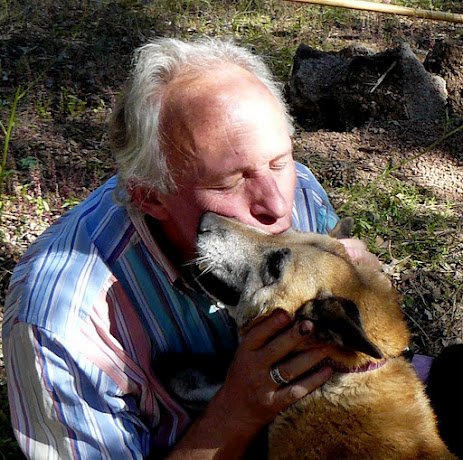
The love between a dog and a human – hugging a dog when one is feeling emotionally vulnerable is beyond measure. Dogs always sense when we humans are feeling fragile and they offer their uncomplicated hearts to us without any condition or need for return. That selfless love is an inspiring example of what we all need to learn to give one another.
Touch and social intimacy – we have so much to learn from dogs when it comes to touch and social intimacy. We are all needy for touch.
Which leads me providentially to a recent item from Terry Hershey. Terry came to Payson in March, 2011 and he was a most inspirational speaker. I have followed him ever since.
Last Monday’s Sabbath Moment included the following story, republished with Terry’s kind permission – the story is all about touch!
Caroline was very sad. Caroline was only six years old and her father had just died. In fact, her father had been assassinated.
Sitting in the back of big black limousine, Caroline Kennedy didn’t quite know what to do with her sadness. On the seat next to her sat her nanny, Maud Shaw, and next to Maud, Caroline’s younger brother John.
Through the windshield Caroline could see her mother, Jackie, and her uncles, Robert and Ted, walking in front of the limousine as it slowly made it’s way down the Boulevard to St. Matthew’s Cathedral. Looking out of her side of the car, Caroline recognized the friendly face of Secret Service agent, Robert Foster. She liked and trusted Robert Foster.
Not knowing what to do with her sadness, and on impulse, she rolled down the window and stuck out her six-year old hand. Agent Foster had a choice to make. Secret Service agents are not allowed to have their hands occupied, needing to be ready for any emergency. But Robert Foster didn’t even think twice. He held Caroline’s hand tightly the entire way to the cathedral.
Later, Agent Foster said it was all he could do to “fight back his own tears of sadness, for little Caroline Kennedy.” When asked about his kindness, he seemed surprised, “All I did was hold a hand,” he answered.
Terry then goes on to say,
We all know sadness. Life breaks for each one of us in different ways and in different places. And sometimes the sadness seems too much to carry.
It requires courage to roll down the window, to connect or ask or invite. For whatever reason, there is a knee-jerk need to deny any sadness, or dismiss it, or apologize for it. “I’m sorry,” people will say, wiping away their tears, as if their sadness is a violation of some tenet of propriety. Heaven forbid if any humanity is exposed.
So sometimes I am afraid to ask. Not sometimes; most times. I don’t want to appear weak. Asking for help is a hard pill to swallow.
I spent Saturday in Clearwater, Florida, with a group talking about intimacy and communication. (Yes, it is easier to talk about than to practice.) Here’s what I told the group.
If we don’t bring it with us, we’re not going to find it there. Which means intimacy–trust, vulnerability, authenticity, honesty–begins here.
With me. With this me.
I was raised in a religious environment that taught me to eradicate my messiness (to quash my sadness or grief or untidiness).
I now believe differently. I now know that we find and express acceptance, love and grace (the place where we can be fully human), in our messy, imperfect, and fully thorny selves. In other words: We can embrace this life–without any need to photoshop it.
To be human is to be vulnerable. I am capable of being wounded and cut and sad… which also means that I am capable of being kind and generous and present.
In such moments of heartache, I can have the courage to ask for a hand to hold.
In such moments of heartache, I can have the courage to hold a hand the needs to be held.
Robert Foster didn’t think twice about holding a hand that needed to be held. And he wasn’t posturing or amassing heavenly brownie points. He was doing what needed to be done.
Here’s the deal: we don’t need more remedies or advice. We need more touch. We become more human when we touch. Why? Because when we touch, we are seen. And when we are seen, we recognize that our value is not tied solely to our sorrow.
And we, you and I, will find no better lesson to learn from our beautiful canine friends, than this lesson of touch.










 Learning from Dogs