Category: Culture

Just slip away for a while.

There are some things we will always cherish.

Just a few days ago I wrote of the time when I was living in the small village of Harberton in South Devon, England. Harberton was a wonderful reminder that these modern times don’t reach to everyone all of the time. There were still plenty of folk who recalled the past times in very beautiful ways. (I wish I could remember the name of the old Devonian who used to come into the village pub on a regular basis and demonstrate that by listening to a local’s accent he could tell which Devon village they were from!)

It’s all too easy to lose sight of the fact that many things change very slowly, and local and regional accents are examples of that.

You know the saying Down to Earth? Chill out for 18 minutes and revel in these two Welshmen that appeared in a recent essay over on Mother Nature News.

ooOOoo

These 2 Welsh farmers will melt your heart (and challenge your ears)

The internet’s newest stars have lived and farmed on the same plot of land in Wales for over 70 years.

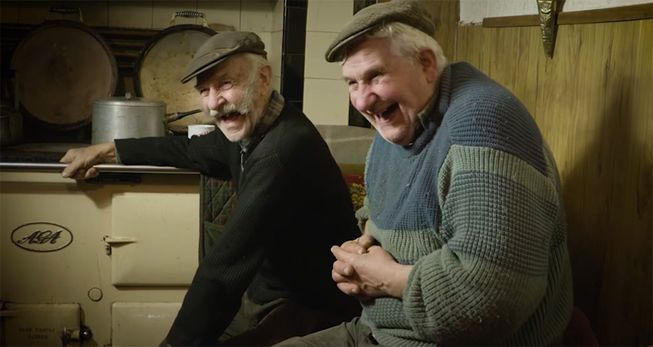
 Welsh farmers Howell and Gerwyn George's secret to a rich life is plain to see: just enjoy a good laugh! (Photo: Riverlea/YouTube)
Welsh farmers Howell and Gerwyn George’s secret to a rich life is plain to see: just enjoy a good laugh! (Photo: Riverlea/YouTube)

If we told you that listening to two old Welsh farmers recount the good ol’ days might just become the highlight of your day, would you believe us?

For whatever reason, whether it’s their charm, genuine brotherly love, or endearing/confounding Welsh dialect, Howell and Gerwyn George have mesmerized nearly everyone who has given up a few moments to watch them reminisce.

“They don’t make boys like that any more, more is the pity!!!,” said one commenter on Facebook. “Quality, pleasure to watch.”

“I could listen to this pair all day long…,” said another.

In the 18-minute video, the George brothers discuss everything from livestock to family and changing agricultural practices. Everything is interjected with anecdotes that invariably lead to one or both of the men to erupt into laughter. Several times, I found myself laughing without even knowing what in the world they were saying.

But enough gab from us; we’ll gladly let Howell and Gerwyn take over the conversation. Someone throw these two a reality television contract.

ooOOoo

Simply gorgeous!

Celestial certainties

Our December Solstice

I deliberately planned for this post to be published at the precise moment, in Pacific Time that is, when the solstice occurs.

Welcome to the shortest day of 2016.

Winter Solstice at the Stonehenge Monument in Southern England.

I am now republishing much of what appeared on the EarthSky blog a few days ago.

Late dawn. Early sunset. Short day. Long night. For us in the Northern Hemisphere, the December solstice marks the longest night and shortest day of the year. Meanwhile, on the day of the December solstice, the Southern Hemisphere has its longest day and shortest night. This special day is coming up on Wednesday, December 21 at 10:44 UTC (December 21 at 4:44 a.m. CST). No matter where you live on Earth’s globe, a solstice is your signal to celebrate.

Want to know what time it is where you are living?

When is the solstice where I live? The solstice happens at the same instant for all of us, everywhere on Earth. In 2016, the December solstice comes on December 21 at 4:44 a.m. CST. That’s on December 21 at 10:44 Universal Time. It’s when the sun on our sky’s dome reaches its farthest southward point for the year. At this solstice, the Northern Hemisphere has its shortest day and longest night of the year.

To find the time in your location, you have to translate to your time zone. Click here to translate Universal Time to your local time.

World Time Zones
World Time Zones

Roll on Summer!

Footnote:

This morning I read an interesting set of facts about the Solstice over on the Mother Nature Network. It included this:

The word “solstice” comes from the Latin solstitium, meaning “point at which the sun stands still.” Since when has the sun ever moved?! Of course, before Renaissance astronomer Nicolaus Copernicus (aka “super smartypants”) came up with the ‘ol heliocentric model, we all figured that everything revolved around the Earth, sun included. Our continued use of the word “solstice” is a beautiful reminder of just how far we’ve come and provides a nice opportunity to give a tip of the hat to great thinkers who challenged the status quo.

Two sides of the pilot’s life!

The life of the commercial pilot; that is.

I have a good understanding of the commercial pilot’s world, both inside and outside of my family. For many years as an active private pilot I held a British Instrument Rating (IR) that allowed me to fly in the commercial airways. Studying for the IR required a good appreciation of the safety culture that was at the root of commercial flying especially surrounding one’s departure and arrival airports.

So when I read a recent item from the Smithsonian Magazine proposing that airline pilots were more depressed than the average American my first reaction was one of disbelief. I forwarded the link to Bob D., an experienced British airline Captain and a good friend for years. Here is that article:

ooOOoo

Think Your Job Is Depressing? Try Being an Airline Pilot

New study suggests pilots are more depressed than the average American

4322816521_2e87d62705_o-jpeg__800x600_q85_cropBy Erin Blakemore
smithsonian.com  December 16, 2016

Being a pilot for a commercial airline has its perks—travel to exotic places, a cool uniform and those breathtaking views of the sky. But that job can come with a side of something much more sobering: depression. As Melissa Healy reports for The Los Angeles Times, the mental health of airline pilots is coming into sharp focus with the revelation that nearly 13 percent of them could be depressed.

A new study of the mental health of commercial airline pilots, recently published in the Journal of Environmental Health, suggests that depression is a major problem for pilots. The first to document mental health for this particular field, the study relied on a 2015 web survey of international pilots that contained a range of questions about their condition over the prior two weeks. Questions included whether they felt like failures, had trouble falling or staying asleep, or felt they were better off dead. (Those questions are part of a depression screening tool called the PHQ-9.) Other questions involved pilots’ flight habits, their use of sleep aids and alcohol, and whether they have been sexually or verbally harassed on the job.

Of the 1,848 pilots who responded to the depression screening portions of the questionnaire, 12.6 percent met the threshold for depression. In addition, 4.1 percent of those respondents reported having suicidal thoughts at some point during the two weeks before taking the survey. The researchers found that pilots who were depressed were also more likely to take sleep aids and report verbal or sexual harassment.

Airline pilot organizations and occupational safety experts assure Healy that airline travel is still safe. But the study continues a conversation about pilot psychology that has been in full swing since a German pilot committed suicide by crashing his plane in 2015—an incident that inspired the current study.

Since then, calls for better statistics on pilot suicide have grown louder. As Carl Bialik notes for FiveThirtyEight, those statistics do exist—and do suggest that the number of actual suicides among pilots are very small. However, limitations in data, the possibility of underreporting, and infrequent data collection all challenge a complete understanding of that facet of pilots’ mental health.

This latest mental health study has its own limitations, including the fact that it relies on self-reporting and a relatively small sample size compared to total pilot numbers worldwide (in the U.S. alone, there are over 70,000 commercial airline pilots). The cause of the reported depression also remains unclear.

But if the depression rate for commercial airline pilots really is nearly 13 percent, it’s almost double the national rate of about seven percent. Though future work is necessary to confirm these results, this study provides an initial glimpse into the health of the people who make the nation’s airlines tick and emphasizes the importance of figuring out ways to improve their mental health and quality of life.

Read more: http://www.smithsonianmag.com/smart-news/airline-pilots-are-really-depressed-180961475/#QojUDlEzhHEsxww4.99
Give the gift of Smithsonian magazine for only $12! http://bit.ly/1cGUiGv
Follow us: @SmithsonianMag on Twitter

ooOOoo

As the article points out the study contains a number of flaws that really reduce it from an erudite analysis to an eye-catching news item. (Better than reading about politics; that’s for sure!)

I know these are busy times for Captain Bob even without it being Christmas. But if Bob finds time to comment on this study then I will publish it later on.

However, Bob did find a moment to forward me copies of some of the many placards that are a necessary part of the flight deck.

pilot1oooo

pilot2oooo

pilot3Fly safely all you good pilots out there!

Saturday stalls!

The Finalists of the 2016 Plumbers of the Year Competition.

The craftsmanship skills shown by these winners is simply ‘breath-taking’!

(Huge thanks to Cynthia Gomez for sending these to me.)

One very good reason for not putting the toilet paper on the roll.

oooo

The saying: "Prior planning prevents piss poor performance" comes to mind.
The saying: “Prior planning prevents piss poor performance” comes to mind.

oooo

"Hey Joe, I thought the measurements were in centimeters!"
“Hey Joe, I thought the measurements were in centimeters!”

oooo

Apparently, you don't want anyone seeing your face, but everything else is okay?
Apparently, you don’t want anyone seeing your face, but everything else is okay?

oooo

Well at least the seat will be warm to the bum!

oooo

And the purpose for the door is?

oooo

For the long-armed among us.

Cynthia will be delighted to forward you contact details for any of the plumbers whose work is shown above!

In recognition of our mothers.

A month ago this day my mother died.

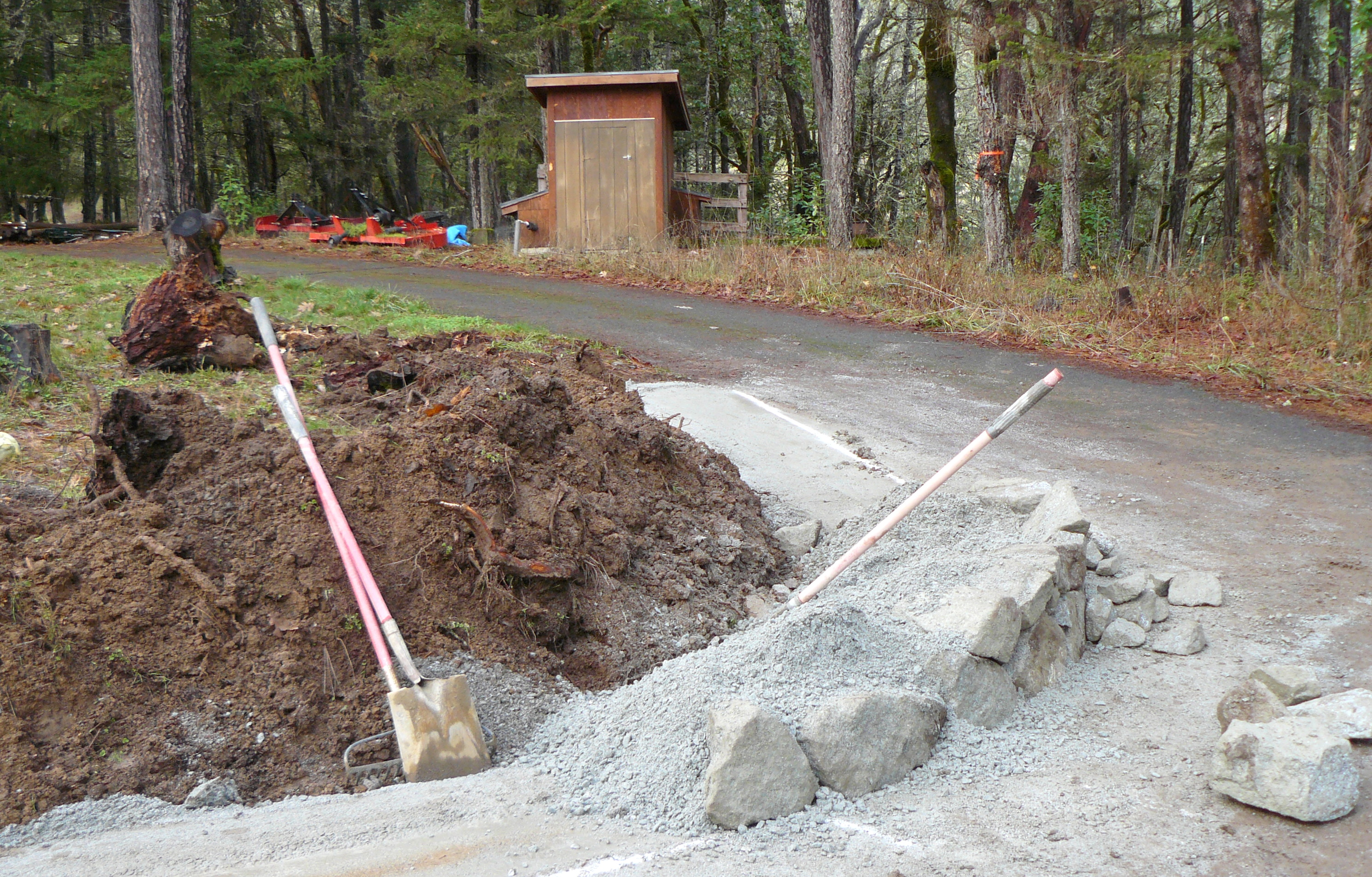
Not long before my mother died we contracted with a local landscaper, Leif Monchallin, to do quite an extensive improvement to the area of land that is to the front of the house. One of the improvements is putting in a dry-stone wall at the top of the driveway just before it splits into a turning circle. The photograph below shows the early stages of that wall.

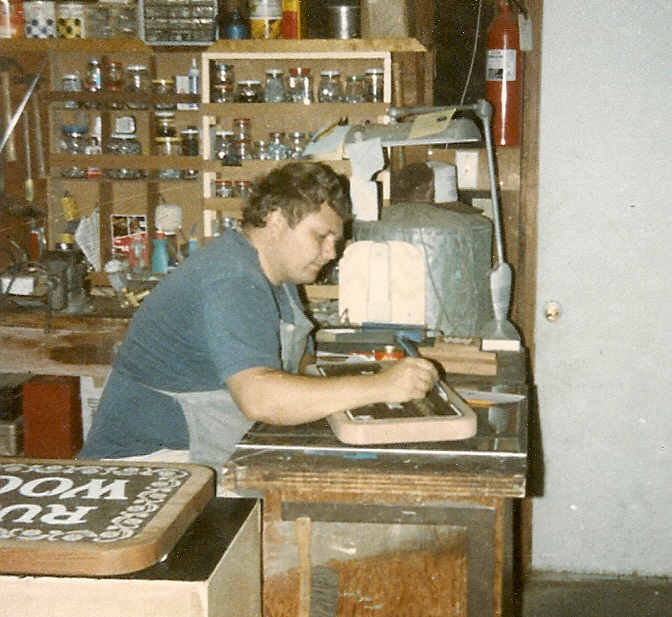
p1160682Anyway, Jeannie came up with the idea of putting in some sort of engraved stone right in the centre of the wall. Leif knew of a local stone mason, Oregon Valley Sign Company, and off Jean and I went to meet Bryan Schram, who with his wife, run the business.

Bryan Sch at work
Bryan Schram at work.

Between the three of us we came up with a form of words that seemed highly appropriate.

But first off Jean and I had to locate a suitable stone for the engraving and take it over to Bryan’s premises.

Once that was done then it was about a week before we went to collect the engraved stone with the lettering also painted (that was Bryan’s wife’s area of expertise).

Finally, Leif placed the engraved stone in the wall after taking meticulous care to ensure it was perfectly positioned.

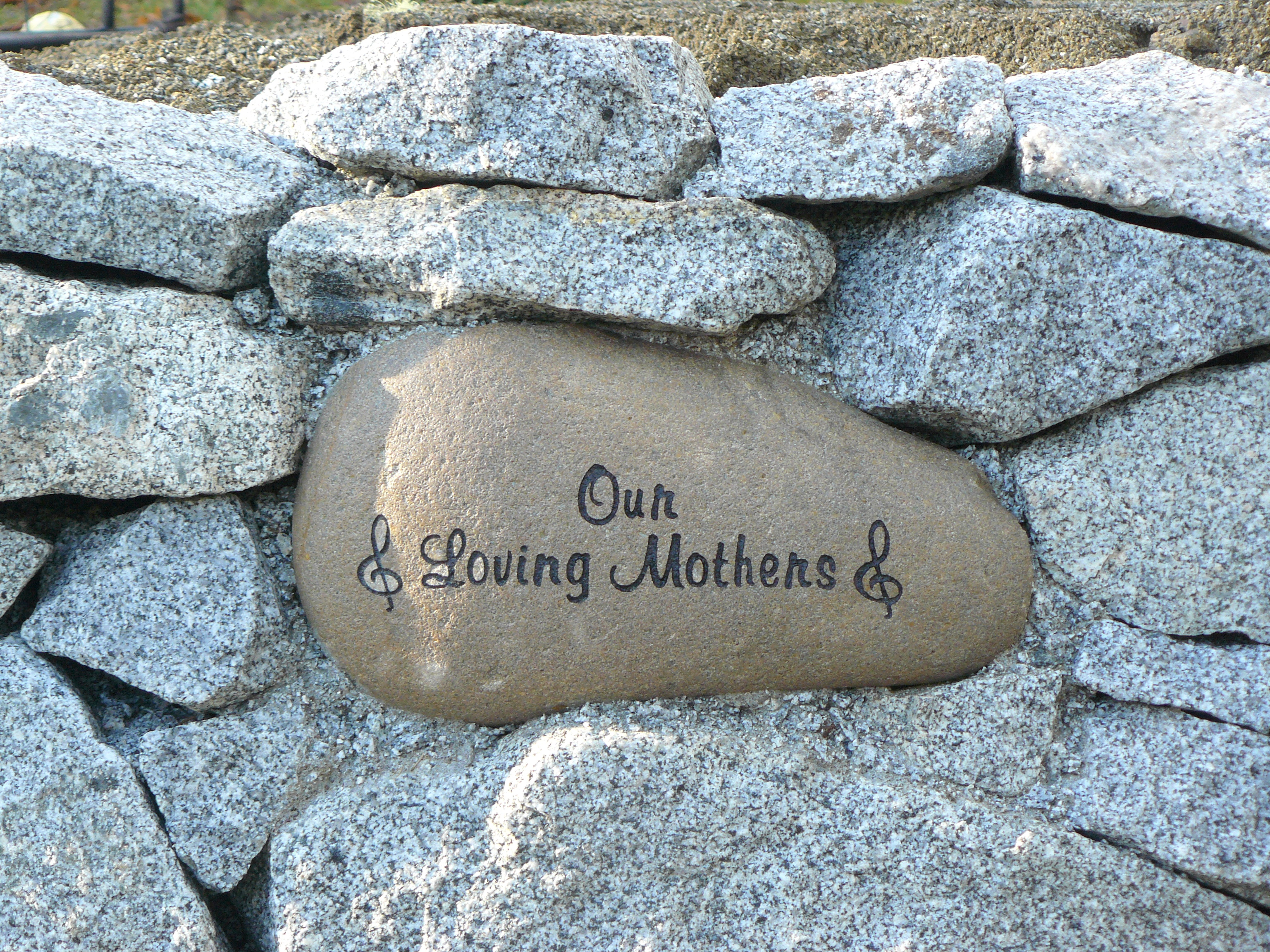
Here’s the result.

p1160722My mother was a musician and music teacher for most of her life and Jeannie’s Mum, Florence, was a great lover of music and dancing. Hence the clefs either side of the wording.

A rather special reminder of our mothers; don’t you think!

It seems like the blink of an eye.

How the years speed past us!

I have lost count of the times in the last year that I have said the following:

Thank goodness that when we were younger we really didn’t understand what it was to be old!

Now being old is to a great extent as much as a thing of the mind as it is of the body. As the saying goes: “One is only as old as you feel!” (Or as many men know it: One is only as old as the woman you feel.)

Moving swiftly on!

Dogs offer us many lessons including what it is to become old, then old and infirm, and then pass away. Which is why so many owners of their beloved dogs spend as much time and care on keeping their elderly dogs as fit as possible as they do on themselves; probably in many cases spending more care and attention on their dogs than on themselves.

ooOOoo

 10 Simple Tips for Keeping Your Old Dog Young

1396029-largeBy: Lisa Spector December 10, 2016

About Lisa

Those of us who love and have dogs know that senior years always approach too fast. Sanchez, my 13 1/2 year old yellow Lab, has had his health challenges this year, but now that he’s gained back his strength and has recovered from E. coli, he’s acting younger than he has in years. I’ve noticed this not only in his energy level, but also in his cognitive abilities and in his engagement with dogs and people around him. I cherish his golden years and am always looking for ways to keep his mind active and alert, and keep him connected with life.

sanchezginainbed-443x3311. Adopt a second, younger dog.

Admittedly, I’ve been a single dog person my entire life… up until five years ago. When it felt like I was agonizing on the decision to expand my canine household, my vet said to me, “Bringing a younger dog into your household will help keep Sanchez younger as he ages.” Sanchez was only seven at the time, and that perspective had never occurred to me. It’s shown itself to be true.

2. Give daily spoonfuls of coconut oil.

I’ve written about the benefits of coconut oil for pets, everything from fur conditioner to paw protection. But, I hadn’t realized that coconut oil helps with canine cognition until I read this Cambridge study. I’ve been giving both Sanchez and Gina a tablespoon of coconut oil nightly for a couple of months. Not only do they love the taste, but I have definitely noticed an improvement in Sanchez’s cognitive abilities.

3. Train him often. 

An old dog not only can learn new tricks, but also loves the attention and benefits from the mental stimulation as much as any age dog. Dogs love to learn, no matter their age. I still spend time training every night with Sanchez. As you can see in the video above, I’ve come up with ways to make his training less physical. But, he still gets rewarded for being involved and staying still. If it gets late, he starts whining and begging for his training time with me. The bonding time is precious and it stimulates him to keep learning and being challenged. He has no complaints about his yummy rewards either.

goldens-cat-sanchez-gina-443x3344. Mix it up.

Although dogs love consistency and build confidence through their routines, it’s sometimes good to mix up that routine as well. I recently was staying with friends and their three Golden Retrievers. While there, Sanchez loved the new smells in their backyard, neglected all of his daily naps and really enjoyed their multi-pet household, including the cats.  Our routine completely changed as my friends generally rise much earlier than me and their dogs are fed right away. I decided to allow my dogs the same privilege while we were there. Of course, Sanchez just loved it. I was surprised how quickly he reverted back to our normal routine when we got home. While he’s making up for his missed naps now, he really enjoyed the change of scenery, people, pets, and general surroundings.

5. Add variety to diet, and consider nutritional needs.

I also add variety to Sanchez’s dog food. While the base is the same (organic meat), the variety comes in the extras. Sometimes I add in canned sardines, other times it’s salmon oil. I alter between any of the following additions: sweet potatoes, carrots, pumpkin, green beans, spinach, kale, apples, and bananas. He’s a Lab and LOVES his food. Surprising him adds to his olfactory delight as well.

6. Add environmental enrichment.

Ohio State University College of Veterinary Medicine defines environmental or behavior enrichment as “the process of manipulating an animal’s environment to increase physical activity & normal species typical behavior that satisfies the animal’s physical and psychological needs.” Music created for senior dogs, with their hearing sensitivities in mind, is a great way to provide auditory stimulation that engages their senses.

7. Incorporate nose work.

Dogs often lose hearing and sight in their senior years. But, as long as they can still smell, they can still find their way around. I’ve honestly met blind and deaf dogs that were still retrieving balls, and I barely noticed any impairment to their sight or hearing. Engage a dog’s nose, and you’ll keep him stimulated.

K9 Nose Work defines this sport as “the fun search and scenting activity for virtually all dogs and people. This easy to learn activity and sport builds confidence and focus in many dogs, and provides a safe way to keep dogs fit and healthy through mental and physical exercise.” I enrolled Sanchez in classes a couple of years ago, and now we play “find” games at home. I hide pieces of liver in boxes spread throughout the living room. He searches for the piece of liver and is rewarded with more liver in the box when he finds it. He LOVES this search game.

8. Play often.

No matter the age, dogs enjoy and benefit from playtime. Even if they don’t have the same physical abilities as their younger canine friends, they can still engage in play. Try a game of hide and seek. Actually, all training and nose-work games should also feel like play to them. Pretend you’re a kid again, and they’ll pick up on your energy and thank you for it.

9. Walk them in new areas.

Again, engaging their nose helps keep them stimulated and interested in their surroundings. Bringing them to a new area for a walk is another way to do that. Sanchez is still often with me in the car. So, once a week, I try and stop in a new area for him to explore.

10. Take time to smell the roses.

Walks may no longer be about physical activity. Move at his pace. Allow him to use his nose as much as he chooses. I’ve learned that it’s not only good for Sanchez, but it’s good for me. He’s teaching me the importance of taking time to slow down and enjoy nature. Honestly, does it ever get any better?

ooOOoo

Our wonderful Pharaoh is getting pretty old now; he was 13 1/2 years-old on December 3rd which is a grand age for a German Shepherd. When he was a young puppy I was advised to get a younger playmate for him when his years were building up. For two reasons. The first being that the younger dog keeps the elderly dog playing and interested in the world. The second reason being that the elder dog will teach the younger dog all the owner’s commands.

Pharaoh demonstrating his benevolent status with puppy Cleo. April 2012.

Cleo has proved both points. Pharaoh in living with so many dogs around him is most definitely kept engaged and despite his rear hips being so very fragile and weak he still doesn’t miss a turn in going out with the other dogs.

Just to underline how fantastic Pharaoh is doing, his age at the conversion ratio of 1 dog year to 8 human years makes him 108! Or 36 years my senior!

What to say to the kids.

Reflections on what we leave behind.

I included in yesterday’s post the interview with Bill Kotke and his concern that humanity’s greed, and that’s the correct term in my view, focusing on each generation having more, howsoever one defines ‘more’, was utterly at odds with a sustainable future on the only home we have: Planet Earth.  A finite planet in a finite solar system.

On Monday I was chatting with Roger D. back in the old country. It was Roger who introduced me to gliding back in the late 70s. Later we were in business together in Colchester, Essex and we still keep in touch.

Anyway, Roger was bemoaning the current state of affairs in the UK regarding Brexit and went on to say that every economic strategy offered by this or that UK Government was about growth. Whether we are talking economic growth, improvement in living standards or population growth why are there no leading figures in any leading government standing up and saying this can’t go on! Because it can’t!

world_population_1050_to_2050We are presently a global population of 7.5 billion. This year alone, as of today, there have been 56,000,000 deaths. But also, as of today, there have been 133,000,000 births. (I rounded the figures but what difference does it make!) That’s a growth of 77 million persons in this one year. It cannot go on!

Bill Kotke also spoke of soil loss. Just last Sunday there was a Care2 item about soil loss. From which I extract:

Could soil ever actually run out?

Yes. If we continue to harm and degrade topsoil at the current rate, it’s estimated that the world could lose all its topsoil within 60 years.

Topsoil is the uppermost layer of soil on the surface of the earth. It’s the most fertile type of soil that typically contains lots of nutrient-rich organic matter from broken down plants and other organisms. Topsoil is also alive with beneficial microbes, fungi and critters like earth worms, which feed on the organic matter.

The deeper layers of soil beneath the topsoil are not nearly as rich. They are primarily made up of decomposing rock that provides the raw material for future topsoil as well as a substrate for deeply rooted plants to anchor in.

If the delicate ecosystem within topsoil is disrupted, it will essentially die. Plants can’t grow in topsoil that doesn’t have abundant organic matter and thriving populations of microbes.

Yes, there are street protests about this political action or that political action but why aren’t we seeing tens of thousands on the streets protesting about the loss of our topsoil!!

Moving on.

There was a recent essay from Patrice Ayme in which he wrote about the Australian Asthma Thunderstorm. Just read this long extract from that essay:

(November 29th, 2016 Italics are from the story as presented in the New York Times)

Mr. McGann was one of thousands of people in Melbourne having an attack of thunderstorm asthma. About 8,500 people went to hospitals. Eight have died, and one remains in intensive care more than a week after a thunderstorm surged across Melbourne, carrying pollen that strong winds and rain broke into tiny fragments.

Perennial ryegrass seeds were swept up in whorls of wind and carried from four million hectares of pasturelands (about 9.9 million acres) that lie to Melbourne’s north and west. If broken into fragments, they are so fine that they can be inhaled.” 

Actually what also lie north and west of Melbourne are giant fields of canola. Consider the following propaganda picture:

Mr. McGann did not end up in the hospital.  “Every breath I took made the next breath harder,” he said, adding that he had no family history of asthma. “I just didn’t realize it could have the effect it had.”

Grass pollen is the primary source of allergies in southern Australia, and tracking the data allowed scientists to forecast high levels of grass seeds in the atmosphere on Nov. 21. Still, Ms. Hennessy said, the government was taken by surprise.”

Surprise, indeed, this did not happen before, by two orders of magnitude. How come so much more severity?

My lawyer’s theory is different.  It evolved from my own observations and theories of why asthma and allergies, let alone weird cancers, have been augmenting spectacularly. There are around 150,000 artificial, man-made chemical products in use. By medical drug standards, they are untested (in earlier essays, I mentioned 80,000, which is the number brandished in the USA; however, French specialists talk about 150,000 untested chemicals.).

Canola (or rapeseed), Brassica napus, is an oilseed crop which is cultivated for its high quality edible oil used in many foods (eg. margarines and cooking oil) and seed meal (the fibrous material left after the oil pressing process), which has a high protein content. That makes it highly desirable as a stock feed.

In 2010-11, the Australian state of Victoria, where Melbourne is located,  produced 476 thousand tonnes of canola with a gross value of $293 million.

Control of weeds, particularly weeds from the Brassicaceae family (broadleaf), through herbicide application during the canola-growing season, significantly improves the quantity of the grain produced. Weeds compete for space, nutrients and sunlight. (African countries have dismissed that the quality of GMO seed is higher, in contradistinction with US propaganda; quite the opposite, they say)

Two genetically modified (GM) canola varieties have been developed in Australia, Roundup Ready® (by Monsanto Australia Ltd) and InVigor® (by Bayer CropSciences Pty Ltd). For maximum effect, each GM variety has been developed to be tolerant to and hence used with, a specific herbicide. The result is the mass poisoning of the planet, horizon to horizon.

The same poisoning trick is used for insecticides. To boot, the poison resistance spreads, demanding even higher doses of poison to be used in the grand outdoors..

In other words, massive quantities of poisons are put in the soil, and from there, are kicked up, in the air.

Exposed to this life destroying poisons, the body reacts by shutting down all pores. Asthma.

It cannot go on!

It is time for you and me and millions of others to be the change we want to see. Whether it’s the little things like recycling, or car sharing, or the bigger things like moving to an eco village we have to make a difference.

We have to learn from those communities that for thousands of years lived harmonious and sustainable lives on the planet. Doing so many thousands of years before farming man came on to the scene

In 1969 I spent a year in the outback of Australia as a correspondent for KotiPosti; a Finnish magazine. While I was out in the wilderness looking for Finns to write about it was impossible not to be drawn into the history of the aboriginal Australian.

ABORIGINAL AUSTRALIANS ARE descendents of the first people to leave Africa up to 75,000 years ago, a genetic study has found, confirming they may have the oldest continuous culture on the planet.
Professor Eske Willerslev of the University of Copenhagen, who led the study, says Aboriginal Australians were the first modern humans to traverse unknown territory in Asia and Australia. “It was a truly amazing journey that must have demanded exceptional survival skills and bravery,” he says.
A century-old lock of hair, given by a West Australian indigenous man to an anthropologist, has led to the discovery that ancestors of Aboriginal Australians reached Asia at least 24,000 years before another wave of migration that populated Europe and Asia.

It was back then that I truly understood the relationship that those early Australians had with the earth; with their planet. Forget religions and churches, the Aborigines had a spiritual relationship with the planet that sustained them.

I will never forget exploring quietly, just me and my wife of those days, the caves and darker recesses around the base of Ayers Rock, better called Uluru, the most amazing monolith right out there in the middle of the desert. The unmistakable signs of so many of those quiet recesses being spiritual places for those ancient people.
home-1Uluru, or Ayers Rock, is a massive sandstone monolith in the heart of the Northern Territory’s arid “Red Centre”. The nearest large town is Alice Springs, 450km away. Uluru is sacred to indigenous Australians and is thought to have started forming around 550 million years ago. It’s within Uluru-Kata Tjuta National Park, which also includes the 36 red-rock domes of the Kata Tjuta (colloquially “The Olgas”) formation.

It is just he same for the North American Indians. They have a spiritual relationship with the land.

Back to Bill Kotke’s talk. He spoke of how when each of us was the product of the fertilisation of the egg by the sperm in utero we grow first as a fish, then as a mammal and, finally, emerge as a human: “We are connected to the earth!

As you all know I am a secular humanist. But that doesn’t mean that I don’t have deep, as in spiritual, feelings for the lands and the oceans and for the wildlife of this planet

So let me close by repeating what I said at that meeting where Bill was presenting. For Bill spoke of being connected, in a heartfelt manner, with the planet. For if one is so connected then it is natural for one to want to love and protect the planet.

This is what I said:

Bill,

In 1991 I departed Gibraltar Harbour solo on my yacht Songbird of Kent heading West out across the Atlantic.

After I had settled in to the routine of being at sea, better described as settling in to being connected to the ocean, I loved watching the dolphins come up to the boat, give it the once over, raise their heads and offer me a brief eye contact and then slip away.

Then I became aware that when I was laying down on my bunk in the cabin I could sense when the dolphins were close to my hull. Each time I had that sense I would come up to the deck, briefly pausing to clip on my safety harness lest I truly joined the dolphins, and one or two of those dolphins were always by my boat.

I called this post What To Say To The Kids. Not just my son and daughter, now both mature adults, but my grandson Morten son to my daughter and her husband.

Because I feel so strongly that waiting for our leaders and politicians to lead humanity in protecting our planet is pointless. They are driven by other values.

It cannot go on!

I want to be measured by my son and my daughter, and by my grandson in due time, as a person who made a difference; even just a small one.

For I truly believe that showing love for our planet will make a difference and that is what I want to say to my kids.

We have to return to community living;  a twenty-first century version of such living. Even in the giant populations of big cities we have to reach out and form local communities. Groups of people who are driven by the imperative to curtail population growth, eager to share in as many ways as possible and totally committed to taking no more from the planet than they put in.

Because It cannot go on!

This is what I want to say to my kids.


Staying in balance.

We, as in humanity, could be very close to the end!

Now my sub-title could be argued as being a tad provocative and, perhaps, it is. But I wanted to catch your attention and then hope that you stay with me for today’s post.

Jean and I belong to the Humanists & Freethinkers Group of Grants Pass. At last Saturday’s meeting the main item was a talk given by William Kötke: His website is here. Bill, as he was happy to be called, is the author of the books The Final Empire and Garden Planet (the links take you to the respective Amazon pages). Bill also has more details of his first book here.

The essence of Bill’s talk was that when we ‘evolved’ from a life of hunting and gathering to developing the land for agricultural purposes we lost our connection to the planet. For the simple reason that as foragers we depended on always being able to find edible wild plants and fruit, and therefore lived in balance with the land, but when we started to farm we became protective, materialistic and greedy. For having more land, even if one took it by force from another, equated to making more; making more food, using the surplus to buy favours, sell, etc.

Some of the facts that Bill presented in his talk were truly frightening such as soil loss; a topic I highlight in tomorrow’s post.

But for now just settle down and watch this interview of Bill filmed by Woodburn Community Access Television.

Published on Jan 10, 2016

Author and Futurist William H. Kotke shares with Woodburn his years of knowledge and understandings of the Human History and The Current Dilemma all of us face as a species.

Is there a way forward?

Yes, I think so and it’s all to do with communities; more on that in a later post.

Is this anything to do with dogs?

Here’s what the Welcome page of this blog says (in part):

As man’s companion, protector and helper, history suggests that dogs were critically important in man achieving success as a hunter-gatherer.  Dogs ‘teaching’ man to be so successful a hunter enabled evolution, some 20,000 years later, to farming,  thence the long journey to modern man.  But in the last, say 100 years, that farming spirit has become corrupted to the point where we see the planet’s plant and mineral resources as infinite.  Mankind is close to the edge of extinction, literally and spiritually.

Dogs know better, much better!  Time again for man to learn from dogs!

I rest my case.