Category: Culture

Up, Up And Away?

It is very hard to avoid hyperbole when one speaks of global warming.

I am indebted to The Nation magazine, May 8/15 Issue, in which is included a feature article authored by Bill McKibben. My sub-heading is much of what Bill wrote in his first line.

It is hard to avoid hyperbole when you talk about global warming. It is, after all, the biggest 
thing humans have ever done, and by a very large margin.

A few sentences later, Bill offers this:

In the drought-stricken territories around the Sahara, we’ve helped kick off what The New York Times called “one of the biggest humanitarian disasters since World War II.” We’ve melted ice at the poles at a record pace, because our emissions trap extra heat from the sun that’s equivalent to 400,000 Hiroshima-size explosions a day.

Yet what scares me, scares me beyond comprehension, is the almost universal disregard being shown by Governments and those with power and influence right across the world to what in anyone’s language is the most pressing catastrophe heading down the tracks. Not next year; not tomorrow, but now!

Or in Mr. McKibben’s words, once more from that Nation article:

But as scientists have finally begun to realize, there’s nothing rational about the world we currently inhabit. We’re not having an argument about climate change, to be swayed by more studies and journal articles and symposia. That argument is long since won, but the fight is mostly lost—the fight about the money and power that’s kept us from taking action and that is now being used to shut down large parts of the scientific enterprise. As Trump budget chief Mick Mulvaney said in March, “We’re not spending money on that anymore. We consider that to be a waste of your money to go out and do that.” In a case this extreme, scientists have little choice but to be citizens as well. And given their credibility, it will matter: 76 percent of Americans trust scientists to act in the public interest, compared with 27 percent who think the same thing about elected officials.

Whatever your response is to what I have already presented, the one thing that I do know is that you have been aware of humanity’s effect on our atmosphere for many, many years. Indeed, Bill McKibben wrote his first book twenty-eight years ago!

His 1989 book The End of Nature is regarded as the first book for a general audience about climate change, and has appeared in 24 languages; he’s gone on to write a dozen more books.

But I would be the first to acknowledge that back in 1989 while I did become aware of Bill McKibben and did purchase and read that book of his, I didn’t see the effects he prophesied. In addition, I didn’t understand the mechanisms that would bring those effects into place.

Now, today, it’s very difficult to deny that global weather systems are behaving in ways that most do not understand albeit we do understand how those weather changes are affecting our lives.

One person who did, and still does even more, understand the physics involved in our changing weather, is Patrice Ayme. For some nineteen years after Bill McKibben’s first book, Patrice published a post on his blog. I have been following Patrice’s blog for some years and while I would be the first to stick my hand in the air and declare that some of his posts are a little beyond me, there’s no question of the integrity of his writings and his bravery in spelling out the truth of these present times. (OK, the truth a la Monsieur Aymes but I would place a decent bet of PA being closer to the core truth of many issues than Joe Public.)

I am indebted to Patrice for granting me permission to republish that post. Please read it. Don’t be put off by terms that may not be familiar to you. Read it to the end – the message is very clear.

ooOOoo

Applying Equipartition Of Energy To Climate Change PREDICTS WILD WEATHER.

By Patrice Ayme, March 8th, 2008.

Lately, the world weather has been especially perplexing, influenced by the cold ocean temperatures of a La Niña current in the equatorial Pacific. For Earth’s land areas, 2007 was the warmest year on record.

This year, record cold is more the norm. Global land-surface temperatures so far are below the 20th-century mean for the first time since 1982, according to the National Climatic Data Center. Last month in China, snowstorms stranded millions of people, while in Mumbai, officials reported the coldest day in 46 years.

Yet, England basked in its fourth-warmest January since 1914, the British Met Office reported. The crocus and narcissus at the U.K.’s Royal Botanical Gardens at Kew flowered a week earlier than last year — 11 days ahead of their average for the decade and weeks ahead of their pattern in the 1980s. In Prague, New Year’s Day was the warmest since 1775.

“It is difficult to judge the significance of what we are seeing this year,” said Kew researcher Sandra Bell. “Is it a glitch or is it the beginning of something more sinister and alarming?”” (Robert Lee Hotz, Wall Street Journal, March 8, 2008).

Many scientists have pondered this question, as if they did not know the answer, but it is a straightforward application of thermodynamics.

A basic theorem of equilibrium thermodynamics, the EQUIPARTITION OF ENERGY theorem, says that the same amount of energy should be present in all degrees of freedom into which energy can spill.

(How does one demonstrate this theorem? Basically, heat is agitation, kinetic energy at the scale of atoms and molecules. This agitation can spill in a more organized manner, in great ensembles, such as vast low and high pressure systems, or large scale dynamics. See the note on entropy and negative temperatures.)

In the case of meteorology, this implies, oversimplifying a bit, that only one-third of the energy should go into heat (and everybody focuses on the augmentation of temperature). Now, of course, since the energy enters the system as heat, non equilibrium thermodynamics imposes more than one-third of the energy will be heat.

As time goes by, though, the other two degrees of freedom, potential energy (represented as the geometry of gradients of pressures, high and low pressure systems, hurricanes) and dynamics (wind speed and vast movements of air masses of varying temperatures and/or pressure; and the same for sea currents) will also store energy.

Thus the new heat created in the lower atmosphere by the increased CO2 greenhouse will be transformed in all sorts of weather weirdness: heat, cold, high and low pressures, wind, and big moves of big things. Big things such as vast re-arrangements of low and high pressure systems, as observed in the Northern Hemisphere, or the re-arrangement of sea currents as apparently also observed, and certainly as it is expected. Since it happened in the past (flash ice age of the Younger Dryas over Europe, 18,000 years ago).

As cold and warm air masses get thrown about, the variability of temperatures will augment all over.

In other words, record snow and cold in the Alps and record warmth simultaneously in England is a manifestation of the equipartition of energy theorem applied to the greenhouse warming we are experiencing. It is not mysterious at all, and brutal variations such as these, including sudden cold episodes, are to be expected, as more and more energy gets stuffed in the planetary climate, and yanks it away from its previous equilibrium.

Wind speed augmentations have already had a spectacular effect: by shaking the waters of the Austral ocean with increasingly violent waves, carbon dioxyde is being removed as if out of a shaken carbonated drink. Thus the Austral ocean is now a net emitter of CO2 (other oceans absorb CO2, and transform it into carbonic acid).

Hence the observed variations are the beginning of something more sinister and alarming. Climate change is changing speed. Up, up, and away.

Patrice Ayme
Patriceayme.com
Patriceayme.wordpress.com.

Note on entropy: Some may object that transforming heat into collective behavior of vast masses of air or sea violates the Second Law Of Thermodynamics, namely that entropy augments always, in any natural process. Well, first of all, the genius of the genus Homo, not to say of all of life itself, rests on local violations of the Second Law. Secondly, the most recent physics recognizes that fundamental considerations allow systems where increased energy lead to increased order (such a system is said to be in a negative temperature state).

Even more revealingly, a massive greenhouse on planet Earth would lead, as happened in the past, to a much more uniform heat, all around the planet, that is, a more ordered state. Meanwhile, the transition to the present order of a temperate climate to the completely different order of an over-heated Earth will bring complete disorder, as observed.

ooOOoo

Going to leave you with a picture taken from weather.com

An emaciated polar bear is seen on a small sheet of ice in this image taken in August in Svalbard, north of mainland Norway. (Kerstin Langenberger)

Please, please, please: make a difference! Environmentally, domestically and politically, please make a difference.

Picture Parade One Hundred and Ninety-Five

Be happy good people.

oooo

oooo

oooo

oooo

oooo

oooo

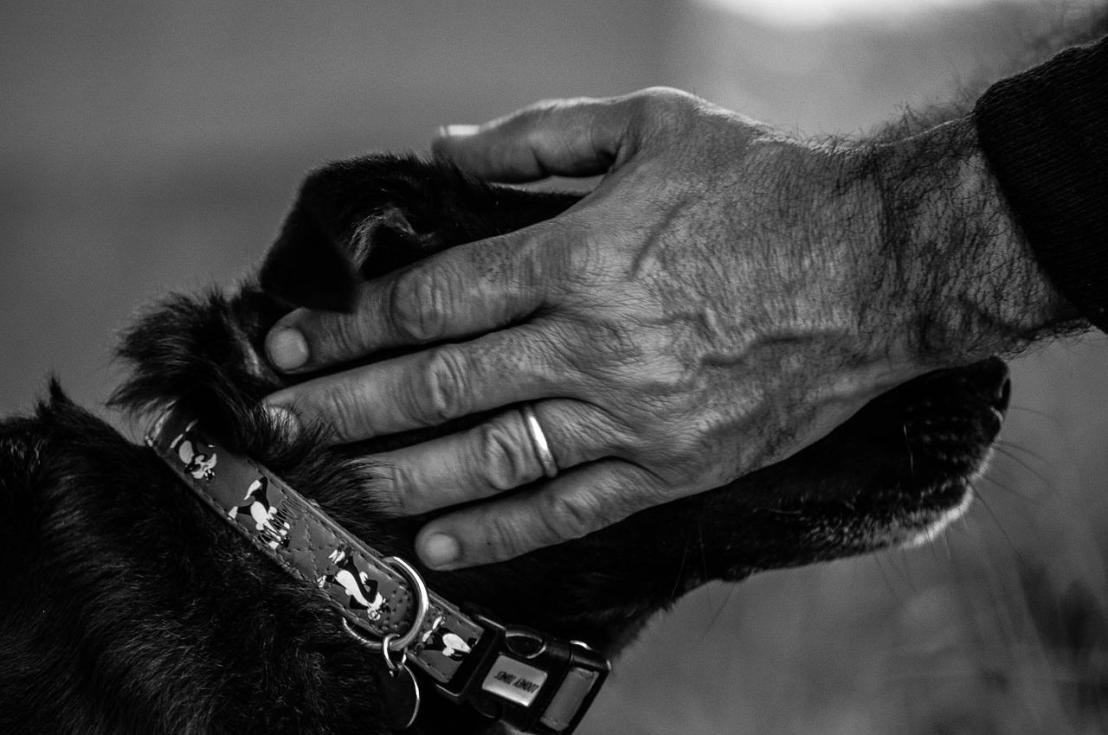
And the final photograph for this week’s Picture Parade is of Socks being cuddled by a member of his new family home. Socks has been adopted!! (Full story about this wonderful happening on Tuesday.)

Keep loving those animals of yours out there!

More wonderful doggy goodness!

Such a wonderful and obvious thing to do!

Yet despite it being so obvious it hadn’t crossed my mind before.

I’m referring to the wonderful idea of using those people, who through circumstance have found themselves homeless, to care for animals via an animal shelter.

This fabulous project came to me when reading a recent item on the Democracy Now website. Do watch the video.

ooOOoo

Glenn Greenwald Unveils New Project to Build Animal Shelter in Brazil Staffed by Homeless People

Published on May 10, 2017

http://democracynow.org – Pulitzer Prize-winning journalist Glenn Greenwald unveils his plans to build an animal shelter in Brazil with his husband David Miranda, a city council member in Rio de Janeiro. The shelter will be staffed by homeless people who live on the streets with abandoned pets.

ooOOoo

If you, like me, needed to be reminded as to Mr. Greenwald’s background there’s plenty online.

He has his own website here. Over at The Intercept website one reads:

Glenn Greenwald is one of three co-founding editors of The Intercept. He is a journalist, constitutional lawyer, and author of four New York Times best-selling books on politics and law. His most recent book, No Place to Hide, is about the U.S. surveillance state and his experiences reporting on the Snowden documents around the world. Prior to co-founding The Intercept, Glenn’s column was featured at The Guardian and Salon. He was the debut winner, along with Amy Goodman, of the Park Center I.F. Stone Award for Independent Journalism in 2008, and also received the 2010 Online Journalism Award for his investigative work on the abusive detention conditions of Chelsea Manning. For his 2013 NSA reporting, he received the George Polk award for National Security Reporting; the Gannett Foundation award for investigative journalism and the Gannett Foundation watchdog journalism award; the Esso Premio for Excellence in Investigative Reporting in Brazil (he was the first non-Brazilian to win), and the Electronic Frontier Foundation’s Pioneer Award. Along with Laura Poitras, Foreign Policy magazine named him one of the top 100 Global Thinkers for 2013. The NSA reporting he led for The Guardian was awarded the 2014 Pulitzer Prize for public service.

Plus, there is more information about Glenn Greenwald on WikiPedia.

Well done, that man, and the rest of the team!!

More importantly, well done all those special people who are loving those dogs.

Another great move for dogs in Brazil.

Still in the month of May!

Figurative and literal cracks!

My rather cryptic sub-heading will make sense very soon.

Just ten days ago I published a post The Month of May. It explained why May had always been a special month in my life and then went on to introduce an article published by The Smithsonian Using a New Roadmap to Democratize Climate Change.

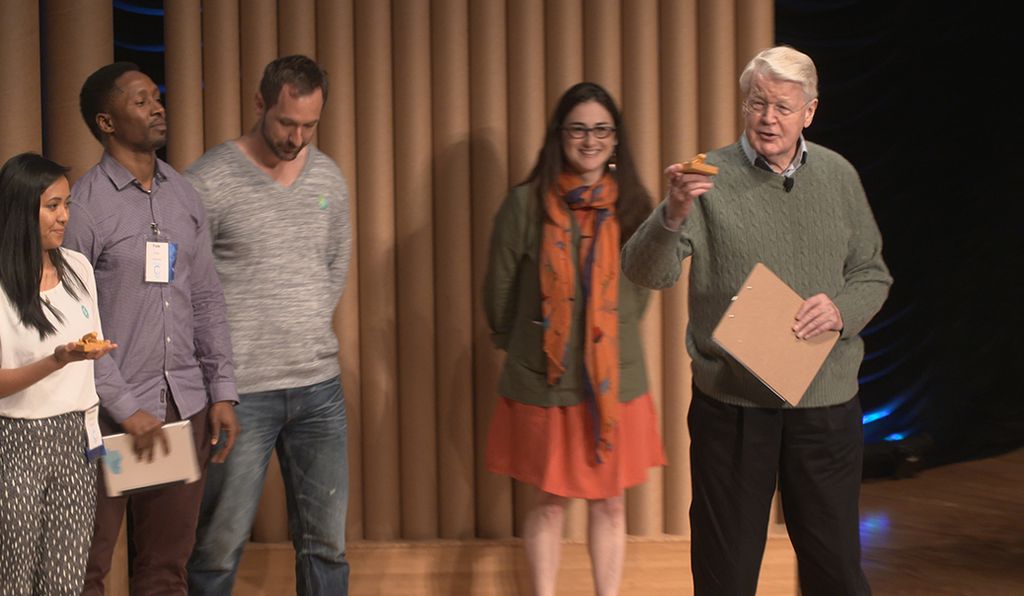
That article featured the former president of Iceland, Olafur Grimsson, and how he was encouraging new solutions to climate change. Primarily via a new organisation called RoadMap. (Did you sign up??)

There is change in the air. People are starting to make a better future. Cities across the USA (and elsewhere undoubtedly) are pledging to go 100 percent renewable. Here’s what Grist published on May 4th.

ooOOoo

Cities all over the U.S. are pledging to go 100 percent renewable.

Atlanta, Georgia (Shutterstock)

On Monday, Atlanta lawmakers voted unanimously to power the city entirely with clean energy sources by 2035.

Atlanta is the 27th city to make the pledge, according to the Sierra Club. These kinds of municipal promises have been popping up nationwide over the past few months. Here’s a recap:

“We know that moving to clean energy will create good jobs, clean up our air and water, and lower our residents’ utility bills,” said Kwanza Hall, an Atlanta City Council member and mayoral candidate, in a statement. “We have to set an ambitious goal or we’re never going to get there.”

A round of applause for local climate progress!

ooOOoo

Lovely to see the city of Portland on that list.

Keep it coming. For we need to see cracks of change; cracks of hope.

Cracks to counter literal cracks.

ooOOoo

The crack that’s redrawing the world’s map.

(From the BBC Culture Newsletter 5th May.)

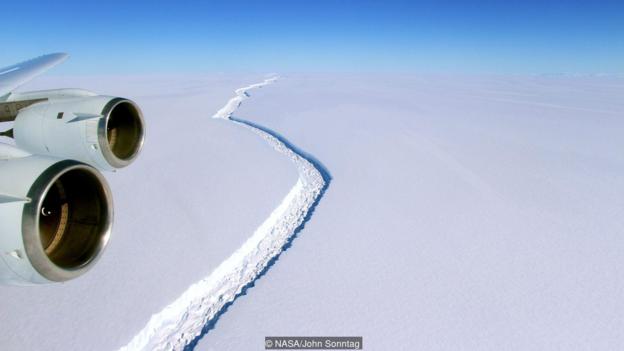
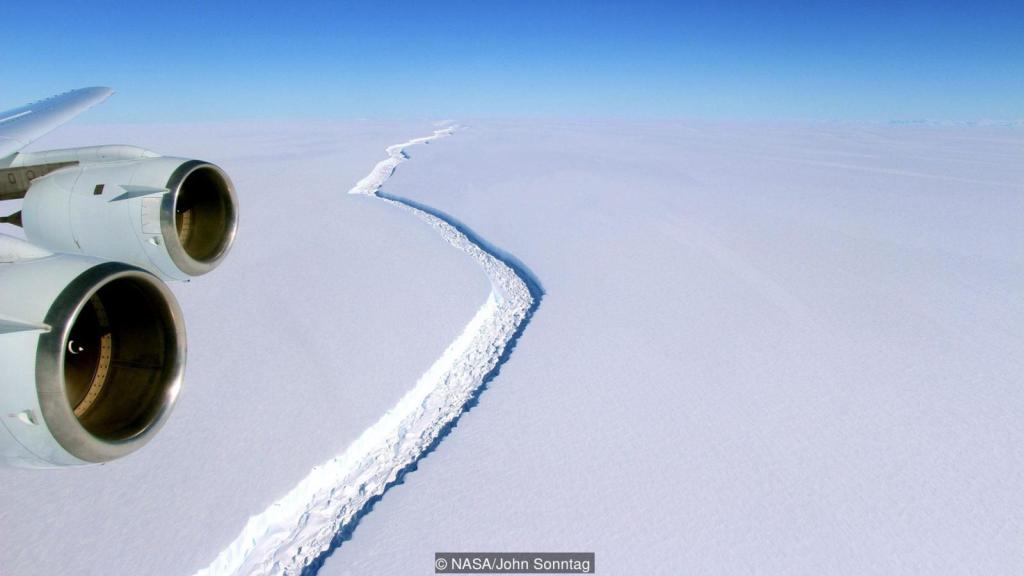
The shape of the world is hanging by a thread – or rather, according to experts, by a 110 mile-long (177km) rift. That’s the extent of a rapidly expanding crack in an enormous ice shelf in Antarctica. When the Larsen C shelf finally splits, the largest iceberg ever recorded (bigger than the US state of Rhode Island and a third the size of Wales) will snap off into the ocean. Widening each day by 3 ft (1 m), the groaning cleft is on the verge of dramatically redrawing the southern-most cartography of our planet and is likely to lead, climatologists predict, to an acceleration in the rise of sea levels globally.

 An aerial photo of the frigid fissure, taken late last year when it was discovered that the pace of the icy tear was quickening, was suddenly back in the news this week with the announcement that a second rift in the shelf had been detected. The fracture leads our eye along a zig-zagging path – from the backward gaze of the plane’s right engines to the pristine polar blue of the horizon in the distance. The jaggedness of the cleft, which takes our vision on a journey whose ultimate destination is unfathomable, seems at once monumental and terrifyingly fragile. The photo intensifies our helplessness in the face of cataclysmic change. It freezes the potential destruction in the blink of a camera’s shutter, while at the same time hinting at a catastrophe that we can witness unfolding but are utterly powerless to stop.

A second rift was recently discovered in the Larsen C ice shelf on the Antarctic peninsula (Credit: NASA/John Sonntag)

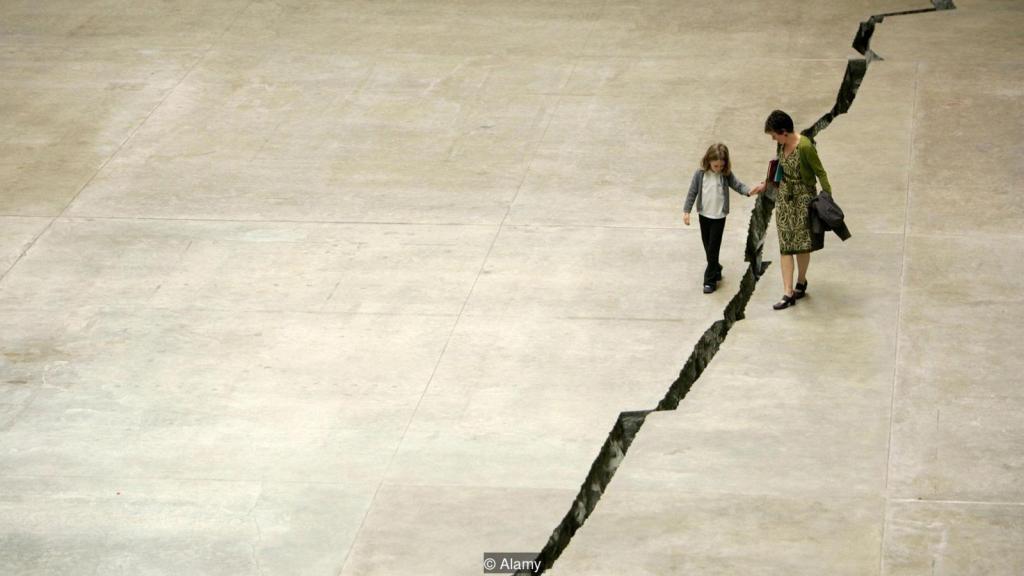
As a visual statement, the aerial photo of the Larsen C crack is, by definition, incomparable; never before has the world marked the glacial advance of such a sublime and fearsome fracture in its very fabric. Yet the reemergence of the image in the news anticipates the ten-year anniversary of one of the most intriguing and innovative large-scale works in contemporary art – a work whose power relies for its thought-provoking effect on the peculiar poetry of ruinous rifts. In October 2007, the Colombian-born artist Doris Salcedo unveiled in London an ambitious installation in the cavernous space of Tate Modern’s Turbine Hall – a piece that split reaction down the middle.

Inviting gallery-goers into the otherwise empty and austere interior of the former Bankside Power Station, Salcedo subverted expectations. Rather than offering visitors a hall of temporarily installed sculptures, she orchestrated the contemplation instead of a ragged subterranean breach that appeared to rip open the concrete floor of the structure – a crevice that extended from one end of the yawning space to the other.

For the Colombian artist Doris Salcedo’s 2007 work, Shibboleth, a giant crack was made in the concrete floor of Tate Modern’s Turbine Hall (Credit: Alamy)

Salcedo deepened the mystery of her bold and experimental conceptual work by giving to it the curious title Shibboleth – a biblical word which, when mispronounced, was said to have exposed the outsider status of individuals. Complicating matters still further, the artist insisted that her work was a comment not on the folly of material ambitions, but on racism – that deep cultural scar that tears at the foundations of humanity. Placed side-by-side, this week’s photo from Antarctica and the image captured a decade ago of Doris Salcedo’s challenging Shibboleth share both a brutal beauty and a common theme: the brittleness of being.

If you would like to comment on this story or anything else you have seen on BBC Culture, head over to our Facebook page or message us on Twitter.

And if you liked this story, sign up for the weekly bbc.com features newsletter, called “If You Only Read 6 Things This Week”. A handpicked selection of stories from BBC Future, Earth, Culture, Capital and Travel, delivered to your inbox every Friday.

ooOOoo

“the brittleness of being.”

Please, all of us, let’s make a positive difference so that we can soften the edges of that brittleness.

Little by little!

It takes so little good news to uplift one’s heart!

For reasons I can’t readily put my finger on it’s been feeling like a bit of a struggle recently. But that’s enough of that! For our gorgeous dogs have yet another lesson for me: How little it takes for a dog to wag it’s tail!

I so frequently share stuff that I read over on the Care 2 site and why not because as the home page declares:

40,107,687 members: the world’s largest community for good

Just three days ago there was a wonderful article shared on the Care 2 site about some dogs being rescued from a so-called backyard breeder. Better than that, it highlighted the wonderful consequence of a donation from George and Amal Clooney.

Here’s the story.

ooOOoo

9 Dogs Successfully Rescued From Backyard Breeder Thanks to George and Amal Clooney

By: Alicia Graef May 5, 2017

About Alicia Follow Alicia at @care2

Nine lucky dogs have just had their world turned upside down in the best way possible.

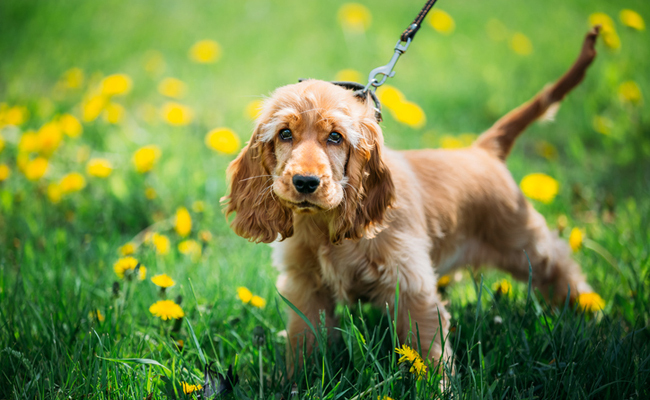
Camp Cocker Rescue, based in California, just took in the “Mojave 9″ who were being kept by a backyard breeder. They’ll be getting all the love and veterinary care they desperately need thanks to a generous donation made by George and Amal Clooney.

The nine dogs have had little human contact, and are all in need of extensive veterinary treatment for health issues ranging from mammary tumors and dental disease to skin and ear infections to ingrown toenails. The organization relies on donations, and expenses for this rescue operation were quickly rising.

“We literally didn’t know how we were even going to begin to start paying for all of these new dogs that we took in on the same day,” Camp Cocker’s founder Cathy Stanley told PEOPLE.

Now, the organization is celebrating a generous and unexpected donation of $10,000 made by George and Amal Clooney, who are parents to two adopted cocker spaniels from Camp Cocker — Einstein and Louie.

Their donation is going to help cover the cost of care for these dogs, who have never been to a vet. The Clooney’s will also be matching donations up to $10,000 for the rest of May.

“After we all did happy dances and cried with happiness for this unbelievable matching donation offer – we then asked the donors if (and only if they gave us their permission) . . . if we could reveal their names to our supporters in order to help us reach our big goal this month. They were so very gracious to give us permission to reveal their names,” Camp Cocker wrote in an update.

While this was a huge boost for them, Camp Cocker is quick to point out that no donation is too small to help.

“We have a philosophy where we want to be very inclusive of all of our supporters and it’s important to us that no matter how small of a donation, every person feels like their donation is meaningful and that we appreciate them,” Stanley added.

Hopefully news about the Mojave 9 and the attention it’s getting will help raise awareness about rescue and inspire more people to get involved … and will help find each of these precious dogs their perfect forever home.

For more on how to help, and info on how to adopt one of these dogs, check out Camp Cocker Rescue and follow updates on Facebook.

Photo credit: Thinkstock

ooOOoo

Here’s the video that accompanied that story.

And there’s only one way to close.

By thanking George and Amal for their wonderful generosity and their love for ex-rescue dogs!

Thanks, you two!

So little good news makes such a huge positive difference!

Picture Parade One Hundred and Ninety-Four

More from Janet ….

But first a couple from closer to home.

Soaking up the afternoon sunshine.
Our babies will be three weeks old next Tuesday.

oooo

oooo

oooo

oooo

oooo

oooo

Yet more to come in a week’s time.

You and your lovely animals please take care out there!

The aesthetic beauty of mathematics!

Sorry! Did you say the beauty of mathematics?

Those of you that read this blog fairly regularly know that from time to time I drift away from all things dog and potter in the garden of simply fascinating ideas.

Such is the case today.

It is an article on mathematics that was sent to me by Jim Goodbrod. He had read it in The New York Times in April.

Read it and see if you, too, find it as fascinating as I did!

ooOOoo

The World’s Most Beautiful Mathematical Equation

When the sun is low in the sky!

What dogs mean to us whatever our age!

I chose the title for today’s post deliberately. Wanting it to act as a metaphor for our senior years, as the dear Americans like to put it, or leaning on my English roots, preferring the metaphor of the sinking sun for the Autumnal years of our lives.

We live in a part of the world where “The median age was 47.3 years.”

Josephine County, Oregon

As of the 2010 United States Census, there were 82,713 people, 34,646 households, and 22,498 families residing in the county.[20] The population density was 50.4 inhabitants per square mile (19.5/km2). There were 38,001 housing units at an average density of 23.2 per square mile (9.0/km2).[21] The racial makeup of the county was 92.4% white, 1.4% American Indian, 0.8% Asian, 0.4% black or African American, 0.2% Pacific islander, 1.5% from other races, and 3.2% from two or more races. Those of Hispanic or Latino origin made up 6.3% of the population.[20] In terms of ancestry, 26.3% were German, 15.6% were Irish, 15.5% were English, 5.5% were Italian, and 5.5% were American.[22]

Of the 34,646 households, 25.5% had children under the age of 18 living with them, 49.2% were married couples living together, 11.0% had a female householder with no husband present, 35.1% were non-families, and 28.3% of all households were made up of individuals. The average household size was 2.34 and the average family size was 2.82. The median age was 47.3 years.[20]

Yet in the rural areas of this County one does see a fair number of people who, as with Jean and me, are the wrong side of 65!!

But one very frequent observation of those ‘senior’ people is that they have a dog in their lives.

On April 10th, I posted a guest article written by Jessica Brody. It was very well received and I closed that post by saying: “I know many will agree with me when I say that it would be good to receive some more articles from Jessica.”

Our wishes have been granted. Here is Jessica’s second guest article.

ooOOoo

The Wonderful Benefits of Pet Ownership for Seniors

by Jessica Browdy. May 3rd., 2017

It’s no mystery that pet ownership can bring joy to people’s lives, but it turns out that having a pet may benefit seniors in ways that reach far beyond the pleasures of companionship. For elderly people who live alone or in senior care facilities, owning a pet can improve mental and physical health, paving the way for longer, healthier, and happier lives. Here are five ways that having a critter companion can benefit senior health.
Pets Improve Senior Mental Health
One of the greatest benefits of pet ownership for people of any age is the unconditional friendship and love that a pet provides. This support is especially important for elderly people, who are prone to loneliness and isolation as they leave the workforce, children move away, and friends and loved ones begin to pass on. Isolation is one of the biggest risks to senior health; isolation can cause depression (and related issues), cognitive decline, and even early death. The company of a beloved pet can help seniors stave off loneliness and preserve their mental health. Caring for a pet can also give seniors something to focus on other than negative thoughts about grief, physical ailments, and aging, thereby reducing their overall stress levels.

Pets Keep Seniors Social

Pets do more than provide a social outlet for seniors — they can actually lead the elderly to be more social with their peers as well. People are naturally drawn to dogs, and a senior who is out walking a pet is more likely to meet new people than if walking alone. Pets can help bring people together in senior living facilities, too. Dogs, cats, and other animals give people a common interest over which they can come together, share stories, and develop friendships.

Pets Reduce Heart Attack Risk

Companion animals like dogs, cats, birds, and even fish can improve heart health by lowering blood pressure. One study showed that being in the presence of your dog can even have a greater impact on your blood pressure than some medications. And by lowering blood pressure, pets can reduce heart attack risk in seniors.
Pets Keep Seniors Active
The daily routine of caring for a pet helps seniors maintain functional mobility. Giving food and water, cleaning a litter box, and letting the dog outside makes a sedentary senior get up and get moving. These simple activities can support an elderly person’s ability to complete the activities of daily living like bending, preparing meals, bathing, and dressing. Older people who own dogs are also more likely to stay active into their later years. Not only do they get out to walk the dog, but they’re also more likely to be involved in other active hobbies like gardening.
Pets Improve Senior Personal Care
A senior who has a daily pet care routine is more likely to adhere to a daily personal care routine. Having a routine gives structure to a senior’s days, making it easier to adhere to medication schedules, meal times, and personal care. Maintaining a daily routine can even help seniors sleep better.

Seniors can be saviors to pets, too. When older people adopt adult or senior pets, they provide a loving, stable home to an animal that may not have found a home otherwise. Dogs and cats aged seven and older are adopted at staggeringly low rates, even though they still have years of love to give. Many shelters and rescues even offer discounts for seniors adopting senior pets, so be sure to ask if you might be able to adopt your new friend at a reduced rate.

Image viaPixabay by marmax

Author: Jessica Brody

ooOOoo

Keep them coming, Jessica. (Well that’s the view from this senior!)

The Month of May!

For all my life this has felt like a very special month.

And, dear friends, at the risk of repeating myself to many of you, this is why the month of May is special for me.

Simply that I was born in London during the closing months of the Second World War. Inevitably, I was unaware of the number of German bombs that were falling on London during those last few months. But there were thousands.

On May 8th. 1945, the day that WWII ended and six months to the day from when I was born, my mother looked down at me and said aloud to me: “You are going to live”. Despite the fact that I don’t recall my mother saying that, it was verified many times later when I was growing up.

Now here we are approaching May 8th. 2017 and in a very real sense it seems that we are in another war.

A war of consequence.

A war that we have been engaged in for many, many years.

A war where we are inadvertently fighting on a global battlefield.

A war where 99.99% of us don’t consciously identify the weapons we are using. Weapons that are incredibly effective. So much so that we are in sight of winning the last battle; winning the war.

Yet a war where winning is no win at all. Indeed, where winning this war, this global war, spells the end. The end of life for 99.99% of us humans (and much else besides).

Now what on earth has got me so fired up?

Two things have:

The first is that I am living in my 73rd year of life. I have no idea of when my life comes to an end. But that death is a guarantee. Indeed, if one takes note of the average life expectancy of a male today in the USA (75.6 years) , it may not be that far away.

The second thing is that before my death I truly want to know that humankind has laid down its weapons of war against our planet and that there really is an unstoppable mission, a united wave of passion, to live in peace on this planet. Perhaps better put to live in peace with this planet.

Or in the words of an organization that I now want to introduce:

A mission which will require the hard work and dedication of each and every one of us as we do everything in our power as individuals, but also as we galvanize businesses, entrepreneurs, innovators, city planners, communities, people and politicians—all those who share our purpose.

OK! Thank you if you are still reading this! (Someone give Fred in that soft arm-chair over there a nudge; I can hear his snores from here!)

In the last Smithsonian electronic newsletter that I was reading yesterday morning there was a reference to an organization that I hadn’t previously come across. Here is the link to that item on The Smithsonian website. I am republishing it in full in this place. As you read it you will understand why I am republishing it.

ooOOoo

Using a New Roadmap to Democratize Climate Change

A new tool aims to bypass governments and put the power of climate action in the people’s hands

By Anne Glusker    Smithsonian.com     April 28, 2017

Olafur Grimsson, who was president of Iceland from 1996 to 2016 and saw his country through the worst economic crisis in its history, making headlines all over the world as banks collapsed and the country fell into a depression, is the very picture of an urbane statesman. Collected and poised, with a striking full head of white hair, as comfortable in English as in his native Icelandic, he seems an unlikely revolutionary, not the sort of person you’d look at and immediately find yourself thinking: “Power to the People.”

 But Grimsson is one of the primary architects of a quietly radical new idea whose aim is to facilitate action on climate change without any of the usual suspects—governments, countries, international bodies, negotiating parties.

He and several other veterans of the historic 2015 Paris Agreement on climate change were in Washington, D.C., last year, just before COP22, the climate meeting held in Marrakesh in 2016. They were pondering next steps when the conversation took a new and interesting turn, Grimsson says, addressing the question: “Was it possible to have the success of Paris without governments necessarily being in the leading role?”

The group included movers and shakers such as Peter Seligmann, the chairman of Conservation International; Laurene Powell Jobs, president of the philanthropic organization the Emerson Collective; and Andy Karsner, an assistant energy secretary during the administration of George W. Bush. Galvanized by their own query, they decided to try to answer it—to set about creating a new tool to aid in achieving the goals of the Paris accord.

At the Smithsonian’s Earth Optimism Summit, a gathering this past weekend of conservation-minded citizens, scientists and activists, Grimsson explained: “You get governments that are opposed or even hostile to climate action. We decided to bring together in Marrakesh a gathering of thinkers and scientists and innovators and policymakers from different countries in order to discuss a new model of securing the success of the future of the climate movement.”

At the Smithsonian’s Earth Optimism Summit, the former president of Iceland Olafur Grimsson encouraged new solutions to climate change, awarding cash prizes to the winners of the “Make for the Planet” challenge. (The Roadmap)

Grimsson’s group felt that due to changes in information technology and social transformations, the large organizations and structures that used to be necessary to effect change were now not needed. And thus was born Roadmap, a new crowdsourcing tool for anyone and everyone interested in climate action. Still in its very early stages, Roadmap’s founders envision it as a platform for those working on climate issues—from scientist and policymaker to farmer and fisherman—to facilitate the sharing of knowledge and ideas, methods and techniques.

“A new political model is possible—where everyone can be a doer, where you no longer need big government or big enterprises to bring about success,” Grimsson says.

This new model for social change that skips the usual cumbersome channels and processes has been seen everywhere from public health, where the Bill & Melinda Gates Foundation has redefined the sector, to the hospitality industry, which is working to combat the human trafficking that plagues its businesses, to perhaps most famously the Arab Spring, where the role of social media in bringing about political change is still being debated today.

And this new model is complemented by technological changes. “The innovation in energy technology is such that we no longer have to wait for the big energy breakthrough,” Grimsson says. “We already have the available technologies. Every individual, home, village, community, town and region can execute change. The good news from the climate point of view is that, in addition to the information technology revolution, there has now also taken place an energy revolution. A house can be a power station: If the people who live in that house have extra energy, they can sell their energy through the smart grid. The notion that every house can be a power station is as revolutionary as saying that every mobile phone can be a media company.”

Grimsson admits that it may seem odd for someone in his position to be advocating that ordinary citizens take action apart from the conventional corridors of governmental power.

“For me to say that these traditional political organizations and positions are somewhat outdated is perhaps a strange statement: I was a professor of political science, I’ve been a member of parliament, I’ve been a minister of finance, I was president for 20 years,” he says.

It was during Iceland’s financial meltdown that he first experienced this new kind of social change: “I saw this very strongly through the financial crisis in my own country, which led to a big social economic uprising. All those activities were engineered by unknown people, people who were not part of a big organization, who used Facebook and the information media to bring thousands of people together in one day.”

Right now, Roadmap consists of a website and a lofty manifesto that speaks of raising the value of “moral currency” and creating a “best practices warehouse.” Visitors to the site can fill out a form if they want to become part of its community of “doers.” The practical part of the manifesto speaks of identifying the best methodologies and models; implementing a “real-time system of measurement” and a way to “gauge and understand what is working, what is not, and exactly what is being achieved.” As the platform develops, it will be interesting to see exactly what form these gauges, measurement systems, and warehouses take.

After the Paris Agreement, Grimsson says of himself and his Roadmap co-founders, “We were all optimistic, but we are all also realists.” It is his belief that if you “give people the tools, they can execute the transformation and the change—without governmental leadership.” Perhaps Roadmap will be one of those tools.

 ooOOoo

Here’s a video that spells it out in ways that I find impossible to ignore. (And, yes, I signed up, as in joining, yesterday afternoon.)

Because in hundreds of years time I want others to look at the following picture of Troutbeck Valley in England and know how precious is this one and only planet we live on.

Or in the words of Sue Dreamwalker that I read yesterday evening:

We are witnessing more storms, more unseasonal weather patterns, and I just hope that we wake up soon to the damage we are doing to our beloved Mother that has held us in her eternal arms for so long..

Photo credit: Getty Images

Enjoy the month of May wherever you are in the world!

Closing by repeating a key pronouncement in that RoadMap video above:

Why We? Who Else!

Picture Parade One Hundred and Ninety-Three

Janet Goodbrod just keeps giving and giving!

oooo

oooo

oooo

oooo

oooo

More next Sunday and, thanks to Janet, for quite a few Sundays thereafter.