Our Planet is a living entity, which means…. well, allow Professor Klare to spell it out.
A few months back, specifically on the 3rd May, I reflected on views that the Planet Earth was a living entity responding to how it was treated. One of those views was the now-famous Gaia hypothesis from Prof. James Lovelock; the other idea, of an avenging planet, was from Michael T. Klare, a professor of peace and world security studies at Hampshire College.
Then in June, Tom Engelhardt, of TomDispatch fame, published a further article from Professor Michael Klare. Tom’s generosity allows me the permission to re-publish the article, which is riveting reading.
The Global Energy Crisis Deepens
Three Energy Developments That Are Changing Your Life
By Michael T. Klare
Here’s the good news about energy: thanks to rising oil prices and deteriorating economic conditions worldwide, the International Energy Agency (IEA) reports that global oil demand will not grow this year as much as once assumed, which may provide some temporary price relief at the gas pump. In its May Oil Market Report, the IEA reduced its 2011 estimate for global oil consumption by 190,000 barrels per day, pegging it at 89.2 million barrels daily. As a result, retail prices may not reach the stratospheric levels predicted earlier this year, though they will undoubtedly remain higher than at any time since the peak months of 2008, just before the global economic meltdown. Keep in mind that this is the good news.
As for the bad news: the world faces an array of intractable energy problems that, if anything, have only worsened in recent weeks. These problems are multiplying on either side of energy’s key geological divide: below ground, once-abundant reserves of easy-to-get “conventional” oil, natural gas, and coal are drying up;above ground, human miscalculation and geopolitics are limiting the production and availability of specific energy supplies. With troubles mounting in both arenas, our energy prospects are only growing dimmer.
Here’s one simple fact without which our deepening energy crisis makes no sense: the world economy is structured in such a way that standing still in energy production is not an option. In order to satisfy the staggering needs of older industrial powers like the United States along with the voracious thirst of rising powers like China, global energy must grow substantially every year. According to the projections of the U.S. Department of Energy (DoE), world energy output, based on 2007 levels, must rise 29% to 640 quadrillion British thermal units by 2025 to meet anticipated demand. Even if usage grows somewhat more slowly than projected, any failure to satisfy the world’s requirements produces a perception of scarcity, which also means rising fuel prices. These are precisely the conditions we see today and should expect for the indefinite future.
It is against this backdrop that three crucial developments of 2011 are changing the way we are likely to live on this planet for the foreseeable future.
Tough-Oil Rebels
The first and still most momentous of the year’s energy shocks was the series of events precipitated by the Tunisian and Egyptian rebellions and the ensuing “Arab Spring” in the greater Middle East. Neither Tunisia nor Egypt was, in fact, a major oil producer, but the political shockwaves these insurrections unleashed has spread to other countries in the region that are, including Libya, Oman, and Saudi Arabia. At this point, the Saudi and Omani leaderships appear to be keeping a tight lid on protests, but Libyan production, normally averaging approximately 1.7 million barrels per day, has fallen to near zero.
When it comes to the future availability of oil, it is impossible to overstate the importance of this spring’s events in the Middle East, which continue to thoroughly rattle the energy markets. According to all projections of global petroleum output, Saudi Arabia and the other Persian Gulf states are slated to supply an ever-increasing share of the world’s total oil supply as production in key regions elsewhere declines. Achieving this production increase is essential, but it will not happen unless the rulers of those countries invest colossal sums in the development of new petroleum reserves — especially the heavy, “tough oil” variety that requires far more costly infrastructure than existing “easy oil” deposits.
In a front-page story entitled “Facing Up to the End of ‘Easy Oil,’” the Wall Street Journal noted that any hope of meeting future world oil requirements rests on a Saudi willingness to sink hundreds of billions of dollars into their remaining heavy-oil deposits. But right now, faced with a ballooning population and the prospects of an Egyptian-style youth revolt, the Saudi leadership seems intent on using its staggering wealth on employment-generating public-works programs and vast arrays of weaponry, not new tough-oil facilities; the same is largely true of the other monarchical oil states of the Persian Gulf.
Whether such efforts will prove effective is unknown. If a youthful Saudi population faced with promises of jobs and money, as well as the fierce repression of dissidence, has seemed less confrontational than their Tunisian, Egyptian, and Syrian counterparts, that doesn’t mean that the status quo will remain forever. “Saudi Arabia is a time bomb,” commented Jaafar Al Taie, managing director of Manaar Energy Consulting (which advises foreign oil firms operating in the region). “I don’t think that what the King is doing now is sufficient to prevent an uprising,” he added, even though the Saudi royals had just announced a $36-billion plan to raise the minimum wage, increase unemployment benefits, and build affordable housing.
At present, the world can accommodate a prolonged loss of Libyan oil. Saudi Arabia and a few other producers possess sufficient excess capacity to make up the difference. Should Saudi Arabia ever explode, however, all bets are off. “If something happens in Saudi Arabia, [oil] will go to $200 to $300 [per barrel],”said Sheikh Zaki Yamani, the kingdom’s former oil minister, on April 5th. “I don’t expect this for the time being, but who would have expected Tunisia?”
Nuclear Power on the Downward Slope
In terms of the energy markets, the second major development of 2011 occurred on March 11th when an unexpectedly powerful earthquake and tsunami struck Japan. As a start, nature’s two-fisted attack damaged or destroyed a significant proportion of northern Japan’s energy infrastructure, including refineries, port facilities, pipelines, power plants, and transmission lines. In addition, of course, it devastated four nuclear plants at Fukushima, resulting, according to the U.S. Department of Energy, in the permanent loss of 6,800 megawatts of electric generating capacity.
This, in turn, has forced Japan to increase its imports of oil, coal, and natural gas, adding to the pressure on global supplies. With Fukushima and other nuclear plants off line, industry analysts calculate that Japanese oil imports could rise by as much as 238,000 barrels per day, and imports of natural gas by 1.2 billion cubic feet per day (mostly in the form of liquefied natural gas, or LNG).
This is one major short-term effect of the tsunami. What about the longer-term effects? The Japanese government now claims it is scrapping plans to build as many as 14 new nuclear reactors over the next two decades. On May 10th, Prime Minister Naoto Kan announced that the government would have to “start from scratch” in devising a new energy policy for the country. Though he speaks of replacing the cancelled reactors with renewable energy systems like wind and solar, the sad reality is that a significant part of any future energy expansion will inevitably come from more imported oil, coal, and LNG.
Read this book.
The disaster at Fukushima — and ensuing revelations of design flaws and maintenance failures at the plant — has had a domino effect, causing energy officials in other countries to cancel plans to build new nuclear plants or extend the life of existing ones. The first to do so was Germany: on March 14th, Chancellor Angela Merkelclosed two older plants and suspended plans to extend the life of 15 others. On May 30th, her government made the suspension permanent. In the wake of mass antinuclear rallies and an election setback, she promised to shut all existing nuclear plants by 2022, which, experts believe, will result in an increase in fossil-fuel use.
China also acted swiftly, announcing on March 16th that it would stop awarding permits for the construction of new reactors pending a review of safety procedures, though it did not rule out such investments altogether. Other countries, including India and the United States, similarly undertook reviews of reactor safety procedures, putting ambitious nuclear plans at risk. Then, on May 25th, the Swiss government announced that it would abandon plans to build three new nuclear power plants, phase out nuclear power, and close the last of its plants by 2034, joining the list of countries that appear to have abandoned nuclear power for good.
How Drought Strangles Energy
The third major energy development of 2011, less obviously energy-connected than the other two, has been a series of persistent, often record, droughts gripping many areas of the planet. Typically, the most immediate and dramatic effect of prolonged drought is a reduction in grain production, leading to ever-higher food prices and ever more social turmoil.
Intense drought over the past year in Australia, China, Russia, and parts of theMiddle East, South America, the United States, and most recently northern Europehas contributed to the current record-breaking price of food — and this, in turn, has been a key factor in the political unrest now sweeping North Africa, East Africa, and the Middle East. But drought has an energy effect as well. It can reduce the flow of major river systems, leading to a decline in the output of hydroelectric power plants, as is now happening in several drought-stricken regions.
By far the greatest threat to electricity generation exists in China, which is suffering from one of its worst droughts ever. Rainfall levels from January to April in the drainage basin of the Yangtze, China’s longest and most economically important river, have been 40% lower than the average of the past 50 years, according toChina Daily. This has resulted in a significant decline in hydropower and severe electricity shortages throughout much of central China.
The Chinese are burning more coal to generate electricity, but domestic mines no longer satisfy the country’s needs and so China has become a major coal importer. Rising demand combined with inadequate supply has led to a spike in coal prices, and with no comparable spurt in electricity rates (set by the government), many Chinese utilities are rationing power rather than buy more expensive coal and operate at a loss. In response, industries are upping their reliance on diesel-powered backup generators, which in turn increases China’s demand for imported oil, putting yet more pressure on global fuel prices.
Wrecking the Planet
So now we enter June with continuing unrest in the Middle East, a grim outlook for nuclear power, and a severe electricity shortage in China (and possibly elsewhere). What else do we see on the global energy horizon?
Despite the IEA’s forecast of diminished future oil consumption, global energy demand continues to outpace increases in supply. From all indications, this imbalance will persist.
Take oil. A growing number of energy analysts now agree that the era of “easy oil” has ended and that the world must increasingly rely on hard-to-get “tough oil.” It is widely assumed, moreover, that the planet harbors a lot of this stuff — deep underground, far offshore, in problematic geological formations like Canada’s tar sands, and in the melting Arctic. However, extracting and processing tough oil will prove ever more costly and involve great human, and even greater environmental, risk. Think: BP’s Deepwater Horizon disaster of April 2010 in the Gulf of Mexico.
Such is the world’s thirst for oil that a growing amount of this stuff will nonetheless be extracted, even if not, in all likelihood, at a pace and on a scale necessary to replace the disappearance of yesterday’s and today’s easy oil. Along with continued instability in the Middle East, this tough-oil landscape seems to underlie expectations that the price of oil will only rise in the coming years. In a poll of global energy company executives conducted this April by the KPMG Global Energy Institute, 64% of those surveyed predicted that crude oil prices will cross the $120 per barrel barrier before the end of 2011. Approximately one-third of them predicted that the price would go even higher, with 17% believing it would reach $131-$140 per barrel; 9%, $141-$150 per barrel; and 6%, above the $150 mark.
The price of coal, too, has soared in recent months, thanks to mounting worldwide demand as supplies of energy from nuclear power and hydroelectricity have contracted. Many countries have launched significant efforts to spur the development of renewable energy, but these are not advancing fast enough or on a large enough scale to replace older technologies quickly. The only bright spot, experts say, is the growing extraction of natural gas from shale rock in the United States through the use of hydraulic fracturing (“hydro-fracking”).
Proponents of shale gas claim it can provide a large share of America’s energy needs in the years ahead, while actually reducing harm to the environment when compared to coal and oil (as gas emits less carbon dioxide per unit of energy released); however, an expanding chorus of opponents are warning of the threat to municipal water supplies posed by the use of toxic chemicals in the fracking process. These warnings have proven convincing enough to lead lawmakers in a growing number of statesto begin placing restrictions on the practice, throwing into doubt the future contribution of shale gas to the nation’s energy supply. Also, on May 12th, the French National Assembly (the powerful lower house of parliament)voted 287 to 146 to ban hydro-fracking in France, becoming the first nation to do so.
The environmental problems of shale gas are hardly unique. The fact is that all of the strategies now being considered to extend the life-spans of oil, coal, and natural gas involve severe economic and environmental risks and costs — as, of course, does the very use of fossil fuels of any sort at a moment when the first IEA numbers for 2010 indicate that it was an unexpectedly record-breaking year for humanity when it came to dumping greenhouse gases into the atmosphere.
With the easily accessible mammoth oil fields of Texas, Venezuela, and the Middle East either used up or soon to be significantly depleted, the future of oil rests on third-rate stuff like tar sands, shale oil, and extra-heavy crude that require a lot of energy to extract, processes that emit added greenhouse gases, and as with those tar sands, tend to play havoc with the environment.
Shale gas is typical. Though plentiful, it can only be pried loose from underground shale formations through the use of explosives and highly pressurized water mixed with toxic chemicals. In addition, to obtain the necessary quantities of shale oil, many tens of thousands of wells will have to be sunk across the American landscape, any of one of which could prove to be an environmental disaster.
Likewise, the future of coal will rest on increasingly invasive and hazardous techniques, such as the explosive removal of mountaintops and the dispersal of excess rock and toxic wastes in the valleys below. Any increase in the use of coal will also enhance climate change, since coal emits more carbon dioxide than do oil and natural gas.
Here’s the bottom line: Any expectations that ever-increasing supplies of energy will meet demand in the coming years are destined to be disappointed. Instead, recurring shortages, rising prices, and mounting discontent are likely to be the thematic drumbeat of the globe’s energy future.
If we don’t abandon a belief that unrestricted growth is our inalienable birthright and embrace the genuine promise of renewable energy (with the necessary effort and investment that would make such a commitment meaningful), the future is likely to prove grim indeed. Then, the history of energy, as taught in some late twenty-first-century university, will be labeled: How to Wreck the Planet 101.
Michael T. Klare is a professor of peace and world security studies at Hampshire College, a TomDispatch regular, and the author, most recently, ofRising Powers, Shrinking Planet. A documentary movie version of his previous book, Blood and Oil, is available from the Media Education Foundation. To listen to Timothy MacBain’s latest TomCast audio interview in which Klare discusses the U.S., Saudi Arabia, and resource conflicts, click here, or download it to your iPod here.
Martin Luther King, (January 15, 1929-April 4, 1968)
One of the aspects of modern life that is deeply unsatisfactory is the way that politicians and leaders of democratic societies fudge the truth in the hope that trying to be all things to all men means wider acceptance of their messages.
Think of the quote from Martin Luther King, Jr., “A genuine leader is not a searcher for consensus but a molder of consensus. ”
These words serve as an introduction to some beautiful thoughts from a loyal American living here in Payson. This is a man who is deeply spiritual, who has fought for his country, and who is soft and gentle to the core. This is a man who is not afraid to offer a personal vision to the world. I regard it as a real bonus that Jean and I have his friendship.
Here is the first of two contributions from John H.
The Passion of Enlightenment
Enlightenment includes deep grief and a passion to leave life a bit better than we found it. Enlightenment has little practical value in a growing and constantly consuming cultural demographic. Consumers tend to spiritually disconnect when faced by a need for change or when morality becomes inconvenient.
Is God truth? What is the opposite of truth? We’ve lost our way as a species. Does God tell us to worship money? Does God tell us to ignore our finite earth? Does God tell us to kill each other? Does God tell us to ignore human history and the emerging network of scientific understandings?
Human wisdom has been far greater in the past than it is today. God is not known through empirical knowledge. Man is as limited as the finite planet which gave life to our species and sustains our existence. Matter and energy are interchangeable as fundamental forces. God is experienced through our inner being and understood through the wisdom tradition of our species.
Sustainability includes the well-being of our planet and the life it supports. Sustainability includes serving as caretakers rather than acting as owners. Sustainability includes surrendering our addictions, our illusions and our delusions. Surrendering includes the courage to speak the truth and walk as we talk. Surrendering assures our common well-being as a conscious component of God. We have nothing to fear.
Consider world leadership. Who are the aggressors? Who are the oppressed? Who serves God? Who serves Mammon? We each must search our heart, mind and soul to answer these questions honestly. We need to face our shame and guilt in order to redeem ourselves and make a sustained effort to change.
The roots of wisdom in a constantly changing world are God, nature, history, and science. We’ve come a long way since we first learned to use tools. What have we forgotten in the process? We can’t wait for the truth to become popular. We each need to help make the truth popular.
Want a brilliant idea for tomorrow? Stay in the present!
Dogs do this wonderfully. I am told that followers of Zen Buddhism discover peace and grace from embracing the present. But is there more to this? Is there some deeper psychology involved? Does our species have an intrinsic challenge in terms of staying in the present?
My musings on this arise from a couple of recent conversations.
The first was with Peter McCarthy from the Bristol area of West England. Peter and I go back a few years (at my age, everything goes back a few years!) and at one stage I did some work for Peter’s company, Telecom Potential. Just a quick aside, Peter’s company was based in the magnificent Clevedon Hall, a mansion built in 1853 as a family home for Conrad William Finzel, a German-born businessman. Here’s a picture of one of the rooms,
A room at Clevedon Hall
Peter, like me, is sure that the period in which the world now appears to be, is not some cyclical downturn, not some temporary departure from the national growth and employment ambitions promoted by so many countries. No! This one is different.
Peter is sure that a major transition is under way, as big as any of the great societal upheavals of the past. And, for me, a fascinating comment from Peter was his belief that the key attitude required for the next years would be innovation. Peter reminded me that we tend to think of innovation as applying to things physical, scientific and technical. But Peter sensed that it would be in the area of social innovation where key changes would arise and, from which, these large societal changes would flow.
Then a day later I was chatting with one of the founders of a brilliant new authentication process, Pin Plus. It is a very smart solution to a major global problem, the weaknesses of traditional password user-authentication systems.
On the face of it, Pin Plus is obviously a better and more secure way of authenticating users, and a number of key test customers have borne this out. Jonathan C was speaking of the challenges of convincing companies to have faith in this new process. This is what he said,
More than once, indeed many times, I am told by prospects something along the lines that the IT world has been looking so hard and so long for a password solution that a solution can’t possibly exist.
Let’s ponder that for a moment. Are we saying that a far-sighted approach to the potential for change is not an easy place for some, probably many, human brains?
Indeed, Jonathan and I mused that here we were, both speaking via Skype, an internet telephony service, both of us looking at different web sites in support of many of the points that we were discussing and totally dependent, in terms of our mentoring relationship, on the technology of the internet, a multi-node packet-switched communications system that was a direct result of the American shock of seeing the Russians launch the world’s first artificial satellite, Sputnik 1, into low earth orbit on the 4th October, 1957.
Launch of Sputnik 1
At that time, it would have seemed impossible for anyone on the planet to see that the American response to Sputnik 1 would eventually lead to the vast packet-switched network that is now the modern Internet.
But why do we regard the ability to look into the future so utterly out of reach of the common man? Look at this, the Internet Timeline here. Look how quickly the response to Sputnik1 gathered pace. See how Leonard Kleinrock of MIT way back in May, 1961, presented a paper on the theory of packet-switching in large communications networks.
So maybe there’s a blindness with humans. A blindess that creates the following bizarre characteristics,
Whatever is going on in our lives at present we assume will go on forever. I.e. the boom times will never end, or the period of doom and gloom is endless.
Our obsession with how things are now prevents us from reflecting on those signs that indicate changes are under way, even when the likely conclusions are unmistakeable. The ecological and climatic changes being the most obvious example of this strange blindness that mankind possesses.
Yet, unlike animals and some spiritual groups of humans, truly living in the present appears incredibly difficult for man.
However, the history of mankind shows that our species is capable of huge change, practically living in constant change for the last few millennia, and that a very small proportion of a society, see yesterday’s article, is all that is required to create a ‘tipping point’.
I want to continue with this theme but conscious that there is still much to be written. So, dear reader, I shall pause and pick this up tomorrow.
We must never lose sight of the greater power of positive thoughts.
Indeed, who cannot look at a dog’s wagging tail and not feel better about life. There is so much doom and gloom around that we need constantly to remind ourselves that there is a brighter future ahead, there always is.
And to understand how little it takes for a positive difference to sweep through, take a look at this article from Science Daily,
Scientists at Rensselaer Polytechnic Institute have found that when just 10 percent of the population holds an unshakable belief, their belief will always be adopted by the majority of the society.
The implications of this are profound. Be sure that we are living through a transition period, a period necessary to find a better future. Find another nine people who agree with you, and there’s a hundred on their way! Back to the article,
“When the number of committed opinion holders is below 10 percent, there is no visible progress in the spread of ideas. It would literally take the amount of time comparable to the age of the universe for this size group to reach the majority,” said SCNARC Director Boleslaw Szymanski, the Claire and Roland Schmitt Distinguished Professor at Rensselaer. “Once that number grows above 10 percent, the idea spreads like flame.”
A President with more speech writers than one could imagine.
Got a vested interest or a strong view? Then draft a speech for the President of the United States of America. Many do. Some are clearly very tongue-in-cheek, some are pertinent. The following from CASSE fits into the latter category. Enjoy.
President Obama’s (Hoped for) “Amaze Speech”
Speechwriter: Brian Czech
President Obama’s hoped-for speech first appeared in the Daly News on August 7. We reprint it this week in anticipation of the President’s September 8th speech.
Pres. Obama
Fellow Americans, this evening I have a special message for you. It’s an unprecedented and surprising message, but ultimately it will resonate with your common sense, good will, and patriotic spirit. It turns out that the recessionary cloud we’re under does have an extremely valuable silver lining. I know; it sounds like something only a politician would say, but wait. I think you’ll be surprised to hear my explanation.
Now before I elaborate on the silver lining, I want to make it clear that the cloud has some rain, too. As a nation, we are struggling with debt, credit ratings, and worst of all, the painful experience of unemployment. The last thing I want is to mislead you into thinking these are problems I take lightly, or problems that will be automatically solved by the markets or policy makers. These problems were many years in the making — decades in fact — and it’s going to take years of diligence and readjustment to solve them.
Yet none of these problems can deny us the silver lining, which is this: the economic turmoil we experience today will change the course of history in such a way as to secure the future for American posterity, starting with our children and grandchildren. Let me reiterate, our own kids and grandkids — the most precious American treasure — will have a secure future as a result of the problems we face today. Here’s why…
Far from the trading floors of Wall Street and the policy meetings of the Federal Reserve, crucial discoveries have been made by scientists, economists, anthropologists, historians, and others collaborating under a broad umbrella called “sustainability science.” No, they haven’t discovered an unlimited energy source, a pollution-free car, or a method to stabilize our climate at optimum conditions. They’ve discovered something far more important and exciting: the key to permanent economic security.
For the past few years, as time has allowed, I and my economic advisors, with the assistance of numerous scholars, have studied this key to economic security. The theory and evidence for it is absolutely irrefutable. The only reason this key to security hasn’t broken into public dialog is because it serves no short-term vested interests; no wealthy corporations, think tanks, or political parties that would stand to profit before the next shareholders meeting or election cycle. But that’s also the beauty of it: the key to security is a non-partisan, scientifically sound approach to the long-run interests of all, especially our kids and grandkids. Fortunately for us, it’s surprisingly simple as well.
What is this key to a secure future? We could coin a new phrase to get credit for the idea or to improve its political flavor, but I believe the clearest term is what the scientists already call it: the “steady state economy.” Political advisors think it’s a bit on the dry side, but after what we’ve been through – stock market crashes, insurance crises, banker bailouts, panic over the debt ceiling, having our credit downgraded — doesn’t a “steady state economy” sound like just what the doctor ordered?
In the coming weeks and months, I and my Cabinet will be helping to introduce fellow Americans to the basics of steady state economics, especially what it means for producers, consumers, and public policy. We’ll do this through a series of public announcements, publications, and townhall meetings. Meanwhile, this evening, I’ll provide a brief summary, first by noting what a steady state economy is not.
A steady state economy is not communism, Marxism, or anything at odds with the Constitution of the United States. A steady state economy is not a stagnant, flat-lined economy but is rather continuously dynamic and creative. A steady state economy is not established overnight with draconian policies; instead it evolves as a matter of consumer preference and prudent policy. Most importantly, a steady state economy is in no way opposed to jobs and full employment. To the contrary, a steady state economy is the only economy that can ensure full employment, for your kids and theirs.
The most fundamental feature of the steady state economy is stability. The idea is to stabilize good conditions; stable agriculture, stable manufacturing, stable services, stable production and consumption, stable currency, stable markets, stable international trade, stable impact on the environment, stable air and water, stable climate… You get the picture, and remember, all this stability is at a good level — a level that ensures life, liberty and happiness for us and future generations. At this point in history, the steady state economy is the right goal, and the first step in getting there is recognizing it.
Perhaps you find this amazing. I think you should be amazed. After all, I haven’t said a word about economic growth; in fact I’ve called growth into question. The closest thing to this in presidential history is when President Carter encouraged Americans to consume a little less after the OPEC oil embargo. But President Carter was before his time, and his speech was maligned as the “malaise speech.”
Well, at this point in history, we can no longer afford — literally or figuratively — to pull out all the stops for economic growth. Therefore, tonight you’re hearing the “amaze speech,” the speech that introduces our nation to steady state economics, the alternative to growth.
I understand the adjustment in thinking that this will entail. I’ve gone through it myself. With the exception of President Carter in 1979, my predecessors for over 50 years have prioritized economic growth in their speeches, campaigns, and policies. None even mentioned steady state economics in a speech. Yet with every new president, the pursuit of economic growth has become less realistic, less sustainable, and even less desirable.
Earlier I mentioned the profound developments in sustainability science. Among the sustainability scholars are behavioral scientists and psychologists who have found compelling evidence that economic growth stopped contributing to a happier United States somewhere from the 1950′s to the 1970′s. After that, our gross domestic product continued to rise, but our happiness did not. If you’re like me — meaning old enough to remember — this probably resonates with you. Somewhere along the line the brighter lights, bigger houses and fancier cars stopped making us better off. In fact, all the new “stuff” started working against us. Now we struggle to find enough oil, water, “green space,” solitude, free time, and the peace of mind that comes with a stable climate. It’s all the sign of an economy grown too big.
They say the definition of insanity is doing the same thing over and over again and expecting a different result. I think we’ve all done some crazy things in life, but I don’t want to go down in history as the insane president who kept trying every trick in the book to “stimulate the economy,” when stimulating the economy was neither bound to work nor even desirable by that point in history. I don’t want to oversee more banker bailouts, more stimulus spending, more loosening of environmental protections in a vain attempt to increase GDP growth. That would be insane. Instead, I’m going to tell it like it is: the pursuit of economic growth has become a dangerous obsession that we must overcome. I say this with the backing of sound science, the lessons I’ve learned, and the concern I have for the future of America.
I’m going to test your common sense now. Do you think there is a limit to economic growth? Remember, economic growth is increasing production and consumption of goods and services. It means more and more people, more and more stuff. It takes more energy, water, space to operate in, and places to put out the trash.
Now as a politician, I can assure you that, in the coming days, well-paid pundits will conjure up magical concepts of perpetual growth based on “dematerializing” the economy. Well when they’re ready to dematerialize it, maybe they can beam us up. Meanwhile, the rest of us in the real economy know what perpetual GDP growth would take: evermore people, evermore stuff. And we know we’re running out of evermore room, resources, and patience for unreal notions of evermore growth.
I know that for some, and perhaps for many, this is hard to swallow. For decades we Americans have been encouraged to believe in the notion of continual economic growth. But look at it this way: to think there is no limit to economic growth on Earth is like thinking we could fit a stabilized economy into a perpetually shrinking area. For example, with computers, robots, nanotechnology and the like, we could squish the $70 trillion global economy into North America, then the United States, then Iowa, then into the foyer of the Des Moines Chamber of Commerce, leaving the rest of the world as a designated wilderness area! It’s a ludicrous notion, and it’s precisely as ludicrous as thinking there’s no limit to economic growth in Des Moines, the United States, or Earth.
Now, let’s consider some of the problems we will face if we continue pulling out all the stops for economic growth. The first is inflation. Typically we use monetary policy — such as increasing the money supply — to stimulate growth. But when the real economy isn’t meant to grow as easily as increasing the money supply, the result is inflation. Nothing could be more harmful to our economy at this point than inflation, which is like a devastating tax on the nation.
Another problem is debt. As you know, my Administration injected a major fiscal stimulus into the economy. It helped somewhat and spun off some jobs, but it did not produce the wave of jobs we’d get in an economy with plenty of room to grow. Meanwhile, it added to our deficit and ultimately our debt. Now our credit is coming into question, as with so many nations in a global economy bumping up against the limits to growth.
Of course, there is no shortage of special interests to pounce on the news of faltering fiscal policy. The answer, they say, is to turn over as much as possible to Wall Street. “Take care of national security,” they say, “and let the markets take care of the economy.” The problem with that approach is that national security is about more than having the biggest military. National security starts with a sustainable economy, which requires a stable environment to support the agricultural, fishing, logging, mining, and ranching activities that have always been and always will be the foundation of the American and global economy. Our manufacturing and service sectors — the best in the world — are the best because we have the biggest and best agricultural and extractive sectors. And we have those because we have protected the environment from overuse, pollution, and displacement.
Consider what will happen if we take an unbalanced approach and prioritize economic growth even more over environmental protection. Does anyone really question whether we will have more environmental problems, including devastating problems? More oil spills in the Gulf of Mexico and Gulf of Alaska, more mountaintop mining in the Appalachians, more scraping for shale oil in the Rockies, more nuclear waste, more endangered species, more greenhouse gas emissions, and all the while less water, less fish and wildlife, less wilderness, less nature, less beauty. Does anyone question whether such trends diminish the quality of life for future generations? No, the problems caused by economic growth are unquestionable. It’s just that, for much of American history, the benefits of increasing GDP outweighed the costs. That’s no longer the case, and I’m confident that most of us can sense it.
In fact, the more I thought about this speech, the more amazed I became. Why did it take us so long, in America, to have an open discussion of limits to growth and alternatives to growth? The principles are irrefutable. Neither growth nor recession is sustainable in the long run; a steady state economy is the obvious policy for long-run security. Yet based on the politics of the past 50 years, you’d think economic growth had supplanted apple pie as the companion to motherhood.
Well, now we’re entering a new era of dealing squarely with sustainability. It turns out that economic growth was not a good companion to motherhood, not in the long run. We want apple pie back. We want loving homes for our children, quality time with family and friends, the occasional escape to the great outdoors, and peace. That’s the American dream in a nutshell, and it’s too valuable to sacrifice for economic growth.
So let’s roll up our sleeves and wash our hands of the dirty business of growth at all costs. We know what the right goal is, and malaise won’t get us there. We have work to do to stabilize the economy for our children and grandchildren. Our decisions — what we eat, what we drive, what we build, and frankly how many kids we have — all these will determine the quality of life for the kids that we do have. Meanwhile, those of us privileged to hold public office are responsible for developing the policies to help you thrive in a steady state economy, and for avoiding the policies that force us onto an unsustainable pathway of evermore growth. You could say we are tasked now with “steady statesmanship.”
To conclude, my fellow Americans, do stay tuned. In the coming days and weeks we’ll be discussing the details of transitioning from growth to a steady state. We’ll be talking with you about employment, population growth, stock markets, the banking system, and more. Don’t fear any shocks to the system; you’ve seen most of the shocks already as the policies of economic growth have failed. One by one, we’re going to turn these “failures” into steady state successes.
The latest announcement continues to show dogs in very good light!
Before I plunge into this Post, just an apology. I’m trying hard to get out of what feels like a recent pattern of ‘re-publishing’ stuff rather than posting material that is primarily my own creative output. Ironically, it’s become a little harder to achieve since starting a creating writing course last Tuesday 23rd (every Tuesday evening for 12 weeks!). The course requires several thousand words of ‘homework’ each week.
Then I lost the plot and published two posts yesterday, when one of them should have been scheduled for today! Thus making it almost impossible to be fully creative today!
Anyway, to today’s theme. Which comes very close on the heels of my post on Monday about the antics of the big oil companies and ‘recovering’ oil from tar sands in Canada.
We all know that some of the most ecologically and environmentally fragile places on the planet are the polar regions. Of the two polar regions, the more sensitive one is the North Polar region. The Arctic ice cap is forecast to be clear of ice each Summer by 2030 assuming the huge annual run-off of fresh water doesn’t screw up the existing ocean currents before then. (Indeed, a fascinating film about the complexity of the weather systems as a result of very long heating and cooling cycles was seen recently on YouTube – link at the end of this post.)
So continued madness over our love affair with oil is just that: madness. Don’t get me wrong. Jean and I drive gasoline-powered vehicles but at least we are conscious of the damage we are doing and will change just as soon as it becomes viable for us to so do.
So with all that in mind, here’s a recent announcement from Exxon first seen on the BBC News website.
US oil major Exxon Mobil has clinched an Arctic oil exploration deal withRussian state-owned oil firm Rosneft.
The venture seemingly extinguishes any remaining chance of BP reviving its own deal, which lapsed in May.The agreement was signed on Tuesday in the presence of Prime Minister Vladimir Putin, a Rosneft spokesman said.
Prime Minister Putin said that it would also allow Rosneft to develop fields in the Gulf of Mexico and Texas, according to local media reports.
“New horizons are opening up. One of the world’s leading companies, Exxon Mobil, is starting to work on Russia’s strategic shelf and deepwater continental shelf,” he said.
‘Big win
‘Under the agreement, the two firms will spend $3.2bn on deep-sea exploration in the East Prinovozemelsky region of the Kara Sea, as well as in the Russian Black Sea.
Exxon described these areas as “among the most promising and least explored offshore areas globally, with high potential for liquids and gas”.
The two companies will also co-operate on the development of oil fields in Western Siberia.
Exxon spokesman Alan Jeffers told the BBC: “[The Russian Arctic] is among the most promising and least explored regions for oil, that is why we are very interested.
Cynic mode on: “The Russian Arctic is among the most promising and least explored regions for oil …” Well that’s alright then!
If one follows that link in the BBC news item, it goes to the ExxonMobil press release where one can quickly read the following key points,
US $3.2 billion exploration program planned for Kara Sea and Black Sea
Establishment of a joint Arctic Research and Design Center for Offshore Development in St. Petersburg
Rosneft participation in ExxonMobil projects in the U.S. and other countries with a focus on building offshore and tight oil expertise
Joint operations to develop Western Siberia tight oil resources
Companies form partnership to undertake projects in the Russian Federation and internationally
Thus this is not some small sideline – it’s potentially very big business for both partners.
The Kara Sea, an extension of the Arctic Ocean, is located off the coastline of Siberia in far northwestern Russia.
It’s separated from the Barents Sea (in the west) by the Kara Strait and Novaya Zemlya – and the Laptev Sea (in the east) by the Taymyr Peninsula and Severnaya Zemlya. The northern border (shown) is a mapping opinion.
It has an estimated area of 880,000 sq km (340,000 sq mi), an average depth of 128 m (420 ft) and a maximum depth of 620 m (2,034 ft).
Ice-bound for most of the year, the sea is generally navigable only during August and September.
The main ports are Dikson (Dickson) and Novyy Port, and they are heavily used during the two-month (lucrative) fishing season. They will also be distribution points when the petroleum and natural gas discovered here is brought to the surface.
Just look at that map again and see how far North of the Arctic Circle is the Kara Sea.
Dad, where's the ice gone?
Let’s go back to dogs. When dogs were primarily wild animals, really when they were still carrying all the ‘habits’ of the Grey Wolf, from which dogs are genetically descended, they were very territorial, as indeed domestic dogs are towards their domestic area. WikiPedia explains, ‘The core of their territory is on average 35 km2 (14 sq mi), in which they spend 50% of their time.‘ (That’s a great article on WikiPedia about the Grey Wolf, by the way.)
Anyway, the wolves, like practically all other animal species, live in harmony within their territory and only move or amend their territorial boundaries if the survival of the pack is threatened.
So when, oh when, is mankind going to learn that our territory is Planet Earth. We have no other territory to move to. I still remember my form teacher way back in my first English school saying to me, “There are two ways you can learn this lesson, the easy way or the hard way!” Same applies to us all! Let’s urgently learn this lesson from dogs and move on from oil.
Finally, that YouTube video. Less than an hour long, it has some interesting facts about climate change over many thousands of years and a rather interesting conclusion.
(Apologies to all you readers – bit under the cosh at the moment in terms of free thinking time – so have lent on this timely update from CASSE for today.)
From CASSE, the Centre for the Advancement of the Steady State Economy
Why Do So Many People Believe in the Fantasy of Infinite Growth on a Finite Planet?
by Rob Dietz
How do you feel about the economy these days? How about the environment? Do you think we’re sitting in a better spot than we were ten, twenty, or thirty years ago? It’s hard to find folks who are satisfied with either economic or environmental conditions. In the first place, the way we run the economy is producing appalling results. We have a mix of financial fiascos, unacceptable unemployment, and a dismal disparity between the haves and the have-nots. And if you’re not soiling yourself (or at least somewhat concerned) about what’s happening on land, sea and air, then you’re not paying much attention to the omnipresent signs of environmental breakdown.
Each day it becomes more apparent that we are on a misguided mission. Pursuit of perpetual economic growth is not a winning proposition for a lasting prosperity. Building a bigger economy can make sense in some circumstances, but always aiming to build a bigger economy means taking an ever-bigger chunk out of the earth’s ecosystems and the life-support services they provide. Why, then, do so many people believe in the fantasy of infinite growth on a finite planet? Is it because we can’t come up with a better idea? Is it because the rich and powerful have trapped the rest of us in their web of conspiracy? Is it because people are hopelessly greedy and materialistic?
At various times and places we might answer these questions affirmatively, but we can more commonly answer, “No, no, and no.” Putting aside conspiracy theories for the moment, there are three honest (but bogus) reasons why we pursue economic growth past the point of effectiveness and reason.
Bogus Reason #1: We think we have to have economic growth to create jobs.
People, and especially politicians, want jobs. We’ve used the blunt tool of economic growth to create jobs for decades, but do we really need economic growth to have good jobs? It’s true that there are typically more job openings in a growing economy, but there are other, less costly ways to make sure jobs are available. Growth, however, gives corporate elites an easy out. They can point to economic growth as the job creator while doing what they want without considering the impacts of their decisions on jobs.
If jobs are really the priority, then we wouldn’t replace people with machinery. And we wouldn’t eliminate service jobs to shift more and more burden onto people to serve themselves. My friend Chris works as a gas station attendant and provides a valuable service pumping gas for customers. He wouldn’t have a job, however, if he lived elsewhere. He happens to live in Oregon where the law says that only professional attendants can pump gas. In most states, gas station attendants have been replaced by customer labor and credit card readers. This sort of substitution has become commonplace in the name of efficiency — policy makers find it easier (or at least they’ve found it easier in the past) to avoid considering jobs explicitly. Just grow the economy and let Chris find a job elsewhere — that’s just the way it goes if his job is eliminated and the customer is forced to pick up the slack.
The truth is that we can have good jobs without producing and consuming evermore stuff. For starters, we can institute policies to make job-sharing an attainable reality. Many people would gladly trade some salary for more time. We can also stop the process of eliminating jobs through outsourcing and machinery-for-people swaps. Of course stopping this process would require a change in corporate incentives…
Shareholder corporations are severely flawed. In my household, let’s say my overriding goal is to maximize my earnings. What would I do? I would take the highest paying job I could get. I certainly wouldn’t be involved in public policy or a not-for-profit enterprise. I wouldn’t spend much time with my wife or daughter — that would be time away from my career, and it could eat into my earnings (cue the Cat’s in the Cradle). If the goal is so single-focused, the results aren’t surprising. Profit maximization, whether it occurs in my household or in a corporation, produces perverse outcomes.
We know this about shareholder corporations. We know there are better ways to set up productive enterprises that have more worthy goals, but we don’t make the change. The reason is that we are addicted to two things corporations do well. First, we’re addicted to consumer novelty. We’ve gotta have the latest and greatest. People chase after I-phones, I-pods, I-pads, and plenty of other I-wants. Second, we’re addicted to receiving unearned income from investments in stocks or mutual funds. People who can afford it are invested in corporations. Their personal wealth is tied to the ability of corporations to grow. We’ve become accustomed to the idea of passive investment — we put extra money into an account and do absolutely nothing but watch the size of the account get bigger. Are we really entitled to get something for nothing?
Bogus Reason #3: We refuse to pay attention to the downsides of economic growth.
Few people are studying ecology and understanding how economic growth is degrading environmental resources. In fact, a whopping 21% percent of college students are business majors. And as Dr. Seuss noted in his classic book, The Lorax, “Business is business, and business must grow!” While we continue to tempt fate by disrupting and dismantling natural systems that we only partially understand, our attention is locked on the results of reality TV shows, Tiger Woods’s sex life, Jennifer Anniston’s and Justin Bieber’s haircuts, fairytale weddings of figurehead monarchs, and other matters of critical importance.
While we’re failing to pay attention, those who benefit most from growth — the corporate elites — will keep on doing what they do, and they’ll keep on selling it to the rest of us. If we don’t start asking, “why?” real soon, our kids will one day be asking “How did we let this happen?”
A fascinating and beautiful insight into wild turkeys!
Yesterday, I published a couple of stories that demonstrated that close, loving bonds can form between different species, including an orang-utan and a dog, and a duck and a man.
By chance, Jean and I came across another example of cross-species bonding. This time between Joe Hutto, an American living in Florida, and a brood (is that the right description?) of newly-born wild turkeys. The first thing these tiny birds saw when they opened their eyes after breaking clear of their egg was Joe, and they immediately imprinted him as their ‘mother’.
Joe spent a complete year and more being ‘mother’ to these birds right up to the point where they naturally flew the nest, so to speak. Joe’s experiences led to a book, Illumination in the Flatwoods, and from that to a BBC Natural World special My Life as a Turkey, regrettably not available to viewers outside the UK.
But speaking to someone who did watch the BBC film, it was clear that it was a most beautiful and touching account of how young wild turkeys can bond to a human. Here’s part of the programme review in the British Guardian newspaper,
Joe Hutto’s life changed when a local farmer in the Florida flatlands where he lives left a stainless steel dog bowl full of wild turkey eggs on the porch of his cabin. Joe put them in an incubator, and waited. Some weeks later, cracks began to appear. This is the crucial time: “imprinting” only occurs in the first few moments after hatching. So Joe put his face down to the level of the opening eggs and the first poult emerged, wet and confused. Joe made a chirping, clucky noise, the poult looked him square in the eye, “and something very unambiguous happened in that moment”.
The little turkey stumbled and crawled across to Joe, and huddled up against his face. It recognised Joe as its mother. In the next few hours, Joe became mother to 15 more baby turkeys and remained so for the next 18 months. My Life as a Turkey: Natural World Special (BBC2) tells that story.
Across to the programme details from the BBC2 website (may not be available 26 days after the date of this article),
Biologist Joe Hutto was mother to the strangest family in the world, thirteen endangered wild turkeys that he raised from egg to the day they left home.
For a whole year his turkey children were his only companions as he walked them deep through the Florida Everglades. Suffering all the heartache and joy of any other parent as he tried to bring up his new family, he even learnt to speak their language and began to see the world through turkey eyes. Told as a drama documentary with an actor recreating the remarkable scenes of Joe’s life as a turkey mum.
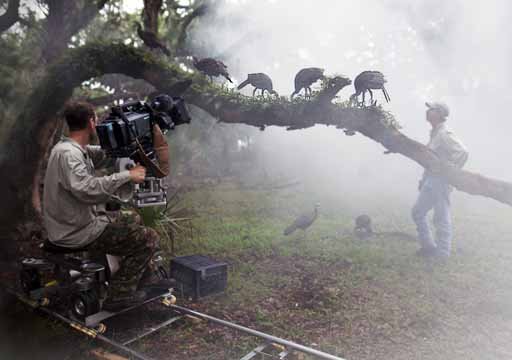
Behind the scenes image of turkeys and Jeff Palmer (actor) in misty forest in Florida. Cameraman (Mark Smith) on track & dolly shows how some of the beautiful sweeping shots were filmed.
Sam Wollaston of the Guardian continues,
It’s not hard to see how the little birds were taken in. Joe’s moustache does look a bit like feathers, he has a long scraggy neck, an understanding of the forest, and a tentative, birdlike walk. He takes them out, to catch their first grasshoppers; he teaches them how to roost. For Joe, as for any mother, parenthood is an emotional rollercoaster ride. There is the joy of seeing his babies grow, but almost constant worry. Grief too, when one is taken by a rat snake, and another by a hawk, and two more get sick (bird flu?) and die.
Adolescence arrives with all its associated problems. The males start fighting; only the toughest will get to mate. “I had no way of knowing how I was going to be part of this rite of passage,” says Joe. Steady now, Joe, let’s not take this too far, you’re not supposed to mate with any of them. For one, they’re your children. They’re also turkeys. That would be doubly wrong. Sometimes I think Joe spends too much time alone in the forest.
Quite so! However, the film was so beautifully shot that it was very, very easy to forget that this was a re-enactment of Joe’s original experience. That love is all about how you make someone, or in these cases, some other creature, feel. Another couple of pictures from the BBC website,
Lights, camera, action!Jeff Palmer (actor) sat on large felled tree on his cell phone with a dozen wild turkeys.
One final extract from the Sam Wollaston article in The Guardian newspaper,
My Life as a Turkey isn’t simply a wildlife film though. It’s not just about wild animals, it’s about one man’s relationship with wild animals, and that’s what makes it so fabulous. Serious animal behaviourists may not agree, but if you throw a human being in there, it all suddenly becomes a lot more interesting. I’m thinking Ring of Bright Water, Gorillas in the Mist, I’m definitely thinking Werner Herzog’s brilliant Grizzly Man about a man named Tim whose friendship with bears went wrong and he ended up inside one. My Life as a Turkey has something of Grizzly Man about it – a man obsessed, alone in a beautiful place, living with wild animals. But, although Joe was attacked, he didn’t end up inside one of his turkeys thankfully. There would have been a certain irony to that, especially if it had happened at Thanksgiving.
Anyway, it’s a lovely film – beautiful, charming, funny, sad, thought-provoking even. What thoughts did it provoke in me? That I need to go and see my mum.
Unfortunately, as mentioned above if you are outside the UK you are not able to watch the film via the BBC iPlayer system. But you can buy the book.
Joe Hutto's book of his life with wild turkeys.
Available from Amazon, here’s just one of the reviews,
My review is not unbiased because Joe Hutto, author of “Illumination in the Flatwoods,” and I have been friends for almost 25 years.
Joe is the most humble man I’ve ever known. I am honored that he brought me the original manuscript to read. It was so beautiful I could have cried.
With the same graceful writing skills used by conservationists Aldo Leopold (“Sand County Almanac”) and Herbert Stoddard (“Memoirs of a Naturalist”), Joe gives a masterful mix of documentary-style nature reporting and heartfelt thoughts on the meaning of life. As dramatic as that sounds, I think most readers will agree that “Illumination in the Flatwoods” is a life-changing book.
You will never regret the dollars you spend to buy this book nor the time it takes you to read it. . .
Just a few days ago, the British news media carried a wonderful story about the resurgence of the otter in every county of England. For many years, the otter was losing the battle for survival owing to hunting and trapping and the far South-West of England became it’s last refuge.
Then a combination of sensible legislation and public commitment to saving the otter became the turning point.
Watch this clip from ITN News from the 18th August.
Here’s a typical media report from The Independent newspaper of Thursday, 18th August,
Otters return to every county in England
Once the rivers were cleaned up, fish returned to once-polluted waters and otters began to spread back eastwards from their strongholds in Devon and Wales
By Michael McCarthy, Environment Editor
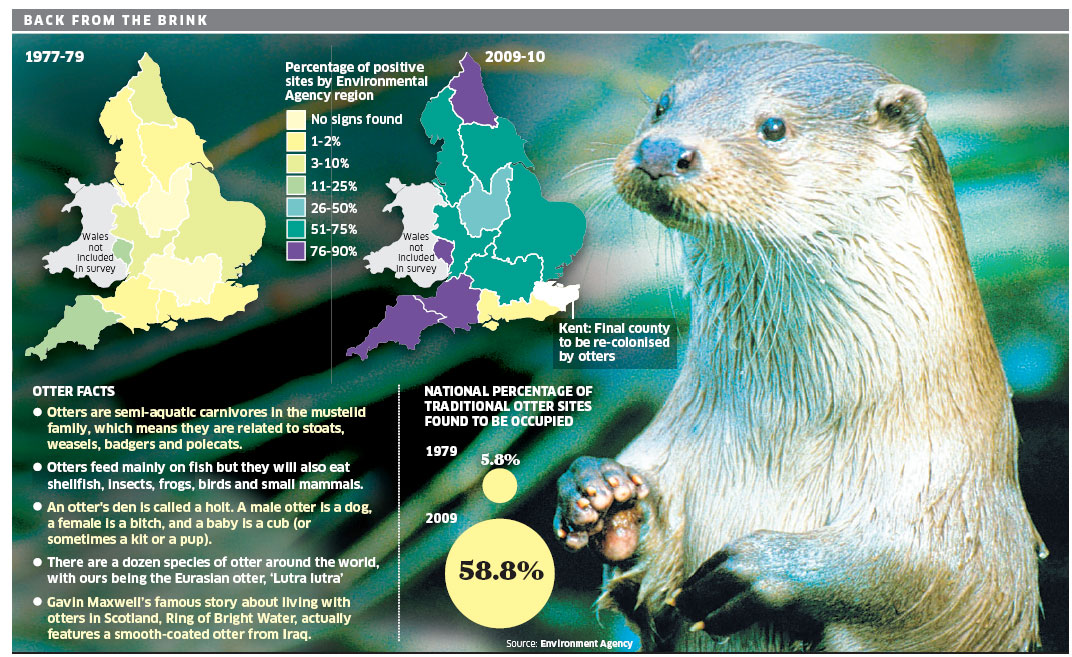
It has taken 30 years, but the otter’s comeback is now complete. After becoming extinct across most of England in the Fifties and Sixties, one of Britain’s best-loved animals has now returned to every English county, the Environment Agency announced yesterday.
The slow but steady recolonisation of its former haunts has been rounded off with the reappearance of otters in Kent, the last county to have been without them, the agency said.
The otter’s return represents a happy ending to one of the worst episodes in modern British wildlife history: the sudden disappearance of one of our most widespread and charismatic mammals.
The process began around 1956 and was almost certainly caused by the introduction of powerful organochlorine pesticides such as aldrin and dieldrin. Residues of these chemicals were washed into the rivers where otters lived, poisoning them.
As wild otters are hard to spot – their presence is usually detected by their spraints, or droppings – it was several years before the scale of their disappearance began to dawn on people, but by then they had been wiped out over vast areas of lowland England.
Despite the banning of organochlorine pesticides in the mid-Sixties, otters continued to decline, and their population reached a low point by the end of the 1970s, when they had effectively vanished from everywhere except the West Country and parts of Northern England (although good numbers remained in Wales and Scotland).
The first national otter survey, carried out between 1977 and 1979, detected the presence of otters in just over 5 per cent of the 2,940 sites surveyed; all the sites were known to have held the animals previously.
But then a comeback gradually began. Helped by a substantial clean-up of England’s rivers, which brought back fish to many once-polluted watercourses, and by legal protection, otters began to spread back eastwards into England from their strongholds in Devon and in areas of the Welsh borders, such as the Wye Valley.
By the time of the fourth otter survey, carried out between 2000 and 2002, more than 36 per cent of the sites examined showed otter traces; and when the fifth survey was carried out, between 2009 and 2010, the figure had risen to nearly 60 per cent, with otters back in every English county except Kent. Now wildlife experts at the Environment Agency have confirmed that there are at least two otters in Kent, which have built their holts on the River Medway and the River Eden.
“The recovery of otters from near-extinction shows how far we’ve come in controlling pollution and improving water quality,” said Alastair Driver, the Environment Agency’s National Conservation Manager. “Rivers in England are the healthiest for over 20 years, and otters, salmon and other wildlife are returning to many rivers for the first time since the industrial revolution.
“The fact that otters are now returning to Kent is the final piece in the jigsaw for otter recovery in England and is a symbol of great success for everybody involved in otter conservation.”
Otters are at the top of the food chain, and are therefore an important indicator of river health. The clean-up means that they are now inhabiting once-polluted rivers running through cities – something which would have been unthinkable before the population crash – and they have been detected in places such as Stoke-on-Trent, Reading, Exeter and Leeds, as well as in more likely urban centres, such as Winchester.
But although they are now widespread once more, otters’ nocturnal habits and riverine habitat make them difficult to glimpse, let alone observe, in England. The best place to see otters in Britain is Western Scotland, where the animals have become semi-marine and live along the coast. They can regularly be seen foraging along the shoreline in the daytime, especially on some of the larger islands, such as Mull and Skye.
A lovely story with a powerful message – mankind can change things for the better, and frequently has done.














 Learning from Dogs