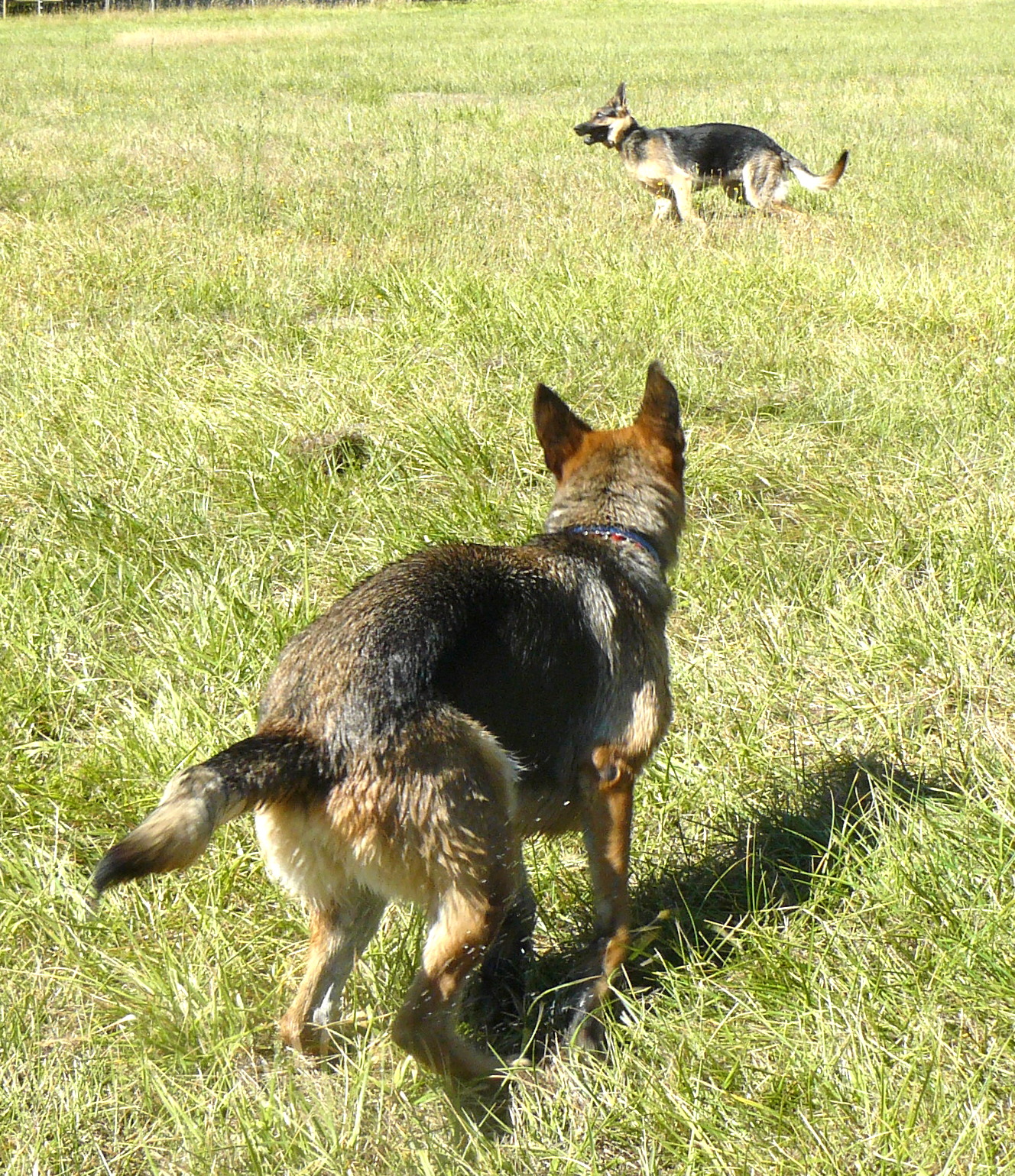
John Hurlburt writing as ‘an old lamplighter‘ has been a regular contributor to Learning from Dogs. Indeed, just last Friday in my rather introspective post, Maybe home is found in our quietness, I included John’s beautiful Evening Meditation. The day before that post, John sent me the following (the picture below is my contribution to John’s essay!) It’s a reflection on both the absurdity of modern times and the simplicity of the answers.
oooOOOOoo
Our interconnected world.
Bird Seed!
In return for a local pet store patronage, today’s cost savings included free bird seed. Meanwhile, our economic system squanders our common wealth.
The agendas of rich and powerful people who don’t want anything to change are reflected by FAUX News. What we have on our hands is an absurd interpretation of reality, which is made up as they go along. Politics has become a game of “Can You Top This”; with no limits. There’s a question about our collective level of sanity.
Our shared crisis mounts as our demographic increases and our natural resources are depleted accordingly. The fact is that we’re beyond the carbon limits the atmosphere requires to maintain the inclusive well-being of life on earth. And we’re damaging the surface layer of the planet that sustains us all in the process.
The answers are simple and natural. Here are five quick examples and a conclusion of sorts.
1. Diesel fuels run the majority of the world’s heavy machinery. Switching from carbon-based diesel fuels to natural bio-fuels, as per the original design by Rudolf Diesel, would have a profound effect on carbon pollution as well as fostering green innovation and industry. No modification of any on-line diesel engines would be required. As a matter of fact, they’d probably run more efficiently.
Solution: Economic advantage of using bio-fuels.
2. Re-establishing human rights may be best accomplished through increased awareness of our fragile unity as a species. The openness, honesty and integrity of Creation lights the way each day and lends serenity to our reflections.
Solution: Accept that deliberate human war and related destruction of the earth is empty, has no future, and is contrary to the purpose of human life.
Incidentally, when we put a natural floor under the global economy we’ll save our collective bacon in the process. Transitioning military forces to support green economic development opportunities might be a possibility if we decide to take life seriously enough to make a real difference.
3. Re-establishing a realistic base for a global economy that’s swollen 25 times beyond any material planetary resource foundation may best be accomplished by transitioning to green industries that benefit our planet, nations, communities and the sanctity of life in general. A modification to our technically driven financial system is needed.
Solution: Isaac Asimov; “I Robot” (the laws of robotics)
4. Re-establishing common law with inclusive equality and justice may be best accomplished by an in-depth examination of personal beliefs values, motives and actions in terms of respect for whatever Higher Power we may believe there to Be, compassion for Creation and the realization that we’re all living in and on the same life boat.
Solution: Education, formation and transformation based upon the facts of reality that we know in our present state of development and the far greater Reality which transcends our being and our current understanding based upon reason alone.
For example, Einstein’s General and Special Theories of Relativity tell us that we are in the process of turning inside out without breaking. A phrase that comes to mind is “transrational reality”. When we step beyond “self” we see the world through new eyes.
5. Agreeing on an equitably interactive and enforceable world-wide corporate, government, labor, and service organization wage scale may best be accomplished by listening to the voices of economic reason which tell us that money is only a symbol.
Rationale: Everything fits together. Change is constant. Life needs to adapt to survive. In Unity there is strength. At our best, we care for the earth and each other.
Inclusive solution: Surrender to Reality. The global system is broken, Resources are limited. It’s time to wake up. It’s time to change. A sustainable and growing green economy benefits everyone on earth.
Bottom Line
Love lights the way
Faith is stronger than fear
Hope springs Eternal
Our truths, our home, our serenity; all flow from stillness.
Soon silence will have passed into legend. Man has turned his back on silence. Day after day he invents machines and devices that increase noise and distract humanity from the essence of life, contemplation, meditation.
As is often the way, a number of disparate items came together for today’s post in a way of lovely connectivity.
A few weeks ago when meeting our local doctor for the first time since we moved to Oregon, I had grumbled about bouts of terrible short-term memory recall and more or less had shrugged my shoulders in resignation that there was nothing one could do: it was just part of getting older, I guessed!
“On the contrary”, responded Dr. Hurd, continuing, “There’s growing evidence that our information-crowded lives: cell phones; email; constant TV; constant news, is pumping too much for our brains to manage.”
Dr. Hurd continued, “Think about it! Our brains have to process every single sensory stimulus. The research is suggesting that our brains are being over-loaded and then the brain just dumps the excess data. If that is the case, and the evidence is pointing in that direction, then try thirty minutes of meditation each day; give your brain a chance to rest.”
So that was the first revelation.
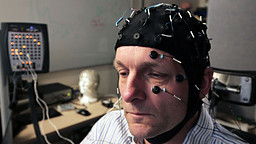
The second was a recent science programme on the BBC under the Horizon series. The programme was called, The Truth About Personality.
Michael Mosley’s brain being measured.
Michael Mosley explores the latest science about how our personalities are created – and whether they can be changed.
Despite appearances, Mosley is a pessimist who constantly frets about the future. He wants to worry less and become more of an optimist.
He tries out two techniques to change this aspect of his personality – with surprising results.
And he travels to the frontiers of genetics and neuroscience to find out about the forces that shape all our personalities.
Within the programme came the astounding fact that even ten minutes a day meditation can help the brain achieve a more balanced personality (balance in terms of not being overly negative in one’s thoughts).
The third revelation came from Jean and me watching a TED Talk last night. Just 14 minutes long, please watch it – you will be transformed!
Published on Jul 17, 2013
More and more people worldwide are living in countries not considered their own. Writer Pico Iyer — who himself has three or four “origins” — meditates on the meaning of home, the joy of traveling and the serenity of standing still.
Then, just three days ago, John Hurlburt, a long-time supporter and regular contributor to Learning from Dogs, emailed me his reflection on meditation. John quickly gave permission for it to be published here.
oooOOOooo
The stillness of evening.
Evening Meditation
Our world is increasingly spiritually, morally, mentally, physically and economically bankrupt. Many people would like to change the world one way or another. Most don’t really know why. Some folks simply don’t care. The idea is to leave life a bit better than we found it when we were born.
The fact is we’re all intrinsically sacred in a universe we didn’t create. We tend to prioritize illusion and delusion above reality. Playing God is a precursor of evil. A supreme faith in Money is self contradictory and ultimately fatal. Arrogance compounds the problem.
We connect in unified awareness through serene meditation. We experience harmony within an emerging celestial symphony. Answers flow from the inside out as we surrender to the eternal energy flow.
Be still and know…
an old lamplighter
oooOOOooo
Finally, after having a real struggle to find the place, both psychologically and physically, where I could start my own relationship with meditation, on Wednesday afternoon, when walking the quarter-mile up to our mail-box, it struck me as obvious.
Embraced by nature.
This quiet place on our creek where the water trickles down from an old flood irrigation dam. Somewhere to sit under the shade of a tree, somewhere to be still, somewhere as perfect a home as anyone could ever find.
Meditation is the dissolution of thoughts in Eternal awareness or Pure consciousness without objectification, knowing without thinking, merging finitude in infinity.
A beautifully written, soul-stirring account of strife, darkness, hope and, above all, love shared between dog and human.
Gracious, I don’t know where to start! Guess at the beginning.
Which was that a little over a month ago, I received this email:
Dear Paul:
I hope this note finds you well. We were in touch several years about Racing in the Rain, and I wanted to get in touch about another dog-related novel that may be of interest to you and your readers.
I am working with Forge Books to set up a blog tour for Andrea Thalasinos, whose novel Traveling Light hits bookshelves and e-readers on July 16th. Traveling Light is an inspiring story about fate, family, and healing; it also explores the special bond that exists between humans and canines.
Now I well remembered the book Racing in the Rain, writing about it in May 2011 and then a guest post from the author, Garth Stein, in September under the title of A game called Fetch.
Wiley included in his email a “flavour” of Andrea Thalasinos’ novel, as in:
Paula Makaikis is ashamed of her marriage. Driven out of their bedroom by Roger’s compulsive hoarding, she has spent the past ten years sleeping downstairs on her husband’s ratty couch. Distant and uninspired, Paula is more concerned with the robins landing on her office window ledge than her hard-earned position at the university. Until a phone call changes everything.
A homeless Greek man is dying in a Queens hospital and Paula is asked to come and translate. The old man tells her of his beloved dog, Fotis, who bit a police officer when they were separated. Paula has never considered adopting a dog, but she promises the man that she will rescue Fotis and find him a good home. But when Fotis enters her life she finds a companion she can’t live without. Suddenly Paula has a dog, a brand-new Ford Escape, an eight-week leave of absence, and a plan.
So Fotis and Paula begin the longest drive of their lives. In northern Minnesota, something compels her to answer a help-wanted ad for a wildlife rehabilitation center. Soon Paula is holding an eagle in her hands, and the experience leaves her changed forever.
Traveling Light explores what is possible when we cut the ties that hold us down and the heart is free to soar.
Of course, I wanted to read and review Andrea’s book. Wiley and I agreed that a review published on the 18th July, i.e. today, would be perfect. However, for reasons not entirely clear, the review copy of the book didn’t arrive until July 10th; just 8 days ago. That made it too tight for me to read in that time, so I gave the book to Jean for her to read first.
If I tell you that Jean devoured the book and had it finished in three days, you won’t get a better idea than that of how moving and captivating she found it. At the time of writing this post (9am yesterday) I was already up to page 160. So the review that follows a little later in today’s post is the combined feelings of Jean and me.
One of the other things that Wiley offered was for Andrea to write a guest post for Learning from Dogs. That now follows! I checked with Wiley: This is a true account from Andrea. (Trust me, you will be entranced!)
oooOOOooo
Andrea and Panda.
We’d come up to the edge of a wooden bridge that had almost as much space between the boards as the width of the boards themselves. Snow ordinarily covered the iffy-looking surfaces of such bridges, but the strength March’s early sun had melted clear down to the wood, leaving a full view of the snowy rocks in the creek bed below.
At the time, I didn’t know what my lead dog, Gorky, a red Siberian yearling (tiny in stature by Siberian standards) would do. From a puppy, she’d had more confidence in her furry little toe than I had in my whole body.
The dog positioned the team at the edge of the bridge and paused. She looked around, sniffing the wind, looking to the other side and then down through the slats into the creek bed below. I could tell she was thinking, calculating risks, odds and whether or not she had the moxie to cross. The other six dogs (including her father), were hooked up to the gangline behind her and by the set of their shoulders, their hedging and shirking back in their harnesses I could tell they were nervous.
It was a narrow trail, just wide enough for one dog team. Two more experienced teams were closing in from behind and I wondered what we would do. Rock walls butted up to either side of the trail, making it impossible to either turn around or move off the trail to let the others pass. I’d considered leading my dog team down into the gully, but the drop-off looked steep and as a rookie musher, I didn’t trust my skills to do so safely.
“Fifty bucks says she won’t take it,” the approaching musher called out from behind.
Thinking I’d be out the fifty before I could say boo, Gorky stepped up to the edge. Her body language changed. She’d committed to taking the bridge. As the red dog leaned into her harness, she gave the forward cue. The others fell in line, following her calm, forward gait with no signs of wavering.
After her first step I noticed that not once did Gorky look down, but rather kept her eye on the other side of the bridge as if she were already there.
Whenever I have to make difficult decisions, I think back to this moment. Sometimes I don’t have enough information or am waiting for some cosmic gut-affirmation that never seems to arrive when I need it. But one thing is clear. Like Gorky, once I set my mind on a course of action, I think of her and act.
Who knows if she was scared or not—she never said. The red dog lived to be 15 ½ and taught me more about not second-guessing than any person, place or thing I’ve come across since. Being brave doesn’t mean you’re not scared, it just means you do it anyway.
oooOOOooo
Traveling Light, a novel by Andrea Thalasinos
The opening of the book, In The Beginning, more of a prologue than anything else, firmly sets the context. For we read that the heroine of the story, Paula Makaikis, is tipped out of what is a highly unsatisfactory marriage into “the longest drive of her life” by a phone call from Celeste, Paula’s best friend.
The drive comes out of the tragic death of an old Greek man who pleads, in his last few breaths, that Paula takes his dog, Fotis, before the pound puts the dog to sleep.
If I tell you that by page 71, I had been brought to tears on two occasions then you will understand the depth of feeling that Andrea conveys: about life; about love; and the precious nature of a dog called Fotis .
This book, even as a work of fiction, seems to reach out to the reader, well to this reader anyway, with many messages of what life is all about. Take this for example, from page 104:
Paula few out of the Holland Tunnel into the early colors of the morning. Gas pedal depressed, windows open, her hair blowing, the faster she accelerated the better she felt. Getting up to eighty, then ninety, she thought maybe the wind would whisk her thoughts away.
Jersey was a blur except for periodic traffic congestion; Pennsylvania went on like a past life. The faster she drove, the clearer the sense that there was somewhere she needed to be. It wasn’t California or New York. It wasn’t a place. The map was nothing but lines, numbers, destinations. Wherever she was meant to be, she’d know it when she got there.
How many of us have shaken off our troubles as a dog shakes off water from its coat and ended up coming to a place and knowing that we were at the place we were meant to be!
In many ways, the book is a lovely fairy-tale, right up to the perfect ending. But in so many other ways the book is a reminder that we only have one life. Easy to say but less easy to embrace fully with heart and head. In fact, the book reinforces something that I wrote as a private letter to a family member in consequence of my sister’s recent death. I will share just a portion of that letter because I sense Andrea Thalasinos would love to see how her book reaches out to her readers.
Be clear about the purpose of life: your life. Do not put off what brings meaning, truth and happiness. Not even for a day. Live your beautiful life now; live it this day.
Thus for both Jean and me, this was the most beautiful of books and both of us have no hesitation in strongly recommending it.
Big thanks to Wiley Saichek for giving Jean and me the opportunity to read Traveling Light.
oooOOOooo
Now here’s an offer.
Wiley has offered a free copy of Andrea’s book as a ‘give-away’ from Learning from Dogs. Here’s the plan.
Would you like to write a story about any aspect of the relationship that dogs can have with humans?
Any length, truth or fiction; it doesn’t matter. Email your story to me (learningfromdogs (at) gmail (dot) com) to be received by the end of Wednesday, 31st July 2013, Pacific Daylight Time.
Then during the early part of August, I will publish every one received with some mechanism for readers to ‘score’ the stories and the winning author will be sent a free copy of the book.
It is our routine at home here in Oregon to let the kitchen group of dogs out first (Lily, Ruby, Casey & Paloma, with Sweeny tagging along) while Jean puts together our small breakfast. The time is around 6am to 6:30am and both Jean and I are usually wearing dressing gowns. Once this first group has been outside, then I let the ‘bedroom’ group out (Pharaoh, Cleo, Hazel and Dhalia).
Such as I did this morning, unusually a day starting dull with overcast cloud.
Suddenly, I heard the most awful squealing of an animal in pain over in the dense wooded area to the South-West of the property.
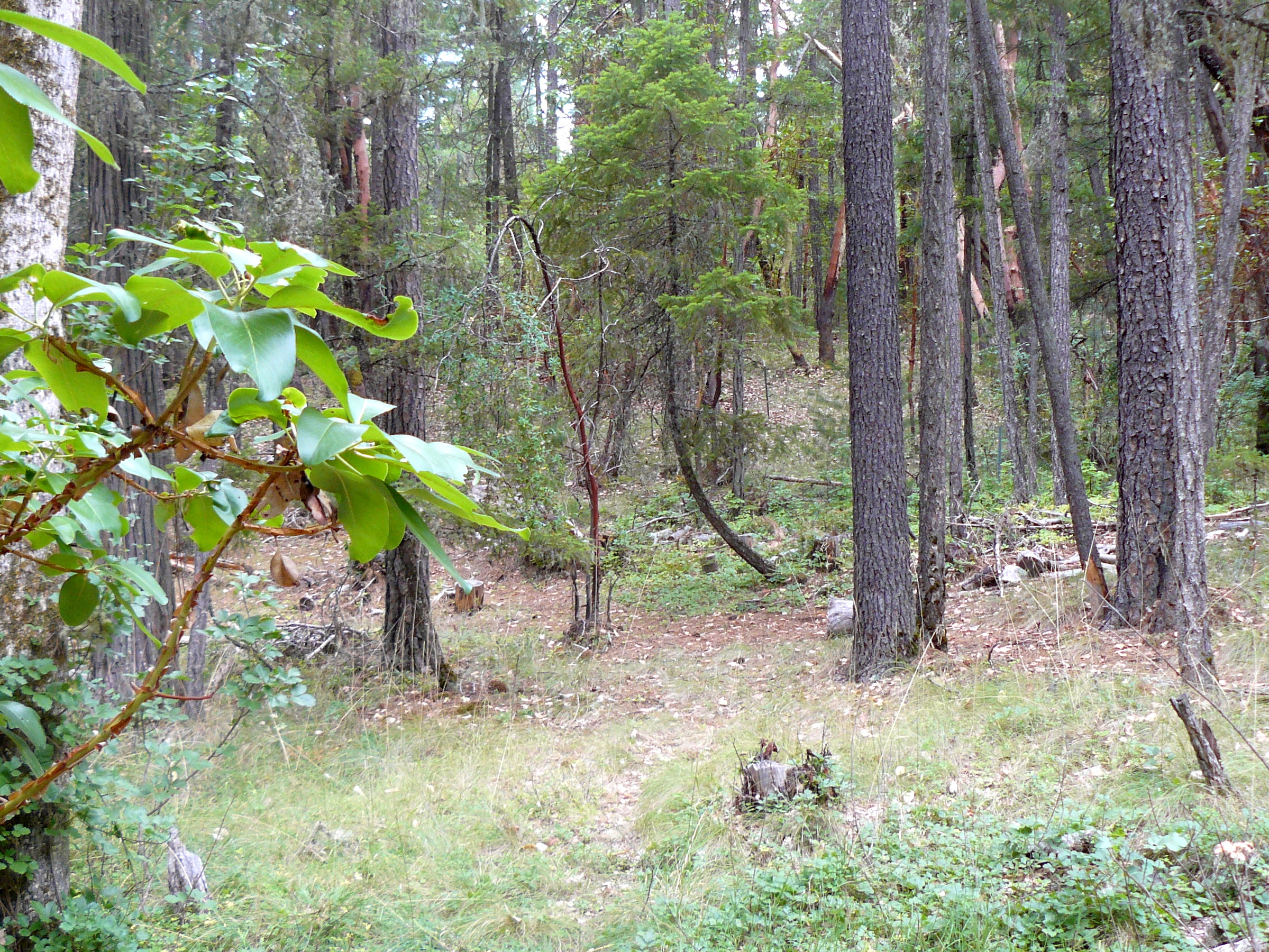
The wooded area in question.
In plastic slippers and dressing-gown only, I dashed into the woods and to my horror saw that Cleo, Hazel and Dhalia had cornered a young deer, and at least Hazel was nipping at a rear leg.
A not uncommon sight at home.
I screamed at the dogs, to no avail. They took not the slightest notice of me.
Then the young deer wriggled free and fled into the trees. The dogs recornered it and plunged in again. The deer broke free again, and so it went on. Eventually, after some ten minutes of the most dreadful hollering and chasing by me, the young deer jumped a fence and ran off with its mother who had been shadowing the terrible event. I prayed that it wasn’t badly hurt.
Gracious, I was so angry with the dogs! What disgusting behaviour towards this young, beautiful creature.
When I was back in the house trying to regain my breath, still so angry at the dogs, a thought came to my mind. Tens of thousands of years ago, this behaviour of the dogs was held in great esteem.
Early man evolved from a tribal hunter-gatherer existence to the pastoral life of farming about 10,000 years ago. If the DNA evidence shows, as it does, that the dog evolved from the wolf as a separate species around 100,000 years ago, then dogs were part of the life of hunter-gatherer man for something of the order of 90,000 years, possibly a couple of decades longer!
In fairness, the present lineage of dogs was domesticated from grey wolves only about 15,000 years ago. Despite fossil remains of domesticated dogs having been found in Siberia and Belgium from about 33,000 years ago, none of those lineages survived the Last Glacial Maximum. No fossil specimens prior to 33,000 years ago have indicated that they are clearly from the morphologically domesticated dog.
Even if, and it’s a very big ‘if’, the relationship between man and dog is only about 15,000 years old, one can only speculate how each species came to know the other, in every imaginable way.
Actually, we can go beyond speculation because in a study published by the PLOS ONE scientific journal in March 2013, Dr. Robert Losey, Associate Professor in the Department of Anthropology, University of Alberta and the lead author, explained that:
Dog burials appear to be more common in areas where diets were rich in aquatic foods because these same areas also appear to have had the densest human populations and the most cemeteries,
If the practice of burying dogs was solely related to their importance in procuring terrestrial game, we would expect to see them in the Early Holocene (around 9,000 years ago), when human subsistence practices were focused on these animals. Further, we would expect to see them in later periods in areas where fish were never really major components of the diet and deer were the primary focus, but they are rare or absent in these regions.
The PLOS ONE paper went on to report that researchers found that most of the dog burials occurred during the Early Neolithic period, some 7,000-8,000 years ago, and that “dogs were only buried when human hunter-gatherers were also being buried.”
So back to the morning’s drama between the dogs and the young deer.
The efficiency of the way the dogs cornered the deer was breath-taking. Had I not been coming at them in such a state of anger and agitation, and especially if I was one of a group of say, 2 or 3 humans, the odds are that the deer could have been grabbed and dispatched. In other words, those three dogs had demonstrated that 20,000, 40,000, 80,000 or more years ago, they were critically useful at helping early hunter-gatherer man feed himself.
Back to Dr. Losey’s view, “I think the hunter-gatherers here saw some of their dogs as being nearly the same as themselves, even at a spiritual level. At this time, dogs were the only animals living closely with humans, and they were likely known at an individual level, far more so than any other animal people encountered. People came to know them as unique, special individuals.”
Does make sense, doesn’t it.
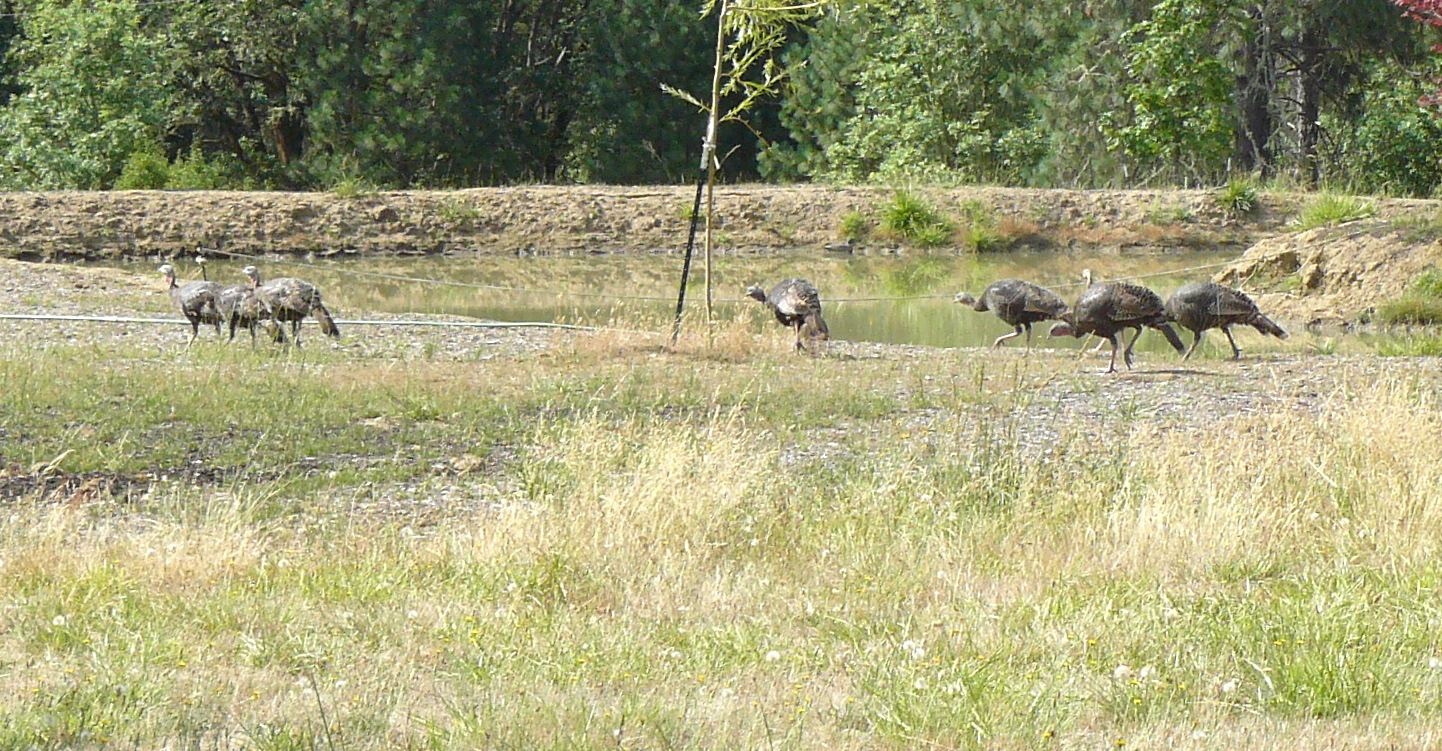
“Oh look! We could have turkey for dinner tonight!”
Four years ago this day, the first post was published on Learning from Dogs. Here it is again:
Parenting lessons from Dogs!
Much too late to make me realise the inadequacies of my own parenting skills, I learnt an important lesson when training my GSD (who is called Pharaoh, by the way). That is that putting more emphasis into praise and reward for getting it right ‘trains’ the dog much quicker than telling it off. The classic example is scolding a dog for running off when it should be lots of hugs and praise for returning home. The scolding simply teaches the dog that returning home isn’t pleasant whereas praise reinforces that home is the place to be. Like so many things in life, very obvious once understood!
Absolutely certain that it works with youngsters just the same way.
Despite being a very dominant dog, Pharaoh showed his teaching ability when working with other dogs. In the UK there is an amazing woman, Angela Stockdale, who has proved that dogs (and horses) learn most effectively when being taught by other dogs (and horses). Pharaoh was revealed to be a Beta Dog, (i.e. second in status below the Alpha Dog) and, therefore, was able to use his natural pack instinct to teach puppy dogs their social skills and to break up squabbles within a pack.
When you think about it, don’t kids learn much more (often to our chagrin!) from other kids than they do from their parents. Still focusing on giving more praise than punishment seems like a much more effective strategy.
As was read somewhere, Catch them in the act of doing Right!
By Paul Handover.
As it happens, it feels a little like ‘what goes around, comes around’. Why do I say that?
Because just last Saturday, I sent off a selection of pictures and videos to Angela Stockdale. Stay with me for a while as to the reason why.
Angela trades under the name of The Dog Partnership and, frankly, what she doesn’t know about the behaviour of dogs isn’t worth bothering about!
Just take a peek at the page on her website under the heading of Teaching Dogs. Here’s a little of what Angela writes:
I consider myself so lucky for dogs alone to have been my teachers. I learnt from watching how my own dogs responded to another dog’s body language and vice versa their language. Watching, learning and working with Teaching Dogs was the only way I knew.
I was and always will be in awe of a Teaching Dog’s dogs ability to consciously adapt their body language in accordance to how the other dog was feeling. The result being, they could relax nervous dogs but at the same time maintain control of a problem situation. Remember, dogs talk dog far better than we do.
It came as quite a shock to me when I learnt about other approaches. It seemed foreign for people to have so much input in resolving what were described as ‘ behavioural’ issues. For me, working with these dogs was far more than resolving a behavioural issue. It was about improving the quality of lives of dogs who were not coping with everyday life. If they found dogs or people worrying, sometimes this was shown in displays of aggression. It is important to understand, these dogs were not aggressive, they simply displayed aggressive behaviour.
Now, I would like to introduce you to the world of Teaching Dogs and how these special dogs change the lives of less fortunate dogs, who never had the opportunity to really understand how to communicate with their own species.
Back to why those photographs and videos had been sent to Angela. A couple of weeks ago, we enjoyed an evening meal with friends of friends, so to speak. This other couple owned a beautiful-looking male German Shepherd dog: Duke. Duke was 4-years-old. Our hostess remarked that he was very boisterous and had nipped a couple of strangers who had called at the house. She added that he seemed difficult to control. Duke had been there for about a month and he was a rescue so they had little or no knowledge of past behaviour.
Well, I’m no expect with dogs, that’s Jean’s domain. But there was something about Duke that captivated me. Something in the way he looked at me, his eyes linking so directly with mine, allowing me to see a dog that offered an honest openness.
More or less on impulse I stood up, held my right arm up at 45 degrees, looked Duke in the face and said, “Duke! Sit!”
Duke held my gaze and sat back on his haunches.
I moved my arm in a complete circle, around to the right, and said, “Duke! Lie down!” Duke lay down.
H’mm, I thought. Fascinating. This dog has been professionally trained at some point in the past, using the same ‘command’ system of voice and arm signalling as I had learnt with Pharaoh way back in 2003/2004.
The food was now on the table. I grabbed a small piece of meat off my plate and returned to Duke who had, of course, resumed his pottering around the room. “Duke! Here boy!” Duke came over to me. “Duke! Lie down!” Duke did so. I placed the piece of meat on the wooden floor about three feet in front of him. Duke’s eyes were riveted on the meat. “Duke!” Duke’s eyes reluctantly engaged with mine. “Duke! Stay!” I repeated the Stay command a couple more times as I backed away about 6 or 8 feet.
“Go on, Boy. Take the meat!” Duke gleefully grabbed the piece of meat. Gracious, I thought, this dog is magnificent. I wonder ……..
I took another piece of meat, “Duke! Sit!” “Duke! Stay!” I then backed off that 8 feet again, got down on my knees and placed the piece of meat just between my lips. I knew this was potential madness with a dog I had only met some 30 minutes previously, but there wasn’t an ounce of doubt in my mind. I voiced in my throat for Duke to fetch the meat. Duke came straight over and confidently and carefully removed the meat from my lips.
What a truly fabulous dog! It was a wonderful evening and once home both Jean and I were eulogising about Duke.
Then two days later, our dinner hostess rang me. “You know, I have decided we can no longer keep Duke. He is too strong a dog, I can’t control him. Is there any chance of you finding a new home for Duke?”
Without question, Jean and I would have offered Duke a new home; in a heartbeat. The only thing stopping that was me wondering if this strong-willed, male German Shepherd might be a Beta dog, as Pharaoh was. Or just might be too dominant a male dog to fit in comfortably with our dogs, especially Pharaoh who was at the stage of life where the last thing that should happen is for his happiness and contentment to be disturbed.
I hadn’t a clue as to how to answer that question. But I knew someone who would know: Angela Stockdale.
I rang her, caught up on old times and then explained the background to Duke’s situation. Angela said to repeat the exercise that I had witnessed when I took Pharaoh to her all those years ago, when I wondered if Pharaoh was an aggressive dog. My uncertainty with regard to Pharaoh followed a number of times when walking him in a public area with other dogs and he had been very threatening, both in voice and posture, towards some of those other dogs.
This is what Angela arranged. I took Pharaoh up to her place at Wheddon Cross, near Minehead in Somerset. When we arrived, Angela was standing just by a gate into a fenced paddock, maybe a half-acre in size. In the far corner were two dogs.
Angela asked me to bring Pharaoh to the gate and let him off the leash. It was clear that Pharaoh was going to be let into the paddock. I cautioned that Pharaoh could be quite a handful with other dogs and, perhaps, it would be better that I walked him into the area still on his lead. Angela said that wouldn’t be necessary. So as she held the gate open sufficient for Pharaoh to enter the paddock, I slipped the lead off him and backed away, as requested.
Pharaoh had hardly taken 2 or 3 paces when Angela called out, “Paul, there’s nothing wrong with him!”
I was astounded and stammered, “But, er, er, how can you tell so quickly?” “Because my two dogs haven’t taken any notice!”, came the reply.
Later Angela explained that in the paddock were her female Alpha dog and her male Beta dog. Ergo, the two top dogs in terms of status so far as dogs see other dogs.
In fact, Pharaoh was utterly subservient to these dogs, in a way that I had never witnessed before. Later on, as Pharaoh relaxed and started playing, Angela said that she thought that Pharaoh was a Beta dog. Mixing some of her other dogs into the group was later able to confirm that.
So back now to present times and Duke.
Thus last Saturday, as Angela recommended, we selected two of our dogs, Cleo our female German Shepherd and the most socialable of dogs, and Casey, a strong but not aggressive male (he had some PitBull in him).
Duke arrived and was allowed freely to nose around the large grassed area some way from the fenced-off horse paddock that we were using for the ‘introduction’.
Duke pottered around and then caught sight of Cleo and Casey in the paddock.
First sighting of Cleo and Casey.
Then the meetings began!
Hello! My name is Duke. Do I smell OK? Mr. Casey?
And play didn’t seem to be too far off the agenda!
You lead, Cleo, I’ll chase!
So all the photographs and videos have been sent to Angela, and we will see what the conclusion is!
As Angela put it, “Remember, dogs talk dog far better than we do.”
A friend of Jean and me and recent follower of Learning from Dogs, Ira W., sent me an email that included a link to Theo Jansen’s Strandbeest website. To say that I was astonished at what I read would be a giant understatement. Wikipedia offers this opening description:
Theo Jansen (born 1948) is a Dutch artist. In 1990, he began what he is known for today: building large mechanisms out of PVC that are able to move on their own, known as Strandbeest. His animated works are a fusion of art and engineering; in a car company (BMW) television commercial Jansen says: “The walls between art and engineering exist only in our minds.” He strives to equip his creations with their own artificial intelligence so they can avoid obstacles by changing course when one is detected, such as the sea itself.
How is that realised? Well take a look at this:
The Strandbeest website has this information about what the ‘beast’ is about.
Self-propelling beach animals like Animaris Percipiere have a stomach . This consists of recycled plastic bottles containing air that can be pumped up to a high pressure by the wind. This is done using a variety of bicycle pump, needless to say of plastic tubing. Several of these little pumps are driven by wings up at the front of the animal that flap in the breeze. It takes a few hours, but then the bottles are full. They contain a supply of potential wind. Take off the cap and the wind will emerge from the bottle at high speed. The trick is to get that untamed wind under control and use it to move the animal. For this, muscles are required. Beach animals have pushing muscles which get longer when told to do so. These consist of a tube containing another that is able to move in and out. There is a rubber ring on the end of the inner tube so that this acts as a piston. When the air runs from the bottles through a small pipe in the tube it pushes the piston outwards and the muscle lengthens. The beach animal’s muscle can best be likened to a bone that gets longer. Muscles can open taps to activate other muscles that open other taps, and so on. This creates control centres that can be compared to brains.
Plus there is no shortage of videos to find on the web. I chose this one for you. (But, please do go to Jansen’s home page as well and watch the video.)
So the creativity of man knows no bounds! Which neatly brings me to the creativity of the poet John Masefield. Here is that famous poem.
I must go down to the seas again, to the lonely sea and the sky,
And all I ask is a tall ship and a star to steer her by;
And the wheel’s kick and the wind’s song and the white sail’s shaking,
And a grey mist on the sea’s face, and a grey dawn breaking,
I must go down to the seas again, for the call of the running tide
Is a wild call and a clear call that may not be denied;
And all I ask is a windy day with the white clouds flying,
And the flung spray and the blown spume, and the sea-gulls crying.
I must go down to the seas again, to the vagrant gypsy life,
To the gull’s way and the whale’s way where the wind’s like a whetted knife;
And all I ask is a merry yarn from a laughing fellow-rover,
And quiet sleep and a sweet dream when the long trick’s over.
We are, above all, so intimately part of the natural world.
In yesterday’s post, I shared an email that I had sent to friend, Dan, that included:
I want to retreat from these areas and focus on what is most valuable to me.
Aspects of my life such as love, friendship with ‘old’ travelers, the natural world, being in the present, community, our animals (especially Pharaoh who is over 10), my writings, my book, our small world here at 4000 Hugo; you get my drift!
Well it didn’t take me long to come across an email that John Hurlburt had sent not so long ago recommending the following film.
Enjoy!
Published on May 5, 2012
Video by Scott Mckinley Productions, Produced for Rocky Mountain Elk Foundation for Ad campaign. Licensed music by Kenny G.. This short video won Best of Category at the International Wildlife Film Festival in Missoula Montana! The majority was shot on location in Yellowstone National Park, Grand Teton National Park and The National Elk Refuge in Jackson Hole, Wyoming.
Before you turn away from this, go across to the website of the Rocky Mountain Elk Foundation. Or do an image search on the ‘web’ where you will, for example, find this breathtaking picture:
*** If you are not into introspection, then look away and come back tomorrow! 😉 ***
Regular readers will know that quite frequently I write under a topic heading that could be regarded as within the classification of key subjects of our time. You know, such subjects as big government, big money, big power, and even climate change! 😉
Why has this been the case?
Well, because, a) most of my life I’ve tried to stay abreast of ‘current affairs’ and, b) within the broad label of ‘integrity’ it’s relevant to this blog. The sub-heading of the blog is after all: “Dogs are integrous animals. We have much to learn from them.” (Yes, I do know ‘integrous’ isn’t grammatically accurate! – Any suggestions for an alternative word?)
Stay with that while I go elsewhere.
Yesterday (Tuesday) a number of events ended up having a profound effect on me. On the face of it, utterly disconnected events.
The first was a post from Alex Jones on his blog The Liberated Way. The only common ground between Alex and me is that we both know Colchester in Essex, England. Alex because he lives there today, me because I used to have a business in Colchester in previous times. Other than that just a couple of bloggers separated by thousands of miles.
Anyway, the post was this one: Cycle of Life. Alex wrote:
Life seems like a cycle of birth, living and death.
I have the honour of following awesome bloggers on WordPress. I learn inspirational teachings from their intimate life experiences that they share with their readers. The cycle, for in my belief everything moves in cycles, of birth, life and death is if we are attentive to living life something we will often be reminded of in our interactions with others and nature.
Then later, adding:
Lijiun is a Buddhist who shares daily experiences from their own life with a Buddhist theme running through their blog. Lijiun has a cat called Little White who often acts as a teacher to them about the meaning of life and a reminder of Buddhist teachings. Little White two weeks ago brought home a stray kitten, which it adopted as like a surrogate parent. Yesterday Adik the kitten died, and a beautiful blog post by Lijiun in memory of Adik reminds us life is impermanent.
Almost absent-mindedly, I clicked on the link about the death of Adik and …… was shaken to my core; shaken by the power of the truth. I want to give you more than a link to the post – want to share some of the beautiful words.
IN MEMORY OF “ADIK”…
In memory of our little Kitten, “adik”….
Every moment in life is full of changes, this is a law of nature.
However, sometimes we might assume that everything unchanged.
“Adik”- Our stray kitten, so far, she was not showing a sign of sickness. Yesterday, in the evening, I discovered she was laid down under my neighbor car, not moving at all and look severe sick. We checked through her little body, no physical injuries and we tried our best to feed her water and Cat food. She refuse to take.
We need to send her to Veterinarian immediately as her condition was critical, however during Sunday, especially evening time. Most of the Veterinarian clinic is closed. We did our best to check through internet, we were able to locate one of the Vet and we rushed over.
In the journey, we played Mantra Chanting to our little kitten, We reached to the vet clinic, “Adik” was alive but in agony…. she was struggling for life. The only thing we can help was to keep chanting mantra, our only aspiration are for her to relieve from suffering, not to reborn in 3 lower realm, able to follow spiritual practice and attain enlightenment in the coming life.
“Adik” passed away in peace even before the Veterinarian came to treat her.
Then Lijiun went on to write that “This incident gave me a very clear insight on “death” and offered more of that insight: (These are extracts: Please read the full post.)
1. Impermanence Of life
Nothing is permanence , we need to live at now, not past or future.
When Death approached, no bargain time at all whether you are rich or poor, you are ready or not, you are healthy or sick, …
Do all good deeds when you are still alive, Follow spiritual path whenever you can, don’t give excuses that “I’ve plenty of time, I’ll do it when I am “FREE”? When You are Free, you might not able to do it…
2. Young or old…
Some of us, might assume that people died in old age. As such, we’ve a long journey in life.
Is It true???
I learned from “Adik” Sudden death – that death will happen in any age.
“Coffin is not meant for elderly people….” This is so profound.
Spend time with your family members, be filial piety to your parent, Pursuit your dream, Don’t wait until later day…. We are unsure we can survive until later day!
3. Breathing in & Out
Treasure every breath in & breath out…
Life is just in between Breath in & out.
Be Mindfulness in life!
4. What Can you bring???
What can you bring after death, “NOTHING”.
No matter, how much wealth, how much money, how many cars, how many bungalow, how high is your position, how lovely is your family… you can’t bring anything..
Ask yourself, “What is the purpose of life?”, “What do you want?”
5. Alone..
You, yourself need to face the death moment…
Nobody can help you… Don’t avoid the topic and say, “It’ll not happen to me so soon”..
Just get ready.
6. Love
“Adik” passed away at 8:30 pm.. according to my mom, Little White, Our lovely cat was “Meowing” loudly at home. He can sense that “Adik” was not longer around. Animals are just like us, they are loving. Please treat all beings well, no differentiation on form.
We are so touched that “Adik” came home before her death and spend her last moment with us.
Before we sent “Adik” to Vet, She “Meow” loudly to my mom as a good-bye & gratitude to my mom for taking care of her. It’s so touching!
Thank you to “Adik” for celebrating 16 happy day with us and leave behind a great lesson to us.
May “Adik” be relieved from suffering, not reborn in 3 lower realm and find the lasting happiness!
May all beings be Well and Happy!
Then also yesterday, I was chatting to someone who lives close to us; he and his partner-lady have become good friends. He was bemoaning the corruption of so much of his fine country and went on to say that the only way that he could function was to turn away from the big stuff, have no TV, ignore the constant news of this and that, the endless trials and tribulations in this world of ours. I listened in silence, only to find later that the words must have left a mark on me.
My dear friend, Dan Gomez, has known me for over 40 years. He was my Best Man at my wedding to Jean in November, 2010. He and I have been exchanging emails about the truth of the role of man in the raising of the temperature of the planet. I sent Dan the link to the death of Adik, the kitten. It seemed so much more important than the emails we had been exchanging about the ‘big’ subjects in life.
Then something happened overnight (Tuesday/Wednesday) because not long after I got to my PC this morning, I sent this email to Dan.
Dear Dan,
Yesterday was one of those days, one of those rare days I should have said, where my view of life was radically changed.
Partly because I’m still adjusting to Corinne’s death [my sister], partly because of something I read elsewhere, and other stuff best left for a phone call.
In essence, despite my anger at what is going on around us (big government, big money, big power, even climate change!) I want to retreat from these areas and focus on what is most valuable to me.
Aspects of my life such as love, friendship with ‘old’ travelers, the natural world, being in the present, community, our animals (especially Pharaoh who is over 10), my writings, my book, our small world here at 4000 Hugo; you get my drift!
I’m 70 in November, 2014. Corinne died in her 80th year. Time goes so quickly. No, life goes so quickly. Jean and I met 6 years ago this next December. I must turn away from the things over which I have little or no control and embrace the present. Just what dogs do so well. Live in the present.
It’s all about endeavouring to come to the end of one’s life hearing those immortal words of Edith Piaf, “Je regret rien.”
So dear reader of Learning from Dogs, if you are still ‘on frequency’ – Well done! You have stuck with my very long ramble!
Back to what gets written about in this place. If integrity means anything, it means I’m going to drop all the ‘big’ topics and focus entirely on what man can learn, nay, has to learn from dogs. Indeed, will close by republishing the full ‘home’ page below.
Pharaoh – just being a dog!
Dogs live in the present – they just are! Dogs make the best of each moment uncluttered by the sorts of complex fears and feelings that we humans have. They don’t judge, they simply take the world around them at face value. Yet they have been part of man’s world for an unimaginable time, at least 30,000 years. That makes the domesticated dog the longest animal companion to man, by far!
As man’s companion, protector and helper, history suggests that dogs were critically important in man achieving success as a hunter-gatherer. Dogs ‘teaching’ man to be so successful a hunter enabled evolution, some 20,000 years later, to farming, thence the long journey to modern man. But in the last, say 100 years, that farming spirit has become corrupted to the point where we see the planet’s plant and mineral resources as infinite. Mankind is close to the edge of extinction, literally and spiritually.
Dogs know better, much better! Time again for man to learn from dogs!
I first met Chris many years ago when he was working for a French educational college with the name of ISUGA, based in Quimper, France. As a result of being introduced to Chris, I had the very good fortune of becoming a guest teacher at ISUGA.
Classroom picture taken at ISUGA.
Anyway, Chris has his own blog Nemo Insular Est. If the title doesn’t immediately say very much to you, try Chris’ sub-title: Truth, Justice, Sanity & Brotherhood.
Thus it is with great pleasure I offer this guest post from Chris.
oooOOOooo
In Defence of “Politics”
by Chris Snuggs.
The most depressing thing I ever heard at school was: “I’m not interested in politics.” Even at the age of 10, this seemed to me bizarre, for politics is at the heart of everything. It decides what we can eat, how much money we have, what sort of shelter we have, health, education, defence, what it takes to get locked up, EVERYTHING – including in the USA of course gun control …….
“Politics” completely arranges the environment of our existence, within which we can be individuals and lead some kind of “private life”, but nothing can function in a civilised manner without politics.
There is only one circumstance I can imagine when the statement: “I’m not interested in politics.” might possibly be justified, and that is if you lived in a society where everything was perfect: no injustice, hunger, or discomfort; excellent health, education, shelter and sustenance in a peaceful environment with nothing to worry about ….
There remains a niggling doubt about whether such a society would be just a teensy bit boring. However, the point is, has there ever been one? Does anyone KNOW one? Are they accepting immigrants?
If we accept that politics decides everything, then there are certain conclusions to be drawn. If it is so fundamentally important, is it not then legitimate to oblige everyone to vote, as they do in Australia for example? Then again, is it acceptable that we so easily tolerate as “democracy” elections where only 30% of eligible voters actually vote? And is it acceptable that the teaching of “politics” and all it involves holds such little place in our schools?
I would say “NO!!” And in fact, the study of politics involves so many branches of knowledge. You can’t (or shouldn’t) be taught “politics” without teaching psychology. Why is X saying that? What are his motivations? What is the psychology of voting groups. Or without studying logic, so as to recognize false arguments, of which there is no lack. You need to study what evidence is, since a political policy should be based on evidence, not fantasy or demagoguery.
In fact, just as politics decides everything then a study of politics involves just about every branch of knowledge, too. You cannot vote sensibly for party X which wants to build zillions of windfarms or go full-steam ahead on shale-fracking if you don’t have a reasonable understanding of the science, and of course environmental consequences. You can’t sensibly vote for or against grammar schools without a sound knowledge of the social and psychological rationale behind them or indeed of their history. The same applies to religion of course, and almost any other area you care to mention.
No, politics as a subject of study, discussion and involvement is vastly undervalued in our society. And the fact that politicians are often venal and incompetent liars is not a reason to be LESS interested in politics but a compelling reason to be MORE involved!! If you don’t get informed and involved, the politicians will do it THEIR way, and you have to ask yourself one final question: Do you REALLY trust them to do it in YOUR interests?