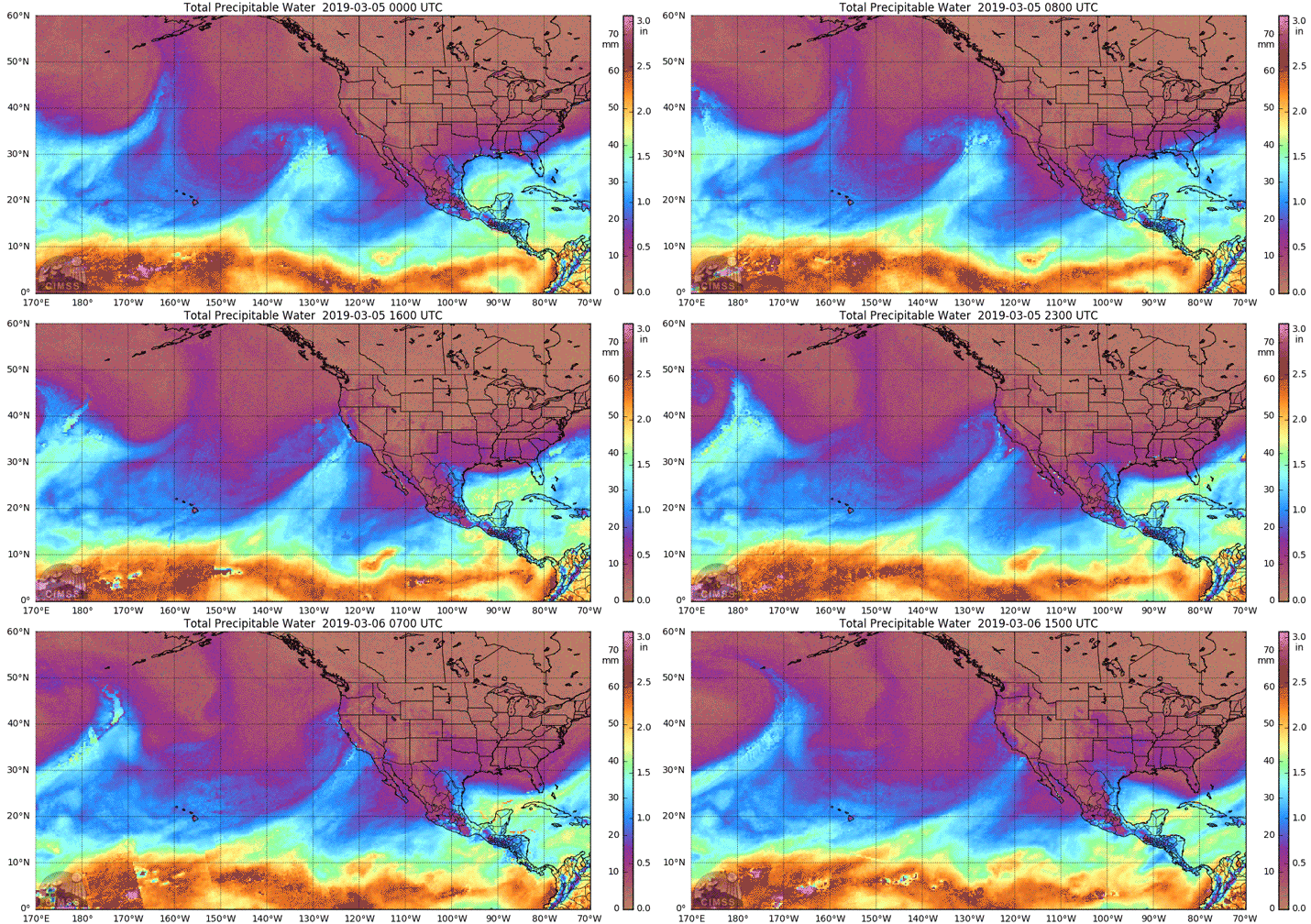
The atmospheric river in California is reaching up to Southern Oregon
After we had the thick end of twelve inches of rain in January, February has kept up the downpours; as of yesterday morning we had had 0.52 inches (1.32 cm) for the month and it was still raining. (And 0.8 in at 08:00 this morning.)
Here’s an item from yesterday about the situation in California.
Plus the BBC News had an item on the California flood.
So it seemed opportune to present this article on atmospheric rivers.
ooOOoo
What is an atmospheric river? A hydrologist explains the good and bad of these flood-prone storms and how they’re changing
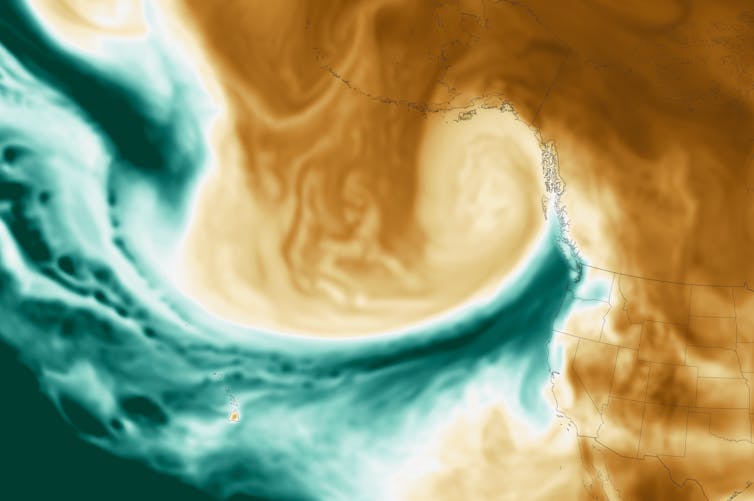
A satellite image shows a powerful atmospheric river hitting the Pacific Northwest in December 2023. Darker greens are more water vapor. Lauren Dauphin/NASA Earth Observatory
A series of atmospheric rivers is bringing the threat of heavy downpours, flooding, mudslides and avalanches to the Pacific Northwest and California this week. While these storms are dreaded for the damage they can cause, they are also essential to the region’s water supply, particularly in California, as Qian Cao, a hydrologist at the University of California, San Diego, explains.
What are atmospheric rivers?
An atmospheric river is a narrow corridor or filament of concentrated water vapor transported in the atmosphere. It’s like a river in the sky that can be 1,000 miles long. On average, atmospheric rivers have about twice the regular flow of the Amazon River.
When atmospheric rivers run up against mountains or run into local atmospheric dynamics and are forced to ascend, the moisture they carry cools and condenses, so they can produce intense rainfall or snowfall. https://www.youtube.com/embed/w3rtYM0HtIM?wmode=transparent&start=0 A satellite view of atmospheric rivers.
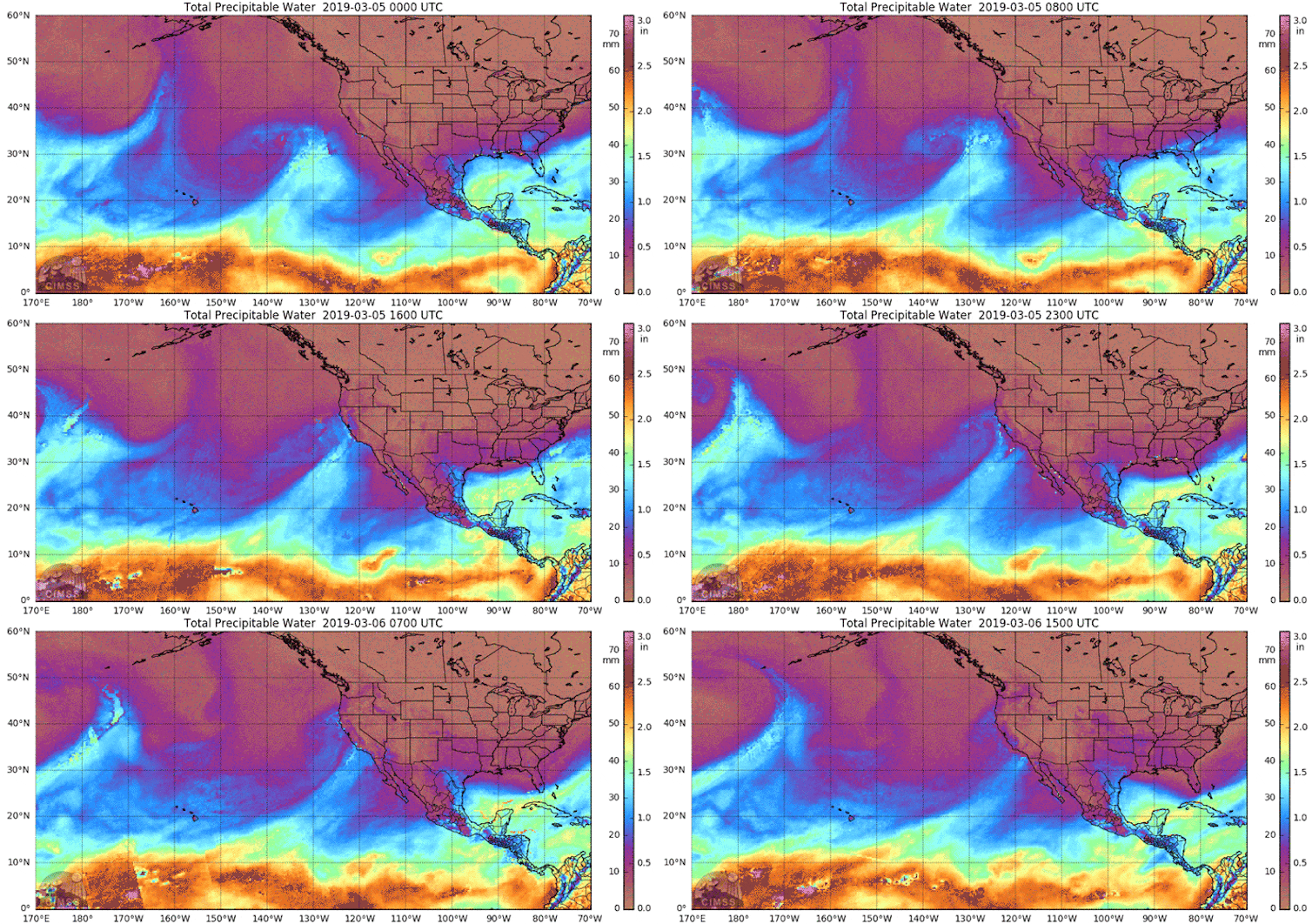
Atmospheric rivers occur all over the world, most commonly in the mid-latitudes. They form when large-scale weather patterns align to create narrow channels, or filaments, of intense moisture transport. These start over warm water, typically tropical oceans, and are guided toward the coast by low-level jet streams ahead of cold fronts of extratropical cyclones.
Along the U.S. West Coast, the Pacific Ocean serves as the reservoir of moisture for the storm, and the mountain ranges act as barriers, which is why the western sides of the coastal ranges and Sierra Nevada see so much rain and snow.
Why are back-to-back atmospheric rivers a high flood risk?
The first heavy downpours saturate the ground. As consecutive storms arrive, their precipitation falls on soil that can’t absorb more water. That contributes to more runoff. Rivers and streams fill up. In the meantime, there may be snowmelt due to warm temperatures, further adding to the runoff and flood risk.
California experienced a historic run of nine consecutive atmospheric rivers in the span of three weeks in December 2022 and January 2023. The storms helped bring most reservoirs back to historical averages in 2023 after several drought years, but they also produced damaging floods and debris flows.
Atmospheric rivers forming over the tropical Pacific Ocean head for the U.S. West Coast. NOAA
The cause of AR families is an active area of research. Compared with single atmospheric river events, AR families tend to be associated with lower atmospheric pressure heights across the North Pacific, higher pressure heights over the subtropics, a stronger and more zonally elongated jet stream and warmer tropical air temperatures.
Large-scale weather patterns and climate phenomena such as the Madden-Julian Oscillation, or MJO, also play an important role in the generation of AR families. An active MJO shift occurred during the early 2023 events, tilting the odds toward increased atmospheric river activity over California.
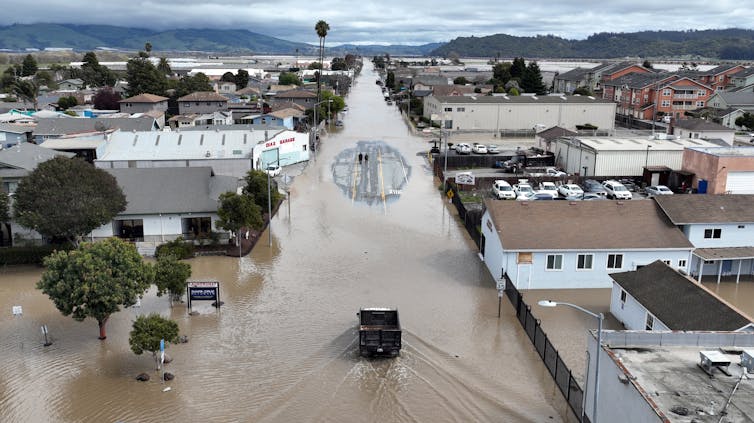
An aerial view shows a flooded neighborhood in the community of Pajaro in central California on March 11, 2023, after a series of atmospheric rivers. Josh Edelson/AFP via Getty Images
A recent study by scientists at Stanford and the University of Florida found that storms within AR families cause three to four times more economic damage when the storms arrive back to back than they would have caused by themselves.
How important are atmospheric rivers to the West Coast’s water supply?
I’m a research hydrologist, so I focus on hydrological impacts of atmospheric rivers. Although they can lead to flood hazards, atmospheric rivers are also essential to the Western water supply. Atmospheric rivers have been responsible for ending more than a third of the region’s major droughts, including the severe California drought of 2012-16.
They also contribute to the snowpack, which provides a significant portion of California’s year-round water supply.
In an average year, one to two extreme atmospheric rivers with snow will be the dominant contributors to the snowpack in the Sierra Nevada. Together, atmospheric rivers will contribute about 30% to 40% of an average season’s total snow accumulation there.
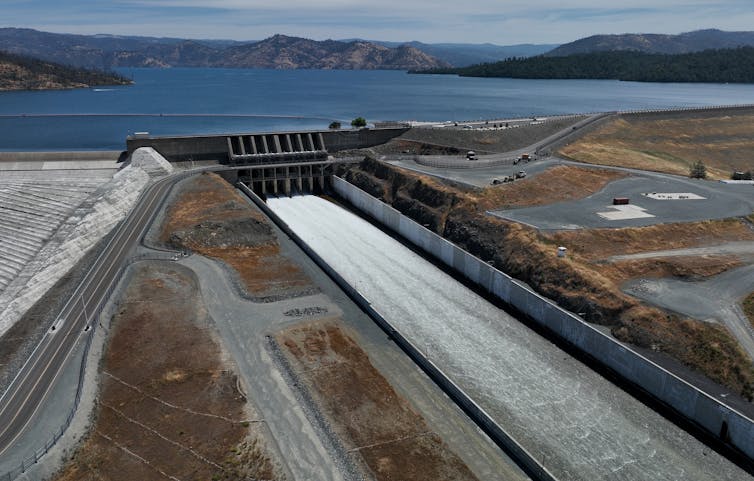
After several winter storms brought record snowfall to California’s Sierra Nevada in early 2023, Lake Oroville, California’s second-largest reservoir, was at 100% capacity. The previous year, much of the state had faced water restrictions. Justin Sullivan/Getty Images
That’s why my colleagues at the Center for Western Weather and Water Extremes at the Scripps Institution of Oceanography, part of the University of California, San Diego, work on improving atmospheric river forecasts and predictions. Water managers need to be able to regulate reservoirs and figure out how much water they can save for the dry season while still leaving room in the reservoirs to manage flood risk from future storms.
How is global warming affecting atmospheric rivers?
My research also shows that more atmospheric rivers are likely to occur concurrently during already wet conditions. So, the chance of extreme flooding also increases. Another study, by scientists from the University of Washington, suggests that there will be a seasonal shift to more atmospheric rivers earlier in the rainy season.
There will likely also be more year-to-year variability in the total annual precipitation, particularly in California, as a study by my colleagues at the Center for Western Weather and Water Extremes projects.
Personal musings on what ‘live for the day’ means.
Jeannie wakes early on in the morning; it’s one of the characteristics of Parkinson’s Disease (PD). So last Sunday morning I was washed and dressed by 5am (PST), and listening to the BBC’s World at One. (No connection with today’s post.)
Later on I started writing this post with a first look at what ‘live for the day’ means in the eyes of others. At first I wanted to research the phrase; imagine my surprise when I found out there wasn’t a consistent meaning.
Dictionary.com came up with Concentrate on the present, with little or no concern for the future.
Merriam-Webster gave live for meaning one of three things: lived for; living for; lives for.
The English-Collins dictionary, according to Wikipedia: The dictionary uses language research based on the Collins Corpus, which is continually updated and has over 4.5 billion words. But it did not easily give me any answer to my question.
Quora was too complicated for me to easily search for this phrase.
Thus I abandoned that approach.
I also did not reach out to friends and ask them what they thought of the saying. But, to me, that meaning from Dictionary.com seemed the closest to what I had in mind. So let me settle on that.
Concentrate on the present, with little or no concern for the future.
But how can Jeannie and me live without ‘concern for the future‘?
The list of things that we think about that involve the future is enormous. Many of the things are relatively minor, such as do we have enough food in the house, or petrol in the car, going on to do have I enough COB (Corn, Oats, Barley) to feed the deer that come here each morning, etc., etc.
Then there are future plans such as keeping next Tuesday clear (that is today, in fact) for Jeannie and Dordie to be out together for a few hours. Plus, in a few months time, my son is coming over to stay with us in April, and Richard coming in May. (Richard is a great British friend who was diagnosed with PD the same time as Jean.)
Then there is the task of keeping the trees within fifty feet of the house safe. That involves cutting down the trees that are getting old and trimming off the lower branches in the others. This is part of our desire to stay safe if a forest fire comes through this part of Merlin. We would be evacuated if that happened and part of our preparation is to have an ‘exit pack’ at the ready. Something else that affects our ‘concern for the future‘.
Finally in this list of introspections comes the ultimate end! I am in my 80th year and Jean and I find ourselves talking about death more often than we did at a younger age. Is that normal? I do not know. We are both humanists; I hope I will outlive Jean because I love her to pieces and want to be the last person she sees and embraces. It is one of the reasons that I go bike riding on a regular basis and staying as healthy as we can embraces the fact that we are both pescatarian and attend the local Club Northwest two days a week. Jeannie goes to the Rock Steady Class held at the Club.
So that is a pretty good set of reasons why living for the day is not viable.
ooOOoo
Footnote
We lost our Brandy yesterday morning. He went out for his usual ‘whatever’ at a little after 5am and after he had been back in the house for no more than a minute, he shook his head and went to the front door to be let out again! I thought he had gone out for a poo.
After I was washed and dressed, but it was still dark, I started to look for him aided by my big torch. I could not see him anywhere. To cut a long story short here we are at 4pm and he hasn’t surfaced. My speculation was that his head shake was a brain problem and then he lost all sense of where he was. To continue that speculation, I believe he ended up being swept away in Bummer Creek, that crosses our property just in from the main gate, and was drowned.
Patrice Ayme is a writer who lives in France and is a person of extreme breadth of knowledge, and very clever to boot.
He writes blog posts on a variety of topics. His latest post is breathtakingly powerful and could be the way we all go over the future years. Read it for yourself online or as follows:
ooOOoo
How Solar System Colonization Will Save Earth
By Patrice Ayme
Saving Earth and colonizing the Solar System are basically the same problem and have the same solution: much more advanced technology [1].There is no contradiction, far from it. There is complementarity, as technology that will have to be developed for space will be found to be useful for Earth. For psycho-political reasons those technologies won’t be developed directly for Earth. So those who complain about space, while claiming we should focus on Earth, get it only half right.
Colonizing Mars with present technology is not going to happen anymore than the technology of the 1960s enabled to colonize the Moon. A visit from a human crew on Mars with the technology SpaceX wants to develop is imaginable… Barely. And those will just be visits, multi-year commitments full of lethal radiation and worse living accommodations than the highest maximum security prison: basically what was done on the Moon in the 1960s, but much more daunting.
It’s much more feasible to establish bases on the Moon. First, there is plenty of oxygen and hydrogen (so water) on the Moon, imprisoned in rocks: one only needs energy to extract them, and the Moon has plenty of that (solar panels!) Second, the gravity well of the Moon is also half that of Mars. Third, the Moon is close by and one can go there all the time (whereas Mars can be visited with present fossil fuel tech only every two years, when the planets align; serious commuting of goods and people between Earth and Mars will require nuclear propulsion).Monitoring robots on the Moon is possible, whereas on Mars, with up to twenty minutes delay, one will have to use advanced, autonomous AI. Fixing problems caused by dust in robots on the Moon with roaming human crews… A solution that won’t exist on Mars, for decades.
Thus AI is the first order solution: AI just needs energy, not shelter, air, water and food. AI colonies on the Moon, and then, later, Mars could build environments that humans could then inhabit. Say pressurized lava tubes…
Skeptics could object that I didn’t roll out specific techs. But space colonization, especially if robot and AI driven, will require much higher tech. For example solar energy, which works wonderfully, was led by its usage in space… where it has long worked splendidly. The solar cells used in space have an efficiency more than twice that of the ones used on the ground… from using more advanced (but expensive) materials, like Gallium… That has invited researchers and companies to boost the efficiency of the silicon and now perovskites cells used on the ground. SpaceX uses Reliable Reusable Rockets (RRR), lowering the cost of space access… That is revolutionary, but actually follows the tech used to land on the Moon in the first place. But the first landing rockets, the LEMS, were Lunar Exploration Modules… They showed the way…
Technology is impossible without wisdom, and wisdom impossible without technology. One can’t grow without the other. The quest for tech is a quest for wisdom.
We don’t need AI on Earth, at least so many “leaders” will think (and they would be very wrong)… However, for space colonization, clearly, we need AI. Space AI will then bring in the Earth AI we need to solve countless problems, including the ones we didn’t think we had.
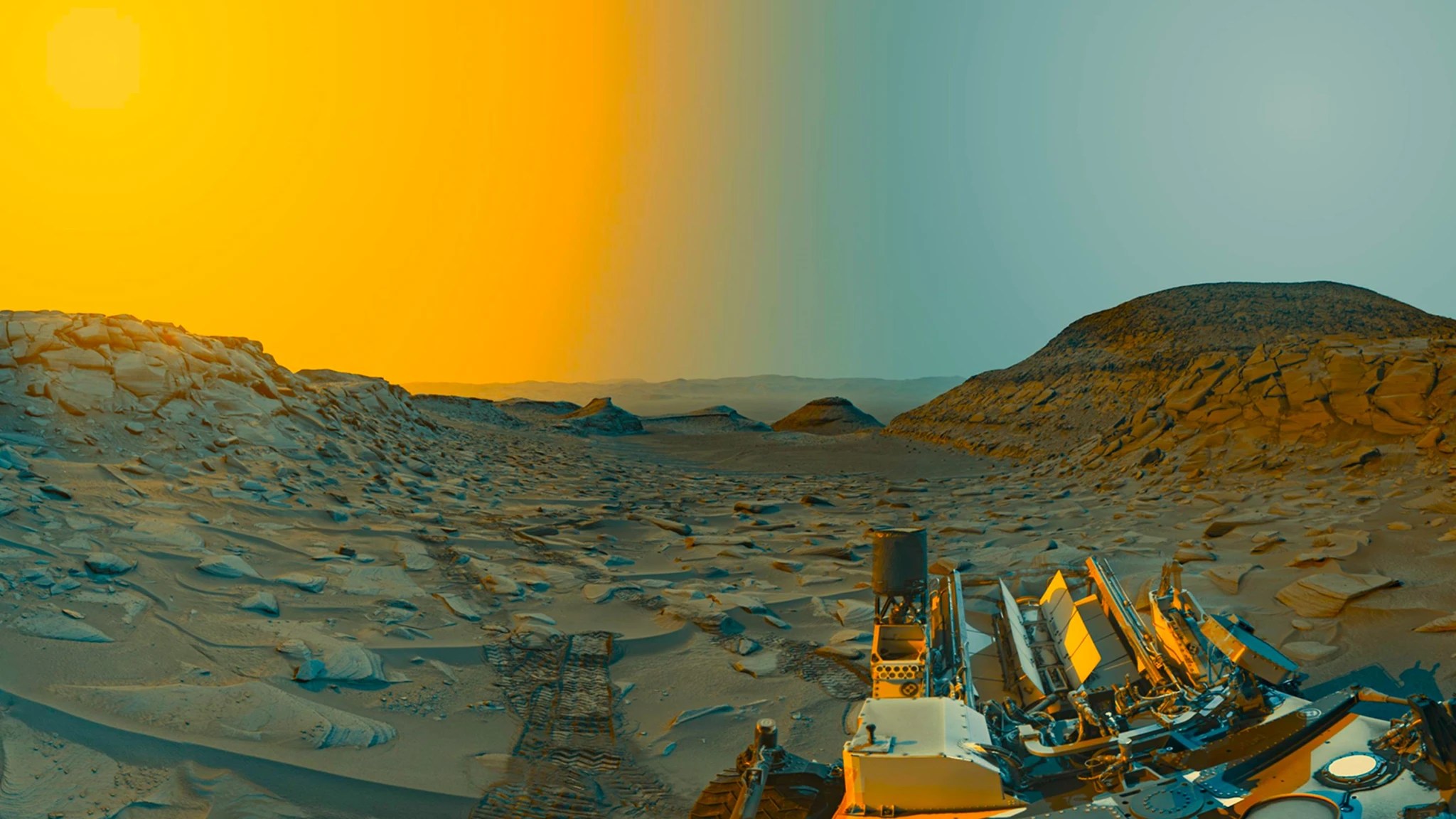
NASA picture from Curiosity rover on a rather barren, poisonous, irradiated, dusty and dry Mars
P/S: Scifi novels are an old genre: The Birds of Aristophanes, making fun of the colonies Athens established everywhere, by establishing one in the sky, preceded the space colonization of Lucian by seven centuries…
***
[1] The European solution to the Earth Crisis has been Mathusianism: use less energy. This weakens Europe and encourages its dictatorial enemies. Actually the best solution is rather the opposite: to use more ABSOLUTE WORTH ENERGY. Use, much more EFFICIENT energy. In particular, we have to leverage fossil fuels to get out of them… using the energy they provide to invent new science and tech….
ooOOoo
Yet another masterpiece from Mr. Ayme. I cannot add anything to this post except to applaud it.
Last Sunday Jean and I watched a Top Documentary Film about the origins of dogs. It was filmed in 2018 and was precious.
Here are the words that accompanied the film:
He has been an integral part of our existence for over 20,000 years. Throughout history, his contributions have been diverse and invaluable. He’s aided us in procuring sustenance, safeguarded our domesticated animals, served as a shield against adversaries, provided navigation during harsh conditions, and rescued us from imminent danger.
Presently, he offers solace, alleviating solitude and assisting us in managing the challenges of advancing age. He has evolved into an unwavering comrade. The origins of dogs raise intriguing questions: How did these remarkable creatures emerge? How did they ascend to such prominence in our lives? How did we forge a collaborative relationship, leveraging their distinct abilities? Moreover, what remarkable feats do they accomplish for us in contemporary times?
Prepare to embark on a journey that unveils the extraordinary escapades of these exceptional beings, showcasing their heroic deeds. Transitioning from wild wolves to beloved companions, from predatory instincts to steadfast friendship, we will traverse the globe to narrate the captivating narrative of how dogs earned their title: man’s first friend.
Director: Frédéric Fougea
Luckily the film, that runs for 90 minutes, is available on YouTube.
Here it is:
If you haven’t seen the film then, please, put some time aside to watch it. You will not be disappointed.
Recovery from addiction is a complex and emotionally taxing process that involves much more than simply abstaining from substance use. It necessitates a holistic approach to healing, which often includes medical treatment, psychotherapy, lifestyle changes, and, for many people, the support of loved ones.
Another source of support that is increasingly recognized for its therapeutic benefits is the companionship of pets. Whether it’s a dog, a cat, or even a bird, pets offer emotional sustenance, non-judgmental companionship, and numerous practical advantages. In this article from Learning from Dogs, we delve into how the presence of a pet can be a transformative experience.
It’s All About a Good Routine
Establishing a stable routine is a cornerstone of addiction recovery. A routine not only provides structure to the day but also instills a sense of responsibility and purpose. Owning a pet naturally requires a routine for feeding, exercise, and care.
This routine can help an individual in recovery stay focused and reduce the void or emptiness often cited as a relapse trigger. Technologies like automated pet feeders can further support this routine, ensuring that your responsibilities are met even when you’re dealing with emotional ups and downs.
Pets Just Make You Feel Better
PsychCentral notes that interacting with pets has been scientifically shown to improve emotional health. Simple actions such as petting a dog or cat trigger the release of “feel-good” hormones like oxytocin, reducing stress and elevating mood.
These emotional benefits are invaluable, especially during the psychologically taxing phases of withdrawal and detoxification. Mental health tracking apps can provide real-time data on your emotional state, often reflecting an improvement correlated with increased time spent with your pet.
Pet-Friendliness and Rehab
Selecting the appropriate rehab facility is an essential step toward a successful recovery journey. An important criterion to consider is the availability of pet-friendly options or the incorporation of pet therapy in the facility’s treatment approach.
Many centers, including local resources for treatment and recovery, are increasingly acknowledging the multifaceted therapeutic advantages that pets can offer and are thus integrating them into their treatment regimens. Specialized online platforms provide comprehensive data about such pet-amicable facilities, empowering individuals to make a well-informed decision.
Diverting from Destructive Urges
Engaging with pets can provide a crucial distraction from cravings and negative thoughts. Whether it’s going for a walk, playing fetch, or simply cuddling on the sofa, these activities require engagement that diverts attention away from destructive patterns. There are even interactive pet toys available now, controlled via smartphone apps, that can keep both the pet and the owner engaged, further reducing idle time that might otherwise lead to cravings.
Pets Make You Social
HABRI points out that owning a pet often encourages social interaction, which can be particularly beneficial during recovery. Whether it’s through meeting other dog owners during walks or engaging in community pet events, these interactions foster a sense of community and belonging. These newly formed social connections can be a significant supportive element in staying sober. Social platforms and apps for pet owners offer a virtual space to connect, share experiences, and seek advice, contributing to a broader support system.
Enhancing Self-Image
Successfully caring for a pet significantly boosts self-esteem and self-worth. Taking responsibility for the well-being of another life generates a sense of accomplishment and purpose, which are foundational in rebuilding one’s life after addiction. Virtual training modules and online courses offer valuable insights into pet care, further increasing competence and confidence in this area.
The journey through addiction recovery is seldom straightforward. It’s a path fraught with challenges, emotional turbulence, and setbacks. However, the simple act of caring for a pet offers an unmatched emotional and practical support system that aids significantly in the recovery process. From establishing routine and boosting emotional well-being to providing a sense of purpose, the benefits are multi-layered and profound. As you navigate through the trials of addiction recovery, the companionship of a pet can become one of your most significant sources of comfort, strength, and hope.
Learning from Dogs serves as a reminder of the values of life and the power of unconditional love – as so many, many dogs prove each and every day. Read more informative articles today!
ooOOoo
HABRI stands for The Human Animal Bond Research Institute and their website is available if you click on the title. I am going to see if I can republish some of HABRI’s articles.
Anyway, thanks to Penny for another great guest post.
It just goes to show the importance of loving an animal, especially a cat or a dog.


























 Learning from Dogs