I am using the software Scrivener to write this book. I fail to recall how I came across Scrivener but, boy of boy, am I glad I did. It is fabulous. One can set out the raw structure of the book, section by section, chapter by chapter, much helping keep one’s mind on the construction of the book as the writing progresses.
All of which is a preamble for me telling you that when I clicked on the chapter ‘folder’ that was named Power and corruption, a folder empty of any words, my heart sank. Power and corruption! Where, oh where, does one start!
Then almost immediately kicked myself; metaphorically speaking! Simply for the reason that one of the most famous sayings is surely that of Lord Acton, the 19th-century British historian: “Power tends to corrupt; Absolute power corrupts absolutely.” That is the place to start this essay on power and corruption.
History has plenty of examples of the tendency of power to corrupt. Of course, when the word ‘power’ is used on its own it misses its natural companion words; the words ‘other people’. Ergo: Power over other people tends to corrupt; Absolute power over other people corrupts absolutely. Napoleon Bonaparte declaring himself as emperor comes to mind, as does further back in time, the Roman emperors, who declared themselves gods, demonstrated absolute corruption from the absolute power, over other people, that they wielded.
Anyway, returning to Lord Acton, or to give him his full name, John Emerich Edward Dalberg Acton. He was the 19th century historian and moralist who was otherwise known more simply as Lord Acton, as in the first Baron Acton (Lord Acton lived from 1834 until 1902). His expression, “Absolute power corrupts absolutely; ……” arose expressed in a letter to Bishop Mandell Creighton in 1887:
“Power tends to corrupt, and absolute power corrupts absolutely. Great men are almost always bad men.”
Great men are almost always bad men: Now there’s a statement to play with!
Despite the text written in Lord Acton’s letter to the Bishop having become a favourite of the many collectors of quotations, it is probable that Lord Acton didn’t invent the idea; quotations very similar had been uttered by several authors well before 1887.
Let us explore the central question as to why it is that power has a corrupting characteristic; a largely corrupting characteristic might be more accurate. For in the Smithsonian magazine of October, 2012, there was an article that examined the social science behind why power brings out both the worst in some people, but also, at times, the best in people.
Why Power Corrupts
His [Lord Acton’s] maxim has been vividly illustrated in psychological studies, notably the 1971 Stanford Prison Experiment, which was halted when one group of students arbitrarily assigned to serve as “prison guards” over another group began to abuse their wards.
But new scholarship is bringing fresh subtlety to psychologists’ understanding of when power leads people to take ethical shortcuts — and when it doesn’t. Indeed, for some people, power seems to bring out their best. After all, good people do win elective office, says Katherine A. DeCelles, a professor of management at the University of Toronto, and no few business executives want to do good while doing well. “When you give good people power,” DeCelles says she wondered, are they more able than others “to enact that moral identity, to do what’s right?”
In a study recently published in the Journal of Applied Psychology, DeCelles and her co-authors found that the answer is yes. People’s sense of “moral identity”—the degree to which they thought it was important to their sense of self to be “caring,” “compassionate,” “fair,” “generous” and so on—shaped their responses to feelings of power.
Christopher Shea, the author of the Smithsonian article, went on to explain that:
DeCelles and her colleagues developed moral identity scores for two groups, 173 working adults and 102 undergraduates, by asking the participants to rate how important those ethically related attributes were to them. The researchers had some participants write an essay recalling an incident in which they felt powerful, while others wrote about an ordinary day. Then the participants took part in lab experiments to probe how they balanced self-interest against the common good.
Christopher Shea then concluded:
The experiment involving the adults found a similar relationship between moral identity, ethical behavior and innate aggressiveness. Assertive people who scored low on the moral-identity scale were more likely to say they’d cheated their employer in the past week than more passive types with similar moral-identity scores. But among those with high moral-identity scores, the assertive people were less likely to have cheated.
In sum, the study found, power doesn’t corrupt; it heightens pre-existing ethical tendencies. Which brings to mind another maxim, from Abraham Lincoln: “Nearly all men can stand adversity, but if you want to test a man’s character, give him power.”
Yet despite the evidence presented that power does not automatically corrupt, the news is so often full of stories of powerful men, well predominantly men, behaving badly in all manner of ways: sex with their staff, assaulting others, such as hotel maids, cheating and lying. So if there is no direct wiring between power and corruption, that power does not automatically corrupt, it still leaves open the question of why power so often does corrupt. What motivates people in power to behave so badly?
In my research, I came across an article in WIRED magazine, How Power Corrupts, that revealed:
Psychologists refer to this [Why does power corrupt] as the paradox of power. The very traits that helped leaders accumulate control in the first place all but disappear once they rise to power. Instead of being polite, honest and outgoing, they become impulsive, reckless and rude. According to psychologists, one of the main problems with authority is that it makes us less sympathetic to the concerns and emotions of others. For instance, several studies have found that people in positions of authority are more likely to rely on stereotypes and generalizations when judging other people. They also spend much less time making eye contact, at least when a person without power is talking.
Then later on Jonah Lehrer, the author of the article, explained:
Although people almost always know the right thing to do — cheating is wrong — their sense of power makes it easier to rationalize away the ethical lapse. For instance, when the psychologists asked the subjects (in both low- and high-power conditions) how they would judge an individual who drove too fast when late for an appointment, people in the high-power group consistently said it was worse when others committed those crimes than when they did themselves. In other words, the feeling of eminence led people to conclude that they had a good reason for speeding — they’re important people, with important things to do — but that everyone else should follow the posted signs.
Concluding:
The larger lesson is that Foucault had a point: The dynamics of power can profoundly influence how we think. When we climb the ladder of status, our inner arguments get warped and our natural sympathy for others is vanquished. Instead of fretting about the effects of our actions, we just go ahead and act. We deserve what we want. And how dare they resist. Don’t they know who we are?
At this point, I sat staring at the screen for some time, wondering what to make of my research findings. Just ‘hearing’ my mind coming up with questions, questions that were rhetorical in nature, not hearing hard, clear questions that could command hard, clear answers. Questions such as:
• Is this characteristic of power warping our judgment, profoundly influencing how we think, as Foucault is recorded as saying, ‘hard-wired’ in humans?
• If so, has it always been this way?
• If not having always been this way with man, then what brought it on?
• Irrespective of the scale of an emergency affecting mankind, either on a regional or global scale, would power always have a tendency to corrupt?
• What cultural changes would need to take place to break the link between power and corruption?
• Indeed, could there be any changes that would achieve this?
Back on the 28th October, Tom Engelhardt published over on TomDispatch: Tomgram: Studs Terkel on Death and Forgiveness in America. I read the essay early on that morning and was blown away by it; to use the modern venacular. I checked with Tom that it was alright for me to republish here but decided to delay that for a couple of weeks.
The Tomgram included two essays by Studs Terkel, an author I hadn’t come across, and a terrible omission for this amateur author. His website provides this biographical overview:
Studs Terkel, prize-winning author and radio broadcast personality was born Louis Terkel in New York on May 16, 1912. His father, Samuel, was a tailor and his mother, Anna (Finkel) was a seamstress. He had three brothers. The family moved to Chicago in 1922 and opened a rooming house at Ashland and Flournoy on the near West side. From 1926 to 1936 they ran another rooming house, the Wells-Grand Hotel at Wells Street and Grand Avenue. Terkel credited his knowledge of the world to the tenants who gathered in the lobby of the hotel and the people who congregated in nearby Bughouse Square, a meeting place for workers, labor organizers, dissidents, the unemployed, and religious fanatics of many persuasions. In 1939 he married Ida Goldberg and had one son.
Terkel attended University of Chicago and received a law degree in 1934. He chose not to pursue a career in law. After a brief stint with the civil service in Washington D.C., he returned to Chicago and worked with the WPA Writers Project in the radio division. One day he was asked to read a script and soon found himself in radio soap operas, in other stage performances, and on a WAIT news show. After a year in the Air Force, he returned to writing radio shows and ads. He was on a sports show on WBBM and then, in 1944, he landed his own show on WENR. This was called the Wax Museum show that allowed him to express his own personality and play recordings he liked from folk music, opera, jazz, or blues. A year later he had his own television show called Stud’s Place and started asking people the kind of questions that marked his later work as an interviewer.
In 1952 Terkel began working for WFMT, first with the “Studs Terkel Almanac” and the “Studs Terkel Show,” primarily to play music. The interviewing came along by accident. This later became the award-winning, “The Studs Terkel Program.” His first book, Giants of Jazz, was published in 1956. Ten years later his first book of oral history interviews, Division Street: America, came out. It was followed by a succession of oral history books on the 1930s Depression, World War Two, race relations, working, the American dream, and aging. His last oral history book, Will the Circle Be Unbroken: Reflections on Death, Rebirth, and Hunger for a Faith, was published in 2001.
Late into his life Terkel continued to interview people, work on his books, and make public appearances. He was the first Distinguished Scholar-in-Residence at the Chicago Historical Society. His last book, P.S.: Further Thoughts from a Lifetime of Listening was released in November 2008. Terkel died on October 31, 2008 at the age of 96.
Although the TomGram includes two essays from Stud, I’m going to split it and republish the first essay, together with Tom’s introduction.
Prepare to be very moved!
ooOOoo
Tomgram: Studs Terkel on Death and Forgiveness in America
Posted by Studs Terkel at 8:00am, October 28, 2014.
Follow TomDispatch on Twitter @TomDispatch.
Studs Terkel, who put oral history on the American map with one spectacular book after another, was a small man who had a knack for making everyone around him feel larger than life. He taught me the first significant lesson I learned as a book editor — and he didn’t even know it. I stumbled into Pantheon Books in the summer of 1976, hired (on the basis of remarkably little) by André Schiffrin, who ran that pioneering publishing outfit. I had only the most minimal idea of what a book editor was or did, but on one thing I was clear: I was going to put new voices between covers. (I would later start calling them “voices from elsewhere, even when the elsewhere is here.”) I couldn’t have been less interested in well known or famous writers. I was, that is, something of a reverse snob.
Nonetheless, one day that first fall André came into my office with the manuscript of Stud Terkel’s memoir, Talking to Myself, which was to be published the following spring. He asked me to read it because Studs — he claimed — wanted my reaction. A longtime Chicago radio personality, who had even hosted an early, unscripted TV show, “Studs’ Place,” set in a fictional bar (the “Cheers” of its era), he was well known indeed. The first book he and André had done together, Division Street: America, had broken into bestsellerdom and neither of them had ever looked back.
Studs didn’t know me from a hole in the wall, so I didn’t take the request seriously until André returned a few days later to ask whether I had read the manuscript. I hadn’t. He said, “Please do. Studs is waiting anxiously.” Anxiously? That was hard to imagine, but when your boss insists… so I went home, read it, and two days later let him know what I thought. (What could you think, given that Studs was fantastic at what he did?) Soon after, he put me on the phone with Studs to tell him just how good it was and make a few modest, last-minute suggestions.
So many years later, I still remember that unforgettable voice (possibly the last on Earth out of which a cigar emerged) saying something like, “Do you really mean it, Tom?” What I’ll specifically never forget was the quaver in it, the shiver that seemed like a caricature of fear. After all, he was the best-known author I’d ever talked to and, as a young man with enough doubts of my own, it had never crossed my mind that a successful writer might feel vulnerable when it came to his latest work or give a damn about the opinion of a total nobody. In a way, that moment taught me everything I needed to know about the essential vulnerability of the writer and, thanks to Studs, I never looked back.
For years, André, who was his editor, would call me in to take a final look at his oral histories. (It was like sending in the second team.) Only after I left Pantheon did I became Studs’ primary editor. It was the experience of a lifetime. Just to give you a little taste of the man, I’m including excerpts from the only letter of his I still have, typed by hand, filled with X’d out words, and further hand-corrected in pen. It came with the first batch of rough interviews for the final book we worked on together, an oral history of political activism aptly titled Hope Dies Last. By that time, Studs was in his early nineties and still a human dynamo. Maxwell Perkins, whom he mentions, was a famed editor who joined the venerable firm of Scribner’s wanting to publish vibrant young voices and ended up working with, among others, F. Scott Fitzgerald, Ernest Hemingway, and most famously the novelist Thomas Wolfe who simply couldn’t stop writing, which meant that his books involved marathon bouts of editing. Here, then, are the first two paragraphs of that letter in his telegraphese.
“Post-election day,” Studs began. “A hell of a time to write about hope… The ton of stuff — good and less than good. Since what you have is the raw stuff — I have already tossed aside about 20 [interviews] — I shall, of course, begin my cuts shortly after you receive this messy letter.
“You’ll be my Maxwell Perkins, though you don’t wear a hat, and I’m your Thomas Wolfe, though a foot and a half shorter than he was…”
And here’s how he ended: “I’m eagerly looking forward to your reactions when you get this bundle. Horrified [though] you may be by its bulk, remember you’re my Maxwell Perkins. If it works out, I’ll buy you a hat.”
What a guy (even if I never got that hat)! I always considered it appropriately Studsian that the book preceding Hope Dies Last was his oral history of death, Will the Circle Be Unbroken?: Reflections on Death, Rebirth, and Hunger for a Faith. Studs himself died in 2008. Circle has just been reissued in paperback with a new Jane Gross introduction by the New Press, the publishing house that André, who died last December, set up after he was forced out of Pantheon by Sy Newhouse, the right-wing owner of its parent company, Random House.
Given the grim panorama of death these days — from beheadings to pandemics — and the hysteria accompanying it all, I thought it might be both a relief and a change of pace at TomDispatch to turn back to Studs’ oral history of death, which as its editor I can testify is moving and uncannily uplifting. That, of course, is not as odd as it sounds from the man who was the troubadour for the extraordinary ordinary American. Thanks to the kindness of his publisher, the New Press, I’ve chosen two interviews from that book which stayed in my mind these last 13 years: the first focuses on an impulse that may be among the hardest to understand and yet most moving to encounter, forgiveness; and the second, from this country’s medical front lines, centers on a subject that, unfortunately, is still all too timely: the trauma deaths of young Americans from gunshot wounds. This is the only book I ever remember editing while, in some cases, crying. Tom
“You Got Into My Heart Violently, But You’re There”
Trauma, Death, and Forgiveness on the Front Lines of American Life
By Studs Terkel
[The following is excerpted from the new paperback edition of Studs Terkel’s oral history of death, Will The Circle Be Unbroken?: Reflections on Death, Rebirth, and Hunger for a Faith, with special thanks to his publisher, the New Press.]
“The Other Son” Maurine Young
In contrast to her husband’s introspective nature, she is outgoing, a large-boned woman, overflowing with gusto and ebullience. She frequently laughs out loud.
I’m a forty-six-year-old woman of Jewish-Gentile descent — my father’s a Jew, my mother’s a Gentile. My parents divorced when I was young, and I was raised by my stepfather — raised Catholic. He was a truck driver. My younger brother, Mark, became a truck driver. I went to public school. But I went to the Catholic catechism every Wednesday. I did the confirmation and all that kind of stuff. I got close to age twelve, thirteen, and I began to see what I was saved from. I was saved from Hell. But what Catholicism wasn’t teaching me was what I was saved to. They didn’t tell me how to live with God and experience a taste of Heaven on Earth, now. So I began to pull away from the Church. It just didn’t meet my needs.
If I read my Bible I saw that it said very clearly to worship God, then why were people worshiping statues? To me that looked like idolatry. So, as a young teenager, I started asking questions. Then I began to wonder what is this all about? I know that there’s a God, and I know that He loves me, but what else is there? How do you live now? I lived in a very difficult, alcoholic home, and early in my teens began to experiment with drugs — do whatever I felt like doing. In the one sense, I had the Ten Commandments ingrained in me, so I knew what was right and wrong — but I didn’t really care about the consequences. I didn’t really understand the value of a God who loves me, and that because He loves me, I should act loving towards him, which means act loving towards everybody else. I was very, very selfish.
I had been working part-time jobs since I was fourteen. A couple of weeks after I graduated from high school, my dad said, “Get out of the backyard, sitting in your bikini, and get your butt downtown and find a job.” So I went downtown and found a secretarial position. I was seventeen. And then I moved out when I was eighteen, to live with my boyfriend. That didn’t work out. Moved back home and met Steve not that long afterwards, in March of 1975. We moved up here to Rogers Park and had a family. We had twins in May of 1977, Andrew Needham and Samuel Richard, born on different days — May 7 and May 8. And then in 1982, in August, we had Philip; and then in 1987, December, we had Clinton. I was working as a floral designer, part-time, in Skokie. Steve was tuning pianos.
Andrew went out to cash a check with his brother and didn’t come back. He was shot by a young man who had easy access to a handgun and who had graduated from high school the day before and was looking to move up in the gang that he was in, the Latin Kings. He shot Andrew, probably because Andrew didn’t back down with his mouth. He knew that gang members were idiots and didn’t mind telling them what he thought of them when they made signs at him. He was in our car.
When I got to the hospital and found out that he was gone, and I asked the boys what happened and they told me, I said, “Well, you know what? There’ll be no retaliation for this. I just want to make that clear.” Men usually want revenge; women, too, but men usually much quicker. Women will stew for a while. I knew that revenge was wrong, but I also knew that I hated what these kids had done and knew that they deserved to be punished. I pulled out some old journals from that time. These notebooks. Here’s an entry that I wrote July 13th of 1996. Andrew was murdered June 10th of 1996. It reads: “It’s been sixty days since Andrew left us. Forced out of his body by Mario and Roberto. Please, Lord, let justice be served. Plus, punish them. Let them not have a free life.” That’s how I felt. I did not want them to be free, and I was real glad that the police had seen what had happened.
I’m going to backtrack a tiny bit. My twins were three months old. I was sitting on the beach with them. Somebody came up to me and said, “Could we talk to you about Jesus?” And I said, “It’s a public park, it’s a free country, you can sit down.” So they started talking to me about Jesus. This lady turns to me and she says, “So how’s your life?” And her words shot into my chest like a sword. I’m thinking, Oh my God, what does she know? I had just had the twins. I was not coping. I was smoking massive amounts of marijuana. I was up twenty-four hours a day, not knowing how to keep these little babies on a schedule. I was fantasizing throwing one of them out the window. I was having what now I understand to be severe post-partum psychosis. I didn’t have any help. I was really just trying to hold on… So I began to tell this lady and her friends how poorly I was doing. She said, “Would you like to commit your life to Christ again?” And I said, “I really would. Because I realize I’m not doing very well by myself. Something is missing.” So I did that and I prayed that day. Since that day, I’ve been learning how to parent, and to let God love me, and to love and forgive others.
Nineteen years later, when this happened with Andrew being murdered, I said, “OK, I know who I’m following.” What would Jesus do? It was pretty clear. He says: Love your enemies — I consider these little guys my enemies that killed my son. Pray for those who use you, forgive as God has forgiven you. So I thought, OK, what does that mean? Looking back at another journal… this is from January of 1997. I wrote: “What are the obstacles to forgiveness? How can forgiveness free us? How can it free me? Well, first I needed to know that I must face my own pain and grieve. And not keep anger on, sort of as a suit of armor. Admit the wrong that was done to me and experience the rage. But be honest with God about my pain and why. Releasing my anger to him and pardoning the offender makes me feel vulnerable, even out of control. But what’s my choice? If I hold my anger, it will destroy me.” And then I also wrote, “It’s OK to be afraid of being hurt again.” So, obviously, the whole idea of forgiveness was there in the back of my mind the whole time, and I kept thinking: I want to kill them, I want to see them fry. But God says forgive… And I kept going back and forth thinking, How do you do this? Scratching my head. Then I realized I could make the choice and trust that the power to do it would be there. Because I know that my faith, which is just my yes, is the glue that holds God’s power to his promises. And He’s promised that He would do what I ask, He would do the right thing in my life. I’m going to have the faith and forgive and trust that He’s going to take care of it all. So I finally did that about July of 1997, about six months after what I just read to you. I forgave and wrote Mario in prison a letter. He was eighteen, my son was nineteen. I told him about my life. I just wanted him to know how I was raised, and that I had done plenty of things that needed forgiving and God forgave me. So how could I withhold forgiveness from him? I couldn’t. That I love him and God loves him and I forgave him.
I didn’t know that at the same time, he was writing me a letter. As I remember, he was begging forgiveness, saying how sorry he was, how he wished he could bring Andrew back, even trade places. And I believed his letter was sincere. But his letter was unnecessary for my forgiveness. I had been asking to see him.
It’s one thing to write to someone and say you forgive them — it’s another to physically touch them and say you forgive them. It would help me in my healing and him in his, I knew. I felt compelled to do it. I had been asking through his priest when was a good time. Mario kept saying, “I’m not ready. Mrs. Young is pushing too much. I’m not ready.” He was terrified. He thought I might hit him or something. He was not ready to face me. That was July of 1997. I didn’t get to see him until December 17th of 1998. So it took more than a year and a half before he was ready. And I waited. We did correspond. And then I went to visit him with Father Oldershaw, and a retired schoolteacher by the name of Arlene Bozack. She had been visiting him.
When we first got there, the assistant warden, who was Hispanic, was crying. He said, “Mrs. Young, why are you here?” I said, “Well, I’m here to offer forgiveness to the young man who killed my son.” And he said, “Why?” And I said, “Because I care about him, I love him. It’s the right thing to do. I want to do it in person.” He said, “In all my years, this is the first time I’ve ever seen this happen. I really commend what you’re doing.” He was this big, tough-looking Hispanic warden.
I see Mario for the first time. He couldn’t look at me. He had his head hanging down. They sat us around a small round table with four attached seats, told us where to sit. Everybody kept looking at me very suspiciously, like I was going to just jump on this kid and beat the hell out of him. Mario’s got his head hanging down, and all of a sudden he kind of looks, and he can’t make eye contact. I saw that his whole body was starting to shake. All four of us prayed. It was me, Father Oldershaw on my right, Mario was across from me, and Arlene Bozack was to his right.
I grabbed both Mario’s hands from across the table, and I looked at him in the eye, and I said, “I just want you to know that I’m glad to be here.” I knew I had to go first. He just shook his head. Slowly, but surely, the conversation started. Little chitchat, we all took turns talking. I wanted to know about his family and how they were doing. Because the shame that he brought on them — especially being an Hispanic family — that’s so important. And then the conversation changed a bit because I felt like, OK, it’s time for this little guy to hear what he’s done to us. The consequences of his actions. I began to tell him the difficulties that each of our family members was having. As I went through, person by person, saying, one young man’s suicidal, the other one can’t focus, or whatever the problems were for each of us, he listened. He held Arlene’s hand and he trembled and he wept, but he listened.
At some point in the conversation I said, “I love you like you’re my son, like you’re one of mine.” And I was like, “I can’t figure out how this happened!” [Laughs] I thought I was nuts. I didn’t tell him that. I was thinking, I gotta be crazy. So I said, “I love you like you’re my own son. You got into my heart violently, but you’re there. So this has to be a miracle. God did this. Because I didn’t do this. But, as a son, you have responsibilities to know what’s going on and to pray for us, to communicate with us regularly. You’re part of the family now.” Then he pulled out his Bible. I said, “Mario, there’s a Scripture that meant a lot to me and helped me take this step. I wanted to tell you what it is. It’s in Romans, in the twelfth chapter. It says, ‘Never pay back evil for evil to anyone. Respect what is right in the sight of all men. If possible, so far as it depends on you, be at peace with all men.’” I said, “My reaching out and extending and forgiving was my responsibility, and it didn’t depend on whether or not you accepted that forgiveness. I had to do that.” It also says, “Never take your own revenge, but leave room for the wrath of God.” Then I said what was really important was when I got to verse 21. It says, “Do not be overcome by evil, but overcome evil with good.” I said, “Mario, that really meant a lot to me. Because I wanted to win. I did not want this evil thing that you and Roberto did to us to win. I wanted good to win. So that’s why I forgave you and that’s why I love you.”
He was speechless. He looked at me like I had two heads. [She roars with laughter.] He stared at me like: I don’t know what she’s talking about — she’s from another planet. It wasn’t quite sinking in. But he was listening. I heard later that he was confused and didn’t understand it, but it was beginning to make sense. He was actually holding his Bible open to this spot, looking at it over and over and over again. We talked, and then I got to hold him. That was really, really special. Here’s another reason I thought I was crazy: I’m sitting across this little table from him, and it’s all I can do to stay in my seat. I’m thinking: What’s wrong with me? Am I having a nervous breakdown? Everything in me wanted to leap over the table, grab hold of this kid, and rock him like a baby, just hold him. The urge was so overwhelming. The compulsion was so overwhelming, I was afraid that if I couldn’t keep control, I’d be in really big trouble with the guards and the warden. So I resisted that urge the whole time.
On the way back home, I was thinking about it, and then I talked to Arlene and Father Oldershaw. I said, “I’ve got it! I know what was happening. I was getting a taste in my body of how much God loves us. He loves us so much that He wants to leap over the table, grab hold of us, and just rock us because we’re his children.” That love, that forgiveness — I got a taste of what it must have been like for Jesus when he was here and walked the Earth among people that he loved so desperately, so wonderfully. I got a taste of it!
As time went on and we kept corresponding, I did go see him again there, and it was good. I really began to see him maturing, through his letters and through visiting him. I was training him, I was mentoring him — to help him to grow up, to help him in his spiritual walk. His letters changed. They became clearer, he became more willing to take total responsibility. I saw no excuses anymore, I saw a person that was squarely saying: This is where I am and this is where I should be, and God’s changing me right here, and probably being here saved my life. He’s working as a chaplain’s assistant now… [Sighs]… I’m convinced that if I did not forgive and I held on to my anger, that I probably would have become mentally ill. Maybe killed myself, maybe hurt someone else. I felt like God’s hand was on me and he was squashing me into a pancake: You gotta do this — this is the right thing.
I knew that there were great things ahead, although they terrified me, the thought of going out into new territory. Because, I’ll tell ya, I was not a very forgiving person most of my life. I used to hold things against whoever did what to me. It really took the murder of my son and the forgiving of his killer to teach me how to forgive everybody around me. I began to realize: My husband’s not going to be Mr. Perfect. My parents haven’t been perfect parents. My children are not perfect children. My friends are going to let me down. That’s a given. Because they’re human, like I am. There is one perfect, that is God, and He loves me. And that’s good enough for me. So, by forgiving them, like I did Mario, it freed me to really love. My love was, like, stopped up in a bottle or something. It came out in little bits. But for the most part, it was stopped up until I forgave this kid. And then it was like whoosh — this is what I’ve been missing my whole life. [Belly laugh]
I saw Mario just this last month. I’ve met his mom and his dad. They don’t speak any English, but usually one of his sisters is there to interpret. Most of the time, all his mother can do is hold on to me and cry. She’s a very sweet person.
Yesterday, I published a chapter from ‘the book’ under the title of The Power of Negativity.
However, as I contemplated a number of chapters coming along that, taken collectively, might seem out of place in a book that, essentially, offers a positive message, I decided an introduction was called for.
Thus in thirty minutes time that introduction is published.
I also realised that this introduction should have come before yesterday’s chapter on negativity.
So for those of you that might be following my draft, you poor souls, try and come at the Introduction as if it had been presented before The Power of Negativity.
Now for a complete change of topic!
Neighbour Dordie recently sent me the following. Here’s Part One.
ooOOoo
The Washington Post’s Mensa Invitational once again invited readers to take any word from the dictionary, alter it by adding, subtracting, or changing one letter, and supply a new definition.
Here are the winners:
1. Cashtration (n.): The act of buying a house, which renders the subject financially impotent for an indefinite period of time.
2. Ignoranus: A person who’s both stupid and an asshole.
3. Intaxicaton: Euphoria at getting a tax refund, which lasts until you realize it was your money to start with.
4. Reintarnation: Coming back to life as a hillbilly.
5. Bozone (n.): The substance surrounding stupid people that stops bright ideas from penetrating. The bozone layer, unfortunately, shows little sign of breaking down in the near future.
6. Foreploy: Any misrepresentation about yourself for the purpose of getting laid
7. Giraffiti: Vandalism spray-painted very, very high.
8. Sarchasm: The gulf between the author of sarcastic wit and the person who doesn’t get it.
9. Inoculatte: To take coffee intravenously when you are running late.
10. Osteopornosis: A degenerate disease. (This one got extra credit)
11. Karmageddon: It’s like, when everybody is sending off all these really bad vibes, right? And then, like, the Earth explodes and it’s like, a serious bummer.
12. Decafalon (n):The grueling event of getting through the day consuming only things that are good for you.
13. Glibido: All talk and no action.
14. Dopeler Effect: The tendency of stupid ideas to seem smarter when they come at you rapidly.
15. Arachnoleptic Fit (n.): The frantic dance performed just after you’ve accidentally walked through a spider web.
16. Beelzebug (n.): Satan in the form of a mosquito, that gets into your bedroom at three in the morning and cannot be cast out.
17. Caterpallor (n.): The color you turn after finding half a worm in the fruit you’re eating.
Taking a shortcut and reposting something from 2009
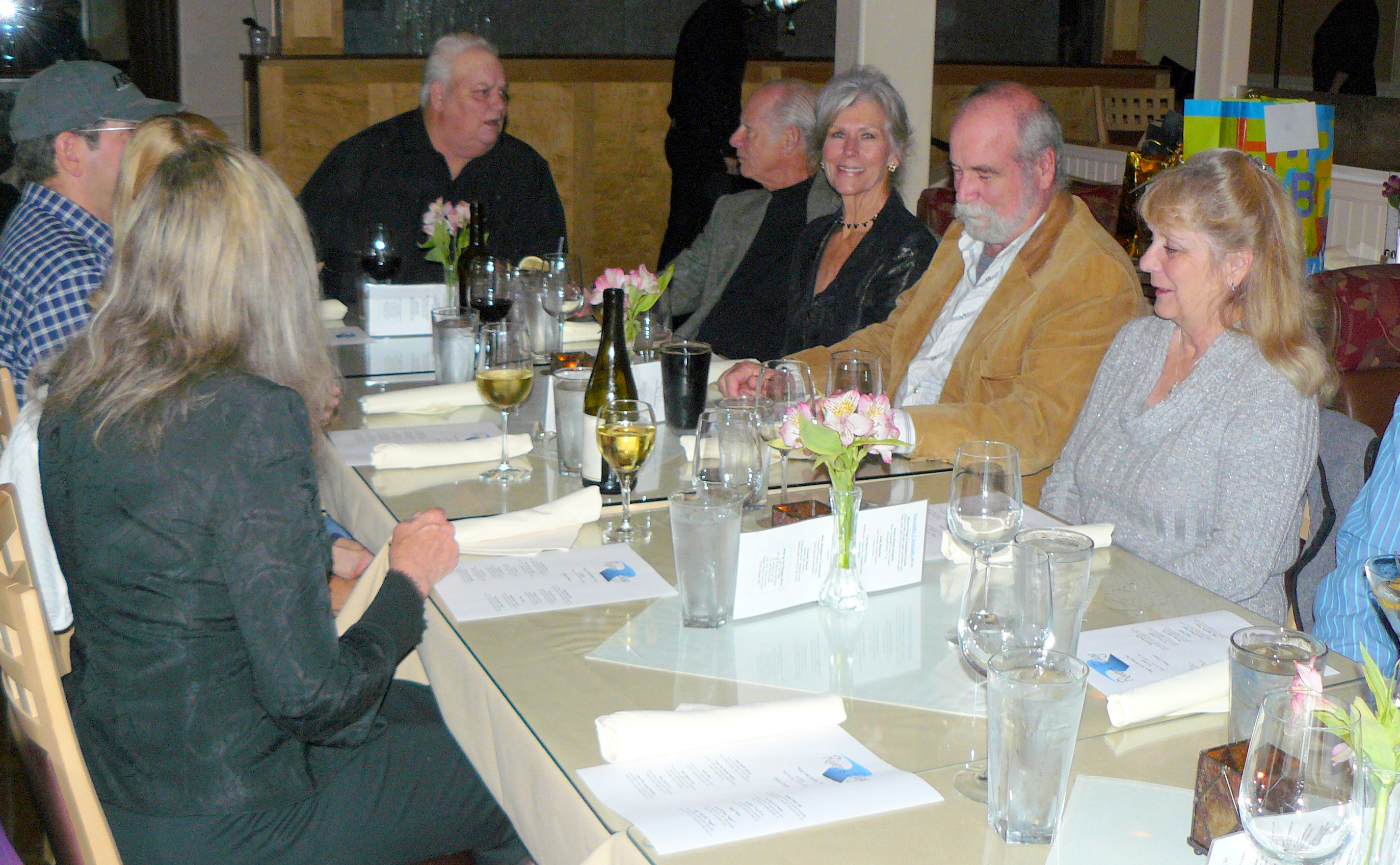
Yesterday, Sunday, was a quiet day. For several good reasons. Firstly, on Saturday evening Jean and I and eleven of our close neighbours enjoyed a glorious birthday meal at the River’s Edge restaurant in Grants Pass.
That meant, inevitably, that Jean and I were a little jaded yesterday.
Secondly, I needed to get my head down and put a few thousand words under my belt in terms of NaNoWriMo and ‘the book’.
Lastly, a comment from a new reader to a post that was published nearly five years ago reminded me of how special a person is Kevin Richardson. Here’s that comment:
Paul, this article is amazing. Thank you so much for taking the time to write this, I’m a huge fan of Kevin. So is my Marine boyfriend who actually told me to look him up, this man is truly remarkable. I’ve always wanted to work with animals, my dream is to be a veterinary pathologist but lately I’ve been so stressed with school and college I wasn’t sure if I could make it. But Kevin is the one who has motivated me to continue to pursue my dream, so you think there’s a way I could contact him? I know it’s kinda crazy but I would love to get to speak to him. My boyfriend looks up to him alot too and I’ve tried looking for it but I had no luck. If there’s the possibility that you may know where I could find it or somehow contact him I would greatly appreciate it. Thank you so much. Maria.
So here is that post, and can anyone find a way to help Maria? (I have her email address.)
oooo
Remarkable people – Kevin Richardson
December 30th, 2009
Trust is both taught and learnt!
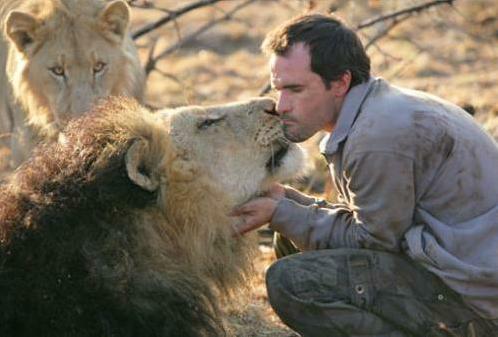
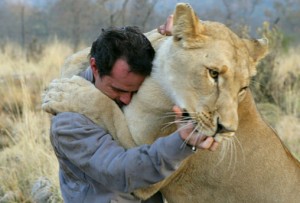
Thanks to Naked Capitalism, we posted an item on the 19th December about an unknown wild-life ranger working in the wildlife refuge area of Lanseria, South Africa. Here was one of the pictures included in that Post:
The Post finished with an appeal to anyone that knew the name of this Ranger. Many of you did and responded; thank you!
His name is Kevin Richardson and there is an interesting account of how he works and some of his ‘experiences’ in Revolution Magazine, luckily with online content. That article is here. It starts thus:
To do this he does not use the common methods of breaking the animal’s spirit with sticks and chains, instead he uses love, understanding and trust. With this unusual method of training he has developed some exceptionally personal bonds with his students. He sleeps with lions, cuddles newborn hyenas, swims with lionesses. Kevin can confidently look into their eyes, crouch to the their level and even lie down with them – all taboos in the normal world of wild animal handling – yet he doesn’t get mauled or attacked.
The article goes on to say that Kevin often works with the animals when they are very young. Thus he is demonstrating very powerfully that how we behave, especially with our children when they are young, creates the environment for building trust out of consistency of deed and thought. (By the way, do read some of the comments posted at the end of that Magazine article – some of them make for powerful reading.)
Kevin Richardson at ‘work’.
Luckily, thanks to this wired world we now live in, there is also video of Kevin available on YouTube. A quick search under Kevin Richardson on YouTube will quickly find a number of videos but here are two that I wanted to share with you.
The first will leave you speechless and possibly wet-eyed!
The second is a promotional video by Kevin encouraging us to buy his recent book – and why not!
This is a very remarkable person and it’s an honour to share this with you. We have so much to learn from all animals.
1944 to 2014 in what seems like the blink of an eye.
At 7:30am UTC on November 8th, 1944 in the antenatal ward of Hampstead Heath General Hospital, North-West London, yours truly took his first lung-full of air.
It would be impossible to list all the memorable things that have happened in these last seventy years and, anyway, it would bore your pants off!
So all I want to reflect upon were those first six months, despite me not remembering any moment of them.
For on May 8th, 1945 World War II ended.
Here’s the historic announcement by Sir Winston Churchill.
The Allies accepted the unconditional surrender of the defeated Third Reich on May 8, 1945. This brought an end to the Second World War in Europe after 2074 days.
My mother, still very much alive at the age of 94, recalls that on hearing that announcement from Churchill she looked down at me and knew her young baby boy wasn’t going to be killed by a German bomb.
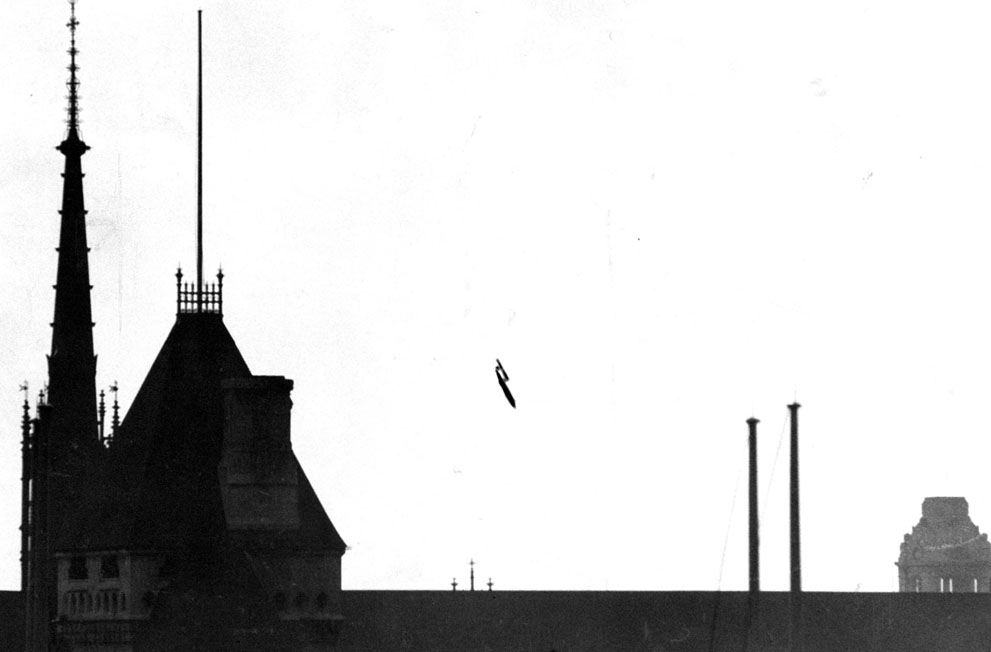
By no means was this a theoretical concern of hers. For in much of the preceding months the Germans had been hammering London with their V-1 “Buzz Bombs”. As this historic photograph shows.
A V-1, “buzz bomb”, plunging toward central London, 1945.
This bomb landed on a side road off Drury Lane blasted several buildings, including the office of the Daily Herald. Known as the Flying bomb, Buzz bomb or Doodlebug, V-1 was the first modern guided missile used in wartime and the forerunner of today’s cruise missile. The V-1 (and later V-2 ) added a new terror to an already terrible war – robot missiles. Once launched, these weapons flew without human intervention to strike distant targets.
Circumstances meant that my mother was living in North-West London when I was born and that’s where I was brought up for the first two years of my life. Still remember the address: 17 Burnside Crescent, Alperton, North-West London.
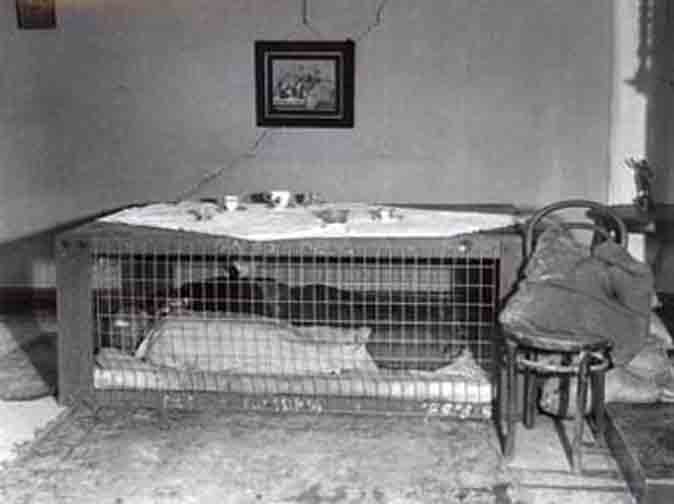
Burnside Crescent was close to factories that were being targeted by the Germans. That meant that at night my mother and I slept in what was called a Morrison shelter.
An indoor Morrison shelter.
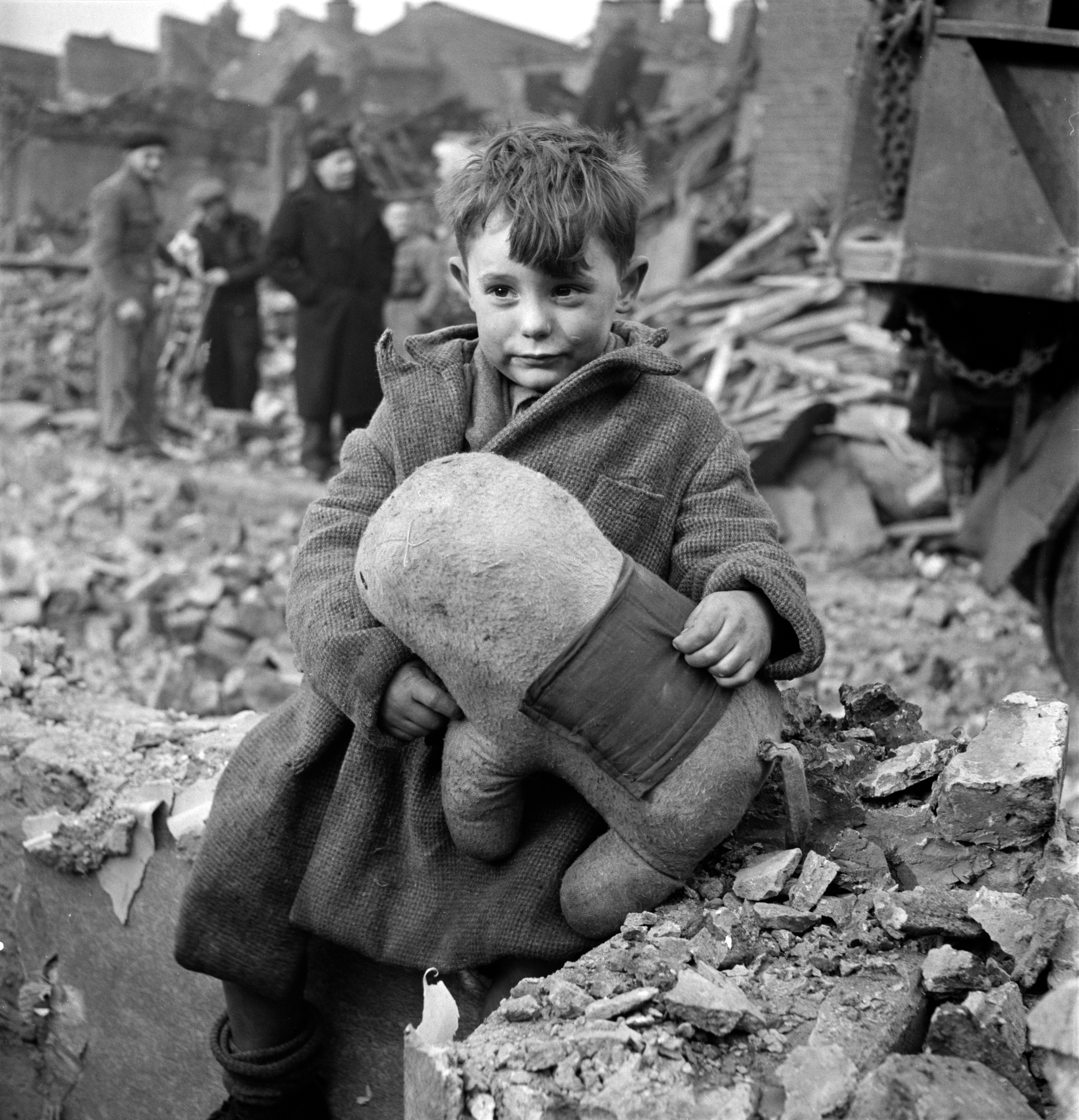
As if to underscore the hazards of early-1945 London, the photograph below is of a young boy, Toni Frisell, the sole family survivor from a V-1 bombing in 1945.
Toni Frissell – wonder where he is now?
So here I am still a living being and still loving my life.
How to close?
By coming all the way forward to modern times and the incredible technology that enables so much. Not just the world of blogging but such things as NASA’s Scientific Visualization Studio from where this compelling video was taken.
I wrote about my first six months that were not remembered one jot!
This quote, therefore, seems an apt statement for the end of today’s post.
Yesterday, on my blog post about the dog’s ancestor, the wolf, a kind reader commented, “So beautiful and such interesting information! Thanks so much for sharing your research! 🙂 ”
Mark Derr
That was very motivational for me because Part Two of my book, being driven along by NaNoWriMo!, is much tougher and requires significant research. Research to a much greater extent than I have been used to. Thus it was that my research wanderings brought me to the magazine The Bark and thence to an article written by Mark Derr back in 2006. I had previously heard of neither.
It was such a fantastic article, of such relevance to what I was writing about, that I took a deep breath and emailed Mark asking if I might have his permission to republish; both in the book and here on Learning from Dogs. Promptly, Mark replied in the affirmative. 🙂
I’m still deliberating how it will be included in the book but have no hesitation in publishing it here for your enjoyment.
That the dog is descended from the wolf—or more precisely, the wolf who stayed—is by now an accepted fact of evolution and history. But that fact is about all that is agreed to among the people who attempt to answer fundamental questions about the origins of the dog—specifically, the who, where, when, how and why of domestication.
Dates range from the dog’s earliest appearance in the archaeological record around 14,000 years ago to the earliest estimated time for its genetic sidestep from wolves around 135,000 years ago. Did the dog emerge in Central Europe, as the archaeological record suggests, or in East Asia, where the genetic evidence points? Were they tame wolves whose offspring over time became homebodies, or scavenging wolves whose love of human waste made them increasingly tame and submissive enough to insinuate themselves into human hearts? Or did humans learn to follow, herd and hunt big game from wolves and in so doing, enter into a complex dance of co-evolution?
Despite the adamancy of adherents to specific positions, the data are too incomplete, too subject to wildly different interpretations; some of the theories themselves too vague; and the physical evidence too sparse to say with certainty what happened. Nonetheless, some models—and not necessarily the most popular and current ones—more clearly fit what is known about dogs and wolves and humans than others. It is a field in high flux, due in no small measure to the full sequencing of the dog genome. But were I a bettor, I would wager that the winning view, the more-or-less historically correct one, shows that the dog is the result of the interaction of wolves and ancient humans rather than a self-invention by wolves or a “conquest” by humans.
Our views of the dog are integrally bound to the answers to these questions, and, for better or worse, those views help shape the way we approach our own and other dogs. It is difficult, for example, to treat as a valued companion a “social parasite” or, literally, a “shit-eater.” To argue that different breeds or types of dogs represent arrested stages of wolf development both physically and behaviorally is not only to confuse, biologically, description with prescription but also to overlook the dog’s unique behavioral adaptations to life with humans. Thus, according to some studies, the dog has developed barking, a little-used wolf talent, into a fairly sophisticated form of communication, but a person who finds barking the noise of a neotenic wolf is unlikely to hear what is being conveyed. “The dog is everywhere what society makes him,” Charles Dudley Warner wrote in Harper’s New Monthly Magazine in 1896. His words still hold true.
Since the dog is both a cultural and a biological creation, it is worth noting here that these opposing views of the dog’s origin echo the old theory that the sniveling, slinking pariah dogs and their like—“southern breeds”—derived from jackals, while “northern breeds”—Spitz-like dogs and Huskies—descended directly from the wolf. Darwin thought as much, so did the pioneering ethologist Konrad Lorenz until late in his life, when he accepted that the wolf was the sole progenitor of the dog. In the theories of Raymond Coppinger and others—and I think this transference is unconscious—the scavenging jackal becomes a camp-following, offal-eating, self-domesticating weenie of a tame wolf. In turn, those wolves become the ur-dog, still manifest in the pariahs of India and Asia, from which the dog we know is said to have emerged. It’s a tidy, convenient, unprovable story that has an element of truth—dogs are accomplished scavengers—but beyond that, it is the jackal theory with a tattered new coat. In dropping humans from the process, the scavenging, self-domesticating wolf theory ignores the archaeological record and other crucial facts that undercut it.
Fossils found at Zhoukoudian, China, have suggested to archaeologists such as Stanley Olsen, author of Origins of the Domestic Dog, that wolves and Homo erectus were at least working the same terrain as early as 500,000 years ago. The remains of wolves and Homo erectus dating to around 300,000 years ago have also been found in association with each other at Boxgrove in Kent, England, and from 150,000 years ago at Lauzerte in the south of France. It seems more likely that this omnivorous biped, with its tools and weapons, lived and hunted in proximity to that consummate social hunter, the wolf, through much of Eurasia, than that their bones simply fell into select caves together. Who scavenged from whom, we cannot say.
Wolves were far more numerous then than now, and they adapted to a wide range of habitats and prey. On the Eurasian steppes, wolves learned to follow herds of ungulates—in effect, to herd them. Meriwether Lewis observed the same behavior during his journey across North America in the opening years of the 19th century; he referred to wolves that watched over herds of bison on the Plains as the bisons’ “shepherds.” Of course, those “shepherds” liked it when human hunters attacked a herd because they killed many more animals than the wolves, and although the humans carried off the prime cuts, they left plenty behind.
Ethologists Wolfgang M. Schleidt and Michael D. Shalter refer to wolves as the first pastoralists in “Co-evolution of Humans and Canids,” their 2003 paper in the journal Cognition and Evolution. Early humans, they argue, learned to hunt and herd big game from those wolves; thus, the dog emerged from mutual cooperation between wolves and early humans, possibly including Neanderthal. There is no evidence yet of Neanderthal having tame wolves, much less dogs, but the larger point is that when modern humans arrived on the scene, they found wolves already tending their herds, and they immediately began to learn from them. That was long before humans began, in some parts of the world, to settle into more permanent villages, some 12,000 to 20,000 or 25,000 years ago.
Schleidt and Shalter based their model on wolf behavior and on genetic studies that have consistently shown that dogs and wolves diverged between 40,000 and 135,000 years ago. The first of those studies emerged from the lab of Robert K. Wayne, an evolutionary biologist at the University of California at Los Angeles who had already made headlines by showing definitively that the dog descended from the wolf alone. In a paper appearing in the June 13, 1997, issue of Science, Wayne and his collaborators said that dogs could have originated around 135,000 years ago in as many as four different places. They also argued that genetic exchanges between wolves and dogs continued—as they do to this day, albeit in an age during which dogs have become ubiquitous and wolves imperiled.
Since that paper appeared, the dog genome has been fully sequenced and provides a time frame for domestication of 9,000 generations, which the authors of a paper on the sequencing in the December 8, 2005, issue of Nature pegged at 27,000 years. But except for that, subsequent studies of mitochondrial DNA, which is most commonly used to date species divergence, have pointed to a time frame of 40,000 to 135,000, with 40,000 to 50,000 years ago looking like the consensus date.
Most of this work has been conducted in Wayne’s lab; in the Uppsala University lab of Carles Vilà, his former student and the lead researcher on the 1997 paper; and in the lab of Peter Savolainen of the Royal Institute of Technology, Stockholm, another collaborator on the original paper.
A signal problem with the early date is that it doesn’t appear to match the archaeological record. The dog is not only behaviorally but also morphologically different from the wolf, and such an animal first appears in the fossil record around 14,000 years ago in Bonn-Oberkassel, Germany. Archaeologists nearly universally peg the origin of the dog to that time.
Wayne, Vilà and their supporters have suggested from the start that behavioral change could predate morphological change, which would have occurred when humans began to create permanent settlements, thereby cutting—or at least reducing—their wolf-dogs’ contact with wild wolves. People might also have begun attempting to influence the appearance of their dogs at this point.
But those Germans get in the way again. Bonn-Oberkassel, site of the consensus first fossil dog, is not a permanent settlement.
Trying to square genetic and archaeological dates, Peter Savolainen resurveyed the mitochondrial DNA of dogs and wolves, recalibrated the molecular clock and proposed in a paper in Science, November 22, 2002, that the dog originated in East Asia 15,000 to 40,000 years ago. It was a good try, but now it appears that his “40,000 years ago” date was more accurate. Also, the earliest known dog appears in Germany, not East Asia, a region to which other genetic evidence points as well.
In many ways, the dispute over dates and places is just a precursor for the debate over how that happened. Archaeologists and evolutionary biologists who want the first dogs to look like dogs have tended to argue that the transition is a result of a biological phenomenon called “paedomorphosis.” That basically means that the animal’s physical development is delayed relative to its sexual maturation. It produces dogs with more domed heads; shorter, broader muzzles; and overall reduced size and slighter build than a wolf. Accelerated physical development relative to sexual maturation (hypermorphosis), on the other hand, produces dogs larger than the progenitor wolf.
When maturation is stopped early enough, the resulting animal is said to resemble a “neotenic,” or perpetually juvenilized, wolf. Coppinger and others have carried the argument further to argue that behaviorally, the dog resembles a neotenic wolf, with some breeds being more immature or less developed than others. There is general agreement that, beginning in the late 19th century when the dog began to move into the city as a pet, breeders sought to soften and humanize the appearance of some breeds to make them look like perpetual puppies. But beyond that, it is more correct to view the dog as an entity different from the wolf.
Currently, many researchers like to invoke an experiment in domestication launched in 1959 at the Institute of Cytology and Genetics in Novosibirsk, Siberia, by Dmitry Belyaev and continued after his death by Lyudmila Trut and her colleagues. Belyaev selectively bred foxes for “tameness” alone, defined as their level of friendliness toward people. He ended up with foxes that resembled dogs. A number of them had floppy ears, piebald coats, curly tails and a habit of submissively seeking attention from their human handlers with whines, whimpers and licks. (I wouldn’t want such a dog.)
Anthropologist Brian Hare tested the tame foxes in 2004 and found that they, like dogs, had the capacity to follow a human’s gaze, something wolves and wild foxes, not to mention chimpanzees, won’t do.
A number of researchers have embraced these tame foxes as a template for dog domestication. While they doubtless cast insight on the problem, I doubt that they will answer all questions. Arguments by analogy are suspect science and should be even more so in this case, since the selection criteria for these foxes were also against aggression—hardly the case for dogs—and foxes clearly are not wolves.
That said, the experiment does appear to confirm that selective breeding for behavior alone can also produce morphological changes similar to what the wolf experienced in becoming a dog.
Coppinger has invoked the fox experiment to support his theory that wolves that became dogs self-domesticated. As humans in some areas moved into permanent settlements, their refuse heaps became feeding grounds for wolves who were tame enough—or least-frightened enough—to feed near humans. Subsequent generations became more tame, and people began to allow them to wander their camps, eating feces, hunting rodents. From that group, people took some animals for food. Then, when the animals were thoroughly self-tamed, people began to train them to more wolfish behaviors, like hunting.
What he and others overlook in citing the fox experiment is that those animals were subjected to intense artificial selection by people. They also ignore the fact that the first dog appears in a seasonal camp, not a permanent settlement.
In their book, Dogs, Coppinger and his wife, Lorna, argue that these early protodogs would have resembled the ownerless dogs of Pemba Island, a remote part of the Zanzibar archipelago. As a model, Pemba suffers numerous problems, as does Coppinger’s theory. It is an Islamic island, and Islam has scarce place for dogs, believing them filthy, largely because they scavenge and eat excrement.
Beyond that, Pemba was a wealthy island in the 18th and 19th centuries due to its clove plantations, which were worked by African slaves and overseen by Arabs. The plantations have long since fallen into disrepair, on an island populated by the descendants of free slaves, where poverty is the rule. Attempting to read the past by looking at the present is a well recognized form of historical fallacy. It can’t be done, especially in a place where there is no strong cultural tradition.
Elsewhere in the developing world, free-ranging dogs are often more than scavengers or food. Some are fed; they protect territories or vendors’ carts. A few might be taken in, but, again, these dogs must be studied and understood in their current context and then placed in a broader historical context, if possible.
Moreover, Coppinger ignores the entire tradition of dogs and people in Europe, Japan and Korea—wherever dogs were employed from an apparently early date for a purpose, including companionship and ritual. Archaeologist Darcy F. Morey clearly demonstrated in the February 2006 issue of The Journal of Archaeological Science that people have been burying dogs and treating them with reverence and respect from the beginning, hardly the fate of scavengers.
People will argue, but I think the question of whether the dog is a juvenilized wolf is best answered with this observation: The dog follows human gaze, according to Hare, and is so attentive to people that it can imitate them, according to Vilmos Csányi, and it does so from an early age. No wolf of any age can replicate that basic behavior. It is far better to look at the dog as a differently developed wolf than as a developmentally retarded wolf.
Similarly, until shown otherwise, it seems more accurate to view domestication as a dynamic process involving wolves and people. At a time when the boundaries between human and wild were much more porous than now, people doubtless took in animals, especially young animals of all kinds, especially wolf pups, since in many places, they were hunting the same game and perhaps scavenging from each other.
As those pups matured, they returned to the wild to breed, with the naturally tamest among them denning close to the camp where they had been raised and, yes, could scavenge. Over the past year, researchers have shown that the area of the brain known as the amygdala is quite active when “fear of the other” begins to develop. In 2004, a team of researchers from Uppsala University, including Vilà, reported in the journal Molecular Brain Research on changes they had found in gene expression in the frontal lobe, hypothalamus and amygdala of wolves, coyotes and dogs. More than 40 years ago, J.P. Scott and John L. Fuller showed that the dog pup had a lengthened socialization period before fear of the other set in, compared with the wolf pup.
No one knows how fast the change happened, but in some places, tame wolves—dogs—resulted from this process. They provided territorial defense, helped with hunting (which they do well), scavenged, and were valued for companionship and utility. Some could be trained to carry packs. That early dog probably remained nearly indistinguishable from the wolf except in places where their gene pool became limited by virtue of some isolating event. The smaller gene pool forced inbreeding that, along with changing environmental conditions, somehow “destabilized” the genome.
Vilà and two colleagues suggested in an article published online on June 29, 2006, in Genome Research, that domestication relaxed “selective constraint” on the dog’s mitochondrial genome, and if that relaxation extended to the whole genome, as it appeared to, “it could have facilitated the generation of novel functional genetic diversity.”
European and North American breeders have taken full advantage of that or some other mechanism to create the most morphologically diverse mammal around. But other cultures did not follow that path.
There are other theories afloat in what is an exciting time for people who study dogs. But the one that succeeds will reflect the dynamic relationship between human and dog.
This article first appeared in The Bark, Issue 38: Sep/Oct 2006
Mark Derr is the author of A Dog’s History of America, Dog’s Best Friend, The Frontiersman: The Real Life and Many Legends of Davy Crockett, Some Kind of Paradise, and numerous articles on science, environment and transportation.
ooOOoo
Thank you, Mark.
Time and time again, I marvel at how this modern, wired world creates such beautiful connections.
Again, another long day of hammering away at the keyboard.
One of the items that I incorporated into ‘the book’ was a story told to me back in 2009. I had forgotten just how wonderful this true story was.
So it is repeated today. You will love it; of that I have no doubt!
oooo
An amazing true story of a relationship between a wild wolf and a man.
This is a story of a particular event in the life of Tim Woods told to me by his brother, DR. It revolves around the coming together of a man sleeping rough, with his dog, on Mingus Mountain, and a fully grown female Grey Wolf. Mingus is in the Black Hills mountain range between Cottonwood and Prescott in Arizona, USA.
DR and his brother, Tim, belong to a large family; there are 7 sons and 2 daughters. Tim had a twin brother, Tom, and DR knew from an early age that Tim was different.
As DR explained,
Tim was much more enlightened than the rest of us. I remember that Tim and Tom, as twin brothers, could feel each other in almost a mystical manner. I witnessed Tom grabbing his hand in pain when Tim stuck the point of his knife into his (Tim’s) palm. Stuff like that! Tim just saw more of life than most other people.
The incident involving the wolf was when Tim was in his late 40s and, as mentioned, was living in a rough shack on the mountain. The shack was simply a plywood shelter with an old couch and a few blankets for the cold nights. The dog was companion, guard and a means of keeping Tim in food; the dog was a great hunter. But Tim was no stranger to living in the wild.
DR again,
Tim was ex-US Army and a great horseman. There was a time when he was up in the Superstition Mountains, sleeping rough, riding during the day. At night Tim would get the horse to lay down and Tim would sleep with his back next to the horse for warmth.
Anyway, Tim was up on Mingus Mountain using an old disk from an agricultural harrow as both a cook-pan and plate. After he had finished eating, Tim would leave his ‘plate’ outside his shack. It would be left out in the open over night.
Tim became aware that a creature was coming by and licking the plate clean and so Tim started to leave scraps of food on the plate. Then one night, Tim was awoken to to the noise of the owner of the ‘tongue’ and saw that it was a large, female gray wolf.
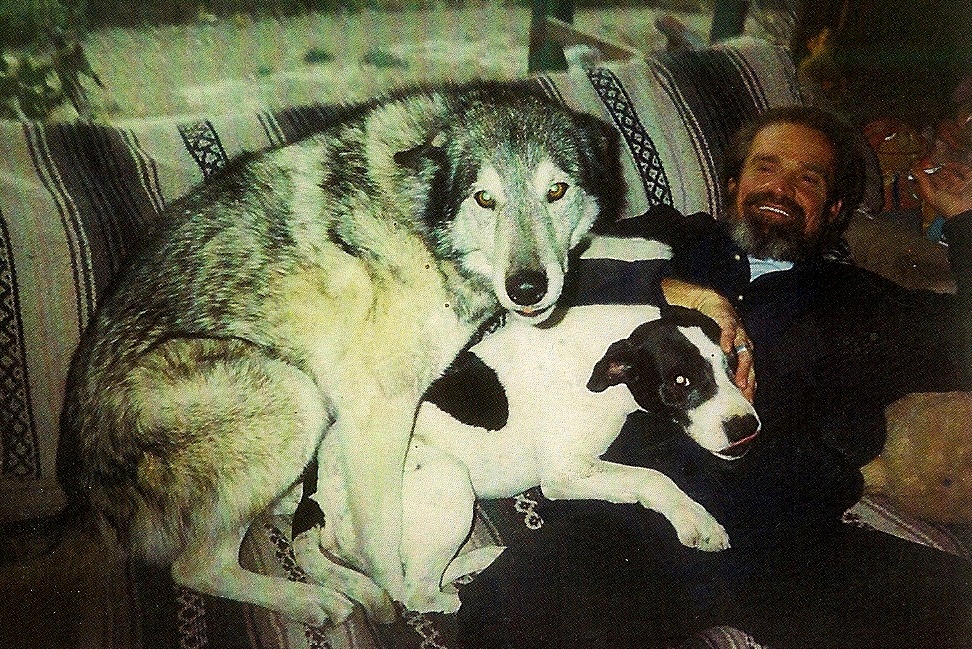
The wolf became a regular visitor and Tim became sure that the wolf, now having been given the name Luna by Tim, was aware that she was being watched by a human.
Over many, many months Luna built up sufficient trust in Tim that eventually she would take food from Tim’s outstretched hand. It was only now a matter of time before Luna started behaving more like a pet dog than the wild wolf that she was. The photo below is a scan from a traditional photograph and is unaltered.
Luna, the wild wolf, taken in 2006.
From now on, Luna would stay the night with Tim and his dog, keeping watch over them.
DR also recalls,
I remember Tim being distraught because, without warning, Luna stopped coming by. Then a few months later back she was. Tim never did know what lay behind her absence but guessed it might have been because she went off to have pups.
Unfortunately, this wonderful tale does have a sad ending.
About two years ago, Tim lost his dog. He was awakened to hear a pack of coyotes yelping and his dog missing.
Then tragically some 6 months later Tim contracted a gall bladder infection. Slowly it became worse.
By the time he realised that it was sufficiently serious to require medical treatment, it was too late. Despite the best efforts of modern medicine, Tim died on June 25th, 2009, just 51 years young.
So if you are ever out on Mingus Mountain and hear the howl of a wolf, reflect that it could just be poor Luna calling out for her very special man friend.
With very grateful thanks to DR for sharing such a special story.
A very timely item sent to me by neighbour, Dordie.
I say timely because it was nearly 6pm before I stopped writing ‘the book’. It was a tough day of research and cross-checking and seeking permission to republish essays from other authors and magazines. That’s the reason that my next NaNoWriMo chapter is not being published in thirty minutes time. Still waiting for some of those permissions.
So ‘thank you’ Dordie.
Do you know that when a woman wears a leather dress…
Exciting Rosetta space mission inspires a magical short film
A very good 7-minute film, called Ambition. It’s not like any film about space exploration you’ve ever seen. The Rosetta comet mission lies at its heart.
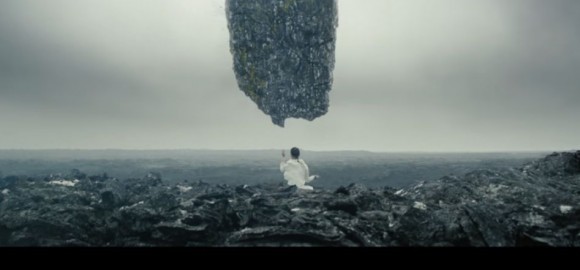
Everything about the European Space Agency’s Rosetta mission – which, in August, caught up to Comet 67P/Churyumov–Gerasimenko and began moving in tandem with it – has been fantastic so far. For us space buffs, this mission has gone a long way toward fulfilling our fantasies about what might be accomplished in outer space. It’s caused us to remember why we got so excited about space exploration in the first place. And now – just weeks before Rosetta will send a lander to the surface of its comet – ESA and Platige Image have released a very good short film, called Ambition. It’s not a space documentary, or like any film about space exploration you’ve ever seen. It doesn’t focus so much on the mission itself – although the Rosetta mission does lie at the heart of the film – as on why we need to go into space.
The film features an apprentice magician and her master, talking about the making of solar systems.
I won’t tell you more; you should watch the film. It might touch your heart in ways you’ve forgotten, as the Rosetta mission itself has touched mine.
Tomek Baginski directed the film Ambition, which stars Aiden Gillen – who played Littlefinger in Game of Thrones – and Aisling Franciosi. Its producers shot Ambition on location in Iceland and produced it primarily in Poland. Its first public screening was October 24, 2014 during the British Film Institute’s celebration of Sci-Fi: Days of Fear and Wonder, at the Southbank, London.
By the way, Tim Reyes at UniverseToday.com has written a very good essay about the film Ambition, and what it means in the context of U.S. and European space efforts, and in the larger context of our striving to meet challenges in the world today. He also says you should watch the film. Because it’s about what it means to want to know what’s possible.
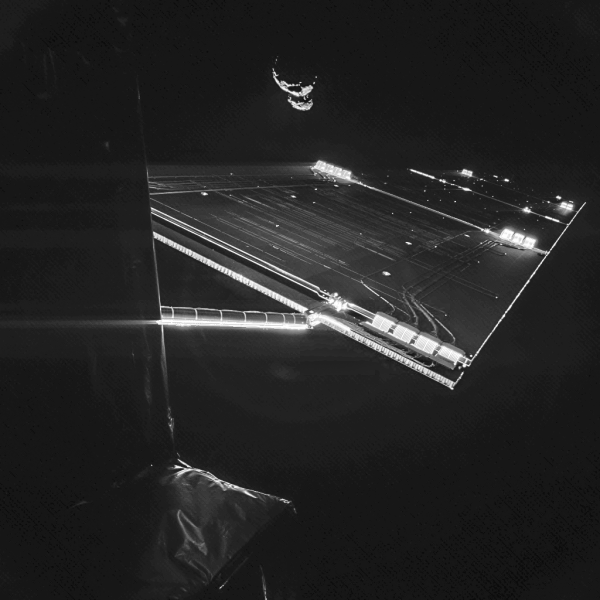
In the film Ambition, a young magician tries to build a solar system … but fails.Did you assume this was an artist’s concept? It’s not. It’s a real image. It’s the Rosetta spacecraft’s selfie with comet 67P/Churyumov–Gerasimenko, imaged Sunday, September 7, 2014. Image via ESA/Rosetta/Philae/CIVA
Bottom line: A very good 7-minute film, called Ambition. It’s not like any film about space exploration you’ve ever seen. The Rosetta comet mission lies at its heart.
ooOOoo
And here is that film.
Published on Oct 24, 2014
Ambition is a collaboration between Platige Image and ESA. Directed by Tomek Bagiński and starring Aidan Gillen and Aisling Franciosi, Ambition was shot on location in Iceland, and screened on 24 October 2014 during the British Film Institute’s celebration of Sci-Fi: Days of Fear and Wonder, at the Southbank, London.
I had my surgical procedure for the removal of a benign prostatic enlargement (BPE) last Tuesday and was back home by 6pm. However, having a catheter and a collection bag attached to me for Tuesday and Wednesday nights inhibited a decent night’s sleep. The catheter was removed on Thursday morning and I was confident of getting a good night. Wrong! I found myself having to get up and pee more-or-less every hour of the night. Apparently, according to the nurse to whom I spoke yesterday, my bladder would have still been extremely sore making any form of urine retention impossible.
All a long-winded way of me saying that my creative juices were non-existent when I wanted to get today’s post completed.
So please accept the following and hope it puts a smile on your face. (To make matters worse, I forgot which kind reader sent it to me!)
ooOOoo
MURPHY’S OTHER 15 LAWS
Light travels faster than sound. This is why some people appear bright until you hear them speak.
A fine is a tax for doing wrong. A tax is a fine for doing well.
He, who laughs last, thinks slowest.
A day without sunshine is like, well, night.
Change is inevitable, except from a vending machine.
Those who live by the sword get shot by those who don’t.
Nothing is foolproof to a sufficiently talented fool.
The 50-50-90 rule: Anytime you have a 50-50 chance of getting something right, there’s a 90% probability you’ll get it wrong.
It is said that if you line up all the cars in the world end-to-end, someone from California would be stupid enough to try to pass them.
If the shoe fits, get another one just like it.
The things that come to those who wait, may be the things left by those who got there first.
Give a man a fish and he will eat for a day. Teach a man to fish and he will sit in a boat all day drinking beer.
Flashlight: A case for holding dead batteries.
God gave you toes as a device for finding furniture in the dark.
When you go into court, you are putting yourself in the hands of twelve people, who weren’t smart enough to get out of jury duty.