Disappointing news about the Keystone XL pipeline project.
I have previously written about the madness of this proposed project, in fact have written six or seven times before. You may like to dip back into this Post. This one, too, shows starkly how our relationship with oil is changing the world we live in.
So it is with some sadness that I reproduce in full a recent circulation from Duncan Meisel from 350.org.
Dear friends,
I’m writing to share some disappointing news: yesterday, the U.S. House of Representatives voted in favor of rushing approval of the Keystone XL oil pipeline.
This doesn’t mean the pipeline is getting built — not by a long shot. The bill would still have to pass the Senate and be signed by the President, neither of which are likely to happen. It does show that we need to be vigilant after our temporary victory to stop Keystone XL — the corporate polluters pushing this climate disaster never sleep.
Since we blocked the front door, Big Oil is now trying to bring Keystone in through the back — their representatives in Congress are attaching the pipeline as an amendment to a crucial bill about taxes and the economy. If we want to make sure the pipeline never gets built, once again we need to get loud and bring this fight back into the public.
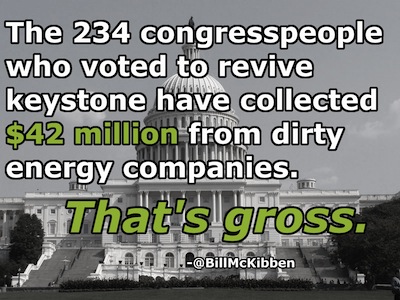
Here’s the truth: much of our Congress is bought and sold by corporations. The 234 members of the House who supported this bill took $42,374,100 from corporate polluters in the last decade. If we want Congress to start working for us, and for the planet, we need to call them out on this corruption whenever it happens.
Can you share this image (with a quote from Bill McKibben) on Facebook or Twitter to show just how much this corrupt attempt to revive the pipeline stinks?
We’ll never have the money and the lobbyists of Big Oil, so we’ve got to use our voices and our bodies to make our point.
Over the past six months, we’ve signed petitions, led actions in communities coast-to-coast, and organized large-scale civil disobedience against this pipeline. All that work added up. President Obama’s announcement about the pipeline delay was HUGE, and gave us the chance to shut Keystone XL down for good.
Ultimately, we’re in a long term fight to save the planet from the polluters who would buy their way to total catastrophe. It’s up to us to use this moment to show just how dangerous they have become, and begin making the case that corporate control over government must end. Let’s make sure all of our friends know how much their latest Keystone XL stunt stinks.
P.S. In case you were wondering, we’re not only spreading the word online — folks in certain states are calling their senators and we’re continuing to ratchet up our actions across the country. As I type this, activists in Ohio are staging a “human oil spill” to House Speaker Boehner’s front door. We’ll need all sorts of creative tactics on the road ahead — more on that in a future email!
Please do everything to spread this message. Thank you.
Finally, go and put your arms around your dog, give him or her a very big hug, and pray that mankind might learn something about truth and integrity from the humble dog!
A reflection on the huge changes facing our global society.
I am reading James Howard Kunstler’s book The Long Emergency. On the front cover there is a quote from a review in The Independent newspaper, “If you give a damn, you should read this book.” On the back cover, the quote, “Stark and frightening. Read it soon.” – Daily Camera. The quotes are spot on!
Rather than give my own opinion at this stage (I should finish the book first!), let me quote from the opening of Chapter Five, Nature Bites Back.
I was a at a four-day conference called Pop Tech in the seaside village of Camden, Maine, at the peak of the fall foliage season in October 2003, having a pretty good time at the talks, and enjoyiong a series of extravagant dinners – one featuring a free oyster raw bar and gratis Grey Goose vodka – not to mention all the lobsters, steaks, and other products of our bountiful cheap-oil economy. Then, on Saturday afternoon, a scientist from the University of Washington, Peter D. Ward, got up in the old-time opera house where the conference was held and did a presentation about the life and death of the planet Earth, Using a series of vivid artist’s renderings delivered on PowerPoint, Ward showed us how, hundreds of millions of years hence, all land animals would become extinct, the green forests and grasslands would broil away, the oceans would evaporate, and eventually our beloved planet would be reduced to a pathetic ball of inert lifeless lint – prefatory to being subsumed in the expanded red giant heat cloud of our baking sun. Few members of the audience had any appetite for the spread of cookies and munchables laid out for the break that followed. Personally, I was so depressed that I felt like gargling with razor blades.
The human spirit is remarkably resilient, though. A few hours later, the horror of it all was forgotten and the conference-goers reported to the next supper buffet with the appetites recharged, happy to scarf more lobster and beef medallions and guzzle more liquor, while chatting up new friends about their various hopes and dreams for the continuing story of civilized life here on good old planet Earth, which, it was assumed, had quite a ways to go before any of us needed to worry about its fate, if ever.
Wasn’t it John Maynard Keynes who famously remarked to a group of fellow economists dithering about the long-term this and the long-term that: “Gentlemen, in the long term we’re all dead.” Our brains are really not equipped to process events on a geological scale – at least in reference to how we choose to live, or what we choose to do in the here-and-now. Five hundred millions years is a long time, but how about the mad rush of events in just the past 2,000 years starring the human race? Rather action-packed, wouldn’t you say? Everything from the Roman Empire to the Twin Towers, with a cast of billions – emperors, slaves, saviors, popes, kings, queens, navies, rabbles, conquest , murder, famine, art, science, revolution, comedy, tragedy, genocide, and Michael Jackson. Enough going on in a mere 2,000 years to divert anyone’s attention from the ultimate fate of the earth, you would think. Just reflecting on the events of the twentieth century alone could take your breath away, so why get bent out of shape about the ultimate fate of the earth? Yet, I was not soothed by these thoughts, nor by the free eats, and even the liquor failed to lift me up because I couldn’t shake the recognition that in the short term we are in pretty serious trouble, too.
OK, that’s enough for today – I’ll continue this important extract on Monday. Let me close by inviting you to watch James Kunstler in interview.
The concluding part of what we might care to leave for the next generation
Mankind over the next few years is facing the start of an interval of economic chaos and social stress between the end of the fossil fuel age and whatever follows. That interval could well last a lifetime or more. Some might argue that the economic challenges that have been the mark of 2011 are, indeed, the first signs of this economic chaos.
How well we cope, adapt and survive is not going to be down to those of my age (born 1944) but to the bright youngsters who have been born in the 21st century.
That was the motivation behind publishing, on December 1st, the speech given by Steve Jobs, the 2005 Stanford Commencement Speech, and on December 6th, the famous and fabulous speech given by Sir Ken Robinson at the 2005 TED Talks conference.
The third and concluding message is a subsequent speech given by Sir Ken, this time in May 2010. It isn’t as stirring as his speech in 2005 but still a wonderful focus on what is our, as in homo sapiens, only chance of surviving – the innovation and creativity of the next generations.
In this poignant, funny follow-up to his fabled 2006 talk, Sir Ken Robinson makes the case for a radical shift from standardized schools to personalized learning — creating conditions where kids’ natural talents can flourish.
A reminder that other people in other places may not be so fortunate as you.
In that sub-heading is an assumption that everyone who calls by Learning from Dogs enjoys a life where they are, relatively speaking, free to make their own life decisions. My apologies if that is a false assumption.
Amnesty International have a December campaign Write for Rights. It is so worth supporting. Here are some details from that website,
YOUR WORDS CAN CHANGE LIVES.
Your words can be a SPOTLIGHT that exposes the dark corners of the torture chamber. They can bring POWER to a human rights defender whose life is in jeopardy. They can IGNITE hope in a forgotten prisoner.
Your words can SAVE LIVES.
Join hundreds of thousands of people around the world in marking International Human Rights Day this December by taking part in Amnesty International’s Write for Rights Global Write-a-thon – the world’s largest human rights event. Through letters, cards and more, we take action to demand that the human rights of individuals are respected, protected and fulfilled. We show solidarity with those suffering human rights abuses, and work to bring about positive change in people’s lives.
Will you write a letter to save a life?
Sign up now to Write for Rights!
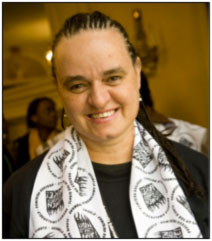
Jenni Williams
“I am alive today, after 34 arrests, because members of Amnesty International spoke out for me.”
– Jenni Williams, human rights defender in Zimbabwe
It really doesn’t make any difference which Amnesty case you support – just pick one and do it before the end of the month.
Amnesty also offer a full suite of resources, obtainable from here, to assist you with producing your letter.
Jean and I have decided to write in support of Jabbar Savalan, as described here and below,
AZERBAIJAN – Jabbar Savalan / Youth activist detained after using facebook
Jabbar Savalan
Hours after he posted a note on Facebook calling for protests against the government, Jabbar Savalan told his family that he was being followed. The next evening, February 5, 2011, police arrested him without explanation and took him to the Sumgayit police station, where they “discovered” marijuana in his outer coat pocket. Police questioned him without a lawyer for two days, reportedly hitting and intimidating him to make him sign a confession.
Authorities in Azerbaijan have a history of using trumped-up drug charges to jail perceived critics. Jabbar maintains that he does not use drugs and that the marijuana was planted on him. In May 2011, he was was convicted of possessing illegal drugs and sentenced to two-and-a-half years in prison. Amnesty International believes that authorities fabricated the drug charges against Jabbar to silence him. Amnesty considers him to be a prisoner of conscience.
A history student in college, Jabbar was an active member of an opposition political party. In January 2011, he posted on Facebook a newspaper article that described Azerbaijan’s President Ilham Aliyev as corrupt.
On February 4, Jabbar was inspired by the protests in the Middle East and North Africa to use Facebook to call for a “Day of Rage” to protest the government in Azerbaijan. The next day, police arrested him. He was 19 years old at the time.
A plea to sign a global call not to delay action on global warming
How many of you in Europe watched the final episode of Sir Peter Attenborough’s Frozen Planet series, entitled On Thin Ice?
Did you watch the short video in last week’s post, The power of truth? If not, it’s below.
Here’s a piece from a BBC news item from yesterday,
A hungry polar bear
It is an image that is sure to shock many people.
An adult polar bear is seen dragging the body of a cub that it has just killed across the Arctic sea ice.
Polar bears normally hunt seals but if these are not available, the big predators will seek out other sources of food – even their own kind.
The picture was taken by environmental photojournalist Jenny Ross in Olgastretet, a stretch of water in the Svalbard archipelago.
“This type of intraspecific predation has always occurred to some extent,” she told BBC News.
“However, there are increasing numbers of observations of it occurring, particularly on land where polar bears are trapped ashore, completely food-deprived for extended periods of time due to the loss of sea ice as a result of climate change.”
Re-read that last segment of that last sentence, “completely food-deprived for extended periods of time due to the loss of sea ice as a result of climate change.”
So with all that in mind, please read on.
Friends,
What if someone told you we should abandon all hope for global climate action until 2020? Well, that’s exactly the proposal that the United States is pushing at the UN Climate Talks taking place this week in Durban, South Africa. The 2020 delay might well be the worst idea ever.
Waiting nine years for climate action isn’t just a delay, it’s a death sentence for communities on the front lines of the climate crisis — and it could slam the door on ever getting carbon pollution levels below the safe upper limit of 350 parts per million.
It’s not too late to stop this delay from going through. Over the next three days, our team of 350.org activists in Durban will be working with our partners at Avaaz and allies from around the world to isolate the United States — and build support for the African nations that are fighting for real climate action. But it will take a massive grassroots outcry to demonstrate that people everywhere are taking a stand to prevent the United States negotiators from signing away our future.
If we raise an international alarm before the talks end on Friday, we can convince the US to get out of way of progress and help unlock the global process that can lead to bold climate action all around the world.
The climate talks in South Africa end in just 48 hours, and it’s vital that we ramp up the pressure now. To make sure the US gets the message, our team on the ground here in Durban will deliver your messages directly to the US negotiating team at a high-impact event we’re helping to pull together on Friday. We can’t say much more about it now, but suffice to say our message will be unavoidable.
This year, the 350 network has shown that people power can truly move the planet in the right direction. We mobilized hundreds of thousands of people to push for climate action in nearly every country on earth. We beat back the Keystone XL pipeline when no one said it was possible. We took over the radio waves to spread a message of hope and action on the climate crisis. And through our actions, we helped keep the hope of saving our planet — and reaching 350 ppm — alive.
The UN Climate Talks here in Durban aren’t going to get us back to 350 by themselves, but they can keep the option open by making progress on a legally binding, international framework to help nations make serious cuts in carbon emissions. In 2012, we’re going to need to do all we can to challenge the fossil fuel companies that are the real obstacles to progress. Breaking their stranglehold on our governments is the only way to really unlock these negotiations.
But right now, the most important thing we can do is keep the possibility of a strong international climate deal alive by pushing back on the United States negotiating team. In recent months, President Obama has shown that he’ll stand up for the climate, but only if he’s got a movement to back him up. On the Keystone pipeline, he’s been doing the right thing by blocking Republican efforts to push it through — now we need him to do the right thing on the international stage.
There’s no guarantee that we’ll be successful, but we owe it to our allies across the planet — many of whom are already feeling the impacts of climate change — to resist the chorus of cynics and keep hope alive. As Nelson Mandela said, “It always seems impossible until it’s done.” The 350 network has pulled off the impossible before — now’s the time to step up the pressure again.
P.S. We have just 48 hours to build a huge groundswell of pressure. Please help make it go viral with a few clicks on Twitterand Facebook — tag your popular friends, and post it again and again.
Continuing the advice you might offer to the next generation?
On the 1st December I published the first message. It had been inspired by a conversation with Peter McCarthy, who lives and works in Bristol, England. Here’s a little of what I wrote,
Anyway, Peter and I were talking about the sorts of qualities that enable some young people to take a risk-based entrepreneurial approach to life. Peter gave me the links to three videos that he thought were especially relevant to the notion of achieving success in life. So over the next few days I want to share those videos with you, dear reader. To me, these videos are, indeed, the essence of the messages that any person, especially those the wrong side of 60, would wish to leave in a bottle floating down the river of life.
So to the second message which is a recording of the talk that Sir Ken Robinson gave to the TED Talks conference in Monterey in February, 2006. It has been widely seen for all the right reasons; Sir Ken offers some powerful common-sense and a wonderful message for all the young people out there. As Sir Ken’s website says,
Sir Ken Robinson, PhD is an internationally recognized leader in the development of education, creativity and innovation. He is also one of the world’s leading speakers with a profound impact on audiences everywhere. The videos of his famous 2006 and 2010 talks to the prestigious TED Conference have been seen by an estimated 200 million people in over 150 countries.
Last Friday I published a Post under the title of The power of truth. Just 5 minutes long, the YouTube video was powerful, starkly so. I wrote at the end of that article, “The principal source for the footage was Yann Arthus-Bertrand’s incredible film HOME.”
Jean and I watched Yann Arthus-Bertrand’s film last Friday night and to say that we were moved would be pitiful compared to the emotional impact it really had. Take a look at the film trailer; it’s a little over 3 1/2 minutes long. (But please don’t use that as a substitute for watching the full film, see below!)
Home is a 2009 documentary by Yann Arthus-Bertrand. The film is entirely composed of aerial shots of various places around Earth. It shows the diversity of life on Earth and how humanity is threatening the ecological balance of the planet. The movie was released simultaneously on June 5th in cinemas all over the world, on DVD and on YouTube. Released on the same date in 50 countries is a world record for any film release in history. The film is 100% free, and no profits will be made from its release or future showings.
I wasn’t going to add anything other than a brief introduction to the main film. However, an article in The Economist The World in 2012 caught my eye and seemed especially relevant to promoting the message carried by the film. Sheryl Sandberg, chief operating officer of Facebook, wrote about the power of social media and how it would be even more evident in 2012. This is the paragraph that caught my eye,
Expressing our authentic identity will become even more pervasive in the coming year. Profiles will no longer be outlines, but detailed self-portraits of who we really are, including the books we read, the music we listen to, the distances we run, the places we travel, the causes we support, the videos of cats we laugh at, our likes and our links. And, yes, this shift to authenticity will take getting used to and will elicit cries about lost privacy. But people will increasingly recognise the benefits of such expression. Because the strength of social media is that it empowers individuals to amplify and broadcast their voices. The truer that voice, the louder it will sound and the farther it will reach.
That last sentence jumped out at me, “The truer that voice, the louder it will sound and the farther it will reach.” Mull on that as you watch the film and, please, please, please if you support the need to return to a harmonious relationship with the planet spread the word as far and wide as you can.
Please promise yourself to sit down quietly and watch it uninterrupted. And if you feel so minded to add comments to this Post please do – would be delighted to have your feedback.
We are living in exceptional times. Scientists tell us that we have 10 years to change the way we live, avert the depletion of natural resources and the catastrophic evolution of the Earth’s climate.
The stakes are high for us and our children. Everyone should take part in the effort, and HOME has been conceived to take a message of mobilization out to every human being.
For this purpose, HOME needs to be free. A patron, the PPR Group, made this possible. EuropaCorp, the distributor, also pledged not to make any profit because Home is a non-profit film.
HOME has been made for you : share it! And act for the planet.
A remarkably simple explanation, courtesy of a Greek Hotel, about financial bailouts!
Last week-end I was indebted to Neil Kelly for supplying a more humorous look at life for Learning from Dogs. This week-end I turn to friend, Bob D., a corporate airliner Captain out in the Middle East. Here is Bob’s contribution for today. (Editor’s note: at the time of posting this, 1 euro = 1.3405 US dollars, ergo €100 = $134 – read on, this will make sense.)
No connection with the hotel in the story!
For those interested in world events….
How the Greek bailout package works.
It is a slow day in a damp little Greek town. The rain is beating down and the streets are deserted. Times are tough, everybody is in debt, and everybody lives on credit.
On this particular day a rich German tourist is driving through the town, stops at the local hotel and lays a €100 note on the desk, telling the hotel owner he wants to inspect the rooms upstairs in order to pick one to spend the night.
The owner gives him some keys and, as soon as the visitor has walked upstairs, the hotelier grabs the €100 note and runs next door to pay his debt to the butcher. The butcher takes the €100 note and runs down the street to repay his debt to the pig farmer.
The pig farmer takes the €100 note and heads off to pay his bill at the supplier of feed and fuel. The guy at the Farmers’ Co-op takes the €100 note and runs to pay his drinks bill at the pub. The publican slips the money along to the local prostitute drinking at the bar, who has also been facing hard times and has had to offer him “services” on credit. The hooker then rushes to the hotel and pays off her room bill to the hotel owner with the €100 note.
The hotel proprietor then places the €100 note back on the counter so the rich traveler will not suspect anything. At that moment the traveler comes down the stairs, picks up the €100 note, states that the rooms are not satisfactory, pockets the money, and leaves town.
No one produced anything. No one earned anything. However, the whole town is now out of debt and looking to the future with a lot more optimism.
And that, Ladies and Gentlemen, is how the bailout package works.
So what advice would you offer to the next generation?
One of the biggest differences between Homo sapiens and Canis lupus familiaris is that the latter is such a master of living in the present that, one assumes, the issue of worrying about the next generation is largely irrelevant. Definitely not so with us humans.
A few weeks back I was chatting to a good friend of mine, Peter McCarthy, whom I first met when I undertook a sales and marketing project for one his companies. That was many years ago but Peter and I have stayed in touch. One of the many attributes about Peter that I have admired over the years is his instinctive and thoughtful approach to entrepreneurism. Peter is still an active entrepreneur.
Anyway, Peter and I were talking about the sorts of qualities that enable some young people to take a risk-based entrepreneurial approach to life. Peter gave me the links to three videos that he thought were especially relevant to the notion of achieving success in life. So over the next few days I want to share those videos with you, dear reader. To me, these videos are, indeed, the essence of the messages that any person, especially those the wrong side of 60, would wish to leave in a bottle floating down the river of life.
So to the first. The address by Steve Jobs to the University of Stanford’s 114th Commencement on June 12, 2005. Already watched at the time of writing this by 12,690,731 persons!
Let me offer thanks to Resurgence Magazine for the written permission to reproduce this article in full, see terms at the end of the article. More background information about Robert Holden may be obtained from his own website and, finally, the Happiness Project website is here.
Robert Holden was at the forefront of ‘Happiness’ research. Here, he reflects on how that topic – initially laughed off the agenda – has gained credibility and explains why happiness is important
When I set up The Happiness Project, in 1994, the original goal was simple: talk happiness. In my training in psychology, philosophy and psychotherapy my teachers didn’t talk about happiness. We focused solely on the causes of unhappiness. This didn’t feel right to me. After all, how can you know what the causes are if you do not know what happiness is?
My goal, then, was to stimulate a conversation, so as to deepen our appreciation of what happiness is, its benefits, what enables it, and what blocks it. One conversation I focused on was the question of whether happiness is learned and whether it can be taught. To investigate this further, I created an eight-week happiness programme (which still runs today) called Be Happy.
Today happiness is a much more popular conversation than when The Happiness Project began. We are all talking more about happiness than ever before. The conversation is alive and well. Universities, hospitals, economists and governments publish new studies on happiness every week. So, what we have learned? And where does this conversation about happiness need to go next?
Let’s start with what happiness researchers refer to as ‘static happiness’. In a recent US study, it was found that when people in the 1940s were asked, “How happy are you?” the average score was 7.5 out of 10, whereas today the average score is 7.4 out of 10. In other words, in spite of all the ‘progress’ we appear to have made in the last 50 years or so, our happiness levels have remained mostly static. This tells me we need more conversations to clarify what real happiness is. For instance, we need to discern between pleasure, satisfaction and joy; and on my eight-week happiness programme we always begin by asking people, “What is your definition of a happy life?” and, “Are you living it?”
Happiness researchers have also found that most of us are only semi-happy. In 2006, I participated in a BBC documentary called The Happiness Formula. It reported, “the proportion of people saying they are ‘very happy’ has fallen from 52% in 1957 to just 36% today.” Clearly, research like this is questioning our most basic assumptions about what happiness is, and what we think will make us happy. That’s a good thing. An honest inquiry into happiness is an opportunity to rethink your life. It is one of the gifts of happiness.
Do you really know what makes you happy? This is the question both psychologists and economists are asking now. The evidence suggests we do not know. For instance, many of us believe that more money will make us happier. Some money does help, especially to cover the basics of food, rent, clothing, etc. After that, the correlation between more money and greater happiness is vague. Martin Seligman, former president of the American Psychology Association, and one of the founders of the Positive Psychology movement, concludes most forcibly: “The change in purchasing power over the last half century in the wealthy nations carries the same message: real purchasing power has more than doubled in the United States, France and Japan, but life satisfaction has changed not a whit.”
An inquiry into happiness challenges you to rethink everything. For example, almost everyone agrees with the idea that if their life circumstances improve, their levels of happiness will increase. This is the basis for almost every political and economic strategy the world over. And yet scientific research into happiness tells us this is wrong. New Zealand researcher Richard Kammann reports, “Objective life circumstances have a negligible role to play in a theory of happiness.” The same research concludes that your attitude and personal choices have a far greater influence on your happiness levels.
Another popular theory is that a better education will make our children happier. This has resulted in more tests for preschool children, more focus on regular exams, and more money spent on private education. Surely this increases happiness? “Sorry, Mom and Dad, neither education nor, for that matter, a high IQ paves the road to happiness,” states Claudia Wallis, who compiled a report called The New Science of Happiness for TIME magazine.
Happiness challenges us to rethink what is a “better education” for our children. I support the idea of happiness lessons for children at school, as pioneered at Wellington College by psychologist Nick Baylis and college Master Anthony Seldon [read his thoughts on this important topic in his article Stillness in Schools]. One opposing argument for happiness lessons at school is that children should not be “taught” happiness, but that they should be allowed to think about happiness for themselves. However, this is precisely the aim of these happiness lessons. The approach is inquiry, not dictation.
People who attend my happiness programme are always telling me, “I wish I’d learned this at school.” It’s time then for more conversations about happiness in school, and at home with our children. I encourage all my students and clients to talk more about happiness with their families. Why? Because one of the ways we evolve is through conversation. Drawing happiness with our children or talking about happiness with our partner helps us to clarify things, to heal, to come together, and ultimately to live a happier life.
And now, even governments and politicians want to talk about happiness. In Britain, David Cameron has commissioned a new survey called Measuring National Well-being. A new organisation called Action for Happiness [see what founder Richard Layard says about this new movement in his article A Better Way of Life] is working closely with the government to help create better social change in society. Again, some people are concerned that governments should not “tell us” how to be happy. I agree with this, but I don’t think governments are trying to tell us. Like us, they are simply trying to understand what happiness is, and how we can be happier.
In my latest book, Be Happy, I have written: “Your definition of happiness will influence every significant decision in your life.” It is essential, therefore, that individuals and governments alike keep happiness on the agenda because, more than ever before, humanity needs a better understanding of happiness. We have learned so much, about atoms and galaxies and other things, but we still do not understand ourselves very well; we still go to war too often, and there is still too much suffering.
I remain deeply committed to talking about happiness. Why? Because I believe that happiness is our true nature (it is the natural state of our Unconditioned Self), and for that reason happiness brings out the best in us, both individually and collectively. Happiness research has found a strong link between happiness and altruism, for instance. In a recent study by a Charities Commission, it was reported that the highest predictor of generous giving is not your income level: it’s your happiness level.
Good things come from real happiness. Happier people make better choices, which is good for society and the planet. Your happiness is a gift to the world. I believe this with all my heart.
—————————–
Robert Holden is director of The Happiness Project. His latest book, Be Happy;, is published by Hay House. For more about the eight-week happiness programme visit: http://www.happiness.co.uk
The Gift of Happiness features in Resurgence issue 269, November/December 2011.
This article is reprinted courtesy of Resurgence magazine – at the heart of earth, art and spirit. To buy Resurgence, read further articles online or find out about The Resurgence Trust, visit: http://www.resurgence.org
All rights to this article are reserved to Resurgence, if you wish to republish or make use of this work you must contact the copyright owner to obtain permission
—————————–
One final note from yours truly. Perhaps the art of happiness is yet another thing we can learn from dogs!





 Learning from Dogs