Category: Core thought

Home grown!

Further beautiful reflections from John Hurlburt.

By one of those lovely patterns in life, John’s last contribution to Learning from Dogs was exactly a year ago, a Post that was called Definitions, questions and prayers.

oooOOOooo

Synergy

Past, present and future combine

In the natural beauty of a moment


The sigh of the wind in the pines

Is a hymn to ancient growth

The hush of the wind in the willows

Invites peace and well being


 The sparkle of pure water

Assures that tomorrow will include life

                                                                           an old lamplighter

Postscript to Long Life post

More information about fasting, not about being female!

In yesterday’s post on Learning from Dogs, I wrote that there are two important aspects of living a longer life.  The first one was be a female and the second one was about fasting.  I propose to expand a little on that second aspect because of the number of people who found the topic so interesting.

Valter D. Longo and students.

In yesterday’s post there was reference to the work that Professor Valter D. Longo of the University of Southern California (USC) has been undertaking.  As the USC web reference explains, Valter Longo is the Director of the Longevity Institute, a Professor of Gerontology and Biological Sciences and the Edna Jones Chair of Biogerontology, so if anyone understands how humans tick, it’s likely to be this man!  As his research overview states,

He is interested in understanding the mechanisms of aging in organisms ranging from yeast to humans. The focus is on the conserved nutrient signaling pathways that can be modulated to protect against age-dependent oxidative damage and delay or prevent diseases of aging including cancer, diabetes and neurodegenerative diseases.

(Any questions, ask Prof. Longo not me!)

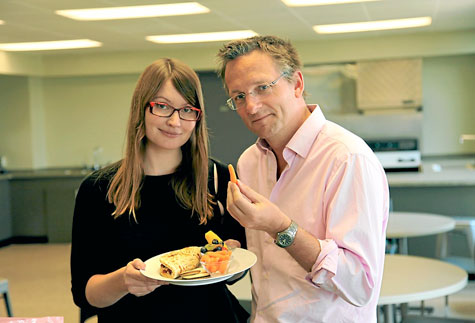
BBC Presenter Michael Mosley with Dr Krista Varady

The other learned person referred to in yesterday’s post was Dr. Krista Varady.  This is what was written,

Dr Krista Varady of the University of Illinois at Chicago carried out an eight-week trial comparing two groups of overweight patients on ADF. (ADF = Alternative Day Fasting)

Over on the Healthy Fellow blogsite, there’s an interview with Dr. Varady.  The web link of that interview is here and crossing over and reading the full interview is much recommended.  Here’s a taste, pardon the pun, of that interview:

JP: Can you help explain the distinctions between alternate day fasting and caloric restriction?

Dr. Varady: Caloric restriction is basically daily calorie restriction where an individual would restrict themselves by about 15% to 40% of their energy needs daily. So basically every single day you’re undergoing the same amount of restriction, whereas alternate day fasting involves a fast day wherein the individual would only eat 25% of their energy needs. So about 500 calories or so and that’s alternated with something called a “feed day” where the individual would eat ad libitum – so as much as they want. However in our studies we show that people end up losing weight because they can’t fully make up for the lack of food on the fast day on the feed day.

Let me add a personal perspective on this.  On the morning of the first day after our two-day fast, my weight was 162.5 lbs (73.71 kg), on the morning of the second day after our fasting days my weight was 161.8 lbs (73.39 kgs) and on the morning of the third day after our fasting, my weight was 161.6 lbs (73.30 kgs).  Ergo even though we were back to eating normally for three days after our two days of fasting, I continued to lose 0.9 lbs (0.4 kgs).

So if you have any concerns over cardiovascular health or want to explore a realistic way of losing excess weight, then do read the interview.  Part One of that interview is here and Part two here.

As is said, we are what we eat and I shall close this postscript with a link to an article on the Mother Nature Network website that was published a little over a year ago: 18 foods that fight common ailments – Try healthy eats that help fight diabetes, heart disease, migraines and more.

So may we all live forever!

Living the long life

Two remarkable aspects of human longevity.

OK, a change to the theme of the last few days, to a topic that must cross the minds of practically every single human being at some point; what is our lifespan going to be?  Who doesn’t want to live a long and healthy life, and I don’t wish to be insensitive to those who labour under mental and physical troubles, of course.

So a recent couple of fascinating stories have given an insight into just how to live that longer and healthier life.

The first one is easy – be a woman!

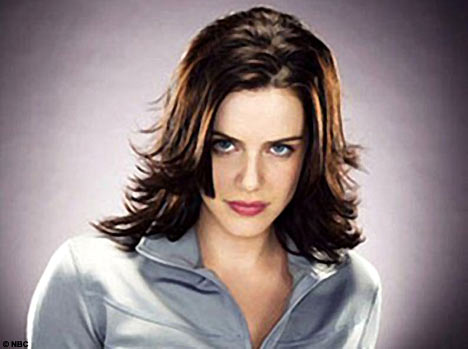
Actress Michelle Ryan as the Bionic Woman was destined to live even longer!

OK, a bit of an issue if you are a man like me but did you realise, because I didn’t, that being the female of many species offers a significant advantage.  This came from a BBC item published on the 2nd August, from which I quote,

Scientists believe they have discovered a clue to why women tend to live longer than men – by studying fruit flies.

Writing in Current Biology, they focus on mutations in mitochondrial DNA – the power source of cells.

Mitochondria are inherited only from mothers, never from fathers, so there is no way to weed out mutations that damage a male’s prospects.

Then came an extraordinary fact [my italics below],

By the age of 85, there are approximately six women for every four men in the UK, and by 100 the ratio is more than two to one.

And females outlive males in many other species.

If you are of the scientific bent and/or a woman! you can read a fuller account of the research findings on the Science Daily website.  As well as that link you can also read the  Monash University press release on those research findings.

As a fella’ I think I’m moving on!

The second one is almost as easy – Fasting

Again, this news came from the BBC website, the news about the power of fasting.  In an article promoting the showing of a BBC Horizon programme, Michael Mosley wrote this,

Scientists are uncovering evidence that short periods of fasting, if properly controlled, could achieve a number of health benefits, as well as potentially helping the overweight, as Michael Mosley discovered.

I’d always thought of fasting as something unpleasant, with no obvious long term benefits. So when I was asked to make a documentary that would involve me going without food, I was not keen as I was sure I would not enjoy it.

But the Horizon editor assured me there was great new science and that I might see some dramatic improvements to my body. So, of course, I said, “yes”.

I am not strong-willed enough to diet over the long term, but I am extremely interested in the reasons why eating less might lead to increased life span, particularly as scientists think it may be possible to get the benefits without the pain.

For obvious reasons I can’t republish the full BBC article but I encourage you to read it here.  And stay with me for some more research links that are most interesting.

But I will just include this part from the BBC item,

The IGF-1 hormone (insulin-like growth factor) is one of the drivers which keep our bodies in go-go mode, with cells driven to reproduce. This is fine when you are growing, but not so good later in life.

There is now evidence suggesting that IGF-1 levels can be lowered by what you eat. Studies on calorie restrictors suggest that eating less helps, but it is not enough.

As well as cutting calories you have to cut your protein intake. Not entirely – that would be a very bad idea. It’s about sticking to recommended guidelines, something most of us fail to do.

The reason seems to be that when our bodies no longer have access to food they switch from “growth mode” to “repair mode”.

As levels of the IGF-1 hormone drop, a number of repair genes appear to get switched on according to ongoing research by Professor Valter Longo of the University of Southern California.

Intermittent fasting

One area of current research into diet is Alternate Day fasting (ADF), involving eating what you want one day, then a very restricted diet (fewer than 600 calories) the next, and most surprisingly, it does not seem to matter that much what you eat on non-fast days.

Dr Krista Varady of the University of Illinois at Chicago carried out an eight-week trial comparing two groups of overweight patients on ADF.

“If you were sticking to your fast days, then in terms of cardiovascular disease risk, it didn’t seem to matter if you were eating a high-fat or low-fat diet on your feed (non-fast) days,” she said.

Michael Mosley explains how he couldn’t manage Alternate Day Fasting and found it was just too impractical.

Instead I did an easier version, the so-called 5:2 diet. As the name implies you eat normally 5 days a week, then two days a week you eat 500 calories if you are a woman, or 600 calories, if you are a man.

The BBC Horizon programme  was screened on the 6th August but is available on the BBC iPlayer for UK viewers.  Here’s how it was promoted on the BBC website,

Michael Mosley has set himself a truly ambitious goal: he wants to live longer, stay younger and lose weight in the bargain. And he wants to make as few changes to his life as possible along the way. He discovers the powerful new science behind the ancient idea of fasting, and he thinks he’s found a way of doing it that still allows him to enjoy his food. Michael tests out the science of fasting on himself – with life-changing results.

This programme clip will also attract your attention, trust me!

and if you would prefer a more inspiring antidote then here’s another clip from the programme,

Tomorrow, I’m going to link to the scientists behind these new findings because this is very significant research that could revolutionize the future health for millions.

Finally, I’m here to tell you that Jean and I have ‘signed up’ to the 5:2 pattern and had our fast days last Thursday and Friday.  They were much easier than I expected and, frankly, will be fun to maintain.  Leave a comment if you would like details of the food and calorific values of what Jean served those two days.

From feeling to doing!

Each of us must understand there is no choice – we have to change. So let’s do it!

This timely video from The Evergreen State College conference, another contribution from David Roberts, was brought to my attention by a recent post on Christine’s excellent blog, 350 or bust.

It so perfectly carries on from yesterday’s Learning from Dogs post, You have to feel it.

So please, promise yourself to watch this video now!  It’s just 15 minutes of very plain speaking by David.  Watch it not just for yourself but for the children and the children’s children across this beautiful world.

David Roberts is staff writer at Grist.org. In “Climate Change is Simple” he describes the causes and effects of climate change in blunt, plain terms.

On April 16, 2012, speakers and attendees gathered at TEDxTheEvergreenStateCollege: Hello Climate Change to reflect on the ability — and responsibility — of formal and informal education to inspire and empower action in this era of climate change.

Watch, be inspired and be empowered as a person that is taking personal responsibility for doing!

As dear old Albert said, (as in Albert Einstein) “You cannot solve a problem from the same consciousness that created it. You must learn to see the world anew.”

You have to feel it!

Fascinating insight into our complex relationship with complex ideas!

There’s a powerful saying in the world of writing: If you can’t feel it you can’t write it!

But our feelings are so, so much a part of what it is to be human.  That’s why I spent some time exploring how our resistance to change is so wrapped up in the emotions that change brings about in an article back on the 2nd August: Changing the person: Me.

So a post on the grist online magazine not so long ago really caught my eye.  It was called Why climate change doesn’t spark moral outrage, and how it could, and was written by David Roberts.  I would dearly love to have sought David’s permission to republish it in full; it’s so relevant to understanding how we humans have to approach turning back from our present course of making the Earth’s biosphere uninhabitable for we humans.

But in a couple of days time, I have a Post coming out that is republished with David’s written permission called Cutting CO2 emissions – who leads the world! It felt greedy to ask David for another full republication.  So I’m going to dip into this one, hopefully to the point where you will go across to grist and read it for yourself.

David opens up as follows:

Perhaps the single biggest barrier to action on climate change is the fact that it doesn’t hit us in the gut. We can identify it as a great moral wrong, through a chain of evidence and reasoning, but we do not instinctively feel it as one. It does not trigger our primal moral intuitions or generate spontaneous outrage, anger, and passion. It’s got no emotional heat. (Ironic!)

David’s article then goes on to refer to a recent paper published on the Nature.com website called Climate change and moral judgement by Ezra M. Markowitz & Azim F. Shariff.  The abstract sets out that:

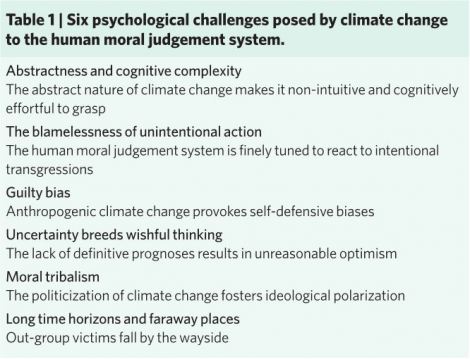
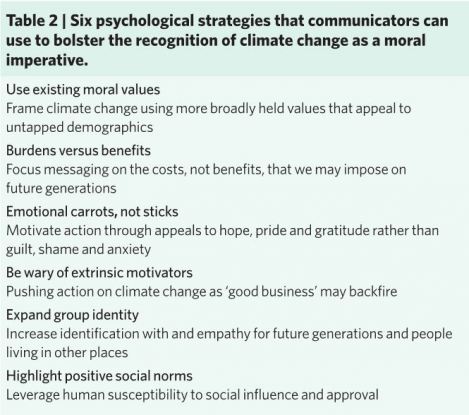
Converging evidence from the behavioural and brain sciences suggests that the human moral judgement system is not well equipped to identify climate change — a complex, large-scale and unintentionally caused phenomenon — as an important moral imperative. As climate change fails to generate strong moral intuitions, it does not motivate an urgent need for action in the way that other moral imperatives do. We review six reasons why climate change poses significant challenges to our moral judgement system and describe six strategies that communicators might use to confront these challenges. Enhancing moral intuitions about climate change may motivate greater support for ameliorative actions and policies.

M’mmm – not sure how that leaves me.  (Which is my way of saying that I don’t really understand that!)  Luckily David goes on to say that the authors “go on to identify six reasons why, “unlike financial fraud or terrorist attacks, climate change does not register, emotionally, as a wrong that demands to be righted.” and refers to an interesting table in the research paper.

Now go to the article on grist to better understand how those challenges are explained.

Then later on in the research paper, there is a second table, as below:

Again, these strategies are expanded upon in David’s article.  What I will do is to copy his final few paragraphs:

6. Highlight positive social norms: This is, to me, the Big Kahuna. As I was reading about all the psychological barriers to climate action, I kept thinking, “one thing can overcome all these: peer pressure!” If people see others that they view as peers or leaders doing something, they will tend to do it too, and retrofit reasons for it after the fact. This is the essence of humans as social creatures.

The recommendation is twofold, though: not just to “highlight pro-environmental, prosocial injunctive norms such as prohibitions against being wasteful,” but also to “be careful not to inadvertently highlight negative, but existent, descriptive norms, which can actually encourage individuals to follow suit in the wrong direction.”

In other words, you want to emphasize that climate hawkery is good, socially desirable, admirable, and that all the cool kids are doing it. You don’t want to give people the impression that “everyone’s doing it” if it is bad. Even if you state clearly that it’s bad, the fact that others are doing it is, in and of itself, a powerful incentive to do it too. It’s the herd instinct. This is good reason not to whine on and on about how everyone drives too much or everyone wastes electricity. The subtext is, “it’s the social norm.”

—-

Aaaanyway, this is a lot of food for thought. But it’s the kind of stuff — not about science but about people — that far too many climate hawks ignore or disregard. Climate change is not only the economic and ecological crisis of our time, it’s also a moral crisis. What we are doing to our descendants is a moral crime. Finding ways to help people get that, feel it in their guts the way they would if someone threatened their own families, is a precondition for serious, sustained action.

Let me repeat David’s closing words, “Climate change is not only the economic and ecological crisis of our time, it’s also a moral crisis. What we are doing to our descendants is a moral crime.

OK, so how strongly do you feel that?  Great, so you do feel it – even feel it deep inside you.

Now that you do, let’s all get stuck into making a difference.  It is all about doing.  As someone of huge stature, and a wonderful person of action no less, said;

I have been impressed with the urgency of doing. Knowing is not enough; we must apply. Being willing is not enough, we must do. Leonardo da Vinci (1452-1519)

We must do!  Start your own ‘doing’, don’t wait upon others, actively look for ideas (there are a few here) and together we can make a positive difference.

Well done, David – great article.

The power of nature

Another gem from Cynthia Gomez.

Do you remember the beautiful pictures of the horse and mare from Saturday, 4th August?  Well many did and loved that Post as was recorded by the number of ‘Likes’.  That was sent to me by Cynthia.

Here’s another one from Cynthia; a beautiful insight into the world of nature, seen over 20 million times!

Wonderful.

No pain: No gain!

The truth is always our friend.

The last couple of weeks of Posts seem to have been rather dominated by the risks to the planet’s biosphere from the highly probable actions of mankind.  I feel a little uncomfortable about this as Learning from Dogs is not a single issue Blog.  Well not in the sense of a tightly defined issue.  But in another sense, it is about the issue of integrity; about raising the values of truth and openness so that it’s clear how we are to move forward as a species and pass through these ‘interesting times’ with hope and confidence.

Dogs are such pure creatures, as I try and explain in the Dogs and Integrity sidelink.  As I wrote in the Vision,

  • Our children require a world that understands the importance of faith, integrity and honesty
  • Learning from Dogs will serve as a reminder of the values of life and the power of unconditional love – as so many, many dogs prove each and every day
  • Constantly trying to get to the truth …
  • The power of greater self-awareness and faith …

So that’s the issue!

If we don’t embrace the truth of what is happening to our planet, then we can’t embrace change.

With thanks to the Yale Forum on Climate Change for promoting this video.

Not even sure what to call this Post?

A futile attempt to explore the concepts of truth, reason, craziness and … (I give up!)

Can’t make sense of this?

Yesterday, I republished an article that Pete Aleshire recently wrote in the Payson Roundup, our local newspaper, on thinking outside the box.  Pete entitled his essay, Strange theory reveals secrets of the universe, the logic of sycamore leaves and why even smart people struggle with new ideas.

And it was part of that title that resonated with a mind-bending (literally) essay that Patrice Ayme presented on his blog on the 27th July.  The part of the title that ‘clicked’ with me was “why even smart people struggle with new ideas.”

You see what Patrice wrote about on the 27th July was about the proposition “that superior intelligence in a species can only come from an ability to engineer (productive) craziness.”

As Patrice explained,

Two of the creators of modern mathematics and metamathematics, Georg Cantor and Kurt Godel, experienced some craziness. Nietzsche produced some of his best work before he went insane. Van Gogh experienced serious mental difficulties. Bolztman killed himself. All these cases were within a generation. Those may all be unrelated accidents, sure.

Immediately leading on to him writing,

 However I will show below that superior intelligence in a species can only come from an ability to engineer (productive) craziness. (Perhaps the reason why chimps and bears are so unpredictable: they are not just clever, but a bit crazy!)

Then after some very detailed reflections on man, Patrice wrote,

Hominids who practiced a bit of craziness were evolutionary advantaged, because they found more readily solutions to logical incompleteness at hand. Craziness allowed to find new, necessary axioms. Thus evolution learned to exploit logical incompleteness.

Typical of Patrice Ayme, the essay is not an easy read but it is brim full of fascinating ideas and well worth the effort.  Patrice concludes,

 If craziness is so useful to augment those mental powers we need so much to survive as a civilization, how do we survive it? Precisely by augmenting the truth. Thus only craziness compatible with the truth will be able to survive. That is why I have not hesitated to tell various truths about Obama (whom I have intensely supported in all sorts of ways), or Hollande, whom I approved of, until he started to say lies about World War Two (details soon to come).

Truth is my religion. A touch of craziness my sanity. (Latest demonstration: It’s not like I did not know of the danger in advance. I was slightly charged by a large bad mood moose with calf today on an Alaskan trail, where I was nonchalantly running with a bad ankle; after a high speed retreat, as a good predator, I circumvented the difficulty, and anxiety switched sides, the calf nearly spraining its own ankle in the process… . )

There is no truth but the full truth, and a touch of craziness is its prophet.

Now go back to Pete Aleshire and see the harmony between his beautiful prose and the fascinating ideas flowing from Patrice’s mind. This is how Pete concluded his essay,

So Drake [Larson] and I spent the day wandering along the banks of Fossil Creek as he kept trying to come up with metaphors so I could grasp math’s secret within the beauty of Fossil Creek’s sycamore leaves. The well-designed sycamore leaves adhere to the Fibonacci sequence, a mysterious progression of numbers that crops up throughout nature — from the spiral of a nautilus shell to the layout of the ruins of Chaco Canyon.

So I figured I’d just write this — and get earth’s 17 PSI cap for dark energy out there in the time/date/ stamped world.

Oh, yeah: And about Kenny Evans. [Mayor of Payson, AZ]

So that night, I took Drake to the Payson council meeting. Turns out, Drake’s family was growing grapes in the Coachella Valley at the same time Evans was farming 10,000 acres in Yuma. They both managed to survive that tempestuous time when the United Farm Workers union organized agriculture workers.

I introduced them and listened as they recalled events and figured out whom they knew in common.

It was then that I decided to blame Drake for my faith in Evans’ ridiculous conviction that a university will build a campus here in this itty bitty tourist town — complete with a research center and convention hotel. No sensible small-town mayor would risk public ridicule while spending thousands of hours on such an outside-the-box notion … unless he’d learned to gamble on dreams and hard work during all those years as a farmer.

Evans’ notion is almost as silly as a farmer who calculates the amount of dark energy emanating from earth, while credentialed experts scratch their collective heads.

Still, I’m thinking maybe I’ll get a nice suit jacket — something I can wear to both the university’s groundbreaking and the ceremonies in Oslo.

Hey, never hurts to be prepared.

So there, I feel much better now!  None the wiser, indeed even more confused, but just grateful there are some out there who have a go at trying to explain ….. whatever it is they are explaining!

And now to do something.

The cumulative effect of millions of decisions brings about change!

Yesterday’s Post was about personal change.  It came on the back of a short series that was triggered by the Bill McKibben essay in Rolling Stone magazine that I republished on 31st July.  If you haven’t read it, do yourself a favour and read it soon.

The essay highlighted the challenge of how we change our ways, that is at a personal level, which is why I decided to devote a complete Post to the subject of change.  There was no doubt that the McKibben essay opened our eyes to the need for change, if they weren’t open already.  So being clear about the need for change and how, initially, it can make us feel less sure of ourselves, where do we go from here?  As John Fisher explains, within the change process, there is the stage where things start to happen.  This is what he writes about that stage,

Moving forward

In this stage we are starting to exert more control, make more things happen in a positive sense and are getting our sense of self back. We know who we are again and are starting to feel comfortable that we are acting in line with our convictions, beliefs, etc. and making the right choices. In this phase we are, again, experimenting within our environment more actively and effectively.

Keep this stage in mind as you journey along your individual path towards reducing your impact on the planet.  It really does act as a beacon for you, as a candle in the darkness.

OK, there’s an old saying in business ‘if you can’t measure it you can’t manage it!‘  So let’s start off by calculating the CO2 we are presently responsible for.

There are a number of CO2 calculators available on the Web but this one from The Resurgence Trust website seems as good as any.  Easy to use and it provides a starting point from which to plan your attack!  Make a promise to calculate your present CO2 output, soon!

Then to the plan of action!  A web search on reducing CO2 produces a huge number of results and I recommend that you undertake your own trawl to find the information that ‘rocks your boat’.  But on the Brave New Climate website there’s a summary that caught my eye, especially how it was introduced:

Top 10 ways to reduce your CO2 emissions footprint

Posted on 29 August 2008 by Barry Brook

Solving climate change is a huge international challenge. Only a concerted global effort, involving the governments of all nations, will be enough to avert dangerous consequences. But that said, the individual actions of everyday people are still crucial. Large and complex issues, like climate change, are usually best tackled by breaking down the problem into manageable bits.

For carbon emissions, this means reducing the COcontribution of each and every one of the six and a half billion people on the planet. But what can you, as an individual person or family, do that will most make a difference to the big picture? Here are my top ten action items, which are both simple to achieve and have a real effect. They are ranked by how much impact they make to ‘kicking the COhabit’.

Then follows ten solid recommendations:

  1. Make climate-conscious political decisions.
  2. Eat less red meat.
  3. Purchase “green electricity“.
  4. Make your home and household energy efficient.
  5. Buy energy and water efficient appliances.
  6. Walk, cycle or take public transport.
  7. Recycle, re-use and avoid useless purchases.
  8. Telecommute and teleconference.
  9. Buy local produce.
  10. Offset what you can’t save.

Each of these recommendations is supported by great web links and plenty of advice.  So don’t just skip through those 10 options, go here and commit to doing something!

And when you are ready to involve others beyond your family, 350.org has a great selection of resources for potential organizers.

We can make a difference!

Changing the person: Me!

It is better to light a candle than curse the darkness. – Chinese Proverb

Yesterday, in a post that picked up on the deep implications of Bill McKibben’s chilling essay on where the world is heading if we don’t change, I set out my understanding of what holds us back from that change.  I wrote, “ … the process of change cannot start until we  truly want to change; a total emotional commitment.  And the formation of those emotions, that realisation, requires a new understanding of the world around us, who we are and who we want to be.”

Previously on Learning from Dogs I have quoted Jon Lavin, “The best way to save the world is to work on our selves.”  I remember decades ago when working as a humble office-products salesman for IBM UK the well-worn saying, “Selling is 90% me and 10% the customer.”  Sort of reminds me of Woody Allen’s: “Eighty percent of success in life is showing up.”

OK, enough of these mental perambulations.  Let’s get on with the task of looking at change.  Because make no bones about it, if we rely on ‘them’, on others, to turn mankind back from where we are heading then it’s all over!  It comes down to each and every one of us deciding to change.

Think this is all melodramatic nonsense?  Go and read the first paragraph of Bill McKibben’s article where he states, “June broke or tied 3,215 high-temperature records across the United States. That followed the warmest May on record for the Northern Hemisphere – the 327th consecutive month in which the temperature of the entire globe exceeded the 20th-century average..

Want more reason to change?  Try this from a recent article on The Daily Impact:

From American Drought to “Global Catastrophe”

Some poet  invented the name “Arab Spring” as a label for the tsunami of public desperation that last year took down the governments of Tunisia, Egypt and Libya. Poets and Pollyannas saw the events as an upwelling of love for democracy. Realists related them to the spike in world food prices that threatened the survival of whole populations and made them desperate for change — any change.  Now, thanks in large part to events unfolding in the American heartland, get ready for another, worse, spike.

We are running out of superlatives with which to describe the Mid- and Southwestern drought and its effect on this year’s corn and soybean crops. According to this week’s USDA crop update the situation during the previous seven days went from “critical” to, um, worse than that. The drought is the worst in half a century. Of the largest US acreage ever planted in corn (industrial agriculture was crowing about that just a couple of months ago), only one-quarter is still in good condition. (Modest rainfall in drought-stricken areas early this week provided mostly emotional relief; the drought is forecast to continue unabated through October.)

Change really does seem like a ‘no-brainer’!

Here’s a lovely cartoon that summarises the steps of change, the process of transition, for you and me.

That diagram is from John Fisher’s model of personal change, full details of which are here.  It includes a link to the process of transition diagram, show above, here.

The most important thing to note, and this is why so many ‘change’ ambitions fail, is that change is deeply unsettling at first.  When change happens for the majority of us, often ‘forced’ on us as a result of unplanned life events, we are left deeply unsettled; a strong feeling of being lost, of being in unfamiliar surroundings.  Think divorce or, worse, the death of a partner or child, reflect on how many sign up for bereavement counselling in such circumstances.  Big-time change is big-time tough (apologies for the grammar!).

Stay with me for a short while while I reinforce this from my own experiences.

My previous ex-wife announced in December, 2006 that she was leaving me for a younger model!  It came as a complete surprise.  Subsequently, I was invited to spend Christmas 2007 out in San Carlos, Mexico with Suzann and her husband, Don.  Suzann is the sister of my dear, close friend of many years, Dan Gomez, hence the connection.  There I met Jean, a long-term friend of Suzann living in San Carlos and, coincidentally as I am, another Londoner by birth.  Jean and I fell deeply in love with each other and a year later I moved out from SW England with Pharaoh to Mexico.

Throughout 2008 I suffered from what was eventually diagnosed as vestibular migraine.  It involved partial loss of vision, vertigo, headaches and significant short-term memory disturbances; let me tell you it was pretty frightening!

Eventually, in 2012 well after we moved from San Carlos up to Payson, Arizona, I got so worried that I went to see a neurologist, convinced that I was heading down the road of dementia.  Dr. Goodell examined me thoroughly and said that there were no signs of dementia or early-onset Alzheimer’s disease.  His conclusion: I was showing the normal signs of forgetfulness that any person of my age (now 67) would show having been through similar life changes.  Dr. Goodell went on to explain that back in England 98% of my life was constant and familiar and therefore adjusting to a 2% change was unremarkable.  However, on moving my life out to Mexico and then on to Arizona, it was all reversed: 2% of my life was constant and 98% was change and that was a huge psychological hill to climb with all the associated mental stresses that I had been experiencing.

Interestingly, that diagnosis rapidly set me on the path of feeling so much better!

So, apologies for that personal diversion but I hope it underlined that life-change is a big deal!

In my trawl across the Web looking for change references, I came across a software engineer by the name of Dave Cheong.  Dave writes a blog.  In Dave’s blog was a piece about change.  Change as a result of a merger of his employer.  This is what Dave wrote:

As a result of the merger, lots of change is happening. Some folks are questioning where things are headed, what management have planned, how their lives will change, etc. Most certainly, there will be job losses as the two companies consolidate things, in particular administrative positions.

With the chaos that’s been unfolding, I’ve thought a bit about “change” in general. What is it? Why do people resist it? Is it always a good thing? What should I do?

And later he writes after referring to the Satir Change Process model, named after Virginia Satir, an American author and psychotherapist:

The diagram depicts several stages of accepting change. The first stage is known as Status Quo (Gray Zone), a state where everyone is generally comfortable with the way things are. The second stage is a point in time a Foreign Element, trigger or change agent is introduced. What follows is a period of Resistance and Chaos (Red Zone), personified as a result of people being scared of the uncertainties the change has brought about and how their lives will be impacted.

The level of performance generally drops off and fluctuates more greatly between the Gray and Red Zones. There are various reasons for this – people may reject the change to protect the status quo; are confused with the change and are unsure of what to do; or simply become less competent with the new tools and processes introduced.

This describes why people by nature resist change. They don’t want to become less useful than they already are.

Just reflect on that.  Dave calls it being ‘less useful’ but that downplays the emotional significance of partially losing one’s self-image, one’s self-identity, the undermining of who we think we are.  As I wrote earlier, life-change is a big deal!

Here’s my final example of how dealing with change is all about the self.  It’s from the Best Self Help website, and opens,

Self help, personal development and self-improvement are topics of considerable interest to pretty much everyone on the planet.

In 1975 my life was a total mess. I was depressed, unemployed and my 5 year marriage was ending.

I’m not going to quote it all but it really is worth a read.  However, I do want to quote the conclusion,

Finally, I Got It!!!

In the Western world, we are educated to look outside ourselves for validation. We want more money to acquire “things” with the mistaken belief this is the source of happiness.

The true source of love, health, happiness and financial success cannot be found outside of ourselves – each of these is already within us. The key is learning how to access and activate that which we already possess.

 “True wisdom comes to each of us when we realize how little we understand about life, ourselves, and the world around us.” ~Socrates~

So that’s enough for today. If you haven’t got the message about change coming from within, then not sure what else I can offer!  However, if you do want to explore changing the way you impact this beautiful planet (and it applies equally to me) then drop in tomorrow.