Category: Core thought

The influence of climate

Changing climate is changing us and the world in significant and fundamental ways.

I wrote this around noon on the 7th September.  That day we awoke to the sky, normally clear blue, covered totally in grey stratus cloud.  Shortly after 9am it started to rain and some three hours later that rain was still steadily falling from the sky.  Don’t get me wrong, the steady rain was vital to the area.

The precipitation statistics for Payson, AZ up to yesterday (6th at the time of writing) are:

Precipitation year to date (ergo to the 6th September) = 8.02 inch (20.37 cms)

Precipitation 30-year average to the end of September = 16.25 inch (41.28 cms)

Year to date as a percentage of 30-year average = 49.4%

The annual 30-year average precipitation for the year for Payson is 21.5 inch. (54.6 cms)

So despite a moderately effective monsoon, there is no way that Payson, Arizona will be even close to the 30-year average for precipitation.

That’s why a recent essay by Chris Martenson, he of Peak Prosperity fame, is so critically worth reading.  I’m very grateful to Adam Taggart, Chris’s business partner, for giving me permission to republish the essay.  (Note that the essay was published before Hurricane Isaac arrived.)

Also note that this is Part One of Chris’s very detailed report and that to read the concluding Part Two you will need to enrol over at Peak Prosperity.  However, Part One is very detailed and covers much. Thus even without Part Two there is much here to ‘exercise the mind’.

oooOOOooo

The U.S. Drought Is Hitting Harder Than Most Realize

Repercussions are everywhere.  By Chris Martenson, Wednesday, August 29, 2012, 8:02 PM

This is an important update on the U.S. drought of 2012, the combined record-setting July land temperatures, and their impact on food prices, water availability, energy, and even U.S. GDP.

Even though the mainstream media seems to have lost some interest in the drought, we should keep it front and center in our minds, as it has already led to sharply higher grain prices, increased gasoline costs (via the pass-through of higher ethanol costs), impeded oil and gas drilling activity in some areas (due to a lack of water), caused the shutdown of a few operating electricity plants, temporarily reduced red meat prices (but will also make them climb sharply later) as cattle are dumped in response to feed- and pasture-management concerns, and blocked and/or reduced shipping on the Mississippi River. All this and there’s also a strong chance that today’s drought will negatively impact next year’s Winter wheat harvest, unless a lot of rain starts falling soon.

The good news from Hurricane Isaac is that he’s traveling on a perfect path to deliver relief to one of the most heavily drought-impacted areas:

There are steps that everyone can and should take to become more food- and fuel-resilient in case the drought persists – as some experts think is quite possible – into next year and perhaps a few more. We’ll get to those steps shortly.

Further, there will be a definite impact to U.S. GDP, which could add to pressures (excuses?) that the Fed may use to justify additional quantitative easing (QE) measures (otherwise known as ‘printing more money’).

U.S. Drought Intensifies

The drought in the U.S. has intensified in the recent weeks, even though it has somewhat dropped from the front pages of mainstream media, possibly because the story is stale or possibly because it’s just too serious to dwell on for long:

Extreme drought in the U.S. intensifies
Aug 17, 2012

The drought in the United States is continuing to intensify, according to the National Oceanic and Atmospheric Administration (NOAA).

The latest Drought Monitor says 61 percent of the contiguous United States faces moderate or worse drought conditions this week.

Nearly 30 percent is experiencing extreme to exceptional drought, exceptional being the most severe category.

Officials say the amount of land that’s currently affected across the U.S. is larger than the entire state of California.

In this next image, it is notable that the areas of the highest drought classification — ‘exceptional’ — have dramatically expanded from the prior week (the August 7, 2012 report).

(Source)

Much of the drought is centered squarely over the U.S. ‘breadbasket’ region and has really dented this year’s harvests in a big way.

Crop Losses

Certainly the number one story around the U.S. drought centers on its impact on grain production, specifically corn and soybeans. In a minute we’ll discuss the other impacts, but we’ll start with the one that has the greatest potential to cause both suffering and strife over the coming months (and possibly years), especially for those on limited budgets.

In 2011, the U.S. reaped a corn harvest of some 314 million tons. In 2012, the USDA has estimated a harvest of 274 million tons – a shortfall of 40 million tons – despite record acreage being planted.

While the USDA has been steadily reducing their crop estimates, practically with every passing week, it seems likely that the USDA remains behind the curve today, as it has been every step of the way. A different source for information comes from the Pro Farmer Midwest Crops Tour, which is coming in slightly under the current USDA estimates:

Crop Tour Points to Sharper Drought Impact on Soy, Corn
Aug 21, 2012

Initial reports from the closely watched Pro Farmer Midwest Crop Tour suggested more crop damage than expected from the drought, raising the potential for diminished soybean production this fall and sending futures sharply higher.

The disappointing crop reports from scouts touring fields on the Pro Farmer crop tour in states such as Ohio and South Dakota make it hard to believe soybean yields will reach current U.S. government crop projections, said Don Roose, president of advisory and brokerage firm U.S. Commodities in West Des Moines, Iowa.

The market is in the “watch and worry” mode on all fronts as shrinking crop forecasts will further tighten supplies already projected to dwindle to precariously tight levels in 2013, Mr. Roose said.

On the annual Pro Farmer tour, analysts and investors walk corn and soybean fields in seven Midwestern states over four days to assess prospects prior to the fall harvest. Pro Farmer is an agricultural advisory firm. The Pro Farmer tour, which wraps up Thursday, reported diminished potential for the soybean crop in both Ohio and South Dakota.

The crop tour doesn’t estimate soybean yields, but it reported an average 584.9 pods per 3-foot-by-3-foot square area in South Dakota, down 47% from a year ago. In Ohio, scouts reported soybean counts at an average of 1,033.72 pods per 3-foot-by-3-foot square area, down from 1,253.2 pods a year ago.

Soybeans entered their critical growing phases in recent weeks, and the crop has benefited in some regions from recent rains across the eastern Farm Belt.

Meanwhile, scouts with the Pro Farmer Midwest Crop Tour on Monday reported an average estimated corn yield in Ohio of 110.5 bushels per acre, down from the tour’s estimate of 156.3 bushels a year ago. In South Dakota, tour scouts reported an average yield estimate of just 74.3 bushels per acre, down from 141.1 bushels a year ago.

While commodities traders and agronomists have braced for weeks for the prospect of a crop decimated by drought, the estimates were lower than many had expected.

The summary here is that the Pro Farmer Tour is reporting crop yields to be 2% – 3% lower than current USDA forecasts, which is a big deal when it comes to food. We’re talking a few tens-of-millions-of-bushels’ difference.

The somewhat sour note in this unfolding drama is the fact that 40% of the nation’s corn crop goes to ethanol producers, which means that food will be burned in the nation’s auto fleet instead of helping to keep prices down for consumers and animal feed. Another 40% goes to animal feed (chicken, cattle, hogs, etc.), and the remaining balance goes to direct human consumption.

However, the ethanol mandate is a congressional requirement for our fuel blenders, so they do not have a choice in the matter. It would literally take an act of Congress to even temporarily suspend the ethanol requirement – and in an election year, that’s just not going to happen, given the powerful constituencies invested in preserving that mandate.

Of course, higher input costs will ripple through the entire chain, so perhaps Bernanke will get the inflation he seeks, although it won’t be the one he wants. The inflation he wants is simple monetary-driven inflation. The inflation he will get is nothing more than a supply/demand mismatch.

Still, the USDA has a handy calculation for estimating the future impacts:

U.S.’s inferior corn crop has supply-chain ramifications
Aug 13. 2012

The USDA has provided considerable information about how the drought’s effects were likely to percolate through the economy. Because of a smaller-than-expected corn crop, the USDA said it can make the general prediction that “we will see impacts within two months for beef, pork, poultry and dairy (especially fluid milk). The full effects of the increase in corn prices for packaged and processed foods (cereal, corn flour, etc.) will likely take 10-12 months to move through to retail food prices.

The USDA has a formula for predicting changes in the rate of inflation caused by gains in prices at the commodity level: if the farm price of corn rises 50%, retail food prices rise by 0.5% to 1% as measured by the Consumer Price Index (CPI).

The price of September corn futures from mid-June until early August advanced 55%, meeting the USDA’s criterion for a measurable increase in the CPI Lapp presented a more extreme scenario than the USDA. He predicted that the damage to the 2012 corn crop will translate into a food inflation rate of 4% to 5% in 2013. In his view, the dollar cost of the drought already was $30 billion, which accrued rapidly over the summer.

“This is a cost that somebody has to bear,” Lapp said. “Some price hikes are fairly quick and others take a while.”

He said high feed costs will have to be absorbed by producers, who will likely liquidate part of their cattle and swine herds and poultry populations. At the retail level, the drought’s effects will translate into narrower margins — and expected higher prices — for processed food and soft drink manufacturers among others.

Lapp offered his opinion that legislation that has effectively required 40% of the corn crop be used in making biofuels has made everything worse.

“The situation has been aided and abetted in a negative way by the biofuels mandates,” he said. “Shame on us for having mandated so much to corn ethanol” without creating contingencies for a bad crop year.

Because corn is the base unit for so many things (especially in the form of high-fructose corn sweetener), and because it’s a primary feed component for finishing cattle and raising chickens and hogs, it tends to have a pretty decent impact on food prices.

However, it takes time for those price hikes to work through the system. So it will not be until 2013 sometime that we really begin to feel it in the U.S. And for the rest of the world that lives more directly on grains? They’re not as lucky. The price hikes hit them almost immediately.

It looks like the harvest in Russia will be below expectations as well:

Russia harvest forecasts cut as drought hits crop in east
Aug 20, 2012

(Reuters) – Two leading Russian agricultural analysts cut their forecasts for Russia’s grain harvest on Monday after harvest data from two drought-stricken eastern growing regions reduced the outlook for the overall crop.

SovEcon narrowed their grain forecast to 71-72.5 million metric tonnes (…)

The government’s official grain harvest forecast is 75-80 million tonnes, of which 45 million tonnes could be wheat. The government has put this season’s exportable surplus at 10-12 million tonnes, a level seen by traders as an informal cap on exports.

The government has tried to reassure markets there will be no repeat of August 2010, when Russia’s government shocked markets with a snap decision to ban grain exports when the scale of losses from major drought became clear.

The government has indicated that protective tariffs could be an option, though only after the end of the calendar year.

But traders widely expect limits to be imposed in some form, perhaps as early as November, after heavy exports in the early months of the season showed Russia could hit the 10-12 million tonne mark sooner than January.

Russia is still officially projecting 75-80 million tonnes but may only get 71 tonnes. If the projected exportable surplus is 10-12 million tonnes, but Russia actually harvests 9 million tonnes less than their hoped-for projection, then its exports will have to decrease to plug that gap.

Here’s the kicker: Russia has already exported a good deal of that amount. That is, the prospect of another Russian export ban this year is quite realistic. If we get one, then we can expect a repeat of the turmoil in the grain markets that we saw in 2010.

But there’s another much more fundamental reason why we can expect higher prices going forward.

Need for Even Higher Prices

The good news is that there’s still plenty of supply to carry us through to the next harvest. However, demand is going to have to go down some, and the way we accomplish that is through the price mechanism.

Right now, physical grain traders are saying that prices are too low and that unless they rise, we’re going to run out of grain before the next harvest. Obviously, that’s not truly going to happen – increasing scarcity will cause prices to rise until current demand levels are reduced.

Fall in corn price disguises real picture (Financial Times)
Aug 20, 2012

Corn prices surged this month to an all-time high of $8.4375 a bushel on the back of the worst drought in the US in nearly half a century. But prices have since fallen roughly 5 per cent. The impression is the rally has run out of steam.

This is far from the real picture. Prices need to rise again – probably setting all-time highs – to dampen consumption that is running ahead of supply.

If demand does not slow down, silos will be all but empty before the next harvest arrives in late 2013.

On paper, the balance sheet for corn supply and demand published by the US Department of Agriculture seems good enough. But in practice, the numbers look a bit shaky. The agency, whose figures are closely watched by the market, first estimates supply and, after that, adjusts the demand data to maintain a minimum level of inventories.

This time the USDA is asking for monumental rationing on the demand side. For example, US corn feed and export demand will need to drop to their lowest levels in nearly 20 years.

The USDA is also forecasting lower ethanol production – and thus corn demand. Ethanol output has fallen, but not nearly enough. Worse, the rise in wholesale petrol prices back above $3 a gallon means that ethanol producers are profitable again, even when paying record corn prices.

Corn is now trading just above $8 a bushel – but traders in the physical market say that prices need to rise to $9-$10 to force demand down enough to meet the consumption levels anticipated by the USDA.

The retreat in corn prices over the past couple of weeks has given inflation watchers a false sense of security. The market should not relax, however. More food inflation is just waiting around the corner.

The idea here is that the cash market will have to lead the futures market higher, an odd situation because it is usually the other way around. With so many hedge funds now playing in the commodity space, one explanation is that they are simply playing paper games with each other – those playing the short side will get a lesson in the importance of keeping one eye on reality.

A truly shocking event would be if the U.S. ever gets to the position of limiting exports of corn or even soybeans. That is a very unlikely proposition to consider, but if the silos get drained because we have dysfunctional markets that saw fit to keep prices bizarrely low while our free trade agreements allow the too-low grains to be exported, threatening domestic supplies, then that possibility notches up a little bit.

Dairy, Meat, and Even Higher Gasoline Costs

While it is clear that basic grain prices are heading higher, the knock-on effects into other soft commodities are a little less clear, but are definitely still important to consider.

The most obvious of these are higher grain feed costs that will hit both livestock and dairy producers especially hard:

The withering crops are translating into higher feed costs for livestock producers. “This is different than anything I’ve ever experienced,” said Kent Pruismann, who raises cattle and hogs on a farm in Sioux County, Iowa, and saw his costs for feed jump by 20% in July.

The higher corn, soybean and wheat prices will reach food makers, exporters and eventually consumers. Drivers already have seen fuel costs climb because of higher prices for ethanol, a corn-based fuel that is blended into gas. The drought also has reignited the debate over whether ethanol production is a drain on global food supplies.

(Source)

Some are already turning to, shall we say, other means to keep their herds fed:

Kentucky cows eat candy instead of corn

Aug 14, 2012

LOUISVILLE, KY (WAVE) – When you think of cattle feed, you probably don’t think of candy, but due to the drought that’s exactly what one farmer chose to do.

At Mayfield’s United Livestock in Western Kentucky, owner Joseph Watson feeds his herd second-hand candy.

Watson started feeding his cattle the candy because corn prices were so high.

He mixes the candy with an ethanol by-product and a mineral nutrient. He monitors the daily intake and said the cows have had no real health issues.

Yes, the higher grain costs are going to hit everything from big cattle feedlot operations to my own two-bags-a-month chicken-feed usage.

However, it will be the cost of and even lack of hay that will really create some big problems later this year. The drought not only harmed the range and pasture lands, forcing greater use of stored hay to offset the decline in forage, but it put a huge crimp in this year’s hay production:

Drought Cripples Hay Feed Industry

Aug 19, 2012

Widespread drought has scorched much of the pastureland and hay fields needed to sustain cattle herds in the U.S., forcing many ranchers to find feed alternatives or sell their animals early into what has become a soft beef market.

The shortage has led to higher hay prices, with some farmers saying they have to pay two to three times last year’s rates.

Despite farmers setting aside more land to grow hay this year, they are still producing a lot less because of the drought, according to a recent Department of Agriculture estimate.

The harvest of alfalfa, generally considered to make the best hay because of its high nutrient levels, is forecast to be the worst since 1953, according to the USDA.

Pasture grass and hay are what most cattle are fed for the roughly two years they live before being slaughtered, but the drought is threatening to starve the animals.

Illinois rancher Steve Foglesong said that most years he could graze his cattle from spring through November on verdant fields that are now brown, buying them hay bales only in the winter. This year, he and his animals have their eyes on withered corn plants.

“It may not have any ears on it, but it makes pretty good cow feed,” he said.

John Erwin, who owns 20 acres of land in Shelbyville, Ill., said he is having trouble growing alfalfa hay, but demand is strong for what he can produce.

I’m getting calls from ranchers as far away as Wyoming,” Mr. Erwin said. “They’re desperate.”

He said he has been offered $250 a ton for his hay, nearly double the $130 a ton in a non-drought year. His fields didn’t produce any hay in July.

A doubling of hay prices is obviously going to create quite a bit of economic hardship for many farming operations, which tend to be marginal profit businesses even when everything is going well.

Here’s another view on the hay situation:

I spoke with Caldwell [of Indiana horse rescue] and a number of other horse-rescue organizations around the country by telephone this week. The relentlessly hot dry weather, amplified in many areas by wildfire, has been devastating to farmers, ranchers and other horse owners.

Everybody is using their winter hay now. The pastures are destroyed and they probably won’t recover before winter,” said Caldwell. “The price of hay has doubled, and the availability is down by 75 percent.”

Caldwell is somewhat sanguine about his own lot, but not optimistic about what lies ahead.

Today the problem is not nearly as bad as it’s going to be,” he told me. “It’s terribly bad today, but it is going to get a lot worse.”

(Source)

The drought has done some very serious harm to the nation’s hay supply that goes beyond the economics of higher hay costs. First there’s the supply of the hay, and then there’s the relatively poor quality of hay that was taken from non-irrigated, drought-stricken fields. All in all, it’s not a good situation.

To add a bit more difficulty into the situation, it turns out that drought-stricken silage and even the corn itself can be harmful to animals:

Drought makes corn dangerous for livestock

Aug 16, 2012

COLUMBIA, MISSOURI, U.S. — Tim Evans, an associate professor of veterinary pathobiology and toxicology section head at the Veterinary Medical Diagnostic Laboratory at the University of Missouri College of Veterinary Medicine, Columbia, Missouri, U.S., warns U.S. farmers and livestock producers that drought-damaged corn plants can pose a risk to animal health.

During severe drought conditions, corn plants, especially those heavily fertilized with nitrogen, can accumulate a chemical called ‘nitrate’,” Evans said.

This chemical can be very harmful to animals, especially cattle, if they eat corn plants or other vegetation containing too much nitrate. Eating plants with too much nitrate can cause damage to red blood cells, resulting in lethargy, miscarriage, and even sudden death.”

Evans says that in normal conditions, corn crops typically absorb nitrate into only the lower 12-18 inches of the stalk, which does not have to be fed to animals. However, during severe drought conditions, high concentrations of nitrate can accumulate in the upper portions of the stalk, which cattle and other livestock often eat.

Evans also says that many naturally growing plants and weeds in grazing pastures can accumulate nitrate during drought conditions, as well. These plants include many types of grasses and some weeds, which animals might be forced to eat because of limited pasture or hay available as forage for livestock.

The key here is that nitrates are safe below 2,000 ppm but toxic above 15,000 ppm, and the levels found in the stalks and how high it travels are a function of whether enough rain fell to allow the plant to take it up. Much of the corn crop was so desiccated that the plants could not even manage to draw up this nutrient, and therefore it is safe as a feed product.

While it’s hard to get a read on at this early stage, there are enough warning signs here pointing to much, much higher grain, food, and meat prices in the future. The worry is whether there will even be enough feed to sustain the animal populations through the Winter and Spring. Given the damage to the harvestable corn, a lot of it is going to be turned into silage

Many ranchers and farmers are faced with a horrible choice here. Saving their herds may be economically unsound or even impossible where hay and safe silage are not available, and so they are selling their herds, one of the most heart-wrenching decisions anyone could have to make.

So many are doing this that recently the price for cattle has dropped, as everyone is selling into an increasingly soft market. My advice is to enjoy these low meat prices while they last, because the next stage of this story involves much higher meat prices.

The problem with understanding just how bad the hay situation might (or might not) be is that there are no national statistics collected that could tell us whether or not there’s even enough hay available to sustain the current commercial and recreational livestock populations.

The Importance of Positioning Yourself

So, with all of these repercussions building during the current drought – to which there’s yet no end in sight – what can you do today to minimize their impact on your budget and lifestyle?

Part II: Positioning for the Drought’s Aftermath looks at the likeliest outcomes in food prices, food availability, energy prices, and macroeconomic consequences (of which there will no doubt be many from this drought). We have a national food distribution system that runs significantly on a just-in-time basis, which leaves it vulnerable to price and inventory shocks when there are supply disruptions. The reduced water levels caused by the drought are handicapping electrical power generation in growing regions in the country; electrical thermal plants are the number one biggest user of water in the U.S.  The global financial markets are similarly tenuous these days, as resources are already taxed in trying to stimulate the moribund U.S. economy and dig Europe out of its massive credit woes.

This is one of those moments where taking simple, prudent steps now can have an outsized effect on preserving your quality of life.

Click here to read Part II of this report (free executive summary; paid enrollment required for full access)

oooOOOooo

It’s not pleasant reading, is it!  But unless we all fully understand the implications of what we are doing to the planet by continuing to pollute the atmosphere, how can we embrace change!

A view from the Radical Middle

Promoting the thoughts of Per Kurowski.

A few days ago, I published a delightful story sent to me by Richard Maugham about Helga’s Bar.  It was a tongue-in-cheek look at the crazy world of finance and banking that we seem to be living in at present.

One of the regular readers of Learning from Dogs is Per Kurowski and he left a couple of comments.  The first being,

As a former ED at the World Bank, 2002-2004, living close to Washington, writing articles and being an assiduous blogger, I’ve been in the middle of many discussions about those many of the challenges our world faces. And my friend, I am sorry to say, our prospects to solve these problems, do not seem good.

One of the main reasons for that negative outlook, is that I have been able to witness how the discussion of many of these problems, no matter how urgent these are, so often get hijacked by a political agenda, or by a group that decides making a business, or a living, out of it.

If we cannot break out of this mold, unfortunately, the world is toast, and this, not only from a global warming perspective.

which was then followed up by,

By the way, I managed to sit down a prominent and important bank regulator in my chair yesterday, though he was invisible and quite silent!

I then replied,

Per, just love that. Any chance of you penning a guest post that could set the background to that video in terms that make it easy for the punter to understand?

So here is Per’s interview (sound volume is a little low) and his views.

oooOOOooo

Paul… well here is “a brief summary of my thoughts on banks and risks”

Capital requirements for banks which are lower when the perceived risk of default of the borrower is low, and higher when the perceived risk is high, distort the economic resource allocation process. This is so because those perceptions of risk have already been cleared for, by bankers and markets, by means of interest rates and amounts of exposures.

All the current dangerous and obese bank exposures are to be found in areas recently considered as safe and which therefore required these banks to hold little capital. What was considered as “risky” is not, as usual, causing any problems. This is not a crisis caused by excessive risk taking by the banks, but by excessive regulatory interference by naïve and nanny type regulators.

And, if that distortion is not urgently eliminated, all our banks are doomed to end up gasping for oxygen and capital on the last officially perceived safe beach… like the US Treasury or the Bundesbank.

Bank regulators have no business regulating based on risk perceptions being right, their role is to prepare for when these perceptions turn out to be wrong.

A nation that cares more for history, what it has got, the haves, the “not-risky”, the AAA rated or the “infallible” sovereigns, than for the future, what it can get, the not-haves, the risky, the small businesses or the entrepreneurs, is a nation on its way down.

Per.

oooOOOooo

You may read more from Per on his blog here, and also read Per’s Tea with FT blog!  So let me close by saying that Per’s summary seems like a blast of sanity in an otherwise crazy world!

Postscript to the memory of Neil Armstrong

An afterthought about the adventurous spirit of man.

While the focus on the manned exploration of space has declined significantly since those days of the Apollo missions, the spirit to explore has not diminished.  This was underlined in spades by a recent post from the British blog Earth & Solar System that I have been subscribing to since a few weeks ago.

First some background to Earth & Solar System.

This blog reflects the research interests of the Isotope Cosmochemistry and Geochemistry Group at the University of Manchester.  In our laboratories we study samples from comets, interstellar dust, interplanetary dust, Mars, the moon and asteroids to understand how the Earth and the Solar System were formed, how they evolved and became what we see today.  We study the Earth and its chemistry to understand how it works, its mantle, crust, oceans and how we change it.  We want to share and discuss what we find with everyone.

The blog is for sharing science and what we and other research groups discover as we do science in real time.  Discussion, questioning and enquiry are good, but politics, and opinion that can’t be backed up by published scientific work are strictly off-limits and will be removed.

Yet another example of why integrity is the only way forward.

Anyway, the recent post that was published came into my ‘in-box’ on Monday and I wanted to share it with you.  Primarily because the mainstream media have moved on and there is little ‘news’ about NASA’s Curiosity rover.  That’s why this post is so fascinating and it’s reproduced on Learning from Dogs with the permission of Ashley King, the author.

oooOOOooo

A busy week

Posted on September 3, 2012 by Ashley King.

The past week has seen NASAs Curiosity rover return more amazing images of the Gale crater, fire up its DAN and SAM instruments, and take its first steps towards Mt. Sharp.

Mastcam view south-west from the Bradbury landing site. The foreground is boulder-strewn and contains the edge of an impact crater. The layered rocks in the background form the base of Mt. Sharp (NASA/JPL-Caltech/MSSS).

The new images, captured using the 100mm telephoto lens of the Mastcam, provide a glimpse of the geological treats that await scientists at the base of Mt. Sharp.  Of particular interest has been the identification of an unconformity, where two rocks in contact but of different ages indicate a break in the geological record. Satellite data suggests that the rocks lying below the unconformity contain hydrous minerals whilst those above are “dry”. It appears these rock units formed under very different environmental conditions.

Unconformity (marked by white dots) at Mt. Sharp (NASA/JPL-Caltech/MSSS).

Next, Curiosity had another driving lesson, this time positioning itself over one of the scour marks created during landing. This allowed the rover to continue testing the ChemCam and turn on the Dynamic Albedo of Neutrons (DAN) instrument, which will be used to search for water below the Martian surface. The Sample Analysis at Mars (SAM) instrument, comprising of a mass spectrometer, gas chromatograph and tunable laser spectrometer, was also gently woken up. SAM can measure the abundance of C compounds, H, N and O, elements associated with life, in atmospheric and powdered rock samples. A quick test of some Earth air trapped in the instrument since launch confirmed that it is working well and should soon be ready for Martian samples.

Curiosity has now completed four drives and is heading for Mt. Sharp. However, the first target is Glenelg, a rock outcrop 400m to the east of the Bradbury landing site, where it’s hoped Curiosity will start using its drill. Although the journey will take several weeks, Glenelg contains at least three different rock types that will help scientists piece together the geological history of Gale crater.

Leaving the Bradbury landing site. This Navcam image shows the tracks left in the Martian soil by Curiosity (NASA/JPL-Caltech).

oooOOOooo

Makes a nice change to forget about the goings-on here on Planet Earth!

The nose of the dog!

The incredible power of smell that dogs have.

The nose of a German Shepherd dog!

Regular readers will know that I subscribe to the blog Naked Capitalism masterminded by Yves Smith.  Some time ago, there was a link on NK to a story about how a tiny Chihuahua dog rescued some missing girls.  It seemed like a good opportunity to take a closer look at this most magical aspect of a dog’s qualities.

First to that story.

I saw it on the Care2 website, from which I quote the following:

Bell

Hero Chihuahua Finds Missing Girls in the Woods

by  August 2, 2012

A 3-year-old chihuahua named Bell is an unexpected hero after finding three young girls who became lost for hours in the woods in Newnan, Georgia, on Monday.

CBS Atlanta reports that, on Monday, 8-year-old Carlie and 5-year-old Lacey Parga went for a walk with their dog Lucy down a cul-de-sac on trails near their neighborhood.

What started as a casual stroll became an unintended, and at times frightening, experience. As Carlie tells CBS, ‘”We tried to find our way out of the woods. We kept following paths and stuff and we got lost.” Indeed, they became scared that they were only to get more and more lost.

Carlie’s father, David Parga, noted that it wasn’t characteristic of them to wander off and, after searching for them but not hearing them respond, he contacted police and firefighters. Neighbors joined them including Carvin Young who thought to take Bell, who plays with the girls every day and knew their scent. Bell was able to lead searchers to the girls.

The full story on the Care2 website is here and on the CBS website here.

So what is it about the nose of the dog?  A dog has more than 220 million olfactory receptors in its nose, while humans have only five million, making dogs’ sense of smell a thousand times greater.  Frankly, trying to get one’s intellect around precisely what having a sense of smell one thousand times greater than a human means is tough!  So on to another story.

The Bark and Clark blogsite reported an item in February that had been seen in the K9 Magazine.

17 Dogs, 3 Generations, 70 Years.
There’s one constant…
…the family dog.

After moving to Wellesley, Massachusetts for an anchor job with a major television sports network, Kevin began taking his German Shepherd, Beverly, for walks in the surrounding neighborhoods. They developed a route that included historic Atwood Street. Beverly kept veering toward one house in particular that had also caught Kevin’s eye previously, thinking it looked familiar but not knowing the reason.

After talking to a close family relative who had also once lived in Wellesley, Kevin was shocked to discover that the memorable house had once been a childhood home to his father, Bob Walsh, before WWII. After digging through old family photos that had been tucked away for years, Kevin uncovered a picture of his father as a toddler with his family on the house’s front porch, complete with their first family dog, Dee Dee.

Kevin’s father had been writing short stories about all of their family dogs through the years, but never knew about the photo. Its discovery was the pivotal moment that offered proof that the Walsh family’s journey with dogs had come back to the exact place where it started.

They’ve turned this story, along with other dog tales, into a book called Follow the Dog Home: How a Simple Walk Unleashed an Incredible Family Journey.

Dog’s nose leads family to back long lost old home, site unseen. German Shepherd, Beverly, is chronicled on WCVB TV’s news magazine show Chronicle. 70 years later, the family goes back “home” for stunning reunion and photograph.

Slightly late on duty!

A stirring set of pictures from the Queen’s Jubilee

At the end of June, pilot friend Bob Derham sent me an email which contained all of what follows.  I ‘filed’ it away and then forgot I had received it!  My apologies.  But as Europe was the subject of yesterday’s post, then maybe this can be seen as remaining on theme.  Enjoy.

oooOOOooo

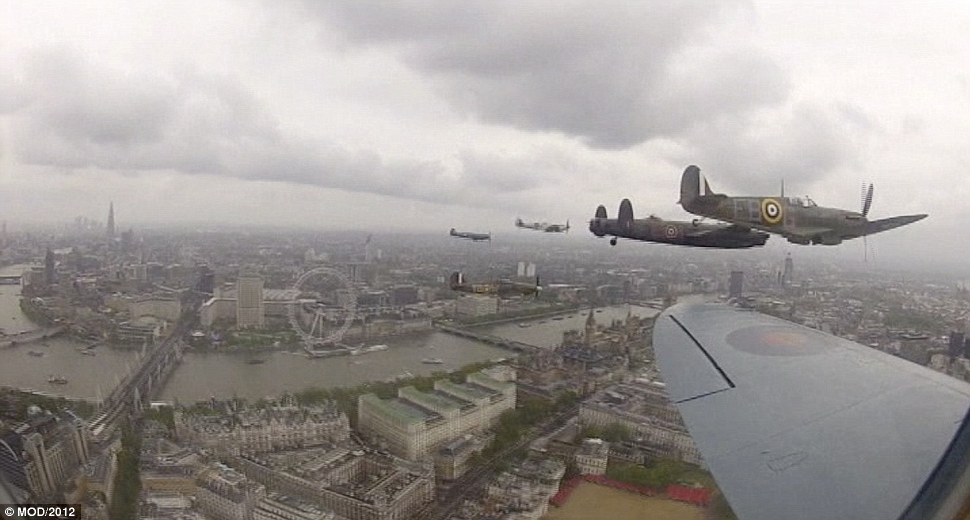
One last look back at those amazing Jubilee celebrations . . . as seen by the ‘Tail-end Charlie’ in Britain’s last airworthy Lancaster

Incredible footage has been released showing the bird’s eye view enjoyed by the crew aboard a Lancaster bomber flying over London for the Queen’s Diamond Jubilee celebrations.

The aeroplane, which is part of the RAF’s Battle of Britain Memorial Flight (BBMF), flew in formation with aircraft including a Spitfire, Hurricane and Dakota transport aircraft down The Mall, followed by the Red Arrows aerobatic team – to the delight of crowds and the Royal Family at Buckingham Palace below.

As well as preserving a fleet of priceless aircraft and keeping them in tip-top flying condition, the BBMF reminds the nation of the sacrifices made during World War Two.

Spectacular: The tail gunner’s view from the Lancaster bomber, as it completed the Diamond Jubilee flypast. Buckingham Palace Gardens can be seen behind the tail of a Hurricane fighter, also of the Battle of Britain Memorial Flight, which flew in formation with the Lancaster
Final approach: Having lined up on The Mall, the RAF Battle of Britain Memorial Flight Lancaster flies towards Buckingham Palace with St James’ Park on the left and Birdcage Walk beyond.
The nose of the Lancaster passes over the Memorial to Queen Victoria in front of Buckingham Palace.

The BBMF is based at RAF Coningsby in Lincolnshire with many of its personnel, including pilots, acting as volunteers; the flight costs about £3m a year to run.

Squadron Leader Ian Smith, who is in charge of the BBMF, is the only permanent member, with all of the remaining pilots, navigators, air engineers and other crew coming from different airbases and ordinarily flying several different types of aircraft; from Typhoon fighters to the huge Hercules transport plane.

Cramped: The footage shows just how tight a fit it can be aboard a vintage aircraft and what a tight squeeze it is for the crew aboard the Lancaster bomber.

The aircrew give up three out of every four weekends from May to the end of September in order to fly and display the historic aircraft.

The footage, released by the Ministry of Defence, shows just how tight a fit it can be aboard a vintage aircraft, with the crew – clearly eager to catch a glimpse of the Queen – taking up most of the available space.

The historic flight includes the Lancaster, which first saw service in 1942. The ‘Lanc’ was the most famous of the Second World War bombers and gained renown for its starring role in the momentous ‘Dambuster’ raid on Germany’s Ruhr Valley in 1943.

Carrying a payload of 22,000lb and with a 1,500-mile range, the RAF bomber wreaked havoc on Germany. Some 3,500 were lost in action during the war.

The view of Buckingham Palace and The Mall beyond from the Lancaster bomber.
In formation: Incredible footage has been released showing the view enjoyed by crew aboard a Lancaster bomber flying over London for the Queen’s Diamond Jubilee celebrations.

Hurricane single-seater fighters played a crucial role in the Battle of Britain. Heavier and slower than the Spitfire, it was considered the RAF’s ‘workhorse’ against the Luftwaffe.

A remarkable total of 14,533 Hurricanes were built and served operationally on every day and in every theatre during the war. Only 12 are still airworthy worldwide.

The Spitfire is the iconic fighter that won legendary status against the Luftwaffe in the Battle of Britain. It possessed a top speed of 378mph, an altitude of 35,000ft and armed with two 20mm cannons, four Browning machine guns and two 250lb bombs.

One of the four that flew yesterday was P7350 – the oldest airworthy Spitfire in the world and the only one which actually fought in the Battle of Britain. It was shot up by a Messerschmitt 109 during combat in October 1940 but its wounded Polish pilot Ludwik Martel managed to crash-land it, wheels up, near Hastings.

The pride of Britain: The vintage planes – all powered by classic World War Two Merlin engines – roar across the London sky.
Flypast: The Duchess of Cornwall, the Prince of Wales, the Queen, the Duke and Duchess of Cambridge and Prince Harry watch the aerial action.
Aerobatic aces: The Red Arrows display team fly in formation over Buckingham Palace.
Stirring image: The Lancaster, centre, was accompanied by two Spitfires on both flanks and tailed by a Hurricane.

oooOOOooo

A wonderful and incredibly nostalgic set of photographs.  Finally, let me close with a short piece of video of that Lancaster Bomber in flight.

YOU are responsible

An intriguing guest post from Schalk Cloete.

Introduction

Schalk is the author of the Blog One in a Billion which describes itself as ‘A DIY guide to saving our world while building a happy, healthy and wealthy life.‘  The Billion in the title refers to ‘the billion wealthiest world citizens, are creating serious global problems through our unsustainable consumption habits.’

As the Blog’s About page explains,

My name is Schalk Cloete, a South African research scientist currently living and working in Norway. Officially, my research is centered around the mathematical modelling of fluidized bed reactors; something which makes nice pictures, but which is not exactly the most brilliant blog material. I will therefore not bore you with further details about the kinetic theory of granular flows.

Nope, the material I write about here; building a happy, healthy, wealthy and sustainable life within our affluent modern society, should be much more interesting. I use the word “building” quite a lot because that is exactly what needs to be done. One literally needs to build the environment within which one functions from day to day with the same level of diligence and attention to detail one would use to build a house.

Anyway, with no further ado, let me go to Schalk’s guest post.

oooOOOooo

YOU are responsible

Not so long ago, Paul left a very thought-provoking comment on my blog: the One in a Billion project, and suggested that my response to that comment was worth publishing as a guest post on Learning from Dogs. Needless to say, I gratefully accepted this generous offer!  Before we go any further though, I’d just like briefly to describe my blog so that the comment can be seen in perspective.

The principle objective of my blog is to advocate personal lifestyle change as a lasting solution to the pressing sustainability problems we are facing today.

The rationale behind this overall theme is threefold:

  1. Our current systems are fundamentally guaranteed to collapse (more about this here)
  2. A personal lifestyle change is the one and only sustainable solution to this impending crisis (further detail can be found here)
  3. Such personal lifestyle changes towards sustainable living are the one and only road to lasting health, wealth and happiness.

So, on that backdrop, here was Paul’s comment:

Any successful attempt at reversing and correcting the perilous journey humanity is on has to focus on the nature of change, how humans change, why the change required in this case is psychologically complex, and how the reward feedback process has to work. In my opinion these are the core issues to be tackled.

And my response:

Change is driven by a complex set of internal and external triggers that influence our consciousness every second of every day. If these triggers collectively indicate to a person (based on his or her unique subjective interpretations and subconscious filters) that some alternative is more attractive or that the current reality is unacceptable, motivation for change is granted. The exact nature of the change that this project requests is a change in day-to-day lifestyle choices which stems from shaping a person’s interpretation and filtering of the various internal and external triggers to accurately represent the reality that a lifestyle aimed at sustainable happiness is infinitely more attractive than one focused on consumerism.

This project tries to motivate people to take action by strongly emphasizing on the immediate personal benefits of making these lifestyle changes, the ease with which these changes can be made (and made permanent), the short and long term hazards of not making these changes and the moral obligation we have to the poor and to future generations to make these changes.

The change is psychologically complex because the entire environment we live in today just begs us to consume at ever increasing rates. This is the reason why this project repeatedly emphasizes on the construction of micro-environments to protect against this toxic macro-environment and make the correct actions natural and automatic. On a higher level, change is psychologically complex because we now have to abandon a system that has raised our standard of living tremendously while we still had abundant cheap fossil fuels and a limitless planet. Our most powerful weapon has turned into our greatest threat and it should come as no surprise that we seem totally unable to handle that.

The reward-feedback process in the One in a Billion initiative is actually quite interesting. As stated before, a lot of emphasis is placed on the immediate rewards of making certain lifestyle choices, but the thing that makes it really interesting is the holistic and complementary nature of this plan. Because it covers such a broad spectrum of areas, one quickly finds that gains in one area start to enhance gains in other areas. From personal experience, this truly is an extremely exciting journey and even becomes addictive, thereby all but guaranteeing further lifestyle changes. As soon as this spiral is started, the mind becomes a lot more open to the wealth of information on sustainability out there and this understanding then stimulates further action. In the end, you end up with a completely self-sustaining upwards spiral towards happy, healthy, wealthy and sustainable living.

In closing, the change that is needed within the developed world today can basically be summarized as follows: hundreds of millions of people must be reconditioned away from a debilitating and self-destructive culture of consumerism and entitlement towards a healthy and fulfilling culture of contribution and personal responsibility. It is my sincere hope that the One in a Billion project can contribute to this change and help overcome the great challenges discussed above.

This really is a dream of mine which I have recently described in more detail under my Dream heading for anyone who might be interested. Please spend a minute or two to think about this philosophy and whether you might consider developing a similar dream of your own.

oooOOOooo

Trust me, Schalk’s blog is full of very interesting propositions.  Yet another sign that opinions are changing across this great interconnected world.

Back to fasting!

A closer look at the excellent work undertaken by Dr. Krista Varady.

Back on the 16th I wrote a post that was a follow-up to the previous day’s post about living a long life.  My follow-up was called, hardly surprisingly, Postscript to Long Life post.

In that follow-up post, I wrote this,

Over on the Healthy Fellow blogsite, there’s an interview with Dr. Varady.  The web link of that interview is here and crossing over and reading the full interview is much recommended.  Here’s a taste, pardon the pun, of that interview:

JP: Can you help explain the distinctions between alternate day fasting and caloric restriction?

Dr. Varady: Caloric restriction is basically daily calorie restriction where an individual would restrict themselves by about 15% to 40% of their energy needs daily. So basically every single day you’re undergoing the same amount of restriction, whereas alternate day fasting involves a fast day wherein the individual would only eat 25% of their energy needs. So about 500 calories or so and that’s alternated with something called a “feed day” where the individual would eat ad libitum – so as much as they want. However in our studies we show that people end up losing weight because they can’t fully make up for the lack of food on the fast day on the feed day.

I’ve been in touch with JP wondering if I might have permission to republish the full interview.  Unfortunately that wasn’t possible.  However JP did say that republishing a couple of paragraphs would be fine and I’m going to be cheeky in adding a couple to the one I already published above!

Anyway, before inserting those paragraphs, let me set the scene.  A very quick web search comes across the fact that Dr. Varady is an Assistant Professor at the UIC College of Applied Health Sciences.  Her research work is described thus,

Research Interests

Dr. Varady, PhD

My research investigates the ability of novel dietary restriction strategies to facilitate weight loss and decrease cardiovascular risk in obese subjects. The most common dietary restriction protocol implemented is daily calorie restriction (CR), which involves reducing energy intake by 15 to 40% of needs daily. Another dietary restriction regimen employed, although far less commonly, is alternate day fasting (ADF). ADF regimens include a “feed day” where food is consumed ad-libitum over 24-h, alternated with a “fast day”, where food intake is partially or completely reduced for 24-h. ADF regimens were created to increase adherence to dietary restriction protocols since these regimens only require energy restriction every other day, rather than every day, as with CR. Recent findings from our lab demonstrate that ADF is an effective means of facilitating weight loss and improving several indicators of cardiovascular disease risk in overweight and obese subjects. Our findings also show that changes in adipose tissue physiology during weight loss may mediate these improvements in vascular health.

Current research activities

Developing novel diet and exercise regimens to facilitate weight loss and decrease cardiovascular disease risk in humans; Examining the intermediate role of adipose tissue in mediating the cardio-protective effects of diet and exercise; Investigating the behavioral factors that influence adherence to dietary restriction strategies.

So this is one lady that ought to understand the effects of what we shovel down our mouths.  OK, on to that interview.  From Part One, I selected this exchange,

JP: How long does it generally take for people to adapt to this new way of eating?

Dr. Varady: A lot of the subjects were saying that for the first two weeks it was pretty tough to basically change from a 3 meal a day eating pattern to just eating 1 meal a day and then 3 slightly bigger meals the next day. But they said that about after two weeks they totally got used to it and weren’t that hungry on the fast day anymore. They could undergo these really long periods of fasting without really feeling deprived. The other interesting thing that they were telling us was with regard to the feed day. The people didn’t binge. They only ate about 100% to 110% of their calorie needs.

Then from the second part of the interview, JP underlines an important point, “The truth of the matter is that research into ADF is still in its infancy and Dr. Varady is the first person to admit it. ”  I then went on to select this exchange between JP and Dr. Varady,

JP: It seems as though ADF provides a very broad array of health benefits. Do you have a theory about why this is possible?

Dr. Varady: In the human data the main thing you see is weight loss. Even if it’s done in normal weight people. The minute you start losing weight you all of a sudden see an improvement in the majority of these factors. A lot of the effects of alternate day fasting are mediated through weight loss. Losing weight is so tightly correlated with your blood pressure, your cholesterol levels and heart rate, etc.

Fasting May Reduce Age-Related Disease Risk Factors

Source: J Appl Physiol 103: 547-551, 2007 (link)

So this is not something of trivial interest, it’s serious research that could have a remarkable effect on the huge problems of obesity and poor diet that affect millions.  Do yourself a favour and read the interview now.  Part One and Part Two.

Finally, in that post on the 16th, I owned up to having got my weight down to 161.6 lbs (73.30 kgs).  Now here we are having completed my third week of 5:2 fasting and last Saturday morning my weight was 159.0 lbs (72.12 kgs).  The routine is very comfortable and as Dr. Varady mentioned, there is no sense of wanting to binge after the two days of fasting.

Clean, clear air!

Just about the most fundamental requirement in life!

I subscribe to the Mother Nature Network website and recently in their ’round robin’ was this item, A Breath of Fresh Air.  It’s all about the role of plants inside the home for improving the quality of the air we breathe.  Thought, dear reader, that you would enjoy this.

15 houseplants for improving indoor air quality

Photo: ivama/Flickr

A breath of fresh air

In the late ’80s, NASA and the Associated Landscape Contractors of America studied houseplants as a way to purify the air in space facilities. They found several plants that filter out common volatile organic compounds (VOCs). Lucky for us the plants can also help clean indoor air on Earth, which is typically far more polluted than outdoor air. Other studies have since been published in the Journal of American Society of Horticultural Science furtherproving the science.  Want to see the best flowers? Just click through the buttons above to see all 15 plants. (Text: Julie Knapp)<

The image above is just one of 17, each with details of how they contribute to cleaner, less toxic, air. So don’t delay, click here and read all about them yourself.  Here’s an example of the presentation from picture number 16.

Peace lily (Spathiphyllum)

Shade and weekly watering are all the peace lily needs to survive and produce blooms. It topped NASA’s list for removing all three of most common VOCs — formaldehyde, benzeneand trichloroethylene. It can also combat toluene and xylene.

Have a great day!

Avoiding the catastrophe of indifference.

Doing nothing is not an option.

Introduction

So back to non-doggy stuff although I hope the themes of truth and integrity continue to rein supreme though this blog!

In the last couple of weeks, I have devoted a number of posts to the subject of change, as in how do we humans change.  The first post was Changing the person: Me where I started examining the process of change; by process I mean the models of change commonly understood in, say, management change.

The next post was You have to feel it! which drew heavily on research from Ezra M. Markowitz & Azim F. Shariff regarding the psychological aspects posed by climate change to the human moral judgement system.

The final post was From feeling to doing.  In this post, David Roberts of Grist showed that one could put aside all the ‘head stuff’ about change and in just 15 minutes cover all that one would ever want to know about the biggest issue of all facing this planet.

So rather a long introduction to two guest posts that today and tomorrow set out the case for what we all have to consider; doing nothing is just not a viable option.  The first is from Martin Lack of the popular and hard-hitting blog Lack of Environment.

oooOOOooo

Avoiding the catastrophe of indifference.

by Martin Lack.

Paul has very kindly invited me to follow-up his recent post regarding David Roberts’ item on the Grist blog entitled ‘Why climate change doesn’t spark moral outrage, and how it could’ followed by a second post in which was embedded David Roberts’ excellent video ‘Climate change is simple – we do something or we’re screwed’.

So my guest post is an expansion of a comment I submitted in response to the first of those two posts, You have to feel it.  However it would be wrong not to first add my voice to all those that have applauded David Roberts for all his excellent work.

Clive Charles Hamilton

In 2010, the Australian social anthropologist Clive Hamilton published Requiem for a Species: Why we Resist the Truth About Climate Change – one of the scariest but most important books I think I have ever read.

Reading Hamilton’s book was one of the reasons I decided, as part of my MA in Environmental Politics, to base my dissertation on climate change scepticism in the UK.

In the process, I read much but Hamilton’s book was one of very few that I actually read from cover to cover – I simply did not have time to read fully all the books for my research. However, because I have a background in geology and hydrogeology, my greatest challenge was learning to think like a social scientist.

I was all for taking these climate change sceptics head on and demolishing their pseudo-scientific arguments or taking them to task for the ideological prejudices that drive them to reject what scientists tell us. Thus, it fell to my dissertation supervisor to mention politely but firmly that I needed to disengage with the issues and analyse patterns of behaviour and frequency of arguments favoured by different groups of people.  In short, I needed to stop trying to prove the scientific consensus correct and start understanding the views held by those that dispute that consensus.

Having said how I read Professor Hamilton’s book in full, I must admit to learning about a load of other equally-scary sounding books since subscribing to Learning from Dogs;  Lester Brown’s World on the Edge: How to Prevent Environmental and Economic Collapse being just one that comes to mind!

David Roberts

Then of course there is what David Roberts himself says, which is just as scary. I think we have good reason to be scared. However, as Hamilton points out, we must move beyond being scared, which is simply debilitating, and channel our frustration into positive action.

Because if we do not, there is a great deal of circumstantial evidence to suggest that civilisation may well fail. If that means engaging in acts of civil disobedience, as it has done for James Hansen and many others, well, so be it. I suspect that nothing worthwhile has ever been achieved without someone breaking the law in order to draw attention to injustice – the abolition of slavery and child labour, the extension for all of the right to vote including women, come to mind.

That is the conclusion of Hamilton’s book; that civil disobedience is almost inevitable (p.225). Just as turkeys won’t vote for Christmas, our politicians are not going to vote for climate change mitigation unless we demand that they do so.

So it was the steer from my dissertation supervisor that lead me to read David Aaronovitch’s Voodoo Histories: How Conspiracy Theory Has Shaped Modern History, and much more about psychology. All of which guided the Introductory section of my dissertation, which summarised the philosophical roots of scepticism, the political misuse of scepticism, and the psychology of denial; see a recent post on my blog Lack of Environment.   In terms of what I want to say here, it is an elaboration of the last of those topics, the psychology of denial.  Indeed, it formed the preamble to the findings of my research.

To help me research this unfamiliar subject, my dissertation supervisor sent me a PDF copy of a paper written by Janis L. Dickinson in 2009 and published in Ecology and Society.  It was called ‘The People Paradox: Self-Esteem Striving, Immortality Ideologies, and Human Response to Climate Change’ and dealt with a challenging, almost taboo subject, namely our own mortality.

Despite my initial reluctance to learn about psychology, the more I read the more I realised just how central psychology was to explaining why we humans have failed to address the problem of climate change.

I ended up summarising the work of Dickinson, together with other sources of material, in the following manner.

In considering reasons for the collective human failure to act to prevent anthropogenic global warming (AGW), a number of authors appear to have been influenced by Ernest Becker’s The Denial of Death (1973). For example, Aaronovitch proposed that we try to avoid the “catastrophe of indifference” that a world devoid of meaning or purpose represents (p. 340).  Hamilton suggested that climate disruption “has the smell of death about it” (p. 215).

Janis Dickinson elaborates a little more, exploring what she describes as “…one of the key psychological links between the reality of global climate change and the difficulty of mobilizing individuals and groups to confront the problem in a rational and timely manner”, then referring to what psychologists call terror management theory (TMT) – Dickinson also categorises denial of climate change; denial of human responsibility and immediacy of the problem as proximal responses (Dickinson 2009).

Furthermore, as referenced here, both Dickinson and Hamilton suggest that other distal TMT responses, such as focussing on maintaining self-esteem or enhancing self-gratification, can be counter-intuitive and counter-productive. Dickinson summarises the recent work of Tim Dyson by saying “[b]ehavioral response to the threat of global climate change simply does not match its unique potential for cumulative, adverse, and potentially chaotic outcomes” (ibid).

Based on the evidence of the most frequently used arguments for dismissing the scientific consensus regarding climate change, I collated the findings of my research and which might be summarised as follows:

Having analysed the output of such UK-based Conservative think-tanks (CTTs), along with that of scientists, economists, journalists, politicians and others, it would appear that the majority of CTTs dispute the existence of a legitimate consensus, whereas the majority of sceptical journalists focus on conspiracy theories; the majority of scientists and economists equate environmentalism with a new religion; and politicians and others analysed appear equally likely to cite denialist or economic arguments for inaction.

As I find myself saying quite frequently, the most persistent arguments against taking action to mitigate climate change are the economic ones.

However, as all the authors mentioned have suggested, or at least inferred, I think it is undoubtedly true that the most potent obstacle to people facing up to the truth of climate change is our psychological reluctance to accept responsibility for something that is obviously deteriorating – namely our environment!

Nevertheless, all is not yet lost.  We do not all need to go back to living in the Dark Ages to prevent societal and environmental collapse but we do need to accept a couple of fundamental realities:

  1. Burning fossilised carbon is trashing the planet. Therefore, fossil fuel use must be substituted in every possible process as rapidly as possible. Unfortunately, it is not substitutable in the most damaging process of all; aviation.  That merely increases the urgency of substituting where we can (i.e. power, lighting and temperature control).
  2. Poor people in developing countries have a legitimate right to aspire to having a more comfortable life but the planet definitely cannot cope with 7 to 10 billion people living like we do in the “developed” countries.

Once we accept these realities, we will learn to use less fossil fuels and, if we can become self-sufficient using renewable energy sources, we can have a flat-screen TV in every room and leave them on standby and the A/C on full power 24/7 and still have a clear conscience. However, we must get off fossil fuels ASAP.

oooOOOooo

I am indebted to Martin for writing such an insightful analysis of how we all have to change.  Tomorrow, another guest post further exploring the options that face us all as we work towards a sustainable future.  As I opened this post, doing nothing is not an option!

Feeling depressed? Join your pals in the pool!

A wonderful video sent in by Dan Gomez.

Regular followers of Learning from Dogs will know that Dan and I go back a long way; far too long!  In fact the occasion of me becoming aware of Mr. Daniel Gomez was at a Commodore Computer users conference in Boston, Mass.

I was giving a talk promoting a word-processing program that I was marketing for the Commodore.  That software was called Wordcraft and I think the year was 1979, possibly 1980.  Anyway, I used the word ‘fortnight’, which back in England is a common word meaning two weeks.  Immediately, a voice called out from the audience, “Hey Handover, what’s a fortnight?

The session deteriorated rapidly thereafter!  Dan and I became very good friends and his LA company Cimarron became my West Coast USA distributor for Wordcraft.  And it was Dan’s sister, Suzann, who invited me down to Mexico for Christmas 2007 which led to me meeting my beloved Jeannie!  Funny old world!

On to the video

The male golden dog on the left-hand side of pool is Willis, a two-year-old Golden Retriever who has cataracts and is practically blind.  Then there is Gwendy who seems to have been with Dan for an absolute lifetime.

Then the black dog is Bella, a flat-coated retriever, that belongs to a neighbour.

When I spoke with Dan over the phone about Willis, Dan said that he is not in any way a disabled dog.  In the pool, he listens to where the ball lands, swims towards it and then lets his nose locate it precisely.  Out walking, when Dan throws the ball, Willis is just able to see Dan’s arm move through the air.  Willis then computes where the ball is heading, runs in that direction and, again, uses his power of smell to pin down the ball exactly.

What fabulous animals they are