Category: Core thought

Three years on, and ….

Nothing much changes.  This post first published on the 4th November, 2009!

Debt stress in Middle Class America – how may this play out?

On Saturday, October 24th Yves Smith of Naked Capitalism ran a Post on her Blog about an anonymous couple who were over their heads in debt.  (Yves has given me written permission to reproduce the Post.) The story of this couple then generated a huge response of comments. Read the comments, each and every one of them.

Then ask yourself abraham-lincoln-picturewhere this is all heading?  These comments may, almost certainly are, just be the tip of the iceberg.  Seems a long way from Lincoln’s Gettysburg address in which he was reputed  to have used the words: “… government of the people, by the people, for the people, shall not perish from the earth.”
Some days I worry; worry a lot!

The extract from Yves Post about this couple is reproduced below but far better is to go and read the whole Post and all the comments.

UPDATE: Since writing this Post Yves has published a further Post on the topic again generating a huge volume of comments.  That was Sunday, November 1st.  Then bright and early on November 2nd James Kwak of Baseline Scenario weighs in with his version, Do smart, hard-working people deserve to make more money? 150 comments (at the time of writing) for that one.  Interestingly, as the days have gone on the mood of the commentators has become more reflective and thoughtful thus partly negating the theme behind this Post.

This is the original Post from Naked Capitalism:

Some readers like to demonize those who get in over there heads with debt as people who lived high on the hog and had their day of reckoning come upon them. This story, forwarded from a reader, shows the picture is more complicated.

When I was young, savings of six months of living expenses was considered to be a good cushion against risk. Is that true any more? I doubt it. Although this couple didn’t even have that much stashed away, the sort of buffers that worked a generation ago are insufficient now. People spend longer between jobs than in the past, and if/when they do find new work, it is often at a lower level of pay than before.

Job loss and major illness rather than an overly lavish lifestyle are still the biggest causes of bankruptcy. And now that the average tenure at a job has shrunken considerably, people need to have more in the way of savings, yet the high cost of unemployment means it is even harder than before to build up a big enough kitty.

Via one a correspondent:

Just like most everyone I know, my husband and I are in big debt with our credit card companies. My husband was laid off on New Year’s Eve last year. We were in total shock. I am retired from the USAF and receive a small monthly check, and my husband began collecting a meager unemployment check. He searched all over the US and made several trips out west knocking on doors and handing out his resume. NOTHING. Anyway, we had no saving and a little bit of stock which was cashed in at an all time low. No help there. Then we started living off our credit cards. Without them, we would have not made it, period. Our daughter and her family moved in upstairs and her husband was working of a whopping $8.50 an hour. No help there. So basically we were supporting them as well.

We have a mortgage payment of $1175 and $30,000 equity still in our home, but we are unable to refinance at a lower rate BECAUSE my hubby was unemployed!

Getting back to my B of A card, I have NEVER been late on a payment in 10 years (until last month). I have always paid more than the minimum (until January 1st). BUT, my interest rates have inched up and up in the last few months and then, BOW! I tried to use my card about 3 weeks ago at the grocery store and it was denied. Needless to say, I walked out without the food. We don’t waste anything, not money, not food, not heat or lights, nothing, but we are going down fast. The good news is that my husband got a job this week (at a much, much lower wage) and will finally get a pay next week after almost 10 months. The bad news is that B of A is killing me and will ruin me soon. I sent them a “token” $10 payment on the $450 monthly that I owed. The payment was on time, but the $10 sure didn’t make them happy. They slapped a “LATE FEE” of $39 even though my “payment” was not late AND of course the dreaded overdraft fee of $39. Yesterday I got a statement from them saying that my next payment due 11/11 is $950. I can see the snowball at the top of the hill ready to roll. What do I do? Do I revolt and refuse to pay? Do I keep sending them $10 as a promise to pay? OR do I write Kenneth Lewis and say I want some of their TARP/bonus money back so I can apply it to my B of A account? It’s not fair, although I know we lived off our credits cards and much of what I owe is money that I spent on essentials, BUT, the ultrahigh interests rates combined with their slap-on-every-extra-fee-we-can mentality is outrageous. We have worked all our lives to have and keep our excellent credit ratings and now all that is shot.

What do I do? What do we do? Like I mentioned before, my husband just got a job, but he will be making much, much less than he used to. Our mortgage is behind, the bank is on us about that, our credit cards a behind and they want even MORE blood, our kids and their families aren’t making it even though they work and pinch every penny, no insurance is within reach for them or their babies, so we have been shuffling payments to help our grandchildren, the list goes on and on and on and on…

Please, what do we do? How can we stop the madness that has engulfed us? We are good citizens, worked hard all our lives, paid all our bills on time and paid more than the minimum – until lately -, penny pinch, reheat the reheated leftovers, eat toast, never go out, never hurt anyone, love our family and served our country, and now this.

Please, what do we do?

oooOOOooo

Could have been written yesterday!

The Duke of dogs

The widely reported story of a dog saving the life of a baby.

Although this story came into prominence a week ago, this is the first opportunity for inserting it on Learning from Dogs.  That doesn’t detract one little bit from the power of the tale, so watch this video!

Time to change the clocks!

A republication of a post first shown on 28th October, 2009 which still seems relevant as British Summer Time is due to end in a couple of days time.

oooOOOooo

An ancient idea may have run it’s course?

What is the purpose of “Daylight Saving”? [Interesting history of Daylight Saving on Wikipedia. Ed.]

clock faceThis week we are in a particularly interesting situation as we are in the middle of a one week separation between the dates when Europe and US change their clocks back to “normal” winter time. I.e. Europe changed their clocks back at 2am last Sunday and most, but not all, US States change their clocks back at 2am this coming Sunday.

This is even more confusing than normal. But why are we doing this at all?

Is it to save fuel, to save lives, to save time or to save something else?

In my humble opinion it is all nonsense!

“Time management” is a myth

Time is time! People say that they do not have enough time to do this or that, as if they have ways to make some more; and, of course, there is much talk about “time management”. Yet we all have the same amount of time and no amount of management will change that!

We are certainly able to manage the things that we try to fit into the available time.  That is, we can manage tasks, effort and so on. But, in everyday (Newtonian rather than Einsteinian) regimes, time is an inelastic independent variable. Fiddling about with the clocks and trying to “manage time” have no effect on the stuff whatsoever. Let it be!

There must be a better way!

Yes, I know! Some people make claims of wasted daylight or of the dangers to schoolchildren walking to or from school in the dark. These are valid areas of concern. If adjusting the times of business operations or schooling helps to deal with them, then by all means do so. But, for goodness, let’s not pretend the time is different.


Adieu Payson

The end of a treasured time in Payson, Arizona.

Today, Jean and I together with our 11 dogs and 5 cats start the 1,200 mile journey to Merlin, Oregon.  While we have only lived in Payson since February, 2010, it has been a time of fantastic experiences.  I had to work through the long process of getting a fiancee visa from the American Embassy in London.  Until that was issued my ‘residence’ in Payson was that of a British tourist with me having to leave the USA every 90 days.

The visa was issued in October, 2010 and I flew immediately to Arizona.  On the 8th November, 2010 Jean and I were issued with a Marriage License Certificate and we were married on the 20th November at St. Paul’s Episcopal Church in Payson.

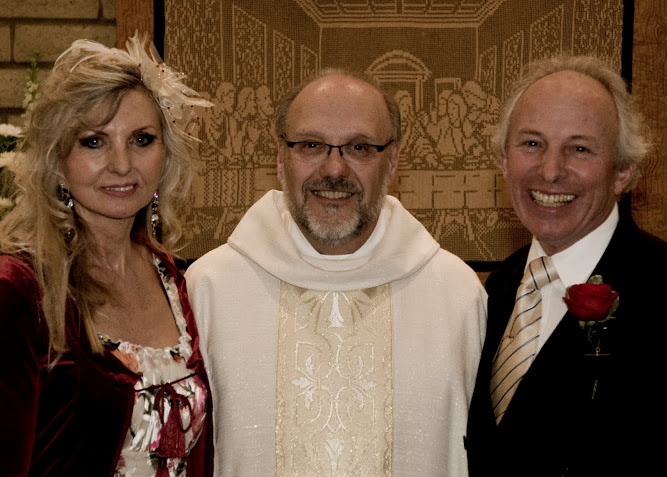
Fr. Dan Tantimonaco with the newly weds!

We have made many very dear friends here in Payson but Oregon feels like the start of our home in every sense of the word, not just because it is the first home that Jean and I have bought jointly.

One of those dear friends here in Payson has been John Hurlburt, a devoutly spiritual man.  A little over a week ago, he sent me a very thoughtful essay and I wanted to include it today as a guest post in recognition of the way that John and many, many others have embraced these couple of Brits over the last 32 months.  Thank you all.

oooOOOooo

Unity

Everything fits together

The species of animals we know as human beings is a part of everything that exists. We are a very young consciously-aware species that does not begin to know all the answers. What little we do know has a Natural pattern. It would seem that there’s a lamplighter and a navigator in all of us. The lamplighter is our fundamental awareness of being and provides nature’s guidance along life’s pathways.

Our natural navigator is designed for evolutionary competition. There’s a biological survival kit in our DNA. Extreme demand for limited resources generates deadly combat; both within and between species. As a result of competition taken to wretched excess, our global economy is leveraged 22 times beyond any earthly foundation. The unspoken intent to destroy each other over what remains of our planet is becoming increasingly evident.

The human species is engaged in a global war over money, ideals and disappearing finite resources. Ninety-seven percent of the world scientific community has confirmed that the natural effects of heat and discharges generated by human machines and related human activities are the primary cause of recent rapid climate change.

These dedicated scientists are opposed in the media by three percent of their corporate energy-financed peers. An oppressive worldwide network of often offensive politicians is similarly supported and managed accordingly. Nature couldn’t care less about politics, emotions or idealistic arguments.

Human squabbles mean very little in the totality of universal life. The drumbeat of local natural disasters increases steadily. There are no two ways about it. No amount of human ifs or buts can or will change reality. Our human species is in deep serious trouble.

It has been six million years since the first humanoids emerged and two million years since the rise of human civilization. What a sorrow it is to realize what we have done to the earth in just the past two hundred and fifty years. We’ve reached the moon and are exploring Mars. It’s well past time to clean house and re-grow our local garden.

As an old navigator, there’s a sense of urgency regarding the course life on earth has taken. For those who continue to care about facts, the prognosis is not encouraging. We have the know-how for an alternative. We can avoid the perfect storm of going over the edge of an economic cliff and the crush of an environmental crisis in the midst of a war-fuelled, profit-driven, global, corporate fight to the end. The alternative is that we have the know-how to transition rapidly to a reality-based economy and a way of living that’s gentle to the earth. The solution is global, it’s industrial, it’s natural and it’s our best hope. It may well be our only hope. It’s time to light some lamps.

Conscious human awareness emerges as we relax, contemplate, meditate, and communicate openly. These are levels of awareness beyond the limits of our daily human musings. The wisdom which flows from enlightened awareness embraces humility, experience, knowledge, understanding, and faith. Life has never been easy. We’re fragile biological beings. Our mutual growth is the result of sustained efforts over millions of years.

Yet despite attaining a higher level of conscious awareness our human culture continues to operate on a material basis rather than a moral basis. We have become confused by our own importance or the apparent lack thereof. We all too often retreat into a rut, furnish it and turn on the electronics.

By definition, natural processes support species growth in harmony with all natural life. Those natural processes are indistinguishable from the planetary support systems within which all life interacts. Human interaction is local. We spend much of our lives unaware that we are unaware; initially as infants and throughout our lives in deep sleep. When caught up in the pressures of our daily lives, it’s easy to be unaware of being unaware.

It’s time to wake up. Cosmology is an eternal spring from which the waters of the earth still flow. When we turn ourselves inside-out and achieve higher awareness, we discover who, what and where we really and truly are. In a trinity of spirituality, nature and science, we’re cosmically energized beings; spiritual beings sharing a transitory human existence.

Ninety-eight percent of the human population believes in a power beyond species and self. The simplest understanding of this belief is that we humans did not originally create ourselves. All human wisdom and understanding leads to the conclusion that human beings don’t own the earth. We’re caretakers and we’re only passing through. Given that we have a systemic crisis, what do we have to work with?

We have a species that’s squabbling over diminishing resources, an environment and an infrastructure which both desperately require attention, a sustaining objective of equitable global employment, a world economy that’s about to collapse for lack of any real foundation, a burgeoning population which further strains the system and the clear need for a unifying purpose.

Put it all together and what do we have? The navigator is our guide to growth. The navigator shares our wholeness. The lamplighter is our guide to unity. Everything fits together. Each of us is a part of the unity of life. Unity has a natural purpose. It’s time to build a life boat.

John Hurlburt is a former U.S. Navy aviator and successful corporate executive who presently serves as a senior Christian educator and a founding member of an international Transition Town in Payson, Arizona.

oooOOOooo

Don’t know about you, dear reader, but I find those incredibly powerful words.  Words that provide the truth. A truth the whole world needs.  John set out in a personal email to me the three simple fundamentals of our lives. Just a few more words to sum up the truth.

There’s an environmental crisis.  There’s an inevitable global economic abyss touching us all on a daily basis.  The need for a green economic transformation is obvious.

Thank you, John.

In the sky with diamonds!

A fascinating item recently published by Yale University.

Apologies, time pressure allows me little more than to repeat this in full.  But still no less interesting.

oooOOOooo

Nearby super-Earth likely a diamond planet

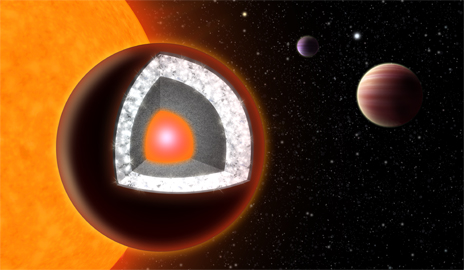
Illustration of the interior of 55 Cancri e — an extremely hot planet with a surface of mostly graphite surrounding a thick layer of diamond, below which is a layer of silicon-based minerals and a molten iron core at the center. (Image by Haven Giguere)

October 11, 2012

New research led by Yale University scientists suggests that a rocky planet twice Earth’s size orbiting a nearby star is a diamond planet.

“This is our first glimpse of a rocky world with a fundamentally different chemistry from Earth,” said lead researcher Nikku Madhusudhan, a Yale postdoctoral researcher in physics and astronomy. “The surface of this planet is likely covered in graphite and diamond rather than water and granite.”

The paper reporting the findings has been accepted for publication in the journal Astrophysical Journal Letters.

The planet — called 55 Cancri e — has a radius twice Earth’s, and a mass eight times greater, making it a “super-Earth.” It is one of five planets orbiting a sun-like star, 55 Cancri, that is located 40 light years from Earth yet visible to the naked eye in the constellation of Cancer.

The planet orbits at hyper speed — its year lasts just 18 hours, in contrast to Earth’s 365 days. It is also blazingly hot, with a temperature of about 3,900 degrees Fahrenheit, researchers said, a far cry from a habitable world.

The planet was first observed transiting its star last year, allowing astronomers to measure its radius for the first time. This new information, combined with the most recent estimate of its mass, allowed Madhusudhan and colleagues to infer its chemical composition using models of its interior and by computing all possible combinations of elements and compounds that would yield those specific characteristics.

Star map showing the planet-hosting star 55 Cancri in the constellation of Cancer. The star is visible to the naked eye, though better through binoculars. (Image by Nikku Madhusudhan; created using Sky Map Online

Astronomers had previously reported that the host star has more carbon than oxygen, and Madhusudhan and colleagues confirmed that substantial amounts of carbon and silicon carbide, and a negligible amount of water ice, were available during the planet’s formation.

Astronomers also thought 55 Cancri e contained a substantial amount of super-heated water, based on the assumption that its chemical makeup was similar to Earth’s, Madhusudhan said. But the new research suggests the planet has no water at all, and appears to be composed primarily of carbon (as graphite and diamond), iron, silicon carbide, and, possibly, some silicates. The study estimates that at least a third of the planet’s mass — the equivalent of about three Earth masses — could be diamond.

“By contrast, Earth’s interior is rich in oxygen, but extremely poor in carbon — less than a part in thousand by mass,” says co-author and Yale geophysicist Kanani Lee.

The identification of a carbon-rich super-Earth means that distant rocky planets can no longer be assumed to have chemical constituents, interiors, atmospheres, or biologies similar to those of Earth, Madhusudhan said. The discovery also opens new avenues for the study of geochemistry and geophysical processes in Earth-sized alien planets. A carbon-rich composition could influence the planet’s thermal evolution and plate tectonics, for example, with implications for volcanism, seismic activity, and mountain formation.

“Stars are simple — given a star’s mass and age, you know its basic structure and history,” said David Spergel, professor of astronomy and chair of astrophysical sciences at Princeton University, who is not a co-author of the study. “Planets are much more complex. This ‘diamond-rich super-Earth’ is likely just one example of the rich sets of discoveries that await us as we begin to explore planets around nearby stars.”

In 2011, Madhusudhan led the first discovery of a carbon-rich atmosphere in a distant gas giant planet, opening the possibility of long-theorized carbon-rich rocky planets (or “diamond planets”). The new research represents the first time that astronomers have identified a likely diamond planet around a sun-like star and specified its chemical make-up. Follow-up observations of the planet’s atmosphere and additional estimates of the stellar composition would strengthen the findings about the planet’s chemical composition.

The authors of the paper are Madhusudhan, Lee, and Olivier Mousis, a planetary scientist at the Institut de Recherche en Astrophysique et Planetologie in Toulose, France.

The paper is titled “A Possible Carbon-rich Interior in Super-Earth 55 Cancri e.”

The research was supported by the Yale Center for Astronomy and Astrophysics (YCAA) in the Yale Department of Physics through Madhusudhan’s YCAA postdoctoral prize fellowship.

oooOOOooo

Dead easy to know how to finish this post off!

Regrowth

Yet another example of how positive change is so powerful.

I first saw this mentioned in a recent update from The Permaculture Research Institute of Australia.  It concerns the wonderful work being done by the town of Todmorden in the UK.  Here’s a recent piece on Daily Mail Online,

Carrots in the car park. Radishes on the roundabout. The deliciously eccentric story of the town growing ALL its own veg

Admittedly, it sounds like the most foolhardy of criminal capers, and one of the cheekiest, too.

Outside the police station in the small Victorian mill town of Todmorden, West Yorkshire, there are three large raised flower beds.

If you’d visited a few months ago, you’d have found them overflowing with curly kale, carrot plants, lettuces, spring onions — all manner of vegetables and salad leaves.

Today the beds are bare. Why? Because people have been wandering up to the police station forecourt in broad daylight and digging up the vegetables. And what are the cops doing about this brazen theft from right under their noses? Nothing.

Now watch this:

Todmorden have a website where all is explained, not unnaturally (sorry) called Incredible Edible Todmorden Unlimited! From there one learns that what they do is as follows:

What we do

We grow and campaign for local food.

Follow the links on the left to see in detail what we’re up to. Or you can get involved yourself. Our growing around town is organised by our community growers’ group: find out about that here.

From our beginnings with herb gardens, we’ve taken to planting and growing veggies and trees round town we’ve planted several orchards and there are more to come, and we’re working with public bodies round town to use their land – like the fire station and the railway station – or to work with them on their own Incredible ideas – like social landlord Pennine Housing.

Every school in the town is now involved in growing with us and we promotefood-based learning for the community as a whole.

We’re reaching back into local memories and knowledge with our History project.

Our campaigns aim to make different futures happen, through local campaigns like Every Egg Matters, and by spreading the word locally, regionally and nationally.

We hope to make a difference with major projects. We now have Lottery funding for our food hub at Tod High School and are just waiting for the final planning permission. That bid included the work of a food-inspirer a position now held by Sally.

We have also branched out to greenfield sites, working on donated land in Walsden to create a major resource for growing and learning, and on donated land in Gorpley to develop ideas about hill-top farming. More about them here

Growing herbs at the Station – of course!

What an absolutely fabulous example to the rest of the world!

Lets try not to get stuck in a rut…

A fascinating look back at making tracks!

This came in from Suzann, Su to her friends, a few days ago.  Suzann is Dan Gomez’s sister and if Dan’s name is familiar it’s because he, too, sends in items for Learning from Dogs, the recent Tad too much cabin pressure being an example.  It was Su that invited me out to San Carlos, Mexico for Christmas 2007 which resulted in me meeting Jean, a long-time friend of Su, and, as they say, the rest is history!  OK, to the article from Su.

oooOOOooo

Here’s a question?

Think about railroad (railways in ‘English’!) tracks.  The US standard railroad gauge (distance between the rails) is 4 feet, 8.5 inches.  That’s an exceedingly odd number.

Why was that gauge used? Because that’s the way they built them in Scotland, and Scots expatriates designed the US railroads.

Why did the Scots build them like that? Because the first rail lines were built by the same people who built the pre-railroad tramways, and that’s the gauge they used.

Why that gauge then?  Because the people who built the tramways used the same jigs and tools that they had used for building wagons, which used that wheel spacing.

Why did the wagons have that particular odd wheel spacing?  Well, if they tried to use any other spacing, the wagon wheels would break on some of the old, long-distance roads in Scotland, because that’s the spacing of the wheel ruts.

So who built those old rutted roads?  Imperial Rome built the first long distance roads in Europe (including Scotland) for their legions.  Those roads have been used ever since. [And rarely repaired! 😉 Ed. ]

And the ruts in the roads? Roman war chariots formed the initial ruts.  Which forever more everyone else had to match for fear of destroying their wagon wheels.

Since the chariots were made for Imperial Rome, they were all alike in the matter of wheel spacing.  Therefore the United States standard railroad gauge of 4 feet, 8.5 inches is derived from the original specifications for an Imperial Roman war chariot.

Bureaucracies live forever….

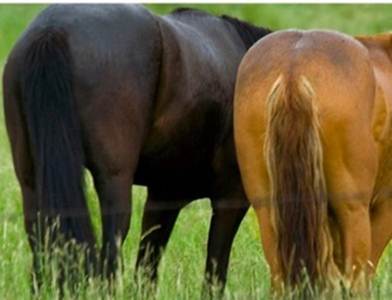
So the next time you are handed a specification or a procedure or process and wonder ‘What horse’s ass came up with this?‘, you may be exactly right.  Imperial Roman army chariots were made just wide enough to accommodate the rear ends of two war horses.

Now, the twist to the story. When you see a Space Shuttle sitting on its launch pad, there are two big booster rockets attached to the sides of the main fuel tank. These are solid rocket boosters, or SRBs.  The SRBs are made by Thiokol at their factory in Utah.

The engineers who designed the SRBs would have preferred to make them a bit fatter, but the SRBs had to be shipped by train from the factory to the launch site. The railroad line from the factory happens to run through a tunnel in the mountains, and the SRBs had to fit through that tunnel.

The tunnel is slightly wider than the railroad track, and the railroad track, as you now know, is about as wide as two horses’ behinds.

oooOOOooo

Just a fabulously interesting account of something we all take for granted, or had done until now! Thank you so much, Su, for sharing that with everyone.

Help stop this cruelty to dogs and cats.

A recent petition from Change.org

I subscribe to Change.org and recently this came into my email in-box.

Tell Veterinarians: Devocalization is Mutilation!

Started by: Sue Perry

It’s hard to believe, but some vets actually cut the vocal cords of dogs AND cats just to suppress their voices. We know because it happened to our dogs before we adopted them. They’re two very different breeds—a Newfoundland and a Chihuahua—and we live in two different states.

We joined with Coalition to Protect and Rescue Pets, which led the successful campaign to ban devocalization in Massachusetts, to make sure no other dog or cat anywhere suffers as ours have.

But until the American Veterinary Medical Association (AVMA) changes its position on devocalization, countless other dogs AND cats will be subjected to this inhumane, unnecessary surgery.

Though devocalization is so cruel it is illegal in many countries, the AVMA continues to condone it as a “final alternative” to manage barking.

That leaves animals vulnerable to and legitimizes devocalization. Here’s why:

No vet can possibly know if devocalization is a “final alternative,” and some won’t ask. Even receipts from a trainer or behaviorist don’t mean the advice was followed consistently or at all; devocalization is easier for lazy or impatient owners.

And just as devocalization didn’t keep our dogs from becoming homeless, it hasn’t prevented the abandonment and euthanasia of countless other dogs and cats.

HOW AVMA’S POSITION HURTS ANIMALS

Massachusetts currently has the only enforceable state devocalization ban in the US. Other state laws protect owners and vets but not animals, who are subjected to a dangerous surgery they don’t need but are helpless to refuse: http://cprpets.weebly.com/loopholes-that-hurt-animals.html

We wish veterinary associations had supported legislation that truly protects animals by prohibiting vocal cord surgery except to treat a physical illness, injury or birth defect.

Instead, these associations have opposed enforceable humane laws, using the AVMA’s “final alternative” position to justify cutting an animal’s vocal cords just to deal with barking or meowing.

Why would any vet condone such cruelty? It’s obvious that some devocalize dogs and cats because it’s profitable. Others won’t devocalize but oppose banning it anyway. It could be they fear these laws would lead to prohibition of other unnecessary, mutilating surgeries like declawing, cropping ears and docking tails.

HOW DEVOCALIZATION HURT OUR DOGS

Please meet our dogs in the video on this page.

Though an experienced vet devocalized our gentle giant, Porter, in the least invasive way, scar tissue formed in his throat, making it hard for him to breathe and swallow; he rasps, coughs and gags throughout the day like a chain smoker. Because devocalization permanently damaged his larynx too, he’s at great risk for inhaling food, liquids, even vomit into his lungs.

Tiny Lola struggles to force out a bark and doesn’t always succeed. Like other devocalized animals, she coughs and gags a lot. One day, she may have to face the same $2,000 surgery Porter needed to save his life after he was devocalized.

That’s brutal punishment for the “crime” of communicating!

Please don’t let this brutality continue. Tell the AVMA: There is no ethical reason to cut vocal cords just to stifle an animal’s voice—ever. Devocalization is an act of cruelty that no animal deserves, no vet should perform, no veterinary association should sanction, and no civilized society should allow.

Click here to sign Sue Perry ‘s petition, “Tell Veterinarians: Devocalization is Mutilation!”.

Please, also, go to the petition page on Change.org here.  Thank you for helping.

Change in action

There is real hope for us all!

Hopefully, you were able to watch the Amory Lovins talk in yesterday’s post?  If not, then do find time to watch how Professor Lovins sets out the powerful argument that the USA could soon, relatively speaking, be energy self-sufficient.

So on top of the Lovins presentation, I wanted to draw your attention to an item on Climate Crocks last October 5th.

One of the great stories untold in the American media is the ongoing revolution in one of the world’s most advanced economies – as Germany undertakes a bold and serious transition from powering a great engine of prosperity on fossil fuels, to plentiful and inexhaustible renewable energy.

Listening to Mitt Romney double and triple down on the bogus Fox/Fossil narrative about “clean coal” and failed renewables, it might be well to consider how one of our toughest manufacturing competitors is going all-in on the high stakes renewable energy revolution of the new century.

The article is a detailed analysis of how Germany is powering ahead, pardon the pun, in the provision of non carbon-based power, as this reference illustrates,

German use of coal to generate electricity has declined steadily from 1990 to 2011, according to readily available statistics on the German electricity system. The percentage of coal-fired electricity in German electricity generation has fallen from 56.7% in 1990 to 43.5% last year–a decrease of more than 10% despite a increase in total electricity generation during the same period of about 10%. At the same time the share of renewable energy in the electricity mix has increased from 3.6% to 19.9%, mostly due to the rapid development of wind energy and biomass.

Do go across and read the article.

Then thanks to a comment left on a recent post by Martin Lack another very positive story came to light (yet another pun – read on!),

Comment from Jules,

Here is one for you- http://www.solarroadways.com/intro.shtml – the idea is totally leftfield, but it fulfils certain issues such as distribution, decentralisation of power and offers a recharge network for electric cars and it has received a big chunk of government funding. It is so out there that I wonder if it could possibly be the answer but you never know.

Very quickly one finds that Solar Roadways are involved in something VERY interesting, namely,

Years ago, when the phrase “Global Warming” began gaining popularity, we started batting around the idea of replacing asphalt and concrete surfaces with solar panels that could be driven upon. We thought of the “black box” on airplanes: We didn’t know what material that black box was made of, but it seemed to be able to protect sensitive electronics from the worst of airline crashes.

Suppose we made a section of road out of this material and housed solar cells to collect energy, which could pay for the cost of the panel, thereby creating a road that would pay for itself over time. What if we added LEDs to “paint” the road lines from beneath, lighting up the road for safer night time driving? What if we added a heating element in the surface (like the defrosting wire in the rear window of our cars) to prevent snow/ice accumulation in northern climates? The ideas and possibilities just continued to roll in and the Solar Roadway project was born.

Now watch this!

and then watch this, as nearly 1.5 million others have!

The Solar Roadways project is working to pave roads with solar panels that you can drive on. Co-founder Scott Brusaw has made some major steps forward since our first visit back in 2007, so we visited him again for an exclusive update on the project, including the first ever video recorded of the Solar Roadways prototype! For more information visit http://www.solarroadways.com . This Solar Roadway project is highlighted as one of many planet-friendly solutions in the feature film by YERT – Your Environmental Road Trip. To learn more about YERT, visit http://yert.com .

Flattr this video here: https://flattr.com/thing/407726/YERT-video-about-Solar-Roadways-The-Prototype

And you can become a fan of YERT on Facebook here:http://www.facebook.com/home.php#!/pages/YERT-Your-Environmental-Road-Trip/12…

So nothing ever stays the same!

Extreme weather events

Nature is really starting to speak to mankind!

I started writing this post back on the 25th September.  Why so far back?  Because that day something came into my in-box that deserved the widest circulation.  It’s an event being held just under a month from today, November 14th.  But it seemed worthwhile to give this amount of notice.  However, the reason why I wanted to start it back in September was because in the last 24 hours of that day, the 25th, the UK offered very good evidence of the significant increase in severe weather.

From the UK’s Met Office blog on the 25th September, 2012, (I have included the inches equivalent of the mm figures)

Rainfall figures: over a month’s worth of rain in two days

Rainfall totals for the past few days – from 1:00 am Sunday morning to 8:00 am this morning [Tuesday] – show some areas have already had more than twice their usual September rainfall. Ravensworth, in North Yorkshire, has seen the highest total, with 107.8 mm [4.24 in] falling, over 200 % of its average September rainfall.

The rainfall has been widespread, with many areas across the United Kingdom receiving large totals. Killylane, in Antrim Northern Ireland saw 98.2 mm [3.87 in], and high totals were also recorded in the south-west, with 72.4 mm [2.85 in] in Filton and 65.2 mm [2.57 in] at Dunkeswell Aerodrome.

Dunkeswell Aerodrome in Devon was where I used to fly our group-owned Piper Super Cub, still in military markings.

Piper Super Cub at Dunkeswell Aerodrome
A carriage made for two!

Anyway, back to the plot!

Also on that day (September 25th) the website Think Progress released this item,

Markey/Waxman Report: Carbon Pollution Creating A ‘Cocktail Of Heat And Extreme Weather’

By Climate Guest Blogger and Stephen Lacey on Sep 25, 2012 at 3:31 pm

by Katie Valentine and Stephen Lacey

Two House Democrats have released a report that aims to connect the dots on climate change and extreme weather events.

The staff report, issued by Henry Waxman (D-Calif.) and Edward Markey (D-Mass.), outlines the past year’s record-setting temperatures, storms, droughts, water levels and wildfires, and is being circulated in an attempt to rebuild congressional momentum to address climate change.

“The evidence is overwhelming — climate change is occurring and it is occurring now,” said Rep. Waxman, a Ranking Member of the Energy and Commerce Committee, in a statement.

The report outlines the stunning array of record-breaking extreme weather events throughout 2012 within five categories:

Extreme temperatures

  • July was the hottest month ever recorded in the continental U.S.  Some areas were 8 degrees warmer than average, with the average temperature in the lower 48 states at 77.6 degrees Fahrenheit, 3.3 degrees above the 20th century average.
  • Spring 2012 saw the warmest March, third-warmest April and second-warmest May in history, and was approximately 5.2 degrees Fahrenheit above average overall.
  • Through late June 2011, daily record highs were outnumbering daily record lows by 9-to-1.

Drought

  • As of September, 64 percent of the continental U.S. is experiencing drought, with August and September 2012 comparable to the worst months of the 1930s Dust Bowl.
  • By the beginning of August, more than half the counties in the U.S. had been designated disaster zones because of drought.
  • As of August, 51 percent of corn and 38 percent of soybeans grown in the U.S. were rated as poor or very poor by the U.S. Department of Agriculture. Some states’ corn fared worse – Indiana had 70 percent of its corn rated as poor or very poor, and Missouri had 84 percent.

Wildfires

  • This fire season 8.6 million acres – roughly the size of Connecticut and New Jersey combined – have burned in the U.S., with fires still burning in parts of the West.
  • Wildfires in Colorado have killed six people, destroyed 600 homes and caused about $500 million in property damage.
  • There has been nearly a four-fold increase in large wildfires in the West in recent decades, with fires burning longer and more intensely and wildfire seasons lasting longer.

Storms

  • Tropical Storm Debby caused Florida to have its wettest June on record. The storm killed at least seven people and also damaged more than 7,500 homes and businesses.
  • In July, the “derecho” storm system killed at least 23 people and left more than 3.7 million people without power.
  • In August, Hurricane Isaac caused storm surges of up to 15 feet in some places and contributed to Louisiana and Mississippi experiencing their second-wettest August on record and to Florida experiencing its wettest summer on record.

Extreme water levels and water temperatures

  • In July, water in the Great Lakes reached temperatures of 60 and 65 degrees Fahrenheit – more than 10 degrees warmer than the same time last year.
  • In August, water temperatures of up to 97 degrees and low water levels caused tens of thousands of fish to die in Midwestern lakes and rivers.
  • Low water levels in the Mississippi watershed have caused some barge companies to reduce their loads by 25 percent and have caused harbor closures in Tennessee, Missouri, Arkansas and Mississippi.

According to the report, 2012 natural disasters (not including wildfires or drought) have caused $22 billion in insured losses and more than 220 deaths as of August. The full cost of 2012’s extreme weather events isn’t yet known, but it’s expected to rival 2011’s record-breaking $55 billion.

The document outlines what scientists following the link between extreme weather and climate change have been saying for years: more carbon pollution adds extra energy in the atmosphere, thus warming the planet and making extreme weather events more likely.

Read the full report here.

So what came into my in-box?  An announcement from The Climate Reality Project: 24 HOURS OF REALITY: The Dirty Weather Report.

NOVEMBER 14-15, 2012

A lot can change in a day. This November 14, we hope you can help us make big change happen.

Join The Climate Reality Project for 24 Hours of Reality: The Dirty Weather Report. This will be our second annual, online event showing how global climate change is connected to the extreme weather we experience in our daily lives. The entire 24-hour event will be broadcast live over the Internet.

We’ll move between our home studio in New York City and into each region of the world, bringing voices, news and multimedia content across all 24 time zones. We’ll feature videos from around the globe, man-on-the-street reports, music, and most importantly, stories from communities moving forward with solutions.

Most of all, we’ll generate new energy and urgency around the fact that we must — and we can — work together to address the climate crisis.

GET INVOLVED

Sign up today to be a part of the global community taking part in 24 Hours of RealityRSVP on Facebook. Share this event with your friends. Submit your own video about the impacts of climate change where you live. And keep checking this page: We’ll post further details as the event draws closer.

Millions of people around the world know that the weather, their climate is changing.  But if you can take some more powerful evidence of just how it’s all changing then go and read a recent report on the Grist website, entitled ‘Deadly connection: New report on extreme weather and climate change’

So one more video to close.