At-home DNA kits have become a popular way to learn more about one’s ancestry and genetic makeup—and the handy tests aren’t just for humans, either. Dog owners who want to delve into their fluffy friends’ family history and uncover the risks of possible diseases can choose from a number of services that screen doggie DNA.
As Kitson Jazynka reports for National Geographic, one of these services, Embark Veterinary, Inc., recently analyzed user data to unlock an enduring canine mystery: How did Siberian huskies get their brilliant blue eyes?
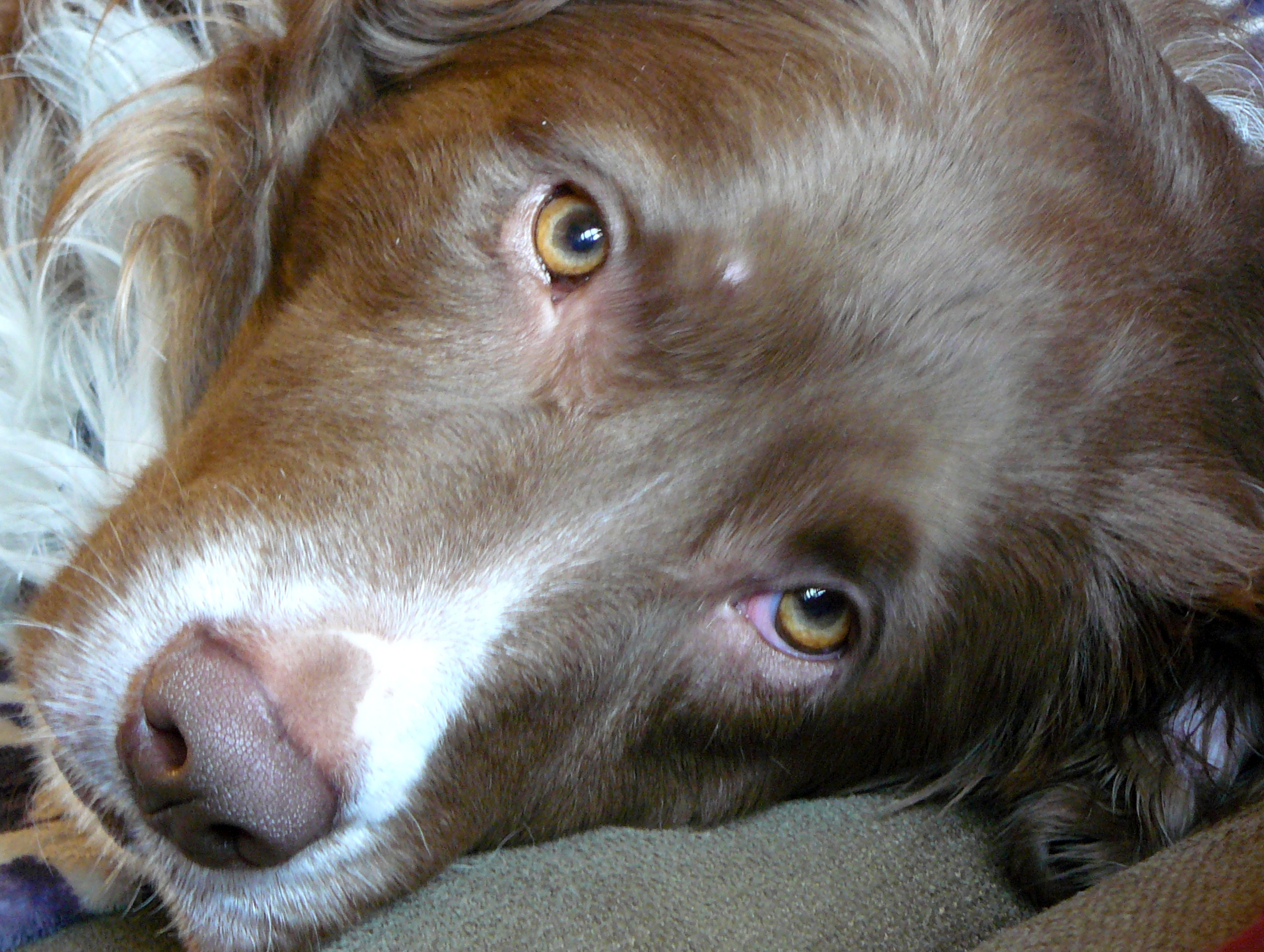
Piercing peepers are a defining trait of this beautiful doggo. According to the new study, published in PLOS Genetics, breeders report that blue eyes are a common and dominant trait among Siberian huskies, but appear to be rare and recessive in other breeds, like Pembroke Welsh corgis, old English sheepdogs and border collies. In some breeds, like Australian shepherds, blue eyes have been linked to patchy coat patterns known as “merle” and “piebald,” which are caused by certain genetic mutations. But it was not clear why other dogs—chief among them the Siberian husky—frequently wind up with blue eyes.
Hoping to crack this genetic conundrum, researchers at Embark studied the DNA of more than 6,000 pooches, whose owners had taken their dogs’ saliva samples and submitted them to the company for testing. The owners also took part in an online survey and uploaded photos of their dogs. According to the study authors, their research marked “the first consumer genomics study ever conducted in a non-human model and the largest canine genome-wide association study to date.”
The expansive analysis revealed that blue eyes in Siberian huskies appear to be associated with a duplication on what is known as canine chromosome 18, which is located near a gene called ALX4. This gene plays an important role in mammalian eye development, leading the researchers to suspect that the duplication “may alter expression of ALX4, which may lead to repression of genes involved in eye pigmentation,” Aaron Sams of Embark tells Inverse’s Sarah Sloat.
The genetic variation was also linked to blue eyes in non-merle Australian shepherds. Just one copy of the mutated sequence was enough to give dogs either two blue eyes, or one blue and one brown eye, a phenomenon known as “heterochromia.” It would seem, however, that duplication on chromosome 18 is not the only factor influencing blue eye color: Some dogs that had the mutation did not have blue eyes.
More research into this topic is needed to understand the genetic mechanisms at work when it comes to blue-eyed dogs. But the study shows how at-home DNA kits can be highly valuable to scientists, providing them with a wealth of genetic samples to study.
“With 6,000 people getting DNA samples from their dogs and mailing them to a centralized location and then filling out a website form detailing all the traits of their dog—that’s a game-changer for how genetics is being done in the 21st century,” Kristopher Irizarry, a geneticist with the College of Veterinary Medicine at Western University of Health Sciences, tells National Geographic’s Jazynka.
The benefits of having access to such huge troves of data go further than uncovering nifty insights into our canine companions. Scientists are also teaming up with at-home DNA test companies to learn more about human genetics and behavior.
ooOOoo
There’s such a wide range of information about our lovely dogs!
I was contacted about three weeks ago by a Jenny Harrison who wondered if I would be interested in posting a guest post. I said that I was and we settled on the following. Enjoy!
ooOOoo
What Is the Best Way to Pet-Proof an Apartment?
By Jenny Harrison.
There isn’t any doubt that pets are great companions to have around. Not only will they encourage you to be more active, but they look forward to seeing you after you have been out all day. Now the thing is if you plan on leaving your pet alone in your apartment, there is always a chance they might harm themselves. Keeping a pet in an apartment is tricky, but it is not something you can’t pull off.
If you worry about your pet being alone at home, you should definitely look into pet-proofing your apartment. To learn more about pet-proofing your home, and the best ways you can go about doing so, read on.
Organize your Living Space
You will find it incredibly cute that your pet pulls on anything and everything it comes across, but it is unsafe. You will not want your pet around electrical cords, blind cords, earbud cords and any wire or cord for that matter. Keep everything wrapped up and tidy. Leave no stone unturned to make your living space free from cords or laces of any type.
For things your pet loves to chew on i.e. cushions, shoes, or even paper, make it a point to keep them away. If your pet is tearing things up, especially your dog, then it is a sign they are restless. Take your pet out as much as you can so they are calm and relaxed at home.
Pet-Proof your Furniture
Cats are known for leaving claw marks on couches. All cat owners are familiar with this, but that does not mean you can’t do anything about it. You can cat-proof your couch with the help of cat-deterrent sprays or stick furniture strips, that will make it uncomfortable for your cat to use your couch as a scratching post.
Dogs aren’t any better when it comes to couches, since they shed their fur, chew and leave their scent. To deal with dogs get a blanket or cover for furniture, but keep it reserved for your pet alone. If the smell gets to you or your guests, then get a furniture spray.
Another great way to solve this problem is by getting furniture that can’t be chewed and is unattractive to pets; so that is a no to furniture with fluffy cushions and wooden legs. Also, if your pet does not refrain from sitting or sleeping on the couch, then get a couch that matches with your pet’s coat of fur, so it is not visible.
Install Baby Gates
For pets that are too noisy, it is a good idea to install baby gates. You can install baby gates in areas you want to keep them out from. This is especially useful for those times when you will be out for longer than usual, and can’t exactly keep an eye on them.
If your pet is too big, and won’t be held back by baby gates, then a crate might just do the trick. If you opt for this option, ask someone to check out your pet in the apartment, and take them out for a walk, more specifically if it is a dog.
Give your Pets their own Space
One of the biggest reasons your pet will want to sit on your bed, couch or anywhere else they should not be in the first place, is because it looks comfortable. Another reason they will want to do so is that they want to be close to you.
Enough emphasis cannot be placed on the fact that you need to give your pet their own space. Get a bed for them and don’t be surprised if they snub it at first. Remember, it takes time for pets to get used to change, and if you want them off your bed or couch, then you will have to be consistent about teaching them to sit or sleep in their own cozy little bed.
Keep away Cleaners
Animals are curious creatures so you need to treat them like children. You cannot expect them to stay clear of stuff, like cleaners for instance, so you might as well remove them from their sight. Since some cleaners consist of harmful chemicals, you can’t let this one slide.
Cats love licking themselves clean, not excluding their paws, which would come in contact with the floor you just cleaned with chemicals. So the next time you go shopping for cleaning products, take your pet into consideration. You should look into “green alternatives”, or better yet, you can concoct your own with a hot water and vinegar solution.
Prepare to Clean… A lot!
Living with a pet in an apartment means you should be ready for anything. You will have to deal with expected as well as unexpected cleanups.
Keep a lint roller within your reach to remove fur stuck to your furniture. As for the carpets, get new ones installed, the kind that comes with a unique stain resistant technology. It may cost you a bit, but it will make cleaning accidents a breeze.
There are a lot of great ways you can pet-proof your apartment, so it is up to you to decide what will work and what won’t. Since you know your pet better, adapt and overcome challenges as they come your way. But remember, your pet’s safety should be your top priority.
The aforementioned tips should be part of your apartment move in checklist if you have a pet, or you are getting a pet in the apartment for the first time. No matter the case, make it a point to do a bit of homework on your own to ensure you are not getting in way over your head.
If you need help, ask your friends or family, especially those who already know how to deal with pets. Pet-proofing your home may seem difficult at first, but it does not require much time or effort to pull off, so don’t get overwhelmed.
ooOOoo
It is a useful document and one that would find itself valuable in the right situation.
For your reference Jenny included her bio. It is as follow:
Jenny Harrison is a passionate home and lifestyle blogger. She loves to engage with readers who are seeking home and lifestyle-related information on the internet. She is a featured blogger at various high authority blogs and magazines in which she shared her research and experience with the vast online community. Currently, she is associated with New York moving company ‘All Around Moving Services Company Inc.’ Specializes in arranging and assembling services of professional and skilled local movers locally in New York City as well as areas in New Jersey, Connecticut and the Miami Dale area in South Florida. Follow her on twitter @MJennyHarrison for more updates.
‘Rigel and the Witch Head Nebula’ (Photo: Mario Cogo)
An aurora borealis that lights up the night sky in Iceland. The Milky Way that illuminates in a remote area in Australia. Even nebulae that display dazzling colors. All these phenomena have delighted astronomy enthusiasts for years, and many people travel the globe to capture such events.
The Astronomy Photographer of the Year competition honors amateur astronomy photographers who capture stunning images of space. The organization released several dozens images out of the more than 4,200 entries it received ahead of its announcement this October of this year’s winners. The competition began in 2009 and is organized by the Royal Observatory Greenwich in the United Kingdom.
The photographers featured here are a mixture of amateurs and professionals, but their images are universally stunning.
The photo above entitled “Rigel and the Witch Head Nebula” was taken by Mario Cogo in Namibia. “The dark Namibian sky was the perfect location to capture the wonder of the Witch Head Nebula and Rigel,” said Cogo in his submission. “The Witch Head Nebula is a very faint molecular gas cloud which is illuminated by supergiant star Rigel, the seventh brightest star of the sky and the brightest star in the constellation of Orion.”
The caption listed below each photo was written by the photographer and provides additional context.
‘Thunderstorm under milky way’ (Photo: Tianyuan Xiao)
“A glorious Milky Way looms over a thunderstorm that lights up the Florida sky. The photographer wanted to show the great contrast between stable (Milky Way) and moving (thunderstorm) objects in the sky.” — Tianyuan Xiao
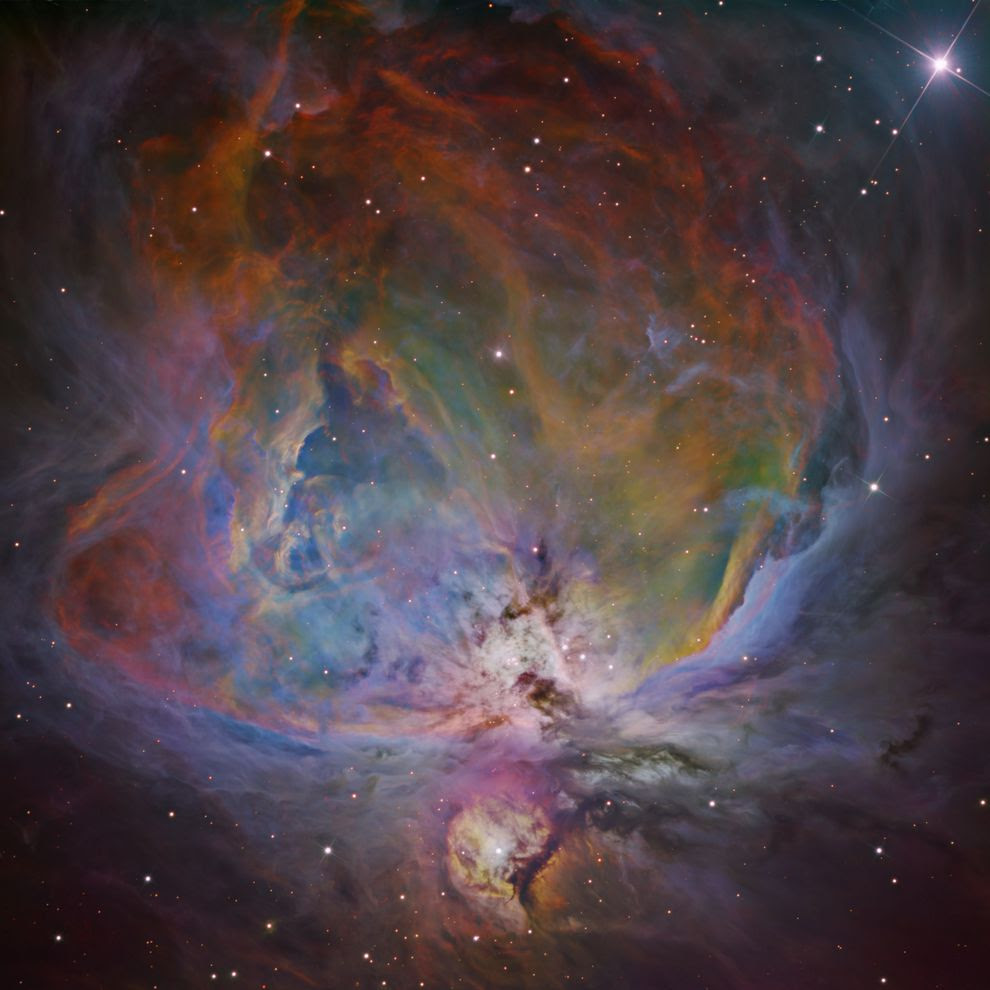
‘The Orion Nebula in 6-Filter Narrowband’ (Photo: Bernard Miller)
“One of the brightest nebulae, the M42 or the Orion Nebula, is located in the Milky Way south of Orion’s belt. It is an emission nebula about 1500 light years away in the constellation Orion. This image was produced by combining 36 hours of total exposure using six different filters; Ha, SII, OIII, Red, Green, and Blue. The central Trapezium cluster of the nebula is so bright that it is usually over exposed with the long exposures needed for the nebula. In this image a series of short 3-second exposures in each filter were blended with the long exposures to create a high dynamic range image that produces detail in the faint nebula and bright Trapezium.” — Bernard Miller
The neglected neighbour’ (Photo: Kfir Simon)
“Taken from Tivoli Southern Sky Guest Farm in Namibia, the great Horsehead nebula is overlooking the striking and often overlooked Nebula NGC 2023. At 4 light years in diameter it is one of the largest reflection nebulae ever discovered.” — Kfir Simon
‘The Hidden Galaxy’ (Photo: Tom O’Donoghue and Olly Penrice)
“Camelopardalis, also known as the Hidden Galaxy is one of the largest Galaxies visible from the Northern Hemisphere; however it is also obscured by foreground stars and dust, as it lies in the Milky Way plane. The photographer added a Ha filter to this LRGB image in order to enhance the emission nebula regions in the galaxy and after stacking single exposures (subs) the brilliant spiral arms at the core were revealed.” — Tom O’Donoghue and Olly Penrice
‘The Eagle nebula’ (Photo: Marcel Drechsler)
“The Eagle Nebula, also known as Messier 16, is a young open cluster of stars, surrounded by hot hydrogen gas in the constellation Serpens and lies at a distance of 7,000 light years from Earth. Taken at the Baerenstein Observatory in Germany, the photo is a RGB-Ha-OIII image and shows off the radiant red and blue colours of the nebula. In the centre you can spot the famous Pillars of Creation.” — Marcel Drechsler
‘Stars over Sacred Mongolian Ovoo’ (Photo: Qiqige Zhao)
“Taken during a summer night in Mingantu in Inner Mongolia, star trails are sweeping over the colourful and extraordinary sacred altars, called Ovoo, creating a spectacular painting.” — Qiqige Zhao
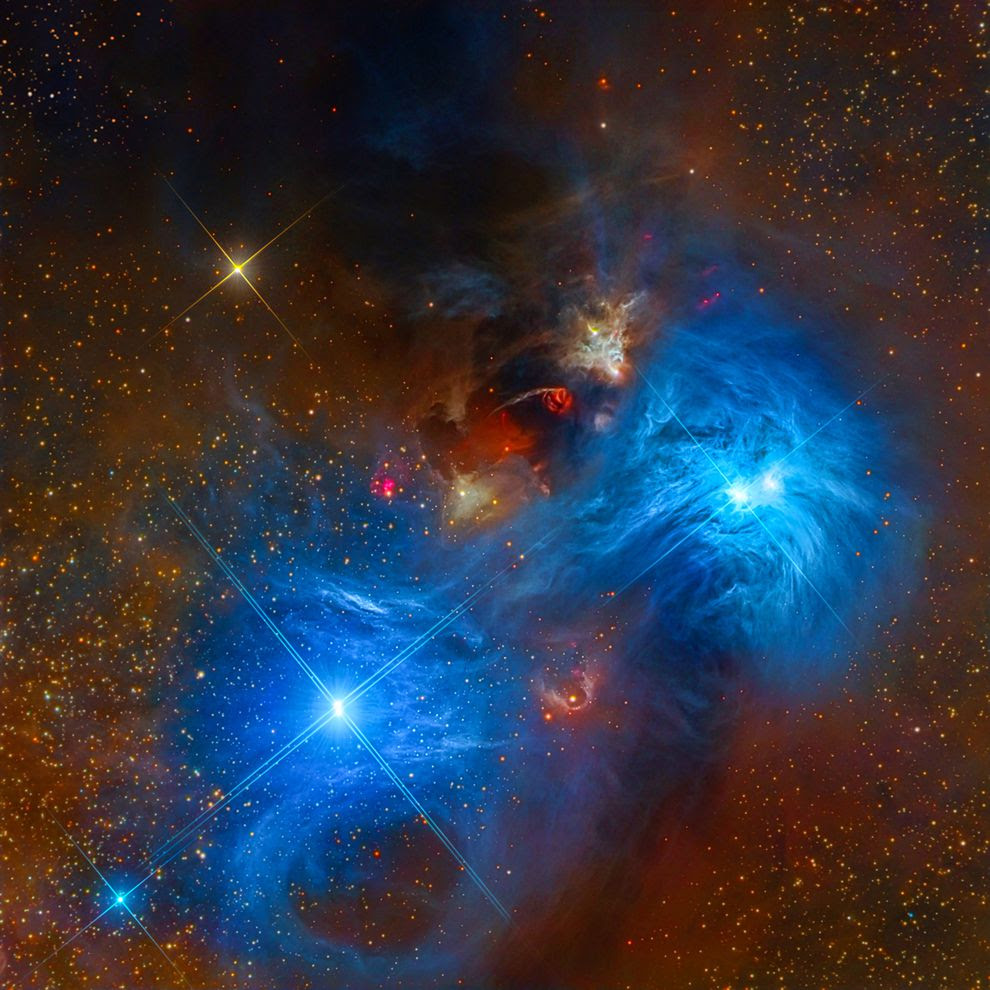
‘NGC 6726 and NGC 6727’ (Photo: Mark Hanson, Warren Keller, Steve Mazlin, Rex Parker, Tommy Tse, David Plesko, Pete Proulx)
“These spectacular reflection nebulae in the Corona Australis constellation depict the characteristic vivid blue color produced by the light of hot stars, reflected by silica-based cosmic dust. A rare high resolution view of the cores NGC 6726 and 6727 is captured on camera. The data was acquired by Star Shadows Remote Observatory at CTIO’s PROMPT2, using LRGB filters, stacked with CCDStack and post-processed in Photoshop and PixInsight.” — Mark Hanson, Warren Keller, Steve Mazlin, Rex Parker, Tommy Tse, David Plesko and Pete Proulx
‘Mosaic of the Great Orion & Running Man Nebula’ (Photo: Miguel Angel García Borrella and Lluis Romero Ventura)
“The Orion Nebula, also known as Messier 42, M42, or NGC 1976, is a diffuse nebula situated in the Milky Way, south of Orion’s Belt in the constellation of Orion. It is one of the brightest nebulae and is visible to the naked eye during a clear night sky. M42 is 1270 light years from our planet and is the closest region of massive star formation to Earth. It is estimated to be 24 light years across and it has a mass of about 2,000 times more than that of the Sun. This image is the result of the efforts of two astrophotographers using different equipment from their observatories. Located hundreds of kilometres away from each other, they chose the Orion Sword are as a common target to render. The software suites used in this image are Maxim DL, Pixinsight and Photoshop CC 2017.” — Miguel Angel García Borrella and Lluis Romero Ventura
‘Milky Way shining over Atashkooh’ (Photo: Masoud Ghadiri)
“The Milky Way stretches across the night sky between four columns in the ancient Atashkooh Fire Temple near Mahllat city in Iran. The camera was placed on the ground in the centre of the four columns, and with no use of any other equipment, the photographer managed to capture our magnificent galaxy using just one image.” — Masoud Ghadiri
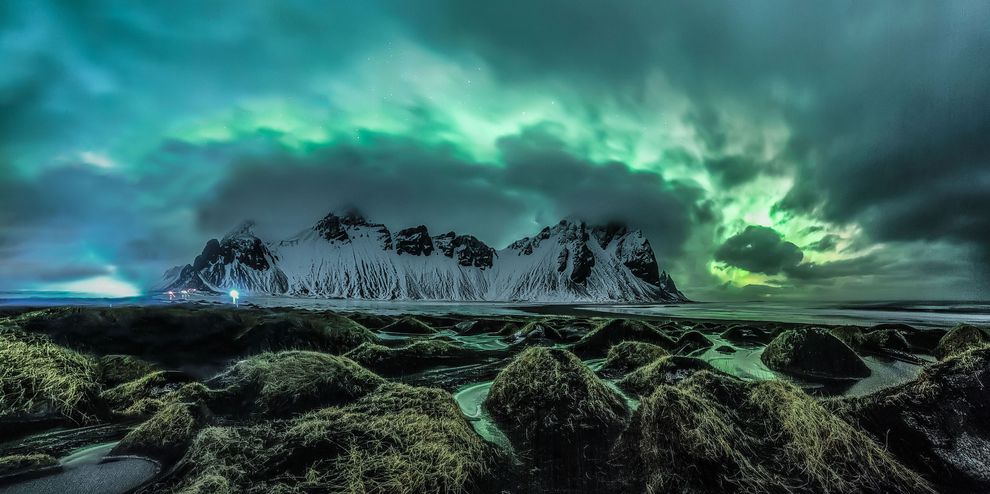
‘Magic’ (Photo: Jingyi Zhang)
“The magical Aurora Borealis explodes from the clouds and looms over the mountains in Stokknes on the south coast of Iceland. Snow has melted and created pools of water between the dunes, creating a perfect foreground for this image.” — Jingyi Zhang
‘Kynance cove by night’ (Photo: Ainsley Bennett)
“On a family trip to Cornwall after visiting Kynance Cove, on the Lizard Peninsula, the beautiful landscape seemed to be the ideal place for the photographer to capture the glimmering stars and the striking colours of the Milky Way illuminating the beautiful rocky coastline. This is a composition of two separate exposures, one for the sky and one for the foreground blended together post-processing to achieve the desired result, producing a more even exposure.” — Ainsley Bennett
‘Keeper of the Light’ (Photo: James Stone)
“The Milky Way rises above an isolated lighthouse in Tasmania. The photographer planned his position to shoot the perfect composition positioning the Milky Way in conjunction with the lighthouse and observing how to best light the tower for artistic effect. This image is part of a time-lapse sequence, allowing the photographer some time to climb the tower into the lantern room of the lighthouse and reflect on the hard and lonely, yet incredible life the former lighthouse keepers would have lived.” — James Stone
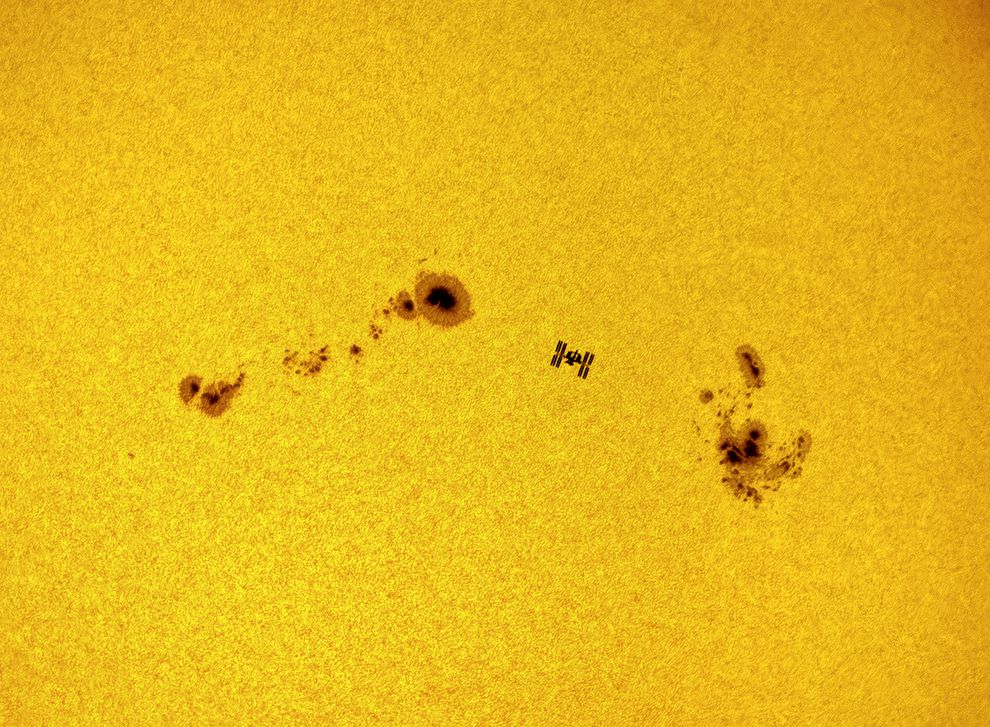
“The International Space Station (ISS) was captured between two massive sunspots, the AR 12674 and AR 12673, during its solar transit. The image was taken in Madrid and it took ISS less than a second to cross the solar disk.” — Dani Caxete
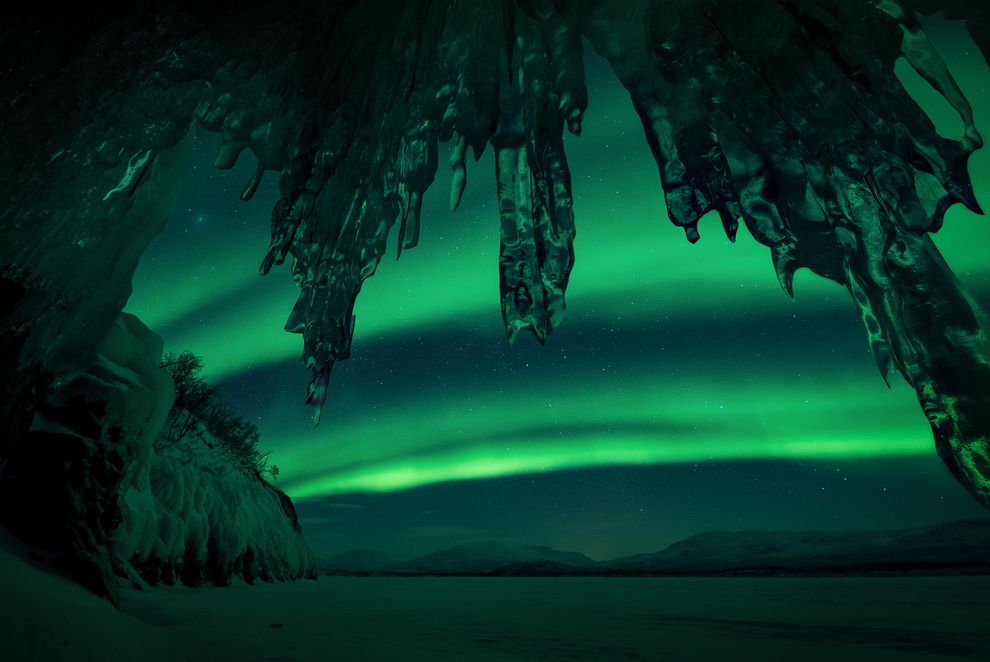
‘Ice Castle’ (Photo: Arild Heitmann)
“A remarkable display of the Northern Lights reflecting shades of green and yellow on the snow. Squeezed into a tiny cave on Lake Torneträsk, in Swedish Lapland, in minus 26 degrees with the camera lens just a few centimeters away from the icicles, it was a challenge well worth it for the photographer.” — Arild Heitmann
‘Holy Light II’ (Photo: Mikkel Beiter)
“The Black Church at Búðir in Iceland beneath the stripes of the Aurora Borealis and the bright stars in the night sky. Fighting the worst weather the photographer had ever encountered in Snæfellsnes Peninsula and with strong gale winds around 30 meters per second on the night the image was taken, his hard work paid off.” — Mikkel Beiter
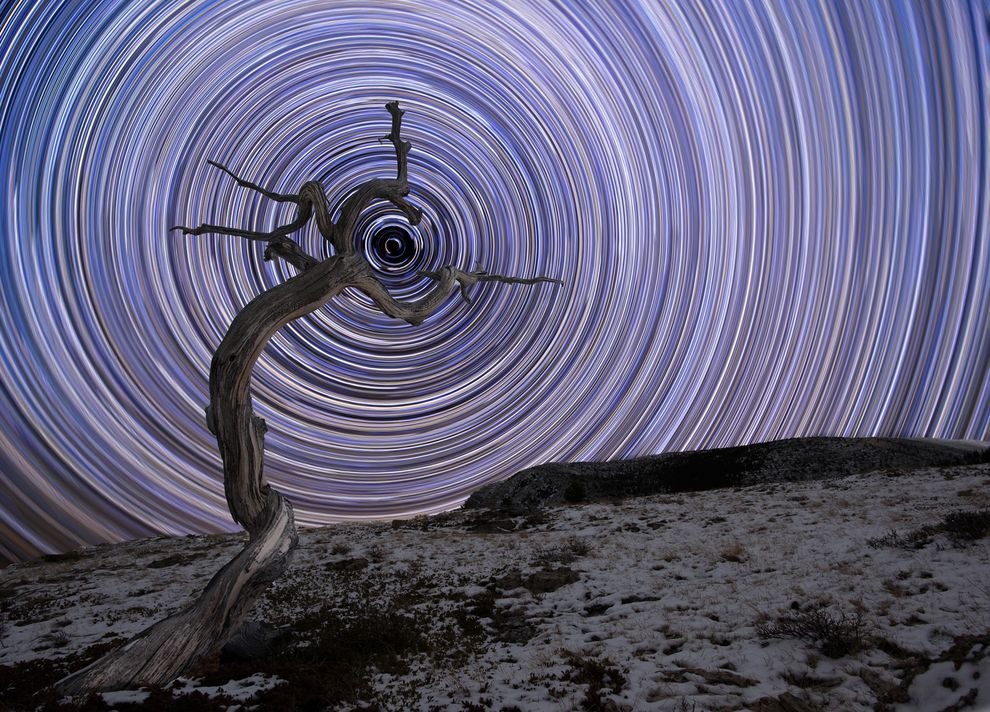
‘Holding Due North’ (Photo: Jake Mosher)
“A weathered juniper tree in Montana’s northern Rocky Mountains is filled with arced star trails and in the centre sits Polaris, the brightest star in the constellation of Ursa Minor. It took several test frames of long exposures to make sure that Polaris was in the right position, but eventually things lined up and the Moon provided enough light to the foreground, yet plenty of dark skies to allow a high enough ISO to capture lots of stars.” — Jake Mosher
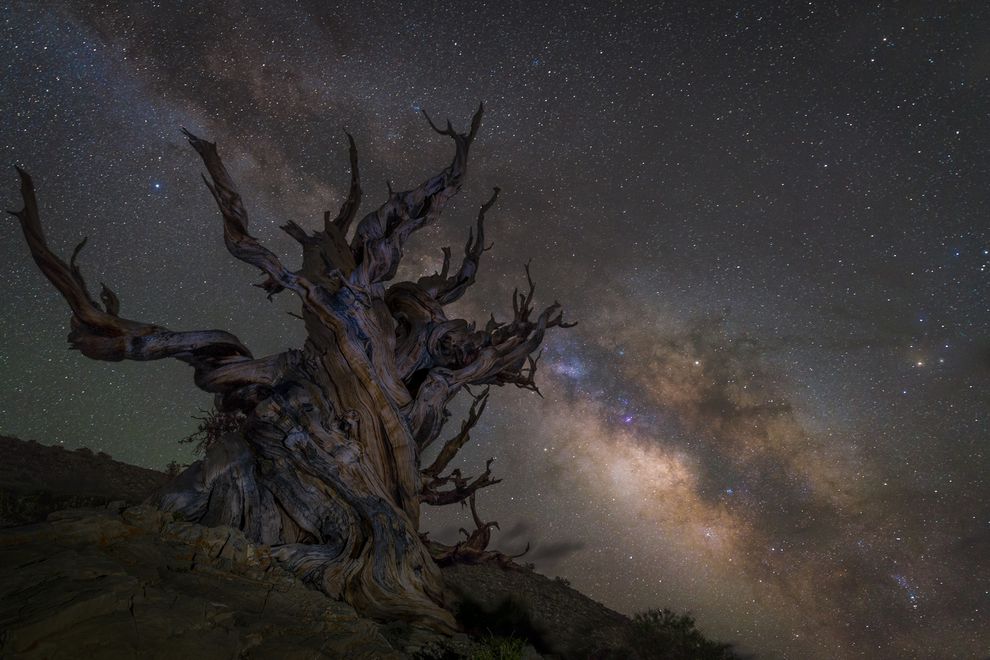
‘Guarding the galaxy’ (Photo: Jez Hughes)
“The Milky Way rises over some of the oldest trees on Earth in the Ancient Bristlecone Pine Forest, set within the Inyo National Forest along the White Mountains in California. Growing at altitudes of over 10,000 feet, these trees can live for over 4,000 years. The high elevation also results in thin air and incredibly dark skies on display. This photograph was taken in between rolling thunderstorms which were passing through the Eastern Sierras, leaving time for only a few exposures.” — Jez Hughes
Guardian of Tre Cime’ (Photo: Carlos F. Turienzo)
“This panoramic image, composed out of eight photos, depicts the Milky Way emerging over the rocky Dolomites in Tre Crime on the left and on the right the lights from a house illuminating the beautiful terrain. The photographer noted that the image represents sharing unforgettable moment with the ones you love.” — Carlos F. Turienzo
‘First Impressions’ (Photo: Casper Kentish)
“After a few days of cloudy skies the photographer finally got the chance to use his birthday present, a new telescope. The clouds were moving fast so there was not much time to capture the Moon. With the help of his grandfather who kept moving the telescope and trying to keep an iPad at the right position, he managed to capture this wonderful and artistic image of his first viewing of our Moon.” — Casper Kentish
‘Expedition to Infinity’ (Photo: Jingpeng Liu)
“The photographer captured the splendor of our galaxy in Badlands National Park, in South Dakota and is a panoramic view of a 6-shot composite, three for the sky and three for the foreground, all of which were taken successively using the same gear and equivalent exposure settings, from the same location, within a short period. The raw files were initially processed in Lightroom for lens correction only, followed by merging to panorama in Photoshop. Final retouching was applied back in Lightroom, including WB correction, basic toning and local adjustments.” — Jingpeng Liu
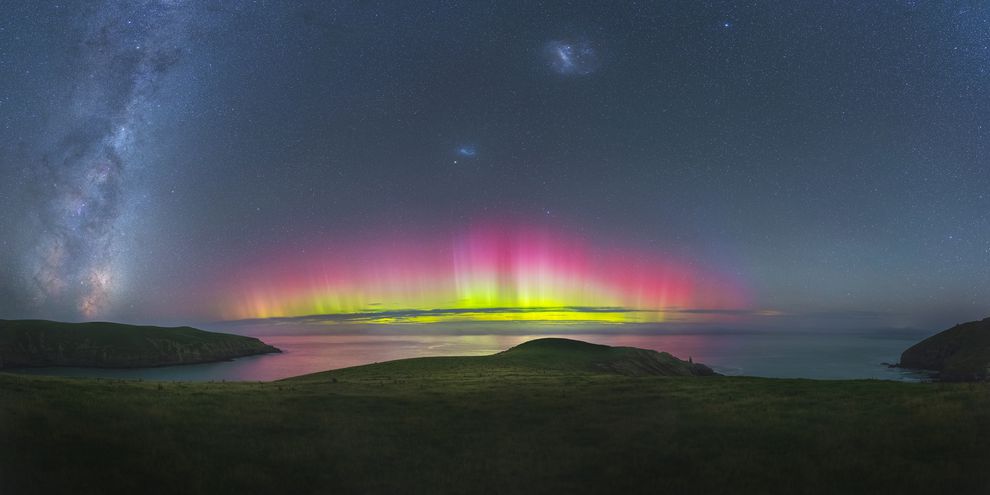
‘Empyreal’ (Photo: Paul Wilson)
“A flared up Aurora reflects bright pink and yellow colours on the water at Southern Bays near Christchurch, New Zealand. The incredible combination of the radiant Aurora colours, the wide green fields and the dark blue, starry night sky paint a spectacular picture and accentuates the wonders of our galaxy.” — Paul Wilson
‘Earth Shine’ (Photo: Peter Ward)
“During a solar eclipse, the brightness of the solar corona hides the details of the moon. By layering 9 exposures ranging from 2 seconds to 1/2000th of a second and with Extreme High Dynamic Range photography or XHDR the image shows not just the radiant solar corona, but the newest possible of new moons, seen here illuminated by sunlight reflecting off the earth.” — Peter Ward
‘Deep Space’ (Photo: Dave Brosha)
“Exploring the remarkable underbelly of the Breiðamerkurjökull glacial tongue in Iceland. With this image the photographer wanted to pay tribute to the serenity and wonder he felt while he spent some time in this peaceful and magnificent place.” — Dave Brosha
‘Daytime Moon’ (Photo: Helen Schofield)
“Earth’s only natural satellite is situated above the horizon of our planet so it is visible during daytime and the waxing gibbous phase can clearly be seen in the sky. The photographer captured this imposing image in Malaga, Spain while vacationing with her children.” — Helen Schofield
Color-Full Moon’ (Photo: Nicolas Lefaudeux)
“A phenomenal image depicting the incredible colours and details of the surface of the Moon. The photographer applied a similar procedure he used for capturing the solar eclipse and noted that this lit up the full Moon like a Christmas tree ornament, with a great variety of hues and shades.” — Nicolas Lefaudeux
‘Cable Bay’ (Photo: Mark Gee)
“The magnificent Milky Way stretches across the night sky reflecting on the Cable Bay near Nelson, New Zealand. The photographer had to take the picture before the light washed out the sky. 42 individual images were stitched in to a large multi row panorama to create this image.” — Mark Gee
‘Aurorascape’ (Photo: Mikkel Beiter)
“The conditions the night the image was taken were not ideal because of the bright moon lighting up the sky. The photographer managed to overcome this obstacle and capture the incredible Aurora Borealis above the fjord at Haukland in the gorgeous Lofoten archipelago, Northern Norway. The small pool of water with rocks made the perfect foreground and a natural leading line into the frame.” — Mikkel Beiter
‘Aurora Borealis on the coast of the Barents sea’ (Photo: Michael Zav’yalov)
“From the city of Yaroslavl in Russia to the coast of the Barents Sea in the Arctic Circle, a party of three travelled 2000 kilometers to capture the magnificent Northern Lights. The photographer stayed in the village of Teriberka in the Murmansk Oblast district for five days. After four days of bad weather, with heavy snow and thick clouds the sky finally cleared on the last day and the Northern Lights appeared in all their glory.” — Michael Zav’yalov
‘AR 2665 and Quiescent Prominence’ (Photo: Łukasz Sujka)
“The sunspot AR2665 was one of the most active regions in 2017 on the right you can see a phenomenal quiescent prominence extending from our star, the Sun. This type of prominence lasts for a very long time and its structure is quite stable. The photo is a composition of two images: one of the magnificent prominence and one of the Sun’s surface. The surface is much brighter than the prominence so it is a negative to reveal details of Sun chromosphere (spicules and filaments).” — Łukasz Sujka
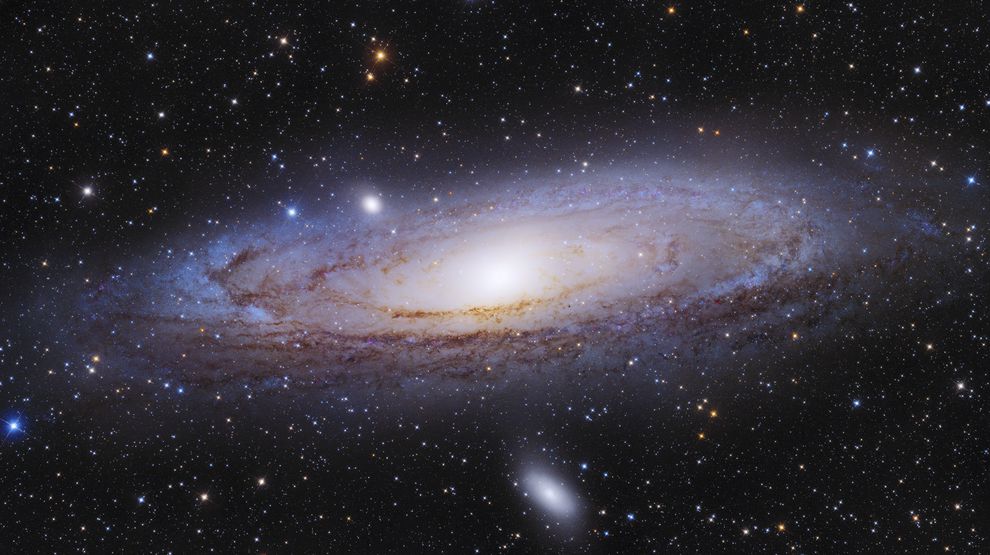
‘Andromeda Galaxy’ (Photo: Péter Feltóti)
“Andromeda Galaxy has always amazed the photographer. The dust lanes and bright star clusters in its arms, the emblematic galaxy shape of it, and the magnificent look of this great star city make it one of his most desired objects to photograph. This image was taken using a 200mm mirror and creating a three panel mosaic.” — Péter Feltóti
‘A Magnificent Saturn’ (Photo: Avani Soares)
“In high resolution planetary photography having a good view of a planet is a key factor but also completely out of a photographer’s control. In this image the photographer was lucky to capture our second largest planet, Saturn, in all its glory. After stacking 4,000 out of 10,000 frames we can admire details such as the beautiful polar hexagon, the Encke Division and even the crepe ring.” — Avani Soares
ooOOoo
These are the most beautiful images of the cosmos that I have ever seen!
Dawn breaks over Moskey Basin, at Isle Royale National Park, Michigan. Canadian wolves colonized the island in 1949. (Photo: Steve Lagreca/Shutterstock)
The American people’s relationship with top predators — especially wolves — is complex and ever-evolving. About three decades ago, it was mostly just animal-rights groups and their supporters who fought for the wolves’ right to exist; they were often considered a nuisance. But now there’s plenty of scientific evidence proving what’s good for wolves is good for their prey, the plants those prey eat, and indeed, positively affects the entire ecosystem. That’s ultimately good for humans too — unless you’re competing with the wolves, like a rancher who grazes animals or a hunter who wants to shoot the same deer or moose that wolves need to eat. But at this point, even some ranchers and hunters have come over to the pro-predator side.
Much of that change in the perception of predators is down to studies that have proven how precisely cougars, wolves, bears, tigers, lions, bald eagles, alligators and other apex predators affect the land around them. None have been studied longer than the wolves and moose in Isle Royale National Park, a Guam-sized island in Lake Superior. For almost 60 years, the populations of these two groups have been tracked — as well as their effects on the plants and other animal communities on the island. (You can read the reports here, including the recent 59th annual report.)
As the video above explains, there used to be as many as 50 wolves on Isle Royale; however, that number has dwindled, mostly due to inbreeding that caused a debilitating spinal condition to proliferate among the too-closely-related wolves. Just 10 years ago, there were still around 30 wolves but by 2015, there were only three wolves left. Now, there are just two, a closely related male-female pair that probably won’t breed. (The female of the pair has aggressively fought back when the male attempted to breed with her.)
Already, the moose population on the island has boomed, “undoubtably because of lack of predation,” John Vucetich, a wildlife ecologist from Michigan Technological University told Science magazine, adding that the two remaining wolves are now “… swimming in moose.” Despite the wolves’ regular predation on moose, there’s been a 20 percent increase in moose in just one year, which scientists estimate is about five to 10 times higher than on mainland areas. Beaver populations have also risen sharply. There’s just not enough wolves to keep either population in check.
So what’s so bad about so many moose? Well, as most ungulates do, moose spend their days browsing on vegetation, so the more moose, the more food they need — and the plants on the island can only take so much nibbling. An aquatic plant, which was found in abundance just six years ago, is now only found in places where moose are not. Long-term, this means the island will soon run out of food to keep the ever-larger moose population alive, and many will starve once food becomes scarce. Previously, the wolves have kept moose populations low enough so they didn’t overeat the vegetation, keeping the system in balance.
A plan to rebalance the ecosystem
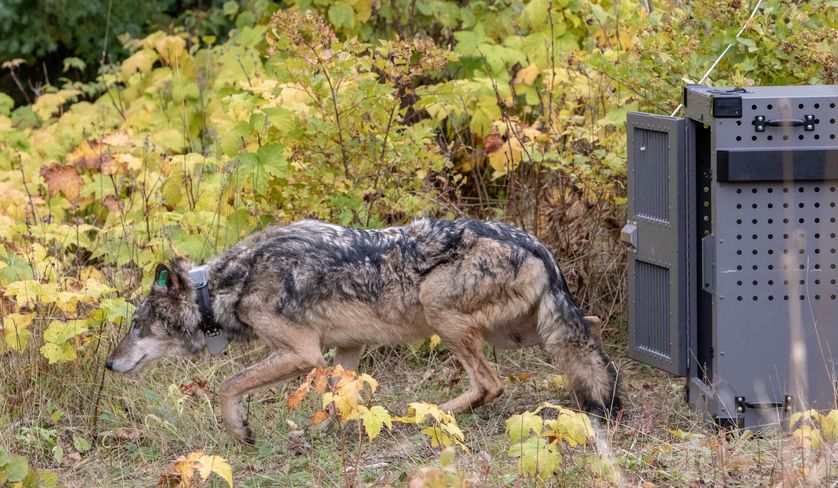
This female wolf arrived at Isle Royale on Oct. 2, 2018. (Photo: NPS/Jim Peaco)
This is why some people think the best solution is to bring a fresh influx of wolves to Isle Royale National Park. The plan is to release 25-30 wolves over the next three to five years. So far, park officials have trapped four wolves on the mainland beginning in late September and released them on the island. Three of the wolves are female — with the hope they will successfully breed.
This new blood would potentially rebalance the predator-prey relationship and the idea is that the rest of the ecosystem would follow. Introducing so many wolves over several years is hardly natural either, others argue, saying that humans should just be hands off and let nature take its course. The original 50 wolves had found their way to the island on their own, having moved in from Canada; perhaps they could do so again if given the chance.
Editor’s note: This article has been updated since it was originally published in April 2017.
Last Wednesday week, the 3rd October, I had a really strange morning.
As per usual for a Wednesday I went for a group bike ride. I didn’t notice anything unusual except perhaps that I was rather more remote than the others on this particular occasion. When I got home I didn’t mention anything. But later that morning Jeannie rang Dordie, one of the cycling group, and found out that I had basically being speaking gibberish.
Jeannie and I discussed the situation and we decided that it was best to volunteer ourselves for a visit to the local Three Rivers hospital. There is a walk-in facility there that is open 24 hours a day.
Asante Three Rivers Hospital, Grants Pass.
I was seen pretty promptly but nothing was found.
Also later that day I noticed my typing skills had disappeared.
At the same time I also noticed that my left-hand side of my face had a ‘edge’ to it. Whereas normally I couldn’t feel it in this instance I could.
Jeannie started to worry about me, big time, and I wasn’t sure about anything anymore. I resisted seeing any more specialists although Jeannie thought that I should.
I hung on to the fact that I was seeing my regular doctor, Dr. Angela Mount, on the 12th.
So yesterday I saw Dr. Mount.
She was of no doubt that what I had experienced was a ‘magnification’ of the old wound resulting from my trip to the Regional Trauma Centre in Eugene on December 24th, 2017.
Now, today, that had been brought about by me incurring a low-level infection; probably a cold-like infection but without the streaming nose normally associated with such diseases.
What had happened was that the extra load on the body brought about by the infection had caused the damage to my left-hand side of my body and skull to re-appear.
Thus no need to worry, it was OK and that fairly rapidly I should regain my old composure.
Phew!
P.S. Only wrote this just in case it matched any experiences out there.
If you can, please support this PDX event coming up on the 5th.
In my post that was my letter to Mr. Neptune, Colette left a reply that was a ‘heads up’ to an event being held in Portland, Oregon on October 5th. Ergo, this coming Friday.
Now the odds are that very few of you dear readers will be within reach of that event.
But that doesn’t stop me from promoting the event so that the details may be shared as far and wide as possible.
Join us October 5th for a peaceful Demonstration to help endangered Southern Resident Killer Whales. There are only 74 left after the loss of 2 baby Orcas this Summer. You may have seen the dead newborn Orca carried “Save our Orcas”. Meet promptly at Holladay Park at 3:00pm.
ooOOoo
Here’s a news item taken from CBS News.
Then for those that would like more background on the Orca whale, let me republish the opening paragraphs of an item from Wikipedia.
The killer whale or orca (Orcinus orca) is a toothed whale belonging to the oceanic dolphin family, of which it is the largest member. Killer whales have a diverse diet, although individual populations often specialize in particular types of prey. Some feed exclusively on fish, while others hunt marine mammals such as seals and dolphins. They have been known to attack baleen whale calves, and even adult whales. Killer whales are apex predators, as no animal preys on them. A cosmopolitan species, they can be found in each of the world’s oceans in a variety of marine environments, from Arctic and Antarctic regions to tropical seas, absent only from the Baltic and Black seas, and some areas of the Arctic Ocean.
Killer whales are highly social; some populations are composed of matrilineal family groups (pods) which are the most stable of any animal species. Their sophisticated hunting techniques and vocal behaviours, which are often specific to a particular group and passed across generations, have been described as manifestations of animal culture.
Wild killer whales are not considered a threat to humans,[6] but there have been cases of captive orcas killing or injuring their handlers at marine theme parks. Killer whales feature strongly in the mythologies of indigenous cultures, with their reputation ranging from being the souls of humans to merciless killers.
Orcas leaping. Picture from the Whale and Dolphin Conservation (WDC) website.
Your oceans of the world are truly breath-taking. The power you can display in the odd wave or million through to the tranquility you so often also display defy rational explanations.
I have had the profound experience of sailing upon your waters, dear Mr. Neptune, over a number of years sailing back and forth between Cyprus and Turkey. Not a long distance but still sufficient to experience being solo on a yacht day and night.
Tradewind 33 – Songbird of Kent. My home for five years.
Then on my way sailing back to Plymouth, SW England, the magical, almost primeval, feeling of being alone on the Atlantic Ocean. Looking up at the night sky, feeling so insignificant, so infinitesimally minute with 500 miles of open ocean in all directions and those stars above my head.
No question, that practically everything about your oceans is beyond the understanding of us humans. Indeed, I had to look up online how much water there is on Earth to discover there is:
It’s roughly 326 million cubic miles (1.332 billion cubic kilometers), according to a recent study from the U.S. Geological Survey.
Because I simply didn’t have a clue.
And knowing there are approximately 326 million cubic miles of water doesn’t help because I am still left not having a clue as to what that means!
So, thank goodness, Mr. Neptune this is all a ‘walk in the park’ for you!
But I do have a question for you.
What do you make of this?
The image is cropped from the following:
The description of these figures is:
Figure. (upper) Change in global upper-level (0–2000 m) ocean heat content since 1958. Each bar shows the annual mean relative to a 1981–2010 baseline. (lower) Annual mean ocean heat content anomaly in 2017 relative to a 1981–2010 baseline.
And it was taken from research undertaken by Lijing Cheng and Jiang Zhu and found on the web here.
Ocean Heat Content
Owing to its large heat capacity, the ocean accumulates the warming derived from human activities; indeed, more than 90% of Earth’s residual heat related to global warming is absorbed by the ocean (IPCC, Cheng et al. 2017). As such, the global ocean heat content record robustly represents the signature of global warming and is impacted less by weather-related noise and climate variability such as El Niño and La Niña events (Cheng et al. 2018). On the other hand, ocean thermal expansion due to ocean temperature change contributes substantially (30%~50%) to the sea level change, which can considerably influence human populations in coastal and island regions and marine ecosystems. Therefore, monitoring the OHC changes and understanding its variation are crucial for climate change.
Is it possible, Mr. Neptune, that even you as the master of all our oceans is worried about the future?
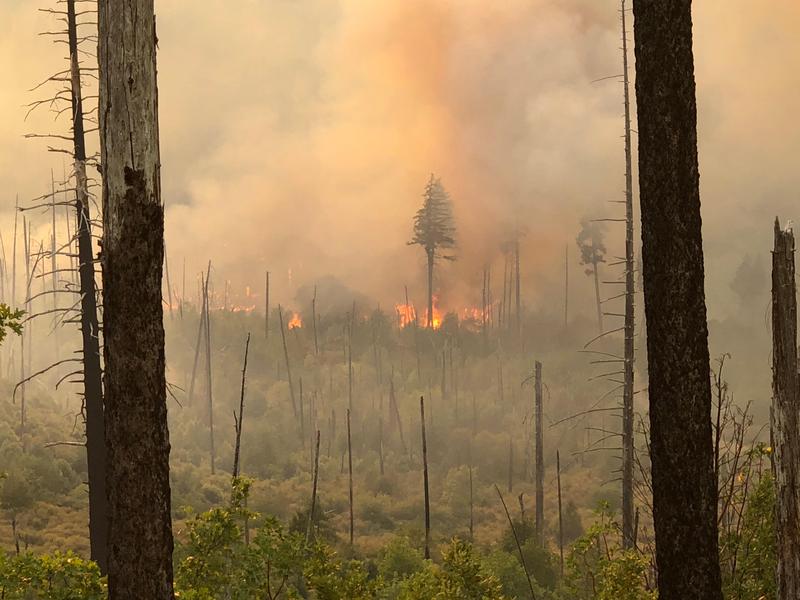
The latest news is that our Klondike Fire is now burning an area larger than 100,000 acres. Or to use the words from the incident webpage(my emphasis):
The Taylor Creek and Klondike Fires were split into zones on Saturday, Aug. 18. The fires are now referred to as “Taylor Creek Fire” and “Klondike Fire East,” managed by the Northwest Incident Management Team 12 out of Lake Selmac, and “Klondike Fire West” managed by California Interagency Incident Management Team 4 out of Gold Beach. A transfer of command of the Klondike West Zone will occur at 6:00 AM Friday when the Southern Area Red Team who arrived on Wednesday will take over.
As of the morning of Aug. 30, the Taylor Creek Fire is estimated 52,839 acres and is 95 percent contained. The Klondike Fire is estimated at 100,996 acres and is 40 percent contained. There are 1,214 personnel working on the Klondike Fire and 126 personnel assigned to the Taylor Creek Fire.
Courtesy Jeffersen Public Radio
Then just over a week ago, The Conversation blogsite published a reminder that I wanted to share with you today, under the permissions offered by The Conversation site.
ooOOoo
Many native animals and birds thrive in burned forests, research shows
But the idea that wildfires should be suppressed by logging the forest is far too simplistic. Most scientists agree that large hot wildfires produce many benefits for North American forests. Notably, they create essential habitat for many native species.
Fifteen years of research on Spotted Owls – a species that has played an oversized role in shaping U.S. forest management policies and practices for the past several decades – directly contradicts the argument that logging is needed to protect wildlife from fires. Wildlife biologists, including me, have shown in a string of peer-reviewed studies, that wildfires have little to no effect on Spotted Owls’ occupancy, reproduction or foraging, and even provide benefits to the owls.
The Northern Spotted Owl in the Pacific Northwest was listed as threatened under the Endangered Species Act in 1990. At that point, about 90 percent of U.S. old-growth forest had already been lost to logging. Every year in the 1980s the U.S. Forest Service sold about 7 to 12 billion board feet of public lands timber.
Figure 1. National forest timber sales (1905–2017). FY 1905-2017 National Summary Cut and Sold Data USDA Forest Service
Listing the owl drew attention to the dramatic decline of old-growth forest ecosystems due to 50 years of unsustainable logging practices. In response the U.S. Forest Service adopted new regulations that included fewer clearcuts, less cutting of trees over 30 inches in diameter and fewer cuts that opened up too much of the forest canopy. These policies, along with vast depletion of old-growth forests, reduced logging on Forest Service lands to about 2 billion board feet per year.
During the 1990s, national forest management policy for the Northern Spotted Owl included creating old-growth reserves and designating critical habitat where logging was restricted – mostly within half a mile of a Spotted Owl nest. In spite of these protections, populations of Northern Spotted Owls, as well as California and Mexican Spotted Owls, continued to decline on forest lands outside national parks. This was most likely due to ongoing logging outside of their protected nesting areas in the owls’ much larger year-round home ranges.
Fire and owls
Over the years the Forest Service shifted away from treating Spotted Owls as symbols of old-
Historical range (burgundy) of the Northern Spotted Owl, which also extended north into British Columbia. One hundred fifty years of logging, agriculture and urbanization have reduced the amount of old growth forest (potential Spotted Owl habitat) in this zone by 85-90 percent. NASA Earth Observatory
growth forest biodiversity, and instead started to cite them as an excuse for more logging. The idea that forest fires were a threat to Spotted Owls was first proposed in 1992 by agency biologists and contract researchers. In a status assessment of the California Spotted Owl, these scientists speculated that fires might be as damaging as clearcuts to the owls.
This perspective gained popularity within the Forest Service over the next 10 years and led to increased logging on public lands that degraded old-growth habitat for Spotted Owls.
Academic scientists, including some with Forest Service funding, published peer-reviewed studies of Spotted Owls and fire in 2002, 2009, 2011 and 2012. All four studies showed either no effects from fire or positive benefits from fire for Spotted Owls. Subsequent research on Spotted Owls in fire-affected forests has showed repeatedly that the owls can persist and thrive in burned landscapes.
(The U.S. Forest Service says wildfires harm wildlife habitat, but wildfires actually create rare and important habitat.)
Many wild species thrive in burned landscapes
I recently conducted a systematic review and meta-analysis that summarized all available scientific research on the effects of wildfires on Spotted Owl ecology. It found that Spotted Owls are usually not significantly affected by mixed-severity forest fire. Mixed-severity forest fire, which includes large patches with 100 percent tree mortality, is how wildfires in western forests naturally burn. The preponderance of evidence indicated that mixed-severity wildfire has more benefits than costs for Spotted Owls.
In 2017 I submitted an early version of this analysis with the same conclusions to the U.S. Fish and Wildlife Service during the agency’s peer-review process for its Conservation Objectives Report for the California Spotted Owl. My conclusions were not included in the final report.
Decades of science have shown that forest fires – including large hot fires – are an essential part of western U.S. forest ecosystems and create highly biodiverse wildlife habitat. Many native animals thrive in the years and decades after large intense fires, including deer, bats, woodpeckers and songbirds as well as Spotted Owls. Additionally, many native species are only found in the snag forest habitat of dead and dying trees created by high-severity wildfire.
Pileated woodpeckers excavate nests within snags, bringing life to charred forests in Oregon. NASA/S. Russell, CC BY-ND
Wildfires threaten homes, but wildlife and water supplies benefit
It is also time to reform Forest Service management goals to emphasize carbon capture, biodiversity, outdoor recreation and water supply as the most important ecosystem services provided by national forest lands. These services are enhanced by wildfires, not by logging.
ooOOoo
These last two paragraphs are key lessons: 1. Logging does not stop the biggest, hottest fires, and, 2. It is time to change the goals under which our forests are managed emphasising carbon capture, biodiversity, recreation and water supplies!
Simply because yesterday Anita from Anitashope blog left the following comment:
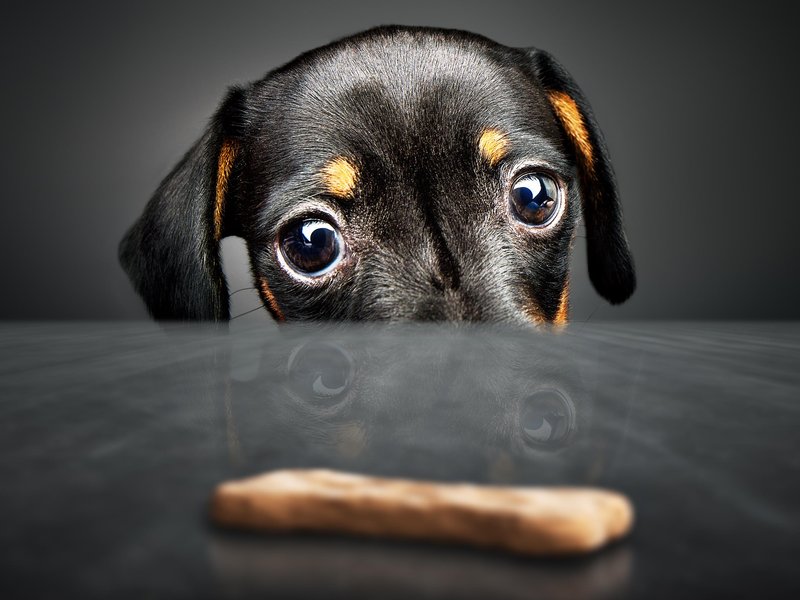
This article popped up after I responded to todays post but I also have to respond to this one as I need to tell you about Mimi. Mimi is my coon hound black lab mix and she will NOT make eye contact with you when a treat is involved. She will come sit by you and look off in the distance like “I am not looking at you”, then she will cut her eyes sideways just to make sure the treat is still there. Its hilarious.
The post where her comment was left was one that I published back on March 13th, 2017. It included the most beautiful photograph of Oliver’s eyes. I had forgotten that picture.
So for that reason alone, it is being republished today.
ooOOoo
The love and admiration for this beautiful animal goes on and on!
It seems as though it is almost on a weekly basis that new and incredible facts about our dear, dear dogs come to the surface.
So what prompted this from me today!
Only a wonderful article that was originally published in New Scientist but then was carried by The Smithsonian. I am hoping that by fully linking this post to both the New Scientist article and the essay in The Smithsonian I am at liberty to republish it for all you good people.
ooOOoo
Dogs Use Deception to Get Treats, Study Shows
When a human partner withheld tasty snacks, the dogs got sneaky
Would these eyes deceive you? New study says yes. (johan63/iStock)
By Brigit Katz smithsonian.com March 10, 2017
There is plenty of evidence to suggest that dogs, in addition to looking adorable in sweaters, possess fairly sophisticated cognitive abilities. They recognize emotion, for example, and respond negatively to antisocial behavior between humans. Man’s best friend can also get pretty tricksy when it comes to scoring snacks. As Brian Owens reports for New Scientist, a recent study found that dogs are capable of using deceptive tactics to get their favorite treats.
The study, published in the journal Animal Cognition, was led by Marianne Heberlein of the Department of Evolutionary Biology and Experimental Studies at the University of Zürich. Heberlein told Owens that the idea for the study was born when she observed her pet pooches engaging in deceptive behavior; one sometimes pretends to see something interesting outside, prompting the other to give up his sleeping spot.
To find out if dogs engage in similar shenanigans with humans, Heberlein and a team of researchers paired 27 dogs with two different partners, Stanley Coren explains in Psychology Today. One of these partners would repeatedly go to the bowl of a given dog, fish out a treat, and give it to the pup. The other would show the treat to the dog, and then put it in her pocket. Perhaps unsurprisingly, the dogs began to show a preference for the more generous partners, and would approach them spontaneously.
Once one partner had been established as co-operative, the other as competitive, the dogs were taught to lead their partners to one of two boxes, both containing food, with the command “Show me the food.” And the same pattern was repeated: when the dogs led the co-operative partner to a treat, they got to eat it. The competitive partner withheld the treat.
Researchers then showed the dogs three covered boxes. One contained a sausage, the second contained a less-yummy dry biscuit, and the third was empty. Once again, the process of treat giving and withholding was repeated, but this time with a twist: when the dog was reunited with its owner, the owner asked it to choose one of the boxes. If there was a treat inside the box, the dog was allowed to eat it. But “if the dog chose the box which had been opened before,” Coren explains, “the owner just showed the empty box to the dog.”
Over the course of a two-day testing period, the dogs were repeatedly presented with this conundrum. They had been trained to lead both partners to boxes containing food, but they knew that the competitive partner would not let them eat the snacks. They also knew that if any snacks remained inside the boxes once they were reunited with their owners, they would get a chance to eat them. So the dogs got a little devious.
Researchers observed the pooches leading the co-operative partner to the box containing the sausage more often than expected by chance. They led the competitive partner to the sausage less often than expected by chance. And here’s where things get really interesting: the dogs took the competitive partner to the empty box more frequently than the co-operative partner, suggesting that they were working through their options and engaging in deliberate deception to maximize their chances of getting both treats.
“It is as though the dog is thinking, ‘Why should I tell that selfish person where the best treat [is] if it means that I will never get it?’,” writes Coren.
“These results show that dogs distinguished between the co-operative and the competitive partner,” the authors of the study write, “and indicate the flexibility of dogs to adjust their behaviour and that they are able to use tactical deception.”
Rest assured, dog lovers: your pooches may be sneaky, but they still love you more than cats.



 ‘Rigel and the Witch Head Nebula’ (Photo: Mario Cogo)