Yesterday, I wrote about Eckhart and included the extract on Manifestation. Rather than cloud what was presented yesterday with more material, I held it over until today.
All I wanted to do was to draw your attention to Eckhart’s website, which is here – do spend some time going through what’s on offer – and I wanted to include this video of Eckhart speaking about Being Yourself.
But before you click the play button for the video, just listen to the words without having any reactions to how the words are presented, the accent of the speaker or anything else. You’ll understand when the video starts running. Just close your eyes and listen deeply to what is being said.
One of the many lessons that we can learn from dogs is the ability to be still. On the 2nd November, I wrote a
Eckhart Tolle
piece on Learning from Dogs about the critically important role of silence in our lives.
Eckhart Tolle is a very interesting person. He had a challenging background but has used his life experiences to gain a much deeper awareness of the world. Indeed, he measures around 600 on the Hawkin’s scale of consciousness.
Anyway, I reproduce in full an item from Tolle’s November Newsletter. It is called Eckhart on Manifestation.
Often people ask questions about manifesting and the power of intention, and how that relates to the power of Now. One person asked me about the difference between the continuous wanting that I write about in A New Earth and intention – the intention to create something. What is the importance of manifesting things in your life, or creating, or is that counter-productive?
There are many exciting books these days about creating and manifesting: The Secret, the teachings of Abraham, and so on. Often people ask, how does that relate to Stillness and inner peace? And acceptance of what is? And surrender to the Present Moment? And living in alignment with Now? Is there conflict, is one wrong? Or misleading?
This is an important question for almost everybody. Your own life is a microcosm of the macrocosm. If you look at the Universe, the first thing you will see is that it likes to create, and it likes to manifest. On this planet alone, the Universe is continuously creating and manifesting countless life forms. And in outer space, we can only assume – we don’t know what exactly is there – but there is a vastness of life out there, and probably many more life forms than we have on this planet. The life forms, both in the sea, and on land, including humans, they seem to enjoy a dance of coming into being and destruction. It’s a transformational process.By just looking at life, you can see that the Universe loves to manifest. Also it seems to be the case that life forms, over periods of time, become more differentiated. Many more come. And even human societies become more complex. We have had ancient civilizations that were very complex, but our present civilization is the most complex. This of course includes problem-ridden. That goes with complexity. Every individual who is part of this civilization has a life that is full of problems. But complexity cannot go on forever.
The Universe likes to create, to manifest, to experience the play of form. That’s one movement. And you can see it in yourself, at some level. There is something else in humans, you can only really see in yourself, an inner phenomenon. The Universe wants not only to experience that manifested life, it also wants to experience peace and something that is not touched by the continuously fluctuating forms. It wants to know itself deeply, directly, in its essence. That really is the root of spirituality. The Universe not only wants the outward movement, but it also wants the inward – the return movement to the One. Every human being also embodies these two movements. It seems that you are torn sometimes between the outward movement into form, and the inward return movement to the Source where it all started. The Source that was never really lost, it is always there because it is timeless, and it is within you. You feel drawn back to that, and that is the pull toward spirituality, peace, Stillness.
Not one or the other is right or wrong. It’s only perhaps if you totally lose yourself in one or the other – maybe that’s not quite it. Perhaps this is the challenge of the Universe here on this planet, and perhaps on other planets. The challenge to reconcile the two movements, rather than to have them be separate. Is it possible to reconcile the inner movement toward Stillness and Being, and the outer toward action, and doing? I would say it is, and that is our challenge at this time.
Traditionally, it’s been very unconscious what humans have manifested in this world. They have been identified with doing, and identified with form. That has been going on for as long as anyone can remember – since recorded history and beyond. And we call that ‘ego’. The One consciousness that underlies everything moves into form, assumes forms, and enjoys the play of form but it’s not enough for the one consciousness to enjoy the play of form, it needs to completely believe in it to make it seem ‘real’. You need to lose yourself in that dream of form.
Every human believes that they have a life of their own, and that means they are identified with the form of that life. This particular physical body, this particular psychological life form, the accumulation of thoughts and the emotions that go with these thoughts; it all becomes part of that form-identity.
Consciousness is trapped, or believes itself to be trapped in that. We could say that in that state, the Universe or Consciousness has entered a “dream-like” state. It wants to do that, it must enjoy that dream, up to a point. Consciousness has entered that “dream-like” state where it is completely identified with form. It doesn’t realize that every other form is an aspect of itself. Of course, then you are just an isolated entity. It becomes quite unpleasant after a while. So you have to get together with other entities and instead of having an “I” form, you have a “We” form, an “Us”.
For a while, the Universe seems to be okay with that, to have Consciousness identified completely with form. Then the “movie” goes on. Reading through history, you can see what happens when Consciousness is identified completely with form. Then it comes time for another stage to arise, when Consciousness is beginning to awaken from complete identification with form. This is beginning to happen at many stages, this is why human beings are drawn to spiritual teachings. It is the awakening from the dream of form.
This is not corny, this is at the heart of everything in life.
Nearly a month ago, I wrote a piece called The Power of Love. It was offered as a logical argument in favour of love – read it if you want to see what was written.
In line with the general Blog theme on here that we have much to learn from dogs and unconditional love is the BIG lesson we should take from these noble animals, here’s a lovely story that was sent to me by a dear friend.
WHOEVER DID THIS IS A VERY BEAUTIFUL PERSON
The ‘whoever’ being someone at a dead letter office within the US Postal System.
Here’s how it goes.
Our 14 year old dog, Abbey, died last month. The day after she died, my 4 year old daughter Meredith was crying and talking about how much she missed Abbey.. She asked if we could write a letter to God so that when Abbey got to heaven, God would recognize her. I told her that I thought we could so she dictated these words:
Abbey and Meredith
Dear God,
Will you please take care of my dog? She died yesterday and is with you in heaven. I miss her very much. I am happy that you let me have her as my dog even though she got sick.
I hope you will play with her.. She likes to play with balls and to swim. I am sending a picture of her so when you see her You will know that she is my dog. I really miss her.
Love, Meredith
We put the letter in an envelope with a picture of Abbey and Meredith and addressed it to God/Heaven. We put our return address on it.. Then Meredith pasted several stamps on the front of the envelope because she said it would take lots of stamps to get the letter all the way to heaven. That afternoon she dropped it into the letter box at the post office. A few days later, she asked if God had gotten the letter yet. I told her that I thought He had.
Yesterday, there was a package wrapped in gold paper on our front porch addressed, ‘To Meredith’ in an unfamiliar hand.. Meredith opened it. Inside was a book by Mr. Rogers called, ‘When a Pet Dies..’ Taped to the inside front cover was the letter we had written to God in its opened envelope. On the opposite page was the picture of Abbey &Meredith and this note:
Dear Meredith,
Abbey arrived safely in heaven.
Having the picture was a big help. I recognized Abbey right away.
Abbey isn’t sick anymore. Her spirit is here with me just like it stays in your heart. Abbey loved being your dog. Since we don’t need our bodies in heaven, I don’t have any pockets to keep your picture in, so I am sending it back to you in this little book for you to keep and have something to remember Abbey by..
Thank you for the beautiful letter and thank your mother for helping you write it and sending it to me. What a wonderful mother you have. I picked her especially for you.
I send my blessings every day and remember that I love you very much.
By the way, I’m easy to find, I am wherever there is love.
Love,
God
[The book is available on Amazon here. I have no financial interest in providing you with the link. Ed.]
Thanks Julie for sending that in – it’s a very moving example of unconditional love and generosity.
There is so much information around us these days that it’s easy to forget how incredibly advantaged are those today that wish to learn about everything and anything. It was just such a meander around the internet that brought me to a website called Science Daily, a wonderful daily digest of top science news items.
And a browse through that web site brought me to this piece on the creation of the very first stars in the universe.
June 1, 2007 — Astronomers removed light from closer and better known galaxies and stars from pictures taken with the Spitzer Space Telescope. The remaining images are believed to be the first objects in space, 13 billion light years away.
The first stars in our universe are long gone, but their light still shines, giving us a peek at what the universe looked like in its early years.
Astrophysicists believe they’ve spotted a faint glow from stars born at the beginning of time. Harvey Moseley, Ph.D., an astrophysicist at the NASA Goddard Space Flight Center in Greenbelt, Maryland, says, “The reason they’re faint is just because they’re very, very far away, they’re over at the far edge of the universe.”
I don’t know about you but I find this so deeply inspiring – a reminder of the instinctive nature of man to enquire and explore. And it is this exploratory instinct that will pull us all through from the challenges that we all face today.
Anyway, I’m wandering off the subject!
Do read the piece in full here and then watch the following video from Avi Loeb.
Oh, want to know how far 13 billion light years is? Brace yourself!
Light travels at 186,000 miles per second or more properly expressed 299,792.458 km/sec. See here. (Brilliant website by the way) That is 10 trillion kilometres a year.
So 13 billion light years is simply! 10 trillion multiplied by 13 billion kilometres. Anyone got a larger calculator?
Whichever way we look, there appear to be huge problems. Not insurmountable but, metaphorically speaking, sheer vertical cliffs without any easy way up.
One might ponder if the last 50 years, that post-war period of growth and prosperity, have, in reality given society real, sustainable, core improvements or whether all the ‘gains’ have come at such a cost that the net benefit is questionable?
This could be seen as pessimism gone mad. Undoubtedly, there have been some huge gains from a scientific point of view and we now enjoy lives that are greatly enhanced and longer. But not to ask such a fundamental question is to assume the alternative, that everything in the garden is rosy.
Now this may seem a strange introduction to a topic that is going to be deeply personal and private.
But both the private, individual world of the ‘self’ and the great, interconnected world of the planet are indivisible. Every aspect of our lives, our livelihoods, our environment and the future of our children depends on how well, and how sustainably, we manage our personal, local, national and international interests.
For example, if Prof. Lovelock’s theory on the planet being a self-regulating organism is correct, his Gaia theory, then possibly in the lifetimes of our children, and certainly in the lifetimes of our grandchildren, worrying about a job or repaying the mortgage will be irrelevant. Our descendants will be worrying about their very survival!
I called this piece To Move on, First Give Up. Why?
Because the only way forward is to give up on the present.
The future depends on each of us being happy and contented with ourselves and avoiding looking out there for the magic cure to all our troubles. Being, as far as we are able, at peace with our circumstances and able to do the best, individually, as well as the best for our families, our friends and the larger world in which we work and play.
I have heard people ask the question before, “How can I best help the world?” The only truthful answer is to develop ourselves as individuals. In doing this, the field of consciousness that we are all connected to is also lifted or elevated to a higher level.
At this stage of history, either…the general population will take control of its own destiny and will
Noam Chomsky
concern itself with community interests guided by values of solidarity and sympathy and concern for others or alternately there will be no destiny for anyone to control.
-Noam Chomsky
By Jon Lavin
[Anyone who has been affected by this article and wishes to contact Jon may find his contact details here. Ed.]
Jon’s post yesterday about how silence in more general terms is so important for good mental health got me musing about this.
The first thing that struck me was how good dogs are at doing nothing. They are naturals at being in the present, especially when being in the present means nothing more than just laying around.
Just doing - nothing!
OK, one could come up with an intellectual rebuff of that. Dogs aren’t humans, don’t have to go to work, don’t have to struggle to make one’s way in the world, etc., etc. No argument in that, is there. Or is there?
Let’s take monks. Clearly being a monk is a spiritual vocation that appeals to a very small number of people. But they prove that the ‘work, rush around, struggle with life’ scene is NOT hard-wired into mankind, ultimately it is a choice.
Just read this about a day in the life of a monk at Downside Abbey. Don’t react to what you read, just go through the text and notice how frequently words of silence, faith, reflection and prayer come up.
Now I am not suggesting that we all give up our present daily lives and become monks, but I am underlining the importance of balance, and for the sake of our private and public worlds that probably means spending more time doing nothing!
Let’s take North American Indians, in this case the Navajo. They too understood the huge importance of meditation and prayer. This video is just 3:40 long – see if you have the stillness in your mind to watch and listen to this for these few, short minutes.
How did you do?
Now let’s go back to 1966, the year when Simon & Garfunkel released the song, words written by Paul Simon, The Sound of Silence, that later became a huge, global hit. Here are the lyrics – read them slowly and reflect on the meaning in those words.
The Sound Of Silence (3:08)
P. Simon, 1964
Hello darkness, my old friend
I’ve come to talk with you again
Because a vision softly creeping
Left its seeds while I was sleeping
And the vision that was planted in my brain
Still remains
Within the sound of silence
In restless dreams I walked alone
Narrow streets of cobblestone
‘Neath the halo of a street lamp
I turn my collar to the cold and damp
When my eyes were stabbed by the flash of a neon light
That split the night
And touched the sound of silence
And in the naked light I saw
Ten thousand people maybe more
People talking without speaking
People hearing without listening
People writing songs that voices never shared
No one dared
Disturb the sound of silence
“Fools,” said I, “you do not know
Silence like a cancer grows
Hear my words that I might teach you
Take my arms that I might reach you”
But my words like silent raindrops fell
And echoed in the wells of silence
And the people bowed and prayed
To the neon god they made
And the sign flashed out its warning
In the words that it was forming
And the sign said “The words of the prophets are written on the subway walls
And tenement halls
And whispered in the sound of silence
For your sake, and therefore for the sake of all those around you – find your silence.
Like many others, I saw the first episode of the BBC2 television programme, The Big Silence. It clearly touched many people. (Useful links at the very end of this article.)
I wanted to throw a bit of light on this fascinating subject. As the five people in the TV programme all readily admit, real silence is rather scary to them.
Why would something so wished for by so many – an hour doing absolutely nothing – be sufficiently scary that, in reality, the majority will do everything in their power to avoid silence?
Let’s go to a video recorded by Abbot Christopher Jamison a couple of years ago in connection with the BBC Programme Finding Happiness. Here it is:
The points made by Abbot Jamison in that video apply just as much to the task finding peace through silence. Around the 3 minute mark, the Abbott says,
If we come to terms with our demons then we will find that we are not unhappy ….. face the unhappy demons.
We all have unhappy demons, OK some more than others. We start to hear them when we gift our bodies and minds the grace of real silence. I deliberately included the word ‘bodies’ even though silence is a ‘mind’ thing because resting our bodies with regular silence will also be very therapeutic for us.
What does coming to terms mean? It means giving space to those inner thoughts so that one can clearly hear them. You probably won’t make sense of them, indeed they may have a great unsettling effect, but they won’t hurt you.
Indeed, it’s when we try and stop those inner demons that they manifest themselves in many other ways: fidgeting, funny little unexplained aches, itchy skin, short-tempers, constant feeding of the ego, and on and on and on.
A good indication of what’s going on ‘under the bonnet’, so to speak, is to see if you can sit still in a relaxed manner for just 15 minutes.
Let’s go back to the website where you can buy the booklet on Growing into Silence. Here’s what is written there:
The Big Silence is a BBC TWO series about five men and women all of whom believed that they would benefit from finding more time for silence in their lives. They all felt that they needed to slow down and attend more to some of the deeper issues in life. They had little or no outward religious practice but all said that they were open to religious guidance. The result is a journey that took them into a deep silence and in that silence they discovered some powerful dynamics working in their own lives. – All of them were profoundly changed by the experience.
This 44-page booklet, Growing into Silence, offers you the chance to enter into that silence in your own life. You can undertake similar spiritual exercises to those which the volunteers undertook. To help you deepen some of the insights expressed in the series, there are also details of further resources, including a booklist and websites which you can explore.
Each of the exercises in this booklet is presented as a prayerful reflection. They assume that you are not alone as you reflect on your life. You carry out this process in the company of a loving God who looks over you, supports you, and who may well have something to add to your reflections. This is not a hidden way of persuading you to go to church, or sign up to any particular belief-system. Even if you have no idea about God, you can look at whatever most brings you to life or fills you with energy. That is always the most appropriate starting point.
Look at this sentence again, “The result is a journey that took them into a deep silence and in that silence they discovered some powerful dynamics working in their own lives.”
Self-awareness cannot come from outside, it has to come from inside, it has to come from what, in a spiritual sense, we call the soul. If you saw the BBC2 programme, you may recall the Abbot saying, “Silence is the route to the soul, the soul is the route to God.”
And now is not the time to have any form of reaction to the word, God. God, as it is said, works in mysterious ways and if those mysterious ways enable you to move towards your soul then don’t analyse it, just accept it as it is.
My co-author, Paul, wrote an article about Thinking about Truth on the 11th September. He wrote about Dr David Hawkins, another great-standing advocate of the importance of consciousness. Paul wrote in that article,
Think about what Hawkins is saying. He is saying that we intuitively know, without the need of intellectual argument or ‘proof’, the rightness, the beauty, the perfection of some deeply fundamental concepts.
It’s as if from the earliest moments of human awareness, gravity, sunlight, night and day, for example, were obvious despite eons of time needing to pass before science could ’explain’ these aspects of life.
In that blog article, Paul quotes Hawkins, “True power, then, emanates from consciousness itself; what we see is a visible manifestation of the invisible.”
It’s a simple step to connect what the Abbot is saying with that sentence from Hawkins. Silence is the way to hear our consciousness, and those sounds, those inner voices, are the manifestation of what, otherwise, we don’t ‘see’.
Here are the last three paragraphs from the article on truth:
A very well-known magical attribute of the human brain is what goes on in the sub-conscious, our ‘back-office’. Give the brain some space to process a dilemma such as deciding what to do for the best and it does come up with what is best for us. Often the best space we can provide for our brain is a good night’s sleep. It’s common folklore to ‘sleep’ on a problem.
My co-founder of Learning from Dogs, Paul, says that often in sleep we find the truth. I think the same could be said for meditation and prayer, as in a spiritual sense more than in a religious sense.
Just reflect again on the power of what comes out from those two paragraphs. Truth is not something external to us; it is within us, all the time. Our level of consciousness is the key to this truth. Our self-awareness is the tool by which we understand our level of consciousness – our mirror to our soul.
I have been reading Will Hutton‘s latest book for the last couple of weeks and am now through the first 5 chapters, at the time of writing this Post! To my mind, it’s a very powerful and extremely well-argued summary of the sickness that has engulfed Britain, and by implication, other countries who have had similar experiences over the last 20 years.
There was a long extract published by the Guardian on the 26th September 2010 which gives one a good feel for the book. Here’s how that extract starts:
The British are a lost tribe – disoriented, brooding and suspicious. They have lived through the biggest bank bail-out in history and the deepest recession since the 1930s, and they are now being warned that they face a decade of unparalleled public and private austerity. Yet only a few years earlier their political and business leaders were congratulating themselves on creating a new economic alchemy of unbroken growth based on financial services, open markets and a seemingly unending credit and property boom. As we know now, that was a false prospectus. All that had been created was a bubble economy and society. Yet while the country is now exhorted to tighten its belt and pay off its debts, those who created the crisis — the country’s CEOs and bankers, still living on Planet Extravagance, not to mention mainstream politicians — all want to get back to “business as usual”: the world of 1997 to 2007.
There are many, many sentences in the book that have one gasping for breath. One of them that particular struck me was one on Page 13, see below for the sentence in italics. But let me include sufficient text to put the sentence into context:
Today, philanthropy or living according to a particular moral code does not confer status. Only money is able to do that. People start to question whether vocational career choices – in farming, teaching, medicine or science – make any sense when society rewards them so lowly while rewarding finance so high. Material values start to crowd out altruism, philanthropy and restraint.
Then comes this staggering reflection:
Two incidents in September 2007 highlighted the new values. Lance Bombardier Ben Parkinson, who lost both legs after a landmine exploded in Afghanistan, was offered £152,000 compensation by the Ministry of Defence. The very same week, Eric Nicoli left his job as CEO of EMI – having failed to turn around the company – with a pay-off of £3 million. [My italics]
Earlier, on page 6, Hutton writes of Richard Lambert, head of the Confederation of British Industry, the CBI as having said in March 2010, “for the first time in history officers of a company can become seriously rich without risking any of their own money.” Here’s another piece from that extract published in the Guardian:
We need a shared understanding of what constitutes fairness in order to restore our society. At present, there is none. The rich argue that it is fair for them to be so wealthy, in much the same way as Athenian noblemen believed that their riches were signifiers of their worth. They believe they owe little or nothing to society, government or public institutions. They accept no limit or proportionality to their wealth, benchmarking themselves only against their fellow rich. Philanthropic giving is declining; tax avoidance is rising; and executive pay is rising exponentially. All three are justified by the doctrine that the rich simply deserve to be rich. Meanwhile, the poor, in their view – and that of a virulent right-wing media – largely deserve their plight because they could have chosen otherwise. The mockery of chavs is premised on the assumption that they could be different if they wanted to be. The poor could work, save and show some initiative. So why should we indulge them by giving them state handouts?
This lies behind the arrogance with which bankers still defend their bonuses, in spite of everything that has happened over the past few years.
OK, you get my drift! I could go on and on but, hopefully, my point is made. This book by Hutton is going to be another of his classics and may well be seen as the ‘tipping point’ when society looks back in a decade’s time with that wonderful 20:20 hindsight!
Finally, are there other conclusions to be made of Hutton’s approach? Yes, of course. Reading the comments posted on the Guardian web page will show you many.
“Faith is not simply a patience that passively suffers until the storm is past. Rather, it is a spirit that bears things – with resignations, yes, but above all, with blazing, serene hope.” Corazon Aquino.
Yes, I cheated. I looked for a quotation to suit the mood of this post and came across the above. Corazon Aquino was the woman who led the revolution which toppled the authoritarian regime of the late strongman Ferdinand Marcos and restored democracy in the Philippines.
Anyway, to the theme of this Post.
Those that are regular readers of Learning from Dogs know that at one level I am not optimistic about the future over the coming years. A quick trawl through this Blog will find quite a few articles showing that things are going to get a lot worse before they get better.
One of the forecasters who has consistently been on the money, so to speak, is Gerald Celente. He runs an organisation known as Trends Research Institute.
Here’s 14 minutes from a recent interview on the Alex Jones Show. Do watch it to the end.
Despite being US focussed this interview still has massive implications for the rest of the world.
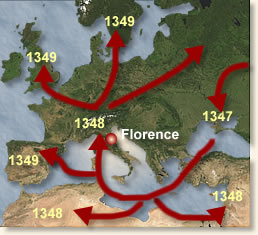
This Post is about faith. Around minute 10:30 in the above video, Celente talks of those people that have the faith in themselves to bring about change. Celente talks that from all great disasters comes change. He talks of the Black Death that in the three years from 1348 wiped out up to 50% of Europe’s population.
Coming out of the East, the Black Death reached the shores of Italy in the spring of 1348 unleashing a rampage of death across Europe unprecedented in recorded history. By the time the epidemic played itself out three years later, anywhere between 25% and 50% of Europe’s population had fallen victim to the pestilence.
Plague's progress
So here’s the point. In the Celente interview, he predicts that 20% of Americans will reject the way that they see their society going. Fascinating! That 20% figure.
Dr David Hawkins in his seminal book Power vs Force writes on page 77:
… 85% of the [world] race is below the critical level of 200, while the overall average level of human consciousness is approximately 204. The power of the relatively few individuals near the top counterbalance the weakness of the masses towards the bottom to achieve the overall balance.
Hawkins is saying that 15% of the world’s population has the integrity required to bring up the level of consciousness of all the rest.
I have the faith that we are on the verge of another renaissance for mankind, one based on integrity and truthfulness, honesty and love. In my faith, I see this next renaissance being born in America, still the land of the free.
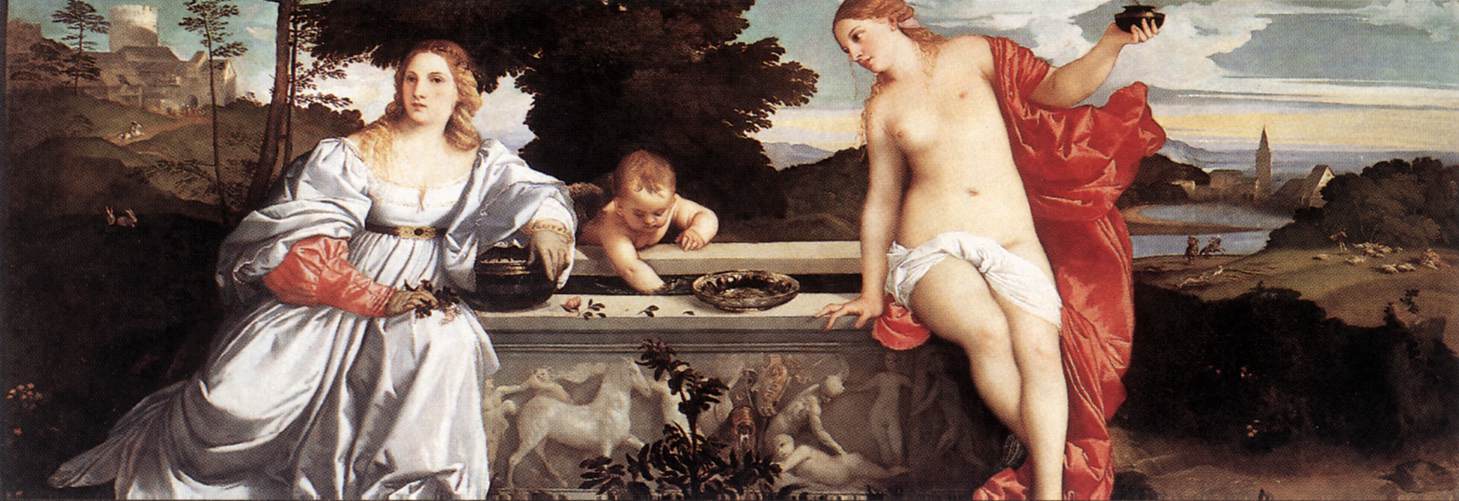
"Sacred and Profane Love" by Tiziano Vecellio, otherwise known as Titian
Titian was born in 1488 just 100 years after Europe was ravaged by the Plague.
Keep the faith – there is a wonderful new world just around the corner.
Pure luck in discovering things you were not looking for.
But the Buddhist belief is that there is no such thing as luck. See here:
The dictionary defines luck as ‘believing that whatever happens, either good or bad, to a person in the course of events is due to chance, fate or fortune.’ The Buddha denied this belief completely. Everything that happens has a specific cause or causes and there must be some relationships between the cause and the effect. (My italics.)
So you takes your choice! The Free Dictionary goes on to provide a fascinating account of the word history of serendipity:
Word History: We are indebted to the English author Horace Walpole for the word serendipity, which he coined in one of the 3,000 or more letters on which his literary reputation primarily rests. In a letter of January 28, 1754, Walpole says that “this discovery, indeed, is almost of that kind which I call Serendipity, a very expressive word.” Walpole formed the word on an old name for Sri Lanka, Serendip.He explained that this name was part of the title of “a silly fairy tale, called The Three Princes of Serendip:as their highnesses traveled, they were always making discoveries, by accidents and sagacity, of things which they were not in quest of….”
The work that the dedicated folks at WITNESS do is both humbling and uplifting and puts into perspective the value of what we do everyday.
Take 10 minutes from your busy day to view this video and then look at the WITNESS website to see what real change looks like. It will inspire you and enrich your life. It is important.
That reference to the charity WITNESS impressed me. Especially the fact that
Peter Gabriel
it was founded by that great musician Peter Gabriel.
Here’s the video mentioned in the extract above:
So how to close this particular post? Not sure, to be honest. But whether one believes in luck or not, there’s no doubt that we attract the world around us that we ‘deserve’.
As has been said before on this Blog, we get more of what we think about most. So really the Buddhist approach that there “must be some relationships between the cause and the effect” is more than sufficient reason to be a good and integrous member of this planet.





 Learning from Dogs