Category: Core thought

Plan B for Planet Earth

Going for a sustainable future is not ‘pie in the sky’.

I have been attempting to write on Learning from Dogs about my experience reading the Lester Brown book, World on the Edge. In

Lester Brown's book

fact, there have been four articles written all with the title Total, Utter Madness (Pts 1 to 4.)  If you read the early chapters of Lester’s book you will have no issue with the notion of summarising the propositions that he presents as ‘total, utter madness’.

There was another article published on the 3rd March that I called, ‘Where are we off to?‘ that presented more information about the fragility of mankind on this Planet if we don’t change our ways, and soon. (There are links to all my articles from this 3rd March piece.)

But much of the second half of Lester Brown’s book is about the relative ease with which we can change the way we all live and offer the generations ahead of us a real alternative to the selfish, greedy way in which we treat Planet Earth at present.  That alternative is called Plan B.

Plan B offers the real hope of developing a sustainable relationship with our planet.  So this post is to reproduce in full a recent release by the Earth Policy Institute about wind power.

Wind: The Center of the Plan B Economy

Lester R. Brown

For many years, a small handful of countries dominated growth in wind power, but this is changing as the industry goes global, with more than 70 countries now developing wind resources. Between 2000 and 2010, world wind electric generating capacity increased at a frenetic pace from 17,000 megawatts to nearly 200,000 megawatts.

Measured by share of electricity supplied by wind, Denmark is the leading nation at 21 percent. Three north German states now get 40 percent or more of their electricity from wind. For Germany as a whole, the figure is 8 percent—and climbing. And in the state of Iowa, enough wind turbines came online in the last few years to produce up to 20 percent of that state’s electricity.

In terms of sheer volume, the United States leads the world with 35,000 megawatts of wind generating capacity, followed by China and Germany with 26,000 megawatts each. Texas, long the leading U.S. oil-producing state, is now also the nation’s leading generator of electricity from wind. It has 9,700 megawatts of wind generating capacity online, 370 megawatts more under construction, and a huge amount under development. If all of the wind farms projected for 2025 are completed, Texas will have 38,000 megawatts of wind generating capacity—the equivalent of 38 coal-fired power plants. This would satisfy roughly 90 percent of the current residential electricity needs of the state’s 25 million people.

In July 2010, ground was broken for the Alta Wind Energy Center (AWEC) in the Tehachapi Pass, some 75 miles north of Los Angeles, California. At 1,550 megawatts, it will be the largest U.S. wind farm. The AWEC is part of what will eventually be 4,500 megawatts of renewable power generation, enough to supply electricity to some 3 million homes.

Since wind turbines occupy only 1 percent of the land covered by a wind farm, farmers and ranchers can continue to grow grain and graze cattle on land devoted to wind farms. In effect, they double-crop their land, simultaneously harvesting electricity and wheat, corn, or cattle. With no investment on their part, farmers and ranchers typically receive $3,000–10,000 a year in royalties for each wind turbine on their land. For thousands of ranchers in the U.S. Great Plains, wind royalties will dwarf their net earnings from cattle sales.

In considering the energy productivity of land, wind turbines are in a class by themselves. For example, an acre of land in northern Iowa planted in corn can yield $1,000 worth of ethanol per year. That same acre used to site a wind turbine can produce $300,000 worth of electricity per year. This helps explain why investors find wind farms so attractive.

Impressive though U.S. wind energy growth is, the expansion now under way in China is even more so. China has enough onshore harnessable wind energy to raise its current electricity consumption 16-fold. Today, most of China’s 26,000 megawatts of wind generating capacity come from 50- to 100-megawatt wind farms. Beyond the many other wind farms of that size that are on the way, China’s new Wind Base program is creating seven wind mega-complexes of 10 to 38 gigawatts each in six provinces (1 gigawatt equals 1,000 megawatts). When completed, these complexes will have a generating capacity of more than 130 gigawatts. This is equivalent to building one new coal plant per week for two and a half years.

Of these 130 gigawatts, 7 gigawatts will be in the coastal waters of Jiangsu Province, one of China’s most highly industrialized provinces. China is planning a total of 23 gigawatts of offshore wind generating capacity. The country’s first major offshore project, the 102-megawatt Donghai Bridge Wind Farm near Shanghai, is already in operation.

In Europe, which now has 2,400 megawatts of offshore wind online, wind developers are planning 140 gigawatts of offshore wind generating capacity, mostly in the North Sea. There is enough harnessable wind energy in offshore Europe to satisfy the continent’s needs seven times over.

In September 2010, the Scottish government announced that it was replacing its goal of 50 percent renewable electricity by 2020 with a new goal of 80 percent. By 2025, Scotland expects renewables to meet all of its electricity needs. Much of the new capacity will be provided by offshore wind.

Denmark is looking to push the wind share of its electricity to 50 percent by 2025, with most of the additional power coming from offshore. In contemplating this prospect, Danish planners have turned conventional energy policy upside down. They plan to use wind as the mainstay of their electrical generating system and to use fossil-fuel-generated power to fill in when the wind dies down.

Spain, which has 19,000 megawatts of wind-generating capacity for its 45 million people, got 14 percent of its electricity from wind in 2009. On November 8th of that year, strong winds across Spain enabled wind turbines to supply 53 percent of the country’s electricity over a five-hour stretch. London Times reporter Graham Keeley wrote from Barcelona that “the towering white wind turbines which loom over Castilla-La Mancha—home of Cervantes’s hero, Don Quixote—and which dominate other parts of Spain, set a new record in wind energy production.”

In 2007, when Turkey issued a request for proposals to build wind farms, it received bids to build a staggering 78,000 megawatts of wind generating capacity, far beyond its 41,000 megawatts of total electrical generating capacity. Having selected 7,000 megawatts of the most promising proposals, the government is issuing construction permits.

In wind-rich Canada, Ontario, Quebec, and Alberta are the leaders in installed capacity. Ontario, Canada’s most populous province, has received applications for offshore wind development rights on its side of the Great Lakes that could result in some 21,000 megawatts of generating capacity. The provincial goal is to back out all coal-fired power by 2014.

On the U.S. side of Lake Ontario, New York State is also requesting proposals. Several of the seven other states that border the Great Lakes are planning to harness lake winds.

Earth Policy Institute’s Plan B to save civilization has four components: stabilizing climate, restoring earth’s natural support systems, stabilizing population, and eradicating poverty. At the heart of the plan is a crash program to develop 4,000 gigawatts (4 million megawatts) of wind generating capacity by 2020, enough to cover over half of world electricity consumptionin the Plan B economy. This will require a near doubling of capacity every two years, up from a doubling every three years over the last decade.

This climate-stabilizing initiative would mean the installation of 2 million wind turbines of 2 megawatts each. Manufacturing 2 million wind turbines over the next 10 years sounds intimidating—until it is compared with the 70 million automobiles the world produces each year.

At $3 million per installed turbine, the 2 million turbines would mean spending $600 billion per year worldwide between now and 2020. This compares with world oil and gas capital expenditures that are projected to double from $800 billion in 2010 to $1.6 trillion in 2015.

Adapted from Chapter 9, “Harnessing Wind, Solar, and Geothermal Energy” in Lester R. Brown, World on the Edge: How to Prevent Environmental and Economic Collapse (New York: W.W. Norton & Company, 2011), available online at www.earth-policy.org/books/wote.
Travel well.

It is better to travel well than to arrive.” Buddhist quote.

Those of you who are regular readers of Learning from Dogs, and I am flattered at how many there are now, will recall that on March 8th I posted an announcement of the Rev. Terry Hershey coming to Payson to give a couple of seminars based around his best-selling book, Soul Gardening.  Jean and I had the honour of having Terry stay with us for a couple of nights.

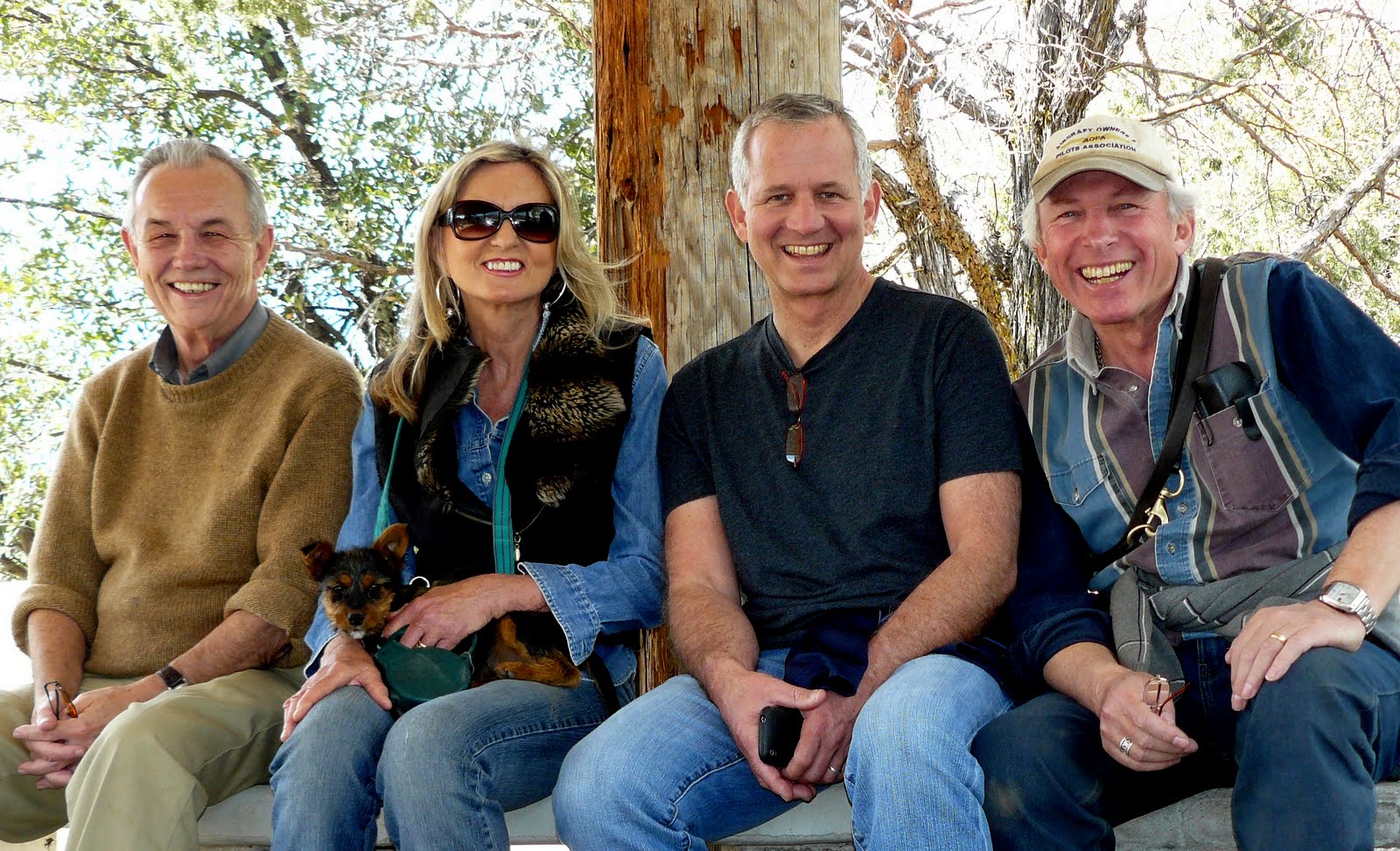
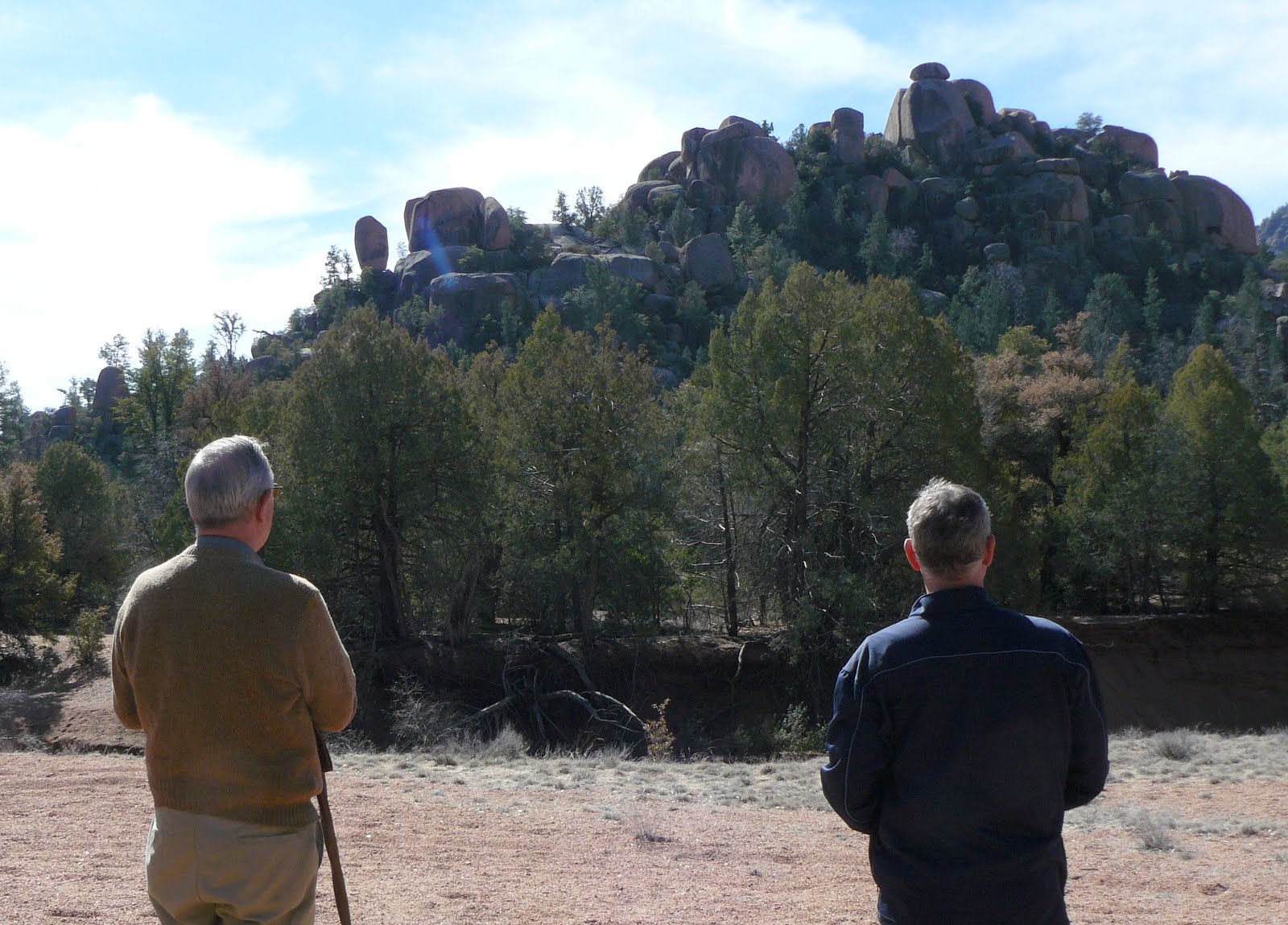
Anyway, on Monday morning, the day Terry was to give his talks, four of us took a couple of hours off in the morning to take a walk around the majestic granite boulders, a couple of miles on from our house.  These great boulders give rise to the name of the road that we live on; Granite Dells Rd.  Most afternoons, Jean and I take Pharaoh and his little pack of dogs for this three-mile walk so today was no different other than the walk being in the morning.

John H and Terry admiring the granite dells.

However, one of the benefits of having Terry with us on the walk was that he pointed out something really obvious that, so far, Jean and I had just taken for granted, i.e. missed!

It’s this. That dogs, when out for a walk off-leash, never travel the same journey, however many times they go on the same walk.  All dog-owners will be aware of this.

Dogs are all over the place, scurrying here and there, following sweet scents, totally absorbed in the intimacy of their relationship with their immediate experience.  There’s no ‘purpose’ to their behaviour, there’s no ‘clock’ running in their head as to what time it is and when they have to be somewhere else.  It is the epitome of travelling well, as from the quote at the start of this article.

The metaphor of how dogs journey as a comparison to how so many of us humans travel with eyes closed, never stopping to smell the roses, was mentioned by Terry when we stopped for group photo towards the end of the walk.  Terry also touched on the importance of living in the present, as dogs do so very, very well, many times during his later talks.

As soon as we make our happiness conditional on ‘getting’ somewhere in the future, our journey rather becomes pointless.


John, Jean, Terry, Paul - being happy in the moment.

What a wonderful day this Monday was.


Enough – from Baseline Scenario

A powerful reflection on values.

I am indebted to James Kwak, the author of this article on Baseline Scenario, for giving me permission to reproduce in full what was published on the 12th March, 2011.

By James Kwak

A friend passed on this article in The Motley Fool by Morgan Housel. It begins this way:

Enough.

“That’s the title of Vanguard founder John Bogle’s fantastic book about measuring what counts in life.

“The title, as Bogle explains, comes from a conversation between Kurt Vonnegut and novelist Joseph Heller, who are enjoying a party hosted by a billionaire hedge fund manager. Vonnegut points out that their wealthy host had made more money in one day than Heller ever made from his novelCatch-22. Heller responds: ‘Yes, but I have something he will never have: enough.’”

The rest of the article discusses the cases of Rajat Gupta and Bernie Madoff, the former accused (but not criminally) and the latter convicted of illegal activity done after they had already been enormously successful, professionally and financially.

Housel asks, why do people push on — legally or illegally — when they have more of everything than anyone could possibly need? He summarizes the happiness research as follows:

“Money isn’t the key to happiness. What really gives people meaning and happiness is a combination of four things: Control over what they’re doing, progress in what they’re pursuing, being connected with others, and being part of something they enjoy that’s bigger than themselves.”

Of course, even if that’s true (and I think it is, except for the first sentence, on which more below), that doesn’t mean that people realize it. And if people don’t understand the relationship between their actions and their personal outcomes, we have no reason to believe that they will behave in a utility-maximizing way.

That said, renowned economist Justin Wolfers was recently on Planet Money saying that money does, indeed, buy happiness. He was discussing a paper he did with Betsey Stevenson looking at datasets covering many countries over many years. They find a positive relationship between income and subjective well-being, whether in the form of life satisfaction or happiness (although the relationship appears somewhat weaker for happiness).* In particular, they find that there is no satiation point, at least when making cross-country comparison (that is, the positive relationship persists even when you look only at countries that are at least moderately wealth).

At one point in the Planet Money interview, I believe Wolfers did say that when it comes to happiness, someone (Kahneman, I think) had estimated that there is a satiation point at around $75,000 per year. But, he went on, the issue is that we may want subjective states other than simple happiness. So, for example, we may want the subjective feeling of power, whether or not it actually makes us happy in the moment. And those other subjective states may not have satiation points, or they may have little to do with income.

But ultimately I agree with Heller. It is a great thing to have “enough,” and to know you have enough. And that is a feeling that for some people, apparently, no amount of money can buy.

* The difference, put simply, is between whether you feel happy at this moment and whether you feel satisfied with your life as a whole. For more, see this fantastic TED Talk by Daniel Kahneman (which I have recommended before).

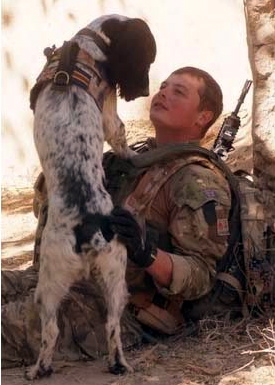
Remembering Lance Corporal Liam Tasker and Theo

The body of a soldier who died along with his dog in Afghanistan last week has returned home to the UK.

Most days when I’m sitting in front of my PC I tend to drop in on the BBC New website.  Today (last Thursday) was no exception.  However I did not expect to be so moved by a story of the death of a British soldier in Afghanistan together with his sniffer dog.  Here’s how the BBC reported it.

Liam and Theo, RIP

The body of a soldier who died along with his record breaking sniffer dog in Afghanistan last week has returned home to the UK.

Lance Corporal Liam Tasker, from Kirkcaldy in Fife, was shot dead while on patrol in Helmand province.

The ashes of the 26-year-old’s dog Theo were flown home on the same plane.

L/Cpl Tasker, who was called a “rising star” by Army chiefs, was shot by Taliban snipers and Theo died of a seizure shortly after his master.

The soldier and his 22-month-old dog had made 14 finds in five months while on the frontline.

The pair’s successes at uncovering so many explosions and weapons had resulted in their tour of Afghanistan being extended by a month.

Just three weeks ago, springer spaniel Theo was praised as a record breaking Army sniffer dog.

The body of L/Cpl Tasker and the ashes of Theo were flown to RAF Lyneham in Wiltshire at lunchtime, before a cortege passed through Wootton Bassett, the Wiltshire town which has built up a tradition of welcoming back fallen heroes.

But what the BBC report doesn’t make clear is that Theo, L/Cpl Tasker’s dog, did not die in the action that killed Liam but of a seizure just three hours later.  Here’s how the British newspaper The Daily Telegraph reported the sad event.

Hundreds of mourners lined the main street through the Wiltshire town to honour Lance Corporal Liam Tasker, of the Royal Army Veterinary Corps, who was shot while on patrol in Helmand province, Afghanistan on March 1.

The crowds were swelled by family pets and a dozen police and Prison Service dogs at the repatriation ceremony for the 26-year-old soldier, whose dog Theo died from a seizure three hours after his master was killed.

L/Cpl Tasker’s family said they believe the dog died from a broken heart.

The body of L/Cpl Tasker, from Kirkcaldy, Fife, and the ashes of Theo had earlier been flown back to RAF Lyneham in the same aircraft.

L/Cpl Tasker was the subject of the repatriation ceremony but Theo’s ashes will be presented in private to his family.

So a silent prayer this Sunday for Liam and Theo and for all those who knew them both.  Finally, if anyone wants to share a thought on the UK Forces in Afghanistan Blog then here’s the link to the Post that mentions the death of these two brave soldiers.

Peter Russell

Life is such a learning experience!

A good friend of Jeannie and me in Payson is John H.  John has stimulated much wonderful thinking and reflection through conversation and the sharing of books and DVDs.  It was John H. who introduced us to Joseph Campbell about whom I wrote on the 14th February.

Well the other day, John handed us a DVD of Peter Russell giving three talks.  We watched it on Sunday evening. An amazing and inspiring experience.  But first some information about Peter Russell from, of course, his own website!  Peter describes himself as follows:


Peter Russell

Peter Russell is a fellow of the Institute of Noetic Sciences, of The World Business Academy and of The Findhorn Foundation, and an Honorary Member of The Club of Budapest

At Cambridge University (UK), he studied mathematics and theoretical physics. Then, as he became increasingly fascinated by the mysteries of the human mind he changed to experimental psychology. Pursuing this interest, he traveled to India to study meditation and eastern philosophy, and on his return took up the first research post ever offered in Britain on the psychology of meditation.

His principal interest is the deeper, spiritual significance of the times we are passing through. He has written several books in this area — The TM TechniqueThe UpanishadsThe Brain BookThe Global Brain AwakensThe Creative ManagerThe Consciousness RevolutionWaking Up in Time, and From Science to God.

As one of the more revolutionary futurists Peter Russell has been a keynote speaker at many international conferences, in Europe, Japan and the USA. His multi-image shows and videos, The Global Brain and The White Hole in Time have won praise and prizes from around the world. In 1993 the environmental magazine Buzzworm voted Peter Russell “Eco-Philosopher Extraordinaire” of the year.

Now in terms of the video that we watched, it contained three films: The Global Brain; The White Whole in Time; From Science to God.  In a very generous act the talk entitled The Global Brain is available to watch online – just click here. (Haven’t been over the website in detail but I suspect more of Peter’s material is available online.)  That online version is the full talk of 35 minutes but you will get lost in time as you watch it!

But if, for now, you want a feel for Peter’s approach then here are a couple of YouTube videos.  But a health warning, you may never look at the world around you in quite the same way!

and here are the first two parts of Waking up in Time (just over 6 minutes in total)


Just a reflection on nearly 900 posts!!

Prompted by a recent comment from a reader.

This Blog started on July 15th, 2009.  At first there were a group of authors all committed to the vision but for various reasons they all were unable to maintain the very real challenges of writing a daily article and they amended the relationship to that of occasional guest author. My fellow founding author, Jon Lavin, has just completed a very demanding Master’s Degree which, for very valid reasons, has kept his nose to a different grinding wheel for the last 3 years.  My greatest wish is that Jon can return to writing for this Blog simply because the original idea about dogs having much to teach us came from Jon.

The vision of why so many hours are spent managing and writing on Learning from Dogs is encapsulated here.  One of the ideas expressed there is, “Our children require a world that understands the importance of faith, integrity and honesty“.  This aspect has become more and more important in my mind.  Within less than a month of this Post, I will have my first grandchild (the gender is a closely guarded secret!)  When I look at some of the scenarios that could face that grandchild over the next four decades, it’s easy to feel pretty nervous. So being able to use the power of this electronically connected world to ramble on is my way to trying to do something!

This is leading me to the point of this Post.  If it wasn’t for the growing number of readers, now several hundred a day, and the graciousness of those readers to find the time to comment, I think this Blog would have rolled over and gone back to sleep in front of the fire as Pharaoh is wont to do!

The comments have been fabulous and even selecting a couple seems unfair on the rest.  But nonetheless that is what this article is going to include.

Just a few days ago, there was an article about the internet and control.  Dogkisses wrote:

I feel quite positive about technology, including the Internet, but I also wish we could keep things like public libraries and continue to learn skills such as handwriting.

My nephew, an A student in college, recently had to take a handwriting course. My sis was embarrassed ’til she arrived finding many Mothers she knew there for the same reason. Many college students didn’t know how to write.

I volunteered once at a “Center for Independent Living.” One of the main services they offered was free Internet access to people with disabilities. I have since learned how important this is for people who are either bed-ridden or as with Chronic Fatigue Syndrome, stay home much of the time. It is a connection to the world. People can have a sense of community. This is a good thing.

I also love how quickly I can learn little things, such as words and how that might take me somewhere else to learn about something different. Pretty cool.

Maybe some people who have control in certain arenas are afraid that The People who are being controlled will, via the Internet, be heard and all too clearly.

Then last Friday, another reader, Steven Law, added an insightful comment to a Guest Post written by Patrice Ayme last December 10th., the Essence of the Civilizational Crisis, a very profound piece.  This is what Steven wrote:

“To create public money, the money everybody uses (be it cash, electronic transfers, swaps, whatever) we use a private system, with proprietary money creating devices inside (say subprime, or derivatives). Civilization has never worked this way before, as the state previously was careful to stay the one and only money creator.”
What Patrice ignores here is that the State “creates” nothing. And I do not support “private” monopoly of money either.What I would like to entertain is the ability for a true free market (one in which we do not have) to explore competitive money, and yes, privately issued by competing banks. But that these banks would not operate on fractional reserve. They would largely operate their monies on a commodities basket reserve system. Not just precious metals, but multiple commodities as well.
At any rate you can learn more on this by reading F.A. Hayek’s “Good Money”pts. 1 & 2. Also I recommend spending some time at The Von Mises Institute online, great insights and education from an Austrian perspective on these matters.

I like your post, but find a few flaws in the argument. My main point here is that civilization has failed throughout history to keep the State under control and not allow state controlled money monopoly. Fiat currencies have failed miserably throughout history and are doing so again. We have some serious learning lessons coming our way…again.

Just want to expand on what I said about the State not creating anything. How can they create when the monies the receive are largely from coercion as well as monopoly? Therefore any “creation” by the State is at the expense of industry and freedom. Hence the need for a limited government.
I also recommend watching “Corporation Nation” on youtube. It’s pretty long and supports with verifiable evidence the depths our government has reached into fascism.

So there we are! Writing this Blog is a labour of love and having both readers and readers willing to comment keeps the love affair going!  Thank you all, every one of you.

Finally, Steven mentions that YouTube video Corporation Nation.  The whole series of videos is long but if you fancy starting in at the beginning, here it is.

Where are we off to?

More musings on how this present civilisation is going to change, as change it must.

I have a sense that this article is going to spread across a number of posts.  Regular readers of Learning from Dogs will be aware that I am summarising Lester Brown’s excellent book, World on the Edge.  If you have missed those summaries, the last one, Part 4, was here. (Part 3 here, Part 2 here, Part 1 here.)

Details of this excellent book are on the Earth Policy Institute website including the opportunity to download the book for free.

OK, back to the theme of this article, very much connected with the mission of the EPI.

Jean and I watched a video last night from the website Top Documentary Films; great site by the way.  It was called 2210: The Collapse.  This was how the film was described on that website.

Imagine if hundreds of years from now, scientists excavated the abandoned ruins of some of our largest cities, what conclusions would they come to?

It happened to the Romans, the Anasazi, and the Mayans and, inevitably, one day our own modern civilization will also fall. In this two hour special discover how a future civilization might be baffled as to why the population of these once-great cities would suddenly abandon their technology and architecture, and turn their homes into ghost towns.

Some experts believe that there is a very real risk this could happen, and the collapse of the world as we know it is closer than we think.

Examining the parallels between cultures separated by hundreds of years, explore whether the key to preventing such a global collapse today could lie in finding renewable alternatives to our dwindling energy supplies and sustainable resources. Can we learn from the mistakes of the past before it’s too late?

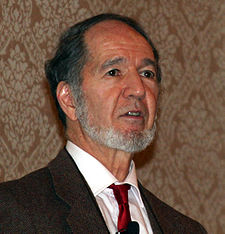
Jared Diamond

In some ways the film didn’t cover any new ground despite it being an interesting way of approaching the subject of the future of our present civilisation.  But what was really worthwhile were the clips from three experts in their various fields.  They were the author Jared Diamond, Daniel Gilbert who is Professor of Psychology at Havard, and Joseph Tainter also an author.  There is much material around from these three gentlemen.

So I am going to start with Jared Diamond.  WikiPedia has Jared’s details.  The following is a video going back to 2003 which is no less relevant in terms of where we are in 2011.  (If you want more of Jared’s ideas, just let me know and they will be included in a future Post.)

“I’ve set myself the modest task of trying to explain the broad pattern of human history, on all the continents, for the last 13,000 years. Why did history take such different evolutionary courses for peoples of different continents? This problem has fascinated me for a long time, but it’s now ripe for a new synthesis because of recent advances in many fields seemingly remote from history, including molecular biology, plant and animal genetics and biogeography, archaeology, and linguistics.”

JARED DIAMOND is Professor of Geography at the University of California, Los Angeles. Until recently he was Professor of Physiology at the UCLA School of Medicine. He is the author of the recently published Collapse: How Societies Choose to Fail or Succeed, and the Pulitzer Prize-winning author of the widely acclaimed Guns, Germs, and Steel: the Fates of Human Societies, which also is the winner of Britain’s 1998 Rhone-Poulenc Science Book Prize.  (From here)

Total, utter madness, Pt 4

Continuing the review of Lester Brown’s book World on the Edge.

Regular readers will be aware that I have been summarising each chapter of this pivotal book.  Chapters 2, 3 and 4 are part of the section that Lester Brown calls A Deteriorating Foundation.  But I am aware that wall-to-wall gloom is often too much for people to take in so I wanted to let you know that the third section, The Response: Plan B, is very much a realistic and pragmatic approach to the alternative, a planet that will let countless future generations live in harmony and sustainably.

So please take in the dire situation that we are in by reading these summaries or, better still, buy the book!

Chapter Four, Rising Temperatures, Melting Ice, and Food Security.

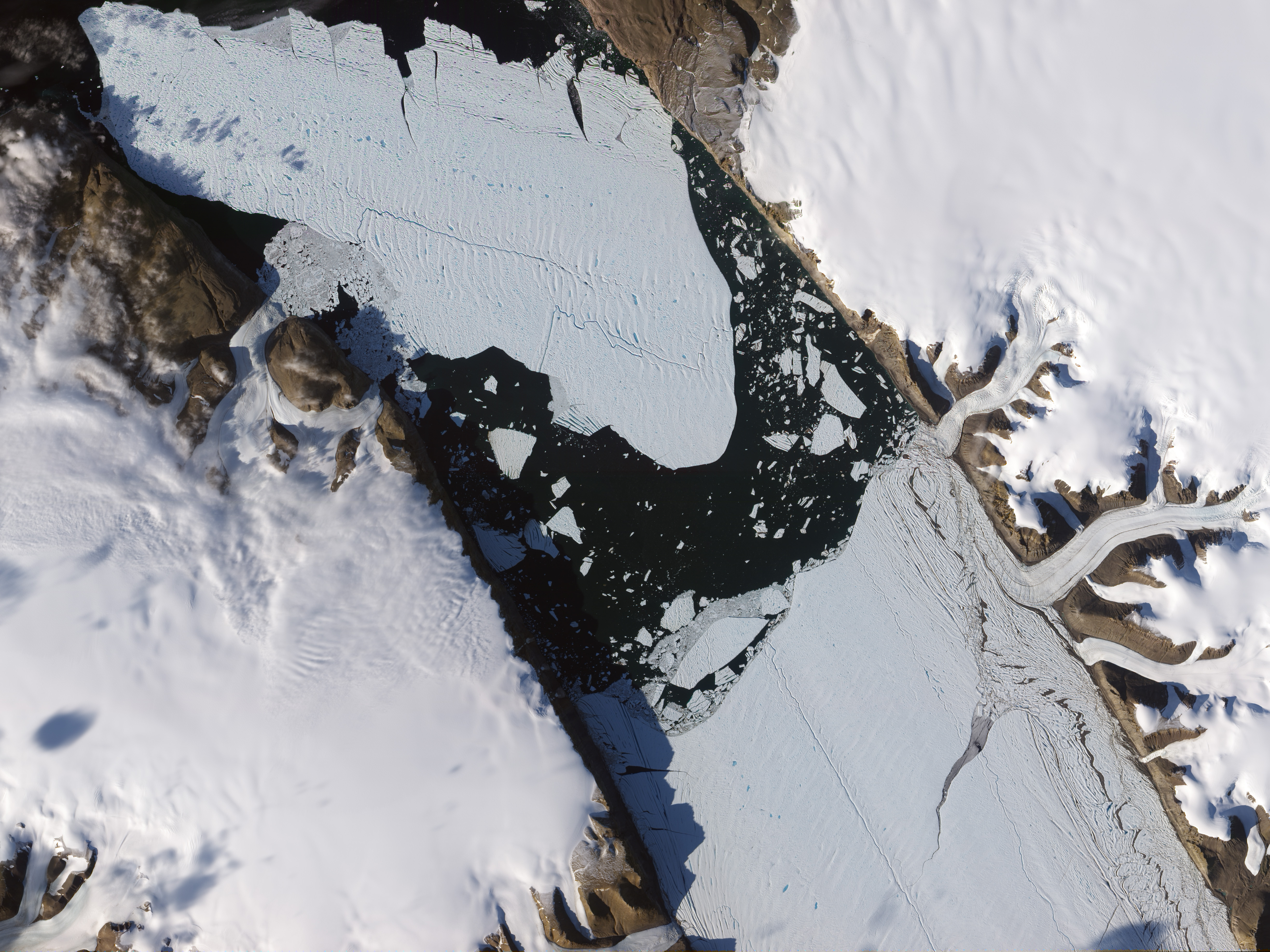
  • The Petermann Glacier calves an iceberg that covered 97 square miles on August 5th, 2010.
  • Scientists for some years have been reporting that the Greenland ice sheet was melting at an accelerating rate.
  • Richard Bates, from the University of St Andrews, part of a team monitoring Greenland ice melt, was reported as saying:

Dr Richard Bates, who is monitoring the ice alongside researchers from America, said the expedition had expected to find evidence of melting this year after “abnormally high” temperatures in the area. Climate change experts say that globally it has been the warmest six months globally since records began.

But he was “amazed to see an area of ice three times the size of Manhattan Island had broken off.

“It is not a freak event and is certainly a manifestation of warming. This year marks yet another record breaking melt year in Greenland; temperatures and melt across the entire ice sheet have exceeded those in 2007 and of historical records.”

  • A temperate rise of between 2C and 7C would cause the entire Greenland ice mass to melt – raising sea-levels world-wide by 23 feet (7 metres)!
  • In the United States last year saw record hot temperatures on the East Coast.
  • On September 27th Los Angeles recorded an all-time high of 113 degrees F, then the official thermometer broke.
  • A nearby thermometer survived to register a temperature of 119 degrees F, a record for the region.
  • Crop ecologists use a rule of thumb that for each 1-degree-Celsius rise in temperature above the optimum during the growing season, we can expect a 10-percent decline in grain yields.
  • Temperatures are rising much faster in the Arctic than elsewhere.  Winter temperatures in the Arctic, including Alaska, western Canada and eastern Russia, have climbed by 4-7 degrees F. over the last half-century.
  • This record rise in temperatures in the Arctic region could lead to changes in climate patterns that will affect the entire planet.
  • Even a 3-foot rise in sea level would sharply reduce the rice harvest in Asia. It would inundate Bangladesh, a country of 164 million people, submerge part of the Mekong Delta ( a region that produces half of Viet Nam’s rice).

That’s enough from me, simply because although this chapter in the book continues with many more frightening facts, I can’t continue to list them in this particular Post.  If the above doesn’t cause you to think and want to change, then a couple of dozen more facts aren’t going to do it either.

Just look at the photograph below and ponder on what we are leaving our children and our grand-children.  Indeed, if you are, say 50 years or younger, ponder on what the next few decades could offer for you.

We have to break our addiction with our modern way of living – or Planet Earth will do it for us.

A mother of an iceberg!

On Aug. 5, 2010, an enormous chunk of ice, roughly 97 square miles (251 square kilometers) in size, broke off the Petermann Glacier, along the northwestern coast of Greenland. The Canadian Ice Service detected the remote event within hours in near real-time data from the Moderate Resolution Imaging Spectroradiometer (MODIS) on NASA’s Aqua satellite. The Petermann Glacier lost about one-quarter of its 70-kilometer (40-mile) long floating ice shelf, said researchers who analyzed the satellite data at the University of Delaware. Taken from here.

This most beautiful of relationships

That of man and dog.

A number of items have crossed my screen that, together, present the most wonderful story of the intensity and length of the time that mankind has shared his life with the dog.

First is this piece from Anthropology.net from 2008 when this was big news.

A Possible Domestication Of Dogs During The Aurignacian: 31,700 Years Ago

Both Dienkes and John Hawks have shared news about the latest research on the domestication of dogs. The researchers analyze 117 skulls of prehistoric canids from sites in Belgium, Ukraine and Russia. They conclude that a 31,700 year old canid from Belgium is ‘clearly different from the recent wolves, resembling most closely the prehistoric dogs.’

The draft can be found in the Journal of Archaeological Science under the title, “Fossil dogs and wolves from Palaeolithic sites in Belgium, the Ukraine and Russia: osteometry, ancient DNA and stable isotopes.” If the dating, and phylogenetic analysis is correct, these remains makes them the oldest known remains of domesticated dog, pushing back domestication time by 17,700 years, since the second oldest known dog, found in Russia, dates to 14,000 years ago as explained by Carl Feagans.

Doral View of the Goyet Cave Dog (a) and wolf skulls (b & c)Doral View of the Goyet Cave Dog (a) and wolf skulls (b & c)

Prehistoric dogs are distinguished from both prehistoric and extant wolves in having a shorter and broader snout, relatively wider brain cases, and a general reduction in skull size. Palaeolithic dogs in the study conform to this pattern. The researchers extended their anatomical analysis to mtDNA and stable isotopes on the Belgian samples. All fossil samples yielded unique DNA sequences.

This is a fascinating article, read the rest of it here.

Next a further explanation of the history of the dog from About.com Archaeology:

Dog history is really the history of the partnership between dogs (Canis lupus familiaris) and humans. That partnership is based on human needs for help with herding and hunting, an early alarm system, and a source of food in addition to the companionship many of us today know and love. Dogs get companionship, protection and shelter, and a reliable food source out of the deal. But when this partnership first occurred is at the moment under some controversy.

Dog history has been studied recently using mitochondrial DNA, which suggests that wolves and dogs split into different species around 100,000 years ago; but whether humans had anything to do with that, no one really knows.

Just think about that – 100,000 years ago!  But even if one assumes that early man wasn’t linked to this species divergence, the hard evidence of dogs being special to man still goes back a very long way.  Continuing the piece above:

The oldest dog skull discovered to date is from Goyet Cave, Belgium. The Goyet cave collections (the site was excavated in the mid-19th century) were examined recently (Germonpré and colleagues, cited below) and a fossil canid skull was discovered among them. Although there is some confusion as to which level the skull came from, it has been direct-dated by AMS at 31,700 BP. The skull most closely represents prehistoric dogs, rather than wolves. The study examining the Goyet cave also identified what appears to be prehistoric dogs at Chauvet Cave (~26,000 bp) and Mezhirich in the Ukraine (ca 15,000 years BP), among others.

However, I am told that what the Goyet Cave skull represents is not a “domesticated dog” but rather a wolf in transition to a dog, and that the physical changes seen in the skulls (consisting primarily of the shortening of the snout) may have been driven by changes in diet, rather than specific selection of traits by humans. That transition in diet could well have been partly due to the beginnings of a relationship between humans and dogs, although the relationship might have been as tenuous as animals following human hunters to scavenge, rather like the behavior that is believed to have existed between humans and cats. You could argue that cats never have been domesticated, they just take advantage of the mice we attract

As they say, dogs have masters, cats have slaves! Millions of dog owners have a relationship with their dog that is close to spiritual, and that also isn’t new. Let’s read on:

A burial site in Germany called Bonn-Oberkassel has joint human and dog interments dated to 14,000 years ago. The earliest domesticated dog found in China is at the early Neolithic (7000-5800 BC) Jiahu site in Henan Province. European Mesolithic sites like Skateholm(5250-3700 BC) in Sweden have dog burials, proving the value of the furry beasts to hunter-gatherer settlements. Danger Cave in Utah is the earliest case of dog burial in the Americas, at about 11,000 years ago.

Haplotypes and Grey Wolves

A recent study led by Robert Wayne (vonHoldt et al., below) at UCLA and appearing in Nature in March 2010 reported that dogs appear to have a higher proportion of wolf haplotypes from grey wolves native to the Middle East. That suggests, contrary to earlier studies, that the middle east was the original location of domestication. What also showed up in this report was evidence for either a second Asian domestication or a later admixture with Chinese wolves.

Dog History: When Were Dogs Domesticated?

It seems clear that dog domestication was a long process, which started far longer ago than was believed even as recently as 2008. Based on evidence from Goyet and Chauvetcaves in Europe, the dog domestication process probably began as long ago as 30,000 years, although the oldest evidence for a broader relationship, a working relationship, is at the Bonn-Oberkassel site, 14,000 years ago. The story of dog domestication is still in transition itself.

14,000 years ago people buried a dog with a human!  That is so beautiful.

Finally, National Geographic have been showing a series on this wonderful relationship between man and dog.  Enjoy this introduction video.

Words fail one

Income inequality, when it becomes excessive, is very corrosive to a society.

This is clearly a complex subject because one man’s excess is another man’s just reward for building a successful business that employs his fellow citizens.

Nonetheless, I do want to touch on this sensitive area because, to my mind, they are connected with the tragic story that is the point of this article.

But first, a couple of quotes from an article by Prof. G. William Domhoff of the Sociology Department of the University of California at Santa Cruz.  It was entitled Wealth, Income, Power.

This document presents details on the wealth and income distributions in the United States, and explains how we use these two distributions as power indicators.

Some of the information may come as a surprise to many people. In fact, I know it will be a surprise and then some, because of a recent study (Norton & Ariely, 2010) showing that most Americans (high income or low income, female or male, young or old, Republican or Democrat) have no idea just how concentrated the wealth distribution actually is.

Later on, Prof. Domhoff writes:

The Wealth Distribution

In the United States, wealth is highly concentrated in a relatively few hands. As of 2007, the top 1% of households (the upper class) owned 34.6% of all privately held wealth, and the next 19% (the managerial, professional, and small business stratum) had 50.5%, which means that just 20% of the people owned a remarkable 85%, leaving only 15% of the wealth for the bottom 80% (wage and salary workers). In terms of financial wealth (total net worth minus the value of one’s home), the top 1% of households had an even greater share: 42.7%. Table 1 and Figure 1 present further details drawn from the careful work of economist Edward N. Wolff at New York University (2010).

That table and the whole article is powerful and a well-worth reading. Read it here.

Stay with me a little longer.  Here’s an extract from an article from Nicholos Kristof of the New York Times written in November last year.

Nicholas Kristof

In my reporting, I regularly travel to banana republics notorious for their inequality. In some of these plutocracies, the richest 1 percent of the population gobbles up 20 percent of the national pie.

But guess what? You no longer need to travel to distant and dangerous countries to observe such rapacious inequality. We now have it right here at home — and in the aftermath of Tuesday’s election, it may get worse.

The richest 1 percent of Americans now take home almost 24 percent of income, up from almost 9 percent in 1976. As Timothy Noah of Slate noted in an excellent series on inequality, the United States now arguably has a more unequal distribution of wealth than traditional banana republics like Nicaragua, Venezuela and Guyana.

C.E.O.’s of the largest American companies earned an average of 42 times as much as the average worker in 1980, but 531 times as much in 2001. Perhaps the most astounding statistic is this: From 1980 to 2005, more than four-fifths of the total increase in American incomes went to the richest 1 percent.

By the way, Kristof has his own blog site and added material from him about this topic and readers’ comments are here.

Now to the core of this article on Learning from Dogs which, I passionately believe, is closely tied in to the background theme already expressed here.  It’s from the blogsite Corrente and, once again, I am indebted to Naked Capitalism for having it in a recent set of links.

It concerns Jack, his family and their house.

The House that Jack’s Bank Took

Jack was a friendly man, who always had a pleasant word and a smile and handshake for everyone. The men hung with him at barbeques and discussed sports. He was strong, had a belly, and always wore a baseball cap. He was married to his high school sweetheart, Mary. He was good to his 4 kids and took care of his oldest child when he had a breakdown in his early twenties. He went to all school and family events and encouraged his children in their dreams. He took care of the family needs and finances. He was a small business owner and had invented his product, which a short while ago became outmoded. He always decorated the house with lots of Christmas decorations and candles. They are still up. He lost his house to foreclosure and the family was given 3 days to move out.

He drove into the deep woods and drank poison to make sure he was dead. I knew him. My family knew him; he lived within walking distance of one of us. At his funeral his childhood sweetheart and their children told a lot of Jack stories. The family did their best to resurrect him to our eyes. One of his kids sang and the eldest read a poem he’d written. Mary said she didn’t know what she was going to do and that she would now have to rely on those from town sitting in the packed chapel pews. There are other houses nearby that haven’t been foreclosed on but Jack’s house was nice and had a good view. The bank has now given Mary 3 weeks to move out.

It was written on the 15th February, 2011; you can read it here.  Click on the link and read some of the comments expressed – very powerful.

Wish I could think of something apt to say but I can’t.  All I can feel is great sadness and a horrible feeling in the pit of my stomach that this ‘Jack’ story is being echoed in many other places.