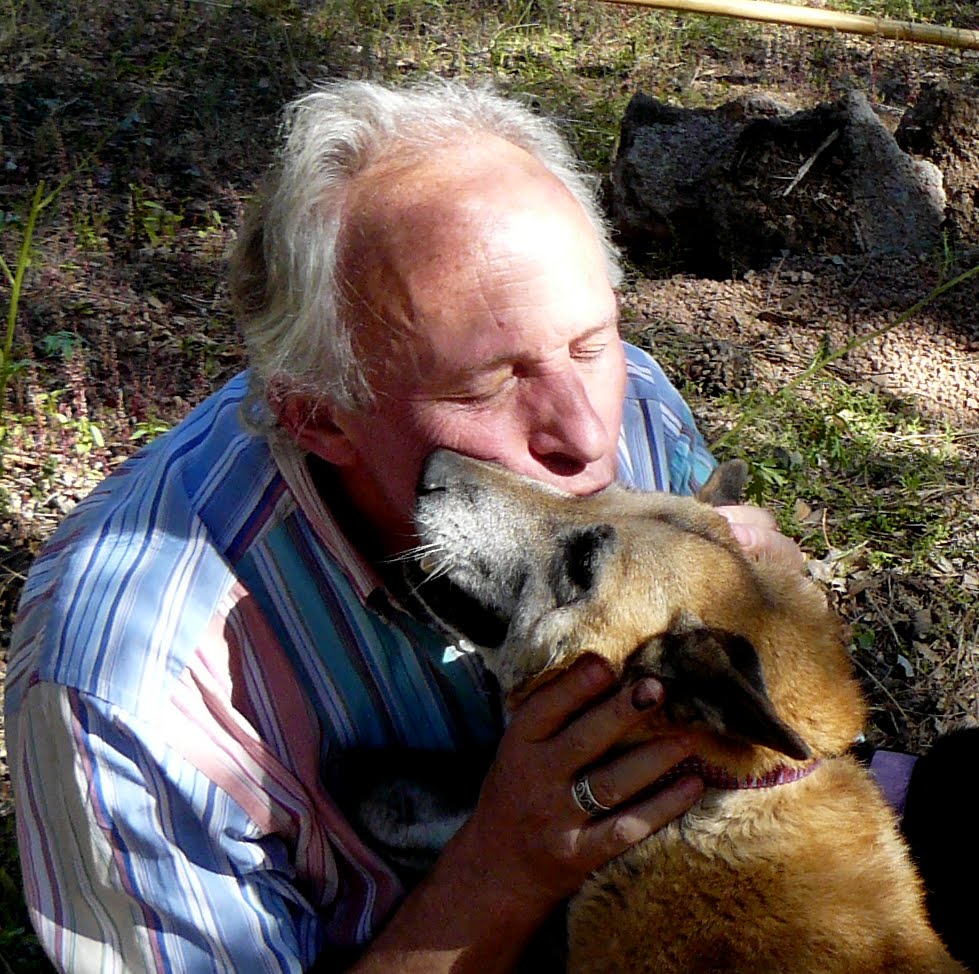
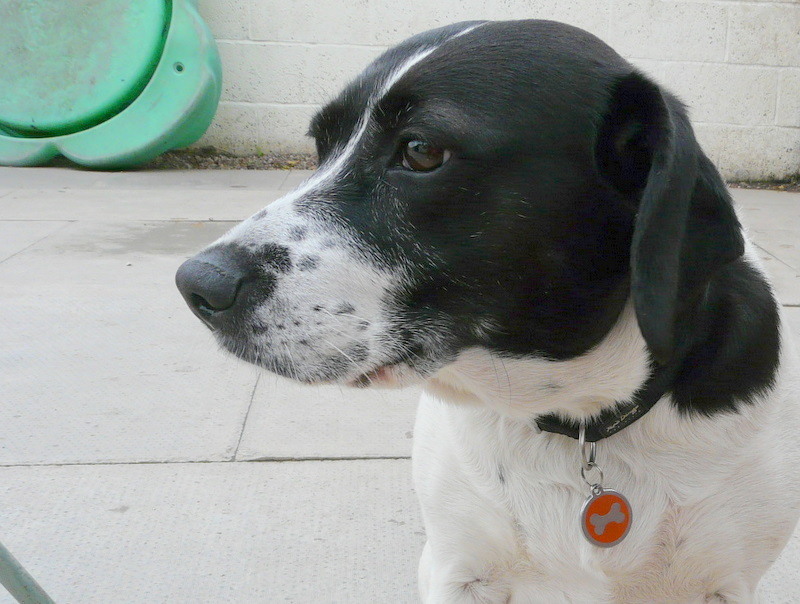
The brown dog with her head nestled against my chest is Loopy. Like Phoebe, the black dog looking at the camera, they are dogs that Jean originally had rescued in Mexico.
Here’s Loopy’s story.
Loopy and Phoebe
When I first met Jean in December 2007 in San Carlos, Mexico, it was immediately clear that she was an animal lover extraordinaire! There were 13 dogs and 6 cats in her home and many other dogs in a fenced off compound not so far away from the house.
Abandoned and stray dogs in that part of Mexico were numerous, there was no humane society and no real care or interest from the Mexicans for these dogs. So many years ago, Jean decided to run her own unofficial dog rescue society, supported by more than a few Americans who had winter homes in San Carlos. Over the years, Jeannie and her team must have rescued and found homes for well over 50 dogs.
In my introduction to the post last Tuesday, Please Help a George, I wrote about how long it had taken for Loopy to bond with me, but Jean’s experience of Loopy goes way back before I entered their lives.
I mentioned above that Jean had a piece of land in San Carlos that she used as a rescue compound for her dogs. One morning, back in 2003, as usual she had gone to the compound to attend to her dogs. Jeannie noticed immediately, cowering in one corner, this young female, brown-haired dog, the dog had been tossed over the fence of the compound. Jean estimated that she was about a year old, hadn’t yet had any pups. The dog had very cold eyes, growled aggressively as soon as Jean approached her; clearly deeply traumatised.
Jean set out food and water before the dog, hoping that whatever had traumatised the dog would soon abate. The dog was named: Loopy!
Despite the fact that Loopy wouldn’t mix with the other dogs in the compound, she was not mean. But the days turned into weeks, the weeks into months, and still Loopy would not allow Jean to get close to her. One could only imagine the degree of cruelty that must have been metered out to Loopy – or, rather, one couldn’t imagine it!
Then, one day, when Jean went to the compound, Loopy was amongst the other dogs. Loopy cautiously came up to Jean, sniffed her feet and legs and then, miraculously, allowed Jean to gently stroke her head and back. Loopy’s cold, angry eyes were now soft and brown; Loopy had melted. For obvious reasons, Loopy would never be available for adoption and soon moved into the main house.
When I became a permanent part of the Mexican household in 2008, Loopy was deeply suspicious of me. I was given the cold, hard-eyed stare from Loopy and any attempt by me to touch her was returned with growling, fanged teeth. There were a number of instances where I collected teeth rips across my hands from Loopy.
The aggression towards me lasted a long time, about a year. But then one day, quite unexpectedly, Loopy decided that I was friend, not some reminder of a demon foe from her past. She trusted me, first with strokes and cuddles and then with the most passionate and trusting embraces. I love her so much.
One could wax lyrical about love, patience and trust, but I won’t. The photograph below says it all. We really do have so much to learn from dogs!
This is such a beautiful dog, and so many ways to help her.
Milly
On the 11th October, I published a story, a story with a very happy ending, about George, a lovely dog who was rescued from the Dog Pound the day before he was due to be killed. The underlying request was to help, in any way that you could, raise funds in conjunction with the Dog Pound Ball being held in Yorkshire.
As I wrote, and as we all know full too well, there are many other dogs that require our help. This is the story of Milly, 9 years old and sadly has spent almost 3 years in rescue.
Little Milly
Milly was handed in from a local home when her owners felt they could no longer keep her. She is an affectionate dog once she learns to trusts, but does growl at strangers and doesn’t present well in kennels. As a result of these issues Milly has been at the rescue kennels for almost three years now, which is a long time for any dog to have to tolerate.
As time goes on it becomes increasingly unlikely that we will succeed in finding her a home. Barnsley Animal Rescue Centre (BARC) does not give up on its rescue animals and has been working with this lovely dog to overcome her problems. Sadly we feel we have done all we can here.
It would be heartbreaking to think she would live out the rest of her life here with us instead of being loved and surrounded by her own family. So we have decided on a way of helping Milly, but it comes at a cost.
Specialist rehabilitation has been arranged but it is going to cost BARC about £50 per week. It’s unclear how long the treatment will take and how effective it will be, but we feel Milly deserves this chance, and know that you will agree with us.
So let’s all do something to help these special creatures, the Georges and the Millys of this world, who offer us humans such unconditionally love and loyalty.
Friday 4th November, 7.30pm – Come to the Hellaby Hall Hotel, Old Hellaby, Maltby, Yorkshire, S66 8SN
Call for tickets now to the Pound Dog Ball telephone number (UK) 07772 538513 or email pogpublications@yahoo.com Full details here.
Please help by supporting this Charity Fundraising Event: Black Tie, Dinner/Dance at Hellaby Hall, Rotherham, 7.30pm, on Friday 4th November. It’s a don’t miss night…..3 course meal, live entertainment all night and dancing ’til late!!!! It’s going to be a great night.
If you can’t make the Ball but would like to send in a donation then please post a cheque, made out to Pound Dog Ball, to the following address:
c/o Jennifer Smith
Clumber Lodge,
50 Hemingfield Road
Wombwell, S73 0LY.
Or if you prefer an electronic donation, further details are:
Pound Dog Ball
A/C 31542265
Sort 40-45-29 (HSBC)
The account is a charity account, set up only for this event. Once the money has been paid to the charities the account will be closed.
A canine charitable opportunity that deserves wide support.
The details that follow strike a chord with me, strike a chord in a big way. When I first came to live with Jean back in 2008 it was clear that this wasn’t going to be a normal relationship. Why? Because, at that time Jean had 12 dogs living with her in San Carlos, Mexico and my arrival, together with my Shepherd dog, Pharaoh (see home page for a picture of him), took that number to 13. Jean’s dogs were all Mexican rescues; she also ran her own local humane society in San Carlos and over the years had found homes for literally dozens of dogs.
One of those Mexican rescues was a dog called Loopy, who had been terribly treated by local Mexicans. The consequence when I arrived, a stranger in the middle of Loopy’s life with Jean, was that Loopy was very aggressive towards me; my hands have small scars to bear witness to the number of nips Loopy launched in my direction.
It took over a year before I was able to just let my hand ‘accidentally’ brush her side. Slowly Loopy’s trust in me built up until now I can press my face to her face and cuddle her for ages. (To underline the love that Loopy bestows on me, I will get Jean to take a picture and publish that before the end of the week.) So with that in mind, let me turn to the details recently sent to me by friend and colleague, Dapinder Singh, from England.
———————
George and loving owner, Ian.
This is George. He was in an English dog pound and condemned to death.
He had been very badly abused, one eye blinded by what was thought to be a kick, he trusted no-one and had rejected all human contact. He was desperate and in despair.
After an exhaustive search for anyone who take on the rescue of George, we (as in Doris Banham) took him into our care just a day before he was due to be euthanased. His veterinary problems were easier to deal with than the mental ones. His eye was damaged beyond repair causing him constant pain so it had to be removed, teaching George to trust again was much harder.
That journey back to trusting humans was long, George had suffered severe and terrible abuse, but there was no question of giving up on him and slowly but surely he began to live again as we fought to undo the wrongs that had been done to him. After some months with us, a wonderful family came to the rescue and offered George his ‘forever’ home where he found the love that he so deserved. His family are completely devoted to him.
His story, however, could have been a very different one were it not for the work of the team at Doris Banham’s. Below is an extract written by the lovely family who adopted him and from our fantastic volunteer, Sheila, who helped bring George back to life again.
“Hi, Sheila. Here is a shot of George in his new garden. He is settling down very well and seems to be very happy. I will keep you posted as to his progress. All the best Liz and Ian.”
There were a number of photographs sent to Sheila, however I have taken editor’s liberty and moved them to the foot of the article – I want you to stay with this to the point where you can see how to help. Here’s Sheila’s reply,
“WELL THESE BOUGHT ME TO TEARS , OUR GEORGE , THIS IS TRUE RESCUE , THIS IS ALL DOWN TO YOU DORIS BANHAM NOTHING ELSE TO SAY …” SHEILA X.
Are there other Georges out there? You bet! Far too many of them, right across the world. So let’s all do something to help these special creatures, who show us humans just what unconditionally love feels like.
Friday 4th November, 7.30pm – Come to the Hellaby Hall Hotel, Old Hellaby, Maltby, Yorkshire, S66 8SN
Call for tickets now to the Pound Dog Ball telephone number (UK) 07772 538513 or email pogpublications@yahoo.com Full details here.
Please help all the Georges out there by supporting this Charity Fundraising Event: Black Tie, Dinner/Dance at Hellaby Hall, Rotherham, 7.30pm, on Friday 4th November. It’s a don’t miss night…..3 course meal, live entertainment all night and dancing ’til late!!!! It’s going to be a great night.
If you can’t make the Ball but would like to send in a donation then please post a cheque, made out to Pound Dog Ball, to the following address:
c/o Jennifer Smith
Clumber Lodge,
50 Hemingfield Road
Wombwell, S73 0LY.
Or if you prefer an electronic donation, further details are:
Pound Dog Ball
A/C 31542265
Sort 40-45-29 (HSBC)
The account is a charity account, set up only for this event. Once the money has been paid to the charities the account will be closed.
I know that Dapinder, and everyone else involved in helping these precious animals, sends you their heartfelt thanks.
Finally, more photos of George enjoying life as all dogs should. What a wonderful story, an honour to be able to publish it, and promote the Ball, on Learning from Dogs. Please help.
Maybe less is more is really at the heart of our thirst for something more
A number of disparate recent experiences seem to have an underlying common thread.
See if these strike you in a similar fashion.
Yesterday, Joelle Jordan wrote about joy, about the wonderful relationship that dogs have with the world around them. As Joelle wrote,
Joy is a difficult commodity to come by these days. I don’t mean entertainment, I don’t mean a good laugh, I mean pure joy, where, even just for a single moment, all worries and doubts, frustration and anger are lifted as though by Atlas.
Like so many other humans in our world, I often find myself in a constant state of stress. There always seems to be something to worry about, whether it’s money, job fulfilment, the state of my relationships, getting the house cleaned, finding time to get to the market, and more. If given the chance, I know we all could spend nearly all of our waking hours (and some of our sleeping hours, too) worrying about something. We spend so much time on the many things that inevitably work themselves out, and so little time on things that will create a memory and a crystal moment of joy.
My little dog Charlie spends his time in the completely opposite fashion; spending his waking hours seeking joy, and committing less time to things that worry him.
Charlie seems to exist normally in three states of being; content, happy and utterly joyful.
How many of us can echo Charlie’s existance in our own lives?
Then last Sunday, Father D’s sermon spoke about our tendency to develop habitual behaviours and rarely challenge the point of them.
The truth is that we get used to doing things a certain way and keep doing them without ever thinking of what we are doing. We say things in the liturgy without even thinking of what we are saying. I’m sure many people utter the words in the Book of Common Prayer without thinking of the theology behind the words, or the relationship between church and state that they express.
Later on,
There was a desire for “something more” but it was hard to put a finger on what it was. I realized from these conversations that we are involved today in a time of intense searching. Few of us are satisfied with what the church and society have served up.
The honest among us will readily admit we lead fractured lives – with a disembodied spirituality on one side, and a soulless daily existence on the other. We are desperate for something more, for a faith with the power to transform both ourselves and our world.
“…. we are involved today in a time of intense searching“! That smacked me right in the eye!
These are clearly challenging times with mankind facing increasing odds of an ecological disaster of Old Testament proportions, and much of the western world on the cusp of a long and difficult recession. It is so easy to go on “doing things a certain way and keep doing them without ever thinking of what we are doing” while we wait for the leaders of our societies to fix our problems.
The truth is that we have to be the first to change, to question what we do on a daily basis and amend it if it is not truly healthy for us and for the planet. As was said in that sermon, “It means bringing forth each day the fruits of the Spirit: Love, joy, patience, kindness, generosity, faithfulness, gentleness and self-control.”
Go back and read yesterday’s Post and reflect on how many of those ‘fruits’ are the ways of dogs.
My final connection with the theme of today’s essay is with a recent series from the BBC called ‘Status Anxiety’. The programmes are still on YouTube and the first 10 minutes is below,
Status Anxiety discusses the desire of people in many modern societies to “climb the social ladder” and the anxieties that result from a focus on how one is perceived by others. De Botton claims that chronic anxiety about status is an inevitable side effect of any democratic, ostensibly egalitarian society. De Botton lays out the causes of and solutions to status anxiety.
Or if you prefer, all 2 hours 23 minutes may be watched on Top Documentary Films, described thus,
De Botton's book
Why doesn’t money (usually) buy happiness? Alain de Botton breaks new ground for most of us, offering reasons for something our grandparents may well have told us, as children.
It is rare, and pleasing, to see a substantial philosophical argument sustained as well as it is in this documentary. De Botton claims that we are more anxious about our own importance and achievements than our grandparents were. This is status anxiety.
Alain quotes philosophical writings, such as Democracy in America, a report by Alexis de Tocqueville on his visit to the USA in 1831. De Tocqueville noted that American equality, notable in those times, was accompanied by a climate of envy.
We jump to present-day USA, and see what, to de Botton, are some awful examples ofThe American Way. A Christian preaches get rich. A steelworker tells of his insecure life in an industry being closed down through others’ love of money.
Our protagonist points out the advantage of high status: those with high status will enjoy the care and attention of the world. Then joins this advantage with the illusion, orattempt at meritocracy in the USA, mentioning Jefferson’s notion of an aristocracy of talent.
Some of the messages towards the end of the programme are very thought-provoking indeed. Let me draw this all together.
If you own a dog, or a cat, or any pet, stop a while today and see how their simplicity of life brings them so much more. Naturally, we can never live life in the same way that our pet does but there are strong metaphors that carry equally strong messages for us. Less is more.
Now watch the last part of Status Anxiety even if you didn’t watch the first segment above, Reason? Watch and it will become clear.
Readers may recall that John H. and I went to the nearest Moving Planet event in Phoenix, as posted on Monday. Now 350.org have released a video of the event as seen from a global perspective.
2000+ events. 180+ countries. A single day to Move Beyond Fossil Fuels. 350.org’s 2011 day of action, Moving Planet, brought together Moving Together.
Photos and Videos submitted by thousands of organizers and activists around the world — THANK YOU!
A fascinating point of view of the relationship between humans and animals.
Jean and I were at our regular gardening college class yesterday. It was all about the growing of vegetables. OK, I can hear you thinking, what on earth does that have to do with today’s topic? Simply because the tutor, Cayci V., mused at the start of her lesson how gardeners were great animal lovers and then proceeded to list all the animals she and her husband kept at their home in Globe, about an hour from Payson, Arizona. Cayci admitted to having 5 dogs, 15 cats, 2 emus, 2 llamas, numerous chickens. She also had 2 bison that recently died having been poisoned by Oleander cuttings. Anyway, to the article.
A recent article on the BBC News Magazine was about the need for humans to have contact with animals. It was presented by John Gray who is a political philosopher and author of the book False Dawn: The Delusions of Global Capitalism which argues that free market globalization is unstable and is in the process of collapsing! H’mmm. John is also the author of the book Straw Dogs: Thoughts on Humans and Other Animals, a book that was described by the British Observer newspaper thus,
There is unlikely to be a more provocative or more compelling book published this year than Straw Dogs. A long-time scourge of the delusions of global capitalism, John Gray is one of the most consistently interesting and unpredictable thinkers in Britain. He is unpredictable because, unlike most political commentators, he never ceases to question the underlying assumptions of his own beliefs and prejudices.
Anyway, I’m at risk of digressing, as many of you will regularly notice! The article by John Gray on the BBC News website was published over a couple of weeks ago and, therefore, I feel it not too great a copyright sin to reproduce it in full on Learning from Dogs. It’s a fascinating article.
Why does the human animal need contact with something other than itself, asks John Gray.
Many years ago an eminent philosopher told me he’d persuaded his cat to become a vegan. To begin with I thought he was joking. Knowing a bit about cats, I couldn’t take seriously the idea that they’d give up their predatory ways.
“You must have provided the cat with some pretty powerful arguments,” I said jokingly. “It wasn’t as difficult as you may think,” he replied rather sternly.
He never explained exactly how the transformation was achieved. Was his cat presented with other cats that had converted to veganism – feline role models, so to speak? Had he prepared special delicacies for his cat – snacks that looked like mice but were made of soya, perhaps?
Beginning to suspect that the philosopher might after all be serious, I asked if the cat went out. He told me it did. That answered a part of my puzzlement. Evidently the cat was supplementing its vegan diet by hunting, natural behaviour for cats after all.
I was still a little perplexed though. Cats tend to bring their hunting trophies back home and I wondered how the philosopher had missed seeing them. Had the cat hidden them out of sight? Or were the cat’s trophies prominently displayed but disregarded by the philosopher, marks of atavistic feline behaviour that would eventually disappear as the cat progressed towards a new kind of meat-free life?
The conversation tapered off and I never did get to the bottom of the mystery. The dialogue did set me thinking. Evidently the philosopher thought of the cat as a less evolved version of himself that, with a lot of help, could eventually share his values. But the idea that animals are inferior versions of humans is fundamentally misguided.
Each of the millions of species that evolution has thrown up is different and particular, and the animals with which we share the planet aren’t stages on the way to something else – ourselves. There’s no evolutionary hierarchy with humans perched at the top. The value of animals – or as I’d prefer to say other animals – comes from being what they are. And it’s the fact that they are so different from humans that makes contact with them so valuable to us.
Human qualities
Some philosophers – not many it must be admitted – have in the past understood this. The 16th Century French essayist, Michel de Montaigne, loved cats because he knew he would never be able to enter their minds. “When I play with my cat,” he asked, “how do I know she is not amusing herself with me rather than I with her?”
Montaigne didn’t want his animal companions to be mirrors of himself, he wanted them to be a window from which he could look out from himself and from the human world.
Never more than partly domesticated, cats are never fundamentally humanised. Montaigne found them lovable for precisely this reason, it wasn’t that he was suggesting we should emulate cats. Wiser than the philosopher who believed he’d converted his cat to veganism, he understood that the good life means different things for animals with different natures. What he questioned was the idea that one kind of life, the kind humans alone can live, is always best.
It’s true that cats don’t have some of the capacities we associate with morality. They seem to lack empathy, the capacity of identifying with the emotions of others. This may explain what has often been described as cruelty in their behaviour, toying with captured mice for example. Attributing cruelty to cats seems a clear case of anthropomorphism – the error of projecting distinctively human qualities onto other species.
Cats are not known to display compassion, but neither do they inflict pain and death on each other in order to gratify some impulse or ideal of their own. There are no feline inquisitors or suicide bombers. Pedants will say that this is because cats lack the intellectual equipment that is required to formulate an idea of truth or justice. I prefer to think that they simply decline to be enrolled in fanaticism, another peculiarly human trait.
Dogs seem to be capable of showing human-like emotions of shame, but though they are more domesticated they still remain different from us. And I think it’s their differences from us, as much as their similarities, that makes them such good companions.
Whatever you feel about cats and dogs, it seems clear that the human animal needs contact with something other than itself. For religious people this need may be satisfied by God, even if the God with whom they commune seems too often all-too-human. For many landscape gives a sense of release from the human world, even if the land has been groomed and combed by humans for generations, as it has in England.
The contemplation of field, wood and water intermingling with wind and sky still has the power to liberate the spirit from an unhealthy obsession with human affairs. Poets such as Edward Thomas and Ted Hughes have turned to the natural world in an attempt to escape a purely human view of things. Since they remained human and used human language in the attempt, it’s obvious that they couldn’t altogether succeed. It’s also obvious that searching for a way of looking at the world that’s not simply human expresses a powerful human impulse.
The most intense example of this search I know is that recorded by John Baker in his book The Peregrine. First published in 1967 and recently reissued, the book is seemingly a piece of nature writing which slowly reveals itself as the testament of someone struggling to shed the point of view of a human observer.
Renewed humanity
Baker records his pursuit of two pairs of peregrines, which had arrived to hunt in the part of East Anglia where he lived. Alone he followed the birds for over 10 years. Concentrating the decade-long quest into a single year in order to recount it in the book, he writes of the peregrine: “Wherever he goes, this winter, I will follow him. I will share the fear, and the exaltation, and the boredom of the hunting life.”
He tells us that he came late to the love of birds. “For years I saw them only as a tremor on the edge of vision. They know suffering and joy in simple states not possible for us. Their lives quicken and warm to a pulse our hearts can never reach. They race to oblivion.”
In time the human observer seemed to be transmuted into the inhuman hawk. “In a lair of shadow,” Baker writes, “the peregrine was crouching, watching me… We live, in these days in the open, the same ecstatic fearful life. We shun men.”
Note how Baker switches suddenly from describing the hawk watching him to describing how “we” flee from humans. Baker found a sensation of freedom in the feeling that he and the hawk were fused into one. Sharing in the “exaltation and serenity” of the birds’ life he could imagine that he’d shed his human identity, at least for a time, and could view the world through hawks’ eyes.
Of course he didn’t take this to be literal truth. He knew he couldn’t in the end be anything other than human. Yet he still found the pursuit of the peregrine deeply rewarding, for it opened up a temporary exit from the introspective human world.
John Baker’s devotion to the peregrine hadn’t enabled him to see things as birds see them. What it had done was to enable him to see the world through his own eyes, but in a different way. His descriptions of the landscape of East Anglia are exact and faithful to fact. But they reveal that long-familiar countryside in a light in which it looks as strange and exotically beautiful as anything in Africa or the Himalayas. The pursuit of a bird had revitalised his human perceptions.
What birds and animals offer us is not confirmation of our sense of having an exalted place in some sort of cosmic hierarchy, it’s admission into a larger scheme of things, where our minds are no longer turned in on themselves. Unless it has contact with something other than itself, the human animal soon becomes stale and mad. By giving us the freedom to see the world afresh, birds and animals renew our humanity.
A fascinating, beautiful and incredibly thought-provoking essay.
Our Planet is a living entity, which means…. well, allow Professor Klare to spell it out.
A few months back, specifically on the 3rd May, I reflected on views that the Planet Earth was a living entity responding to how it was treated. One of those views was the now-famous Gaia hypothesis from Prof. James Lovelock; the other idea, of an avenging planet, was from Michael T. Klare, a professor of peace and world security studies at Hampshire College.
Then in June, Tom Engelhardt, of TomDispatch fame, published a further article from Professor Michael Klare. Tom’s generosity allows me the permission to re-publish the article, which is riveting reading.
The Global Energy Crisis Deepens
Three Energy Developments That Are Changing Your Life
By Michael T. Klare
Here’s the good news about energy: thanks to rising oil prices and deteriorating economic conditions worldwide, the International Energy Agency (IEA) reports that global oil demand will not grow this year as much as once assumed, which may provide some temporary price relief at the gas pump. In its May Oil Market Report, the IEA reduced its 2011 estimate for global oil consumption by 190,000 barrels per day, pegging it at 89.2 million barrels daily. As a result, retail prices may not reach the stratospheric levels predicted earlier this year, though they will undoubtedly remain higher than at any time since the peak months of 2008, just before the global economic meltdown. Keep in mind that this is the good news.
As for the bad news: the world faces an array of intractable energy problems that, if anything, have only worsened in recent weeks. These problems are multiplying on either side of energy’s key geological divide: below ground, once-abundant reserves of easy-to-get “conventional” oil, natural gas, and coal are drying up;above ground, human miscalculation and geopolitics are limiting the production and availability of specific energy supplies. With troubles mounting in both arenas, our energy prospects are only growing dimmer.
Here’s one simple fact without which our deepening energy crisis makes no sense: the world economy is structured in such a way that standing still in energy production is not an option. In order to satisfy the staggering needs of older industrial powers like the United States along with the voracious thirst of rising powers like China, global energy must grow substantially every year. According to the projections of the U.S. Department of Energy (DoE), world energy output, based on 2007 levels, must rise 29% to 640 quadrillion British thermal units by 2025 to meet anticipated demand. Even if usage grows somewhat more slowly than projected, any failure to satisfy the world’s requirements produces a perception of scarcity, which also means rising fuel prices. These are precisely the conditions we see today and should expect for the indefinite future.
It is against this backdrop that three crucial developments of 2011 are changing the way we are likely to live on this planet for the foreseeable future.
Tough-Oil Rebels
The first and still most momentous of the year’s energy shocks was the series of events precipitated by the Tunisian and Egyptian rebellions and the ensuing “Arab Spring” in the greater Middle East. Neither Tunisia nor Egypt was, in fact, a major oil producer, but the political shockwaves these insurrections unleashed has spread to other countries in the region that are, including Libya, Oman, and Saudi Arabia. At this point, the Saudi and Omani leaderships appear to be keeping a tight lid on protests, but Libyan production, normally averaging approximately 1.7 million barrels per day, has fallen to near zero.
When it comes to the future availability of oil, it is impossible to overstate the importance of this spring’s events in the Middle East, which continue to thoroughly rattle the energy markets. According to all projections of global petroleum output, Saudi Arabia and the other Persian Gulf states are slated to supply an ever-increasing share of the world’s total oil supply as production in key regions elsewhere declines. Achieving this production increase is essential, but it will not happen unless the rulers of those countries invest colossal sums in the development of new petroleum reserves — especially the heavy, “tough oil” variety that requires far more costly infrastructure than existing “easy oil” deposits.
In a front-page story entitled “Facing Up to the End of ‘Easy Oil,’” the Wall Street Journal noted that any hope of meeting future world oil requirements rests on a Saudi willingness to sink hundreds of billions of dollars into their remaining heavy-oil deposits. But right now, faced with a ballooning population and the prospects of an Egyptian-style youth revolt, the Saudi leadership seems intent on using its staggering wealth on employment-generating public-works programs and vast arrays of weaponry, not new tough-oil facilities; the same is largely true of the other monarchical oil states of the Persian Gulf.
Whether such efforts will prove effective is unknown. If a youthful Saudi population faced with promises of jobs and money, as well as the fierce repression of dissidence, has seemed less confrontational than their Tunisian, Egyptian, and Syrian counterparts, that doesn’t mean that the status quo will remain forever. “Saudi Arabia is a time bomb,” commented Jaafar Al Taie, managing director of Manaar Energy Consulting (which advises foreign oil firms operating in the region). “I don’t think that what the King is doing now is sufficient to prevent an uprising,” he added, even though the Saudi royals had just announced a $36-billion plan to raise the minimum wage, increase unemployment benefits, and build affordable housing.
At present, the world can accommodate a prolonged loss of Libyan oil. Saudi Arabia and a few other producers possess sufficient excess capacity to make up the difference. Should Saudi Arabia ever explode, however, all bets are off. “If something happens in Saudi Arabia, [oil] will go to $200 to $300 [per barrel],”said Sheikh Zaki Yamani, the kingdom’s former oil minister, on April 5th. “I don’t expect this for the time being, but who would have expected Tunisia?”
Nuclear Power on the Downward Slope
In terms of the energy markets, the second major development of 2011 occurred on March 11th when an unexpectedly powerful earthquake and tsunami struck Japan. As a start, nature’s two-fisted attack damaged or destroyed a significant proportion of northern Japan’s energy infrastructure, including refineries, port facilities, pipelines, power plants, and transmission lines. In addition, of course, it devastated four nuclear plants at Fukushima, resulting, according to the U.S. Department of Energy, in the permanent loss of 6,800 megawatts of electric generating capacity.
This, in turn, has forced Japan to increase its imports of oil, coal, and natural gas, adding to the pressure on global supplies. With Fukushima and other nuclear plants off line, industry analysts calculate that Japanese oil imports could rise by as much as 238,000 barrels per day, and imports of natural gas by 1.2 billion cubic feet per day (mostly in the form of liquefied natural gas, or LNG).
This is one major short-term effect of the tsunami. What about the longer-term effects? The Japanese government now claims it is scrapping plans to build as many as 14 new nuclear reactors over the next two decades. On May 10th, Prime Minister Naoto Kan announced that the government would have to “start from scratch” in devising a new energy policy for the country. Though he speaks of replacing the cancelled reactors with renewable energy systems like wind and solar, the sad reality is that a significant part of any future energy expansion will inevitably come from more imported oil, coal, and LNG.
Read this book.
The disaster at Fukushima — and ensuing revelations of design flaws and maintenance failures at the plant — has had a domino effect, causing energy officials in other countries to cancel plans to build new nuclear plants or extend the life of existing ones. The first to do so was Germany: on March 14th, Chancellor Angela Merkelclosed two older plants and suspended plans to extend the life of 15 others. On May 30th, her government made the suspension permanent. In the wake of mass antinuclear rallies and an election setback, she promised to shut all existing nuclear plants by 2022, which, experts believe, will result in an increase in fossil-fuel use.
China also acted swiftly, announcing on March 16th that it would stop awarding permits for the construction of new reactors pending a review of safety procedures, though it did not rule out such investments altogether. Other countries, including India and the United States, similarly undertook reviews of reactor safety procedures, putting ambitious nuclear plans at risk. Then, on May 25th, the Swiss government announced that it would abandon plans to build three new nuclear power plants, phase out nuclear power, and close the last of its plants by 2034, joining the list of countries that appear to have abandoned nuclear power for good.
How Drought Strangles Energy
The third major energy development of 2011, less obviously energy-connected than the other two, has been a series of persistent, often record, droughts gripping many areas of the planet. Typically, the most immediate and dramatic effect of prolonged drought is a reduction in grain production, leading to ever-higher food prices and ever more social turmoil.
Intense drought over the past year in Australia, China, Russia, and parts of theMiddle East, South America, the United States, and most recently northern Europehas contributed to the current record-breaking price of food — and this, in turn, has been a key factor in the political unrest now sweeping North Africa, East Africa, and the Middle East. But drought has an energy effect as well. It can reduce the flow of major river systems, leading to a decline in the output of hydroelectric power plants, as is now happening in several drought-stricken regions.
By far the greatest threat to electricity generation exists in China, which is suffering from one of its worst droughts ever. Rainfall levels from January to April in the drainage basin of the Yangtze, China’s longest and most economically important river, have been 40% lower than the average of the past 50 years, according toChina Daily. This has resulted in a significant decline in hydropower and severe electricity shortages throughout much of central China.
The Chinese are burning more coal to generate electricity, but domestic mines no longer satisfy the country’s needs and so China has become a major coal importer. Rising demand combined with inadequate supply has led to a spike in coal prices, and with no comparable spurt in electricity rates (set by the government), many Chinese utilities are rationing power rather than buy more expensive coal and operate at a loss. In response, industries are upping their reliance on diesel-powered backup generators, which in turn increases China’s demand for imported oil, putting yet more pressure on global fuel prices.
Wrecking the Planet
So now we enter June with continuing unrest in the Middle East, a grim outlook for nuclear power, and a severe electricity shortage in China (and possibly elsewhere). What else do we see on the global energy horizon?
Despite the IEA’s forecast of diminished future oil consumption, global energy demand continues to outpace increases in supply. From all indications, this imbalance will persist.
Take oil. A growing number of energy analysts now agree that the era of “easy oil” has ended and that the world must increasingly rely on hard-to-get “tough oil.” It is widely assumed, moreover, that the planet harbors a lot of this stuff — deep underground, far offshore, in problematic geological formations like Canada’s tar sands, and in the melting Arctic. However, extracting and processing tough oil will prove ever more costly and involve great human, and even greater environmental, risk. Think: BP’s Deepwater Horizon disaster of April 2010 in the Gulf of Mexico.
Such is the world’s thirst for oil that a growing amount of this stuff will nonetheless be extracted, even if not, in all likelihood, at a pace and on a scale necessary to replace the disappearance of yesterday’s and today’s easy oil. Along with continued instability in the Middle East, this tough-oil landscape seems to underlie expectations that the price of oil will only rise in the coming years. In a poll of global energy company executives conducted this April by the KPMG Global Energy Institute, 64% of those surveyed predicted that crude oil prices will cross the $120 per barrel barrier before the end of 2011. Approximately one-third of them predicted that the price would go even higher, with 17% believing it would reach $131-$140 per barrel; 9%, $141-$150 per barrel; and 6%, above the $150 mark.
The price of coal, too, has soared in recent months, thanks to mounting worldwide demand as supplies of energy from nuclear power and hydroelectricity have contracted. Many countries have launched significant efforts to spur the development of renewable energy, but these are not advancing fast enough or on a large enough scale to replace older technologies quickly. The only bright spot, experts say, is the growing extraction of natural gas from shale rock in the United States through the use of hydraulic fracturing (“hydro-fracking”).
Proponents of shale gas claim it can provide a large share of America’s energy needs in the years ahead, while actually reducing harm to the environment when compared to coal and oil (as gas emits less carbon dioxide per unit of energy released); however, an expanding chorus of opponents are warning of the threat to municipal water supplies posed by the use of toxic chemicals in the fracking process. These warnings have proven convincing enough to lead lawmakers in a growing number of statesto begin placing restrictions on the practice, throwing into doubt the future contribution of shale gas to the nation’s energy supply. Also, on May 12th, the French National Assembly (the powerful lower house of parliament)voted 287 to 146 to ban hydro-fracking in France, becoming the first nation to do so.
The environmental problems of shale gas are hardly unique. The fact is that all of the strategies now being considered to extend the life-spans of oil, coal, and natural gas involve severe economic and environmental risks and costs — as, of course, does the very use of fossil fuels of any sort at a moment when the first IEA numbers for 2010 indicate that it was an unexpectedly record-breaking year for humanity when it came to dumping greenhouse gases into the atmosphere.
With the easily accessible mammoth oil fields of Texas, Venezuela, and the Middle East either used up or soon to be significantly depleted, the future of oil rests on third-rate stuff like tar sands, shale oil, and extra-heavy crude that require a lot of energy to extract, processes that emit added greenhouse gases, and as with those tar sands, tend to play havoc with the environment.
Shale gas is typical. Though plentiful, it can only be pried loose from underground shale formations through the use of explosives and highly pressurized water mixed with toxic chemicals. In addition, to obtain the necessary quantities of shale oil, many tens of thousands of wells will have to be sunk across the American landscape, any of one of which could prove to be an environmental disaster.
Likewise, the future of coal will rest on increasingly invasive and hazardous techniques, such as the explosive removal of mountaintops and the dispersal of excess rock and toxic wastes in the valleys below. Any increase in the use of coal will also enhance climate change, since coal emits more carbon dioxide than do oil and natural gas.
Here’s the bottom line: Any expectations that ever-increasing supplies of energy will meet demand in the coming years are destined to be disappointed. Instead, recurring shortages, rising prices, and mounting discontent are likely to be the thematic drumbeat of the globe’s energy future.
If we don’t abandon a belief that unrestricted growth is our inalienable birthright and embrace the genuine promise of renewable energy (with the necessary effort and investment that would make such a commitment meaningful), the future is likely to prove grim indeed. Then, the history of energy, as taught in some late twenty-first-century university, will be labeled: How to Wreck the Planet 101.
Michael T. Klare is a professor of peace and world security studies at Hampshire College, a TomDispatch regular, and the author, most recently, ofRising Powers, Shrinking Planet. A documentary movie version of his previous book, Blood and Oil, is available from the Media Education Foundation. To listen to Timothy MacBain’s latest TomCast audio interview in which Klare discusses the U.S., Saudi Arabia, and resource conflicts, click here, or download it to your iPod here.
Martin Luther King, (January 15, 1929-April 4, 1968)
One of the aspects of modern life that is deeply unsatisfactory is the way that politicians and leaders of democratic societies fudge the truth in the hope that trying to be all things to all men means wider acceptance of their messages.
Think of the quote from Martin Luther King, Jr., “A genuine leader is not a searcher for consensus but a molder of consensus. ”
These words serve as an introduction to some beautiful thoughts from a loyal American living here in Payson. This is a man who is deeply spiritual, who has fought for his country, and who is soft and gentle to the core. This is a man who is not afraid to offer a personal vision to the world. I regard it as a real bonus that Jean and I have his friendship.
Here is the first of two contributions from John H.
The Passion of Enlightenment
Enlightenment includes deep grief and a passion to leave life a bit better than we found it. Enlightenment has little practical value in a growing and constantly consuming cultural demographic. Consumers tend to spiritually disconnect when faced by a need for change or when morality becomes inconvenient.
Is God truth? What is the opposite of truth? We’ve lost our way as a species. Does God tell us to worship money? Does God tell us to ignore our finite earth? Does God tell us to kill each other? Does God tell us to ignore human history and the emerging network of scientific understandings?
Human wisdom has been far greater in the past than it is today. God is not known through empirical knowledge. Man is as limited as the finite planet which gave life to our species and sustains our existence. Matter and energy are interchangeable as fundamental forces. God is experienced through our inner being and understood through the wisdom tradition of our species.
Sustainability includes the well-being of our planet and the life it supports. Sustainability includes serving as caretakers rather than acting as owners. Sustainability includes surrendering our addictions, our illusions and our delusions. Surrendering includes the courage to speak the truth and walk as we talk. Surrendering assures our common well-being as a conscious component of God. We have nothing to fear.
Consider world leadership. Who are the aggressors? Who are the oppressed? Who serves God? Who serves Mammon? We each must search our heart, mind and soul to answer these questions honestly. We need to face our shame and guilt in order to redeem ourselves and make a sustained effort to change.
The roots of wisdom in a constantly changing world are God, nature, history, and science. We’ve come a long way since we first learned to use tools. What have we forgotten in the process? We can’t wait for the truth to become popular. We each need to help make the truth popular.
A couple of days ago, out of the blue, in came an email with this article attached. Was sure that Joelle and I didn’t know each other but so what! One of the lovely aspects of this wired-up world is the ease with which like-minded people can communicate. It’s a pleasure to publish Joelle’s story.
Charlie's first day!
I had been resistant to getting a new dog. We couldn’t afford one; we couldn’t afford the time to train a pup, the sleep deprivation, the continual puppy proofing the areas he would reside in, the contingent poop and pee cleanup. We couldn’t financially afford the shots, the toys, the food, the new crate. It was just too much stuff all at once, and we were just getting established as a couple and as a family.
That wasn’t the true reason I didn’t want a dog. I had been resistant because of a dog I’d had before, the dog I left behind. I loved this dog with all my heart, he was my “first.” I did not want to disrespect that dog by replacing him. I always questioned if my decision to leave him behind with my ex was right. My head always said yes, but my heart always said no. This left a war inside of me of enormous proportions that I could only allow to play out as it would, a sort of inner-Vietnam that ended only with withdrawal, but not with surrender.
So I put my foot down for a long time. “No, no dogs.” I would add the caveat the sake of mollification: “Not yet.” Maybe someday. Maybe someday I would be ready. Maybe someday our home situation would be perfect for a puppy. That would be when we could get a puppy: when we were independently wealthy and didn’t have to work and had all the time in the world to train a pup the proper way. Yeah, then.
I added another caveat to my “no dogs” edict: “I’ll know my dog when I see him.” I knew I would know the right dog for us when I saw him. It would be a chemical thing, like falling in love. I would not be swayed by cute fluff balls and wide expressive eyes. I would not be swayed by the tug of puppy teeth and the scent of puppy breath through a cage as we wandered through the aisles of a rescue. I would not be swayed; I would not be swayed until the perfect time when we were independently wealthy. In this way, I could save our money, our time, and my heart. I would just use my intuition (which I heretofore had never had) to know the when and the which one.
My partner continued to try to bend me, showing me pictures on the internet of homeless pups and rescue pups. She tried every breed; I saw terriers and shih tzus, Pomeranians and Pekinese, Maltese and min-pins. I saw every mutt with a happy, drooly, grinning face, and heard every sad story about why the owners could not keep said dog. And my response was always the same: “Oh, yes, he’s so cute, but no, not yet.”
What it came down to was that I was not ready to forgive myself. It’s not as though the dog I left behind wasn’t loved; I knew my ex loved him as much as I did. I didn’t leave him in some rat hole; it’s a two bedroom, one bath with a fenced back yard. But circumstances dictated that I leave, and leave my boy behind. Did that kind of behavior even warrant the luxury of having another dog again? I wondered in silence but responded with “No, not yet.”
Until one day, while trolling the internet for that love match for me yet again, my partner turned the screen towards me and said, “Baby, look.” Two males, pug crossed with dachshund, both auburn with black muzzles. Their mother had died shortly after birth and their father had gone missing.
I looked.
“Wow, they’re really cute,” I said.
I’m sure my partner was shocked that she didn’t receive my standard, “Oh, yes, they’re so cute, but no, not yet.” She could only pause and let me look at the picture.
“They’re only two hours away, and they don’t want a lot of money, just to cover the shots,” she offered.
“Yeah, they’re really cute,” I responded again.
Something in me said that’s your dog. I knew in theory that it would happen like that, but I was surprised that it actually did happen.
Two days later my partner and I were in the very nice home of some very nice people trying to rehome the last two of the surprise litter of their two lost but beloved house dogs. I sat cross-legged on the floor, and the daughter put the pups down about three feet from me. They were barely bigger than hamsters, just eight weeks old to the day. One of them walked right to me, as though he knew me, crawled in my lap, as though my lap were his home. The other had nothing to do with me, had nothing to do with either my partner or me. The first pup explored me, my fingers, tasting, smelling, intent. I looked up at my partner as I cuddled the warm ball of fur to my neck, and our eyes met. She smiled at me and fished through her purse for the nominal rehoming fee.
That little guy rode home most of the way with me, on my chest, staring into my eyes as I stared back into his. He studied me hard, calmly, gazing, as though memorizing. I thought perhaps that he was imprinting me (as I was him) but I think it was more than that, now that I think back on it. I think he was singing The Byrds, as sometimes he still sings, even now, softly, as he lays against my leg as I write this about him, “To everything, turn, turn, turn, there is a season, turn, turn, turn, and a time for every purpose under heaven.”
I’m sure all you lovely readers will agree that is a very moving story. Thank you Joelle.
Reflections on these present times, concluding part.
I closed yesterday with, So maybe there’s a blindness with humans, and then set out the characteristics of that blindness. One of those characteristics being,
Our obsession with how things are now prevents us from reflecting on those signs that indicate changes are under way, even when the likely conclusions are unmistakeable. The ecological and climatic changes being the most obvious example of this strange blindness that mankind possesses.
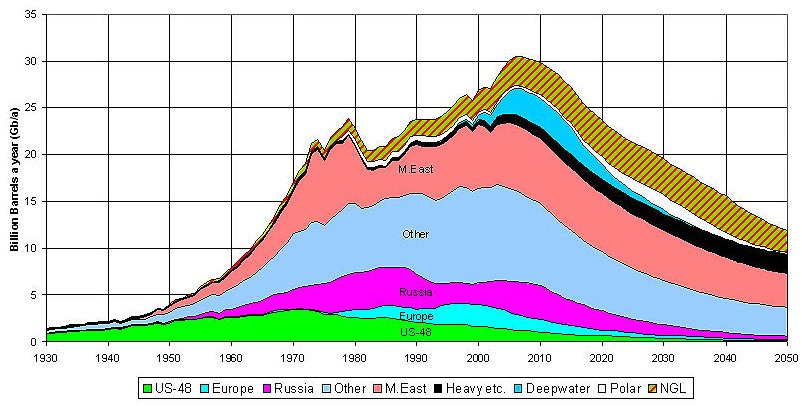
Let’s move this on a little. The arguments from a wide range of scientists are overwhelmingly in favour of the proposition that mankind is using vastly more resources from the planet than the planet can provide. Take oil. This graph show past and projected oil production for the whole Earth out to 2050, less than 40 years away.
Here’s an extract from that website which I encourage you to read in full,
The part before 2007 is historical fact. The part that comes afterward is an ASPO extrapolation.
This graph is worth careful attention as a lot of world history is written into it. Note the steep rise in oil production after World War II. Note that 1971 was the peak in oil production in the United States lower 48. There is a sliver of white labled Arctic oil. That is mostly Alaskan Prudhoe Bay oil, which peaked in 1990. Prudhoe Bay was almost big enough to counteract the lower 48 peak of 1971. The sliver is very narrow now. The OPEC oil embargo of 1973 is very visible. The oil produced by non-OPEC countries stayed nearly constant while OPEC production nearly halved. The embargo caused the world economy to slow. But the high cost of energy spurred the development of energy efficient automobiles and refrigerators and a lot of other things. Note the effect of the collapse of the Russian economy in 1990 on Russian oil production. Note the rapid increase in oil production when the world economy boomed near the end of the twentieth century. Oil was $12 a barrel at that time. Note that European (North Sea) oil peaked in 2000. Note especially what would have happened if the 1973 embargo had not occurred. It is possible that the world would now be on the steep part of the right side of the Hubbert curve.
Take population growth. Here’s a graph that shows that going through seven billion, which is due shortly, is likely to be way short of the eventual peak. Likely peak might be in the range of eight to ten billion! Just take a look at that graph,
Take global warming. Here’s a graph from NASA, from which I quote,
The five warmest years since the late 1880s, according to NASA scientists, are in descending order 2005, 1998, 2002, 2003 and 2006. (reported in the year 2007!)
No apologies for bashing you around the head with these graphs and figures – most people have a good sense about these aspects of our life on this planet. But, in a very real sense, that’s the point.
The point that despite powerful and obvious evidence, mankind has great difficulty accepting obvious trends and understanding that whatever ‘today’ feels like, ‘tomorrow’ is almost certainly not going to be more of the same.
At the risk of hammering this point to death, here are two pictures and some text to show how quickly ‘today’ changes and becomes ‘tomorrow’.
Scientist left speechless as vast glacier turns to water
THESE images show the astonishing rate of break-up of an enormous glacier in north Greenland – from ice to water in just two years.
The before and after photographs, which left a Welsh scientist who led the 24-month project “speechless”, reveal the worrying effects of climate change in an area previously thought too cold to be much affected.
The Petermann glacier pictured August, 5th, 2009Petermann glacier, pictured from same position, July 24th, 2011
Dr Alun Hubbard, a reader at Aberystwyth University’s Centre for Glaciology, returned from the Petermann Glacier in north-west Greenland a month ago, but did not see the stark images documenting the changes until this week.
He said: “Although I knew what to expect in terms of ice loss from satellite imagery, I was still completely unprepared for the gob-smacking scale of the break-up, which rendered me speechless. It was just incredible to see. This glacier is huge, 20km across, 1,000m high.”
“It’s like looking into the Grand Canyon full of ice and coming back two years later to find it’s full of water.”
“It’s quite hard to get your head around the scale of the change. To be able to see that, everything changed in such a short period of time, I was speechless.”
Do read the full article on the Wales Online website here.
Stay with me a little longer, if you will.
Yves Smith in her wonderfully broad and addictive Blog, Naked Capitalism, had the first part of a powerful interview with Satyajit Das published on the 7th. Here are a couple of extracts,
It’s amazing how much money you can make just shuffling paper backwards and forwards. Malcolm Gladwell wrote a piece praising John Paulson who made a killing from the subprime disaster as an entrepreneur. But what did he make? What did he leave behind? Paul Volcker, the former chairman of the Federal Reserve, argued: “I wish someone would give me one shred of neutral evidence that financial innovation has led to economic growth — one shred of evidence. US financial services increased its share of value added from 2% to 6.5% but is that a reflection of your financial innovation, or just a reflection of what you’re paid?”
Just let that quote from Paul Volcker stay with you for a while. Satyajit goes on to say,
Management and directors of financial institutions cannot really understand what is going on – it’s simply not practical. They cannot be across all the products. For example, Robert Rubin, the former head of Goldman Sachs and Treasury Secretary under President Clinton, encouraged increased risk taking at CitiGroup. He was guided by a consultant’s report and famously stated that risk was the only underpriced asset. He encouraged investment in AAA securities assuming that they were ‘money good’. He seemed not to be aware of the liquidity puts that Citi had written which meant that toxic off-balance sheet assets would come back to the mother ship in the case of a crisis. Now, if he didn’t understand, others would find it near impossible. And I’m talking about executive management.
Non executives are even further removed. Upon joining the Salomon Brothers Board, Henry Kaufman, the original Dr. Doom found that most non-executive directors had little experience or understanding of banking. They relied on board reports that were, “neither comprehensive … nor detailed enough … about the diversity and complexity of our operations.” Non-executive directors were reliant “on the veracity and competency of senior managers, who in turn … are beholden to the veracity of middle managers, who are themselves motivated to take risks through a variety of profit compensation formulas.”
Kaufman later joined the board of Lehman Brothers. Nine out of ten members of the Lehman board were retired, four were 75 years or more in age, only two had banking experience, but in a different era. The octogenarian Kaufman sat on the Lehman Risk Committee with a Broadway producer, a former Navy admiral, a former CEO of a Spanish-language TV station and the former chairman of IBM. The Committee only had two meetings in 2006 and 2007. AIG’s board included several heavyweight diplomats and admirals; even though Richard Breeden, former head of the SEC told a reporter, “AIG, as far as I know, didn’t own any aircraft carriers and didn’t have a seat in the United Nations.”
In other words, there is no shortage of information from all corners of the world to show, with very little doubt, that the last few decades have seen unprecedented mistakes by national governments, mistakes in corporate governance, a lack of understanding of economic fundamentals, poor financial and social management, and on and on and on.
But practically all of us, and I mean all of us, didn’t see it at the time, didn’t see where it was heading and only now, when it is full in our faces, do we get it and see it for what it has really been, a long period of over two decades where the ‘me‘ has been more important than the ‘us‘.
That me versus us even being promoted, if that’s the right word, by a British Prime Minister twenty-five years ago. That quote from Margaret Thatcher back in 1987, “And, you know, there is no such thing as society. There are individual men and women, and there are families.” (Margaret Thatcher, talking to Women’s Own magazine, October 31 1987)
Let me draw this all together, yesterday’s part and this concluding part.
There is significant evidence, real hard evidence, that the patterns of mankind’s behaviours of the last few decades cannot continue. Simply because mankind will go over the edge of self-extinction. Darwin’s evidence and all that! We have to accept that humans will see the bleedin’ obvious before it is too late. We have to keep the faith that our species homo sapiens is capable of huge and rapid change when that tipping point is reached, so eloquently written by Paul Gilding in his book, The Great Disruption, reviewed by me here. We have to embrace the fact that just because the world and his wife appears to be living in total denial, the seedlings of change, powerful change, are already sprouting, everywhere, all over the world.
So let’s welcome those changes. Let’s nurture those seedlings, encourage them to grow and engulf our society with a new richness, a new fertile landscape.
Let’s embrace the power of now, the beauty of making today much better and letting go of tomorrow.
For today, I am in charge of my life,
Today, I choose my thoughts,
Today, I choose my attitudes,
Today, I choose my actions and behaviours.
With these, I create my life and my destiny.
It’s very difficult to make predictions, especially when they involve the future!








 Learning from Dogs