Three things cannot be long hidden: the sun, the moon, and the truth.
The above is a quote attributed to the Buddha. It is perfect as an introduction to today’s piece.
When I sat down at my PC yesterday afternoon I was planning to finish off a Post about the BBC’s fabulous Frozen Planet TV series. But a check of my email changed all that. Because there was an email from Merci O., someone in Payson that Jean and I know well. Merci had sent me an email with a link to the following YouYube video.
Watch and be moved.
This is a non-commercial attempt to highlight the fact that world leaders, irresponsible corporates and mindless ‘consumers’ are combining to destroy life on earth. It is dedicated to all who died fighting for the planet and those whose lives are on the line today. The cut was put together by Vivek Chauhan, a young film maker, together with naturalists working with the Sanctuary Asia network (www.sanctuaryasia.com).
Content credit: The principal source for the footage was Yann Arthus-Bertrand’s incredible film HOME http://www.homethemovie.org/. The music was by Armand Amar. Thank you too Greenpeace and http://timescapes.org/
A beautiful story of dog loyalty – to another dog, to another blind dog.
I first received this lovely story last Sunday from Dan G., dear friend of over 30 years. As is my want, did some research to discover the source of the story. It appeared on the website of Ross Parry Agency on the 22nd October, 2011 (note the pics are copyright rossparry.co.uk) But I have taken the liberty of reproducing the story as it appeared in the UK Daily Mail online site, on the same date. Enjoy.
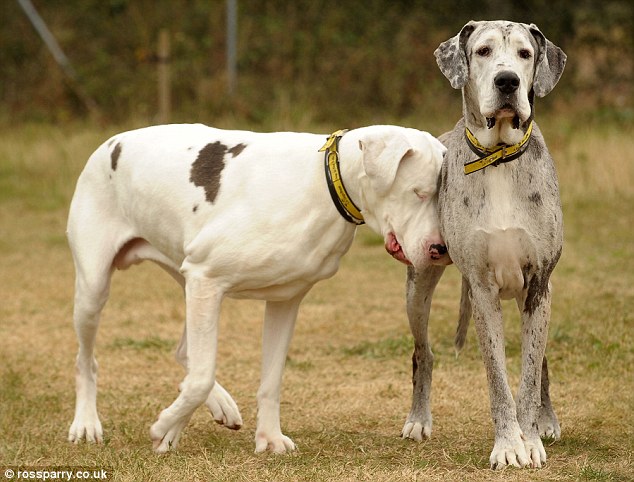
Meet the blind Great Dane in need of a home (but you’ll need to make space for HER huge guide dog)
When illness forced vets to remove Great Dane Lily’s eyes, the prospects of a fulfilling life didn’t look good.
But then no one had reckoned on her pal Maddison stepping in to turn guide dog.
The pair have been inseparable for years but now find themselves looking for a new home because their owner could no longer cope.
The catch for anyone interested is that the Great Danes come as a package. They have been waiting at the Dogs Trust re-homing centre in Shrewsbury since July.
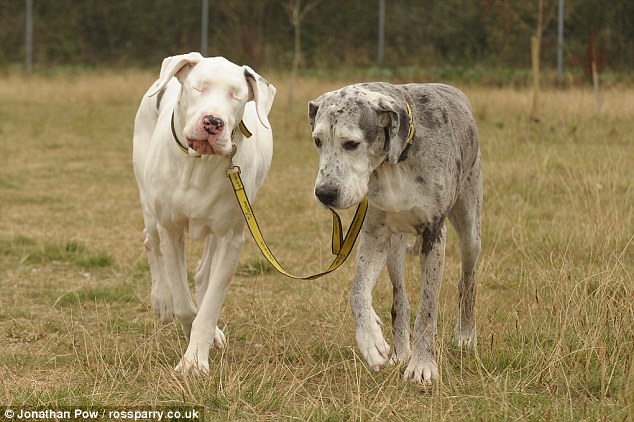
Homeless: Blind Great Dane Lily and her kind-hearted canine carer MaddisonForever friends: Lily, left, being guided while walking with Maddison right. The pair have been inseparable since Lily lost her sight
Manager Louise Campbell said: ‘Maddison is Lily’s guide dog. If they are out and about, for the majority of the time Maddison will lead and Lily will walk nearly touching her so she knows where to go. It’s lovely to watch. Maddison is always looking out for her.’
Lily, six, was barely a puppy when she was struck down by a condition that caused her eyelashes to grown into her eyeballs, damaging them beyond repair.
It was after this traumatic event that her relationship with seven-year-old Maddison developed as she took her under her wing.
The best buddies lived together until their owners decided they couldn’t look after them any more.
Miss Campbell said: ‘With her lack of sight, Lily’s other senses have heightened so although we don’t split them up often she can tell if Maddison is nearby.
‘They curl up together to go to sleep and they are very vocal with each other.
‘We haven’t analysed their different barks but if Lily wants to go forward and Maddison is in her way, the bark will have a different pitch.
‘They are very close to one another and enjoy each other’s company‘.
Playful: Lily's lack of sight has heightened her other senses so she can often tell if Maddison is nearby without the pair touching
Miss Campbell said that Lily does all the things normal dogs do and if you saw her from a distance you wouldn’t realise she had anything wrong with her eyes.
She added: ‘They are really happy with life, the glass is always half full with these two.
‘They have been with us for a considerable amount of time but they are quite happy and go about their daily routine – they are very affectionate.’
She believes the dogs’ size and advancing years, as well as the fact they have to come in a pair, may have put off potential owners and she warned that anyone contemplating taking the dogs in should look at their lifestyle and think of the responsibility involved.
‘They are not gigantic when you see them outside. These are two lovely big girls who deserve to live out the rest of their lives together in comfort‘, she said.
Dogs Trust cares for around 16,000 stray and abandoned dogs every year through a network of 17 re-homing centres.
The Great Dane is seeking an owner who would be willing to give both her and best friend Maddison a new home
Back to me. Must say that it was just fortuitous that Dan’s email came in to me a little while after I posted yesterday’s article by Robert Holden, The Gift of Happiness. Indeed, shortly after I had written, “Perhaps the art of happiness is yet another thing we can learn from dogs!”
Anyone in the UK who wants to contact the Dogs Trust click here.
Let me offer thanks to Resurgence Magazine for the written permission to reproduce this article in full, see terms at the end of the article. More background information about Robert Holden may be obtained from his own website and, finally, the Happiness Project website is here.
Robert Holden was at the forefront of ‘Happiness’ research. Here, he reflects on how that topic – initially laughed off the agenda – has gained credibility and explains why happiness is important
When I set up The Happiness Project, in 1994, the original goal was simple: talk happiness. In my training in psychology, philosophy and psychotherapy my teachers didn’t talk about happiness. We focused solely on the causes of unhappiness. This didn’t feel right to me. After all, how can you know what the causes are if you do not know what happiness is?
My goal, then, was to stimulate a conversation, so as to deepen our appreciation of what happiness is, its benefits, what enables it, and what blocks it. One conversation I focused on was the question of whether happiness is learned and whether it can be taught. To investigate this further, I created an eight-week happiness programme (which still runs today) called Be Happy.
Today happiness is a much more popular conversation than when The Happiness Project began. We are all talking more about happiness than ever before. The conversation is alive and well. Universities, hospitals, economists and governments publish new studies on happiness every week. So, what we have learned? And where does this conversation about happiness need to go next?
Let’s start with what happiness researchers refer to as ‘static happiness’. In a recent US study, it was found that when people in the 1940s were asked, “How happy are you?” the average score was 7.5 out of 10, whereas today the average score is 7.4 out of 10. In other words, in spite of all the ‘progress’ we appear to have made in the last 50 years or so, our happiness levels have remained mostly static. This tells me we need more conversations to clarify what real happiness is. For instance, we need to discern between pleasure, satisfaction and joy; and on my eight-week happiness programme we always begin by asking people, “What is your definition of a happy life?” and, “Are you living it?”
Happiness researchers have also found that most of us are only semi-happy. In 2006, I participated in a BBC documentary called The Happiness Formula. It reported, “the proportion of people saying they are ‘very happy’ has fallen from 52% in 1957 to just 36% today.” Clearly, research like this is questioning our most basic assumptions about what happiness is, and what we think will make us happy. That’s a good thing. An honest inquiry into happiness is an opportunity to rethink your life. It is one of the gifts of happiness.
Do you really know what makes you happy? This is the question both psychologists and economists are asking now. The evidence suggests we do not know. For instance, many of us believe that more money will make us happier. Some money does help, especially to cover the basics of food, rent, clothing, etc. After that, the correlation between more money and greater happiness is vague. Martin Seligman, former president of the American Psychology Association, and one of the founders of the Positive Psychology movement, concludes most forcibly: “The change in purchasing power over the last half century in the wealthy nations carries the same message: real purchasing power has more than doubled in the United States, France and Japan, but life satisfaction has changed not a whit.”
An inquiry into happiness challenges you to rethink everything. For example, almost everyone agrees with the idea that if their life circumstances improve, their levels of happiness will increase. This is the basis for almost every political and economic strategy the world over. And yet scientific research into happiness tells us this is wrong. New Zealand researcher Richard Kammann reports, “Objective life circumstances have a negligible role to play in a theory of happiness.” The same research concludes that your attitude and personal choices have a far greater influence on your happiness levels.
Another popular theory is that a better education will make our children happier. This has resulted in more tests for preschool children, more focus on regular exams, and more money spent on private education. Surely this increases happiness? “Sorry, Mom and Dad, neither education nor, for that matter, a high IQ paves the road to happiness,” states Claudia Wallis, who compiled a report called The New Science of Happiness for TIME magazine.
Happiness challenges us to rethink what is a “better education” for our children. I support the idea of happiness lessons for children at school, as pioneered at Wellington College by psychologist Nick Baylis and college Master Anthony Seldon [read his thoughts on this important topic in his article Stillness in Schools]. One opposing argument for happiness lessons at school is that children should not be “taught” happiness, but that they should be allowed to think about happiness for themselves. However, this is precisely the aim of these happiness lessons. The approach is inquiry, not dictation.
People who attend my happiness programme are always telling me, “I wish I’d learned this at school.” It’s time then for more conversations about happiness in school, and at home with our children. I encourage all my students and clients to talk more about happiness with their families. Why? Because one of the ways we evolve is through conversation. Drawing happiness with our children or talking about happiness with our partner helps us to clarify things, to heal, to come together, and ultimately to live a happier life.
And now, even governments and politicians want to talk about happiness. In Britain, David Cameron has commissioned a new survey called Measuring National Well-being. A new organisation called Action for Happiness [see what founder Richard Layard says about this new movement in his article A Better Way of Life] is working closely with the government to help create better social change in society. Again, some people are concerned that governments should not “tell us” how to be happy. I agree with this, but I don’t think governments are trying to tell us. Like us, they are simply trying to understand what happiness is, and how we can be happier.
In my latest book, Be Happy, I have written: “Your definition of happiness will influence every significant decision in your life.” It is essential, therefore, that individuals and governments alike keep happiness on the agenda because, more than ever before, humanity needs a better understanding of happiness. We have learned so much, about atoms and galaxies and other things, but we still do not understand ourselves very well; we still go to war too often, and there is still too much suffering.
I remain deeply committed to talking about happiness. Why? Because I believe that happiness is our true nature (it is the natural state of our Unconditioned Self), and for that reason happiness brings out the best in us, both individually and collectively. Happiness research has found a strong link between happiness and altruism, for instance. In a recent study by a Charities Commission, it was reported that the highest predictor of generous giving is not your income level: it’s your happiness level.
Good things come from real happiness. Happier people make better choices, which is good for society and the planet. Your happiness is a gift to the world. I believe this with all my heart.
—————————–
Robert Holden is director of The Happiness Project. His latest book, Be Happy;, is published by Hay House. For more about the eight-week happiness programme visit: http://www.happiness.co.uk
The Gift of Happiness features in Resurgence issue 269, November/December 2011.
This article is reprinted courtesy of Resurgence magazine – at the heart of earth, art and spirit. To buy Resurgence, read further articles online or find out about The Resurgence Trust, visit: http://www.resurgence.org
All rights to this article are reserved to Resurgence, if you wish to republish or make use of this work you must contact the copyright owner to obtain permission
—————————–
One final note from yours truly. Perhaps the art of happiness is yet another thing we can learn from dogs!
Not too long ago, I came across the website The Big Think. It tickled my curiosity to the extent that I subscribed. On November 6th an essay was published with the wonderful title of ‘Consciousness: The Black Hole of Neuroscience‘. Couldn’t resist that! Here’s how that essay started,
What’s the Big Idea?
“By the word ‘thought’ (‘pensée’) I understand all that of which we are conscious as operating in us.” –Renee Descartes
The simplest description of a black hole is a region of space-time from which no light is reflected and nothing escapes. The simplest description of consciousness is a mind that absorbs many things and attends to a few of them. Neither of these concepts can be captured quantitatively. Together they suggest the appealing possibility that endlessness surrounds us and infinity is within.
That last sentence jumped off the page at me – hence me using it as the title of this post.
If this interests you at all, then do read the full item. That closes like this …
Hirsch sees it more practically. Though functional imaging has not explained where perception comes from, it has important applications for unconscious patients. “The boundaries have been broken a little bit, clinically,” she says. “As we study patients with disorders of consciousness, we can probe their levels of awareness in ways that other traditional ways of asking them to respond.”
It’s no different than any other aspect of the brain that we cannot presently explain, she says:
For example, we don’t understand how the brain creates colors. That’s a perception that is very private – I don’t know that your perception of blue is like my perception of blue, for example. Smells are another one. I don’t know that your perception of the smell of an orange is like mine. These are the hard problems of neuroscience and philosophy that we haven’t made a great deal of progress on.
What do you think? Is the distinction between “hard problems” and “soft problems” useful, or reductive? Does the brain create consciousness? Will we ever empirically understand where it comes from or how it works?
But that’s not the end of it. Browsing the comments revealed a link to the Blog called NeuroLogica Blog. The author is Steven Novella, MD. Here’s a flavour of Steven’s competencies.
The NeuroLogicaBlog covers news and issues in neuroscience, but also general science, scientific skepticism, philosophy of science, critical thinking, and the intersection of science with the media and society.
Dr. Novella also contributes every Sunday to The Rogues Gallery, the official blog of the SGU, every Monday to SkepticBlog, and every Wednesday to Science-Based Medicine, a blog dedicated to issues of science and medicine.
I couldn’t resist doing a search on Dr. Novella’s blog using the search term ‘consciousness’. What a rich vein! Here’s just one example of what came to light,
Neuroscience research has been increasingly fleshing out the fascinating and complex relationship between the subconscious processing of the brain and our conscious awareness. We all labor under the illusion that our decisions, feelings, and behaviors are all conscious. When we do something, it seems, it is because we wanted to do it. We are very good, in fact, at retrofitting a logical explanation for why we consciously did something.
But much of our brain’s decision making occurs at a subconscious level. When presented with a choice various parts of our brains make a calculation – processing the choice, weighing varying factors based upon some neuro-algorithm, and then present that choice to our conscious mind (the global workspace, if you accept this hypothesis). Research shows that if we change the subconscious algorithm, by suppressing, for example, one part of the brain, the decision-making process is altered. We are not aware of this, and we still are under the illusion that the decision was completely conscious.
Strongly recommend that you read the article in full; it is deeply fascinating. And then laugh out loud, as I did, when you read the first comment made to that article,
I find this fascinating even though I am not conciously aware of why!
I want to write a little more about Neil but, first, let me show you what he passed to me a few days ago.
Ten years ago we had Steve Jobs, Johnny Cash, Bob Hope and Jimmy Saville; now we’ve no jobs, no cash, no hope and no one to fix it.
I’m aware that there will be many people who read this who may not be familiar with Jimmy Saville and his long-running television programme Jim’ll Fix It. Here’s a taste of that programme,
Sir Jimmy was an amazing man and natural performer. More on his life later. Let me turn back to Neil.
Those of you who are regular readers of Learning from Dogs will have seen over the last few months a number of entries from Devon friend of many years, Neil K. Neil’s surname is Kelly, no relation to the infamous Ned Kelly! Do a search from the home page of the Blog for more of Neil’s contribtions. Or try this one, The Story of Adam & Eve’s Pets.
Anyway, Neil has very kindly offered to contribute on a regular basis and, of course, I welcomed that with open arms. So a big ‘thank you’ from me and I’m sure many others will look forward to Neil’s contributions. Neil is updating his website, at which point I will ask Neil to say a little more about himself.
I am indebted to Merci O. who regularly comments on Learning from Dogs for sending me the first film, see below. In my efforts to find a YouTube link (there didn’t appear to be one) I came across the second film. Both are good for the soul.
So click here to watch the first film. The film is comprised of a series of slides melded together with a beautiful music track. Do watch and listen.
Then here is the YouTube video, Morcheeba’s Enjoy The Ride.
Have a peaceful day wherever you are in the world.
John’s first guest contribution, Clarity of Thought, was published on the 20th September and attracted a collection of very thoughtful comments. To give you a sense of that first contribution, it started thus,
The Passion of Enlightenment
Enlightenment includes deep grief and a passion to leave life a bit better than we found it. Enlightenment has little practical value in a growing and constantly consuming cultural demographic. Consumers tend to spiritually disconnect when faced by a need for change or when morality becomes inconvenient.
To set the scene for these musings from John, Highway 87 that runs South-North through Payson, where John lives, is called the Beeline Highway and there is, indeed, a Beeline Cafe in town.
Over to John now.
Voices from the Beeline Café
Americans are the best entertained and the least informed people on earth.
Combined commercial and investment banks have become a global casino.
No one can afford to run for political office without corporate approval.
—ooOOoo—
Political campaigns are celebrity theaters devoid of content or reality.
Climate change is a planetary constant exacerbated by human activities.
A twenty-four hour media drumbeat of fear encourages human divisiveness.
—ooOOoo—
Education, history and science are marginalized.
Facts are systematically denied.
People are confused.
—ooOOoo—
Global totalitarianism is immensely profitable.
Corporations do not care about democracy or humanity.
Economically stressed voters are disenfranchised by corporate government.
—ooOOoo—
The rule of law has lost equity and become the tool of oppressors.
Firefighters, policemen, nurses and clergy have become political pawns.
Corporate supported criminals control a majority of the nations of the world.
—ooOOoo—
We have lost the rudder of human morality.
Material well-being is considered the greastest good.
War is a highly profitable form of corporate enterprise.
—ooOOoo—
The flag and cross are employed to demonize opposition to corporate authority.
Politics worth supporting begin and end with service to God and nature.
God grant us each the grace to make a transformative difference.
An intriguing examination of how we build our sense of self.
Note: This article goes back to 2007, part of a programme that I was involved in back then. However, re-reading the article shows it to be timeless, so trust you find it interesting. There is a fascinating test, still online, details provided at the end of the article – but if you can’t wait, it’s here.
Finding the self.
What is Self?
Edited by Fiona Kerr from original text by Dorothy Miell
So what is self and how do we study its development? As we grow older we become aware of differences between ourselves and others, for example: what I look like; my gender; what makes me happy or sad. A sense of self is not achieved in a single step; we don’t emerge from our mother’s womb as fully formed adults. As our bodies grow and change we also learn more and more about ourselves. How we describe ourselves to others changes as we get older. This process is not necessarily constant – some aspects of self may stay the same for many years, others may change rapidly.
There may also be big differences to how you feel and how you want others to think you are. This may colour your choices in self-description.
A sense of self is also a cultural construction – in some societies individual uniqueness and self-expression is seen as vulgar and uncivilised. In Open2.net’s “Who Am I?” test we will be examining self in a Western sense, the gradual formation of becoming a self-aware individual. We’ll be grouping the results in age groups, so you can see how the self-descriptions change as people get older. Although self development is most significant in childhood, we’ve decided to keep the results going to see how things change into adulthood (if at all!).
I exist!
A child’s first step to self-understanding is the recognition that she or he exists. As an infant explores the world and interacts with caregivers, she becomes aware that she has power – she is an agent of change within her own environment. She is able to cause things to happen and control objects. This awareness is known as “self-as-subject”, “I” or the “existential self”:
There are thought to be four elements to the existential self:
an awareness of one’s own agency (i.e. one’s power to act) in life events,
an awareness of the uniqueness of one’s own experience, of one’s distinctiveness from other people,
an awareness of the continuity of one’s identity,
an awareness of one’s own awareness, the element of reflexiveness.
For example, if a child closes his or her eyes, the world goes dark. If a toy is touched, it moves. The interaction with the world is physical, external and, in developmental terms, it helps the child differentiate between self and other.
What Makes Me?
At around a child’s second birthday, many children recognise themselves in a mirror or in a photograph. In Western cultures, from the age of 18 months to 3 years of age, infants start to display self-awareness through the use of the word “me” or “mine”. This self-sense isn’t a passive, self-reflective discovery, but is often the result of effort, particularly in rivalry with others. It arises from striving in the face of obstacles.
These are the second steps in establishing a full sense of self, the acquisition and elaboration as “self-as-object” or “me”, now often referred to as the “categorical self”. This aspect of self concerns the qualities that define oneself as a person, e.g. gender, name and relationships with others. Once a child has gained a certain level of self-awareness (of the existential self) he or she begins to place herself (or is placed by others) into a set of categories. This aspect of self is the most influenced by social factors, since it is made up of social roles (such as being a student, a sister, a friend) and characteristics that come from a comparison with others (such as trustworthiness, shyness or sporting ability). Social context is an important feature in self-development.
Self-Esteem
Measuring self-esteem is difficult. We might feel good about ourselves in one aspect of our lives, but not so good in others. One way of measuring self-esteem in children is to ask questions about how they feel in the different aspects of their life, such as: scholastic competence; athletic competence; social acceptance; behavioural conduct; physical appearance.
How we feel about ourselves overall may bear little or no relationship to how we feel about ourselves in these different areas. It’s the importance we place on our areas of achievement or failure that leads to an overall level of self-esteem. A child who is anxious to succeed at sport would have a high level of self-esteem if she did well at sport, but low self-esteem if her performance in sport was poor, even if the child was good academically or socially. The match between our aspirations and performance is one important factor in determining self-esteem. Another factor which might influence a child’s overall feeling of self-esteem is the regard in which they are held by “significant others”, people whose opinion the child values, such as parents, teachers and peers.
Gender identity
Children by the age of about two are able to correctly label themselves as a boy or a girl. But it is not until later that they understand that gender is a stable concept, e.g. that boys cannot become mothers. Being able to identify themselves in terms of gender helps children develop a sense of categorical self and helps define appropriate behaviour for boys and girls. Children develop their gender roles in part through imitation of models, so parents’ reactions to the behaviour of children are an important influence on children’s developing sense of gender identity. Parents who try to raise their children in a non-sexist way have encountered difficulties, as other influences such as the media and society itself can counter their attempts.
If children are shown individual differences between people, that different people believe different things, they can see that contradictory beliefs and behaviours can co-exist, that the rules for their family may not be true of the family next door, but both are valid.
Describing self changes as we grow older
A child uses comparison with others to see how he or she fits into different categories. In order to evaluate if he or she is short, tall, clever or shy, a child either has to compare themselves physically with others, or consider their evaluation by others.
This contrast between self and others helps the child to develop an increasingly complex understanding about self. Children’s self-descriptions change as they become more able to evaluate themselves and develop a sense of self-worth and self-esteem. Children seem to think about themselves in different ways as they get older. Younger children seem to focus more on physical features, activities and behaviours, whereas older children mention more psychological characteristics. So, by the age of about 18, individuals are able to describe themselves in terms of the world of emotions, attitudes, secrets and wishes. Self-reflection is focused inwards, on their inner, private world.
OpenLearn, part of The Open University, have designed a test to illustrate how people of different ages define themselves. Once you take the test, you can then compare yourself to the database of other people who have taken the test to see how you compare with others in your age group, how you compare with people from other age groups and how people differ according to gender. Alternatively you can view the database without taking the test first. Try taking the test with a child and see how your results compare. So why not take the test to find out “Who Am I?”
References
MIELL, D. (1995) ‘Developing a Sense of Self’
BARNES, P. (ed.) Personal, Social and Emotional Development of Children, Oxford, Blackwell Publishers
The above article was published by the BBC as part of their Child of our Time series, unfortunately no longer available online.
The results of the Who Am I test based on 53,345 entries as at October 30th, 2011, show overwhelmingly that both sexes at all ages describe their relationships and inner emotions as more important than their physical or character descriptions. For men from the age of 16-19 until 61+ their description of their relationships scores more important than their inner self but the margin is slight. For women over the same age span the situation is reversed; inner emotions score marginally higher than relationships.
What is very revealing is that for both sexes across the whole of their adult life, their physical and character identities are significantly less important than their social and emotional selves.
A return to the beautiful writings of Irishman, John O’Donohue
Last week, I published a Post about John O’Donuhue‘s book Anam Cara, entitled Soul friend, the meaning of anam cara in Gaelic. There were a number of lovely responses, both as comments to the Post, and as emails sent to me. I thought I would share another essay with you. First, some reflections about transfiguration or, perhaps a better word for today’s challenging times is ‘change’.
I have made no secret of my belief that we are in a period of great change, perhaps greater than mankind has faced before. Possibly that is slightly hyperbolic, but looked at from the perspective of the extinction of homo sapiens then perhaps it is no exaggeration. The vast majority of people, who stop and reflect, sense that on several fronts it is change or die!
A classic behavioural attribute of modern man is to see ‘change’ as something that others should do, rather than change coming from within. From time to time, I have quoted this,
For today, I am in charge of my life.
Today, I choose my thoughts,
Today, I choose my attitudes,
Today, I choose my actions and behaviours,
With these, I create my life and my destiny.
Much, much easier to say, and write, than to undertake. But it does underscore the obvious – change flows from our journey inwards. Let’s turn to John O’Donohue’s inspirational words about this subject.
From the John O’Donohue website
Spirituality of transfiguration
Spirituality is the art of transfiguration. We should not force ourselves to change by hammering our lives into any predetermined shape. We do not need to operate according to the idea of a predetermined programme or plan for our lives. Rather, we need to practise a new art of attention to our inner rhythm of our days and lives. This attention brings a new awareness of our own human and divine presence. A dramatic example of this kind of transfiguration is the one all parents know. You watch your children carefully, but one day they surprise you; you still recognise them, but your knowledge of them is insufficient. You have to start listening to them all over again.
It is far more creative to work with the idea of mindfulness rather than with the idea of will. Too often people try to change their lives by using the will as a kind of hammer to beat their life into proper shape. The intellect identifies the goal of the programme, and the will accordingly forces the life into that shape. This way of approaching the sacredness of one’s own presence is externalistic and violent. It brings you falsely outside your own self and you can spend years lost in the wilderness of your own mechanical, spiritual programmes. You can perish in a famine of your own making.
If you work with a different rhythm, you will come easily and naturally home to your self. Your soul knows the geography of your destiny. Your soul alone has a map of your future, therefore you can trust this indirect, oblique side of your self. If you do, it will take you where you need to go, but more importantly it will teach you a kindness of rhythm in your journey. There are no general principles for this art of being. Yet the signature of this unique journey is inscribed deeply in each soul. If you attend to your self and seek to come into your own presence, you will find exactly the right rhythm for your life. The senses are generous pathways which can bring you home.
A renewal, indeed a complete transfiguration of your life, can come through attention to your senses. Your senses are the guides to take you deep into the inner world of your heart. The greatest philosophers admit that to a large degree all knowledge comes through the senses. The senses are our bridge to the world. Human skin is porous; the world flows through you. Your senses are large pores which let the world in. Through attunement to the wisdom of your senses, you will never become an exile in your own life, an outsider lost in an external spiritual place which your will and intellect have constructed.
Please just read those words from John again. Re-read the last paragraph. Then go one paragraph up and read that again, “Your soul knows the geography of your destiny. Your soul alone has a map of your future, therefore you can trust this indirect, oblique side of your self. If you do, it will take you where you need to go, but more importantly it will teach you a kindness of rhythm in your journey.”
Each of us taking us to where we need to go, and one by one, each of us taking our world to where it needs to go.
Reflections on the Irish poet and author, John O’Donohue.
John O'Donohue
While many will have heard the name of this wonderfully inspirational man, John O’Donohue is not a name known to the masses. Yet his writings are, without fail, beautifully moving. Indeed, this Post was prompted by me coming across a piece from his first book, Anam Cara, meaning ‘soul friend’ in Gaelic, and, as any dog owner will attest, dogs are the animal example of a soul friend to a human.
John tragically died well before his time, in January 2008, just three days after his 56th birthday. As the John O’Donohue website reveals,
John O’Donohue vanished from among us on January 4, 2008 as physical presence, but it is impossible to write about John as someone who “was”; he so thoroughly “is”. In the context of the immense presence of his absence, the following biographical facts and dates can serve only as time-bound points of orientation for those who wish to try and locate history.
John was born in January 1956, the first of four children to Patrick and Josie O’Donohue. At the age of 18, John entered the novitiate at Maynooth where he completed his BA in English and Philosophy in 1977 and his degree in Theology, in 1980. He was ordained to the priesthood in 1982, received his MA in 1982 and, in 1986 began work on a doctorate at the University of Tubingen in Germany. John was awarded his Ph.D in Philosophical Theology in 1990. In his dissertation, Person als Vermittlung, (published in Germany in 1993), John developed a new concept of Person through a re-interpretation of the philosophy of Hegel. The prestigious Review of Metaphysics commended him for “breaking new ground in our thinking about consciousness . . . [with] a richer and deeper notion of Personhood.” In John’s words: “Hegel struck me as someone who put his eye to the earth at a most unusual angle and managed to glimpse the circle toward which all things aspire.”
There is so much more to say and write about this lovely man, but for another time. Let me close by publishing this extract from Anam Cara. But a plea! Before you plunge ahead and read these words, just slow yourself down. The thoughts behind the words below are profound, romantic and applicable to all, yes, every one of us. They offer peace and calmness – embrace them with a peaceful and calm mind.
The eye celebrates Motion
The human eye adores movement and is alert to the slightest flicker. It enjoys great moments of celebration when it beholds the ocean as the tide comes in, and tide upon tide repeats its dance against the shore. The eye also loves the way light moves; summer light behind a cloud crawling over a meadow. The eye follows the way the wind shovels leaves and sways trees. The human person is always attracted to motion. As a little baby you wanted to crawl, then to walk, and as an adult you feel the continuous desire to walk into independence and freedom.
Everything alive is in movement. This movement we call growth. The most exciting form of growth is not mere physical growth, but the inner growth of one’s soul and life. It is here that the holy longing within the heart brings one’s life to motion. The deepest wish of the heart is that this motion does not remain broken or jagged, but develops sufficient fluency to become the rhythm of one’s life.
The secret heart of time is change and growth. Each new experience which awakens in you adds to your soul and deepens your memory. The person is always a nomad, journeying from threshold to threshold, into ever different experiences. In each new experience, another dimension of the soul unfolds. It is no wonder that from ancient times the human person has been understood as a wanderer. Traditionally, these wanderers traversed foreign territories and unknown places. Yet, Stanislavsky, the Russian dramatist and thinker, wrote: “The longest and most exciting journey is the journey inwards.”
There is a beautiful complexity of growth within the human soul. In order to glimpse this, it is helpful to visualise the mind as a tower of windows. Sadly, many people remain trapped at one window, looking out every day at the same scene in the same way. Real growth is experienced when you draw back from one window, turn and walk around the inner tower of the soul and see all the different windows that await your gaze. Through these different windows, you can see new vistas of possibility, presence and creativity. Complacency, habit and blindness often prevent you from feeling your life. So much depends on the frame of vision – the window through which we look.
Think about the times we live in, challenging times for so many. Then realise that what we see (and feel) is so dependent on how we look. Let me repeat those last few lines, “Through these different windows, you can see new vistas of possibility, presence and creativity. Complacency, habit and blindness often prevent you from feeling your life. So much depends on the frame of vision – the window through which we look.”






 Learning from Dogs