Yet another learning message from our animal kingdom.
As I wrote in Monday’s post, this week I was going to “Enjoy the beauty of the world around me and offer a few essays on the meaning of life.”
Hopefully the subsequent essays on Carl Sagan and how our beautiful planet can change our consciousness, under the title of To see is to understand, have partly achieved that aim.
We hear so much that is unsettling that it is easy to lose sight of the core qualities of a sustainable society. And one of the most fundamental requirements is that of trust.
A loving dog owner will most likely take their dog’s trust for granted.
However, think of the incredible differences, at so many levels, between man and dog. Then reflect on how a dog learns to trust a human.
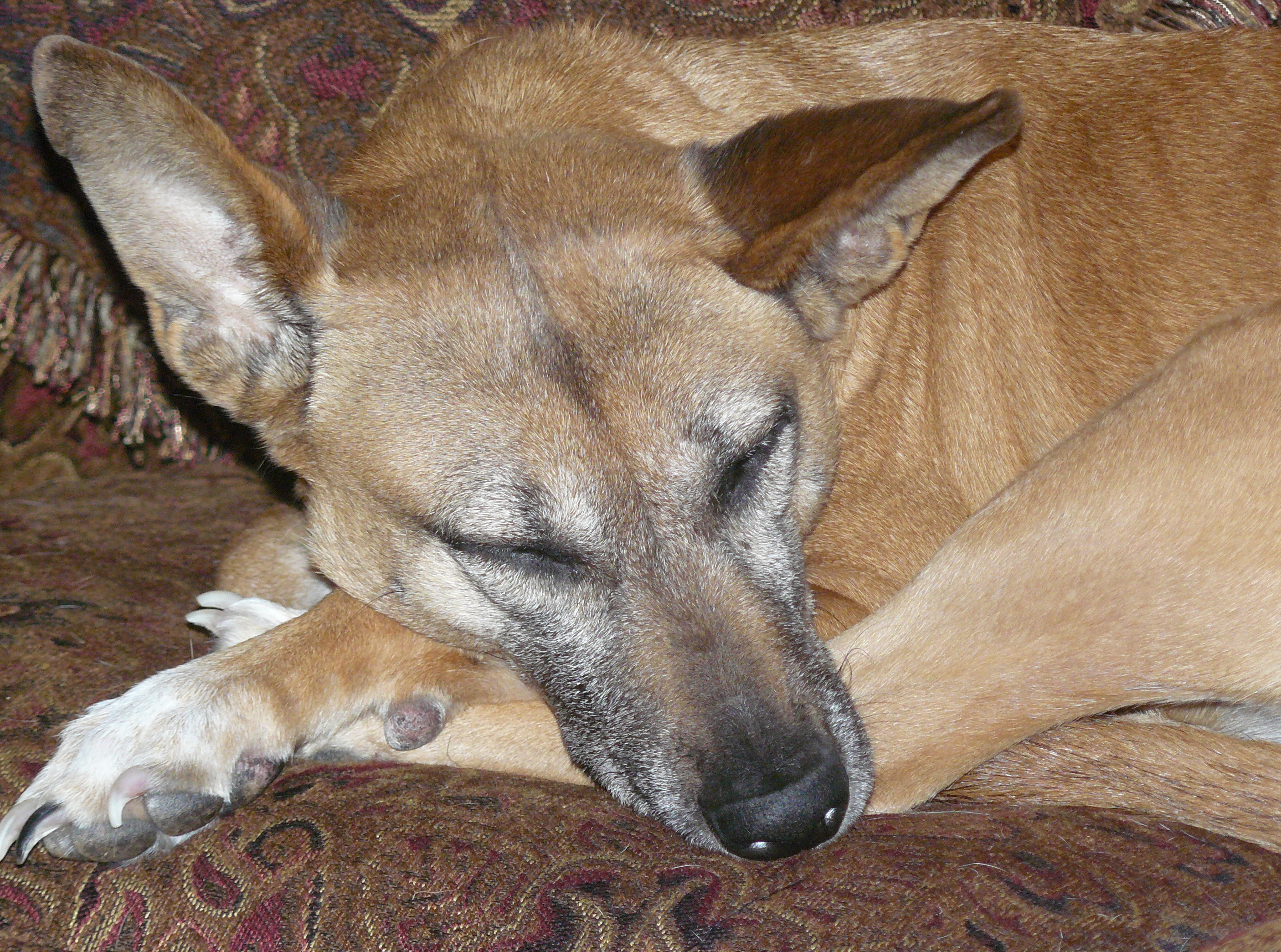
This picture is of Dhalia taken less than a couple of months ago. She was found by Jean in 2005 running wild in the Mexican desert with a companion dog. As Jean explains,
With friend, Suzann, I was driving out to a fishing village to medicate and feed the many starving dogs. The two dogs were in a very desolate part of the desert prowling the roadside for road-kill. We stopped to feed them and give them water. One of the dogs ran off but as I put down food, I saw the smaller brown dog walking slowly towards me.
She was emaciated and full of mange. She looked up at me, ignoring the food. I reached out with my hand and she gently nudged it with her nose.
The food was irrelevant to her at this moment. She just seemed to know that I was there to help. I scooped her up and took her home, curled up in my arms as we drove away.
No better example of a dog instinctively trusting a human, almost immediately.
OK, from dogs to elephants.
I recently became aware of Lawrence Anthony. Here’s a brief extract from WikiPedia:
Lawrence Anthony (17 September 1950 – 7 March 2012) was an international conservationist, environmentalist, explorer, and bestselling author.
He was the long-standing head of conservation at the Thula Thula game reserve in Zululand, South Africa and the Founder of The Earth Organization, a privately registered, independent, international conservation and environmental group with a strong scientific orientation. He was an international member of the esteemed Explorers Club of New York and a member of the National Council of the Southern Africa Association for the Advancement of Science, South Africa’s oldest scientific association.
Anthony had a reputation for bold conservation initiatives, including the rescue of the Baghdad zoo at the height of the US lead Coalition 2003 invasion of Iraq, and negotiations with the infamous Lord’s Resistance rebel army in Southern Sudan, to raise awareness of the environment and protect endangered species, including the last of the Northern White Rhinoceros.
Lawrence Anthony died of a heart attack at the young age of 62. In just a short time that will be a year ago.
In doing research for today’s post, I quickly came across this story.
Lawrence Anthony, a legend in South Africa and author of 3 books including the bestseller The Elephant Whisperer, bravely rescued wildlife and rehabilitated elephants all over the globe from human atrocities, including the courageous rescue of Baghdad Zoo animals during the US invasion in 2003.
On March 7, 2012 Lawrence Anthony died. He is remembered and missed by his wife, 2 sons, 2 grandsons and numerous elephants.
Two days after his passing, a remarkable thing happened! The wild elephants showed up at his home led by two large matriarchs. Separate wild herds arrived in droves to say ”goodbye” to their beloved man-friend. A total of 20 elephants had patiently walked over 12 miles to get to his South African house. [my emphasis.]
Was this true? A quick web search came across this video, (overlook the last few seconds!)
Françoise Malby-Anthony, wife of the late Lawrence Anthony, talks about the entire herd of elephants returning to the main house to pay their respects to their rescuer and friend ‘The Elephant Whisperer’.
Something each and every one of us has to absorb – but without going in to space!
“No problem can be solved from the same level of consciousness that created it.“
So said Albert Einstein. As with so many wise men from all times, what gets uttered strikes as such obvious common-sense. But it took a wise person to utter it!
We need a change of consciousness. About the world we live on. This single, fragile, vulnerable rock in space that was featured in last Sunday’s post, Just a small white dot, and in yesterday’s post about Carl Sagan.
Climate Crocks, a ‘must follow’ blogsite for those that are concerned about the state of our planet, recently published a post that revealed how astronauts upon viewing the Planet Earth from Space had a profound Consciousness Change. Take this example;
“I think you start out with this idea of what it’s going to be like…and then when you do finally look at the Earth for the first time…you’re overwhelmed by how much more beautiful it really is, when you see it for real.
It’s just like it’s this dynamic, alive place, ..that you see glowing all the time..”
-Nicole Stott, Shuttle, ISS Astronaut
Or this from Ron Garan;
“When we look down on the Earth from space, we see this amazing, indescribably beautiful planet, ..it looks like a living, breathing organism..”
– Ron Garan, Suttle, ISS Astronaut
Wonderfully, that Climate Crocks piece quickly led to a new organisation called Planetary Collective.
Planetary Collective is a group of filmmakers, visual media creatives and thinkers who work with cosmologists, ecologists, and philosophers to explore some of the big questions facing our planet at this time.
Embracing a multidisciplinary, multi-media approach, we brings scientists, philosophers, and researchers together with designers, coders, and creatives to bring new perspectives to audiences around the world in fresh and innovative ways.
It was this group that last December released the short, but incredibly powerful film, Overview. Here it is:
Released 7th December 2012
At the end of 2011, we filmed a short documentary called OVERVIEW about astronauts’ experiences in space, due for release in the last quarter of 2012. The film is both a stand-alone short film and a prelude to CONTINUUM, introducing many of the key ideas expanded upon in the feature documentary.
SYNOPSIS
Astronauts who have seen the Earth from space have often described the ‘overview effect’ as an experience that has transformed their perspective of the planet and mankind’s place upon it, and enabled them to perceive it as our shared home, without boundaries between nations or species.
OVERVIEW is a short film that will explore this perspective through interviews with astronauts who have experienced the overview effect. The film also features insights from commentators and thinkers on the wider implications and importance of this understanding for humanity as a whole, and especially its relevance to how we meet the tremendous challenges facing our planet at this time.
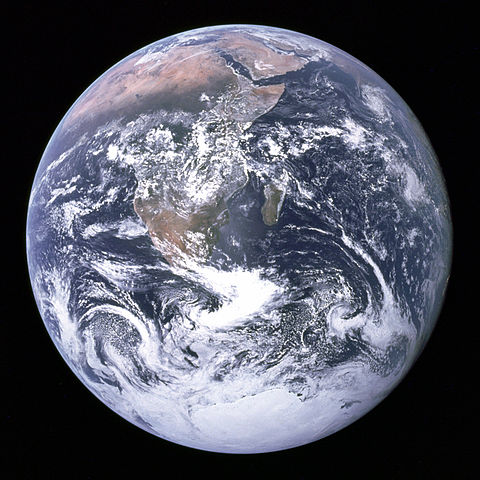
That film release date of the 7th December, 2012 was the 40th anniversary of the most famous photograph of Planet Earth taken on the 7th December, 1972: The Blue Marble.
The Earth seen from Apollo 17.
Original caption: “View of the Earth as seen by the Apollo 17 crew traveling toward the moon. This translunar coast photograph extends from the Mediterranean Sea area to the Antarctica south polar ice cap.
This is the first time the Apollo trajectory made it possible to photograph the south polar ice cap. Note the heavy cloud cover in the Southern Hemisphere. Almost the entire coastline of Africa is clearly visible. The Arabian Peninsula can be seen at the northeastern edge of Africa. The large island off the coast of Africa is Madagascar. The Asian mainland is on the horizon toward the northeast.”
The Blue Marble is a famous photograph of the Earth, taken on December 7, 1972, by the crew of the Apollo 17 spacecraft, at a distance of about 45,000 kilometres (28,000 mi).
The snapshot — taken by astronauts on December 7, 1972, at 5:39 a.m. EST (10:39 UTC) — is one of the most widely distributed photographic images in existence.
The image is one of the few to show a fully illuminated Earth, as the astronauts had the Sun behind them when they took the image. To the astronauts, Earth had the appearance and size of a glass marble, hence the name.
Back to that Overview film. Slightly confusing is the fact that the Planetary Collective website, where that Overview film is highlighted, is a different one to the associated Overview Institute website, from where one can read this Declaration:
A Critical Time
We live at a critical moment in human history. The challenges of climate change, food, water and energy shortages as well as the increasing disparity between the developed and developing nations are testing our will to unite, while differences in religions, cultures, and politics continue to keep us apart.
The creation of a “global village” through satellite TV and the Internet is still struggling to connect the world into one community. At this critical moment, our greatest need is for a global vision of planetary unity and purpose for humanity as a whole.
And to my mind the greatest need, the ONLY need, for that global vision is to move rapidly beyond our industrial and materialistic way of life to one where we live in harmony with our planet.
To pick up on what Ron Garan was quoted as saying, Planet Earth is a living, breathing organism. If the species man and thousands of other non-human species are to stand a chance of remaining on this living, breathing organism then You, Me and every other person out there, has to have a change of consciousness about the one and only place we live on.
So don’t flick over from those last words to the next thing in your life. Go back and look at the picture of our home, taken from Apollo 17. Make sure that you ask as many as you can to watch the Overview film above.
Finally, you be a person who makes a change in your consciousness. The rest is easy.
Back to dear old Albert E.
“No problem can be solved from the same level of consciousness that created it.“
How very precious, vulnerable and fragile is this precious place we call home.
Today’s consciousness perambulation is the fault of Mr. P., as I like to call him. I refer to Pendantry as he is on his blog, Wibble.
You see on Sunday he added a comment to my post Just a small, white dot! that included the beautiful and awe-inspiring film made by the late Carl Sagan called Pale Blue Dot.
Like millions of others, I came to admire Carl Sagan through watching the fabulous, the truly fabulous, television series Cosmos: A Personal Voyage.(NB. All the episodes are on YouTube, Episode One is at the end of this Post, Ed.) Here’s how WikiPedia opens their reference to Carl.
Carl Edward Sagan (November 9, 1934 – December 20, 1996) was an American astronomer, astrophysicist, cosmologist, author, science popularizer and science communicator in astronomy and natural sciences. He spent most of his career as a professor of astronomy at Cornell University where he directed the Laboratory for Planetary Studies.
He published more than 600 scientific papers and articles and was author, co-author or editor of more than 20 books. He advocated scientifically skeptical inquiry and the scientific method, pioneered exobiology and promoted the Search for Extra-Terrestrial Intelligence (SETI).
Sagan is known for his popular science books and for the award-winning 1980 television series Cosmos: A Personal Voyage, which he narrated and co-wrote. The book Cosmos was published to accompany the series. Sagan wrote the novel Contact, the basis for a 1997 film of the same name.
He died far too young and was a tragic loss to humanity. The Carl Sagan web portal is here.
That 3:30 minute video Pale Blue Dot has, likewise, been seen by millions. If you or someone you know hasn’t seen it, then you must pause now …
It’s practically impossible to watch that video and not embrace the central message from Mr. Sagan. Here’s the transcript:
Our home from 6 billion kilometres. A very tiny dot against the vastness of space.
From this distant vantage point, the Earth might not seem of any particular interest. But for us, it’s different.
Consider again that dot. That’s here. That’s home. That’s us.
On it everyone you love, everyone you know, everyone you ever heard of, every human being who ever was, lived out their lives.
The aggregate of our joy and suffering, thousands of confident religions, ideologies, and economic doctrines, every hunter and forager, every hero and coward, every creator and destroyer of civilization, every king and peasant, every young couple in love, every mother and father, hopeful child, inventor and explorer, every teacher of morals, every corrupt politician, every “superstar,” every “supreme leader,” every saint and sinner in the history of our species lived there – on a mote of dust suspended in a sunbeam.
The Earth is a very small stage in a vast cosmic arena.
Think of the rivers of blood spilled by all those generals and emperors so that in glory and triumph they could become the momentary masters of a fraction of a dot.
Think of the endless cruelties visited by the inhabitants of one corner of this pixel on the scarcely distinguishable inhabitants of some other corner. How frequent their misunderstandings, how eager they are to kill one another, how fervent their hatreds.
Our posturings, our imagined self-importance, the delusion that we have some privileged position in the universe, are challenged by this point of pale light. Our planet is a lonely speck in the great enveloping cosmic dark. In our obscurity – in all this vastness – there is no hint that help will come from elsewhere to save us from ourselves.
The Earth is the only world known, so far, to harbor life. There is nowhere else, at least in the near future, to which our species could migrate. Visit, yes. Settle, not yet. Like it or not, for the moment, the Earth is where we make our stand.
It has been said that astronomy is a humbling and character-building experience. There is perhaps no better demonstration of the folly of human conceits than this distant image of our tiny world. To me, it underscores our responsibility to deal more kindly with one another and to preserve and cherish the pale blue dot, the only home we’ve ever known.
Tomorrow, I will stay with the theme of our beautiful planet. Hope you can join me.
Now spoil yourself and watch Episode One of Cosmos.
“Fear comes from uncertainty. When we are absolutely certain, whether of our worth or worthlessness, we are almost impervious to fear.”William Congreve, English playwright and poet.
It’s Sunday (i.e. yesterday). I woke around 6am to a cold morning (28 deg F/-2.2 deg C), the result of a clear, moonlit night.
Then as the night sky lightened with the coming dawn, the green, forest-cloaked valleys, visible to the East through the bedroom windows filled with a white, morning mist. In a metaphorical sense that descending mist matched a mood of gloom that was trying to descend on me.
Early morning mist, taken 7:15 am Sunday, 24th Feb.
As I lay back against the headboard of the bed, Jean still sleeping close to me, dogs Cleo, Hazel and Sweeny snoozing on and around me, I pondered on my mood. It came to me that I might be picking up the growing sense of anxiety, of uncertainty, that seems to be ‘in the air’. Me reading too many blog articles about global warming, climate change, et al. Being three-quarters through Professor Guy McPherson’s book Walking Away from Empire: A Personal Journey wasn’t helping either!
Then I recalled a recent conversation with dear friend and colleague from our Payson, AZ. days, John Hurlburt, who said that fear is the absence of faith. That if we trust what will be will be, then we can counter the fear of the unknown and embrace the present day, one day at a time. Living in the now as, you’ve guessed it, that dogs do so supremely well. Something else to learn from dogs!
I made a decision to take a stroll in the forest, emotionally speaking, for this week, so far as Learning from Dogs is concerned. Enjoy the beauty of the world around me and offer a few essays on the meaning of life. No blog posts at all about anything that engenders fear from any quarter!
And if that doesn’t slash the readership figures, I don’t know what will! So there! You have been warned.
So let me start by offering this essay from John. John is one of those rare people who has been through more than his fair share of ‘challenges’ over the years, yet has grown from those experiences.
Here’s John – I’m turning over and going back to sleep!
oooOOOooo
Education, Formation and Transformation
Most Americans remain comfortably complacent despite world economic brinksmanship, the escalating deterioration of our planetary environment and raging world discontent. Although we may be caring and compassionate in our personal lives, we are often reluctant to take any risk of reducing our personal comfort.
Education is a process. A process of learning how to think life through in order to become aware of whom we are, what we are, where we are, and why we exist. Education has always been the human gateway to a better future.
Knowledge does not guarantee wisdom. Education, formation and transformation are an integrated process which includes studying to gain knowledge, making natural connections based on the best information available, and experiencing the higher levels of conscious awareness we recognize as wisdom. The educational process works best when it is open minded, factual and sustained. We learn best when we learn together.
The human wisdom tradition is rich in myth, mysticism, symbols, imagination and creativity. It tells a common story of emergence through centuries of sacred writings stretching back through time to the earliest human cave scratchings roughly 17,000 years ago, and the beauty of the prayers of the Rig-Veda 12,000 years ago which all begin with an homage to the natural energy of the Sun.
We’re conscious components of a living planet. We’re surface dwellers with exposure to universal and planetary energies. Our species is only 200,000 years old. The universe is roughly 13 billion years old. Our planet is deteriorating and we’ve lost our collective moral compass. What can we do to make a local difference?
We only recently learned to hunt woolly mammoths in packs using bows, arrows and spears as tools. A perception of God in relation to our responsibility to each other and creation exists as the foundation of a human wisdom tradition which, relatively speaking, has just began.
In many ways, nothing seems to have changed as we have passed through successive cyclic waves of emergence and contraction. It becomes simultaneously increasingly more complex and exquisitely simple to understand. That is as we begin to realize how our metanexus emerges, contracts and turns inside out without breaking … like a pulse.
The next ten years are more important than the next several thousand years in respect to the choices we make about our biosphere.
There seems to be little doubt that our world problems are steadily increasing. What’s the next right thing to do? It’s time to grow our conscious connection in God. It’s time to share the spring of human wisdom from the ground up. It’s time to develop a world economy which is gentle to the earth.
The Clearing Rests in Song and Shade
The clearing rests in song and shade.
It is a creature made
By old light held in soul and leaf.
By humans joy and grief,
By human work,
Fidelity of sight and stroke,
By rain, by water on
The parent stone.
We join our work to Heaven’s gift,
Our hope to what is left,
That field and woods at last agree
In an economy
Of widest worth.
High Heaven’s Kingdom come on earth,
Imagine Paradise
O dust, arise!
Wendell Berry; 1909
oooOOOooo
“The illiterate of the future will not be the person who cannot read. It will be the person who does not know how to learn.” Alvin Toffler
Does rather serve to remind us of our place in the scheme of things.
This stunning image was taken by the Cassini-Huygens probe. Many of the images taken by NASA are available for download from the DVIDS website, which is where this one was found. (But also do visit the Ciclops website.)
The title of the photograph is:
A View of Earth from Saturn
Although the Earth Observatory typically reserves ”Image of the Day” space for publishing data and images acquired by Earth-observing satellites, we are sometimes so enthralled by the spectacular images acquired by spacecraft observing other parts of the solar system that we want to share these ‘otherworldy’ views with our visitors. And if you are looking for remotely sensed images of the Earth, this view is the most remotely sensed image we have ever published!
This beautiful image of Saturn and its rings looks more like an artist’s creation than a real image, but in fact, the image is a composite (layered image) made from 165 images taken by the wide-angle camera on the Cassini spacecraft over nearly three hours on September 15, 2006.
Scientists created the color in the image by digitally compositing ultraviolet, infrared, and clear-filter images and then adjusting the final image to resemble natural color. (A clear filter is one that allows in all the wavelengths of light the sensor is capable of detecting.) The bottom image [the one above. Ed.] is a closeup view of the upper left quadrant of the rings, through which Earth is visible in the far, far distance.
On this day, Saturn interceded between the Sun and Cassini, shielding Cassini from the Sun’s glare. As the spacecraft lingered in Saturn’s shadow, it viewed the planet’s rings as never before, revealing previously unknown faint rings and even glimpsing its home world. Seen from more than a billion kilometers (almost a billion miles) away, through the ice and dust particles of Saturn’s rings, Earth appears as a tiny, bright dot to the left and slightly behind Saturn.
Although it might appear that Earth is located within Saturn’s outermost rings, that positioning is just an illusion created by the enormous distance between Cassini and Earth. When Cassini took this image, the spacecraft was looking back at Saturn from a distance of about 2.2.million kilometers (about 1.3 million miles). The Sun was millions of additional miles beyond, hidden behind Saturn. On September 15, Earth’s orbit had brought our home planet to a location slightly behind and to the left of the Sun from Cassini’s perspective. The Website of the Cassini Imaging Central Laboratory for Operations (CICLOPS) provides more detailed information about this image. The Cassini-Huygens mission is a cooperative project of NASA, the European Space Agency, and the Italian Space Agency.
Trying to find that faint image of Planet Earth in the above photograph is a challenge, even for those with much younger eyes than mine.
However, with a little bit of jiggery-pokery I was able to crop and enlarge the photograph, see below:
Planet Earth is in the ’10 o’clock’ position in the photograph, about half-way from the centre of the enlarged segment towards the top-left corner of the picture, just outside the outer white ring.
That’s us. All that we have ever been. All that we ever will be. Just that small white dot.
(Reposted from The Liberated Way with the generous permission of Alex Jones)
Go beyond the appearance and the behaviour to the nature that underpins everything.
The truth of being a cat is relative only to this cat.
Recent events got me thinking about what truth is. I find that nobody has a monopoly on truth, that truth is relative. Take for example the colour red, I see red as red, the bee sees red as black. Truth is the product of self, the bee brain makes red black and my brain red as red; truth in this sense is relative to the beholder of the truth.
God.
Take the example of God, some believe in God, some reject God, some like me sit on the fence as agnostics. Those that believe in God differ on what God is: energy, gravity, a mind, with no mind, in creation, separate from creation. God is one of those ideas that can neither be disproved or proven with any certainty. Truth is relative to the beholder.
Nothing is certain.
Truth then to me is never one conclusion, but can be a diversity of conclusions. Red can be red but can also be black depending on the beholder, thus truth is relative. It is better to say I believe the truth to be, rather than say this is the truth. With the universe composed of visible and hidden variables, always changing and in feedback loops nothing can be claimed with any certainty.
Belief.
Since truth is relative it is better to say that I act and think according to a belief rather than a truth, the same for everyone. When the word belief is mentioned some people choke on it, they believe that the universe is deterministic, that there is only one truth, often the one they believe it to be. It is apparent neither Bee nor I have a monopoly on the truth of what the colour red is, we hold different beliefs of the colour red relative to ourselves.
The hubristic need to monopolise belief.
I see no harm in a world holding a diversity of beliefs. So what if a Native American believes a tree has a spirit, a belief based on animism? Yet to the Christian missionary the Native American is a lost soul to be saved, and to the Atheist the Native American is one to be converted to the progress of modern science. The outsider has this need to force their own beliefs onto the Native American, resulting in widespread suicide, mental illness, drug abuse and alcoholism amongst the people whose belief systems they obliterated. The need of some to westernise Islam or Islam to convert the West sets the scene for a so-called clash of civilisations: violence, hate, fear and anger.
Black swans.
Even in my own empirical and inductive approach to truth, I know I can only draw a probability of truth. I may count 1000 white swans on a lake and conclude the world only has white swans, then one day a black swan appears. I have to be open to the possibility of black swans, which is a position of humility.
Hubris hates diversity of belief.
The individual or group who claims their truth is the only truth is gripped in hubris. Truth is relative, there can be many truths. Hubris follows through to control, the individual or group needs and acts to force their belief upon other people who have a different belief of a truth relative to them. Those inflicted with hubris hate diversity, they only want one truth, that of their own. The horrors of Nazi Germany, or the Crusades or of Vietnam were because a group of people wanted a world based on their own beliefs with all other beliefs eliminated.
Grounding belief like roots of a tree.
A belief should be grounded like a tree has roots that anchors it into the ground, otherwise it moves into fantasy. To ground a belief it is to be tested by asking questions, by looking for observable, experiential or demonstrable evidence of its existence. A belief untested but accepted without question is ignorance, it is opinion.
Follow the common.
When Heraclitus suggests “follow the common”, he means to deal with things based upon their nature: it is common for all ducks to love water; it is common for all energy to flow; it is common for all things to evolve or change through strife. Heraclitus suggests people go beyond appearances and behaviour to the underlying nature of the universe, and in this one grounds belief in the common of reality rather than in the ignorance of opinion.
A superb reminder of the positives of this funny old species of ours!
The issue of what man is doing to our biosphere is all important, probably above all else. It surely occupies much of the thinking time of me and countless others across the globe. It seems so obvious that we are harming the planet it’s easy to forget that there are hundreds of thousands, if not millions, of people who are making a very positive difference in countless ways.
Take Erik Bendl. Not someone I had previously heard of so thanks to Lew L. who sent me the information.
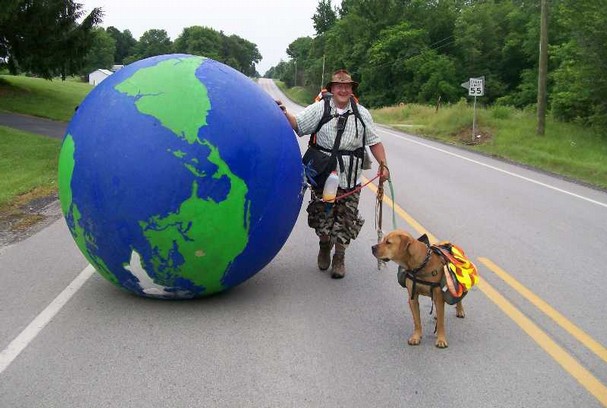
Erik Bendl has walked over six thousand miles for the cause of diabetes awareness. In recent years he and his dog named Nice have walked in over thirty nine states and Washington D.C. to help diabetes organizations and encourage people to get healthy with exercise to control and prevent diabetes. When you see him on the road stop to say hello, walk with him or call him @ (502) 408-5772. (This includes a link to here)
That link (this one) takes you to a place on the website of the American Diabetes Association from which one further learns,
I AM STEPPING OUT BECAUSE…
I am Stepping Out because the American Diabetes Association’s Step Out: Walk to Stop Diabetes is so much more than a fundraising event to me. It is my opportunity to change the future and make a positive impact in the lives of those who are affected by diabetes. I am committed to walk and raise money in this inspirational event not because 26 million people in the United States have diabetes, but because I personally know some of them, and I want to do something about it.
I am now inviting you to join me in my quest to prevent and cure diabetes once and for all. Chances are, you also know someone who has been affected by diabetes and you already know how important it is to stop this disease. By making a donation on my behalf, you will be helping the Association provide community-based education programs, protect the rights of people with diabetes and fund critical research for a cure.
With your help, we will fight for a future where a parent does not have to hear that their child has diabetes. A future where an adult does not have to face the uncertain times ahead after receiving a diabetes diagnosis. A future where you and I will know that we had a part in making this possible.
I truly appreciate your support. Together we can Stop Diabetes!
Easy to read, even easier to copy and paste into this post. Far, far more difficult to undertake what Erik and Nice have been doing for so long.
Uploaded on Aug 25, 2011
FORT RIPLEY — He may have the world on a string, but Erik Bendl’s highly visible stroll along Highway 371 is hardly a walk in the park. The Louisville, Ky., carpenter and his dog, Nice, are walking along the highway shoulder with a large, inflatable, rubber globe in order to raise awareness about diabetes.
This particular walk started in Sheboygan, Wis., and has Lake Itasca as its final destination. His route took him into Iowa before heading into Minnesota.
“I’m walking until the snow flies,” he said.
Stopping to answer questions from the curious near Eagle’s Landing on Tuesday afternoon, Bendl had a few northbound miles to go until Fort Ripley, his stated goal for that day.
The 49-year-old travels about 10 to 15 miles a day and estimated he had walked about 3,000 miles in 26 states in his five trips with Nice. Asked what kind of dog his non-descript companion was, Bendl replied, “He’s a brown dog.”
But apart from the commitment to his chosen cause, Erik also writes beautifully. Take this recent piece (which I trust Erik doesn’t mind me reposting here.)
Out of a dream
I awoke thinking I was writing about the twelve miles we had pushed against the wind. It took ten hours. Good people stopped and gave us water through the windy, hot day. Never thirsty, backpack still full at the end of the day with the bottles I started out with in the morning. Others brought food for us to eat. Dog biscuits and salad for me. Burgers and chews kept our stomachs full and my pack heavier with extra dogs treats when we stopped for the night.
We met diabetics of all shapes, ages and size. Stubborn ones who are not to be told and dedicated ones who want to grow old. I was told by all what I am doing is an inspiration, still some could not get away fast enough, lest they admit they could do more for themselves.
Everyday someone will tell me as they leave, smiling ear to ear, that I have made their day happier. A bonus which makes my day a joy.
Now I am awake from my sleepy dream. The fog has lifted from my tired senses. I hesitate to read over what I have just written. Will it make any sense? Will it matter? Or Am I still dreaming?
I think I will push the “send” button and forget, like most other dreams.
Why not send him an email to remind him of the universal power of being a good person: erikbendl (at) gmail (dot) com
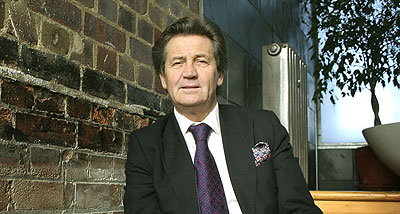
I am indebted to my son for dropping me an email with a link to a recent BBC Radio programme. It was from the long-running programme series In Our Time, presented by the consummate broadcasting professional Melvyn Bragg.
Melvyn Bragg
The WikiPedia entry details, The Rt. Honourable The Lord Bragg no less,
Melvyn Bragg, Baron Bragg, FRS, FBA, FRSA, FRSL, FRTS (born 6 October 1939), is an English broadcaster and author, best known for his work with the BBC and for ITV presenting the The South Bank Show (1978–2010). Since 1998 he has presented over 550 weekly episodes of the BBC Radio discussion programme In Our Time.
This particular episode was called Ice Ages; the link will take you to the programme page which includes the ability to listen to the 43 minutes long episode. (Alternatively, you can go straight to the recording via the BBC iPlayer.) The programme page explains:
ICE AGES
Jane Francis, Richard Corfield and Carrie Lear join Melvyn Bragg to discuss ice ages, periods when a reduction in the surface temperature of the Earth has resulted in ice sheets at the Poles. Although the term ‘ice age’ is commonly associated with prehistoric eras when much of northern Europe was covered in ice, we are in fact currently in an ice age which began up to 40 million years ago. Geological evidence indicates that there have been several in the Earth’s history, although their precise cause is not known. Ice ages have had profound effects on the geography and biology of our planet.
With:
Jane Francis
Professor of Paleoclimatology at the University of Leeds
Richard Corfield
Visiting Research Fellow in the Department of Earth Sciences at Oxford University
Carrie Lear
Senior Lecturer in Palaeoceanography at Cardiff University.
Now the programme requires careful listening as the conversation ranges rapidly about the number of ice ages, the intervening greenhouse periods and where we are at present. It would be easy to end up thinking that we are in a cooling phase (we are not) or that it’s only a matter of time before we are back in the next ice age (in geological terms, yes).
It was a close call. After the programme Jane Francis and Carrie Lear continued to talk about the climbing count of CO2 which was pumping up global warming, in their opinion, which would lead most dramatically to mass flooding. On the programme Richard Corfield did not join in very enthusiastically, pointing out that the CO2 count had been at least twice as high quite recently (geologically speaking) and even higher than that a bit before recently. The situation was beginning to develop into a relevant, contemporary conversation about climate change and the final bell was a merciful release. There was no thought of the ingenuity of men and women combating what would be a gradual increase (if it happens) of rising sea levels – we could have looked at the Dutch in the sixteenth century onwards. But I strayed from my task.
The grim conclusion of Jane Francis was never to buy or rent a house on a flood plain, always to buy or rent a house on a hill, or take a tent, or anything, as long as it’s on a hill and, I think Richard Corfield added, fortify it. Well, well. [my italics]
As I wrote yesterday, either Jane or Carrie, don’t recall whom, said on air just at the end that a CO2 level of nearly 400 ppm (January 2013: 395.55 ppm) is way above the range of levels where the Earth’s atmosphere has traditionally behaved in a stable manner.
In the end it really doesn’t matter geologically.
Our planet is approximately 4,540,000,000 years old. As WikiPedia explains,
There have been five known ice ages in the Earth’s history, with the Earth experiencing the Quaternary Ice Age during the present time. Within ice ages, there exist periods of more severe glacial conditions and more temperate referred to as glacial periods and interglacial periods, respectively. The Earth is currently in an interglacial period of the Quaternary Ice Age, with the last glacial period of the Quaternary having ended approximately 10,000 years ago with the start of the Holocene epoch.
This graph shows the history of ice ages and the fact that we are close to turning upwards towards a hotter geological period.
So we live on a planet that is 4.5 billion years old, towards the end of the current ice age that started 2.58 million years ago.
Early man evolved from hunting and gathering into the domestication of plants and animals, in other words farming, about 10,000 years ago. In these short years, from a geological perspective, we have lost total sight of the intimate relationship we had with the planet when our very survival depended on hunting and gathering.
In so little time!
Just reflect on the last 100 years of so-called modern agriculture. It has been characterised by enhanced productivity, the replacement of human labour by synthetic fertilizers and pesticides, selective breeding, and mechanisation. It has been closely tied to political issues such as water pollution, biofuels, genetically modified organisms, tariffs, and farm subsidies. All of which explains the backlash against the external environmental effects of mechanised agriculture, and increasing support for the organic movement and sustainable agriculture.
One might say that we have been farming the planet in the most broadest of senses; as if the planet is nothing more than a bottomless pool of resources.
Chief Jackie Thomas at the recent Forward-On-Climate rally talked about the toll that tar sands are already taking on her neighbors in Alberta, and promised that First Nations communities and their allies in Canada will never allow a pipeline to be built west to the Pacific.
Such peoples still in tune with their ancient heritage understand that humanity is first and foremost in and of the land.
Many will know the origins of this blog; a chance comment by Jon Lavin back in England in early 2007 that dogs were integrous, (a score of 210 as defined by Dr David Hawkins).
“There is nothing to fear except the persistent refusal to find out the truth, the persistent refusal to analyse the causes of happenings.” Dorothy Thompson.
When I started Learning from Dogs I was initially rather vague but knew that the Blog should reflect the growing need for greater integrity and mindfulness in our planetary civilisation. Here are some early musings,
Show that integrity delivers better results … integrity doesn’t require force … networking power of a group … demonstrate the power of intention … cut through the power of propaganda and media distortion …
Promulgate the idea that integrity is the glue that holds a just society together … urgent need as society under huge pressures …. want a decent world for my grandchildren … for all our grandchildren …. feels like the 11th hour….
But as the initial, rather hesitant, start to the Blog settled into a reliable, daily posting, and as the minuscule number of readers steadily grew to the present level of many hundreds each day, the clarity of the purpose of Learning from Dogs also improved.
Because, while it may sound a tad grandiose and pompous, if society doesn’t eschew the games, half-truths and selfish attitudes of the last, say, 30 years or more, then civilisation, as we know it, could be under threat.
Or, possibly, it’s more accurate to say that our civilisation is under threat and the time left to change our ways, to embrace those qualities of integrity, truth and consciousness for the very planet we all live on, is running out.
“Time left to change our ways is running out.”
So what’s rattled my cage, so to speak, that prompted today’s reflection? I’ll tell you! (You knew I was going to anyway, didn’t you!)
I’m drafting these thoughts around noon Pacific Standard Time on Sunday, 17th. At the same time, tens of thousands of ordinary good folk (40,000 plus at the latest estimate) are gathering by the Washington Monument ready to march past the White House demanding that President Obama block the Keystone XL pipeline and move forward toward climate action.
Do I trust the US Government to take this action? On balance, no! That hurts me terribly to write that. I really want to trust and believe what the President of my new home country says.
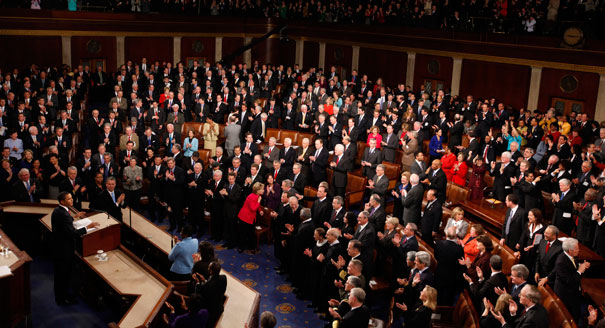
State of the Union speech 2013. AP photo.
Here’s a snippet of what the President did say in his State of the Union speech on February 12th.
Now, it’s true that no single event makes a trend. But the fact is, the 12 hottest years on record have all come in the last 15. Heat waves, droughts, wildfires, floods, all are now more frequent and more intense.
We can choose to believe that Superstorm Sandy, and the most severe drought in decades, and the worst wildfires some states have ever seen were all just a freak coincidence. Or we can choose to believe in the overwhelming judgment of science and act before it’s too late.
A frank admission that the climate is changing in dramatic ways; the overwhelming judgment of science – fantastic!
The evidence that burning carbon-based fuels (coal, oil, gas) is the primary cause of today’s high CO2 levels is overwhelming. As a recent BBC radio programme reveals (being featured tomorrow) huge climate changes going back millions of years are a natural part of Earth’s history. However, as one of the scientists explains at the end of that radio programme, the present CO2 level, 395.55 ppm as of January, is now way above the safe, stable limit for the majority of life species on the planet.
But say you are reading this and are not yet convinced?
Let me borrow an old pilot’s saying from the world of aviation: If there’s any doubt, there’s no doubt!
That embracing, cautious attitude is part of the reason why commercial air transport is among the most safest forms of transport. If you had the slightest doubt about the safety of a flight, you wouldn’t board the aircraft.
If you had the slightest doubt about the future for civilisation on this planet likewise you would do something! Remember, that dry word civilisation means family, children, grandchildren, friends and loved ones. The last thing you would do is to carry on as before!
Which is where my lack of trust of leaders comes from!
Back to that State of the Union speech. Just 210 words after the spoken words “act before it’s too late” (I counted them!) Pres. Obama says, “That’s why my administration will keep cutting red tape and speeding up new oil and gas permits.”
Here’s the relevant section:
I will direct my cabinet to come up with executive actions we can take, now and in the future, to reduce pollution, prepare our communities for the consequences of climate change, and speed the transition to more sustainable sources of energy.
Now, four years ago, other countries dominated the clean-energy market and the jobs that came with it. And we’ve begun to change that. Last year, wind energy added nearly half of all new power capacity in America. So let’s generate even more. Solar energy gets cheaper by the year. Let’s drive down costs even further. As long as countries like China keep going all-in on clean energy, so must we.
Now, in the meantime, the natural gas boom has led to cleaner power and greater energy independence. We need to encourage that. That’s why my administration will keep cutting red tape and speeding up new oil and gas permits.
We don’t require any more oil to be used. We are already using a staggering amount of it. Let me refer you to an essay on Nature Bats Last called Math. The scary kind, not the fuzzy kind. Prof. McPherson wrote:
I performed a little rudimentary math last week. A little because even a little pushes my limit for math, these days. And rudimentary for the same reason. The outcome was staggering: We’re using oil at the rate of 5,500 cubic feet per second (cfs).
“5,500 cubic feet per second” Don’t know about you but I have some trouble in visualising that flow rate. Try this from later in the essay:
Here’s another shot of perspective: We burn a cubic mile of crude oil every year. The Empire State Building, the world’s ninth-tallest building, towers above New York at 1,250 feet. The world’s tallest building, Taipei 101, is 1,667 feet from ground to tip.
Put those buildings together, end to end, and you have one side of a cube. Do it again, and you have the second side. Once more, but this time straight up, and you have one big cube. Filling that cube with oil takes nearly 200 billion gallons … which is about one-sixth the size of the cube of oil we’re burning every year.
Burning a cubic mile every year! Yes, Mr. President, more oil permits is a wonderful way of taking action before it’s too late!
So let’s see what transpires? Let’s see if integrity is given the highest political focus. As in “adherence to moral and ethical principles; soundness of moral character; honesty.” Because if there’s ever been a time when all of us, from every spectrum of society need honesty about what we are doing to the planet, it’s now!
As the tag on the home page of this blog says, “Dogs are integrous animals. We have much to learn from them.“







 Learning from Dogs