Category: consciousness

Four years old!

How time flies!

Four years ago this day, the first post was published on Learning from Dogs.  Here it is again:

Parenting lessons from Dogs!

Much too late to make me realise the inadequacies of my own parenting skills, I learnt an important lesson when training my GSD (who is called Pharaoh, by the way).  That is that putting more emphasis into praise and reward for getting it right ‘trains’ the dog much quicker than telling it off.  The classic example is scolding a dog for running off when it should be lots of hugs and praise for returning home.  The scolding simply teaches the dog that returning home isn’t pleasant whereas praise reinforces that home is the place to be.  Like so many things in life, very obvious once understood!

Absolutely certain that it works with youngsters just the same way.

Despite being a very dominant dog, Pharaoh showed his teaching ability when working with other dogs.  In the UK there is an amazing woman, Angela Stockdale, who has proved that dogs (and horses) learn most effectively when being taught by other dogs (and horses).  Pharaoh was revealed to be a Beta Dog, (i.e. second in status below the Alpha Dog) and, therefore, was able to use his natural pack instinct to teach puppy dogs their social skills and to break up squabbles within a pack.

When you think about it, don’t kids learn much more (often to our chagrin!) from other kids than they do from their parents.  Still focusing on giving more praise than punishment seems like a much more effective strategy.

As was read somewhere, Catch them in the act of doing Right!

By Paul Handover.

As it happens, it feels a little like ‘what goes around, comes around’.  Why do I say that?

Because just last Saturday, I sent off a selection of pictures and videos to Angela Stockdale.  Stay with me for a while as to the reason why.

Angela trades under the name of The Dog Partnership and, frankly, what she doesn’t know about the behaviour of dogs isn’t worth bothering about!

Just take a peek at the page on her website under the heading of Teaching Dogs.  Here’s a little of what Angela writes:

I consider myself so lucky for dogs alone to have been my teachers. I learnt from watching how my own dogs responded to another dog’s body language and vice versa their language. Watching, learning and working with Teaching Dogs was the only way I knew.

I was and always will be in awe of a Teaching Dog’s dogs ability to consciously adapt their body language in accordance to how the other dog was feeling. The result being, they could relax nervous dogs but at the same time maintain control of a problem situation. Remember, dogs talk dog far better than we do.

It came as quite a shock to me when I learnt about other approaches. It seemed foreign for people to have so much input in resolving what were described as ‘ behavioural’ issues. For me, working with these dogs was far more than resolving a behavioural issue. It was about improving the quality of lives of dogs who were not coping with everyday life. If they found dogs or people worrying, sometimes this was shown in displays of aggression. It is important to understand, these dogs were not aggressive, they simply displayed aggressive behaviour.

Now, I would like to introduce you to the world of Teaching Dogs and how these special dogs change the lives of less fortunate dogs, who never had the opportunity to really understand how to communicate with their own species.

Do read the rest here.

Back to why those photographs and videos had been sent to Angela.  A couple of weeks ago, we enjoyed an evening meal with friends of friends, so to speak.  This other couple owned a beautiful-looking male German Shepherd dog: Duke.  Duke was 4-years-old.  Our hostess remarked that he was very boisterous and had nipped a couple of strangers who had called at the house.  She added that he seemed difficult to control.  Duke had been there for about a month and he was a rescue so they had little or no knowledge of past behaviour.

Well, I’m no expect with dogs, that’s Jean’s domain.  But there was something about Duke that captivated me.  Something in the way he looked at me, his eyes linking so directly with mine, allowing me to see a dog that offered an honest openness.

More or less on impulse I stood up, held my right arm up at 45 degrees, looked Duke in the face and said, “Duke! Sit!”

Duke held my gaze and sat back on his haunches.

I moved my arm in a complete circle, around to the right, and said, “Duke! Lie down!” Duke lay down.

H’mm, I thought. Fascinating.  This dog has been professionally trained at some point in the past, using the same ‘command’ system of voice and arm signalling as I had learnt with Pharaoh way back in 2003/2004.

The food was now on the table.  I grabbed a small piece of meat off my plate and returned to Duke who had, of course, resumed his pottering around the room.  “Duke! Here boy!”  Duke came over to me.  “Duke! Lie down!”  Duke did so.  I placed the piece of meat on the wooden floor about three feet in front of him.  Duke’s eyes were riveted on the meat.  “Duke!”  Duke’s eyes reluctantly engaged with mine.  “Duke! Stay!”  I repeated the Stay command a couple more times as I backed away about 6 or 8 feet.

“Go on, Boy. Take the meat!”  Duke gleefully grabbed the piece of meat.  Gracious, I thought, this dog is magnificent.  I wonder ……..

I took another piece of meat, “Duke! Sit!”  “Duke! Stay!”  I then backed off that 8 feet again, got down on my knees and placed the piece of meat just between my lips.  I knew this was potential madness with a dog I had only met some 30 minutes previously, but there wasn’t an ounce of doubt in my mind.  I voiced in my throat for Duke to fetch the meat. Duke came straight over and confidently and carefully removed the meat from my lips.

What a truly fabulous dog! It was a wonderful evening and once home both Jean and I were eulogising about Duke.

Then two days later, our dinner hostess rang me.  “You know, I have decided we can no longer keep Duke.  He is too strong a dog, I can’t control him.  Is there any chance of you finding a new home for Duke?”

Without question, Jean and I would have offered Duke a new home; in a heartbeat.  The only thing stopping that was me wondering if this strong-willed, male German Shepherd might be a Beta dog, as Pharaoh was. Or just might be too dominant a male dog to fit in comfortably with our dogs, especially Pharaoh who was at the stage of life where the last thing that should happen is for his happiness and contentment to be disturbed.

I hadn’t a clue as to how to answer that question.  But I knew someone who would know: Angela Stockdale.

I rang her, caught up on old times and then explained the background to Duke’s situation.  Angela said to repeat the exercise that I had witnessed when I took Pharaoh to her all those years ago, when I wondered if Pharaoh was an aggressive dog.  My uncertainty with regard to Pharaoh followed a number of times when walking him in a public area with other dogs and he had been very threatening, both in voice and posture, towards some of those other dogs.

This is what Angela arranged.  I took Pharaoh up to her place at Wheddon Cross, near Minehead in Somerset.  When we arrived, Angela was standing just by a gate into a fenced paddock, maybe a half-acre in size.  In the far corner were two dogs.

Angela asked me to bring Pharaoh to the gate and let him off the leash.  It was clear that Pharaoh was going to be let into the paddock.  I cautioned that Pharaoh could be quite a handful with other dogs and, perhaps, it would be better that I walked him into the area still on his lead.  Angela said that wouldn’t be necessary.  So as she held the gate open sufficient for Pharaoh to enter the paddock, I slipped the lead off him and backed away, as requested.

Pharaoh had hardly taken 2 or 3 paces when Angela called out, “Paul, there’s nothing wrong with him!”

I was astounded and stammered, “But, er, er, how can you tell so quickly?”  “Because my two dogs haven’t taken any notice!”, came the reply.

Later Angela explained that in the paddock were her female Alpha dog and her male Beta dog.  Ergo, the two top dogs in terms of status so far as dogs see other dogs.

In fact, Pharaoh was utterly subservient to these dogs, in a way that I had never witnessed before.  Later on, as Pharaoh relaxed and started playing, Angela said that she thought that Pharaoh was a Beta dog.  Mixing some of her other dogs into the group was later able to confirm that.

So back now to present times and Duke.

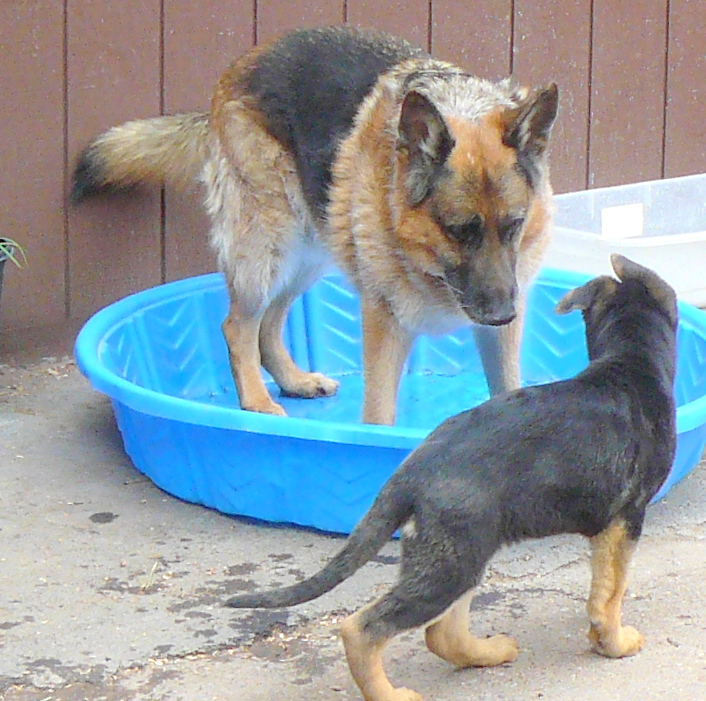
Thus last Saturday, as Angela recommended, we selected two of our dogs, Cleo our female German Shepherd and the most socialable of dogs, and Casey, a strong but not aggressive male (he had some PitBull in him).

Duke arrived and was allowed freely to nose around the large grassed area some way from the fenced-off horse paddock that we were using for the ‘introduction’.

Duke pottered around and then caught sight of Cleo and Casey in the paddock.

First sighting of Cleo and Casey.

Then the meetings began!

Hello! My name is Duke.  Do I smell OK? Mr. Casey?
Hello! My name is Duke. Do I smell OK? Mr. Casey?

And play didn’t seem to be too far off the agenda!

You lead, Cleo, I'll chase!
You lead, Cleo, I’ll chase!

So all the photographs and videos have been sent to Angela, and we will see what the conclusion is!

As Angela put it, “Remember, dogs talk dog far better than we do.”

Love of nature

We are, above all, so intimately part of the natural world.

In yesterday’s post, I shared an email that I had sent to friend, Dan, that included:

I want to retreat from these areas and focus on what is most valuable to me.

Aspects of my life such as love, friendship with ‘old’ travelers, the natural world, being in the present, community, our animals (especially Pharaoh who is over 10), my writings, my book, our small world here at 4000 Hugo; you get my drift!

Well it didn’t take me long to come across an email that John Hurlburt had sent not so long ago recommending the following film.

Enjoy!

Published on May 5, 2012

Video by Scott Mckinley Productions, Produced for Rocky Mountain Elk Foundation for Ad campaign. Licensed music by Kenny G.. This short video won Best of Category at the International Wildlife Film Festival in Missoula Montana! The majority was shot on location in Yellowstone National Park, Grand Teton National Park and The National Elk Refuge in Jackson Hole, Wyoming.

Before you turn away from this, go across to the website of the Rocky Mountain Elk Foundation. Or do an image search on the ‘web’ where you will, for example, find this breathtaking picture:

Bull Elk on top of the World.
Bull Elk on top of the World. Copyright ©2011-2013 Vic Schendel Photography, all rights reserved.

Vic Schendel Photography may be found here and I do recommend having a leisurely browse through the website.

Life’s changes.

Sometimes life has a way of offering a new path.

*** If you are not into introspection, then look away and come back tomorrow! 😉 ***

Regular readers will know that quite frequently I write under a topic heading that could be regarded as within the classification of key subjects of our time.  You know, such subjects as big government, big money, big power, and even climate change! 😉

Why has this been the case?

Well, because, a) most of my life I’ve tried to stay abreast of ‘current affairs’ and, b) within the broad label of ‘integrity’ it’s relevant to this blog.  The sub-heading of the blog is after all: “Dogs are integrous animals. We have much to learn from them.”  (Yes, I do know ‘integrous’ isn’t grammatically accurate! – Any suggestions for an alternative word?)

Stay with that while I go elsewhere.

Yesterday (Tuesday) a number of events ended up having a profound effect on me. On the face of it, utterly disconnected events.

The first was a post from Alex Jones on his blog The Liberated Way.  The only common ground between Alex and me is that we both know Colchester in Essex, England.  Alex because he lives there today, me because I used to have a business in Colchester in previous times.  Other than that just a couple of bloggers separated by thousands of miles.

Anyway, the post was this one: Cycle of Life. Alex wrote:

Life seems like a cycle of birth, living and death.

I have the honour of following awesome bloggers on WordPress.  I learn inspirational teachings from their intimate life experiences that they share with their readers.  The cycle, for in my belief everything moves in cycles, of birth, life and death is if we are attentive to living life something we will often be reminded of in our interactions with others and nature.

Then later, adding:

Lijiun is a Buddhist who shares daily experiences from their own life with a Buddhist theme running through their blog.  Lijiun has a cat called Little White who often acts as a teacher to them about the meaning of life and a reminder of Buddhist teachings.  Little White two weeks ago brought home a stray kitten, which it adopted as like a surrogate parent.  Yesterday Adik the kitten died, and a beautiful blog post by Lijiun in memory of Adik reminds us life is impermanent.

Almost absent-mindedly, I clicked on the link about the death of Adik and …… was shaken to my core; shaken by the power of the truth.  I want to give you more than a link to the post – want to share some of the beautiful words.

IN MEMORY OF “ADIK”…

In memory of our little Kitten, “adik”….

Every moment in life is full of changes, this is a law of nature.

However, sometimes we might assume that everything unchanged.

“Adik”- Our stray kitten, so far, she was not showing a sign of sickness. Yesterday, in the evening, I discovered she was laid down under my neighbor car, not moving at all and look severe sick. We checked through her little body, no physical injuries and we tried our best to feed her water and Cat food. She refuse to take.

We need to send her to Veterinarian immediately as her condition was critical, however during Sunday, especially evening time. Most of the Veterinarian clinic is closed. We did our best to check through internet, we were able to locate one of the Vet and we rushed over.

In the journey, we played Mantra Chanting to our little kitten, We reached to the vet clinic, “Adik” was alive but in agony…. she was struggling for life. The only thing we can help was to keep chanting mantra, our only aspiration are for her to relieve from suffering, not to reborn in 3 lower realm, able to follow spiritual practice and attain enlightenment in the coming life.

“Adik” passed away in peace even before the Veterinarian came to treat her.

Then Lijiun went on to write that “This incident gave me a very clear insight on “death”  and offered more of that insight: (These are extracts: Please read the full post.)

1. Impermanence Of life

Nothing is permanence , we need to live at now, not past or future.

When Death approached, no bargain time at all whether you are rich or poor, you are ready or not, you are healthy or sick, …

Do all good deeds when you are still alive, Follow spiritual path whenever you can, don’t give excuses that “I’ve plenty of time, I’ll do it when I am “FREE”? When You are Free, you might not able to do it…

2. Young or old…

Some of us, might assume that people died in old age. As such, we’ve a long journey in life.

Is It true???

I learned from “Adik” Sudden death – that death will happen in any age.

“Coffin is not meant for elderly people….” This is so profound.

Spend time with your family members, be filial piety to your parent, Pursuit your dream, Don’t wait until later day…. We are unsure we can survive until later day!

3. Breathing in & Out

Treasure every breath in & breath out…

Life is just in between Breath in & out.

Be Mindfulness in life!

4. What Can you bring???

What can you bring after death, “NOTHING”.

No matter, how much wealth, how much money, how many cars, how many bungalow, how high is your position, how lovely is your family… you can’t bring anything..

Ask yourself, “What is the purpose of life?”, “What do you want?”

5. Alone..

You, yourself need to face the death moment…

Nobody can help you… Don’t avoid the topic and say, “It’ll not happen to me so soon”..

Just get ready.

6. Love

“Adik” passed away at 8:30 pm.. according to my mom, Little White, Our lovely cat was “Meowing” loudly at home. He can sense that “Adik” was not longer around. Animals are just like us, they are loving. Please treat all beings well, no differentiation on form.

We are so touched that “Adik” came home before her death and spend her last moment with us.

Before we sent “Adik” to Vet, She “Meow” loudly to my mom as a good-bye & gratitude to my mom for taking care of her. It’s so touching!

Thank you to “Adik” for celebrating 16 happy day with us and leave behind a great lesson to us.

May “Adik” be relieved from suffering, not reborn in 3 lower realm and find the lasting happiness!

May all beings be Well and Happy!

Then also yesterday, I was chatting to someone who lives close to us; he and his partner-lady have become good friends.  He was bemoaning the corruption of so much of his fine country and went on to say that the only way that he could function was to turn away from the big stuff, have no TV, ignore the constant news of this and that, the endless trials and tribulations in this world of ours.  I listened in silence, only to find later that the words must have left a mark on me.

My dear friend, Dan Gomez, has known me for over 40 years.  He was my Best Man at my wedding to Jean in November, 2010.  He and I have been exchanging emails about the truth of the role of man in the raising of the temperature of the planet.  I sent Dan the link to the death of Adik, the kitten.  It seemed so much more important than the emails we had been exchanging about the ‘big’ subjects in life.

Then something happened overnight (Tuesday/Wednesday) because not long after I got to my PC this morning, I sent this email to Dan.

Dear Dan,

Yesterday was one of those days, one of those rare days I should have said, where my view of life was radically changed.

Partly because I’m still adjusting to Corinne’s death [my sister], partly because of something I read elsewhere, and other stuff best left for a phone call.

In essence, despite my anger at what is going on around us (big government, big money, big power, even climate change!) I want to retreat from these areas and focus on what is most valuable to me.

Aspects of my life such as love, friendship with ‘old’ travelers, the natural world, being in the present, community, our animals (especially Pharaoh who is over 10), my writings, my book, our small world here at 4000 Hugo; you get my drift!

I’m 70 in November, 2014. Corinne died in her 80th year. Time goes so quickly. No, life goes so quickly. Jean and I met 6 years ago this next December. I must turn away from the things over which I have little or no control and embrace the present. Just what dogs do so well. Live in the present.

It’s all about endeavouring to come to the end of one’s life hearing those immortal words of Edith Piaf, “Je regret rien.”

So dear reader of Learning from Dogs, if you are still ‘on frequency’ – Well done! You have stuck with my very long ramble!

Back to what gets written about in this place.  If integrity means anything, it means I’m going to drop all the ‘big’ topics and focus entirely on what man can learn, nay, has to learn from dogs.  Indeed, will close by republishing the full ‘home’ page below.

Pharaoh – just being a dog!

Dogs live in the present – they just are!  Dogs make the best of each moment uncluttered by the sorts of complex fears and feelings that we humans have. They don’t judge, they simply take the world around them at face value.  Yet they have been part of man’s world for an unimaginable time, at least 30,000 years.  That makes the domesticated dog the longest animal companion to man, by far!

As man’s companion, protector and helper, history suggests that dogs were critically important in man achieving success as a hunter-gatherer.  Dogs ‘teaching’ man to be so successful a hunter enabled evolution, some 20,000 years later, to farming,  thence the long journey to modern man.  But in the last, say 100 years, that farming spirit has become corrupted to the point where we see the planet’s plant and mineral resources as infinite.  Mankind is close to the edge of extinction, literally and spiritually.

Dogs know better, much better!  Time again for man to learn from dogs!

Welcome to Learning from Dogs

Entropia, a review.

A review of the new book by Dr. Samuel Alexander.

Back last November, not long after Jean and I had moved up to Oregon, I saw this on the PRI website: The Sufficiency Economy – Envisioning a Prosperous Way Down. Very quickly I realised the importance of the essay and contacted the author requesting permission to republish on Learning from Dogs.  That author was Dr. Samuel Alexander and permission was quickly given, leading to two essays: The simpler life and Where less is so much more.

Now fast forward to nearly a month ago and in came this email:

Samuel Alexander here, from the Simplicity Institute. I’ve recently published a new book, Entropia: Life Beyond Industrial Civilisation. Was wondering whether you were interested in posting either a review or an excerpt on your website?

I was flattered to have been asked and delighted to review the book.

First, some background. samuelalexanderDr. Alexander is a part-time lecturer with the Office for Environmental Programs, University of Melbourne, Australia. He teaches a course called ‘Consumerism and the Growth Paradigm: Interdisciplinary Perspectives’ in the Masters of Environment.

He is also co-director of the Simplicity Institute and co-founder of Transition Coburg. He writes regularly at the Simplicity Collective and posts most of his academic essays at www.TheSufficiencyEconomy.com.

oooOOOooo

Introduction

After the review was completed, I forwarded it to Sam just to check that I hadn’t made any technical errors.  Within Sam’s reply to that email was his acknowledgement that his book fell into a genre that was not easily classified.  Ergo, the book being fiction yet not a novel.  Sam went on to muse that perhaps he should have been clearer about what the reader was going to get.  He wondered if my review should mention that aspect.  I said that I wouldn’t amend my review but would include an introduction to that effect, as now witnessed!

So to the review.  (Note: For some reason, I was unable to prevent the paragraph spacing from being deleted in the published version.  Hence the insertion of a single ‘-‘ after each paragraph.)

oooOOOooo

Entropia-Cover

Entropia – Life Beyond Industrial Civilisation by Samuel Alexander

A review by Paul Handover

The title of the book didn’t offer this reader any clue about what might be coming. Nevertheless, very soon an experience of an ‘ah-ha’ moment arrived. Right on page one of the Acknowledgements when this sentence jumped off the page: “Henry Thoreau has been by far the greatest influence on my worldview, for it was he who awakened me to the insight that ‘superfluous wealth can buy superfluities only’.” [my emphasis] Wow, what an intriguing turn of phrase about wealth.

I plunged into the Prologue:

After the poets were banished from Plato’s Republic it is said that they set sail into unknown horizons in search of a new place to call home.

Shortly later reading:

But life proceeds in twists and turns, not straight lines. After losing consciousness in the midst of this perfect storm, the lost poets found themselves washed ashore on a small,fertile island, which was uninhabited and isolated entirely from the rest of civilisation. The boundless opportunities presented by this merciful twist of fate were immediately clear to all.

Some people believe this simple living community flourishes peacefully to this day, lost to the world in its own harmonious, aesthetic existence. But like Atlantis, the Isle of Furor Poeticus, as it has come to be known, has never been found.

* * *

The Isle of Furor Poeticus is a utopian romance of course – a myth. But we should remember that human existence has always been shaped and guided by myths and stories, so let us not dismiss the story of the lost poets too quickly or proudly. After all, we may not be so free from superstitions of our own. Modernity’s ‘myth of progress’ might itself just be a story we have been telling ourselves in recent centuries, one in fact that could soon be dismissed as a story no longer worth telling. Indeed, perhaps that book is closing before our very eyes – has already closed – leaving us to reflect on its themes from beyond as we step forth into unknown pages. And yet, it seems we have not found a new story by which to live. We are the generation in-between stories, desperately clinging to yesterday’s story but uncertain of tomorrow’s. Adrift in the cosmos, without a narrative in which to lay down new roots, humanity marches on – lost and directionless. But then again, perhaps the new words we need are already with us. Perhaps we just need to live them into existence.

Beautiful, magical writing right up to the closing sentences of the Prologue:

By choosing to do so we could again become the poets of our own lives and of a new generation, instead of merely reading out a pre-written script to an audience that is no longer listening. So open your mind, gentle reader, for the future is but clay in the hands of our imaginations.

We are being called to make things new. [again, my emphasis]

The novel, for it is a work of fiction, opens in substance with the account of Mortimer Flynn, a wealthy Texas oil magnate and son and only child of a Welsh coal industrialist, who having achieved “everything of which he had ever dreamed” comes to the realisation that he has no idea at all as to the purpose of his life. From this life-changing reassessment of his journey, his profound crisis of conscious, comes the purpose of the book. A story of a group of people who settle down in a remote South Pacific island, the island of Entropia. A “story about a community that became isolated on its small island in the wake of industrial civilisation’s collapse, during the third decade of the twenty-first century.”

Now, it’s fair to say that at this point I was truly hooked on the book. This was going to be the read of my life. Because it reflected my own belief that humanity was at the point, perhaps beyond the point, where the growing threats to our natural world threatened our moral obligations to the generations that follow.

However, somewhere during the second chapter, the style of writing started to intrude into my absorption of the story. At first the intrusion was more like a fly buzzing around; a minor irritation. Then it got to the stage where I had to stop reading and ponder on why I felt so uncomfortable with this reading experience. I was by now well into the third chapter.

Still couldn’t put my finger on what the problem was. Returned to the book but noticed that I was skim reading and had forcibly to focus on fully reading each page. After all, I was reading the book for review purposes!

Then it struck me. There were no characters coming to life off the page. Consequently, there was no dialogue. It didn’t read like a novel, much more like a report. That was the key to me re-establishing my relationship with the story; the book. Because despite the unusual style for a work of fiction, the value inherent in the pages was beyond measure. Here was a book that described in great detail the way a community discovered the reality of a sustainable way of life. How this group of a couple of thousand souls reinvented a society, a sustainable society, out of the ashes of a failed industrial civilisation.

I read on.

Later on the book described how the community looked at the way they governed themselves, how they set up representative systems and then, on page 119, came something that really punched me in the face, figuratively speaking. It was introduced, thus:

Eventually a short constitutional document was drafted by the Advisory Council and put to a referendum by the People’s Council, and this document received 94 per cent support. It is reproduced in its entirety below, as it serves as the best summary of our social, economic and political vision.

And proceeded:

Charter of the Deep Future

ENOUGH, FOR EVERYONE, FOREVER

.

We affirm that providing ‘enough, for everyone, forever’ is

the defining objective of our economy, which we seek to

achieve by working together in free association.

.

We affirm that everyone is free to create as an aesthetic

project the meaning of their own lives, while acknowledging

that this freedom legitimately extends only so far as others

can have the same freedom. Freedom thus implies restraint.

.

We affirm that our inclusive democracy does not

discriminate on such grounds as race, ethnicity, gender,

age, sexuality, politics, or faith.

.

We affirm that generations into the deep future are entitled

to the same freedoms as present generations.

.

We affirm that respecting the deep future requires maintaining

a healthy environment.

.

We affirm that technology can help to protect our

environment only if it is governed by an ethics of sufficiency,

not an ethics of growth. Efficiency without sufficiency is lost.

.

We affirm that maintaining a healthy environment requires

creating a stationary state economy that operates within

environmental and energy limits.

.

We affirm that a stationary state means stabilising

consumption and population, transitioning to renewable

sources of energy, and adapting to reduced energy supply.

.

We affirm that strict limits on material accumulation are

required if a stationary state is to maintain a just distribution

of resources and avoid corrosive inequalities.

.

We affirm that property rights are justifiable only to the

extent they serve the common good, including the overriding

interests of humanitarian and ecological justice.

.

We affirm that a stationary state economy depends on a

culture that embraces lifestyles of material sufficiency and

rejects lifestyles of material affluence.

.

We affirm that material sufficiency in a free society provides

the conditions for an infinite variety of meaningful, happy,

and fulfilling lives.

___________________________

Well that had such an impact on this reader. For this reason. The contrast between the reality of our present 21st Century life and the lives of those souls on Entropia was like night versus day. Enough, For everyone, Forever. If ever we needed a new cry from the heart, a new cry of hope and purpose, it was now and those are the words of that cry.

Entropia is a book you should read. It is a book that offers much hope, much guidance and much direction. As Samuel Alexander wrote on page 148, “Tranquillity and angst are both contagious, so it matters which of them we feed.

Time to feed that tranquillity.

oooOOOooo

Hands across the ether.

Never underestimate the power of like-minded people.

We are nothing without others in our life.  Each one of us is drawn to those that laugh with us, cry with us and comfort us in times of sorrow.

These thoughts come to mind as, to my humble amazement, the number of followers of Learning from Dogs approaches 500 and I reflect on how many of you, dear readers, now feel like friends. (Update: as at 7:40 pm last night, Raechelsheart became follower number 500!  Thank you all.)

So from that parochial view to the following video.  No introduction required by me, other than to thank neighbours Dordie and Bill who brought this performance to my attention.

Finally, it’s not just humans who are drawn together.  Here’s Pharaoh getting to know puppy Cleo back on the 7th April last year.  They are now deeply connected friends who share their whole lives together; with so much fun.

P1110332

People, people, everywhere!

What on earth is going to happen?

Without doubt, President Obama’s recent speech on climate change was very welcome.  I fervently hope this is a genuine commitment to change the course of the biggest and most powerful nation on our planet.  Abandoning the Keystone XL pipeline would be the proof to my mind.  UPDATE: But read this!

But the runaway, exponential growth in CO2 has a brother; huge growth in the world’s population.

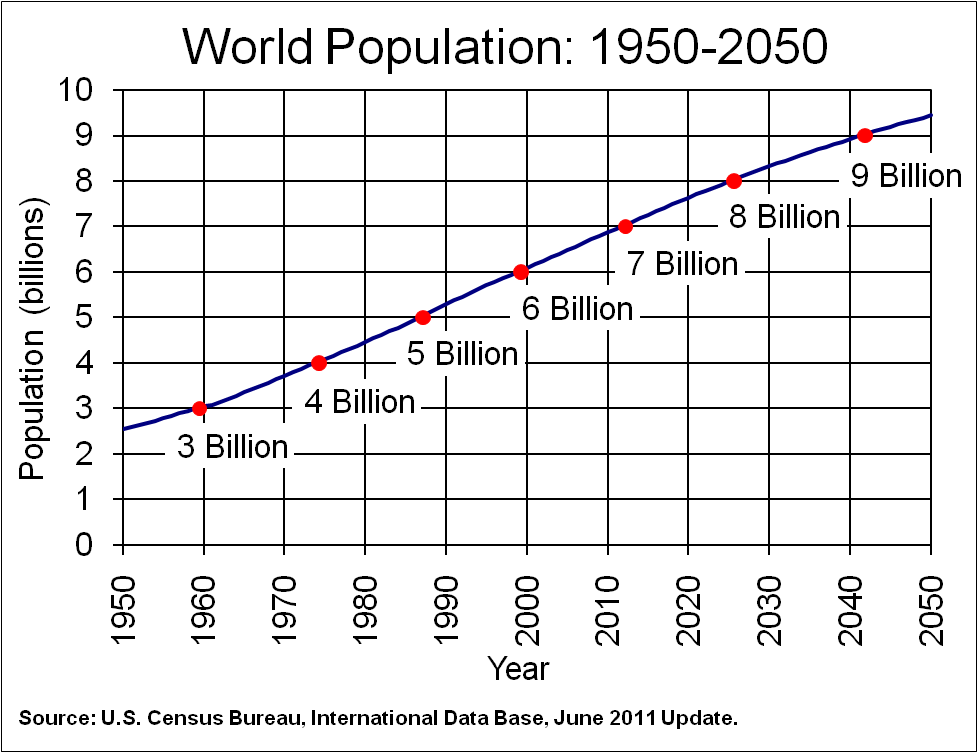
I’m going to ‘smack you in the face‘ with this population chart.

worldpop

To put that into context from a personal perspective, when I was born in 1944 the global population was 2.5 billion persons.  Some 4.7 billion fewer people than today!

But that prediction from the U.S Census Bureau in June, 2011 is already out of date!

Just a couple of weeks ago, the UN released this update:

13 June 2013 – The current world population of 7.2 billion is projected to increase by 1 billion over the next 12 years and reach 9.6 billion by 2050, according to a United Nations report launched today, which points out that growth will be mainly in developing countries, with more than half in Africa.

Now please humour me for a few moments. If the world population is presently 7.2 billion people and by 2050 the prediction is 9.2 billion people, that is an increase of 2,400,000,000 persons.

The end of 2050 is 438 months away. Now do the maths. That growth in population in that time period is the equivalent of an increase in population of 5,479,000 persons every single month!

Need to find a darkened room – I feel a headache coming on!

Mid-week break.

Just ran out of time yesterday, so enjoy the following:

(Sent to me by Dan Gomez.)

DanG1

The beautiful strange-eyed kitten, taken in  Lovech, Bulgaria in the summer of 2009 by Bobby Pfeiffer.

DanG3

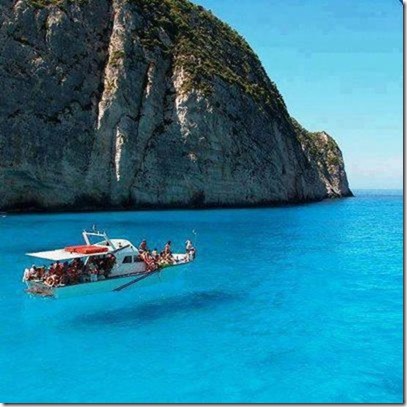
Zakynthos Island in Greece. The water is so clear, it looks like the boat is floating in the air.

DanG4
This is what ocean sand looks like when it’s magnified 250 times.

DanG5
California Red-Sided Garter Snake.

DanG8

Zanjeer, The Golden Labrador Who Saved Thousands Of Lives.

In March 1993, a series of 12 bombs went off across Mumbai, India. The serial blasts left 257 dead and 713 injured. But in the aftermath, an unlikely hero emerged. According to Reuters, a golden labrador named Zanjeer worked with the bomb squad and saved thousands of lives by detecting “more than 3,329 kgs of the explosive RDX, 600 detonators, 249 hand grenades and 6,406 rounds of live ammunition.” He helped avert three more bombs in the days following the blasts.

The dog died of bone cancer in 2000. He was eight years old.

In the photo, a senior police officer lays a wreath of flowers on Zanjeer as he was buried with full police honors at a widely-attended ceremony.

DanG6

The love of a woman for her horse!

The incredible story of one woman’s loyalty to her horse – she spent three hours holding its head above the tide after it got stuck in the mud on a beach in Australia.  His owner, Nicole Graham, who was enjoying an afternoon ride, stayed with him as rescuers struggled for three hours to pull him out. With moments to spare, the 500kg horse, named Astro, was freed with the help of a tractor and harness at Avalon Beach in Geelong, Victoria, Australia .

DanG7

Rewilding the West

Staying with the theme of rejuvenating our relationship with the natural world.

A recent post from TomDispatch republished in this place once again with the generous permission of Tom Engelhardt.  It follows on so sweetly to yesterday’s post Returning to Nature.

oooOOOooo

Tomgram: Chip Ward, Rewilding the West

Rewilding the West

Here’s a nifty trick that’s been on my mind lately. In case you hadn’t noticed, the weather news this season has been pretty grim. Tornados so large and destructive that they would have given Dorothy pause, 500-year European floods, massive rainstorms rolling across the land, record heat in California and Alaska, late snowfalls that boggle the imagination, wildfires that dwarf past ones in the American West. I could go on, but why bother since anyone who has been watching primetime TV news can’t but notice that staggering weather has been the lead or second story much of the time all spring and into the summer.

You’re probably wondering right now: But what’s the trick? I’m surprised you haven’t noticed yourself. All of this weather has a new, made-for-TV label. It’s now regularly called “extreme weather” or “severe weather.”  And that’s anything but inaccurate. The weather has been both “severe” and “extreme” this spring. The trick is that, as a label, “extreme weather” has managed (with rare exceptions) to obviate the need even to mention that any of this could have the slightest thing to do with climate change, with our overheating, over-greenhouse-gassed planet. Think of it as a fabulous form of recognition and denial wrapped in the same package.

The TV news gets all the benefits of night-after-night, eyeball-gluing drama in which the weather goes nuts, houses are destroyed, and people weep (or are stoic) about ruined lives. It gets to bring in the tornado watchers and the weather people in their raincoats and waders.  (Have you noticed that the TV news can’t report a flood without putting some reporter with a mic knee-deep in water?) It gets to focus nightly on those daunting weather maps with their blazing red danger zones, and offer warnings about what potential disaster tomorrow might have to offer, all the while remaining in official, blissful denial about what’s happening on this planet of ours. Somehow, it has managed to incorporate the possible effects of climate change into the nightly news as a major story, while excluding just about all serious discussion of it. Tell me that isn’t a doubly nifty trick!

Of course, if there’s nothing but “extreme weather” happening and that weather has no extreme context, no extreme meaning, then none of us have to worry our little heads about what’s to be done. Those trying to remedy the degradation of conditions on this planet can also be ignored, which is why we couldn’t be more pleased that TomDispatch regular Chip Ward introduces us to such a person today. Tom

Trek West for the Big Picture
Saving the Land One Footfall at a Time
By Chip Ward

My home sits at the gateway to a national park in Utah, a source of envy among tourists who gather along Capitol Reef’s “scenic drive.” But after 40 years of living in one desert or another, I know firsthand that America’s iconic desert landscapes, places like Monument Valley and Arches National Park, are the exceptions, not the rule. The rule is that we dig up, dump on, dam, bomb, drill, over-graze, and otherwise abuse our deserts, most of them public lands owned by you, the taxpaying citizen. Generally, our management of the nation’s public lands is a disgrace and deserts are exhibit A.

But let’s skip the grim survey of how humans are overloading the carrying capacity of our original earthly Eden that usually opens a report like this. The intent of such a recitation of folly is to compel the reader’s attention by underlining the dire importance of the topic at hand. But I assume you understand by now that you woke up this morning on an overheated planet of slums threatened by ecological collapse.

So instead, let’s get right to the point: what do we do about it? How do we begin to heal the wounds?

The crises we face and that our children and grandchildren will endure long after we leave them invite a visionary response.  On the other hand, the world is already awash in well-intentioned tinkerers.  Yet dysfunction and destruction still reign.  Maybe it’s time to leap to a new paradigm.

Enter John Davis and Trek West.  At this very moment, Davis is walking, biking, paddling, and horseback riding 6,000 miles through a chain of mountain ranges that stretches like a spine across North America from the Sierra Madres of Mexico through the Rockies of the American West up into Canada.  He started this winter in the Sonoran desert we share with our southern neighbor and has been heading northward for months.  He will cross many of our most treasured national parks like Yellowstone and Grand Canyon, the ones that tourists love, but his trek is no sightseeing adventure.

Davis and his Trek West partners along the route are advocating for what they call “landscape connectivity” on a continental scale.  Two years ago, Davis trekked from Key West to Quebec, 8,000 human-powered miles.  Same theme: conserve and connect.

A Conservation Revolution

Gone are the days when conservation was all about bullets, hooks, and cameras.  Fishermen and hunters are still an important constituency in the conservation community, but birdwatchers now outnumber them. Ecological criteria increasingly frame any debate about how to heal degraded habitat.  What the nineteenth century naturalist and Sierra Club founder John Muir knew intuitively — that everything in the universe is “hitched to everything else” — has been confirmed beyond doubt by hard science.

Davis is one of the founders of a new school of thought called conservation biology.  Its proponents argue that it is not faintly enough to preserve scenic rock and ice parks and isolated islands of wildlife.  Wild creatures need room to roam so they can find the necessary water, food, and mates.  In the long run, many of America’s wild creatures from salamanders to bears will survive only in Disney movies if we box out genetic diversity, block migration routes, destroy nesting grounds, and save only carefully preserved, isolated populations of a species.  Connectivity is the keel of an emerging conservation ethic for helping to heal this country.

John Davis envisions an unbroken chain of wild lands spanning North America from Mexico to Canada.  When completed, a necklace of “core” areas, including national parks, wildlife reserves, and protected wilderness areas will be linked together and buffered by national forests and private lands.  Creatures now boxed into wild islands surrounded by a sea of development will have room to roam.

A connected landscape will be more resilient as climate change puts further stress on creatures and their habitats.  Already species from birds to mammals are responding to warming temperatures by moving northward if they can, or to higher ground if they can’t migrate horizontally.  The famed scientist and conservationist E.O. Wilson called the project to link together America’s wild lands the most important conservation initiative in the world today.

After trekking through the habitat of the last remaining jaguars on the continent, Davis ran into the new wall designed to keep illegal Mexican migrants out of the United States. It is, he pointed out, a far more effective barrier against wildlife migration than the human version of the same and so is lobotomizing the border ecosystem we share with Mexico.  As for Davis, he easily climbed it in less than five minutes and was on his way.

Backpacks Meet Cowboy Hats 

Although pushing 50, Davis has the trim, muscular build of a professional athlete — and he’ll need every toned muscle he has to complete his quest.  The day before I met him in Escalante, Utah, he had been surprised by a lingering bout of spring weather and found himself pushing his bike through 10 miles of deep snow on top of Utah’s Aquarius Plateau.  The next week, he planned to paddle through Desolation Canyon, one of the most spectacular river passages on the planet.  But when I encountered him, he was taking a break and making a pitch for connectivity before a gathering of federal land managers, concerned local citizens, and ranchers who share the watershed of the Escalante River.

The Escalante River Watershed Partnership (ERWP) is the unwieldy name for a grassroots coalition whose aim is to restore the river’s degraded ecosystem.  The rugged network of high desert canyons that drain into the remote Escalante River have been eroding for years thanks to overgrazing by cattle.  They are also choked with tamarisk and Russian olive trees.

Tamarisks are an invasive species that suck up precious ground water, while filling in springs and seeps that are the only water sources for many bird and animal species.  The tall, feathery plumes of the tamarisk have taken over hundreds of miles of riverbank in the West.  “Tammies” also salt the surrounding soil when they shed their leaves, killing native plants that might otherwise compete.  A beetle was imported from Eurasia to eat the tammies and was unbelievably successful.  As a result, those thick hedges that still block riverbanks are now dead-dry and ready to ignite.  If not cut back, they will burn or regrow.  Russian olive trees also crowd stream banks and add needle-like thorns to the unpleasant mix.

The diverse stakeholders in the Escalante River Watershed Partnership may not share John Davis’s grand vision of an ecologically whole and “rewilded” continent, but they are intent on sewing together and rewilding their pieces of the torn fabric of American life.  As any effective organizer knows, you start where there is common ground — or where there are common weeds.

Ranchers, rangers, biologists, hikers, and back-country guides are in many ways competing constituencies, but it turns out they all share the goal of clearing riparian (wet) canyons of those suffocating tammies.  The scientists survey the ground and identify targets.  Grants are written to bring in volunteers to do the fieldwork.  Last week, a dozen Great Old Broads for Wilderness, mostly outspoken middle-aged women, spent a week clearing unwanted brush as a service project.

As biologists monitor progress and the group discusses issues that arise, inevitably the damage done by grazing cows comes up.  It couldn’t be a more awkward topic.  After all, ranchers are in the room.  Cattle ranching in these desert landscapes is a marginal activity.  Those ranchers depend on federal grants, tax breaks, and access to public land to make it work.  But cows erode stream banks and silt the water, short-circuit forest succession by eating seedlings, and contaminate fresh water with their voluminous poop that also spreads cheatgrass and weeds.

The hope is that eventually the EWRP will become a platform for a public airing of difficult issues like where cattle should be allowed to graze on public land and how many and when.

A Roadkill Extravaganza

Those awaiting Davis’s Trek West presentation this particular day in this particular corner of Utah have already found a scale that seems to fit the desperate needs of our landscape, state, country, and planet.  Most of us who believe in change are caught between the seeming futility of small-scale actions — like recycling our trash or using more energy-efficient light bulbs — and the impotence we experience when we push for large-scale change like climate legislation in Congress or international treaties to limit atmospheric greenhouse gases.

On the one hand, too little; on the other, too late.  There does, however, turn out to be a middle scale between individual action and national or global campaigns that works well and makes sense: the community.  That’s the place where people can best embrace their roles as citizens, face off, share, contend, cooperate, create, learn from, and empower one another.

Watershed partnerships harken back to an old ideal.  John Wesley Powell, the one-armed general and Civil War hero who later explored the Colorado River and its tributaries, was the first person to grasp and publicize the aridity rather than fecundity of significant parts of the American West.  He argued that practices and policies developed for wet Eastern lands were inappropriate for the drier West.  He advocated for governance around watersheds where local stakeholders committed to living within the limits they knew firsthand could come together and plan.  That’s what I’m observing this morning in Utah.  In twenty-first-century terms, think of it as ecological citizenship.

Davis claims he is shy and a poor presenter, but it turns out that he is quietly charismatic.  The case he makes for corridors is practical.   His listeners know that he is trekking across a landscape that is not your grandfather’s Wild West.  The wide-open spaces where the antelope once roamed are now fragmented by a zillion roads featuring SUVs with flattened animals on their bumpers.  Davis says that, on his most recent journey, he’s already seen at least 1,000 crushed, dead creatures.  It’s been a roadkill extravaganza.

So, what to do?  He shows pictures of a landscaped underpass in nearby Kanab, Utah, constructed at a deer crossing where at least 100 deer a year were being hit by cars.  Every year about 10% of the local herd was becoming roadkill along with foxes, turkeys, and the occasional bobcat.  The underpass cost $2.6 million, which is hardly chump change in this neck of the woods, but each deer-car collision costs, on average, $6,600. Do the math, he tells them. Making the landscape permeable for animals seeking food, mates, and water keeps them healthy and pays for itself soon enough.

The Wolf at the Door 

Ranchers and the Bureau of Land Management (BLM) rangers who serve them view John Davis skeptically.  For one thing, he’s been frank about the need to reintroduce wolves across Western ecosystems, given the “keystone” role they play in shaping a healthy landscape. In case you’re not a Westerner, you should know that the subject of wolf reintroduction is a political third rail in much of our region. It’s an idea that would stun and appall our grandfathers, who killed wolves on their lands to leave more deer and elk for hunters and make meadows safe for cattle.

Ecologically, the reintroduction of wolves to Yellowstone National Park has been an unqualified success. Since wolves were returned to that landscape, elk are no longer bunching up and munching down in stream-fed valleys until they are silted, eroded, and devoid of other wildlife. The wolves thin the elk herds and move them, which, in turn, allows willows, aspens, beavers, birds, and a more biodiverse landscape to thrive.  Their success in Yellowstone has confirmed the insights of conservation biologists, giving them credibility and authority. Cowboys fear that, having pushed aside elk, conservationists will go after their cows next.

Meanwhile, back at the ranch, elk hunters, cowboys, gun-nuts, and tea-hadi politicians have worked themselves into an anti-wolf frenzy.  Western state legislators have introduced several bills designed to limit and control wolves even if they haven’t seen one in their area for 100 years.  They want to trade the wolves’ endangered status under the law for licenses to hunt them.  A few days after Davis met the watershed group, the Obama administration caved in to this eco-political hysteria and agreed to remove endangered species protections from wolves.  This backlash against reintroduction has been painful for advocates like Davis.

A Greater Canyonlands National Monument Moment?

The decision to lift wolf protection is consistent with the Obama administration’s disappointing record on Western environmental issues.  Nevertheless, conservation advocacy groups like the Southern Utah Wilderness Alliance and the Sierra Club are urging the president to take a cue from Bill Clinton’s example.  Back in 1996, he created the Grand Staircase Escalante National Monument under the Antiquities Act that allows presidents to set aside natural and archaeological treasures. Now, the conservation groups want Obama to do something similar on an even grander scale and create a “Greater Canyonlands National Monument” from some of the healthiest wild lands in southern Utah.

A few days later, Davis addressed the need for such a monument at a forum in Moab, Utah.  Our state has about nine million acres of quality wilderness land ready to be designated and protected as such.  That’s a lot of core area for John Davis’s conservation vision, a lot of possibility for connectivity. But the public debate about wilderness designation has been stalemated for decades.  Utah Republicans in particular resist more steps to formally protect wilderness areas even though the public overwhelmingly supports it.

They are wedded to traditional mining and grazing interests and like to portray themselves as victims of a bullying federal government that wants to jam national monuments and formally designated wilderness areas down their throats.  But Clinton’s creation of the new monument has proven a boon for Escalante’s economy.  In the 12 years since it came into being, the populations of surrounding Kane and Garfield counties have grown by 8%.  Jobs rose in those years by 38% and per capita income by 30%.  Adjoining counties whose economies are oriented towards gas and oil lagged far behind.

President Obama’s appointment of Sally Jewel, former CEO of REI, a chain of outdoor gear and clothing stores, may signal a shift away from ranching and mining as the dominant voices on the Western political stage. Jewel understands firsthand that recreation and tourism have become powerful economic engines here.

A presidential initiative alone will hardly begin to settle all the questions we face about how to make peace with the land that holds us in its embrace.  But designating another monument here could be a catalyst for an ever-expanding idea of grassroots stewardship of America’s wild lands.

The Escalante watershed partnership was formed in the wake of Clinton’s catalytic act. At that time, the Clinton administration took another experimental step. It gave stewardship of Grand Staircase Escalante to the controversial Bureau of Land Management instead of the National Park Service.  That was a first and undoubtedly a concession to Utah’s politicians who would rather deal with the traditionally compliant, pro-mining, pro-grazing BLM than the stricter National Park Service.  Clinton gambled that the move might instill a missing environmental ethic in that bureau.

The results on that are not yet in, but there is no question about one thing: Clinton’s creation has been a catalyst for grassroots political activity.  When monument status was a done deal, the river’s stakeholders decided the time had finally come to practice that awkward dance of mutuality among conservationists who want to save the land, ranchers who want to use it, and federal land managers charged with sorting out what exactly to do.  John Davis is clearly on the side of conservation.

Making the Imaginary Real

The Trek West sponsors recognize that there may never be some grand national initiative to accomplish their vision, nothing like the Wilderness Act, the Clean Air Act, or the other signature environmental legislation of the 1960s and 1970s.  If our troubled public lands are rescued, it’s likely to happen in a piecemeal fashion, as local and regional groups work to improve their own backyards.  The folks who gather in Escalante don’t claim to have all the answers.  They are not here to spread the truth and save the world.  They belong to no ideology or movement.  They’re just working on their piece of the puzzle, experimenting and learning as they go.  Rivers being the arteries of the land, it makes sense to start there.

An existing constituency almost always trumps an imaginary one.  You can make a case, for example, that a change in land use practices and policies would benefit more people, boost the local economy, and be healthier for wildlife, too, but those imaginary winners can’t compete with cattlemen who are real, well organized, and have been active in the political arena for many years.  They have established close relationships with local politicians who depend on their support.   Because they were there first, they wrote most of the rules and those favor their uses of public land.

The trick for conservationists who want change is to make that imaginary constituency real, to bring a new set of stakeholders together and find ways to empower them.  That may not be the intention of those who gathered in Escalante for the watershed partnership, but it’s what is happening nonetheless — and John Davis is a catalyst.

According to the prevailing belief, growth should always be the bottom line.  Trek West expresses an alternate vision that aims instead to translate ecological principles and criteria into actual designs on the ground.  That’s not simply a matter of making better maps.  Those of us who live within the iconic Western landscapes so treasured by all Americans understand that maps, charts, and spreadsheets do not adequately measure or describe this inspiring and awesome place where we live.

We experience the land sensually.  Perhaps that is the ultimate message John Davis is delivering as he treks across the continent’s wild spine.  He is making sense of the land one footfall at a time, listening to it, watching it, and feeling it as he goes.  So, reconnect landscapes, yes, but also connect head and heart.

Davis’s quest is heroic, but his testimony is simple: when we learn from the land we lean towards wholeness.

Chip Ward, a former librarian and grassroots organizer, is the author of Canaries on the Rim and Hope’s Horizon as well as a TomDispatch regular. He wrote this essay while living between a mountain on fire and a desert that is blowing away.  

Follow TomDispatch on Twitter and join us on Facebook or Tumblr. Check out the newest Dispatch book, Nick Turse’s The Changing Face of Empire: Special Ops, Drones, Proxy Fighters, Secret Bases, and Cyberwarfare.

Copyright 2013 Chip Ward

oooOOOooo

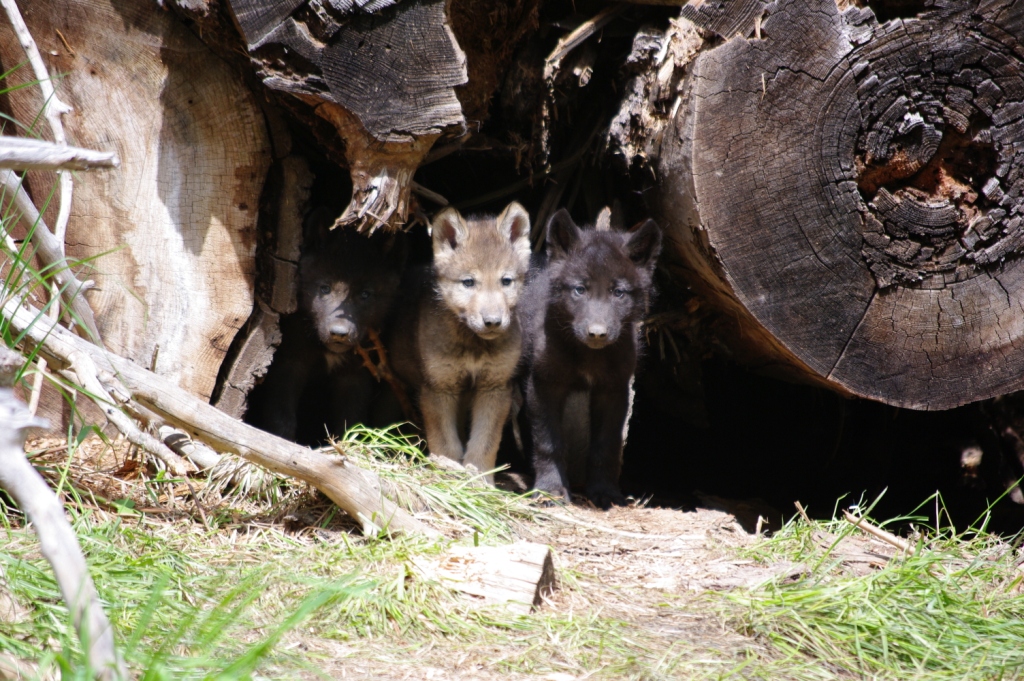
Simply going to finish off today’s post with the two pictures included recently in, I cry for the wolves.

These wolf pups born to the Wenaha Pack in 2012 helped get recovery back on track. But their future remains tenuous (photo courtesy ODFW)

oooo

Wolf greets man.
Wolf greets man, courtesy Wildlife Images Rehabilitation and Education Center, Merlin, Oregon.

Returning to Nature

The power of serendipity!

Why the choice of this sub-heading?  Well, just because a number of quite separate articles and essays have come together to offer a powerful, cohesive argument for reconsidering the role of Nature in the future of mankind.

Of course, my use of words in that preceding sentence is completely ludicrous; the suggestion that ‘Nature’ is disconnected from ‘mankind’.  Yet millions of us, to a greater or lesser degree, do behave as if we are the masters of the world.

So let me dip into what has been ‘crossing my desk’ in recent times.

On May 28th, George Monbiot published in The Guardian newspaper an essay entitled A Manifesto for Rewilding the World.  (The link takes you to the article on the Monbiot blogsite.)  Here’s how that essay opened,

Until modern humans arrived, every continent except Antarctica possessed a megafauna. In the Americas, alongside mastodons, mammoths, four-tusked and spiral-tusked elephants, there was a beaver the size of a black bear: eight feet from nose to tail(1). There were giant bison weighing two tonnes, which carried horns seven feet across(2).

The short-faced bear stood thirteen feet in its hind socks(3). One hypothesis maintains that its astonishing size and shocking armoury of teeth and claws are the hallmarks of a specialist scavenger: it specialised in driving giant lions and sabretooth cats off their prey(4). The Argentine roc (Argentavis magnificens) had a wingspan of 26 feet(5). Sabretooth salmon nine feet long migrated up Pacific coast rivers(6).

During the previous interglacial period, Britain and Europe contained much of the megafauna we now associate with the tropics: forest elephants, rhinos, hippos, lions and hyaenas. The elephants, rhinos and hippos were driven into southern Europe by the ice, then exterminated around 40,000 years ago when modern humans arrived(7,8,9). Lions and hyaenas persisted: lions hunted reindeer across the frozen wastes of Britain until 11,000 years ago(10, 11). The distribution of these animals has little to do with temperature: only where they co-evolved with humans and learnt to fear them did they survive.

I’m not going to reproduce the bulk of the article; just hoped that I have tickled your curiousity sufficient for you to read it in full here. But will just show you how it closed:

Despite the best efforts of governments, farmers and conservationists, nature is already beginning to return. One estimate suggests that two thirds of the previously-forested parts of the US have reforested, as farming and logging have retreated, especially from the eastern half of the country(23). Another proposes that by 2030 farmers on the European Continent (though not in Britain, where no major shift is expected) will vacate around 30 million hectares (75 million acres), roughly the size of Poland(24). While the mesofauna is already beginning to spread back across Europe, land areas of this size could perhaps permit the reintroduction of some of our lost megafauna. Why should Europe not have a Serengeti or two?

Above all, rewilding offers a positive environmentalism. Environmentalists have long known what they are against; now we can explain what we are for. It introduces hope where hope seemed absent. It offers us a chance to replace our silent spring with a raucous summer.

Then further research for this post brought to light an interview with David Suzuki in February.  Widely reported, I picked the version published on Straight.com, from which comes:

In December, Canadian specialty TV channel Business News Network interviewed me about the climate summit in Copenhagen. My six-minute interview followed a five-minute live report from Copenhagen, about poor countries demanding more money to address climate change and rich countries pleading a lack of resources. Before and after those spots were all kinds of reports on the Dow Jones Industrial Average, the price of gold and the loonie, and the implications of some new phone technology.

For me, this brought into sharp focus the inevitable failure of our negotiating efforts on climate change. BNN, like the New York-based Bloomberg channel, is a 24-hour-a-day network focused completely on business. These networks indicate that the economy is our top priority. And at Copenhagen, money dominated the discussions and the outcome.

But where is the 24-hour network dealing with the biosphere? As biological creatures, we depend on clean air, clean water, clean soil, clean energy, and biodiversity for our well-being and survival. Surely protecting those fundamental needs should be our top priority and should dominate our thinking and the way we live. After all, we are animals and our biological dependence on the biosphere for our most basic needs should be obvious.

The economy is a human construct, not a force of nature like entropy, gravity, or the speed of light or our biological makeup. It makes no sense to elevate the economy above the things that keep us alive. But that’s what our prime minister does when he claims we can’t even try to meet the Kyoto targets because that might have a detrimental effect on the economy.

This economic system is built on exploiting raw materials from the biosphere and dumping the waste back into the biosphere. And conventional economics dismisses all the “services” that nature performs to keep the planet habitable for animals like us as “externalities”. As long as economic considerations trump all other factors in our decisions, we will never work our way out of the problems we’ve created.

Concluding:

Nature is our home. Nature provides our most fundamental needs. Nature dictates limits. If we are striving for a truly sustainable future, we have to subordinate our activities to the limits that come from nature. We know how much carbon dioxide can be reabsorbed by all the green things in the oceans and on land, and we know we are exceeding those limits. That’s why carbon is building up in the atmosphere. So our goal is clear. All of humanity must find a way to keep emissions below the limits imposed by the biosphere.

The only equitable course is to determine the acceptable level of emissions on a global per capita basis. Those who fall below the line should be compensated for their small carbon footprint while those who are far above should be assessed accordingly. But the economy must be aligned with the limits imposed by the biosphere, not above them.

Quite clearly, if we continue to turn our backs on Nature, the consequences won’t be long in tapping us on the shoulder.

So, going to close it today with this, seen nearly a month ago on the PRI website:

oooo

Plant a Tree

Trees — by Kristof Nordin May 27, 2013

angel-tree

Imagine the type of world we could see
If instead of saying ‘pray,’ we said, ‘plant a tree’.
With this one little change so much more could be done
To protect all living things found under the sun.

We could ‘plant a tree’ for our troops sent away into war
So when they return they’d come home to find more.
We could ‘plant a tree’ at our churches with our husband or wife
To praise the Creator through a celebration of life.

We could ‘plant a tree’ for the needy and for those with no food
We could even plant in public without seeming rude.
The government would not have to introduce rules,
And most likely we could ‘plant a tree’ at our schools.

If we took it to task to ‘plant trees’ for the poorest,
We would all soon be reaping the wealth of a forest.
We could plant freely with those of all religions and creeds,
The improvement of earth would be based on these deeds.

We could plant with our neighbours, our family, and friends,
And ‘plant a tree’ with our enemies to help make amends.
If we ‘plant a tree’ for the sick to show them we care,
We would also be healing the soil, water, and air.

We could ‘plant a tree’ to observe when two people wed,
And plant one with our kids each night before bed.
Throughout the history of the whole human race
We find respect for the ‘tree’ has always had a place.

The great Ash of the Norse was their tree of the World,
And on a tree in the Garden is where the serpent once curled.
It was in groves of Oaks that the Druid priests wandered,
And under the Bodhi where the great Buddha pondered.

In the Bible it’s clear that we have all that we need:
‘All the trees with their fruits and plants yielding seed’.
Despite all these lessons that the past has taught
Now days, it seems, we cut our trees without thought.

This is confirmed by the Koran, for in it we read:
‘Many are the marvels of earth, yet we pay them no heed’.
We all have a duty, no matter what nation
To perform our part in protecting Creation.

Just think what we’d have if we had picked up a spade
Every time each one of us bowed our heads and prayed.

Further Reading:

oooOOOooo

The theme continues tomorrow.

Every dog should have its cat!

Another gem from John Hurlburt.

dogcat1

oooo

dogcat2

oooo

dogcat3

oooo

dogcat4

oooo

dogcat5

oooo

dogcat6

oooo

dogcat7

oooo

dogcat8

oooo

dogcat9

oooo

It came to me that every time I lose a dog,
they take a piece of my heart with them….
And every new dog who comes into my life,
gifts me with a piece of their heart.
If I live long enough, all the components of
my heart will be dog …
and maybe
I will become as generous and loving as they are.

Unknown author.