For a while now I have been subscribing to The Dodo. As the website explains it’s for animal people and as you and I know that’s quite a great many people!
Until now I have been a little nervous of sharing articles from The Dodo with you. But then I noticed quite recently that there is a ‘share’ button at the end of the articles.
So I presume it’s alright to share these wonderful stories!
A family was out riding their bikes one day in South Carolina when they suddenly heard what sounded like a puppy crying. They pulled their bikes over to the side of the road and went to investigate, and were shocked to find a little puppy trapped under a pile of dirt and concrete. Not knowing how else to help, they quickly called 911, and both the police and firefighters with the North Charleston Fire Department responded in hopes that they could free the trapped puppy.
North Charleston Fire Department
“They showed us where the dog was located,” Captain Paul Bryant, of the North Charleston Fire Department, told The Dodo. “It was piles of concrete 4 foot by 4 foot, some smaller, some bigger. One of the police officers said he could see the dog so we got on our hands and knees to look and saw his nose sticking out of the pile of rubble.”
After moving the concrete slabs out of the way with a pry bar, Captain Bryant attempted to pull the puppy, later named Rocky, out from the remaining dirt and rubble, but unfortunately there just wasn’t enough room. He then took a shovel and started digging, and finally was able to create enough space to pull the confused puppy out to safety. The whole rescue only took about 11 minutes, but no one has any idea how long Rocky had been stuck under there before everyone arrived.
North Charleston Fire Department
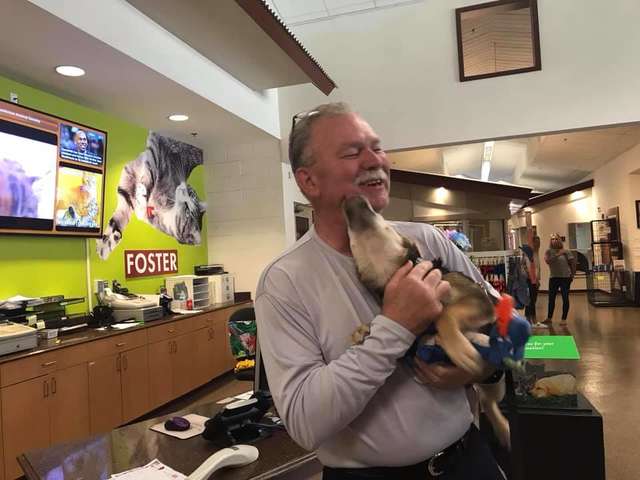
As soon as he was free, little Rocky couldn’t stop licking Bryant’s face in gratitude. The puppy clearly had so much energy and lots of love to give, and everyone immediately fell in love with him — especially Bryant. The family who had initially found Rocky said they would take him to a nearby animal hospital to get checked for a microchip so he could hopefully be reunited with his family, but after he was gone, Bryant just couldn’t get Rocky out of his head.
“I wanted to know if his owner was found, or if the person who found him was going to keep him,” Bryant said. “Once I found out he did not have an owner and the family who found him could not keep him, I knew he was coming home with me.”
North Charleston Fire Department
Bryant felt connected to Rocky from the second he rescued him from underneath that concrete, and it was as if the pair had always been meant to be together.
“I found out I was going to be able to adopt him, and I’ve been on a high ever since,” Bryant said in a video about Rocky’s rescue.
Captain Paul Bryant
Once Rocky had been given a clean bill of health and was ready to head off to his new forever home, Bryant headed over to Charleston Animal Society to pick him up …
Facebook/Charleston Animal Society
… and as soon as Rocky saw his rescuer again, he could barely contain his excitement.
Charleston Animal Society
Rocky is now all settled into his new home and couldn’t be happier with how things turned out. He went from being trapped and alone to having the world’s best dad, and everyone involved is so thrilled that Bryant and Rocky ended up together.
Captain Paul Bryant
“He is a very energetic dog and loves to play fetch with his new toys,” Bryant said. “He is always by my side, never letting me leave the room without following me.”
ooOOoo
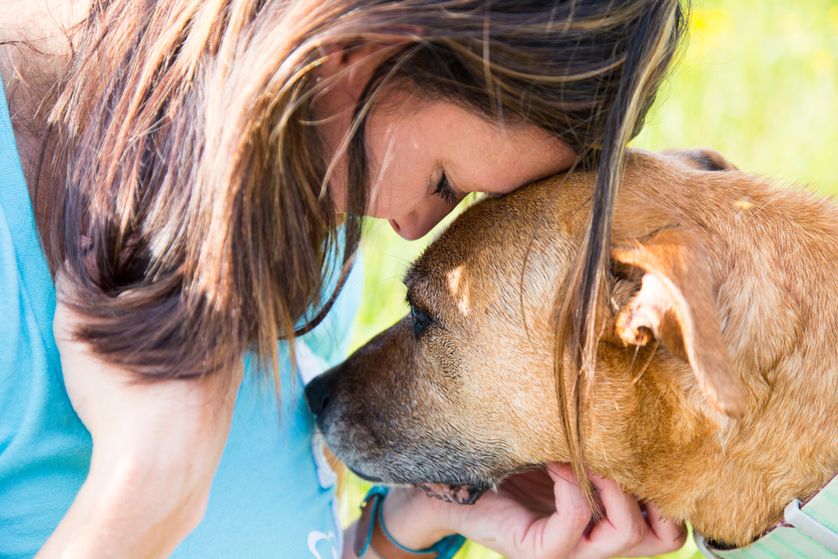
Time and time again people from all walks of life know something instinctively when it’s in front of them. The love that we humans give to our dogs and the love that they return to us.
And a particular credit must go to the dog’s nose. It is many more times more sensitive than our nose, as the following article taken from Mother Nature Network shows. (And I really must stop republishing articles from MNN!)
ooOOoo
6 medical conditions that dogs can sniff out
From cancer to migraines and even seizures, dogs can give us a heads up about a range of human diseases.
Dogs have millions of smell receptors that can detect countless smells, including the smells of changes going on inside our bodies. (Photo: RedTC/Shutterstock)
Dogs are famous for their sense of smell. With about 220 million scent receptors (compared to our 5 million), dogs can smell things that seem unfathomable to us. They can detect some odors in parts per trillion, and they can detect countless subtleties in scents.
As PBS points out, “Experts have reported incredible true stories about the acuteness of dogs’ sense of smell. There’s the drug-sniffing dog that ‘found’ a plastic container packed with 35 pounds of marijuana submerged in gasoline within a gas tank. There’s the black lab stray from the streets of Seattle that can detect floating orca scat from up to a mile away across the choppy waters of Puget Sound.”
And yes, there are the dogs who have sniffed out medical issues that even doctors weren’t aware of. Dogs can pick up on tiny changes in the human body, from a tiny shift in our hormones to the release of volatile organic compounds, or VOCs, released by cancer cells. Researchers and dog trainers are just beginning to understand how dogs do this and how we might put them to work in being our helpers in health care. Here are six medical conditions that dogs are able to smell.
Dog are naturally tuned into their owner’s emotions, but what about signs of ill health? (Photo: sherwood/Shutterstock)
Cancer
Perhaps the condition dogs are currently most famous for detecting is cancer. Dogs have been able to sniff out a variety of types including skin cancer, breast cancer and bladder cancer.
There are quite a few stories of a pet dog obsessing about an owner’s mole or some part of their body, only to discover in a doctor’s appointment that the dog was actually sensing cancer. For example, Canada Free Press writes of a 1989 instance when a woman’s “dog kept sniffing at a mole on her thigh, but ignored other moles. In fact, the dog had actually tried to bite off the mole when she was wearing shorts. The woman consulted her doctor, the mole was excised and the diagnosis confirmed a malignant melanoma.”
In the last couple decades, researchers have looked seriously into dogs’ sniffing abilities when it comes to cancers. In studies, dogs have successfully been trained to detect the disease using samples from known cancer patients and people without cancer.
The newest study offers the most startling statistics: Dogs can correctly pick out blood samples from people who have cancer with 97% accuracy, a 2019 study published in Experimental Biology found. Heather Junqueira, the lead researcher at BioScentDx who performed the study, used clicker training with four beagles. The dogs focused their efforts on blood samples from patients with lung cancer, and with one exception, they were highly successful. The sample was small, so BioScentDx plans to continue its work, according to Science Daily.
In a 2006 study, five dogs were trained to detect cancer based on breath samples. Once trained, the dogs were able to detect breast cancer with 88 percent accuracy, and lung cancer with 99 percent accuracy. They could do this across all four stages of the diseases.
Sometimes the dogs can do an even better job than the humans in these studies. According to Penn State News, Nancy Dreschel, a veterinarian in Dairy and Animal Science at Penn State University, tells of an illuminating example: “A scientist was training dogs to detect bladder cancer in humans by smelling their urine. She said a dog alerted them to a sample from a supposedly healthy person who was being used as a control. On reexamination that person was found to have bladder cancer, so the dog caught it before anyone else did.”
Study after study has shown that dogs can detect cancer in people, but it may a while before your doctor employs a hound for your annual checkup. Researchers still don’t know exactly what chemical compounds for different types of cancers the dogs are sensing in these samples to alert to the presence of the disease, and this remains a hurdle both for better training of cancer-sniffing dogs and for creating machines that can more accurately detect cancer in the early stages.
Narcolepsy
Narcolepsy is a brain disorder that affects the ability to control sleep-wake cycles. This can mean a person suddenly falls asleep, even in the middle of a task. It’s a dangerous condition, as someone who has an attack could be injured falling to the ground or could have a car accident if it happens while driving.
Mary McNeight, Service Dog Academy director of training and behavior, has been working with narcolepsy service dogs since 2010, and she notes that there’s a scent the dogs pick up on when an attack is coming on. “It’s a biochemical change in the body. We do not know what the particular odor smells like due to the difference between human scent perception and dog scent perception,” she tells Sleep Review.
In a study published in 2013, Luis Dominguez-Ortega, M.D., Ph.D., found that two trained dogs detected 11 of 12 narcolepsy patients using sweat samples, demonstrating that dogs can detect a distinct scent for the disorder.
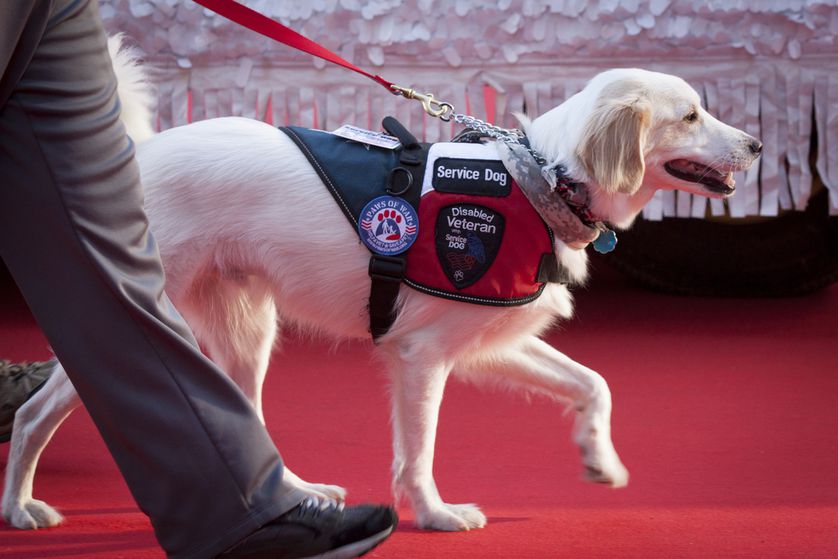
Service dogs help people with narcolepsy by performing several different types of tasks. They can stand over the person’s lap when an attack comes on, which prevents them from sliding out of a chair onto the floor; they can also stand over the person to protect them if they are out in public, or they can go get help. And most importantly, they can provide a warning up to 5 minutes before an attack comes on, giving their handler a chance to get to a safe place or a safe position.
While large dogs can be helpful in giving a narcoleptic sufferer extra support in balance and mobility after an attack, these dogs don’t have to be big. According to Petful, even medium-sized dogs can do the job. “Theo, a 2-year-old cocker spaniel, has virtually put an end to [Kelly] Sears’ suffering. He can sense when she is about to have a narcoleptic episode and warn her so that she can sit or lie down, waking her after a few seconds with a kiss on her chin. Since arriving two months ago from Medical Detection Dogs, the only organization in Europe that trains narcolepsy service dogs, Theo has proven himself indispensable.”
Dogs can smell all sorts of chemical changes in our bodies, including a drop in blood sugar or the onset of a migraine. (Photo: WilleeCole Photography/Shutterstock)
Migraines
For those who suffer migraines, having a warning before one comes on can mean the difference between managing the problem or succumbing to hours or days of intense pain. Fortunately, some dogs have a talent for sniffing out the signs that a migraine is on the way.
Psychology Today reports on a recent study that asked migraine sufferers with dogs if they noticed a change in their dogs’ behavior before or during a migraine. The results show that “54 percent of the 1027 participants indicated they had noticed changes in the behavior of their pets during or preceding migraines. Nearly 60 percent of these subjects indicated that their dog had alerted them to the onset of a headache — usually an hour or two in advance.” The results are fascinating, though it’s important to point out that the study was conducted with self-reports rather than observation by researchers. Even so, the study shows evidence that many dogs seem to detect and point out a change in their human companion’s health.
According to Kendall Winship, a migraine sufferer with a service dog, “These [migraine alert service] dogs are highly valued because the ability to tell when a migraine is approaching is an innate talent; it can’t be taught. Similar to diabetic alert dogs that can smell when their handler has low blood sugar, migraine alert dogs can hone in on the scent of serotonin, a chemical that skyrockets when the body is about to have a migraine. By alerting to the danger long before their handlers might feel any symptoms, these dogs can warn them to take preventative medication. When Rally looks up at me and whines, I know I have about two hours before the migraine will strike, and if I can take my medication early enough, I might be able to avoid the stroke-like symptoms and incapacitating pain.”
Low blood sugar
Increasingly, dogs are helping diabetics know when their blood sugar level is dropping or spiking. Dogs4Diabetics is one organization that trains and places service dogs with insulin-dependent diabetics. These dogs undergo extensive training to be able to detect and alert their handlers to changes in blood sugar levels.
A 2016 study published in the journal Diabetes Care found that the dogs detect isoprene, a common natural chemical found in human breath that rises significantly during episode of low blood sugar. People can’t detect the chemical, but the researchers believe that the dogs are particularly sensitive to it and can tell when their owner’s breath has high levels of it.
Medical News Today reports that dogs are trained to discriminate between the scent from a previous episode and the scent of a current episode. They detect when their handler is having an issue and alert the person, giving them time to test their blood sugar and take the insulin they need.
A 2013 study published in PLOS One showed that having a diabetic alert dog seems to provide significant improvements in both the safety and quality of life of insulin-dependent diabetics. “Since obtaining their dog, all 17 clients studied reported positive effects including reduced paramedic call outs, decreased unconscious episodes and improved independence.”
There’s still some skepticism about whether or not dogs can accurately alert handlers to a blood sugar change at a level beyond chance, something that can be determined with more studies. Even so, for those diabetics living with alert dogs, the sniffing ability of their companions seems to be a big help.
Seizure
One of the more controversial areas where dogs are used to alert to a medical condition is with seizures. There is growing evidence that dogs can and do detect the onset of a seizure; however, the level of accuracy and, most importantly, our ability to train dogs to alert a handler to an oncoming seizure remains a bit questionable.
As is the case with some other conditions, dogs cannot be trained to predict seizures. We don’t have a way to provide them with a scent or information that can be used for training. We can, however, train dogs how to respond to and assist a handler when a seizure occurs. Some service dogs that are placed with seizure patients do develop the ability to detect when a seizure is coming and can provide an alert if the handler pays close attention to the signals the dog provides. WebMD reports, “Jennifer Arnold, founder of Canine Assistants in Georgia, … says about nine out of 10 of the service dogs her organization has placed develop the ability on their own within a year of placement.”
A small 2019 study found that dogs were able to clearly discriminate a general epileptic “seizure odor.” However the study only involved a handful of dogs and involved odor samples that were collected during a seizure. Researchers pointed out that much more extensive testing would need to be done to see if other dogs would respond similarly and if dogs could predict seizures before they happened.
However, there is some question about how dogs are responding. How Stuff Workspoints out that in 2007, “two small studies in the journal Neurology reported that four out of seven seizure alert dogs studied turned out to be warning their masters of psychological, rather than epileptic seizures. This may not seem like a big deal, but the two disorders are different. A 2006 study revealed that up to 30 percent of patients who suffer from psychogenic nonepileptic seizures (PNES) are misdiagnosed with epilepsy. PNES, which results from emotional difficulties and can often be successfully treated with counseling, rather than unnecessary and harsh epilepsy drugs. The 2007 study also revealed one instance of seizures being triggered by the patient’s dog’s warning behaviors, indicating another flaw in the reliability of canine seizure prediction.”
A 2003 study concluded that “findings suggest some dogs have innate ability to alert and/or respond to seizures” however, it notes that further research is needed to uncover which seizure patients would benefit from the help of a dog. We also need more research to learn how to train dogs to be as effective as possible. We have to first learn how dogs know when a seizure is coming — are they smelling a change in body chemistry, or are they picking up on behavior changes? — before we can reliably train them to alert handlers before a seizure happens.
Dogs can smell fear and stress, and they can use that ability to help people with issues such as PTSD. (Photo: Glynnis Jones/Shutterstock)
Fear and stress
The age-old notion that dogs can smell fear is an accurate one. Dogs can smell when we are feeling fear or are experiencing an increased level of stress, even if we aren’t showing outward signs. What dogs are smelling is the surge of hormones our bodies release to respond to stressful situations, including adrenalin and cortisol.
Thankfully, this can be used to humans’ benefit, as dogs can signal a handler that they (or someone else) needs to take a few deep breaths. Dogs that alert handlers of the change in their emotional state — a change that often people aren’t even aware they’re experiencing — can help prevent panic attacks and other possible episodes associated with post-traumatic stress disorder or other issues.
“This 18-month Rhodesian ridgeback is the first cortisol-sniffing dog on staff at a school. Cortisol is known as the ‘stress hormone,’ and people on the autism spectrum tend to have higher levels of cortisol in their blood. Cali is employed to detect rising cortisol levels in the students. She waits outside of school each morning as the students file by. If she notices anyone with a high level of cortisol in their blood, she will signal to her handler, Casey Butler, a health teacher on staff at The Calais School who is a certified specialist in natural canine behavior rehabilitation and in animal adaptive therapy. When Cali stares at a child, Butler knows that is the signal. She then takes that child aside and works with him or her before a meltdown occurs.”
We still have a long way to go to discover exactly what dogs are smelling about us, let alone how we can train them to be as accurate as possible about a change in our bodies. Even though many details are not yet known, it’s clear that dogs have an uncanny ability to sniff out certain medical issues, and that’s a skill that could be a real lifesaver.
Editor’s note: This story was originally published in 2016 and has been updated with new information.
Jaymi Heimbuch ( @jaymiheimbuch ) focuses on wildlife conservation and animal news from her home base in San Francisco.
ooOOoo
Where on earth would we be without these wonderful, clever dogs! Seriously, whether you love dogs or not you cannot deny that they are incredible creatures!
For someone born on May 8th, 1926 he, perhaps, should be slowing down. But none of it. He is passionate about how we are endangering our planet. And having a public profile he is the right position to do something about it, albeit a warning statement.
Plus, he is not the only one doing something about it. For Extinction Rebellion are protesting in the London streets.
Sir David’s new programme lays out the science behind climate change, the impact it is having right now and the steps that can be taken to fight it.
“In the 20 years since I first started talking about the impact of climate change on our world, conditions have changed far faster than I ever imagined,” Sir David states in the film.
“It may sound frightening, but the scientific evidence is that if we have not taken dramatic action within the next decade, we could face irreversible damage to the natural world and the collapse of our societies.”
Speaking to a range of scientists, the programme highlights that temperatures are rising quickly, with the world now around 1C warmer than before the industrial revolution.
“There are dips and troughs and there are some years that are not as warm as other years,” says Dr Peter Stott from the Met Office.
“But what we have seen is the steady and unremitting temperature trend. Twenty of the warmest years on record have all occurred in the last 22 years.”
The programme shows dramatic scenes of people escaping from wildfires in the US, as a father and son narrowly escape with their lives when they drive into an inferno.
Scientists say that the dry conditions that make wildfires so deadly are increasing as the planet heats up.
Greenland is losing ice five times as fast as it was 25 years ago – Getty Images.
Some of the other impacts highlighted by scientists are irreversible.
“In the last year we’ve had a global assessment of ice losses from Antarctica and Greenland and they tell us that things are worse than we’d expected,” says Prof Andrew Shepherd from the University of Leeds.
“The Greenland ice sheet is melting, it’s lost four trillion tonnes of ice and it’s losing five times as much ice today as it was 25 years ago.”
These losses are driving up sea levels around the world. The programme highlights the threat posed by rising waters to people living on the Isle de Jean Charles in Louisiana, forcing them from their homes.
“In the US, Louisiana is on the front line of this climate crisis. It’s losing land at one of the fastest rates on the planet – at the rate of of a football field every 45 minutes,” says Colette Pichon Battle, a director of the Gulf Coast Center for Law & Policy.
People are moving from parts of Louisiana in the US as a result of rising waters. – Julie Dermansky
“The impact on families is going to be something I don’t think we could ever prepare for.”
Hope rising
Sir David’s concern over the impacts of climate change has become a major focus for the naturalist in recent years.
This has also been a theme of his One Planet series on Netflix.
His new BBC programme has a strong emphasis on hope.
Sir David argues that if dramatic action is taken over the next decade then the world can keep temperatures from rising more than 1.5C this century. This would limit the scale of the damage.
“We are running out of time, but there is still hope,” says Sir David.
“I believe that if we better understand the threat we face the more likely it is we can avoid such a catastrophic future.”
The programme says that rapid progress is being made in renewable energy, with wind now as cheap as fossil fuels in many cases. It shows how technologies to remove and bury carbon dioxide under the ground are now becoming more viable.
But politicians will need to act decisively and rapidly.
“This is the brave political decision that needs to be taken,” says Chris Stark from the UK’s Committee on Climate Change.
Teenage campaigner Greta Thunberg has helped spark school strikes all over the world. – Getty Images.
“Do we incur a small but not insignificant cost now, or do we wait and see the need to adapt. The economics are really clear on this, the costs of action are dwarfed by the costs of inaction.”
The programme also highlights the rising generation of young people who are deeply concerned about what’s happening to the planet.
Swedish teenager Greta Thunberg explains that things can change quickly, despite the scale of the challenge on climate change.
“The first day I sat all alone,” she says, speaking of her decision to go on strike from school and sit outside the Swedish parliament to highlight the climate crisis.
“But on the second day, people started joining me… I wouldn’t have imagined in my wildest dreams that this would have happened so fast.”
Earlier yesterday I received a letter from a firm of lawyers Higbee & Associates. It was to advise me that, “Unlicensed Use Of Work Copyrighted By Paul Martinka.” and went on to detail how Paul Martinka had quite correctly was seeking compensation for my republishing a photograph without a license.
So, moving on!
It is going to change the blog quite a bit because I frequently republish material from other websites without formal permission.
So while I think through how to continue blogging there’s something you can do for me.
Let me know if I can republish your work. You can leave a comment to this blog or ask me to email you.
And offer me posts that I can use. Please!
Meantime I will ponder what to do!
P.S. That’s why you may have noticed quite a few posts have been taken down!
But then I saw another version of the same story on the BBC News site, from which I republish it in its entirety.
ooOOoo
First ever black hole image released
By Pallab Ghosh
Science correspondent, BBC News
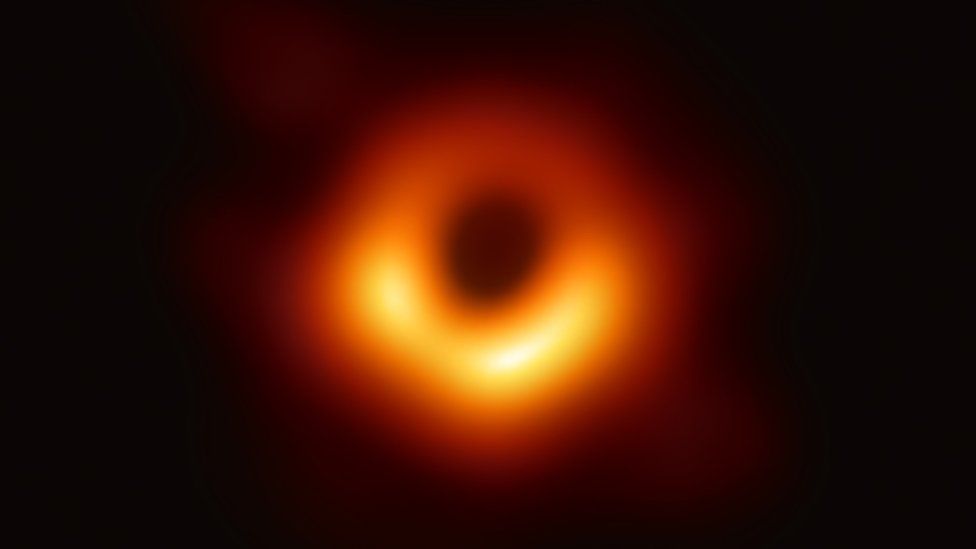
The first ever picture of a black hole: It’s surrounded by a halo of bright gas.
Astronomers have taken the first ever image of a black hole, which is located in a distant galaxy.
It measures 40 billion km across – three million times the size of the Earth – and has been described by scientists as “a monster”.
The black hole is 500 million trillion km away and was photographed by a network of eight telescopes across the world.
Details have been published today in Astrophysical Journal Letters.
Prof Heino Falcke, of Radboud University in the Netherlands, who proposed the experiment, told BBC News that the black hole was found in a galaxy called M87.
“What we see is larger than the size of our entire Solar System,” he said.
“It has a mass 6.5 billion times that of the Sun. And it is one of the heaviest black holes that we think exists. It is an absolute monster, the heavyweight champion of black holes in the Universe.”
The image shows an intensely bright “ring of fire”, as Prof Falcke describes it, surrounding a perfectly circular dark hole. The bright halo is caused by superheated gas falling into the hole. The light is brighter than all the billions of other stars in the galaxy combined – which is why it can be seen at such distance from Earth.
The edge of the dark circle at the centre is the point at which the gas enters the black hole, which is an object that has such a large gravitational pull, not even light can escape.
DR JEAN LORRE/SCIENCE PHOTO LIBRARY I have suspected that the M87 galaxy has a supermassive black hole at its heart from false colour images such as this one. The dark centre is not a black hole but indicates that stars are densely packed and fast moving.
The image matches what theoretical physicists and indeed, Hollywood directors, imagined black holes would look like, according to Dr Ziri Younsi, of University College London – who is part of the collaboration.
“Although they are relatively simple objects, black holes raise some of the most complex questions about the nature of space and time, and ultimately of our existence,” he said.
“It is remarkable that the image we observe is so similar to that which we obtain from our theoretical calculations. So far, it looks like Einstein is correct once again.”
But having the first image will enable researchers to learn more about these mysterious objects. They will be keen to look out for ways in which the black hole departs from what’s expected in physics. No-one really knows how the bright ring around the hole is created. Even more intriguing is the question of what happens when an object falls into a black hole.
What is a black hole?
A black hole is a region of space from which nothing, not even light, can escape
Despite the name, they are not empty but instead consist of a huge amount of matter packed densely into a small area, giving it an immense gravitational pull
There is a region of space beyond the black hole called the event horizon. This is a “point of no return”, beyond which it is impossible to escape the gravitational effects of the black hole
Prof Falcke had the idea for the project when he was a PhD student in 1993. At the time, no-one thought it was possible. But he was the first to realise that a certain type of radio emission would be generated close to and all around the black hole, which would be powerful enough to be detected by telescopes on Earth.
He also recalled reading a scientific paper from 1973 that suggested that because of their enormous gravity, black holes appear 2.5 times larger than they actually are.
These two previously unknown factors suddenly made the seemingly impossible, possible. After arguing his case for 20 years, Prof Falcke persuaded the European Research Council to fund the project. The National Science Foundation and agencies in East Asia then joined in to bankroll the project to the tune of more than £40m.
The eventual EHT array will have 12 widely spaced participating radio facilities
It is an investment that has been vindicated with the publication of the image. Prof Falcke told me that he felt that “it’s mission accomplished”.
He said: “It has been a long journey, but this is what I wanted to see with my own eyes. I wanted to know is this real?”
No single telescope is powerful enough to image the black hole. So, in the biggest experiment of its kind, Prof Sheperd Doeleman of the Harvard-Smithsonian Centre for Astrophysics, led a project to set up a network of eight linked telescopes. Together, they form the Event Horizon Telescope and can be thought of as a planet-sized array of dishes.
KATIE BOUMAN Information gathered is too much to be sent across the internet. Instead the data was stored on hundreds of hard drives which were flown to a central processing centre.JASON GALLICCHIO
Each is located high up at a variety of exotic sites, including on volcanoes in Hawaii and Mexico, mountains in Arizona and the Spanish Sierra Nevada, in the Atacama Desert of Chile, and in Antarctica.
A team of 200 scientists pointed the networked telescopes towards M87 and scanned its heart over a period of 10 days.
The information they gathered was too much to be sent across the internet. Instead, the data was stored on hundreds of hard drives that were flown to a central processing centres in Boston, US, and Bonn, Germany, to assemble the information. Prof Doeleman described the achievement as “an extraordinary scientific feat”.
“We have achieved something presumed to be impossible just a generation ago,” he said.
“Breakthroughs in technology, connections between the world’s best radio observatories, and innovative algorithms all came together to open an entirely new window on black holes.”
The team is also imaging the supermassive black hole at the centre of our own galaxy, the Milky Way.
Odd though it may sound, that is harder than getting an image from a distant galaxy 55 million light-years away. This is because, for some unknown reason, the “ring of fire” around the black hole at the heart of the Milky Way is smaller and dimmer.
One of the most remarkable things about this story is that it continues to validate the theories of Albert Einstein (1879-1955). That is doubly impressive.
April 7, 2019 — Thogersen Family Farm of Stanwood, WA is voluntarily recalling raw frozen ground pet food because it has the potential to be contaminated with Listeria monocytogenes.
What’s Recalled?
The following 2-pound packaged varieties are included in this recall:
Coarse ground rabbit frozen raw pet food
Coarse ground mallard duck frozen raw pet food
Ground llama frozen raw pet food
Ground pork frozen raw pet food
Recalled product labels did not contain any lot identification, batch codes, or expiration dates.
Products were packaged in 2-pound flattened, rectangular clear plastic packages and stored frozen.
The front of each package contains one large white square label with the company name, product type and weight.
About Listeria
Listeria monocytogenes can affect animals eating the products and there is risk to humans from handling contaminated pet products, especially if they have not thoroughly washed their hands after having contact with the products or any surfaces exposed to these products.
Listeria monocytogenes infections can cause serious and sometimes fatal infections in young children, frail or elderly people, and others with weakened immune systems.
Although healthy individuals may suffer only short-term symptoms such as high fever, severe headache, stiffness, nausea, abdominal pain and diarrhea, Listeria infection can cause miscarriages and stillbirths among pregnant women.
Anyone experiencing these symptoms should immediately contact a health care provider.
Pets with Listeria monocytogenes infections may be lethargic and have diarrhea or bloody diarrhea, fever, and vomiting.
Some pets will have only decreased appetite, fever and abdominal pain.
Infected but otherwise healthy pets can be carriers and infect other animals or humans.
If your pet has consumed the recalled product and has these symptoms, please contact your veterinarian.
Recalled product labels did not contain any lot identification, batch codes, or expiration dates. Products were packaged in two pound flattened, rectangular clear plastic packages and stored frozen.
The front of the package contains one large white square label with the company name, product type and weight.
Where Was It Sold?
Thogersen Family Farm stated the affected products were either sold to individual customers or two retail establishments that have been notified.
Some of the product has not been distributed and held at the manufacturing location.
What Caused the Recall?
The recall is the result of samples collected by the Washington State Department of Agriculture and revealed the finished products contained the bacteria.
No illnesses have been reported to date.
What to Do?
Consumers who have purchased affected product should discontinue use.
For questions, consumers may contact the company at 360-929-9808.
U.S. citizens can report complaints about FDA-regulated pet food products by calling the consumer complaint coordinator in your area.
Two Chinese governing bodies plan to introduce new legislation that will provide special protections to canines by classifying them as companion animals. This would exclude dogs from being used for human consumption.
If you are unfamiliar with the festival, it is notorious for its bloodshed and cruelty. Because dog meat consumers believe that the meat tastes better when dogs have more adrenaline in their blood, dog meat butchers torture the animals. Dogs are beaten, burned alive with blowtorches, or tossed into pots of boiling water.
Thanks to public outcry, the festival’s popularity has decreased and restrictions have been set, however, that hasn’t been enough to end the festival for good. Now’s our chance.
Mr Panek, who lost his sight in his early 20s, told CNN that while he appreciated the support of human volunteers, he missed the feeling of independence.
“It never made sense to me to walk out the door and leave my guide dog behind when I love to run and they love to run,” he said. “It was just a matter of bucking conventional wisdom and saying why not.
In 2015, Mr Panek established the Running Guides programme which trains dogs to support runners.
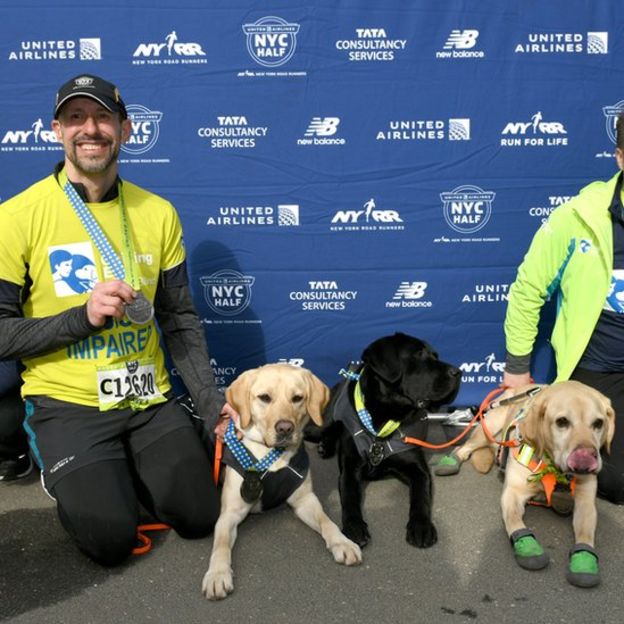
When selecting his canine companions for the New York race, Mr Panek chose siblings Waffle and Westley to join Gus, who is his full-time guide dog.
(L-R) Thomas Panek, Waffle, Westley and Gus show off their medals after the race
“The bond is really important. You can’t just pick up the harness and go for a run with these dogs,” Mr Panek told CNN. “You’re training with a team no matter what kind of athlete you are, and you want to spend time together in that training camp.”
Each dogs sets its own pace – Westley runs an eight minute mile, while his sister Waffle can cover the same distance in six minutes – and helps Mr Panek avoid obstacles such as kerbs and cones.
Each dog wears a special harness and set of running boots, to protect their paws.
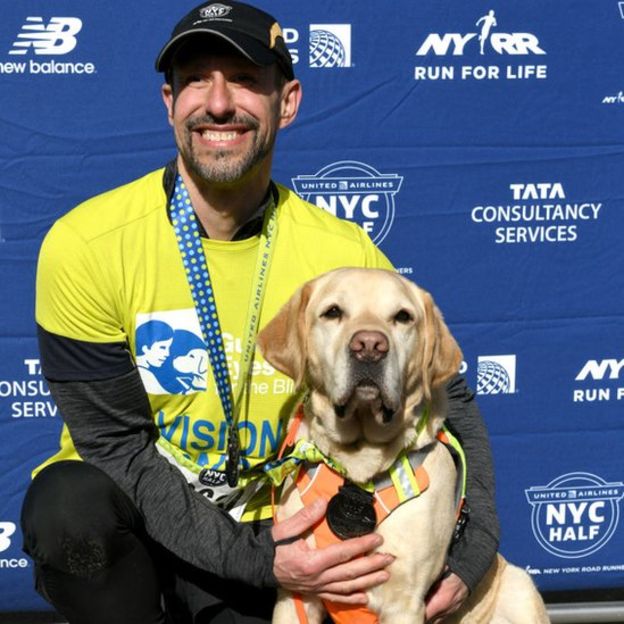
Gus was chosen to run the final leg of the race and cross the finish line with Mr Panek. He retired from his duties as a guide dog at the end of the race.
“It’s a little emotional for me because he’s been there with me the whole time,” Mr Panek said.
Gus, Mr Panek’s personal guide dog, entered retirement after the race
Before the race, Mr Panek told Time magazine that guide dogs give visually impaired people the freedom to “do whatever it is a sighted person does, and sometimes, even run a little faster than them”.
ooOOoo
“It’s a little emotional for me because he’s been there with me the whole time,”
It’s not just Mr. Panek who finds the report a little emotional!
As I have said many times before and undoubtedly will continue to say: Dogs are truly amazing animals.
Dear Fellow Dog Lover,
The U.S. Food and Drug Administration is warning pet owners not to feed 3 specific lots of Darwin’s Natural dog food because Salmonella bacteria were discovered in the product.
To learn which products are affected, please visit the following link:
Please be sure to share the news of this alert with other pet owners.
If you go to that link then you will see the following:
FDA Warning: Do Not Feed These Lots of Darwin’s Natural Dog Food
March 26, 2019 — The U.S. Food and Drug Administration is cautioning pet ownersnot to feed their pets 3 lots of Darwin’s Natural Pet Products raw dog food after samples from these lots tested positive for Salmonella.
No images were provided by the FDA in its announcement.
The following image was previously retrieved from the brand’s website and is provided in good faith by The Dog Food Advisor. It may not be an accurate representation of the affected products.
What Products Are Affected?
The codes for each product affected are listed in the second group of numbers found just below the barcode on the package.
Here are the affected products:
Darwin’s Natural Pet Products Natural Selections Chicken Recipe with Organic Vegetables for Dogs
Package: 5309(11)181019
Manufacture Date: October 19, 2018
Darwin’s Natural Pet Products Natural Selections Chicken Recipe with Organic Vegetables for Dogs
Package: 5375(11)181106
Manufacture Date: November 11, 2018
Darwin’s Natural Pet Products Natural Selections Turkey Recipe with Organic Vegetables for Dogs
Package: 5339(11)181026
Manufacture Date: October 26, 2018
These products are manufactured by Arrow Reliance Inc., doing business as Darwin’s Natural Pet Products.
They are sold online direct to consumers.
What Caused This Alert?
The FDA is issuing this alert because the affected lots of Darwin’s raw dog food represent a serious threat to human and animal health.
They are are considered adulterated under the Federal Food, Drug, and Cosmetic Act because they contain Salmonella bacteria.
The FDA collected and analyzed unopened samples of products from these 3 lots in response to a consumer complaint.
Samples from all three lots tested positive for Salmonella.
Because these products are sold and stored frozen, the FDA is concerned that people may still have them in their possession.
About Salmonella
Salmonella is a bacterium that can cause illness and death in humans and animals, especially those who are very young, very old, or have weak immune systems.
According to the Centers for Disease Control and Prevention (CDC), people infected with Salmonella can develop diarrhea, fever and abdominal cramps.
Most people recover without treatment. But in some people, the diarrhea may be so severe that they need to be hospitalized.
In these patients, the Salmonella infection may spread from the intestines to the blood stream and then to other body sites unless the person is treated promptly with antibiotics.
Consult your health care provider if you have symptoms of Salmonella infection.
Pets do not always display symptoms when infected with Salmonella, but signs can include vomiting, diarrhea (which may be bloody), fever, loss of appetite and/or decreased activity level. If your pet has these symptoms, consult a veterinarian promptly. You should also be aware that infected pets can shed the bacteria in their feces without showing signs of being sick.
Consult a veterinarian if your pet has symptoms of Salmonella infection.
What to Do?
If you have any of the affected Darwin’s Natural Pet Products in your possession, stop feeding it to your pets.
Discard the product in a secure container where other animals, including wildlife, cannot access it.
Consumers who have had the affected products in their homes should clean refrigerators and freezers where they were stored.
Clean and disinfect all bowls, utensils, food prep surfaces, pet bedding, toys, floors, and any other surfaces that the food or pet may have had contact with.
Clean up the pet’s feces in yards or parks where people or other animals may become exposed.
Consumers should thoroughly wash their hands after handling the recalled product or cleaning up potentially contaminated items and surfaces.
U.S. citizens can report complaints about FDA-regulated pet food products by calling the consumer complaint coordinator in your area.
Because you signed up on our website and asked to be notified, I’m sending you this special recall alert. If you no longer wish to receive these emails, please click the “unsubscribe” link at the bottom of this message.
Hill’s Pet Nutrition is expanding its recall of specific lots of its Prescription Diet and Science Diet dog foods due to elevated levels of vitamin D.
Very high levels of vitamin D can lead to serious health issues in dogs, including kidney dysfunction.
To learn which products are affected, please visit the following link:
Vitamin D, when consumed at very high levels, can lead to serious health issues in dogs including kidney dysfunction.
What’s Recalled?
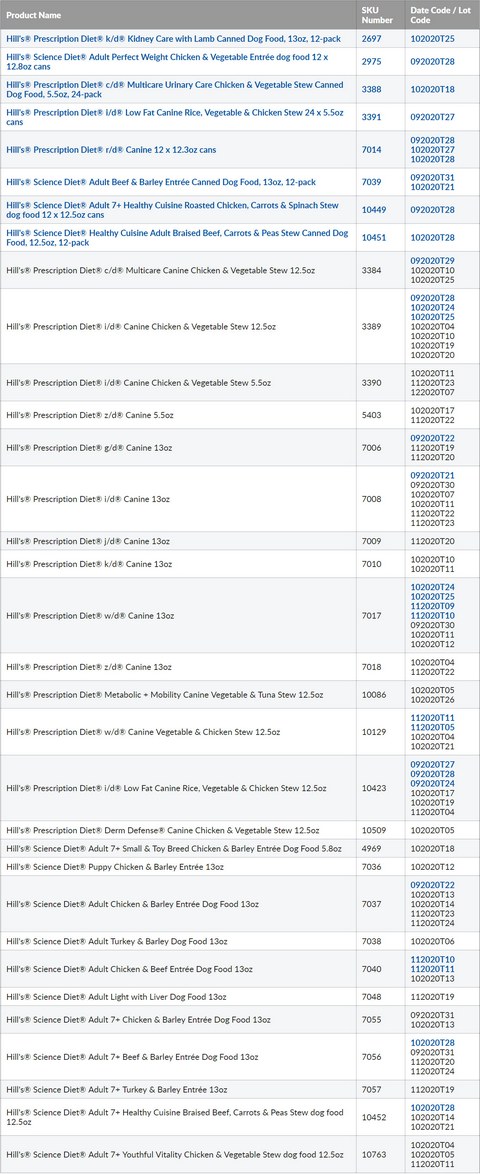
The following products and lot numbers are affected by the recall.
Items marked in blue are new SKUs that were added to the list on March 20, 2019.
About Excessive Levels of Vitamin D
While vitamin D is an essential nutrient for dogs, ingestion of elevated levels can lead to potential health issues depending on the level of vitamin D and the length of exposure.
Dogs may exhibit symptoms such as vomiting, loss of appetite, increased thirst, increased urination, excessive drooling, and weight loss.
Pet parents with dogs who have consumed any of the products listed and are exhibiting any of these signs should contact their veterinarian.
In most cases, complete recovery is expected after discontinuation of feeding.
What to Do?
If your SKU, Date and Lot codes are found in the list above, you have an affected product.
You should stop feeding it and should return to the place of purchase for a full refund.
If you have questions, you may contact Hill’s Consumer Affairs at 800-445-5777.
U.S. citizens can report complaints about FDA-regulated pet food products by calling the consumer complaint coordinator in your area.















 Learning from Dogs