I read recently a review of the most popular dog names by State.
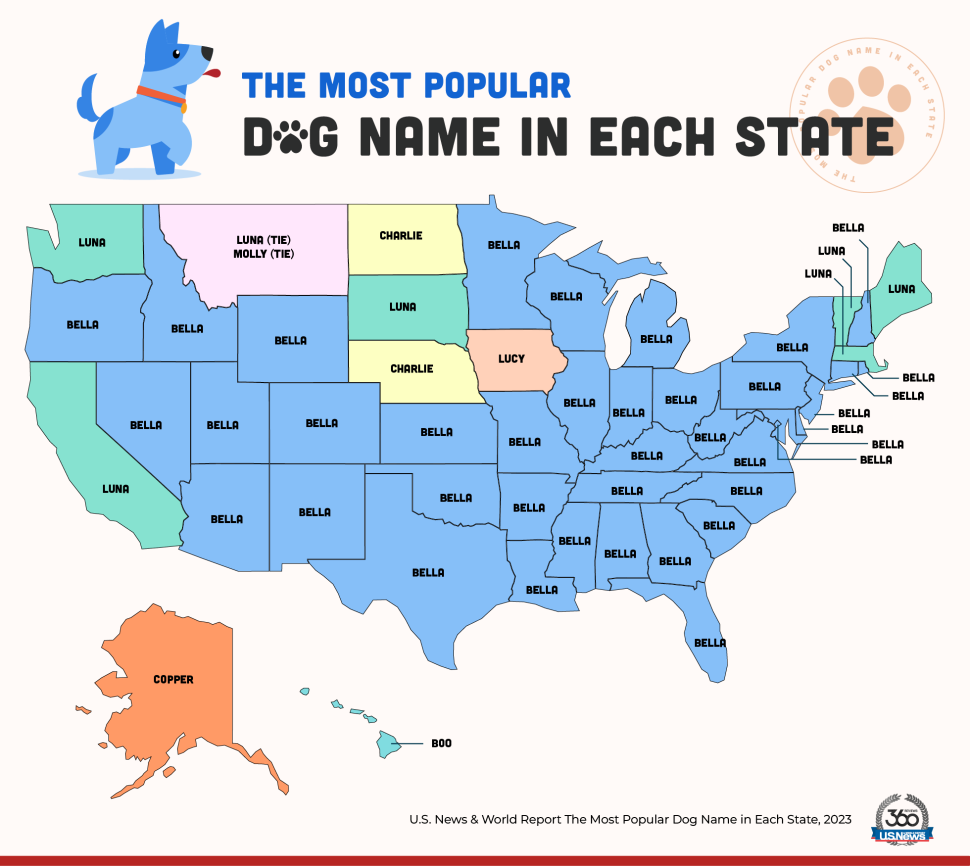
This was an article on US News dated November 6th. It showed the names for our dogs in the U.S. in a table:
The article also reported that dogs and puppies were living in more than half of the nation’s households. That is one heck of a lot of dogs and it just shows how great dogs are as companions to us humans.
Then the article went on to declare the most popular dog name by State, and there was another graphic:
So much for the names of our three remaining dogs: Brandy; Cleopatra; Oliver.
I was looking through posts from a few years ago and came across ‘Dogs – their deep ties to man” and thought it would be a grand post to publish again.
ooOOoo
Dogs – their deep ties to man!
It’s impossible not to admire, respect and love a dog
(First published on the 4th August, 2009but it relates to an event even before I left the United Kingdom. I met Jean in December, 2007 and Pharaoh and me travelled out to Mexico a year later.)
An incident last night reminded me of the complexity of the dog’s mind. It has not been the first time this has happened.
Our 6 year-old German Shepherd dog, Pharaoh, was given a bone as a treat during the previous day and, as sometimes happens, it was a bit tough on his stomach. So at around 1.30 am, I was woken up. Nothing so special about that. But reflect on how this happened.
1.30 am is the part of night where, hopefully, we are in that very deep phase of sleep. How then does Pharaoh calculate the best way of awakening me so that he can be let out into the yard? One might consider the various options:
– He barks
– He paws at the bed
– He jumps on the bed
– He scratches at the door
and so on.
What Pharaoh did (and has done before, so this is a calculated behaviour) is very gently put his damp nose onto the side of my face, just below my left ear, which was the part of my face nearest to the edge of the bed. It woke me so gently from my deep sleep but made me immediately aware (as a parent is when their young child cries) that Pharaoh required urgent attention.
A moment later he was standing by the bedroom door, letting out that soft, quiet whine that is only used when he needs to use the yard. Within seconds his collar and lead were on and he was outside doing what nature was prompting him.
Pharaoh resting on an English lawn
No big deal but it stayed with me this morning as I reflected on the empathetic way that Pharaoh had communicated with me during the night.
Dogs sensitivity to the world around them is a powerful reminder that the less we focus in on ourselves the more we learn.
I thought it very worthwhile to repeat this, plus a real treat at the end of the post!
Scamming in all its forms has only got worse in the last couple of years, since I parted with $9,000 in 2021!
As a direct result of that error, I changed my bank, installed a VPN at home (Proton), changed my email account to ProtonMail, and also changed my calendar (also to Proton).
But I still do not take it as important as it is. I guess because it is not my first thought whenever I come across an unfamiliar email.
ooOOoo
Please read this; and do not make the same mistake as me!
The Story of a Scam
(or how I lost the thick end of $10,000.)
On Friday, 6th August, 2021 at 05:51 in came the following email:
Norton Customer ,
User name:paulhandover
*we like to confim you that the NortonDesk re-newal. has been done on your request*
It is very easy to unsubscribe it,
and related to your any query, reach us at +1-(860) – (852) – (6259).
Product-Name : NortonDesk
……………………………………………………………………………………………………..
Price : $475.04
……………………………………………………………………………………………………..
Subscription ID : 8837-77942826-947192-8126
……………………………………………………………………………………………………..
Expiration Date : 3 Year from the Date of Purchase
………………………………………………………………………………………………
* If you wish to Cancel this Membership then please feel free to Contact our Billing department as soon as Possible*
……………………………………………………………………………………………………..
*Please do not write to this mail address, that will not help*
Reach us on +1 – (860) – (852) – (6259)
……………………………………………………………………………………………………..
Regards,
Billing department
Contact: +1 – (860) – (852) – (6259)
693 Amwell Rd, Hillsborough, NJ
My first mistake was not to check the incoming email address. It was mahaliashomakerxhv928@gmail.com
I telephoned the number given and told the person that I wanted to cancel this membership. Indeed that I had never subscribed for this membership in the first place.
I spoke with ‘Adam’. I was then asked to go to a webpage where I filled in a Refund Application Order form. I filled in my details including the refund amount and my bank details: Sort Code & Account Number.
I then submitted the form and imagine my surprise when a few minutes later I was informed that I had received the sum of $10,000. I quickly checked our bank account online and there was the $10,000 credit in our checking account.
My second mistake was me not examining the total in our accounts. I have the facility to show the total funds in our accounts. Why I didn’t do that I can not explain.
Then it was back on the telephone and Adam also was surprised (later I realised that this was a feigned surprise and all part of the scam) and said could I go to the bank and fill in an International Wire Transfer for the amount of $9,500. Adam also said that he would give me the details of the person in Thailand that was to receive the funds, and could I say this was for a medical operation because it would save ‘Norton’ the taxation.
My third mistake was not to discuss this with Jeannie and to assume that it was just a harmless error.
The details came through and I went to our bank in Grants Pass. I got to the bank a little after 09:00. I saw a staff member of the bank and explained what I needed to do. The bank member queried this and said that it sounded like a scam. I lied and said I knew the woman in Thailand and wanted to go ahead. That was what I had been instructed to say.
My fourth mistake was not listening to the woman at the bank. (And I still thought that the ‘Norton’ funds were in my account.)
The International Wire Transfer was completed and I signed it. I also asked the balances on our two accounts. It was about $10,000 less than I expected and I queried it but was told that there had been a transfer from my savings account to my checking account of $10,000 for Norton. I thought that this was still a little low but that I could check it carefully once I got home. I had a thirty-minute window to change my mind.
Mistake number five, a huge mistake, was while at the bank not to ask them carefully to go through all my transactions that day because that would have revealed that the receipt of $10,000 that I had seen online had mysteriously disappeared. Indeed had never been received. That would have enabled me to stop the wire transfer within the thirty-minute window.
I returned home and found out the truth. I had been scammed out of $9,500.
The strange thing was that ‘Adam’ of the billing department of so-called Norton kept ringing me throughout the day to say that the funds would be sent back to me and gave me the details of three wires and that the funds would be back in my bank account on Monday, 9th August!
Later that morning I rang Kevin Dick who manages our investments and told him the tale. He said that there was a huge amount of scamming about and that I should make three phone calls: to the bank and report the fraud; to the Sheriff’s office and report the fraud; and to my insurance company. The first two were done straight away. Kevin also told me to close my bank accounts and amend my email address. Alex, my son, said to use my Proton mail account and straight away I started to make the change.
A person from the humanists group that we belong to said also to inform The Daily Courier.
On Monday morning Ryan of ‘Norton’ called me at 07:15 and said that Adam Prescott was no longer with the firm. Ryan said that their General Manager, Ron Cooper, would call me shortly. Ron did indeed call me and said that they would return the money but that the minimum cheque they could write was $30,000. I was then told that in advance of me receiving the money I would have to pay a small amount to them. At this point I put the phone down for it was clearly a second attempt to steal more funds from me.
Finally we went back to the bank on Monday morning. We were informed that there was never a credit of $10,000 but that a clever switch of the money from one account to another made it look as though the money had been credited. The event had been reported to the bank’s fraud department.
On Tuesday morning, the 10th August, the bank said that as well as our two accounts being locked out from us and that only cheques and cash withdrawals would be honoured for the time being, the fraud department had made the decision to issue us with a ten-day notice to terminate our accounts. In other words, within ten days the bank would no longer want us as customers. Since then I have done much research and found out via the Forbes website that this was more to do with the bank being ultra conservative than anything else. Indeed Kevin said that he had spoken with his IT department and they thought that it was strange that my ex-bank had terminated us so quickly. The IT department thought that the teller at the bank realised that she had been partly culpable.
However the bank did recommend another bank to go to in Grants Pass.
I have since reset my iMac and changed my email address.
It is a most humiliating affair. I have beaten myself up several times over and have at last understood the frame of mind that I had gotten myself into.
To explain that, first of all I thought that I needed to stop the billing urgently and because it was early on a Friday morning thought that the best thing to do was to call immediately.
Secondly, during the call that scammers spoke to me in friendly tones and quietly complimented me on my integrity. I am sure that this ‘spoke’ to my psychological fear of rejection that I have had since I my father died in 1956.
Then in the morning of the 11th August I received a call from a regular contact at the English company who manage my UK SIPP. He wanted to check if I had tried to log on at 09:00 UK time and I replied that there was no way that was me for that UK time was 01:00 Pacific time. There were apparently three attempts to log on. Unsuccessfully as it turned out and my SIPP account is temporarily closed as a result.
The scammers are very thorough in their crooked craft!
Now as of Thursday, the 12th August, we are pretty much out of the grim shadow of this event. We have new accounts at The People’s Bank here in Grants Pass. I have changed my email address and yesterday afternoon I decided that the only safe way of protecting myself was to get another iMac. I was speaking to the sales department of Apple and mentioned the scam and the woman immediately said I should speak with their Technical Support and transferred me. Then I was helped via screen sharing to go through many pages deleting unnecessary files and other stuff. And the helpful woman found another item of malware that was deleted and removed. She spent 54 minutes getting me properly cleaned out and then forwarded an email with all the links for me to do the same process at a later date. It was a superb experience.
So that is it.
Now watch these two YouTube videos. The first is just 5 minutes long and is important to all who use computers and want to be protected against scammers. (NB: This first video is now not included.)
and then watch this slightly longer video from Jim
Be safe! Please!
An addendum dated Saturday, 14th August, at 7am Pacific Time.
Only to say that I also posted my scamming report on Ugly HedgeHog under their General Chit Chat forum. Of the many responses that came in I wanted to post here two of them.
The first from ‘Stanikon’:
Sorry you had to go through this. Your first clue should have been the grammar and phrasing of the original email. That would have given it away. Legitimate companies go to great lengths to make sure their grammar, phrasing and language are correct. I have avoided several scams by paying attention to that so there is some value in being slightly OCD.
and the second from ‘Red6’:
The safest thing to do in these situations is simply not to open the email. I receive on a daily basis, emails telling me that the items I ordered are being shipped, my subscription to something has been renewed etc, etc. 99.9% of these are scams and nothing bad will happen if you just delete them. Older working people often have the fear that there’s a bill out there that has not been paid and they are afraid of getting a bad credit report. So they aggressively try to send someone money for something they cannot even recognize. If it is a true debt, you will be reminded of it several times before any reports are made.
I follow several simple rules in preventing scams. There are many more but this will take care of most of them.
1. Examine the sender’s email address, if you do not recognize it then DO NOT OPEN and DELETE immediately. Most of these scammer’s email addresses will not have the company name in the email address OR it will be combined with other names. Most will not have the .com, .org, etc but will be gmail, Hotmail, or other generic URL. Many of these scammers “broadcast” their emails to everyone on a purchased email list not knowing whether some or valid or not. If you open or reply to these it verifies your email as valid and active and worthy of more attention. Also, if it is an unknown email address, it could be a carrier of a virus or some other bad computer/software infection.
2. If you do get involved with something that does not feel right and you take it to the bank – TRUST THE BANK if they tell you it is suspicious. They see these things every day and develop a feel for them. I received a cashier’s check for something I sold on craigslist. I took it to the bank to deposit and the bank rep immediately recognized the cashier’s check as a fake. She even called the bank the check was supposed to be drawn on and they checked the records and told her that it was counterfeit. You trust your bankers, credit union, etc with your money every day so trust them when they tell you something does not seem right.
3. Scammers know that many older people do NOT like to use credit cards. So a lot of their dealings involve checks, bank transfers, and other forms of older less secure payment methods that older citizens are comfortable with. I NEVER, NEVER send money for something I purchase or order online unless it is through a credit card. In fact, I rarely buy ANYTHING anymore that does not go on the credit card. They are safer, quicker, and easier. If somehow you do get something on your bill that you did not authorize, the credit card company will investigate and go after the person or company that charged you. This is one more safety step that protects the consumer. This does not always apply to debit cards. Debit cards are issued by individual banks or credit unions and some have policies in the fine print that they do NOT have the same policies as the big credit card companies and may not forgive or relieve the user for bad charges made to their debit card.
4. Just do not believe anyone or any company that says they sent you a huge refund or overpayment or some amount of money by mistake. That rarely happens. It is even rarer if they also tell you to return the money to some foreign address, email, or wire transfer. When in doubt, wait for a week or so before you do ANYTHING. If they sent you the check, transfer etc, wait to see if it clears or is valid. We are conditioned by TV and movies that we need to act immediately in situations such as this. This is rarely the case. Take time to see what happens. During this cooling-off period check them out, research the internet to see if others have experienced this scam. It is almost a sure thing that if you are being scammed, others have been also and it has been reported somewhere with law enforcement agencies or on websites on the internet. Check them out before acting. Or better yet, do nothing for a while and most likely they will just go away. Much like the telephone scammers, they make their money on volume, calling as many as possible in the least amount of time. Scammers will not waste time working on you for days, they have thousands of other emails, accounts to call. Remember, they are after the fastest, easiest targets – the low-hanging fruit.
If it is a true mistake or debt you owe then most likely you will receive some official correspondence in regards to the debt. A good example is the IRS and Social Security phone scams in the past couple of years. You get a call from the IRS or Social Security informing you that you may have committed fraud and law enforcement is on their way to arrest you. But if you arrange repayment with their representative, an arrest can be avoided. The IRS and Social Security NEVER take action without first sending several official US Postal letters to you. If you are still inclined to send money to someone in a foreign country then discuss it with your bank and listen.
Hope this helps.
ooOOoo
All very sound advice and as relevant today as it was when first published.
Finally, for something completely different; have a look at the recent Hunter’s Moon as featured on YouTube.
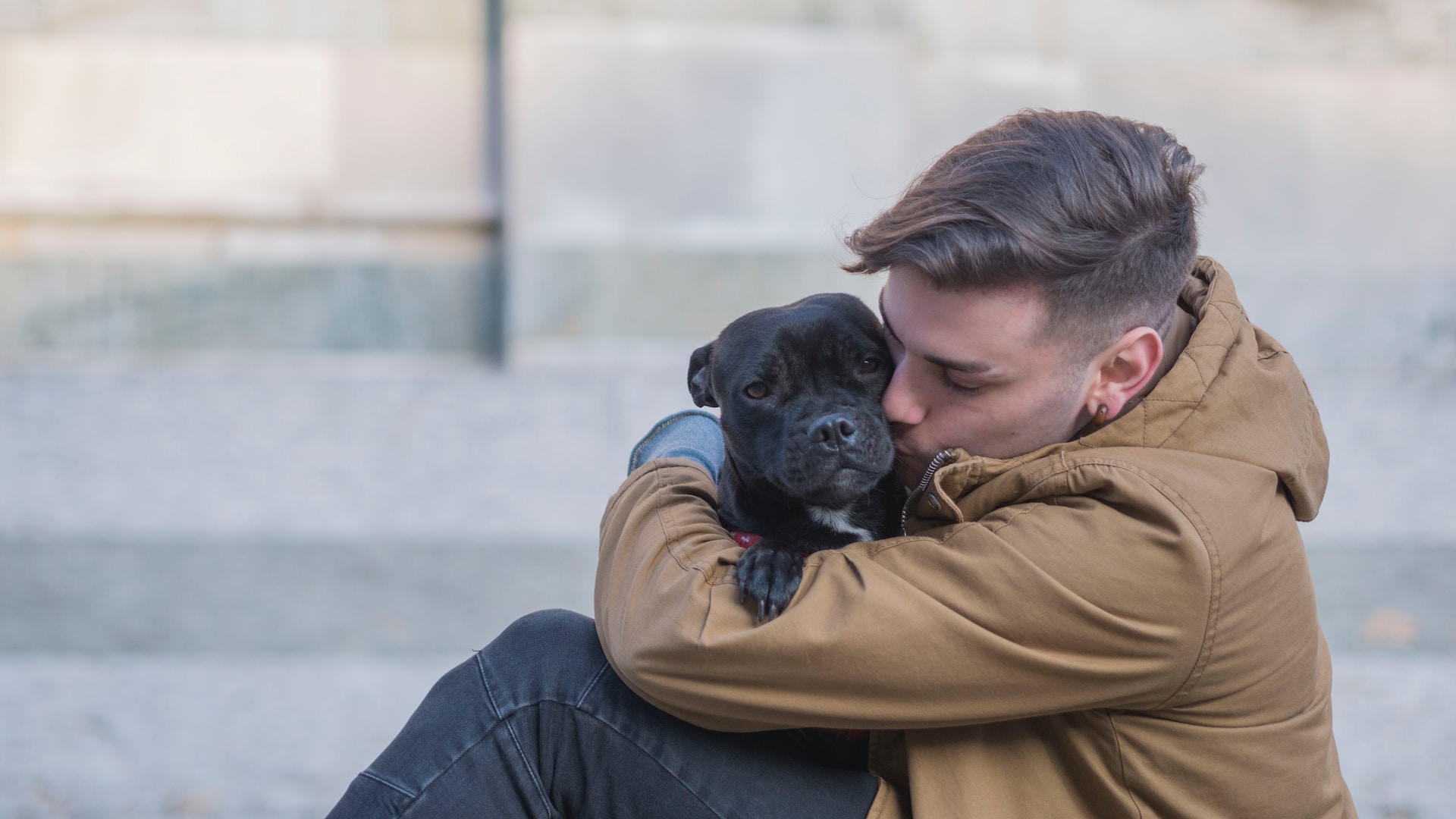
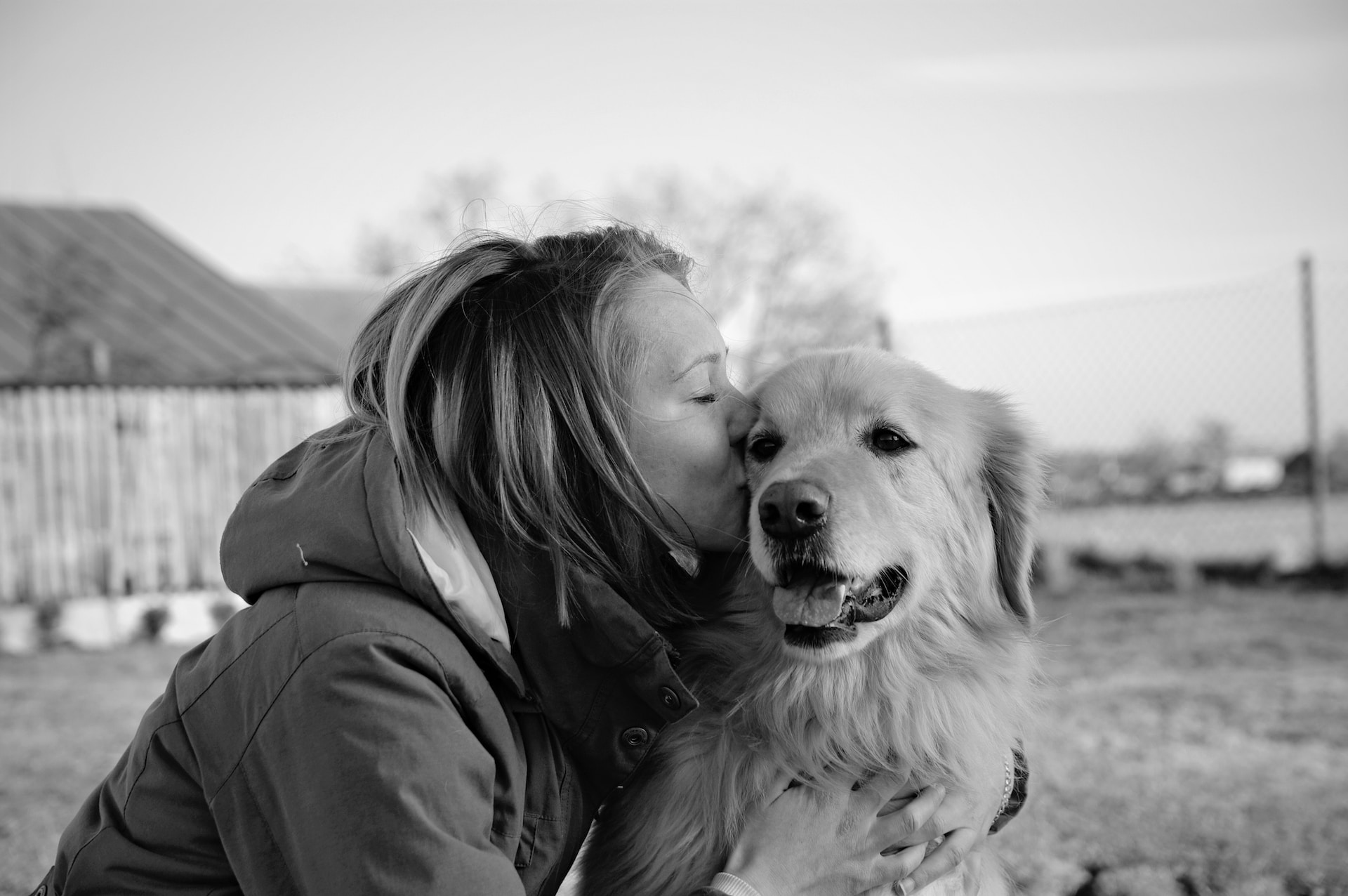
My feelings when I look at these pictures are nothing new but that doesn’t diminish at all my despair at these poor dogs. At least there are a few photographs of people loving them but they are intelligent, caring animals and in an ideal world we wouldn’t have strays.
For most of us these days old age is part of the scene (and I am classifying old age as being over 70 years). Here are a few facts from the website of the World Health Organization.
Key facts
Worldwide obesity has nearly tripled since 1975.
In 2016, more than 1.9 billion adults, 18 years and older, were overweight. Of these over 650 million were obese.
39% of adults aged 18 years and over were overweight in 2016, and 13% were obese.
Most of the world’s population live in countries where overweight and obesity kills more people than underweight.
39 million children under the age of 5 were overweight or obese in 2020.
Over 340 million children and adolescents aged 5-19 were overweight or obese in 2016.
Obesity is preventable.
What are obesity and overweight Overweight and obesity are defined as abnormal or excessive fat accumulation that may impair health.
Body mass index (BMI) is a simple index of weight-for-height that is commonly used to classify overweight and obesity in adults. It is defined as a person’s weight in kilograms divided by the square of his height in meters (kg/m2).
Adults
For adults, WHO defines overweight and obesity as follows:
overweight is a BMI greater than or equal to 25; and
obesity is a BMI greater than or equal to 30.
BMI provides the most useful population-level measure of overweight and obesity as it is the same for both sexes and for all ages of adults. However, it should be considered a rough guide because it may not correspond to the same degree of fatness in different individuals.
World Health Organisation
This is the link for anyone who wants to use the BMI Calculator.
Now this is not a post about obesity or being overweight. It is a post taken from The Conversation about staying as healthy as one can in one’s older years.
ooOOoo
Steep physical decline with age is not inevitable – here’s how strength training can change the trajectory
Raise your hand if you regularly find yourself walking up a flight of stairs. What about carrying heavy bags of groceries? How about picking up your child or grandchild? Most of us would raise our hands to doing at least one of those weekly, or even daily.
As people age, it can become more and more difficult to perform some physical tasks, even those that are normal activities of daily living. However, prioritizing physical fitness and health as you get older can help you go through your normal day-to-day routine without feeling physically exhausted at the end of the day.
It can also help you continue to have special memories with your family and loved ones that you might not have been able to have if you weren’t physically active. For example, I ran two half-marathons with my dad when he was in his 60s!
I am an exercise physiologist who studies how people can use resistance training to improve human performance, whether it be in sports and other recreational settings, in everyday life, or both. I am also a certified strength and conditioning specialist. My career has given me the opportunity to design exercise programs for kids, college athletes and elderly adults.
Staying physically active as you get older doesn’t need to include running a half-marathon or trying to be a bodybuilder; it could be as simple as trying to get through the day without feeling winded after you go up a flight of stairs. Although our muscles naturally get weaker as we age, there are ways we can combat that to help improve quality of life as we get older.
From left are the author’s father, who was age 61 at the time, the author’s wife and the author after completing the Lincoln Half Marathon. Zachary Gillen, CC BY-NC-ND
Muscle loss and chronic disease
One of the most important parts of exercise programming, no matter who I am working with, is proper resistance training to build muscle strength. Some amount of age-related loss of muscle function is normal and inevitable. But by incorporating resistance training that is appropriate and safe at any ability level, you can slow down the rate of decline and even prevent some loss of muscle function.
In one of our team’s previous studies, we saw that otherwise healthy individuals with sarcopenia had issues delivering vital nutrients to muscle. This could lead to greater likelihood of various diseases, such as Type 2 diabetes, and slow down recovery from exercise.
Recent estimates suggest that sarcopenia affects 10% to 16% of the elderly population worldwide. But even if a person doesn’t have clinically diagnosed sarcopenia, they may still have some of the underlying symptoms that, if not dealt with, could lead to sarcopenia.
Strength training is key
So the question is, what can be done to reverse this decline?
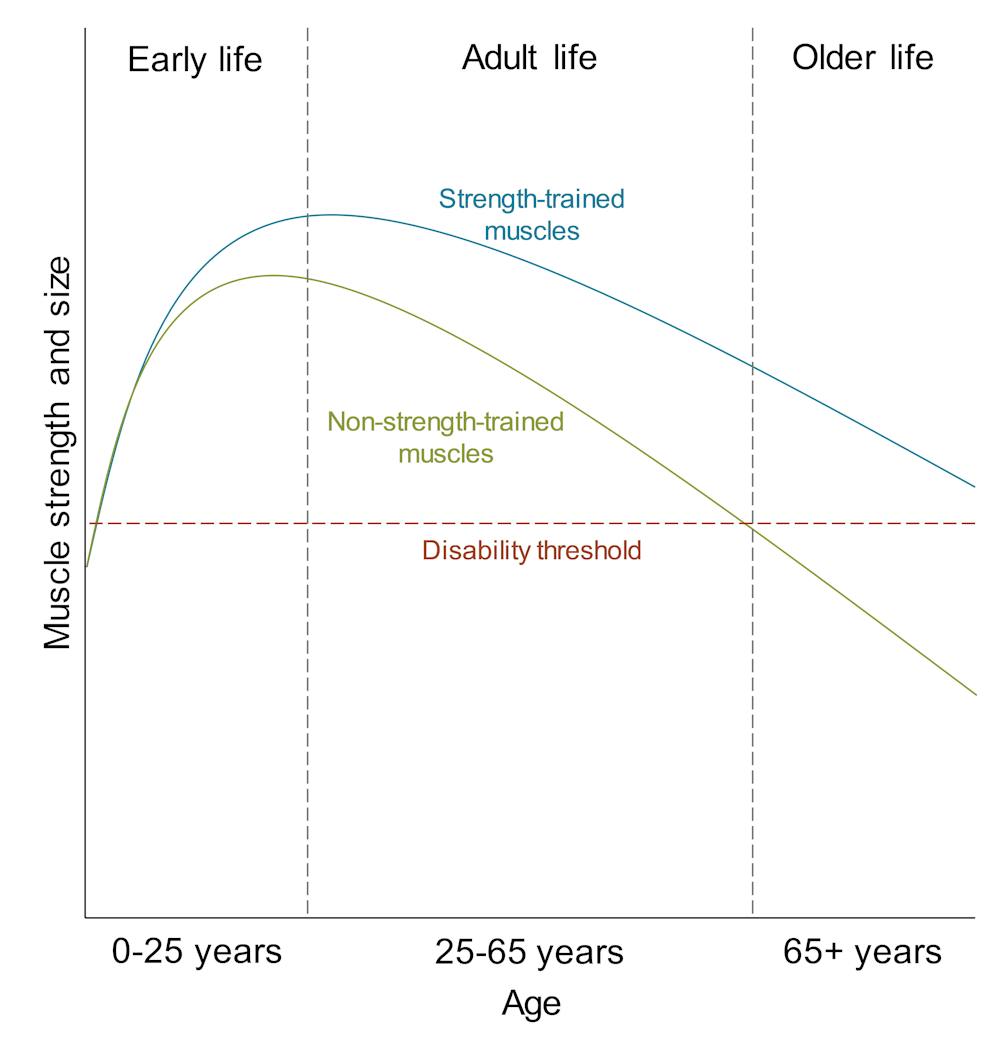
Recent evidence suggests that one of the key factors leading to sarcopenia is low muscle strength. In other words, combating or reversing sarcopenia, or both, may be best done with a proper resistance-training program that prioritizes improving strength. In fact, the decline in muscle strength seems to occur at a much faster rate than the decline in muscle size, underscoring the importance of proper strength training as people age.
Typical age-related changes in muscle strength and size with and without strength training. Zachary Gillen
Continuing to regularly strength train with moderate to heavy weights has been shown to be not only effective at combating the symptoms of sarcopenia but also very safe when done properly. The best way to make sure you are strength training properly is to seek out guidance from a qualified individual such as a personal trainer or strength and conditioning specialist.
Despite the clear benefits of strength training, it’s been shown that only about 13% of Americans age 50 and older do some form of strength training at least twice a week.
Finding what works for you
So how does a person properly strength train as they age?
The National Strength and Conditioning Association, a leading organization in advancing strength and conditioning around the world, states that for older adults, two to three days per week of strength training can be incredibly helpful for maintaining healthy muscle and bone and combating a number of chronic conditions.
The organization recommends that these workouts involve one to two exercises involving multiple joints per major muscle group, with six to 12 repetitions per set. These are done at an intensity of 50% to 85% of what’s known as one-repetition maximum – the most weight you could handle for a single repetition – with the exception of body weight exercises that use one’s own body weight as the resistance, such as pushups.
I would also recommend resting for about two to three minutes between sets, or even up to five minutes if the set was challenging. For older adults, particularly those age 60 and older, the National Strength and Conditioning Association guidelines suggest that a program like this be performed two to three days per week, with 24 to 48 hours between sessions.
An example of a strength training routine for older adults based on the National Strength and Conditioning Association guidelines
There are a great variety of exercises that could be done interchangeably in a strength training program like this.
The guidelines above are only one example out of many options, but they provide a framework that you can use to build your own program. However, I would highly recommend seeking out a professional in the field to give specific exercise programming advice that can be tailored to your own needs and goals as you age.
Following such a program would give your muscles an excellent stimulus to enhance strength, while also allowing enough recovery, a very important consideration as people age. You might think it looks like a huge time commitment, but an exercise routine like this can be done in less than an hour. This means that in less than three hours of strength training per week you can help improve your muscle health and reduce the risk of getting sarcopenia and associated health issues.
It’s also important to note that there is no one right way to do resistance training, and it needn’t involve traditional weight equipment. Group classes like Pilates and yoga or those that involve circuit training and work with resistance bands can all produce similar results. The key is to get out and exercise regularly, whatever that entails.
My wife, Jean, was diagnosed with Parkinson’s Disease (PD) in December, 2015. Many of you know that.
Fortunately at our local Club Northwest there was a group of PD sufferers who twice a week held a ‘Rock Steady Class’ under the instruction of a professional coach; Jean joined the group. It was a brilliant move for Jean and she gets a huge amount of care from being with them.
Luckily for me having to drive Jean into Club Northwest it made sense for me to sign up to a fitness class at the same time so I am put through a regular fitness routine under the coaching of Bruce. Plus I try and go bike riding three times a week.
In other words, we both try and stay as fit as we can.
These are such powerful photographs and the many photographers who contributed them to Unsplash are to be heartily congratulated, especially as they are provided without charge.
Thank you to all the photographers. I am certain that I am not the only one saying ‘thank you’ even if most of you are thinking a ‘thank you’ rather than verbalising it. I am unsure at this stage as to whether I will post further photographs from Unsplash; any feedback?
If you have not registered with the BBC then you will need to do so before the link at the bottom works.
This last time it is wood. Here it is:
In this episode – Wood – we visit the Woodwork for Wellbeing Workshop in Bethnal Green, London where every Tuesday people with mental health issues spend time making things with wood. They find it to be very therapeutic and fun. And Professor Miles Richardson of the University of Derby shares research from Japan which shows that simply touching wood is calming.
This is the last one of this series from the Beeb and if any of you have noticed I chose to present these programmes in a different order to that presented by the BBC.
‘chose‘ is only slightly accurate – the true reason is that I screwed up!
Another broadcast from BBC Radio 4 in this series!
As I said before, so far this has been a fascinating series of programmes and, hopefully, some of you have listened to the episodes.
In Episode 5 – Earth – we visit the Horticultural Therapy Trust allotment in Plymouth and discover how gardening can be soothing for people with severe mental illnesses. We also hear about how putting our hands in the earth can be good for our gut microbiome and potentially our mental health.
Produced and Presented by Helen Needham Research by Anna Miles and Maud Start Original Music by Anthony Cowie Mixed by Ron McCaskill and Malcolm Torrie
A BBC Scotland Production made in Aberdeen for BBC Radio 4
This is about breathing and is something I know about. Because Bruce at our local ClubNorthwest has a session with me when I spend five minutes or so taking in through the nose the deepest breath that I can.
If you have not registered with the BBC then you will need to do so before the link at the bottom works.
In Episode 4 – Air – we visit an infant school in Nottingham where young children regularly learn breathing techniques to reduce stress and anxiety. We also hear about research from Italy showing how slowing our breathing impacts positively on brain activity. Plus breath coach and founder of School Breathe, Aimee Hartley, shares her experience of learning to breathe well.
Produced and Presented by Helen Needham Research by Anna Miles and Maud Start Original Music by Anthony Cowie Mixed by Ron McCaskill and Malcolm Torrie
A BBC Scotland Production made in Aberdeen for BBC Radio 4



















 Learning from Dogs