A fascinating and beautiful insight into wild turkeys!
Yesterday, I published a couple of stories that demonstrated that close, loving bonds can form between different species, including an orang-utan and a dog, and a duck and a man.
By chance, Jean and I came across another example of cross-species bonding. This time between Joe Hutto, an American living in Florida, and a brood (is that the right description?) of newly-born wild turkeys. The first thing these tiny birds saw when they opened their eyes after breaking clear of their egg was Joe, and they immediately imprinted him as their ‘mother’.
Joe spent a complete year and more being ‘mother’ to these birds right up to the point where they naturally flew the nest, so to speak. Joe’s experiences led to a book, Illumination in the Flatwoods, and from that to a BBC Natural World special My Life as a Turkey, regrettably not available to viewers outside the UK.
But speaking to someone who did watch the BBC film, it was clear that it was a most beautiful and touching account of how young wild turkeys can bond to a human. Here’s part of the programme review in the British Guardian newspaper,
Joe Hutto’s life changed when a local farmer in the Florida flatlands where he lives left a stainless steel dog bowl full of wild turkey eggs on the porch of his cabin. Joe put them in an incubator, and waited. Some weeks later, cracks began to appear. This is the crucial time: “imprinting” only occurs in the first few moments after hatching. So Joe put his face down to the level of the opening eggs and the first poult emerged, wet and confused. Joe made a chirping, clucky noise, the poult looked him square in the eye, “and something very unambiguous happened in that moment”.
The little turkey stumbled and crawled across to Joe, and huddled up against his face. It recognised Joe as its mother. In the next few hours, Joe became mother to 15 more baby turkeys and remained so for the next 18 months. My Life as a Turkey: Natural World Special (BBC2) tells that story.
Across to the programme details from the BBC2 website (may not be available 26 days after the date of this article),
Biologist Joe Hutto was mother to the strangest family in the world, thirteen endangered wild turkeys that he raised from egg to the day they left home.
For a whole year his turkey children were his only companions as he walked them deep through the Florida Everglades. Suffering all the heartache and joy of any other parent as he tried to bring up his new family, he even learnt to speak their language and began to see the world through turkey eyes. Told as a drama documentary with an actor recreating the remarkable scenes of Joe’s life as a turkey mum.
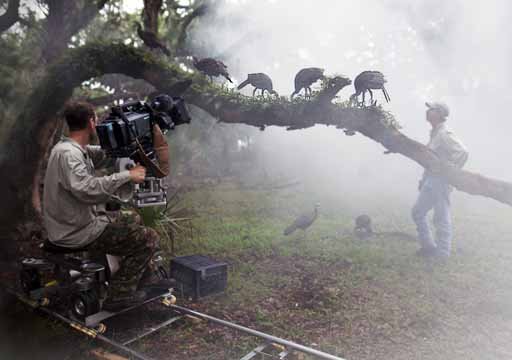
Behind the scenes image of turkeys and Jeff Palmer (actor) in misty forest in Florida. Cameraman (Mark Smith) on track & dolly shows how some of the beautiful sweeping shots were filmed.
Sam Wollaston of the Guardian continues,
It’s not hard to see how the little birds were taken in. Joe’s moustache does look a bit like feathers, he has a long scraggy neck, an understanding of the forest, and a tentative, birdlike walk. He takes them out, to catch their first grasshoppers; he teaches them how to roost. For Joe, as for any mother, parenthood is an emotional rollercoaster ride. There is the joy of seeing his babies grow, but almost constant worry. Grief too, when one is taken by a rat snake, and another by a hawk, and two more get sick (bird flu?) and die.
Adolescence arrives with all its associated problems. The males start fighting; only the toughest will get to mate. “I had no way of knowing how I was going to be part of this rite of passage,” says Joe. Steady now, Joe, let’s not take this too far, you’re not supposed to mate with any of them. For one, they’re your children. They’re also turkeys. That would be doubly wrong. Sometimes I think Joe spends too much time alone in the forest.
Quite so! However, the film was so beautifully shot that it was very, very easy to forget that this was a re-enactment of Joe’s original experience. That love is all about how you make someone, or in these cases, some other creature, feel. Another couple of pictures from the BBC website,
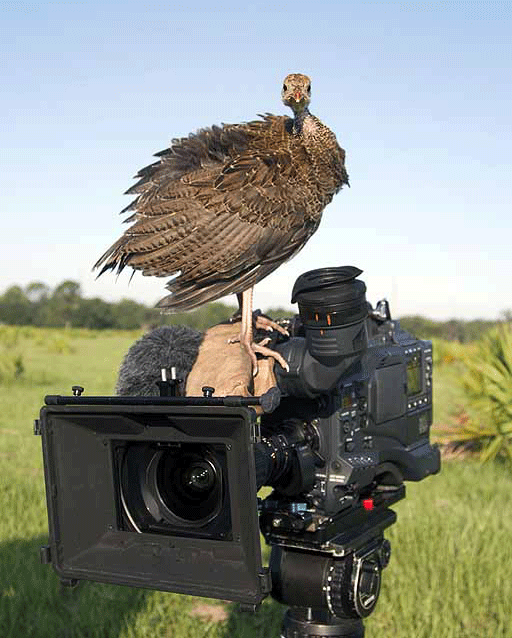
Lights, camera, action!Jeff Palmer (actor) sat on large felled tree on his cell phone with a dozen wild turkeys.
One final extract from the Sam Wollaston article in The Guardian newspaper,
My Life as a Turkey isn’t simply a wildlife film though. It’s not just about wild animals, it’s about one man’s relationship with wild animals, and that’s what makes it so fabulous. Serious animal behaviourists may not agree, but if you throw a human being in there, it all suddenly becomes a lot more interesting. I’m thinking Ring of Bright Water, Gorillas in the Mist, I’m definitely thinking Werner Herzog’s brilliant Grizzly Man about a man named Tim whose friendship with bears went wrong and he ended up inside one. My Life as a Turkey has something of Grizzly Man about it – a man obsessed, alone in a beautiful place, living with wild animals. But, although Joe was attacked, he didn’t end up inside one of his turkeys thankfully. There would have been a certain irony to that, especially if it had happened at Thanksgiving.
Anyway, it’s a lovely film – beautiful, charming, funny, sad, thought-provoking even. What thoughts did it provoke in me? That I need to go and see my mum.
Unfortunately, as mentioned above if you are outside the UK you are not able to watch the film via the BBC iPlayer system. But you can buy the book.
Joe Hutto's book of his life with wild turkeys.
Available from Amazon, here’s just one of the reviews,
My review is not unbiased because Joe Hutto, author of “Illumination in the Flatwoods,” and I have been friends for almost 25 years.
Joe is the most humble man I’ve ever known. I am honored that he brought me the original manuscript to read. It was so beautiful I could have cried.
With the same graceful writing skills used by conservationists Aldo Leopold (“Sand County Almanac”) and Herbert Stoddard (“Memoirs of a Naturalist”), Joe gives a masterful mix of documentary-style nature reporting and heartfelt thoughts on the meaning of life. As dramatic as that sounds, I think most readers will agree that “Illumination in the Flatwoods” is a life-changing book.
You will never regret the dollars you spend to buy this book nor the time it takes you to read it. . .
Yesterday, I wrote about the fabulous success of the British otter having gone from the crumbling edge of extinction to now being found in every English county.
For something completely different, and I do mean completely, have a read of this item that appeared in the British Guardian newspaper of the 18th August.
Aliens may destroy humanity to protect other civilisations, say scientists
Rising greenhouse emissions could tip off aliens that we are a rapidly expanding threat, warns a report
It may not rank as the most compelling reason to curb greenhouse gases, but reducing our emissions might just save humanity from a pre-emptive alien attack, scientists claim.
Watching from afar, extraterrestrial beings might view changes in Earth’s atmosphere as symptomatic of a civilisation growing out of control – and take drastic action to keep us from becoming a more serious threat, the researchers explain.
This highly speculative scenario is one of several described by a Nasa-affiliated scientist and colleagues at Pennsylvania State University that, while considered unlikely, they say could play out were humans and alien life to make contact at some point in the future.
Shawn Domagal-Goldman of Nasa’s Planetary Science Division and his colleagues compiled a list of plausible outcomes that could unfold in the aftermath of a close encounter, to help humanity “prepare for actual contact”.
Beneficial encounters ranged from the mere detection of extraterrestrial intelligence (ETI), for example through the interception of alien broadcasts, to contact with cooperative organisms that help us advance our knowledge and solve global problems such as hunger, poverty and disease.
Another beneficial outcome the authors entertain sees humanity triumph over a more powerful alien aggressor, or even being saved by a second group of ETs. “In these scenarios, humanity benefits not only from the major moral victory of having defeated a daunting rival, but also from the opportunity to reverse-engineer ETI technology,” the authors write.
Other kinds of close encounter may be less rewarding and leave much of human society feeling indifferent towards alien life. The extraterrestrials may be too different from us to communicate with usefully. They might invite humanity to join the “Galactic Club” only for the entry requirements to be too bureaucratic and tedious for humans to bother with. They could even become a nuisance, like the stranded, prawn-like creatures that are kept in a refugee camp in the 2009 South African movie, District 9, the report explains.
The most unappealing outcomes would arise if extraterrestrials caused harm to humanity, even if by accident. While aliens may arrive to eat, enslave or attack us, the report adds that people might also suffer from being physically crushed or by contracting diseases carried by the visitors. In especially unfortunate incidents, humanity could be wiped out when a more advanced civilisation accidentally unleashes an unfriendly artificial intelligence, or performs a catastrophic physics experiment that renders a portion of the galaxy uninhabitable.
To bolster humanity’s chances of survival, the researchers call for caution in sending signals into space, and in particular warn against broadcasting information about our biological make-up, which could be used to manufacture weapons that target humans. Instead, any contact with ETs should be limited to mathematical discourse “until we have a better idea of the type of ETI we are dealing with.”
The authors warn that extraterrestrials may be wary of civilisations that expand very rapidly, as these may be prone to destroy other life as they grow, just as humans have pushed species to extinction on Earth. In the most extreme scenario, aliens might choose to destroy humanity to protect other civilisations.
“A preemptive strike would be particularly likely in the early phases of our expansion because a civilisation may become increasingly difficult to destroy as it continues to expand. Humanity may just now be entering the period in which its rapid civilisational expansion could be detected by an ETI because our expansion is changing the composition of the Earth’s atmosphere, via greenhouse gas emissions,” the report states.
“Green” aliens might object to the environmental damage humans have caused on Earth and wipe us out to save the planet. “These scenarios give us reason to limit our growth and reduce our impact on global ecosystems. It would be particularly important for us to limit our emissions of greenhouse gases, since atmospheric composition can be observed from other planets,” the authors write.
Even if we never make contact with extraterrestrials, the report argues that considering the potential scenarios may help to plot the future path of human civilisation, avoid collapse and achieve long-term survival.
I am bound to say that if Mr Domagal-Goldman and his colleagues believe that spending time and money on the possible outcomes of contact with extraterrestrials is a good idea in these present times then I am minded about those other visitors from outer space who passed Planet Earth by because there were no signs of intelligent life!
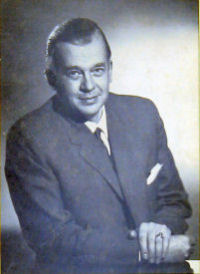
Ernst Friedrich “Fritz” Schumacher (16 August 1911 – 4 September 1977)
Ernst Friedrich "Fritz" Schumacher
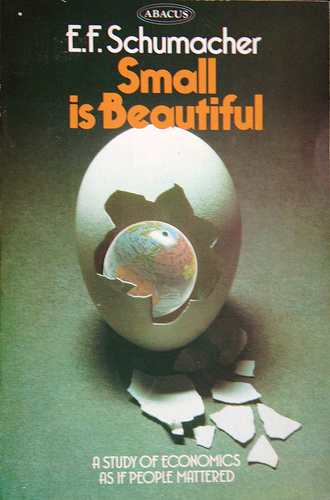
It seems amazing to realise both that this far-sighted man was born a century ago this day and that his incredibly influential book, Small is Beautiful, was published 38 years ago.
The book has been hugely influential. Indeed, my gut sense is that it probably started the whole ‘green’ movement. The Times Literary Supplement of October 6, 1995 regarded E.F. Schumacher’s 1973 book Small Is Beautiful: a study of economics as if people mattered as among the 100 most influential books published since the end of the Second World War.
Just a personal note that for many years I lived just a few miles from Dartington in Devon (UK) where Schumacher College was founded in 1991. Named after the great man, it provided, and still does, learning for sustainable living. Perhaps no surprise at all that nearby Totnes became the world’s first ‘transition town’.
Want to find out more? Then go to the New Economics Institute website here and discover,
The New Economics Institute is a US organization that uniquely combines vision, theory, action, and communication to effect a transition to a new economy — an economy that gives priority to supporting human well-being and Earth’s natural systems. Our multidisciplinary approach employs research, applied theory, public campaigns, and educational events to describe an alternative socio-economic system that is capable of addressing the enormous challenges of our times. Our premise is that a fair and sustainable economy is possible and that ways must be found to realize it.
The Institute, formerly the E. F. Schumacher Society, is working in close partnership with the New Economics Foundation from London to add the programs and experience developed in the UK to its own work in the US.
Finally, to get a flavour of this wonderful man and the amazing legacy that he has left the planet, watch this short video of E.F. Schumacher answering a question from the moderator about whether or not Buddhist Economics can work in the West. (Question & Answer Panel at Great Circle Center, 3/19/77. Peter Gillingham Collection, E. F. Schumacher Library Archives.)
A passing visit to the American biologist, E. O. Wilson
E O Wilson
Edward Osborne Wilson was born in June 1929 thus making him, at this time of writing, just into his 82 year. His biological specialty is myrmecology. Got that? Myrmecology. And if you, like me, didn’t have a clue as to what myrmecology is and had to look it up, it is the study of ants. Blow me down, there is even a myrmecology blogsite!
So where is this all heading?
One of the things that we do know about dogs, especially if we go way back into the dim and distant times when they behaved more like the grey wolf, from which the species ‘dog’ genetically originates 100,000 years ago, is that their social order, their pack behaviour, was highly stable. As an aside, when Jean was rescuing dogs in San Carlos, Mexico during the years that she lived there with her late husband she readily observed that the stray dogs, of which there were too many, had a natural propensity to group up into their historic pack formations. (And as an aside to my aside, Jean’s close friend of many years, Dan’s sister Suzann, today carries on the splendid work of looking after stray dogs from her San Carlos house!)
OK, back to the plot!
E O Wilson’s study of ants has revealed much about social order and organisation. The following YouTube video was from a PBS programme, aired in May, 2008, from which I quote (that is the PBS website),
Program Description
At age 78, E.O. Wilson is still going through his “little savage” phase of boyhood exploration of the natural world. In “Lord of the Ants,” NOVA profiles this soft-spoken Southerner and Harvard professor, who is an acclaimed advocate for ants, biological diversity, and the controversial extension of Darwinian ideas to human society.
Actor and environmentalist Harrison Ford narrates this engaging portrait of a ceaselessly active scientist and eloquent writer, who has accumulated two Pulitzer Prizes among his many other honors. Says fellow naturalist David Attenborough: “He will go down as the man who opened the eyes of millions ’round the world to the glories, the values, the importance of—to use his term—biodiversity.”
It’s a fascinating film, truly engaging, so do settle down for a relaxing 53 minutes and watch,
Now there’s more to this and I do want to continue with the theme of this Post tomorrow.
So for now, look in on the E O Wilson Biodiversity Foundation’s website and I’ll see you tomorrow.
Underlining what 30,000 years of domestication produces!
This video, just under 6 minutes long, may well be ‘old news’ to many dog owners but still very much worth a viewing.
Scamp
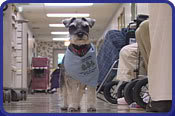
And while I think about, if you didn’t see the video about Scamp and his ability to identify, and then comfort, humans very close to death, when it first appeared on Learning from Dogs, then do drop back to here and watch it. It’s from the Extraordinary Animals series from Channel Five on British television and just 22 minutes long.
Those of you who have come across Rupert Sheldrake and, in particular his book Dogs That Know When Their Owners Are Coming Home will really not be surprised at what is coming, in terms of the rest of this Post. Because most dog owners know, from countless observations, that dogs have an uncanny ability to see the world around them in a more deeper and intuitive manner than we can explain.
I wrote of Sheldrake’s book on the 1st June including touching on a report of Mason, a small terrier mix …
On April 27th, Mason was hiding in his garage in North Smithfield when the storm picked him up and blew him away. His owners couldn’t find him and had about given up when they came back Monday to sift through the debris, and found Mason waiting for them on the porch.
A few evenings ago, we watched a documentary from the website Top Documentary Films from the series Through The Wormhole. This particular documentary was entitled Is There a Sixth Sense? Here’s how that film was introduced,
Sight, hearing, smell, taste and touch are the tools most of us depend on to perceive the world. But some people say they also can perceive things that are outside the range of the conventional senses, through some other channel for which there is no anatomical or neurological explanation. Scientific researchers who study such abilities call them extrasensory perception (ESP), but lay people often refer to them as the sixth sense.
Either term really is a catch-all for a variety of different purported abilities that vary from person to person. Some people claim the power of telepathy – that is, the ability to perceive others’ thoughts, without having them communicated verbally or in writing. Others claim to have the power of clairvoyance, which is the ability to perceive events and objects that are hidden from view because of barriers or distance. Still others claim to be gifted with precognition, which enables them to look into the future and glimpse what hasn’t yet occurred.
The belief in ESP or the sixth sense dates back thousands of years. The Greek historian Herodotus wrote that Croesus, who ruled a kingdom in what is now Turkey in the sixth century B.C., consulted oracles – that is, groups of priests claimed to be able to predict the future — before he went to war. In ancient India, Hindu holy men were believed to possess the power to see and hear at a distance, and to communicate through telepathy.
In the late 1700s, the Viennese physician Franz Mesmer claimed that he could give people ESP powers by hypnotizing them. Just before his assassination in 1865, President Abraham Lincoln told friends that he’d dreamed of his own body lying in state in the White House. In the 20th century, Edgar Cayce and Jean Dixon attracted wide followings by claiming that they could foresee future events. During the Cold War, U.S. military and intelligence agencies, spurred by reports that the Soviets had psychics at their disposal, even tried to utilize clairvoyants who claimed remote-viewing powers for espionage purposes.
As well as watching it directly from the Top Documentary Films website, it is also available from YouTube. Here are the four links. It is a most fascinating review of the scientific findings in this area. If you have a dog with you when you watch the videos, don’t be surprised if he or she fall asleep! Nothing new for dogs in all this!
Dr. Michael Shermer is the Founding Publisher of Skeptic magazine, the Executive Director of the Skeptics Society, a monthly columnist for Scientific American, the host of the Skeptics Distinguished Science Lecture Series at Caltech, and Adjunct Professor at Claremont Graduate University.
Finally, Joe Keohane (with thanks to Tom M. for the intro.)
Joe wrote a fascinating article that appeared in the Boston Globe last July that opens,
How facts backfire
Researchers discover a surprising threat to democracy: our brains
It’s one of the great assumptions underlying modern democracy that an informed citizenry is preferable to an uninformed one. “Whenever the people are well-informed, they can be trusted with their own government,” Thomas Jefferson wrote in 1789. This notion, carried down through the years, underlies everything from humble political pamphlets to presidential debates to the very notion of a free press. Mankind may be crooked timber, as Kant put it, uniquely susceptible to ignorance and misinformation, but it’s an article of faith that knowledge is the best remedy. If people are furnished with the facts, they will be clearer thinkers and better citizens. If they are ignorant, facts will enlighten them. If they are mistaken, facts will set them straight.
This is a very smart article and much recommended, do read it fully here.
This coming next couple of weeks is going to see me reflecting on some of the powerful messages that flow from three one-hour documentaries by Adam Curtis during a series of programmes for the BBC in 2007.
For today, just enjoy the BBC trailer. (Assuming ‘enjoy’ is the right expression!)