Category: Communication

Plus ça change

Plus ça change, plus c’est la même chose (“the more it changes, the more it’s the same thing”).

I’m at my PC thinking about tomorrow’s post.  It’s past 4pm and my creative juices are elsewhere!  So out of curiosity I wondered what I had published a year ago, in early February 2012.  To my amazement what was published was as fresh and relevant as if it had been published today.  So that’s what I am doing.  Republishing it along with the sequels on Tuesday and Wednesday.

oooOOOooo

Climate, truth and integrity, part one.

It ought to be straightforward, but the reality is different!

Those of you, dear readers, that have been following these ramblings and musings over the last 30 months, now amounting to more than 1,200 Posts [now 1,582, Ed.] , will hopefully have sensed that Learning from Dogs is much more than a blogsite about dogs!  It is, as I say here, about truth, integrity, honesty and trust using dogs as a powerful metaphor for these essential qualities of a civilised society.

But perhaps there is no topic more challenging for people to determine the truth than the topic of man’s impact on the earth’s climate.  I’m sure that millions intuitively sense that we are over-consuming ourselves to oblivion.  That is where I come from.  I am not a scientist, just a humble writer, and rely on quality sources of information and instinct to form my conclusions in this area.  I am also deeply suspicious of the largely out-of-sight relationships between large corporations, big money and politics!

I have no doubt that there are other millions of people who do believe that mankind is changing our planet’s climate.

So when I saw this article in the Wall Street Journal, I was dumbstruck.  Here’s the headline and opening paragraph,

No Need to Panic About Global Warming

There’s no compelling scientific argument for drastic action to ‘decarbonize’ the world’s economy.

Editor’s Note: The following has been signed by the 16 scientists listed at the end of the article:

A candidate for public office in any contemporary democracy may have to consider what, if anything, to do about “global warming.” Candidates should understand that the oft-repeated claim that nearly all scientists demand that something dramatic be done to stop global warming is not true. In fact, a large and growing number of distinguished scientists and engineers do not agree that drastic actions on global warming are needed.

The long article closes with this paragraph just ahead of the ‘signatures’ of the scientists.

Every candidate should support rational measures to protect and improve our environment, but it makes no sense at all to back expensive programs that divert resources from real needs and are based on alarming but untenable claims of “incontrovertible” evidence.

Then in short order, up came this from the Daily Mail online,

The supposed ‘consensus’ on man-made global warming is facing an inconvenient challenge after the release of new temperature data showing the planet has not warmed for the past 15 years.

The figures suggest that we could even be heading for a mini ice age to rival the 70-year temperature drop that saw frost fairs held on the Thames in the 17th Century.

Based on readings from more than 30,000 measuring stations, the data was issued last week without fanfare by the Met Office and the University of East Anglia Climatic Research Unit. It confirms that the rising trend in world temperatures ended in 1997.

I subscribe both to Climate Sight and Lack of Environment, although wish I spent more time thoroughly reading these fabulous sources of information.  However, I did spot an article on Climate Sight that came out on the 31st January with the heading of How much is most?  It opened thus,

A growing body of research is showing that humans are likely causing more than 100% of global warming: without our influences on the climate, the planet would actually be cooling slightly.

In 2007, the Intergovernmental Panel on Climate Change published its fourth assessment report, internationally regarded as the most credible summary of climate science to date. It concluded that “most of the observed increase in global average temperatures since the mid-20th century is very likely due to the observed increase in anthropogenic greenhouse gas concentrations”.

A clear question remains: How much is “most”? 51%? 75%? 99%? At the time that the IPCC report was written, the answer was unclear. However, a new frontier of climate research has emerged since, and scientists are working hard to quantify the answer to this question.

The timing was impeccable, so far as I was concerned.  I posted a comment, “While in every way that I can think of, I support the premise of mankind affecting global climate, I would love to hear from someone who could reconcile the Post above with these recent items:” and then included the links to the WSJ and Daily Mail items.

Little did I realise what a response I would get.  Just wonderful!  I will offer some of them to you in this piece, but please do read all the comments offered on that Climate Sight post.

First up was Dana Nuccitelli.  Dana is an environmental scientist at a private environmental consulting firm in the Sacramento, California area. He has a Bachelor’s Degree in astrophysics from the University of California at Berkeley, and a Master’s Degree in physics from the University of California at Davis.  (Taken from here.)  This is what he wrote,

How to reconcile the two? The folks who wrote those two articles you linked are misinformed and/or misinformers. I covered the first here  (and) SkS will shortly have a post on the second as well, but I covered the solar cycle issue recently here.

Dana’s article in Skeptical Science, that first link, included this:

Nearly half of the list (at least 7 of 16) have received fossil fuel industry funding, and the list also includes an economist, a physician, a chemist, an aerospace engineer, and an astronaut/politician.  These are apparently the best and brightest the climate denialists can come up with these days?

  • Claude Allegre, former director of the Institute for the Study of the Earth, University of Paris
  • J. Scott Armstrong, cofounder of the Journal of Forecasting and the International Journal of Forecasting;
  • Jan Breslow, head of the Laboratory of Biochemical Genetics and Metabolism, Rockefeller University;
  • Roger Cohen, fellow, American Physical Society;
  • Edward David, member, National Academy of Engineering and National Academy of Sciences;
  • William Happer, professor of physics, Princeton; 
  • Michael Kelly, professor of technology, University of Cambridge, U.K.;
  • William Kininmonth, former head of climate research at the Australian Bureau of Meteorology;
  • Richard Lindzen, professor of atmospheric sciences, MIT;
  • James McGrath, professor of chemistry, Virginia Technical University;
  • Rodney Nichols, former president and CEO of the New York Academy of Sciences;
  • Burt Rutan, aerospace engineer, designer of Voyager and SpaceShipOne;
  • Harrison H. Schmitt, Apollo 17 astronaut and former U.S. senator;
  • Nir Shaviv, professor of astrophysics, Hebrew University, Jerusalem;
  • Henk Tennekes, former director, Royal Dutch Meteorological Service;
  • Antonio Zichichi, president of the World Federation of Scientists, Geneva.

RED – No climate science publications, member of at least one climate denialist group – GWPF (advisory board), George C. Marshall Institute (board of directors or roundtable speakers), Australian Climate Science Coalition (advisory panel), Heartland Institute (board of directors), and/or ExxonMobil

BLUE – Published climate science research

Orange – both a member of a climate denialist group and has published climate science research

Black – no climate science publications or climate denialist group membership

Next was Gail Zawacki who writes a compelling Blog Dead Trees and Dying Forests.  She commented thus,

Paul, try climate progress, first link here and second link here.  I suggest you read those refutations very carefully.

The first link went to this,

Panic Attack: Murdoch’s Wall Street Journal Finds 16 Scientists to Push Pollutocrat Agenda With Long-Debunked Climate Lies

By Joe Romm on Jan 29, 2012 at 12:33 pm

A lot of folks have asked me to debunk the recent anti-truthful Wall Street Journal article with the counterfactual headline, “No Need to Panic About Global Warming.”  I’ll combine my debunking with the rapidly growing list of debunkings from scientists and others.  And I’ll update this as new debunkings come in.

That the WSJ would publish an amateurish collection of falsehoods and half truths is no surprise.   The entire global Murdoch enterprise is designed to advance the pollutocrat do-nothing agenda (see Scientist: “The Murdoch Media Empire Has Cost Humanity Perhaps One or Two Decades in Battle Against Climate Change”).  As National Academy of Sciences member Peter Gleick explains in his evisceration of the piece, “Remarkable Editorial Bias on Climate Science at the Wall Street Journal“:

But the most amazing and telling evidence of the bias of the Wall Street Journalin this field is the fact that 255 members of the United States National Academy of Sciences wrote a comparable (but scientifically accurate) essay on the realities of climate change and on the need for improved and serious public debate around the issue, offered it to the Wall Street Journal, and were turned down. The National Academy of Sciences is the nation’s pre-eminent independent scientific organizations. Its members are among the most respected in the world in their fields. Yet the Journal wouldn’t publish this letter, from more than 15 times as many top scientists. Instead they chose to publish an error-filled and misleading piece on climate because some so-called experts aligned with their bias signed it. This may be good politics for them, but it is bad science and it is bad for the nation.

Science magazine – perhaps the nation’s most important journal on scientific issues – published the letter from the NAS members after the Journal turned it down.

A tad more surprising is that 16 admittedly non-leading scientists would choose to soil their reputations by stringing together a collection of long-debunked falsehoods.  What is surprising is that these falsehoods are more easily debunked than the typical disinformer clap-trap because they are so out-of-date!

This is a long, detailed and powerful response to that WSJ article.  Do try and read it in full.

Gail’s second link went to this,

Human emissions of heat-trapping greenhouse gases have risen so rapidly that they now overwhelm any plausible decrease in solar activity.  Indeed, a paper from last June found that even if the Sun goes into “Hibernation” it won’t stop catastrophic global warming.

But that doesn’t stop serial disinformer David Rose of the UK’s Daily Mail from misleading the public — even after being slammed by top scientists in 2010 for falsely asserting “no global warming since 1995″ — see “Error-riddled articles and false statements destroy Daily Mail’s credibility.“  Rose has another willfully misleading piece, “Forget global warming – it’s Cycle 25 we need to worry about (and if NASA scientists are right the Thames will be freezing over again): Met Office releases new figures which show no warming in 15 years.”

OK, I think this is going to end up too long for one Post.

So let’s pause there and I will continue on Monday. [Tomorrow, Ed.]

Would love your comments, of course!

Electrosensitivity (EHS)

Musings on the subject of radio frequency energy.

Faraday House, London

Let me first be completely open about this.  Despite spending a number of years studying for a Diploma in Electrical Engineering at Faraday House, Southampton Row, London and becoming a UK Radio Amateur at the age of 17 (G3PUK), my memory of this subject has become less focused!  Bit like my eyesight!  (I’ll wallow in this nostalgia for Saturday’s post!)

There’s a wealth of information available if you do a web search on the subject of ‘radio frequency spectrum‘ including diagrams such as this one.

Radio Spectrum in demand

In fact, if you use the image above with this one below, you will get a quick idea of the range of frequencies and how almost every aspect of modern life is connected to ‘RF’.  (NB: I find the one below a little out of focus but hope it’s legible.)

rf spectrum

If you look at the frequency band 300 MHz to 3GHz, known as the Ultra-High Frequency or UHB band you will see that it is used by devices including mobile or cell phones as well as wireless phones and the newer DECT phones; these latest phones operating at 900 MHz.

Now I don’t understand the physics of Radio Frequency (RF) transmissions but I do know that the higher the frequency, the more energy is carried.  Living cells are not happy in the presence of RF particularly at those higher frequencies.  Just go back to that top diagram and think about being zapped by X-Rays, Gamma Rays or Cosmic Rays!  Here’s an extract from a Wikipedia article on Radiation burn.

The most common type of radiation burn is a sunburn caused by UV radiation. High exposure to X-rays during diagnostic medical imaging or radiotherapy can also result in radiation burns. As the ionizing radiation interacts with cells within the body—damaging them—the body responds to this damage, typically resulting in erythema—that is, redness around the damaged area. Radiation burns are often associated with radiation-induced cancer due to the ability of ionizing radiation to interact with and damage DNA, occasionally inducing a cell to become cancerous. Cavity magnetrons can be improperly used to create surface and internal burning. Depending on the photon energygamma radiation can cause very deep gamma burns, with 60Co internal burns are common. Beta burns tend to be shallow as beta particles are not able to penetrate deep into the person; these burns can be similar to sunburn.

Radiation burns can also occur with high power radio transmitters at any frequency where the body absorbs radio frequency energy and converts it to heat.[1] The U.S. Federal Communications Commission (FCC) considers 50 watts to be the lowest power above which radio stations must evaluate emission safety. Frequencies considered especially dangerous occur where the human body can become resonant, at 35 MHz, 70 MHz, 80-100 MHz, 400 MHz, and 1 GHz.[2] Exposure to microwaves of too high intensity can cause microwave burns.

We marvel at the efficiency of microwave ovens but possibly don’t connect those with holding a cell phone or cordless phone next to the head!  If you didn’t watch yesterday’s film Beings of Frequency then I really do recommend that you put some time to one side and watch it.

Like so many aspects of modern life, once one has been made aware of something one finds a mountain of information.  So it is with Electromagnetic hypersensitivity.

Again, Wikipedia.

Idiopathic environmental intolerance attributed to electromagnetic fields (IEI-EMF) is a descriptive term for symptoms purportedly caused by exposure to electromagnetic fields.[1] Other terms for IEI-EMF include electromagnetic hypersensitivity (EHS), electrohypersensitivityelectro-sensitivity, and electrical sensitivity (ES).

Although the thermal effects of electromagnetic fields on the body are established, self-described sufferers of electromagnetic hypersensitivity report responding to non-ionizing electromagnetic fields (or electromagnetic radiation) at intensities well below the limits permitted by international radiation safety standards. The majority of provocation trials to date have found that self-described sufferers of electromagnetic hypersensitivity are unable to distinguish between exposure to real and fake electromagnetic fields,[2][3] and it is not recognized as a medical condition by the medical or scientific communities.

The reported symptoms of EHS include headache, fatigue, stress, sleep disturbances, skin symptoms like prickling, burning sensations and rashes, pain and ache in muscles and many other health problems. Whatever their cause, EHS symptoms are a real and sometimes a disabling problem for the affected persons.

Later on that WikiPedia reference states:

A 2001 survey found that people related their symptoms most frequently to mobile phone base stations (74%), followed by mobile phones (36%), cordless phones (29%) and power lines (27%). The survey was not designed to find any causal connection between electromagnetic field exposure and ill health.[5]

A report from the UK Health Protection Agency said that self-described “electrical sensitivity” sufferers have symptoms that can be grouped into two broad categories: facial skin symptoms and more general, non-specific symptoms across a range of body systems. The facial skin symptoms and their attribution to visual display units was mostly a Nordic phenomenon. The report pointed out that it did not “imply the acceptance of a causal relationship between symptoms and attributed exposure”.[6]

Recently a smaller group of people in Europe as a whole and in the USA have reported general and severe symptoms such as headache, fatigue, tinnitus, dizziness, memory deficits, irregular heart beat, and whole-body skin symptoms.[7] A 2005 Health Protection Agency report noted the overlap in many sufferers with other syndromes known as symptom-based conditions, FSS (Functional Somatic Syndromes) and IEI (Idiopathic Environmental Intolerance).[6] Levitt proposed ties between electromagnetic fields and some of these 20th-century maladies, including Chronic Fatigue SyndromeGulf War Syndrome, and Autism.[8]

Anyone find what was described in that last paragraph touch a sore point! Go here to read the full item and the numbered references.

There’s a host of other websites on the subject.  Just picking one more or less at random reveals this:

Electromagnetic Hypersensitivity (EHS) is a “growing worldwide health concern” according to a December 2005 press release issued by the World Health Organization. EHS can be difficult to understand and even more difficult to diagnose. Many doctors and other health professionals here in North America are not yet aware of the recent scientific evidence surrounding electromagnetic energy (EMF) and its effects on human health.

Symptoms of Electrical Hypersensitivity may include skin rash, sleep disorders, muscle and joint pain (fibromyalgia), chronic fatigue, depression, headaches, dizziness, nausea, difficulty concentrating, memory loss, irritability, anxiety, weakness, muscle spasms, numbness, tingling, leg and foot pain, “flu-like” symptoms and fever.

So that’s enough for today.

Tomorrow, I will explore what we can do to lessen the effects of Electro-Magnetic Fields.

Interconnectedness

All and every thing is connected on Planet Earth.

I must share the feelings of millions of others across the world when I admit to going through periods of quiet despair about where ‘modern man’ has got himself. (I don’t intend to be gender specific!)

It goes way beyond the disbelief at some of the things happening today; way beyond the anger that is generated by so many examples of greed and corruption.  It goes to a point where I just want to snuggle down with Jean, curl up with the dogs and kiss the rest of the world good-bye!

The expression that comes to mind is the one about the last person to leave the planet please switch the lights off!

(As if to demonstrate how sensitive dogs are to the feelings of us humans, Cleo just came into the room where I am writing this and laid her head across my left thigh.  I stroked her head and then she wandered back to our bed next door – I then took the following photograph)

P1120525

So what’s feeding my feelings?

Well, as many of you know yesterday and Sunday had posts about saving the Ecuadorian Jaguar and the African Lion.  In the case of the former, it’s:

The president of Ecuador claims to stand for indigenous rights and the environment, but he has just come up with a new plan to bring oil speculators in to 4 million hectares of jungle.  (That’s 9.9 million acres in old money!)

In the case of the African Lion, it’s:

In the past fifty years, the African lion population declined by as much as 90%. Many of the lion prides that do exist today are so genetically weak from being small and isolated by international borders that they can’t promise a future for African lions ….. two thirds of the African lions killed by trophy hunters end up in the U.S. That’s thousands of lions!

Last Friday I wrote about how community living for wolves and dogs had given those species “group survival and well-being“ that we humans couldn’t even dream about.

Then over at Liberated Way, Alex Jones recently wrote:

I attended a lecture at Essex University Colchester last Wednesday on the plight of indigenous indians in Canada, specifically those in Labrador. The Canadian government has embarked on a scheme to disenfranchise the indians of all their land, wipe out all their rights forever, and place them in perpetual bondage. Underlying this horror was what has happened to the indians themselves, a people tainted with mental illness, alcoholism and high suicide rates.

I asked the lecturer why it is that it appears all indigenous people across the globe share this common trait of high levels of abuse, mental illness, suicide and alcoholism. The answer given was that outsiders desired to force their alien world views upon these people destroying their sense of personal identity. For example many of these people see land as a shared resource, the capitalist ideas of land ownership is at odds with their world view. All Native American problem solving is through talking, and everyone has choice, whereas outsiders prefer to impose solutions and intellectualise with clever words.

Just read that last paragraph carefully again and note “outsiders desired to force their alien world views upon these people destroying their sense of personal identity.”

Back closer to home, the struggles of the North American Indians are well-known.

So no nice, neat solution to this place that I’m in just now other than to put down my pen and let the music from the following two videos wash over me.

If you read this far, thank you for suffering the ramblings of this silly old fart!

—-

A Chomsky afterthought.

Dogs wouldn’t treat other members of their pack like this.

(I realise how the heading and the sub-heading don’t appear to have any correlation but stay with me please!)

It’s widely known, I’m sure, that the wolf, from which the wild dog and the domesticated dog evolved, lives in packs of around 50 animals.  The size of the pack offers a cohesive, stable structure for the wolf, and other pack species, ensuring group survival and well-being. In a very real sense the way that wolves live is a fabulous example of the power of community.

Just be sidetracked a moment by the following graph, presented on the Berkeley University website:

hominid_graph
My understanding of early hominids is pretty basic but if ‘Homo habilis‘ represents the evolution of modern man then our species goes back less than 3 million years.

Compare that with canids. The website WolfWeb states,

The Dog linage began 37 million years ago in North America in predators that had distinctive pairs of shearing teeth and ran down prey. Early canids reached Europe seven million years ago.

Thirty-seven million years!  Now that’s what I call an example of  “group survival and well-being“.  The power of community.

As stated elsewhere on this blog,

Dogs are part of the Canidae, a family including wolves, coyotes and foxes, thought to have evolved 60 million years ago.  There is no hard evidence about when dogs and man came together but dogs were certainly around when man developed speech and set out from Africa, about 50,000 years ago.  See an interesting article by Dr. George Johnson.

The ten dogs we have here at home are split into two groups of five.  What we call the bedroom group: Pharaoh, Cleo, Sweeny, Hazel and Dhalia, and the kitchen group consisting of Lily, Casey, Ruby, Paloma and Loopy.  Both groups are separated by wooden fences so are more than aware of each other.

Something that is clear is that whenever one of the dogs is hurt, all the other dogs take notice. Others in the same group will come up to their hurt ‘buddy’ and offer comfort in a variety of ways.  Sadly, I can’t give you a better example than our poor Loopy who is suffering badly from the dog equivalent of dementia.

Here’s a picture taken of Loopy on Wednesday afternoon.  You will notice the strange sleeping position that she frequently adopts.  That’s an aspect of her dementia.

P1120522

The other dogs in her group all give her special attention.  Such as not grabbing her sleeping bed, not pushing or shoving near her, giving her a wide space in general.  The other dogs sense there is something badly awry with Loopy and accommodate that.

So what on earth has this to do with yesterday’s post Who owns the World?  Keep hanging in there!

A recent link in Naked Capitalism‘s daily news summary was to a story in the British Guardian newspaper.  Written by the Guardian’s Kevin McKenna, it was about the likelihood of Scotland breaking away from the United Kingdom.

Scottish independence is fast becoming the only option

Even to a unionist like me, an Alex Salmond-led government is preferable to one that rewards greed and corruption

It’s an interesting article and I recommend you read it directly.  But what jumped off the page at me were these paragraphs.  Please focus deeply on the words and ponder on how foreign they are to the concept of community.

Yet we conveniently overlook the fact that London has already broken away from the United Kingdom and now exists as a world super-state governed by the greed of unhindered capitalism and recognisable as British only by its taxis and bad service. As the world’s most newly minted oligarchs continue to colonise the independent state of London, it becomes almost impossible for families on less than £250k to live decently there. Poor London families made homeless by the coalition benefit cuts are being evacuated as far north as Middlesbrough.

Last week, Goldman Sachs, one of the banks with its fingers in the till when global economic meltdown occurred, awarded an average bonus of £250,000 to each of its employees. The gap between the richest in our society and the poorest stretched a little more and we were reminded yet again that the UK government, despite its promises, allows greed, incompetence and corruption to be rewarded. (How many people do you think will go to jail for the Libor rate-fixing scandal?) Meanwhile, Westminster politicians are dividing the poor into categories marked “deserving” and “scum”.

Think a dog is just a cuddly animal that gives you a chance to do some dog-walking?  Again, written elsewhere on Learning from Dogs.

Dogs:

  • are integrous (a score of 210 according to Dr David Hawkins)
  • don’t cheat or lie
  • don’t have hidden agendas
  • are loyal and faithful
  • forgive
  • love unconditionally
  • value and cherish the ‘present’ in a way that humans can only dream of achieving
  • are, by eons of time, a more successful species than man.

Now compare that with the last sentence in Noam Chomsky’s essay from yesterday, “As long as the general population is passive, apathetic, diverted to consumerism or hatred of the vulnerable, then the powerful can do as they please, and those who survive will be left to contemplate the outcome.

Hatred of the vulnerable“; “those who survive will be left to contemplate the outcome” are not expressions that resonate with the values of loving communities.  If we humans want “group survival and well-being” we had better learn from species lupus and canid. Pronto!

wolf_pack

Happy Birthday, Cleo.

Our beautiful young German Shepherd is one year old today.

How time flies!  How life moves on!

On the 8th April, 2012, I wrote a piece about the arrival of Cleo into our home in Payson, Arizona.  Then on the 26th April, I added a few more pictures to say how well Cleo was setting in.  (I include the links in case you want to look at the pictures in those posts.)

Cleo was born on the 23rd January, 2012.  Thus today is her first birthday.  She has grown into the most loving, friendly dog and she is adored by all who meet her.

Here’s a picture of Cleo from last year.

Cleo, just 71 days old.

Now two pictures taken this week.  This first one showing Cleo lifting her head to the camera.

P1120509

The next one showing Cleo and Sweeny having one of their frequent ‘kiss ins‘.

P1120513

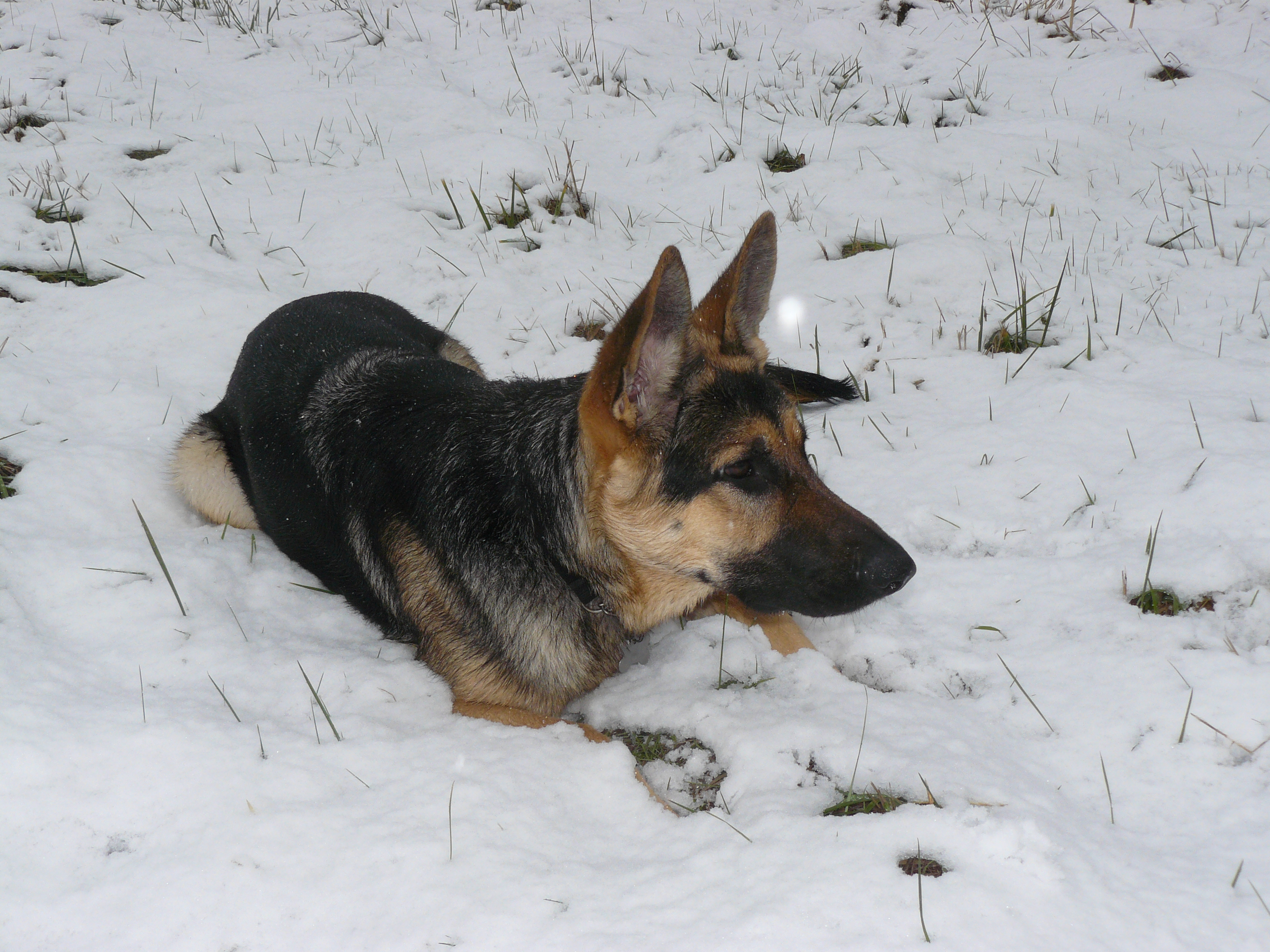
Finally, a picture of Cleo enjoying our recent snows.

Cleo in the snow.

We are so fortunate to share our lives with these beautiful creatures.

Please Americans, set the lead.

Powerful words from President Obama; now we the people must act.

I’m taking the liberty of reproducing in full the item that was published by Bill McKibben of 350.org yesterday.  As I wrote on the 17th this year has to be the year that we make a difference, a call to every man, woman and child on the planet.  This is a snippet from that post.

With these in mind, Doherty proposes a new grand strategic concept: “The United States must lead the global transition to sustainability.
What a vision for the United States of America.  That this Nation will be the most wonderful example of how man can learn, adapt and change.

So to the call issued by 350.org.

oooOOOooo

Dear Friends,

Here’s what President Obama said about climate change during his address today:

barack-obama8_text_small

With words like that, it’s easy to let ourselves dream that something major might be about to happen to fix the biggest problem the world has ever faced.

But we know that even if the President is sincere in every syllable, he’s going to need lots of backup to help him get his point across in a city dominated by fossil fuel interests. And, given the record of the last four years, we know that too often rhetoric has yielded little in the way of results.

That’s why we need you — very badly — to take a trip to our nation’s capital on Feb. 17th. We’ll gather on the National Mall, in what is shaping up to be be the largest environmental rally in many years.

Click here to join us in DC: act.350.org/signup/presidentsday

Together we’ll send the message loud and clear: ‘If you’re serious about protecting future generations from climate change, stop the Keystone XL tar sands pipeline. If you can do that, Mr. President, we can all work together to help build a climate legacy that will be a credit to your critical eight years in office.’

Look — numbers count. If 20,000 of us show up on February 17th, it will be noticed. We need you in that number. The President may have given us an opening, but it’s up to us to go through it, and we need to do it together.

Thanks for all you’ve done to bring us this far, friends. Let’s keep it up — this is our chance.

Bill

oooOOOooo

Even if you are unable to be there in person on the 17th., do what you can to circulate this just as far and wide as possible.

Here’s to a good laugh.

Forwarded to me by Cynthia – a very brave lady indeed.

It seems to have been a tough week in various ways so why not open a bottle of your favourite vintage and raise a glass to all the brave persons in the world.

wine1


—-

wine2

—-

wine3

—-

wine4

—-

wine5

—-

wine6

—-

wine7

—-

wine8

—-

wine9

—-

wine10

—-

wine11

—-

wine12

—-

wine13

—-

wine14

oooOOOooo

Let me close with a quotation reputed to be from the lips of Joan Collins:

Age is just a number. It’s totally irrelevant unless, of course,

you happen to be a bottle of wine.

The wonder of dogs.

Never before has an integrous way of life been so critically important.

When I was preparing this post, I couldn’t make up my mind if it should come before or after the story of the release of The National Climate Assessment.  In the end I decided it should follow the post that I called The unacceptable face of The Daily Mail.

My reasoning was that the NCA report was such a stunning indictment of the madness, the myopic madness of mankind these last 100 years, that this appreciation of the wonder of dogs must act as a beacon for us all.  I use the word ‘beacon’ because the qualities demonstrated by these nine dogs are just the qualities that we need to adopt.

Every living person on Planet Earth has to embrace the stark choice coming up on us like a runaway train. If we don’t change our values, our behaviours and our relationship with this one, finite planet, in the next ten years, at most, then the consequences will be beyond imagination; a world of unimaginable terror and chaos.

Forgive me if I repeat what the Home page of Learning from Dogs offers:

As man’s companion, protector and helper, history suggests that dogs were critically important in man achieving success as a hunter-gatherer.  Dogs ‘teaching’ man to be so successful a hunter enabled evolution, some 20,000 years later, to farming,  thence the long journey to modern man.  But in the last, say 100 years, that farming spirit has become corrupted to the point where we see the planet’s plant and mineral resources as infinite.  Mankind is close to the edge of extinction, literally and spiritually.

On the 30th December, 2012 The Week magazine published an item written by Editor Lauren Hansen.  I ask Lauren if I might republish the article in full but that was denied.  However, I was given permission to refer extensively to the piece.  I will use it to underline just what we have to learn from dogs.

The 9 most newsworthy dogs of 2012

Dogs are the best. Here’s the proof… if you even need it
By Lauren Hansen | December 30, 2012
The K-9 Parish Comfort dogs (and their handlers) who helped the residents of Newtown, Conn., through their grief.

If you’re reading this, then you’re probably aware: Dogs rule. This year, a handful of canines rose above the rest, making headlines for their actions — whether facing imminent danger to save lives, enduring unimaginable physical hardships, or simply making us laugh. A look at nine of the year’s most newsworthy pups:

1. Chicago’s comfort dogs
After the unimaginable events that befell Newtown, Conn., on Dec. 14 that left 27 people, including 20 children, dead at the hands of suspected gunman Adam Lanza, a team of golden retrievers was deployed from Chicago to the picturesque town. About 10 specially trained dogs, including Chewie, Ruthie, and Luther, made the 800-mile journey to sit with children and adults during masses and funerals. “Dogs are nonjudgmental. They are loving. They are accepting of anyone,” says one handler. “It creates the atmosphere for people to share.” The Chicago comfort dogs are notable not only for this caring venture but also for helping those who suffered through Hurricane Sandy and the tornado that hit Joplin, Mo., in 2011.

The next story was about the puppies that kept a lost boy warm.

That was followed by the hero dog that lost its snout saving two girls.

One dog’s heroism so disfigured her sweet little face that her photo is often preceded by a warning. This canine’s story started with a motorcycle careening through the streets of Zamboanga City, Philippines, earlier this year. Young cousins Dina Bunggal, 11, and Princess Diansing, 3, stepped unknowingly into its path. A mutt named Kabang came out of nowhere and jumped in front of the motorbike, stopping it in its tracks, and saving the little girls from serious injury. The driver and the girls emerged with superficial wounds, but Kabang wasn’t so lucky. Her head landed on the motorcycle’s front wheel and as the wheel rolled forward, Kabang’s upper snout was ripped right off. Her story quickly went viral and when local doctors could do no more to help her, specialty surgeons from the University of California, Davis, flew Kabang to their facilities, where she’ll endure six to eight weeks of treatment to repair her face. The cost of her surgeries, which could top $20,000, will be covered by her many supporters who have started an online fundraising campaign.

Here’s a photograph of Kabang found on the web.

kabang_7600
Vets at William R. Pritchard Veterinary Medical Teaching Hospital don’t plan to fullyy reconstruct Kabang’s snout, or fit her with a prosthetic. Instead, they are attempting to close the gaping wound on her face, preventing further infections.

Then my last dip into Lauren’s article is dog story eight.

8. The dog that saved its own life by calling the police

We’ve often heard the tale of the puppy that proves its “man’s best friend” status by saving its owner’s life. But this year, there was George, a 2-year-old basset hound in West Yorkshire, England, who reworked the well-worn script a bit, literally calling for help to save himself. Home alone, George had knocked the phone to the floor and was strangling himself with the handset’s cord when he apparently dialed 999 — England’s 911 equivalent — in a panic. The operator heard only frantic gasps and, assuming someone was desperately sick or reeling from an attack, sent police to the house. The dog was found and rescued from the cord. “Incredibly, you could see where his paw print was on the phone,” said the neighbor, “he literally saved his own life.”

The article also mentions a recent item in Huffington Post (UK):

Now, what fun-loving toddler can walk past a puddle without stopping for a little splash? Not this one!

Little Arthur was out for a stroll with his best mate, Watson the dog, when he noticed a tempting puddle. So he put down the leash and plunged straight in. And Watson? Well, he’s a more mature 12 years old, so he didn’t partake himself. But he was more than happy to wait while Arthur had his fun.

You know what this video is, don’t you? That’s right. Too. Cute. For. Words.

Here’s the video, seen over 4,800,000 times!

Finally, there’s the beautiful story of the dog befriending a Down’s Syndrome boy.

sweetmama

So what does this all add up to?  That the qualities of the dog; integrity, unconditional love, patience, loyalty, and their ability to live in harmony with nature really do send us humans a message for the future.

And a future not so far away.

The unacceptable face of The Daily Mail

The shocking distortions made by The Daily Mail newspaper.

On the 9th January, 2013 The Daily Mail published this item:

The crazy climate change obsession that’s made the Met Office a menace

  • The £200 million-a-year official weather forecaster often gets it wrong
  • This week it has admitted there is no evidence that ‘global warming’ is happening
  • The Met Office quietly readjusted its temperature projections on its website on Christmas Eve

By JAMES DELINGPOLE

PUBLISHED: 19:45 EST, 9 January 2013 | UPDATED: 02:56 EST, 10 January 2013

Was there ever a government quango quite so useless as the Met Office?

From its infamous ‘barbecue summer’ washout of 2009 to the snowbound winter it failed to predict in 2010 and the recent forecast-defying floods, our £200 million-a-year official weather forecaster has become a national joke.

But of all its recent embarrassments, none come close to matching the Met Office’s latest one.

Without fanfare — apparently in the desperate hope no one would notice — it has finally conceded what other scientists have known for ages: there is no evidence that ‘global warming’ is happening.

If you want to read the full article, it’s here.

Needless to say the UK Met Office published a detailed rebuttal.  One of the comments that I spotted following that rebuttal was this lovely one from MD Dalgleish:

The Daily Mail does not let the facts get in the way of a story! Nothing new there, they’ve been doing that since before the war. What baffles me is why so many people buy this paper.

Quite so!

It would all be a bit of a laugh if it were not for what follows.

Last Friday, Naked Capitalism, the fabulous blog run by Yves Smith published in her set of links this item, “Climate change set to make America hotter, drier and more disaster-prone.”  Newly living here in Southern Oregon, that obviously caught my eye!

The item referred to a detailed account in the British Guardian newspaper by Suzanne Goldenberg, the newspaper’s US Environment Correspondent.

Climate change set to make America hotter, drier and more disaster-prone

Draft report from NCA makes clear link between climate change and extreme weather as groups urge Obama to take action

The report says steps taken by Obama to reduce emissions are 'not close to sufficient' to prevent the most severe consequences of climate change. Photo: Saul Loeb/AFP
The report says steps taken by Obama to reduce emissions are ‘not close to sufficient’ to prevent the most severe consequences of climate change. Photo: Saul Loeb/AFP

Future generations of Americans can expect to spend 25 days a year sweltering in temperatures above 100F (38C), with climate change on course to turn the country into a hotter, drier, and more disaster-prone place.

The National Climate Assessment, released in draft form on Friday , provided the fullest picture to date of the real-time effects of climate change on US life, and the most likely consequences for the future.

The 1,000-page report, the work of the more than 300 government scientists and outside experts, was unequivocal on the human causes of climate change, and on the links between climate change and extreme weather.

“Climate change is already affecting the American people,” the draft report said. “Certain types of weather events have become more frequent and/or intense including heat waves, heavy downpours and in some regions floods and drought. Sea level is rising, oceans are becoming more acidic, and glaciers and Arctic sea ice are melting.”

Here’s a pithy question for Mr. James Delingpole of The Daily Mail, “Which part of this sentence are you having trouble with – The 1,000-page report, the work of the more than 300 government scientists and outside experts, was unequivocal on the human causes of climate change, and on the links between climate change and extreme weather.?” [my emphasis]

Suzanne goes on to say:

The report will be open for public comment on Monday.

Environmental groups said they hoped the report would provide Barack Obama with the scientific evidence to push for measures that would slow or halt the rate of climate change – sparing the country some of the worst effects.

The report states clearly that the steps taken by Obama so far to reduce emissions are “not close to sufficient” to prevent the most severe consequences of climate change.

“As climate change and its impacts are becoming more prevalent, Americans face choices,” the report said. “Beyond the next few decades, the amount of climate change will still largely be determined by the choices society makes about emissions. Lower emissions mean less future warming and less severe impacts. Higher emissions would mean more warming and more severe impacts.”

As the report made clear: no place in America had gone untouched by climate change. Nowhere would be entirely immune from the effects of future climate change.

One might argue that it won’t be very long before no sane person on this planet would swallow that crap from The Daily Mail.  But when we get to that stage of every person being aware of the forces at work upon our fair planet it will be a tad too late.

The only home we have.

That’s why this report is to be encouraged, nay embraced.  Of all the nations in the world, the one that should be setting the lead is the United States of America.  As the banner on that globalchange.gov website proclaims: Thirteen Agencies, One Vision: Empower the Nation with Global Change Science

So go and read the report.  For your sake and all our sakes.

Because the more informed you and I are, the better the chances of real political leadership taking place in this fine nation.

Download Chapters of the NCADAC DraftClimate Assessment Report!   
Download the Full Report (warning, 147Mb. Very large file)Between chapters, there are some page numbers that are not used. This is intentional and does not reflect missing pages.or download each chapter separately:

Cover page

Introduction: Letter to the American People

1. Executive Summary

2. Our Changing Climate

Introduction to Sectors

3. Water Resources

4. Energy Supply and Use

5. Transportation

6. Agriculture

7. Forestry

8. Ecosystems, Biodiversity, and Ecosystem Services

9. Human Health

10. Water, Energy, and Land Use

11. Urban Systems, Infrastructure, and Vulnerability

12. Impacts of Climate Change on Tribal, Indigenous, and Native Lands and Resources

13. Land Use and Land Cover Change

14. Rural Communities

15. Interactions of Climate Change and Biogeochemical Cycles

Introduction to Regions

16. Northeast

17. Southeast and Caribbean

18. Midwest

19. Great Plains

20. Southwest

21. Northwest

22. Alaska and the Arctic

23. Hawaii and the U.S. Affiliated Pacific Islands

24. Oceans and Marine Resources

25. Coastal Zone Development and Ecosystems

Introduction to Response Strategies

26. Decision Support: Supporting Policy, Planning, and Resource Management Decisions in a Climate Change Context

27. Mitigation

28. Adaptation

29. Research Agenda for Climate Change Science

30. The NCA Long-Term Process: Vision and Future Development

Appendix I: NCA Climate Science – Addressing Commonly Asked Questions from A to Z

Appendix II: The Science of Climate Change

Essence of wisdom, page three.

A genuine leader is not a searcher for consensus but a molder of consensus.

My concluding essay on the subject of wisdom starts off with this quotation by Martin Luther King, Jr.  That he was best known for using nonviolent civil disobedience to achieve political aims in the 1950’s and 60’s may not be inappropriate today.

I started with looking at our brain in recognition of the strange ways in which we humans make sense of the world, then yesterday looked at how we confuse what we do with what is best for us, surely the essence of wisdom.  Today, I want to conclude with a reflection on the gap between the new wisdom of millions of citizens and the failure of so many leaders to recognise this wisdom.  When I use the word wisdom in this context, it’s probably more in the sense of awareness.  The growing awareness by millions of us that something isn’t right and that our democratic representatives and leaders are way behind.

I will support my argument by referring to a number of media items that have surfaced in recent days.

Let’s start with this weather forecasting chart from the Australian Bureau of Meteorology.

art-weather-620x349

Australia’s “dome of heat” has become so intense that the temperatures are rising off the charts – literally.

The air mass over the inland is still heating up – it hasn’t peaked

The Bureau of Meteorology’s interactive weather forecasting chart has added new colours – deep purple and pink – to extend its previous temperature range that had been capped at 50 degrees.

The range now extends to 54 degrees – well above the all-time record temperature of 50.7 degrees reached on January 2, 1960 at Oodnadatta Airport in South Australia – and, perhaps worryingly, the forecast outlook is starting to deploy the new colours.

“The scale has just been increased today and I would anticipate it is because the forecast coming from the bureau’s model is showing temperatures in excess of 50 degrees,” David Jones, head of the bureau’s climate monitoring and prediction unit, said.

Just reflect on that!  54 degrees Centigrade is 129 degrees Fahrenheit!

On January 4th, just 5 days ago, Bill Moyers held an interview with climate change communication expert Anthony Leiserowitz who explained why climate change gets the silent treatment, and what we should do about it.  Here’s a trailer to that programme.

I very strongly recommend you put an hour to one side and watch the full programme available here.

Next comes a recent item on Christine’s fantastic blog 350 or bust.  I forgot to ask Christine for permission to reproduce her article but am confident that republishing it on Learning from Dogs carries her full support.

New Report Connects Dots Between Political Inaction & Growing Cost Of Climate Change

ucs-cartoon

This is a reposting from The Earth Story’s Facebook page:

“The cost of living is going up and the chance of living is going down. “ –Flip Wilson

A new publication issued by the International Institute for Applied Systems Analysis (IIASA) in the journal “Nature” has reported that the chances of keeping temperatures below a 2 degree rise is now largely in the hands of policy makers.

The challenge of a changing climate can now only be fought with the backing of political agenda – and as most people will agree, this seems bleak.

Of all the uncertainties with regard the effects of climate change, including geophysical and social uncertainties; political uncertainty ranked as the number 1 factor in determining the fate of our species and our planet.

What went wrong? Maybe we have been advertising climate change in an ineffective manner, considering how politically charged the world is?

The burdens of climate change are often communicated in relation to extreme weather events, melting ice caps, lives lost, loss of biodiversity, endangered species etc., but it would appear that to some this doesn’t seem to ring a bell; probably as the bell doesn’t chime as “cha ching cha ching”.

So what happens if we try to communicate climate change in relation to cost?

In 2012, in the United States alone, there were 11 natural disasters that cost over $1 billion – and this does not yet include the almost country wide drought or hurricane sandy, and let’s not forget the multiple other disasters which did not make the 1 billion benchmark. It is predicted that events, like the ones that swept the entire globe in 2012, will increase in frequency and in destructive force if we do not keep temperatures below the 2 degree rise on pre-industrial temperatures.

If we do not change our ways by 2020, the research group have found that the probability of keeping the temperature within the assigned two degree window drops below 50% (best case) or 20% (worst case) – no matter how much money is spent in the effort.

It is predicted that money will not matter; it’s almost bittersweet.

2012 was an eye opening year in terms of our natural environment. From here on out, let’s try change our ways; not our climate. The clock is ticking.

“… the chances of keeping temperatures below a 2 degree rise is now largely in the hands of policy makers.”  Further comment by me is pointless – the message is already crystal clear.

The implications of the changes that are being imposed on all of us were picked up in a recent article in the British newspaper The Telegraph: Rising food prices will reap a bitter harvest.  Here’s a flavour (sorry!) of the article.

British shoppers should brace themselves for “massive” food price rises in 2013, says the aptly named Mark Price, managing director of Waitrose. Is he correct, or is this just another retailer trying to soften up public opinion before imposing price hikes?

Liam Halligan goes on to write (my emphasis):

It strikes me that Price most certainly is right and his statement deserves more comment and consideration. For it is almost inevitable that many crucial foodstuffs will become considerably more expensive during 2013, not least due to recent weather patterns. More fundamentally, the food price rises we’ll see over the coming year will also reflect longer-term non-cyclical trends, not least the burgeoning world population.

During 2013, in fact, rising food prices are likely not only to have a serious impact on the global economy, but could well spark violence and political upheaval, not least in the Middle East.

The importance of the trend Price has highlighted, then, goes way beyond the tills of upmarket British supermarkets. It’s certainly the case, though, that UK food production looks weak, as heavy rainfall in 2012 meant many crops were ruined and farmers couldn’t plant as much as they wanted for 2013. Despite a very dry first quarter, 2012 was this country’s second-wettest year since records began in 1910.

I don’t want to quote any more from the article but read it and realise how the world in 2013 may be unrecognisable beyond our wildest imaginations.

OK, going to round this off.

Firstly, by asking you to read a recent item in Democracy Journal.  This is how the article starts.

Everyone’s Fight: The New Plan to Defeat Big Money

The 2012 campaign is by now mercifully out of our systems, but it remains worth reflecting on some of the dubious firsts that occurred during this election. This was the first presidential campaign to cost more than $2 billion. It was also the first time neither candidate accepted any public financing or the limits that come with it. Finally, it was the first presidential election after Citizens United, the Supreme Court decision that allowed around $600 million in super PAC donations this cycle, and many millions more to nonprofit “social welfare” groups that aren’t required to disclose their donors.

But even these bleak facts don’t do justice to the problem of Big Money. Campaign spending isn’t even our most dire money-in-politics problem. That would be the thousands of lobbyists and many millions of their dollars that are devoted to the warping of our public policy. These powerful lobbies control most outcomes on Capitol Hill, and the problem is far worse than it was 20 years ago.

Read the rest here.

Lastly, by returning to another recent item from Bill Moyers.

Citizens, Not Consumers, Are Key to Solving Climate Crisis

January 4, 2013

by Lauren Feeney

Annie Leonard spent 20 years working for environmental organizations, studying where our stuff comes from and where it goes. She followed waste from industrialized countries to apartheid-era South Africa, where it was dumped in black townships, to Haiti, where it was disguised as fertilizer and dumped on a beach, to Pakistan, Indonesia and the Philippines where we sent everything from e-waste to used car batteries for recycling in a process too dirty for our own backyard.

Then, in 2007, she made a short animated film about our consumer culture and the damage it does to the environment. The Story of Stuff went viral (chances are you’ve seen it — more than 15 million people have) and spawned a whole series of videos that explain complicated environmental and political concepts in an irresistibly simple and engaging way. We reached Annie via email to talk about the latest installment, The Story of Change. This one’s a bit of a departure — instead of looking at the problem, it proposes a solution.

It included this video:

Can shopping save the world? The Story of Change urges viewers to put down their credit cards and start exercising their citizen muscles to build a more sustainable, just and fulfilling world.

I shall close with another quotation from Martin Luther King, Jr.

“The ultimate measure of a man is not where he stands in moments of comfort and convenience, but where he stands at times of challenge and controversy.”