My mother and father were atheists so when I was born in 1944 it was obvious that I would be brought up as an atheist. Same for my sister, Elizabeth, born in 1948. It was amazing that when I met Jean in Mexico in 2007 that she, too, was an atheist. That was on top of the fact that we were both born in North London some 26 miles apart. Talk about fate!
I was abused as a child. The abuse to which I was subjected is called “child indoctrination,” a type of brainwashing considered noble and necessary and, therefore, the most natural thing in the world.
My mother took me to the Seventh-day Adventist Church, an American denomination known for keeping the Sabbath and emphasizing the advent, or return, of Jesus. Adventists boast that they are the only ones to interpret the Bible the way its author wanted. Consequently, they deem themselves the most special creatures to God—so special that they’ll soon arouse the envy and wrath of all other denominations and religions, which, under the command of the beasts of Revelation (the American government and the Catholic Church), will persecute them. Adventists believe that the Earth was created in six days, that it is 6,000 years old, and that dinosaurs are extinct because they were too big to be saved on Noah’s ark.
It closes thus:
I don’t want to believe; I want to know. Atheism is a natural result of intellectual honesty.
The author of the article, Paulo Bittencourt is described as:
Paulo Bittencourt was born in Castro, Brazil, spent his childhood in Rio de Janeiro, and studied theology in São Paulo. Close to becoming a pastor, he went on an adventure to Europe and ended up settling in Austria, where he trained as an opera singer. Bittencourt is the author of the books Liberated from Religion: The Inestimable Pleasure of Being a Freethinker and Wasting Time on God: Why I Am an Atheist.
Any dog owner can tell you there’s nothing like having a loyal companion. Dogs are good pets for people of any age, as long as you choose the right dog for your lifestyle.
If you’re an older adult looking to find a furry, four-legged friend, here are a few things you should consider.
Why Get a Dog?
It’s a big responsibility, but the benefits are worth the work. Dogs can give you joy, companionship, and unconditional love. They can bring warmth and comfort into your life.
Better health. Decades of studies have shown the health benefits of spending time with dogs. Dog owners tend to have better heart and blood vessel health, including lower blood pressure, than those who don’t have a pet pup. That’s because dogs get people moving. Walking a dog regularly can help you boost how much exercise you get each day.
Less lonely. Dogs offer companionship just by being around. They might also help you be more social. Taking your dog on walks gives you a chance to meet neighbors or other canine owners at the local dog park.
Much happier. Looking at your dog can release a hormone that makes you feel happier. Science shows that gazing into your dog’s eye releases oxytocin. Known as the love hormone, oxytocin quickly boosts your mood.
Caring for a Dog
Before you get a furry pal, you should think about what you can offer the dog, as well as what they can offer you. You want to make sure to choose a dog that will be happy with the kind of life you lead. Consider these things when you start looking for a new pet.
Space. How much room do you have indoors and outdoors? You need to pick a dog that will be happy with the space you have to offer.
Exercise. Some dogs need a lot of exercise, while others are happy hanging out on the couch all day. Think about how much exercise time you can give your pup. Also, think about how fit you are. You may not want a large, strong dog that could tug hard on the leash and cause you to get hurt on a walk.
Cost. All dogs need vet care, food, and toys. If they need a lot of grooming, you need to consider paying a professional groomer.
Age. Puppies are cute, but they’re also a lot of work. Older dogs may already have some training, but they might be set in their ways. Spend some time thinking about what you’re willing to accept in dog behavior.
Best Breeds for Seniors
Here are a few breeds that are natural choices for older adults.
Bichon Frise. These dogs are very small and cute. Their fluffy coats need regular grooming. They’re happy in small homes and apartments, and they only need moderate exercise.
Cocker spaniels. These dogs are known for their beautiful, soft coats, which need regular grooming. They’re gentle and friendly, and usually weigh under 30 pounds. They need regular walks to stay fit, but they aren’t highly energetic.
Beagles. They’re small, smart, and make wonderful companions. Their short coats are easy to groom. Beagles are energetic and need a lot of exercise every day.
Greyhounds. They can run fast, but they don’t always want to. They’re happiest lounging around indoors, but they need walks to stay fit. They’re large, usually weighing around 60 pounds, but they have short coats that don’t require a lot of grooming.
Pugs. These happy little dogs make great companions. They’re usually around 15 pounds and have short, easy-to-groom coats. They need more exercise than they want because they’re prone to be overweight. Regular walks can take care of that.
If you’re an older adult looking for a four-legged companion, you can speak to a veterinarian or a dog trainer in your area for more information. They can help you choose the perfect pet.
ooOOoo
I am certain there are many people who will find this a practical help in deciding what dog to get.
In my own case we currently have two dogs, Cleo and Oliver, and I frequently ponder on what Jean and I do when the last of them dies.
This article reminds me and Jean that at whatever age we are it is better to have a dog than not!
I am writing this having listened to a programme on BBC Radio 4. (Was broadcast on Radio 4 on Tuesday, August 13th.) It shows how many, many people can have a really positive response to a dastardly negative occurrence such as the Covid outbreak or a pandemic.
Every Friday, volunteers gather on the Albert Embankment at the River Thames in London to lovingly retouch thousands of red hearts inscribed on a Portland stone wall directly opposite the Houses of Parliament. Each heart is dedicated to a British victim of COVID. It is a deeply social space – a place where the COVID bereaved come together to honour their dead and share memories.
The so-called National Covid Memorial Wall is not, however, officially sanctioned. In fact, ever since activists from COVID-19 Bereaved Families for Justice (CBFFJ) daubed the first hearts on the wall in March 2021 it has been a thorn in the side of the authorities.
Featured in the media whenever there is a new revelation about partygate, the wall is a symbol of the government’s blundering response to the pandemic and an implicit rebuke to former prime minister Boris Johnson and other government staff who breached coronavirus restrictions.
As one writer put it, viewed from parliament the hearts resemble “a reproachful smear of blood”. Little wonder that the only time Johnson visited the wall was under the cover of darkness to avoid the TV cameras. His successor Rishi Sunak has been similarly reluctant to acknowledge the wall or say what might take its place as a more formal memorial to those lost in the pandemic.
Though in April the UK Commission on COVID Commemoration presented Sunak with a report on how the pandemic should be remembered, Sunak has yet to reveal the commission’s recommendations.
Lady Heather Hallett, the former high court judge who chairs the public inquiry into COVID, has attempted to acknowledge the trauma of the bereaved by commissioning a tapestry to capture the experiences of people who “suffered hardship and loss” during the pandemic. Yet such initiatives are no substitute for state-sponsored memorials.
What is remembered and what is forgotten?
This political vacuum is odd when you consider that the United Kingdom, like other countries, engages in many other commemorative activities central to national identity. The fallen of the first world war and other military conflicts are commemorated in a Remembrance Sunday ceremony held every November at the Cenotaph in London, for example.
But while wars lend themselves to compelling moral narratives, it is difficult to locate meaning in the random mutations of a virus. And while wars draw on a familiar repertoire of symbols and rituals, pandemics have few templates.
For instance, despite killing more than 50 million globally, there are virtually no memorials to the 1918-1919 “Spanish” influenza pandemic. Nor does the UK have a memorial to victims of HIV/AIDS. As the memory studies scholar Astrid Erll puts it, pandemics have not been sufficiently “mediated” in collective memory.
As a rule, they do not feature in famous paintings, novels or films or in the oral histories passed down as part of family lore. Nor are they able to draw on familiar cultural materials such as poppies, gun carriages, catafalques and royal salutes. Without such symbols and schemata, Erll argues, we struggle to incorporate pandemics into our collective remembering systems.
This lacuna was brought home to me last September when tens of thousands of Britons flocked to the south bank of the Thames to pay their respects to Britain’s longest serving monarch. By coincidence, the police directed the queue for the late Queen’s lying-in-state in Westminster Hall over Lambeth Bridge and along Albert Embankment.
But few of the people I spoke to in the queue seemed to realise what the hearts signified. It was as if the spectacle of a royal death had eclipsed the suffering of the COVID bereaved, rendering the wall all but invisible.
Waiting for answers
Another place where the pandemic could be embedded in collective memory is at the public inquiry. Opening the preliminary hearing last October into the UK’s resilience and preparedness for a pandemic, Lady Hallett promised to put the estimated 6.8 million Britons mourning the death of a family member or friend to COVID at the heart of the legal process. “I am listening to them; their loss will be recognised,” she said.
But though Lady Hallett has strategically placed photographs of the hearts throughout the inquiry’s offices in Bayswater and has invited the bereaved to relate their experiences to “Every Story Matters”, the hearing room is dominated by ranks of lawyers. And except when a prominent minister or official is called to testify, the proceedings rarely make the news.
This is partly the fault of the inquiry process itself. The hearings are due to last until 2025, with the report on the first stage of the process not expected until the summer of 2024. As Lucy Easthope, an emergency planner and veteran of several disasters, puts it: “one of the most painful frustrations of the inquiry will be temporal. It will simply take too long.”
The inquiry has also been beset by bureaucratic obfuscation, not least by the Cabinet Office which attempted (unsuccessfully in the end) to block the release of WhatsApp messages relating to discussions between ministers and Downing Street officials in the run-up to lockdown.
To the inquiry’s critics, the obvious parallel is with the Grenfell inquiry, which promised to “learn lessons” from the devastating fire that engulfed the west London tower in 2017 but has so far ended up blurring the lines of corporate responsibility and forestalling a political reckoning.
The real work of holding the government to account and making memories takes place every Friday at the wall and the other places where people come together to spontaneously mourn and remember absent loved ones. These are the lives that demand to be “seen”. They are the ghosts that haunt our amnesic political culture.
Ellie Woods’ family dog Bobby has always been an important part of her love story with her wife Georgie Woods. When Ellie brought Georgie home for the first time, the family member she was most anxious for Georgie to meet was Bobby.
When the couple got engaged and started planning their wedding, they decided it would be fun to try to document the wedding from Bobby’s unique perspective. So right before the ceremony started, they attached a GoPro to Bobby’s back and then set him loose.
For some dogs, walking around with a camera on their back might take some getting used to — but not for Bobby. He immediately felt comfortable.
“He loves being the center of attention,” Georgie told The Dodo. “He just loved it.”
Georgie and Ellie said having Bobby at their wedding was incredibly meaningful for them.
@SASHALEEPHOTOGRAPHY
“Animals are really important to queer couples,” Ellie said. “[I]t was so important to have him … as part of our big day.
When the newlyweds sat down to watch the footage Bobby had captured, what they saw surprised and delighted them. The GoPro had caught Bobby stealing hors d’oeuvres and even walking in on Georgie’s sister in the bathroom. While Bobby is an expert videographer, he is still a dog, after all.
Of course, Bobby’s camera recorded much more than shenanigans. Georgie and Ellie loved watching themselves walk down the aisle together from Bobby’s perspective.
“It captured some really special moments,” Ellie said. “[W]e couldn’t be happier for how it came out because it’s just so organic and such an interesting, different perspective.”
ooOOoo
Dogs are just incredible. As much as I have already said that, time and time again there comes a story that just reinforces that previous sentence.
When staff members and volunteers at Saving Hope Rescue noticed a box had been dumped on their property, their hearts sank. As they got closer, they saw the box had “puppies her” written on the side of it and had a feeling they knew who was inside.
Saving Hope Rescue
When they opened the box, the rescuers came face-to-face with a whole pile of all-white puppies. Even though their rescue was already at capacity, they knew they couldn’t turn their backs on the sweet little family. They put out a call for help to the community in order to get some support and began to get the pups settled in.
Saving Hope Rescue
As everyone at the rescue started getting to know the abandoned puppies, they realized that the pups had been hiding something: Apparently, they were all visually and hearing impaired to some degree.
“At first, they were all deemed blind and deaf,” Lauren Anton of Saving Hope Rescue told The Dodo. “Eventually, as time went by and they developed some more, we discovered that some puppies are more impaired than others.”
Saving Hope Rescue
It’s possible that this was the reason the puppies were abandoned in the first place, but it’s hard to know for sure. Either way, it didn’t change anything for the puppies’ rescuers. Even if they might need a little extra help, they were still members of the Saving Hope family.
As the puppies grew, their unique personalities began to shine through, and their rescuers were also able to start getting an accurate picture of their different abilities.
Saving Hope Rescue
“Mate is a good example of the slightly impaired puppies,” Anton said. “We don’t know how much she can see and hear, for sure, but we do know that she can hear being called, knows when we shake the food bag, and will approach people when called to come over … Koala, on the other hand, is much more impaired … We aren’t sure how much he can see. Maybe just shadows.”
Everyone is doing their best to get to know the puppies and their individual needs so they’ll know how to best help them as they grow. One thing is for sure though, the puppies are happy and thriving.
Saving Hope Rescue
“Over the last few weeks, they’ve gone from sleepy babies to rambunctious puppies,” Anton said. “They’re constantly playing and wrestling with each other. They’ve learned that human pets and snuggles feel nice, and they love to sleep in our arms.”
These puppies may have been abandoned, but now they’re getting the second chance they deserve.
ooOOoo
That is a beautiful story. Lauren and the staff are to be congratulated on doing what they did, and that was giving these puppies a new lease of life.
Extreme weather is by definition rare on our planet. Ferocious storms, searing heatwaves and biting cold snaps illustrate what the climate is capable of at its worst. However, since Earth’s climate is rapidly warming, predominantly due to fossil fuel burning, the range of possible weather conditions, including extremes, is changing.
Scientists define “climate” as the distribution of possible weather events observed over a length of time, such as the range of temperatures, rainfall totals or hours of sunshine. From this they construct statistical measures, such as the average (or normal) temperature. Weather varies on several timescales – from seconds to decades – so the longer the period over which the climate is analysed, the more accurately these analyses capture the infinite range of possible configurations of the atmosphere.
Typically, meteorologists and climate scientists use a 30-year period to represent the climate, which is updated every ten years. The most recent climate period is 1991-2020. The difference between each successive 30-year climate period serves as a very literal record of climate change.
This way of thinking about the climate falls short when the climate itself is rapidly changing. Global average temperatures have increased at around 0.2°C per decade over the past 30 years, meaning that the global climate of 1991 was around 0.6°C cooler than that in 2020 (when accounting for other year-to-year fluctuations), and even more so than the present day.
A moving target for climate modellers
If the climate is a range of possible weather events, then this rapid change has two implications. First, it means that part of the distribution of weather events comprising a 30-year climate period occurred in a very different background global climate: for example, northerly winds in the 1990s were much colder than those in the 2020s in north-west Europe, thanks to the Arctic warming nearly four times faster than the global average. Statistics from three decades ago no longer represent what is possible in the present day.
Second, the rapidly changing climate means we have not necessarily experienced the extremes that modern-day atmospheric and oceanic warmth can produce. In a stable climate, scientists would have multiple decades for the atmosphere to get into its various configurations and drive extreme events, such as heatwaves, floods or droughts. We could then use these observations to build up an understanding of what the climate is capable of. But in our rapidly changing climate, we effectively have only a few years – not enough to experience everything the climate has to offer.
Extreme weather events require what meteorologists might call a “perfect storm”. For example, extreme heat in the UK typically requires the northward movement of an air mass from Africa combined with clear skies, dry soils and a stable atmosphere to prevent thunderstorms forming which tend to dissipate heat.
Such “perfect” conditions are intrinsically unlikely, and many years can pass without them occurring – all while the climate continues to change in the background. Based on an understanding of observations alone, this can leave us woefully underprepared for what the climate can now do, should the right weather conditions all come together at once.
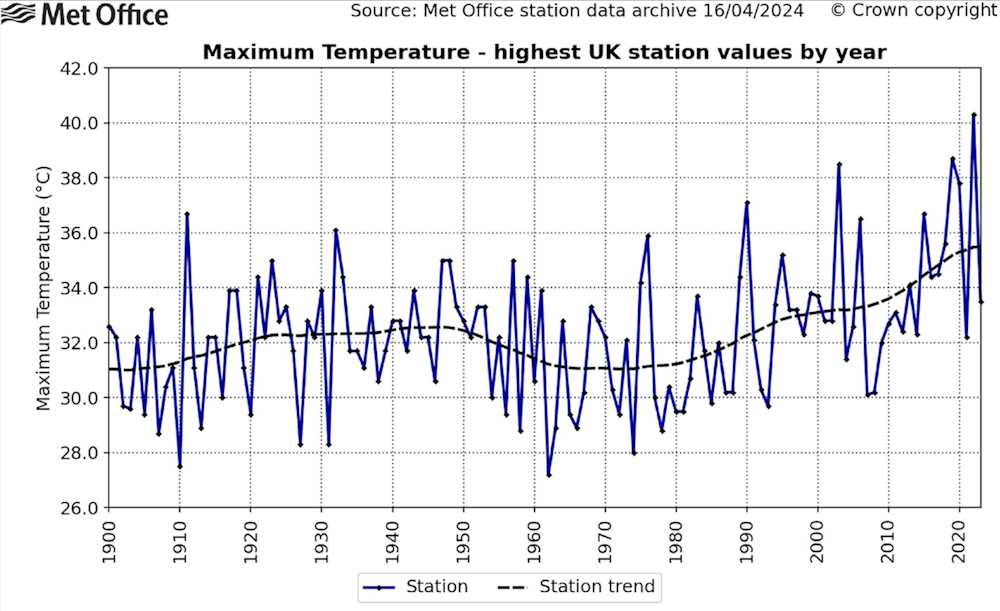
Startling recent examples include the extreme heatwave in the Pacific north-west of North America in 2021, in which temperatures exceeded the previous Canadian record maximum by 4.6°C. Another is the occurrence of 40°C in the UK in summer 2022, which exceeded the previous UK record maximum set only three years earlier by 1.6°C. This is part of the reason why the true impact of a fixed amount of global warming is only evident after several decades, but of course – since the climate is changing rapidly – we cannot use this method anymore.
Playing with fire
To better understand these extremes, scientists can use ensembles: many runs of the same weather or climate model that each slightly differ to show a range of plausible outcomes. Ensembles are routinely used in weather prediction, but can also be used to assess extreme events which could happen even if they do not actually happen at the time.
When 40°C first appeared in ensemble forecasts for the UK before the July 2022 heatwave, it revealed the kind of extreme weather that is possible in the current climate. Even if it had not come to fruition, its mere appearance in the models showed that the previously unthinkable was now possible. In the event, several naturally occurring atmospheric factors combined with background climate warming to generate the record-shattering heat on July 19 that year.
The highest observed temperature each year in the UK, from 1900 to 2023
Later in summer 2022, after the first occurrence of 40°C, some ensemble weather forecasts for the UK showed a situation in which 40°C could be reached on multiple consecutive days. This would have posed an unprecedented threat to public health and infrastructure in the UK. Unlike the previous month, this event did not come to pass, and was quickly forgotten – but it shouldn’t have been.
It is not certain whether these model simulations correctly represent the processes involved in producing extreme heat. Even so, we must heed the warning signs.
Despite a record-warm planet, summer 2024 in the UK has been relatively cool so far. The past two years have seen global temperatures far above anything previously observed, and so potential extremes have probably shifted even further from what we have so far experienced.
Just as was the case in August 2022, we’ve got away with it for now – but we might not be so lucky next time.
That last sentence says it all: “Just as was the case in August 2022, we’ve got away with it for now – but we might not be so lucky next time.”
I am giving a talk, The Next Ten Years, next Saturday to our local Freethinkers group in Grants Pass. Close to the start of the presentation I say: “The Global Temperature anomaly, as of last year, 2023, is 1.17 C, 2.11 F, above the long-term average from 1951 to 1980. The 10 most recent years are the warmest years on record.“
Finally, I am getting on in age and part of me wants to die, hopefully naturally, before more climate extremes are reached, but then another part of me would like to experience it!
The drawing depicts a turbaned cavalry soldier facing off against an English dragoon. It’s a bit trippy: The British soldier sits astride a carrot, and the turbaned soldier rides a grape. Both carrot and grape are fitted with horses’ heads and stick appendages.
‘The Battle of the Fruit and Vegetable Soldiers,’ a drawing on the back of a manuscript page from Charles Darwin’s ‘On the Origin of Species,’ attributed to Darwin’s young son Francis. Cambridge University Library, CC BY-ND
It’s thought to be the work of Francis Darwin, the seventh child of British naturalist Charles Darwin and his wife, Emma, and appears to have been made in 1857, when Frank would have been 10 or 11. And it’s drawn on the back of a page of a draft of “On the Origin of Species,” Darwin’s masterwork and the foundational text of evolutionary biology. The few sheets of the draft that survive are pages Darwin gave to his children to use for drawing paper.
Darwin’s biographers have long recognized that play was important in his personal and familial life. The Georgian manor in which he and Emma raised their 10 children was furnished with a rope swing hung over the first-floor landing and a portable wooden slide that could be laid over the main stairway. The gardens and surrounding countryside served as an open-air laboratory and playground.
Play also has a role in Darwin’s theory of natural selection. As I explain in my new book, “Kingdom of Play: What Ball-bouncing Octopuses, Belly-flopping Monkeys, and Mud-sliding Elephants Reveal about Life Itself,” there are many similarities – so many that if you could distill the processes of natural selection into a single behavior, that behavior would be play.
Through natural selection, the rock pocket mouse has evolved a coat color that hides it from predators in the desert Southwest.
In contrast to foraging and hunting – behaviors with clearly defined goals – play is likewise undirected. When a pony frolics in a field, a dog wrestles with a stick or chimpanzees chase each other, they act with no goal in mind.
Natural selection is utterly provisional: The evolution of any organism responds to whatever conditions are present at a given place and time. Likewise, animals at play are acting provisionally. They constantly adjust their movements in response to changes in circumstances. Playing squirrels, faced with obstacles such as falling branches or other squirrels, nimbly alter their tactics and routes.
Natural selection is open-ended. The forms of life are not fixed, but continually evolving. Play, too, is open-ended. Animals begin a play session with no plan of when to end it. Two dogs play-fighting, for instance, cease playing only when one is injured, exhausted or simply loses interest.
Keepers noticed that Shanthi, a 36-year-old elephant at the Smithsonian national zoo, liked to make noise with objects, so they gave her horns, harmonicas and other noisemakers.
Play is likewise profligate. It requires an animal to expend time and energy that perhaps would be better devoted to behaviors such as foraging and hunting that could aid survival.
And that profligacy is also advantageous. Animals forage and hunt in specific ways that don’t typically change. But an animal at play is far more likely to innovate – and some of its innovations may in time be adapted into new ways to forage and hunt.
Competing and cooperating
As Darwin first framed it, the “struggle for existence” was by and large a competition. But in the 1860s, Russian naturalist Pyotr Kropotkin’s observations of birds and fallow deer led him to conclude that many species were “the most numerous and the most prosperous” because natural selection also selects for cooperation.
Scientists confirmed Kroptokin’s hypothesis in the 20th century, discovering all manner of cooperation, not only between members of the same species but between members of different species. For example, clown fish are immune to anemone stings; they nestle in anemone tentacles for protection and, in return, keep the anemones free of parasites, provide nutrients and drive away predators.
Play likewise utilizes both competition and cooperation. Two dogs play-fighting are certainly competing, yet to sustain their play, they must cooperate. They often reverse roles: A dog with the advantage of position might suddenly surrender that advantage and roll over on its back. If one bites harder than intended, it is likely to retreat and perform a play bow – saying, in effect, “My bad. I hope we can keep playing.”
River otters at the Oregon Zoo repeatedly separate and reunite while playing in a tub of ice.
Natural selection and play also may both employ deception. From butterflies colored to resemble toxic species to wild cats that squeal like distressed baby monkeys, many organisms use mimicry to deceive their prey, predators and rivals. Play – specifically, play-fighting – similarly offers animals opportunities to learn about and practice deception.
And since natural selection shares so many features with play, we may with some justification maintain that life, in a most fundamental sense, is playful.



 Learning from Dogs