Three guest posts from Martin Lack of Lack of Environment, today Part One
Martin came to the attention of Learning from Dogs when making a comment to the second part of my Sceptical Voices essay. Since then, he and I have exchanged a number of emails. Over the next few days, I would like to re-publish an essay that Martin wrote that is worthy of deep consideration. Here is Part One. Part Two will be on Friday and Part Three next Monday, the 10th.
————————-
Can modernisation be “ecological”? – Part 1
This is the first of a series of posts based on an essay with this title that I wrote earlier this year as part of the requirements for my MA in Environmental Politics.
Introduction
There are two possible ways of understanding the question; as to require a critique ofEcological Modernisation (EM) as a school of environmental thought or perhaps, far more demandingly, a critique of modernity itself. Although the main intention of this essay is to do the latter; it will inevitably do the former as well.
Definitions
In order to answer this question, it is essential to define what is meant by ‘ecological’; ‘modernisation’; and the theory of EM to which it has given rise:
– In the context of the question, ‘ecological’ is taken to mean thinking, behaviour, and policy that are ‘environmentally-friendly’; rather than merely or predominantly anthropocentric (i.e. concerned with human needs and interests).
– To understand what is implied by the term ‘modernisation’, it is necessary to define what is meant by the word ‘modernity’ because people often conflate the term with industrialisation or even capitalism. However, whereas both of the latter were forged in the industrial revolution of the late eighteenth and early nineteenth century, modernity has its roots in the scientific revolution of “the Enlightenment” in the eighteenth century.
– The theory – if not the practice – of EM emerged from Germany in the early 1980s. Whereas the social scientists Joseph Huber and Martin Jänicke are most-commonly credited with having originated the term, it is probably Arthur Mol that brought it to the attention of the English-speaking world in 1996, when he quoted Huber as having (somewhat enigmatically) said, ‘…all ways out of the environmental crisis lead us further into modernity.’ Thankfully, Mol then went on to explain that EM theory therefore seeks to repair “…a structural design fault of modernity: the institutionalised destruction of nature.” (Mol 1996: 305).
In addition to the above, it is important to differentiate the terms ‘modernity’ and ‘civilisation’: Civilisation pre-dates the Enlightenment by several millennia; and is often equated with the development of agriculture, settled communities, and cities. However, since past civilisations have come and gone, is there any reason to think that our modern civilisation will be any different? This should not be seen as the question of a wannabe anarchist; as it is merely an acknowledgement of human history.
According to John Dryzek, the rhetoric of the EM discourse is reassuringly optimistic; and would have us believe that we can retain a healthy environment without having to sacrifice the benefits of progress (Dryzek 2005: 171). More recently, echoing both Mol and Dryzek, Neil Carter has defined EM as a “…policy strategy that aims to restructure capitalist political economy along more environmentally benign lines based on the assumption that economic growth and environmental protection can be reconciled.” (Carter 2007: 7).
It is in this context that Carter used the term “decoupling” to refer the idea of breaking any direct causal link between economic growth and environmental degradation; but also suggested that “dematerialisation” of manufacturing processes (i.e. the reduction of environmental resources consumed per unit of production) would be essential (2007: 227). However, if we take the manufacturing of motor cars as an example, the rate of fossil fuel consumption will always accelerate unless the percentage increases engine fuel efficiency is greater than the percentage increases in the number of cars. Therefore, since the former must exponentially decline towards zero, the logical conclusion is that we must control the demand for the latter.
—————
References:
Carter, N. (2007), The Politics of the Environment (2nd ed), Cambridge: Cambridge University Press.
Dryzek, J. (2005), The Politics of the Earth (2nd ed), Oxford: Oxford University Press.
Mol, A. (1996), ‘Ecological Modernisation and Institutional Reflexivity: Environmental Reform in the Late Modern Age’, Environmental Politics, 5(2), pp.302-23.
Readers may recall that John H. and I went to the nearest Moving Planet event in Phoenix, as posted on Monday. Now 350.org have released a video of the event as seen from a global perspective.
2000+ events. 180+ countries. A single day to Move Beyond Fossil Fuels. 350.org’s 2011 day of action, Moving Planet, brought together Moving Together.
Photos and Videos submitted by thousands of organizers and activists around the world — THANK YOU!
I know that expression from my days as a private pilot. It makes such obvious sense, especially in a single-engined light aircraft with one pilot on board. It’s all about risk.
Frederick Herzberg, the famous American psychologist, coined the term ‘hygiene factor’. It was the second part of a two-factor approach to the management of people. According to Herzberg’s theory, people are influenced by two sets of factors, motivation factors and hygiene factors. More background on this aspect here.
To me, as I reflect on the messages offered in the Sceptical Voices article, Part One and Part Two, the concepts of risk and hygiene seem totally appropriate to the topic of AGW, Anthropogenic Global Warming.
Whether or not AGW is a valid theory behind the rapid change in global warming is utterly irrelevant. It is the risk to humanity that matters. There is absolutely no harm done from assuming that AGW is happening and that feedback processes run a grave risk of tipping planetary conditions out of control, and getting that wrong.
On the other hand, assume that AGW is such an uncertain concept that it really isn’t wise to adjust our life styles, and getting that wrong would endanger the human species.
Think of being on a commercial airline flight and you become aware that one of the two pilots in the cockpit is incapacitated through food poisoning. No doubt that you, with all your fellow passengers, would vote for an immediate diversionary landing. It’s to do with risk.
From the perspective of Herzberg, a co-ordinated program by the world’s leading governments to tackle AGW might also improve the overall motivation of their peoples in a whole manner of ways.
Yes, question all we want, yes, there are other important issues to resolve in the world, but WHAT IF “Climate Change/Global Warming“ is for real, what then?
Dan wrote also in that Part One piece,
And by “peel-back-the-onion”, I mean that any ardent, independent researcher should publish both sides of the story as a matter of course. Especially in regards to global warming.
But publishing both sides of the story is not the argument. The argument is the risk to humanity of doing nothing, and getting it wrong.
That well-respected weekly newspaper The Economist had a recent article about the melting of Arctic ice, from which is quoted,
Arctic sea ice is melting far faster than climate models predict. Why?
Sep 24th 2011 - from the print edition
ON SEPTEMBER 9th, at the height of its summertime shrinkage, ice covered 4.33m square km, or 1.67m square miles, of the Arctic Ocean, according to America’s National Snow and Ice Data Centre (NSIDC). That is not a record low—not quite. But the actual record, 4.17m square km in 2007, was the product of an unusual combination of sunny days, cloudless skies and warm currents flowing up from mid-latitudes. This year has seen no such opposite of a perfect storm, yet the summer sea-ice minimum is a mere 4% bigger than that record. Add in the fact that the thickness of the ice, which is much harder to measure, is estimated to have fallen by half since 1979, when satellite records began, and there is probably less ice floating on the Arctic Ocean now than at any time since a particularly warm period 8,000 years ago, soon after the last ice age.
That Arctic sea ice is disappearing has been known for decades. The underlying cause is believed by all but a handful of climatologists to be global warming brought about by greenhouse-gas emissions. Yet the rate the ice is vanishing confounds these climatologists’ models. These predict that if the level of carbon dioxide, methane and so on in the atmosphere continues to rise, then the Arctic Ocean will be free of floating summer ice by the end of the century. At current rates of shrinkage, by contrast, this looks likely to happen some time between 2020 and 2050.
Re-read the sentence, “The underlying cause is believed by all but a handful of climatologists to be global warming brought about by greenhouse-gas emissions.” In particular, “by all but a handful of climatologists” Think of risk.
That article, which should be read in full, concludes thus,
A warming Arctic will bring local benefits to some. The rest of the world may pay the cost.
Indeed, the rest of the world may pay the cost! As I wrote, it’s all about risk.
So whether or not one wants to believe every word of that Economist article is irrelevant. Or whether one should have believed, or not, the article in New York’s The Sun newspaper back in 2007,
By SETH BORENSTEIN, Associated Press | December 12, 2007
WASHINGTON — An already relentless melting of the Arctic greatly accelerated this summer, a warning sign that some scientists worry could mean global warming has passed an ominous tipping point. One even speculated that summer sea ice would be gone in five years.
Greenland’s ice sheet melted nearly 19 billion tons more than the previous high mark, and the volume of Arctic sea ice at summer’s end was half what it was just four years earlier, according to new NASA satellite data obtained by the Associated Press.
“The Arctic is screaming,” a senior scientist at the government’s snow and ice data center in Boulder, Colo., Mark Serreze, said.
Last year, two scientists surprised their colleagues by projecting that the Arctic sea ice was melting so fast that it could disappear entirely by the summer of 2040. This week, after reviewing his own new data, a NASA climate scientist, Jay Zwally, said: “At this rate, the Arctic Ocean could be nearly ice-free at the end of summer by 2012, much faster than previous predictions.”
So scientists in recent days have been asking themselves these questions: Was the record melt seen all over the Arctic in 2007 a blip amid relentless and steady warming? Or has everything sped up to a new climate cycle that goes beyond the worst case scenarios presented by computer models? “The Arctic is often cited as the canary in the coal mine for climate warming,” Mr. Zwally, who as a teenager hauled coal, said. “Now as a sign of climate warming, the canary has died. It is time to start getting out of the coal mines.” [My emphasis, PH]
So, in conclusion, scepticism is healthy and is an important aspect of open debate within an open society, part of determining truth, however challenging that simple concept might be.
But eventually one needs to take a position, to take a stand on the really important issues in life and in the case of climate change the risk of being too sceptical, too cautious is to put the lives of future generations at stake. For me, and I guess for tens of thousands of others, that is a risk too far.
My apologies but the demands on my time are a little challenging this week. All as a result of the creative writing course that is being undertaken at our local Gila Community College, a course that I am loving, by the way!
Last Saturday, John H. and I went down to Tempe, Phoenix to attend the nearest Moving Planet event. It was well-attended especially by people the right side of 40 years-old! After all it is the succeeding generation that is going to cope with the consequences of the present abuse of the planet’s resources.
The leader of the event down in Tempe was Doug Bland of Arizona Interfaith Power and Light and it was very encouraging to see such a strong ecumenical involvement.
Later this week, I want to respond to the views that came out in the first part of the Sceptical voices piece last week but for now let me just leave you with a 4-minute video that was shown to the group down in Tempe last Saturday. It is called Try not to Make Connections.
Those who read yesterday’s part one will undoubtedly have seen the added comment from long-time friend of Learning from Dogs, Patrice Ayme. Yesterday, I promised to conclude Dan’s sceptical approach to climate warming with three articles that he had sent me. Here they are,
Global Warming
“Global warming” refers to the global-average temperature increase that has been observed over the last one hundred years or more. But to many politicians and the public, the term carries the implication that mankind is responsible for that warming. This website describes evidence from my group’s government-funded research that suggests global warming is mostly natural, and that the climate system is quite insensitive to humanity’s greenhouse gas emissions and aerosol pollution.
Believe it or not, very little research has ever been funded to search for natural mechanisms of warming…it has simply been assumed that global warming is manmade. This assumption is rather easy for scientists since we do not have enough accurate global data for a long enough period of time to see whether there are natural warming mechanisms at work.
The United Nation’s Intergovernmental Panel on Climate Change (IPCC) claims that the only way they can get their computerized climate models to produce the observed warming is with anthropogenic (human-caused) pollution. But they’re not going to find something if they don’t search for it. More than one scientist has asked me, “What else COULD it be?” Well, the answer to that takes a little digging… and as I show, one doesn’t have to dig very far.
But first let’s examine the basics of why so many scientists think global warming is manmade. Earth’s atmosphere contains natural greenhouse gases (mostly water vapor, carbon dioxide, and methane) which act to keep the lower layers of the atmosphere warmer than they otherwise would be without those gases. Greenhouse gases trap infrared radiation — the radiant heat energy that the Earth naturally emits to outer space in response to solar heating. Mankind’s burning of fossil fuels (mostly coal, petroleum, and natural gas) releases carbon dioxide into the atmosphere and this is believed to be enhancing the Earth’s natural greenhouse effect. As of 2008, the concentration of carbon dioxide in the atmosphere was about 40% to 45% higher than it was before the start of the industrial revolution in the 1800’s.
It is interesting to note that, even though carbon dioxide is necessary for life on Earth to exist, there is precious little of it in Earth’s atmosphere. As of 2008, only 39 out of every 100,000 molecules of air were CO2, and it will take mankind’s CO2 emissions 5 more years to increase that number by 1, to 40.
Earth's atmosphere
The “Holy Grail”: Climate Sensitivity Figuring out how much past warming is due to mankind, and how much more we can expect in the future, depends upon something called “climate sensitivity”. This is the temperature response of the Earth to a given amount of ‘radiative forcing’, of which there are two kinds: a change in either the amount of sunlight absorbed by the Earth, or in the infrared energy the Earth emits to outer space.
The ‘consensus’ of opinion is that the Earth’s climate sensitivity is quite high, and so warming of about 0.25 deg. C to 0.5 deg. C (about 0.5 deg. F to 0.9 deg. F) every 10 years can be expected for as long as mankind continues to use fossil fuels as our primary source of energy. NASA’s James Hansen claims that climate sensitivity is very high, and that we have already put too much extra CO2 in the atmosphere. Presumably this is why he and Al Gore are campaigning for a moratorium on the construction of any more coal-fired power plants in the U.S.
You would think that we’d know the Earth’s ‘climate sensitivity’ by now, but it has been surprisingly difficult to determine. How atmospheric processes like clouds and precipitation systems respond to warming is critical, as they are either amplifying the warming, or reducing it. This website currently concentrates on the response of clouds to warming, an issue which I am now convinced the scientific community has totally misinterpreted when they have measured natural, year-to-year fluctuations in the climate system. As a result of that confusion, they have the mistaken belief that climate sensitivity is high, when in fact the satellite evidence suggests climate sensitivity is low.
The case for natural climate change I also present an analysis of the Pacific Decadal Oscillation which shows that most climate change might well be the result of….the climate system itself! Because small, chaotic fluctuations in atmospheric and oceanic circulation systems can cause small changes in global average cloudiness, this is all that is necessary to cause climate change. You don’t need the sun, or any other ‘external’ influence (although these are also possible…but for now I’ll let others work on that). It is simply what the climate system does. This is actually quite easy for meteorologists to believe, since we understand how complex weather processes are. Your local TV meteorologist is probably a closet ’skeptic’ regarding mankind’s influence on climate.
Climate change — it happens, with or without our help.
And the next one,
Earth may be headed into a mini Ice Age within a decade
Physicists say sunspot cycle is ‘going into hibernation’
What may be the science story of the century is breaking this evening, as heavyweight US solar physicists announce that the Sun appears to be headed into a lengthy spell of low activity, which could mean that the Earth – far from facing a global warming problem– is actually headed into a mini Ice Age.
Ice skating on the Thames by 2025?
The announcement made on 14 June (18:00 UK time) comes from scientists at the US National Solar Observatory (NSO) and US Air Force Research Laboratory. Three different analyses of the Sun’s recent behaviour all indicate that a period of unusually low solar activity may be about to begin.
The Sun normally follows an 11-year cycle of activity. The current cycle, Cycle 24, is now supposed to be ramping up towards maximum strength. Increased numbers of sunspots and other indications ought to be happening: but in fact results so far are most disappointing. Scientists at the NSO now suspect, based on data showing decades-long trends leading to this point, that Cycle 25 may not happen at all.
This could have major implications for the Earth’s climate. According to a statement issued by the NSO, announcing the research:
An immediate question is whether this slowdown presages a second Maunder Minimum, a 70-year period with virtually no sunspots [which occurred] during 1645-1715.
As NASA notes [1]:
Early records of sunspots indicate that the Sun went through a period of inactivity in the late 17th century. Very few sunspots were seen on the Sun from about 1645 to 1715. Although the observations were not as extensive as in later years, the Sun was in fact well observed during this time and this lack of sunspots is well documented. This period of solar inactivity also corresponds to a climatic period called the “Little Ice Age” when rivers that are normally ice-free froze and snow fields remained year-round at lower altitudes. There is evidence that the Sun has had similar periods of inactivity in the more distant past.
During the Maunder Minimum and for periods either side of it, many European rivers which are ice-free today – including the Thames – routinely froze over, allowing ice skating and even for armies to march across them in some cases.
“This is highly unusual and unexpected,” says Dr Frank Hill of the NSO. “But the fact that three completely different views of the Sun point in the same direction is a powerful indicator that the sunspot cycle may be going into hibernation.”
Hill’s own research focuses on surface pulsations of the Sun and their relationship with sunspots, and his team has already used their methods to successfully predict the late onset of Cycle 24.
“We expected to see the start of the zonal flow for Cycle 25 by now,” Hill explained, “but we see no sign of it. This indicates that the start of Cycle 25 may be delayed to 2021 or 2022, or may not happen at all.”
Hill’s results match those from physicists Matt Penn and William Livingston, who have gone over 13 years of sunspot data from the McMath-Pierce Telescope at Kitt Peak in Arizona. They have seen the strength of the magnetic fields which create sunspots declining steadily. According to the NSO:
Penn and Livingston observed that the average field strength declined about 50 gauss per year during Cycle 23 and now in Cycle 24. They also observed that spot temperatures have risen exactly as expected for such changes in the magnetic field. If the trend continues, the field strength will drop below the 1,500 gauss threshold and spots will largely disappear as the magnetic field is no longer strong enough to overcome convective forces on the solar surface.
In parallel with this comes research from the US Air Force’s studies of the solar corona. Richard Altrock, in charge of this, has found a 40-year decline in the “rush to the poles” – the poleward surge of magnetic activity in the corona.
“Those wonderful, delicate coronal features are actually powerful, robust magnetic structures rooted in the interior of the Sun,” Altrock says. “Changes we see in the corona reflect changes deep inside the Sun …
“Cycle 24 started out late and slow and may not be strong enough to create a rush to the poles, indicating we’ll see a very weak solar maximum in 2013, if at all. If the rush to the poles fails to complete, this creates a tremendous dilemma for the theorists … No one knows what the Sun will do in that case.”
According to the collective wisdom of the NSO, another Maunder Minimum may very well be on the cards.
“If we are right,” summarises Hill, “this could be the last solar maximum we’ll see for a few decades. That would affect everything from space exploration to Earth’s climate.”
The effects on space exploration would be benign, as fewer or no solar storms would make space a much less hostile environment for human beings. At the moment, anyone venturing beyond the Earth’s protective magnetic field (the only people to have done so were the Apollo moon astronauts of the 1960s and ’70s) runs a severe risk of dangerous or fatal radiation exposure during a solar storm.
Manned missions beyond low Earth orbit, a stated aspiration of the USA and other nations, might become significantly safer and cheaper to mount (cheaper as there would be no requirement for possibly very heavy shielding to protect astronauts, so reducing launch costs).
The big consequences of a major solar calm spell, however, would be climatic. The next few generations of humanity might not find themselves trying to cope with global warming but rather with a significant cooling. This could overturn decades of received wisdom on such things as CO2 emissions, and lead to radical shifts in government policy worldwide.
And the last one,
On the Misdiagnosis of Surface Temperature Feedbacks from Variations in Earth’s Radiant Energy Balance
Roy W. Spencer * and William D. Braswell
ESSC-UAH, University of Alabama in Huntsville, Cramer Hall, Huntsville, AL 35899, USA
* Author to whom correspondence should be addressed.Received: 24 May 2011; in revised form: 13 July 2011 / Accepted: 15 July 2011 / Published: 25 July 2011
Abstract: The sensitivity of the climate system to an imposed radiative imbalance remains the largest source of uncertainty in projections of future anthropogenic climate change. Here we present further evidence that this uncertainty from an observational perspective is largely due to the masking of the radiative feedback signal by internal radiative forcing, probably due to natural cloud variations. That these internal radiative forcings exist and likely corrupt feedback diagnosis is demonstrated with lag regression analysis of satellite and coupled climate model data, interpreted with a simple forcing-feedback model. While the satellite-based metrics for the period 2000–2010 depart substantially in the direction of lower climate sensitivity from those similarly computed from coupled climate models, we find that, with traditional methods, it is not possible to accurately quantify this discrepancy in terms of the feedbacks which determine climate sensitivity. It is concluded that atmospheric feedback diagnosis of the climate system remains an unsolved problem, due primarily to the inability to distinguish between radiative forcing and radiative feedback in satellite radiative budget observations.
So back to me!
As you can see there is every opportunity to be confused. Not embracing contrary views to the ones that you believe, however, is not the way to determine the truth.
So let me close with a couple of my own contrary views.
We have a tiny window of opportunity to save something of the magnificence of the Earth so let’s all grab it, writes Bill McKibben, founder of 350.org
Asked to name the biggest thing that’s happened over Resurgence’s 45-year career, I think I’d have to say the melt of the Arctic. When this magazine began publishing, there was 40% more summer sea ice in the Arctic. Viewed from space, in those first pictures from the Apollo spacecraft, the planet looked very different than it does now. In recent summers both the north-west and the north-east passages have opened, allowing sailors to circumnavigate the Arctic through waters that no one thought, even a decade ago, humans would ever navigate.
Or maybe I would pick the rapid acidification of the planet’s seas – they’re 30% more acid than they were in 1966. Which means that the small creatures at the base of the marine food chain are having more trouble forming their shells, and that coral reefs – already stressed by warming waters – have a new trauma to deal with.
Another possibility: the Earth’s atmosphere is about 4% moister than it was 45 years ago, simply because warm air holds more water vapour than cold. This loads the dice for deluge, downpour, flood – it’s not surprising that we’re seeing record rainfall and unprecedented floods. Nor, since that water has to come from somewhere, should increasing drought and desertification come as much of a shock.
Here’s what I’m trying to say: when Resurgence began its run, we were still in the Holocene. Humans had altered much of the planet’s natural environment. We had dirty rivers and dirty air, spreading toxins and endangered species. But the basic operating system of the planet was running pretty much the same as it had for the 10,000 years of human civilisation.
Sometime in the intervening decades we moved out of that comfortable and remarkably stable world, and began the transition to What Comes Next?
Any date would be arbitrary, but if you wanted to pick one, you could say 1988. That was the year NASA scientist Jim Hansen warned the US Congress that global warming was indeed real – and it was the year that we passed the benchmark of 350 parts per million (ppm) of CO2 in the atmosphere. At the time we didn’t know it was a benchmark – it was 20 years later that scientists, again led by Hansen, declared that 350ppm was the absolute upper limit if we wanted a planet “similar to the one on which civilisation developed and to which life is adapted”. If we wanted, in other words, that older world we were born onto.
I could list at some length the various woes this new world is already causing: we see rising sea levels displacing farmers across the deltas of Bangladesh, and Aedes aegypti expanding its boundary and spreading dengue fever like wildfire. Speaking of wildfire, we see record amounts, in part because of more heat and drought, and in part because insects (once kept in check by cold weather) are now spreading.
We see millions still homeless from last year’s flood in Pakistan, and billions struggling to pay for food because a string of crop failures that began with last summer’s Russian drought have increased grain prices by 70–80%.
And I could list at even greater length the woes we expect as the century grinds on. After all, we’ve only raised the temperature about a degree so far, and the climatologists tell us to expect four or five unless we stop burning coal and oil and gas much faster than any government currently plans. Temperatures like that will guarantee the melt of Greenland; according to the agronomists they will cut grain harvests by a third or more; they’ll make current shortages of water seem barely worth mentioning.
But for the moment don’t think about consequences, current or future. Just think about the enormity of what we’ve managed to do: we’ve altered the most basic operations of the one planet we’ve got.
The air is profoundly different, the heat balance with our sun profoundly altered. It’s by far the biggest thing humans have ever done or ever contemplated doing, and were some alien watching from a great distance she’d be scratching her head-like appendage. It’s our head-like appendage that’s responsible, of course. That big brain turned out to be incredibly clever, and its cleverest trick was to figure out that buried carbon could make life easy. Everything that we know around us – the whole modern world – derives from that discovery. Much of it is good. But now we’re threatening to take down the good, and much else with it.
So here’s the question for the next 45 years of Resurgence: can the big brain bail us out?
It’s already provided us with the warnings we need, warnings that would not have been available at any other moment in human history. The scientific method, one of the greatest achievements of our civilisation, has produced a robust consensus on this difficult problem in chemistry and physics: since the mid-1990s the Intergovernmental Panel on Climate Change (IPCC) has said in unmistakably plain language that there is no doubt: we have to cut carbon, and quickly.
But so far that warning has had little or no effect: our national governments, with a few noble exceptions, have paid scant attention; our attempts at global governance have been pathetic failures. The chief reason, I think, is the remarkable power of the fossil-fuel industry to stifle change; for 200 years it has grown bigger and richer and more than able to deal with the threat that science now poses to its reign. It literally makes us stupid: earlier this winter the US House of Representatives, by a 60-vote margin, defeated a resolution that merely stated that global warming was real. Exxon has promoted its own version of physics and chemistry, and they’ve managed to fool a good many too.
The real question, then, is going to be: is there a big enough heart connected to that big brain? Will we be able to heed not only the warnings of science but those of our conscience? Will we, gazing out at the growing array of ‘natural disasters’, figure out that we’ve got to make change? Change in our personal lives, yes, but even more change in our political arrangements, since that’s the only chance that actual physics and chemistry really give us for meeting the deadlines they’ve set.
I think the answer is yes – a tentative and uncertain yes, but one based on just enough real-world data to give me hope.
Three years ago we founded 350.org, the first big global grassroots climate campaign. Rooted in science but expressed in imagination, it has grown to pretty mammoth size. Our first two big global days of action, in the waning months of 2009 and 2010, were what CNN called “the most widespread days of political action in the planet’s history”, with nearly 15,000 demonstrations in every country on Earth but North Korea.
And the good news is we didn’t really ‘organise’ it – our tiny staff worked feverishly, but ultimately it was like a potluck supper. People in every corner of the Earth heard the call and did the work, figuring out what would work in their place. (An underwater demonstration on the dying coral reefs of the Maldives; a giant image of King Canute, composed of thousands of volunteers, trying to hold the sea back on the Brighton seashore!)
It’s not enough yet to beat the fossil-fuel industry – our bodies don’t yet add up to their money. But we’re growing constantly (the next big chance to join us: 24 September 2011, a day we’re calling Moving Planet). And – sad, but true – the natural world is going to continue to give us openings to make the case more strongly. Sooner or later our leaders will listen – and we’re committed to making it sooner.
We’re not going to stop global warming: it’s already warmed and it will warm some more. Those Apollo images of our planet are forever sepia-toned. But we’ve got a tiny window left to save something of the Earth we were born onto – its beauty, its bounty, its safety.
That’s our task, and the next 45 years will tell the tale.
Bill McKibben wrote the first book for a general audience on climate change, The End of Nature, in 1989. He is a scholar in residence at Middlebury College in Vermont.
That value is 36% lower than the average minimum for 1979-2000.
NSIDC said the figure was preliminary, and that “changing winds could still push the ice extent lower” before final numbers are published in early October.
The preliminary value is 160,000 sq km – or 4% – above the record minimum seen in 2007.
The minimum level of cover is far below the average of 1979-2000
“While the record low year of 2007 was marked by a combination of weather conditions that favoured ice loss – including clearer skies, favourable wind patterns and warm temperatures – this year has shown more typical weather patterns but continued warmth over the Arctic,” they wrote.
“This supports the idea that the Arctic sea ice cover is continuing to thin.”
NSIDC director Mark Serreze said: “Every summer that we see a very low ice extent in September sets us up for a similar situation the following year.
“The Arctic sea ice cover is so thin now compared to 30 years ago that it just can’t take a hit any more. This overall pattern of thinning ice in the Arctic in recent decades is really starting to catch up with us.”
In fact, an analysis released last week by researchers at the University of Bremen in Germany, who use a different satellite to assess ice cover, indicated that 2011’s minimum was the lowest on record.
However, there is some controversy surrounding the result; the Bremen team’s higher-resolution data can detect small patches of water where the NSIDC team would not, but the Bremen record goes back only to 2003.
These analyses are for the extent, or area, of Arctic ice, but recent estimates released by the University of Washington’s Polar Science Center give an indication of the total amount of sea ice.
Their data indicate that the ice volume is at an all-time low for the second year in a row.
Analyses of Arctic ice in recent years consistently indicate a change in the nature of the ice itself – from one solid mass that melts and freezes at its edges towards more dispersed, piecemeal ice cover, and from robust “multi-year” ice toward seasonal floes that melt more easily.
The NSIDC data show ice cover extents consistently below earlier averages
You may want to refer to the worrying images of the Petermann Glacier that I published on the 14th September.
—oooOOOooo—
I hope this article, split over two days, has been useful. Hopefully, they underline the need to work it out for yourself and remain open-minded at all times.
Musings about the importance of challenging accepted wisdoms
Life is full of traps. In that sense our lives are little different to our ancient days of cavemen. But the traps are very different. They have changed from pits embedded with sharp sticks, covered with vegetation, to an avalanche of information, news and media output from which determining truth is challenging. The modern equivalent of the ancient pit trap.
My sense is that one way we embrace what we perceive as truthful is through pattern matching, a powerful aspect of the human brain. By pattern matching, I mean the tendency to place greater emphasis on information that matches our view of the world, that accords with our core beliefs, than that which doesn’t.
Thus if one is a liberal with leanings towards social engineering as a means of improving society then news and information that supports that philosophy will be accepted as validation of that view. Then again, if one is strong on the need for the individual to be independent and responsible for their own lives then the validation of that philosophy will be supported by a completely different stream of information.
A prologue to what follows.
Regular readers of Learning from Dogs will be clear that my view is that mankind is responsible for a range of issues that, if not resolved, will threaten the very ecology of Planet Earth that allows mankind to survive. My dear Californian friend of over 40 years, Dan, thinks otherwise. Let me add, Dan is not a mental slouch.
I wanted to share some articles that Dan recently sent me, not to prove who is right or wrong, but to underline the critical importance of never ceasing to question the truth of everything that is fundamental to our knowledge of the world, in the broadest sense, upon which we live.
New NASA Data Blow Gaping Hole In Global Warming Alarmism
NASA satellite data from the years 2000 through 2011 show the Earth’s atmosphere is allowing far more heat to be released into space than alarmist computer models have predicted, reports a new study in the peer-reviewed science journal Remote Sensing. The study indicates far less future global warming will occur than United Nations computer models have predicted, and supports prior studies indicating increases in atmospheric carbon dioxidetrap far less heat than alarmists have claimed.
Study co-author Dr. Roy Spencer, a principal research scientist at the University of Alabama in Huntsville and U.S. Science Team Leader for the Advanced Microwave Scanning Radiometer flying on NASA’s Aqua satellite, reports that real-world data from NASA’s Terra satellite contradict multiple assumptions fed into alarmist computer models.
“The satellite observations suggest there is much more energy lost to space during and after warming than the climate models show,” Spencer said in a July 26 University of Alabama press release. “There is a huge discrepancy between the data and the forecasts that is especially big over the oceans.”
In addition to finding that far less heat is being trapped than alarmist computer models have predicted, the NASA satellite data show the atmosphere begins shedding heat into space long before United Nations computer models predicted.
The new findings are extremely important and should dramatically alter the global warming debate.
This is not the full article, which may be read here.
I was interested in what had been published by Yahoo News and sought to verify it directly on NASA’s web site. I was unable to do so, and replied with links to two findings by NASA that man, indeed, was affecting global climate. One of those NASA links was here,
A new NASA-led study shows that human-caused climate change has impacted a wide range of Earth’s natural systems, from permafrost thawing to plants blooming earlier across Europe to lakes declining in productivity in Africa.
Cynthia Rosenzweig of NASA’s Goddard Institute for Space Science in New York and scientists at 10 other institutions have linked physical and biological impacts since 1970 with rises in temperatures during that period. The study, published May 15 in the journal Nature, concludes that human-caused warming is resulting in a broad range of impacts across the globe.
adding my own view that “There isn’t a serious scientist in the world who has published a peer-reviewed paper that disagrees with the core notion that man has affected the planet. ”
Dan responded thus,
Paul – This will be a good one.
The point I always try to make is that good science is always subject to change as new evidence is discovered. I believe that science is by nature, controversial; plus ça change and all that….
To state as a “Hard-Core Ideological Truth” that Anthropogenic Global Warming (now known as more PC “Climate Change”) is a fact is self-serving. To deny the disputative work of many highly regarded scientists and climatologists who challenge this construct, can only result in a politically charged and alarmist position serving, in the end, special-interests.
Being skeptical is a healthy process. This process should be followed in the “Climate Change” debate. Especially in the face of today’s political reality and the funding that special interest groups need to survive. Regarding the proclamations of “Man-Induced Global Warming/Climate Change Proponents” that Man is and will be single-handedly responsible for the global flooding of most of the world’s coastal cities, is arrogant, absurd and unprovable.
Moreover, to ask world governments to take billions and billions of dollars out of their economies to fund nutty programs like “Cap and Trade” in order to ostensibly “contradict” something that has been happening on its own for millions of years, is pretty much over the top.
For the last 2 million years, Earth cycles in and out of ice ages. It happens whether the planet supports 20 million people or 20 million dinosaurs. Glaciers grow and recede. Polar ice increases and decreases. The planet shifts its axis a few degrees and it gets cold. It shifts back, it gets hotter. Ocean currents change based on God’s unpredictable timetable causing local droughts and floods. A few volcanoes erupt and we get instant cloud cover drifting over the planet changing climatology drastically. The Sun, its relative position to Earth and its sunspot cycles adds a little flavor. How about putting the Earth’s wobble in the mix? Or, for that matter, without the Moon we would have no seasons?
Greenhouse gases are mostly water vapor. After that, CO2 and methane. All together, very small components of the Earth’s atmosphere. That should tell us something.
If you go to NASA scientist, Dr. Spencer’s website – http://www.drroyspencer.com -, you may find some interesting data from his studies that suggest that man-made caused CO2 entering the atmosphere is not all that important. At the very least, this is a controversial subject that should be treated that way and not as fact. And please, don’t tax me more to pay for unsubstantiated programs to make it snow more in the Arctic. What if it snows too much or get’s too cold and Hudson and the Thames freeze again. Rather be warm than cold.
And by “peel-back-the-onion”, I mean that any ardent, independent researcher should publish both sides of the story as a matter of course. Especially in regards to global warming.
For what it is worth, I personally believe that the “Anthropogenic Global Warming Crisis” is an attempt by “Political Man” to assign full blame to the “Global Industrial Sector” for increased CO2 emissions which, in turn, will rapidly create an atmospheric, hydrospheric and lithospheric catastrophe beyond anything Man has every seen (Love that one!). Once that blame can become an incontrovertible truth and that Man is proven Responsible, then the Industrial Enterprises of the Advanced Nations (they have all the money, or they used to) will pay billions to Create Government Managed Programs to Decrease CO2 Emissions and Prevent this World-Ending Catastrophe from ever taking place. Wow.
Instead, what we should really be focused on is something a little more banal like Jobs, freeing up Global Enterprises from regulations and taxes, adjusting our Social Entitlement Programs to fit revenues and paying back Debt. That’s the Red Meat of this era, in my humble opinion.
Paul, I gotta say, this is fun! See more below…..
Dan then included more background articles that will be the subject of Sceptical Voices, Part Two. Hope you can stay with it.
I must immediately volunteer the fact that the thrust of this article is the result of a programme that we watched last Thursday night. It was a programme originally featured on the UK BBC 4 channel in 2008. Called High Anxieties, The Mathematics of Chaos, it is a fascinating examination into the way that mathematicians have fundamentally adjusted their views, from the certainty of Newtonian principles to the certain uncertainty offered by mathematicians such as Henri Poincare and Alexander Lyapunov. The 60-minute documentary, directed by David Malone, is wonderfully interesting and much more relevant to the uncertainty surrounding all our lives than one might anticipate from any references to mathematicians! It puts the collapse of Lehman Brothers, some 2 years ago, last Thursday, into an interesting perspective.
Here’s the first 9 minutes as offered on YouTube, introduced thus,
David Malone http://golemxiv-credo.blogspot.com author of The Debt Generation, directs and presents this film, It is the first part of a documentary first shown on BBC4 Television in the UK in September 2008. The film was first broadcast 2 days after the collapse of Lehman brothers at the start of the financial crisis. It looks at the discoveries in mathematics during the 20th Century which have challenged the view that the world is an essentially knowable and therefore controllable place. The film focuses on the economy and the environment and suggests that ideas about unpredictability, the butterfly effect and tipping points, stemming from mathematics, are part of what underlie some modern anxieties about the world we live in.
If this first part grabs your attention then finding the other 8 parts is easy on YouTube. Alternatively, the complete set of videos is linked together as one film on Top Documentary Films, click High Anxieties: The Mathematics of Chaos. where it is described as follows,
The documentary looks at the modern advances in mathematics and how they affect our understanding of physics, economics, environmental issues and human psychology.
The film looks at how developments in 20th Century mathematics have affected our view of the world, and particularly how the financial economy and earth’s environment are now seen as inherently unpredictable.
The film looks at the influence the work of Henri Poincare and Alexander Lyapunov had on later developments in mathematics. It includes interviews with David Ruelle, about chaos theory and turbulence, the economist Paul Ormerod about the unpredictability of economic systems, and James Lovelock the founder of Gaia theory about climate change and tipping points in the environment.
As we approach tipping points in both the economy and the climate, the film examines the mathematics we have been reluctant to face up to and asks if, even now, we would rather bury our heads in the sand rather than face harsh truths.
Very, very interesting and rather puts the pictures of the Petermann Glacier shown here into context.
A President with more speech writers than one could imagine.
Got a vested interest or a strong view? Then draft a speech for the President of the United States of America. Many do. Some are clearly very tongue-in-cheek, some are pertinent. The following from CASSE fits into the latter category. Enjoy.
President Obama’s (Hoped for) “Amaze Speech”
Speechwriter: Brian Czech
President Obama’s hoped-for speech first appeared in the Daly News on August 7. We reprint it this week in anticipation of the President’s September 8th speech.
Pres. Obama
Fellow Americans, this evening I have a special message for you. It’s an unprecedented and surprising message, but ultimately it will resonate with your common sense, good will, and patriotic spirit. It turns out that the recessionary cloud we’re under does have an extremely valuable silver lining. I know; it sounds like something only a politician would say, but wait. I think you’ll be surprised to hear my explanation.
Now before I elaborate on the silver lining, I want to make it clear that the cloud has some rain, too. As a nation, we are struggling with debt, credit ratings, and worst of all, the painful experience of unemployment. The last thing I want is to mislead you into thinking these are problems I take lightly, or problems that will be automatically solved by the markets or policy makers. These problems were many years in the making — decades in fact — and it’s going to take years of diligence and readjustment to solve them.
Yet none of these problems can deny us the silver lining, which is this: the economic turmoil we experience today will change the course of history in such a way as to secure the future for American posterity, starting with our children and grandchildren. Let me reiterate, our own kids and grandkids — the most precious American treasure — will have a secure future as a result of the problems we face today. Here’s why…
Far from the trading floors of Wall Street and the policy meetings of the Federal Reserve, crucial discoveries have been made by scientists, economists, anthropologists, historians, and others collaborating under a broad umbrella called “sustainability science.” No, they haven’t discovered an unlimited energy source, a pollution-free car, or a method to stabilize our climate at optimum conditions. They’ve discovered something far more important and exciting: the key to permanent economic security.
For the past few years, as time has allowed, I and my economic advisors, with the assistance of numerous scholars, have studied this key to economic security. The theory and evidence for it is absolutely irrefutable. The only reason this key to security hasn’t broken into public dialog is because it serves no short-term vested interests; no wealthy corporations, think tanks, or political parties that would stand to profit before the next shareholders meeting or election cycle. But that’s also the beauty of it: the key to security is a non-partisan, scientifically sound approach to the long-run interests of all, especially our kids and grandkids. Fortunately for us, it’s surprisingly simple as well.
What is this key to a secure future? We could coin a new phrase to get credit for the idea or to improve its political flavor, but I believe the clearest term is what the scientists already call it: the “steady state economy.” Political advisors think it’s a bit on the dry side, but after what we’ve been through – stock market crashes, insurance crises, banker bailouts, panic over the debt ceiling, having our credit downgraded — doesn’t a “steady state economy” sound like just what the doctor ordered?
In the coming weeks and months, I and my Cabinet will be helping to introduce fellow Americans to the basics of steady state economics, especially what it means for producers, consumers, and public policy. We’ll do this through a series of public announcements, publications, and townhall meetings. Meanwhile, this evening, I’ll provide a brief summary, first by noting what a steady state economy is not.
A steady state economy is not communism, Marxism, or anything at odds with the Constitution of the United States. A steady state economy is not a stagnant, flat-lined economy but is rather continuously dynamic and creative. A steady state economy is not established overnight with draconian policies; instead it evolves as a matter of consumer preference and prudent policy. Most importantly, a steady state economy is in no way opposed to jobs and full employment. To the contrary, a steady state economy is the only economy that can ensure full employment, for your kids and theirs.
The most fundamental feature of the steady state economy is stability. The idea is to stabilize good conditions; stable agriculture, stable manufacturing, stable services, stable production and consumption, stable currency, stable markets, stable international trade, stable impact on the environment, stable air and water, stable climate… You get the picture, and remember, all this stability is at a good level — a level that ensures life, liberty and happiness for us and future generations. At this point in history, the steady state economy is the right goal, and the first step in getting there is recognizing it.
Perhaps you find this amazing. I think you should be amazed. After all, I haven’t said a word about economic growth; in fact I’ve called growth into question. The closest thing to this in presidential history is when President Carter encouraged Americans to consume a little less after the OPEC oil embargo. But President Carter was before his time, and his speech was maligned as the “malaise speech.”
Well, at this point in history, we can no longer afford — literally or figuratively — to pull out all the stops for economic growth. Therefore, tonight you’re hearing the “amaze speech,” the speech that introduces our nation to steady state economics, the alternative to growth.
I understand the adjustment in thinking that this will entail. I’ve gone through it myself. With the exception of President Carter in 1979, my predecessors for over 50 years have prioritized economic growth in their speeches, campaigns, and policies. None even mentioned steady state economics in a speech. Yet with every new president, the pursuit of economic growth has become less realistic, less sustainable, and even less desirable.
Earlier I mentioned the profound developments in sustainability science. Among the sustainability scholars are behavioral scientists and psychologists who have found compelling evidence that economic growth stopped contributing to a happier United States somewhere from the 1950′s to the 1970′s. After that, our gross domestic product continued to rise, but our happiness did not. If you’re like me — meaning old enough to remember — this probably resonates with you. Somewhere along the line the brighter lights, bigger houses and fancier cars stopped making us better off. In fact, all the new “stuff” started working against us. Now we struggle to find enough oil, water, “green space,” solitude, free time, and the peace of mind that comes with a stable climate. It’s all the sign of an economy grown too big.
They say the definition of insanity is doing the same thing over and over again and expecting a different result. I think we’ve all done some crazy things in life, but I don’t want to go down in history as the insane president who kept trying every trick in the book to “stimulate the economy,” when stimulating the economy was neither bound to work nor even desirable by that point in history. I don’t want to oversee more banker bailouts, more stimulus spending, more loosening of environmental protections in a vain attempt to increase GDP growth. That would be insane. Instead, I’m going to tell it like it is: the pursuit of economic growth has become a dangerous obsession that we must overcome. I say this with the backing of sound science, the lessons I’ve learned, and the concern I have for the future of America.
I’m going to test your common sense now. Do you think there is a limit to economic growth? Remember, economic growth is increasing production and consumption of goods and services. It means more and more people, more and more stuff. It takes more energy, water, space to operate in, and places to put out the trash.
Now as a politician, I can assure you that, in the coming days, well-paid pundits will conjure up magical concepts of perpetual growth based on “dematerializing” the economy. Well when they’re ready to dematerialize it, maybe they can beam us up. Meanwhile, the rest of us in the real economy know what perpetual GDP growth would take: evermore people, evermore stuff. And we know we’re running out of evermore room, resources, and patience for unreal notions of evermore growth.
I know that for some, and perhaps for many, this is hard to swallow. For decades we Americans have been encouraged to believe in the notion of continual economic growth. But look at it this way: to think there is no limit to economic growth on Earth is like thinking we could fit a stabilized economy into a perpetually shrinking area. For example, with computers, robots, nanotechnology and the like, we could squish the $70 trillion global economy into North America, then the United States, then Iowa, then into the foyer of the Des Moines Chamber of Commerce, leaving the rest of the world as a designated wilderness area! It’s a ludicrous notion, and it’s precisely as ludicrous as thinking there’s no limit to economic growth in Des Moines, the United States, or Earth.
Now, let’s consider some of the problems we will face if we continue pulling out all the stops for economic growth. The first is inflation. Typically we use monetary policy — such as increasing the money supply — to stimulate growth. But when the real economy isn’t meant to grow as easily as increasing the money supply, the result is inflation. Nothing could be more harmful to our economy at this point than inflation, which is like a devastating tax on the nation.
Another problem is debt. As you know, my Administration injected a major fiscal stimulus into the economy. It helped somewhat and spun off some jobs, but it did not produce the wave of jobs we’d get in an economy with plenty of room to grow. Meanwhile, it added to our deficit and ultimately our debt. Now our credit is coming into question, as with so many nations in a global economy bumping up against the limits to growth.
Of course, there is no shortage of special interests to pounce on the news of faltering fiscal policy. The answer, they say, is to turn over as much as possible to Wall Street. “Take care of national security,” they say, “and let the markets take care of the economy.” The problem with that approach is that national security is about more than having the biggest military. National security starts with a sustainable economy, which requires a stable environment to support the agricultural, fishing, logging, mining, and ranching activities that have always been and always will be the foundation of the American and global economy. Our manufacturing and service sectors — the best in the world — are the best because we have the biggest and best agricultural and extractive sectors. And we have those because we have protected the environment from overuse, pollution, and displacement.
Consider what will happen if we take an unbalanced approach and prioritize economic growth even more over environmental protection. Does anyone really question whether we will have more environmental problems, including devastating problems? More oil spills in the Gulf of Mexico and Gulf of Alaska, more mountaintop mining in the Appalachians, more scraping for shale oil in the Rockies, more nuclear waste, more endangered species, more greenhouse gas emissions, and all the while less water, less fish and wildlife, less wilderness, less nature, less beauty. Does anyone question whether such trends diminish the quality of life for future generations? No, the problems caused by economic growth are unquestionable. It’s just that, for much of American history, the benefits of increasing GDP outweighed the costs. That’s no longer the case, and I’m confident that most of us can sense it.
In fact, the more I thought about this speech, the more amazed I became. Why did it take us so long, in America, to have an open discussion of limits to growth and alternatives to growth? The principles are irrefutable. Neither growth nor recession is sustainable in the long run; a steady state economy is the obvious policy for long-run security. Yet based on the politics of the past 50 years, you’d think economic growth had supplanted apple pie as the companion to motherhood.
Well, now we’re entering a new era of dealing squarely with sustainability. It turns out that economic growth was not a good companion to motherhood, not in the long run. We want apple pie back. We want loving homes for our children, quality time with family and friends, the occasional escape to the great outdoors, and peace. That’s the American dream in a nutshell, and it’s too valuable to sacrifice for economic growth.
So let’s roll up our sleeves and wash our hands of the dirty business of growth at all costs. We know what the right goal is, and malaise won’t get us there. We have work to do to stabilize the economy for our children and grandchildren. Our decisions — what we eat, what we drive, what we build, and frankly how many kids we have — all these will determine the quality of life for the kids that we do have. Meanwhile, those of us privileged to hold public office are responsible for developing the policies to help you thrive in a steady state economy, and for avoiding the policies that force us onto an unsustainable pathway of evermore growth. You could say we are tasked now with “steady statesmanship.”
To conclude, my fellow Americans, do stay tuned. In the coming days and weeks we’ll be discussing the details of transitioning from growth to a steady state. We’ll be talking with you about employment, population growth, stock markets, the banking system, and more. Don’t fear any shocks to the system; you’ve seen most of the shocks already as the policies of economic growth have failed. One by one, we’re going to turn these “failures” into steady state successes.
Yesterday, I published a soft little item showing some reflective pictures and rather appropriate words of attachment. Little did I know that some very powerful word forces were planning same day to really thump me around the head. Here’s what happened.
The church that Jean and I go to on a regular basis is very inspiring. Two reasons come to mind. The first is the love and friendship that the congregation offer, both to regulars and visitors alike. The second is the spiritual inspiration gifted to the priest and, boy oh boy, does that come out through his sermons. Indeed, the rest of this article was motivated by yesterday’s sermon.
Take a look at the American railway ticket above. Turn your head and look at the right-hand part. What do you read? ‘This check is not good if detached‘. Now let me quote a little from the sermon,
It is difficult to care for people in the world when we are not a caring community. It is totally absurd to speak of peace in a world when we do not have peace in our community. It is impossible to be an instrument of love in the world if we are not a community of love.
What is true in the Church is of course true in the world as a whole. We do need to learn to live together. Railway tickets used to carry the words, “Not good if detached.” That is true of life in general. Our survival and progress as people on this planet are dependent on our interrelatedness.
See the beautiful spiritual inspiration that comes from those gifted to draw such powerful word pictures. Take that last word ‘interrelatedness’. Jean and I are studying at the local college for a Master Gardener’s Certificate. For the simple reason that we have to find a way to tame our wild garden, comprised mainly of decomposed granite granules, so that we can grown our own vegetables, have some chickens, that sort of thing.
The last session was about botany. To a complete non-gardener like me it was, nonetheless, fascinating. What moved me beyond measure was the detail and complexity of all things botanical; grasses, trees, shrubs, flowering plants, you name it. It was the interconnectedness of it all. Here’s an example.
Not a female wasp, just an orchid.
Certain orchids dupe male wasps into trying to mate with them. Here are a few extracts from a piece in the New Scientist website,
Few can resist the allure of a beautiful rose, but some wasps outdo even the most ardent flower lover. Presented with the right specimen, a male orchid dupe wasp ejaculates right on the petals.
Many insects mistake flowers for femmes, but few go as far as these wasps, says Anne Gaskett, a biologist at Macquarie University in Sydney, Australia, who led a study of the insects’ amorous intentions toward two species of Australian tongue orchids. “It’s just so hard [for the wasps] to resist,” she says.
Now have a quick watch of this video extract from the BBC,
OK, let me get back to that botany class. As our teacher pointed out, lose that particular species of wasp and the planet probably loses that species of orchid. Think about the interconnectedness of that, and much more in the beautiful planet all around us. It is such a marvellous, beautiful, complex and interconnected world. We need constant reminding of that fact. Which is where yesterday’s sermon hit the mark again.
Inspired by the pictures from a flight to the moon in 1968, American poet Archibald MacLeish spoke these beautiful words:
“To see the earth as it truly is, small, blue, beautiful in the eternal silence where it floats, is to see ourselves as riders on the earth together …“
That is a wonderful image, riders on the earth together. It speaks of our togetherness as a human race, brothers and sisters on this fragile island within the vastness of the universe. Brothers and sisters … that really need to know … that we are brothers and sisters.
We need to do all that we can to build bridges, to mend bridges, to stay together as a true community… because we are:
Not good if detached. Amen.
What a powerful sermon. What inspired power in those words. Real words.
Earthrise, from Apollo 8, 1968
Forgive me for holding your attention just a tad longer. This is the full Archibald MacLeish’s quotation, referred to in the sermon above.
To see the earth as it truly is, small and blue and beautiful in that eternal silence where it floats, is to see ourselves as riders on the earth together, brothers on that bright loveliness in the eternal cold—brothers who know now they are truly brothers.
— Archibald MacLeish, American poet, ‘Riders on earth together, Brothers in eternal cold,’ front page of the New York Times, Christmas Day, 25 December 1968
This is what Frank Borman, who was on Apollo 8, had published in Newsweek, 23 December 1968,
When you’re finally up at the moon looking back on earth, all those differences and nationalistic traits are pretty well going to blend, and you’re going to get a concept that maybe this really is one world and why the hell can’t we learn to live together like decent people.
This is what Frank Borman was reported as saying in the press in early 1969,
I think the one overwhelming emotion that we had was when we saw the earth rising in the distance over the lunar landscape . . . . It makes us realize that we all do exist on one small globe. For from 230,000 miles away it really is a small planet.
and this,
The view of the Earth from the Moon fascinated me—a small disk, 240,000 miles away. It was hard to think that that little thing held so many problems, so many frustrations. Raging nationalistic interests, famines, wars, pestilence don’t show from that distance.
The power in those words. The power of the truth about our interconnectedness and the power of Not good if detached.
Let me leave you with a fragment from another Blogsite that I came across quite by chance while researching for this piece.
A blog is a voice, the inner voice, telling, in this case, what is going on, inside and out. And in me, that means it should also be about my spiritual path. My spiritual life is as important to me as breathing. Without connection with the One, what is life? What is it for?
I’m writing this from the lawn in front of the White House.
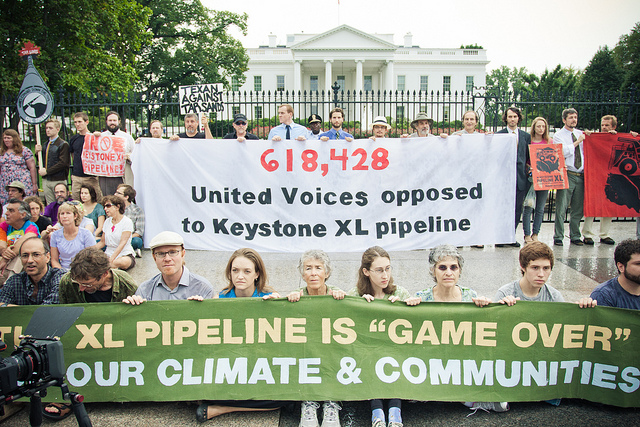
In front of me there’s a sprawling rally underway, with speakers ranging from indigenous elders to the great Canadian writer Naomi Klein. In back of me, another 243 courageous people are being hauled away to jail — it’s the last day of Phase 1 of the tar sands campaign, and 1,252 North Americans have been arrested, the biggest civil disobedience action this century on this continent.
But we’ve been just as cheered by the help that has poured in from around the world — today, activists in front of the White House held a banner with a huge number on it: 618,428. That’s how many people around the world who signed on to the “Stop the Tar Sands” mega-petition to President Obama, including many of you in the 350.org network. Check out this beautiful photo of passion and courage on display:
(Photo Credit: Josh Lopez. If you can’t see the photo above, click here to see it and more inspirational photos from DC.)
But this movement does more than sign petitions: many of you stood strong in front of the White House risking arrest, and protesters on every continent have picketed outside embassies and consulates. That makes sense, for global warming is the one problem that affects everyone everywhere.
And the next moment to prove that is Sept. 24 for Moving Planet — the massive day of climate action that will unite people all over the world. We’ve heard news of amazing actions from every corner of the earth -— from a massive bike rally in the Philippines to an incredible eco-festival in Philadelphia. I truly can’t wait to see the pictures pour in.
But here’s why it’s important: we’re not just a movement that opposes things, we’re also a movement that dreams of what’s coming. And we don’t just dream, we also transform those dreams into reality. On September 24, on bike and on foot and on boards, we’re going to point the way towards that future. By days’ end, we’ll have shown why the bicycle is more glamorous than the car, and why the people have the potential to be more powerful than the polluters.
On some days fighting global warming means swallowing hard, mustering your courage, and making a sacrifice — other days it means getting all your friends up in the saddles of their bikes to have some fun and help move the planet forward.
350.org is building a global grassroots movement to solve the climate crisis. Our online campaigns, grassroots organizing, and mass public actions are led from the bottom up by thousands of volunteer organizers in over 188 countries. You can join 350.org on Facebook by becoming a fan of our page atfacebook.com/350org and follow us on twitter by visiting twitter.com/350. To join our list (maybe a friend forwarded you this e-mail) visitwww.350.org/signup. To support our work, donate securely online at 350.org/donate.
What is 350? 350 is the number that leading scientists say is the safe upper limit for carbon dioxide in our atmosphere. Scientists measure carbon dioxide in “parts per million” (ppm), so 350ppm is the number humanity needs to get below as soon as possible to avoid runaway climate change. To get there, we need a different kind of PPM–a “people powered movement” that is made of people like you in every corner of the planet.
Feel free to circulate this as far and wide as you wish. Thanks, Learning from Dogs