How fundamental reforms of environmental governance are urgently needed.
I must admit that as Post titles go, the one above is about as ‘weighty’ as it comes! But then again, one might argue as Ronald Firbank, a British novelist, was reputedly to have quoted, “The world is so dreadfully managed, one hardly knows to whom to complain! ”
One of the great assets of the part of the world where Jean and I live, namely Arizona, is the state university or to give it it’s proper title Arizona State University. The university has an important School of Sustainability and I subscribe to their regular newsletter. But it was Rob I. here in Payson who spotted a recent item and forwarded same to me. Thank goodness because it covered something of supreme relevance to the future.
Fundamental steps needed now in global redesign of Earth system governance
Leading experts from around the world, 4 from Pac-12 colleges, argue for immediate ambitious reforms
Some 32 social scientists and researchers from around the world, including Kenneth W. Abbott, a professor of international relations in ASU’s Sandra Day O’Connor College of Law and a Senior Sustainability Scholar in the Global Institute of Sustainability a Senior, are calling for fundamental reforms of global environmental governance to avoid dangerous changes in the Earth system.
Some 32 social scientists and researchers from around the world, including a senior sustainability scholar at Arizona State University, have concluded that fundamental reforms of global environmental governance are needed to avoid dangerous changes in the Earth system. The scientists argued in the March 16 edition of the journal Science that the time is now for a “constitutional moment” in world politics.
Research now indicates that the world is nearing critical tipping points in the Earth system, including on climate and biodiversity, which if not addressed through a new framework of governance could lead to rapid and irreversible change.
“Science assessments indicate that human activities are moving several of Earth’s sub-systems outside the range of natural variability typical for the previous 500,000 years,” wrote the authors in the opening of “Navigating the Anthropocene: Improving Earth System Governance.”
Reducing the risk of potential global environmental disaster requires the development of “a clear and ambitious roadmap for institutional change and effective sustainability governance within the next decade,” comparable in scale and importance to the reform of international governance that followed World War II, they wrote.
In particular, the group argued for the creation of a Sustainable Development Council that would better integrate sustainability concerns across the United Nations system. Giving a leading role to the 20 largest economies (G20) would help the council act effectively. The authors also suggested an upgrade of the UN Environment Program to a full-fledged international organization, a move that would give it greater authority and more secure funding
To keep these institutions accountable to the public, the scientists called for stronger consultative rights for representatives of civil society, including representatives from developing countries, NGOs, consumers and indigenous peoples.
“We should seek input from people closest to the ground, not just from the elites, not just at the 30,000-feet level,” noted Kenneth W. Abbott, a professor of international relations in ASU’s Sandra Day O’Connor College of Law. “Consultations should not take place only at the global scale, where the broadest policies are created, but also at local scales, smaller scales, all scales,” he said.
To improve the speed of decision-making in international negotiations, the authors called for stronger reliance on qualified majority voting. “There has to be a change in international negotiating procedures from the current situation, in which no action can be taken unless consensus is reached among all participating governments,” Abbott said.
The authors also called for governments “to close remaining regulatory gaps at the global level,” including the treatment of emerging technologies.
“A great deal of attention has been given to issues such as climate change, yet nanotechnology and other emerging technologies, which may bring significant benefits, also carry potential risks for sustainable development,” Abbott said.
Relying on research by Abbott and his colleagues at ASU’s College of Law, the authors wrote that emerging technologies “need an international institutional arrangement – such as one or several multilateral framework conventions” to support forecasting and transparency, and to ensure that environmental risks are taken into account.
“Working to make the world economy more green and to create an effective institutional framework for sustainable development will be the two main focal points at this summer’s United Nations Conference on Sustainable Development in Rio de Janeiro,” Abbott said. “This article was written to bring urgency to those discussions and to outline specific ‘building blocks’ for a more effective and sustainable Earth system governance system.”
The authors also argued for increased financial support for poorer nations. “More substantial financial resources could be made available through novel financial mechanisms, such as global emissions markets or air transportation levies for sustainability purposes,” they wrote.
Lead author Frank Biermann, of Free University Amsterdam and Lund University, Sweden, said, “Societies must change course to steer away from critical tipping points in the Earth system that could lead to rapid and irreversible change. Incremental change is no longer sufficient to bring about societal change at the level and with the speed needed to stop Earth system transformation.
“Structural change in global governance is needed, both inside and outside the UN system and involving both public and private actors,” said Biermann, who also is chair of the scientific steering committee of the Earth System Governance Project.
All 32 authors of the Science article are affiliated with the Earth System Governance Project, a global alliance of researchers and leading research institutions, specializing in the scientific study of international and national environmental governance. ASU’s Abbott is one of some 50 lead faculty of the Earth System Governance Project. Lead faculty are scientists of high international reputation who share responsibility for research on earth system governance. Additional information is at http://earthsystemgovernance.org.
Among the other authors of “Navigating the Anthropocene” are: S. Andresen, Fridtjof Nansen Institute, Norway; K. Bäckstrand, Lund University, Sweden; S. Bernstein, University of Toronto, Canada; M. M. Betsill, Colorado State University; H. Bulkeley, Durham University, U.K.; B. Cashore, Yale University; J. Clapp, University of Waterloo, Canada; C. Folke, Stockholm Resilience Centre Stockholm University and Beijer Institute, Royal Swedish Academy of Sciences, Sweden; A. Gupta, Wageningen University and Research Centre, Netherlands; J. Gupta, Free University Amsterdam and UNESCO-International Institute for Hydraulic and Environmental Engineering Institute for Water Education, Netherlands; P. M. Haas, University of Massachusetts at Amherst; A. Jordan, Tyndall Centre, University of East Anglia, U.K.; N. Kanie, Tokyo Institute of Technology and United Nations University Institute of Advanced Studies, Japan; T. Kluvánková-Oravská, CETIP, Slovak Academy of Sciences, Slovakia; L. Lebel, Chiang Mai University, Thailand;
And, D. Liverman, University of Arizona and Oxford University, U.K.; J. Meadowcroft, Carleton University, Canada; R. B. Mitchell, University of Oregon; P. Newell, University of Sussex, U.K.; S. Oberthür, Vrije University, Belgium; L. Olsson, Lund University, Sweden; P. Pattberg, Free University Amsterdam; R. Sánchez-Rodríguez, El Colegio de la Frontera Norte, Mexico, and University of California, Riverside; H. Schroeder, Tyndall Centre, University of East Anglia, U.K.; A. Underdal, University of Oslo, Norway; S. Camargo Vieira, Universidade de Itaúna, Brazil; C. Vogel, independent scholar, South Africa; O. R. Young, University of California, Santa Barbara; A. Brock, Free University Amsterdam; and R. Zondervan Lund University, Sweden.
In that first paragraph, it was reported that the March 16 edition of the journal Science carried the argument put forward by the scientists. Here the link to that argument which also includes a link to the full text from which I quote the abstract,
Policy Forum
Navigating the Anthropocene: Improving Earth System Governance
Science assessments indicate that human activities are moving several of Earth’s sub-systems outside the range of natural variability typical for the previous 500,000 years (1, 2). Human societies must now change course and steer away from critical tipping points in the Earth system that might lead to rapid and irreversible change (3). This requires fundamental reorientation and restructuring of national and international institutions toward more effective Earth system governance and planetary stewardship.
The full list of references including the author’s email address can be seen here.
One doesn’t have to be mad to live here, but it sure helps!
Jean and I had been kicking around the idea of having our own eggs. To the point where we had made enquiries at our local feed store, Payson Feed.
Chickens for sale!
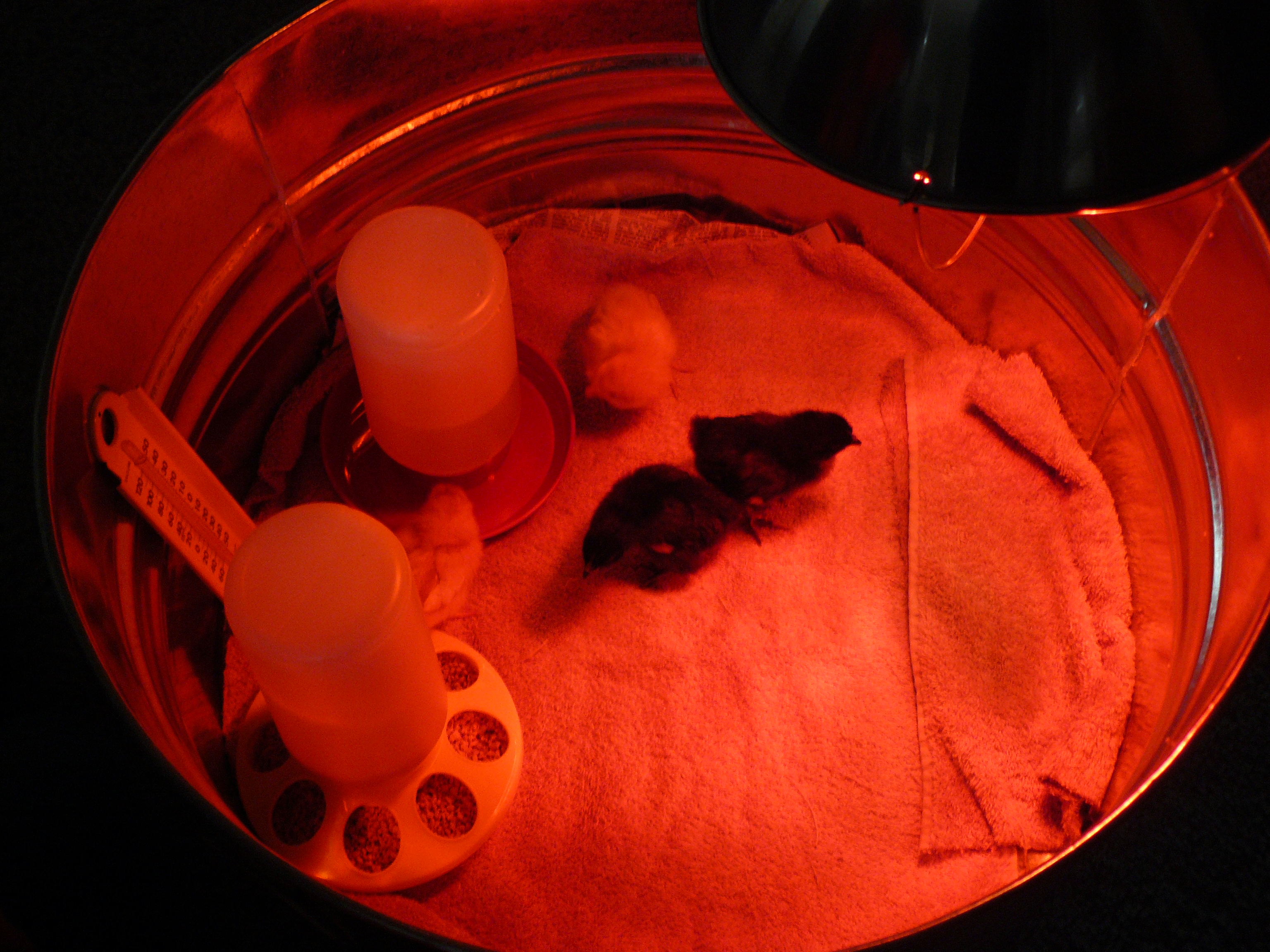
Then the idea grew to the point where we started building our own chicken coop, then a couple of weeks ago we bought the heat lamp and feeders leading inevitably to yesterday morning when we picked up 5 little chicks.
Choosing the chicks in the store.
We planned to buy four chicks but, of course, came out with five! The five being four golden ‘cross-breds’ and one Buff Orpington Our plan had been to buy Rhode Island Reds but we were advised that cockerels could sometimes be bought unintentionally as when just a couple of days old, they couldn’t be identified from the hens, whereas the cross-breeds could be properly ‘sexed’.
Welcome to your new home!
So shortly before mid-day yesterday, Jean was gently transferring our latest ‘pets’ into their new home in the guest bedroom, where they will be fed, watered and kept warm for the next 8 weeks or so before being moved to the chicken coop.
Home sweet home!
I have no doubt that before the week is out, Jean will have given them all names!
Very cute, even at two days old!
Why the title to this Post being ‘Then we were ten, plus chicks’?
Only that three weeks ago, I wrote about Casey joining our dogs and bringing the number of dogs to ten. (Oh, not forgetting the six cats and one fish.) No doubt, status reports on our young chicks will creep into Learning from Dogs from time to time!
A reflection of our unconscious minds – and the potential perils ahead.
Last Monday, March 12th, the BBC aired a programme under their excellent Horizon science series. This programme was entitled, Out of Control? Here’s how the programme was introduced,
We all like to think we are in control of our lives – of what we feel and what we think. But scientists are now discovering this is often simply an illusion.
Surprising experiments are revealing that what you think you do and what you actually do can be very different. Your unconscious mind is often calling the shots, influencing the decisions you make, from what you eat to who you fall in love with. If you think you are really in control of your life, you may have to think again.
The whole 60 minute programme was fascinating right from the start when Professor Nobre introduced the secret world of our unconscious mind. Professor Anna Nobre heads The Brain & Cognition Laboratory, a cognitive neuroscience research group at the Department of Experimental Psychology in the University of Oxford.
For starters, how much of your mind do you think is your conscious mind as opposed to your unconscious mind? Watch this clip and be amazed!
“Are you in control of your unconscious, or is it in control of you?”
So let me link how our mind works to something more relevant today than possibly any other aspect of life.
I’m thinking of the fundamental question that bothers me and, perhaps millions of others. That question being: “Why, with the overwhelming scientific evidence that man is critically threatening the planet’s biosphere upon which we all depend, is there not an equally overwhelming global commitment for change to a sustainable way of life?”
Take, for example, this compelling story.
Last Saturday the BBC News website published a report by Richard Black, the BBC’s Environment correspondent, that opened thus,
An eminent UK engineer is suggesting building cloud-whitening towers in the Faroe Islands as a “technical fix” for warming across the Arctic.
Scientists told UK MPs this week that the possibility of a major methane release triggered by melting Arctic ice constitutes a “planetary emergency“. [my emboldening]
The Arctic could be sea-ice free each September within a few years.
and later goes into this detail (do please read it all, it’s only a few minutes of quiet reading),
On melting ice
The area of Arctic Ocean covered by ice each summer has declined significantly over the last few decades as air and sea temperatures have risen.
For each of the last four years, the September minimum has seen about two-thirds of the average cover for the years 1979-2000, which is used a baseline. The extent covered at other times of the year has also been shrinking.
What more concerns some scientists is the falling volume of ice.
Analysis from the University of Washington, in Seattle, using ice thickness data from submarines and satellites, suggests that Septembers could be ice-free within just a few years.
Data for September suggests the Arctic Ocean could be free of sea ice in a few years
“In 2007, the water [off northern Siberia] warmed up to about 5C (41F) in summer, and this extends down to the sea bed, melting the offshore permafrost,” said Peter Wadhams, professor of ocean physics at Cambridge University.
Among the issues this raises is whether the ice-free conditions will quicken release of methane currently trapped in the sea bed, especially in the shallow waters along the northern coast of Siberia, Canada and Alaska.
Methane is a much more potent greenhouse gas than carbon dioxide, though it does not last as long in the atmosphere.
Several teams of scientists trying to measure how much methane is actually being released have reported seeing vast bubbles coming up through the water – although analysing how much this matters is complicated by the absence of similar measurements from previous decades.
Nevertheless, Prof Wadhams told MPs, the release could be expected to get stronger over time. “With ‘business-as-usual’ greenhouse gas emissions, we might have warming of 9-10C in the Arctic. That will cement in place the ice-free nature of the Arctic Ocean – it will release methane from offshore, and a lot of the methane on land as well.”
This would – in turn – exacerbate warming, across the Arctic and the rest of the world.
Abrupt methane releases from frozen regions may have played a major role in two events, 55 and 251 million years ago, that extinguished much of the life then on Earth.
Meteorologist Lord (Julian) Hunt, who chaired the meeting of the All Party Parliamentary Group on Climate Change, clarified that an abrupt methane release from the current warming was not inevitable, describing that as “an issue for scientific debate”.
But he also said that some in the scientific community had been reluctant to discuss the possibility.
“There is quite a lot of suppression and non-discussion of issues that are difficult, and one of those is in fact methane,” he said, recalling a reluctance on the part of at least one senior scientists involved in the Arctic Climate Impact Assessment to discuss the impact that a methane release might have.
Reams of other factual evidence shows that mankind may have only a few years left to stop the planet going into a runaway condition that would then extinguish much of the life on Earth!
So what’s stopping us?
Dr. Sharot
Well back to that Horizon programme. In the programme, Dr. Tali Sharot of University College London explains how we are all optimists despite the risks. I.e. our unconscious mind deliberately prevents negative information from affecting our conscious mind, our conscious judgment.
In an experiment, an individual is asked to guess the likelihood of a whole range of outcomes, 80 in all. Ergo, you see a gentleman guessing the likelihood of cancer as 18%, of a bone fracture as 10%, of Alzheimer’s as 2%, and so on.
In some cases he guessed a pessimistic probability, in others an optimistic probability. After each guess he was shown the correct probability. E.g. cancer 30% vs his estimate of 18%, for a bone fracture 34% vs his guess of 10%, and the risk in reality of Alzheimer’s is 10% versus his instinct of just 2%. I’ve just quoted his optimistic guesses, in many questions his guess was a pessimistic view, i.e. he guessed a higher likelihood than the statistical reality.
Then he was asked all 80 questions again, having seen the accurate probability compared to his intuitive guess.
So here’s the fascinating outcome.
Where his instinct was a negative guess versus the statistical probability then he adjusted his mind and was able to quote a more accurate figure the second time around. But where the reality was more pessimistic than his first guess, then that adjusted knowledge wasn’t retained. In other words, our beliefs only change when we can adjust to a more positive view of the future.
I just hope I have made that clear. Readers may like to view an article written by Dr. Sharot published in TIME Magazine in May, 2011, called The Optimism Bias or read the introduction to a lecture given in Seattle in June, 2011; “A sunny outlook doesn’t just make you a more pleasant companion: Tali Sharot argues that optimism is a tool for survival and happiness that gets us through hard times—even an economic recession. Sharot, author of The Optimism Bias, uncovers myths about optimism, illuminates the ways it can affect our lives, examines why optimism is necessary for us to function, and illustrates how the human brain is extremely adept at turning lead into gold.”
A summary of a publication, Sharot, T. (2011). The optimism bias. Curr Biol 21(23), R941-R945, reads,
The ability to anticipate is a hallmark of cognition. Inferences about what will occur in the future are critical to decision making, enabling us to prepare our actions so as to avoid harm and gain reward. Given the importance of these future projections, one might expect the brain to possess accurate, unbiased foresight. Humans, however, exhibit a pervasive and surprising bias: when it comes to predicting what will happen to us tomorrow, next week, or fifty years from now, we overestimate the likelihood of positive events, and underestimate the likelihood of negative events. For example, we underrate our chances of getting divorced, being in a car accident, or suffering from cancer. We also expect to live longer than objective measures would warrant, overestimate our success in the job market, and believe that our children will be especially talented. This phenomenon is known as the optimism bias, and it is one of the most consistent, prevalent, and robust biases documented in psychology and behavioral economics.
Our bias towards an optimistic future is a “tool for survival and happiness that gets us through hard times.” But if that ancient bias is preventing mankind from recognising just how close we may be to some form of ‘tipping point’ then this tool for survival may be our undoing.
But if on the other hand, we now unite in changing our ways, first by community then by town then by country our future is incredibly optimistic.
“A single candle may light a thousand others and they in turn many thousands more” – Buddha
The final episode from the series of four 1-hour videos from National Geographic.
The first episode plus the introduction can be seen here, the second episode can be seen here while the third can be seen here.
I wasn’t quite sure what to expect from this last episode. The third episode had shown how good science could determine the deadly cause and effect of past times and enact critically important solutions. Well, the final episode had the same underlying theme. That despite the huge scale of change and transformation required by millions of people to restore the planet to health, it’s not impossible, not by a long chalk.
So I will close these past four Posts by thanking Dogs of Doubt for first bringing these videos to light. I truly hope that they have been for you as Perfect Stranger described them in his Post, “they explained so much that it is impossible not to recognize the changes we have made to our environment.” Nothing to add to that.
National Geographic – Strange Days on Planet Earth – Part 4 of 4 – Troubled Waters
The third of an unmissable series of four 1-hour videos from National Geographic.
The first episode plus the introduction can be seen here, the second episode can be seen here.
By now if you have watched the first two episodes, you will be aware of the huge commitment made by National Geographic and PBS in putting this production together. That’s a strong indicator to my mind that getting the message out there is being taken more and more seriously.
The third episode is called Predator and underscores an important element of the change process. That of properly understanding the nature of a problem before attempting a solution. This episode has some very positive messages, so do watch it.
National Geographic – Strange Days on Planet Earth – Part 3 of 4 – Predator
The second of an unmissable series of four 1-hour videos from National Geographic.
The background and introduction to the first episode was published yesterday. So I won’t natter on today saying more or less the same thing.
But I will add this thought.
The videos are tough viewing but compelling because they show the complexity and inter-relatedness of all forms of life on our Planet. It shows that the debate about climate change/global warming/call it what you will is not a simplistic do you or do you not believe mankind is at the root of the changes. No it’s a much more complex question about the threat to our whole biosphere, as Patrice Ayme so eloquently spelt out on March 2nd. These videos make that crystal clear.
Here’s the second episode,
National Geographic – Strange Days on Planet Earth – Part 2 of 4 – One Degree Factor
An unmissable series of four 1-hour videos from National Geographic.
In my summary yesterday of what had come out of the Posts about man’s influence on the planet, I wrote, “But one of the most wonderful aspects for me was the incredible sharing of ideas and resources.” I then gave many details of those resources. One of the great links was a blogsite called Dogs of Doubt. On that blogsite I came across an item published on the 8th March, called Strange Days on Planet Earth. With permission I repost how that item was introduced.
While the average global temperature on Earth has increased by 1 degree Celsius in the last century, in some places on Earth the temperature has increased by a phenomenal 11 Degrees, for some species, already adapted to life as it has been for millions of years such changes puts them in great danger.
Inter-species transfer from one continent to another through what many thought were harmless human activities has placed great pressures on the survival of local animals, insects and even plants, all of which were not prepared for the arrival of newer, more aggressive species.
In many areas of the world some ocean species are actually relocating themselves in order to survive the loss of their food resources and habitats due to the warming of the oceans.
Herds of animals are vanishing as they struggle with warming temperatures which bring in longer breeding seasons for many insects in turn affecting the living standards and health of the many animals they attack.
On land and across the world entire lakes are either disappearing or being reduced in size through the effects of long lasting droughts, the lack of rain waters in some parts is changing much of our surrounding environment and the dust this causes in some parts of the world is affecting the health of children thousands of miles away.
In the oceans plankton are down 20% to what they were in the 1950s, when the waters are cold they do well but now that the waters are warmer their numbers are falling drastically.
Every little change that occurs on earth through global warming might not mean much to some, but all these changes will eventually add together until our environment reaches a breaking point from which none of us may survive.
This video series from National Geographic aims to create an innovative type of environmental awareness by revealing a cause and effect relationship between what we as humans do to the Earth and what that in turn does to our environment and ecosystems, the series creates a new sense of environmental urgency.
Each of the four episodes is constructed as a high-tech detective story, with the fate of the planet at stake.
Jean and I have watched the first two episodes in full and are about 60% through the third. They are both spell-binding and eye-opening. I believe they were first aired by PBS back in 2005 but, no matter, they are even more relevant today.
So for today and the rest of the week I shall provide a link to the YouTube copy of each programme. Please, if you can, do put aside an hour to watch each video and, even better, please give us your feedback to Learning from Dogs.
The first episode is called Invaders.
National Geographic – Strange Days on Planet Earth – Part 1 of 4 – Invaders
Around the globe, scientists are racing to solve a series of mysteries. Unsettling transformations are sweeping across the planet, and clue by clue, investigators around the world are assembling a new picture of Earth, discovering ways that seemingly disparate events are connected. Crumbling houses in New Orleans are linked to voracious creatures from southern China. Vanishing forests in Yellowstone are linked to the disappearance of wolves. An asthma epidemic in the Caribbean is linked to dust storms in Africa. Scientists suspect we have entered a time of global change swifter than any human being has ever witnessed. Where are we headed? What can we do to alter this course of events? National Geographic’s Strange Days on Planet Earth, premiered on PBS, explores these questions. Drawing upon research being generated by a new discipline, Earth System Science (ESS), the series aims to create an innovative type of environmental awareness. By revealing a cause and effect relationship between what we as humans do to the Earth and what that in turn does to our environment and ecosystems, the series creates a new sense of environmental urgency. Award-winning actor, writer and director Edward Norton (Primal Fear, American History X, Italian Job) hosts the series. A dedicated environmental activist, Norton has a special interest in providing solar energy to low income families. Each of the four one-hour episodes is constructed as a high-tech detective story, with the fate of the planet at stake.
All my life, well all the years that I have appreciated a ‘tea-break’, stopping for a cup of hot tea has been laden with symbolism. A chance to let the brain catch up with whatever one is doing. When working with others an opportunity to stand back and evaluate how the particular project is going. When sharing a project with a loved one, an opportunity to lay down memories for future years, and so forth. (Jean and I were building a chicken coop yesterday afternoon.) Sure there are millions of people that share these feelings.
Anyway, as many of you have been aware, the last 10 days or so on Learning from Dogs have been pretty ‘full-on’ in terms of man and Planet Earth. It started with me publishing on the 27th February a Post called Please help! – A plea to those who understand climate science so much better than I do!. Then on the 2nd March, I republished a Post from Patrice Ayme called The collapse of the biosphere.
That there were a total of 6,313 viewings of those Posts and 69 comments (OK, that doesn’t mean different individuals) was incredibly gratifying – a very big ‘thank you’ to all of you that read the Posts, and likewise to those that commented.
But one of the most wonderful aspects for me was the incredible sharing of ideas and resources. So the point of today’s Post is to bring all those links and contacts onto one ‘page’, so to speak.
Martin Lack was the first to point me in the direction of the book, Merchants of Doubt. There are a number of videos on YouTube but the one below is a good introduction to Naomi Oreskes.
On October 28, 2010 historian of science Naomi Oreskes gave a presentation at Forum Lectures (US Embassy Brussels), based on her new book, Merchants of Doubt: How a Handful of Scientists Obscured the Truth on Issues from Tobacco Smoke to Global Warming, about how right wing scientists founded the George Marshall Institute which has become a key hub for successfully spreading fear, uncertainty and doubt about climate change, along with other environmental issues, and how myths about science enable these political strategies to work.
An in-depth video of over an hour from the University of Rhode Island’s Spring 2010 Vetlesen Lecture Series, hugely worth watching, is here.
Then there is the powerful blog site, De Smog Blog. As the site explains, “The DeSmogBlog Project began in January 2006 and quickly became the world’s number one source for accurate, fact based information regarding global warming misinformation campaigns. TIME Magazine named DeSmogBlog in its “25 Best Blogs of 2011” list.”
Moving on. One of the challenges is knowing how to look up some reasonably reliable information about a person who is claiming this or that. That’s where SourceWatch is invaluable. The website describes itself, “The Center for Media and Democracy publishes SourceWatch, this collaborative resource for citizens and journalists looking for documented information about the corporations, industries, and people trying to influence public policy and public opinion. We believe in telling the truth about the most powerful interests in society—not just relating their self-serving press releases or letting real facts be bleached away by spin.”
Let me give you an example of how SourceWatch works. In my Post A skeptic’s view, Dan offered extensive comment about U.S. Senator James Inhofe’s book The Greatest Hoax. A quick search on SourceWatch revealed (a) (my emboldening)
Arthur B. Robinson is one of the three co-founders of the Oregon Institute of Science and Medicine, a group best known for organising a petition disputing the scientific evidence for human-induced global warming.
On January 7, 2009, the Willamette Week reported that Robinson is “in the vanguard of a small but vocal and persistent collection of scientists, industry advocates and commentators who dismiss human culpability for climate change. … Robinson’s critics say his analysis is simplistic, but it remains persuasive a decade later with powerful policymakers like U.S. Senator James Inhofe (R-Okla.), a visible and effective player in blocking a bill to limit greenhouse-gas emissions last fall.
James Mountain Inhofe, usually known as Jim Inhofe, has been a Republican Senator for Oklahoma since winning a special election in 1994.
Oil
James M. Inhofe has voted in favor of big oil companies on 100% of important oil-related bills from 2005-2007, according to Oil Change International. These bills include Iraq war funding, climate change studies, clean energy, and emissions.
On to another book. I forget who recommended the book by James Hansen, Storms of my Grandchildren but it’s another ‘must-read’ for all those wanting to better understand the risks that lay ahead. As the book’s website explains,
In Storms of My Grandchildren, Dr. James Hansen—the nation’s leading scientist on climate issues—speaks out for the first time with the full truth about global warming: The planet is hurtling even more rapidly than previously acknowledged to a climatic point of no return.
On that website there is a section Hansen On The Issues that includes this 2-minute YouTube video of Dr. Hansen talking about his book.
I can’t close without mentioning some other wonderful websites. There is Skeptical Science, described thus,
Explaining climate change science & rebutting global warming misinformation
Scientific skepticism is healthy. Scientists should always challenge themselves to improve their understanding. Yet this isn’t what happens with climate change denial. Skeptics vigorously criticise any evidence that supports man-made global warming and yet embrace any argument, op-ed, blog or study that refutes global warming. This website gets skeptical about global warming skepticism. Do their arguments have any scientific basis? What does the peer reviewed scientific literature say?
Then there’s ClimateSight, a wonderful effort by Kate, “Kate is a B.Sc. student and aspiring climatologist from the Canadian prairies. She started writing this blog when she was sixteen, simply to keep herself sane, but hopes that she’ll be able to spread accurate information about climate change far and wide while she does so.” Kate’s interest and passion in the subject is unmissable and it’s a real pleasure to subscribe to her postings.
Bill McKibben’s famous site, 350.org, is a must for the thousands of people that are working for a better future. As the mission statement opens up,
350.org is building a global grassroots movement to solve the climate crisis. Our online campaigns, grassroots organizing, and mass public actions are led from the bottom up by thousands of volunteer organizers in over 188 countries.
350 means climate safety. To preserve our planet, scientists tell us we must reduce the amount of CO2 in the atmosphere from its current level of 392 parts per million to below 350 ppm. But 350 is more than a number—it’s a symbol of where we need to head as a planet.
350.org works hard to organize in a new way—everywhere at once, using online tools to facilitate strategic offline action. We want to be a laboratory for the best ways to strengthen the climate movement and catalyze transformation around the world.
RealClimate is a commentary site on climate science by working climate scientists for the interested public and journalists. We aim to provide a quick response to developing stories and provide the context sometimes missing in mainstream commentary. The discussion here is restricted to scientific topics and will not get involved in any political or economic implications of the science. All posts are signed by the author(s), except ‘group’ posts which are collective efforts from the whole team. This is a moderated forum.
There are so many more fabulous sources of real caring about the society we are and, more importantly, the society we hope to be. In this category comes Wibble. Then there’s Dogs of Doubt, that I shall be referring to tomorrow on Learning from Dogs, and The Green Word and so on and so on. It shows the power of ‘hands across the ether’ that the modern world of web sites now offers. I put great faith in this power becoming the power of truth and the power of change. (If you have a blog or a website that resonates with the ones mentioned here, please do drop me an email giving me details.)
Finally, I’m closing with this. If it all sometimes feels too much for you and you want to drift away into the world of the inner consciousness, into the world of dreamtime, then you can do no worse than to call by Sue Dreamwalker‘s wonderful website. Try this, for example. Dan and I had no idea what we were getting into. 😉
Starting to feel like a long way from John Masefield’s poem Sea Fever.
The call of the sea.
One of my all-time favourite poems.
I must go down to the seas again, to the lonely sea and the sky,
And all I ask is a tall ship and a star to steer her by,
And the wheel’s kick and the wind’s song and the white sail’s shaking,
And a grey mist on the sea’s face, and a grey dawn breaking.
I must go down to the seas again, for the call of the running tide
Is a wild call and a clear call that may not be denied;
And all I ask is a windy day with the white clouds flying,
And the flung spray and the blown spume, and the sea-gulls crying.
I must go down to the seas again, to the vagrant gypsy life,
To the gull’s way and the whale’s way, where the wind’s like a whetted knife;
And all I ask is a merry yarn from a laughing fellow-rover,
And quiet sleep and a sweet dream when the long trick’s over.
Why do I start this piece with that poem?
Well, read this,
Carbonic acid is a weak acid that is created when carbon dioxide (CO2) is dissolved in water (H2O), resulting in the chemical formula H2CO3. When the acid dissociates, or gives up a hydrogen ion, the resulting molecule is called a bicarbonate ion. Carbonic acid appears frequently in the natural world. It can be found in sodas, champagne, and blood. The acid even appears in rain.
But like so many things in nature, it’s all about balance.
Besides, it’s not all about “climate change”. Half of the CO2 is presently dissolving in the oceans, so a rise of two degrees Celsius means extremely acid oceans (CO2 turns into carbonic acid after it reacts with water). At the present rate of acidification, marine life will dissolve big time by 2100. That’s how a lot of the oxygen is produced, by photosynthesizing unicellular animals, with acid sensitive skeletons. Atmospheric poisoning deniersdo not want just to warm us up.
On that same day of March 2nd, Yves Smith of Naked Capitalism published an item that reinforced what Patrice wrote. Yves very kindly gave me permission to republish her Post in full, as follows:
Science has published a troubling but not entirely surprising article on the fact that the oceans are acidifying at the fastest rate in 300 million years. Actually, it could be the fastest rate over an even longer time period, but we can only go back with any degree of accuracy for 300 million years
….there are side effects to our love affair with CO2 that are not often mentioned. In fact, whether the earth cools or warms is absolutely irrelevant to these effects. I repeat: Absolutely irrelevant.
One of the most startling effects is the acidification of the oceans. Since 1750, the oceans have become increasingly acidic. In the oceans, CO2 forms carbonic acid, a serious threat to the base of the food chain, especially on shellfish of all sizes. Carbonic acid dissolves calcium carbonate, an essential component of any life form with an exoskeleton. In short, all life forms with an exoskeleton are threatened: shell fish, an important part of the food chain for many fish; coral reefs, the habitat of many species of fish….
The formation of carbonic acid does not depend upon temperature. Whether the oceans warm or cool is irrelevant. Of concern only is the amount of CO2 that enters the oceans.
Fast forward to today. Consider the scope of the paper in Science, per a very good discussion in ars technica:
A new paper in Science examines the geologic record for context relating to ocean acidification…The research group (twenty-one scientists from nearly as many different universities) reviewed the evidence from past known or suspected intervals of ocean acidification…They find that the current rate of ocean acidification puts us on a track that, if continued, would likely be unprecedented in last 300 million years.
There is an important driver of this process that this overview mentions only in passing further on, and it’s useful to have it in mind when you review the discussion of the historical record:ocean acidification depends primarily on the rate of atmospheric CO2 increases, not the absolute concentration. Look at how attenuated the rate of past CO2 changes was in the past versus the speed now:
The first period the researchers looked at was the end of the last ice age, starting around 18,000 years ago. Over a period of about 6,000 years, atmospheric CO2 levels increased by 30 percent, a change of roughly 75 ppm. (For reference, atmospheric CO2 has gone up by about the same amount over the past 50 years.) Over that 6,000 year time period, surface ocean pH dropped by approximately 0.15 units. That comes out to about 0.002 units per century. Our current rate is over 0.1 units per century—two orders of magnitude greater, which lines up well with a model estimate we covered recently.
The last deglaciation did not trigger a mass extinction, but it did cause changes in some species…
During the Pliocene warm period, about 3 million years ago, atmospheric CO2 was about the same as today, but pH was only 0.06 to 0.11 units lower than preindustrial conditions. This is because the event played out over 320,000 years or so. We see species migration in the fossil record in response to the warming planet, but not ill effects on calcifiers…
Next, the researchers turned their focus to the Paleocene-Eocene Thermal Maximum (or PETM), which occurred 56 million years ago. Global temperature increased about 6°C over 20,000 years due to an abrupt release of carbon to the atmosphere (though this was not as abrupt as current emissions). The PETM saw the largest extinction of deep-sea foraminifera of the last 75 million years, and was one of the four biggest coral reef disasters of the last 300 million years…
The group also examined the several mass extinctions that defined the Mesozoic—the age of dinosaurs. The boundary between the Triassic and Jurassic included a large increase in atmospheric CO2 (adding as much as 1,300 to 2,400 ppm) over a relatively short period of time, perhaps just 20,000 years. The authors write, “A calcification crisis amongst hypercalcifying taxa is inferred for this period, with reefs and scleractinian corals experiencing a near-total collapse.” Again, though, it’s unclear how much of the catastrophe can be blamed on acidification rather than warming.
Finally, we come the big one—The Great Dying. The Permian-Triassic mass extinction (about 252 million years ago) wiped out around 96 percent of marine species. Still, the rate of CO2 released to the atmosphere that drove the dangerous climate change was 10-100 times slower than current emissions…
In the end, the researchers conclude that the PETM, Triassic-Jurassic boundary, and Permian-Triassic boundary are the closest analogs to the modern day, at least as far as acidification is concerned. Due to the poor ocean chemistry data for the latter two, the PETM is the best event for us to compare current conditions. It’s still not perfect—the rate of CO2 increase was slower than today…
The authors conclude, “[T]he current rate of (mainly fossil fuel) CO2 release stands out as capable of driving a combination and magnitude of ocean geochemical changes potentially unparalleled in at least the last ~300 [million years] of Earth history, raising the possibility that we are entering an unknown territory of marine ecosystem change.”
Translation: “We’re probably fucked, but the data is so far outside of historical parameters, we can’t say anything with a high degree of certainty.”
For me that quotation sums up how I would like to reply to not only my dear friend, Dan Gomez, who is a denialist of anthropogenic climate change, as last Monday’s Post illustrated, but also to skeptics everywhere else.
I should also add the important qualifier that I am neither a scientist nor have any expert skills in the relevant areas. But, then again, neither does Dan. He and I are both citizens of Planet Earth with a passion for the truth.
So where to go from here? There is no question that the Earth’s climate is complex and endeavouring to understand ’cause and effect’ relies heavily on mathematical models. But many complex aspects of our world are treated similarly, therefore so what! Dan and I share with millions of others a lack of scientific competence, ergo we have to be rely on the scientific views expressed by those who do have the scientific competencies.
Would one challenge the competence of Scientific American magazine, that in an article on March 18, 2007, (five years ago!) opened thus,
Paris–The signs of global climate change are clear: melting glaciers, earlier blooms and rising temperatures. In fact, 11 of the past 12 years rank among the hottest ever recorded.
and continued later with this, [my emboldening]
For example, after objections by Saudi Arabia and China, the report dropped a sentence stating that the impact of human activity on the earth’s heat budget exceeds that of the sun by fivefold. “The difference is really a factor of 10,” says lead author Piers Forster of the University of Leeds in England: compared with its historical output, the sun currently contributes an extra 0.12 watt of energy for each square meter of the earth’s surface, whereas man-made sources trap an additional 1.6 watts per square meter.
Or what ‘influence’ might be at play when the British newspaper The Guardian reported earlier this year that,
Wall Street Journal rapped over climate change stance
The Wall Street Journal has received a dressing down from a large group of leading scientists for promoting retrograde and out-of-date views on climate change. In an opinion piece run by the Journal on Wednesday, nearly 40 scientists, including acknowledged climate change experts, took on the paper for publishing an article disputing the evidence on global warming.
The offending article, No Need to Panic About Global Warming, which appeared last week, argued that climate change was a cunning ploy deployed by governments to raise taxes and by non-profit organisations to solicit donations to save the planet.
It was signed by 16 scientists who don’t subscribe to the conventional wisdom that climate change is happening and is largely man-made – but as Wednesday’s letter points out, many of those who signed don’t actually work in climate science.
Later in that article Suzanne writes, referring to the 40 scientists, [again, my emboldening]
The letter goes on to note that some 97% of researchers who actively publish on climate science agree that climate change is real and caused by humans. It concludes: “It would be an act of recklessness for any political leader to disregard the weight of evidence and ignore the enormous risks that climate change clearly poses.”
There’s much, much more evidence that shows that the science is clear – mankind is risking the future viability of this planet for the species homo sapiens and countless other species!
One of the important points made by Dan in that Post last Monday was about the book, written by Senator James Inhofe, The Greatest Hoax. Dan wrote, “This is all about money and power, not weather.”
There are a number of independent websites across the world where one can quickly research the credentials and background by name of any person. Try Skeptical Science as an example. A quick enquiry using Senator Inhofe’s name came up with this: Quotes by James Inhofe – Climate Myth/What the Science Says. Read It! And read this on the website Think Progress. There are other websites where one can do that type of research.
In an email just a day ago, Dan wrote, “My message/warning remains the same: “Follow the Money”. When the “End-of-the-World” is the message, what politician can resist?” If only it was that easy.
OK, I’m going to start rounding this all off by first asking you to watch this 4-minute video that I came across thanks to Pedantry’s blogsite Wibble.
Next I’m going to repeat something that I have previously mentioned on Learning from Dogs. There’s a saying in the aviation industry, “If there’s any doubt, there’s no doubt!” That saying underpins the culture that has turned commercial air transport into one of the safest means of travel in history.
Let’s ponder that idea of doubt.
There is no question that there is a great deal of doubt. Back in 2010 Gallup Poll reported that “42% of adults worldwide who see global warming as a threat to themselves and their families in 2010 hasn’t budged in the last few years“.
Would you get into a commercial airliner to fly from ‘a’ to ‘b’ if 42% of the passengers saw the flight as a threat to themselves? No, of course not!
So one certainly wouldn’t fly then if 62% thought it was risky! From here,
The newest study from the National Survey of American Public Opinion on Climate Change, which is a biannual survey taken since fall 2008 and organized by the Brookings Institute, shows that 62 percent of Americans now believe that man-made climate change is occurring, and 26 percent do not. The others are unsure.
So back to the theme that started this Post. For the sake of all of us on this planet, for all our children and grandchildren and beyond, we need to start caring deeply about the future, changing our life-styles in as many ways as we can and demanding that our politicians and leaders are similarly committed to the future.
Not because the future is anything like certain – but to reduce the risks of a global catastrophy. I have a grandson who will be one-year-old on March 21st. I want to be certain that he has a viable life ahead of him for many, many years. That means caring ‘a whole awful lot‘, letting hope motivate me to change, and recognising that change is already taking place, as the following trailer so superbly demonstrates.
“Unless someone like you cares a whole awful lot, Nothing is going to get better. It’s not.”