Category: Climate

Options for the future

That damn edge, embrace it or ….. or what?

It’s some ago that I read Lester Brown’s book World on the Edge but I still recall the effect it had on me.  Namely, this is not some environmentalist’s ‘willy waving’ but something that has the potential to hurt, I mean HURT!  Since the book was published the stream of information and evidence has turned into a flood of awareness that if we don’t change our ways soon then we, as in the vastness of human life, will go over the edge.

So it was a good reminder to come across a recent extract on the Earth Policy Institute website that is republished in full, as follows:

No previous civilization has survived the ongoing destruction of its natural supports. Nor will ours. Yet economists look at the future through a different lens. Relying heavily on economic data to measure progress, they see the near 10-fold growth in the world economy since 1950 and the associated gains in living standards as the crowning achievement of our modern civilization. During this period, income per person worldwide climbed nearly fourfold, boosting living standards to previously unimaginable levels. A century ago, annual growth in the world economy was measured in the billions of dollars. Today, it is measured in the trillions. In the eyes of mainstream economists, our present economic system has not only an illustrious past but also a promising future.

Mainstream economists see the 2008–09 global economic recession and near-collapse of the international financial system as a bump in the road, albeit an unusually big one, before a return to growth as usual. Projections of economic growth, whether by the World Bank, Goldman Sachs, or Deutsche Bank, typically show the global economy expanding by roughly 3 percent a year. At this rate the 2010 economy would easily double in size by 2035. With these projections, economic growth in the decades ahead is more or less an extrapolation of the growth of recent decades.

But natural scientists see that as the world economy expanded some 20-fold over the last century, it has revealed a flaw—a flaw so serious that if it is not corrected it will spell the end of civilization as we know it. At some point, what had been excessive local demands on environmental systems when the economy was small became global in scope.

A study by a team of scientists led by Mathis Wackernagel aggregates the use of the earth’s natural assets, including carbon dioxide overload in the atmosphere, into a single indicator—the ecological footprint. The authors concluded that humanity’s collective demands first surpassed the earth’s regenerative capacity around 1980. By 2007, global demands on the earth’s natural systems exceeded sustainable yields by 50 percent. Stated otherwise, it would take 1.5 Earths to sustain our current consumption. If we use environmental indicators to evaluate our situation, then the global decline of the economy’s natural support systems—the environmental decline that will lead to economic decline and social collapse—is well under way.

How did we get into this mess? Our market-based global economy as currently managed is in trouble. The market does many things well. It allocates resources with an efficiency that no central planner could even imagine, much less achieve.

However the market, which sets prices, is not telling us the truth. It is omitting indirect costs that in some cases now dwarf direct costs. Consider gasoline. Pumping oil, refining it into gasoline, and delivering the gas to U.S. service stations may cost, say, $3 per gallon. The indirect costs, including climate change, treatment of respiratory illnesses, oil spills, and the U.S. military presence in the Middle East to ensure access to the oil, total $12 per gallon. Similar calculations can be done for coal.

We delude ourselves with our accounting system. Leaving such huge costs off the books is a formula for bankruptcy. Environmental trends are the lead indicators telling us what lies ahead for the economy and ultimately for society itself. Falling water tables today signal rising food prices tomorrow. Shrinking polar ice sheets are a prelude to falling coastal real estate values.

Beyond this, mainstream economics pays little attention to the sustainable yield thresholds of the earth’s natural systems. Modern economic thinking and policymaking have created an economy that is so out of sync with the ecosystem on which it depends that it is approaching collapse. How can we assume that the growth of an economic system that is shrinking the earth’s forests, eroding its soils, depleting its aquifers, collapsing its fisheries, elevating its temperature, and melting its ice sheets can simply be projected into the long-term future? What is the intellectual process underpinning these extrapolations?

We are facing a situation in economics today similar to that in astronomy when Copernicus arrived on the scene, a time when it was believed that the sun revolved around the earth. Just as Copernicus had to formulate a new astronomical worldview after several decades of celestial observations and mathematical calculations, we too must formulate a new economic worldview based on several decades of environmental observations and analyses.

The archeological record indicates that civilizational collapse does not come suddenly out of the blue. Archeologists analyzing earlier civilizations talk about a decline-and-collapse scenario. Economic and social collapse was almost always preceded by a period of environmental decline.

For past civilizations it was sometimes a single environmental trend that was primarily responsible for their decline. Sometimes it was multiple trends. For Sumer, rising salt concentrations in the soil, as a result of an environmental flaw in the design of their otherwise extraordinary irrigation system, led to a decline in wheat yields. The Sumerians then shifted to barley, a more salt-tolerant crop. But eventually barley yields also began to decline. The collapse of the civilization followed.

For the Mayans, it was deforestation and soil erosion. As more and more land was cleared for farming to support the expanding empire, soil erosion undermined the productivity of their tropical soils. A team of scientists from the National Aeronautics and Space Administration has noted that the extensive land clearing by the Mayans likely also altered the regional climate, reducing rainfall. In effect, the scientists suggest, it was the convergence of several environmental trends, some reinforcing others, that led to the food shortages that brought down the Mayan civilization.

Although we live in a highly urbanized, technologically advanced society, we are as dependent on the earth’s natural support systems as the Sumerians and Mayans were. If we continue with business as usual, civilizational collapse is no longer a matter of whether but when. We now have an economy that is destroying its natural support systems, one that has put us on a decline and collapse path.

The reality of our situation may soon become clearer for mainstream economists as we begin to see some of the early economic effects of overconsuming the earth’s resources, such as rising world food prices. On the social front, the most disturbing trend is spreading hunger.

As rapid population growth continues, cropland becomes scarce, wells go dry, forests disappear, soils erode, unemployment rises, and hunger spreads. As environmental degradation and economic and social stresses mount, the more fragile governments are losing their capacity to govern. They become failing states—countries whose governments can no longer provide personal security, food security, or basic social services, such as education and health care. As the list of failing states grows longer each year, it raises a disturbing question: How many states must fail before our global civilization begins to unravel?

How much longer can we remain in the decline phase, whether measured in natural asset liquidation, spreading hunger, or failing states, before our global civilization begins to break down? We are dangerously close to the edge. Peter Goldmark, former Rockefeller Foundation president, puts it well: “The death of our civilization is no longer a theory or an academic possibility; it is the road we’re on.”

Adapted from World on the Edge by Lester R. Brown.  The message is clear.

But if you haven’t read the book it’s available online, for free!  Just go here and not only will you find the link to the book but also links to other valuable materials.

Founder and President of the Earth Policy Institute, Lester Brown, speaks about his new book World on the Edge: How to Prevent Environmental and Economic Collapse. The issues, says Brown, are critical — and the big question is whether we can change direction before “we go over the edge.” Among his points: solar, wind and geothermal energy, with energy efficiency, can provide all the power we need, but a massive effort must be made now to fully shift to these clean, safe, renewable energy technologies. He strongly rejects nuclear power.

Now for something completely different!

You’ll have to watch the video! (As over 1,300,000 have done)

Have a restful week-end.

Dear George!

The sad story of the death of Lonesome George, a giant tortoise.

When you’re gone, you’re gone, it is said.  But in the case of this example of the beauty of Mother Nature, the idea of being gone is as final as it comes; George was the last of his species.

Here’s how the BBC reported the story,

Last Pinta giant tortoise Lonesome George dies

Staff at the Galapagos National Park in Ecuador say Lonesome George, a giant tortoise believed to be the last of its subspecies, has died.

Scientists estimate he was about 100 years old.

Park officials said they would carry out a post-mortem to determine the cause of his death.

With no offspring and no known individuals from his subspecies left, Lonesome George became known as the rarest creature in the world.

For decades, environmentalists unsuccessfully tried to get the Pinta Island tortoise to reproduce with females from a similar subspecies on the Galapagos Islands.

Park officials said the tortoise was found dead in his corral by his keeper of 40 years, Fausto Llerena.

While his exact age was not known, Lonesome George was estimated to be about 100, which made him a young adult as the subspecies can live up to an age of 200.

Lonesome George was first seen by a Hungarian scientist on the Galapagos island of Pinta in 1972.

Environmentalists had believed his subspecies(Chelonoidis nigra abingdoni) had become extinct.

Lonesome George became part of the Galapagos National Park breeding programme.

After 15 years of living with a female tortoise from the nearby Wolf volcano, Lonesome George did mate, but the eggs were infertile.

He also shared his corral with female tortoises from Espanola island, which are genetically closer to him than those from Wolf volcano, but Lonesome George failed to mate with them.

He became a symbol of the Galapagos Islands, which attract some 180,000 visitors a year.

Galapagos National Park officials said that with George’s death, the Pinta tortoise subspecies has become extinct.

They said his body would probably be embalmed to conserve him for future generations.

Tortoises were plentiful on the Galapagos islands until the late 19th century, but were later hunted for their meat by sailors and fishermen to the point of extinction.

Their habitat furthermore suffered when goats were introduced from the mainland.

The differences in appearance between tortoises from different Galapagos islands were among the features which helped the British naturalist Charles Darwin formulate his theory of evolution.

Some 20,000 giant tortoises of other subspecies still live on the Galapagos.

Continuing the tribute, Chris Mazzarella had some stunning photographs on his wonderful photographic blogsite Fast Forward. (Do take a look!) I held my breath and asked Chris for permission to republish his article and was delighted to be given his approval.  Thanks Chris, thanks very much.

oooOOOooo

An Ode To George

To pay tribute to our late friend Lonesome George, I thought it would be appropriate to write a post in celebration of turtles. George was the last tortoise of the subspecies Chelonoidis nigra abingdoni from Pinta Island in the Galapagos. Sadly George passed yesterday at the tender age of 100 years. This could be considered middle aged for the tortoise who’s counterparts can live beyond 200 years.

This is easily the smallest one I’ve seen all year. To give you some perspective, this lily pad is about eight inches across.

In Vermont, we have seven species of turtles, and I run into many of them while kayaking around the state. The one I see most often is the painted turtle. I spot these guys by the dozen basking in the sun while I’m paddling throughout the northeast. They are very cooperative subjects, but will head for a swim if you get too close. I don’t like spoiling anyone’s sunbath so I do my best to keep a respectable distance out on the water.

You can check out the biggest turtle I’ve seen all year in an April post entitled Snappers.

I’ve read that snapping turtles are the most common turtle in Vermont, yet I do not see quite as many in my travels. When I do see them, they are usually trolling underwater, covered in algae.

I have encountered a few snappers above the surface this year. I found this old guy lounging on a log in Bradford, Vermont a few days ago.

One of the rarer species of turtle I encountered this spring was a wood turtle in Magalloway Brook. I didn’t have much time to prepare for this shot before he launched off the log and into the water. It was a brief meeting, but certainly a memorable one as this is the only wood turtle I’ve ever photographed.

While turtles are not known for their speed they do offer unique challenges for photographers, particularly when shooting in the sun. Their reflective carapace makes them easy to spot, but difficult to expose for. A polarizing filter is sometimes necessary to reduce the glare on their wet shells. While this will help, the ideal situation is to shoot them under overcast skies.

Another thing to keep in mind is the angle of your shot. The kayak makes a great vehicle for wildlife photography because it keeps you low on the water. I often try to shoot wildlife at eye level. This gives you the same perspective from which the animal views the world. It’s much more interesting than a bird’s eye view, for example, and embodies the subject with the sense of pride that it deserves.

George’s passing marks the end of an important legacy, as the Galapagos turtles played a very important role in the foundation of Darwin’s theory of Natural Selection.

To learn more and see photos of George check out this great article by Jess Zimmerman at Grist.org.

We salute you George!

oooOOOooo

What stunningly beautiful photographs.  Once again, Chris, thanks for your permission to republish your Ode.

Finally, going back to 2009 there’s a BBC video of Simon Reeve visiting Lonesome George while visiting the Galapagos islands.

It’s really quite simple.

David Roberts of Grist offers a very clear message.

But before going to the piece, just let me say why there’s been a preponderance of climate change articles on Learning from Dogs.  Two reasons come to mind.  The first one is that this blog’s primary theme is integrity.  The idea of writing about what we can learn from the closest species to man, the domesticated dog, came out of the understanding that dogs are integrous creatures.  As I concluded in the Purpose of this blog,

Or, possibly, it’s more accurate to say that our civilisation is under threat and the time left to change our ways, to embrace those qualities of integrity, truth and consciousness for the very planet we all live on, is running out.

So what has this to do with dogs? Simply that man’s best friend, a relationship that goes back tens of thousands of years, is still a wonderful example of the many qualities that we need now for the very survival of the human species.

The second reason is that as many will be aware it is the G20 gathering this week and the more that millions around the world add their demand for common-sense and reason the better that will be.  Again, honesty and integrity, values not usually associated with the world’s political leaders, must come to the fore.

So now to the recent piece from Grist.

Climate change is simple: We do something or we’re screwed

By David Roberts

Back in April, The Evergreen State College invited me to speak at a TEDx event called “Hello Climate Change: Rethinking the Unthinkable.” Videos from the event are now online.

My talk was called “Climate change is simple.” I’m proud to say that I used only 17 of my allotted 15 minutes.

I’ve put an annotated version of my slideshow beneath the video, linking to sources and adding thoughts. The only thing I’ll say about the video itself is that I’ve always thought these things would be better with a soundtrack. If anybody out there on the web wants to make a mashup with it, add some good beats, be my guest.

This is the video of David’s talk.

And in case you think this is all green paranoia, then spend a couple of minutes watching this,

A group of scientists from around the world who are part of The Berkeley Initiative in Global Change Biology (BiGCB) is warning that an ever-growing population and widespread destruction of natural ecosystems may be driving Earth toward a planet-wide tipping point, an irreversible change in the biosphere with unpredictable consequences. Anthony Barnosky, professor of integrative biology at the University of California, Berkeley, is the lead author of a review paper about this issue in the journal Nature.
For full story: NewsCenter.berkeley.edu
Video by Roxanne Makasdjian, UC Berkeley Media Relations

NB. I found the sound levels on these videos to be rather low – hope you can hear them clearly.

Changing our fuel would be a great move.

A recommendation to watch this film.

I’m talking about the film Fuel which Jean and I watched on Monday night.

Here’s the trailer,

This movie trailer gives insight into the impeding oil dependency problem and hints at the biofuel solution. The Fuel Film raises awareness of 9/11, global warming, and moreover, how we can switch to an alternative fuel called biofuel. It is based on renewable sources such as algae or ethanol, costs less, and combats the impeding destruction of the environment.

But Top Documentary Films has the full film available, the link is here. (And see below)  TDF describe the film, thus,

Eleven years in the making, FUEL is the in-depth personal journey of filmmaker and eco-evangelist Josh Tickell, who takes us on a hip, fast-paced road trip into America’s dependence on foreign oil.

Combining a history lesson of the US auto and petroleum industries and interviews with a wide range of policy makers, educators, and activists such as Woody Harrelson, Sheryl Crow, Neil Young and Willie Nelson.

Animated by powerful graphics, FUEL looks into our future offering hope via a wide-range of renewable energy and bio-fuels. Winner of the Sundance Audience Award.

The events of Sept. 11 and Hurricane Katrina factor in both visually and thematically, providing provocative anchors for the movie’s indictment of what Tickell believes is the Big Oil-cozy, ecologically indifferent Bush administration.

Johnny O’Hara’s WGA Award-nominated script doesn’t dwell on muckraking, however; it’s more focused on broadly inspiring viewers than preaching to the converted.

Interviews with a wide range of environmentalists, policy makers and educators, along with such “green” celebrities as Woody Harrelson, Sheryl Crow and Larry Hagman offer serious fuel for thought – as well as for action.
Smartly animated interstitials, memorable archival material and a lively soundtrack round out the fast-paced proceedings.

Have to say that the film was powerful and compelling and a great reminder that a sustainable way of life for all of us doesn’t mean the end of the world as we know it.  Far from it; the word ‘sustainable’ is the clue here!

Here’s the full film,

Director Josh Tickell takes us along for his 11 year journey around the world to find solutions to America’s addiction to oil. A shrinking economy, a failing auto industry, rampant unemployment, an out-of-control national debt, and an insatiable demand for energy weigh heavily on all of us. Fuel shows us the way out of the mess we’re in by explaining how to replace every drop of oil we now use, while creating green jobs and keeping our money here at home. The film never dwells on the negative, but instead shows us the easy solutions already within our reach.

Finally, a little footnote for all you Planet watchers out there.  Summer starts, as in the summer solstice, today (the 20th) in North America at 7:09 P.M. EDT (UTC -4 hours) or 4:09 P.M. MST (UTC -7 hours) and in the UK at 23:09 UTC.

End Fossil Fuel Subsidies NOW!

It’s rare for me to post a second item on the same day but this warrants it!

The full copy of this recently issued Press Release now available on the End Fossil Fuels Subsidies website is republished in full below.

PASS IT ON!

oooOOOooo

PRESS RELEASES

MIDDAY TWITTERSTORM REPORT
June 18, 2012

Call to #EndFossilFuelSubsidies at Rio+20 Tops Twitter

EU Commissioner for Climate Action Connie Hedegaard, celebrities Mark Ruffalo,
Stephen Fry, and Robert Redford, journalist Nicholas Kristof, and more join global push

RIO DE JANEIRO — The push to end fossil fuel subsidies at Rio+20 became the #2 most talked about topic worldwide on Twitter this morning.

The social networking site, which has 100 million active users, tracks discussions by hashtag and #endfossilfuelsubsidies ranked #2 globally and #2 in United States and Australia. 350.org, the global climate campaign coordinating the effort, estimated that the hashtag was being tweeted at least once a second, reaching millions of people around the world.

A number of politicians, journalists, celebrities, and high-profile activists joined in the campaign, helping catapult it into the spotlight:

British actor Stephen Fry tweeted, “Let’s green $1 trillion with a plan to save the planet. Sign the petition & RT: http://j.mp/endFFS #endfossilfuelsubsidies #G20 #RioPlus20.”

American actor Mark Ruffalo, who recently played the Hulk in the box-office sensation The Avengers, tweeted, “Good Morn! Can you help us end fossil fuel subsidies? Pls tweet #endfossilfuelsubsidies TODAY to help us send a msg & spread the word.!!!”

The EU Commissioner for Climate Action Connie Hedegaard, who is expected to play a key role at the Rio+20 negotiations,tweeted, “Fossil fuels subsidies have no place in today’s world . They must be phased out as the G20 pledged. #EndFossilFuelSubsidies #Rioplus20.”

Journalist and New York Times columnist Nicholas Kristof tweeted, “A twitterstorm underway calling on leaders to #EndFossilFuelSubsidies at Rio summit: http://yfrog.com/1qamv1j.”

350.org founder Bill McKibben tweeted, “$1 trilllion is a lot of money–tired of the fossil fuel industry laughing at us, so joining the twitterstorm #endfossilfuelsubsidies.”

Activists with 350.org are projecting tweets in cities around the world, including Sydney, London, New Delhi, and New York, as well as inside the Rio+20 negotations.

Yesterday, 350.org and Avaaz unfurled a giant $1 trillion bill on the Copacabana beach in Rio, producing some spectacular photos. The global campaign Avaaz.org is delivering a petition with 750,000 signatures calling for an end to fossil fuel subsidies to G20 leaders in Los Cabos, Mexico this afternoon. Over a million people have signed different petitions calling for action on subsidies in the last two weeks.

The current draft of the Rio+20 agreement released on Saturday includes a paragraph on ending fossil fuel subsidies, but negotiations now hang in the balance as oil exporting countries led by Saudi Arabia and Venezuela attempt to delete any references to the proposal. The final decision is likely to come down to Brazil, who hold sway as the host country.

The Twitterstorm can be tracked at endfossilfuelsubsidies.org. Supporting organizations for endfossilfuelsubsidies.org include: 350.org, Avaaz, Climate Reality Project, Earth Day Network, Friends of the Earth International, Global Exchange, Green For All, Greenpeace International, Greenpeace New Zealand, Natural Resource Defense Council, Oil Change International, Quercus, SumOfUs, Wild Aid, WWF

###

CONTACT: In the US, Daniel Kessler, dk@350.org, +1 510-501-1779; In Rio, Jamie Henn, jamie@350.org, +55(0)2181061948

NOTE TO EDITORS:

1. Information on the $1 Trillion in fossil fuel subsidies: http://priceofoil.org/wp-content/uploads/2012/05/1TFSFIN.pdf

##

PRESS ADVISORY/PHOTO CALL

‘Twitterstorm’ gathers speed before Monday’s Global Cyberaction to #EndFossilFuelSubsidies at Rio+20

RIO, 15 June 2012 — Momentum is building for this Monday’s 24-hour “Twitterstorm,” a massive international online action to increase pressure on world leaders to cut nearly $1 trillion in fossil fuel subsidies at the upcoming Rio+20 Earth Summit.

For 24 hours between June 18th and 19th, as world leaders gather at the G20 summit and prepare for Rio+20, hundreds of thousands of people around the world will tweet with the same hashtag — #EndFossilFuelSubsidies — at celebrities and politicians, flooding the popular social network with their demand. Over 1 million people have already signed a petition calling on leaders to act.

Recent developments on the Twitterstorm include:

• Confirmation of tweet projections in Sydney, London, New Dehli, and Rio (see Notes section for times and locations) (1)
• A new website with fact sheets, a tool to tweet at celebrities and Heads of State, and more resources for activists: http://www.endfossilfuelsubsidies.org
• A new Facebook event that has registered over two thousand “Tweet Team” members to recruit participants for the day of action. (2)
• Support from over a dozen civil society groups, including 350.org, Greenpeace International, Oil Change International and WWF. (3)

WHAT: A 24-hour Twitterstorm to #EndFossilFuelSubsidies at Rio+20

WHEN: The 24-hour clock will begin at 8:00 UTC (6 PM local time in Sydney) when activists will flock to Twitter with messages that will be projected in iconic locations in Sydney, New Delhi, London, and Rio. In recent weeks campaigning groups have collected over 1 million signatures demanding that leaders act now.

WHY: According to figures compiled by Oil Change International, countries are spending as much as $1 trillion USD combined annually on fossil fuel subsidies. (4) The International Energy Agency estimates that by cutting these subsidies, the world can cut global warming causing emissions in half and significantly contribute to preventing a 2 degree temperature rise, the limit most scientists say we need to stay under to prevent runaway climate change. (5)

In May, leaders of the G20 again pledged to eliminate fossil fuel subsidies. They first made the commitment in 2009 but have yet to implement the policy change at the country level.

While global warming emissions rise and gas prices spike, fossil fuel companies continue to make massive profits, which brings into doubt the need for subsidies. ExxonMobil, for example, made $41.1 billion USD in profit in 2011.

###

CONTACT: In the US, Daniel Kessler, 350.org, dk@350.org, +1 510-501-1779; In Rio, Jamie Henn, jamie@350.org, +55(0)2181061948

NOTE TO EDITORS:

1. June 18 projection events

• Sydney
◦ Summary: Sydney will launch the Twitter Storm from the Sydney Opera House.  Local supporters are invited to send a photo or video message to world leaders with the Sydney Opera House and Sydney Harbour Bridge as a backdrop.  Projection of the Twitter feed will continue late at night around Sydney’s CBD.
◦ 6 PM (UTC+10) Sydney Opera House Boardwalks
◦ 9 PM (UTC+10) Sydney CBD
◦ CONTACT: Abi Jamines abigail@350.org, +61 403278621

• New Delhi
◦ Summary: There will be two projections in New Delhi.
◦ Projection 1: 6 PM – 9 PM, Moonlighting, An indoor projection while the Twitter feed is projected to an invited audience along with a speaker to discuss the issue of fossil fuel subsidies in the Indian context. (Will share speaker details soon, yet to be confirmed).
◦ Projection 2: 6PM – 11 PM An outdoor projection at a local mall called DLF Saket.
◦ CONTACT: Chaitanya Kumar, chaitanya@350.org, +91-9849016371

• London
◦ Summary: There will be 3 events in London–a petition delivery at 10 Downing Street in the morning, followed by two projections.
◦ Petition delivery: 10:30am GMT+1, Number 10 Downing Street, London.
◦ Projection 1: 1:30pm GMT+1, Houses of Parliament, London
◦ Projection 2: Approximately midnight GMT+1 (Tuesday 19th June), Nelson’s Column, Trafalgar Square, London
◦ CONTACT: Emma Biermann, emma@350.org, +44 (0) 78 3500 4720,

• Rio
◦ Summary: Tweets will be displayed in the Rio Centro conference center all day.
◦ CONTACT: Jamie Henn, jamie@350.org, +55(0)2181061948

2.  https://www.facebook.com/events/304496622975461/

3. Supporting organizations include: 350.org, Avaaz, Climate Reality Project, Earth Day Network, Friends of the Earth International, Global Exchange, Green For All, Greenpeace International, Greenpeace Australia, and Greenpeace New Zealand, League of Conservation Voters, Natural Resource Defense Council, Oil Change International, Oxfam, Quercus, SumOfUs, Wild Aid, World Wildlife Fund

4. http://priceofoil.org/wp-content/uploads/2012/05/1TFSFIN.pdf

5. http://www.iea.org/files/energy_subsidies_slides.pdf

##

‘Twitter Storm’ Planned to Pressure Leaders to End Fossil Fuel Subsidies at Rio+20

Environmental conference ideal place to end wasteful giveaways to corporate polluters, says civil society groups

Oakland, 7 June 2012 — Campaigning organizations from around the world will join forces on June 18 for a 24-hour ‘Twitter storm’ in which tens of thousands of messages will be posted on the social networking site demanding that world leaders use Rio+20 to agree to end fossil fuel subsidies.

The 24 hour clock will start at 6PM local time in Sydney (8AM UTC), when activists will begin to flock to Twitter with messages that will also be projected in iconic spots in Sydney, New Delhi, London, Rio, and other locations. In recent weeks campaigning groups have collected over 1 million signatures demanding that leaders act now to end subsidies and start to invest in clean energy solutions. (1)

According to figures compiled by Oil Change International, countries together are spending as much as $1 trillion dollars annually on fossil fuel subsidies. (2) The International Energy Agency estimates that by cutting these subsidies, the world can cut global warming causing emissions in half and significantly contribute to preventing a 2 degree temperature rise, the number most scientists say we need to stay under to prevent runaway climate change. (3)

“We are giving twelve times as much in subsidies to fossil fuels as we are providing to clean energy, like wind and solar. World leaders shouldn’t be subsidizing the destruction of our planet, especially since these subsidies are cooking our planet,” said Jake Schmidt, International Climate Policy Director at the Natural Resources Defense Council.

In May, leaders of the G20 again pledged to eliminate fossil fuel subsidies. They first made the commitment in 2009 but have yet to implement the policy change at the country level.

While global warming emissions rise and gas prices spike, fossil fuel companies continue to make massive profits, which brings into doubt the need for subsidies. ExxonMobil, for example, paid an effective US federal tax rate in 2010 of 17.2 percent, while the average American paid 28 percent.

Participating organizations include 350.org, Avaaz, Greenpeace. Oil Change International, Natural Resources Defense Council, and others.

###

CONTACT: In the US, Daniel Kessler, 350.org, +1 510 501 1779, daniel@350.org

NOTE TO EDITORS:

1.http://endfossilfuelsubsidies.org/

2. http://priceofoil.org/wp-content/uploads/2012/05/1TFSFIN.pdf

3. http://www.iea.org/files/energy_subsidies_slides.pdf
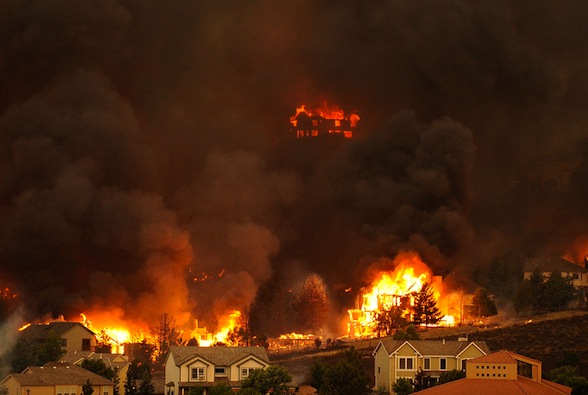
Planet Earth is just one world!

A very simple, fundamental message to the G20+ Conference in Rio.

We live on one planet.  It is the solemn duty of everyone living on this planet to protect it from harm.  So to all those at Rio claiming to represent a Nation, or more accurately the people living in that Nation, act not only on behalf of that Nation but on behalf of the planet, the only planet, we all live on.

The only life-sustaining planet we have!

Fracking Hell!

Is it me or are we all totally mad?  Only if we don’t take action!

I’ve quoted this expression before so forgive me for using it again.  That’s the old Devon expression, “All the world’s a little queer, ‘cept thee and me, and I ha’ me doubts about thee!”  It really does seem as if most of us are ‘a little queer!’

Yesterday, I expressed the tip of much frustration, nay incredulity, in a rant about why society showed such complacency towards the impending crisis of our civilisation.  As I wrote,

Why isn’t there such a huge outpouring of anger at the complacency of the world’s leaders?  How far does the collapse of the conditions, both social and physical, as in biosphere, have to go before we get real, urgent change?

Well today’s Post is taking a selection of recent items that have been published to show why I feel as I do.  I make no apologies for this being a longish Post but that doesn’t make it anything other than incredibly important; personal opinion, of course!

Let’s start with our love affair with carbon-based fuels, in this case natural gas (that’s methane you know).  Over on Lack of Environment Martin Lack recently published a piece on Fracking.  Here’s an extract,

Burning fossil fuels just because they are there is insane
For a long time, I have told anyone that would listen that we should leave unconventional hydrocarbons in the ground because of the extremely high probability that James Hansen is right; if we burn them all the runaway greenhouse effect is a “dead certainty” (i.e. on page 236 of Storms of My Grandchildren). However, thanks to the persistence of my many friends in the blogosphere, I have now also woken up to the reality that unconventional fossil fuel extraction – and hydraulic fracturing (known as fracking) in particular – is having significant immediate adverse environmental impacts. Pendantry has described this as humanity “fouling its own nest”; but I think my own description of it as “defecating in our own pig pen” conveys a more appropriate image.

In the USA, fracking has recently been prohibited in the State of Vermont and it must be hoped that other States will now do the same. The Vermont legislature took this action as a result of reports confirming the link between fracking and minor earthquakes; and because of high profile campaigns mounted by those communities already being adversely impacted by fracking. However, the latter should not be confused with NIMBYism. This is because opposition to fracking is a response to real environmental problems afflicting real people as a result of real stupidity on an industrial scale.

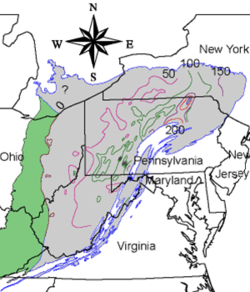
The Marcellus Shale formation

Martin also included a 17-minute feature from Link TV on the use, and dangers, of extracting natural gas from the Marcellus Shale in the US North-East.  It’s a sobering reminder of how we are playing with fire with the planet, both literally and metaphorically.  This is the video:

My next reference is an article published in the latest issue of Nature.  Only a summary is available freely online, but here it is anyway,

Approaching a state shift in Earth’s biosphere

Localized ecological systems are known to shift abruptly and irreversibly from one state to another when they are forced across critical thresholds. Here we review evidence that the global ecosystem as a whole can react in the same way and is approaching a planetary-scale critical transition as a result of human influence. The plausibility of a planetary-scale ‘tipping point’ highlights the need to improve biological forecasting by detecting early warning signs of critical transitions on global as well as local scales, and by detecting feedbacks that promote such transitions. It is also necessary to address root causes of how humans are forcing biological changes.

The overall theme of this issue of Nature is shown in their leading story, again taking the liberty of republishing an extract.  First how the article opens,

Return to Rio: Second chance for the planet

Twenty years ago, when the world’s leaders pledged to protect Earth’s climate and biodiversity at the Rio Earth Summit, they knew it would not be easy. But few could have guessed how much worse the situation would get. In 1992, the atmosphere held fewer than 360 parts per million (p.p.m.) of carbon dioxide; the concentration is now nearing 400 p.p.m. and surging upwards. At the same time, species are disappearing at an accelerating rate.

On the eve of the second Rio Earth Summit, Nature explores the causes and consequence of those changes, as well as the efforts that are being made to avert the worst outcomes. Our assessment shows how little progress nations have made towards honouring the commitments they made in 1992.

Then how that article closes,

Anthony Barnosky and his colleagues argue that the global ecosystem could eventually pass a tipping point and shift into a new state, the likes of which are hard for science to predict. But there are ways to avoid that fate, say Paul Ehrlich and his colleagues (page 68), who suggest techniques to make societies more sustainable and to head off many of the world’s chronic environmental problems.

Earth and its inhabitants have a second chance in Rio. They may not get many more.

There’s more and more of this but, yes, I know, one can only take so much.  So let me head for the close with a message of what you and I, and all of us, can do.

The United Nations Environment Programme recently released a video showing how inadequate have been our leaders.  Watch it first and then I’ll offer a solution.

The fifth edition of the Global Environmental Outlook (GEO-5), launched on the eve of the Rio+20 Summit, assessed 90 of the most-important environmental goals and objectives and found that significant progress had only been made in four.

More on the report findings here.

So join with me as I focus my rant from yesterday into something more valuable – asking you to take action – in whatever way you can!

Go here and sign the petition from 350.org.

Add your name to this:

To the G20 and World Leaders:

As concerned global citizens, we urge you to honour your previous commitments to end taxpayer handouts to the fossil fuel industry. To save our planet we need a game-changer now — we call on you to first lead by example, and then make ending all polluter payments the top global priority for the Rio Earth Summit.

So do it now – Go here and sign the petition from 350.org.

Then when you have signed that plea to world leaders to stop the subsidies to fossil fuels, pass this link to everyone you can – www.350.org/rio

And get close to 350.org and stay in touch.

Let’s do this; it’s so much better than ranting!

I feel a headache coming on!

A bit of a personal rant about complacency!

But before I get my blood up, let me reflect on a small passage of time.  I first started writing this Blog on July 15th, 2009, coming up to three years ago.  The idea came from a previous conversation with Jon Lavin of The People Workshop when we were chatting about Dr. David Hawkins’ Map of Consciousness and Jon pointed out that dogs had a ‘score’ of about 210, i.e. were positively above the boundary between truth and falsehood.  As I wrote here,

Dogs:

  • are integrous ( a score of 210) according to Dr David Hawkins
  • don’t cheat or lie
  • don’t have hidden agendas
  • are loyal and faithful
  • forgive
  • love unconditionally
  • value and cherish the ‘present’ in a way that humans dream of achieving
  • are, by eons of time, a more successful species than man.

That’s why the blog is called Learning from Dogs!

Stay with me just a little longer.

The picture of Pharaoh on the Home page, this one:

Dogs know better, much better! Time again for man to learn from dogs!

is a picture of a ‘beta’ dog.  The beta dog is the second-in-command, so to speak, in a wild dog pack.  A dog pack, about 40 to 50 dogs in the wild, has three dogs of special rank, although rank is not really the correct word, role is a better one.  The leader of the pack is the alpha dog; always a female dog.  The next role dog is the beta; always a male.  The third role dog is the ‘clown’ dog and can be either sex.

In reverse order, the clown dog is there to keep the pack happy (in dog terms), the beta dog’s role is to break up fights within the pack and to ‘teach’ the puppies their social skills (which is why a beta dog is always a dominant male) and the alpha’s primary role is to ensure that the pack’s territory is not compromised by other animals and that there is plenty of food for the pack.

Ergo, the single most important decision of the alpha dog is to move the pack to a new territory when she judges that the present one is unsustainable!

OK, to my ‘rant’!

Why isn’t mankind learning from dogs and realising that our present ‘territory’, Planet Earth, is not capable of sustaining mankind for very much longer.

I don’t believe that man is intrinsically stupid!  Many know the famous quotation from Einstein, “Insanity: doing the same thing over and over again and expecting different results.”  So if most of us ‘nod’ our heads when we read that quote, why are most of us seemingly content to keep doing the same thing?  Why isn’t there such a huge outpouring of anger at the complacency of the world’s leaders?  How far does the collapse of the conditions, both social and physical, as in biosphere, have to go before we get real, urgent change?

Last Thursday, in a post I called Denialists standing up for insanity, I quoted Tom Engelhardt in his introduction to an article by Bill McKibben thus,

It’s true that no single event can be pinned on climate change with absolute certainty.  But anyone who doesn’t think we’re in a fierce new world of weather extremes — and as TomDispatch regular Bill McKibben has suggested, on an increasingly less hospitable planet that he calls Eaarth – is likely to learn the realities firsthand soon enough.  Not so long ago, if you really wanted to notice the effects of climate change around you, you had to be an Inuit, an Aleut, or some other native of the far north where rising temperatures and melting ice were visibly changing the landscape and wrecking ways of life — or maybe an inhabitant of Kiribati.  Now, it seems, we are all Inuit or Pacific islanders.  And the latest polling numbers indicate that Americans are finally beginning to notice in their own lives, and in numbers that may matter.

Well it’s good that Americans are starting to get the picture but it’s all too gentile – we all have to get much more excited about making our leaders understand that we want action to curb CO2 emissions, and we want action NOW!

Just look at this chart from NOAA as seen on the Climate Central website:

Year-to-Date divisional temperature rankings from NOAA.

More about that tomorrow!

OK, only a short rant!  Which is immediately followed by an apology!  Because you will have to wait 24 hours before reading my next Post about fracking, about how some ‘leaders’ expect the CO2 emissions in the earth’s atmosphere to stabilise at 650 ppm and how very close we are to losing control!

Think I need to go and lie down!

Climate change is not a right vs left issue.

A revealing article in The Atlantic by Professor Adler.

Yesterday, I published a Post called Denialists standing up for insanity.  Then within hours of writing that, up popped in my email ‘in-box’ the latest ‘What’s New’ from the Yale Forum on Climate Change and the Media.  One article that jumped off the page at me was this one,

How A Conservative Sees, Wants to Address, Climate Change

June 6, 2012

Law professor Jonathan Adler, no flaming liberal, accepts much of the science and outlines conservative property rights principles for addressing climate change challenges.

What is surprising about these quotations?

  • “… there is reason to believe many of the effects [of climate change] will be quite negative.
  • “Excesses” of climate campaigners and “bad behavior” by some scientists “do not, and should not, discredit the underlying science.”
  • Despite some “substantial uncertainty … this is not sufficient justification for ignoring global warming or pretending that climate change is not a serious problem.”
  • “… effects will be most severe in those nations that are both least able to adapt and least responsible for” the greenhouse problem.
  • “Even non-catastrophic warming should be a serious concern.”

What’s actually surprising about these points is not so much the messages, but the messenger.

Then a couple of paragraphs later, the Yale Forum article links to The Atlantic piece as in, “Adler expresses his views on the seriousness of climate change in “A Conservative’s Approach to Combating Climate Change.”

Let me just give you a taste of that Atlantic piece.

It opens thus,

A Conservative’s Approach to Combating Climate Change

Guest post by Jonathan H. Adler, a professor at the Case Western Reserve University School of Law and regular contributor to the Volokh Conspiracy

No environmental issue is more polarizing than global climate change.  Many on the left fear increases in atmospheric concentrations of greenhouse gases threaten an environmental apocalypse while many on the right believe anthropogenic global warming is much ado about nothing and, at worst, a hoax.  Both sides pretend as if the climate policy debate is, first and foremost, about science, rather than policy. This is not so. There is substantial uncertainty about the scope, scale, and consequences of anthropogenic warming, and will be for some time, but this is not sufficient justification for ignoring global warming or pretending that climate change is not a serious problem.

The fifth and sixth paragraphs present a powerful ‘constitutional’ perspective,

Accepting, for the sake of argument, that the skeptics’ assessment of the science is correct, global warming will produce effects that should be of concern.  Among other things, even a modest increase in global temperature can be expected to produce some degree of sea-level rise, with consequent negative effects on low-lying regions.  Michaels and Balling, for instance, have posited a “best guess” that sea levels will rise 5 to 11 inches over the next century.  Such an increase in sea levels is likely manageable in wealthy, developed nations, such as the United States.  Poorer nations in the developing world, however, will not be so able to adapt to such changes.  This is of particular concern because these effects will be most severe in those nations that are both least able to adapt and least responsible for contributing to the concentration of greenhouse gases in the atmosphere.

It is a well established principle in the Anglo-American legal tradition that one does not have the right to use one’s own property in a manner that causes harm to one’s neighbor.  There are common law cases gong back 400 years establishing this principle and international law has long embraced a similar norm.  As I argued at length in this paper, if we accept this principle, even non-catastrophic warming should be a serious concern, as even non-catastrophic warming will produce the sorts of consequences that have long been recognized as property rights violations, such as the flooding of the land of others.

Professor Adler closes the article, as follows,

Fourth and finally, it is important to recognize that some degree of warming is already hard-wired into the system.  This means that some degree of adaptation will be necessary.  Yet as above, recognizing the reality of global warming need not justify increased federal control over the private economy.  There are many market-oriented steps that can, and should, be taken to increase the country’s ability to adapt to climate change including, as I’ve argued here and here, increased reliance upon water markets, particularly in the western United States where the effects of climate change on water supplies are likely to be most severe.

I recognize that a relatively brief post like this is unlikely to convince many people who have set positions on climate change.  I can already anticipate a comment thread filled with charges and counter-charges over the science.  But I hope this post has helped illustrate that the embrace of limited government principles need not entail the denial of environmental claims and that a concern for environmental protection need not lead to an ever increasing mound of prescriptive regulation.  And for those who wish to explore these arguments in further detail, there’s lots more in the links I’ve provided throughout this post.

The links provided by Professor Adler, as he refers to above, are well-worth pursuing, so for that reason alone, I do recommend reading the whole Atlantic piece in full.