Category: Climate

These Heat Waves?

What is the truth?

Today, August 14th, here in Southern Oregon we are expecting 111 degrees Fahrenheit or 43.8 degrees C. That is really hot! (And at home it reached 108 deg. F. at 3pm.)

So it seems pertinent to republish a post from The Conversation that was published on July 21st, 2023.

ooOOoo

Is it really hotter now than any time in 100,000 years?

By Darrell Kaufman

Professor of Earth and Environmental Sciences, Northern Arizona University

As scorching heat grips large swaths of the Earth, a lot of people are trying to put the extreme temperatures into context and asking: When was it ever this hot before?

Globally, 2023 has seen some of the hottest days in modern measurements, but what about farther back, before weather stations and satellites?

Some news outlets have reported that daily temperatures hit a 100,000-year high. 

As a paleoclimate scientist who studies temperatures of the past, I see where this claim comes from, but I cringe at the inexact headlines. While this claim may well be correct, there are no detailed temperature records extending back 100,000 years, so we don’t know for sure.

Here’s what we can confidently say about when Earth was last this hot.

This is a new climate state

Scientists concluded a few years ago that Earth had entered a new climate state not seen in more than 100,000 years. As fellow climate scientist Nick McKay and I recently discussed in a scientific journal article, that conclusion was part of a climate assessment report published by the Intergovernmental Panel on Climate Change (IPCC) in 2021.

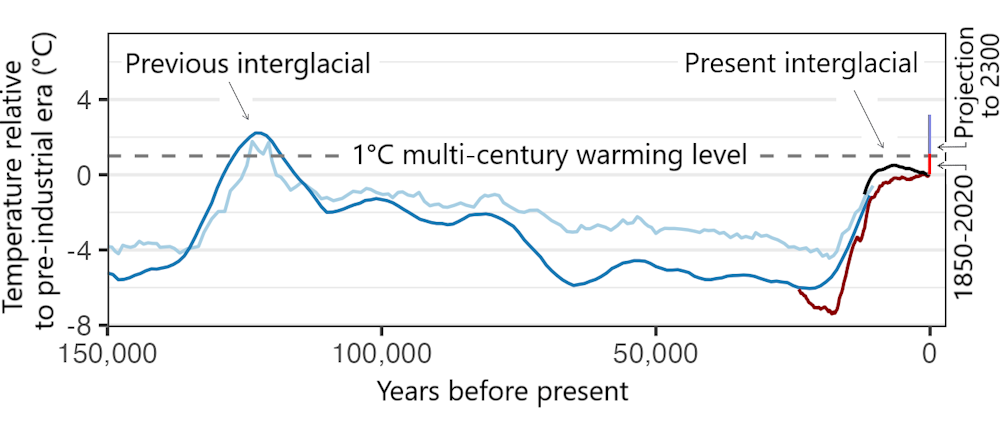
Earth was already more than 1 degree Celsius (1.8 Fahrenheit) warmer than preindustrial times, and the levels of greenhouse gases in the atmosphere were high enough to assure temperatures would stay elevated for a long time.
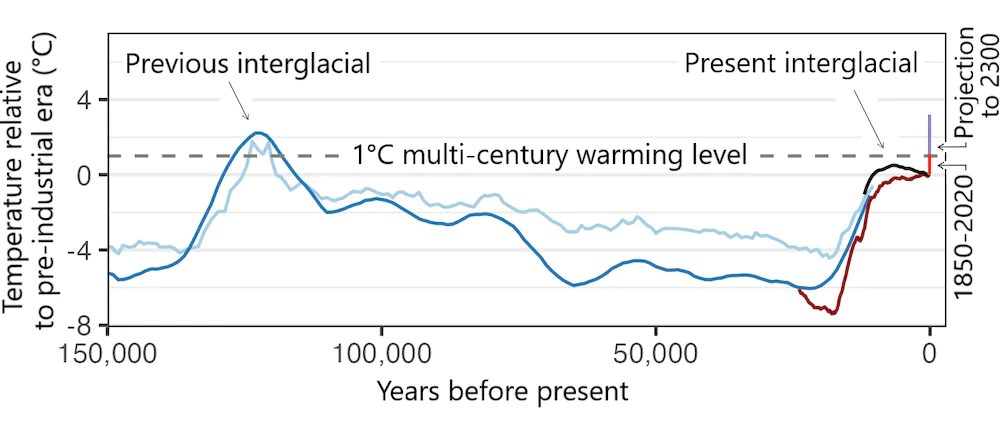
Earth’s average temperature has exceeded 1 degree Celsius (1.8 F) above the preindustrial baseline. This new climate state will very likely persist for centuries as the warmest period in more than 100,000 years. The chart shows different reconstructions of temperature over time, with measured temperatures since 1850 and a projection to 2300 based on an intermediate emissions scenario. D.S. Kaufman and N.P. McKay, 2022, and published datasets, Author provided

Even under the most optimistic scenarios of the future – in which humans stop burning fossil fuels and reduce other greenhouse gas emissions – average global temperature will very likely remain at least 1 C above preindustrial temperatures, and possibly much higher, for multiple centuries.

This new climate state, characterized by a multi-century global warming level of 1 C and higher, can be reliably compared with temperature reconstructions from the very distant past.

How we estimate past temperature

To reconstruct temperatures from times before thermometers, paleoclimate scientists rely on information stored in a variety of natural archives.

The most widespread archive going back many thousands of years is at the bottom of lakes and oceans, where an assortment of biological, chemical and physical evidence offers clues to the past. These materials build up continuously over time and can be analyzed by extracting a sediment core from the lake bed or ocean floor.
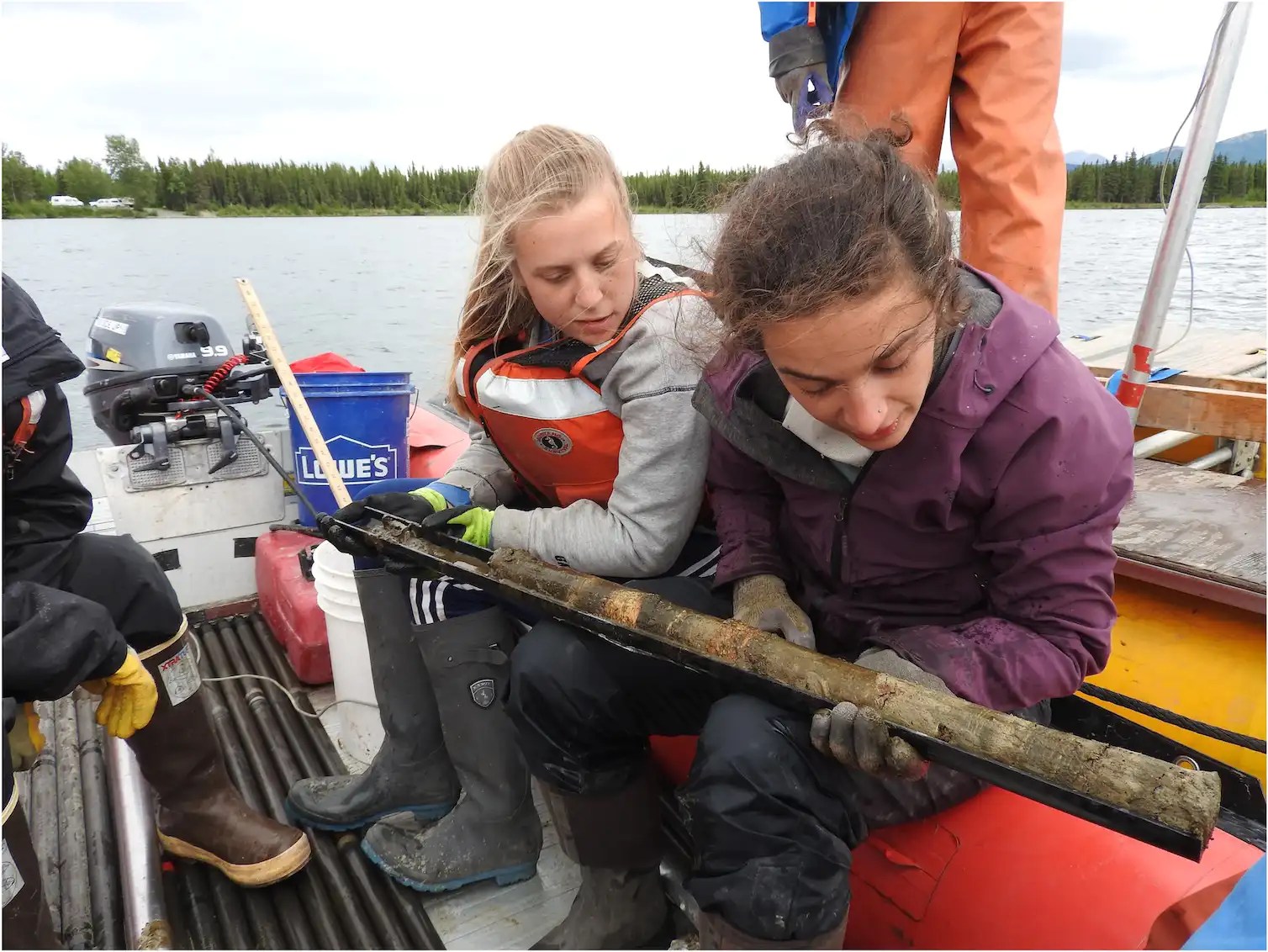
University of Arizona scientist Ellie Broadman holds a sediment core from the bottom of a lake on Alaska’s Kenai Peninsula. Emily Stone

These sediment-based records are rich sources of information that have enabled paleoclimate scientists to reconstruct past global temperatures, but they have important limitations.

For one, bottom currents and burrowing organisms can mix the sediment, blurring any short-term temperature spikes. For another, the timeline for each record is not known precisely, so when multiple records are averaged together to estimate past global temperature, fine-scale fluctuations can be canceled out.

Because of this, paleoclimate scientists are reluctant to compare the long-term record of past temperature with short-term extremes.

Looking back tens of thousands of years

Earth’s average global temperature has fluctuated between glacial and interglacial conditions in cycles lasting around 100,000 years, driven largely by slow and predictable changes in Earth’s orbit with attendant changes in greenhouse gas concentrations in the atmosphere. We are currently in an interglacial period that began around 12,000 years ago as ice sheets retreated and greenhouse gases rose.

Looking at that 12,000-year interglacial period, global temperature averaged over multiple centuries might have peaked roughly around 6,000 years ago, but probably did not exceed the 1 C global warming level at that point, according to the IPCC reportAnother study found that global average temperatures continued to increase across the interglacial period. This is a topic of active research.

That means we have to look farther back to find a time that might have been as warm as today.

The last glacial episode lasted nearly 100,000 years. There is no evidence that long-term global temperatures reached the preindustrial baseline anytime during that period.

If we look even farther back, to the previous interglacial period, which peaked around 125,000 years ago, we do find evidence of warmer temperatures. The evidence suggests the long-term average temperature was probably no more than 1.5 C (2.7 F) above preindustrial levels – not much more than the current global warming level.

Now what?

Without rapid and sustained reductions in greenhouse gas emissions, the Earth is currently on course to reach temperatures of roughly 3 C (5.4 F) above preindustrial levels by the end of the century, and possibly quite a bit higher.

At that point, we would need to look back millions of years to find a climate state with temperatures as hot. That would take us back to the previous geologic epoch, the Pliocene, when the Earth’s climate was a distant relative of the one that sustained the rise of agriculture and civilization.

ooOOoo

It is difficult to know what to say other than one hopes that Governments and country leaders recognise the situation and DO SOMETHING!

As Dr. Michael Mann put it in the last issue of The Humanist: “The only obstacles aren’t the laws of physics, but the flaws in our politics.

I have a son and a daughter in their early 50’s and a grandson who is 12. They, along with millions of other younger people, need action now.

Please!
The Earth became very quiet!

An essay from The Conversation aimed at our youngsters but highly relevant to us all!

I sense we are living in very strange times. As an extract from recent essay from George Monbiot said:

Above all, our ability to adapt to massive change depends on what practitioners call “metacognition” and “meta-skills”. Metacognition means thinking about thinking. In a brilliant essay for the Journal of Academic Perspectives, Natasha Robson argues that while metacognition is implicit in current teaching – “show your working”, “justify your arguments” – it should be explicit and sustained. Schoolchildren should be taught to understand how thinking works, from neuroscience to cultural conditioning; how to observe and interrogate their thought processes; and how and why they might become vulnerable to disinformation and exploitation. Self-awareness could turn out to be the most important topic of all.

Thinking about Thinking

That is why I want to share a recent post from The Conversation with you.

ooOOoo

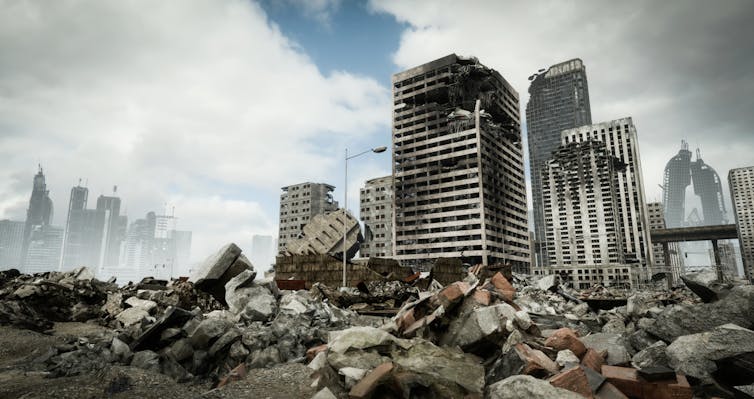
If humans went extinct, what would the Earth look like one year later?

A glimpse of a post-apocalyptic world. Bulgar/E+ via Getty Images

Carlton Basmajian, Iowa State University


If humans went extinct, what would the Earth look like one year later? – Essie, age 11, Michigan


Have you ever wondered what the world would be like if everyone suddenly disappeared?

What would happen to all our stuff? What would happen to our houses, our schools, our neighborhoods, our cities? Who would feed the dog? Who would cut the grass? Although it’s a common theme in movies, TV shows and books, the end of humanity is still a strange thing to think about.

But as an associate professor of urban design – that is, someone who helps towns and cities plan what their communities will look like – it’s sometimes my job to think about prospects like this.

So much silence

If humans just disappeared from the world, and you could come back to Earth to see what had happened one year later, the first thing you’d notice wouldn’t be with your eyes.

It would be with your ears.

The world would be quiet. And you would realize how much noise people make. Our buildings are noisy. Our cars are noisy. Our sky is noisy. All of that noise would stop.

You’d notice the weather. After a year without people, the sky would be bluer, the air clearer. The wind and the rain would scrub clean the surface of the Earth; all the smog and dust that humans make would be gone.

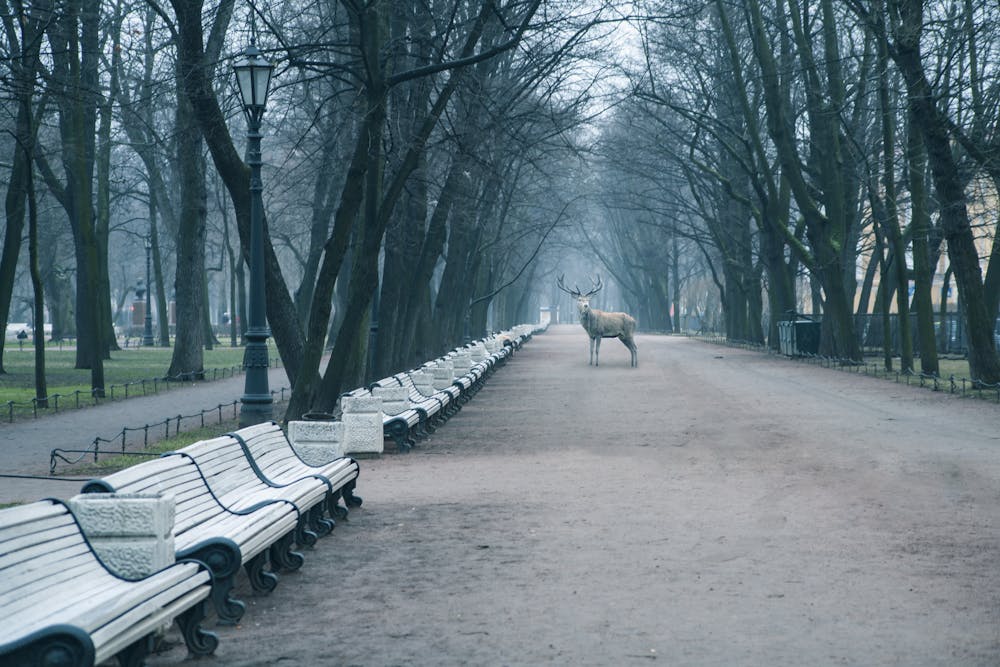
An illustration of a large city park with a deer standing in the middle of a tree-lined path.
It wouldn’t be long before wild animals visited our once well-trodden cities. Boris SV/Moment via Getty Images

Home sweet home

Imagine that first year, when your house would sit unbothered by anyone.

Go inside your house – and hope you’re not thirsty, because no water would be in your faucets. Water systems require constant pumping. If no one’s at the public water supply to manage the machines that pump water, then there’s no water.

But the water that was in the pipes when everyone disappeared would still be there when the first winter came – so on the first cold snap, the frigid air would freeze the water in the pipes and burst them.

There would be no electricity. Power plants would stop working because no one would monitor them and maintain a supply of fuel. So your house would be dark, with no lights, TV, phones or computers.

Your house would be dusty. Actually, there’s dust in the air all the time, but we don’t notice it because our air conditioning systems and heaters blow air around. And as you move through the rooms in your house, you keep dust on the move too. But once all that stops, the air inside your house would be still and the dust would settle all over.

The grass in your yard would grow – and grow and grow until it got so long and floppy it would stop growing. New weeds would appear, and they would be everywhere.

Lots of plants that you’ve never seen before would take root in your yard. Every time a tree drops a seed, a little sapling might grow. No one would be there to pull it out or cut it down.

You’d notice a lot more bugs buzzing around. Remember, people tend to do everything they can to get rid of bugs. They spray the air and the ground with bug spray. They remove bug habitat. They put screens on the windows. And if that doesn’t work, they swat them.

Without people doing all these things, the bugs would come back. They would have free rein of the world again.

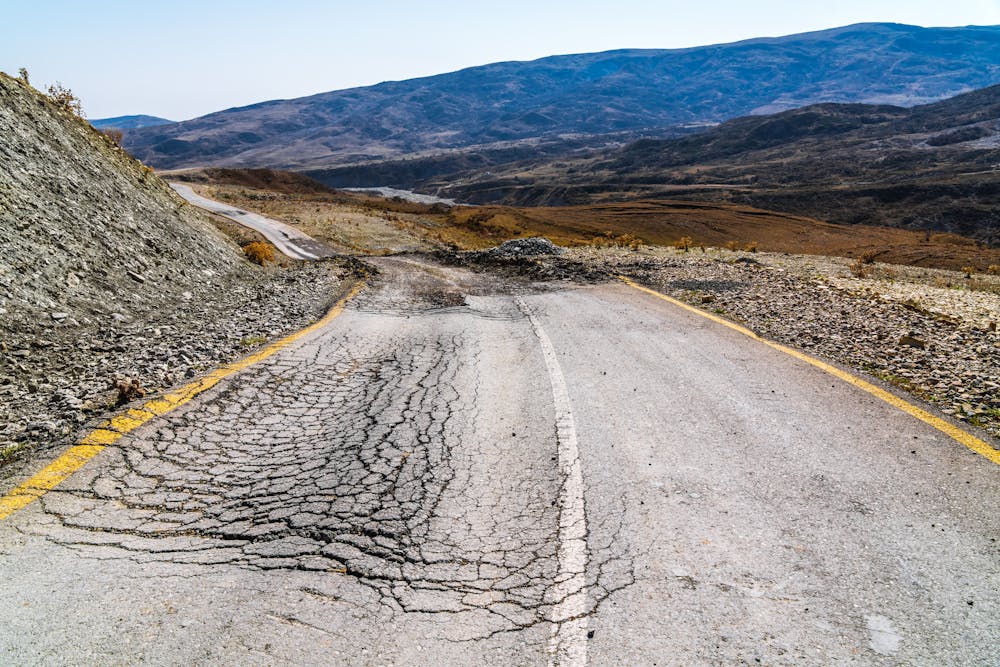
Surrounded by hills and mountains is an isolated two-lane road, cracked and crumbling.
Given enough time, roads would start to crumble. Armastas/iStock via Getty Images Plus

On the street where you live

In your neighborhood, critters would wander around, looking and wondering.

First the little ones: mice, groundhogs, raccoons, skunks, foxes and beavers. That last one might surprise you, but North America was once rich with beavers.

Bigger animals would come later – deer, coyotes and the occasional bear. Not in the first year, maybe, but eventually.

With no electric lights, the rhythm of the natural world would return. The only light would be from the Sun, the Moon and the stars. The night critters would feel good they got their dark sky back.

Fires would happen frequently. Lightning might strike a tree or a field and set brush on fire, or hit the houses and buildings. Without people to put them out, those fires would keeping going until they burned themselves out.

Around your city

After just one year, the concrete stuff – roads, highways, bridges and buildings – would look about the same.

Come back, say, a decade later, and cracks in them would have appeared, with little plants wiggling up through them. This happens because the Earth is constantly moving. With this motion comes pressure, and with this pressure come cracks. Eventually, the roads would crack so much they would look like broken glass, and even trees would grow through them.

Bridges with metal legs would slowly rust. The beams and bolts that hold the bridges up would rust too. But the big concrete bridges, and the interstate highways, also concrete, would last for centuries.

The dams and levees that people have built on the rivers and streams of the world would erode. Farms would fall back to nature. The plants we eat would begin to disappear. Not much corn or potatoes or tomatoes anymore.

Farm animals would be easy prey for bears, coyotes, wolves and panthers. And pets? The cats would go feral – that is, they would become wild, though many would be preyed upon by larger animals. Most dogs wouldn’t survive, either.

An asteroid hit and a solar flare are two of the ways the world could end.

Like ancient Rome

In a thousand years, the world you remember would still be vaguely recognizable. Some things would remain; it would depend on the materials they were made of, the climate they’re in, and just plain luck. An apartment building here, a movie theater there, or a crumbling shopping mall would stand as monuments to a lost civilization. The Roman Empire collapsed more than 1,500 years ago, yet you can see some remnants even today.

If nothing else, humans’ suddenly vanishing from the world would reveal something about the way we treated the Earth. It would also show us that the world we have today can’t survive without us and that we can’t survive if we don’t care for it. To keep it working, civilization – like anything else – requires constant upkeep.


Hello, curious kids! Do you have a question you’d like an expert to answer? Ask an adult to send your question to CuriousKidsUS@theconversation.com. Please tell us your name, age and the city where you live.

And since curiosity has no age limit – adults, let us know what you’re wondering, too. We won’t be able to answer every question, but we will do our best.

Carlton Basmajian, Associate Professor of Community and Regional Planning, Urban Design, Iowa State University

This article is republished from The Conversation under a Creative Commons license. Read the original article.

ooOOoo

Returning to that George Monbiot essay and his closing paragraphs:

Meta-skills are the overarching aptitudes – such as self-development, social intelligence, openness, resilience and creativity – that help us acquire the new competencies that sudden change demands. Like metacognition, meta-skills can be taught. Unfortunately, some public bodies are trapped in the bleak and narrow instrumentalism we need to transcend. For example, after identifying empathy as a crucial meta-skill, a manual by Skills Development Scotland reports that: “Empathy has been identified as a key differentiator for business success, with companies such as Facebook, Google and Unilever being recognised as excelling in this area.” I’ve seldom read a more depressing sentence.

Schooling alone will not be enough to lead us out of the many crises and disasters we now face. Those who are adult today must take responsibility for confronting them. But it should at least lend us a torch.

Thinking about Thinking

We live in a very strange world now. One truly wonders how those who are younger will respond to the demands.

One of the numerous effects of a warming climate.

An article that I wanted to share with you!

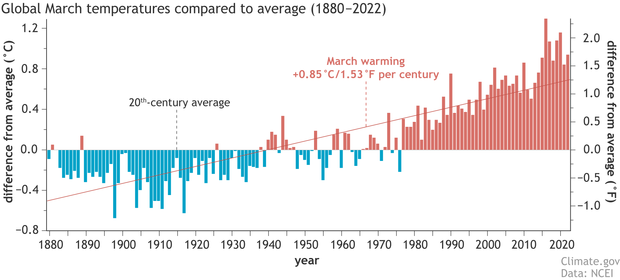
There is no question that we are warming the world, and in my mind, there’s very little doubt that it is us older persons who are the cause. Take this chart, for example, where the effects of populations in the 1980’s – 2000’s had a dramatic impact on the worsening trend:

The reason for today’s post is to share an article that writes of the science of precipitation.

ooOOoo

THE PHYSICS OF PRECIPITATION
IN A WARMING CLIMATE

WRITTEN BY DR ASHLEIGH MASSAM

The scientific consensus on climate change is that atmospheric temperatures are rising and will continue to rise. Mean global temperatures are already 1˚C warmer than preindustrial times (relative to 1850–1900), predominantly due to human activity increasing the amount of greenhouse gases in the atmosphere (IPCC, 2018a). The 2020 Paris Conference of Parties (COP) agreed on the aim of a 1.5˚C cap on climate change-induced warming, although without rapidly introducing measures to reduce carbon and greenhouse gas emissions, global warming could easily go beyond this limit. 

In fact, the Intergovernmental Panel on Climate Change (IPCC) warns that even a mean global temperature increase of 1.5˚C will lead to an increase in the frequency and intensity of rainfall events. But what links a warmer climate to an increase in intense rainfall events? This blog post will explain the physics behind the changes to precipitation rates in a warming climate.

A SIMPLE OVERVIEW OF THE PHYSICS

Climate projections simultaneously warn of higher annual mean surface temperatures, higher rates of intense rainfall and more frequent intense rainfall events. The atmospheric moisture content increases with respect to a change in temperature – essentially, the warmer the atmosphere, the more water is held in the atmosphere, and therefore higher rates of precipitation can be expected.

This is explained by the Clausius-Clapeyron relationship between surface temperature and water vapour. According to the Clausius-Clapeyron relationship, atmospheric water content increases by between 6 and 7% per 1 °C. Therefore, even just an increase of 1.5°C could result in ~9% more water in the atmosphere, which could have a major impact on storm systems and subsequent rainfall.

Storm systems travelling across oceans will have an increased moisture content from water evaporated from the sea surface, forming a larger storm system and therefore more precipitation. JBA has recently discussed the risk of flooding from intensifying rainfall due to climate change and this will be explored in respect to storm systems later in this blog.

HOW PRECIPITATION IS FORMED

In meteorology, precipitation can be liquid or solid water that falls from the atmosphere and reaches the Earth’s surface. Types of precipitation include rain, sleet, or snow, depending on the temperature of the atmosphere. During the water cycle (fig. 1), water evaporates from the surface into the atmosphere, and changes state from liquid to vapour. The water vapour forms cloud droplets, which join together until the heavy droplets fall from the clouds as precipitation. Several processes affect this simple view of the journey from evaporation to precipitation.

Figure 1: A diagram of the water cycle showing the connections between water masses, the atmosphere and the transpiration and condensation of water vapour.

THE SURFACE TEMPERATURE – PRECIPITATION RELATIONSHIP IN MORE DEPTH

The connection between precipitation and surface temperature is defined by the Clausius-Clapeyron equations. The Clausius-Clapeyron equations calculate the energy required to cause a chemical reaction at a given pressure. In terms of precipitation, the Clausius-Clapeyron equations can be used to calculate the thermal energy required to condense water vapour into droplets when the atmospheric pressure is known. 

When water droplets are evaporated into the atmosphere, they travel upwards. As the Clausius-Clapeyron relationship is dependent on atmospheric pressure, the thermal energy requirement for a phase change is lower at a lower pressure. As the water droplets travel upwards, two things happen: 

  1. The atmospheric pressure decreases, and 
  2. The atmospheric temperature cools (this is known as the temperature lapse rate and is typically estimated at -6.5°C per kilometre). 

When the water vapour reaches an elevation where the atmospheric pressure and temperature satisfy the Clausius-Clapeyron relationship, the water vapour condenses into cloud droplets. 

IMPACTS OF A WARMING CLIMATE ON THE SURFACE TEMPERATURE – PRECIPITATION RELATIONSHIP

The release of carbon dioxide, and other greenhouse gases, into the atmosphere by humans has already led to climate change in the form of atmospheric warming. Long-term measurements show that the atmosphere has already warmed by 1°C since 1900. IPCC projections suggest that additional warming is inevitable, and attempts are being made to keep global atmospheric warming to under 1.5°C. Although, as previously mentioned, this could still increase the frequency and intensity of rainfall (IPCC, 2018b). To understand how an increase in annual mean surface temperature will influence rainfall events, we can apply the Clausius-Clapeyron relationship in a geographical context. 

As the Clausius-Clapeyron equations define the relationship between vapour and pressure, they can also be used to define the saturation vapour pressure with respect to temperature. In meteorology, the saturation vapour pressure is the maximum pressure of water vapour, at a given temperature, before it condenses. Therefore, the pressure required to condense a water droplet increases exponentially with respect to a change in temperature. 

This means that the Clausius-Clapeyron relationship can be used to determine the moisture content of the atmosphere. Warmer atmospheric temperatures will increase the atmospheric moisture content before condensation because the atmospheric pressure will not be affected by climate change in the same way as temperature. This results in the previously mentioned calculation that moisture content will increase by ~6.5% in the atmosphere per 1°C increase in temperature and means that atmospheric warming of 1.5°C will yield an increase in atmospheric moisture content of ~9%.

THE EFFECT ON STORMS AND PRECIPITATION

This ~9% increase has an impact on storm systems and therefore rainfall. Hurricane Harvey made landfall on the coast of Texas in August 2017. Over seven days, areas of Texas including Galveston and Houston experienced nearly 1.5 metres of rainfall. 

Research published since the event suggests that the intensity of Hurricane Harvey is attributable to a combination of the storm stalling over one location and climate change. The Gulf of Mexico, the source of moisture for Hurricane Harvey, has experienced anthropogenic-induced sea-surface temperature warming of 1°C since preindustrial times (Pall et al., 2017; Trenberth et al., 2018). Comparing Hurricane Harvey’s precipitation records with an equivalent event from 1950, extreme value analysis concluded that climate change contributed to a 5-7% increase in rainfall rates covering the full region affected by the hurricane (Risser and Wehner, 2017). 

With an increase in rainfall events and the wider impacts of climate change, it’s important for organisations to think about the potential risk to their business. JBA’s UK Climate Change Flood Model assesses and quantifies future flood risk in the UK under a warming climate and complements our range of global Climate Change Analytics, helping clients to understand and manage the effects of climate change on their assets and to enable long-term planning.

For more information on our climate change work, including bespoke consultancy services offered by our expert team, get in touch.

REFERENCES

IPCC, 2018a: Summary for Policymakers. In: Global warming of 1.5°C. An IPCC Special Report on the impacts of global warming of 1.5°C above pre-industrial levels and related global greenhouse gas emission pathways, in the context of strengthening the global response to the threat of climate change, sustainable development, and efforts to eradicate poverty [Masson-Delmotte, V., P. Zhai, H.-O. Pörtner, D. Roberts, J. Skea, P.R. Shukla, A. Pirani, W. Moufouma-Okia, C. Péan, R. Pidcock, S. Connors, J.B.R. Matthews, Y. Chen, X. Zhou, M.I.Gomis, E. Lonnoy, T.Maycock, M.Tignor, and T. Waterfield (eds.)].]. World Meteorological Organization, Geneva, Switzerland.

IPCC, 2018b. Impacts of 1.5ºC Global Warming on Natural and Human Systems. In: Global Warming of 1.5°C. An IPCC Special Report on the impacts of global warming of 1.5°C above pre-industrial levels and related global greenhouse gas emission pathways, in the context of strengthening the global response to the threat of climate change, sustainable development, and efforts to eradicate poverty [Masson-Delmotte, V., P. Zhai, H.-O. Pörtner, D. Roberts, J. Skea, P.R. Shukla, A. Pirani, W. Moufouma-Okia, C. Péan, R. Pidcock, S. Connors, J.B.R. Matthews, Y. Chen, X. Zhou, M.I.Gomis, E. Lonnoy, T.Maycock, M.Tignor, and T. Waterfield (eds.)]. World Meteorological Organization, Geneva, Switzerland.

Pall, P., Patricola, C.M., Wehner, M.F., Stone, D.A., Paciorek, C.J., Collins, W.D. 2017. Diagnosing conditional anthropogenic contributions to heavy Colorado rainfall in September 2013. Weather and Climate Extremes, 17, pp 1-6.

Risser, M.D., Wehner, MF. 2017. Attributable human-induced changes in the likelihood and magnitude of the observed extreme precipitation during Hurricane Harvey. Geophysical Research Letters¸ 44(24), doi: 10.1002/2017GL075888.

Trenberth, K.E., Cheng, L., Jacobs, P., Zhang, Y., Fasullo, J. 2018. Hurricane Harvey links to ocean heat content and climate change adaptation. Earth’s Future, 6(5), doi: 10.1029/2018EF000825

ooOOoo

The IPCC states what is clearly known in science circles; a warmer atmosphere equals more moisture in the air and that translates into more rainfall.

It comes down to warmer atmospheric temperatures increasing the atmospheric moisture content before condensation, simply because the atmospheric pressure will not be affected by climate change in the same way as temperature, as was described earlier in the paper. The reference to Hurricane Harvey was very powerful.

The world has to focus on climate change in an urgent manner. Because there isn’t a great deal of time, something like 10 years, at most, to bring about huge changes in the way we consume energy.

There’s more to water than one might think.

This post attracted me and I wanted to share it with you.

Here in Oregon we are lucky because the ground water is of a high quality and there is plenty of it. At home we drink our water straight from our well without any filtering or chlorination. Have been doing that ever since we moved in back in 2012.

But water is a much deeper subject than I tend to think of and this article is an in-depth review of the topic. It is an article from The Conversation.

ooOOoo

Water in space – a ‘Goldilocks’ star reveals previously hidden step in how water gets to planets like Earth

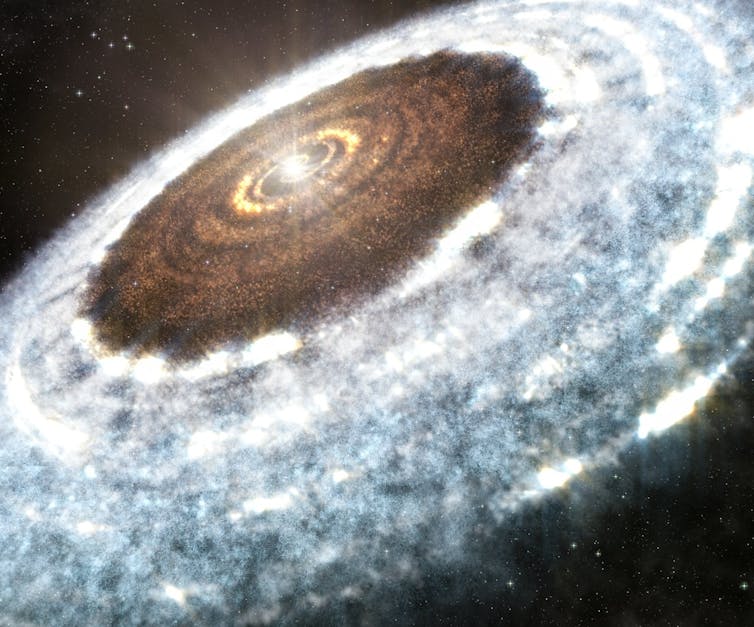
The star system V883 Orionis contains a rare star surrounded by a disk of gas, ice and dust.
A. Angelich (NRAO/AUI/NSF)/ALMA (ESO/NAOJ/NRAO), CC BY

John Tobin, National Radio Astronomy Observatory

Without water, life on Earth could not exist as it does today. Understanding the history of water in the universe is critical to understanding how planets like Earth come to be.

Astronomers typically refer to the journey water takes from its formation as individual molecules in space to its resting place on the surfaces of planets as “the water trail.” The trail starts in the interstellar medium with hydrogen and oxygen gas and ends with oceans and ice caps on planets, with icy moons orbiting gas giants and icy comets and asteroids that orbit stars. The beginnings and ends of this trail are easy to see, but the middle has remained a mystery.

I am an astronomer who studies the formation of stars and planets using observations from radio and infrared telescopes. In a new paper, my colleagues and I describe the first measurements ever made of this previously hidden middle part of the water trail and what these findings mean for the water found on planets like Earth.

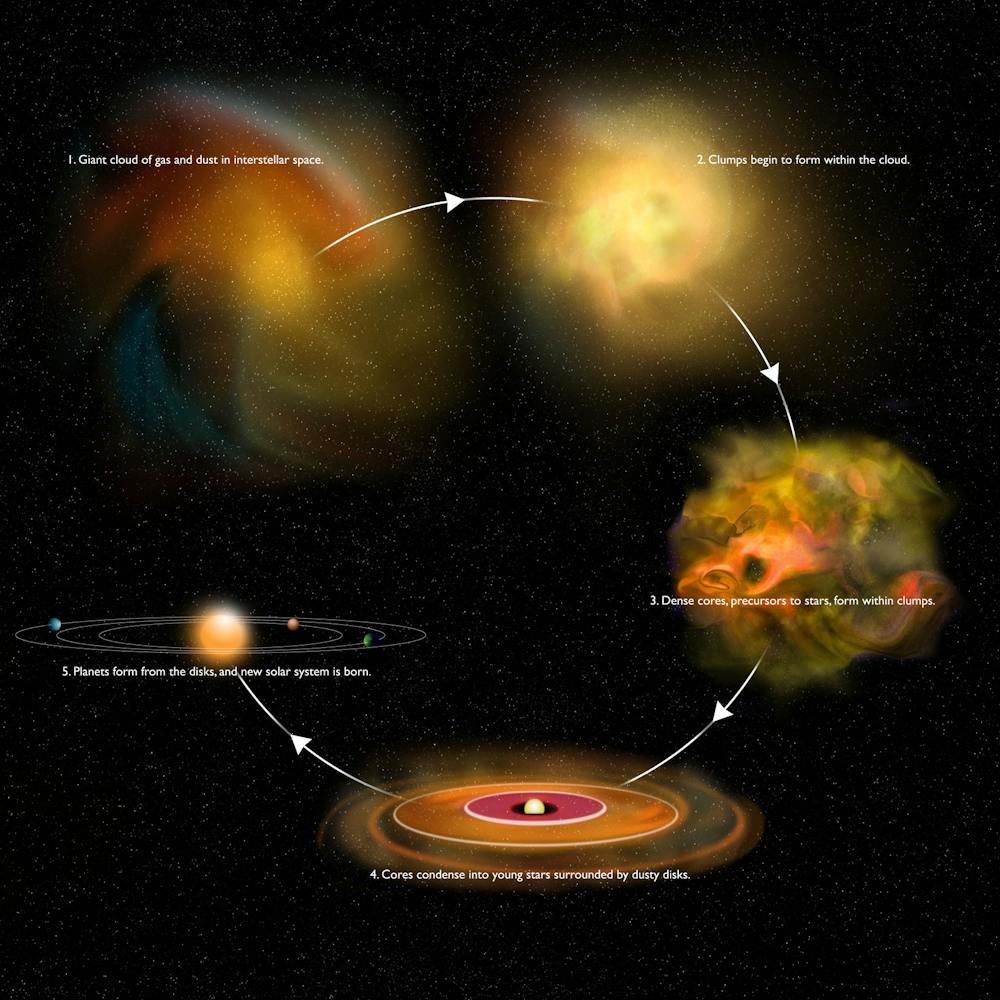
The progression of a star system from a cloud of dust and gas into a mature star with orbiting planets.

Star and planet formation is an intertwined process that starts with a cloud of molecules in space.
Bill Saxton, NRAO/AUI/NSF, CC BY

How planets are formed

The formation of stars and planets is intertwined. The so-called “emptiness of space” – or the interstellar medium – in fact contains large amounts of gaseous hydrogen, smaller amounts of other gasses and grains of dust. Due to gravity, some pockets of the interstellar medium will become more dense as particles attract each other and form clouds. As the density of these clouds increases, atoms begin to collide more frequently and form larger molecules, including water that forms on dust grains and coats the dust in ice.

Stars begin to form when parts of the collapsing cloud reach a certain density and heat up enough to start fusing hydrogen atoms together. Since only a small fraction of the gas initially collapses into the newborn protostar, the rest of the gas and dust forms a flattened disk of material circling around the spinning, newborn star. Astronomers call this a proto-planetary disk.

As icy dust particles collide with each other inside a proto-planetary disk, they begin to clump together. The process continues and eventually forms the familiar objects of space like asteroids, comets, rocky planets like Earth and gas giants like Jupiter or Saturn.

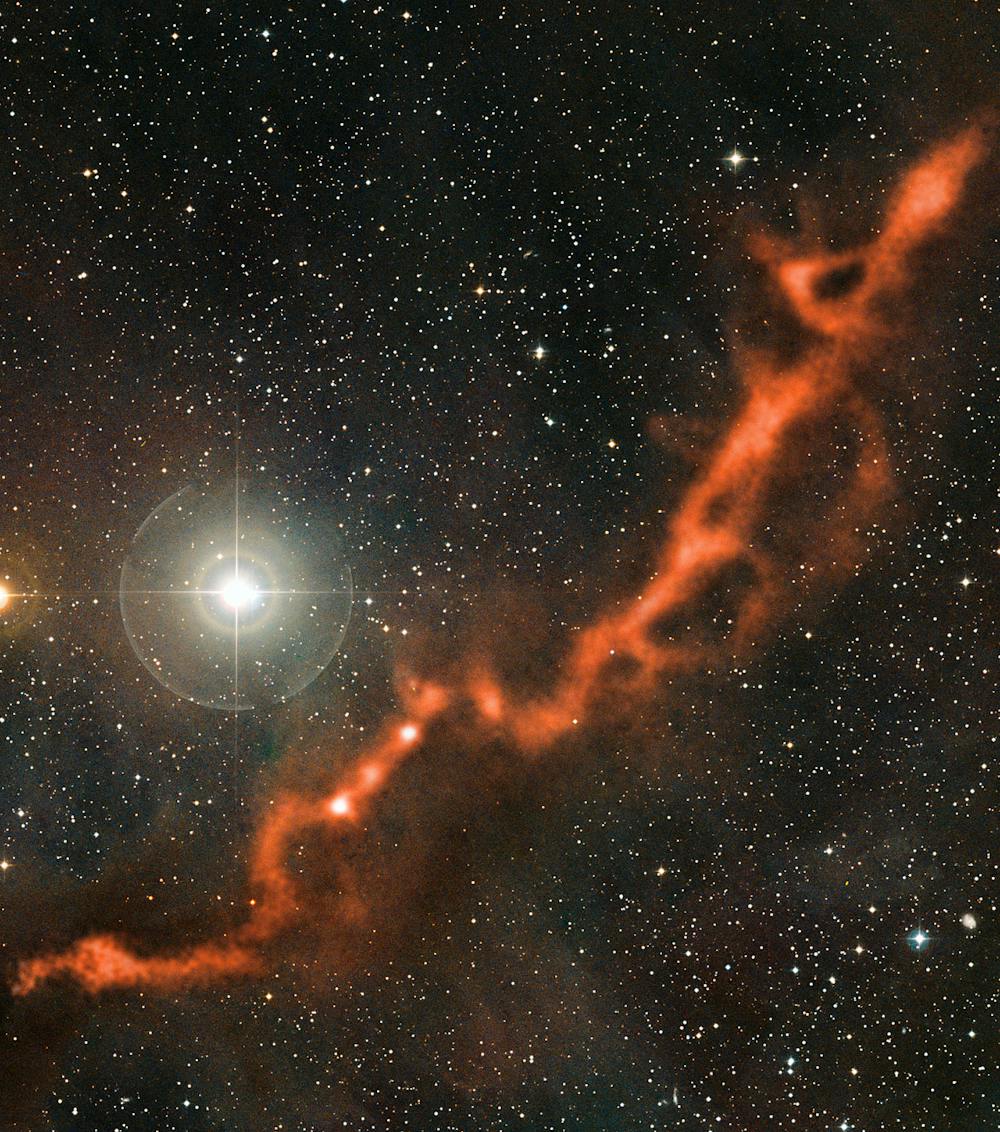
A cloudy filament against a backdrop of stars.

Gas and dust can condense into clouds, like the Taurus Molecular Cloud, where collisions between hydrogen and oxygen can form water.
ESO/APEX (MPIfR/ESO/OSO)/A. Hacar et al./Digitized Sky Survey 2, CC BY

Two theories for the source of water

There are two potential pathways that water in our solar system could have taken. The first, called chemical inheritance, is when the water molecules originally formed in the interstellar medium are delivered to proto-planetary disks and all the bodies they create without going through any changes.

The second theory is called chemical reset. In this process, the heat from the formation of the proto-planetary disk and newborn star breaks apart water molecules, which then reform once the proto-planetary disk cools.

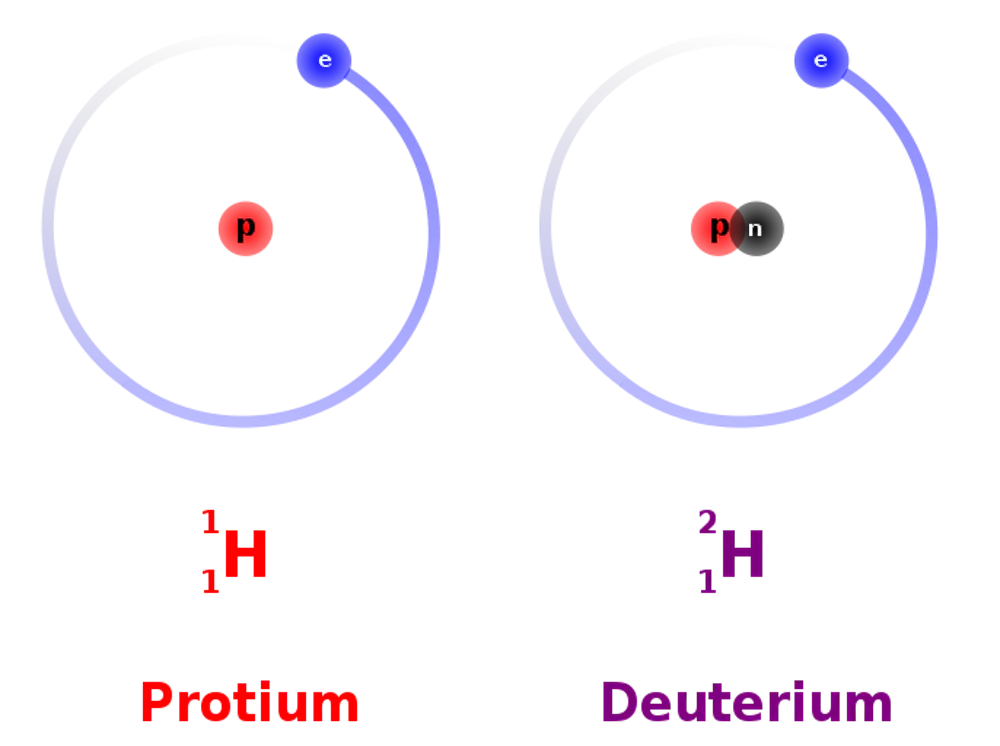
Models of protium and deuterium.

Normal hydrogen, or protium, does not contain a neutron in its nucleus, while deuterium contains one neutron, making it heavier.
Dirk Hünniger/Wikimedia Commons, CC BY-SA

To test these theories, astronomers like me look at the ratio between normal water and a special kind of water called semi-heavy water. Water is normally made of two hydrogen atoms and one oxygen atom. Semi-heavy water is made of one oxygen atom, one hydrogen atom and one atom of deuterium – a heavier isotope of hydrogen with an extra neutron in its nucleus.

The ratio of semi-heavy to normal water is a guiding light on the water trail – measuring the ratio can tell astronomers a lot about the source of water. Chemical models and experiments have shown that about 1,000 times more semi-heavy water will be produced in the cold interstellar medium than in the conditions of a protoplanetary disk.

This difference means that by measuring the ratio of semi-heavy to normal water in a place, astronomers can tell whether that water went through the chemical inheritance or chemical reset pathway.

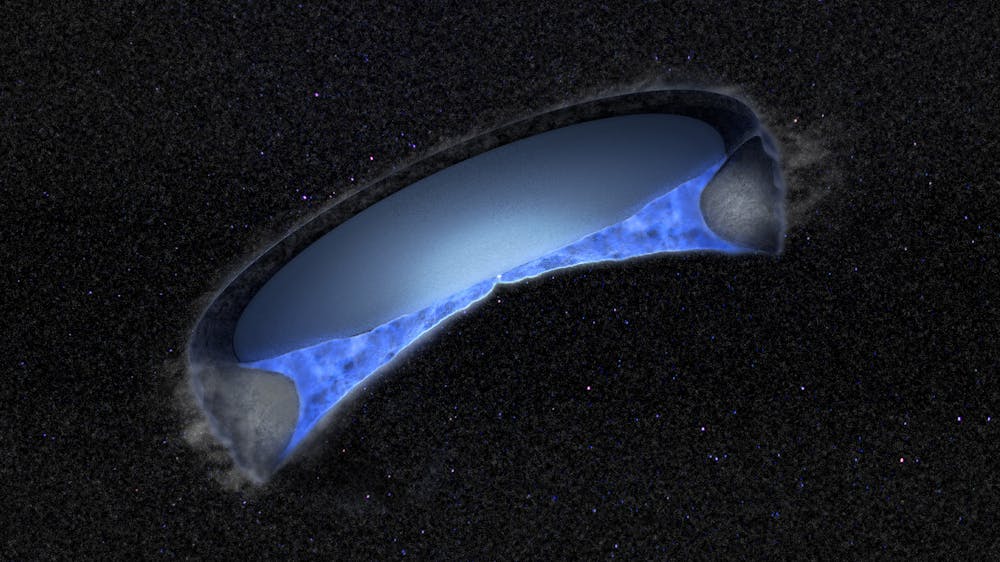
A star surrounded by a ring of gas and dust.

V883 Orionis is a young star system with a rare star at its center that makes measuring water in the proto-planetary cloud, shown in the cutaway, possible.
ALMA (ESO/NAOJ/NRAO), B. Saxton (NRAO/AUI/NSF), CC BY

Measuring water during the formation of a planet

Comets have a ratio of semi-heavy to normal water almost perfectly in line with chemical inheritance, meaning the water hasn’t undergone a major chemical change since it was first created in space. Earth’s ratio sits somewhere in between the inheritance and reset ratio, making it unclear where the water came from.

To truly determine where the water on planets comes from, astronomers needed to find a goldilocks proto-planetary disk – one that is just the right temperature and size to allow observations of water. Doing so has proved to be incredibly difficult. It is possible to detect semi-heavy and normal water when water is a gas; unfortunately for astronomers, the vast majority of proto-plantary disks are very cold and contain mostly ice, and it is nearly impossible to measure water ratios from ice at interstellar distances.

A breakthrough came in 2016, when my colleagues and I were studying proto-planetary disks around a rare type of young star called FU Orionis stars. Most young stars consume matter from the proto-planetary disks around them. FU Orionis stars are unique because they consume matter about 100 times faster than typical young stars and, as a result, emit hundreds of times more energy. Due to this higher energy output, the proto-planetary disks around FU Orionis stars are heated to much higher temperatures, turning ice into water vapor out to large distances from the star.

Using the Atacama Large Millimeter/submillimeter Array, a powerful radio telescope in northern Chile, we discovered a large, warm proto-planetary disk around the Sunlike young star V883 Ori, about 1,300 light years from Earth in the constellation Orion.

V883 Ori emits 200 times more energy than the Sun, and my colleagues and I recognized that it was an ideal candidate to observe the semi-heavy to normal water ratio.

A radio image of the disk around V883 Ori.

The proto-planetary disk around V883 Ori contains gaseous water, shown in the orange layer, allowing astronomers to measure the ratio of semi-heavy to normal water.
ALMA (ESO/NAOJ/NRAO), J. Tobin, B. Saxton (NRAO/AUI/NSF), CC BY

Completing the water trail

In 2021, the Atacama Large Millimeter/submillimeter Array took measurements of V883 Ori for six hours. The data revealed a strong signature of semi-heavy and normal water coming from V883 Ori’s proto-planetary disk. We measured the ratio of semi-heavy to normal water and found that the ratio was very similar to ratios found in comets as well as the ratios found in younger protostar systems.

These results fill in the gap of the water trail forging a direct link between water in the interstellar medium, protostars, proto-planetary disks and planets like Earth through the process of inheritance, not chemical reset.

The new results show definitively that a substantial portion of the water on Earth most likely formed billions of years ago, before the Sun had even ignited. Confirming this missing piece of water’s path through the universe offers clues to origins of water on Earth. Scientists have previously suggested that most water on Earth came from comets impacting the planet. The fact that Earth has less semi-heavy water than comets and V883 Ori, but more than chemical reset theory would produce, means that water on Earth likely came from more than one source.The Conversation

John Tobin, Scientist, National Radio Astronomy Observatory

This article is republished from The Conversation under a Creative Commons license. Read the original article.

ooOOoo

Now this was a long article and I hope some of you stayed with John’s piece until the very end.

It really shows how the water trail is a much greater and longer journey than I assumed.

Please, please watch this

And I wish I knew what to say…

This is a video that is three years old.

But it is more pertinent today than it was when it was first released.

The video asks ‘… why we never really learnt how to talk about this’.

The video is a little less than ten minutes long so watch it now, with the family as well, if that is appropriate, and perhaps have a discussion afterwards.

Jean and I do not have any answers especially when the news is all about other things.

Yes, we know that the climate is changing but what exactly does that mean is a more difficult question to answer. Mind you there are a growing number of organisations committed to finding answers.

Yes, there are many scientists who have clear opinions on the situation but we need a global movement, NOW, to address this very urgent requirement, and there is no sign that the global community are even talking about climate change let alone doing something.

Please, please watch this:

I would love to hear your thoughts.

Plastics in the ocean

A fascinating insight into recovered plastic.

Like so many others we do our little bit regarding plastic but do not properly think about the issue. I have to admit that I am not even sure if all plastics are harmful or just some.

But I comprehend art!

That is why I am republishing, with permission, this article from The Conversation.

ooOOoo

My art uses plastic recovered from beaches around the world to understand how our consumer society is transforming the ocean

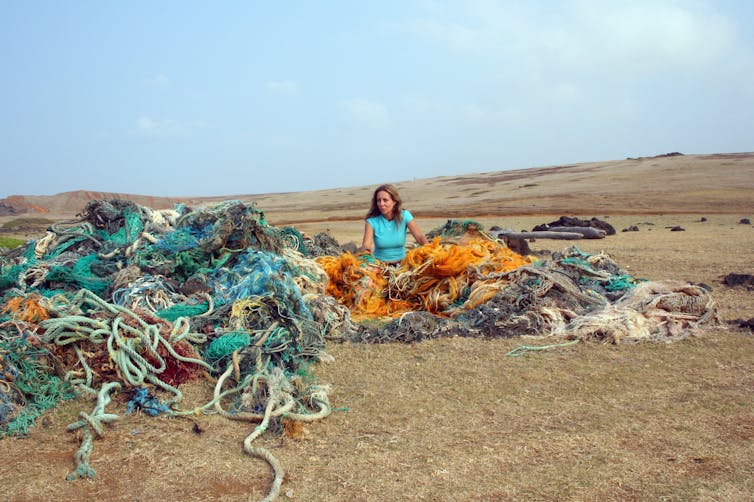
Pam Longobardi amid a giant heap of fishing gear that she and volunteers from the Hawaii Wildlife Fund collected in 2008. David Rothstein, CC BY-ND

Pam Longobardi, Georgia State University

I am obsessed with plastic objects. I harvest them from the ocean for the stories they hold and to mitigate their ability to harm. Each object has the potential to be a message from the sea – a poem, a cipher, a metaphor, a warning.

My work collecting and photographing ocean plastic and turning it into art began with an epiphany in 2005, on a far-flung beach at the southern tip of the Big Island of Hawaii. At the edge of a black lava beach pounded by surf, I encountered multitudes upon multitudes of plastic objects that the angry ocean was vomiting onto the rocky shore.

I could see that somehow, impossibly, humans had permeated the ocean with plastic waste. Its alien presence was so enormous that it had reached this most isolated point of land in the immense Pacific Ocean. I felt I was witness to an unspeakable crime against nature, and needed to document it and bring back evidence.

I began cleaning the beach, hauling away weathered and misshapen plastic debris – known and unknown objects, hidden parts of a world of things I had never seen before, and enormous whalelike colored entanglements of nets and ropes.

Three large plastic art installations, the central one a cornucopia spilling plastic objects onto the floor.
‘Bounty Pilfered’ (center), ‘Newer Laocoön’ (left) and ‘Threnody’ (right). All made of ocean plastic from the Atlantic, Pacific and Gulf of Mexico, installed at the Baker Museum in Naples, Fla., 2022. Pam Longobardi, CC BY-ND

I returned to that site again and again, gathering material evidence to study its volume and how it had been deposited, trying to understand the immensity it represented. In 2006, I formed the Drifters Project, a collaborative global entity to highlight these vagrant, translocational plastics and recruit others to investigate and mitigate ocean plastics’ impact.

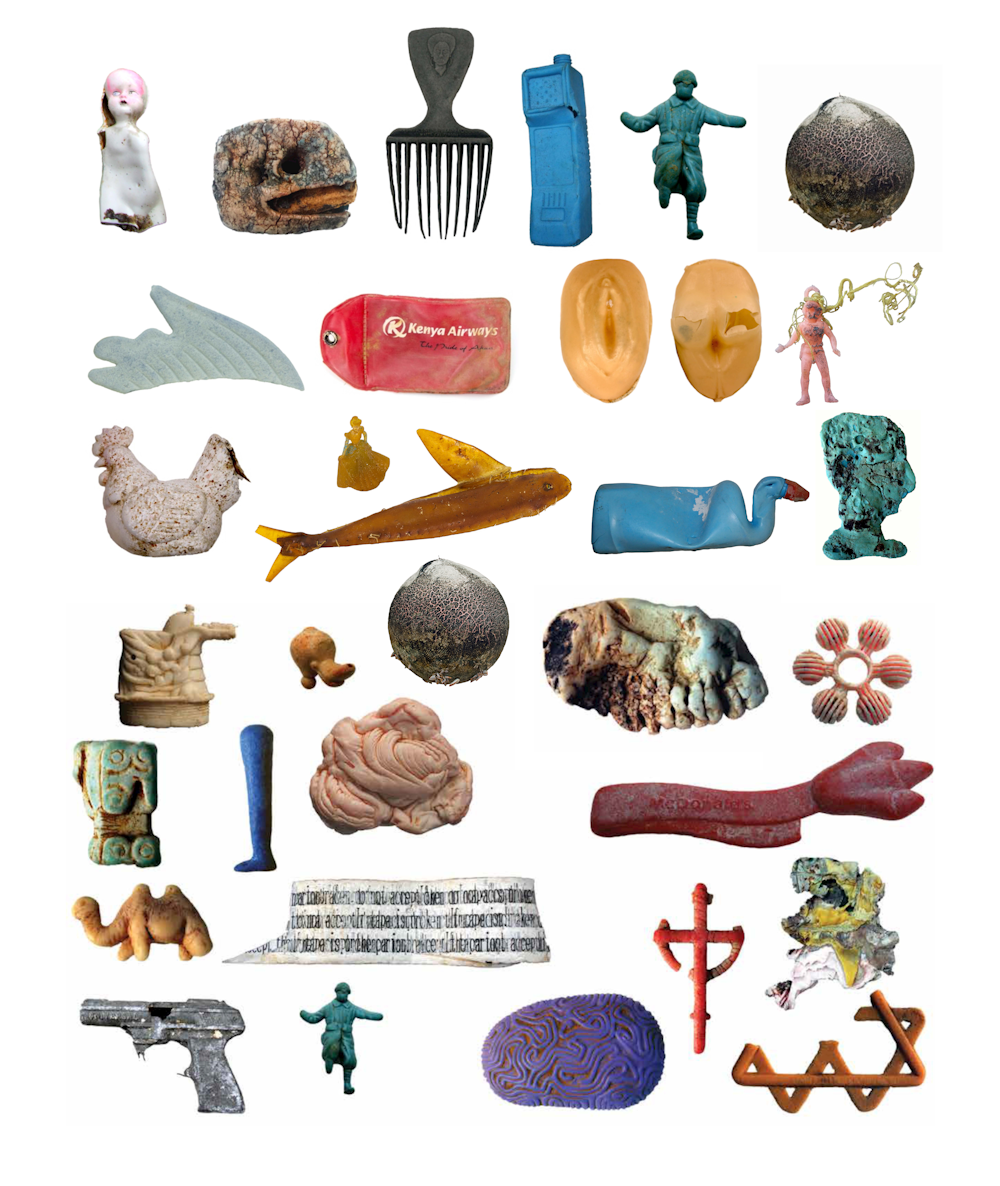
My new book, “Ocean Gleaning,” tracks 17 years of my art and research around the world through the Drifters Project. It reveals specimens of striking artifacts harvested from the sea – objects that once were utilitarian, but have been changed by their oceanic voyages and come back as messages from the ocean.

Array of plastic objects, including toys, action figures and fragments of larger objects.
‘Drifters Objects,’ a tiny sample of the plastic artifacts Pam Longobardi has collected from beaches worldwide. Pam Longobardi, CC BY-ND

Living in a plastic age

I grew up in what some now deem the age of plastic. Though it’s not the only modern material invention, plastic has had the most unforeseen consequences.

My father was a biochemist at the chemical company Union Carbide when I was a child in New Jersey. He played golf with an actor who portrayed “The Man from Glad,” a Get Smart-styled agent who rescued flustered housewives in TV commercials from inferior brands of plastic wrap that snarled and tangled. My father brought home souvenir pins of Union Carbide’s hexagonal logo, based on the carbon molecule, and figurine pencil holders of “TERGIE,” the company’s blobby turquoise mascot.

On the 2013 Gyre Expedition, Pam Longobardi traveled with a team of scientists, artists and policymakers to investigate and remove tons of oceanic plastic washing out of great gyres, or currents, in the Pacific Ocean, and make art from it.

Today I see plastic as a zombie material that haunts the ocean. It is made from petroleum, the decayed and transformed life forms of the past. Drifting at sea, it “lives” again as it gathers a biological slime of algae and protozoans, which become attachment sites for larger organisms.

When seabirds, fish and sea turtles mistake this living encrustation for food and eat it, plastic and all, the chemical load lives on in their digestive tracts. Their body tissues absorb chemicals from the plastic, which remain undigested in their stomachs, often ultimately killing them.

Two piles of tiny particles of virtually identical sizes.
Plastic ‘nurdles,’ (left), tiny pellets that serve as raw materials for manufacturing plastic products, and herring roe, or eggs (right). These visually analogous forms exemplify how fish can mistake plastic for food. Pam Longobardi, CC BY-ND

The forensics of plastic

I see plastic objects as the cultural archaeology of our time – relics of global late-capitalist consumer society that mirror our desires, wishes, hubris and ingenuity. They become transformed as they leave the quotidian world and collide with nature. By regurgitating them ashore or jamming them into sea caves, the ocean is communicating with us through materials of our own making. Some seem eerily familiar; others are totally alien.

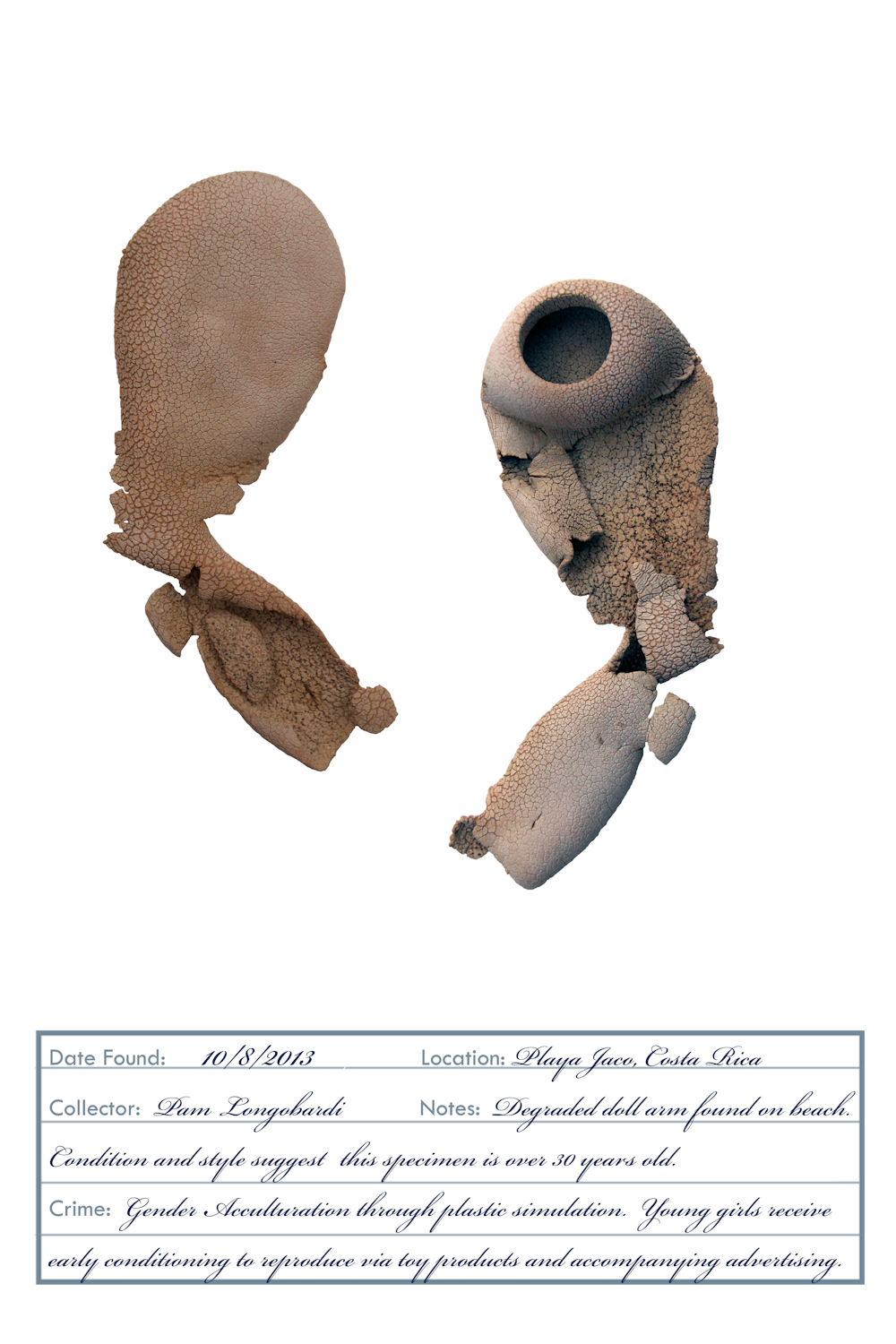
Two views of a degraded arm from a plastic doll, found on Playa Jaco in Costa Rica.
A degraded plastic doll arm, from the series ‘Evidence of Crimes.’ Pam Longobardi, CC BY-ND

A person engaging in ocean gleaning acts as a detective and a beacon, hunting for the forensics of this crime against the natural world and shining the light of interrogation on it. By searching for ocean plastic in a state of open receptiveness, a gleaner like me can find symbols of pop culture, religion, war, humor, irony and sorrow.

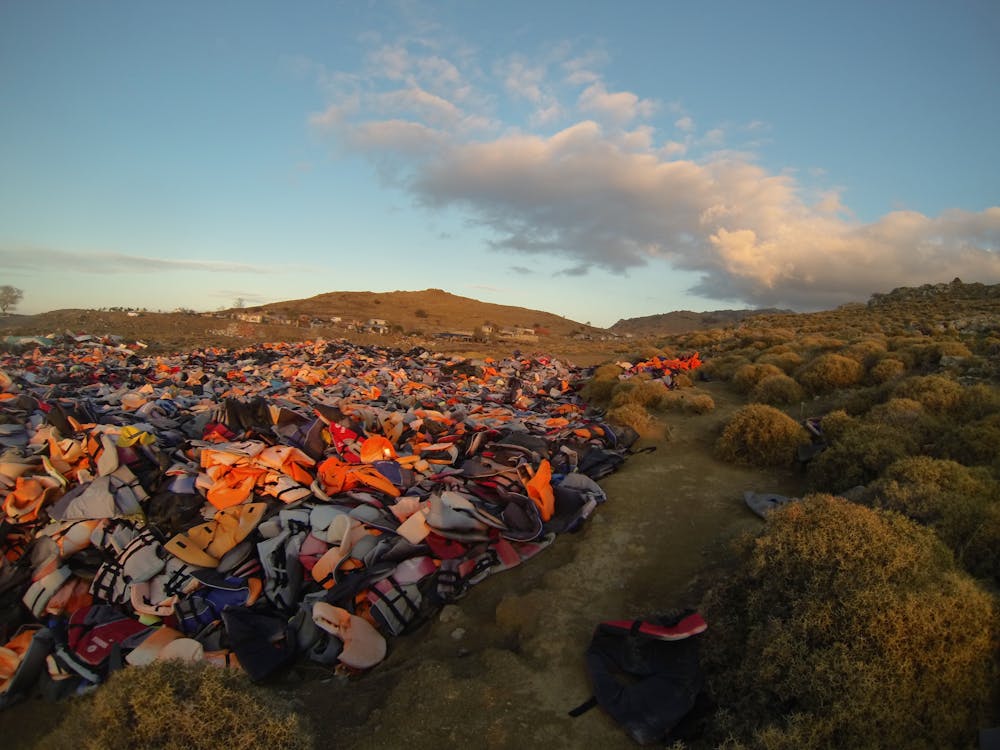
A rolling landscape covered with thousands of life vests.
‘Division Line,’ 2016. This photograph shows the ‘life-jacket cemetary’ in Lesvos, Greece. Traumatized asylum-seekers and migrants arriving by boat from Türkiye leave the life vests on shore as they stagger inland. Most of the waste is plastic. © Pam Longobardi, CC BY-ND

In keeping with the drifting journeys of these material artifacts, I prefer using them in a transitive form as installations. All of these works can be dismantled and reconfigured, although plastic materials are nearly impossible to recycle. I display some objects as specimens on steel pins, and wire others together to form large-scale sculptures.

A plastic bottle cap inscribed 'Endless' and a photograph of a beach littered with plastic objects.
From the series ‘Prophetic Objects,’ a plastic cap from a Greek manufacturer of cleaning products, found on the Greek island of Kefalonia. Pam Longobardi, CC BY-ND

I am interested in ocean plastic in particular because of what it reveals about us as humans in a global culture, and about the ocean as a cultural space and a giant dynamic engine of life and change. Because ocean plastic visibly shows nature’s attempts to reabsorb and regurgitate it, it has profound stories to tell.

A large sculpted anchor in the center of an art gallery, with ties to life preservers mounted on the ceiling.
‘Albatross’ and ‘Hope Floats,’ 2017. Recovered ocean plastic, survival rescue blankets, life vest straps and steel. Pam Longobardi, CC BY-ND

I believe humankind is at a crossroads with regards to the future. The ocean is asking us to pay attention. Paying attention is an act of giving, and in the case of plastic pollution, it is also an act of taking: Taking plastic out of your daily life. Taking plastic out of the environment. And taking, and spreading, the message that the ocean is laying out before our eyes.

Pam Longobardi, Regents’ Professor of Art and Design, Georgia State University

This article is republished from The Conversation under a Creative Commons license. Read the original article.

ooOOoo

Pam at one point describes the ocean plastic”… because of what it reveals about us as humans in a global culture, and about the ocean as a cultural space and a giant dynamic engine of life and change …”. It raises questions that I can only ponder the answer. Ultimately, are there too many inhabitants on this planet? What does the next generation think? Is there an answer?

A lost, and found, dog in Utah

A story that was widely reported.

I was short on time yesterday so no pre-amble.

ooOOoo

Search and rescue team save dog near frozen waterfall in Utah 

The dog separated from its owner on Christmas Eve.

By Teddy Grant, December 27, 2022.

A dog that was stranded near a frozen waterfall in Utah on Christmas Eve was saved by search and rescue officials and reunited with her owner.

According to the Weber County Sheriff’s Office Search and Rescue, a local man was hiking near Waterfall Canyon on Saturday when he became separated from his dog Nala.

The unidentified hiker couldn’t find Nala by nightfall and resumed his search the morning of Christmas Day, the sheriff’s office wrote on its Facebook page.

The hiker’s family members contacted authorities around 1:00 p.m., local time, saying he wasn’t responding to their calls or text messages, officials said.

Nala’s owner answered one of the phone calls once he regained cellphone service and was able to let people know that Nala was around the waterfall, but couldn’t reach her because of the steepness and the icy condition of the terrain, according to Weber County Sheriff’s Office Search and Rescue.

A grab from video posted by Weber County Sheriff’s Office Search and Rescue shows the dog Nala at Waterfall Canyon in Ogden, Utah, Dec. 25, 2022.

Weber County Sheriff’s Office Search and Rescue

The search and rescue team responded to the call and were able to save a skittish Nala after a little coaxing, officials said.

“Nala was cold with a few minor injuries, but was able to hike down with the rescuers,” officials wrote. “She is one tough puppy! Once reaching the trailhead parking lot, both human and canine couldn’t have been happier to be reunited.”

According to Waterfall Canyon it is a “moderately challenging,” 2.4-mile trail near Ogden, Utah, according to AllTrails. Ogden is around 38 miles north of Salt Lake City.

ooOOoo

I’m sure you read that the human and the dog were very grateful to be reunited.

A very small step.

But an important one!

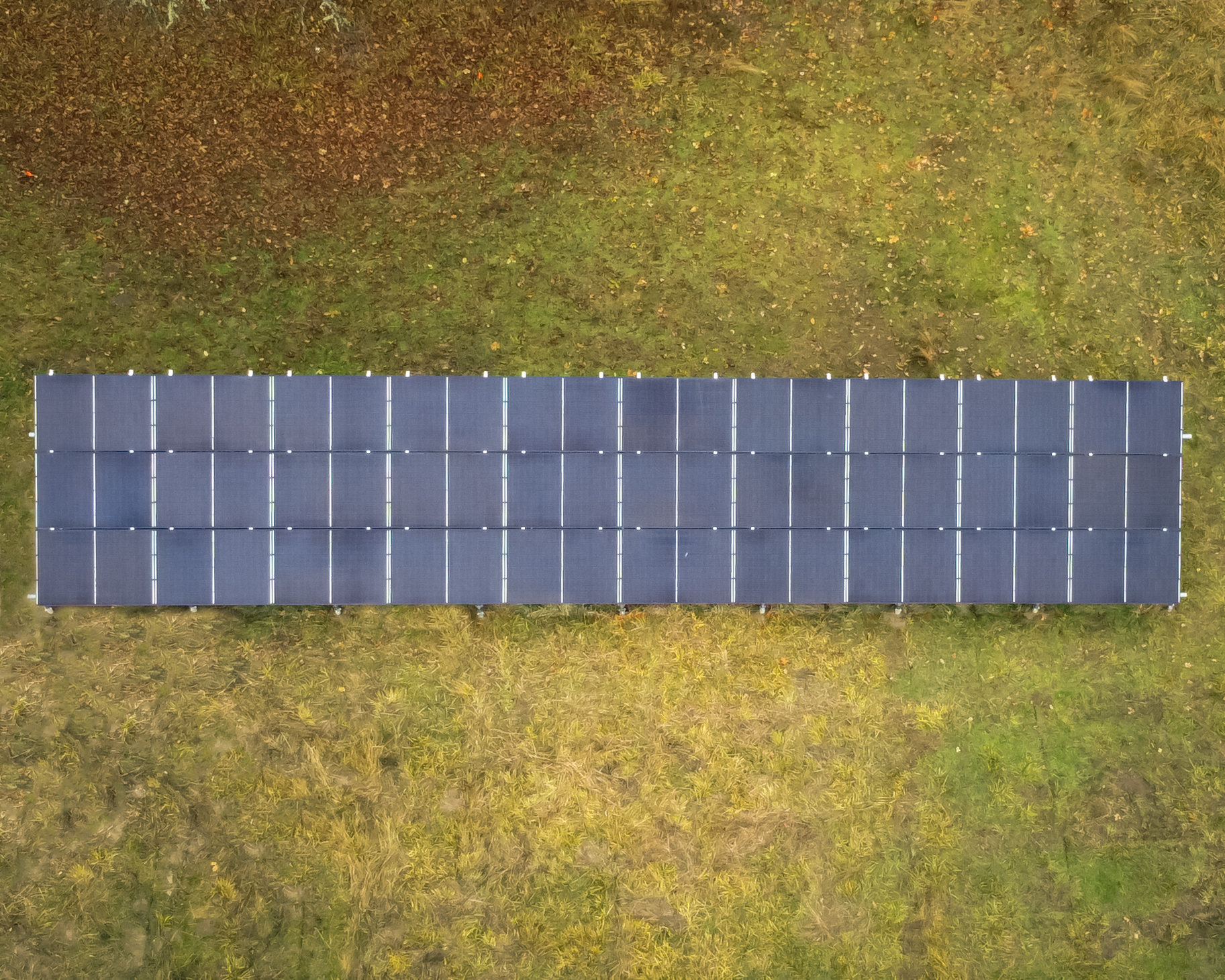
From the 21st November until the 23rd Sunshine Solar installed a solar panel system. But we were then told to wait until Pacific Power had come to the house to put in a new electricity meter. Last Thursday, 1st December, Brent from Pacific Power called by and replaced our electricity meter. He replaced it with a bi-directional meter that when we were producing more power than we are consuming then the surplus would be ‘banked’ to be used at times when we required the surplus.

This was the result of us investing in a ground-mounted solar system.

We purchased the system from Solar Sunshine after doing a great deal of research. Indeed Brent said that they were a great company.

The other thing that we had no choice over was to install a ground-mounted system some 120 feet from the house. Because neither the house nor the roof face East and therefore are no use for solar. But as Brent pointed out last Thursday the ground-mounted system, despite being more expensive, was a good alternative to the roof system because new roof tiles were irrelevant.

The system consists of 30 individual panels capable of producing a maximum output of 65 amps at 240 volts; in other words 15,600 watts!

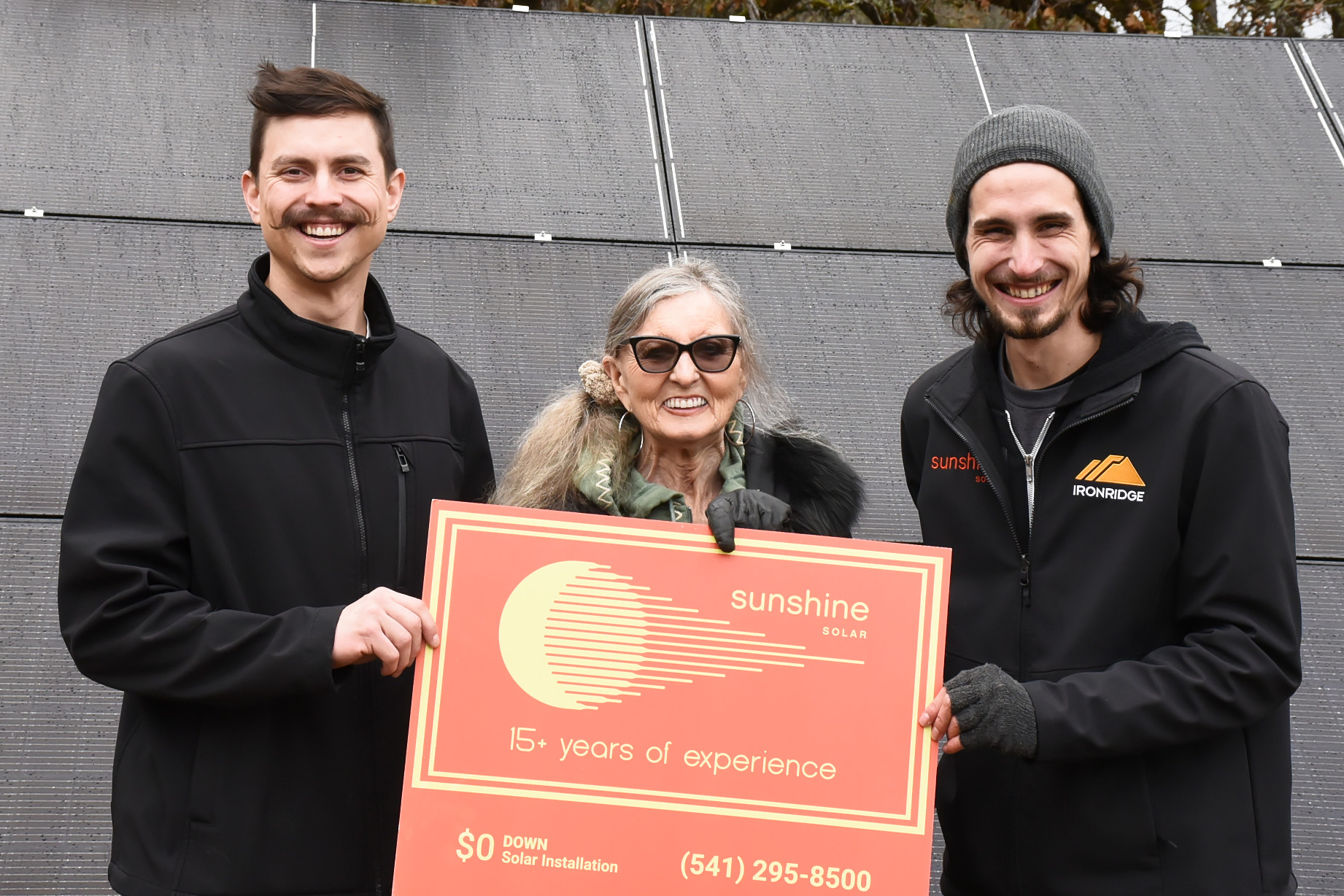
Yesterday, Cory and Brandon (sp?) came out to the system and checked that it was alright. Plus they gave us an digital application so we could see how much power we were generating, plus more, and they also took some photographs, that I offer you now.

oooo

oooo

oooo

This last photograph was one taken by yours truly with Cory on the left and Brandon on the right with Jeannie in the middle.

Finally, the ‘app’ is going to be very useful.

Already it shows that last Saturday the array produced 29 kilowatts and then yesterday, the 4th December, the array produced 22.9 kilowatts and these were by no means sunlit days all the time. That brings the total for all 5 days in December, in other words since the system went live, to 91.1 kilowatts as of 15:27 PT on the 5th.

We are most pleased with the company and the installation.

Herman Daly.

A recent article in The Conversation

I was short of time yesterday when I turned my mind to Tuesday’s post. So I hope you won’t mind if I leave you with this very interesting article.

ooOOoo

The inconvenient truth of Herman Daly: There is no economy without environment

The economy depends on the environment. Economics can seem to forget that point. Ines Lee Photos/Moment via Getty Images

Jon D. Erickson, University of Vermont

Herman Daly had a flair for stating the obvious. When an economy creates more costs than benefits, he called it “uneconomic growth.” But you won’t find that conclusion in economics textbooks. Even suggesting that economic growth could cost more than it’s worth can be seen as economic heresy.

The renegade economist, known as the father of ecological economics and a leading architect of sustainable development, died on Oct. 28, 2022, at the age of 84. He spent his career questioning an economics disconnected from an environmental footing and moral compass.


In an age of climate chaos and economic crisis, his ideas that inspired a movement to live within our means are increasingly essential.

The seeds of an ecological economist

Herman Daly grew up in Beaumont, Texas, ground zero of the early 20th century oil boom. He witnessed the unprecedented growth and prosperity of the “gusher age” set against the poverty and deprivation that lingered after the Great Depression.

To Daly, as many young men then and since believed, economic growth was the solution to the world’s problems, especially in developing countries. To study economics in college and export the northern model to the global south was seen as a righteous path.

Headshot photo of Daly as an older man, with glasses and thinning hair,
Economist Herman Daly (1938-2022) Courtesy of Island Press

But Daly was a voracious reader, a side effect of having polio as a boy and missing out on the Texas football craze. Outside the confines of assigned textbooks, he found a history of economic thought steeped in rich philosophical debates on the function and purpose of the economy.

Unlike the precision of a market equilibrium sketched on the classroom blackboard, the real-world economy was messy and political, designed by those in power to choose winners and losers. He believed that economists should at least ask: Growth for whom, for what purpose and for how long?

Daly’s biggest realization came through reading marine biologist Rachel Carson’s 1962 book “Silent Spring,” and seeing her call to “come to terms with nature … to prove our maturity and our mastery, not of nature but of ourselves.” By then, he was working on a Ph.D. in Latin American development at Vanderbilt University and was already quite skeptical of the hyperindividualism baked into economic models. In Carson’s writing, the conflict between a growing economy and a fragile environment was blindingly clear.

After a fateful class with Nicholas Georgescu-Roegen, Daly’s conversion was complete. Georgescu-Roegen, a Romanian-born economist, dismissed the free market fairy tale of a pendulum swinging back and forth, effortlessly seeking a natural state of equilibrium. He argued that the economy was more like an hourglass, a one-way process converting valuable resources into useless waste.

Daly became convinced that economics should no longer prioritize the efficiency of this one-way process but instead focus on the “optimal” scale of an economy that the Earth can sustain. Just shy of his 30th birthday in 1968, while working as a visiting professor in the poverty-stricken Ceará region of northeastern Brazil, Daly published “On Economics as a Life Science.”

His sketches and tables of the economy as a metabolic process, entirely dependent on the biosphere as source for sustenance and sink for waste, were the road map for a revolution in economics.

Economics of a full world

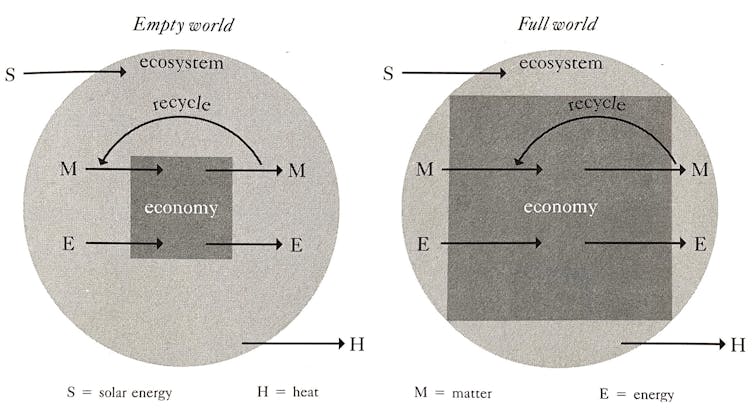
Daly spent the rest of his career drawing boxes in circles. In what he called the “pre-analytical vision,” the economy – the box – was viewed as the “wholly owned subsidiary” of the environment, the circle.

When the economy is small relative to the containing environment, a focus on the efficiency of a growing system has merit. But Daly argued that in a “full world,” with an economy that outgrows its sustaining environment, the system is in danger of collapse.

Illustrations of a square (economy) inside a circle (ecosystem). Energy and matter go into and out of the economy square, and some is recycled. Meanwhile solar energy enters the ecosystem circle and some heat escapes. In one, the square is too large.
Herman Daly’s conception of the economy as a subsystem of the environment. In a ‘full world,’ more growth can become uneconomic. Adapted from ‘Beyond Growth.’ Used with permission from Beacon Press.

While a professor at Louisiana State University in the 1970s, at the height of the U.S. environmental movement, Daly brought the box-in-circle framing to its logical conclusion in “Steady-State Economics.” Daly reasoned that growth and exploitation are prioritized in the competitive, pioneer stage of a young ecosystem. But with age comes a new focus on durability and cooperation. His steady-state model shifted the goal away from blind expansion of the economy and toward purposeful improvement of the human condition.

The international development community took notice. Following the United Nations’ 1987 publication of “Our Common Future,” which framed the goals of a “sustainable” development, Daly saw a window for development policy reform. He left the safety of tenure at LSU to join a rogue group of environmental scientists at the World Bank.

For the better part of six years, they worked to upend the reigning economic logic that treated “the Earth as if it were a business in liquidation.” He often butted heads with senior leadership, most famously with Larry Summers, the bank’s chief economist at the time, who publicly waved off Daly’s question of whether the size of a growing economy relative to a fixed ecosystem was of any importance. The future U.S. treasury secretary’s reply was short and dismissive: “That’s not the right way to look at it.”

But by the end of his tenure there, Daly and colleagues had successfully incorporated new environmental impact standards into all development loans and projects. And the international sustainability agenda they helped shape is now baked into the U.N. Sustainable Development Goals of 193 countries, “a plan of action for people, planet and prosperity.” In 1994, Daly returned to academia at the University of Maryland, and his life’s work was recognized the world over in the years to follow, including by Sweden’s Right Livelihood Award, the Netherlands’ Heineken Prize for Environmental Science, Norway’s Sophie Prize, Italy’s Medal of the Presidency, Japan’s Blue Planet Prize and even Adbuster’s person of the year.

Today, the imprint of his career can be found far and wide, including measures of the Genuine Progress Indicator of an economy, new Doughnut Economics framing of social floors within environmental ceilings, worldwide degree programs in ecological economics and a vibrant degrowth movement focused on a just transition to a right-sized economy.

I knew Herman Daly for two decades as a co-author, mentor and teacher. He always made time for me and my students, most recently writing the foreword to my upcoming book, “The Progress Illusion: Reclaiming Our Future from the Fairytale of Economics.” I will be forever grateful for his inspiration and courage to, as he put it, “ask the naive, honest questions” and then not be “satisfied until I get the answers.”

Jon D. Erickson, Professor of Sustainability Science and Policy, University of Vermont

This article is republished from The Conversation under a Creative Commons license. Read the original article.

ooOOoo

I found this to be absolutely fascinating and I am sure many besides me agree.

The end maybe in sight!

A rather gloomy analysis about the next few years!

One makes decisions all one’s life. But too few of us are making decisions that will prevent our planet from over-heating.

Patrice Ayme wrote a comment in a recent post that said (in part): “However we are tracking to a much higher temperature: + 7 (seven) Celsius in some now temperate parts… imminently. That is going to be catastrophic.”

There is a terrible change going on right now. From the deforestation in the Amazon rainforest to the unseasonable heat in Europe, as reported in the Guardian newspaper: “The result of this advection has been anomalously warm temperatures across large parts of Europe – in particular across France and Spain, where temperatures soared to over 10C above normal. Maximum temperatures widely exceeded 30C in parts of Spain on Thursday, with 35.2C measured at Morón de la Frontera, south-east of Seville.

One would think that our governments would be pulling together in order to have a co-ordinated global plan. But there’s no sight of that yet. What we do have is a sort of craziness of Governments that causes me to lament over our, as in a global ‘our’, distractions. We are running out of time!

To this end I am republishing in full the latest George Monbiot essay. I hasten to add with Mr Monbiot’s permission.

ooOOoo

The Oligarch’s Oligarch

Published 30th October 2022.

Just as we need to get the money out of politics, we have been gifted a Prime Minister who represents the ultra-rich.

By George Monbiot, published in the Guardian 26th October 2022

Before we decide what needs to change, let’s take stock of what we have lost. I want to begin with what happened last week. I don’t mean the resignation of the prime minister. This is more important.

Almost all the media reported a scripted comment by the newly reinstated home secretary, Suella Braverman, about the “Guardian-reading, tofu-eating wokerati”. Astonishingly, scarcely any of them reported what she was doing at the time. She was pushing through the House of Commons the most repressive legislation of the modern era.

Under the public order bill, anyone who has protested in the previous five years, or has encouraged other people to protest, can be forced to “submit to … being fitted with, or the installation of, any necessary apparatus” to monitor their movements. In other words, if you attend or support any protest in which “serious disruption to two or more individuals or to an organisation” occurs, you can be forced to wear an electronic tag. “Serious disruption” was redefined by the 2022 Police Act to include noise.

This is just one of a series of astounding measures in the bill, which has been hardly remarked upon in public life as it passes through Britain’s legislature. What we see here is two losses in one moment: the final erasure of the right to protest, and political journalism’s mutation from reporting substance to reporting spectacle. These are just the latest of our losses.

So extreme has inequality become, and so dangerous is the combination of frozen wages, lagging benefits, rising rents and mortgage repayments, soaring bills and food inflation, that millions of people are being pushed towards destitution. Unless something changes, many will soon lose their homes. In the midst of this crisis, we have been gifted a prime minister who owns four luxury “homes”. One of them is an empty flat in Kensington that he reserves for visiting relatives.

While Rishi Sunak was chancellor, the government repeatedly delayed its manifesto promise to ban no-fault evictions. Landlords are ruthlessly exploiting this power to throw their tenants on to the street or use the threat to force them to accept outrageous rent rises and dismal conditions. Had Sunak’s “help to buy” mortgage scheme succeeded (it was a dismal flop), it would have raised house prices, increasing rents and making ownership less accessible: the opposite of its stated aim. But this, as with all such schemes, was surely its true purpose: to inflate the assets of existing owners, the Conservative party’s base.

Public services are collapsing at breathtaking speed. Headteachers warn that 90% of schools in England could run out of money next year. NHS dentistry is on the verge of extinction. Untold numbers are now living in constant pain and, in some cases, extracting their own teeth. The suspicion that the NHS is being deliberately dismembered, its core services allowed to fail so that we cease to defend it against privatisation, rises ever higher in the mind.

But Sunak appears determined only to hack ever further. Sitting on a family fortune of £730m, he seems unmoved by the plight of people so far removed from him in wealth that they must seem to exist on another planet. He is the oligarch’s oligarch, ever responsive to the demands of big capitaland the three offshore plutocrats who own the country’s biggest newspapers, oblivious of the needs of the 67 million people who live here.

After 12 years of Conservative austerity and chaos, the very rich have taken almost everything. They have even captured virtue. They now appropriate the outward signs of an ethical life while continuing – despite or because of their organic cotton jackets and second homes, their electric cars and pasture-fed meat, their carbon offsets and ayahuasca retreats, philanthropy and holidays in quiet resorts whose palm-thatched cabins mimic the vernacular of the people evicted to make way for them – to grasp the lion’s share of everything.

Corruption is embedded in public life. Fraud is scarcely prosecuted. Organised crime has been so widely facilitated, through the destruction of the state’s capacity to regulate everything from money laundering to waste dumping, that you could almost believe it was deliberate. Our rivers have been reduced to sewers, our soil is washing off the land, the planning system is being dismantled, and hundreds of environmental laws are now under threat. We hurtle towards Earth systems oblivion, while frenetically talking about anything but.

In other words, it’s not just a general election we need, it’s a complete rethink of who we are and where we stand. It’s not just proportional representation we need, but radical devolution to the lowest possible levels at which decisions can be made, accompanied by deliberative, participatory democracy. It’s not just new lobbying laws we require, but a comprehensive programme to get the money out of politics, ending all private political donations, breaking up the billionaire press and demanding full financial transparency for everyone in public life. We should seek not only the repeal of repressive legislation, but – as civil disobedience is the bedrock of democracy – positive rights to protest.

All this now feels far away. Jeremy Corbyn offered some (though by no means all) of these reforms. Keir Starmer offers none. Though Labour MPs voted against the public order bill, his only public comment so far has been to endorse its headline policy: longer sentences for people who glue themselves to roads. But if the Labour party or its future coalition partners can persuade him to agree to just one aspect of this programme, proportional representation, we can start work on the rest, building the political alliances that could transform the life of this nation. Without PR, we’re stuck with a dysfunctional duopoly, in hock to the billionaire press and the millionaires it appoints to govern us. We cannot carry on like this.

http://www.monbiot.com

ooOOoo

So much is really telling but I just want to draw your attention to this sentence: In other words, it’s not just a general election we need, it’s a complete rethink of who we are and where we stand.

It is not just in England and Wales but also in the USA. Indeed, most of the countries in the world.

Here is an excerpt from the latest email from The Economist. It presages the COP27 to be held in Egypt next week.

By burning fossil fuels, humans have altered Earth’s atmosphere, which has consequences for almost everything on the planet. It is reshaping weather systems and coastlines, transforming where crops can be grown, which diseases thrive, and how armies fight . Rising temperatures affect geopolitics, migration, ecosystems and the economy. Over the next century and beyond, climate change—and the responses to it—will remake societies and the world.

And a paragraph later:

This week I wrote about the seven texts I recommend as an introduction to the climate crisis—and explained why each is worth turning to—as a part of our “Economist reads” series. They range from Bill Gates’s assessment of technological solutions to a discussion of international justice by the former UN High Commissioner on Human Rights. One book I find myself recommending over and over again is “What We Know About Climate Change” by Kerry Emanuel, an atmospheric scientist at MIT. At 88 pages, it is a blessedly short, readable primer on the science, history and economics of climate change. The climate crisis touches everything. Understanding it, even a little, is essential for anyone who is engaged with the world and its future. This is a good place to start

Please follow this advice because it is an excellent place to start.

I wish with all my heart that I am wrong and maybe, just maybe, I am having a ‘down in the dumps’ day. Whatever, my judgement is that we have a few more years at most to find out.